Van Thuy Hoang
Network Science Lab
Dept. of Artificial Intelligence
The Catholic University of Korea
E-mail: hoangvanthuy90@gmail.com
2023-10-23
Namkyeong Lee, Dongmin Hyun, Gyoung S. Na,
Sungwon Kim, Junseok Lee, Chanyoung Park
2
X
 X
3
CONTENTS
 Background
 • Molecular Relational Learning
 • Functional Group
 • Information Bottleneck
 Problems
 Conditional Graph Information Bottleneck
 Experiments
 Conclusion
4
MOLECULAR RELATIONAL LEARNING
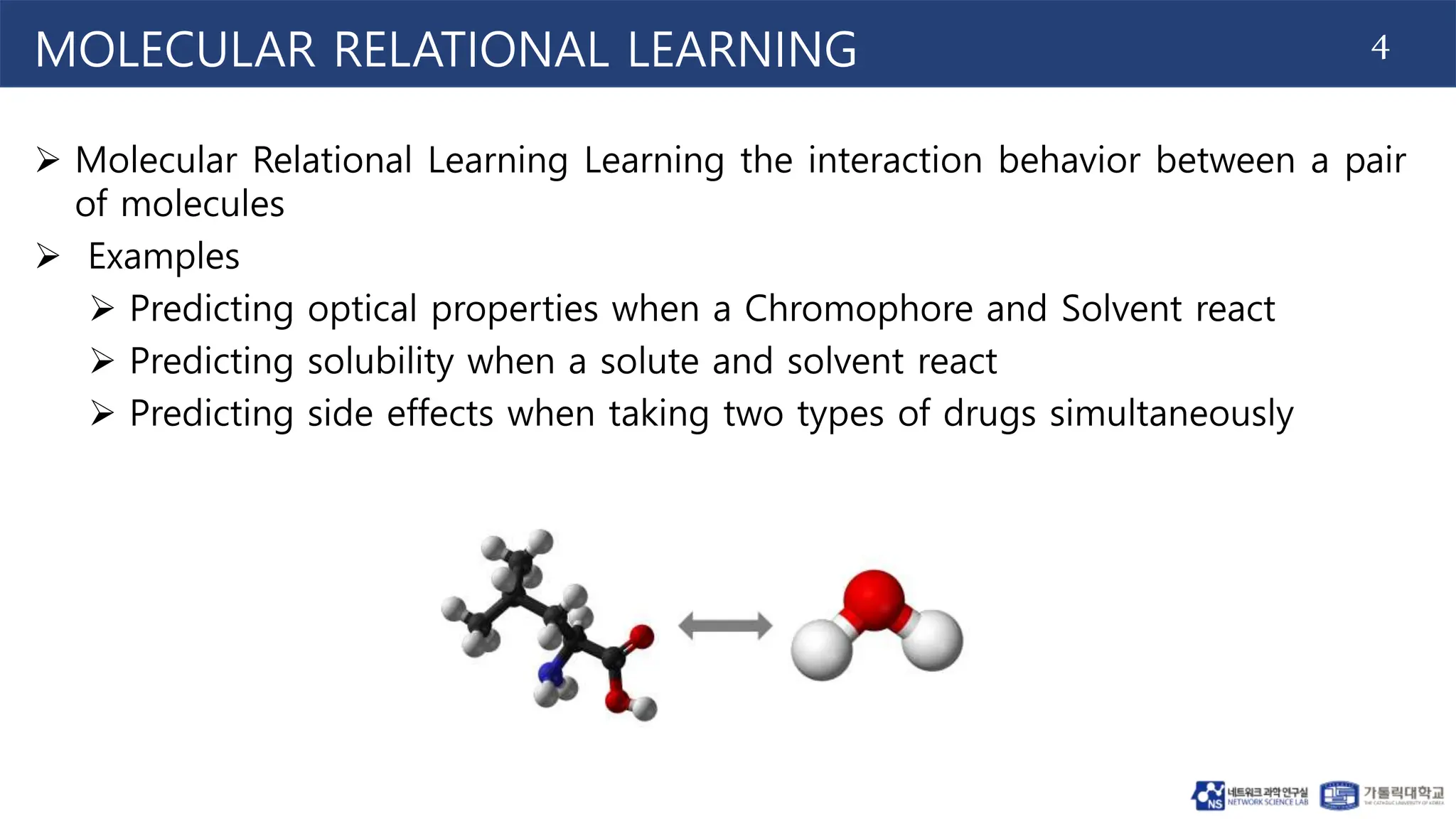
 Molecular Relational Learning Learning the interaction behavior between a pair
of molecules
 Examples
 Predicting optical properties when a Chromophore and Solvent react
 Predicting solubility when a solute and solvent react
 Predicting side effects when taking two types of drugs simultaneously
5
FUNCTIONAL GROUP
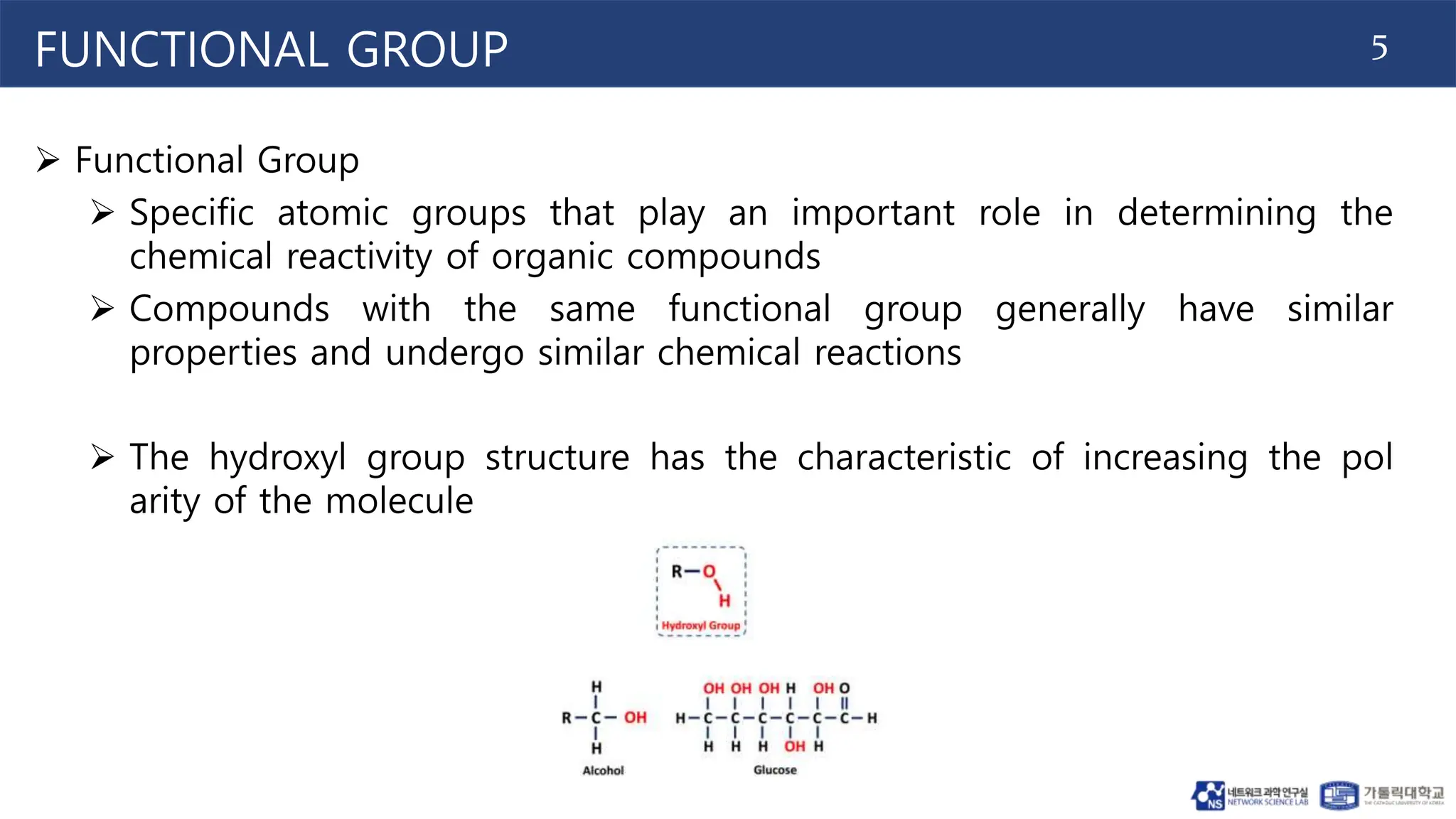
 Functional Group
 Specific atomic groups that play an important role in determining the
chemical reactivity of organic compounds
 Compounds with the same functional group generally have similar
properties and undergo similar chemical reactions
 The hydroxyl group structure has the characteristic of increasing the pol
arity of the molecule
6
FUNCTIONAL GROUP
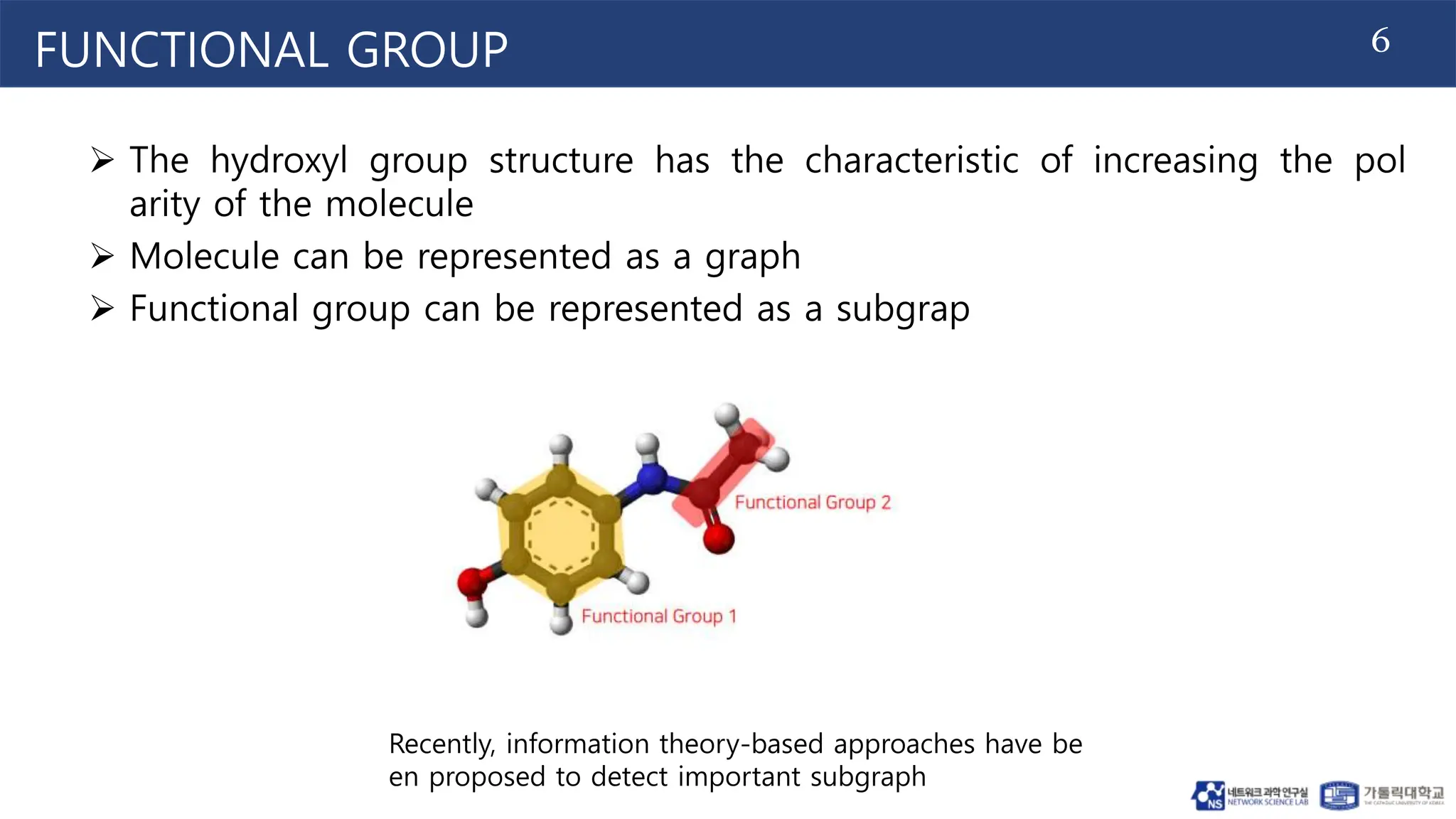
 The hydroxyl group structure has the characteristic of increasing the pol
arity of the molecule
 Molecule can be represented as a graph
 Functional group can be represented as a subgrap
Recently, information theory-based approaches have be
en proposed to detect important subgraph
7
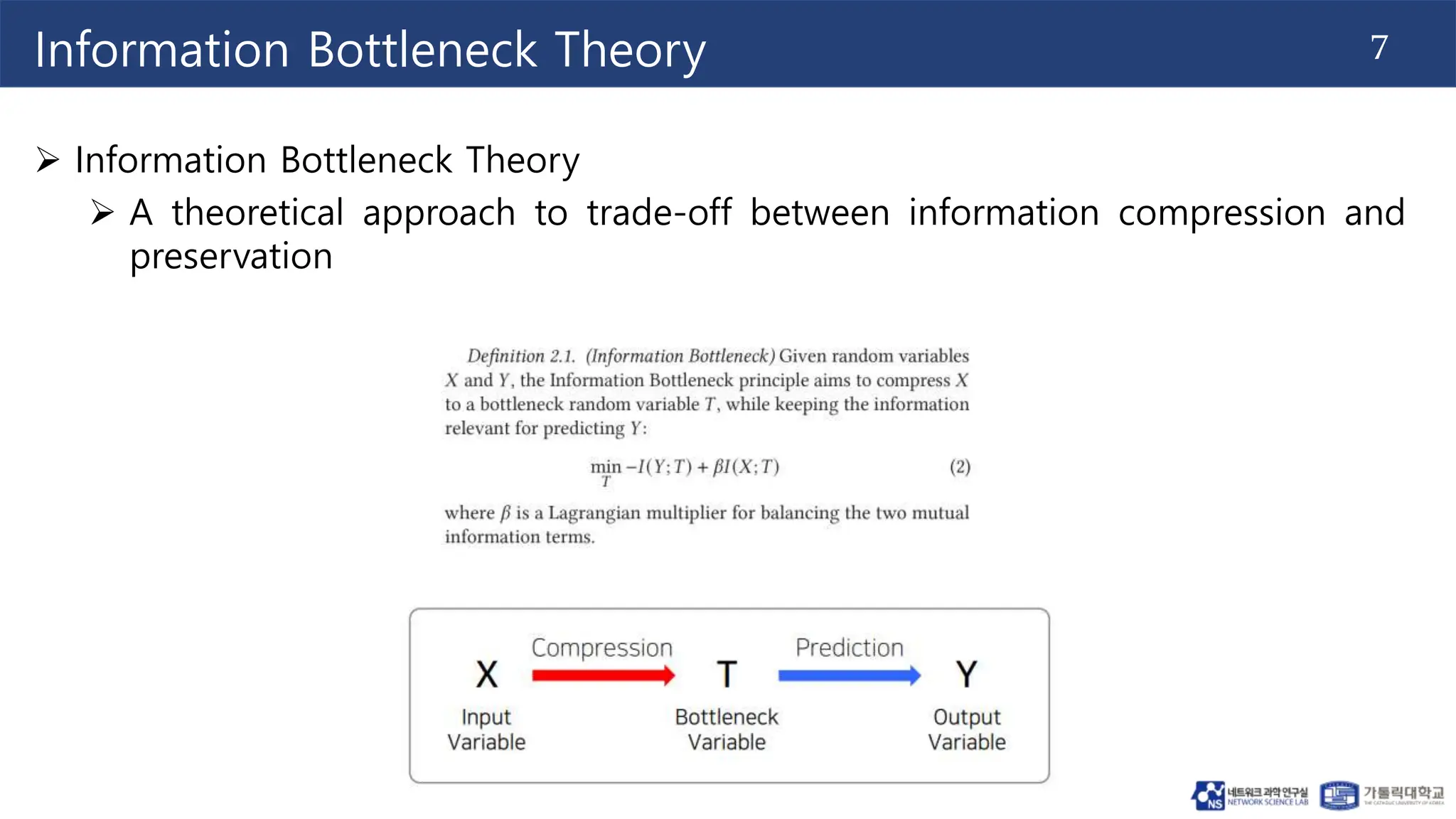
Information Bottleneck Theory
 Information Bottleneck Theory
 A theoretical approach to trade-off between information compression and
preservation
8
GRAPH INFORMATION BOTTLENECK
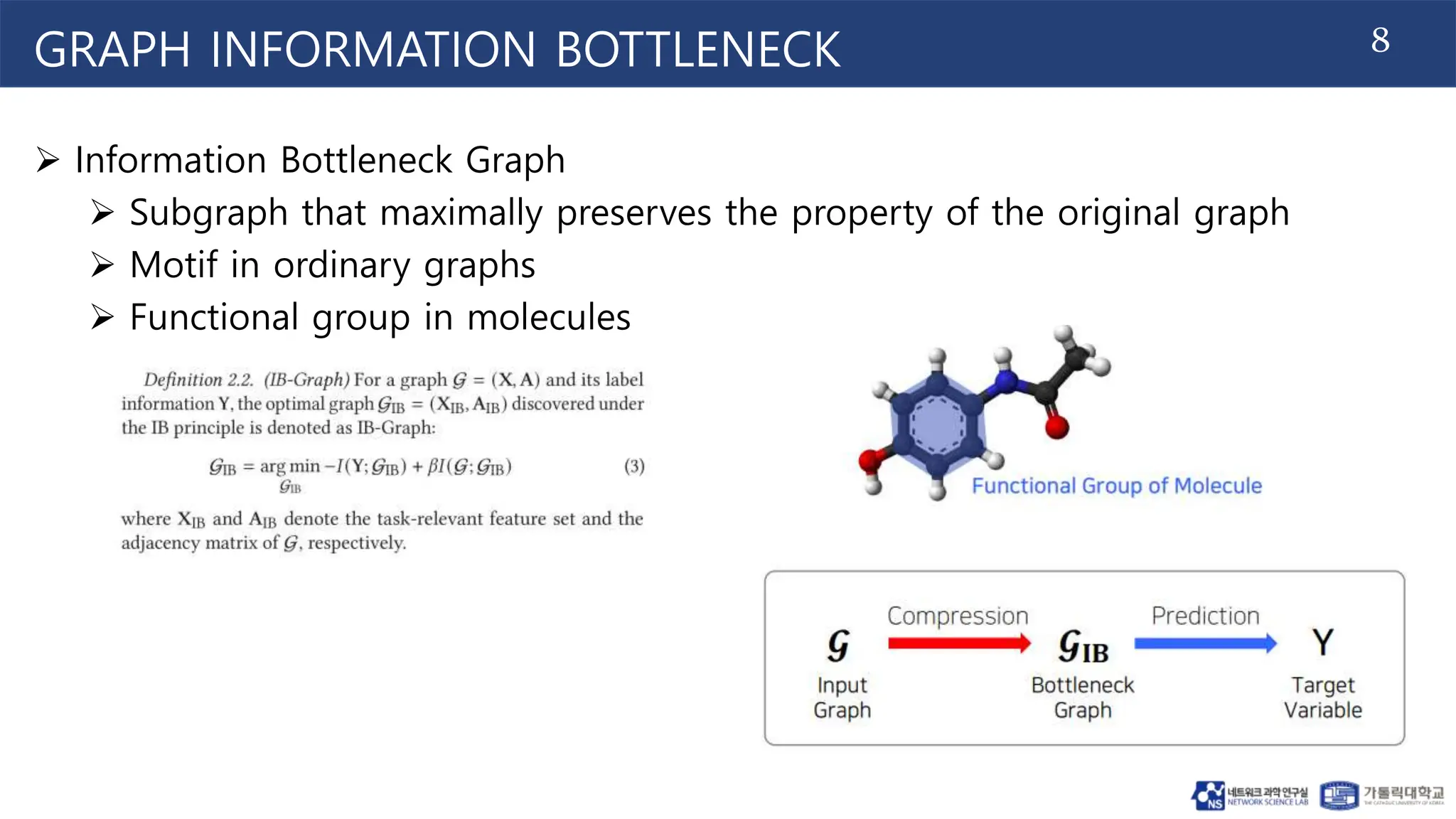
 Information Bottleneck Graph
 Subgraph that maximally preserves the property of the original graph
 Motif in ordinary graphs
 Functional group in molecules
9
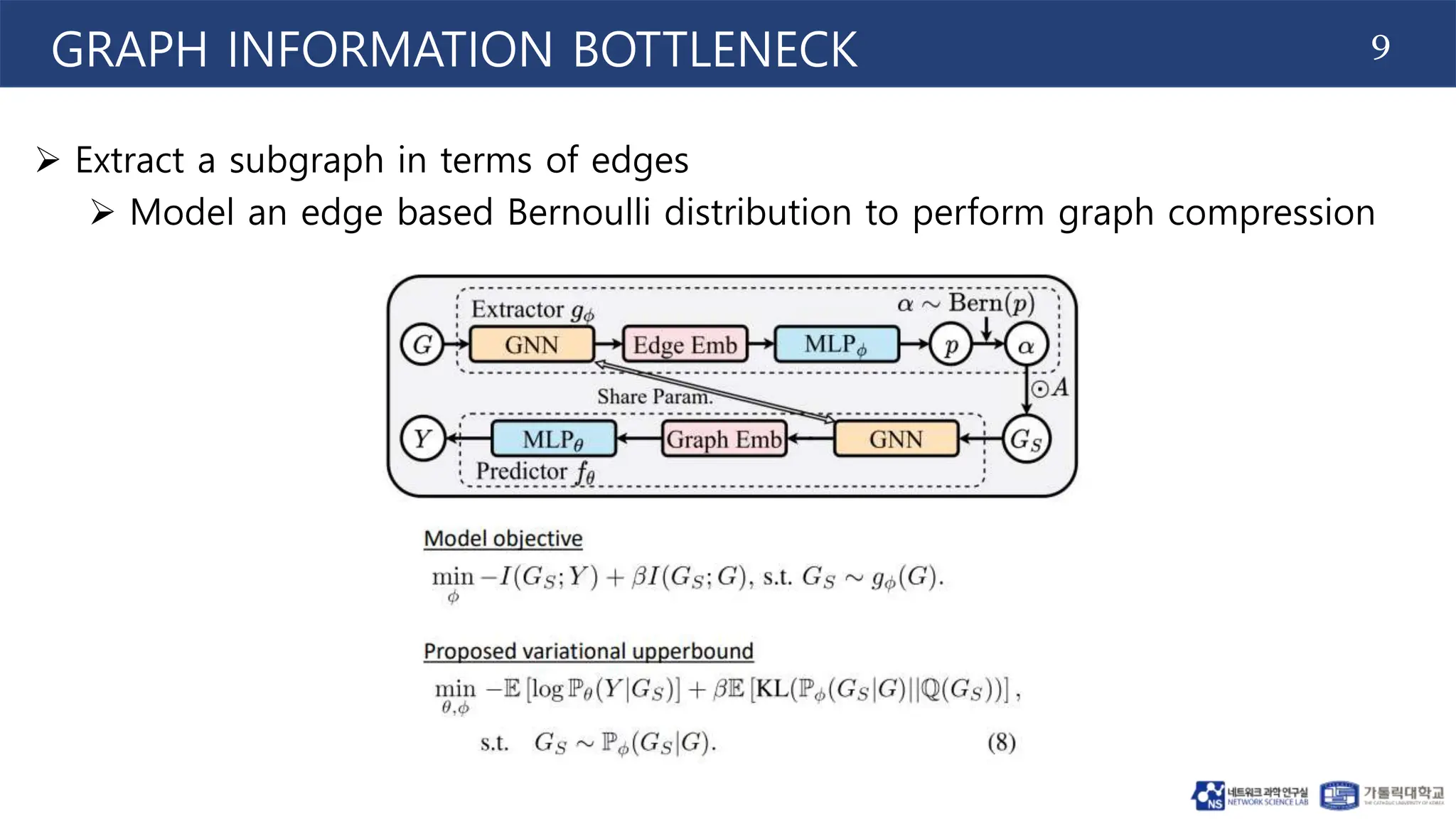
GRAPH INFORMATION BOTTLENECK
 Extract a subgraph in terms of edges
 Model an edge based Bernoulli distribution to perform graph compression
10
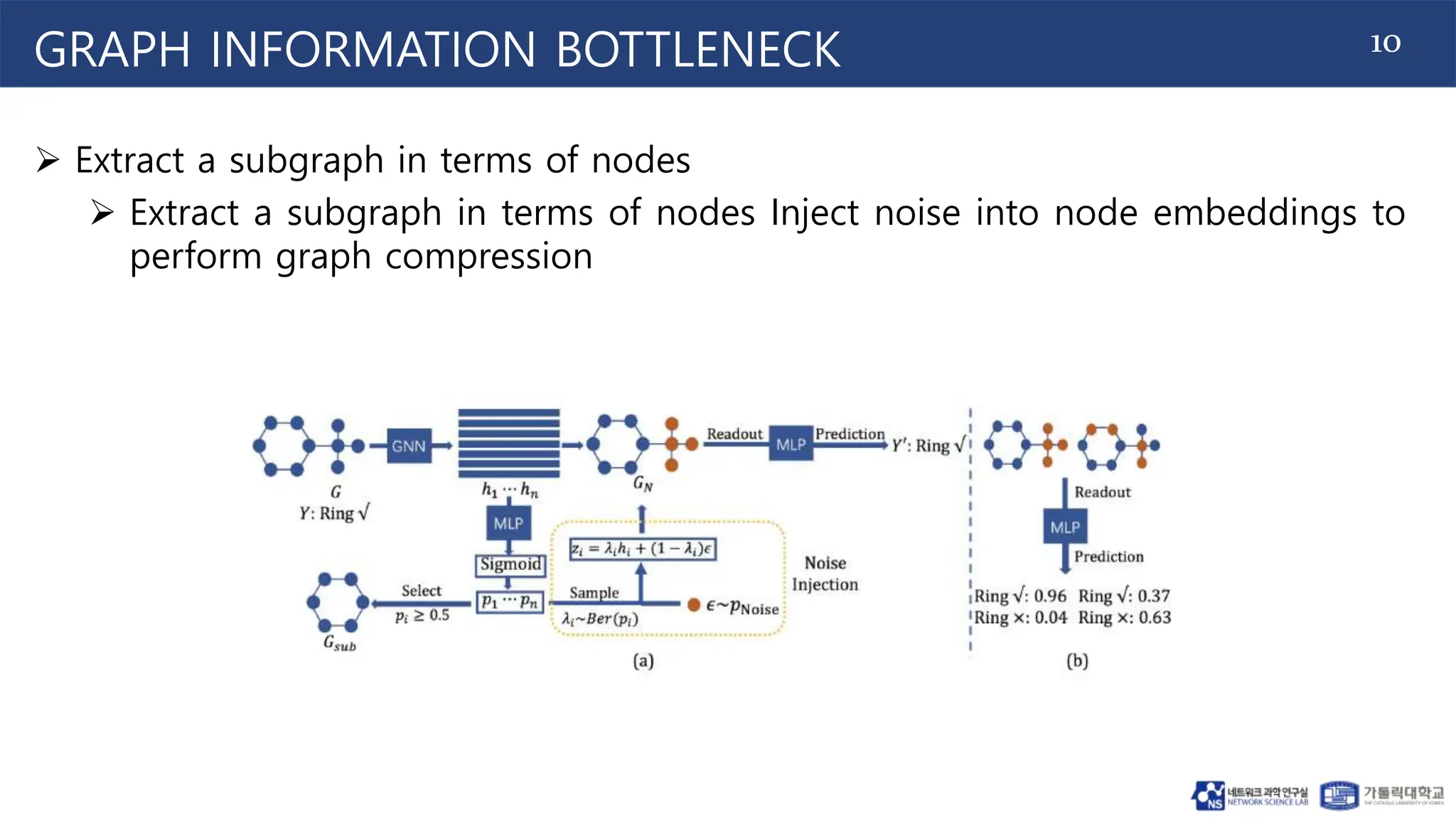
GRAPH INFORMATION BOTTLENECK
 Extract a subgraph in terms of nodes
 Extract a subgraph in terms of nodes Inject noise into node embeddings to
perform graph compression
11
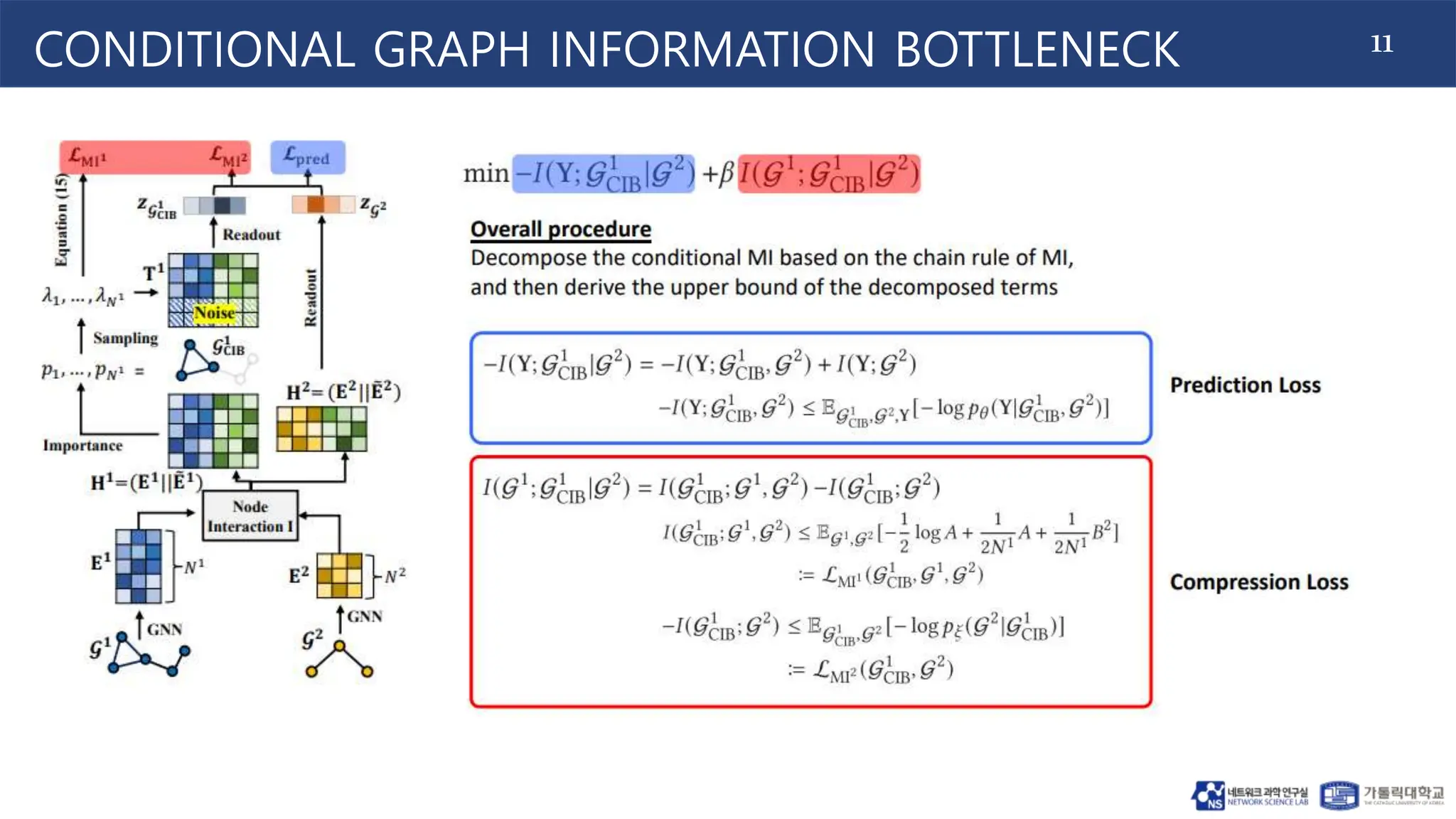
CONDITIONAL GRAPH INFORMATION BOTTLENECK
 X
12
CONDITIONAL GRAPH INFORMATION BOTTLENECK
 X
13
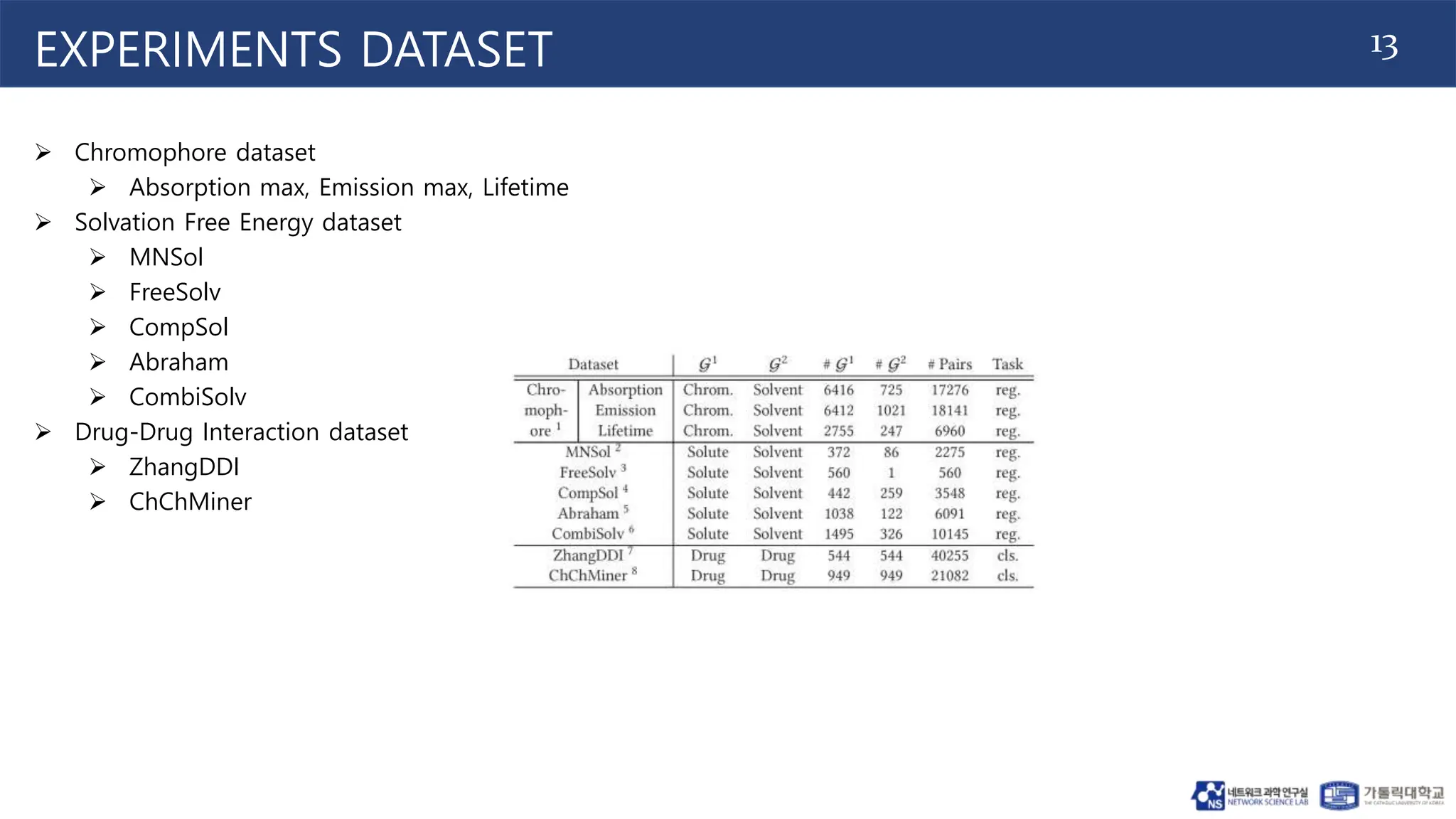
EXPERIMENTS DATASET
 Chromophore dataset
 Absorption max, Emission max, Lifetime
 Solvation Free Energy dataset
 MNSol
 FreeSolv
 CompSol
 Abraham
 CombiSolv
 Drug-Drug Interaction dataset
 ZhangDDI
 ChChMiner
14
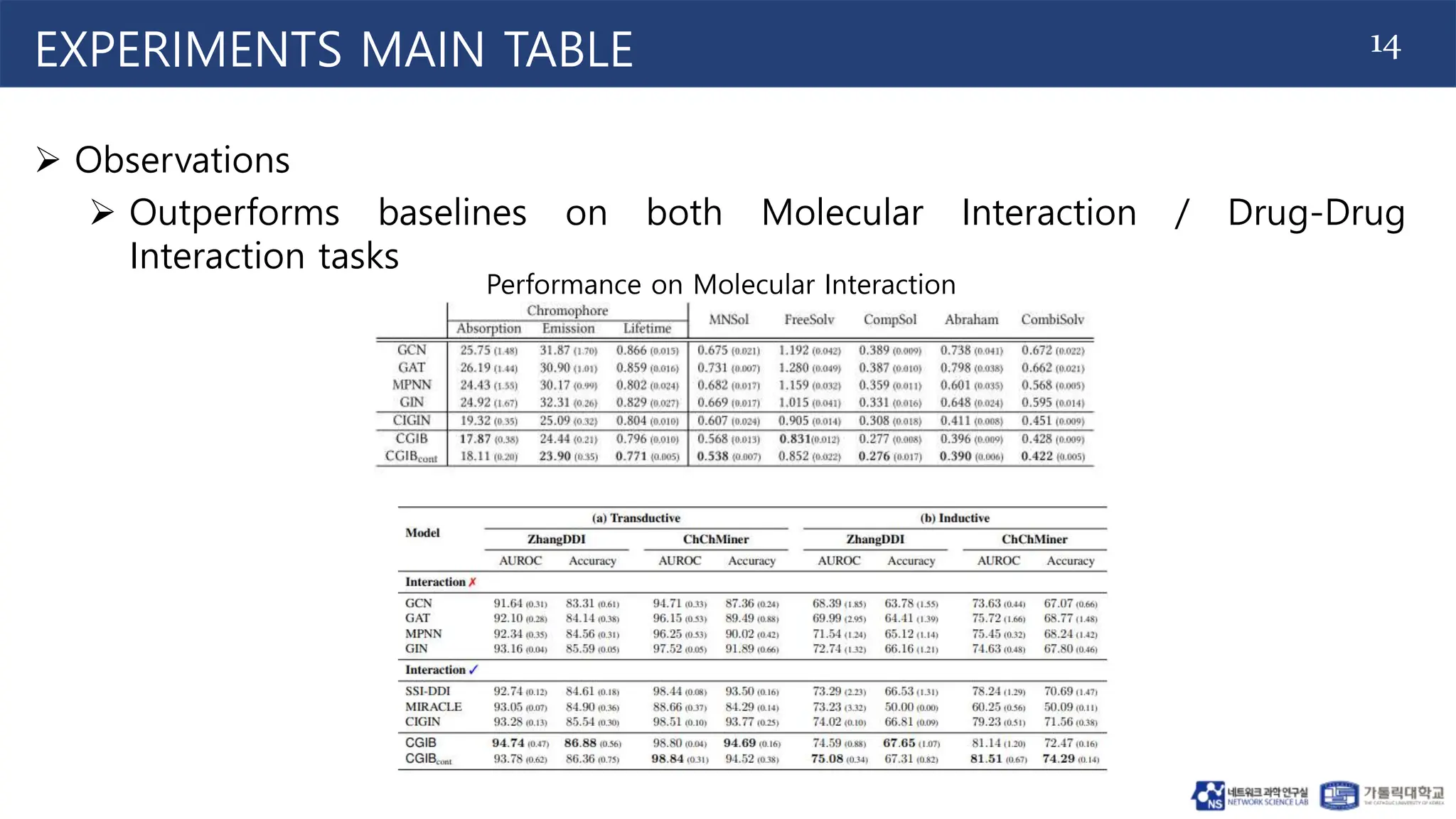
EXPERIMENTS MAIN TABLE
 Observations
 Outperforms baselines on both Molecular Interaction / Drug-Drug
Interaction tasks
Performance on Molecular Interaction
15
CONCLUSION
 proposed a method for tackling relation learning tasks, which are crucial for
scientific discovery
 Based on Conditional Information Bottleneck
 It is crucial to consider Graph 2 (Solvent) when detecting the important
subgraph from Graph 1 (Chromophore)
 CGIB has interpretability, which makes it highly practical
Conditional Graph Information Bottleneck for Molecular Relational Learning.pptx

Conditional Graph Information Bottleneck for Molecular Relational Learning.pptx

  • 1.
    Van Thuy Hoang NetworkScience Lab Dept. of Artificial Intelligence The Catholic University of Korea E-mail: hoangvanthuy90@gmail.com 2023-10-23 Namkyeong Lee, Dongmin Hyun, Gyoung S. Na, Sungwon Kim, Junseok Lee, Chanyoung Park
  • 2.
  • 3.
    3 CONTENTS  Background  •Molecular Relational Learning  • Functional Group  • Information Bottleneck  Problems  Conditional Graph Information Bottleneck  Experiments  Conclusion
  • 4.
    4 MOLECULAR RELATIONAL LEARNING Molecular Relational Learning Learning the interaction behavior between a pair of molecules  Examples  Predicting optical properties when a Chromophore and Solvent react  Predicting solubility when a solute and solvent react  Predicting side effects when taking two types of drugs simultaneously
  • 5.
    5 FUNCTIONAL GROUP  FunctionalGroup  Specific atomic groups that play an important role in determining the chemical reactivity of organic compounds  Compounds with the same functional group generally have similar properties and undergo similar chemical reactions  The hydroxyl group structure has the characteristic of increasing the pol arity of the molecule
  • 6.
    6 FUNCTIONAL GROUP  Thehydroxyl group structure has the characteristic of increasing the pol arity of the molecule  Molecule can be represented as a graph  Functional group can be represented as a subgrap Recently, information theory-based approaches have be en proposed to detect important subgraph
  • 7.
    7 Information Bottleneck Theory Information Bottleneck Theory  A theoretical approach to trade-off between information compression and preservation
  • 8.
    8 GRAPH INFORMATION BOTTLENECK Information Bottleneck Graph  Subgraph that maximally preserves the property of the original graph  Motif in ordinary graphs  Functional group in molecules
  • 9.
    9 GRAPH INFORMATION BOTTLENECK Extract a subgraph in terms of edges  Model an edge based Bernoulli distribution to perform graph compression
  • 10.
    10 GRAPH INFORMATION BOTTLENECK Extract a subgraph in terms of nodes  Extract a subgraph in terms of nodes Inject noise into node embeddings to perform graph compression
  • 11.
  • 12.
  • 13.
    13 EXPERIMENTS DATASET  Chromophoredataset  Absorption max, Emission max, Lifetime  Solvation Free Energy dataset  MNSol  FreeSolv  CompSol  Abraham  CombiSolv  Drug-Drug Interaction dataset  ZhangDDI  ChChMiner
  • 14.
    14 EXPERIMENTS MAIN TABLE Observations  Outperforms baselines on both Molecular Interaction / Drug-Drug Interaction tasks Performance on Molecular Interaction
  • 15.
    15 CONCLUSION  proposed amethod for tackling relation learning tasks, which are crucial for scientific discovery  Based on Conditional Information Bottleneck  It is crucial to consider Graph 2 (Solvent) when detecting the important subgraph from Graph 1 (Chromophore)  CGIB has interpretability, which makes it highly practical