CONDITIONAL SENTENCES
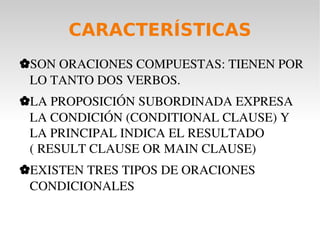
CARACTERÍSTICAS
✿SON ORACIONES COMPUESTAS: TIENEN POR 
 LO TANTO DOS VERBOS.
✿LA PROPOSICIÓN SUBORDINADA EXPRESA 
 LA CONDICIÓN (CONDITIONAL CLAUSE) Y 
 LA PRINCIPAL INDICA EL RESULTADO 
 ( RESULT CLAUSE OR MAIN CLAUSE)
✿EXISTEN TRES TIPOS DE ORACIONES 
 CONDICIONALES
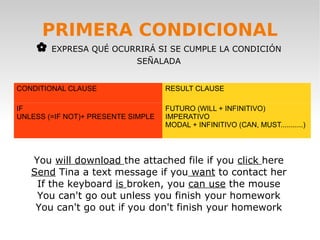
PRIMERA CONDICIONAL
    ✿   EXPRESA QUÉ OCURRIRÁ SI SE CUMPLE LA CONDICIÓN
                            SEÑALADA


CONDITIONAL CLAUSE                  RESULT CLAUSE

IF                                  FUTURO (WILL + INFINITIVO)
UNLESS (=IF NOT)+ PRESENTE SIMPLE   IMPERATIVO
                                    MODAL + INFINITIVO (CAN, MUST...........)


   You will download the attached file if you click here
   Send Tina a text message if you want to contact her
    If the keyboard is broken, you can use the mouse
    You can't go out unless you finish your homework
    You can't go out if you don't finish your homework
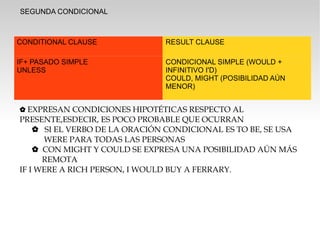
SEGUNDA CONDICIONAL


CONDITIONAL CLAUSE             RESULT CLAUSE

IF+ PASADO SIMPLE              CONDICIONAL SIMPLE (WOULD +
UNLESS                         INFINITIVO I'D)
                               COULD, MIGHT (POSIBILIDAD AÚN
                               MENOR)


✿ EXPRESAN CONDICIONES HIPOTÉTICAS RESPECTO AL
PRESENTE,ESDECIR, ES POCO PROBABLE QUE OCURRAN
    ✿ SI EL VERBO DE LA ORACIÓN CONDICIONAL ES TO BE, SE USA
      WERE PARA TODAS LAS PERSONAS
    ✿ CON MIGHT Y COULD SE EXPRESA UNA POSIBILIDAD AÚN MÁS
      REMOTA
IF I WERE A RICH PERSON, I WOULD BUY A FERRARY.
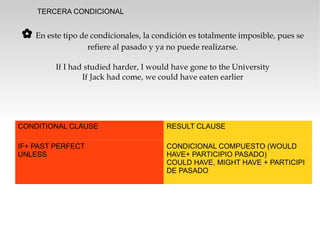
TERCERA CONDICIONAL


✿ En este tipo de condicionales, la condición es totalmente imposible, pues se
                   refiere al pasado y ya no puede realizarse.

         If I had studied harder, I would have gone to the University
                 If Jack had come, we could have eaten earlier


CONDITIONAL CLAUSE                       RESULT CLAUSE

IF+ PAST PERFECT                         CONDICIONAL COMPUESTO (WOULD
UNLESS                                   HAVE+ PARTICIPIO PASADO)
                                         COULD HAVE, MIGHT HAVE + PARTICIPI
                                         DE PASADO
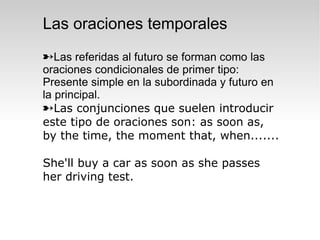
Las oraciones temporales
Las referidas al futuro se forman como las
oraciones condicionales de primer tipo:
Presente simple en la subordinada y futuro en
la principal.
Las conjunciones que suelen introducir
este tipo de oraciones son: as soon as,
by the time, the moment that, when.......

She'll buy a car as soon as she passes
her driving test.

Conditional

  • 1.
  • 2.
    CARACTERÍSTICAS ✿SON ORACIONES COMPUESTAS: TIENEN POR  LO TANTO DOS VERBOS. ✿LA PROPOSICIÓN SUBORDINADA EXPRESA  LA CONDICIÓN (CONDITIONAL CLAUSE) Y  LA PRINCIPAL INDICA EL RESULTADO  ( RESULT CLAUSE OR MAIN CLAUSE) ✿EXISTEN TRES TIPOS DE ORACIONES  CONDICIONALES
  • 3.
    PRIMERA CONDICIONAL ✿ EXPRESA QUÉ OCURRIRÁ SI SE CUMPLE LA CONDICIÓN SEÑALADA CONDITIONAL CLAUSE RESULT CLAUSE IF FUTURO (WILL + INFINITIVO) UNLESS (=IF NOT)+ PRESENTE SIMPLE IMPERATIVO MODAL + INFINITIVO (CAN, MUST...........) You will download the attached file if you click here Send Tina a text message if you want to contact her If the keyboard is broken, you can use the mouse You can't go out unless you finish your homework You can't go out if you don't finish your homework
  • 4.
    SEGUNDA CONDICIONAL CONDITIONAL CLAUSE RESULT CLAUSE IF+ PASADO SIMPLE CONDICIONAL SIMPLE (WOULD + UNLESS INFINITIVO I'D) COULD, MIGHT (POSIBILIDAD AÚN MENOR) ✿ EXPRESAN CONDICIONES HIPOTÉTICAS RESPECTO AL PRESENTE,ESDECIR, ES POCO PROBABLE QUE OCURRAN ✿ SI EL VERBO DE LA ORACIÓN CONDICIONAL ES TO BE, SE USA WERE PARA TODAS LAS PERSONAS ✿ CON MIGHT Y COULD SE EXPRESA UNA POSIBILIDAD AÚN MÁS REMOTA IF I WERE A RICH PERSON, I WOULD BUY A FERRARY.
  • 5.
    TERCERA CONDICIONAL ✿ Eneste tipo de condicionales, la condición es totalmente imposible, pues se refiere al pasado y ya no puede realizarse. If I had studied harder, I would have gone to the University If Jack had come, we could have eaten earlier CONDITIONAL CLAUSE RESULT CLAUSE IF+ PAST PERFECT CONDICIONAL COMPUESTO (WOULD UNLESS HAVE+ PARTICIPIO PASADO) COULD HAVE, MIGHT HAVE + PARTICIPI DE PASADO
  • 6.
    Las oraciones temporales Lasreferidas al futuro se forman como las oraciones condicionales de primer tipo: Presente simple en la subordinada y futuro en la principal. Las conjunciones que suelen introducir este tipo de oraciones son: as soon as, by the time, the moment that, when....... She'll buy a car as soon as she passes her driving test.