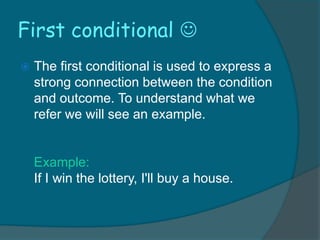
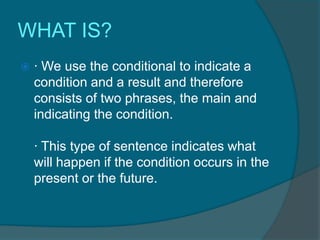
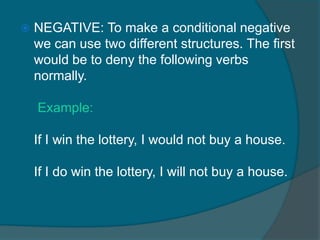
The document discusses the first conditional in English grammar. It explains that the first conditional is used to express a strong connection between a condition and its outcome. It is formed using the present simple in the if-clause and the future simple in the main clause. For example, "If I win the lottery, I'll buy a house." It also describes how to form negative first conditional sentences.

![HOW TO FORM?
YES: The first conditional is formed with the present
simple in the 'if-clause' (a phrase with 'if') and the
simple future in the 'main clause' (main clause).
Example:
[If ... Simple Present +] + [will + main verb]
If I win the lottery, I'll buy a house.
If I win the lottery, I will buy a house](https://image.slidesharecdn.com/ingles-120322131653-phpapp01/85/Ingles-4-320.jpg)



![Computadora[1]](https://cdn.slidesharecdn.com/ss_thumbnails/computadora1-110909174327-phpapp01-thumbnail.jpg?width=640&height=640&fit=bounds)


![5G Explained! A High Level Overview [Introduction]](https://cdn.slidesharecdn.com/ss_thumbnails/5gexplainedahighleveloverview-260119165306-cc137a3e-thumbnail.jpg?width=640&height=640&fit=bounds)


