The Go Programming Language
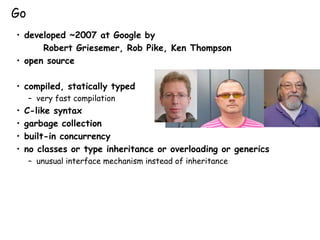
• developed ~2007 at Google by
Robert Griesemer, Rob Pike, Ken Thompson
• open source
• compiled, statically typed
– very fast compilation
• C-like syntax
• garbage collection
• built-in concurrency
• no classes or type inheritance or overloading or generics
– unusual interface mechanism instead of inheritance
Go
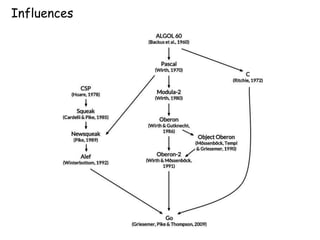
Influences
"When the three of us got started, it was pure research. The
three of us got together and decided that we hated C++. We
started off with the idea that all three of us had to be talked
into every feature in the language, so there was no extraneous
garbage put into the language for any reason." (Ken Thompson)
Negative influences
Outline
• history
• basic constructs, simple programs
• arrays & slices
• maps
• methods, interfaces
• concurrency, goroutines
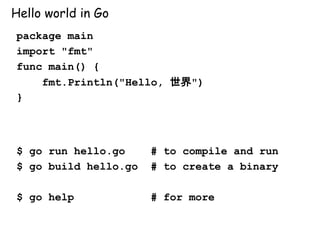
Hello world in Go
package main
import "fmt"
func main() {
fmt.Println("Hello, 世界")
}
$ go run hello.go # to compile and run
$ go build hello.go # to create a binary
$ go help # for more
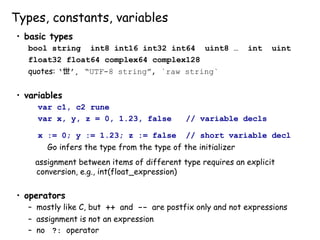
Types, constants, variables
• basic types
bool string int8 int16 int32 int64 uint8 … int uint
float32 float64 complex64 complex128
quotes: ‘世’, “UTF-8 string”, `raw string`
• variables
var c1, c2 rune
var x, y, z = 0, 1.23, false // variable decls
x := 0; y := 1.23; z := false // short variable decl
Go infers the type from the type of the initializer
assignment between items of different type requires an explicit
conversion, e.g., int(float_expression)
• operators
– mostly like C, but ++ and -- are postfix only and not expressions
– assignment is not an expression
– no ?: operator
Echo command:
// Echo prints its command-line arguments.
package main
import (
"fmt"
"os"
)
func main() {
var s, sep string
for i := 1; i < len(os.Args); i++ {
s += sep + os.Args[i]
sep = " "
}
fmt.Println(s)
}
Echo command (version 2):
// Echo prints its command-line arguments.
package main
import (
"fmt"
"os"
)
func main() {
s, sep := "", ""
for _, arg := range os.Args[1:] {
s += sep + arg
sep = " "
}
fmt.Println(s)
}
Arrays and slices
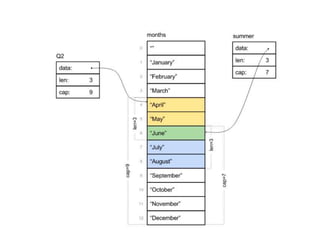
• an array is a fixed-length sequence of same-type items
months := [...]string {1:"Jan", 2:"Feb", /*...,*/ 12:"Dec"}
• a slice is a subsequence of an array
summer := months[6:9]; Q2 := months[4:7]
• elements accessed as slice[index]
– indices from 0 to len(slice)-1 inclusive
summer[0:3] is elements months[6:9]
summer[0] = "Juin"
• loop over a slice with for range
for i, v := range summer {
fmt.Println(i, v)
}
• slices are very efficient (represented as small structures)
• most library functions work on slices
Maps (== associative arrays)
• unordered collection of key-value pairs
– keys are any type that supports == and != operators
– values are any type
// Find duplicated lines in stdin.
func main() {
counts := make(map[string]int)
in := bufio.NewScanner(os.Stdin)
for in.Scan() {
counts[in.Text()]++
}
for line, n := range counts {
if n > 1 {
fmt.Printf("%dt%sn", n, line)
}
}
}
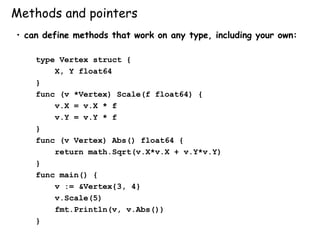
Methods and pointers
• can define methods that work on any type, including your own:
type Vertex struct {
X, Y float64
}
func (v *Vertex) Scale(f float64) {
v.X = v.X * f
v.Y = v.Y * f
}
func (v Vertex) Abs() float64 {
return math.Sqrt(v.X*v.X + v.Y*v.Y)
}
func main() {
v := &Vertex{3, 4}
v.Scale(5)
fmt.Println(v, v.Abs())
}
Interfaces
• an interface is satisfied by any type that implements all the
methods of the interface
• completely abstract: can't instantiate one
• can have a variable with an interface type
• then assign to it a value of any type that has the methods the
interface requires
• a type implements an interface merely by defining the required
methods
– it doesn't declare that it implements them
• Writer: the most common interface
type Writer interface {
Write(p []byte) (n int, err error)
}
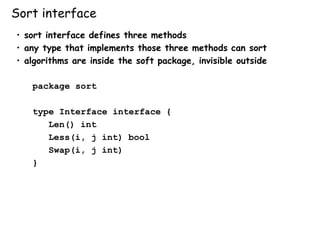
Sort interface
• sort interface defines three methods
• any type that implements those three methods can sort
• algorithms are inside the soft package, invisible outside
package sort
type Interface interface {
Len() int
Less(i, j int) bool
Swap(i, j int)
}
Sort interface (adapted from Go Tour)
type Person struct {
Name string
Age int
}
func (p Person) String() string {
return fmt.Sprintf("%s: %d", p.Name, p.Age)
}
type ByAge []Person
func (a ByAge) Len() int { return len(a) }
func (a ByAge) Swap(i, j int) { a[i], a[j] = a[j], a[i] }
func (a ByAge) Less(i, j int) bool { return a[i].Age < a[j].Age }
func main() {
people := []Person{{"Bob",31}, {"Sue",42}, {"Ed",17}, {"Jen",26},}
fmt.Println(people)
sort.Sort(ByAge(people))
fmt.Println(people)
}
Tiny version of curl
func main() {
url := os.Args[1]
resp, err := http.Get(url)
if err != nil {
fmt.Fprintf(os.Stderr, "curl: %vn", err)
os.Exit(1)
}
_, err = io.Copy(os.Stdout, resp.Body)
if err != nil {
fmt.Fprintf(os.Stderr, "curl: copying %s: %vn",
url, err)
os.Exit(1)
}
}
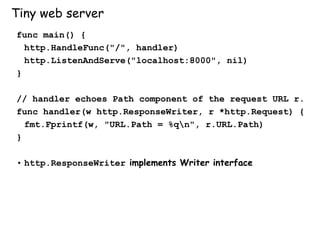
Tiny web server
func main() {
http.HandleFunc("/", handler)
http.ListenAndServe("localhost:8000", nil)
}
// handler echoes Path component of the request URL r.
func handler(w http.ResponseWriter, r *http.Request) {
fmt.Fprintf(w, "URL.Path = %qn", r.URL.Path)
}
• http.ResponseWriter implements Writer interface
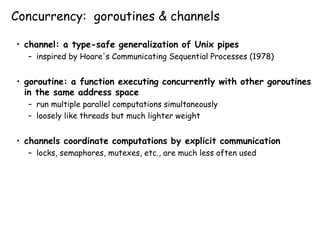
Concurrency: goroutines & channels
• channel: a type-safe generalization of Unix pipes
– inspired by Hoare's Communicating Sequential Processes (1978)
• goroutine: a function executing concurrently with other goroutines
in the same address space
– run multiple parallel computations simultaneously
– loosely like threads but much lighter weight
• channels coordinate computations by explicit communication
– locks, semaphores, mutexes, etc., are much less often used
Example: web crawler
• want to crawl a bunch of web pages to do something
– e.g., figure out how big they are
• problem: network communication takes relatively long time
– program does nothing useful while waiting for a response
• solution: access pages in parallel
– send requests asynchronously
– display results as they arrive
– needs some kind of threading or other parallel process mechanism
• takes less time than doing them sequentially
Version 1: no parallelism
func main() {
start := time.Now()
for _, site := range os.Args[1:] {
count("http://" + site)
}
fmt.Printf("%.2fs totaln", time.Since(start).Seconds())
}
func count(url string) {
start := time.Now()
r, err := http.Get(url)
if err != nil {
fmt.Printf("%s: %sn", url, err)
return
}
n, _ := io.Copy(ioutil.Discard, r.Body)
r.Body.Close()
dt := time.Since(start).Seconds()
fmt.Printf("%s %d [%.2fs]n", url, n, dt)
}
Version 2: parallelism with goroutines
func main() {
start := time.Now()
c := make(chan string)
n := 0
for _, site := range os.Args[1:] {
n++
go count("http://" + site, c)
}
for i := 0; i < n; i++ {
fmt.Print(<-c)
}
fmt.Printf("%.2fs totaln", time.Since(start).Seconds())
}
func count(url string, c chan<- string) {
start := time.Now()
r, err := http.Get(url)
if err != nil {
c <- fmt.Sprintf("%s: %sn", url, err)
return
}
n, _ := io.Copy(ioutil.Discard, r.Body)
r.Body.Close()
dt := time.Since(start).Seconds()
c <- fmt.Sprintf("%s %d [%.2fs]n", url, n, dt)
}
Version 2: main() for parallelism with goroutines
func main() {
start := time.Now()
c := make(chan string)
n := 0
for _, site := range os.Args[1:] {
n++
go count("http://" + site, c)
}
for i := 0; i < n; i++ {
fmt.Print(<-c)
}
fmt.Printf("%.2fs totaln", time.Since(start).Seconds())
}
Version 2: count() for parallelism with goroutines
func count(url string, c chan<- string) {
start := time.Now()
r, err := http.Get(url)
if err != nil {
c <- fmt.Sprintf("%s: %sn", url, err)
return
}
n, _ := io.Copy(ioutil.Discard, r.Body)
r.Body.Close()
dt := time.Since(start).Seconds()
c <- fmt.Sprintf("%s %d [%.2fs]n", url, n, dt)
}
Python version, no parallelism
import urllib2, time, sys
def main():
start = time.time()
for url in sys.argv[1:]:
count("http://" + url)
dt = time.time() - start
print "ntotal: %.2fs" % (dt)
def count(url):
start = time.time()
n = len(urllib2.urlopen(url).read())
dt = time.time() - start
print "%6d %6.2fs %s" % (n, dt, url)
main()
Python version, with threads
import urllib2, time, sys, threading
global_lock = threading.Lock()
class Counter(threading.Thread):
def __init__(self, url):
super(Counter, self).__init__()
self.url = url
def count(self, url):
start = time.time()
n = len(urllib2.urlopen(url).read())
dt = time.time() - start
with global_lock:
print "%6d %6.2fs %s" % (n, dt, url)
def run(self):
self.count(self.url)
def main():
threads = []
start = time.time()
for url in sys.argv[1:]: # one thread each
w = Counter("http://" + url)
threads.append(w)
w.start()
for w in threads:
w.join()
dt = time.time() - start
print "ntotal: %.2fs" % (dt)
main()
Python version, with threads (main)
def main():
threads = []
start = time.time()
for url in sys.argv[1:]: # one thread each
w = Counter("http://" + url)
threads.append(w)
w.start()
for w in threads:
w.join()
dt = time.time() - start
print "ntotal: %.2fs" % (dt)
main()
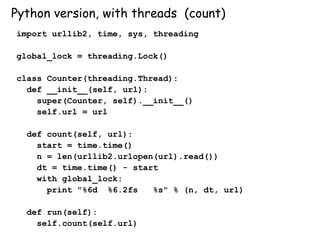
Python version, with threads (count)
import urllib2, time, sys, threading
global_lock = threading.Lock()
class Counter(threading.Thread):
def __init__(self, url):
super(Counter, self).__init__()
self.url = url
def count(self, url):
start = time.time()
n = len(urllib2.urlopen(url).read())
dt = time.time() - start
with global_lock:
print "%6d %6.2fs %s" % (n, dt, url)
def run(self):
self.count(self.url)
Where will Go go?
• comparatively small but rich language
• efficient; compilation is very fast
• concurrency model is convenient and efficient
• object model is unusual but seems powerful
• significant use at Google and elsewhere
• mostly for web server applications
• "C for the 21st century" ?
Go source materials
• official web site:
golang.org
• Go tutorial, playground
• Rob Pike on why it is the way it is:
http://www.youtube.com/watch?v=rKnDgT73v8s
• Russ Cox on interfaces, reflection, concurrency
http://research.swtch.com/gotour
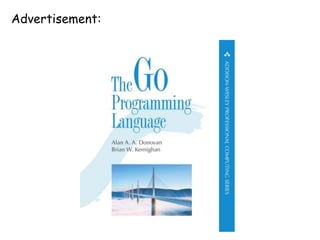
Advertisement:

go.ppt

  • 1.
  • 2.
    • developed ~2007at Google by Robert Griesemer, Rob Pike, Ken Thompson • open source • compiled, statically typed – very fast compilation • C-like syntax • garbage collection • built-in concurrency • no classes or type inheritance or overloading or generics – unusual interface mechanism instead of inheritance Go
  • 3.
  • 4.
    "When the threeof us got started, it was pure research. The three of us got together and decided that we hated C++. We started off with the idea that all three of us had to be talked into every feature in the language, so there was no extraneous garbage put into the language for any reason." (Ken Thompson) Negative influences
  • 5.
    Outline • history • basicconstructs, simple programs • arrays & slices • maps • methods, interfaces • concurrency, goroutines
  • 6.
    Hello world inGo package main import "fmt" func main() { fmt.Println("Hello, 世界") } $ go run hello.go # to compile and run $ go build hello.go # to create a binary $ go help # for more
  • 7.
    Types, constants, variables •basic types bool string int8 int16 int32 int64 uint8 … int uint float32 float64 complex64 complex128 quotes: ‘世’, “UTF-8 string”, `raw string` • variables var c1, c2 rune var x, y, z = 0, 1.23, false // variable decls x := 0; y := 1.23; z := false // short variable decl Go infers the type from the type of the initializer assignment between items of different type requires an explicit conversion, e.g., int(float_expression) • operators – mostly like C, but ++ and -- are postfix only and not expressions – assignment is not an expression – no ?: operator
  • 8.
    Echo command: // Echoprints its command-line arguments. package main import ( "fmt" "os" ) func main() { var s, sep string for i := 1; i < len(os.Args); i++ { s += sep + os.Args[i] sep = " " } fmt.Println(s) }
  • 9.
    Echo command (version2): // Echo prints its command-line arguments. package main import ( "fmt" "os" ) func main() { s, sep := "", "" for _, arg := range os.Args[1:] { s += sep + arg sep = " " } fmt.Println(s) }
  • 10.
    Arrays and slices •an array is a fixed-length sequence of same-type items months := [...]string {1:"Jan", 2:"Feb", /*...,*/ 12:"Dec"} • a slice is a subsequence of an array summer := months[6:9]; Q2 := months[4:7] • elements accessed as slice[index] – indices from 0 to len(slice)-1 inclusive summer[0:3] is elements months[6:9] summer[0] = "Juin" • loop over a slice with for range for i, v := range summer { fmt.Println(i, v) } • slices are very efficient (represented as small structures) • most library functions work on slices
  • 12.
    Maps (== associativearrays) • unordered collection of key-value pairs – keys are any type that supports == and != operators – values are any type // Find duplicated lines in stdin. func main() { counts := make(map[string]int) in := bufio.NewScanner(os.Stdin) for in.Scan() { counts[in.Text()]++ } for line, n := range counts { if n > 1 { fmt.Printf("%dt%sn", n, line) } } }
  • 13.
    Methods and pointers •can define methods that work on any type, including your own: type Vertex struct { X, Y float64 } func (v *Vertex) Scale(f float64) { v.X = v.X * f v.Y = v.Y * f } func (v Vertex) Abs() float64 { return math.Sqrt(v.X*v.X + v.Y*v.Y) } func main() { v := &Vertex{3, 4} v.Scale(5) fmt.Println(v, v.Abs()) }
  • 14.
    Interfaces • an interfaceis satisfied by any type that implements all the methods of the interface • completely abstract: can't instantiate one • can have a variable with an interface type • then assign to it a value of any type that has the methods the interface requires • a type implements an interface merely by defining the required methods – it doesn't declare that it implements them • Writer: the most common interface type Writer interface { Write(p []byte) (n int, err error) }
  • 15.
    Sort interface • sortinterface defines three methods • any type that implements those three methods can sort • algorithms are inside the soft package, invisible outside package sort type Interface interface { Len() int Less(i, j int) bool Swap(i, j int) }
  • 16.
    Sort interface (adaptedfrom Go Tour) type Person struct { Name string Age int } func (p Person) String() string { return fmt.Sprintf("%s: %d", p.Name, p.Age) } type ByAge []Person func (a ByAge) Len() int { return len(a) } func (a ByAge) Swap(i, j int) { a[i], a[j] = a[j], a[i] } func (a ByAge) Less(i, j int) bool { return a[i].Age < a[j].Age } func main() { people := []Person{{"Bob",31}, {"Sue",42}, {"Ed",17}, {"Jen",26},} fmt.Println(people) sort.Sort(ByAge(people)) fmt.Println(people) }
  • 17.
    Tiny version ofcurl func main() { url := os.Args[1] resp, err := http.Get(url) if err != nil { fmt.Fprintf(os.Stderr, "curl: %vn", err) os.Exit(1) } _, err = io.Copy(os.Stdout, resp.Body) if err != nil { fmt.Fprintf(os.Stderr, "curl: copying %s: %vn", url, err) os.Exit(1) } }
  • 18.
    Tiny web server funcmain() { http.HandleFunc("/", handler) http.ListenAndServe("localhost:8000", nil) } // handler echoes Path component of the request URL r. func handler(w http.ResponseWriter, r *http.Request) { fmt.Fprintf(w, "URL.Path = %qn", r.URL.Path) } • http.ResponseWriter implements Writer interface
  • 19.
    Concurrency: goroutines &channels • channel: a type-safe generalization of Unix pipes – inspired by Hoare's Communicating Sequential Processes (1978) • goroutine: a function executing concurrently with other goroutines in the same address space – run multiple parallel computations simultaneously – loosely like threads but much lighter weight • channels coordinate computations by explicit communication – locks, semaphores, mutexes, etc., are much less often used
  • 20.
    Example: web crawler •want to crawl a bunch of web pages to do something – e.g., figure out how big they are • problem: network communication takes relatively long time – program does nothing useful while waiting for a response • solution: access pages in parallel – send requests asynchronously – display results as they arrive – needs some kind of threading or other parallel process mechanism • takes less time than doing them sequentially
  • 21.
    Version 1: noparallelism func main() { start := time.Now() for _, site := range os.Args[1:] { count("http://" + site) } fmt.Printf("%.2fs totaln", time.Since(start).Seconds()) } func count(url string) { start := time.Now() r, err := http.Get(url) if err != nil { fmt.Printf("%s: %sn", url, err) return } n, _ := io.Copy(ioutil.Discard, r.Body) r.Body.Close() dt := time.Since(start).Seconds() fmt.Printf("%s %d [%.2fs]n", url, n, dt) }
  • 22.
    Version 2: parallelismwith goroutines func main() { start := time.Now() c := make(chan string) n := 0 for _, site := range os.Args[1:] { n++ go count("http://" + site, c) } for i := 0; i < n; i++ { fmt.Print(<-c) } fmt.Printf("%.2fs totaln", time.Since(start).Seconds()) } func count(url string, c chan<- string) { start := time.Now() r, err := http.Get(url) if err != nil { c <- fmt.Sprintf("%s: %sn", url, err) return } n, _ := io.Copy(ioutil.Discard, r.Body) r.Body.Close() dt := time.Since(start).Seconds() c <- fmt.Sprintf("%s %d [%.2fs]n", url, n, dt) }
  • 23.
    Version 2: main()for parallelism with goroutines func main() { start := time.Now() c := make(chan string) n := 0 for _, site := range os.Args[1:] { n++ go count("http://" + site, c) } for i := 0; i < n; i++ { fmt.Print(<-c) } fmt.Printf("%.2fs totaln", time.Since(start).Seconds()) }
  • 24.
    Version 2: count()for parallelism with goroutines func count(url string, c chan<- string) { start := time.Now() r, err := http.Get(url) if err != nil { c <- fmt.Sprintf("%s: %sn", url, err) return } n, _ := io.Copy(ioutil.Discard, r.Body) r.Body.Close() dt := time.Since(start).Seconds() c <- fmt.Sprintf("%s %d [%.2fs]n", url, n, dt) }
  • 25.
    Python version, noparallelism import urllib2, time, sys def main(): start = time.time() for url in sys.argv[1:]: count("http://" + url) dt = time.time() - start print "ntotal: %.2fs" % (dt) def count(url): start = time.time() n = len(urllib2.urlopen(url).read()) dt = time.time() - start print "%6d %6.2fs %s" % (n, dt, url) main()
  • 26.
    Python version, withthreads import urllib2, time, sys, threading global_lock = threading.Lock() class Counter(threading.Thread): def __init__(self, url): super(Counter, self).__init__() self.url = url def count(self, url): start = time.time() n = len(urllib2.urlopen(url).read()) dt = time.time() - start with global_lock: print "%6d %6.2fs %s" % (n, dt, url) def run(self): self.count(self.url) def main(): threads = [] start = time.time() for url in sys.argv[1:]: # one thread each w = Counter("http://" + url) threads.append(w) w.start() for w in threads: w.join() dt = time.time() - start print "ntotal: %.2fs" % (dt) main()
  • 27.
    Python version, withthreads (main) def main(): threads = [] start = time.time() for url in sys.argv[1:]: # one thread each w = Counter("http://" + url) threads.append(w) w.start() for w in threads: w.join() dt = time.time() - start print "ntotal: %.2fs" % (dt) main()
  • 28.
    Python version, withthreads (count) import urllib2, time, sys, threading global_lock = threading.Lock() class Counter(threading.Thread): def __init__(self, url): super(Counter, self).__init__() self.url = url def count(self, url): start = time.time() n = len(urllib2.urlopen(url).read()) dt = time.time() - start with global_lock: print "%6d %6.2fs %s" % (n, dt, url) def run(self): self.count(self.url)
  • 29.
    Where will Gogo? • comparatively small but rich language • efficient; compilation is very fast • concurrency model is convenient and efficient • object model is unusual but seems powerful • significant use at Google and elsewhere • mostly for web server applications • "C for the 21st century" ?
  • 30.
    Go source materials •official web site: golang.org • Go tutorial, playground • Rob Pike on why it is the way it is: http://www.youtube.com/watch?v=rKnDgT73v8s • Russ Cox on interfaces, reflection, concurrency http://research.swtch.com/gotour
  • 31.