Concurrency with Go
Natural Design in a Technical Language
Frank Müller
•Oldenburg, Germany


•Born 1965


•Working at Kubermatic


•Team Lead Development


•@themue
Introduction Frank Müller
Our world is concurrent
• Individuals populate this world


• They act sometimes independent of each other, sometimes
dependent, sometimes together


• Communication and signals enable their coexistence
It's a natural principle Frank Müller
World of plants
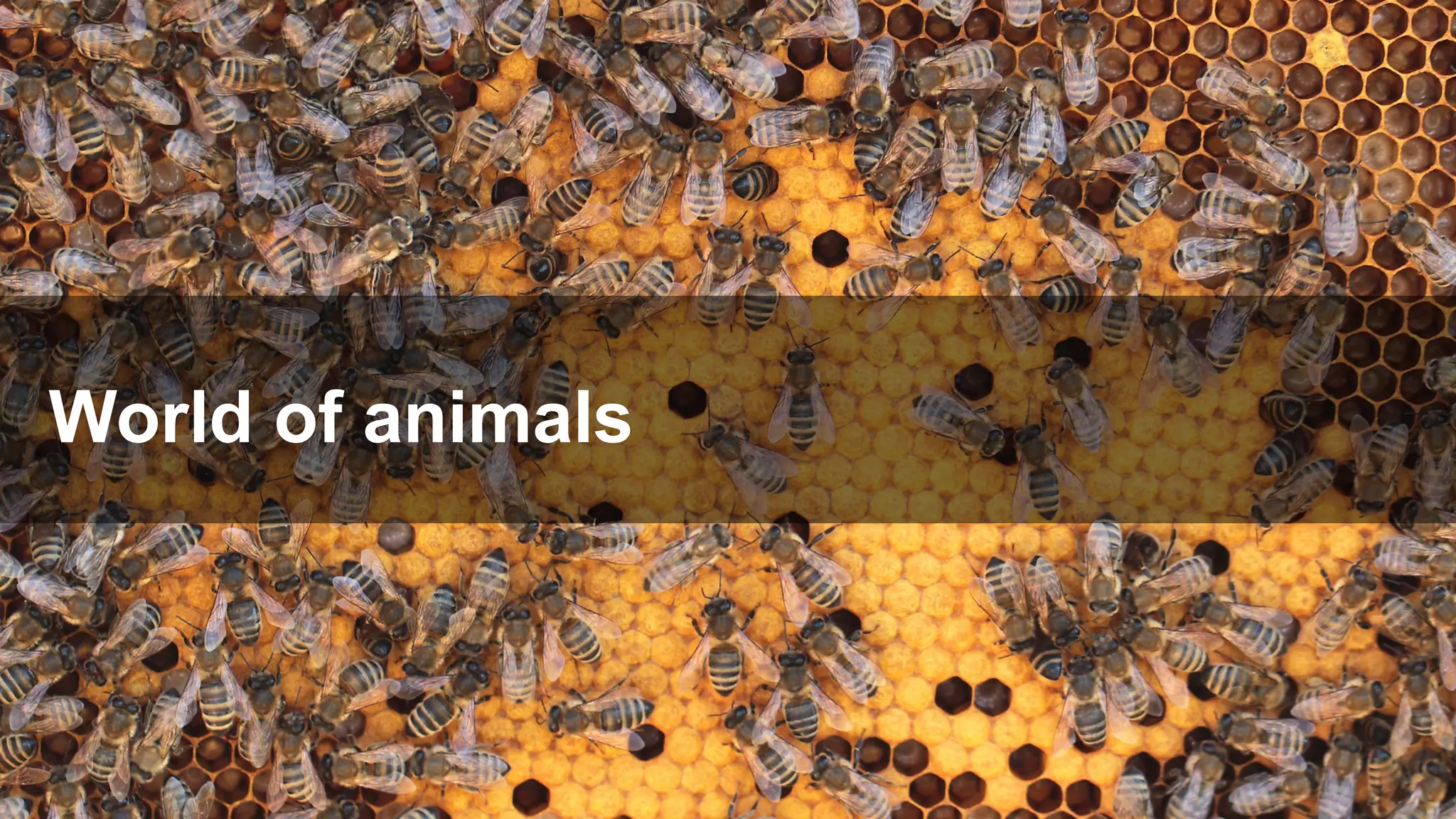
World of animals
People at work
People doing sports
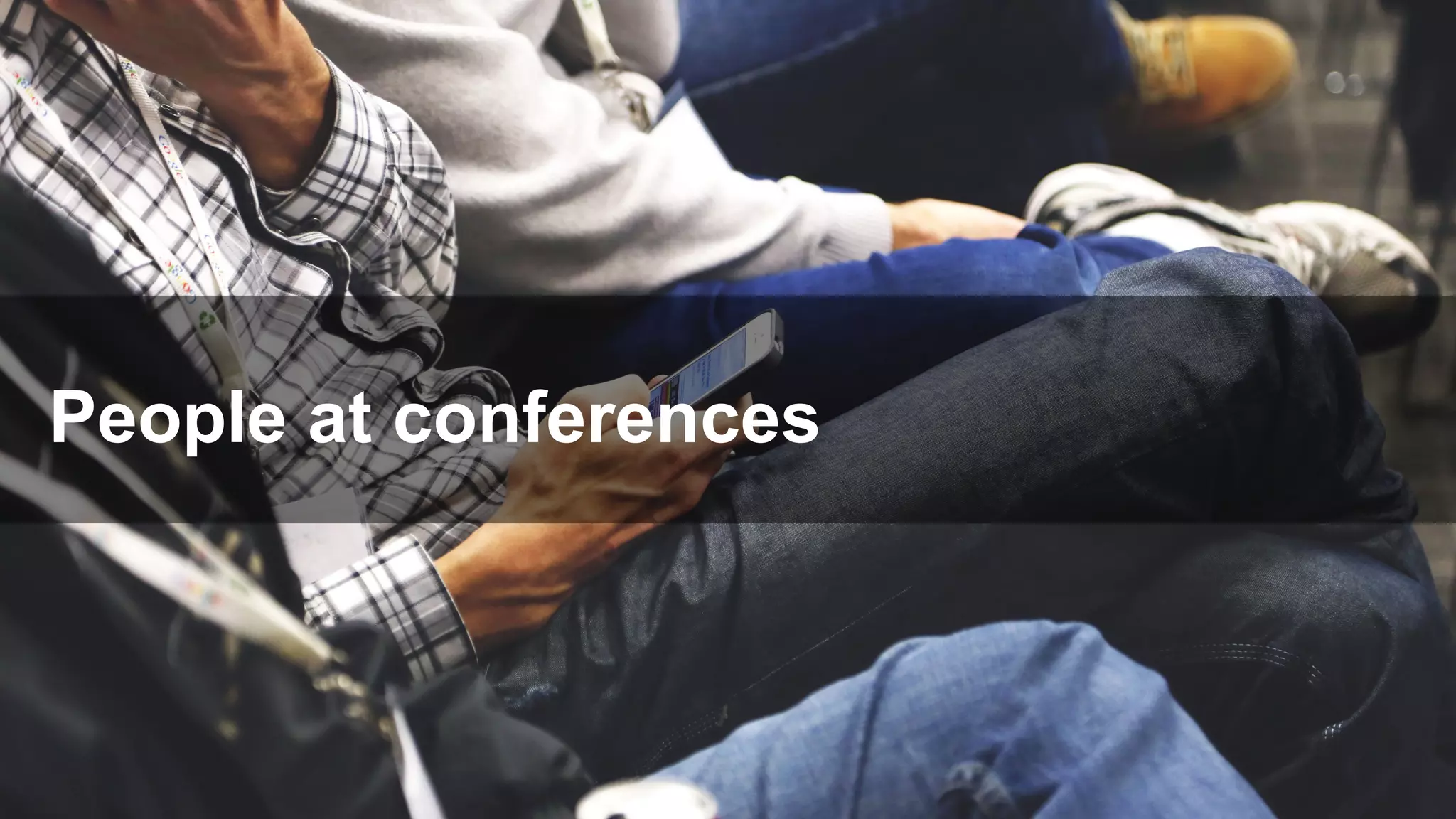
People at conferences
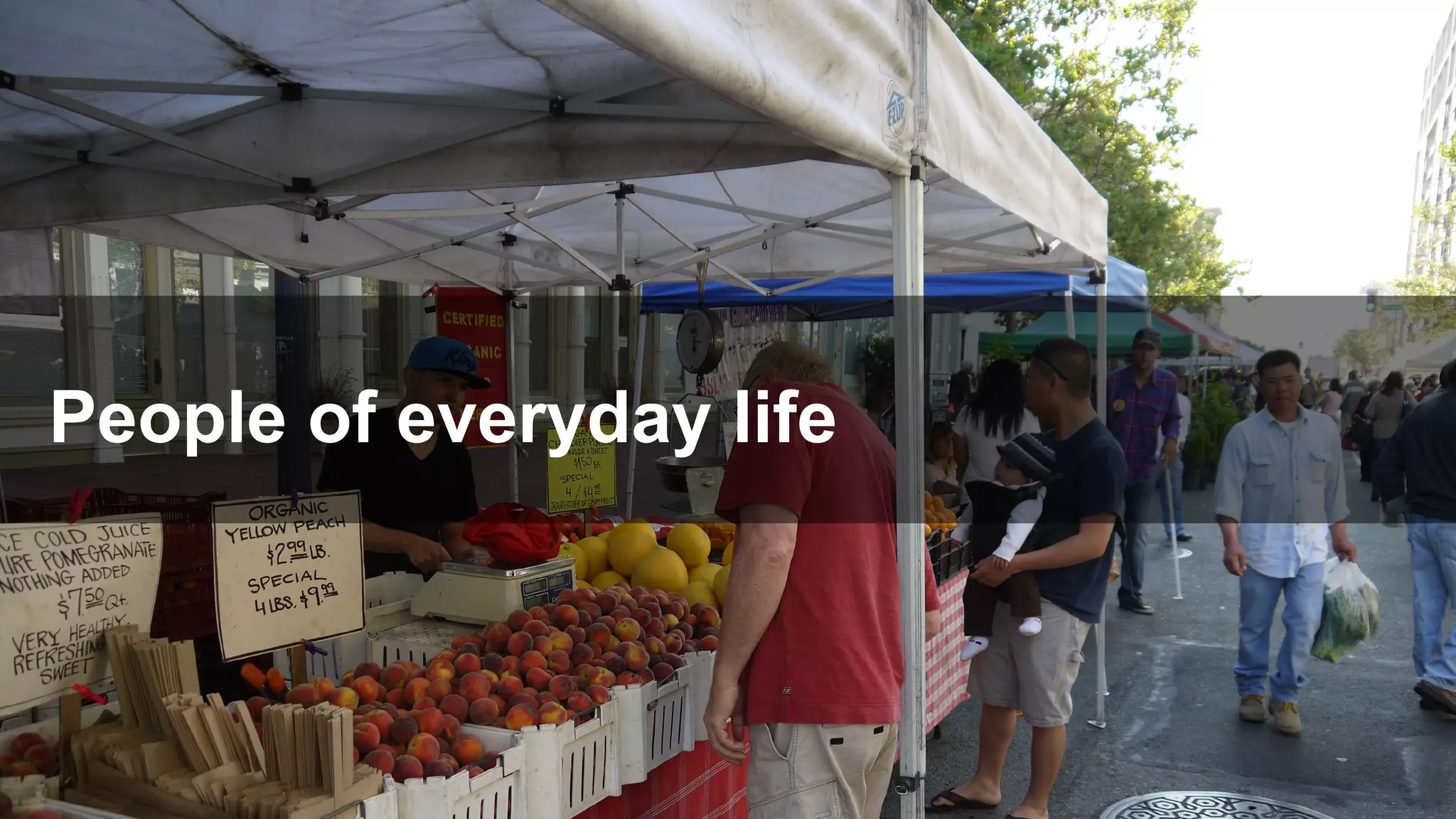
People of everyday life
It's our daily life
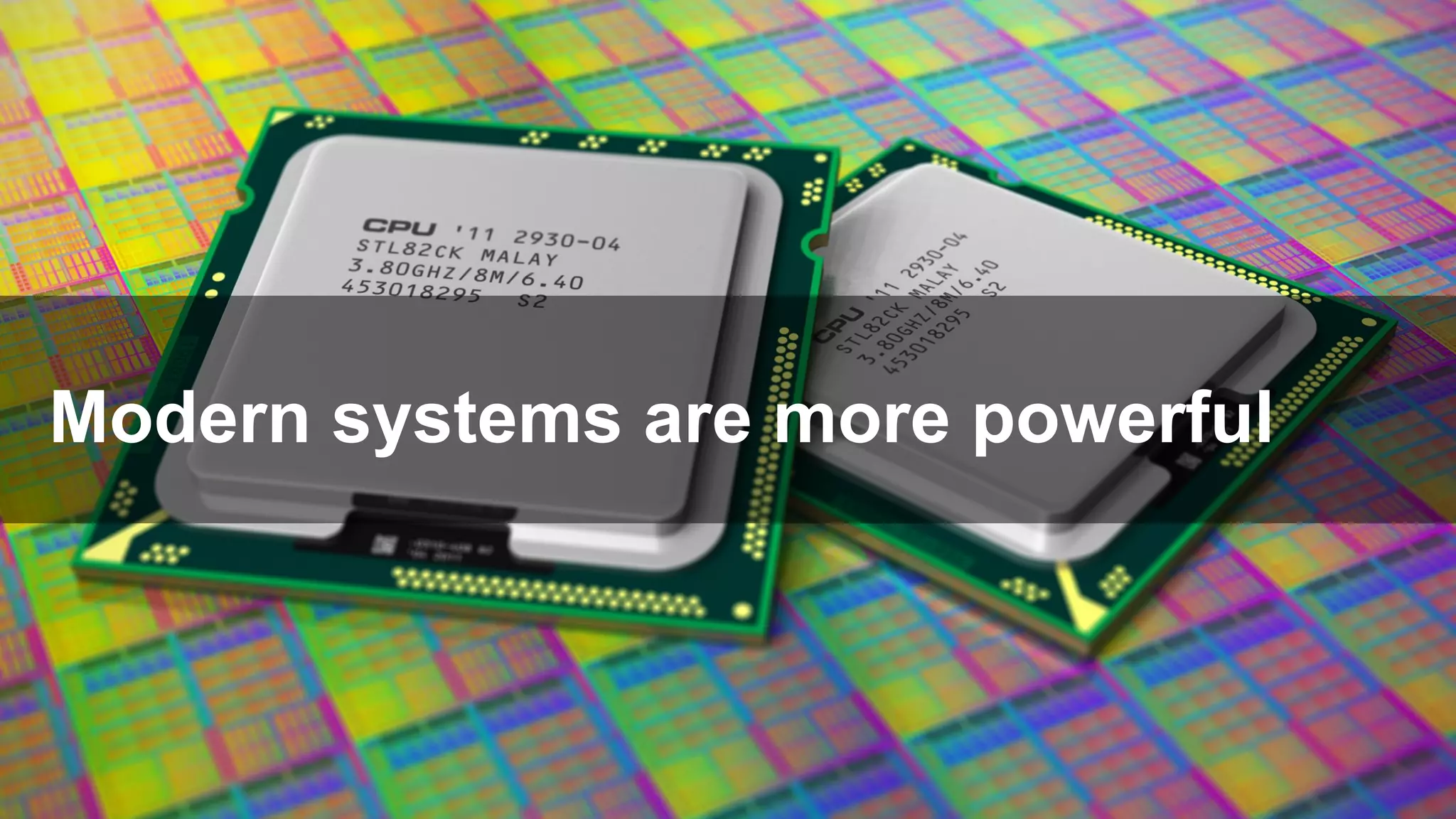
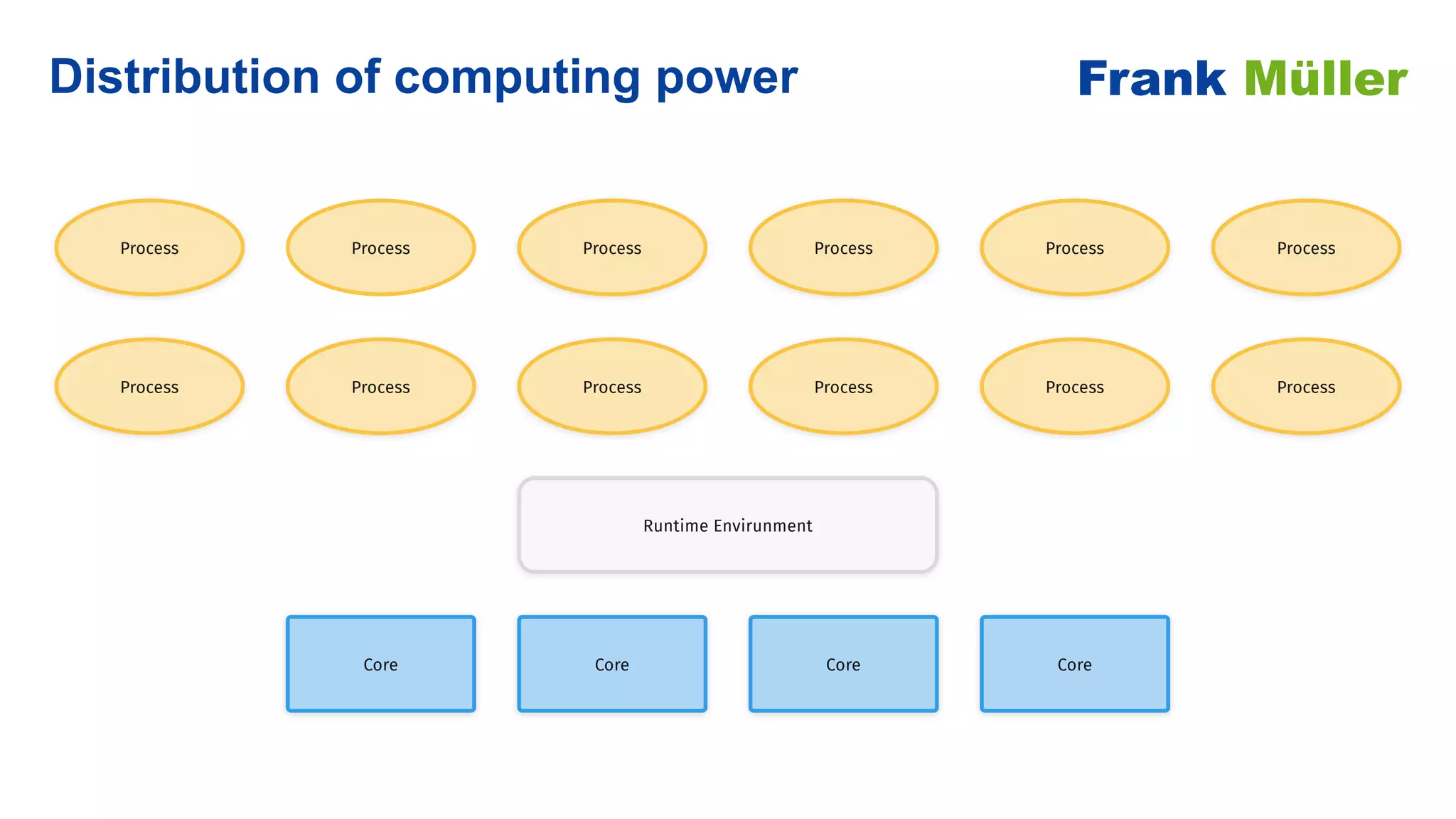
Modern systems are more powerful
• Computer architectures are changing


• Growth via CPUs, cores and hyper-threads


• Manual usage via threads is complex and error-prone


• Concurrent runtime environments enable fine-grained usage
One motivation is the hardware Frank Müller
Distribution of computing power Frank Müller
Process Process Process Process
Runtime Envirunment
Core Core Core Core
Process
Process
Process
Process
Processes can work alone ...
... or as a team together
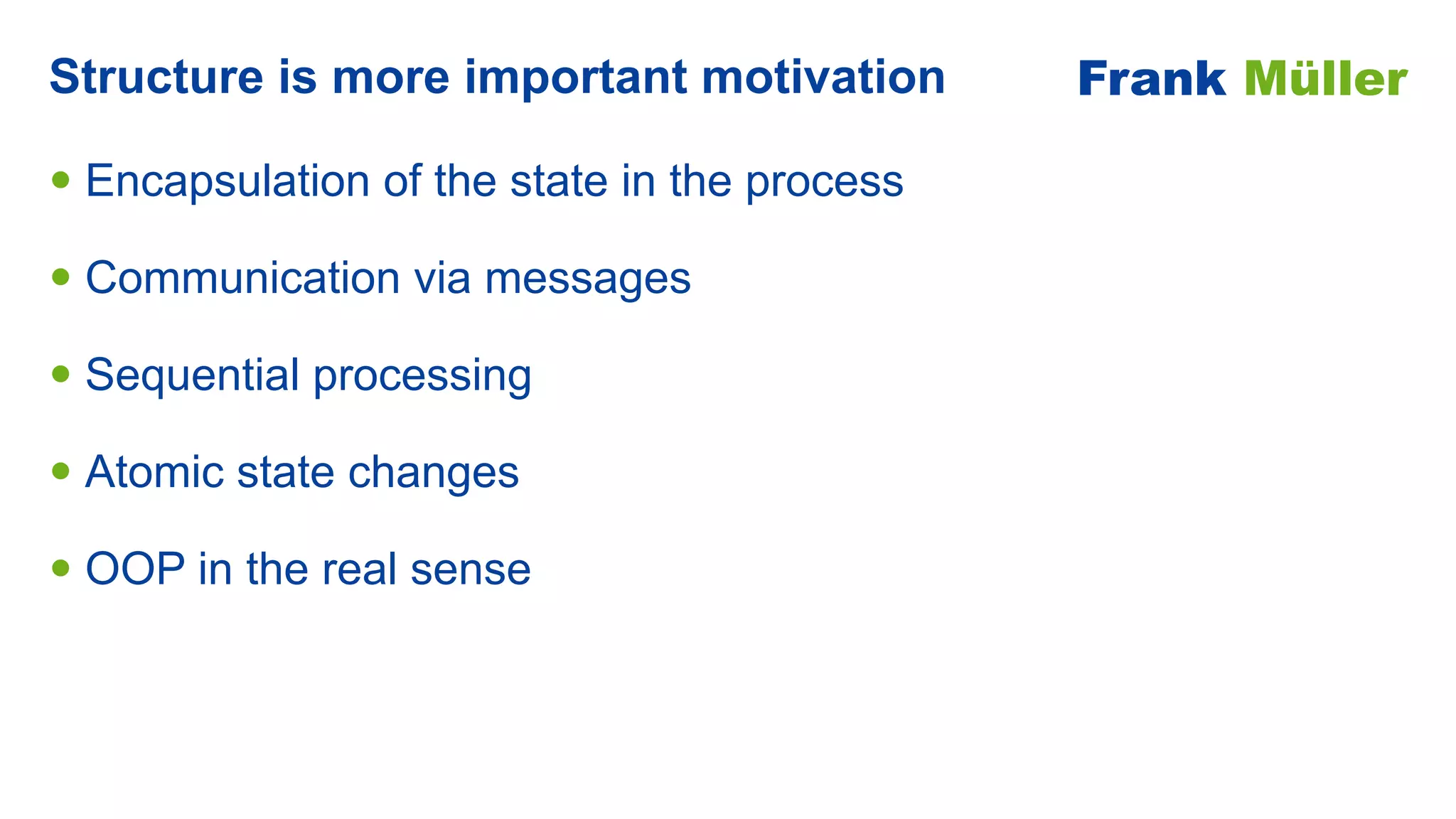
• Encapsulation of the state in the process


• Communication via messages


• Sequential processing


• Atomic state changes


• OOP in the real sense
Structure is more important motivation Frank Müller
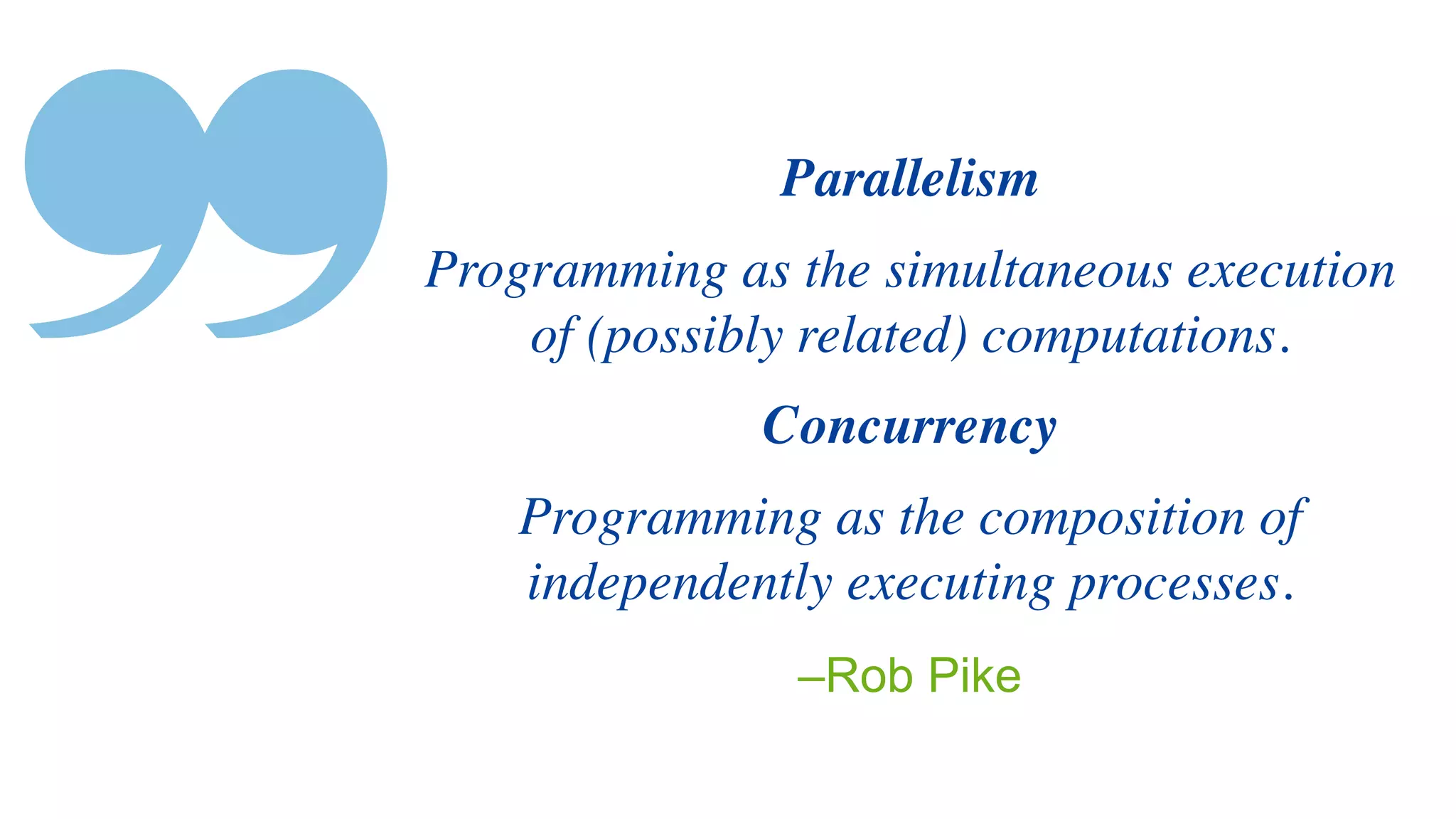
❞ –Rob Pike
Parallelis
m

Programming as the simultaneous execution
of (possibly related) computations
.

Concurrenc
y

Programming as the composition of
independently executing processes.
• Actor Model


‣ 1973


‣ Carl Hewitt, Peter Bishop und Richard Steiger


• Communicating Sequential Processes


‣ 1978


‣ Tony Hoare
Ideas long known Frank Müller
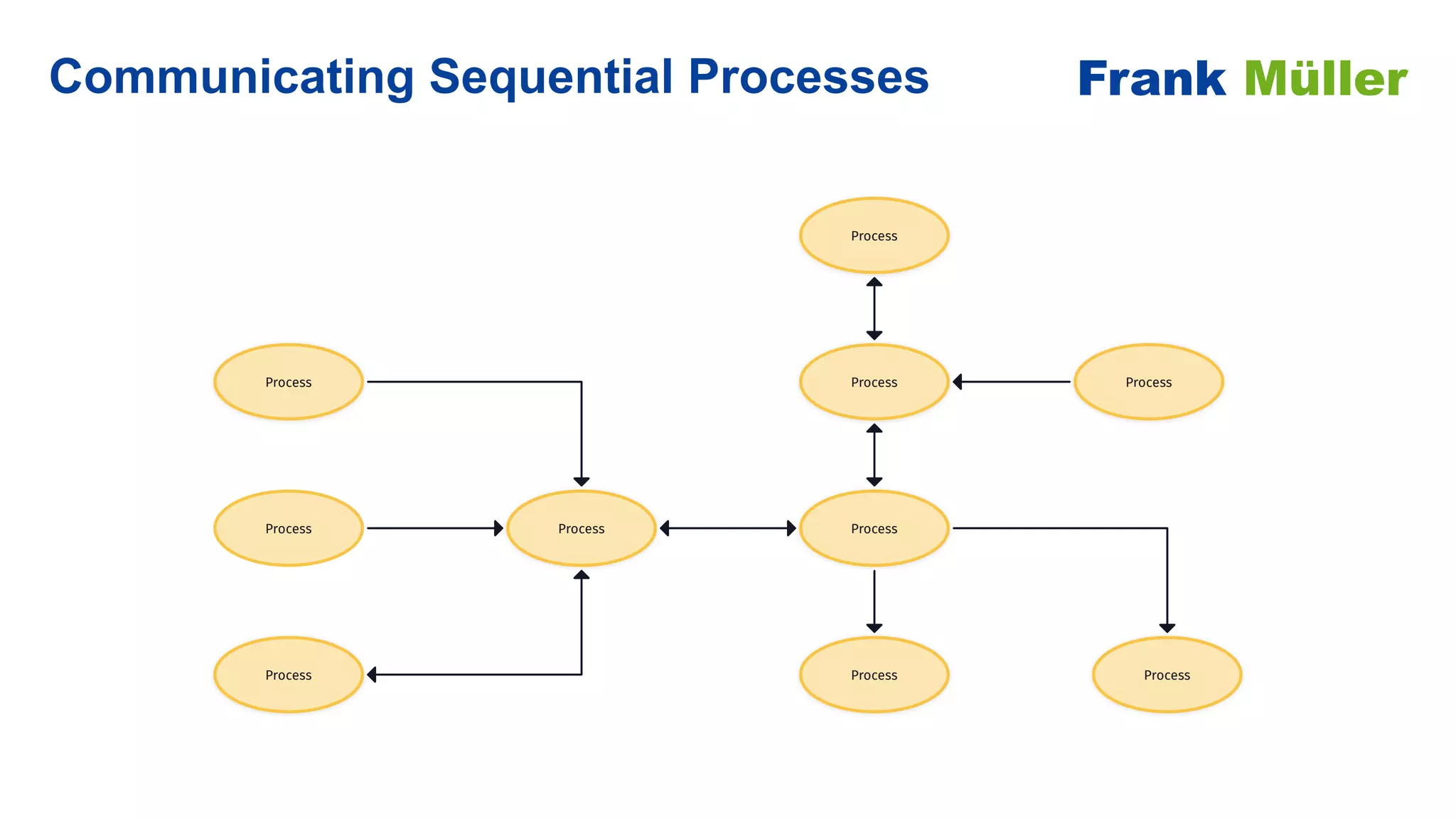
• Concurrent processes communicate via one or more channels


• Processes, unlike channels, are anonymous


• Data is not sent until the receiver is ready to receive it


• Incoming data is processed sequentially
Communicating Sequential Processes Frank Müller
Process
Process
Process
Process Process
Process Process
Process
Process
Process
Technologies need their time
Examples of use
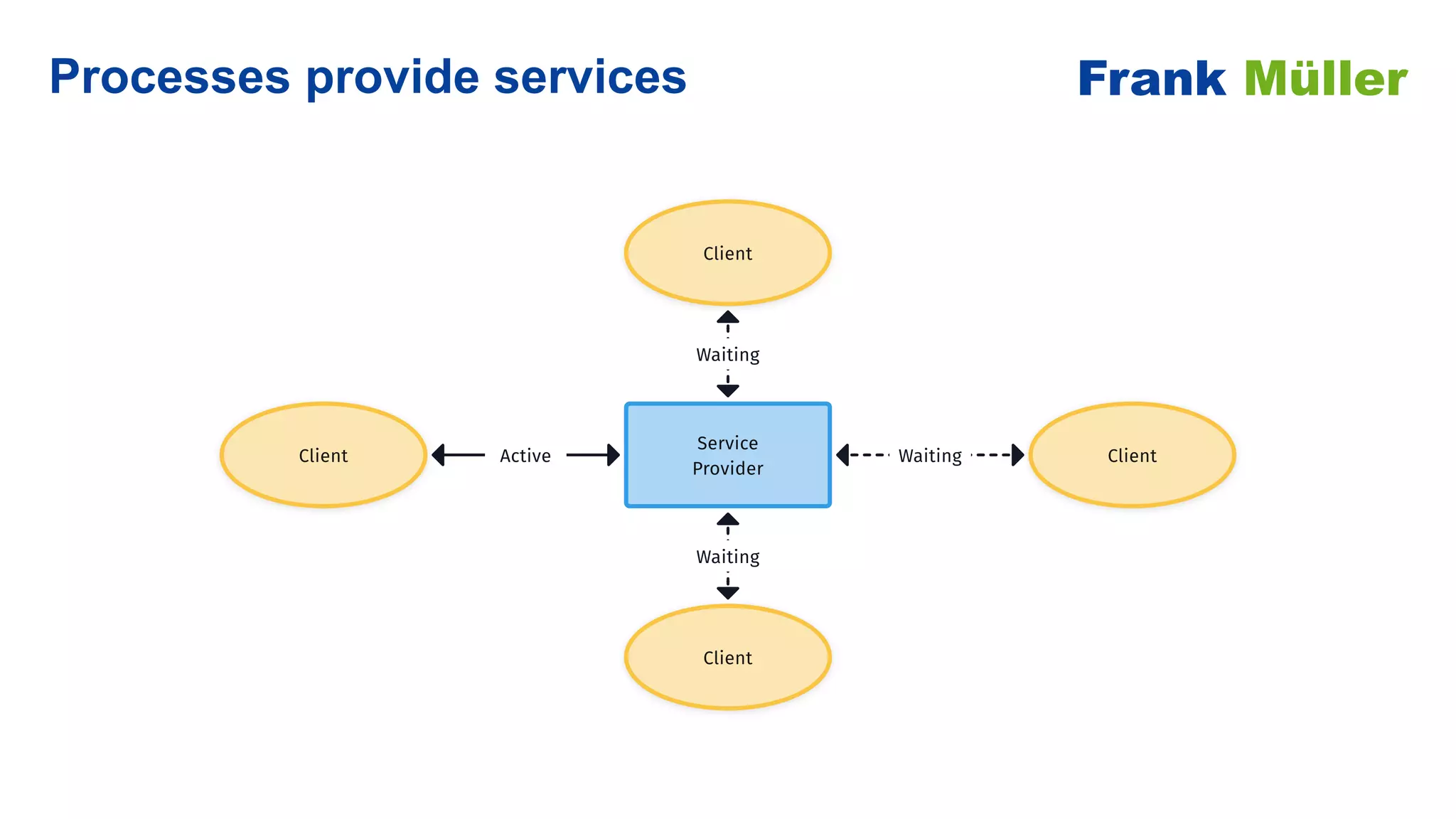
Processes provide services Frank Müller
Service
Provider
Client
Client Client
Client
Active
Waiting
Waiting
Waiting
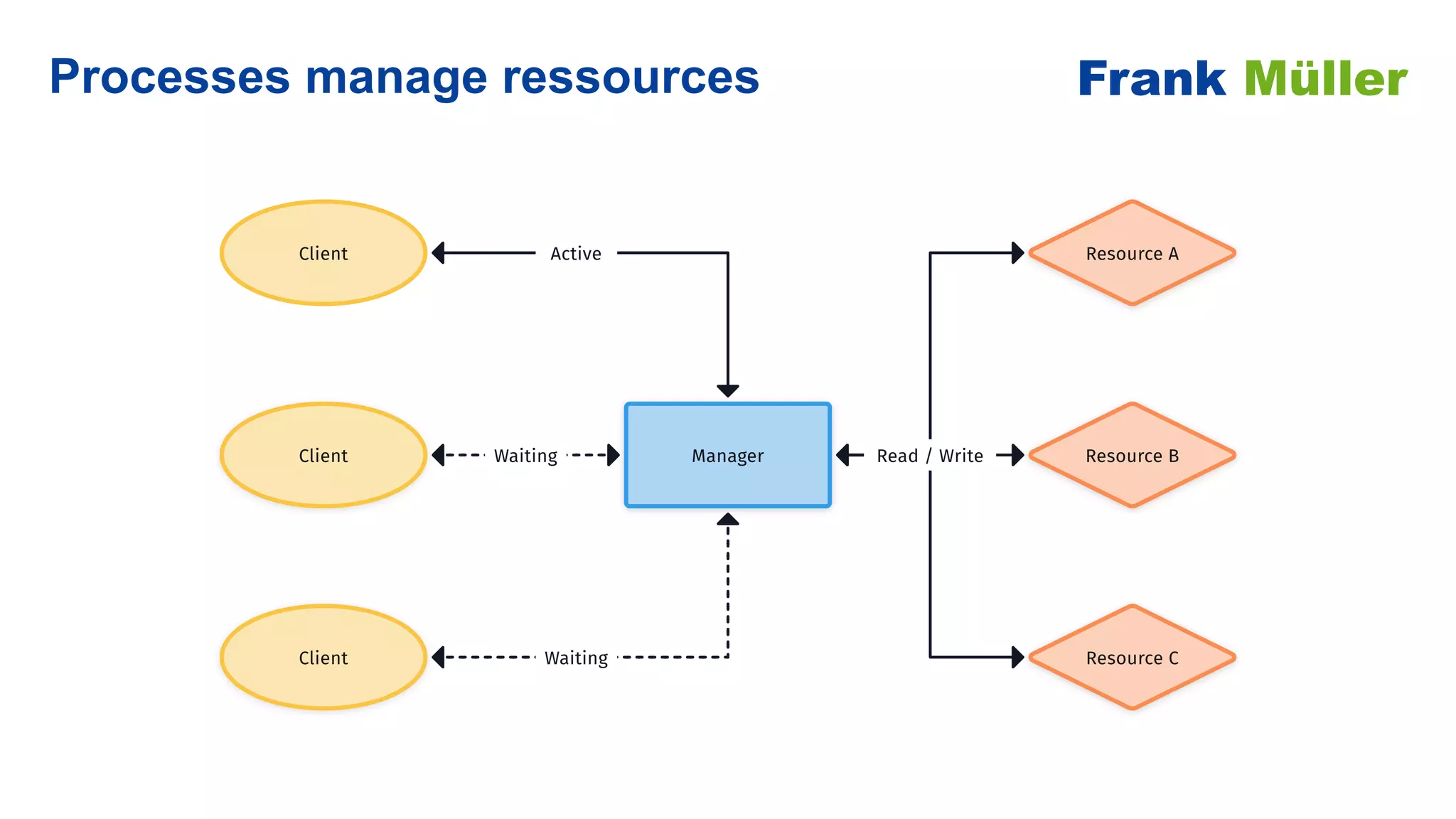
Processes manage ressources Frank Müller
Client
Client
Client
Manager Resource B
Resource A
Resource C
Active
Waiting
Waiting
Read / Write
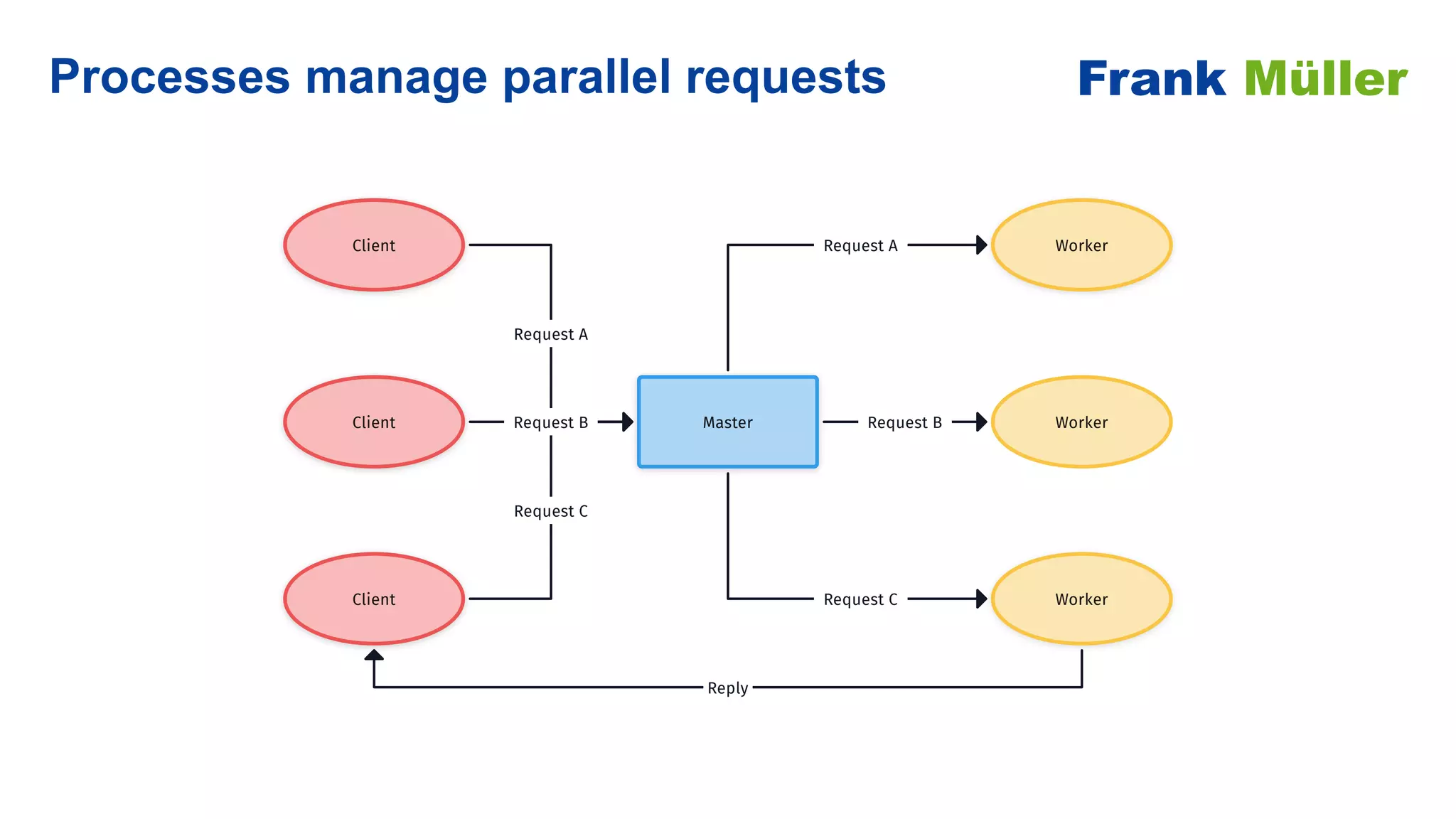
Processes manage parallel requests Frank Müller
Worker
Worker
Worker
Client
Client
Client
Master
Request A
Request B
Request C
Request A
Request B
Request C
Reply
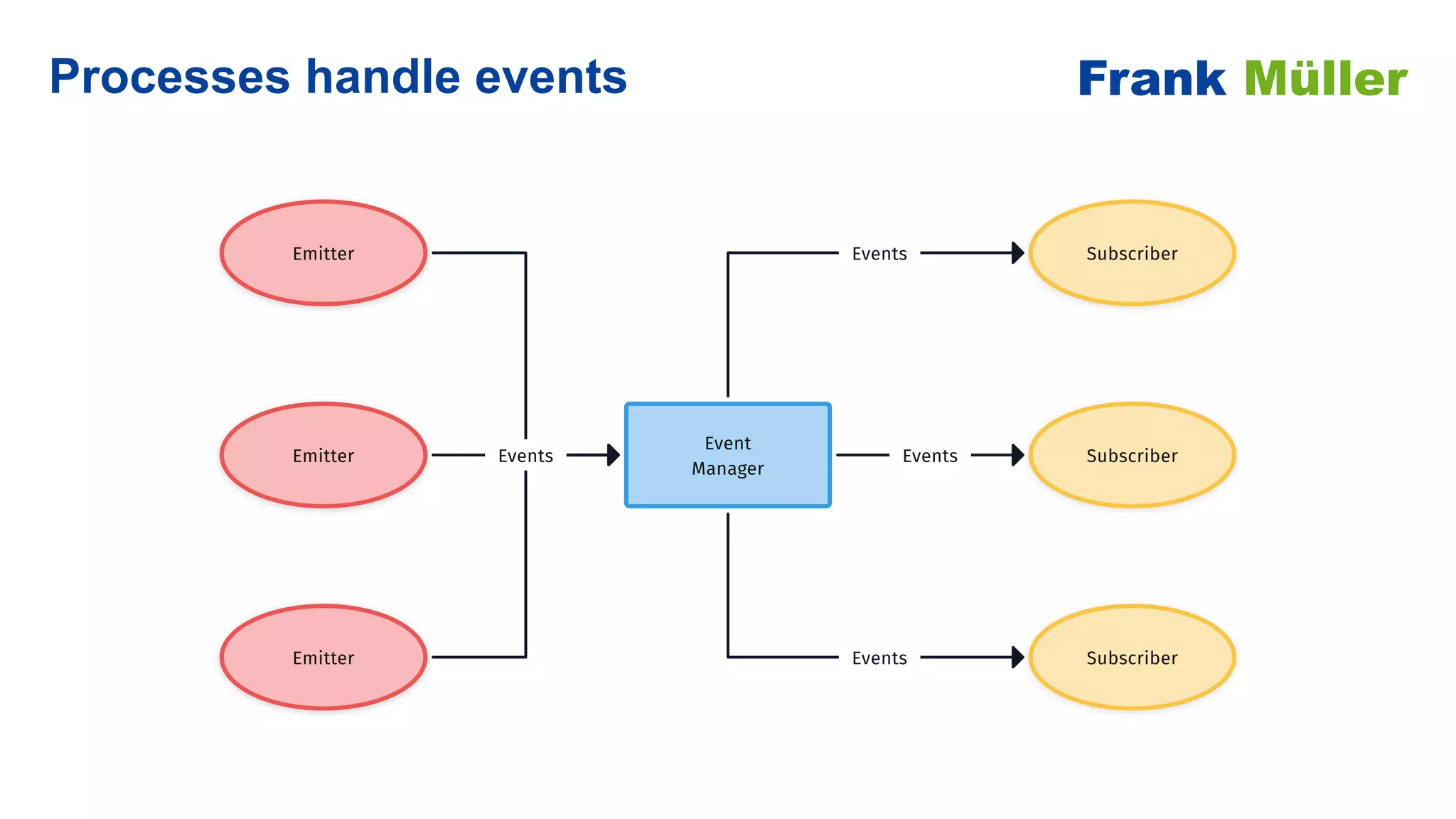
Processes handle events Frank Müller
Event
Manager
Emitter
Emitter
Emitter
Subscriber
Subscriber
Subscriber
Events
Events
Events
Events
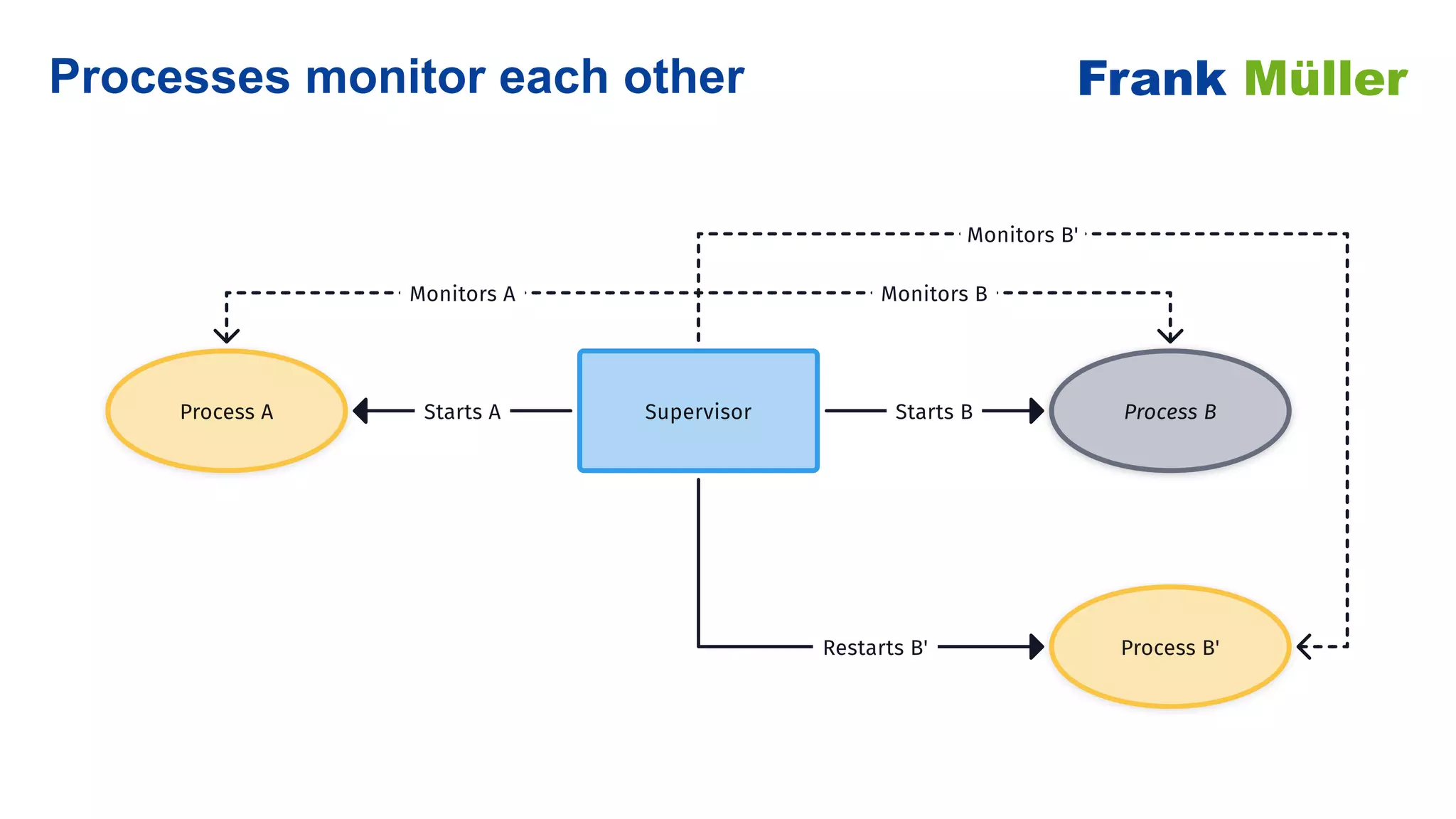
Processes monitor each other Frank Müller
Supervisor
Process A Process B
Process B'
Starts A Starts B
Monitors A Monitors B
Monitors B'
Restarts B'
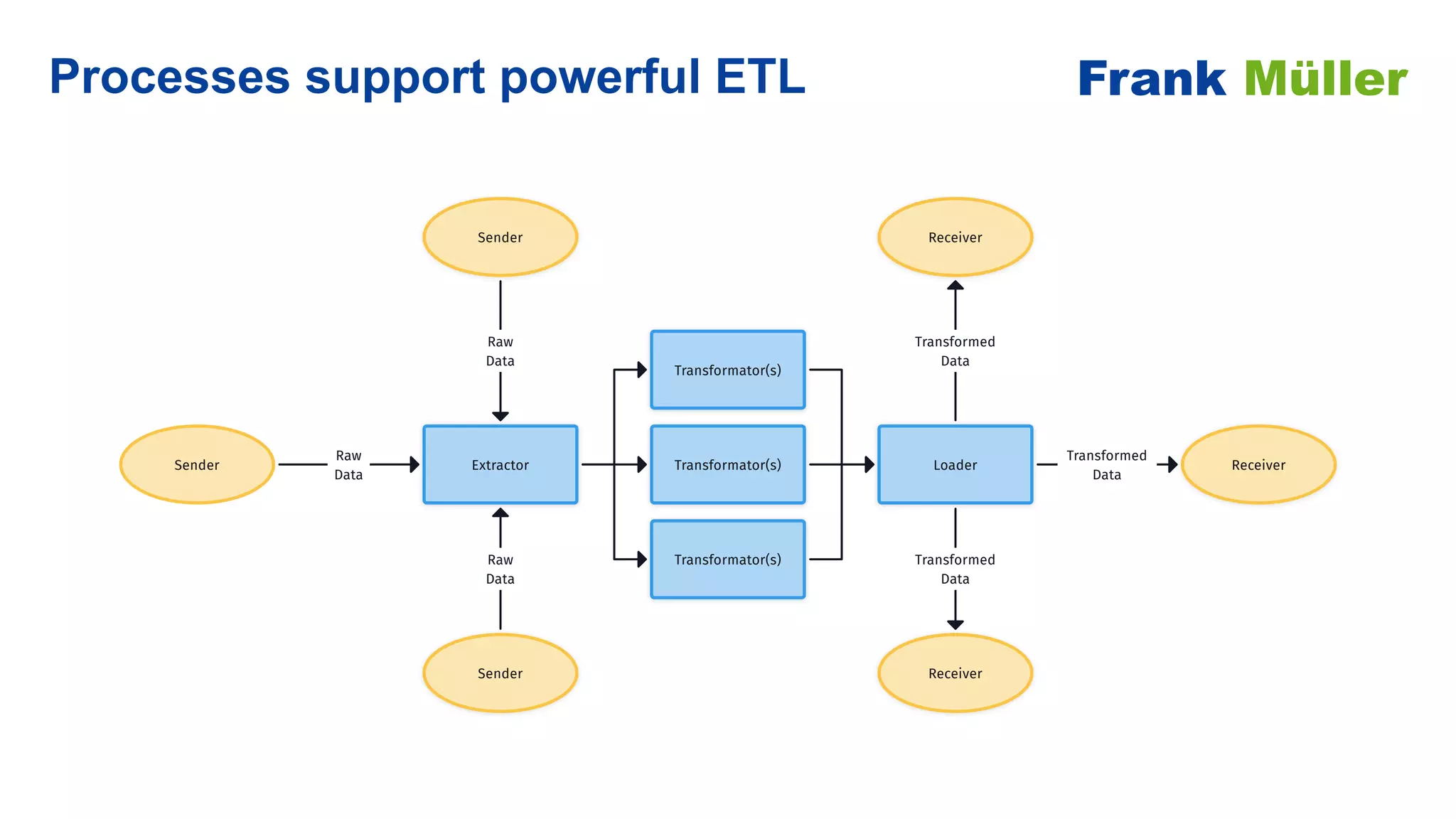
Processes support powerful ETL Frank Müller
Sender
Sender
Sender
Transformator(s) Loader
Extractor Receiver
Receiver
Receiver
Transformator(s)
Transformator(s)
Transformed
Data
Transformed
Data
Transformed
Data
Raw
Data
Raw
Data
Raw
Data
Examples in Go
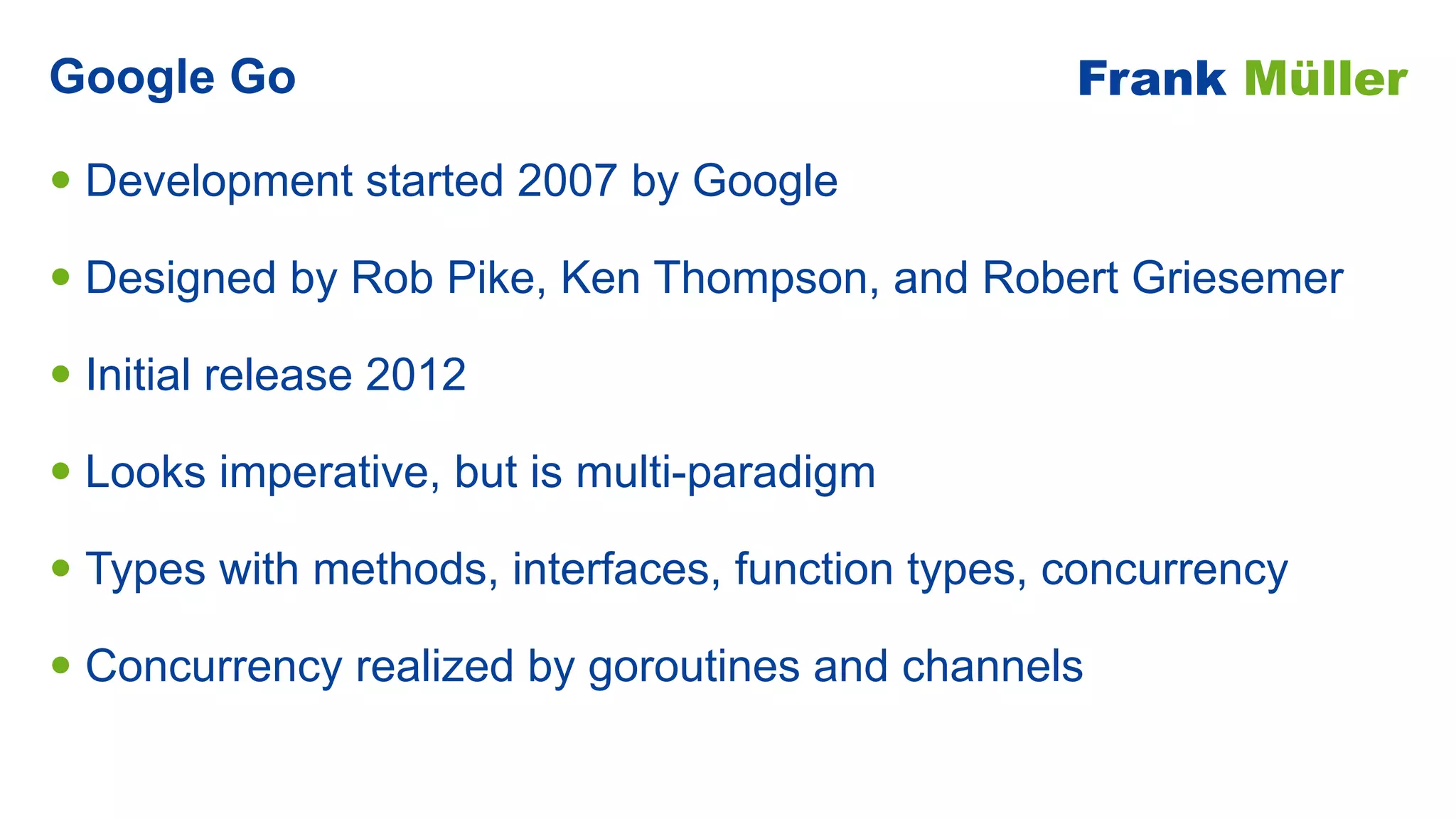
• Development started 2007 by Google


• Designed by Rob Pike, Ken Thompson, and Robert Griesemer


• Initial release 2012


• Looks imperative, but is multi-paradigm


• Types with methods, interfaces, function types, concurrency


• Concurrency realized by goroutines and channels
Google Go Frank Müller
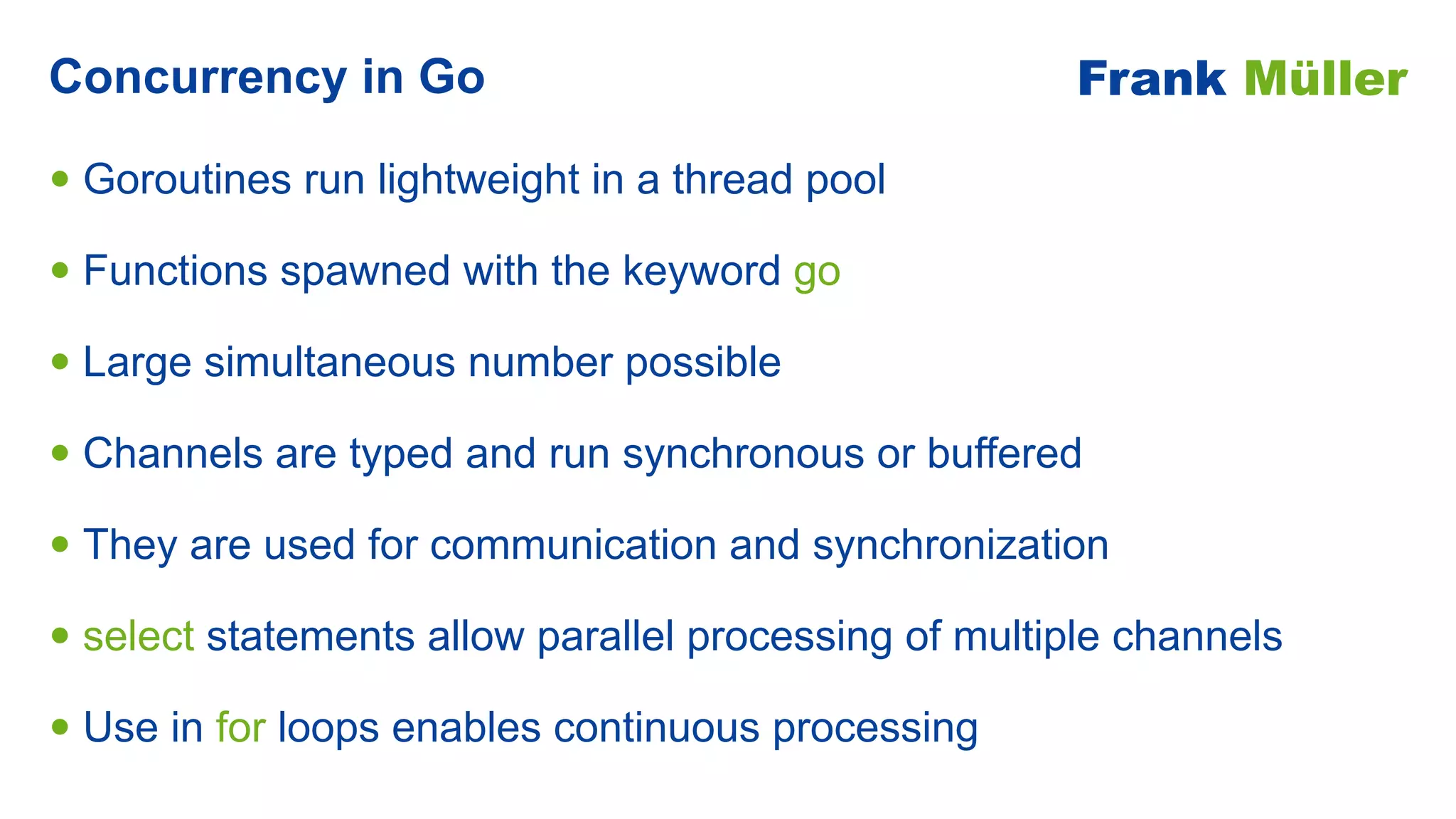
• Goroutines run lightweight in a thread pool


• Functions spawned with the keyword go


• Large simultaneous number possible


• Channels are typed and run synchronous or buffered


• They are used for communication and synchronization


• select statements allow parallel processing of multiple channels


• Use in for loops enables continuous processing
Concurrency in Go Frank Müller
Example "Background Job"
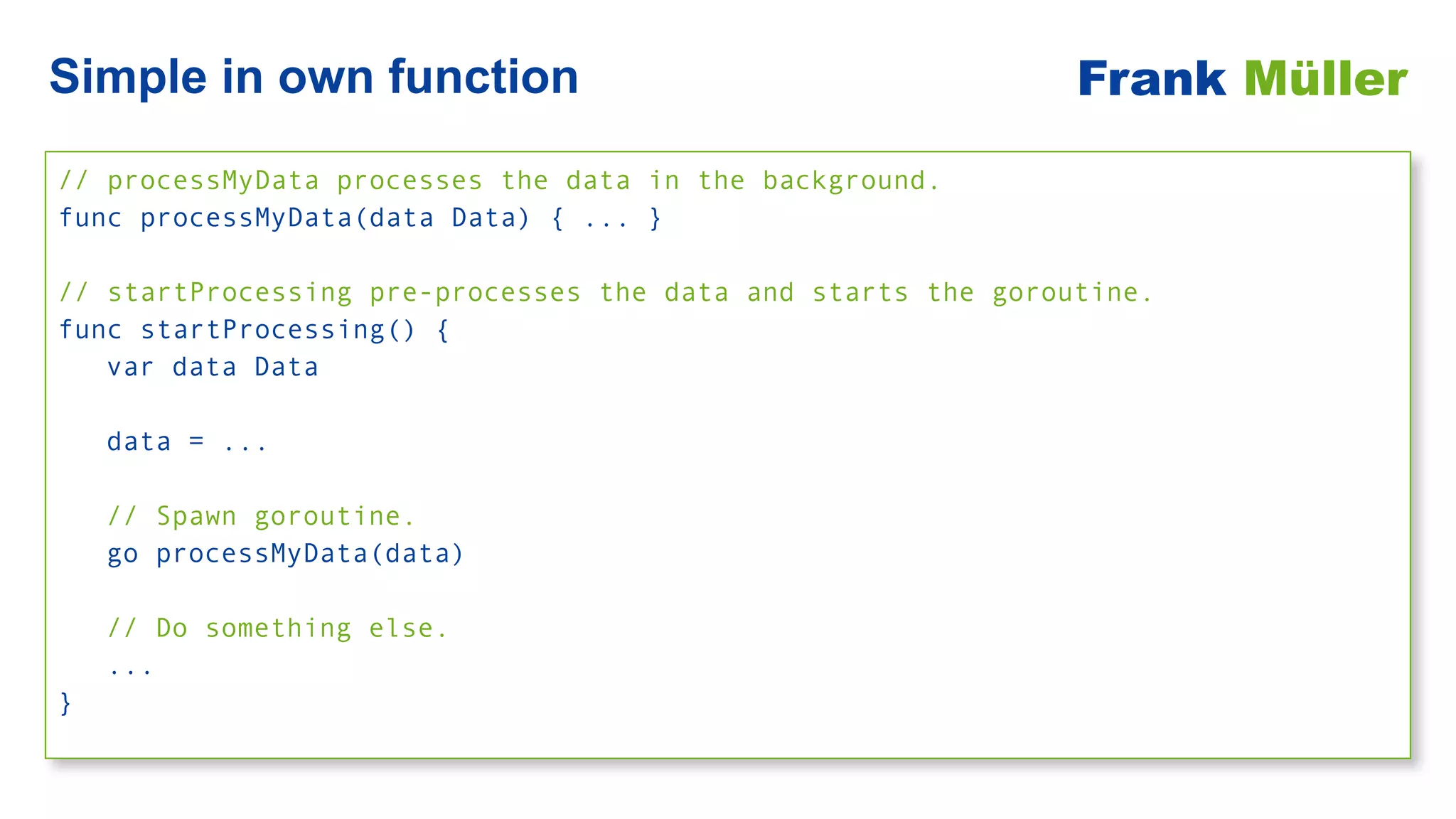
// processMyData processes the data in the background.


func processMyData(data Data) { ... }


// startProcessing pre-processes the data and starts the goroutine.


func startProcessing() {


var data Data


data = ...


// Spawn goroutine.


go processMyData(data)


// Do something else.


...


}
Simple in own function Frank Müller
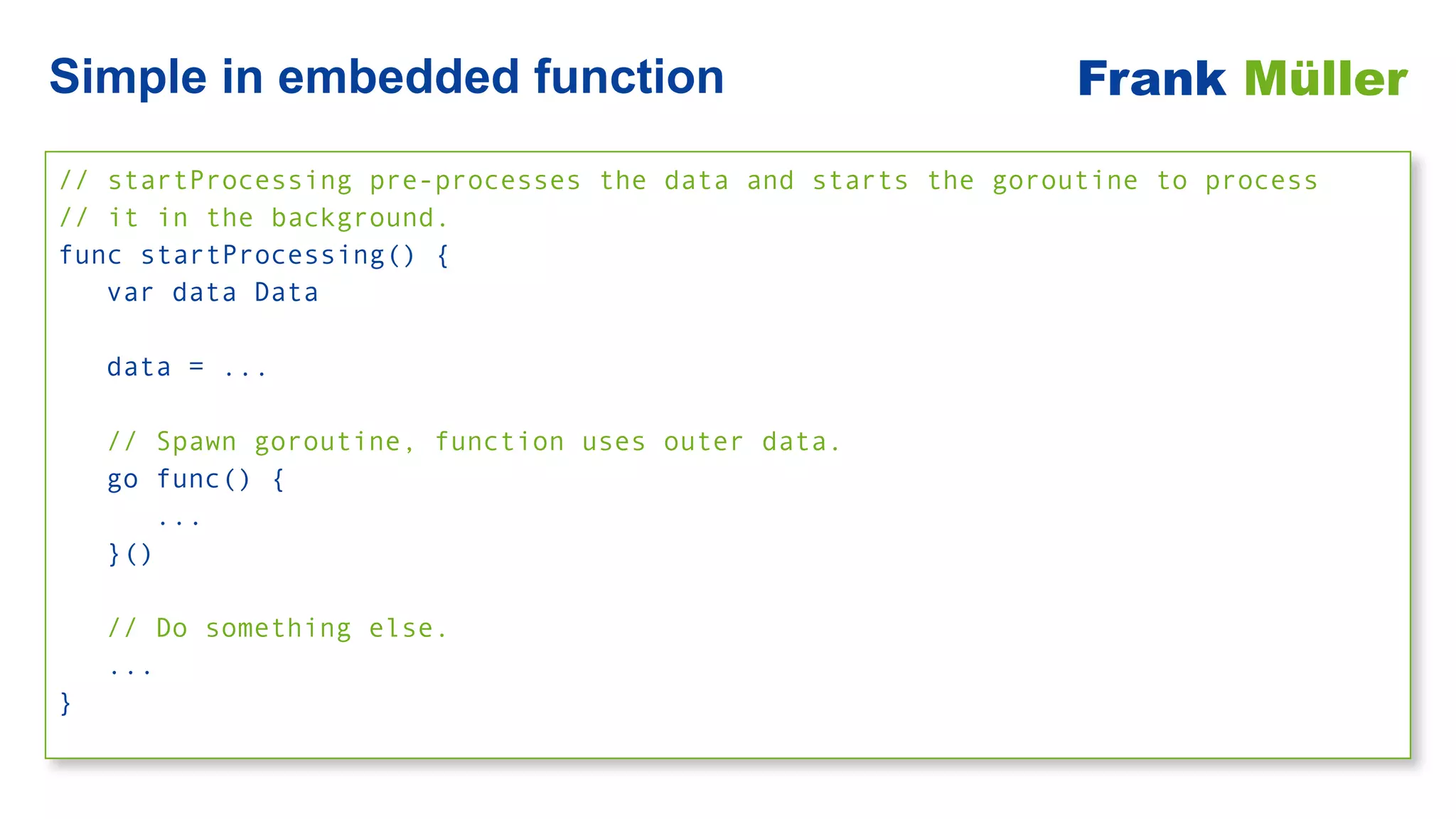
// startProcessing pre-processes the data and starts the goroutine to process

// it in the background.


func startProcessing() {


var data Data


data = ...


// Spawn goroutine, function uses outer data.


go func() {


...


}()


// Do something else.


...


}
Simple in embedded function Frank Müller
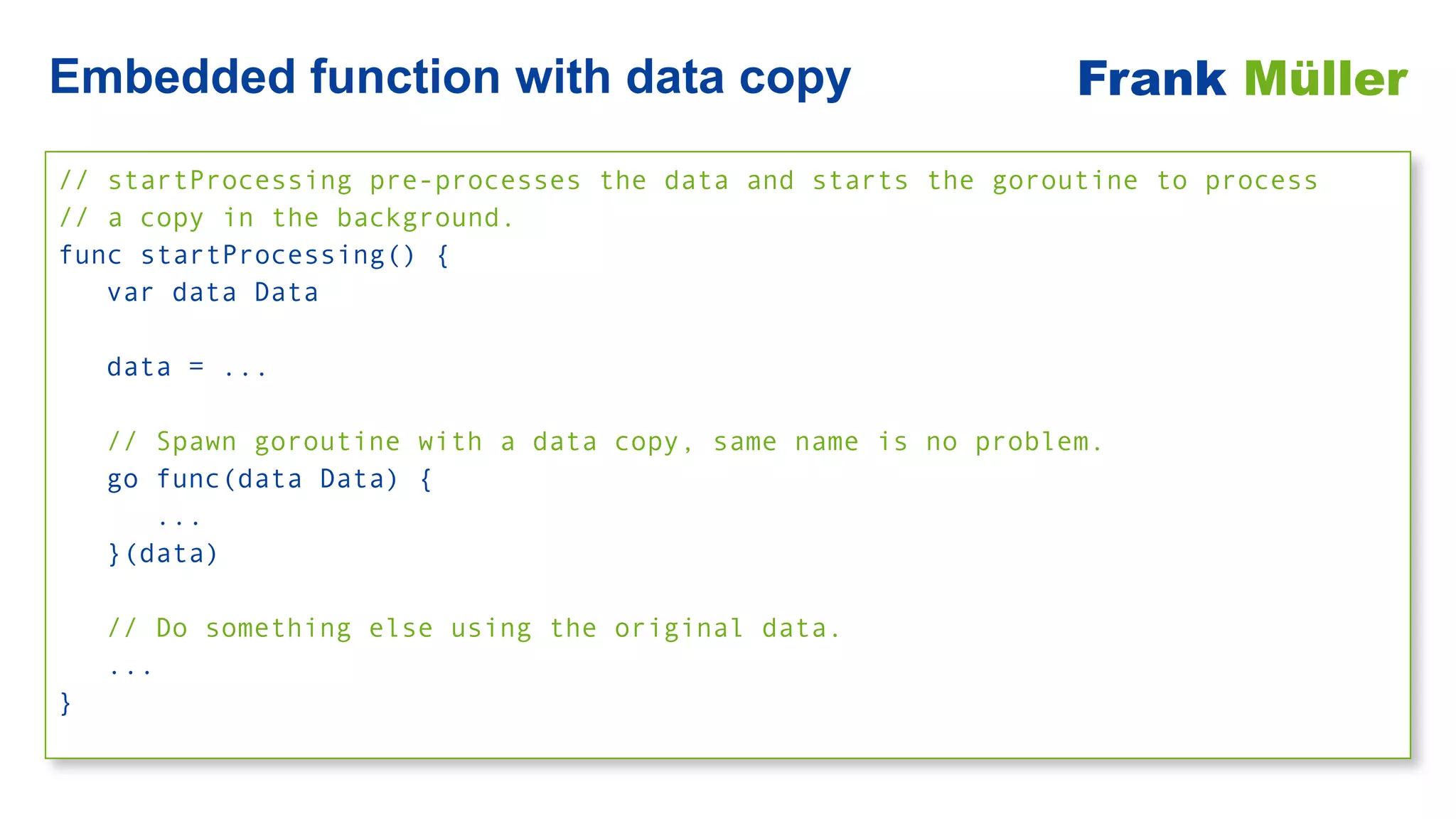
// startProcessing pre-processes the data and starts the goroutine to process

// a copy in the background.


func startProcessing() {


var data Data


data = ...


// Spawn goroutine with a data copy, same name is no problem.


go func(data Data) {


...


}(data)


// Do something else using the original data.


...


}
Embedded function with data copy Frank Müller
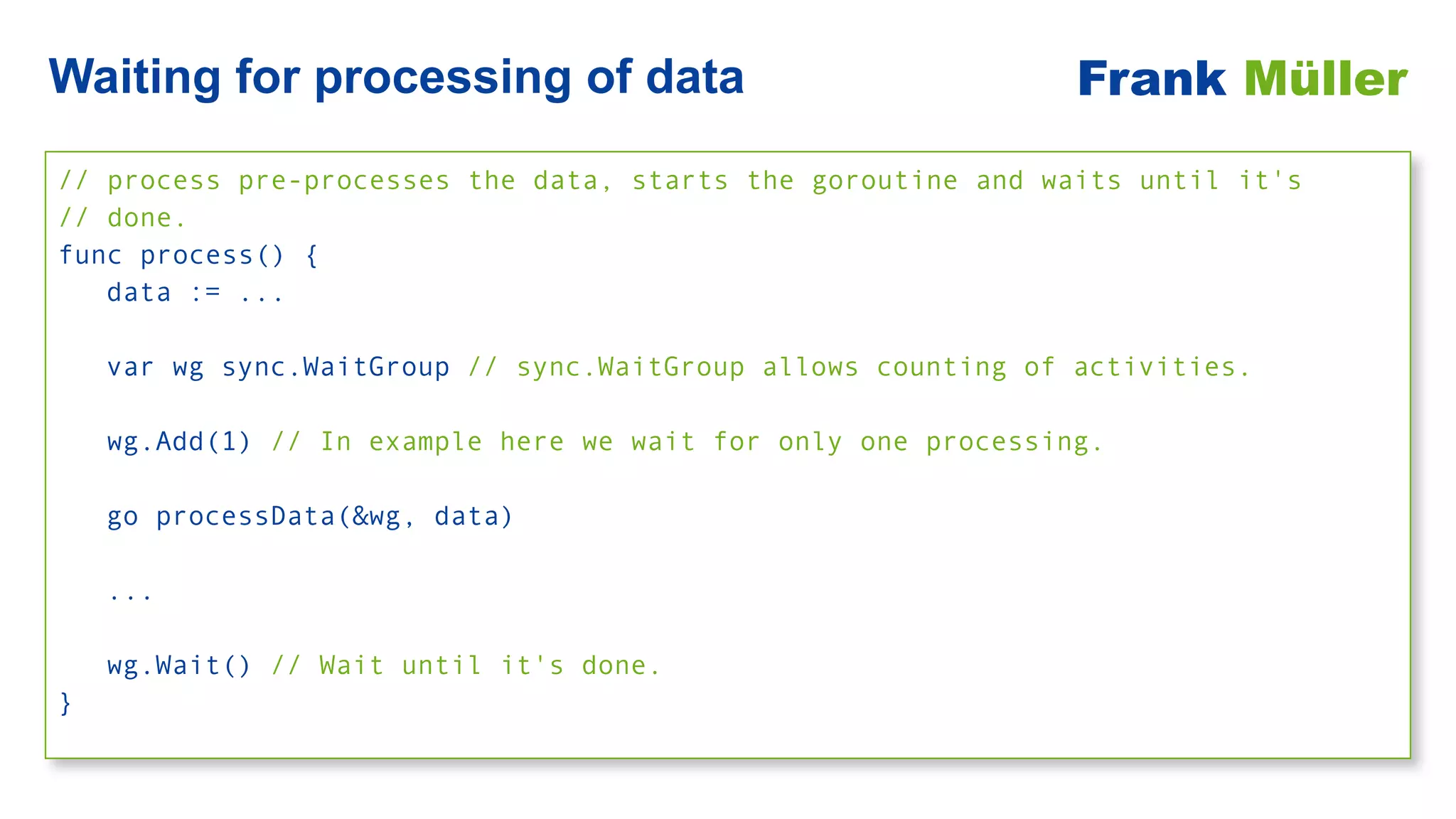
// process pre-processes the data, starts the goroutine and waits until it's


// done.


func process() {


data := ...


var wg sync.WaitGroup // sync.WaitGroup allows counting of activities.


wg.Add(1) // In example here we wait for only one processing.


go processData(&wg, data)


...


wg.Wait() // Wait until it's done.


}
Waiting for processing of data Frank Müller
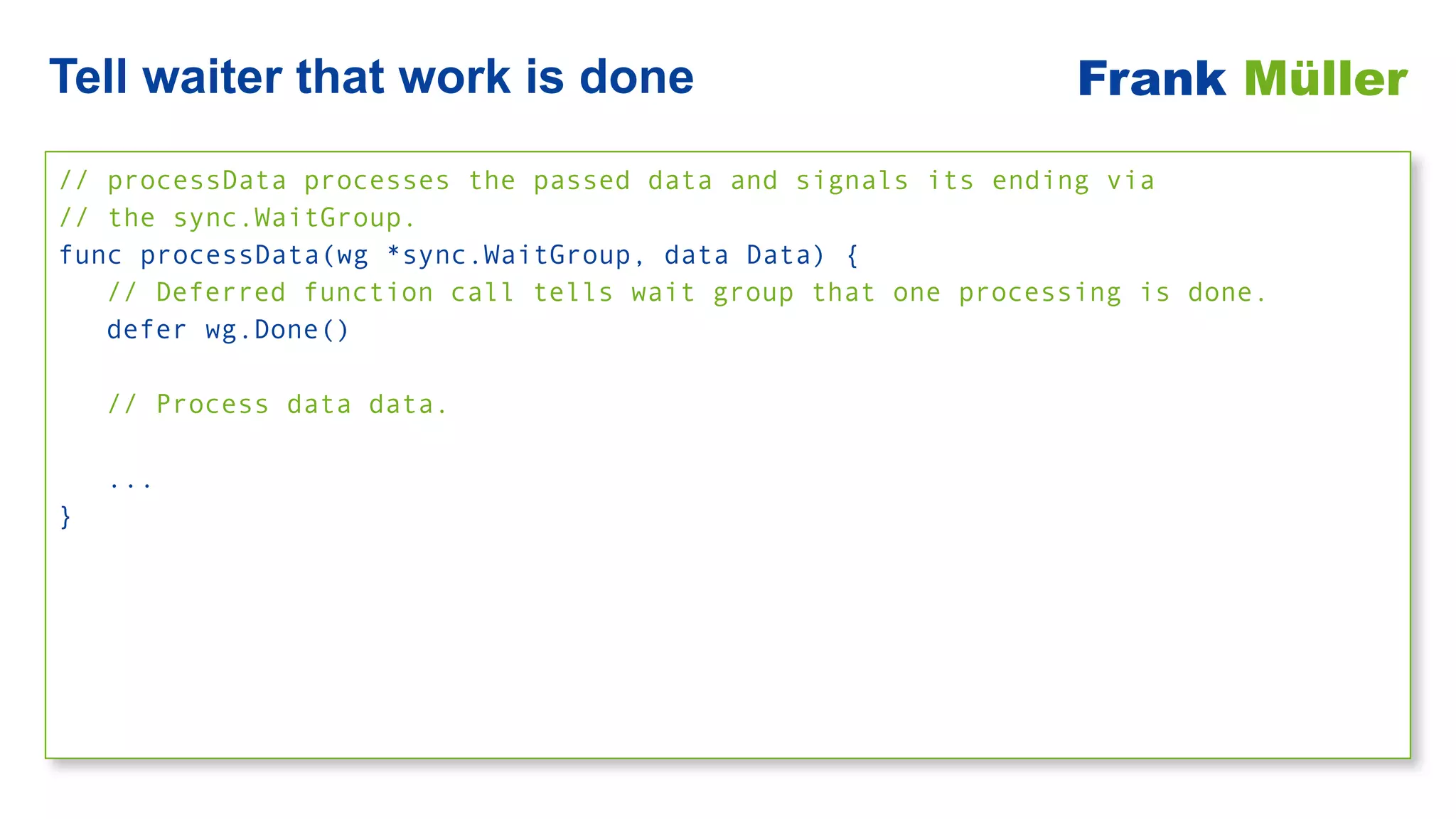
// processData processes the passed data and signals its ending via


// the sync.WaitGroup.


func processData(wg *sync.WaitGroup, data Data) {


// Deferred function call tells wait group that one processing is done.


defer wg.Done()


// Process data data.


...


}
Tell waiter that work is done Frank Müller
// processDatas starts the goroutines to process the individual datas and waits


// until all are done.


func processDatas(datas []Data) {


var wg sync.WaitGroup


for _, data := range datas {


// Add one per each data to process.


wg.Add(1)


// Spawn processing like in last example.


go processData(&wg, data)


}


wg.Wait() // Wait until they are done.


}
Start a number of background jobs Frank Müller
Example "Streaming"
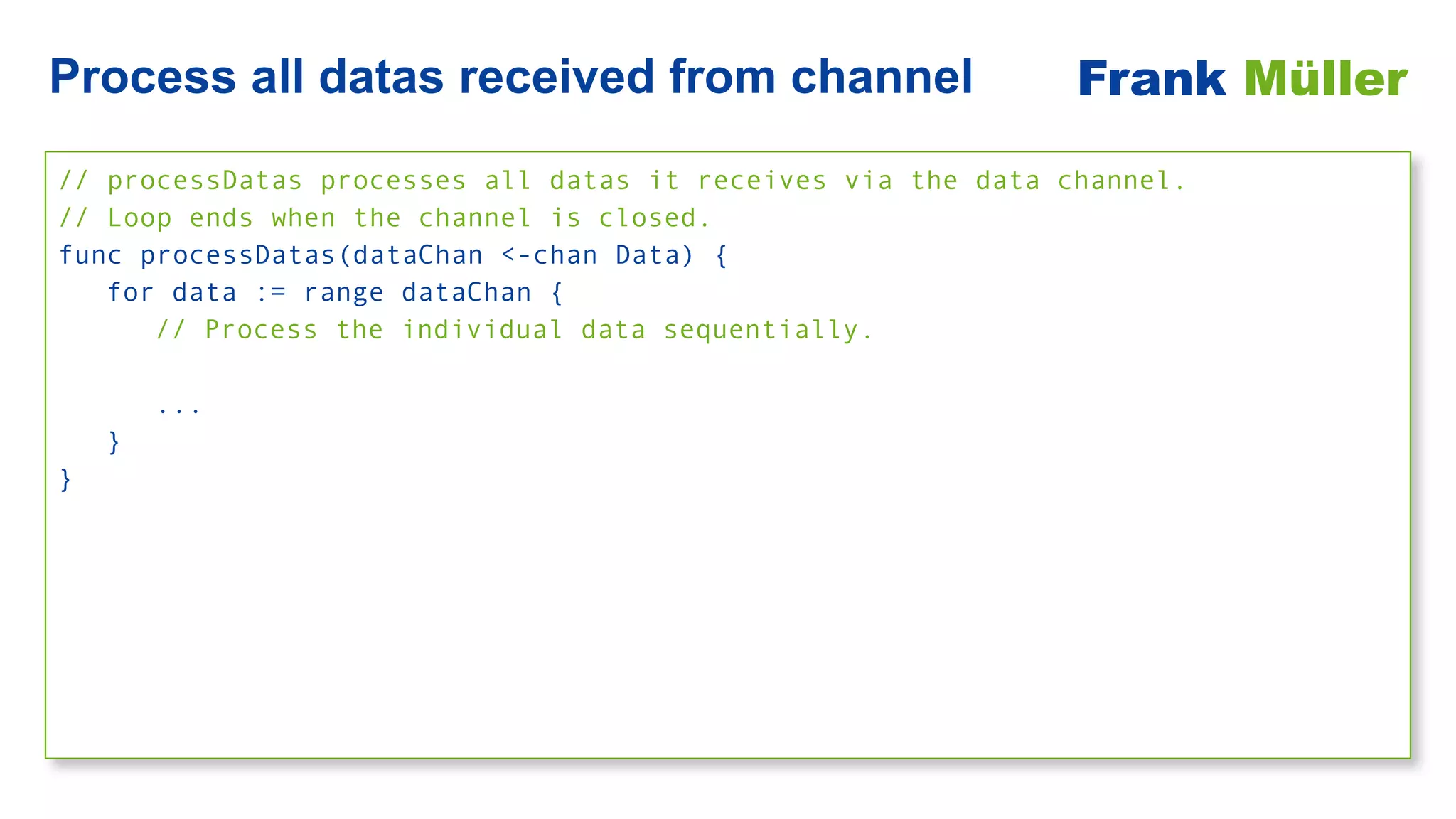
// processDatas processes all datas it receives via the data channel.


// Loop ends when the channel is closed.


func processDatas(dataChan <-chan Data) {


for data := range dataChan {


// Process the individual data sequentially.


...


}


}


Process all datas received from channel Frank Müller
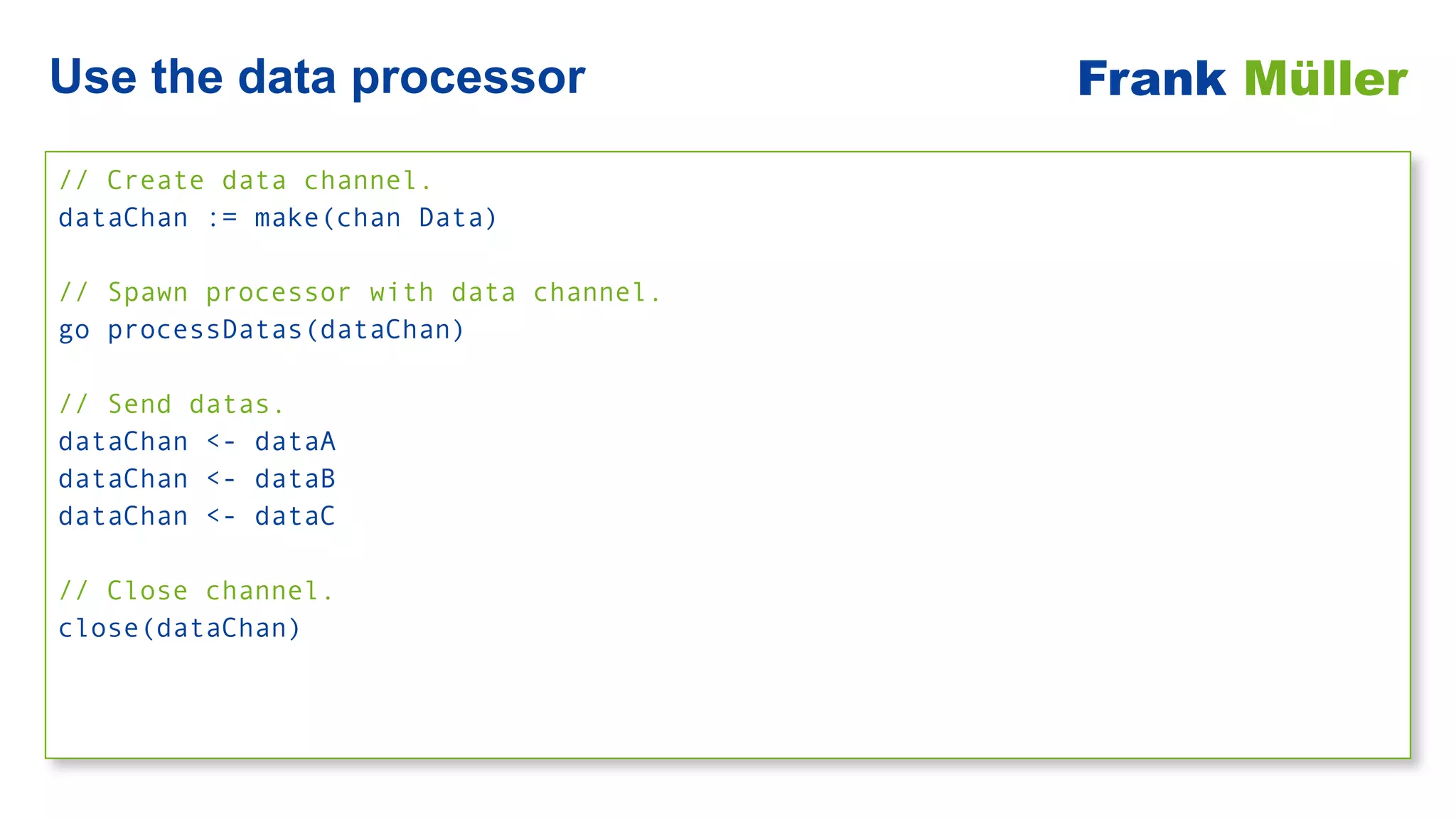
// Create data channel.


dataChan := make(chan Data)


// Spawn processor with data channel.


go processDatas(dataChan)


// Send datas.


dataChan <- dataA


dataChan <- dataB


dataChan <- dataC


// Close channel.


close(dataChan)
Use the data processor Frank Müller
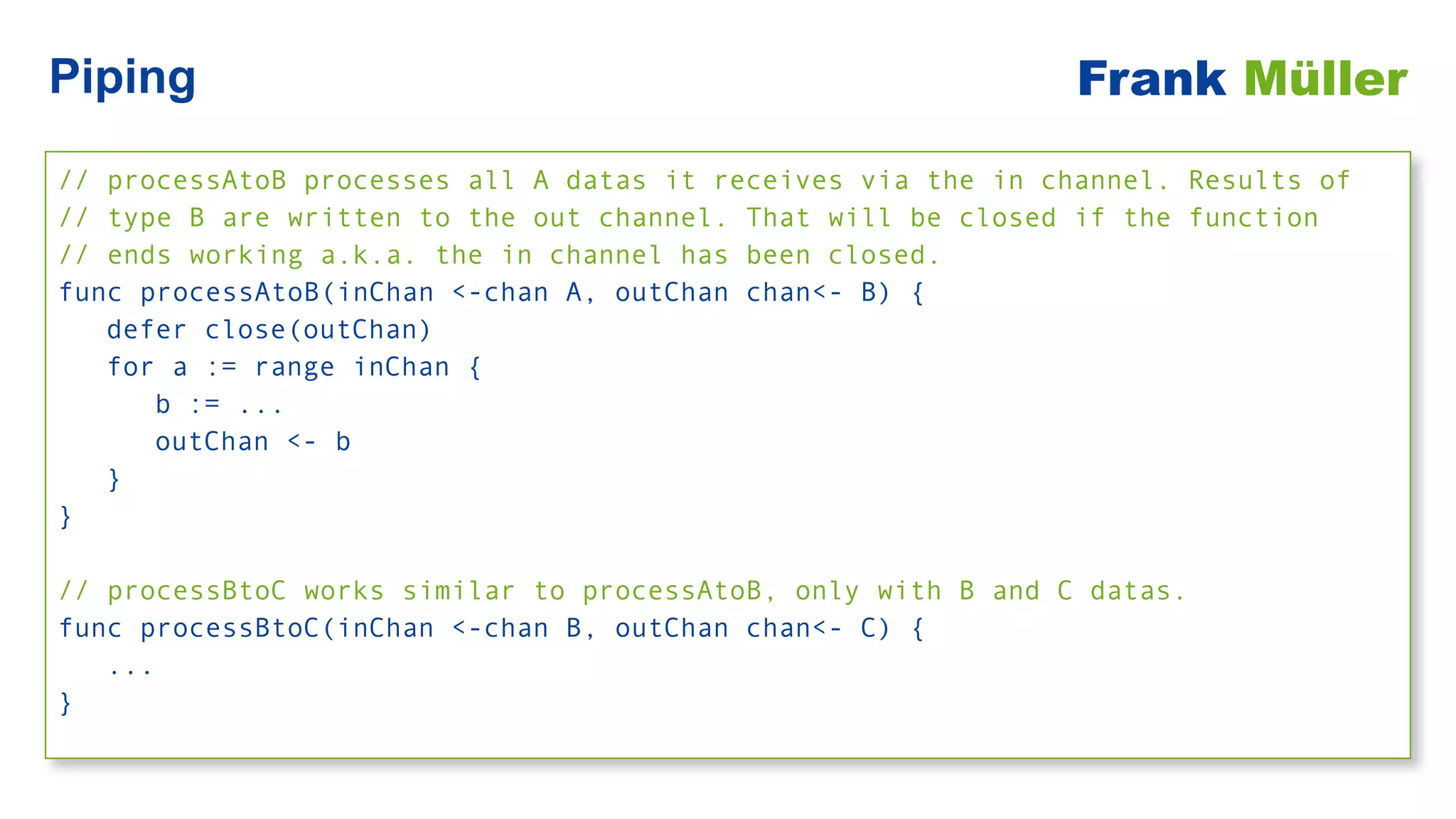
// processAtoB processes all A datas it receives via the in channel. Results of


// type B are written to the out channel. That will be closed if the function


// ends working a.k.a. the in channel has been closed.


func processAtoB(inChan <-chan A, outChan chan<- B) {


defer close(outChan)


for a := range inChan {


b := ...


outChan <- b


}


}


// processBtoC works similar to processAtoB, only with B and C datas.


func processBtoC(inChan <-chan B, outChan chan<- C) {


...


}
Piping Frank Müller
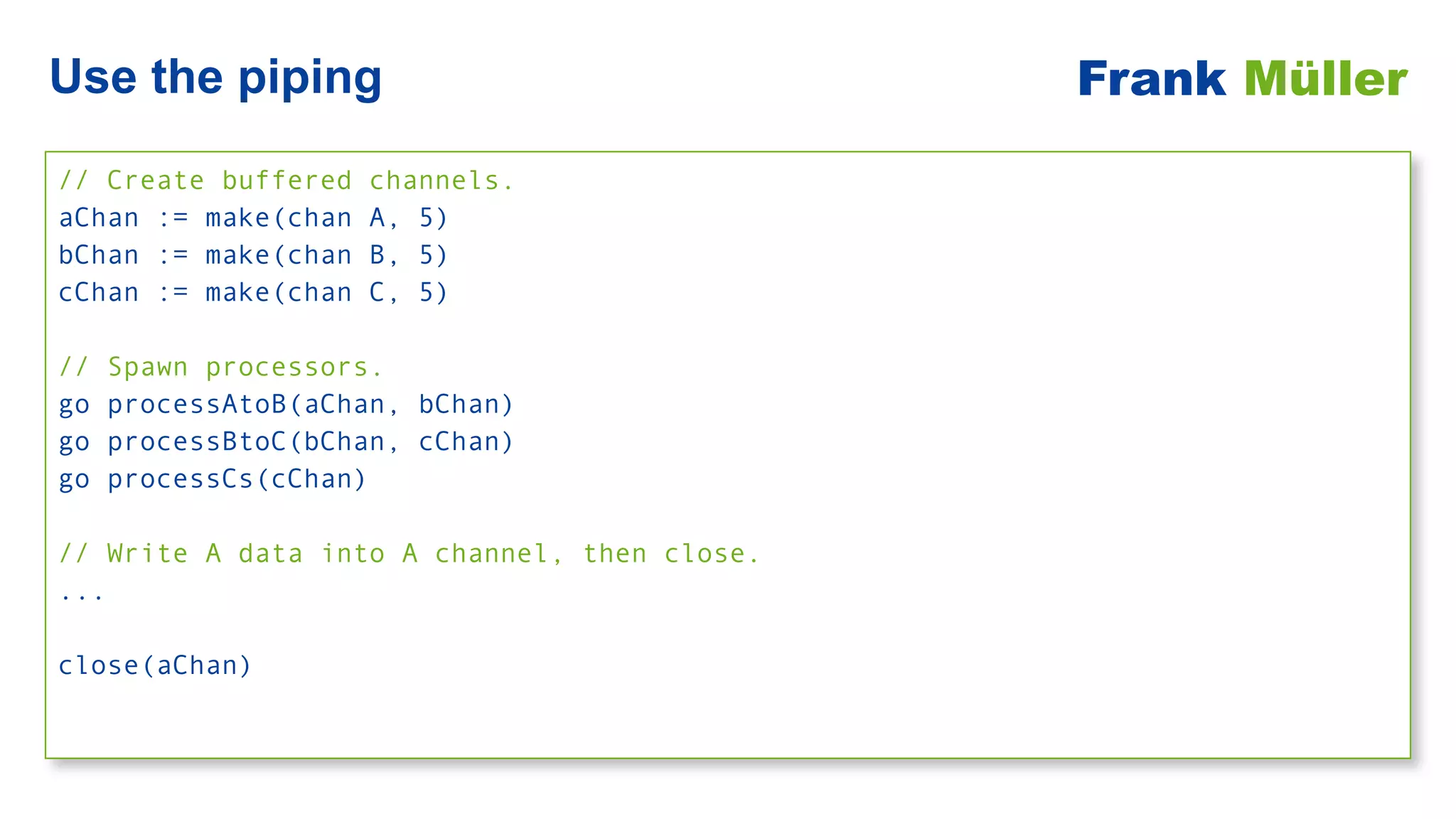
// Create buffered channels.


aChan := make(chan A, 5)


bChan := make(chan B, 5)


cChan := make(chan C, 5)


// Spawn processors.


go processAtoB(aChan, bChan)


go processBtoC(bChan, cChan)


go processCs(cChan)


// Write A data into A channel, then close.


...


close(aChan)
Use the piping Frank Müller
Example "Service"
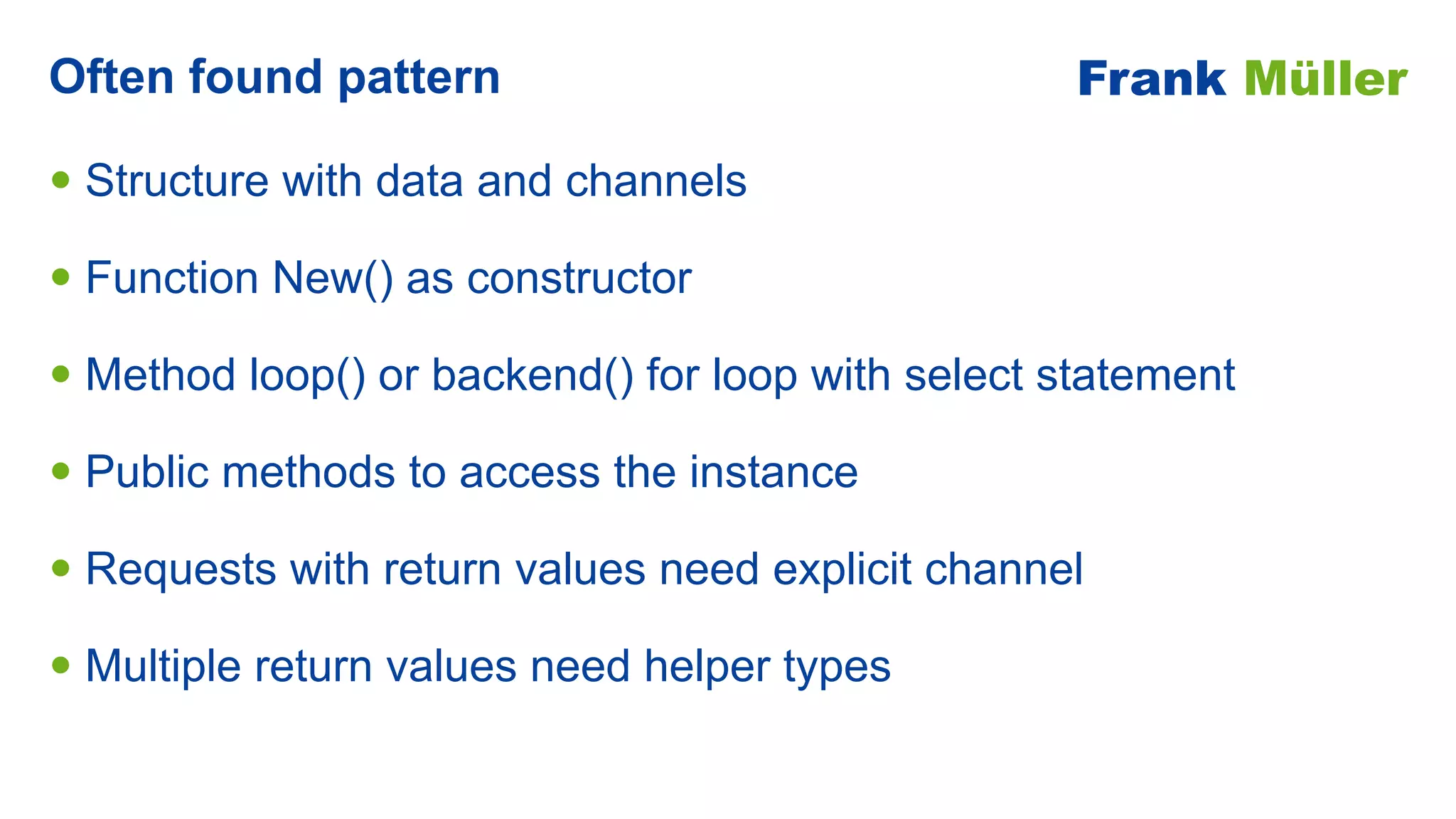
• Structure with data and channels


• Function New() as constructor


• Method loop() or backend() for loop with select statement


• Public methods to access the instance


• Requests with return values need explicit channel


• Multiple return values need helper types
Often found pattern Frank Müller
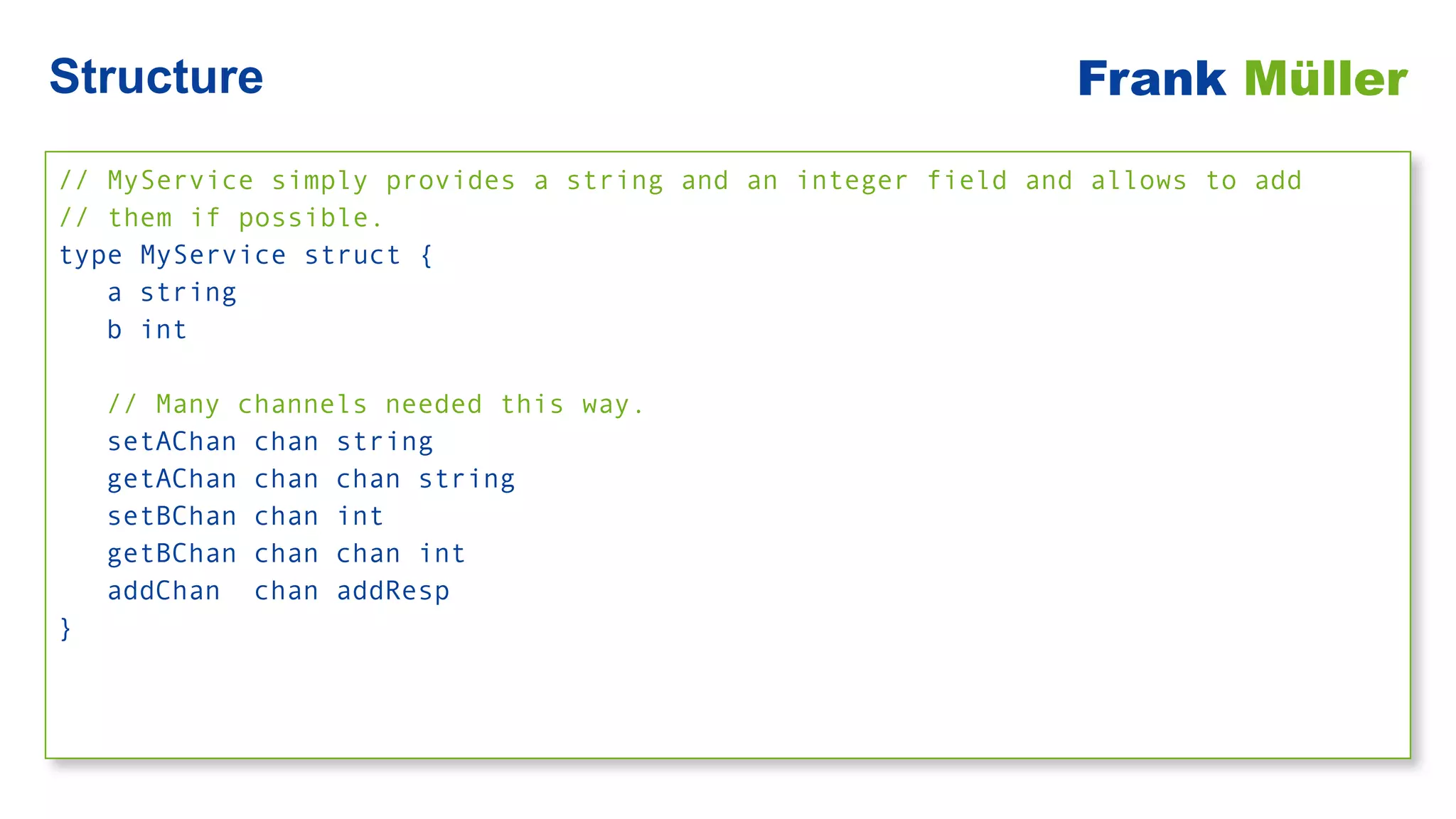
// MyService simply provides a string and an integer field and allows to add


// them if possible.


type MyService struct {


a string


b int


// Many channels needed this way.


setAChan chan string


getAChan chan chan string


setBChan chan int


getBChan chan chan int


addChan chan addResp


}
Structure Frank Müller
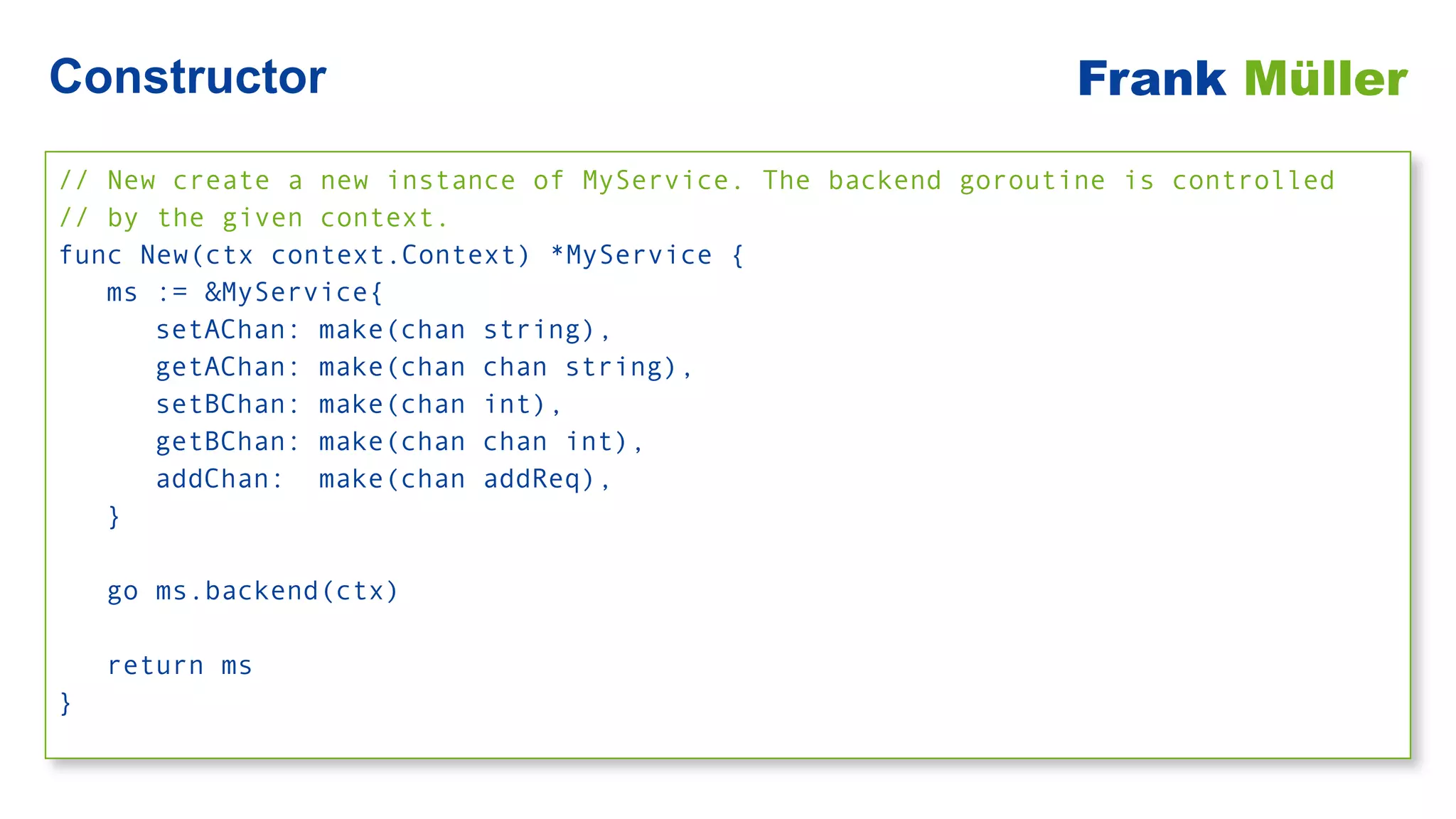
// New create a new instance of MyService. The backend goroutine is controlled


// by the given context.


func New(ctx context.Context) *MyService {


ms := &MyService{


setAChan: make(chan string),


getAChan: make(chan chan string),


setBChan: make(chan int),


getBChan: make(chan chan int),


addChan: make(chan addReq),


}


go ms.backend(ctx)


return ms


}
Constructor Frank Müller
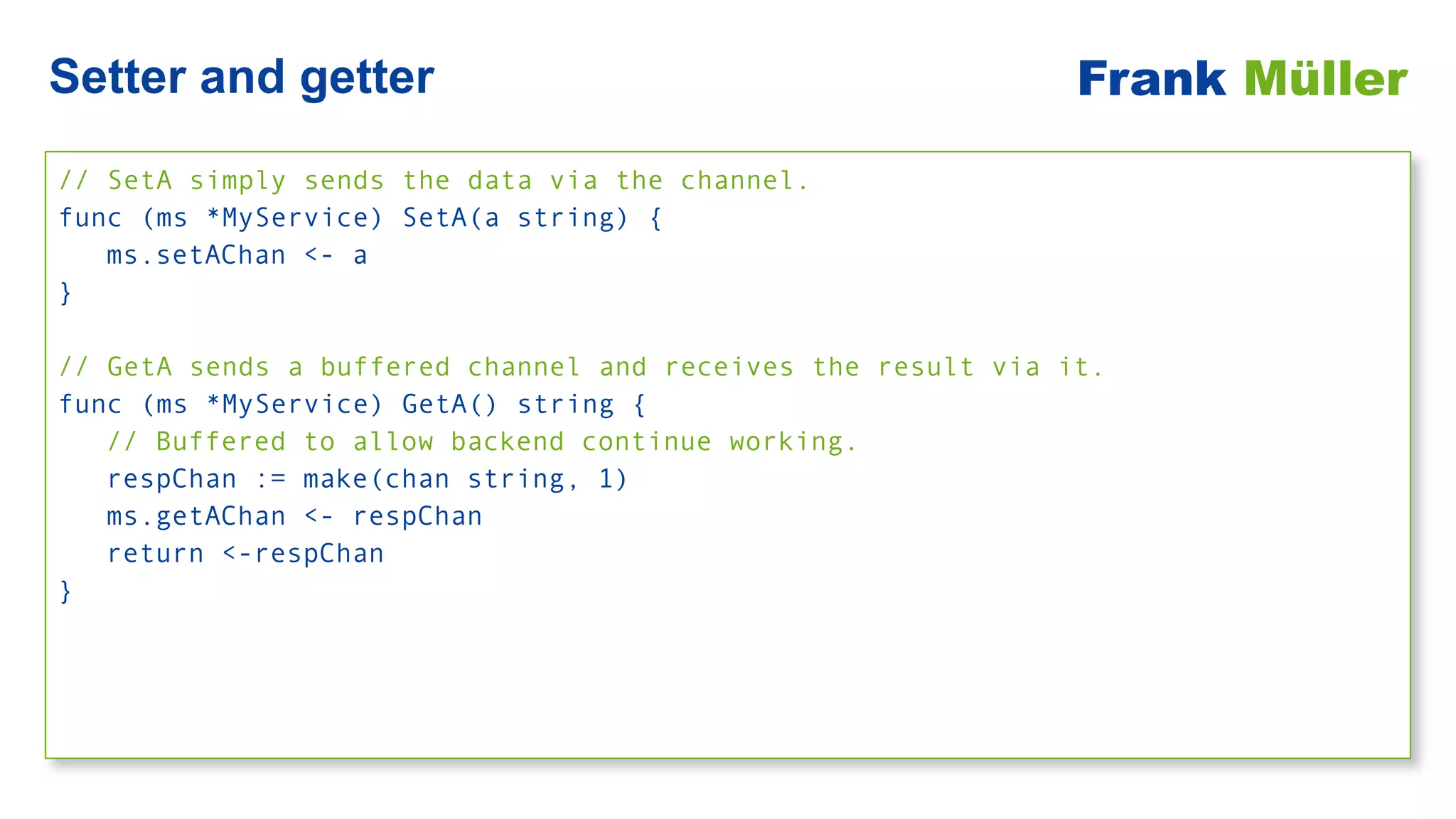
// SetA simply sends the data via the channel.


func (ms *MyService) SetA(a string) {


ms.setAChan <- a


}


// GetA sends a buffered channel and receives the result via it.


func (ms *MyService) GetA() string {


// Buffered to allow backend continue working.


respChan := make(chan string, 1)


ms.getAChan <- respChan


return <-respChan


}
Setter and getter Frank Müller
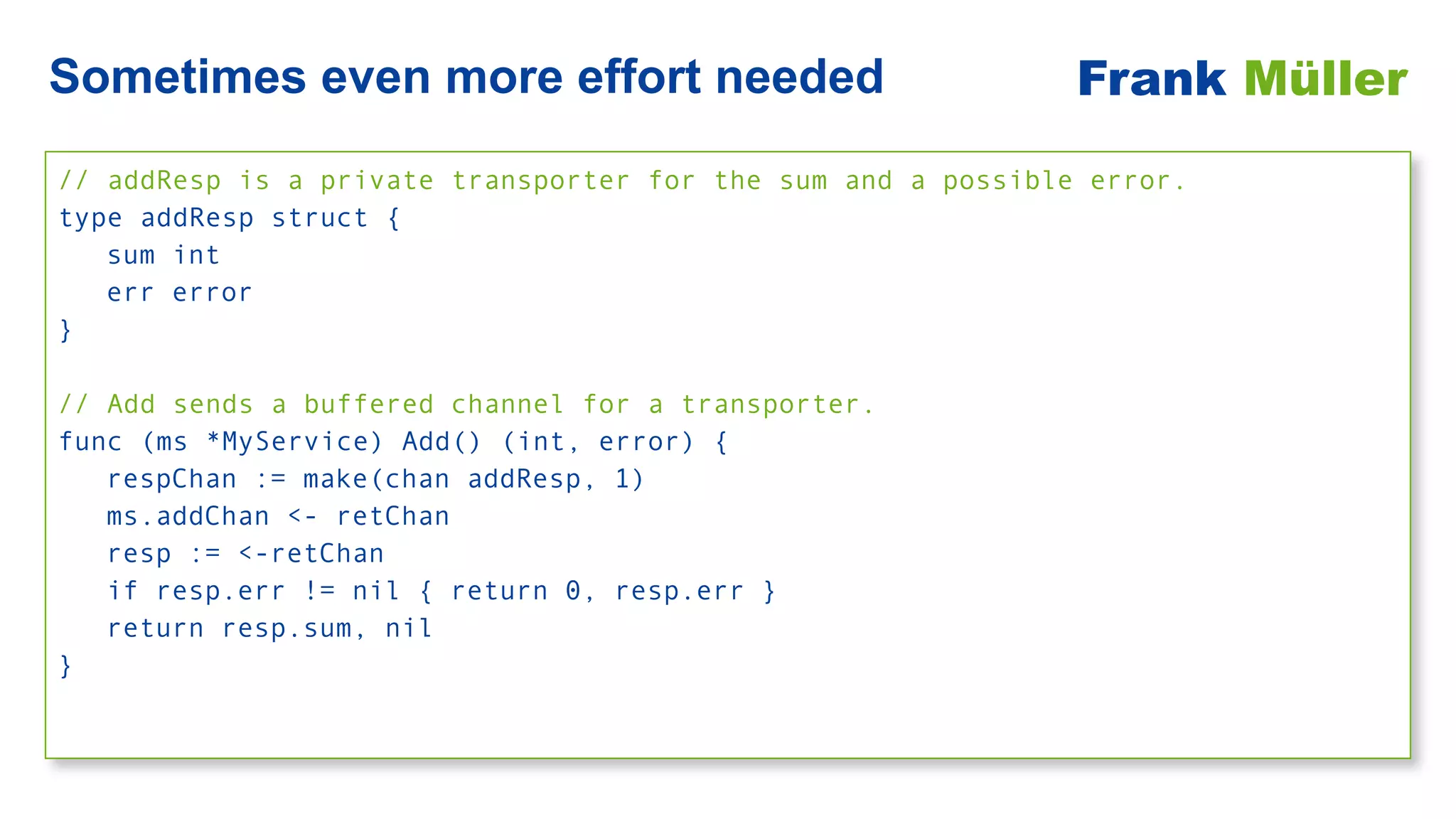
// addResp is a private transporter for the sum and a possible error.


type addResp struct {


sum int


err error


}


// Add sends a buffered channel for a transporter.


func (ms *MyService) Add() (int, error) {


respChan := make(chan addResp, 1)


ms.addChan <- retChan


resp := <-retChan


if resp.err != nil { return 0, resp.err }


return resp.sum, nil


}
Sometimes even more effort needed Frank Müller
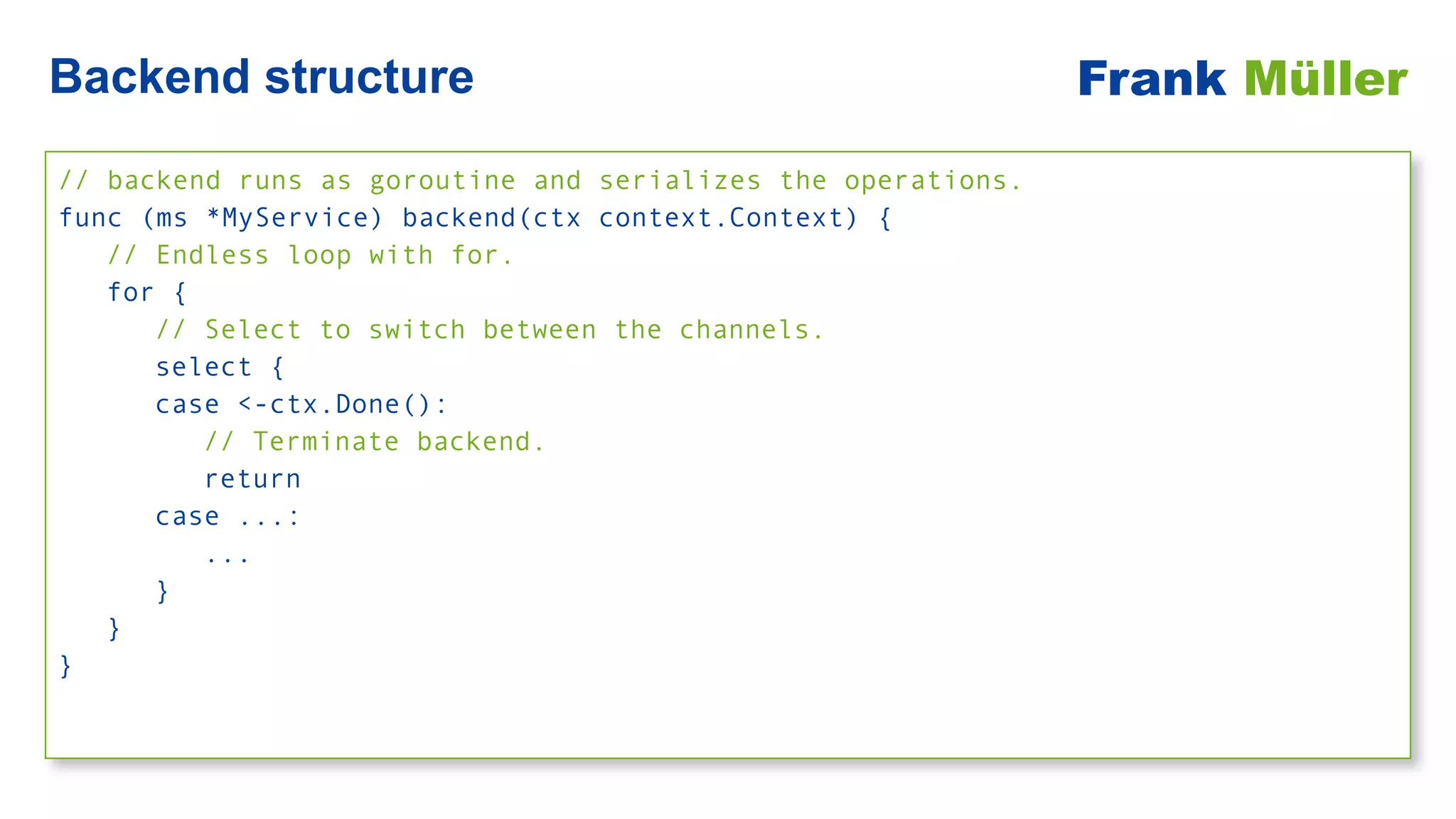
// backend runs as goroutine and serializes the operations.


func (ms *MyService) backend(ctx context.Context) {


// Endless loop with for.


for {


// Select to switch between the channels.


select {


case <-ctx.Done():


// Terminate backend.


return


case ...:


...


}


}


}
Backend structure Frank Müller
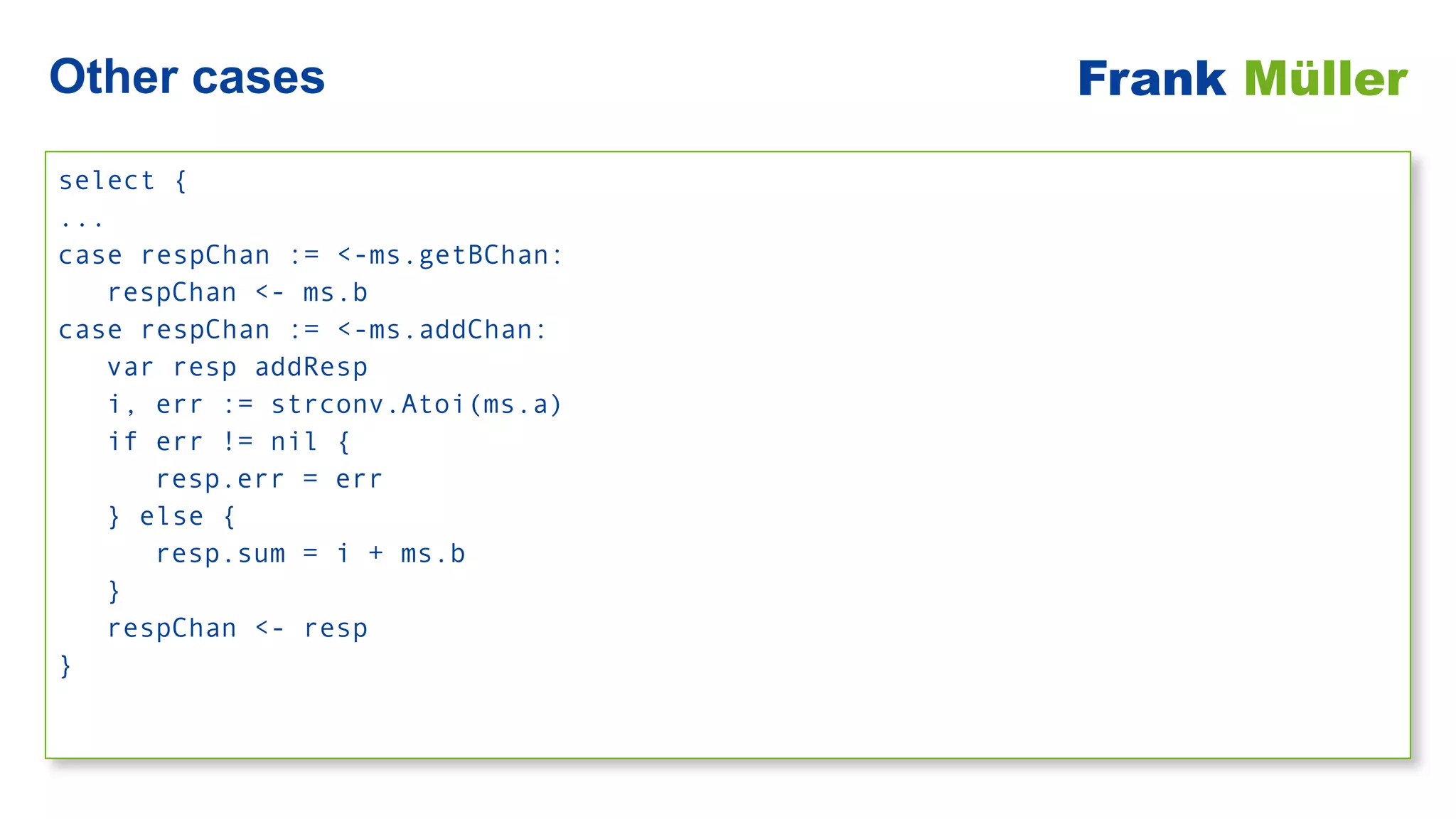
select {


...


case respChan := <-ms.getBChan:


respChan <- ms.b


case respChan := <-ms.addChan:


var resp addResp


i, err := strconv.Atoi(ms.a)


if err != nil {


resp.err = err


} else {


resp.sum = i + ms.b


}


respChan <- resp


}
Other cases Frank Müller
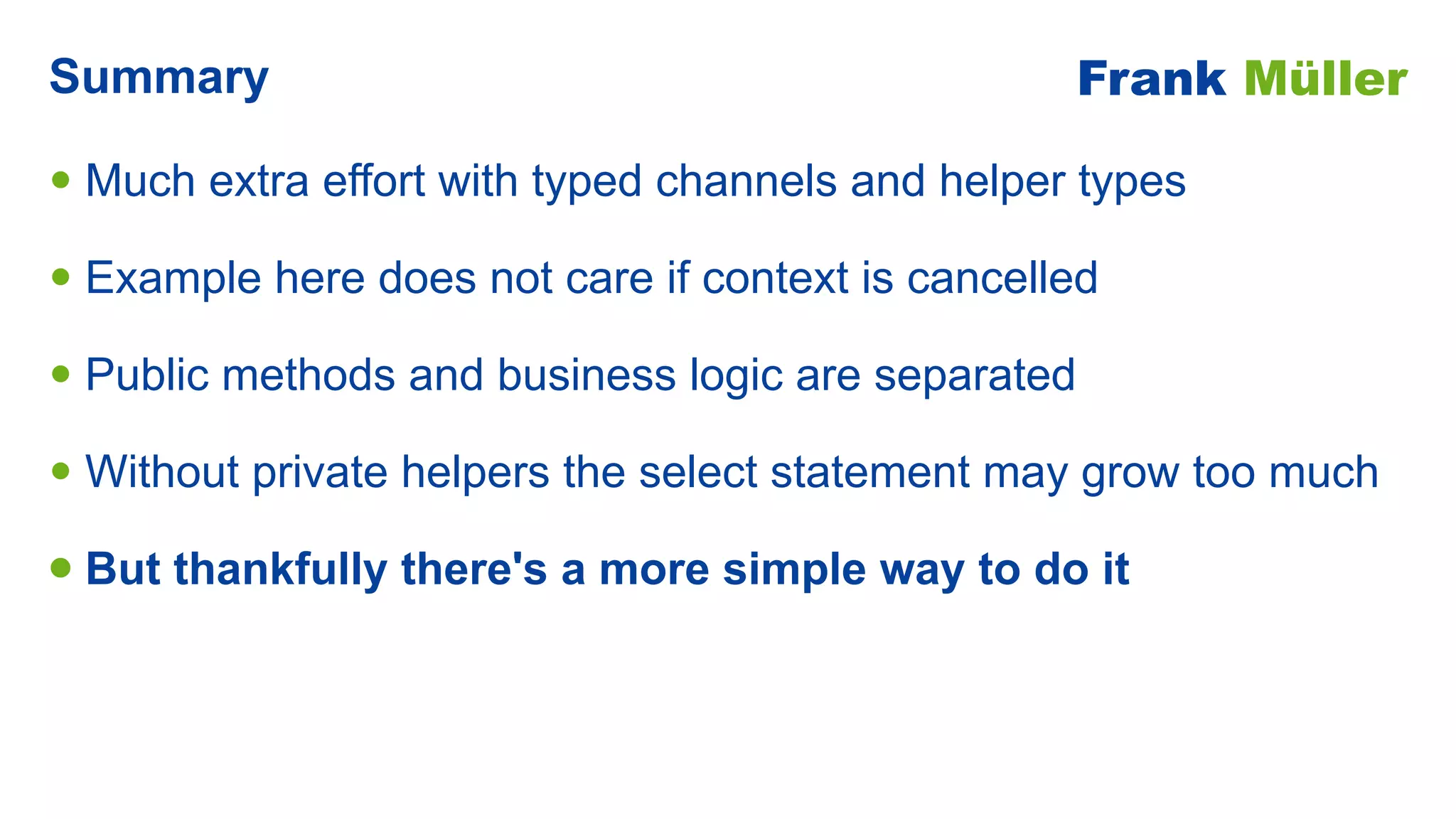
• Much extra effort with typed channels and helper types


• Example here does not care if context is cancelled


• Public methods and business logic are separated


• Without private helpers the select statement may grow too much


• But thankfully there's a more simple way to do it
Summary Frank Müller
Example "Actor"
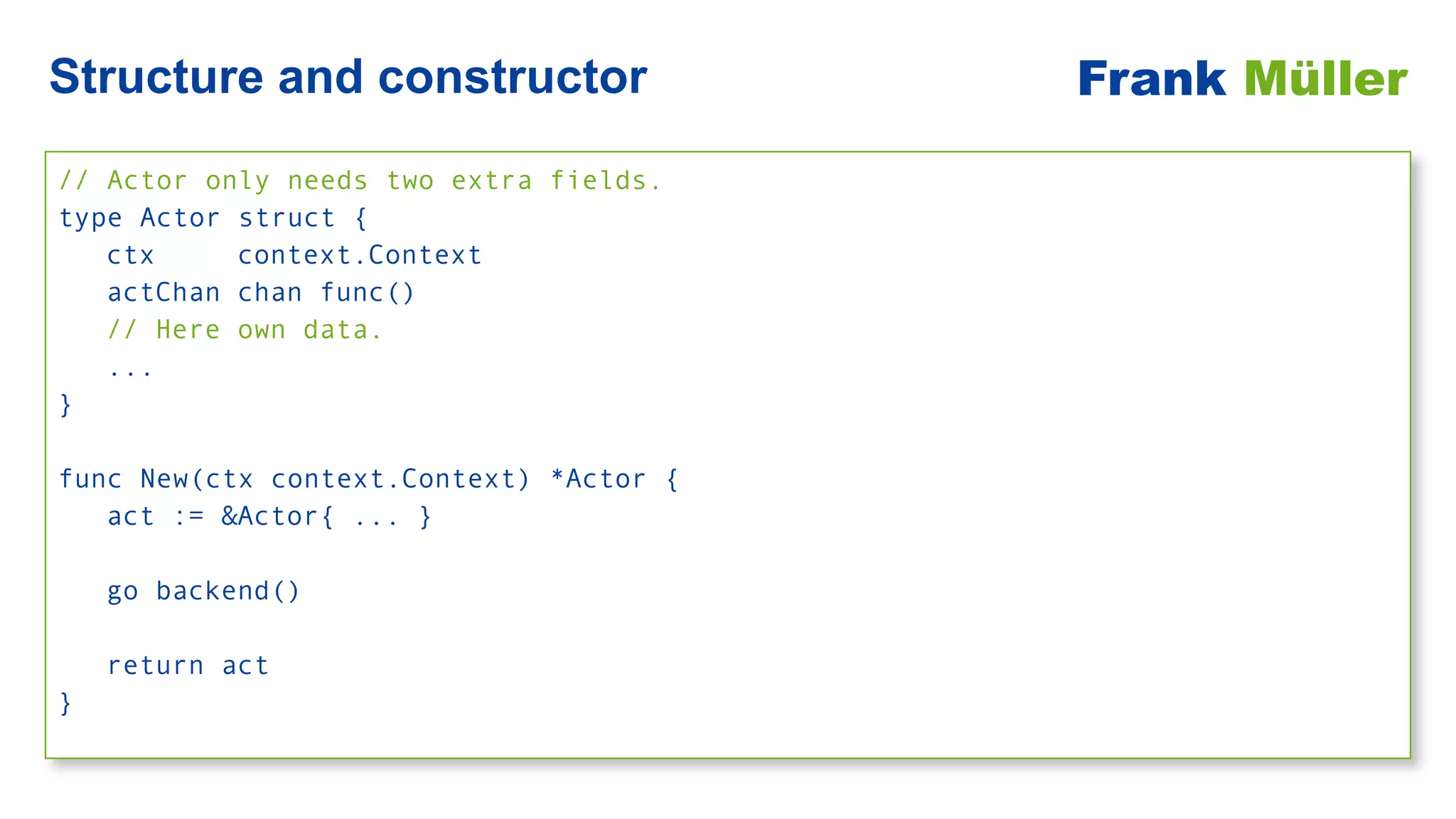
// Actor only needs two extra fields.


type Actor struct {


ctx context.Context


actChan chan func()


// Here own data.


...


}


func New(ctx context.Context) *Actor {


act := &Actor{ ... }


go backend()


return act


}
Structure and constructor Frank Müller
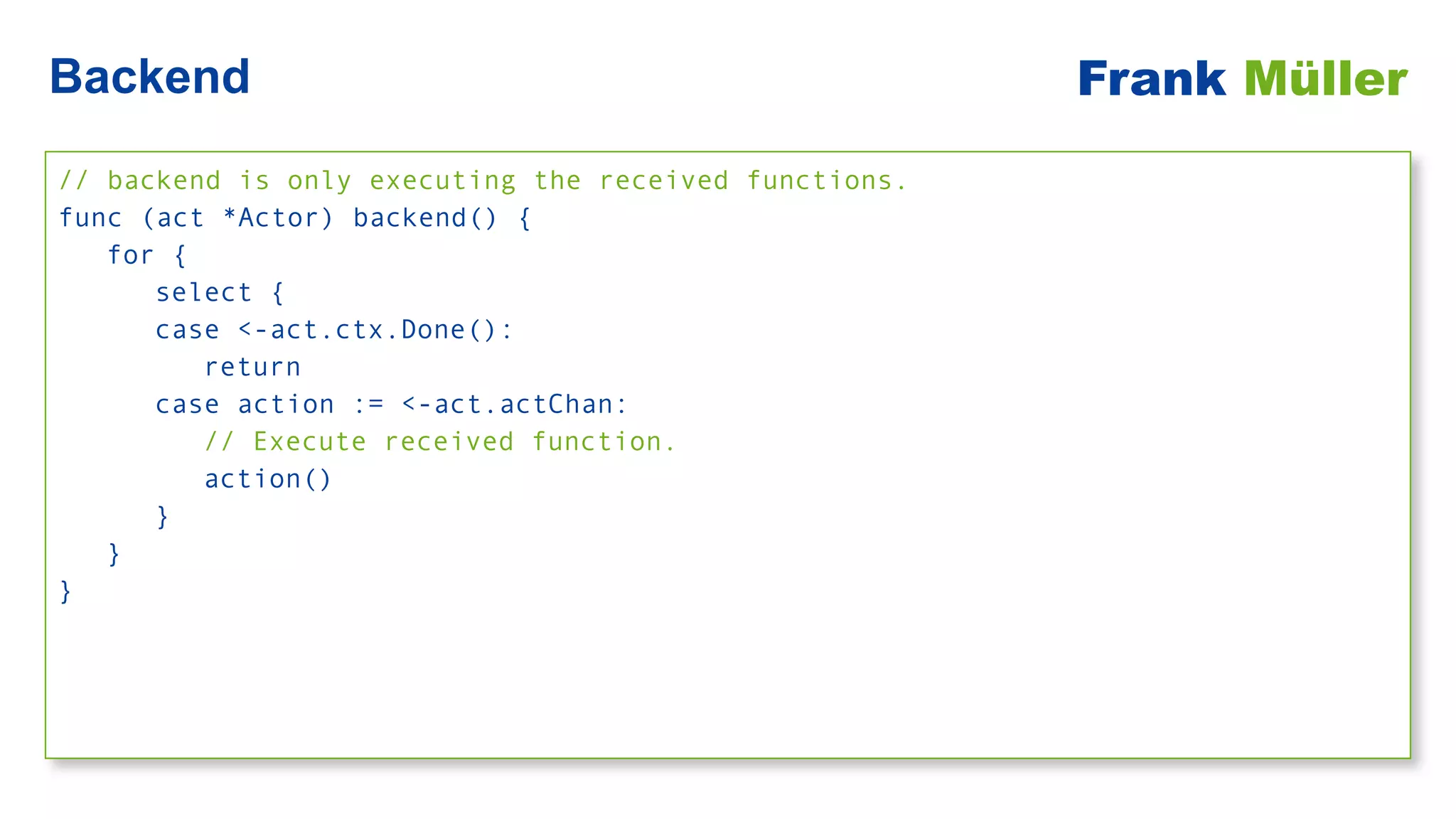
// backend is only executing the received functions.


func (act *Actor) backend() {


for {


select {


case <-act.ctx.Done():


return


case action := <-act.actChan:


// Execute received function.


action()


}


}


}
Backend Frank Müller
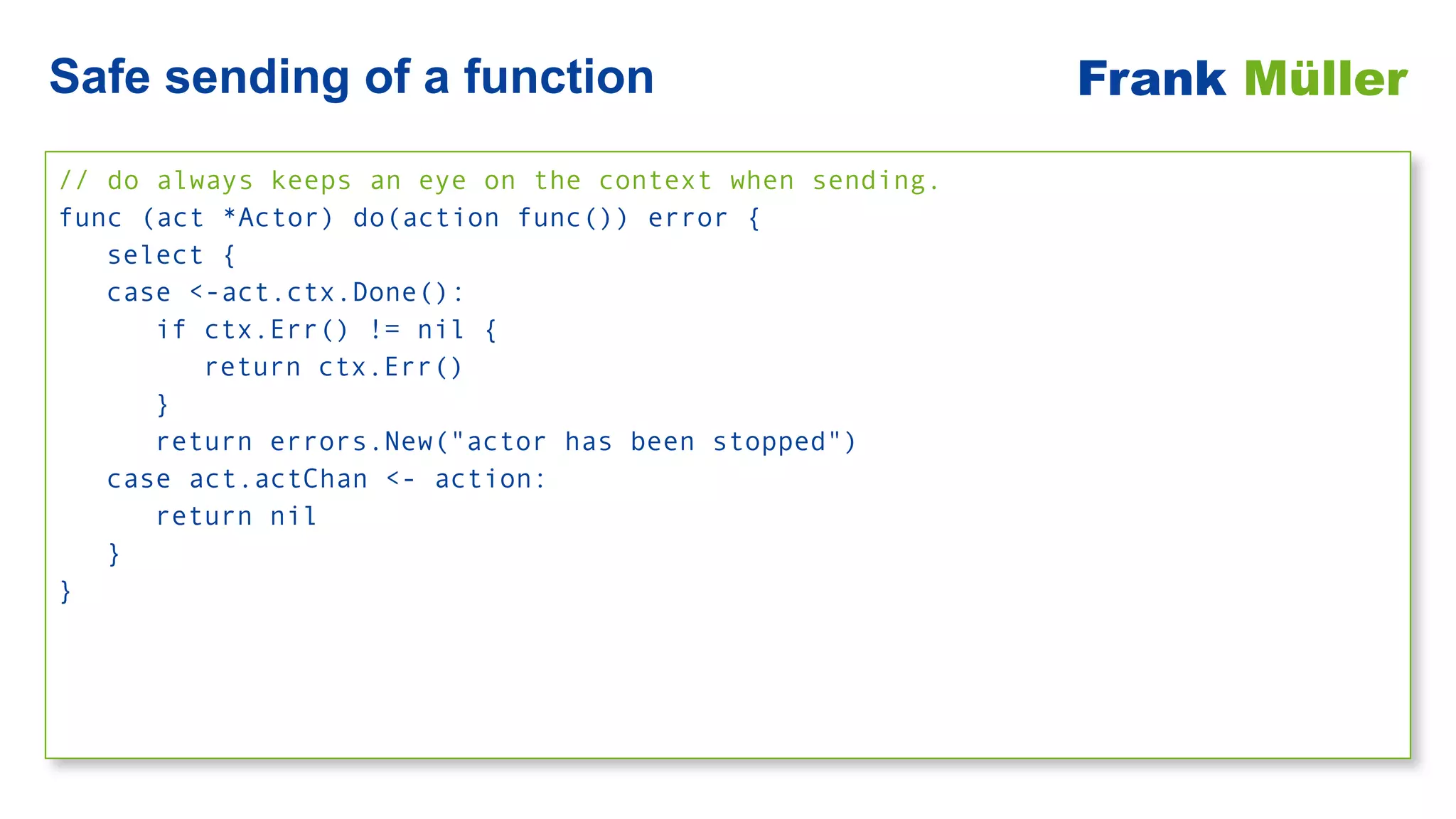
// do always keeps an eye on the context when sending.


func (act *Actor) do(action func()) error {


select {


case <-act.ctx.Done():


if ctx.Err() != nil {


return ctx.Err()


}


return errors.New("actor has been stopped")


case act.actChan <- action:


return nil


}


}
Safe sending of a function Frank Müller
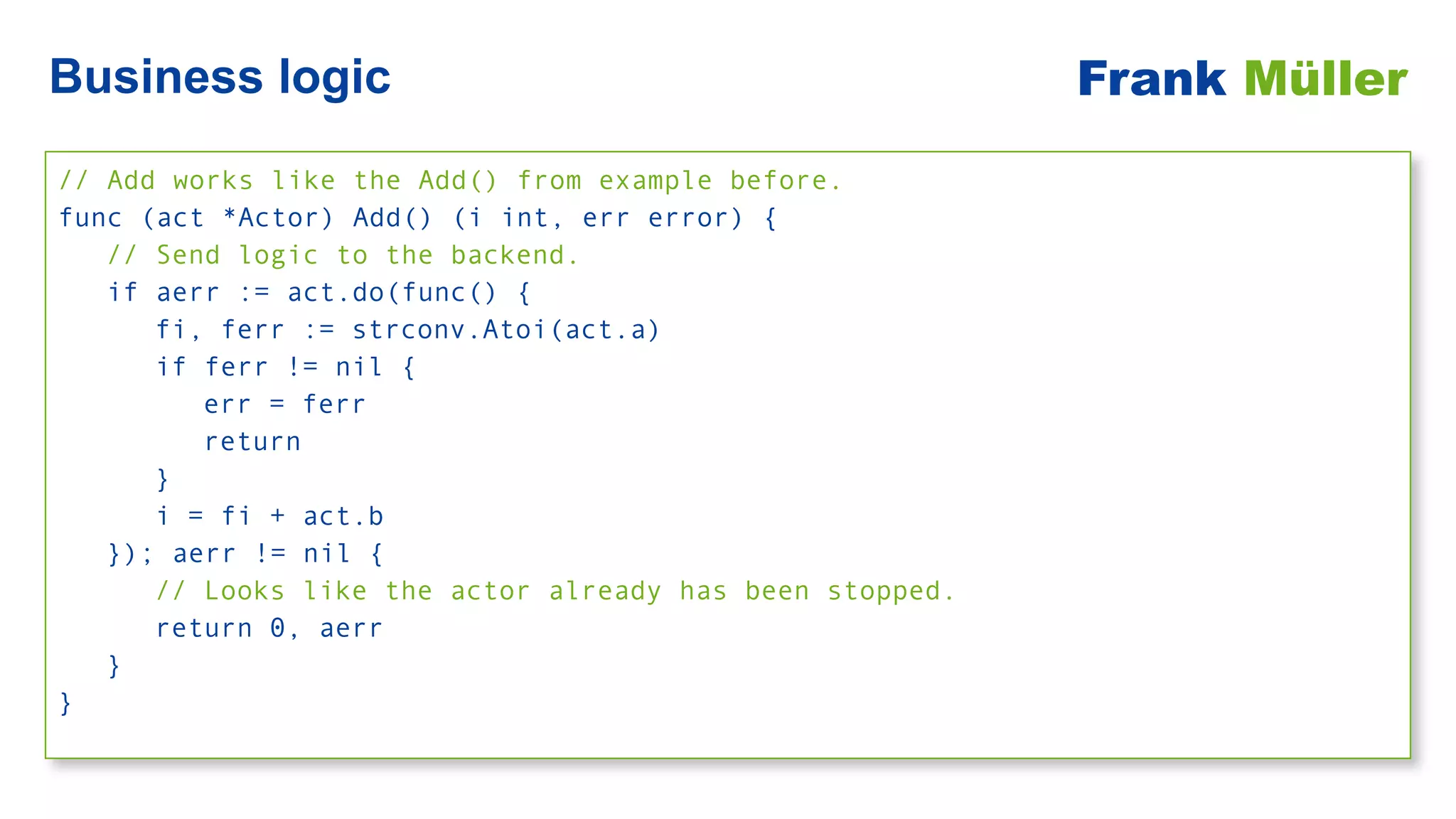
// Add works like the Add() from example before.


func (act *Actor) Add() (i int, err error) {


// Send logic to the backend.


if aerr := act.do(func() {


fi, ferr := strconv.Atoi(act.a)


if ferr != nil {


err = ferr


return


}


i = fi + act.b


}); aerr != nil {


// Looks like the actor already has been stopped.


return 0, aerr


}


}
Business logic Frank Müller
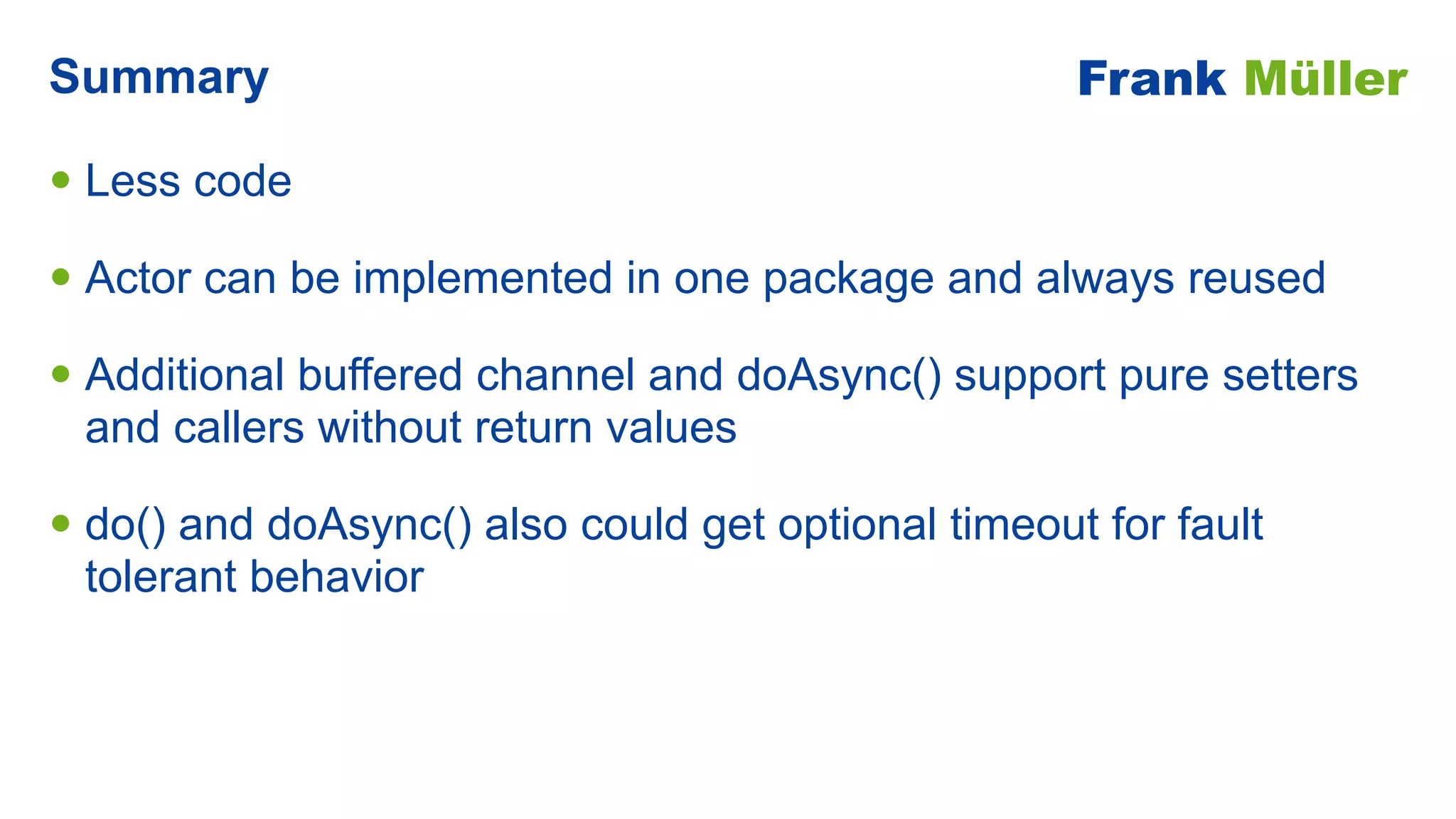
• Less code


• Actor can be implemented in one package and always reused


• Additional buffered channel and doAsync() support pure setters
and callers without return values


• do() and doAsync() also could get optional timeout for fault
tolerant behavior
Summary Frank Müller
Example "Supervisor"
// Supervisor helps monitoring and restarting concurrent functions.


type Supervisor struct {


mu sync.Mutex


workers map[string]func() error


spawnChan chan string


}


// New starts the supervisor in the background.


func New(ctx context.Context) *Supervisor {


s := &Structure{ ... }


go s.backend(ctx)


return s


}
Structure and constructor Frank Müller
// Spawn tells backend to spawn the given worker.


func (s *Supervisor) spawn(id string, worker func() error) error {


s.mu.Lock()


defer s.mu.Unlock()


_, ok := s.workers[id]


if ok {


return errors.New("double worker ID")


}


s.workers[id] = worker


s.spawnChan <- id


return nil


}
Start a worker Frank Müller
// wrap takes care for errors of the worker. In case of an error it notifies


// the backend to re-spawn.


func (s *Supervisor) wrap(id string) {


worker := s.workers[id]


if err := worker(); err != nil {


// Log the error and re-spawn the worker.


log.Printf("worker %q terminated with error: %v", id, err)


s.spawnChan <- id


return


}


// Delete successful terminated worker.


s.mu.Lock()


delete(s.workers, id)


s.mu.Unlock()


}
Wrapper to check if worker error Frank Müller
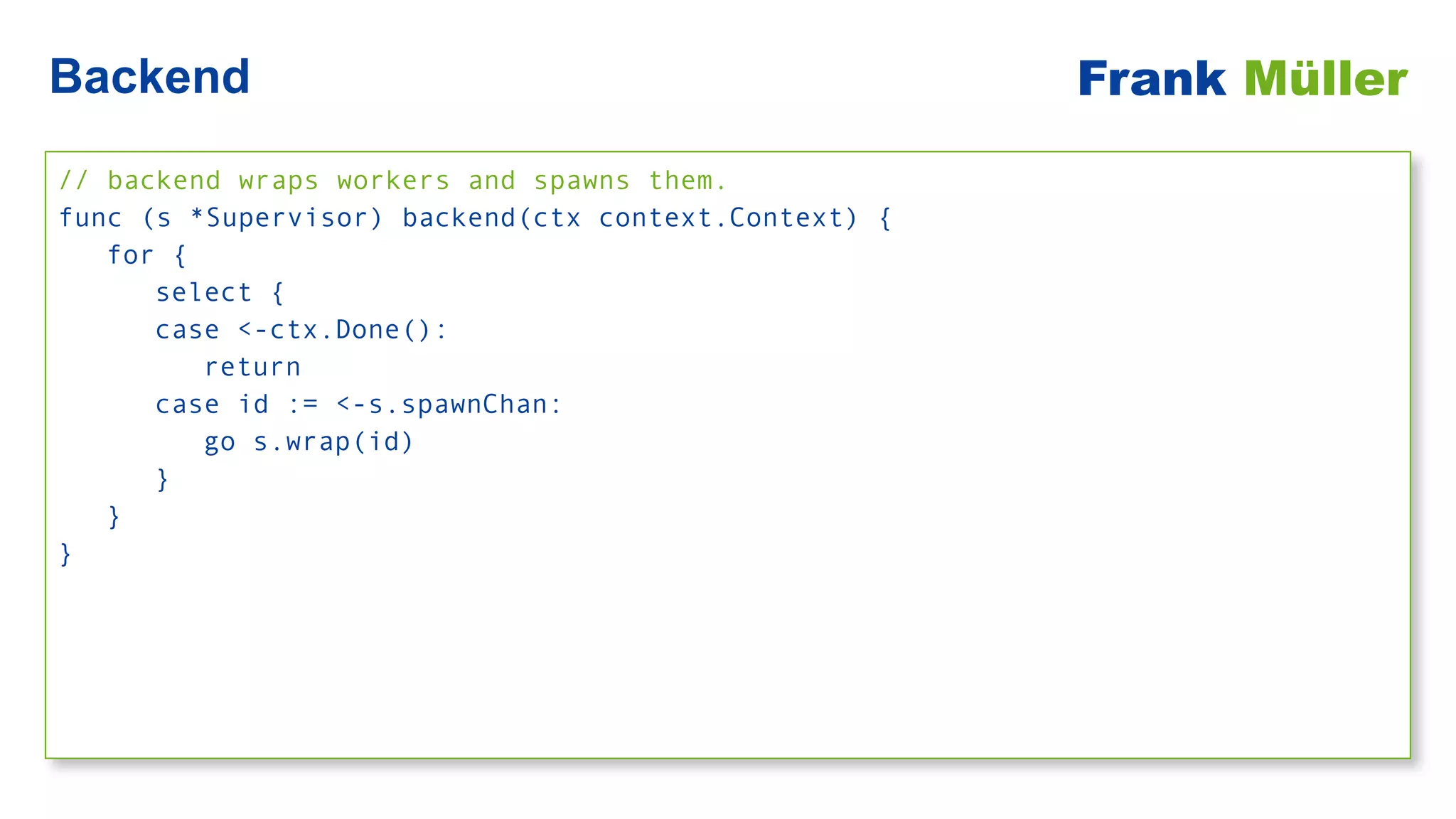
// backend wraps workers and spawns them.


func (s *Supervisor) backend(ctx context.Context) {


for {


select {


case <-ctx.Done():


return


case id := <-s.spawnChan:


go s.wrap(id)


}


}


}
Backend Frank Müller
Pitfalls
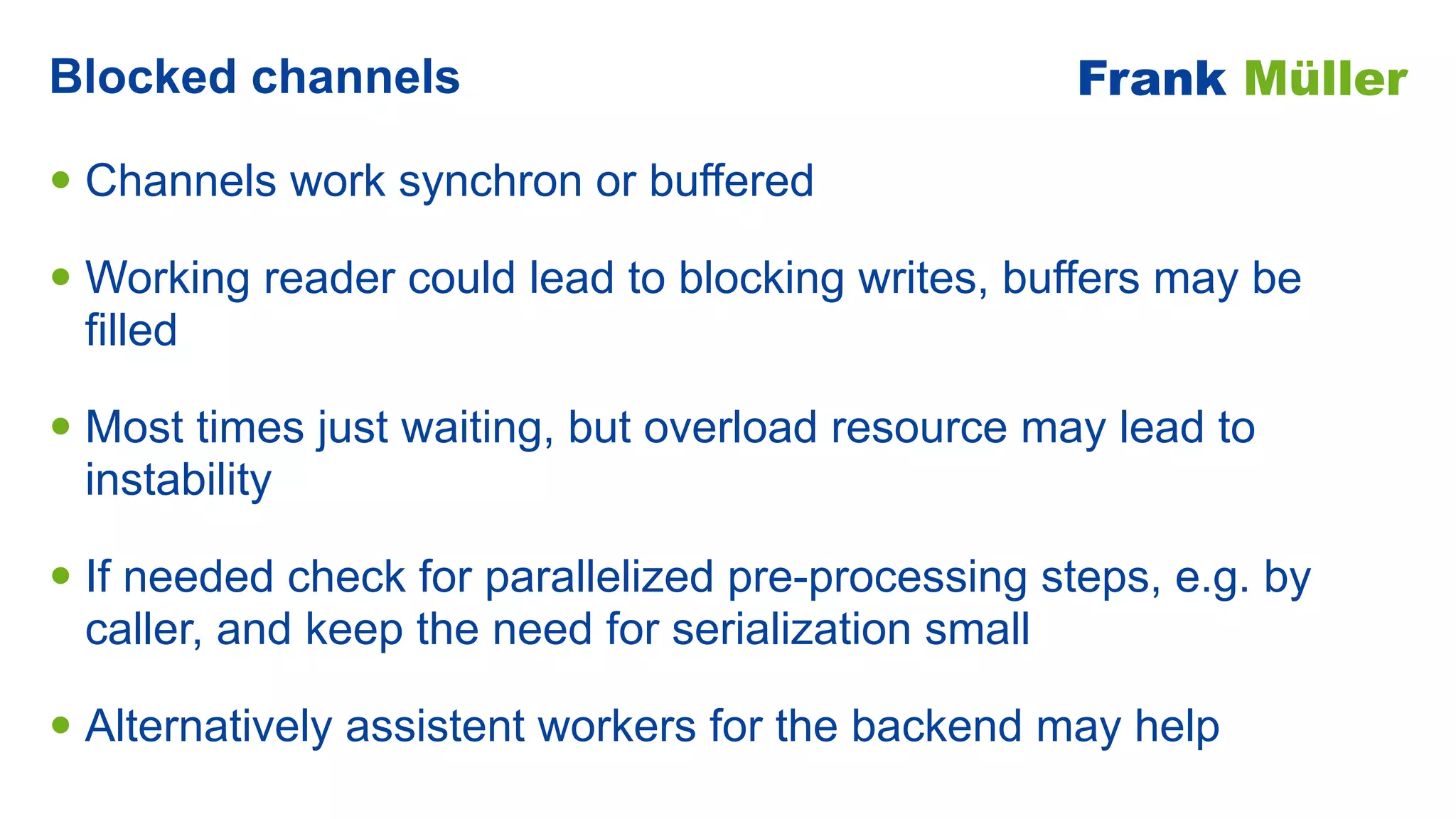
• Channels work synchron or buffered


• Working reader could lead to blocking writes, buffers may be
filled


• Most times just waiting, but overload resource may lead to
instability


• If needed check for parallelized pre-processing steps, e.g. by
caller, and keep the need for serialization small


• Alternatively assistent workers for the backend may help
Blocked channels Frank Müller
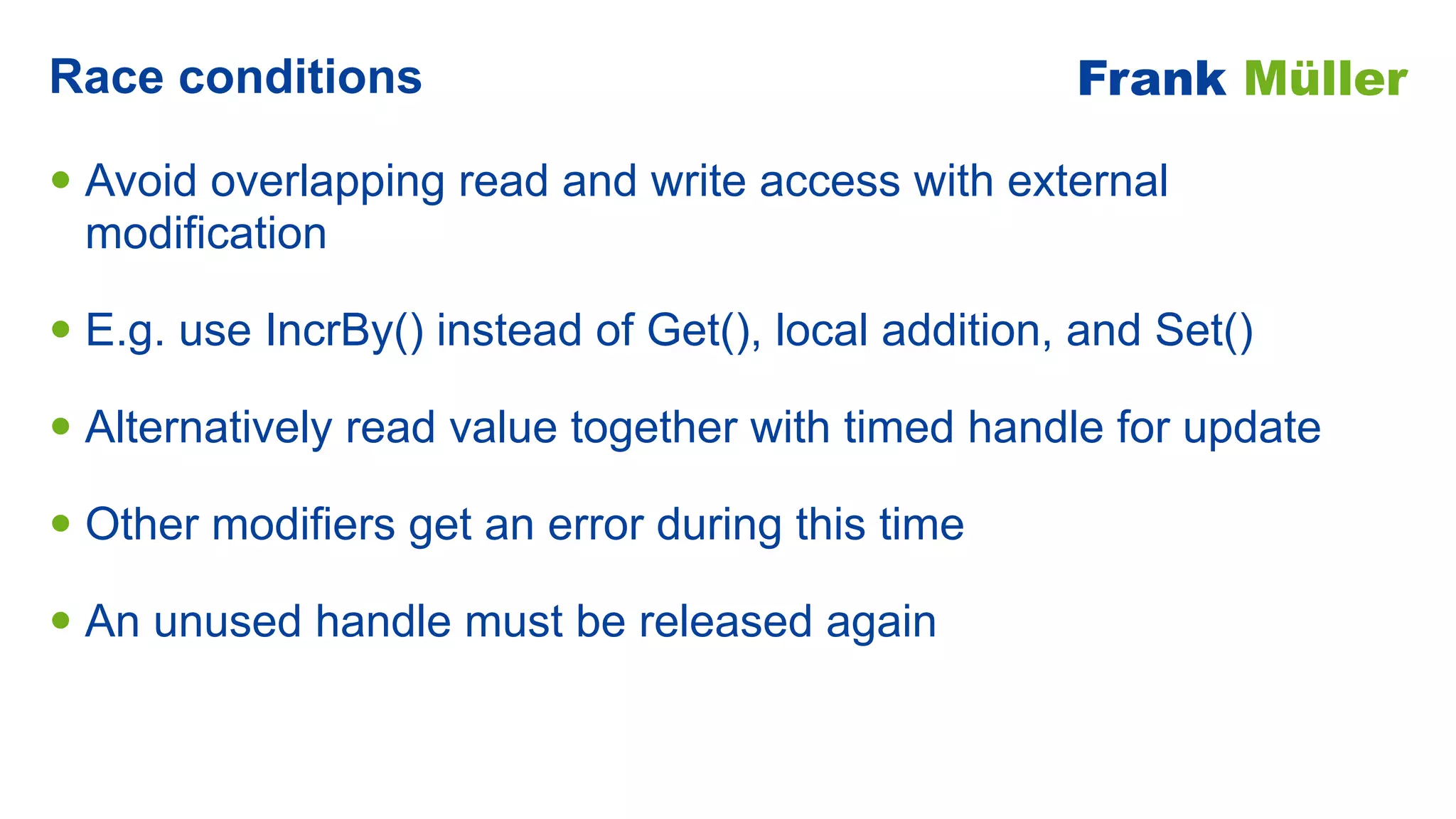
• Avoid overlapping read and write access with external
modification


• E.g. use IncrBy() instead of Get(), local addition, and Set()


• Alternatively read value together with timed handle for update


• Other modifiers get an error during this time


• An unused handle must be released again
Race conditions Frank Müller
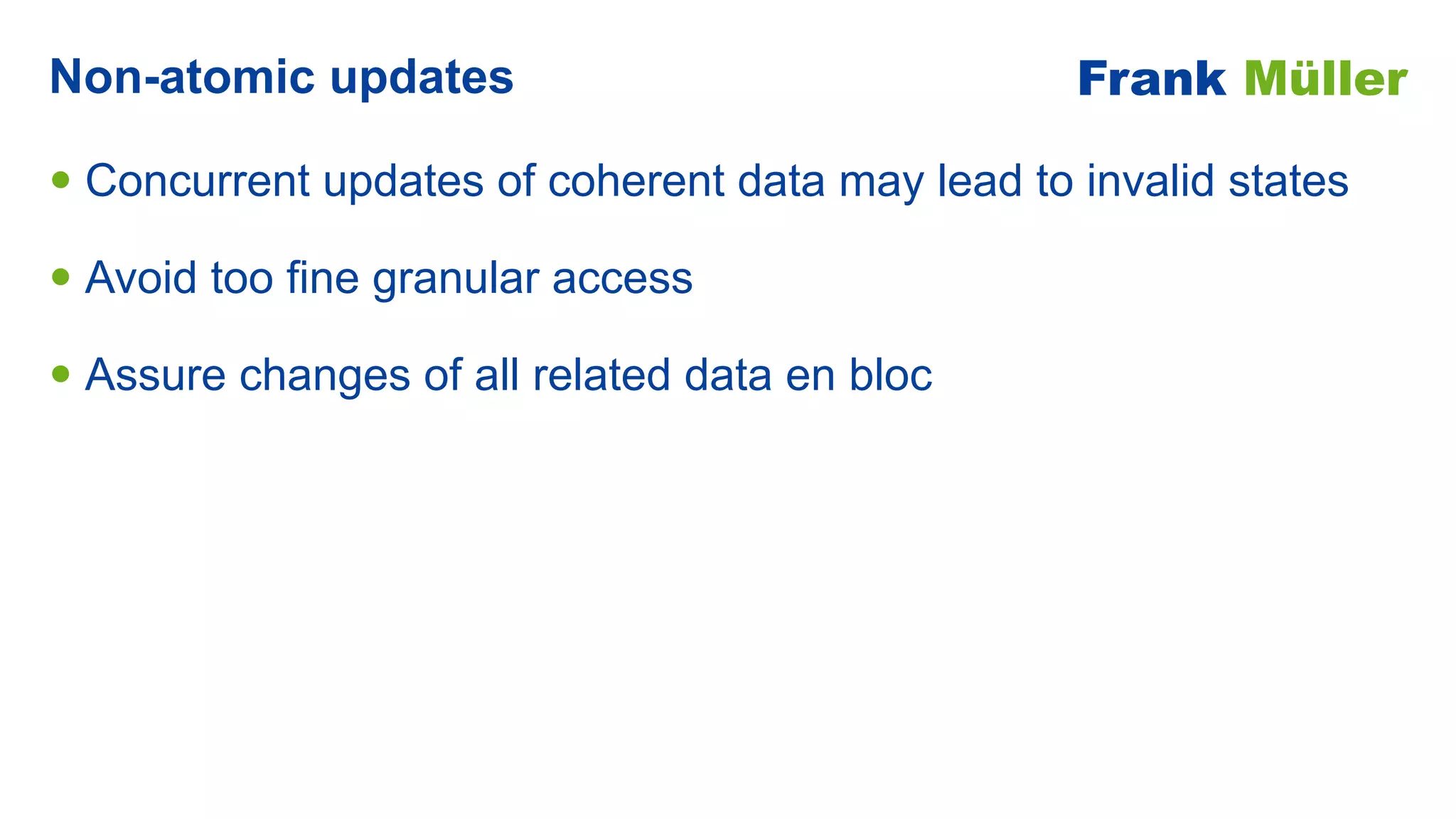
• Concurrent updates of coherent data may lead to invalid states


• Avoid too fine granular access


• Assure changes of all related data en bloc
Non-atomic updates Frank Müller
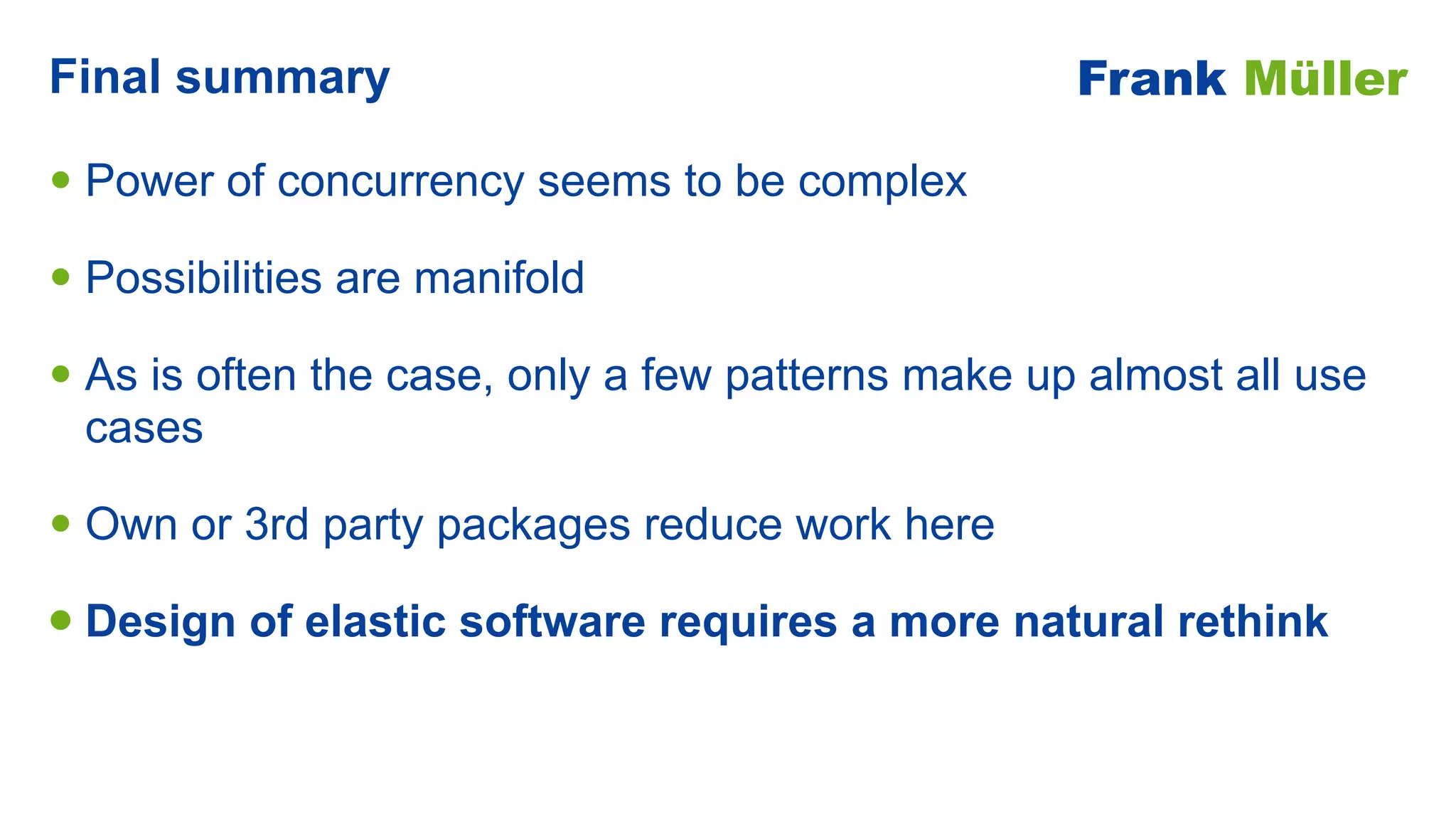
Final summary
• Power of concurrency seems to be complex


• Possibilities are manifold


• As is often the case, only a few patterns make up almost all use
cases


• Own or 3rd party packages reduce work here


• Design of elastic software requires a more natural rethink
Final summary Frank Müller
Thanks a lot and


have a nice


evening


Image Sources


123RF


Pexels


iStockphoto


Own photos

Concurrency with Go

  • 1.
    Concurrency with Go NaturalDesign in a Technical Language Frank Müller
  • 2.
    •Oldenburg, Germany •Born 1965 •Workingat Kubermatic •Team Lead Development •@themue Introduction Frank Müller
  • 3.
    Our world isconcurrent
  • 4.
    • Individuals populatethis world • They act sometimes independent of each other, sometimes dependent, sometimes together • Communication and signals enable their coexistence It's a natural principle Frank Müller
  • 5.
  • 6.
  • 7.
  • 8.
  • 9.
  • 10.
  • 11.
  • 12.
    Modern systems aremore powerful
  • 13.
    • Computer architecturesare changing • Growth via CPUs, cores and hyper-threads • Manual usage via threads is complex and error-prone • Concurrent runtime environments enable fine-grained usage One motivation is the hardware Frank Müller
  • 14.
    Distribution of computingpower Frank Müller Process Process Process Process Process Process Process Process Runtime Envirunment Core Core Core Core Process Process Process Process
  • 15.
  • 16.
    ... or asa team together
  • 17.
    • Encapsulation ofthe state in the process • Communication via messages • Sequential processing • Atomic state changes • OOP in the real sense Structure is more important motivation Frank Müller
  • 18.
    ❞ –Rob Pike Parallelis m Programmingas the simultaneous execution of (possibly related) computations . Concurrenc y Programming as the composition of independently executing processes.
  • 19.
    • Actor Model ‣1973 ‣ Carl Hewitt, Peter Bishop und Richard Steiger • Communicating Sequential Processes ‣ 1978 ‣ Tony Hoare Ideas long known Frank Müller
  • 20.
    • Concurrent processescommunicate via one or more channels • Processes, unlike channels, are anonymous • Data is not sent until the receiver is ready to receive it • Incoming data is processed sequentially Communicating Sequential Processes Frank Müller
  • 21.
    Communicating Sequential ProcessesFrank Müller Process Process Process Process Process Process Process Process Process Process
  • 22.
  • 23.
  • 24.
    Processes provide servicesFrank Müller Service Provider Client Client Client Client Active Waiting Waiting Waiting
  • 25.
    Processes manage ressourcesFrank Müller Client Client Client Manager Resource B Resource A Resource C Active Waiting Waiting Read / Write
  • 26.
    Processes manage parallelrequests Frank Müller Worker Worker Worker Client Client Client Master Request A Request B Request C Request A Request B Request C Reply
  • 27.
    Processes handle eventsFrank Müller Event Manager Emitter Emitter Emitter Subscriber Subscriber Subscriber Events Events Events Events
  • 28.
    Processes monitor eachother Frank Müller Supervisor Process A Process B Process B' Starts A Starts B Monitors A Monitors B Monitors B' Restarts B'
  • 29.
    Processes support powerfulETL Frank Müller Sender Sender Sender Transformator(s) Loader Extractor Receiver Receiver Receiver Transformator(s) Transformator(s) Transformed Data Transformed Data Transformed Data Raw Data Raw Data Raw Data
  • 30.
  • 31.
    • Development started2007 by Google • Designed by Rob Pike, Ken Thompson, and Robert Griesemer • Initial release 2012 • Looks imperative, but is multi-paradigm • Types with methods, interfaces, function types, concurrency • Concurrency realized by goroutines and channels Google Go Frank Müller
  • 32.
    • Goroutines runlightweight in a thread pool • Functions spawned with the keyword go • Large simultaneous number possible • Channels are typed and run synchronous or buffered • They are used for communication and synchronization • select statements allow parallel processing of multiple channels • Use in for loops enables continuous processing Concurrency in Go Frank Müller
  • 33.
  • 34.
    // processMyData processesthe data in the background. func processMyData(data Data) { ... } // startProcessing pre-processes the data and starts the goroutine. func startProcessing() { var data Data data = ... // Spawn goroutine. go processMyData(data) // Do something else. ... } Simple in own function Frank Müller
  • 35.
    // startProcessing pre-processesthe data and starts the goroutine to process 
 // it in the background. func startProcessing() { var data Data data = ... // Spawn goroutine, function uses outer data. go func() { ... }() // Do something else. ... } Simple in embedded function Frank Müller
  • 36.
    // startProcessing pre-processesthe data and starts the goroutine to process 
 // a copy in the background. func startProcessing() { var data Data data = ... // Spawn goroutine with a data copy, same name is no problem. go func(data Data) { ... }(data) // Do something else using the original data. ... } Embedded function with data copy Frank Müller
  • 37.
    // process pre-processesthe data, starts the goroutine and waits until it's 
 // done. func process() { data := ... var wg sync.WaitGroup // sync.WaitGroup allows counting of activities. wg.Add(1) // In example here we wait for only one processing. go processData(&wg, data) ... wg.Wait() // Wait until it's done. } Waiting for processing of data Frank Müller
  • 38.
    // processData processesthe passed data and signals its ending via // the sync.WaitGroup. func processData(wg *sync.WaitGroup, data Data) { // Deferred function call tells wait group that one processing is done. defer wg.Done() // Process data data. ... } Tell waiter that work is done Frank Müller
  • 39.
    // processDatas startsthe goroutines to process the individual datas and waits // until all are done. func processDatas(datas []Data) { var wg sync.WaitGroup for _, data := range datas { // Add one per each data to process. wg.Add(1) // Spawn processing like in last example. go processData(&wg, data) } wg.Wait() // Wait until they are done. } Start a number of background jobs Frank Müller
  • 40.
  • 41.
    // processDatas processesall datas it receives via the data channel. // Loop ends when the channel is closed. func processDatas(dataChan <-chan Data) { for data := range dataChan { // Process the individual data sequentially. ... } } Process all datas received from channel Frank Müller
  • 42.
    // Create datachannel. dataChan := make(chan Data) // Spawn processor with data channel. go processDatas(dataChan) // Send datas. dataChan <- dataA dataChan <- dataB dataChan <- dataC // Close channel. close(dataChan) Use the data processor Frank Müller
  • 43.
    // processAtoB processesall A datas it receives via the in channel. Results of // type B are written to the out channel. That will be closed if the function // ends working a.k.a. the in channel has been closed. func processAtoB(inChan <-chan A, outChan chan<- B) { defer close(outChan) for a := range inChan { b := ... outChan <- b } } // processBtoC works similar to processAtoB, only with B and C datas. func processBtoC(inChan <-chan B, outChan chan<- C) { ... } Piping Frank Müller
  • 44.
    // Create bufferedchannels. aChan := make(chan A, 5) bChan := make(chan B, 5) cChan := make(chan C, 5) // Spawn processors. go processAtoB(aChan, bChan) go processBtoC(bChan, cChan) go processCs(cChan) // Write A data into A channel, then close. ... close(aChan) Use the piping Frank Müller
  • 45.
  • 46.
    • Structure withdata and channels • Function New() as constructor • Method loop() or backend() for loop with select statement • Public methods to access the instance • Requests with return values need explicit channel • Multiple return values need helper types Often found pattern Frank Müller
  • 47.
    // MyService simplyprovides a string and an integer field and allows to add // them if possible. type MyService struct { a string b int // Many channels needed this way. setAChan chan string getAChan chan chan string setBChan chan int getBChan chan chan int addChan chan addResp } Structure Frank Müller
  • 48.
    // New createa new instance of MyService. The backend goroutine is controlled // by the given context. func New(ctx context.Context) *MyService { ms := &MyService{ setAChan: make(chan string), getAChan: make(chan chan string), setBChan: make(chan int), getBChan: make(chan chan int), addChan: make(chan addReq), } go ms.backend(ctx) return ms } Constructor Frank Müller
  • 49.
    // SetA simplysends the data via the channel. func (ms *MyService) SetA(a string) { ms.setAChan <- a } // GetA sends a buffered channel and receives the result via it. func (ms *MyService) GetA() string { // Buffered to allow backend continue working. respChan := make(chan string, 1) ms.getAChan <- respChan return <-respChan } Setter and getter Frank Müller
  • 50.
    // addResp isa private transporter for the sum and a possible error. type addResp struct { sum int err error } // Add sends a buffered channel for a transporter. func (ms *MyService) Add() (int, error) { respChan := make(chan addResp, 1) ms.addChan <- retChan resp := <-retChan if resp.err != nil { return 0, resp.err } return resp.sum, nil } Sometimes even more effort needed Frank Müller
  • 51.
    // backend runsas goroutine and serializes the operations. func (ms *MyService) backend(ctx context.Context) { // Endless loop with for. for { // Select to switch between the channels. select { case <-ctx.Done(): // Terminate backend. return case ...: ... } } } Backend structure Frank Müller
  • 52.
    select { ... case respChan:= <-ms.getBChan: respChan <- ms.b case respChan := <-ms.addChan: var resp addResp i, err := strconv.Atoi(ms.a) if err != nil { resp.err = err } else { resp.sum = i + ms.b } respChan <- resp } Other cases Frank Müller
  • 53.
    • Much extraeffort with typed channels and helper types • Example here does not care if context is cancelled • Public methods and business logic are separated • Without private helpers the select statement may grow too much • But thankfully there's a more simple way to do it Summary Frank Müller
  • 54.
  • 55.
    // Actor onlyneeds two extra fields. type Actor struct { ctx context.Context actChan chan func() // Here own data. ... } func New(ctx context.Context) *Actor { act := &Actor{ ... } go backend() return act } Structure and constructor Frank Müller
  • 56.
    // backend isonly executing the received functions. func (act *Actor) backend() { for { select { case <-act.ctx.Done(): return case action := <-act.actChan: // Execute received function. action() } } } Backend Frank Müller
  • 57.
    // do alwayskeeps an eye on the context when sending. func (act *Actor) do(action func()) error { select { case <-act.ctx.Done(): if ctx.Err() != nil { return ctx.Err() } return errors.New("actor has been stopped") case act.actChan <- action: return nil } } Safe sending of a function Frank Müller
  • 58.
    // Add workslike the Add() from example before. func (act *Actor) Add() (i int, err error) { // Send logic to the backend. if aerr := act.do(func() { fi, ferr := strconv.Atoi(act.a) if ferr != nil { err = ferr return } i = fi + act.b }); aerr != nil { // Looks like the actor already has been stopped. return 0, aerr } } Business logic Frank Müller
  • 59.
    • Less code •Actor can be implemented in one package and always reused • Additional buffered channel and doAsync() support pure setters and callers without return values • do() and doAsync() also could get optional timeout for fault tolerant behavior Summary Frank Müller
  • 60.
  • 61.
    // Supervisor helpsmonitoring and restarting concurrent functions. type Supervisor struct { mu sync.Mutex workers map[string]func() error spawnChan chan string } // New starts the supervisor in the background. func New(ctx context.Context) *Supervisor { s := &Structure{ ... } go s.backend(ctx) return s } Structure and constructor Frank Müller
  • 62.
    // Spawn tellsbackend to spawn the given worker. func (s *Supervisor) spawn(id string, worker func() error) error { s.mu.Lock() defer s.mu.Unlock() _, ok := s.workers[id] if ok { return errors.New("double worker ID") } s.workers[id] = worker s.spawnChan <- id return nil } Start a worker Frank Müller
  • 63.
    // wrap takescare for errors of the worker. In case of an error it notifies // the backend to re-spawn. func (s *Supervisor) wrap(id string) { worker := s.workers[id] if err := worker(); err != nil { // Log the error and re-spawn the worker. log.Printf("worker %q terminated with error: %v", id, err) s.spawnChan <- id return } // Delete successful terminated worker. s.mu.Lock() delete(s.workers, id) s.mu.Unlock() } Wrapper to check if worker error Frank Müller
  • 64.
    // backend wrapsworkers and spawns them. func (s *Supervisor) backend(ctx context.Context) { for { select { case <-ctx.Done(): return case id := <-s.spawnChan: go s.wrap(id) } } } Backend Frank Müller
  • 65.
  • 66.
    • Channels worksynchron or buffered • Working reader could lead to blocking writes, buffers may be filled • Most times just waiting, but overload resource may lead to instability • If needed check for parallelized pre-processing steps, e.g. by caller, and keep the need for serialization small • Alternatively assistent workers for the backend may help Blocked channels Frank Müller
  • 67.
    • Avoid overlappingread and write access with external modification • E.g. use IncrBy() instead of Get(), local addition, and Set() • Alternatively read value together with timed handle for update • Other modifiers get an error during this time • An unused handle must be released again Race conditions Frank Müller
  • 68.
    • Concurrent updatesof coherent data may lead to invalid states • Avoid too fine granular access • Assure changes of all related data en bloc Non-atomic updates Frank Müller
  • 69.
  • 70.
    • Power ofconcurrency seems to be complex • Possibilities are manifold • As is often the case, only a few patterns make up almost all use cases • Own or 3rd party packages reduce work here • Design of elastic software requires a more natural rethink Final summary Frank Müller
  • 71.
    Thanks a lotand have a nice evening Image Sources 123RF Pexels iStockphoto Own photos