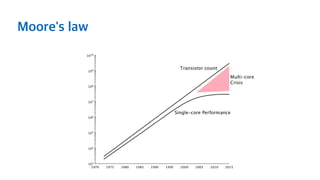
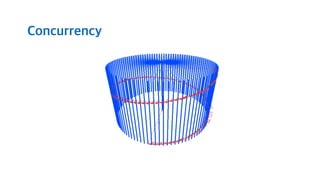
Moore's law
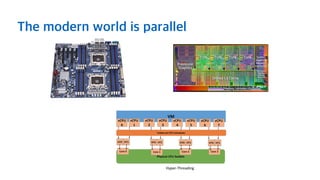
The modern world is parallel
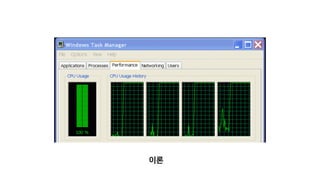
이론
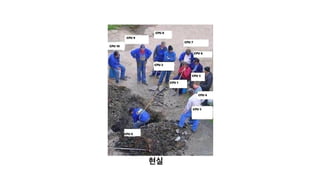
This is what
typically
happens
in your
computer
현실
1. Concurrency
1.	 Concurrency and Parallelism

	 2.	 Models for Programming Concurrency

2. Concurrency Concepts in Golang
	 1.	 Communicating Sequential Processes

	 -	Goroutine

	 -	Channel

	 -	Select

	 2.	 Golang Scheduler

3. Best practices for concurrency
Contents
Concurrency
Parallelism
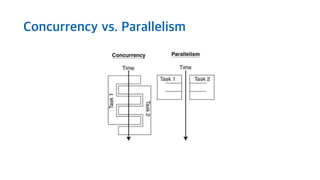
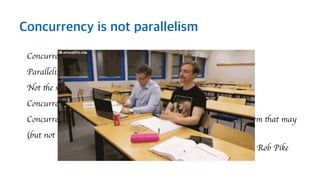
Concurrency vs. Parallelism
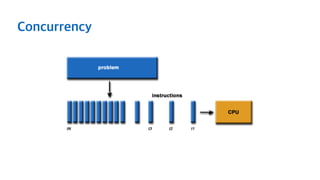
Concurrency is about dealing with lots of things at once.
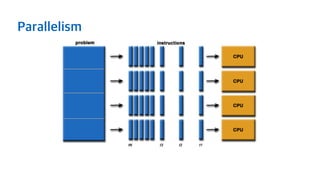
Parallelism is about doing lots of things at once.
Not the same, but related.
Concurrency is about structure, parallelism is about execution.
Concurrency provides a way to structure a solution to solve a problem that may
(but not necessarily) be parallelizable.
By Rob Pike
Concurrency is not parallelism
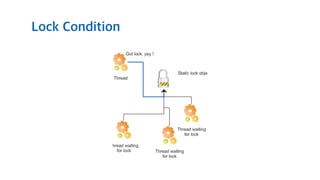
Lock Condition
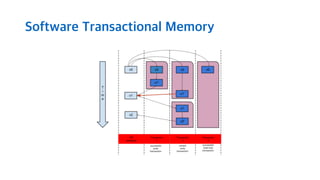
Software Transactional Memory
Easy to understand.

Easy to use.

Easy to reason about.

You don't need to be an expert!
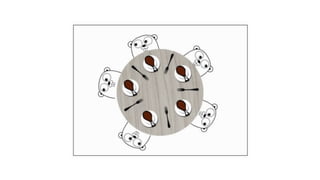
A model for software construction
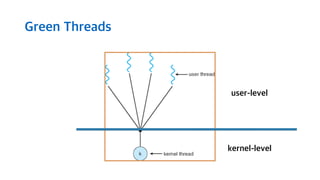
Green Threads
user-level
kernel-level
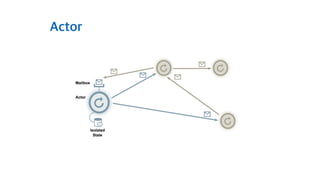
Actor
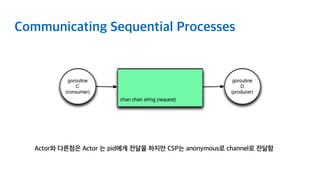
Communicating Sequential Processes
Actor와 다른점은 Actor 는 pid에게 전달을 하지만 CSP는 anonymous로 channel로 전달함
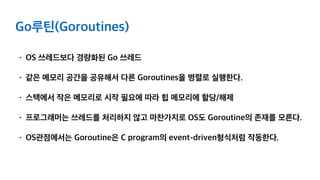
Go루틴(Goroutines)
• OS 쓰레드보다 경량화된 Go 쓰레드
• 같은 메모리 공간을 공유해서 다른 Goroutines을 병렬로 실행한다.
• 스택에서 작은 메모리로 시작 필요에 따라 힙 메모리에 할당/해제
• 프로그래머는 쓰레드를 처리하지 않고 마찬가지로 OS도 Goroutine의 존재를 모른다.
• OS관점에서는 Goroutine은 C program의 event-driven형식처럼 작동한다.
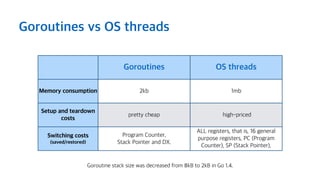
Goroutines vs OS threads
Goroutines OS threads
Memory consumption 2kb 1mb
Setup and teardown
costs
pretty cheap high-priced
Switching costs
(saved/restored)
Program Counter,
Stack Pointer and DX.
ALL registers, that is, 16 general
purpose registers, PC (Program
Counter), SP (Stack Pointer),
segment registers, 16 XMM
Goroutine stack size was decreased from 8kB to 2kB in Go 1.4.
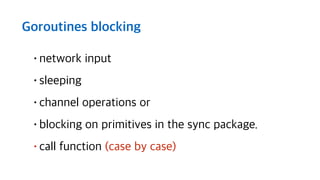
Goroutines blocking
•network input
•sleeping
•channel operations or
•blocking on primitives in the sync package.
•call function (case by case)
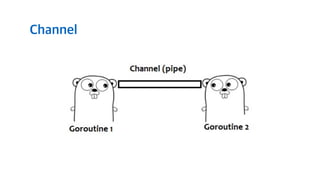
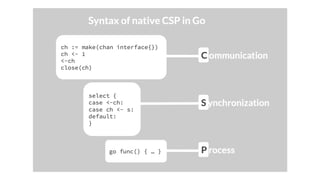
Channel
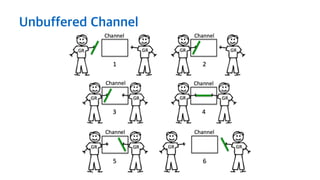
Unbuffered Channel
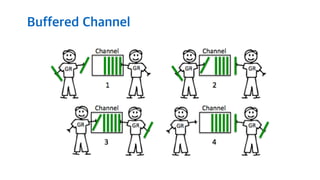
Buffered Channel
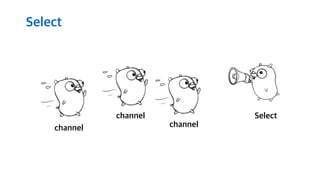
channel
channel
channel
Select
Select
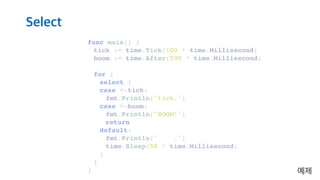
func main() {
tick := time.Tick(100 * time.Millisecond)
boom := time.After(500 * time.Millisecond)
for {
select {
case <-tick:
fmt.Println("tick.")
case <-boom:
fmt.Println("BOOM!")
return
default:
fmt.Println(" .")
time.Sleep(50 * time.Millisecond)
}
}
}
Select
예제
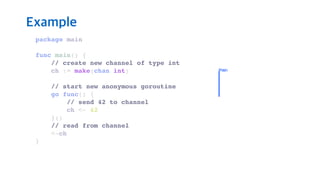
package main
func main() {
// create new channel of type int
ch := make(chan int)
// start new anonymous goroutine
go func() {
// send 42 to channel
ch <- 42
}()
// read from channel
<-ch
}
Example
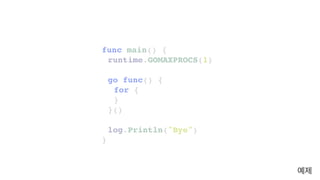
func main() {
runtime.GOMAXPROCS(1)
go func() {
for {
}
}()
log.Println("Bye")
}
예제
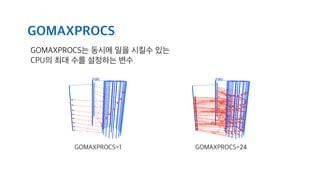
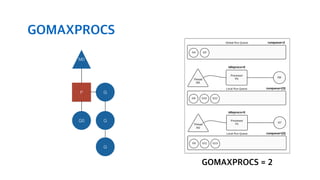
GOMAXPROCS
GOMAXPROCS는 동시에 일을 시킬수 있는 

CPU의 최대 수를 설정하는 변수
GOMAXPROCS=1 GOMAXPROCS=24
Concurrency
Parallelism
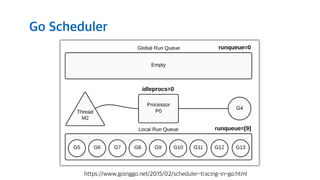
Go Scheduler
https://www.goinggo.net/2015/02/scheduler-tracing-in-go.html
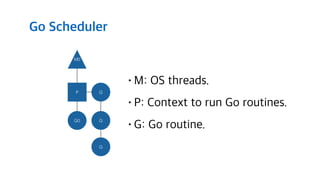
Go Scheduler
•M: OS threads.
•P: Context to run Go routines.
•G: Go routine.
M0
P
G0
G
G
G
Goroutines blocking
•network input
•sleeping
•channel operations or
•blocking on primitives in the sync package.
•call function (case by case)
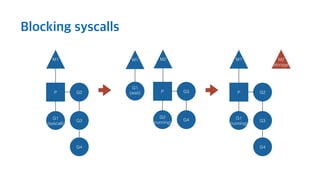
Blocking syscalls
M1
P
G1

(syscall)
G2
G3
G4
M1
P G3
G4
G2

(running)
M2
G1

(wait)
M1
P
G1

(running)
G2
G3
G4
M2

storage
Runtime
Poller
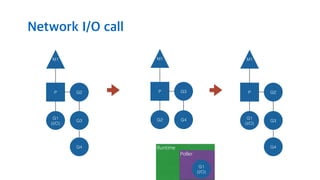
Network I/O call
M1
P
G1

(I/O)
G2
G3
G4
M2M1
P G3
G4G2
G1

(I/O)
M1
P
G1

(I/O)
G2
G3
G4
GOMAXPROCS
GOMAXPROCS = 2
M0
P
G0
G
G
G
이론
현실
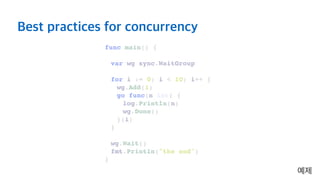
Best practices for concurrency
func main() {
var wg sync.WaitGroup
for i := 0; i < 10; i++ {
wg.Add(1)
go func(n int) {
log.Println(n)
wg.Done()
}(i)
}
wg.Wait()
fmt.Println("the end")
}
예제
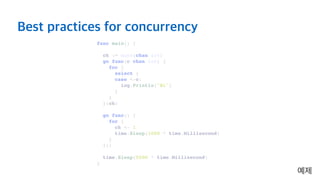
Best practices for concurrency
func main() {
ch := make(chan int)
go func(c chan int) {
for {
select {
case <-c:
log.Println("Hi")
}
}
}(ch)
go func() {
for {
ch <- 1
time.Sleep(1000 * time.Millisecond)
}
}()
time.Sleep(5000 * time.Millisecond)
}
예제
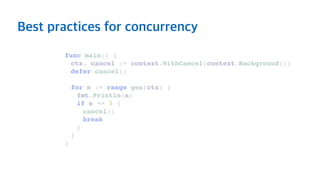
Best practices for concurrency
func main() {
ctx, cancel := context.WithCancel(context.Background())
defer cancel()
for n := range gen(ctx) {
fmt.Println(n)
if n == 5 {
cancel()
break
}
}
}
Best practices for concurrency
msgs, err := ch.Consume(
q.Name, // queue
"", // consumer
true, // auto-ack
false, // exclusive
false, // no-local
false, // no-wait
nil, // args
)
failOnError(err, "Failed to register a consumer")
forever := make(chan bool)
go func() {
for d := range msgs {
log.Printf("Received a message: %s", d.Body)
}
}()
log.Printf(" [*] Waiting for messages. To exit press CTRL+C")
<-forever
MessageQueue(RabbitMQ) Worker
Best practices for concurrency
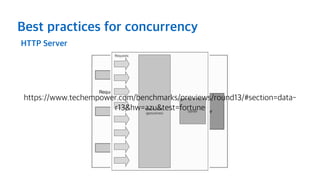
HTTP Server
https://www.techempower.com/benchmarks/previews/round13/#section=data-
r13&hw=azu&test=fortune
끝
Q&A

Golang concurrency design