+
Accessing professional
development activities:
a survey of
health sciences academics
in their teaching role
J Blitz and S van Schalkwyk
Acknowledgement:
ESA20100729000013945 funded by the South African National Research Foundation:
Interplay of Structure, Culture and Agency: A study on Professional Development in Higher Education
+
Professional development – what’s
in a name?
 Staff development
 Faculty development
 Instructional development
 Academic development
“any planned activity to improve an individual’s knowledge
and skills in areas considered essential to the performance of a
faculty member”… in their teaching role …
(Sheets and Schwenk,1990)
With a view to enhancing student learning.
+
Professional development (in
Health Sciences)
 Supporting academics in their teaching role has become an
accepted responsibility of institutions internationally
 Burgeoning body of scholarship that highlights various
aspects of this work and that reflects different trends in
thinking around teaching and learning over time (McLean et
al 2008)
 Studies generally focus on the ‘what’ and the ‘how’ of faculty
development
 Calls in the literature for studies that can take this work
further to determine impact and to uncover evidence of
changed behaviour
+But let’s take a step back
Our study:
What factors, as reported by
academics, enable and constrain them
accessing professional development
opportunities for their teaching role.
+
The study
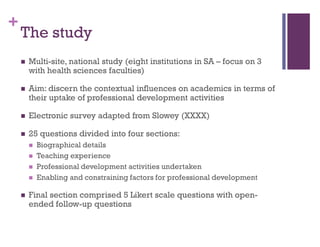
 Multi-site, national study (eight institutions in SA – focus on 3
with health sciences faculties)
 Aim: discern the contextual influences on academics in terms of
their uptake of professional development activities
 Electronic survey adapted from Slowey (XXXX)
 25 questions divided into four sections:
 Biographical details
 Teaching experience
 Professional development activities undertaken
 Enabling and constraining factors for professional development
 Final section comprised 5 Likert scale questions with open-
ended follow-up questions
+
Our respondents
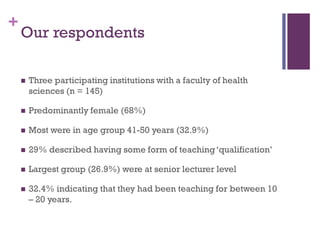
 Three participating institutions with a faculty of health
sciences (n = 145)
 Predominantly female (68%)
 Most were in age group 41-50 years (32.9%)
 29% described having some form of teaching‘qualification’
 Largest group (26.9%) were at senior lecturer level
 32.4% indicating that they had been teaching for between 10
– 20 years.
+
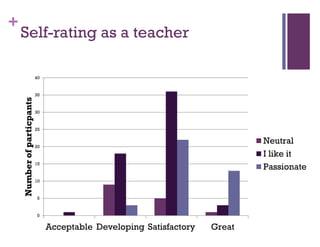
Self-rating as a teacher
0
5
10
15
20
25
30
35
40
Acceptable Developing Satisfactory Great
Numberofparticpants
Neutral
I like it
Passionate
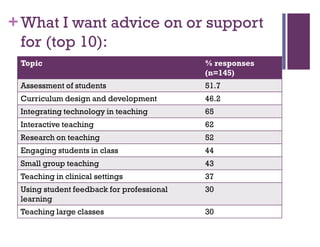
+What I want advice on or support
for (top 10):
Topic % responses
(n=145)
Assessment of students 51.7
Curriculum design and development 46.2
Integrating technology in teaching 65
Interactive teaching 62
Research on teaching 52
Engaging students in class 44
Small group teaching 43
Teaching in clinical settings 37
Using student feedback for professional
learning
30
Teaching large classes 30
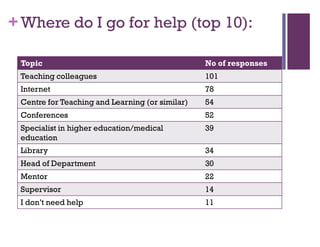
+Where do I go for help (top 10):
Topic No of responses
Teaching colleagues 101
Internet 78
Centre for Teaching and Learning (or similar) 54
Conferences 52
Specialist in higher education/medical
education
39
Library 34
Head of Department 30
Mentor 22
Supervisor 14
I don’t need help 11
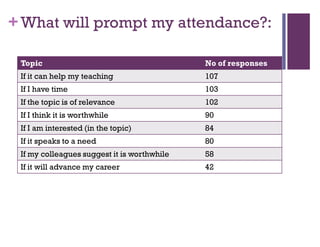
+What will prompt my attendance?:
Topic No of responses
If it can help my teaching 107
If I have time 103
If the topic is of relevance 102
If I think it is worthwhile 90
If I am interested (in the topic) 84
If it speaks to a need 80
If my colleagues suggest it is worthwhile 58
If it will advance my career 42
+
Enabling and constraining factors
 My institution provides formal recognition for engagement in
professional learning for teaching: 40.3% were ‘not sure’
 My institution provides resources for engagement in
professional learning for teaching: 55.9% agreed and 20.2%
strongly agreed
 My workload often hinders my ability to participate in
professional learning for teaching: 91.5% agreed/strongly
agreed
 The topics of the professional learning opportunities are not
applicable in my own discipline: 59% disagreed/strongly
disagreed
 I can easily access information on professional learning
opportunities for teaching in my institution: 60%
agreed/strongly agreed
+Understanding the responses
Political
lens
Political
lens
Structural
lens
Structural
lens
Symbolic
lens
Symbolic
lens
Human
resource
lens
Human
resource
lens
+
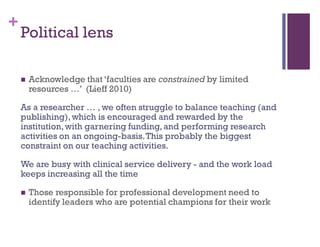
Political lens
 Acknowledge that ‘faculties are constrained by limited
resources …’ (Lieff 2010)
As a researcher … , we often struggle to balance teaching (and
publishing),which is encouraged and rewarded by the
institution,with garnering funding,and performing research
activities on an ongoing-basis.This probably the biggest
constraint on our teaching activities.
We are busy with clinical service delivery - and the work load
keeps increasing all the time
 Those responsible for professional development need to
identify leaders who are potential champions for their work
+
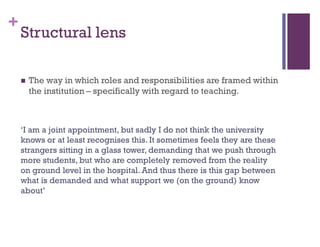
Structural lens
 The way in which roles and responsibilities are framed within
the institution – specifically with regard to teaching.
‘I am a joint appointment, but sadly I do not think the university
knows or at least recognises this. It sometimes feels they are these
strangers sitting in a glass tower, demanding that we push through
more students, but who are completely removed from the reality
on ground level in the hospital. And thus there is this gap between
what is demanded and what support we (on the ground) know
about’
+
Symbolic lens
 Recognising the work that people do (e.g. their teaching) as
having value.
 Work done by departments and faculties that ‘explicitly and
transparently legitimize[s] educational activity and scholarship’
(Lieff 2010)
The main issue at institutional level is that there is this demand to
perform on the 3 levels:Teaching/Research and service delivery.
Sadly the recognition for each level is not equal and therefore
some people that play a major supportive role on the service
delivery side may never get the recognition.
[There is an] unwritten rule that teaching is not nearly as valued as
research outputs
+
Human resources lens
 A focus on the individual.Ensuring protected time for their
wellness and development
Lack of support or understanding of the passion for
professional learning for teaching often leads to demands and
deadlines being placed on me that make attendance of
learning for teaching events/workshops impossible
I dont have the energy to read for my own education when I am
done teaching and supervising masters students
+
What does this mean for our work
in professional development?
 There are a wide range of factors that can either enable or constrain the
uptake of professional develop initiatives
 These factors will include issues such as the relevance and quality of the
workshops, but also extend beyond these to include organisation factors as
described above
 Accordingly, definitional clarity and messaging with regard to roles and
responsibilities of teaching academics and the extent to which teaching is
valued, is required.
 Given that a large number of health science faculty teachers are clinicians
who see their primary commitment as being to patient care, professional
development initiatives need to take cognisance of the tensions that this can
lead to
 Faculties need to explore ways to make activities more accessible and
relevant and address all four lenses through which organizations can be
reframed.
+
References
CLARK, J. M., HOUSTON, T. K., KOLODNER, K., BRANCH, W. T., LEVINE, R. B. & KERN, D. E. 2004. Teaching the
teachers. J Gen Intern Med, 19, 205-214.
DE RIJDT, C., STES, A., VAN DER VLEUTEN, C. & DOCHY, F. 2013. Influencing variables and moderators of
transfer of learning to the workplace within the area of staff development in higher education: Research
review. Educational Research Review, 8, 48-74.
LIEFF, S. J. 2010. Faculty development: Yesterday, today and tomorrow: Guide supplement 33.2-Viewpoint.
Med Teach, 32, 429-431.
MCLEAN, M., CILLIERS, F. & VAN WYK, J. M. 2008. Faculty development: Yesterday, today and tomorrow. Med
Teach, 30, 555-584.
STEINERT, Y., MANN, K., CENTENO, A., DOLMANS, D., SPENCER, J., GELULA, M. & PRIDEAUX, D. 2006. A
systematic review of faculty development initiatives designed to improve teaching effectiveness in medical
education: BEME Guide No. 8. Med Teach, 28, 497-526.
STES, A., MIN-LELIVELD, M., GIJBELS, D. & VAN PETEGEM, P. 2010. The impact of instructional development in
higher education: The state-of-the-art of the research. Educational Research Review, 5, 25-49.

Accessing professional development activities: a survey of health sciences academics in their teaching role

  • 1.
    + Accessing professional development activities: asurvey of health sciences academics in their teaching role J Blitz and S van Schalkwyk Acknowledgement: ESA20100729000013945 funded by the South African National Research Foundation: Interplay of Structure, Culture and Agency: A study on Professional Development in Higher Education
  • 2.
    + Professional development –what’s in a name?  Staff development  Faculty development  Instructional development  Academic development “any planned activity to improve an individual’s knowledge and skills in areas considered essential to the performance of a faculty member”… in their teaching role … (Sheets and Schwenk,1990) With a view to enhancing student learning.
  • 3.
    + Professional development (in HealthSciences)  Supporting academics in their teaching role has become an accepted responsibility of institutions internationally  Burgeoning body of scholarship that highlights various aspects of this work and that reflects different trends in thinking around teaching and learning over time (McLean et al 2008)  Studies generally focus on the ‘what’ and the ‘how’ of faculty development  Calls in the literature for studies that can take this work further to determine impact and to uncover evidence of changed behaviour
  • 4.
    +But let’s takea step back Our study: What factors, as reported by academics, enable and constrain them accessing professional development opportunities for their teaching role.
  • 5.
    + The study  Multi-site,national study (eight institutions in SA – focus on 3 with health sciences faculties)  Aim: discern the contextual influences on academics in terms of their uptake of professional development activities  Electronic survey adapted from Slowey (XXXX)  25 questions divided into four sections:  Biographical details  Teaching experience  Professional development activities undertaken  Enabling and constraining factors for professional development  Final section comprised 5 Likert scale questions with open- ended follow-up questions
  • 6.
    + Our respondents  Threeparticipating institutions with a faculty of health sciences (n = 145)  Predominantly female (68%)  Most were in age group 41-50 years (32.9%)  29% described having some form of teaching‘qualification’  Largest group (26.9%) were at senior lecturer level  32.4% indicating that they had been teaching for between 10 – 20 years.
  • 7.
    + Self-rating as ateacher 0 5 10 15 20 25 30 35 40 Acceptable Developing Satisfactory Great Numberofparticpants Neutral I like it Passionate
  • 8.
    +What I wantadvice on or support for (top 10): Topic % responses (n=145) Assessment of students 51.7 Curriculum design and development 46.2 Integrating technology in teaching 65 Interactive teaching 62 Research on teaching 52 Engaging students in class 44 Small group teaching 43 Teaching in clinical settings 37 Using student feedback for professional learning 30 Teaching large classes 30
  • 9.
    +Where do Igo for help (top 10): Topic No of responses Teaching colleagues 101 Internet 78 Centre for Teaching and Learning (or similar) 54 Conferences 52 Specialist in higher education/medical education 39 Library 34 Head of Department 30 Mentor 22 Supervisor 14 I don’t need help 11
  • 10.
    +What will promptmy attendance?: Topic No of responses If it can help my teaching 107 If I have time 103 If the topic is of relevance 102 If I think it is worthwhile 90 If I am interested (in the topic) 84 If it speaks to a need 80 If my colleagues suggest it is worthwhile 58 If it will advance my career 42
  • 11.
    + Enabling and constrainingfactors  My institution provides formal recognition for engagement in professional learning for teaching: 40.3% were ‘not sure’  My institution provides resources for engagement in professional learning for teaching: 55.9% agreed and 20.2% strongly agreed  My workload often hinders my ability to participate in professional learning for teaching: 91.5% agreed/strongly agreed  The topics of the professional learning opportunities are not applicable in my own discipline: 59% disagreed/strongly disagreed  I can easily access information on professional learning opportunities for teaching in my institution: 60% agreed/strongly agreed
  • 12.
  • 13.
    + Political lens  Acknowledgethat ‘faculties are constrained by limited resources …’ (Lieff 2010) As a researcher … , we often struggle to balance teaching (and publishing),which is encouraged and rewarded by the institution,with garnering funding,and performing research activities on an ongoing-basis.This probably the biggest constraint on our teaching activities. We are busy with clinical service delivery - and the work load keeps increasing all the time  Those responsible for professional development need to identify leaders who are potential champions for their work
  • 14.
    + Structural lens  Theway in which roles and responsibilities are framed within the institution – specifically with regard to teaching. ‘I am a joint appointment, but sadly I do not think the university knows or at least recognises this. It sometimes feels they are these strangers sitting in a glass tower, demanding that we push through more students, but who are completely removed from the reality on ground level in the hospital. And thus there is this gap between what is demanded and what support we (on the ground) know about’
  • 15.
    + Symbolic lens  Recognisingthe work that people do (e.g. their teaching) as having value.  Work done by departments and faculties that ‘explicitly and transparently legitimize[s] educational activity and scholarship’ (Lieff 2010) The main issue at institutional level is that there is this demand to perform on the 3 levels:Teaching/Research and service delivery. Sadly the recognition for each level is not equal and therefore some people that play a major supportive role on the service delivery side may never get the recognition. [There is an] unwritten rule that teaching is not nearly as valued as research outputs
  • 16.
    + Human resources lens A focus on the individual.Ensuring protected time for their wellness and development Lack of support or understanding of the passion for professional learning for teaching often leads to demands and deadlines being placed on me that make attendance of learning for teaching events/workshops impossible I dont have the energy to read for my own education when I am done teaching and supervising masters students
  • 17.
    + What does thismean for our work in professional development?  There are a wide range of factors that can either enable or constrain the uptake of professional develop initiatives  These factors will include issues such as the relevance and quality of the workshops, but also extend beyond these to include organisation factors as described above  Accordingly, definitional clarity and messaging with regard to roles and responsibilities of teaching academics and the extent to which teaching is valued, is required.  Given that a large number of health science faculty teachers are clinicians who see their primary commitment as being to patient care, professional development initiatives need to take cognisance of the tensions that this can lead to  Faculties need to explore ways to make activities more accessible and relevant and address all four lenses through which organizations can be reframed.
  • 18.
    + References CLARK, J. M.,HOUSTON, T. K., KOLODNER, K., BRANCH, W. T., LEVINE, R. B. & KERN, D. E. 2004. Teaching the teachers. J Gen Intern Med, 19, 205-214. DE RIJDT, C., STES, A., VAN DER VLEUTEN, C. & DOCHY, F. 2013. Influencing variables and moderators of transfer of learning to the workplace within the area of staff development in higher education: Research review. Educational Research Review, 8, 48-74. LIEFF, S. J. 2010. Faculty development: Yesterday, today and tomorrow: Guide supplement 33.2-Viewpoint. Med Teach, 32, 429-431. MCLEAN, M., CILLIERS, F. & VAN WYK, J. M. 2008. Faculty development: Yesterday, today and tomorrow. Med Teach, 30, 555-584. STEINERT, Y., MANN, K., CENTENO, A., DOLMANS, D., SPENCER, J., GELULA, M. & PRIDEAUX, D. 2006. A systematic review of faculty development initiatives designed to improve teaching effectiveness in medical education: BEME Guide No. 8. Med Teach, 28, 497-526. STES, A., MIN-LELIVELD, M., GIJBELS, D. & VAN PETEGEM, P. 2010. The impact of instructional development in higher education: The state-of-the-art of the research. Educational Research Review, 5, 25-49.