Spring 2009/Katerina Tsoukala
International Security
Syllabus
Katerina Tsoukala
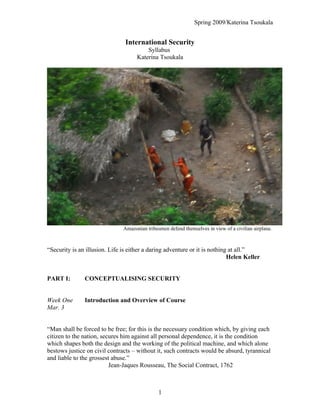
Amazonian tribesmen defend themselves in view of a civilian airplane.
“Security is an illusion. Life is either a daring adventure or it is nothing at all.”
Helen Keller
PART I: CONCEPTUALISING SECURITY
Week One Introduction and Overview of Course
Mar. 3
“Man shall be forced to be free; for this is the necessary condition which, by giving each
citizen to the nation, secures him against all personal dependence, it is the condition
which shapes both the design and the working of the political machine, and which alone
bestows justice on civil contracts – without it, such contracts would be absurd, tyrannical
and liable to the grossest abuse.”
Jean-Jaques Rousseau, The Social Contract, 1762
1
Spring 2009/Katerina Tsoukala
Highly Recommended Optional Readings:
.
Mabee, B. (2003). "Security Studies and the `Security State': Security Provision in
Historical Context." International Relations 17(2): 135-151.
Ripsman, N. M. and T. V. Paul (2005). "Globalization and the National Security State: A
Framework for Analysis " International Studies Review 7: 199-227.
MccGwire, M. (2002). "Shifting the Paradigm." International Affairs 78(1): 1-28
Week 1 International Security Studies and International Relations
Mar. 5 Case Study: The Middle East
“The most certain test by which we judge whether a country is really free is the amount
of security enjoyed by minorities.”
Lord Acton
Readings
Haftendorn, H. (1991). "The Security Puzzle: Theory-Building and Discipline-Building
in International Security." International Studies quarterly 35(1): 3-17.
Messari, N. (2002). "The State and Dilemmas of Security: the Middle East and the
Balkans." Security Dialogue 33(4): 415-427.
Bilgin, P. (2004). "Whose 'Middle East'? Geopolitical Inventions and Practices of
Security." International Relations 18(1): 25-41.
Cha, V. D. (2000). "Globalization and the Study of International Security." Journal of
Peace Research 37(3): 391-403.
Barkawi, T. and M. Laffey (2006). "The Postcolonial Moment in Security Studies."
Review of International Studies 32(2): 329-352.
Optional Readings:
Chalk, P. (2003). "Non-Military Security in the Wider Middle East." Studies in Conflict
and Terrorism 26: 197-214.
Questions for discussion: Has the concept of national security become obsolete? What
are the advantages and flaws regarding the increasing conceptualisation of security
studies at the realm of the global/international? What is the most useful international
2
Spring 2009/Katerina Tsoukala
security paradigm in the study of security in the Middle East ‘region’ (if any)? Is the
‘globalised’ version of Security Studies ultimately ‘eurocentric’?
PART II: ACTORNESS IN THE USE OF FORCE AND THE PROVISION OF
SECURITY
Week Two On War
Mar. 12
“Either war is obsolete or men are.”
R. Buckminster Fuller
Readings:
Mandelbaum, M. (1998). "Is Major War Obsolete?" Survival 40(4): 20-38.
Macmaster, H. R. (2008). "On War: Lessons to be Learned." Survival 50(1): 19-30.
Freedman, L. (1998). "The Changing Forms of Military Conflict." Survival 40(4): 39-56.
Barkawi, T. (2004). "On the Pedagogy of 'Small Wars'." International Affairs 80(1): 19-
37.
Kalyvas, S. N. and M. A. Kocher (2007). "Ethnic Cleavages and Irregular War: Iraq and
Vietnam." Politics Society 35(2): 183-223 - {190-202}
Rogers, P. (2003). "'Losing Control' - War and the Modern World." International
Relations 17(1): 97-108.
Optional Readings:
Smith, M. L. R. (2003). "Guerillas in the Mist: Reassessing Strategy and Low Intensity
Warfare." Review of International Studies 29: 19-37.
Burke, A. (2005). "Iraq: Strategy's burnt offering." Global Change, Peace & Security
17(2): 191-213.
Gray, C. S. (1999). Small Wars and Other Savage Violence. Modern Strategy. Oxford,
Oxford University Press: 273-296.
Calwell, C. E., C. W. Gwynn, et al. (1994). Limited War and Developing Countries. War.
L. Freedman. Oxford, Oxford University Press: 310-357.
3
Spring 2009/Katerina Tsoukala
Clausewitz, C. V. (1989). What is War? On War. M. Howard and P. Paret. Princeton,
Princeton University Press: 75-89.
Movie:
The Thin Red Line by Terrence Malick
Questions: Is there a holistic definition of war? Has war become obsolete as an
instrument of violence to achieve political ends? Is there a state monopoly in the wagε of
wars in contemporary politics? What are the problems as regards the typology of warfare
in International Relations?
Week Three Defence Policy Analysis
Mar. 19
“You can not simultaneously prevent and prepare for war.”
Albert Einstein
“We will bankrupt ourselves in the vain search for absolute security.”
Dwight D. Eisenhower
Readings:
Hayward, K. (2000). "The Globalisation of Defence Industries." Survival 42(2): 115-132.
Kirkpatrick, D. (1997). "Rising Costs, Falling Budgets and their Implications for Defence
Policy." Economic Affairs: 10-14.
Hartley, K. and T. Sandler (2003). "The Future of the Defence Firm." KYKLOS 56(3):
361-380.
Markusen, A. (1999). "The Rise of World Weapons." Foreign Policy 114: 40-51.
Feiler, G. (1998). The Military Industries of the Arab World in the 1990's in The Politics
and Economics of Defence Industries. E. Inbar and B. Zilberfarb. London Frank Cass:
165-200.
Krause, K. (1992). The Subordinate Role of Arms Recipients in Arms and the State:
Patterns of Military Production and Trade. Cambridge, Cambridge University Press: 182-
204.
Optional Readings:
Augustine, N. N. (1997). Augustine's Laws. Reston, Virginia, American Institute of
Aeronautics and Astronautics.
4
Spring 2009/Katerina Tsoukala
Latham, N. (2003). Defence Industry in a Global Context: Policy Implications for the
United kingdom. London, Royal United Services Institute.
Markusen, A., Ed. (1999). Arming the Future: A Defense Industry for the 21st century.
New York, Council on Foreign Relations Press.
McConville, T. and R. Holmes, Eds. (2003). Defence Management in Uncertain Times.
London, Frank Cass.
Edmonds, M., Ed. (1981). International Arms Procurement Pergamon Policy Studies on
Security Affairs. Oxford, Pergamon Policy Studies.
Documentary:
Making a Killing: Inside the International Arms Trade (2006), included on the 2-Disc
Special Edition DVD of the Lord of War (2005)
Questions: How does globalisation affect the production of weapons and the
organisation of defence firms worldwide? What are the consequences for the conduct of
future warfare? Do you believe that the increasing trend of defence procurement from
foreign or trans-national defence firms can guarantee a state’s security?
Week Four: Newroz Holiday
PART III: CHALLENGES TO INTERNATIONAL SECURITY
Week Five Deterrence and Counter-proliferation in an Age of Mass Destruction
Apr. 2
“We need to de-legitimise the nuclear weapon, and by de-legitimizing.. meaning trying to
develop a different system of security that does not depend on nuclear deterrence.”
Mohamed ElBaradei
Readings:
Smith, D. D. (2003). "Deterrence and Counterproliferation in an Age of Weapons of
Mass Destruction " Security Studies 12(4): 152-197.
Glaser, C. L. (1998). "The Flawed Case for Nuclear Disarmament." Survival 40(1): 112-
128.
Russell, J. A. (2006). "Peering into the Abyss: Non-State Actors and the 2016
Proliferation Environment " The Nonproliferation Review 13(3): 645-657.
5
Spring 2009/Katerina Tsoukala
Flibbert, A. (2004). "After Saddam: Regional Insecurity, Weapons of Mass Destruction,
and Proliferation Pressures in Postwar Iraq " Political Science Quarterly 118(4): 547-567.
Optional Readings:
Huntley, W. L. (2006). "Rebels without a Cause: North Korea, Iran and the NPT."
International Affairs 82(4): 723-742.
Carranza, M. E. (2006). "Can the NPT Survive? The Theory and Practice of US Nuclear
Non-proliferation Policy after September 11." Contemporary Security Policy 27(3): 489-
525.
Hanson, M. (2002). "Nuclear Weapons as Obstacles to International Security."
International Relations 16: 361-379.
Movie:
Dr. Strangelove or: How I Learned to Stop Worrying and Love the Bomb by Stanley
Kubrick (1964)
Questions: Is nuclear deterrence a valid concept to think about international security in a
multi-polar world? Is nuclear non-proliferation feasible? What are the limitations
regarding the theory and practice of the Non Proliferation Treaty? Do non-state actors
deconstruct its validity? Does the pre-emptive use of force on states suspected of
possessing nuclear weapons represent a shift in the practice of post-cold war deterrence
and does it ultimately enhance international security?
Week Six Missile Defence
Apr. 9
“It's true that the war in Iraq opened a distance in relations between part of Europe and
the U.S. government, but our basic ties are stronger than that. We share democracy, free
markets and a commitment to Western security. We differ on how to guarantee that
security.”
Jose Luis Zapatero
There can be no security where there is fear.
Felix Frankfurter
Readings:
Bowen, W. Q. (2001). "Missile Defence and the Transatlantic Security Relationship."
International Affairs 77(3): 485-507.
Seaboyer, A. and O. Thranet (2006). "What Missile Proliferation Means for Europe."
Survival 48(2): 85-96.
6
Spring 2009/Katerina Tsoukala
Slocombe, W. B. (2008). "Europe, Russia and American Missile Defence." Survival
50(2): 19-24.
Lebovic, J. H. (2002). "The Law of Small Numbers: Deterrence and National Missile
Defense." Journal of Conflict Resolution 46(4): 455-483.
Bradley, T. (2006). "Why a Ballistic Missile Defense Program is the Wrong Path to US
National Security." Defense & Security Analysis 22(1): 95-99.
Samson, V. (2008). "Spiraling Out of Control: How Missile Defense's Acquisition
Strategy is Setting a Dangerous Precedent." Defense & Security Analysis 24(2): 203-211.
Larrabee, F. S. (2008). "Whither Missile Defence?" The International Spectator 43(2): 5-
13.
Questions: Why has the deployment of ballistic missile defence been a controversial issue
since the 70’s? Does it represent a rift on transatlantic security cultures? Can Missile
Defence Deterrence enhance global security? Is it worth the cost? Is it technically
feasible?
Week Seven Energy Security
Apr. 16
Readings:
Chapman, D. and N. Khanna (2006). "The Persian Gulf, Global Oil Resources, and
International Security." Contemporary Economic Policy 24(4): 507-519.
Williams, P. A. (2006). "Projections for the Geopolitical Economy of Oil after War in
Iraq." Futures 38: 1074-1088.
Harks, E. (2006). "The Conundrum of Energy Security - Gas in Eastern and Western
Europe." The International Spectator: 47 - 58.
Bahgat, G. (2006). "Europe's Energy Security: Challenges and Opportunities."
International Affairs 82(5): 961-975.
Correlje, A. and C. v. d. Linde (2006). "Energy Supply Security and Geopolitics: A
European Perspective." Energy Policy 34: 532-543.
Jaffe, A. M. and R. A. Manning (1999). "The Myth of the Caspian 'Great Game': The
Real Geopolitics of Energy." Survival 40(4): 112-129.
7
Spring 2009/Katerina Tsoukala
J. Gururaja (2003). "Energy for Sustainable Development: Review of National and
International Energy Policies." Natural Resources Forum 27: 53-67.
Optional Readings:
Stulberg, A. N. (2007). "'Fuelling' Transatlantic Entente in the Caspian Basin: Energy
Security and Collective Action." Contemporary Security Policy 25(2): 280-311.
Jhaveri, N. J. (2004). "Petroimperialism: US Oil Interests and the Iraq War." Antipode: 2-
11.
Questions: Why has the framework of steady supply of mutually agreed prices to the
Persian Gulf producers and western consumers been so significant for Global Security?
What are the main problems of gas supply in Europe? Is it misleading to consider the oil
natural reserves in central Caucasus and the Caspian Basin a panacea to long-term energy
security in the West?
Week Eight (In)Humanitarian (Non)Intervention
Apr. 23
“Theory cannot be accepted as conclusive when practice points the other way”
Charles E. Callwell, Small Wars (1906)
“Excessive dealings with tyrants are not good for the security of free states.”
Demosthenes
Readings:
Bellamy, A. J. (2003). "Humanitarian Responsibilities and interventionist claims in
International Society." Review of International Studies 29: 321-340.
Mednicoff, D. M. (2006). "Humane Wars? International Law, Just War Theory and
Contemporary Armed Humanitarian Intervention." Law, Culture and the Humanities 2:
373-398.
Weller, M. (2000). "The US, Iraq and the Use of Force in a Unipolar World." Survival
41(4): 81-100.
Weiss, T. G. (2004). "The Sunset of Humanitarian Intervention? The responsibility to
Protect in a Unipolar Era " Security Dialogue 35(2): 135-153.
Thomas, N. and W. T. Tow (2002). "The Utility of Human Security: Sovereignty and
Humanitarian Intervention." Security Dialogue 33(2): 177-192.
8
Spring 2009/Katerina Tsoukala
Questions: What are the main tenets of the just war thesis? Is humanitarian intervention a
contradiction in terms? Is human security a useful concept to redefine and re-
contextualise the theory and practice of humanitarian intervention? Critically compare
and contrast the effectiveness of military interventions in your readings.
Week Nine International Terrorism
Apr. 30
“Your security is not in the hands of Kerry, Bush or al-Qaida. Your security is in your
own hands”.
Osama bin Laden
Readings:
Shapiro, I. (2008). "A Global Response to Terrorism." The International Spectator 43(3):
27-34.
Kowalski, M. (2008). "Global Insurgency or Global Confrontation? Counter-Insurgency
Doctrine and the "Long War" on Terrorism." Defense & Security Analysis 24(1): 65-71.
Abrahms, M. (2008). "What Terrorists Really Want: Terrorist Motives and
Counterterrorism Strategy." International Security 32(4): 78-105.
Pape, R. (2003). "The Strategic Logic of Suicide Terrorism." American Political Science
Review 97(3): 343-361.
Frey, B. S. and S. Luechinger (2004). "Decentralization as a Disincentive for Terror."
European Journal of Political Economy 20: 509-515.
Stevenson, J. (2006). "Demilitarising the 'War on Terror'." Survival 48(2).
Questions: Is terrorism a global phenomenon? Does it require a global response? Is
counter-insurgency doctrine effective in resolving the ‘long war’ in Iraq and
Afghanistan? Does the solution to terrorism reside in resolving its political utility? Is
there a strategic logic in suicide terrorism? Why is the use of force so much more
predominant in counter-terrorism strategy? Are there any other (non-military) measures?
Week Ten Post-War Reconstruction
May. 7
“I believe that the government that governs best is a government that governs least, and
by these standards we have set up a fabulous government in Iraq.”
9
Spring 2009/Katerina Tsoukala
Stephen Colbert
“The U.S. cannot impose freedom, security, and unity in Iraq by force. Establishing a
firm timeline for bringing our troops home could accelerate the development of Iraqi
security forces and deepen their commitment to defending their own country and their
own government.”
Peter DeFazio
Readings:
Krause, K. and O. Jutersonke (2005). "Peace, Security and Development in Post-Conflict
Environments." Security Dialogue 36(4): 447-462.
Rathmell, A. "Planning Post-Conflict Reconstruction in Iraq: What Can We Learn?"
International Affairs 81(5): 1013-1038.
Dobbins, J. (2006). "Preparing for Nation-Building." Survival 48(3): 27-40.
Sorensen, G. (2001). "War and State-Making: Why doesn't it Work in the Third World?"
Security Dialogue 32(3): 341-354.
Francois, M. and I. Sud (2006). "Promoting Stability and Development in Fragile and
Failed States." Development Policy Review 24(2): 141-160.
Documentary: Post-War Reconstruction: Iraq for Sale: The War Profiteers (2006)
Movie: Charlie Wilson’s War
Questions: What are the problems of the contemporary practice of post-conflict
peacebuilding? Why does Iraq represent the most ambitious plan of post-conflict
reconstruction in recent years? Do you believe that international intervention is a
necessary part of the process of nation-building? Why has the United States performed so
inadequately in Iraq?
Week Eleven Human and Environmental Security
May. 14
“In the long course of history, having people who understand your thought is much
greater security than another submarine.”
J. William Fulbright
“The heart of the security agenda is protecting lives - and we now know that the number
of people who will die of AIDS in the first decade of the 21st Century will rival the
number that died in all the wars in all the decades of the 20th century.”
Al Gore
Readings:
10
Spring 2009/Katerina Tsoukala
Kaldor, M., M. Martin, et al. (2007). "Human Security: A New Strategic Narrative for
Europe." International Affairs 83(2): 273-288.
Fox, M. J. (2004). "Girl Soldiers: Human Security and Gendered Insecurity." Security
Dialogue 35(4): 465-479.
Nuruzzaman, M. (2006). "Paradigms in Conflict: The Contested Claims of Human
Security, Critical Theory and Feminism." Cooperation and Conflict: Journal of the
Nordic International Studies Association 41(3): 285-303.
O'Brien, K. (2006). "Are We Missing the Point? Global Environmental Change as an
Issue of Human security " Global Environmental Change 16: 1-3.
Floyd, R. (2008). "The Environmental Security debate and its significance for Climate
Change." The International Spectator 43(3): 51-65.
Durant, R. F. (2002). "Whither Environmental Security in the Post-September 11th Era?
Assessing the Legal, Organizational and Policy Challenges for the National security
State." Public Administration Review 62: 115-123.
Questions: Does human security deconstruct the traditional realist security paradigm?
What are its flaws and inadequacies? What are the implications of the war on terrorism
for the progress made to date and the likely future of environmental security efforts in the
national security state?
Week Twelve Revision
May. 21
Assessment:
2 Presentations (max. 30 min) with a minimum 3-page report: 10% each
Participation in seminar discussions: 10%
1 Critical Review (3000 words max.) due in on Week 11, May 11th
at me in class: 30%
1 Essay (3000 words) due in on Week 12, May 21st to be submitted as: one copy at me in
class and one copy at Iran’s office with the essay sheet attached and signed: 40%
Please note: There will be no extensions for the assignments and late submission of either
the Critical Review or the Essay will result to a mark of 0%.
11

International Security Syllabus

  • 1.
    Spring 2009/Katerina Tsoukala InternationalSecurity Syllabus Katerina Tsoukala Amazonian tribesmen defend themselves in view of a civilian airplane. “Security is an illusion. Life is either a daring adventure or it is nothing at all.” Helen Keller PART I: CONCEPTUALISING SECURITY Week One Introduction and Overview of Course Mar. 3 “Man shall be forced to be free; for this is the necessary condition which, by giving each citizen to the nation, secures him against all personal dependence, it is the condition which shapes both the design and the working of the political machine, and which alone bestows justice on civil contracts – without it, such contracts would be absurd, tyrannical and liable to the grossest abuse.” Jean-Jaques Rousseau, The Social Contract, 1762 1
  • 2.
    Spring 2009/Katerina Tsoukala HighlyRecommended Optional Readings: . Mabee, B. (2003). "Security Studies and the `Security State': Security Provision in Historical Context." International Relations 17(2): 135-151. Ripsman, N. M. and T. V. Paul (2005). "Globalization and the National Security State: A Framework for Analysis " International Studies Review 7: 199-227. MccGwire, M. (2002). "Shifting the Paradigm." International Affairs 78(1): 1-28 Week 1 International Security Studies and International Relations Mar. 5 Case Study: The Middle East “The most certain test by which we judge whether a country is really free is the amount of security enjoyed by minorities.” Lord Acton Readings Haftendorn, H. (1991). "The Security Puzzle: Theory-Building and Discipline-Building in International Security." International Studies quarterly 35(1): 3-17. Messari, N. (2002). "The State and Dilemmas of Security: the Middle East and the Balkans." Security Dialogue 33(4): 415-427. Bilgin, P. (2004). "Whose 'Middle East'? Geopolitical Inventions and Practices of Security." International Relations 18(1): 25-41. Cha, V. D. (2000). "Globalization and the Study of International Security." Journal of Peace Research 37(3): 391-403. Barkawi, T. and M. Laffey (2006). "The Postcolonial Moment in Security Studies." Review of International Studies 32(2): 329-352. Optional Readings: Chalk, P. (2003). "Non-Military Security in the Wider Middle East." Studies in Conflict and Terrorism 26: 197-214. Questions for discussion: Has the concept of national security become obsolete? What are the advantages and flaws regarding the increasing conceptualisation of security studies at the realm of the global/international? What is the most useful international 2
  • 3.
    Spring 2009/Katerina Tsoukala securityparadigm in the study of security in the Middle East ‘region’ (if any)? Is the ‘globalised’ version of Security Studies ultimately ‘eurocentric’? PART II: ACTORNESS IN THE USE OF FORCE AND THE PROVISION OF SECURITY Week Two On War Mar. 12 “Either war is obsolete or men are.” R. Buckminster Fuller Readings: Mandelbaum, M. (1998). "Is Major War Obsolete?" Survival 40(4): 20-38. Macmaster, H. R. (2008). "On War: Lessons to be Learned." Survival 50(1): 19-30. Freedman, L. (1998). "The Changing Forms of Military Conflict." Survival 40(4): 39-56. Barkawi, T. (2004). "On the Pedagogy of 'Small Wars'." International Affairs 80(1): 19- 37. Kalyvas, S. N. and M. A. Kocher (2007). "Ethnic Cleavages and Irregular War: Iraq and Vietnam." Politics Society 35(2): 183-223 - {190-202} Rogers, P. (2003). "'Losing Control' - War and the Modern World." International Relations 17(1): 97-108. Optional Readings: Smith, M. L. R. (2003). "Guerillas in the Mist: Reassessing Strategy and Low Intensity Warfare." Review of International Studies 29: 19-37. Burke, A. (2005). "Iraq: Strategy's burnt offering." Global Change, Peace & Security 17(2): 191-213. Gray, C. S. (1999). Small Wars and Other Savage Violence. Modern Strategy. Oxford, Oxford University Press: 273-296. Calwell, C. E., C. W. Gwynn, et al. (1994). Limited War and Developing Countries. War. L. Freedman. Oxford, Oxford University Press: 310-357. 3
  • 4.
    Spring 2009/Katerina Tsoukala Clausewitz,C. V. (1989). What is War? On War. M. Howard and P. Paret. Princeton, Princeton University Press: 75-89. Movie: The Thin Red Line by Terrence Malick Questions: Is there a holistic definition of war? Has war become obsolete as an instrument of violence to achieve political ends? Is there a state monopoly in the wagε of wars in contemporary politics? What are the problems as regards the typology of warfare in International Relations? Week Three Defence Policy Analysis Mar. 19 “You can not simultaneously prevent and prepare for war.” Albert Einstein “We will bankrupt ourselves in the vain search for absolute security.” Dwight D. Eisenhower Readings: Hayward, K. (2000). "The Globalisation of Defence Industries." Survival 42(2): 115-132. Kirkpatrick, D. (1997). "Rising Costs, Falling Budgets and their Implications for Defence Policy." Economic Affairs: 10-14. Hartley, K. and T. Sandler (2003). "The Future of the Defence Firm." KYKLOS 56(3): 361-380. Markusen, A. (1999). "The Rise of World Weapons." Foreign Policy 114: 40-51. Feiler, G. (1998). The Military Industries of the Arab World in the 1990's in The Politics and Economics of Defence Industries. E. Inbar and B. Zilberfarb. London Frank Cass: 165-200. Krause, K. (1992). The Subordinate Role of Arms Recipients in Arms and the State: Patterns of Military Production and Trade. Cambridge, Cambridge University Press: 182- 204. Optional Readings: Augustine, N. N. (1997). Augustine's Laws. Reston, Virginia, American Institute of Aeronautics and Astronautics. 4
  • 5.
    Spring 2009/Katerina Tsoukala Latham,N. (2003). Defence Industry in a Global Context: Policy Implications for the United kingdom. London, Royal United Services Institute. Markusen, A., Ed. (1999). Arming the Future: A Defense Industry for the 21st century. New York, Council on Foreign Relations Press. McConville, T. and R. Holmes, Eds. (2003). Defence Management in Uncertain Times. London, Frank Cass. Edmonds, M., Ed. (1981). International Arms Procurement Pergamon Policy Studies on Security Affairs. Oxford, Pergamon Policy Studies. Documentary: Making a Killing: Inside the International Arms Trade (2006), included on the 2-Disc Special Edition DVD of the Lord of War (2005) Questions: How does globalisation affect the production of weapons and the organisation of defence firms worldwide? What are the consequences for the conduct of future warfare? Do you believe that the increasing trend of defence procurement from foreign or trans-national defence firms can guarantee a state’s security? Week Four: Newroz Holiday PART III: CHALLENGES TO INTERNATIONAL SECURITY Week Five Deterrence and Counter-proliferation in an Age of Mass Destruction Apr. 2 “We need to de-legitimise the nuclear weapon, and by de-legitimizing.. meaning trying to develop a different system of security that does not depend on nuclear deterrence.” Mohamed ElBaradei Readings: Smith, D. D. (2003). "Deterrence and Counterproliferation in an Age of Weapons of Mass Destruction " Security Studies 12(4): 152-197. Glaser, C. L. (1998). "The Flawed Case for Nuclear Disarmament." Survival 40(1): 112- 128. Russell, J. A. (2006). "Peering into the Abyss: Non-State Actors and the 2016 Proliferation Environment " The Nonproliferation Review 13(3): 645-657. 5
  • 6.
    Spring 2009/Katerina Tsoukala Flibbert,A. (2004). "After Saddam: Regional Insecurity, Weapons of Mass Destruction, and Proliferation Pressures in Postwar Iraq " Political Science Quarterly 118(4): 547-567. Optional Readings: Huntley, W. L. (2006). "Rebels without a Cause: North Korea, Iran and the NPT." International Affairs 82(4): 723-742. Carranza, M. E. (2006). "Can the NPT Survive? The Theory and Practice of US Nuclear Non-proliferation Policy after September 11." Contemporary Security Policy 27(3): 489- 525. Hanson, M. (2002). "Nuclear Weapons as Obstacles to International Security." International Relations 16: 361-379. Movie: Dr. Strangelove or: How I Learned to Stop Worrying and Love the Bomb by Stanley Kubrick (1964) Questions: Is nuclear deterrence a valid concept to think about international security in a multi-polar world? Is nuclear non-proliferation feasible? What are the limitations regarding the theory and practice of the Non Proliferation Treaty? Do non-state actors deconstruct its validity? Does the pre-emptive use of force on states suspected of possessing nuclear weapons represent a shift in the practice of post-cold war deterrence and does it ultimately enhance international security? Week Six Missile Defence Apr. 9 “It's true that the war in Iraq opened a distance in relations between part of Europe and the U.S. government, but our basic ties are stronger than that. We share democracy, free markets and a commitment to Western security. We differ on how to guarantee that security.” Jose Luis Zapatero There can be no security where there is fear. Felix Frankfurter Readings: Bowen, W. Q. (2001). "Missile Defence and the Transatlantic Security Relationship." International Affairs 77(3): 485-507. Seaboyer, A. and O. Thranet (2006). "What Missile Proliferation Means for Europe." Survival 48(2): 85-96. 6
  • 7.
    Spring 2009/Katerina Tsoukala Slocombe,W. B. (2008). "Europe, Russia and American Missile Defence." Survival 50(2): 19-24. Lebovic, J. H. (2002). "The Law of Small Numbers: Deterrence and National Missile Defense." Journal of Conflict Resolution 46(4): 455-483. Bradley, T. (2006). "Why a Ballistic Missile Defense Program is the Wrong Path to US National Security." Defense & Security Analysis 22(1): 95-99. Samson, V. (2008). "Spiraling Out of Control: How Missile Defense's Acquisition Strategy is Setting a Dangerous Precedent." Defense & Security Analysis 24(2): 203-211. Larrabee, F. S. (2008). "Whither Missile Defence?" The International Spectator 43(2): 5- 13. Questions: Why has the deployment of ballistic missile defence been a controversial issue since the 70’s? Does it represent a rift on transatlantic security cultures? Can Missile Defence Deterrence enhance global security? Is it worth the cost? Is it technically feasible? Week Seven Energy Security Apr. 16 Readings: Chapman, D. and N. Khanna (2006). "The Persian Gulf, Global Oil Resources, and International Security." Contemporary Economic Policy 24(4): 507-519. Williams, P. A. (2006). "Projections for the Geopolitical Economy of Oil after War in Iraq." Futures 38: 1074-1088. Harks, E. (2006). "The Conundrum of Energy Security - Gas in Eastern and Western Europe." The International Spectator: 47 - 58. Bahgat, G. (2006). "Europe's Energy Security: Challenges and Opportunities." International Affairs 82(5): 961-975. Correlje, A. and C. v. d. Linde (2006). "Energy Supply Security and Geopolitics: A European Perspective." Energy Policy 34: 532-543. Jaffe, A. M. and R. A. Manning (1999). "The Myth of the Caspian 'Great Game': The Real Geopolitics of Energy." Survival 40(4): 112-129. 7
  • 8.
    Spring 2009/Katerina Tsoukala J.Gururaja (2003). "Energy for Sustainable Development: Review of National and International Energy Policies." Natural Resources Forum 27: 53-67. Optional Readings: Stulberg, A. N. (2007). "'Fuelling' Transatlantic Entente in the Caspian Basin: Energy Security and Collective Action." Contemporary Security Policy 25(2): 280-311. Jhaveri, N. J. (2004). "Petroimperialism: US Oil Interests and the Iraq War." Antipode: 2- 11. Questions: Why has the framework of steady supply of mutually agreed prices to the Persian Gulf producers and western consumers been so significant for Global Security? What are the main problems of gas supply in Europe? Is it misleading to consider the oil natural reserves in central Caucasus and the Caspian Basin a panacea to long-term energy security in the West? Week Eight (In)Humanitarian (Non)Intervention Apr. 23 “Theory cannot be accepted as conclusive when practice points the other way” Charles E. Callwell, Small Wars (1906) “Excessive dealings with tyrants are not good for the security of free states.” Demosthenes Readings: Bellamy, A. J. (2003). "Humanitarian Responsibilities and interventionist claims in International Society." Review of International Studies 29: 321-340. Mednicoff, D. M. (2006). "Humane Wars? International Law, Just War Theory and Contemporary Armed Humanitarian Intervention." Law, Culture and the Humanities 2: 373-398. Weller, M. (2000). "The US, Iraq and the Use of Force in a Unipolar World." Survival 41(4): 81-100. Weiss, T. G. (2004). "The Sunset of Humanitarian Intervention? The responsibility to Protect in a Unipolar Era " Security Dialogue 35(2): 135-153. Thomas, N. and W. T. Tow (2002). "The Utility of Human Security: Sovereignty and Humanitarian Intervention." Security Dialogue 33(2): 177-192. 8
  • 9.
    Spring 2009/Katerina Tsoukala Questions:What are the main tenets of the just war thesis? Is humanitarian intervention a contradiction in terms? Is human security a useful concept to redefine and re- contextualise the theory and practice of humanitarian intervention? Critically compare and contrast the effectiveness of military interventions in your readings. Week Nine International Terrorism Apr. 30 “Your security is not in the hands of Kerry, Bush or al-Qaida. Your security is in your own hands”. Osama bin Laden Readings: Shapiro, I. (2008). "A Global Response to Terrorism." The International Spectator 43(3): 27-34. Kowalski, M. (2008). "Global Insurgency or Global Confrontation? Counter-Insurgency Doctrine and the "Long War" on Terrorism." Defense & Security Analysis 24(1): 65-71. Abrahms, M. (2008). "What Terrorists Really Want: Terrorist Motives and Counterterrorism Strategy." International Security 32(4): 78-105. Pape, R. (2003). "The Strategic Logic of Suicide Terrorism." American Political Science Review 97(3): 343-361. Frey, B. S. and S. Luechinger (2004). "Decentralization as a Disincentive for Terror." European Journal of Political Economy 20: 509-515. Stevenson, J. (2006). "Demilitarising the 'War on Terror'." Survival 48(2). Questions: Is terrorism a global phenomenon? Does it require a global response? Is counter-insurgency doctrine effective in resolving the ‘long war’ in Iraq and Afghanistan? Does the solution to terrorism reside in resolving its political utility? Is there a strategic logic in suicide terrorism? Why is the use of force so much more predominant in counter-terrorism strategy? Are there any other (non-military) measures? Week Ten Post-War Reconstruction May. 7 “I believe that the government that governs best is a government that governs least, and by these standards we have set up a fabulous government in Iraq.” 9
  • 10.
    Spring 2009/Katerina Tsoukala StephenColbert “The U.S. cannot impose freedom, security, and unity in Iraq by force. Establishing a firm timeline for bringing our troops home could accelerate the development of Iraqi security forces and deepen their commitment to defending their own country and their own government.” Peter DeFazio Readings: Krause, K. and O. Jutersonke (2005). "Peace, Security and Development in Post-Conflict Environments." Security Dialogue 36(4): 447-462. Rathmell, A. "Planning Post-Conflict Reconstruction in Iraq: What Can We Learn?" International Affairs 81(5): 1013-1038. Dobbins, J. (2006). "Preparing for Nation-Building." Survival 48(3): 27-40. Sorensen, G. (2001). "War and State-Making: Why doesn't it Work in the Third World?" Security Dialogue 32(3): 341-354. Francois, M. and I. Sud (2006). "Promoting Stability and Development in Fragile and Failed States." Development Policy Review 24(2): 141-160. Documentary: Post-War Reconstruction: Iraq for Sale: The War Profiteers (2006) Movie: Charlie Wilson’s War Questions: What are the problems of the contemporary practice of post-conflict peacebuilding? Why does Iraq represent the most ambitious plan of post-conflict reconstruction in recent years? Do you believe that international intervention is a necessary part of the process of nation-building? Why has the United States performed so inadequately in Iraq? Week Eleven Human and Environmental Security May. 14 “In the long course of history, having people who understand your thought is much greater security than another submarine.” J. William Fulbright “The heart of the security agenda is protecting lives - and we now know that the number of people who will die of AIDS in the first decade of the 21st Century will rival the number that died in all the wars in all the decades of the 20th century.” Al Gore Readings: 10
  • 11.
    Spring 2009/Katerina Tsoukala Kaldor,M., M. Martin, et al. (2007). "Human Security: A New Strategic Narrative for Europe." International Affairs 83(2): 273-288. Fox, M. J. (2004). "Girl Soldiers: Human Security and Gendered Insecurity." Security Dialogue 35(4): 465-479. Nuruzzaman, M. (2006). "Paradigms in Conflict: The Contested Claims of Human Security, Critical Theory and Feminism." Cooperation and Conflict: Journal of the Nordic International Studies Association 41(3): 285-303. O'Brien, K. (2006). "Are We Missing the Point? Global Environmental Change as an Issue of Human security " Global Environmental Change 16: 1-3. Floyd, R. (2008). "The Environmental Security debate and its significance for Climate Change." The International Spectator 43(3): 51-65. Durant, R. F. (2002). "Whither Environmental Security in the Post-September 11th Era? Assessing the Legal, Organizational and Policy Challenges for the National security State." Public Administration Review 62: 115-123. Questions: Does human security deconstruct the traditional realist security paradigm? What are its flaws and inadequacies? What are the implications of the war on terrorism for the progress made to date and the likely future of environmental security efforts in the national security state? Week Twelve Revision May. 21 Assessment: 2 Presentations (max. 30 min) with a minimum 3-page report: 10% each Participation in seminar discussions: 10% 1 Critical Review (3000 words max.) due in on Week 11, May 11th at me in class: 30% 1 Essay (3000 words) due in on Week 12, May 21st to be submitted as: one copy at me in class and one copy at Iran’s office with the essay sheet attached and signed: 40% Please note: There will be no extensions for the assignments and late submission of either the Critical Review or the Essay will result to a mark of 0%. 11