APPROACHES TO
SOCIAL PROBLEMS
ELMER G. CABANILLAS
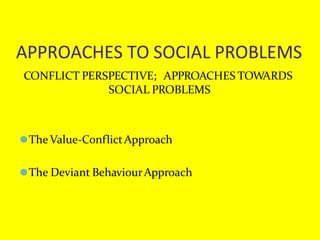
APPROACHES TO SOCIAL PROBLEMS
CONFLICT PERSPECTIVE; APPROACHES TOWARDS
SOCIAL PROBLEMS
⚫The Value-ConflictApproach
⚫The Deviant BehaviourApproach
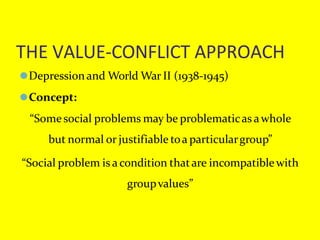
THE VALUE-CONFLICT APPROACH
⚫Depressionand World War II (1938-1945)
⚫Concept:
“Somesocial problems may be problematicas awhole
but normal or justifiable toa particulargroup”
“Social problem is a condition thatare incompatiblewith
groupvalues”
THE VALUE-CONFLICT APPROACH
Causes:
⚫Problems occur when groups with different values meet
and compete
⚫Example: Landlords and Tenants
Effects:
⚫Consequences are costly as groups become polarized
(against each other). Higher goals are sacrificed for lower
ones *compromise)
THE VALUE-CONFLICT APPROACH
Suggestions:
⚫Conflicts to be solved by:
1. Consensus (agreementon compromise)
2. Trading (exchange)
3. Power (dominancy)
⚫Example: Landlordsand Tenants
THE DEVIANT BEHAVIOUR APPROACH
Concept:
“Social Problemsarecreated by peoplewhodeviate from
theaccepted normsand aredelinquents”
THE DEVIANT BEHAVIOUR APPROACH
Causes:
“Behaviour or conditions that are deviant from the
norms, theyarise when legitimate (systematic) meansof
achieving cultural goalsare blocked”
Example:
Unemployment, corruption,violence
THE DEVIANT BEHAVIOUR APPROACH
Remedies:
⚫Re-socialize deviants by increasing their contacts with
accepted patternsof behaviour.
⚫Social systems must be less rigid, legitimate
⚫Opportunitiesand goalsshould be moreattainable
APPROACHES TO SOCIAL PROBLEMS
INTERACTIONIST PERSPECTIVE: APPROACH
TOWARDS SOCIAL PROBLEMS
⚫Labeling Approach
Labeling Approach
⚫Recentapproach tostudy Social Problems
⚫Labelling approach are interested in explaining why
and underwhatconditionscertain actsand situations
come to be defined as problematicordeviant
Concept:
“Social Problemsareconditions in which certain
behaviourorsituation becomedefined as social
problems”
Labeling Approach
Causes:
⚫Awareness of people about certain behaviour or
situation’sexistence makes them social problems.
⚫Definition of social problems changes according to our
own situation, interestor by pressuregroup.
Labeling Approach
Consequences:
⚫People who are considered deviant and are labelled
will accept that definition and will or may adopt more
deviantacts tocompliment/reinforcedeviancy
For Example:
⚫Drug Addiction leading towards crime and life style
changeas secondarydeviance
APPROACHES TO SOCIAL PROBLEMS
FUNCTIONALIST PERSPECTIVE; APPROACHES
TOWARDS SOCIAL PROBLEMS
⚫Social Pathological Approach
⚫Social Disorganization Approach
⚫Institutional Approach
Social Pathology Approach
⚫Nineteenth-centuryAmerican & European sociologists
Concept:
“Individuals and groups who deviate from social norms,
or institutions that do not fit with core social norms, are
“sick” orpathologicand a risk to thesociety's ‘health’ ”
Social Pathology Approach
Causes:
⚫Social Problems arise when either individuals or social
institutions fail to keep pace with changing conditions
and thereby disrupt the healthy operation of the social
organism (individuals or groups) such individuals or
“Sick” hence the term
institutions were considered
“Social Pathology”
For Example:
⚫Rural Migrants who fail to adjust in urban life are
considered as a sourceof “sickness” or “illness”
Social Pathology Approach
Causes:
⚫Early social pathologists identify individual’s as a
source of society’s problems who could not be
properly socialized or who rejected society’s values
and beliefs becauseof their internal defects.
For Example: Social pathology includes: substance
abuse, violence, abuses of women and children, crime,
terrorism, corruption, criminality, discrimination,
isolation, stigmatisationand human rights violations.
Social Pathology Approach
Causes:
⚫Modern Social Pathologists focus more on defects
of society and its institution. Immoral society
produce immoral individuals.
For Example: Corruption.
Many contemporary social problems are global in
natureand are shared by manycountries.
Social Pathology Approach
Consequences:
⚫Social pathologies "often lead to a flood of social,
economic and psychological problems that undermine
well-being” and therefore need to be considered in
developing a mental health policy that promotes
population mental health well-being and addresses
issues thatcontributeto mental illness.
⚫Increase the cost of maintaining social order
(terrorism)
Social Pathology Approach
Solutions:
⚫Education as a solution to social problems
⚫Programs to prevent the transmission of defects in
next generations
Social Disorganization Approach
Conceptand Causes:
Society is organized bya set of expectations and rules. Social
Disorganization results when these fail and result in:
1. Normlessness (people have no rules)
2. Cultural Conflicts (people feel trapped by contradictory
setof rules)
3. Breakdown (obedience to a set of rules results in no
rewards or in punishment)
For Example:
Rapid Social Change, Job Discrimination, drug addiction,
personal, familyand communitydisorganization
Social Disorganization Approach
Consequences:
Social System feels the forceof disorganization
⚫It maychange its rules
⚫Keepcontradictory rules in force
⚫Breaking down
Solution:
⚫Reversed by isolating itscausesand correcting them
⚫Society to make new rulesand expectations
Institutional Approach
Concept:
“Problems in Social institutions produce patterns of
deviance or institutions must address the problems
through strategic social change”
Causes:
⚫Social problems are the product of the “impersonal
operation” of existing social institutions both now and
in the past.
Institutional Approach
Solution/Remedies:
⚫Engage in research and activesocial interventions
⚫Planned changeoroverall change in social institutions
⚫Emergence of new social institutions replacing
existing institutions
ROLE OR CONTRIBUTIONS OF SOCIOLOGISTS/SOCIAL
SCIENTISTS TO UNDERSTAND SOCIAL PROBLEMS
Five contributions of sociologists to understand
social problems:
1. Sociologists can measure objective conditions (IM;
sociologists can gather information on the number
of infant mortality in clinics and hospitals and on
how the cities and provinces vary in their access to
medical facility)
2. Sociologists can measure subjective concerns (they
can determine people’s attitudes and views about
social problems. Such information is useful in
evaluating potential policies)
FIVE CONTRIBUTIONS OF SOCIOLOGISTS/SOCIAL
SCIENTISTS TO UNDERSTANDING SOCIAL PROBLEMS
3. Sociologists can apply the sociological imagination; that
is, they can place social problems into their broad social
context. (family planning is related to people’s attitudes
and is also related to profound differences of opinion
about privacy, what human life is, when life begins and
ends and the role of religious institutions)
4. Sociologists can identify different ways to intervene in a
social problem. They can suggest potential social policies:
courses of action for public and private agencies,
educational programs, public awareness campaigns, and
legal changes toaddress a social problem
FIVE CONTRIBUTIONS OF SOCIOLOGISTS/SOCIAL
SCIENTISTS TO UNDERSTAND SOCIAL PROBLEMS
5. Sociologists can evaluate likely consequences of
social policies. For example, sociologists can estimate
how a proposed social policy on family planning will
affect the birth rate, population growth, crime rate,
and expenditures forwelfareand education.

approachestosocialproblems-160616065911 (1).pptx

  • 1.
  • 2.
    APPROACHES TO SOCIALPROBLEMS CONFLICT PERSPECTIVE; APPROACHES TOWARDS SOCIAL PROBLEMS ⚫The Value-ConflictApproach ⚫The Deviant BehaviourApproach
  • 3.
    THE VALUE-CONFLICT APPROACH ⚫DepressionandWorld War II (1938-1945) ⚫Concept: “Somesocial problems may be problematicas awhole but normal or justifiable toa particulargroup” “Social problem is a condition thatare incompatiblewith groupvalues”
  • 4.
    THE VALUE-CONFLICT APPROACH Causes: ⚫Problemsoccur when groups with different values meet and compete ⚫Example: Landlords and Tenants Effects: ⚫Consequences are costly as groups become polarized (against each other). Higher goals are sacrificed for lower ones *compromise)
  • 5.
    THE VALUE-CONFLICT APPROACH Suggestions: ⚫Conflictsto be solved by: 1. Consensus (agreementon compromise) 2. Trading (exchange) 3. Power (dominancy) ⚫Example: Landlordsand Tenants
  • 6.
    THE DEVIANT BEHAVIOURAPPROACH Concept: “Social Problemsarecreated by peoplewhodeviate from theaccepted normsand aredelinquents”
  • 7.
    THE DEVIANT BEHAVIOURAPPROACH Causes: “Behaviour or conditions that are deviant from the norms, theyarise when legitimate (systematic) meansof achieving cultural goalsare blocked” Example: Unemployment, corruption,violence
  • 8.
    THE DEVIANT BEHAVIOURAPPROACH Remedies: ⚫Re-socialize deviants by increasing their contacts with accepted patternsof behaviour. ⚫Social systems must be less rigid, legitimate ⚫Opportunitiesand goalsshould be moreattainable
  • 9.
    APPROACHES TO SOCIALPROBLEMS INTERACTIONIST PERSPECTIVE: APPROACH TOWARDS SOCIAL PROBLEMS ⚫Labeling Approach
  • 10.
    Labeling Approach ⚫Recentapproach tostudySocial Problems ⚫Labelling approach are interested in explaining why and underwhatconditionscertain actsand situations come to be defined as problematicordeviant Concept: “Social Problemsareconditions in which certain behaviourorsituation becomedefined as social problems”
  • 11.
    Labeling Approach Causes: ⚫Awareness ofpeople about certain behaviour or situation’sexistence makes them social problems. ⚫Definition of social problems changes according to our own situation, interestor by pressuregroup.
  • 12.
    Labeling Approach Consequences: ⚫People whoare considered deviant and are labelled will accept that definition and will or may adopt more deviantacts tocompliment/reinforcedeviancy For Example: ⚫Drug Addiction leading towards crime and life style changeas secondarydeviance
  • 13.
    APPROACHES TO SOCIALPROBLEMS FUNCTIONALIST PERSPECTIVE; APPROACHES TOWARDS SOCIAL PROBLEMS ⚫Social Pathological Approach ⚫Social Disorganization Approach ⚫Institutional Approach
  • 14.
    Social Pathology Approach ⚫Nineteenth-centuryAmerican& European sociologists Concept: “Individuals and groups who deviate from social norms, or institutions that do not fit with core social norms, are “sick” orpathologicand a risk to thesociety's ‘health’ ”
  • 15.
    Social Pathology Approach Causes: ⚫SocialProblems arise when either individuals or social institutions fail to keep pace with changing conditions and thereby disrupt the healthy operation of the social organism (individuals or groups) such individuals or “Sick” hence the term institutions were considered “Social Pathology” For Example: ⚫Rural Migrants who fail to adjust in urban life are considered as a sourceof “sickness” or “illness”
  • 16.
    Social Pathology Approach Causes: ⚫Earlysocial pathologists identify individual’s as a source of society’s problems who could not be properly socialized or who rejected society’s values and beliefs becauseof their internal defects. For Example: Social pathology includes: substance abuse, violence, abuses of women and children, crime, terrorism, corruption, criminality, discrimination, isolation, stigmatisationand human rights violations.
  • 17.
    Social Pathology Approach Causes: ⚫ModernSocial Pathologists focus more on defects of society and its institution. Immoral society produce immoral individuals. For Example: Corruption. Many contemporary social problems are global in natureand are shared by manycountries.
  • 18.
    Social Pathology Approach Consequences: ⚫Socialpathologies "often lead to a flood of social, economic and psychological problems that undermine well-being” and therefore need to be considered in developing a mental health policy that promotes population mental health well-being and addresses issues thatcontributeto mental illness. ⚫Increase the cost of maintaining social order (terrorism)
  • 19.
    Social Pathology Approach Solutions: ⚫Educationas a solution to social problems ⚫Programs to prevent the transmission of defects in next generations
  • 20.
    Social Disorganization Approach ConceptandCauses: Society is organized bya set of expectations and rules. Social Disorganization results when these fail and result in: 1. Normlessness (people have no rules) 2. Cultural Conflicts (people feel trapped by contradictory setof rules) 3. Breakdown (obedience to a set of rules results in no rewards or in punishment) For Example: Rapid Social Change, Job Discrimination, drug addiction, personal, familyand communitydisorganization
  • 21.
    Social Disorganization Approach Consequences: SocialSystem feels the forceof disorganization ⚫It maychange its rules ⚫Keepcontradictory rules in force ⚫Breaking down Solution: ⚫Reversed by isolating itscausesand correcting them ⚫Society to make new rulesand expectations
  • 22.
    Institutional Approach Concept: “Problems inSocial institutions produce patterns of deviance or institutions must address the problems through strategic social change” Causes: ⚫Social problems are the product of the “impersonal operation” of existing social institutions both now and in the past.
  • 23.
    Institutional Approach Solution/Remedies: ⚫Engage inresearch and activesocial interventions ⚫Planned changeoroverall change in social institutions ⚫Emergence of new social institutions replacing existing institutions
  • 24.
    ROLE OR CONTRIBUTIONSOF SOCIOLOGISTS/SOCIAL SCIENTISTS TO UNDERSTAND SOCIAL PROBLEMS Five contributions of sociologists to understand social problems: 1. Sociologists can measure objective conditions (IM; sociologists can gather information on the number of infant mortality in clinics and hospitals and on how the cities and provinces vary in their access to medical facility) 2. Sociologists can measure subjective concerns (they can determine people’s attitudes and views about social problems. Such information is useful in evaluating potential policies)
  • 25.
    FIVE CONTRIBUTIONS OFSOCIOLOGISTS/SOCIAL SCIENTISTS TO UNDERSTANDING SOCIAL PROBLEMS 3. Sociologists can apply the sociological imagination; that is, they can place social problems into their broad social context. (family planning is related to people’s attitudes and is also related to profound differences of opinion about privacy, what human life is, when life begins and ends and the role of religious institutions) 4. Sociologists can identify different ways to intervene in a social problem. They can suggest potential social policies: courses of action for public and private agencies, educational programs, public awareness campaigns, and legal changes toaddress a social problem
  • 26.
    FIVE CONTRIBUTIONS OFSOCIOLOGISTS/SOCIAL SCIENTISTS TO UNDERSTAND SOCIAL PROBLEMS 5. Sociologists can evaluate likely consequences of social policies. For example, sociologists can estimate how a proposed social policy on family planning will affect the birth rate, population growth, crime rate, and expenditures forwelfareand education.