celebrating growth in the spirit
🞭 "And the Spirit of the Lord shall rest upon Him:
the Spirit of wisdom and of understanding, the
Spirit of counsel and of fortitude, the Spirit of
knowledge and of godliness. And He shall be
filled with the Spirit of the fear of the Lord.“
🞭 Isaiah 11:2-3
CONFIRMATION
🞭 the Sacrament of Christian maturity
🞭 Chrismation
🞭 One of the three sacraments of initiation
🞭 A celebration of the full outpouring of the
Holy Spirit on a baptized person
🞭 Completes and strengthens the grace given
by the spirit in Baptism
🞭
CONFIRMATION
🞭 Imparts a permanent character or seal in the
person, marking him or her as belonging
totally to Christ and as united to the church
🞭 A sign of growing in the spirit of Jesus
🞭 Received only once during the age of
discretion
1 Joseph Stoutzenberger; Celebrating Sacraments (St. Mary’s Press, Christian Brothers Publications, 2000) p. 156
CONFIRMATION
🞭 Biblical Foundation
🞭 Recipient and Minister
🞭 Rites
🞭 Form and Matter
🞭 Effects
🞭 Call to Mission
Biblical foundation of the
Sacrament of Confirmation
Baptism and Confirmation in the
New testament
The New Testament reports many
manifestations of the Holy Spirit after the
Father, in the power of the Spirit, raised Jesus
from the dead. John’s Gospel describes an
outpouring of the Spirit when Jesus breathed
on the Apostles and said, “Receive the Holy
Spirit” (Jn 20:22) and the Acts of the Apostles
gives another account of the Holy Spirit at
Pentecost, fifty days after the Resurrection.
Biblical Foundation
The most important scripture for the
understanding of the sacrament of
confirmation is the narrative about Jesus
own baptism and anointing by the Spirit, as
well as the Church’s anointing with the
Spirit at Pentecost (Acts 2).
Jesus own Baptism and
Anointing
Mark 1:9-10 9 In those days Jesus came from
Nazareth of Galilee and was baptized by John in
the Jordan. 10 And when he came up out of the
water, immediately he saw the heavens opened and
the Spirit descending upon him like a dove; 11 and a
voice came from heaven, "Thou art my beloved Son;
with thee I am well pleased.“
The passage shows the relationship between baptism
and confirmation. Baptism is fundamental, but
Confirmation is necessary for the completion of
baptismal grace.
Church’s Anointing
Acts 2:1-4
1When the day of Pentecost came, they
were all together in one place. 2 Suddenly a
sound like the blowing of a violent wind came
from heaven and filled the whole house
where they were sitting.3 They saw what
seemed to be tongues of fire that separated
and came to rest on each of them. 4 All of
them were filled with the Holy Spirit and
began to speak in other tongues as the Spirit
enabled them.
Church’s Anointing
The early fathers, the Apostles where
authorized by the Holy Spirit to perform
the sacraments of baptism and
confirmation after the death of Jesus from
the day they were anointed during
Pentecost.
Baptism and Confirmation as
separate rites
Acts 8:14-17
“Now when the apostles at Jerusalem heard that
Samaria had received the word of God, they sent
to them Peter and John, who came down and
prayed for them that they might receive the Holy
Spirit; for it has not yet fallen on any of them, but
they had only been baptized in the name of the
Lord Jesus. Then they laid their hands on them
and they received the Holy Sprit.”
Baptism and Confirmation as
separate rites
Confirmation is clearly seen as a separate
rite from Baptism in the incident of the
Deacon Philip with his Samaritan converts.
Philip baptized them, but the special
reception of the Holy Spirit awaited the
administration of Confirmation by the
Apostles.
Baptism and Confirmation
foretold in the Old testament
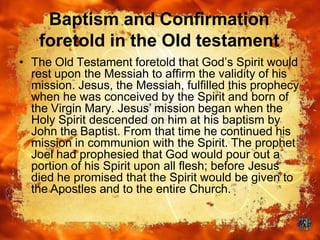
• The Old Testament foretold that God’s Spirit would
rest upon the Messiah to affirm the validity of his
mission. Jesus, the Messiah, fulfilled this prophecy
when he was conceived by the Spirit and born of
the Virgin Mary. Jesus’ mission began when the
Holy Spirit descended on him at his baptism by
John the Baptist. From that time he continued his
mission in communion with the Spirit. The prophet
Joel had prophesied that God would pour out a
portion of his Spirit upon all flesh; before Jesus
died he promised that the Spirit would be given to
the Apostles and to the entire Church.
Baptism and Confirmation
foretold in the Old testament
The prophet Ezekiel foresaw the outpouring of the Holy
Spirit that occurs in the Sacraments of Baptism and
Confirmation:
Ezekiel 36:25-27
I will sprinkle clean water upon you, and you shall be
clean from all your uncleanliness, and for all your idols
I will cleanse you. A new heart I will give you, and a
new spirit I will put within you; and I will take out of
your flesh the heart of stone and give you a heart of
flesh. And I will put my spirit within you, and cause you
to walk in my statutes and be careful to observe my
ordinances.”
RECIPIENTS AND
MINISTER OF
CONFIRMATION
MINISTER:
"The original minister of Confirmation is the BISHOP." Each bishop is a
successor to the apostles, upon whomthe Holy Spirit descended at Pentecost
—the first Confirmation.TheActs of theApostles mentionsthe apostles
imparting the Holy Spirit to believers by the laying on of hands (see, for example,
Acts 8:15-17and 19:6).
APRIEST can also validly confer this sacramentif he has the faculty to do so,
either from the general law or by way of aspecial grant from the competent
authority
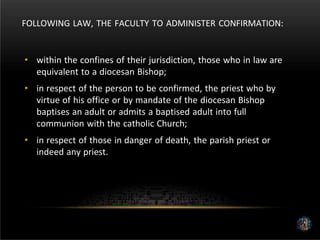
FOLLOWING LAW, THE FACULTY TO ADMINISTER CONFIRMATION:
• within the confines of their jurisdiction, those who in law are
equivalent to a diocesan Bishop;
• in respect of the person to be confirmed, the priest who by
virtue of his office or by mandate of the diocesan Bishop
baptises an adult or admits a baptised adult into full
communion with the catholic Church;
• in respect of those in danger of death, the parish priest or
indeed any priest.
RECIPIENT:
• Every baptised person who is not confirmed, and only such a
person, is capable of receiving confirmation.
• Apart from the danger of death, to receive confirmation lawfully a
person who has the use of reason must be suitably
instructed, properly disposed and able to renew the baptismal
promises.
2Gerard Austin; The Rite of Confirmation: Anointing with the Spirit
(Order of the St. Benedict, Collegeville, Minnesota; 2004) p. 47
Confirmation Rites
The confirmation liturgy marks one stage of
initiation and celebrates the candidates'
gradual and continuing growth into the
Eucharistic community. Confirmation is
most appropriately celebrated in the
context of the Eucharist.
The following moments of the liturgy are
to be carefully prepared:
1. The procession of
ministers, candidates, and elements of the
celebration:
Cross bearer and servers with candles or Easter Candle
(optional).
Water for sprinkling rite.
Candidates
Chrism
Lectionary or Book of Gospels
Bishop accompanied by pastor
II. The sprinkling rite which replaces the
penitential rite.
III. Liturgy of the Word.
IV. The Rite of Confirmation with 6
major actions:
Presentation of the candidates
After the gospel reading the candidates are "each called by
name." They are to stand at their place to emphasize the
importance of the moment
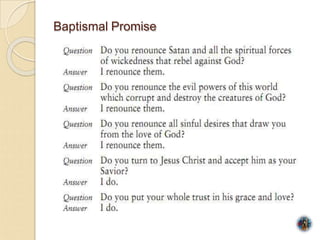
Renewal of Baptismal promises
Each candidate is asked questions about what they
believe. They promise to reject evil. It is a bit like joining a
club, except that the promises affect the whole of a
person's life.
Baptismal Promise
Laying on of hands
The imposition of hands evokes blessing, compassion,
and unity. The bishops extends his hands towards the
candidates, invoking the Holy Spirit to come (Veni Sancti
Spiritus)
Anointing with chrism
The anointing with chrism is the gesture which speaks of
service and discipleship. It is the mark of the kingdom.
The bishop says “Be sealed with the gift of the Holy Spirit”
General Intercession
3Christopher Webber; A User’s Guide to the Book of Common Prayer: Baptism
and Confirmation (Morehouse Publishing, 2006) p.24
4 Timothy Fitzgerald; Confirmation: A Parish Celebration Revised Edition (
Archdiocese of Chicago: Liturgical Training Publications, 1999) p.14
MATTER
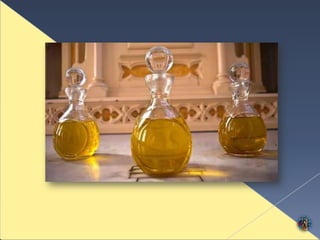
CHRISM
- A Greek word literally meaning “ an anointing”
- Also called as “ myrrh”
- aromatic natural blend of essential oil and resin
- Mixture of olive oil and balm blessed by the
Bishop. This matter most appropriately signifies the
effects of the Sacrament.
OIL
- expresses the plenitude of divine grace which is
poured out
BALSAM
- signifies the sweet odour of virtue and preservation
from the corruption of sin.
-therefore, constitutes the matter of confirmation; and
this mixture of different elements at once expresses
the manifold graces of the Holy Ghost and the
excellence of this Sacrament.
FORM
-The form of this Sacrament is the words pronounced by
the Bishop:
"Isign thee with the sign of the cross, and
confirm thee with the chrism of salvation, in the name
of the
Father, and of the Son, and of the Holy Ghost“
- He/she is confirmed in strength by receiving new
virtue, and becomes a perfect soldier of Christ.
- The form of the Sacrament should embrace whatever
is necessary to explain its nature and substance.
With regard to the nature and substance of
Confirmation there are three things that demand
particular attention:
1.the divine power
-a primary cause that operates in the Sacrament
-"in the name of the Father, and of the Son, and
of the Holy Ghost,"
2.the spiritual strength
-which it imparts to the faithful unto salvation
-"Iconfirm thee with the chrism of salvation;"
3.the sign impressed on him
-who is to engage in the warfare of Christ.
-"Isign thee with the sign of the cross,"
The matter and form of this Sacrament
are administered by the Bishop as the
ordinary minister in conformity with the
teaching of Scripture and tradition.
5Confirmation; http://catholicharboroffaithandmorals.com/
Roots us more deeply in the divine filiation [as
children of God] which makes us cry, "Abba!
Father!";
Unites us more firmly to Christ;
Increases the gifts of the Holy Spirits in us;
Strengthen us with the grace to fight against
internal battles against temptation and sin
Renders our bond with the Church more
perfect;
Gives us a special strength of the Holy Spirit
to spread and defend the faith by word and
action as true witnesses of Christ, to confess
the name of Christ boldly, and never to be
ashamed of the Cross.
6Kathleen Hughes; A Mystatogy of Sacrament: Saying Amen
(Archdiocese of Chicago: Liturgy Training Publications, 1999) p.85
CALL TO MISSION
🞭 “For all those who are able to understand and
fulfill the commandments of God and of the
Church.”
🞭 Catholics who have been confirmed are “more
strictly obliged to spread the faith by word and
deed” (Lumen gentium, para. 11)
7Scannell, T. (1908). Confirmation. In The Catholic Encyclopedia. New York: Robert Appleton Company.
Retrieved September 9, 2012 from New Advent:http://www.newadvent.org/cathen/04215b.htm
8D’Ambrosio, M. http://www.crossroadsinitiative.com/
library_article/68/Sacrament_of_Confirmation Sacrament_of_Champions Part_II.html
confirmation-120920083223-phpapp01.pptx

confirmation-120920083223-phpapp01.pptx

  • 2.
  • 3.
    🞭 "And theSpirit of the Lord shall rest upon Him: the Spirit of wisdom and of understanding, the Spirit of counsel and of fortitude, the Spirit of knowledge and of godliness. And He shall be filled with the Spirit of the fear of the Lord.“ 🞭 Isaiah 11:2-3
  • 4.
    CONFIRMATION 🞭 the Sacramentof Christian maturity 🞭 Chrismation 🞭 One of the three sacraments of initiation 🞭 A celebration of the full outpouring of the Holy Spirit on a baptized person 🞭 Completes and strengthens the grace given by the spirit in Baptism 🞭
  • 5.
    CONFIRMATION 🞭 Imparts apermanent character or seal in the person, marking him or her as belonging totally to Christ and as united to the church 🞭 A sign of growing in the spirit of Jesus 🞭 Received only once during the age of discretion 1 Joseph Stoutzenberger; Celebrating Sacraments (St. Mary’s Press, Christian Brothers Publications, 2000) p. 156
  • 6.
    CONFIRMATION 🞭 Biblical Foundation 🞭Recipient and Minister 🞭 Rites 🞭 Form and Matter 🞭 Effects 🞭 Call to Mission
  • 8.
    Biblical foundation ofthe Sacrament of Confirmation
  • 9.
    Baptism and Confirmationin the New testament The New Testament reports many manifestations of the Holy Spirit after the Father, in the power of the Spirit, raised Jesus from the dead. John’s Gospel describes an outpouring of the Spirit when Jesus breathed on the Apostles and said, “Receive the Holy Spirit” (Jn 20:22) and the Acts of the Apostles gives another account of the Holy Spirit at Pentecost, fifty days after the Resurrection.
  • 10.
    Biblical Foundation The mostimportant scripture for the understanding of the sacrament of confirmation is the narrative about Jesus own baptism and anointing by the Spirit, as well as the Church’s anointing with the Spirit at Pentecost (Acts 2).
  • 11.
    Jesus own Baptismand Anointing Mark 1:9-10 9 In those days Jesus came from Nazareth of Galilee and was baptized by John in the Jordan. 10 And when he came up out of the water, immediately he saw the heavens opened and the Spirit descending upon him like a dove; 11 and a voice came from heaven, "Thou art my beloved Son; with thee I am well pleased.“ The passage shows the relationship between baptism and confirmation. Baptism is fundamental, but Confirmation is necessary for the completion of baptismal grace.
  • 12.
    Church’s Anointing Acts 2:1-4 1Whenthe day of Pentecost came, they were all together in one place. 2 Suddenly a sound like the blowing of a violent wind came from heaven and filled the whole house where they were sitting.3 They saw what seemed to be tongues of fire that separated and came to rest on each of them. 4 All of them were filled with the Holy Spirit and began to speak in other tongues as the Spirit enabled them.
  • 13.
    Church’s Anointing The earlyfathers, the Apostles where authorized by the Holy Spirit to perform the sacraments of baptism and confirmation after the death of Jesus from the day they were anointed during Pentecost.
  • 14.
    Baptism and Confirmationas separate rites Acts 8:14-17 “Now when the apostles at Jerusalem heard that Samaria had received the word of God, they sent to them Peter and John, who came down and prayed for them that they might receive the Holy Spirit; for it has not yet fallen on any of them, but they had only been baptized in the name of the Lord Jesus. Then they laid their hands on them and they received the Holy Sprit.”
  • 15.
    Baptism and Confirmationas separate rites Confirmation is clearly seen as a separate rite from Baptism in the incident of the Deacon Philip with his Samaritan converts. Philip baptized them, but the special reception of the Holy Spirit awaited the administration of Confirmation by the Apostles.
  • 16.
    Baptism and Confirmation foretoldin the Old testament • The Old Testament foretold that God’s Spirit would rest upon the Messiah to affirm the validity of his mission. Jesus, the Messiah, fulfilled this prophecy when he was conceived by the Spirit and born of the Virgin Mary. Jesus’ mission began when the Holy Spirit descended on him at his baptism by John the Baptist. From that time he continued his mission in communion with the Spirit. The prophet Joel had prophesied that God would pour out a portion of his Spirit upon all flesh; before Jesus died he promised that the Spirit would be given to the Apostles and to the entire Church.
  • 17.
    Baptism and Confirmation foretoldin the Old testament The prophet Ezekiel foresaw the outpouring of the Holy Spirit that occurs in the Sacraments of Baptism and Confirmation: Ezekiel 36:25-27 I will sprinkle clean water upon you, and you shall be clean from all your uncleanliness, and for all your idols I will cleanse you. A new heart I will give you, and a new spirit I will put within you; and I will take out of your flesh the heart of stone and give you a heart of flesh. And I will put my spirit within you, and cause you to walk in my statutes and be careful to observe my ordinances.”
  • 18.
  • 19.
    MINISTER: "The original ministerof Confirmation is the BISHOP." Each bishop is a successor to the apostles, upon whomthe Holy Spirit descended at Pentecost —the first Confirmation.TheActs of theApostles mentionsthe apostles imparting the Holy Spirit to believers by the laying on of hands (see, for example, Acts 8:15-17and 19:6). APRIEST can also validly confer this sacramentif he has the faculty to do so, either from the general law or by way of aspecial grant from the competent authority
  • 20.
    FOLLOWING LAW, THEFACULTY TO ADMINISTER CONFIRMATION: • within the confines of their jurisdiction, those who in law are equivalent to a diocesan Bishop; • in respect of the person to be confirmed, the priest who by virtue of his office or by mandate of the diocesan Bishop baptises an adult or admits a baptised adult into full communion with the catholic Church; • in respect of those in danger of death, the parish priest or indeed any priest.
  • 21.
    RECIPIENT: • Every baptisedperson who is not confirmed, and only such a person, is capable of receiving confirmation. • Apart from the danger of death, to receive confirmation lawfully a person who has the use of reason must be suitably instructed, properly disposed and able to renew the baptismal promises. 2Gerard Austin; The Rite of Confirmation: Anointing with the Spirit (Order of the St. Benedict, Collegeville, Minnesota; 2004) p. 47
  • 23.
    Confirmation Rites The confirmationliturgy marks one stage of initiation and celebrates the candidates' gradual and continuing growth into the Eucharistic community. Confirmation is most appropriately celebrated in the context of the Eucharist.
  • 24.
    The following momentsof the liturgy are to be carefully prepared: 1. The procession of ministers, candidates, and elements of the celebration: Cross bearer and servers with candles or Easter Candle (optional). Water for sprinkling rite. Candidates Chrism Lectionary or Book of Gospels Bishop accompanied by pastor II. The sprinkling rite which replaces the penitential rite.
  • 25.
    III. Liturgy ofthe Word. IV. The Rite of Confirmation with 6 major actions: Presentation of the candidates After the gospel reading the candidates are "each called by name." They are to stand at their place to emphasize the importance of the moment Renewal of Baptismal promises Each candidate is asked questions about what they believe. They promise to reject evil. It is a bit like joining a club, except that the promises affect the whole of a person's life.
  • 26.
  • 27.
    Laying on ofhands The imposition of hands evokes blessing, compassion, and unity. The bishops extends his hands towards the candidates, invoking the Holy Spirit to come (Veni Sancti Spiritus) Anointing with chrism The anointing with chrism is the gesture which speaks of service and discipleship. It is the mark of the kingdom. The bishop says “Be sealed with the gift of the Holy Spirit” General Intercession 3Christopher Webber; A User’s Guide to the Book of Common Prayer: Baptism and Confirmation (Morehouse Publishing, 2006) p.24 4 Timothy Fitzgerald; Confirmation: A Parish Celebration Revised Edition ( Archdiocese of Chicago: Liturgical Training Publications, 1999) p.14
  • 28.
    MATTER CHRISM - A Greekword literally meaning “ an anointing” - Also called as “ myrrh” - aromatic natural blend of essential oil and resin - Mixture of olive oil and balm blessed by the Bishop. This matter most appropriately signifies the effects of the Sacrament. OIL - expresses the plenitude of divine grace which is poured out
  • 30.
    BALSAM - signifies thesweet odour of virtue and preservation from the corruption of sin. -therefore, constitutes the matter of confirmation; and this mixture of different elements at once expresses the manifold graces of the Holy Ghost and the excellence of this Sacrament.
  • 31.
    FORM -The form ofthis Sacrament is the words pronounced by the Bishop: "Isign thee with the sign of the cross, and confirm thee with the chrism of salvation, in the name of the Father, and of the Son, and of the Holy Ghost“ - He/she is confirmed in strength by receiving new virtue, and becomes a perfect soldier of Christ. - The form of the Sacrament should embrace whatever is necessary to explain its nature and substance.
  • 32.
    With regard tothe nature and substance of Confirmation there are three things that demand particular attention: 1.the divine power -a primary cause that operates in the Sacrament -"in the name of the Father, and of the Son, and of the Holy Ghost," 2.the spiritual strength -which it imparts to the faithful unto salvation -"Iconfirm thee with the chrism of salvation;" 3.the sign impressed on him -who is to engage in the warfare of Christ. -"Isign thee with the sign of the cross,"
  • 33.
    The matter andform of this Sacrament are administered by the Bishop as the ordinary minister in conformity with the teaching of Scripture and tradition. 5Confirmation; http://catholicharboroffaithandmorals.com/
  • 35.
    Roots us moredeeply in the divine filiation [as children of God] which makes us cry, "Abba! Father!"; Unites us more firmly to Christ; Increases the gifts of the Holy Spirits in us; Strengthen us with the grace to fight against internal battles against temptation and sin
  • 36.
    Renders our bondwith the Church more perfect; Gives us a special strength of the Holy Spirit to spread and defend the faith by word and action as true witnesses of Christ, to confess the name of Christ boldly, and never to be ashamed of the Cross. 6Kathleen Hughes; A Mystatogy of Sacrament: Saying Amen (Archdiocese of Chicago: Liturgy Training Publications, 1999) p.85
  • 37.
    CALL TO MISSION 🞭“For all those who are able to understand and fulfill the commandments of God and of the Church.” 🞭 Catholics who have been confirmed are “more strictly obliged to spread the faith by word and deed” (Lumen gentium, para. 11) 7Scannell, T. (1908). Confirmation. In The Catholic Encyclopedia. New York: Robert Appleton Company. Retrieved September 9, 2012 from New Advent:http://www.newadvent.org/cathen/04215b.htm 8D’Ambrosio, M. http://www.crossroadsinitiative.com/ library_article/68/Sacrament_of_Confirmation Sacrament_of_Champions Part_II.html