REED LII.
Ways of Coming
to Know God
Catechism of the Catholic Church
(Magisterium)
 31 Created in God's image and called to know and
love him, the person who seeks God discovers certain
ways of coming to know him. These are also called
proofs for the existence of God, not in the sense of
proofs in the natural sciences, but rather in the sense
of "converging and convincing arguments", which
allow us to attain certainty about the truth. These
"ways" of approaching God from creation have a
twofold point of departure: the physical world, and
the human person
32 The world: starting from
movement, becoming, contingency,
and the world's order and beauty, one
can come to a knowledge of God as
the origin and the end of the universe.
 As St. Paul says of the Gentiles: For what
can be known about God is plain to them,
because God has shown it to them. Ever
since the creation of the world his invisible
nature, namely, his eternal power and
deity, has been clearly perceived in the
things that have been made.7
 And St. Augustine issues this challenge: Question
the beauty of the earth, question the beauty of
the sea, question the beauty of the air distending
and diffusing itself, question the beauty of the
sky. . . question all these realities. All respond:
"See, we are beautiful." Their beauty is a
profession [confessio]. These beauties are subject
to change. Who made them if not the Beautiful
One [Pulcher] who is not subject to change?8
 33 The human person: with his openness to truth
and beauty, his sense of moral goodness, his
freedom and the voice of his conscience, with his
longings for the infinite and for happiness, man
questions himself about God's existence. In all this
he discerns signs of his spiritual soul. the soul, the
"seed of eternity we bear in ourselves, irreducible
to the merely material",9 can have its origin only
in God.
 34 The world, and man, attest that they
contain within themselves neither their first
principle nor their final end, but rather that
they participate in Being itself, which alone is
without origin or end. Thus, in different ways,
man can come to know that there exists a
reality which is the first cause and final end of
all things, a reality "that everyone calls God".10
 35 Man's faculties make him capable of coming to
a knowledge of the existence of a personal God.
But for man to be able to enter into real intimacy
with him, God willed both to reveal himself to
man, and to give him the grace of being able to
welcome this revelation in faith.(so) the proofs of
God's existence, however, can predispose one to
faith and help one to see that faith is not opposed
to reason.
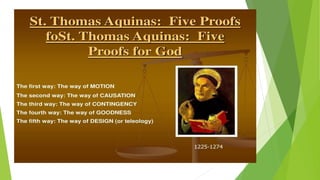
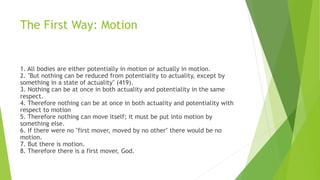
The First Way: Motion
1. All bodies are either potentially in motion or actually in motion.
2. "But nothing can be reduced from potentiality to actuality, except by
something in a state of actuality" (419).
3. Nothing can be at once in both actuality and potentiality in the same
respect.
4. Therefore nothing can be at once in both actuality and potentiality with
respect to motion
5. Therefore nothing can move itself; it must be put into motion by
something else.
6. If there were no "first mover, moved by no other" there would be no
motion.
7. But there is motion.
8. Therefore there is a first mover, God.
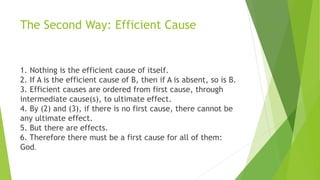
The Second Way: Efficient Cause
1. Nothing is the efficient cause of itself.
2. If A is the efficient cause of B, then if A is absent, so is B.
3. Efficient causes are ordered from first cause, through
intermediate cause(s), to ultimate effect.
4. By (2) and (3), if there is no first cause, there cannot be
any ultimate effect.
5. But there are effects.
6. Therefore there must be a first cause for all of them:
God.
The Third Way: Possibility and Necessity
1. "We find in nature things that are possible to be and not to be:" contingent
beings.
2. Everything is either necessary or contingent.
3. Assume that everything is contingent.
4. "It is impossible for [contingent beings] always to exist, for that which can
not-be at some time is not."
5. Therefore, by (3) and (4), at one time there was nothing.
6. "That which does not exist begins to exist only through something already
existing."
7. Therefore, by (5) and (6), there is nothing now.
8. But there is something now!
9. Therefore (3) is false.
10. Therefore, by (2), there is a necessary being: God.
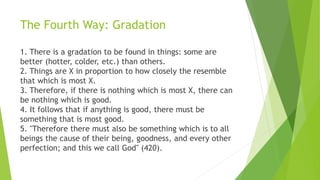
The Fourth Way: Gradation
1. There is a gradation to be found in things: some are
better (hotter, colder, etc.) than others.
2. Things are X in proportion to how closely the resemble
that which is most X.
3. Therefore, if there is nothing which is most X, there can
be nothing which is good.
4. It follows that if anything is good, there must be
something that is most good.
5. "Therefore there must also be something which is to all
beings the cause of their being, goodness, and every other
perfection; and this we call God" (420).
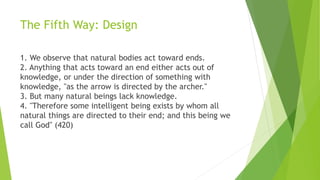
The Fifth Way: Design
1. We observe that natural bodies act toward ends.
2. Anything that acts toward an end either acts out of
knowledge, or under the direction of something with
knowledge, "as the arrow is directed by the archer."
3. But many natural beings lack knowledge.
4. "Therefore some intelligent being exists by whom all
natural things are directed to their end; and this being we
call God" (420)
Short quiz
1. Explain the importance of knowing
God.
2. Elaborate the five proofs of God’s
existence according to St. Thomas
ELABORATE – TO EXPAND IN DETAIL

REED LII [Recovered].pptx

  • 1.
    REED LII. Ways ofComing to Know God
  • 2.
    Catechism of theCatholic Church (Magisterium)  31 Created in God's image and called to know and love him, the person who seeks God discovers certain ways of coming to know him. These are also called proofs for the existence of God, not in the sense of proofs in the natural sciences, but rather in the sense of "converging and convincing arguments", which allow us to attain certainty about the truth. These "ways" of approaching God from creation have a twofold point of departure: the physical world, and the human person
  • 3.
    32 The world:starting from movement, becoming, contingency, and the world's order and beauty, one can come to a knowledge of God as the origin and the end of the universe.
  • 4.
     As St.Paul says of the Gentiles: For what can be known about God is plain to them, because God has shown it to them. Ever since the creation of the world his invisible nature, namely, his eternal power and deity, has been clearly perceived in the things that have been made.7
  • 5.
     And St.Augustine issues this challenge: Question the beauty of the earth, question the beauty of the sea, question the beauty of the air distending and diffusing itself, question the beauty of the sky. . . question all these realities. All respond: "See, we are beautiful." Their beauty is a profession [confessio]. These beauties are subject to change. Who made them if not the Beautiful One [Pulcher] who is not subject to change?8
  • 6.
     33 Thehuman person: with his openness to truth and beauty, his sense of moral goodness, his freedom and the voice of his conscience, with his longings for the infinite and for happiness, man questions himself about God's existence. In all this he discerns signs of his spiritual soul. the soul, the "seed of eternity we bear in ourselves, irreducible to the merely material",9 can have its origin only in God.
  • 7.
     34 Theworld, and man, attest that they contain within themselves neither their first principle nor their final end, but rather that they participate in Being itself, which alone is without origin or end. Thus, in different ways, man can come to know that there exists a reality which is the first cause and final end of all things, a reality "that everyone calls God".10
  • 8.
     35 Man'sfaculties make him capable of coming to a knowledge of the existence of a personal God. But for man to be able to enter into real intimacy with him, God willed both to reveal himself to man, and to give him the grace of being able to welcome this revelation in faith.(so) the proofs of God's existence, however, can predispose one to faith and help one to see that faith is not opposed to reason.
  • 10.
    The First Way:Motion 1. All bodies are either potentially in motion or actually in motion. 2. "But nothing can be reduced from potentiality to actuality, except by something in a state of actuality" (419). 3. Nothing can be at once in both actuality and potentiality in the same respect. 4. Therefore nothing can be at once in both actuality and potentiality with respect to motion 5. Therefore nothing can move itself; it must be put into motion by something else. 6. If there were no "first mover, moved by no other" there would be no motion. 7. But there is motion. 8. Therefore there is a first mover, God.
  • 11.
    The Second Way:Efficient Cause 1. Nothing is the efficient cause of itself. 2. If A is the efficient cause of B, then if A is absent, so is B. 3. Efficient causes are ordered from first cause, through intermediate cause(s), to ultimate effect. 4. By (2) and (3), if there is no first cause, there cannot be any ultimate effect. 5. But there are effects. 6. Therefore there must be a first cause for all of them: God.
  • 12.
    The Third Way:Possibility and Necessity 1. "We find in nature things that are possible to be and not to be:" contingent beings. 2. Everything is either necessary or contingent. 3. Assume that everything is contingent. 4. "It is impossible for [contingent beings] always to exist, for that which can not-be at some time is not." 5. Therefore, by (3) and (4), at one time there was nothing. 6. "That which does not exist begins to exist only through something already existing." 7. Therefore, by (5) and (6), there is nothing now. 8. But there is something now! 9. Therefore (3) is false. 10. Therefore, by (2), there is a necessary being: God.
  • 13.
    The Fourth Way:Gradation 1. There is a gradation to be found in things: some are better (hotter, colder, etc.) than others. 2. Things are X in proportion to how closely the resemble that which is most X. 3. Therefore, if there is nothing which is most X, there can be nothing which is good. 4. It follows that if anything is good, there must be something that is most good. 5. "Therefore there must also be something which is to all beings the cause of their being, goodness, and every other perfection; and this we call God" (420).
  • 14.
    The Fifth Way:Design 1. We observe that natural bodies act toward ends. 2. Anything that acts toward an end either acts out of knowledge, or under the direction of something with knowledge, "as the arrow is directed by the archer." 3. But many natural beings lack knowledge. 4. "Therefore some intelligent being exists by whom all natural things are directed to their end; and this being we call God" (420)
  • 15.
    Short quiz 1. Explainthe importance of knowing God. 2. Elaborate the five proofs of God’s existence according to St. Thomas ELABORATE – TO EXPAND IN DETAIL