© 2017, Amazon Web Services, Inc. or its Affiliates. All rights reserved.
Patterns and Considerations
in Service Discovery
Shubha Rao, Sr. Product Manager, Amazon ECS
Roven Drabo, Head of Cloud Operations, Kaplan
© 2017, Amazon Web Services, Inc. or its Affiliates. All rights reserved.
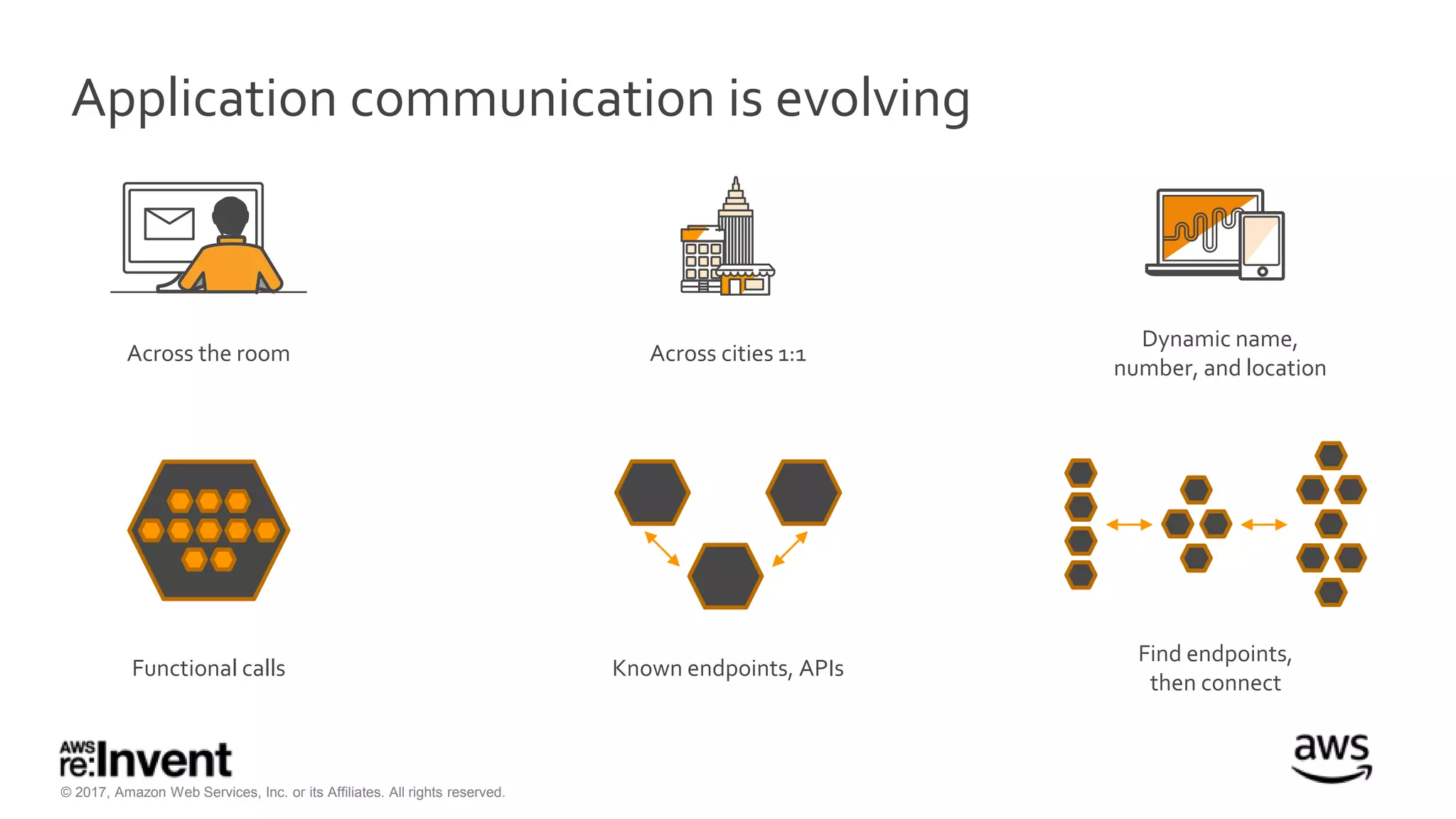
Application communication is evolving
Functional calls
Find endpoints,
then connect
Across the room
Dynamic name,
number, and location
Across cities 1:1
Known endpoints, APIs
© 2017, Amazon Web Services, Inc. or its Affiliates. All rights reserved.
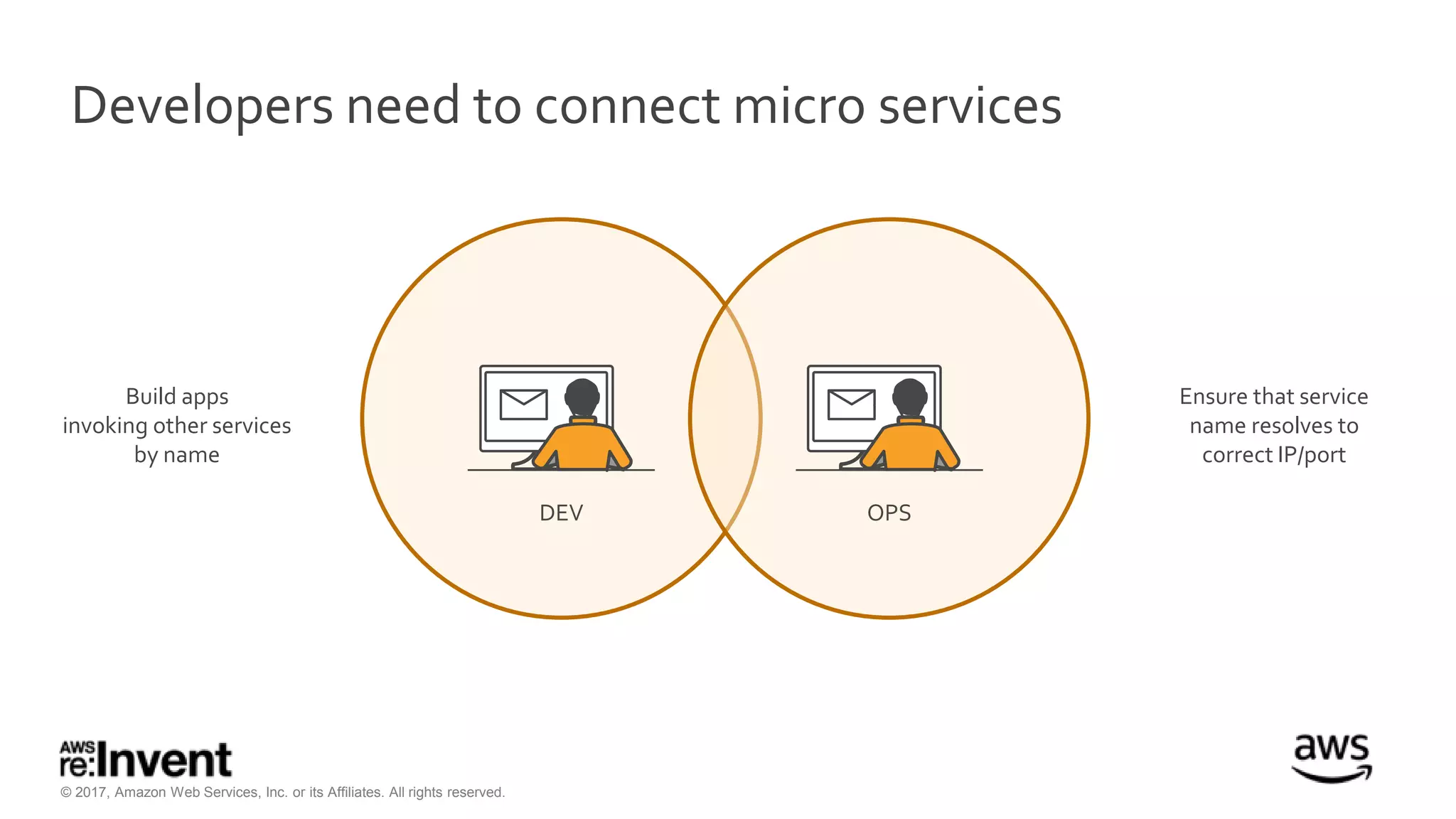
Developers need to connect micro services
Build apps
invoking other services
by name
Ensure that service
name resolves to
correct IP/port
DEV OPS
© 2017, Amazon Web Services, Inc. or its Affiliates. All rights reserved.
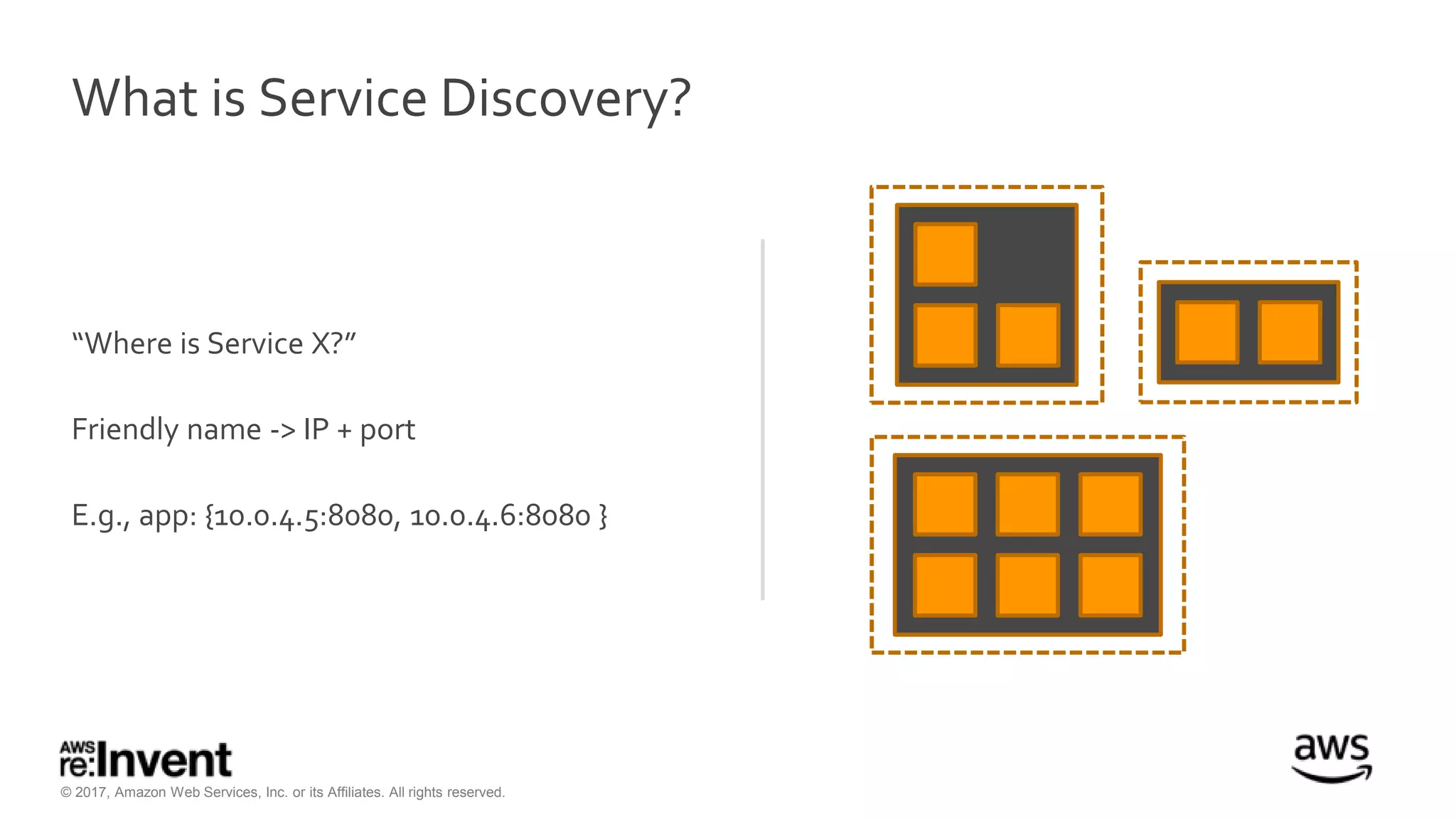
What is Service Discovery?
“Where is Service X?”
Friendly name -> IP + port
E.g., app: {10.0.4.5:8080, 10.0.4.6:8080 }
© 2017, Amazon Web Services, Inc. or its Affiliates. All rights reserved.
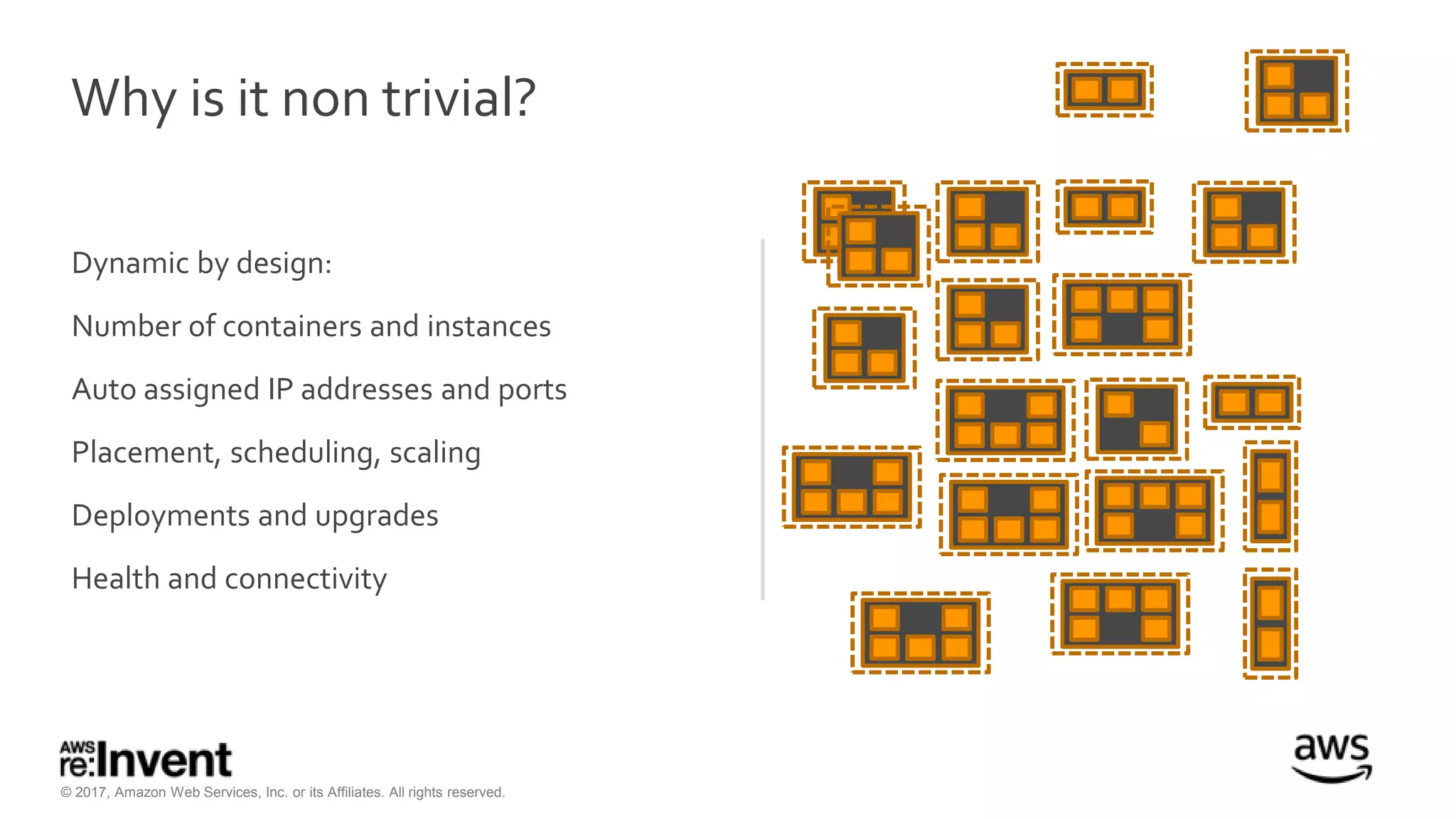
Why is it non trivial?
Dynamic by design:
Number of containers and instances
Auto assigned IP addresses and ports
Placement, scheduling, scaling
Deployments and upgrades
Health and connectivity
© 2017, Amazon Web Services, Inc. or its Affiliates. All rights reserved.
Decision criteria
Service registry
Discovery mechanism
Server side or client side
Registration mechanism
Third party or application framework
© 2017, Amazon Web Services, Inc. or its Affiliates. All rights reserved.
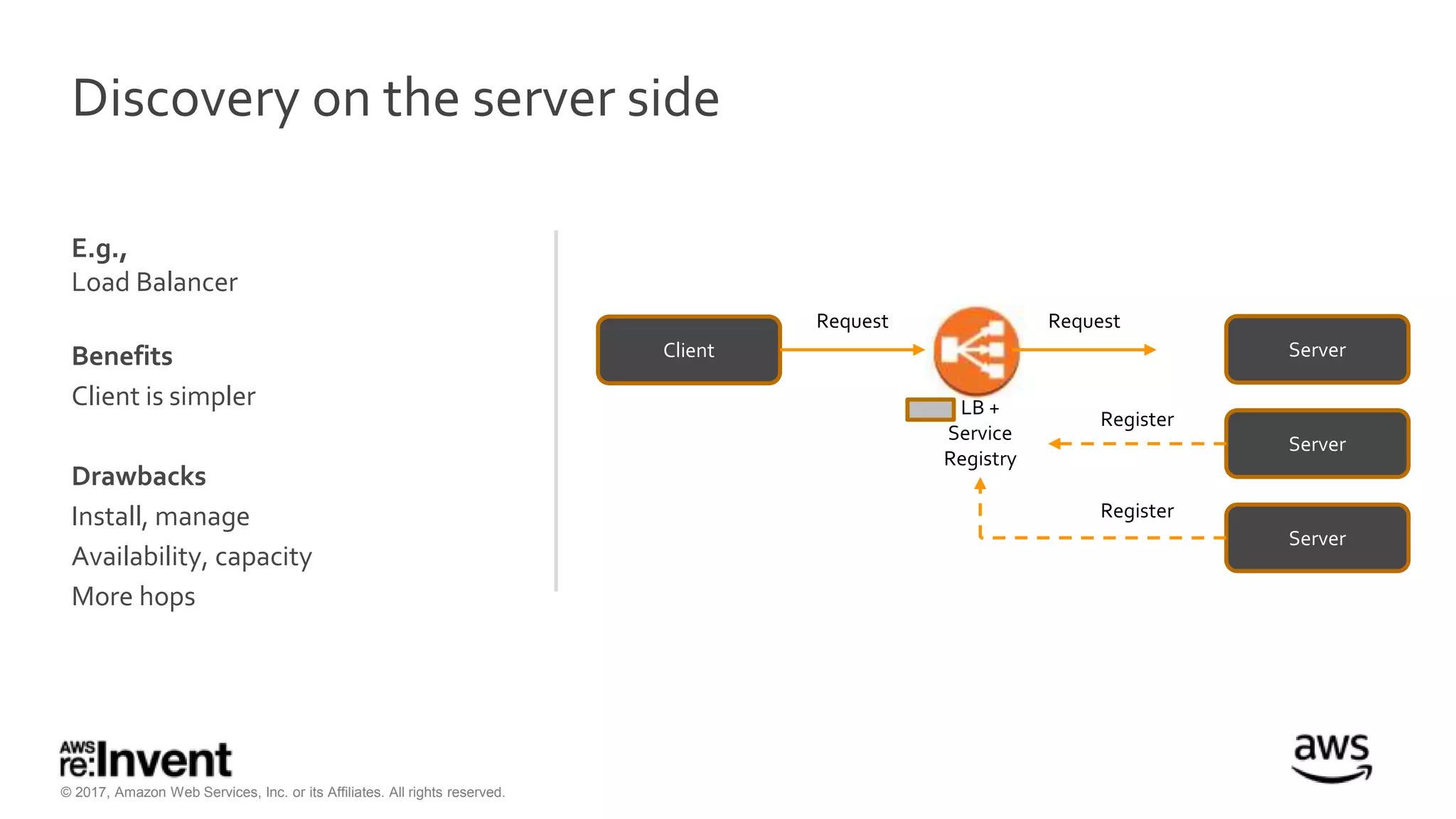
E.g.,
Load Balancer
Benefits
Client is simpler
Drawbacks
Install, manage
Availability, capacity
More hops
Discovery on the server side
Client
Server
Server
Server
Request Request
LB +
Service
Registry
Register
Register
© 2017, Amazon Web Services, Inc. or its Affiliates. All rights reserved.
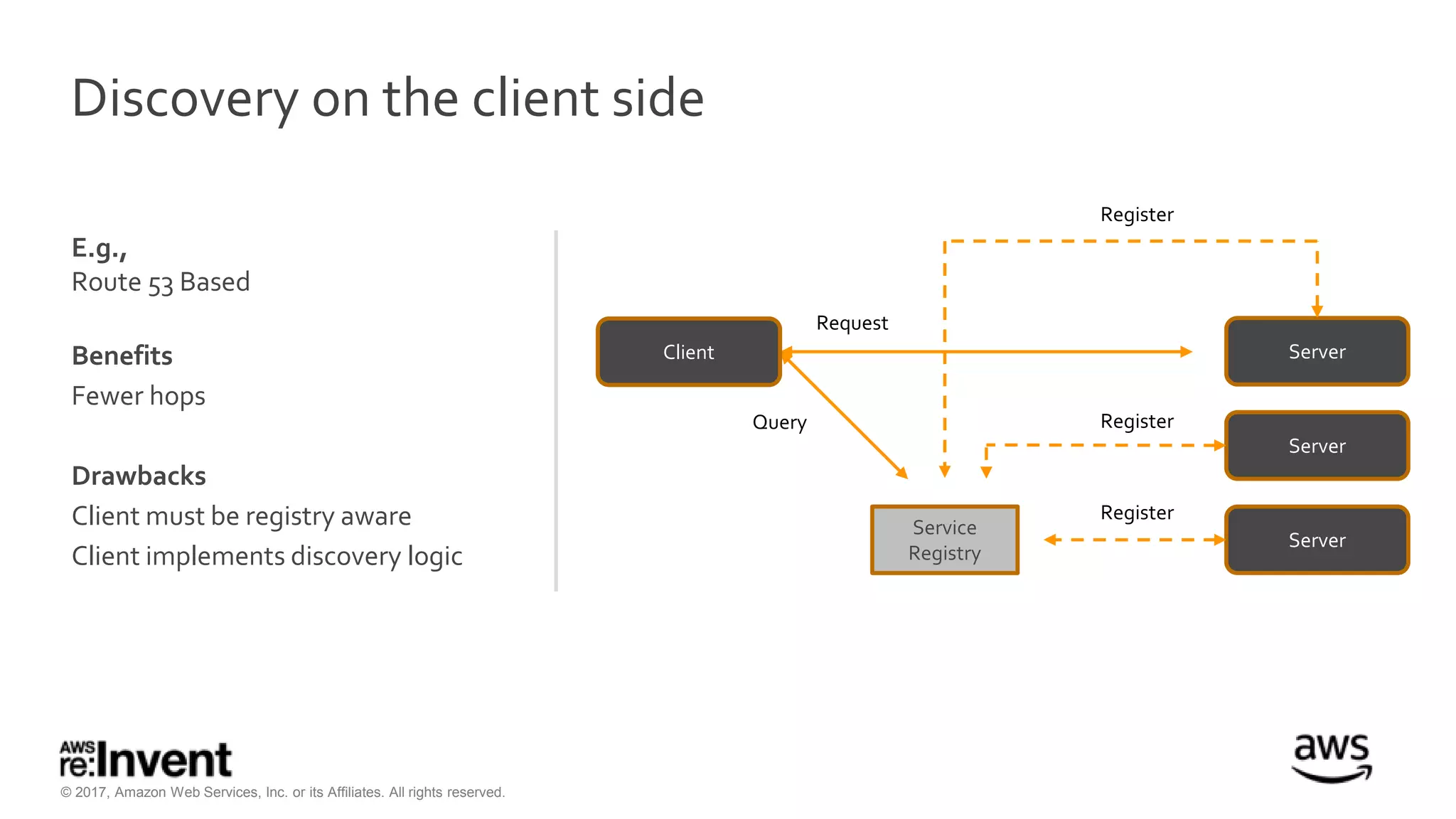
Discovery on the client side
E.g.,
Route 53 Based
Benefits
Fewer hops
Drawbacks
Client must be registry aware
Client implements discovery logic
Client
Server
Server
Server
Service
Registry
Request
Register
Register
Register
Query
© 2017, Amazon Web Services, Inc. or its Affiliates. All rights reserved.
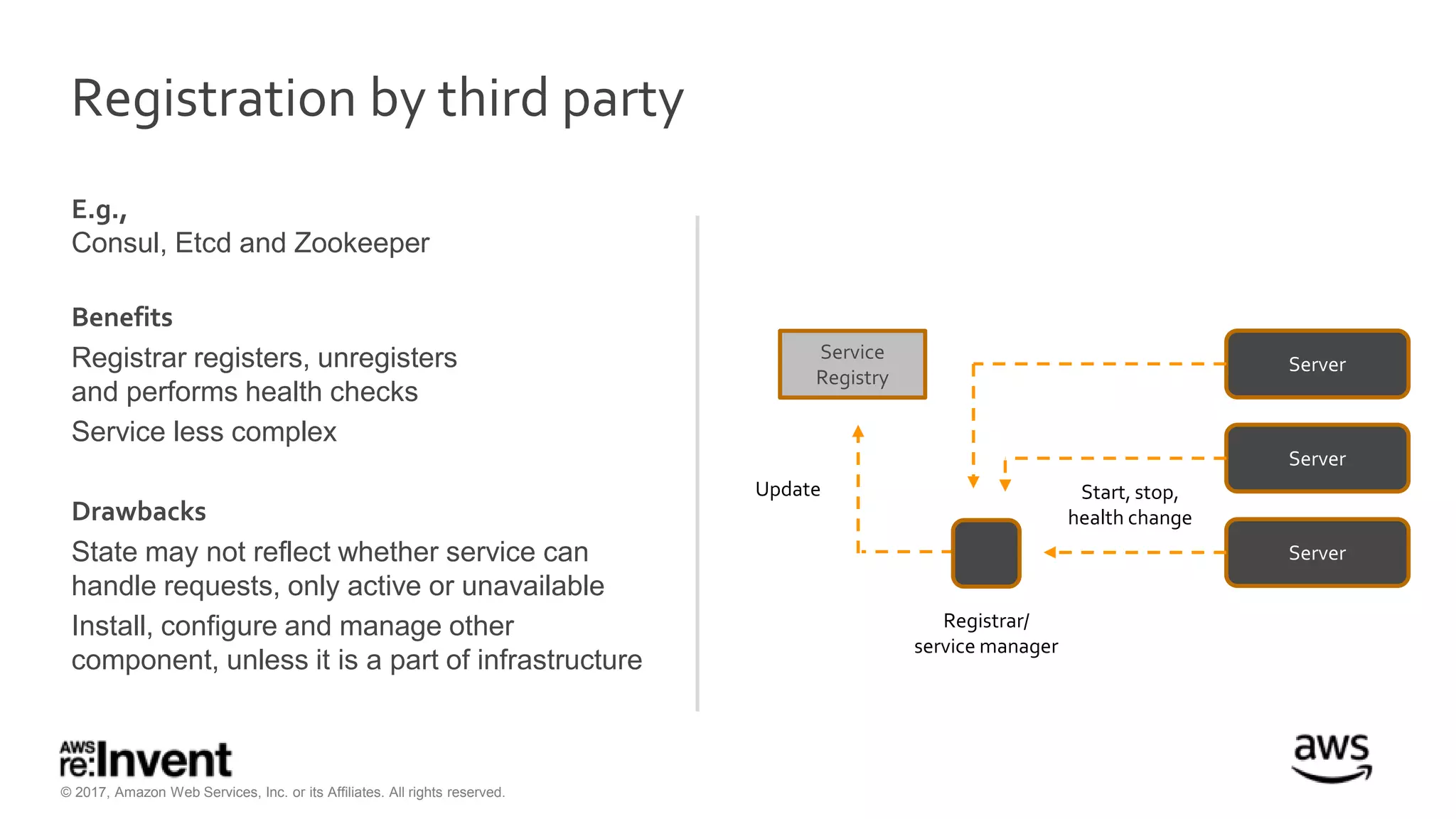
Registration by third party
E.g.,
Consul, Etcd and Zookeeper
Benefits
Registrar registers, unregisters
and performs health checks
Service less complex
Drawbacks
State may not reflect whether service can
handle requests, only active or unavailable
Install, configure and manage other
component, unless it is a part of infrastructure
Server
Server
Server
Service
Registry
Update Start, stop,
health change
Registrar/
service manager
© 2017, Amazon Web Services, Inc. or its Affiliates. All rights reserved.
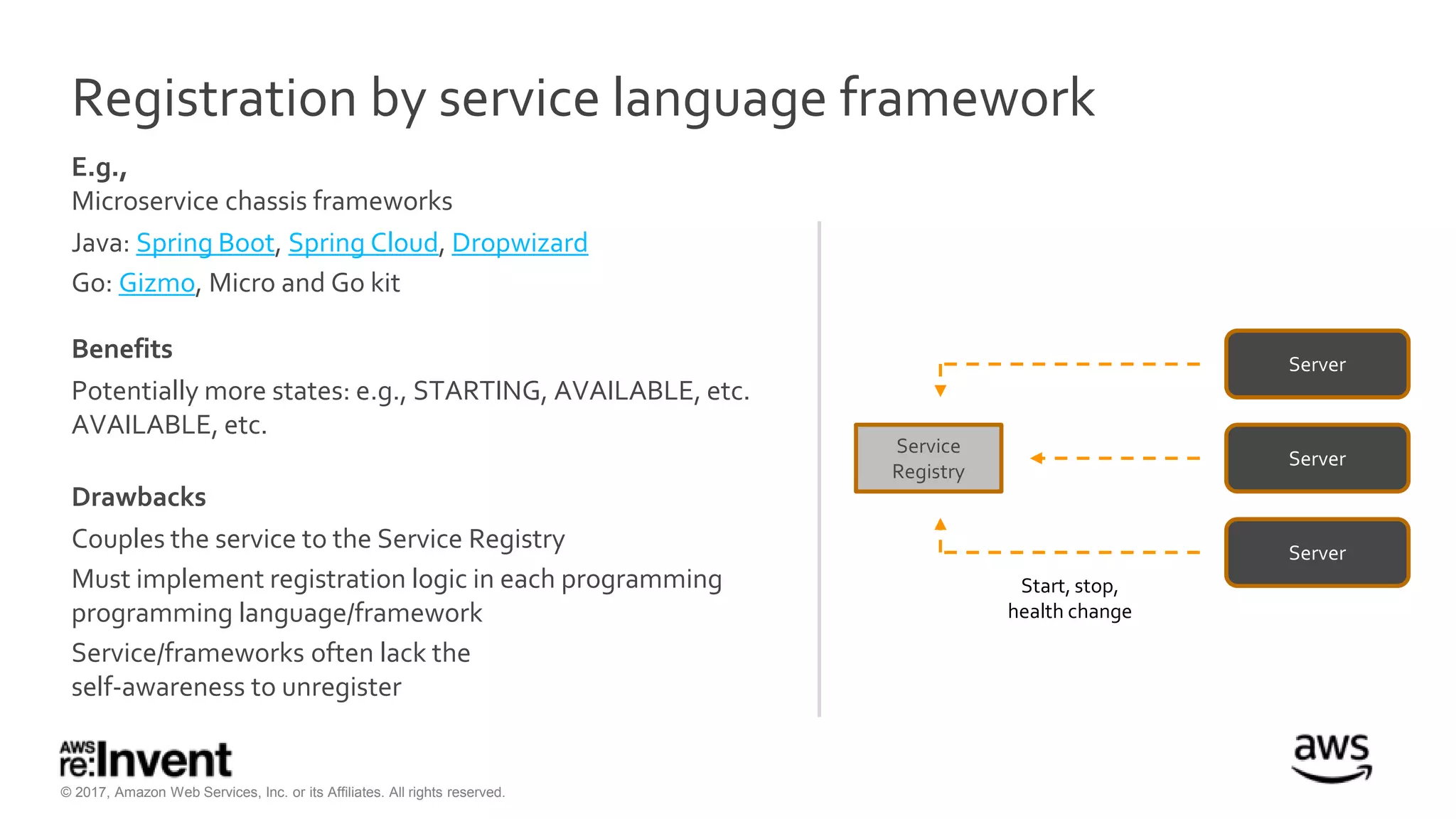
Registration by service language framework
E.g.,
Microservice chassis frameworks
Java: Spring Boot, Spring Cloud, Dropwizard
Go: Gizmo, Micro and Go kit
Benefits
Potentially more states: e.g., STARTING, AVAILABLE, etc.
AVAILABLE, etc.
Drawbacks
Couples the service to the Service Registry
Must implement registration logic in each programming
programming language/framework
Service/frameworks often lack the
self-awareness to unregister
Server
Server
Server
Service
Registry
Start, stop,
health change
© 2017, Amazon Web Services, Inc. or its Affiliates. All rights reserved.
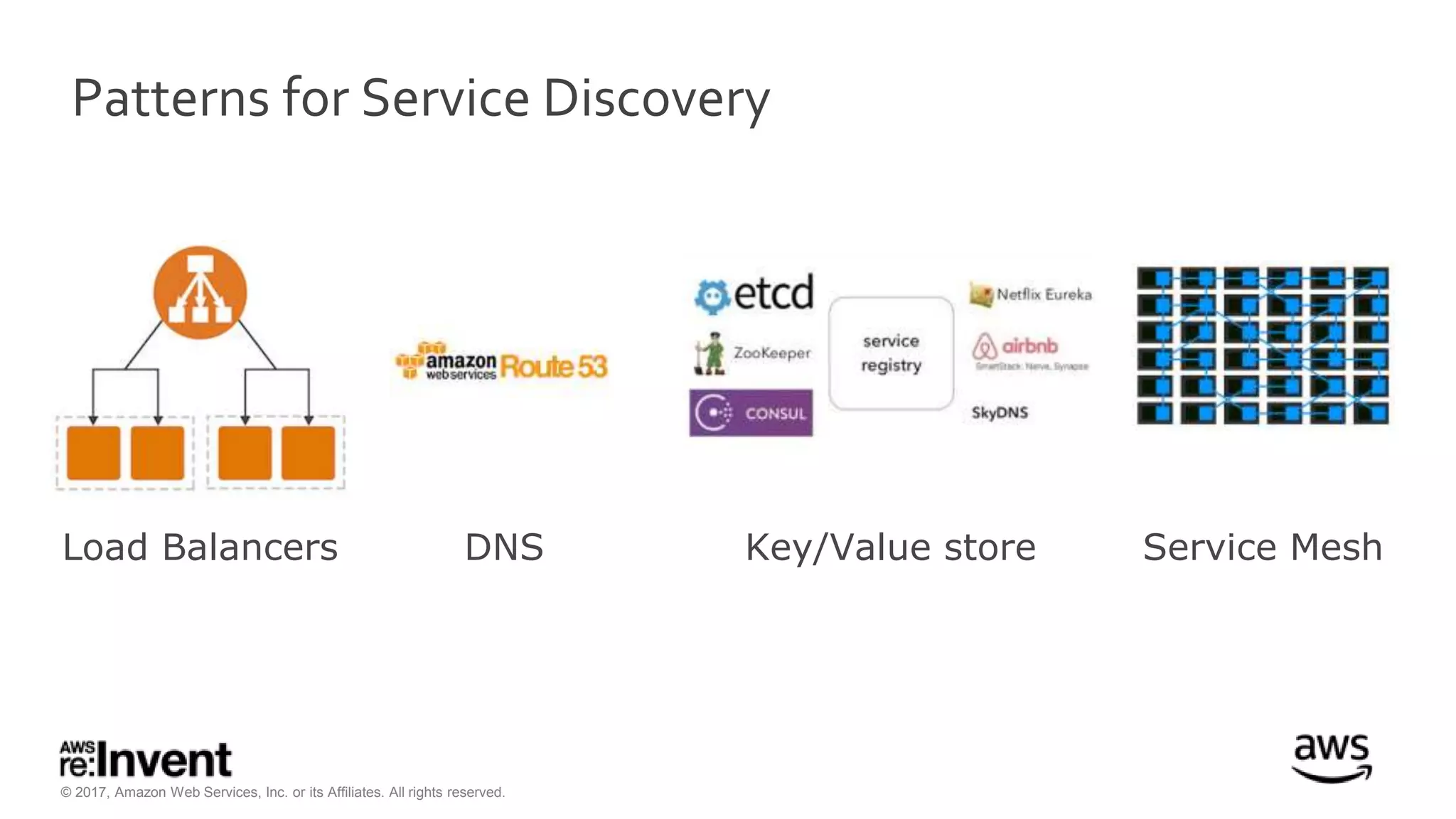
Patterns for Service Discovery
Load Balancers Service MeshDNS Key/Value store
© 2017, Amazon Web Services, Inc. or its Affiliates. All rights reserved.
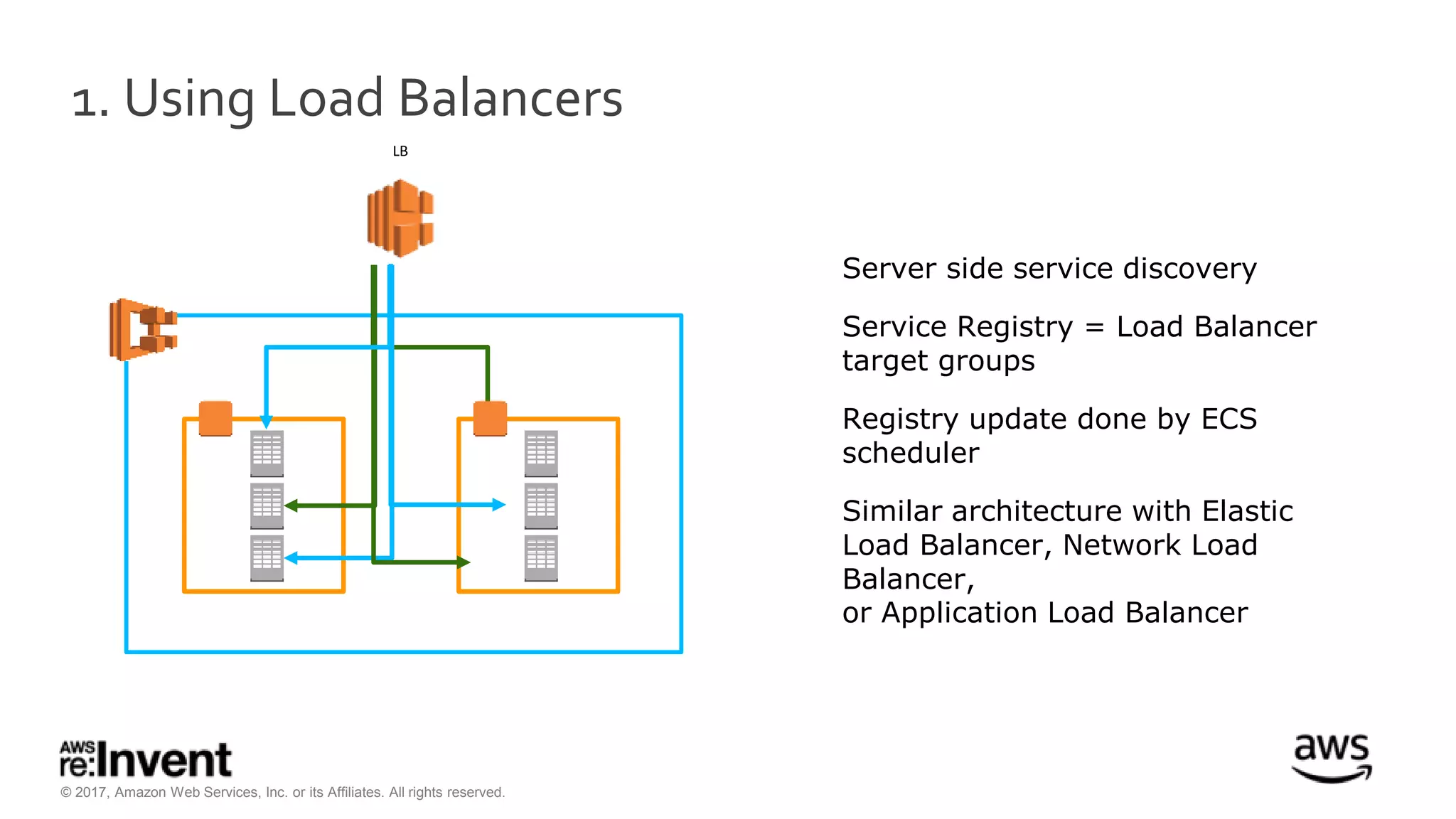
1. Using Load Balancers
Server side service discovery
Service Registry = Load Balancer
target groups
Registry update done by ECS
scheduler
Similar architecture with Elastic
Load Balancer, Network Load
Balancer,
or Application Load Balancer
LB
© 2017, Amazon Web Services, Inc. or its Affiliates. All rights reserved.
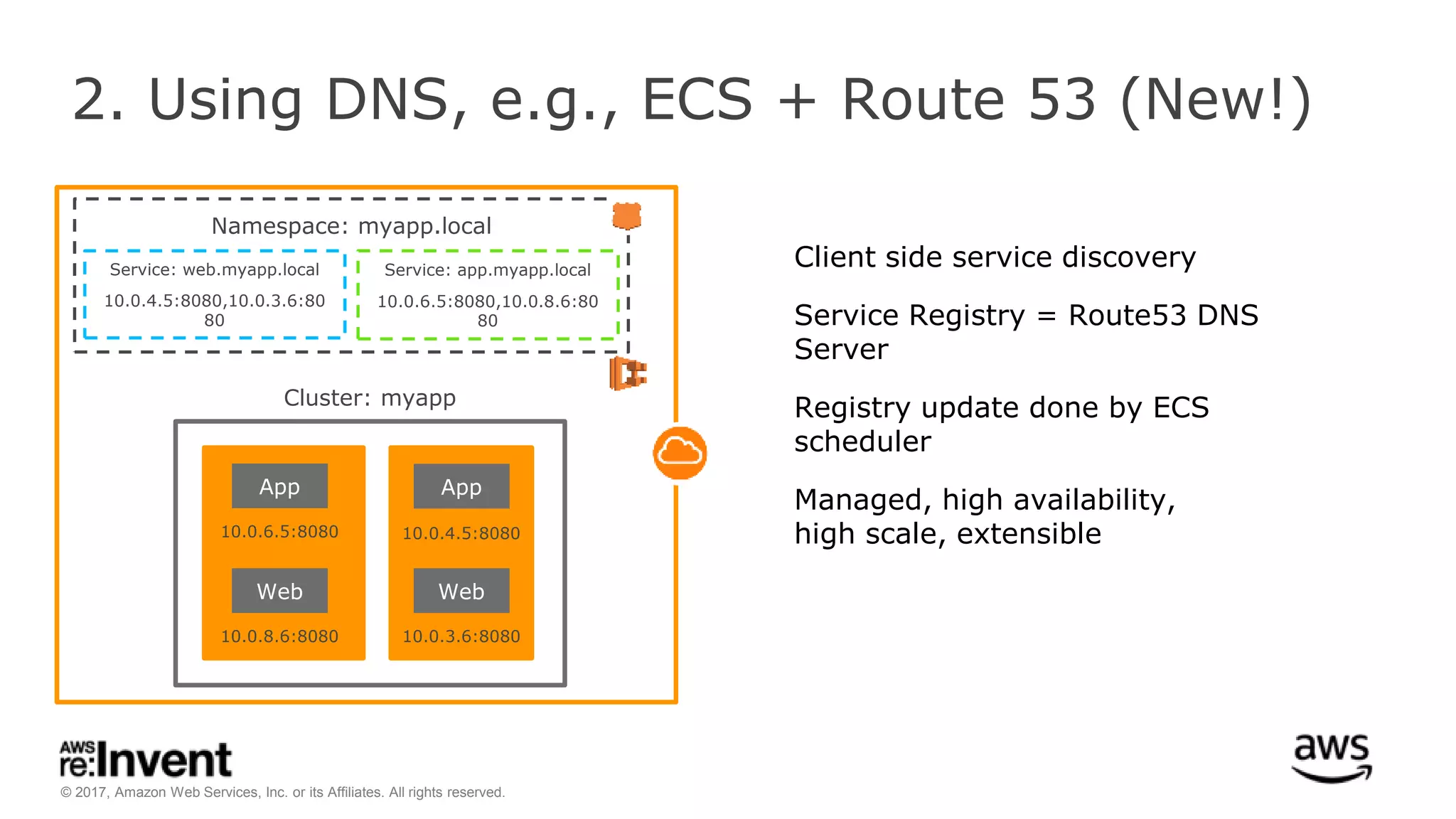
2. Using DNS, e.g., ECS + Route 53 (New!)
Cluster: myapp
App
10.0.6.5:8080
Web
10.0.8.6:8080
App
10.0.4.5:8080
Web
10.0.3.6:8080
Namespace: myapp.local
Service: web.myapp.local
10.0.4.5:8080,10.0.3.6:80
80
Service: app.myapp.local
10.0.6.5:8080,10.0.8.6:80
80
Client side service discovery
Service Registry = Route53 DNS
Server
Registry update done by ECS
scheduler
Managed, high availability,
high scale, extensible
© 2017, Amazon Web Services, Inc. or its Affiliates. All rights reserved.
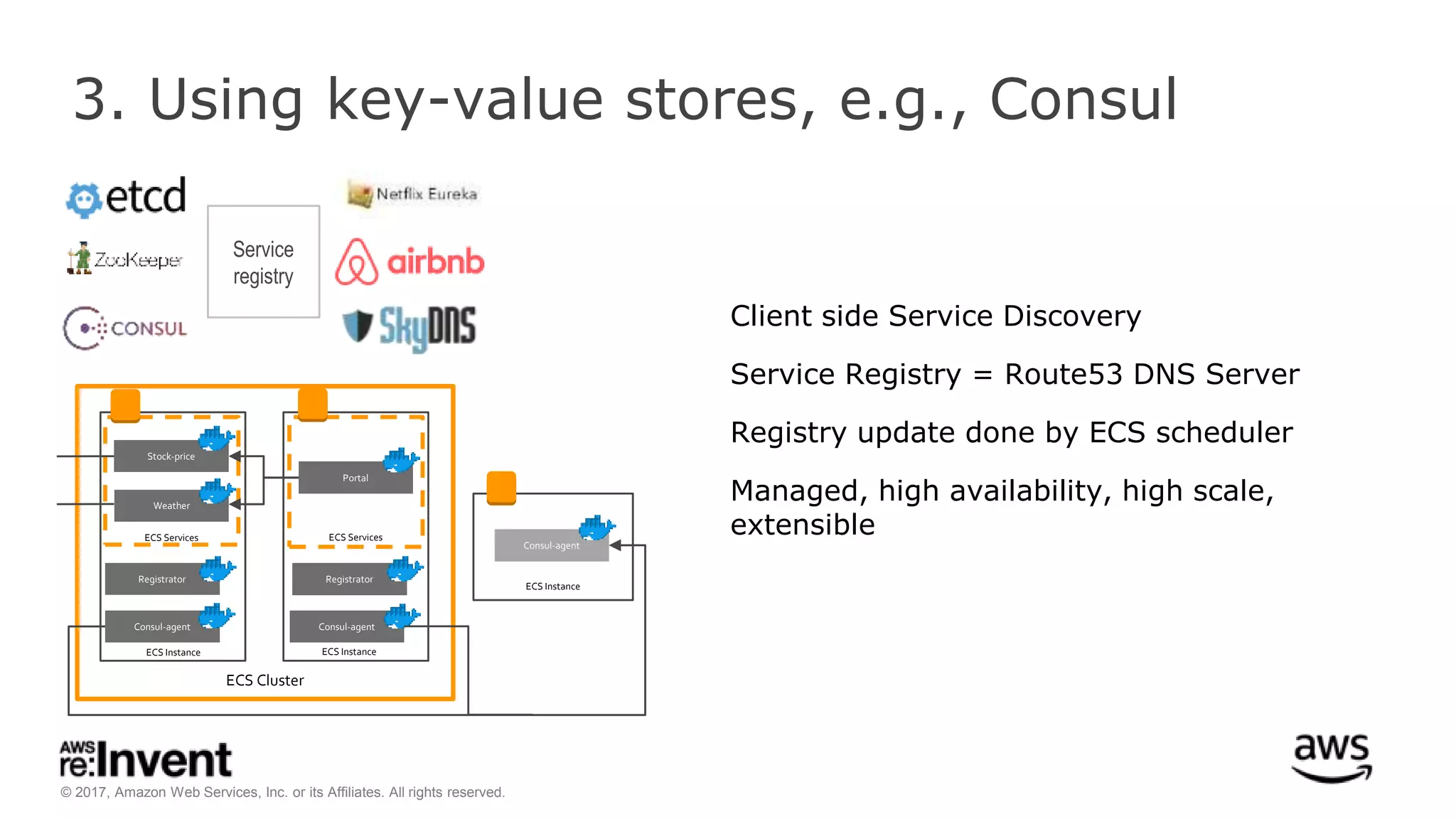
3. Using key-value stores, e.g., Consul
Service
registry
Client side Service Discovery
Service Registry = Route53 DNS Server
Registry update done by ECS scheduler
Managed, high availability, high scale,
extensibleECS Services
Consul-agent
Registrator
Weather
Stock-price
Portal
ECS Services
Registrator
Consul-agent
ECS Instance ECS Instance
ECS Cluster
ECS Instance
Consul-agent
© 2017, Amazon Web Services, Inc. or its Affiliates. All rights reserved.
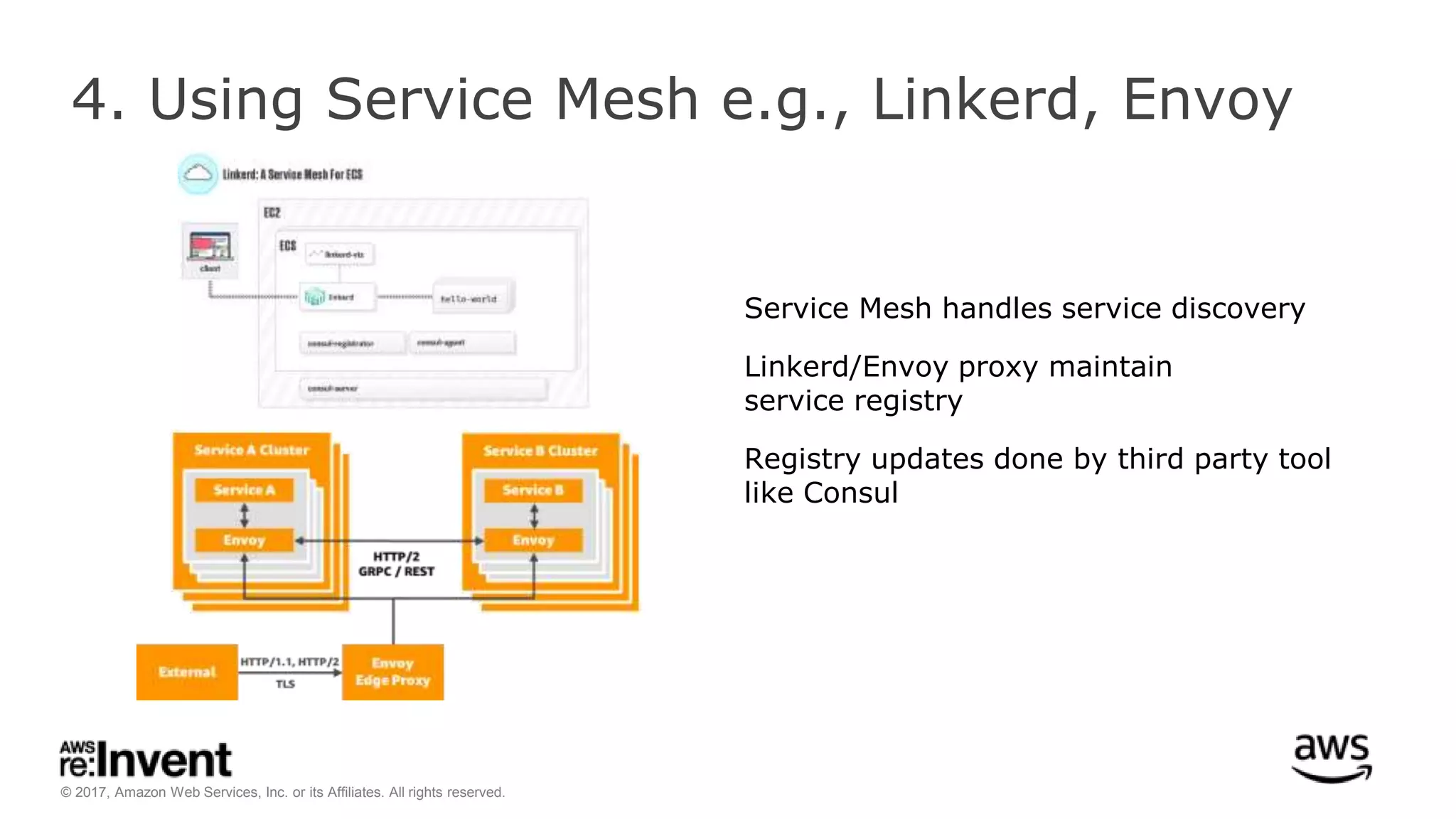
4. Using Service Mesh e.g., Linkerd, Envoy
Service Mesh handles service discovery
Linkerd/Envoy proxy maintain
service registry
Registry updates done by third party tool
like Consul
© 2017, Amazon Web Services, Inc. or its Affiliates. All rights reserved.
Microservices at Kaplan Test Prep
Roven Drabo, Head of Cloud Operations
Customer case study
© 2017, Amazon Web Services, Inc. or its Affiliates. All rights reserved.
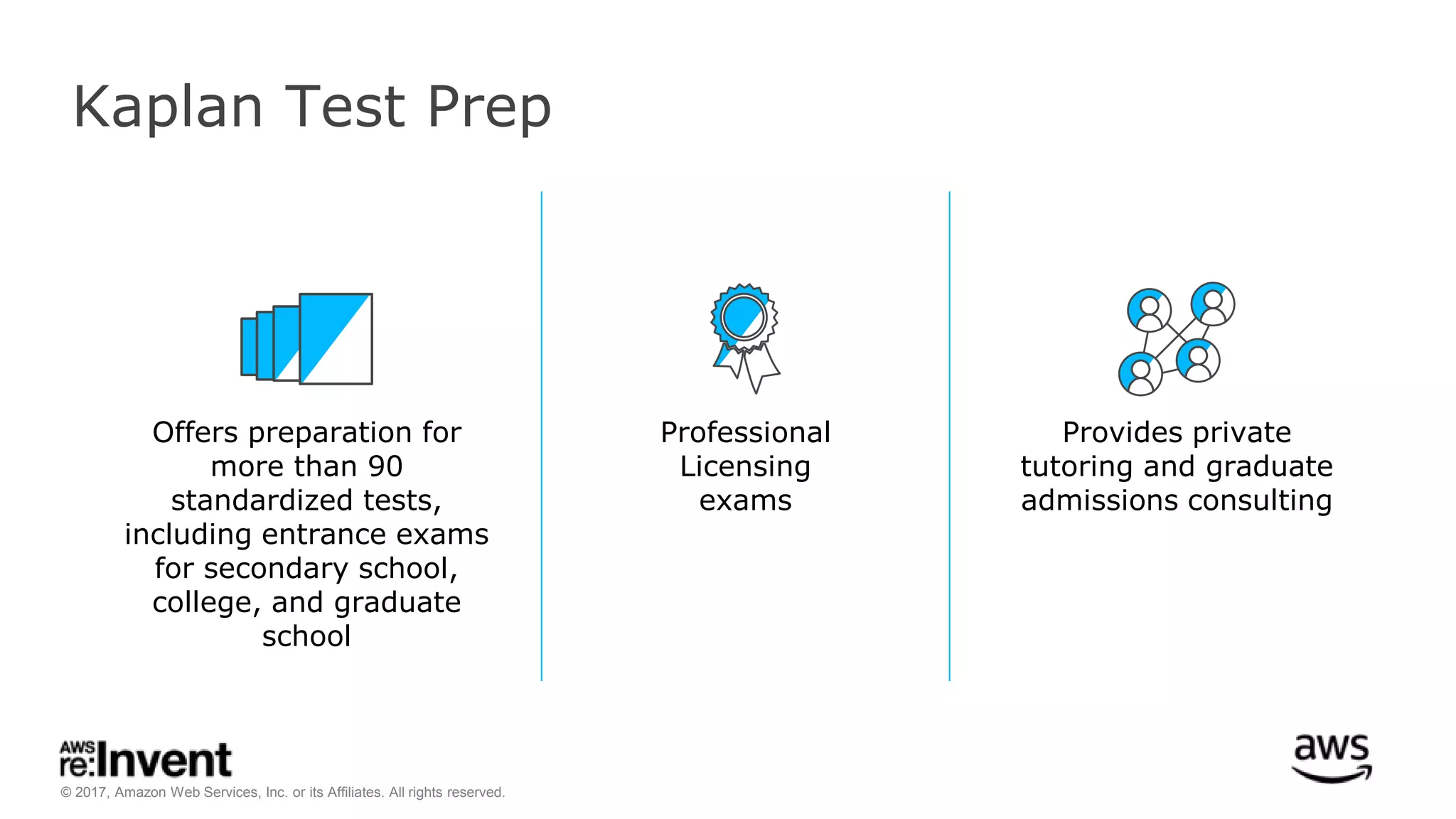
Kaplan Test Prep
Offers preparation for
more than 90
standardized tests,
including entrance exams
for secondary school,
college, and graduate
school
Professional
Licensing
exams
Provides private
tutoring and graduate
admissions consulting
© 2017, Amazon Web Services, Inc. or its Affiliates. All rights reserved.
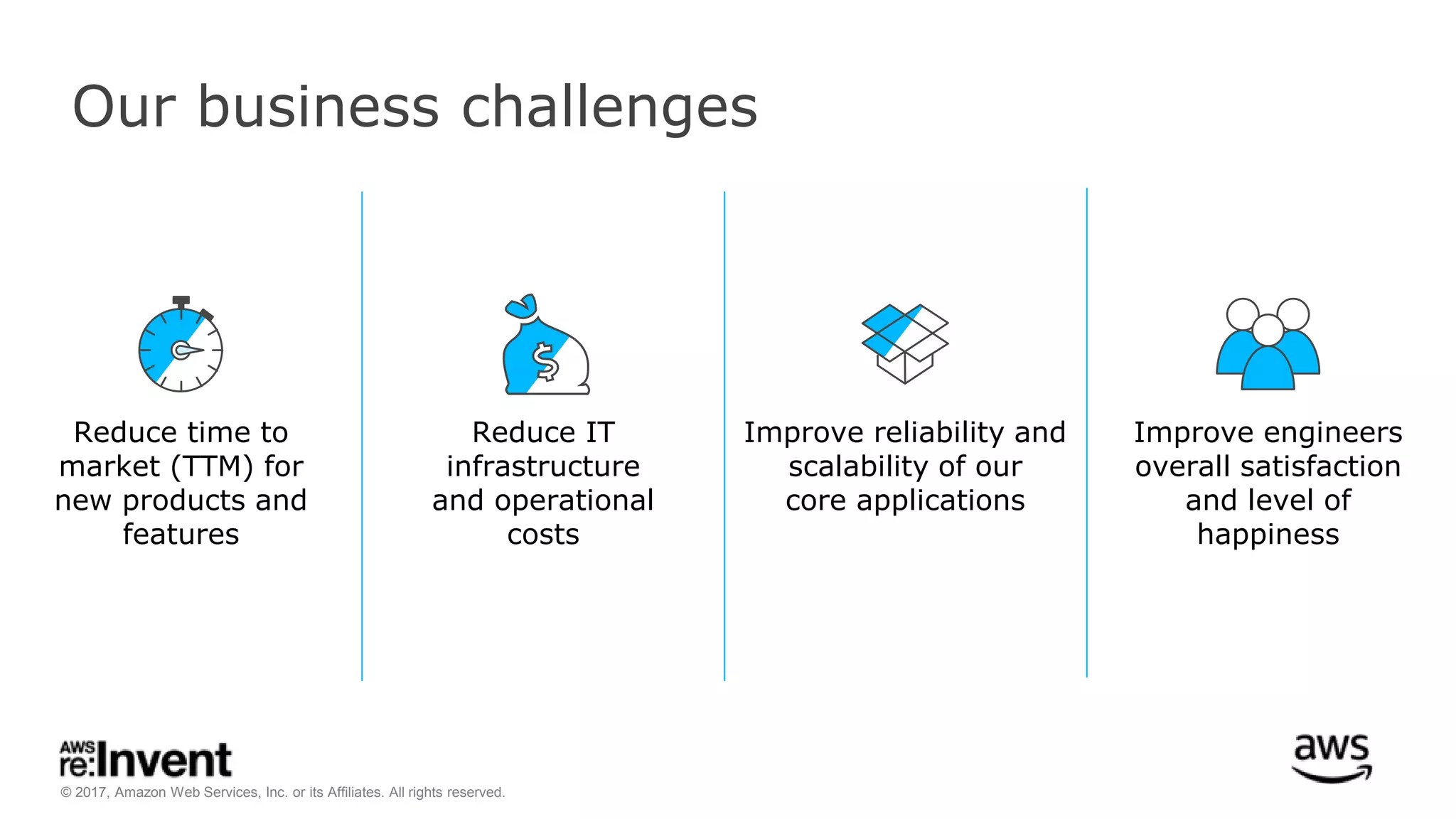
Our business challenges
Reduce time to
market (TTM) for
new products and
features
Reduce IT
infrastructure
and operational
costs
Improve reliability and
scalability of our
core applications
Improve engineers
overall satisfaction
and level of
happiness
© 2017, Amazon Web Services, Inc. or its Affiliates. All rights reserved.
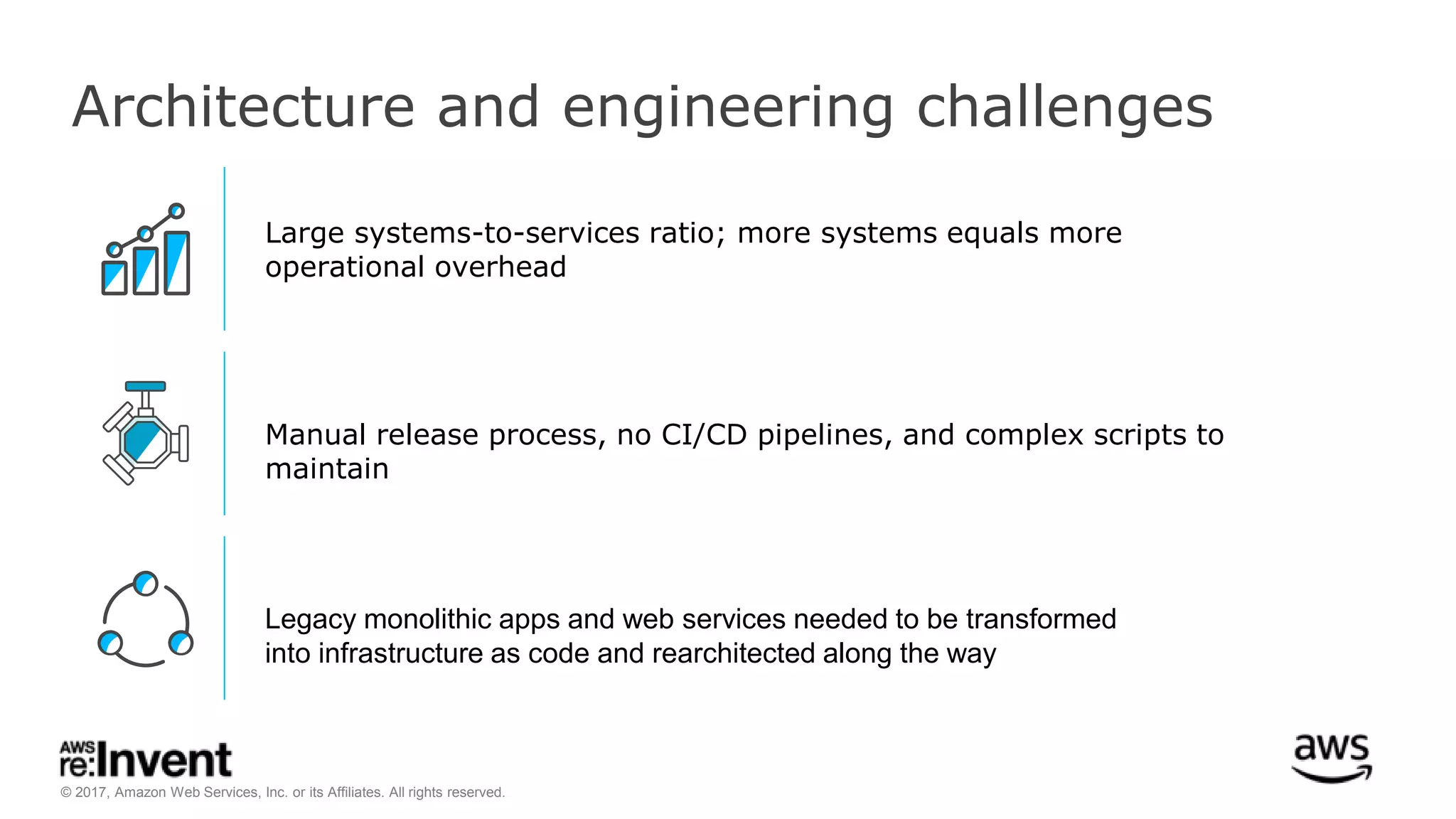
Architecture and engineering challenges
Large systems-to-services ratio; more systems equals more
operational overhead
Manual release process, no CI/CD pipelines, and complex scripts to
maintain
Legacy monolithic apps and web services needed to be transformed
into infrastructure as code and rearchitected along the way
© 2017, Amazon Web Services, Inc. or its Affiliates. All rights reserved.
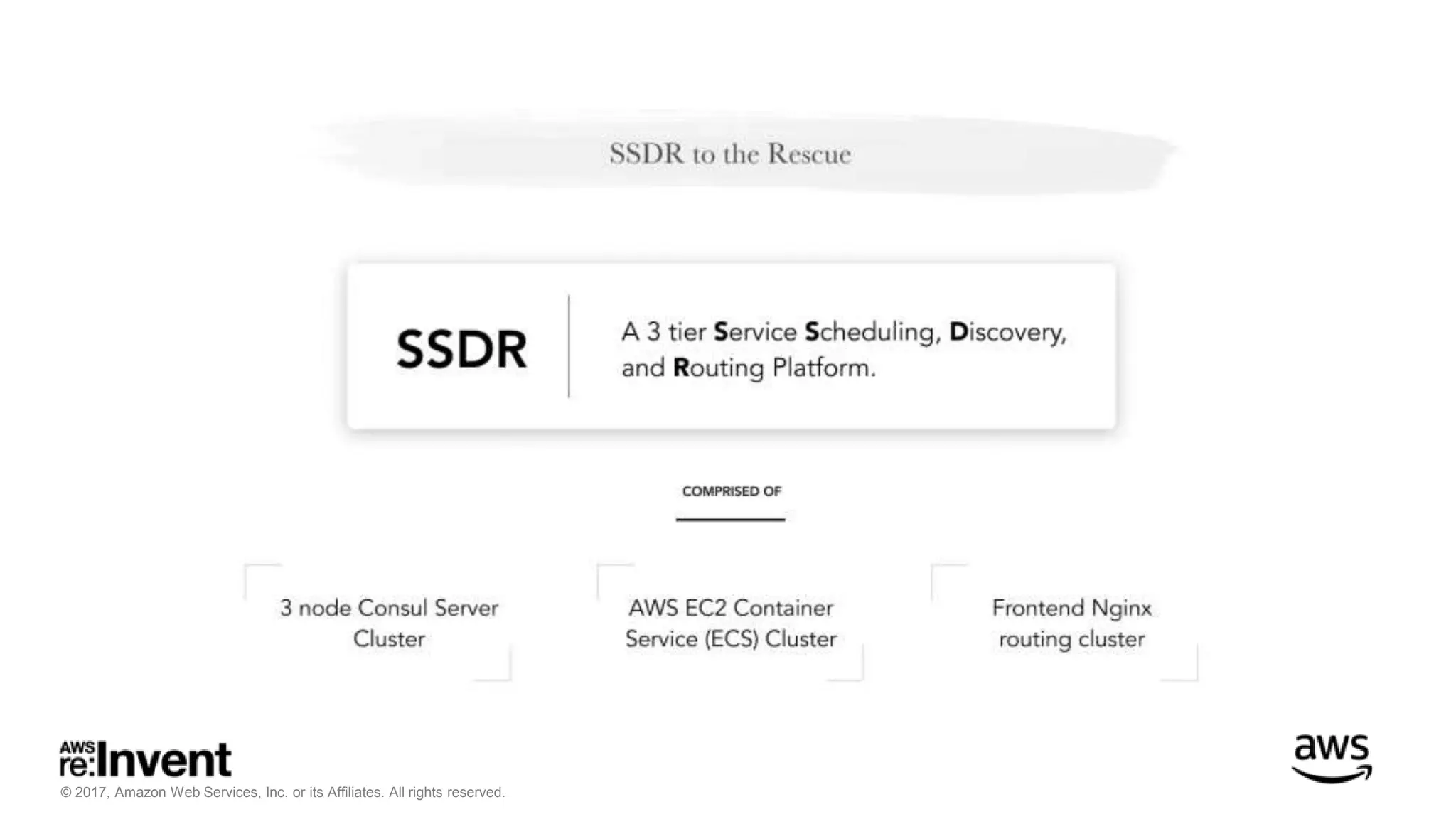
Infrastructure requirements and needs
Needs
Need for an orchestration which would fit our
needs
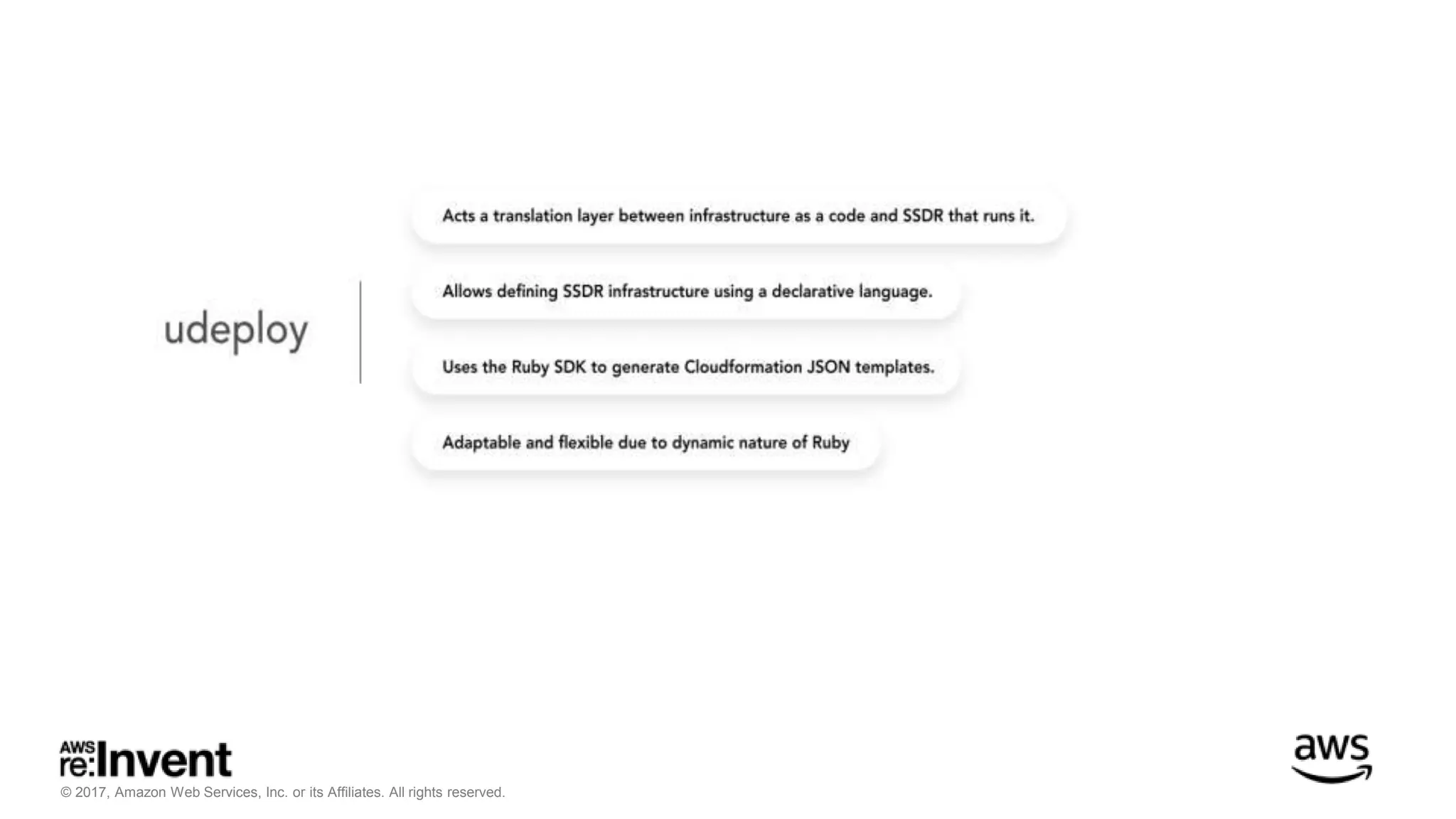
CloudFormation to automate and deploy AWS
services
Consul Key/Value Store as a global state of the
microservices
NGINX for Routing, Customization and Proxying
Requirements
Easy Cluster Management
Container
Management/Scheduling
Auto healing/scaling
AWS Integration
© 2017, Amazon Web Services, Inc. or its Affiliates. All rights reserved.
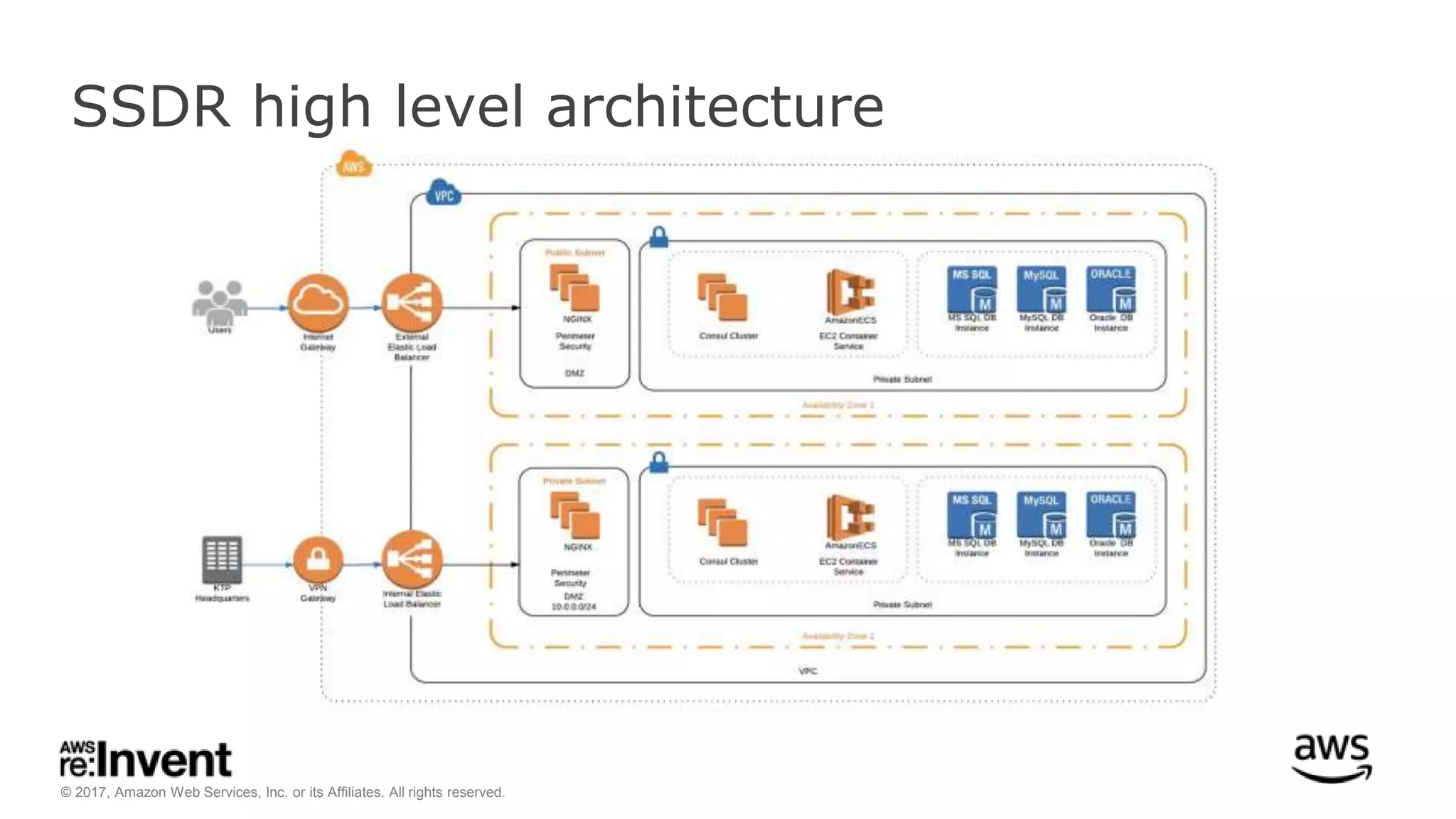
SSDR high level architecture
© 2017, Amazon Web Services, Inc. or its Affiliates. All rights reserved.
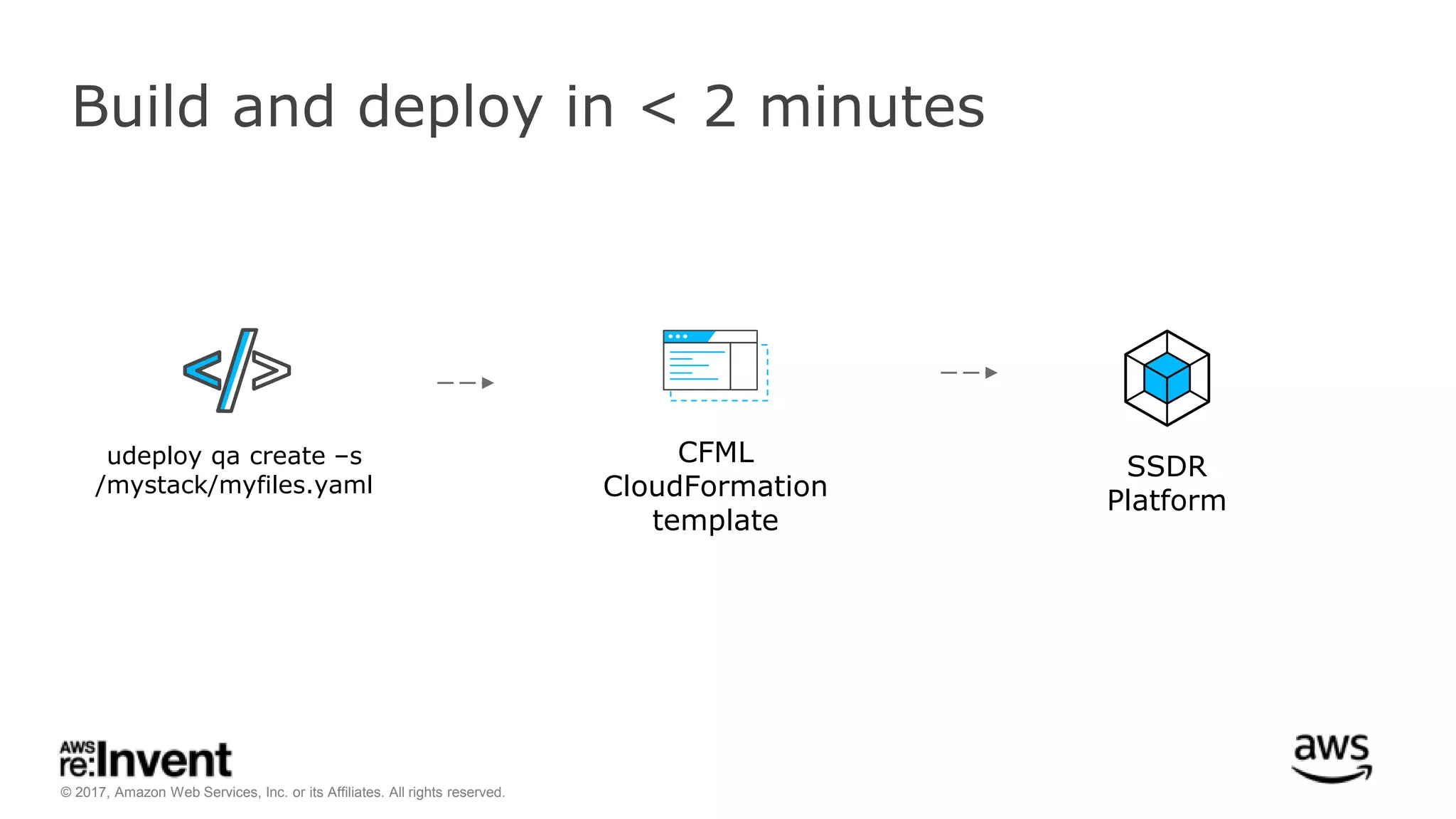
Build and deploy in < 2 minutes
udeploy qa create –s
/mystack/myfiles.yaml
CFML
CloudFormation
template
SSDR
Platform
© 2017, Amazon Web Services, Inc. or its Affiliates. All rights reserved.
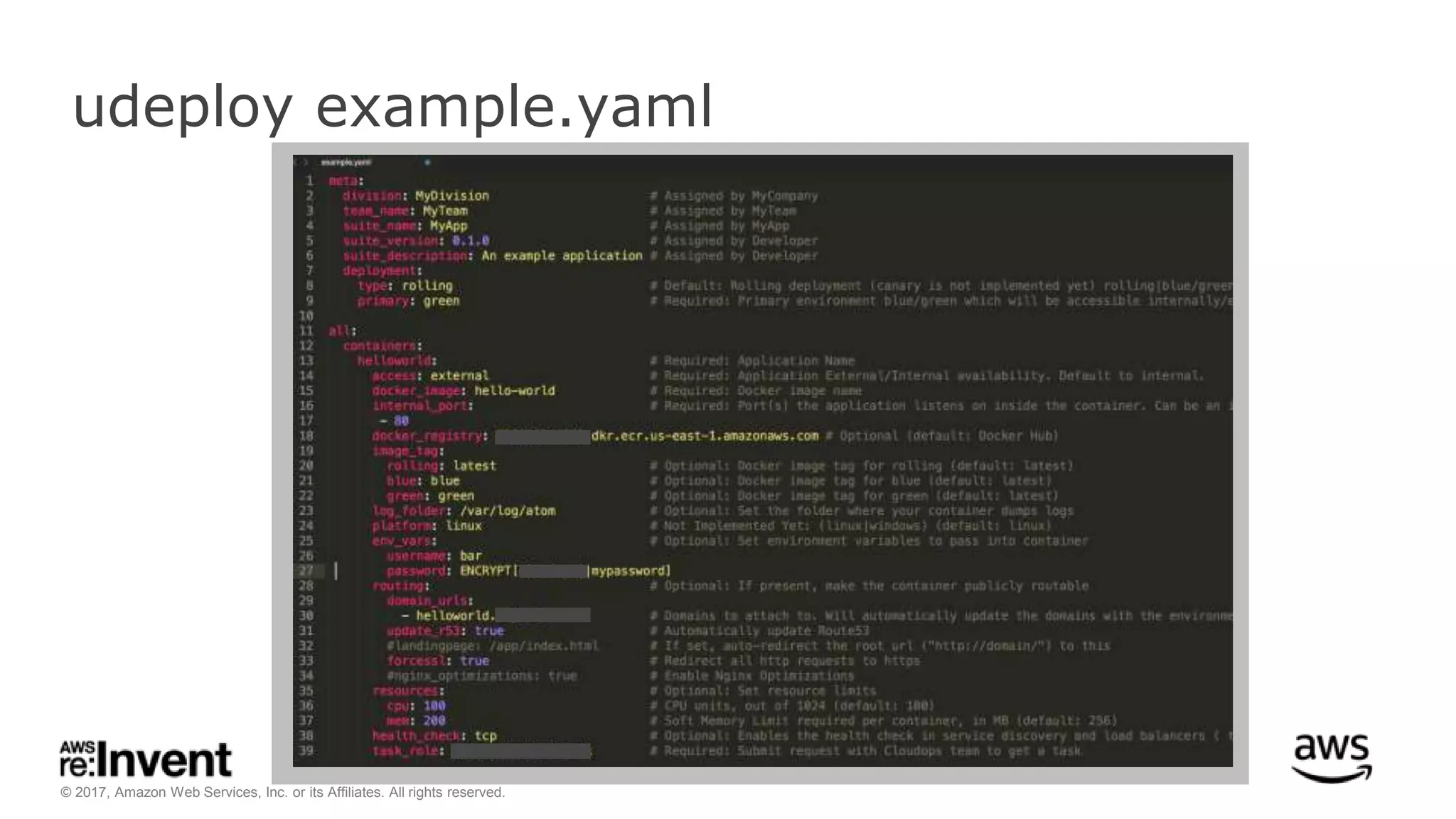
udeploy example.yaml
© 2017, Amazon Web Services, Inc. or its Affiliates. All rights reserved.
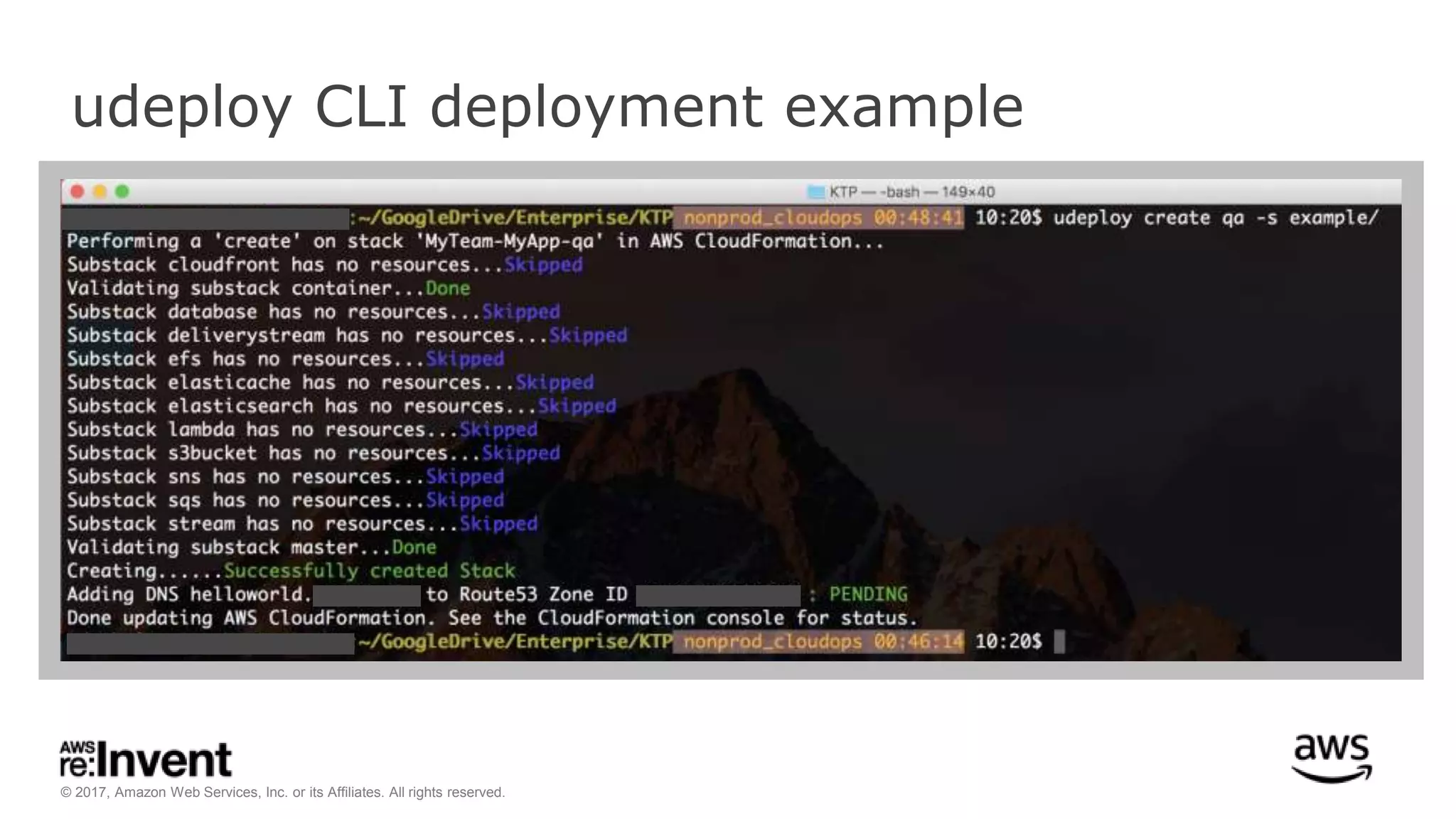
udeploy CLI deployment example
© 2017, Amazon Web Services, Inc. or its Affiliates. All rights reserved.
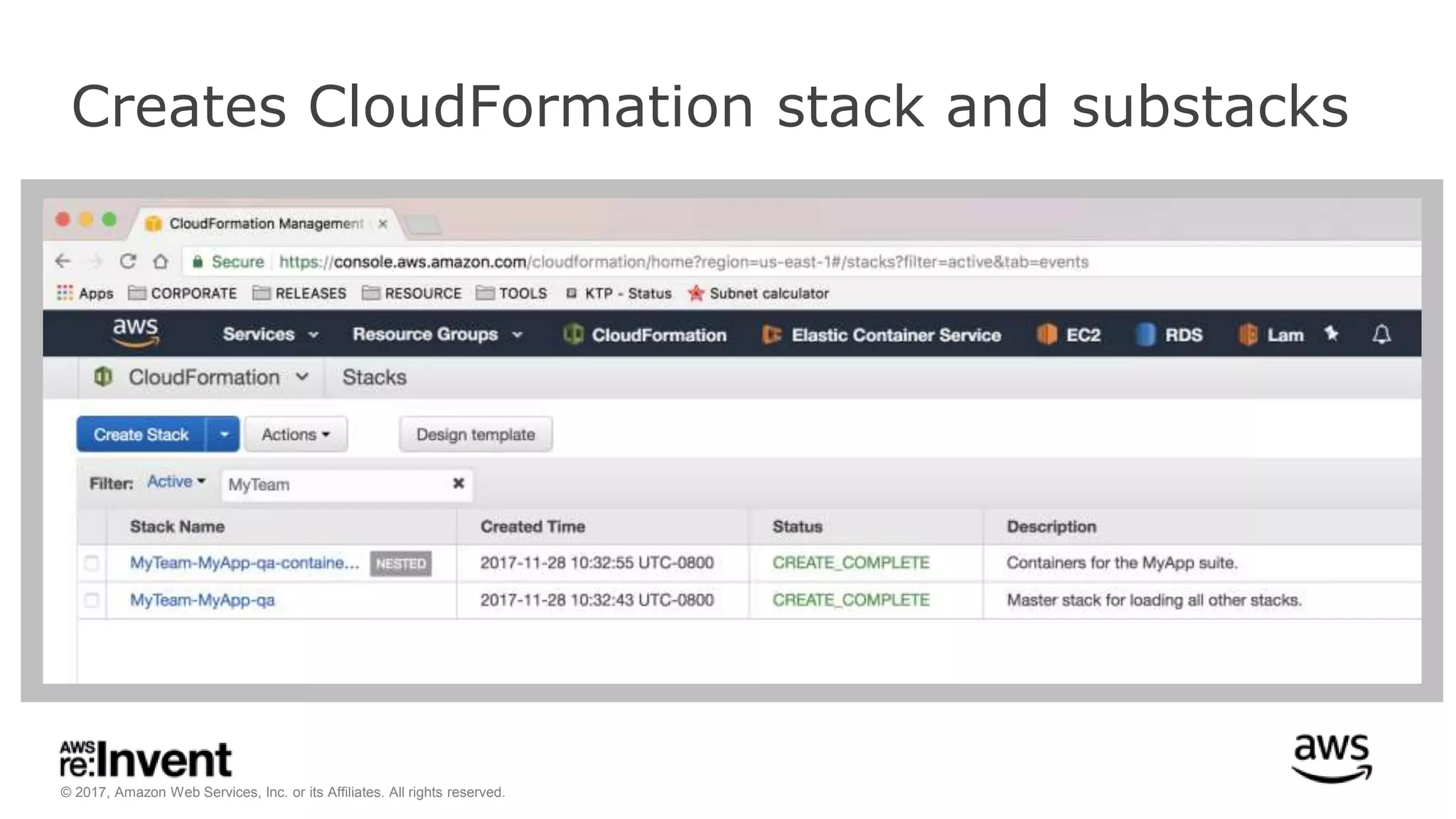
Creates CloudFormation stack and substacks
© 2017, Amazon Web Services, Inc. or its Affiliates. All rights reserved.
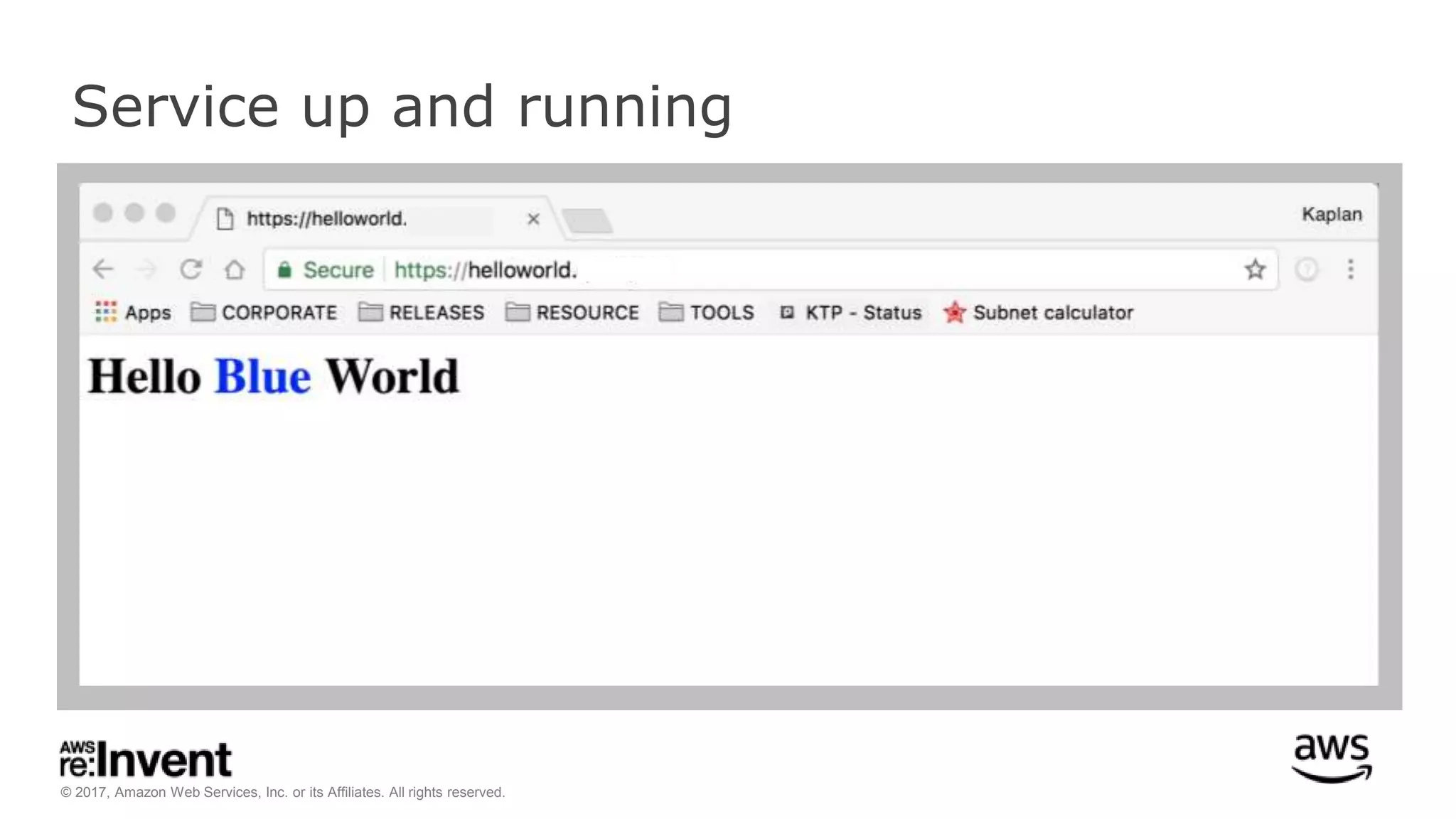
Service up and running
© 2017, Amazon Web Services, Inc. or its Affiliates. All rights reserved.
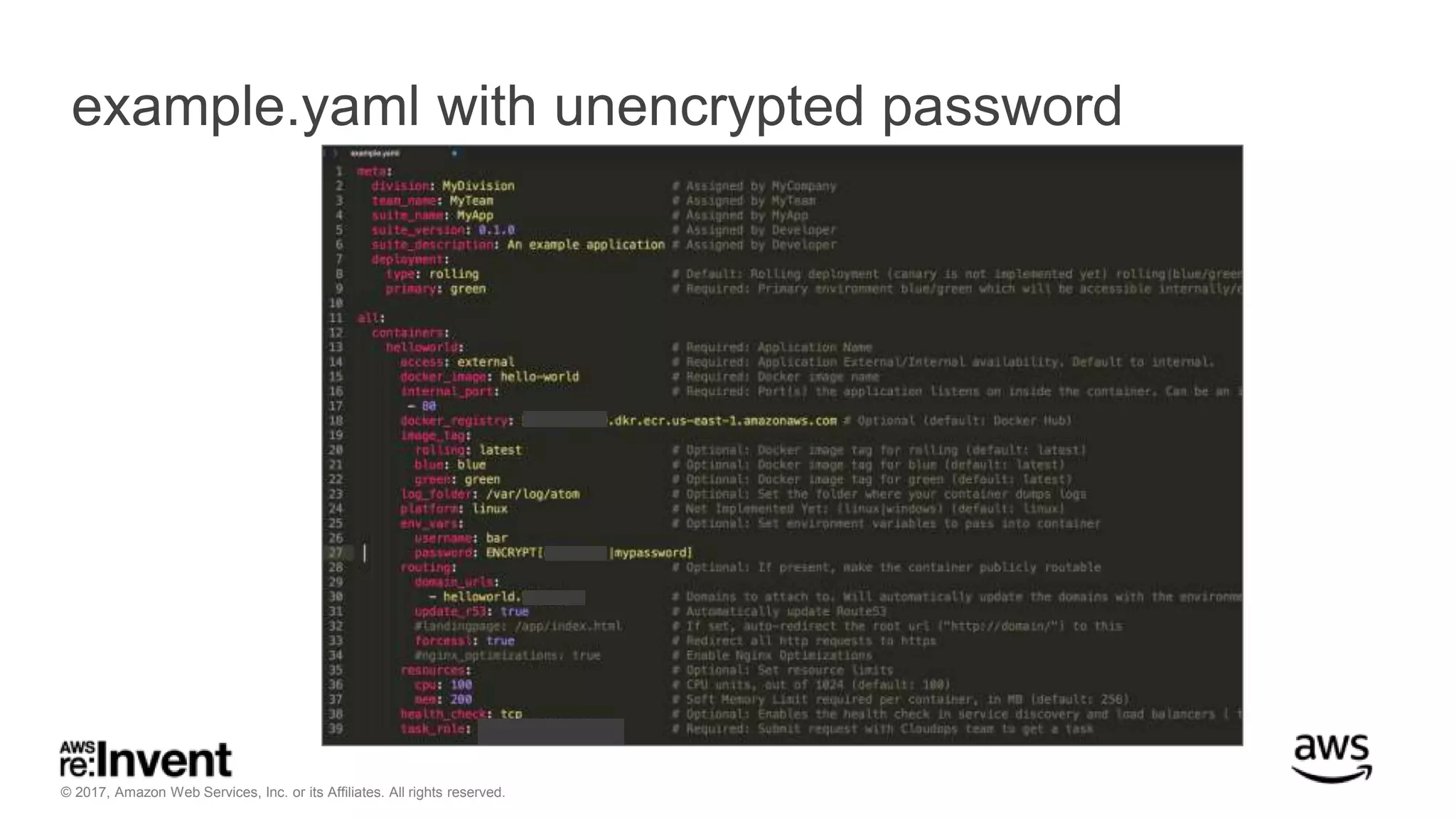
example.yaml with unencrypted password
© 2017, Amazon Web Services, Inc. or its Affiliates. All rights reserved.
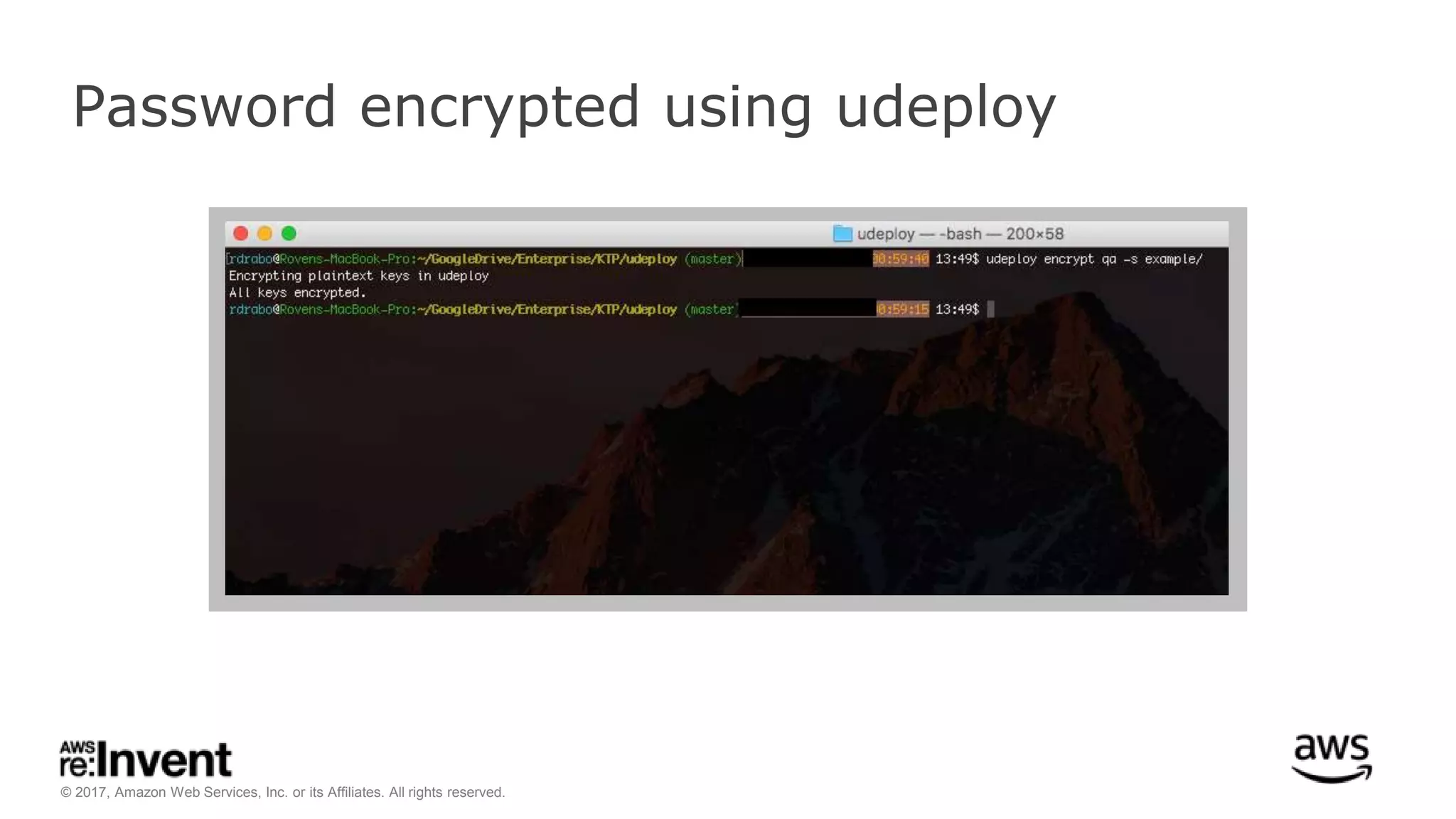
Password encrypted using udeploy
© 2017, Amazon Web Services, Inc. or its Affiliates. All rights reserved.
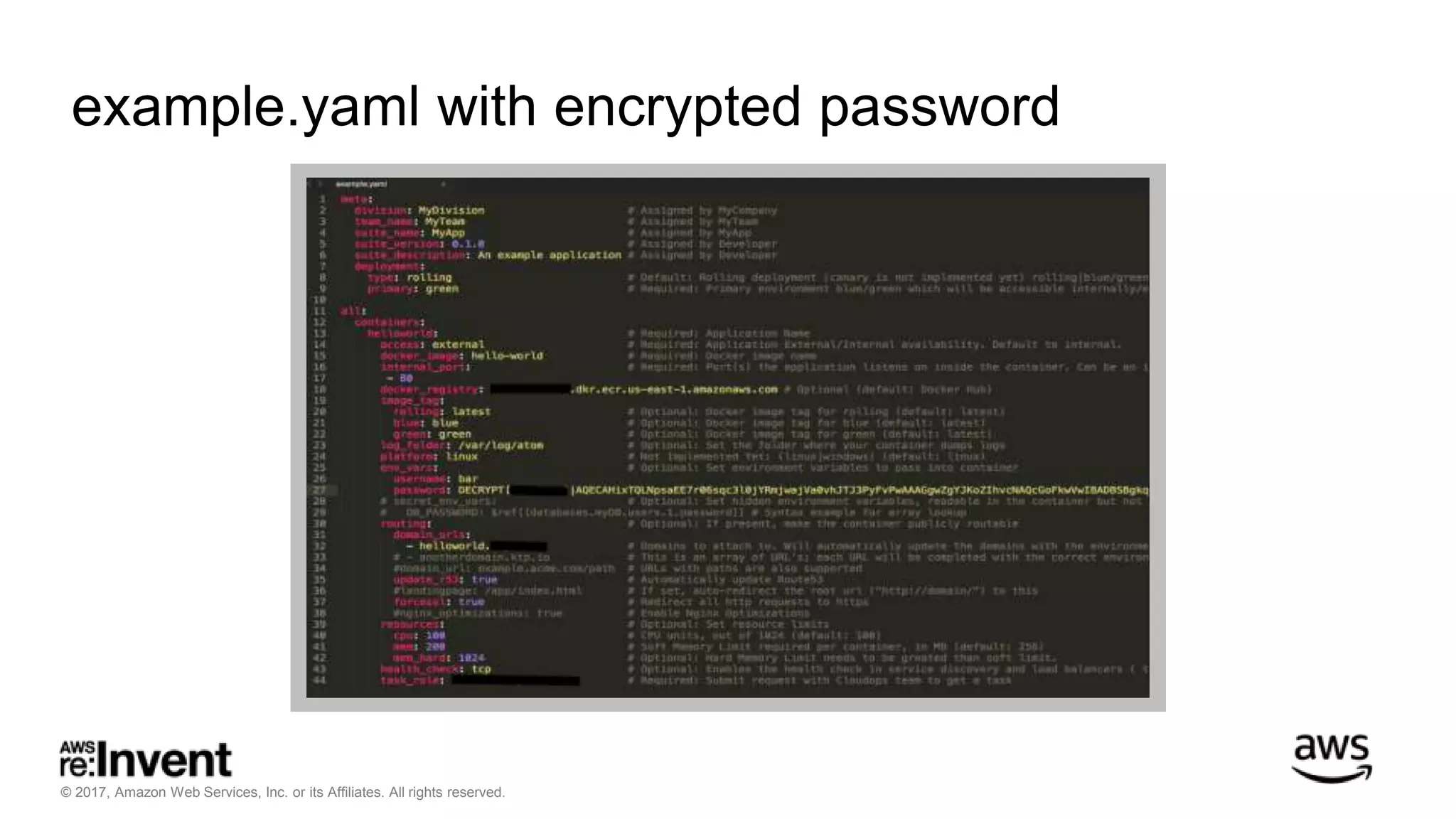
example.yaml with encrypted password
© 2017, Amazon Web Services, Inc. or its Affiliates. All rights reserved.
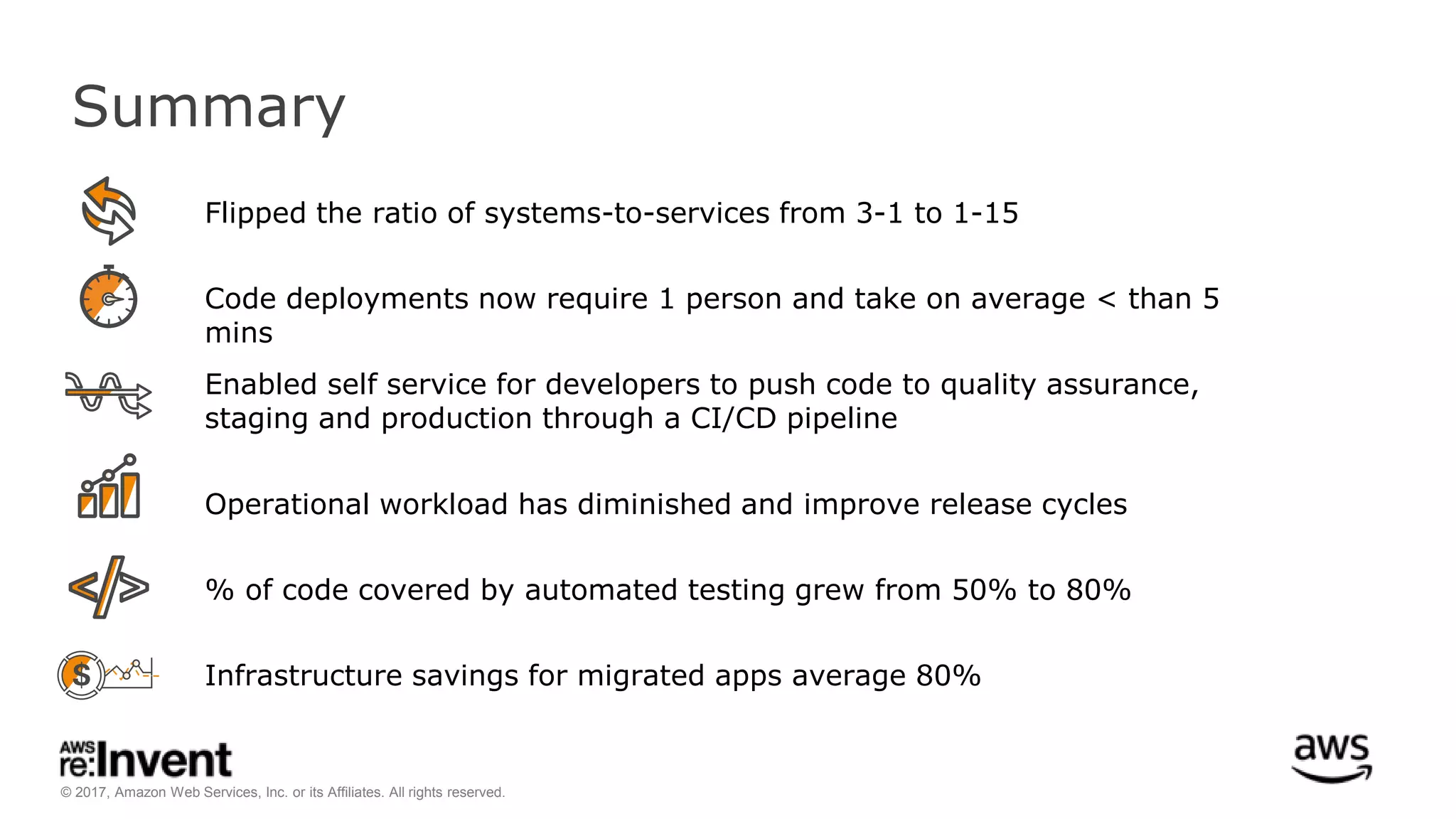
Summary
Flipped the ratio of systems-to-services from 3-1 to 1-15
Code deployments now require 1 person and take on average < than 5
mins
Enabled self service for developers to push code to quality assurance,
staging and production through a CI/CD pipeline
Operational workload has diminished and improve release cycles
% of code covered by automated testing grew from 50% to 80%
Infrastructure savings for migrated apps average 80%
© 2017, Amazon Web Services, Inc. or its Affiliates. All rights reserved.
Thank you

Patterns and Considerations in Service Discovery - Con327 - re:Invent 2017

  • 1.
    © 2017, AmazonWeb Services, Inc. or its Affiliates. All rights reserved. Patterns and Considerations in Service Discovery Shubha Rao, Sr. Product Manager, Amazon ECS Roven Drabo, Head of Cloud Operations, Kaplan
  • 2.
    © 2017, AmazonWeb Services, Inc. or its Affiliates. All rights reserved. Application communication is evolving Functional calls Find endpoints, then connect Across the room Dynamic name, number, and location Across cities 1:1 Known endpoints, APIs
  • 3.
    © 2017, AmazonWeb Services, Inc. or its Affiliates. All rights reserved. Developers need to connect micro services Build apps invoking other services by name Ensure that service name resolves to correct IP/port DEV OPS
  • 4.
    © 2017, AmazonWeb Services, Inc. or its Affiliates. All rights reserved. What is Service Discovery? “Where is Service X?” Friendly name -> IP + port E.g., app: {10.0.4.5:8080, 10.0.4.6:8080 }
  • 5.
    © 2017, AmazonWeb Services, Inc. or its Affiliates. All rights reserved. Why is it non trivial? Dynamic by design: Number of containers and instances Auto assigned IP addresses and ports Placement, scheduling, scaling Deployments and upgrades Health and connectivity
  • 6.
    © 2017, AmazonWeb Services, Inc. or its Affiliates. All rights reserved. Decision criteria Service registry Discovery mechanism Server side or client side Registration mechanism Third party or application framework
  • 7.
    © 2017, AmazonWeb Services, Inc. or its Affiliates. All rights reserved. E.g., Load Balancer Benefits Client is simpler Drawbacks Install, manage Availability, capacity More hops Discovery on the server side Client Server Server Server Request Request LB + Service Registry Register Register
  • 8.
    © 2017, AmazonWeb Services, Inc. or its Affiliates. All rights reserved. Discovery on the client side E.g., Route 53 Based Benefits Fewer hops Drawbacks Client must be registry aware Client implements discovery logic Client Server Server Server Service Registry Request Register Register Register Query
  • 9.
    © 2017, AmazonWeb Services, Inc. or its Affiliates. All rights reserved. Registration by third party E.g., Consul, Etcd and Zookeeper Benefits Registrar registers, unregisters and performs health checks Service less complex Drawbacks State may not reflect whether service can handle requests, only active or unavailable Install, configure and manage other component, unless it is a part of infrastructure Server Server Server Service Registry Update Start, stop, health change Registrar/ service manager
  • 10.
    © 2017, AmazonWeb Services, Inc. or its Affiliates. All rights reserved. Registration by service language framework E.g., Microservice chassis frameworks Java: Spring Boot, Spring Cloud, Dropwizard Go: Gizmo, Micro and Go kit Benefits Potentially more states: e.g., STARTING, AVAILABLE, etc. AVAILABLE, etc. Drawbacks Couples the service to the Service Registry Must implement registration logic in each programming programming language/framework Service/frameworks often lack the self-awareness to unregister Server Server Server Service Registry Start, stop, health change
  • 11.
    © 2017, AmazonWeb Services, Inc. or its Affiliates. All rights reserved. Patterns for Service Discovery Load Balancers Service MeshDNS Key/Value store
  • 12.
    © 2017, AmazonWeb Services, Inc. or its Affiliates. All rights reserved. 1. Using Load Balancers Server side service discovery Service Registry = Load Balancer target groups Registry update done by ECS scheduler Similar architecture with Elastic Load Balancer, Network Load Balancer, or Application Load Balancer LB
  • 13.
    © 2017, AmazonWeb Services, Inc. or its Affiliates. All rights reserved. 2. Using DNS, e.g., ECS + Route 53 (New!) Cluster: myapp App 10.0.6.5:8080 Web 10.0.8.6:8080 App 10.0.4.5:8080 Web 10.0.3.6:8080 Namespace: myapp.local Service: web.myapp.local 10.0.4.5:8080,10.0.3.6:80 80 Service: app.myapp.local 10.0.6.5:8080,10.0.8.6:80 80 Client side service discovery Service Registry = Route53 DNS Server Registry update done by ECS scheduler Managed, high availability, high scale, extensible
  • 14.
    © 2017, AmazonWeb Services, Inc. or its Affiliates. All rights reserved. 3. Using key-value stores, e.g., Consul Service registry Client side Service Discovery Service Registry = Route53 DNS Server Registry update done by ECS scheduler Managed, high availability, high scale, extensibleECS Services Consul-agent Registrator Weather Stock-price Portal ECS Services Registrator Consul-agent ECS Instance ECS Instance ECS Cluster ECS Instance Consul-agent
  • 15.
    © 2017, AmazonWeb Services, Inc. or its Affiliates. All rights reserved. 4. Using Service Mesh e.g., Linkerd, Envoy Service Mesh handles service discovery Linkerd/Envoy proxy maintain service registry Registry updates done by third party tool like Consul
  • 16.
    © 2017, AmazonWeb Services, Inc. or its Affiliates. All rights reserved. Microservices at Kaplan Test Prep Roven Drabo, Head of Cloud Operations Customer case study
  • 17.
    © 2017, AmazonWeb Services, Inc. or its Affiliates. All rights reserved. Kaplan Test Prep Offers preparation for more than 90 standardized tests, including entrance exams for secondary school, college, and graduate school Professional Licensing exams Provides private tutoring and graduate admissions consulting
  • 18.
    © 2017, AmazonWeb Services, Inc. or its Affiliates. All rights reserved. Our business challenges Reduce time to market (TTM) for new products and features Reduce IT infrastructure and operational costs Improve reliability and scalability of our core applications Improve engineers overall satisfaction and level of happiness
  • 19.
    © 2017, AmazonWeb Services, Inc. or its Affiliates. All rights reserved. Architecture and engineering challenges Large systems-to-services ratio; more systems equals more operational overhead Manual release process, no CI/CD pipelines, and complex scripts to maintain Legacy monolithic apps and web services needed to be transformed into infrastructure as code and rearchitected along the way
  • 20.
    © 2017, AmazonWeb Services, Inc. or its Affiliates. All rights reserved. Infrastructure requirements and needs Needs Need for an orchestration which would fit our needs CloudFormation to automate and deploy AWS services Consul Key/Value Store as a global state of the microservices NGINX for Routing, Customization and Proxying Requirements Easy Cluster Management Container Management/Scheduling Auto healing/scaling AWS Integration
  • 21.
    © 2017, AmazonWeb Services, Inc. or its Affiliates. All rights reserved.
  • 22.
    © 2017, AmazonWeb Services, Inc. or its Affiliates. All rights reserved. SSDR high level architecture
  • 23.
    © 2017, AmazonWeb Services, Inc. or its Affiliates. All rights reserved.
  • 24.
    © 2017, AmazonWeb Services, Inc. or its Affiliates. All rights reserved. Build and deploy in < 2 minutes udeploy qa create –s /mystack/myfiles.yaml CFML CloudFormation template SSDR Platform
  • 25.
    © 2017, AmazonWeb Services, Inc. or its Affiliates. All rights reserved. udeploy example.yaml
  • 26.
    © 2017, AmazonWeb Services, Inc. or its Affiliates. All rights reserved. udeploy CLI deployment example
  • 27.
    © 2017, AmazonWeb Services, Inc. or its Affiliates. All rights reserved. Creates CloudFormation stack and substacks
  • 28.
    © 2017, AmazonWeb Services, Inc. or its Affiliates. All rights reserved. Service up and running
  • 29.
    © 2017, AmazonWeb Services, Inc. or its Affiliates. All rights reserved. example.yaml with unencrypted password
  • 30.
    © 2017, AmazonWeb Services, Inc. or its Affiliates. All rights reserved. Password encrypted using udeploy
  • 31.
    © 2017, AmazonWeb Services, Inc. or its Affiliates. All rights reserved. example.yaml with encrypted password
  • 32.
    © 2017, AmazonWeb Services, Inc. or its Affiliates. All rights reserved. Summary Flipped the ratio of systems-to-services from 3-1 to 1-15 Code deployments now require 1 person and take on average < than 5 mins Enabled self service for developers to push code to quality assurance, staging and production through a CI/CD pipeline Operational workload has diminished and improve release cycles % of code covered by automated testing grew from 50% to 80% Infrastructure savings for migrated apps average 80%
  • 33.
    © 2017, AmazonWeb Services, Inc. or its Affiliates. All rights reserved. Thank you