22.1
Chapter 22
Network Layer:
Delivery, Forwarding,
and Routing
Copyright © The McGraw-Hill Companies, Inc. Permission required for reproduction or display.
22.2
22-1 DELIVERY
22-1 DELIVERY
The network layer supervises the handling of the
packets by the underlying physical networks. We
define this handling as the delivery of a packet.
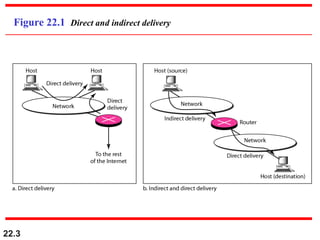
Direct Versus Indirect Delivery
Topics discussed in this section:
22.3
Figure 22.1 Direct and indirect delivery
22.4
22-2 FORWARDING
22-2 FORWARDING
Forwarding means to place the packet in its route to
its destination. Forwarding requires a host or a router
to have a routing table. When a host has a packet to
send or when a router has received a packet to be
forwarded, it looks at this table to find the route to the
final destination.
final destination.
Forwarding Techniques
Forwarding Process
Routing Table
Topics discussed in this section:
22.5
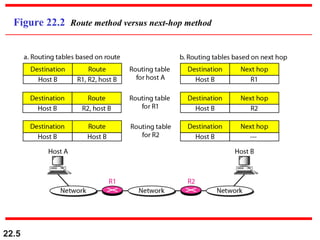
Figure 22.2 Route method versus next-hop method
22.6
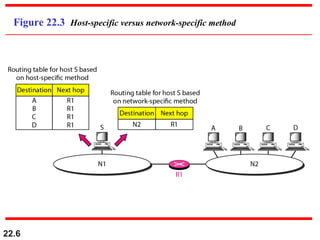
Figure 22.3 Host-specific versus network-specific method
22.7
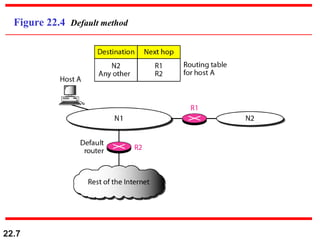
Figure 22.4 Default method
22.8
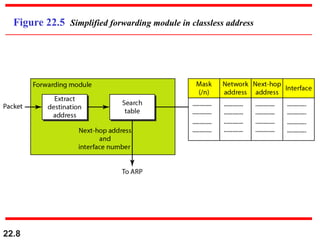
Figure 22.5 Simplified forwarding module in classless address
22.9
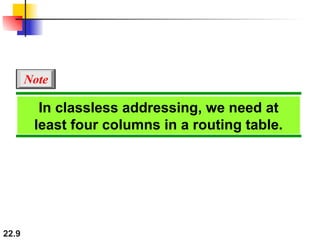
In classless addressing, we need at
least four columns in a routing table.
Note
22.10
Make a routing table for router R1, using the
configuration in Figure 22.6.
Example 22.1
Solution
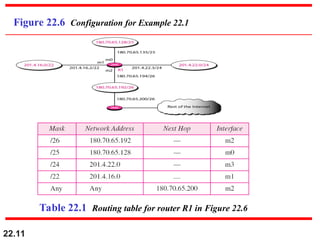
Table 22.1 shows the corresponding table.
22.11
Figure 22.6 Configuration for Example 22.1
Table 22.1 Routing table for router R1 in Figure 22.6
22.12
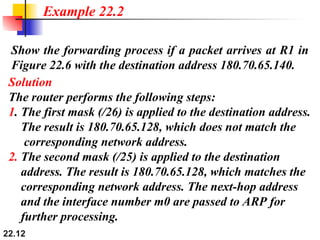
Show the forwarding process if a packet arrives at R1 in
Figure 22.6 with the destination address 180.70.65.140.
Example 22.2
Solution
The router performs the following steps:
1. The first mask (/26) is applied to the destination address.
The result is 180.70.65.128, which does not match the
corresponding network address.
2. The second mask (/25) is applied to the destination
address. The result is 180.70.65.128, which matches the
corresponding network address. The next-hop address
and the interface number m0 are passed to ARP for
further processing.
22.13
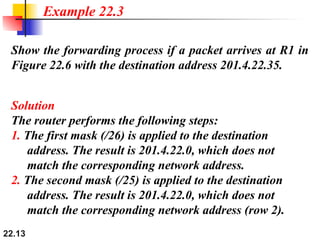
Show the forwarding process if a packet arrives at R1 in
Figure 22.6 with the destination address 201.4.22.35.
Example 22.3
Solution
The router performs the following steps:
1. The first mask (/26) is applied to the destination
address. The result is 201.4.22.0, which does not
match the corresponding network address.
2. The second mask (/25) is applied to the destination
address. The result is 201.4.22.0, which does not
match the corresponding network address (row 2).
22.14
Example 22.3 (continued)
3. The third mask (/24) is applied to the destination
address. The result is 201.4.22.0, which matches the
corresponding network address. The destination
address of the packet and the interface number m3 are
passed to ARP.
22.15
Show the forwarding process if a packet arrives at R1 in
Figure 22.6 with the destination address 18.24.32.78.
Example 22.4
Solution
This time all masks are applied, one by one, to the
destination address, but no matching network address is
found. When it reaches the end of the table, the module
gives the next-hop address 180.70.65.200 and interface
number m2 to ARP. This is probably an outgoing
package that needs to be sent, via the default router, to
someplace else in the Internet.
22.16
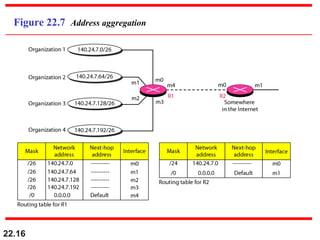
Figure 22.7 Address aggregation
22.17
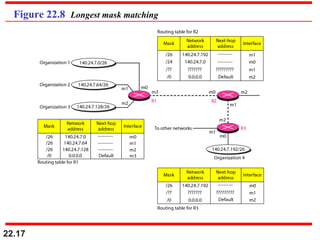
Figure 22.8 Longest mask matching
22.18
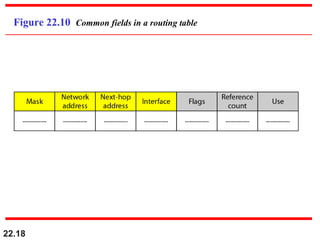
Figure 22.10 Common fields in a routing table
22.19
22-3 UNICAST ROUTING PROTOCOLS
A routing table can be either static or dynamic. A
static table is one with manual entries. A dynamic
table is one that is updated automatically when there is
a change somewhere in the Internet. A routing
protocol is a combination of rules and procedures that
lets routers in the Internet inform each other of
changes.
changes.
Optimization
Intra- and Interdomain Routing
Distance Vector Routing and RIP
Link State Routing and OSPF
Path Vector Routing and BGP
Topics discussed in this section:
22.20
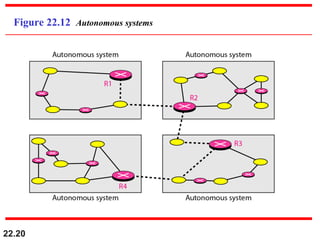
Figure 22.12 Autonomous systems
22.21
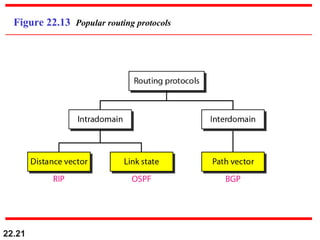
Figure 22.13 Popular routing protocols
22.22
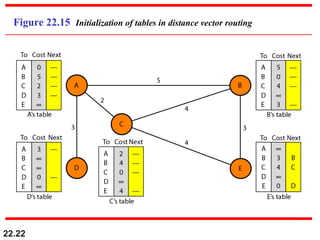
Figure 22.15 Initialization of tables in distance vector routing
22.23
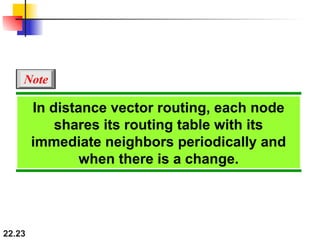
In distance vector routing, each node
shares its routing table with its
immediate neighbors periodically and
when there is a change.
Note
22.24
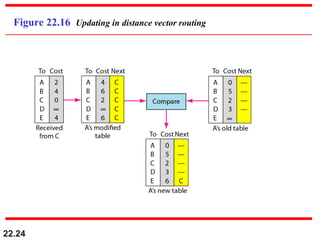
Figure 22.16 Updating in distance vector routing
22.25
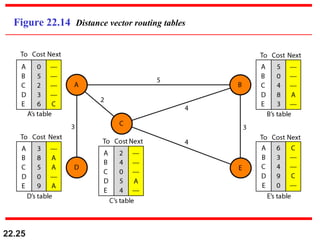
Figure 22.14 Distance vector routing tables
22.26
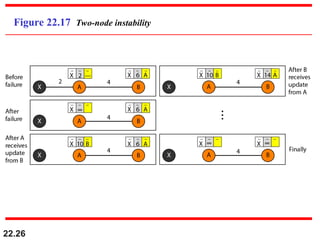
Figure 22.17 Two-node instability
22.27
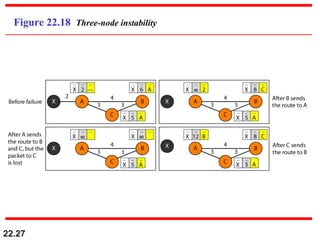
Figure 22.18 Three-node instability
22.28
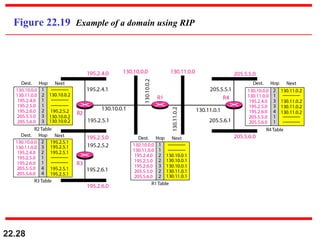
Figure 22.19 Example of a domain using RIP
22.29
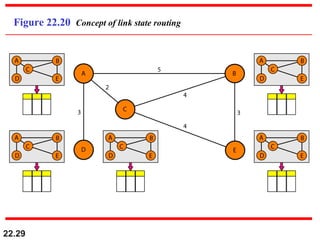
Figure 22.20 Concept of link state routing
22.30
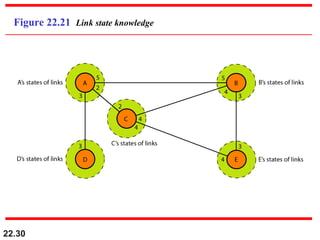
Figure 22.21 Link state knowledge
22.31
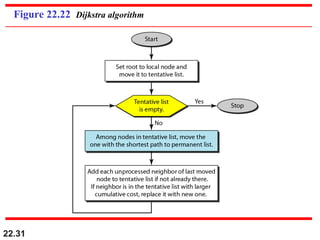
Figure 22.22 Dijkstra algorithm
22.32
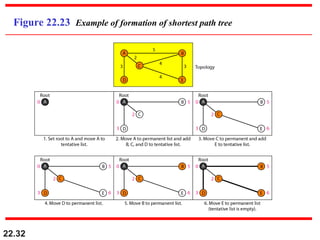
Figure 22.23 Example of formation of shortest path tree
22.33
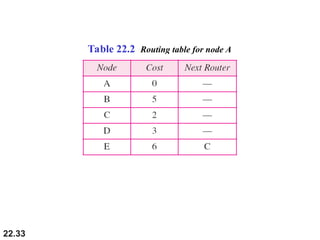
Table 22.2 Routing table for node A
22.34
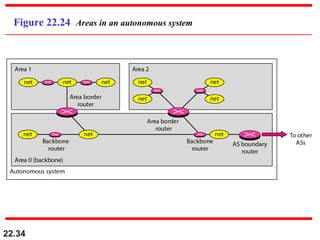
Figure 22.24 Areas in an autonomous system
22.35
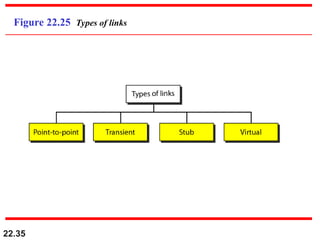
Figure 22.25 Types of links
22.36
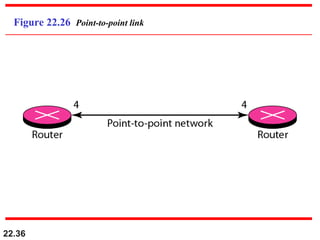
Figure 22.26 Point-to-point link
22.37
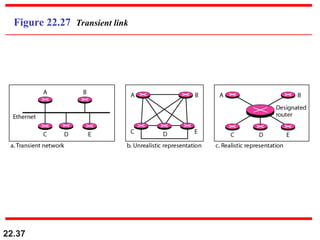
Figure 22.27 Transient link
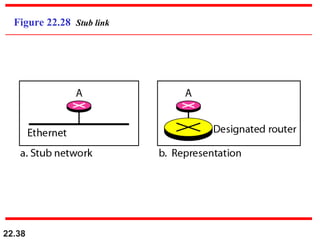
22.38
Figure 22.28 Stub link
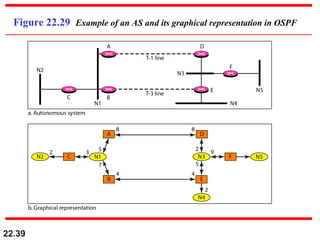
22.39
Figure 22.29 Example of an AS and its graphical representation in OSPF
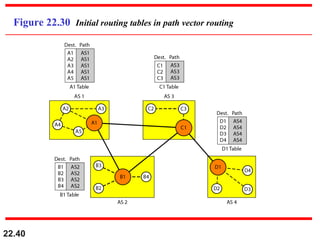
22.40
Figure 22.30 Initial routing tables in path vector routing
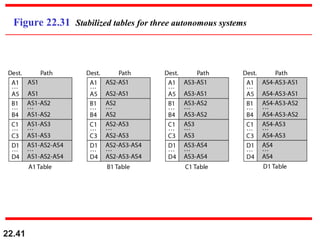
22.41
Figure 22.31 Stabilized tables for three autonomous systems
Types of Autonomous
Systems
 Stub AS
 Multihomed AS
 Transit AS
22.42
22.43
22.44
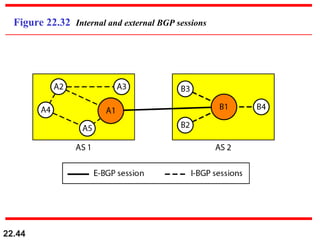
Figure 22.32 Internal and external BGP sessions

computer_communication_network_layer.ppt

  • 1.
    22.1 Chapter 22 Network Layer: Delivery,Forwarding, and Routing Copyright © The McGraw-Hill Companies, Inc. Permission required for reproduction or display.
  • 2.
    22.2 22-1 DELIVERY 22-1 DELIVERY Thenetwork layer supervises the handling of the The network layer supervises the handling of the packets by the underlying physical networks. We packets by the underlying physical networks. We define this handling as the delivery of a packet. define this handling as the delivery of a packet. Direct Versus Indirect Delivery Topics discussed in this section: Topics discussed in this section:
  • 3.
    22.3 Figure 22.1 Directand indirect delivery
  • 4.
    22.4 22-2 FORWARDING 22-2 FORWARDING Forwardingmeans to place the packet in its route to Forwarding means to place the packet in its route to its destination. Forwarding requires a host or a router its destination. Forwarding requires a host or a router to have a routing table. When a host has a packet to to have a routing table. When a host has a packet to send or when a router has received a packet to be send or when a router has received a packet to be forwarded, it looks at this table to find the route to the forwarded, it looks at this table to find the route to the final destination. final destination. Forwarding Techniques Forwarding Process Routing Table Topics discussed in this section: Topics discussed in this section:
  • 5.
    22.5 Figure 22.2 Routemethod versus next-hop method
  • 6.
    22.6 Figure 22.3 Host-specificversus network-specific method
  • 7.
  • 8.
    22.8 Figure 22.5 Simplifiedforwarding module in classless address
  • 9.
    22.9 In classless addressing,we need at least four columns in a routing table. Note
  • 10.
    22.10 Make a routingtable for router R1, using the configuration in Figure 22.6. Example 22.1 Solution Table 22.1 shows the corresponding table.
  • 11.
    22.11 Figure 22.6 Configurationfor Example 22.1 Table 22.1 Routing table for router R1 in Figure 22.6
  • 12.
    22.12 Show the forwardingprocess if a packet arrives at R1 in Figure 22.6 with the destination address 180.70.65.140. Example 22.2 Solution The router performs the following steps: 1. The first mask (/26) is applied to the destination address. The result is 180.70.65.128, which does not match the corresponding network address. 2. The second mask (/25) is applied to the destination address. The result is 180.70.65.128, which matches the corresponding network address. The next-hop address and the interface number m0 are passed to ARP for further processing.
  • 13.
    22.13 Show the forwardingprocess if a packet arrives at R1 in Figure 22.6 with the destination address 201.4.22.35. Example 22.3 Solution The router performs the following steps: 1. The first mask (/26) is applied to the destination address. The result is 201.4.22.0, which does not match the corresponding network address. 2. The second mask (/25) is applied to the destination address. The result is 201.4.22.0, which does not match the corresponding network address (row 2).
  • 14.
    22.14 Example 22.3 (continued) 3.The third mask (/24) is applied to the destination address. The result is 201.4.22.0, which matches the corresponding network address. The destination address of the packet and the interface number m3 are passed to ARP.
  • 15.
    22.15 Show the forwardingprocess if a packet arrives at R1 in Figure 22.6 with the destination address 18.24.32.78. Example 22.4 Solution This time all masks are applied, one by one, to the destination address, but no matching network address is found. When it reaches the end of the table, the module gives the next-hop address 180.70.65.200 and interface number m2 to ARP. This is probably an outgoing package that needs to be sent, via the default router, to someplace else in the Internet.
  • 16.
  • 17.
  • 18.
    22.18 Figure 22.10 Commonfields in a routing table
  • 19.
    22.19 22-3 UNICAST ROUTINGPROTOCOLS 22-3 UNICAST ROUTING PROTOCOLS A routing table can be either static or dynamic. A A routing table can be either static or dynamic. A static table is one with manual entries. A dynamic static table is one with manual entries. A dynamic table is one that is updated automatically when there is table is one that is updated automatically when there is a change somewhere in the Internet. A routing a change somewhere in the Internet. A routing protocol is a combination of rules and procedures that protocol is a combination of rules and procedures that lets routers in the Internet inform each other of lets routers in the Internet inform each other of changes. changes. Optimization Intra- and Interdomain Routing Distance Vector Routing and RIP Link State Routing and OSPF Path Vector Routing and BGP Topics discussed in this section: Topics discussed in this section:
  • 20.
  • 21.
    22.21 Figure 22.13 Popularrouting protocols
  • 22.
    22.22 Figure 22.15 Initializationof tables in distance vector routing
  • 23.
    22.23 In distance vectorrouting, each node shares its routing table with its immediate neighbors periodically and when there is a change. Note
  • 24.
    22.24 Figure 22.16 Updatingin distance vector routing
  • 25.
    22.25 Figure 22.14 Distancevector routing tables
  • 26.
  • 27.
  • 28.
    22.28 Figure 22.19 Exampleof a domain using RIP
  • 29.
    22.29 Figure 22.20 Conceptof link state routing
  • 30.
    22.30 Figure 22.21 Linkstate knowledge
  • 31.
  • 32.
    22.32 Figure 22.23 Exampleof formation of shortest path tree
  • 33.
    22.33 Table 22.2 Routingtable for node A
  • 34.
    22.34 Figure 22.24 Areasin an autonomous system
  • 35.
  • 36.
  • 37.
  • 38.
  • 39.
    22.39 Figure 22.29 Exampleof an AS and its graphical representation in OSPF
  • 40.
    22.40 Figure 22.30 Initialrouting tables in path vector routing
  • 41.
    22.41 Figure 22.31 Stabilizedtables for three autonomous systems
  • 42.
    Types of Autonomous Systems Stub AS  Multihomed AS  Transit AS 22.42
  • 43.
  • 44.
    22.44 Figure 22.32 Internaland external BGP sessions