UNIT I
INTRODUCTION
.
Image Processing, Computer Vision, What is Computer Vision - Low-level, Mid-level,
High-level; Fundamentals of Image Formation, Transformation: Orthogonal,
Euclidean, Affine, Projective, Fourier Transform, Convolution in OpenCV and
Filtering, Image Enhancement, Restoration, Histogram Processing.
INTRODUCTION
IMAGE PROCESSING
•Digital Image Processing means processing digital image by means of a
digital computer. We can also say that it is a use of computer algorithms,
in order to get enhanced image either to extract some useful
information.
•Digital image processing is the use of algorithms and mathematical
models to process and analyze digital images. The goal of digital image
processing is to enhance the quality of images, extract meaningful
information from images, and automate image-based tasks.
Types of an image
1. BINARY IMAGE– The binary image as its name suggests, contain only two pixel elements i.e 0 &
1,where 0 refers to black and 1 refers to white. This image is also known as Monochrome.
2. BLACK AND WHITE IMAGE– The image which consist of only black and white color is called
BLACK AND WHITE IMAGE.
3. 8 bit COLOR FORMAT– It is the most famous image format.It has 256 different shades of colors in it
and commonly known as Grayscale Image. In this format, 0 stands for Black, and 255 stands for white,
and 127 stands for gray.
4. 16 bit COLOR FORMAT– It is a color image format. It has 65,536 different colors in it.It is also
known as High Color Format. In this format the distribution of color is not as same as Grayscale image.
•
•
Computer Vision
• Computer vision is concerned with modeling and replicating human vision using computer software and
hardware. Formally if we define computer vision then its definition would be that computer vision is a
discipline that studies how to reconstruct, interrupt and understand a 3d scene from its 2d images in terms
of the properties of the structure present in scene.
• It needs knowledge from the following fields in order to understand and stimulate the operation of
human vision system.
• Computer Science
• Electrical Engineering
• Mathematics
• Physiology
• Biology
• Cognitive Science
FUNDAMENTALS OF IMAGE FORMATION
•
• Image formation is an analog to digital conversion of an image with the help of 2D
Sampling and Quantization techniques that is done by the capturing devices like cameras.
In general, we see a 2D view of the 3D world.
• In the same way, the formation of the analog image took place. It is basically a
conversion of the 3D world that is our analog image to a 2D world that is our Digital image.
• Generally, a frame grabber or a digitizer is used for sampling and quantizing the analog
signals.
• Imaging:
•
• The mapping of a 3D world object into a 2D digital image plane is called imaging. In order
to do so, each point on the 3D object must correspond to the image plane. We all know that
light reflects from every object that we see thus enabling us to capture all those light-
reflecting points in our image plane.
CONT……….
Transformation: Orthogonal
Following are two types of transformations:
1. Fourier Transform
• Fourier transform is mainly used for image processing. In the Fourier transform, the intensity of the image is
transformed into frequency variation and then to the frequency domain. It is used for slow varying intensity
images such as the background of a passport size photo can be represented as low-frequency components and
the edges can be represented as high-frequency components. Low-frequency components can be removed using
filters of FT domain. When an image is filtered in the FT domain, it contains only the edges of the image. And if
we do inverse FT domain to spatial domain then also an image contains only edges. Fourier transform is the
simplest technique in which edges of the image can be fined.
•
Discrete Cosine Transformation (DCT)
In Discrete Cosine Transformation, coefficients carry information about the pixels of the image.
Also, much information is contained using very few coefficients, and the remaining coefficient
contains minimal information. These coefficients can be removed without losing information. By
doing this, the file size is reduced in the DCT domain. DCT is used for lossy compression.
One Dimension Discrete cosine transformation:
Two Dimension Discrete cosine transformations:
Euclidean transformations:
•
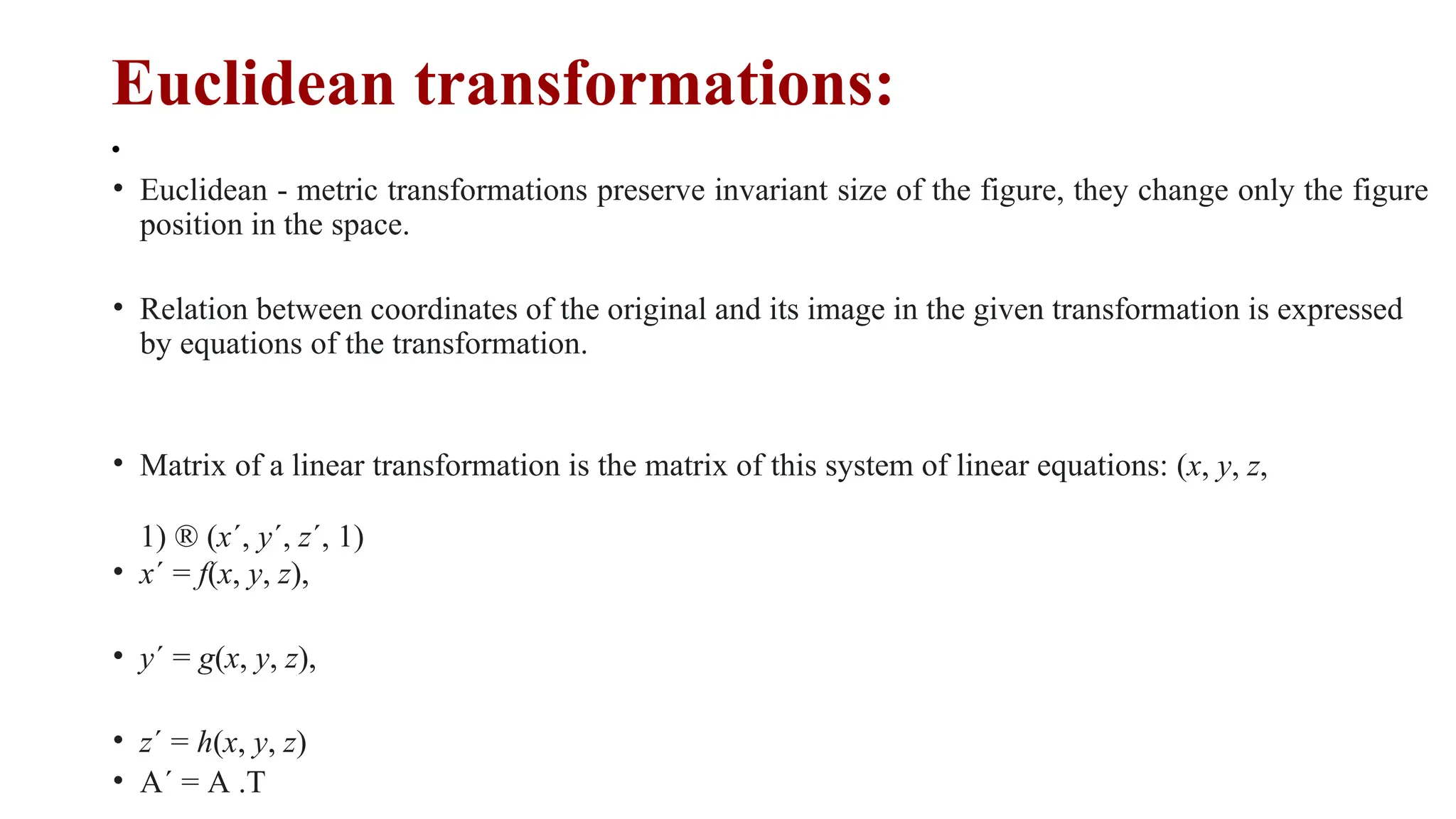
• Euclidean - metric transformations preserve invariant size of the figure, they change only the figure
position in the space.
• Relation between coordinates of the original and its image in the given transformation is expressed
by equations of the transformation.
• Matrix of a linear transformation is the matrix of this system of linear equations: (x, y, z,
1) ® (x´, y´, z´, 1)
• x´ = f(x, y, z),
• y´ = g(x, y, z),
• z´ = h(x, y, z)
• A´ = A .T
Affine transformations of the space
• Affine transformations do not preserve invariant the size of line segments and
angles.
• Special subset of affine transformations form similarities, preserving invariant
the size of angles. Any Euclidean transformation is an affine transformation
(similarity) in .
• Scaling to the centre O
• with the nonzero coefficient s (scale on all coordinate axes)
CONT……..
Projective transformations of the space
Projective transformation of the extended Euclidean space E3 is any linear geometric
transformation of the space called collineation.
In addition to incidence, collinear transformations preserve invariant ration of four points on a
line.
All Euclidean and affine transformations are collineations with special properties and invariant
elements.
• s
Convolution Filtering
• Convolution is a simple mathematical operation which is
fundamental to many common image processing operators.
Convolution provides a way of `multiplying together' two arrays of
numbers, generally of different sizes, but of the same dimensionality,
to produce a third array of numbers of the same dimensionality.
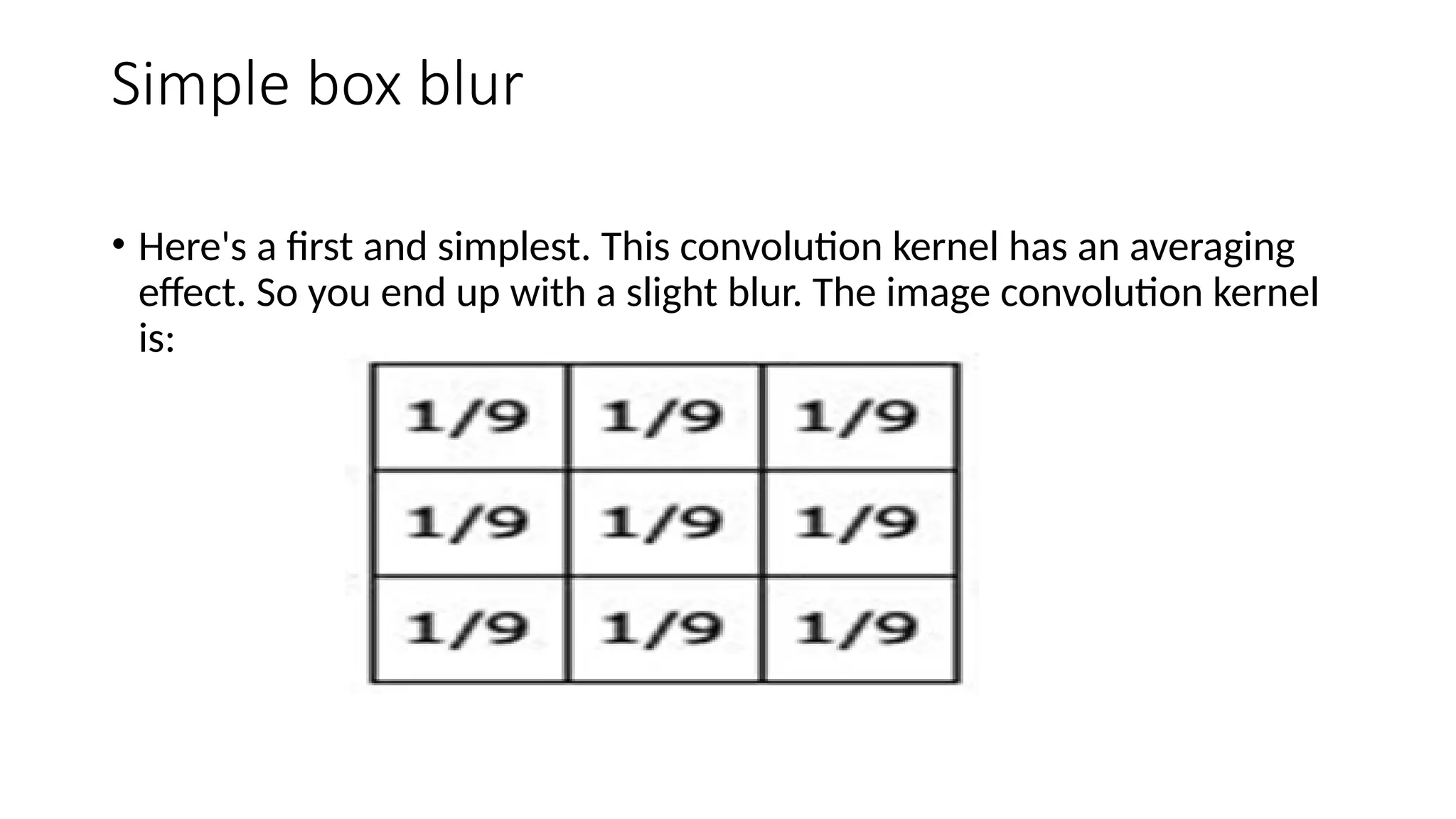
Simple box blur
• Here's a first and simplest. This convolution kernel has an averaging
effect. So you end up with a slight blur. The image convolution kernel
is:
Image enhancement Restoration
Image enhancement is the process of adjusting digital images so that the results are more suitable
for display or further image analysis. For example, you can remove noise, sharpen, or brighten an
image, making it easier to identify key features.
Here are some useful examples and methods of image enhancement:
● Filtering with morphological operators
● Histogram equalization
● Noise removal using a Wiener filter
Restoration
Restoration process improves the appearance of the image. The degraded image is the
convolution of the original image, degraded function, and additive noise. The process of
restoration is deconvolved this degraded image to obtain noiselessly and deblurred original
image.

COMPUTER VISION- ARTIFICIAL INTELLIGENCE

  • 1.
    UNIT I INTRODUCTION . Image Processing,Computer Vision, What is Computer Vision - Low-level, Mid-level, High-level; Fundamentals of Image Formation, Transformation: Orthogonal, Euclidean, Affine, Projective, Fourier Transform, Convolution in OpenCV and Filtering, Image Enhancement, Restoration, Histogram Processing.
  • 2.
  • 3.
    IMAGE PROCESSING •Digital ImageProcessing means processing digital image by means of a digital computer. We can also say that it is a use of computer algorithms, in order to get enhanced image either to extract some useful information. •Digital image processing is the use of algorithms and mathematical models to process and analyze digital images. The goal of digital image processing is to enhance the quality of images, extract meaningful information from images, and automate image-based tasks.
  • 4.
    Types of animage 1. BINARY IMAGE– The binary image as its name suggests, contain only two pixel elements i.e 0 & 1,where 0 refers to black and 1 refers to white. This image is also known as Monochrome. 2. BLACK AND WHITE IMAGE– The image which consist of only black and white color is called BLACK AND WHITE IMAGE. 3. 8 bit COLOR FORMAT– It is the most famous image format.It has 256 different shades of colors in it and commonly known as Grayscale Image. In this format, 0 stands for Black, and 255 stands for white, and 127 stands for gray. 4. 16 bit COLOR FORMAT– It is a color image format. It has 65,536 different colors in it.It is also known as High Color Format. In this format the distribution of color is not as same as Grayscale image. • •
  • 6.
    Computer Vision • Computervision is concerned with modeling and replicating human vision using computer software and hardware. Formally if we define computer vision then its definition would be that computer vision is a discipline that studies how to reconstruct, interrupt and understand a 3d scene from its 2d images in terms of the properties of the structure present in scene. • It needs knowledge from the following fields in order to understand and stimulate the operation of human vision system. • Computer Science • Electrical Engineering • Mathematics • Physiology • Biology • Cognitive Science
  • 7.
    FUNDAMENTALS OF IMAGEFORMATION • • Image formation is an analog to digital conversion of an image with the help of 2D Sampling and Quantization techniques that is done by the capturing devices like cameras. In general, we see a 2D view of the 3D world. • In the same way, the formation of the analog image took place. It is basically a conversion of the 3D world that is our analog image to a 2D world that is our Digital image. • Generally, a frame grabber or a digitizer is used for sampling and quantizing the analog signals. • Imaging: • • The mapping of a 3D world object into a 2D digital image plane is called imaging. In order to do so, each point on the 3D object must correspond to the image plane. We all know that light reflects from every object that we see thus enabling us to capture all those light- reflecting points in our image plane.
  • 8.
  • 9.
  • 10.
    Following are twotypes of transformations: 1. Fourier Transform • Fourier transform is mainly used for image processing. In the Fourier transform, the intensity of the image is transformed into frequency variation and then to the frequency domain. It is used for slow varying intensity images such as the background of a passport size photo can be represented as low-frequency components and the edges can be represented as high-frequency components. Low-frequency components can be removed using filters of FT domain. When an image is filtered in the FT domain, it contains only the edges of the image. And if we do inverse FT domain to spatial domain then also an image contains only edges. Fourier transform is the simplest technique in which edges of the image can be fined. •
  • 12.
    Discrete Cosine Transformation(DCT) In Discrete Cosine Transformation, coefficients carry information about the pixels of the image. Also, much information is contained using very few coefficients, and the remaining coefficient contains minimal information. These coefficients can be removed without losing information. By doing this, the file size is reduced in the DCT domain. DCT is used for lossy compression. One Dimension Discrete cosine transformation: Two Dimension Discrete cosine transformations:
  • 13.
    Euclidean transformations: • • Euclidean- metric transformations preserve invariant size of the figure, they change only the figure position in the space. • Relation between coordinates of the original and its image in the given transformation is expressed by equations of the transformation. • Matrix of a linear transformation is the matrix of this system of linear equations: (x, y, z, 1) ® (x´, y´, z´, 1) • x´ = f(x, y, z), • y´ = g(x, y, z), • z´ = h(x, y, z) • A´ = A .T
  • 14.
    Affine transformations ofthe space • Affine transformations do not preserve invariant the size of line segments and angles. • Special subset of affine transformations form similarities, preserving invariant the size of angles. Any Euclidean transformation is an affine transformation (similarity) in . • Scaling to the centre O • with the nonzero coefficient s (scale on all coordinate axes)
  • 15.
  • 16.
    Projective transformations ofthe space Projective transformation of the extended Euclidean space E3 is any linear geometric transformation of the space called collineation. In addition to incidence, collinear transformations preserve invariant ration of four points on a line. All Euclidean and affine transformations are collineations with special properties and invariant elements. • s
  • 17.
    Convolution Filtering • Convolutionis a simple mathematical operation which is fundamental to many common image processing operators. Convolution provides a way of `multiplying together' two arrays of numbers, generally of different sizes, but of the same dimensionality, to produce a third array of numbers of the same dimensionality.
  • 18.
    Simple box blur •Here's a first and simplest. This convolution kernel has an averaging effect. So you end up with a slight blur. The image convolution kernel is:
  • 19.
    Image enhancement Restoration Imageenhancement is the process of adjusting digital images so that the results are more suitable for display or further image analysis. For example, you can remove noise, sharpen, or brighten an image, making it easier to identify key features. Here are some useful examples and methods of image enhancement: ● Filtering with morphological operators ● Histogram equalization ● Noise removal using a Wiener filter
  • 20.
    Restoration Restoration process improvesthe appearance of the image. The degraded image is the convolution of the original image, degraded function, and additive noise. The process of restoration is deconvolved this degraded image to obtain noiselessly and deblurred original image.