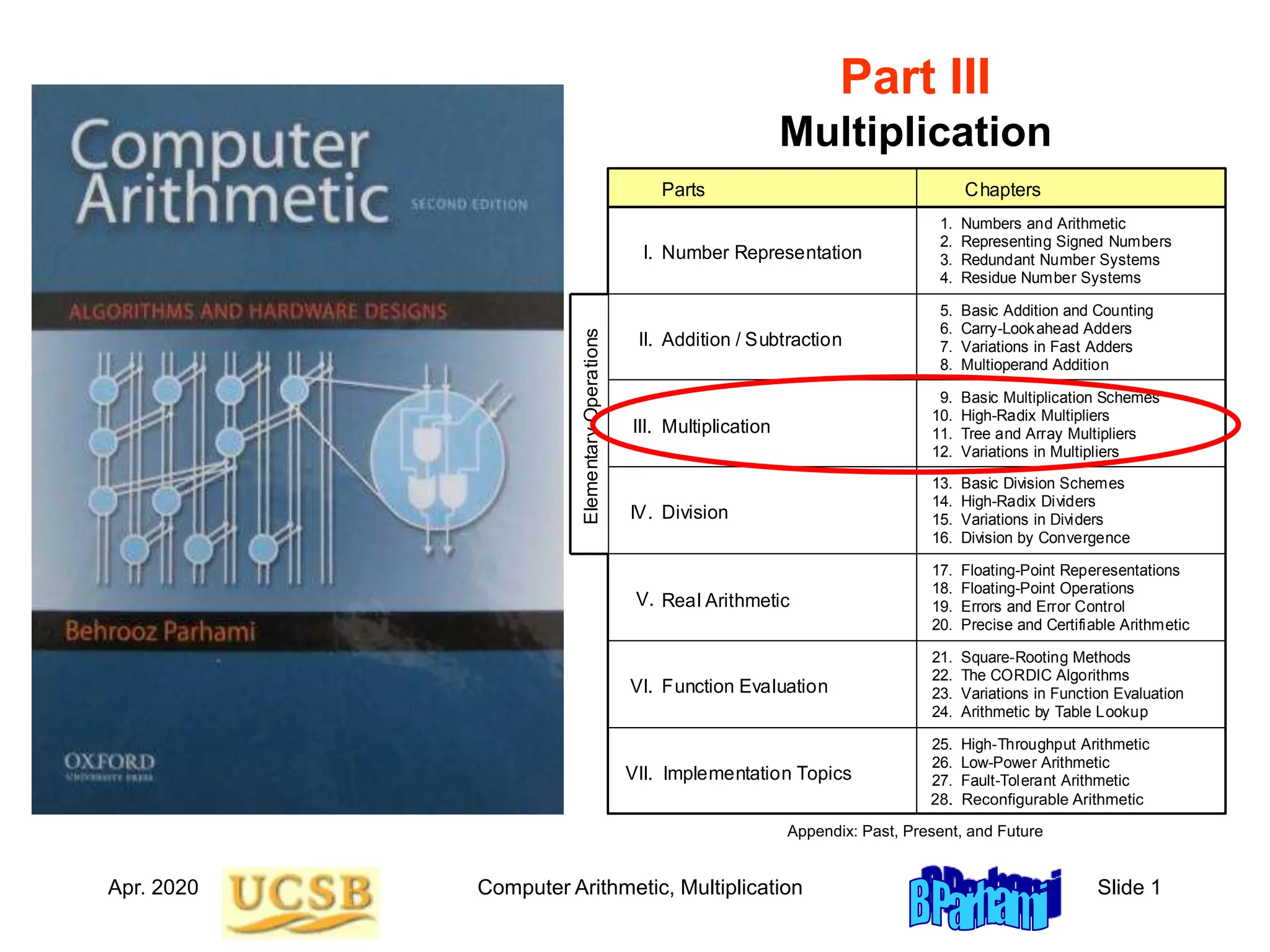
Apr. 2020 Computer Arithmetic, Multiplication Slide 1
Part III
Multiplication
Number Representation
Numbers and Arithmetic
Representing Signed Numbers
Redundant Number Systems
Residue Number Systems
Addition / Subtraction
Basic Addition and Counting
Carry-Lookahead Adders
Variations in Fast Adders
Multioperand Addition
Multiplication
Basic Multiplication Schemes
High-Radix Multipliers
Tree and Array Multipliers
Variations in Multipliers
Division
Basic Division Schemes
High-Radix Dividers
Variations in Dividers
Division by Convergence
Real Arithmetic
Floating-Point Reperesentations
Floating-Point Operations
Errors and Error Control
Precise and Certifiable Arithmetic
Function Evaluation
Square-Rooting Methods
The CORDIC Algorithms
Variations in Function Evaluation
Arithmetic by Table Lookup
Implementation Topics
High-Throughput Arithmetic
Low-Power Arithmetic
Fault-Tolerant Arithmetic
Past, Present, and Future
Parts Chapters
I.
II.
III.
IV.
V.
VI.
VII.
1.
2.
3.
4.
5.
6.
7.
8.
9.
10.
11.
12.
25.
26.
27.
28.
21.
22.
23.
24.
17.
18.
19.
20.
13.
14.
15.
16.
Elementary
Operations
28. Reconfigurable Arithmetic
Appendix: Past, Present, and Future
Apr. 2020 Computer Arithmetic, Multiplication Slide 2
About This Presentation
Edition Released Revised Revised Revised Revised
First Jan. 2000 Sep. 2001 Sep. 2003 Oct. 2005 May 2007
Apr. 2008 Apr. 2009
Second Apr. 2010 Apr. 2011 Apr. 2012 Apr. 2015 Apr. 2020
This presentation is intended to support the use of the textbook
Computer Arithmetic: Algorithms and Hardware Designs (Oxford
U. Press, 2nd ed., 2010, ISBN 978-0-19-532848-6). It is updated
regularly by the author as part of his teaching of the graduate
course ECE 252B, Computer Arithmetic, at the University of
California, Santa Barbara. Instructors can use these slides freely
in classroom teaching and for other educational purposes.
Unauthorized uses are strictly prohibited. © Behrooz Parhami
Apr. 2020 Computer Arithmetic, Multiplication Slide 3
III Multiplication
Topics in This Part
Chapter 9 Basic Multiplication Schemes
Chapter 10 High-Radix Multipliers
Chapter 11 Tree and Array Multipliers
Chapter 12 Variations in Multipliers
Review multiplication schemes and various speedup methods
• Multiplication is heavily used (in arith & array indexing)
• Division = reciprocation + multiplication
• Multiplication speedup: high-radix, tree, recursive
• Bit-serial, modular, and array multipliers
Apr. 2020 Computer Arithmetic, Multiplication Slide 4
“Well, well, for a rabbit, you’re not
very good at multiplying, are you?”
Apr. 2020 Computer Arithmetic, Multiplication Slide 5
9 Basic Multiplication Schemes
Chapter Goals
Study shift/add or bit-at-a-time multipliers
and set the stage for faster methods and
variations to be covered in Chapters 10-12
Chapter Highlights
Multiplication = multioperand addition
Hardware, firmware, software algorithms
Multiplying 2’s-complement numbers
The special case of one constant operand
Apr. 2020 Computer Arithmetic, Multiplication Slide 6
Basic Multiplication Schemes: Topics
Topics in This Chapter
9.1 Shift/Add Multiplication Algorithms
9.2 Programmed Multiplication
9.3 Basic Hardware Multipliers
9.4 Multiplication of Signed Numbers
9.5 Multiplication by Constants
9.6 Preview of Fast Multipliers
Apr. 2020 Computer Arithmetic, Multiplication Slide 7
9.1 Shift/Add Multiplication Algorithms
Notation for our discussion of multiplication algorithms:
a Multiplicand ak–1ak–2 . . . a1a0
x Multiplier xk–1xk–2 . . . x1x0
p Product (a  x) p2k–1p2k–2 . . . p3p2p1p0
Initially, we assume unsigned operands
Fig. 9.1 Multiplication of two 4-bit unsigned binary numbers in dot notation.
Product
Partial
products
bit-matrix
a
x
p
2
x a 0
0
1
x a 21
x a 22
2
23
3
x a
Multiplicand
Multiplier

Apr. 2020 Computer Arithmetic, Multiplication Slide 8
Preferred
Multiplication Recurrence
Multiplication with right shifts: top-to-bottom accumulation
p(j+1) = (p(j) + xj a 2k) 2–1 with p(0) = 0 and
|–––add–––| p(k) = p = ax + p(0)2–k
|––shift right––|
Product
Partial
products
bit-matrix
a
x
p
2
x a 0
0
1
x a 21
x a 22
2
23
3
x a
Multiplicand
Multiplier

Multiplication with left shifts: bottom-to-top accumulation
p(j+1) = 2p(j) + xk–j–1a with p(0) = 0 and
|shift| p(k) = p = ax + p(0)2k
|––––add––––|
Fig. 9.1
Apr. 2020 Computer Arithmetic, Multiplication Slide 9
Why Premultiply the Multiplicand by 2k?
Addition takes place between the dashed lines in the figure below
The 0th PP is eventually shifted right by k bits, the 1st by k – 1 bits, …
Even though the cumulative PP widens by 1 bit at each step,
the addition is always k bits wide
Fig. 9.1 Multiplication of two 4-bit unsigned binary numbers in dot notation.
Product
Partial
products
bit-matrix
a
x
p
2
x a 0
0
1
x a 21
x a 22
2
23
3
x a
Multiplicand
Multiplier

p(j+1) = (p(j) + xj a 2k) 2–1 with p(0) = 0 and
Apr. 2020 Computer Arithmetic, Multiplication Slide 10
Examples of Basic Multiplication
Fig. 9.2
Examples
of
sequential
multipli-
cation with
right and
left shifts.
Right-shift algorithm Left-shift algorithm
======================== =======================
a 1 0 1 0 a 1 0 1 0
x 1 0 1 1 x 1 0 1 1
======================== =======================
p(0) 0 0 0 0 p(0) 0 0 0 0
+x0a 1 0 1 0 2p(0) 0 0 0 0 0
––––––––––––––––––––––––– +x3a 1 0 1 0
2p(1) 0 1 0 1 0 ––––––––––––––––––––––––
p(1) 0 1 0 1 0 p(1) 0 1 0 1 0
+x1a 1 0 1 0 2p(1) 0 1 0 1 0 0
––––––––––––––––––––––––– +x2a 0 0 0 0
2p(2) 0 1 1 1 1 0 ––––––––––––––––––––––––
p(2) 0 1 1 1 1 0 p(2) 0 1 0 1 0 0
+x2a 0 0 0 0 2p(2) 0 1 0 1 0 0 0
––––––––––––––––––––––––– +x1a 1 0 1 0
2p(3) 0 0 1 1 1 1 0 ––––––––––––––––––––––––
p(3) 0 0 1 1 1 1 0 p(3) 0 1 1 0 0 1 0
+x3a 1 0 1 0 2p(3) 0 1 1 0 0 1 0 0
––––––––––––––––––––––––– +x0a 1 0 1 0
2p(4) 0 1 1 0 1 1 1 0 ––––––––––––––––––––––––
p(4) 0 1 1 0 1 1 1 0 p(4) 0 1 1 0 1 1 1 0
======================== =======================
p(j+1) = (p(j) + xj a 2k) 2–1
|–––add–––|
|––shift right––|
1 0 1 0
Check:
10  11
= 110
= 64 + 32 +
8 + 4 + 2
Apr. 2020 Computer Arithmetic, Multiplication Slide 11
Examples of Basic Multiplication (Continued)
Fig. 9.2
Examples
of
sequential
multipli-
cation with
right and
left shifts.
Right-shift algorithm Left-shift algorithm
======================== =======================
a 1 0 1 0 a 1 0 1 0
x 1 0 1 1 x 1 0 1 1
======================== =======================
p(0) 0 0 0 0 p(0) 0 0 0 0
+x0a 1 0 1 0 2p(0) 0 0 0 0 0
––––––––––––––––––––––––– +x3a 1 0 1 0
2p(1) 0 1 0 1 0 ––––––––––––––––––––––––
p(1) 0 1 0 1 0 p(1) 0 1 0 1 0
+x1a 1 0 1 0 2p(1) 0 1 0 1 0 0
––––––––––––––––––––––––– +x2a 0 0 0 0
2p(2) 0 1 1 1 1 0 ––––––––––––––––––––––––
p(2) 0 1 1 1 1 0 p(2) 0 1 0 1 0 0
+x2a 0 0 0 0 2p(2) 0 1 0 1 0 0 0
––––––––––––––––––––––––– +x1a 1 0 1 0
2p(3) 0 0 1 1 1 1 0 ––––––––––––––––––––––––
p(3) 0 0 1 1 1 1 0 p(3) 0 1 1 0 0 1 0
+x3a 1 0 1 0 2p(3) 0 1 1 0 0 1 0 0
––––––––––––––––––––––––– +x0a 1 0 1 0
2p(4) 0 1 1 0 1 1 1 0 ––––––––––––––––––––––––
p(4) 0 1 1 0 1 1 1 0 p(4) 0 1 1 0 1 1 1 0
======================== =======================
p(j+1) = 2p(j) + xk–j–1a
|shift|
|––––add––––|
Check:
10  11
= 110
= 64 + 32 +
8 + 4 + 2
Apr. 2020 Computer Arithmetic, Multiplication Slide 12
9.2 Programmed Multiplication
Fig. 9.3 Programmed
multiplication (right-shift
algorithm).
{Using right shifts, multiply unsigned m_cand and m_ier,
storing the resultant 2k-bit product in p_high and p_low.
Registers: R0 holds 0 Rc for counter
Ra for m_cand Rx for m_ier
Rp for p_high Rq for p_low}
{Load operands into registers Ra and Rx}
mult: load Ra with m_cand
load Rx with m_ier
{Initialize partial product and counter}
copy R0 into Rp
copy R0 into Rq
load k into Rc
{Begin multiplication loop}
m_loop: shift Rx right 1 {LSB moves to carry flag}
branch no_add if carry = 0
add Ra to Rp {carry flag is set to cout}
no_add: rotate Rp right 1 {carry to MSB, LSB to carry}
rotate Rq right 1 {carry to MSB, LSB to carry}
decr Rc {decrement counter by 1}
branch m_loop if Rc  0
{Store the product}
store Rp into p_high
store Rq into p_low
m_done: ...
R0 Rc Counter
0
Ra Rx
Rp Rq
Multiplicand Multiplier
Product, high Product, low
Apr. 2020 Computer Arithmetic, Multiplication Slide 13
Time Complexity of Programmed Multiplication
Assume k-bit words
k iterations of the main loop
6-7 instructions per iteration, depending on the multiplier bit
Thus, 6k + 3 to 7k + 3 machine instructions,
ignoring operand loads and result store
k = 32 implies 200+ instructions on average
This is too slow for many modern applications!
Microprogrammed multiply would be somewhat better
Apr. 2020 Computer Arithmetic, Multiplication Slide 14
9.3 Basic Hardware Multipliers
Fig. 9.4 Hardware realization of the sequential multiplication
algorithm with additions and right shifts.
Multiplier x
Mux
Adder
0
out
c
0 1
Doublewidth partial product p
Multiplicand a
Shift
Shift
(j)
j
x
x a
j
k
k
k p(j+1) = (p(j) + xj a 2k) 2–1
|–––add–––|
|––shift right––|
Apr. 2020 Computer Arithmetic, Multiplication Slide 15
Example of Hardware Multiplication
Fig. 9.4a Hardware realization of the sequential multiplication
algorithm with additions and right shifts.
1 0 1 1
1 0 1 0
0 0 0 0
1 0 1 0
1 0 1
0 1 0 1 0
1 1 1 1 0
1 0
0 1 1 1 1 0
1
0 0 1 1 1 1 0
1 1 0 1 1 1 0
0 1 1 0 1 1 1 0
(11)ten
(10)ten
(110)ten
p(j+1) = (p(j) + xj a 2k) 2–1
|–––add–––|
|––shift right––|
Apr. 2020 Computer Arithmetic, Multiplication Slide 16
Performing Add and Shift in One Clock Cycle
Partial product p(j)
k
Unused
part of the
multiplier x
Adder’s
carry-out
Adder’s sum
k
k – 1
k – 1
To mux control
To adder
Fig. 9.5 Combining the loading and shifting of the
double-width register holding the partial product and
the partially used multiplier.
Apr. 2020 Computer Arithmetic, Multiplication Slide 17
Sequential Multiplication with Left Shifts
Fig. 9.4b Hardware realization of the sequential multiplication
algorithm with left shifts and additions.
Multiplier x
Mux
2k-bit adder
0
out
c
0 1
Doublewidth partial product p
Multiplicand a
Shift
Shift
(j)
k-j-1
x
a
2k
k
k-j-1
x
2k
Apr. 2020 Computer Arithmetic, Multiplication Slide 18
9.4 Multiplication of
Signed Numbers
Fig. 9.6 Sequential
multiplication of
2’s-complement
numbers with right
shifts (positive
multiplier).
============================
a 1 0 1 1 0
x 0 1 0 1 1
============================
p(0) 0 0 0 0 0
+x0a 1 0 1 1 0
–––––––––––––––––––––––––––––
2p(1) 1 1 0 1 1 0
p(1) 1 1 0 1 1 0
+x1a 1 0 1 1 0
–––––––––––––––––––––––––––––
2p(2) 1 1 0 0 0 1 0
p(2) 1 1 0 0 0 1 0
+x2a 0 0 0 0 0
–––––––––––––––––––––––––––––
2p(3) 1 1 1 0 0 0 1 0
p(3) 1 1 1 0 0 0 1 0
+x3a 1 0 1 1 0
–––––––––––––––––––––––––––––
2p(4) 1 1 0 0 1 0 0 1 0
p(4) 1 1 0 0 1 0 0 1 0
+x4a 0 0 0 0 0
–––––––––––––––––––––––––––––
2p(5) 1 1 1 0 0 1 0 0 1 0
p(5) 1 1 1 0 0 1 0 0 1 0
============================
Negative multiplicand,
positive multiplier:
No change, other than
looking out for proper
sign extension
Check:
–10  11
= –110
= –512 +
256 +
128 +
16 + 2
Apr. 2020 Computer Arithmetic, Multiplication Slide 19
The Case of a
Negative Multiplier
Fig. 9.7 Sequential
multiplication of
2’s-complement
numbers with right
shifts (negative
multiplier).
============================
a 1 0 1 1 0
x 1 0 1 0 1
============================
p(0) 0 0 0 0 0
+x0a 1 0 1 1 0
–––––––––––––––––––––––––––––
2p(1) 1 1 0 1 1 0
p(1) 1 1 0 1 1 0
+x1a 0 0 0 0 0
–––––––––––––––––––––––––––––
2p(2) 1 1 1 0 1 1 0
p(2) 1 1 1 0 1 1 0
+x2a 1 0 1 1 0
–––––––––––––––––––––––––––––
2p(3) 1 1 0 0 1 1 1 0
p(3) 1 1 0 0 1 1 1 0
+x3a 0 0 0 0 0
–––––––––––––––––––––––––––––
2p(4) 1 1 1 0 0 1 1 1 0
p(4) 1 1 1 0 0 1 1 1 0
+(-x4a) 0 1 0 1 0
–––––––––––––––––––––––––––––
2p(5) 0 0 0 1 1 0 1 1 1 0
p(5) 0 0 0 1 1 0 1 1 1 0
============================
Negative multiplicand,
negative multiplier:
In last step (the sign bit),
subtract rather than add
Check:
–10  –11
= 110
= 64 + 32 +
8 + 4 + 2
Apr. 2020 Computer Arithmetic, Multiplication Slide 20
Signed 2’s-Complement Hardware Multiplier
Fig. 9.8 The 2’s-complement sequential hardware multiplier.
Adder
k + 1
0, except in
last cycle
0
1
Mux
k + 1
Enable
Select
Partial product
Multiplier
Multiplicand
k + 1
cin
cout
Apr. 2020 Computer Arithmetic, Multiplication Slide 21
Booth’s Recoding
Table 9.1 Radix-2 Booth’s recoding
–––––––––––––––––––––––––––––––––––––
xi xi–1 yi Explanation
–––––––––––––––––––––––––––––––––––––
0 0 0 No string of 1s in sight
0 1 1 End of string of 1s in x
1 0 -1 Beginning of string of 1s in x
1 1 0 Continuation of string of 1s in x
–––––––––––––––––––––––––––––––––––––
Example
1 0 0 1 1 1 0 1 1 0 1 0 1 1 1 0 Operand x
(1) -1 0 1 0 0 -1 1 0 -1 1 -1 1 0 0 -1 0 Recoded version y
Justification
2j + 2j–1 + . . . + 2i+1 + 2i = 2j+1 – 2i
Apr. 2020 Computer Arithmetic, Multiplication Slide 22
Example Multiplication
with Booth’s Recoding
Fig. 9.9 Sequential
multiplication of
2’s-complement
numbers with right
shifts by means of
Booth’s recoding.
============================
a 1 0 1 1 0
x 1 0 1 0 1 Multiplier
y -1 1 -1 1 -1 Booth-recoded
============================
p(0) 0 0 0 0 0
+y0a 0 1 0 1 0
–––––––––––––––––––––––––––––
2p(1) 0 0 1 0 1 0
p(1) 0 0 1 0 1 0
+y1a 1 0 1 1 0
–––––––––––––––––––––––––––––
2p(2) 1 1 1 0 1 1 0
p(2) 1 1 1 0 1 1 0
+y2a 0 1 0 1 0
–––––––––––––––––––––––––––––
2p(3) 0 0 0 1 1 1 1 0
p(3) 0 0 0 1 1 1 1 0
+y3a 1 0 1 1 0
–––––––––––––––––––––––––––––
2p(4) 1 1 1 0 0 1 1 1 0
p(4) 1 1 1 0 0 1 1 1 0
y4a 0 1 0 1 0
–––––––––––––––––––––––––––––
2p(5) 0 0 0 1 1 0 1 1 1 0
p(5) 0 0 0 1 1 0 1 1 1 0
============================
––––––––––
xi xi–1 yi
––––––––––
0 0 0
0 1 1
1 0 -1
1 1 0
––––––––––
Check:
–10  –11
= 110
= 64 + 32 +
8 + 4 + 2
Apr. 2020 Computer Arithmetic, Multiplication Slide 23
9.5 Multiplication by Constants
Explicit, e.g. y := 12 * x + 1
Implicit, e.g. A[i, j] := A[i, j] + B[i, j]
Address of A[i, j] = base + n * i + j
Software aspects:
Optimizing compilers replace multiplications by shifts/adds/subs
Produce efficient code using as few registers as possible
Find the best code by a time/space-efficient algorithm
0 1 2 . . . n – 1
0
1
2
.
.
.
m – 1
Row i
Column j
Hardware aspects:
Synthesize special-purpose units such as filters
y[t] = a0x[t] + a1x[t – 1] + a2x[t – 2] + b1y[t – 1] + b2y[t – 2]
Apr. 2020 Computer Arithmetic, Multiplication Slide 24
Multiplication Using Binary Expansion
Example: Multiply R1 by the constant 113 = (1 1 1 0 0 0 1)two
R2  R1 shift-left 1
R3  R2 + R1
R6  R3 shift-left 1
R7  R6 + R1
R112  R7 shift-left 4
R113  R112 + R1
Shift, add Shift
Ri: Register that contains i times (R1)
This notation is for clarity; only one
register other than R1 is needed
Shorter sequence using shift-and-add instructions
R3  R1 shift-left 1 + R1
R7  R3 shift-left 1 + R1
R113  R7 shift-left 4 + R1
Apr. 2020 Computer Arithmetic, Multiplication Slide 25
Multiplication via Recoding
Example: Multiply R1 by 113 = (1 1 1 0 0 0 1)two = (1 0 0-1 0 0 0 1)two
R8  R1 shift-left 3
R7  R8 – R1
R112  R7 shift-left 4
R113  R112 + R1 Shift, add
Shift
Shorter sequence using shift-and-add/subtract instructions
R7  R1 shift-left 3 – R1
R113  R7 shift-left 4 + R1
Shift, subtract
6 shift or add (3 shift-and-add) instructions needed without recoding
The canonic signed-digit representation of a number contains no
consecutive nonzero digits: average number of shift-adds is O(k/3)
Apr. 2020 Computer Arithmetic, Multiplication Slide 26
Multiplication via Factorization
Example: Multiply R1 by 119 = 7  17
= (8 – 1)  (16 + 1)
R8  R1 shift-left 3
R7  R8 – R1
R112  R7 shift-left 4
R119  R112 + R7
Shorter sequence using shift-and-add/subtract instructions
R7  R1 shift-left 3 – R1
R119  R7 shift-left 4 + R7
119 = (1 1 1 0 1 1 1)two = (1 0 0 0-1 0 0-1)two
More instructions may be needed without factorization
Requires a scratch register
for holding the 7 multiple
CSA
CPA
128x 8x x
119x
1
1
Apr. 2020 Computer Arithmetic, Multiplication Slide 27
Multiplication by Multiple Constants
Example: Multiplying a number by 45, 49, and 65
R9  R1 shift-left 3 + R1
R45  R9 shift-left 2 + R9
R7  R1 shift-left 3 – R1
R49  R7 shift-left 3 – R7
R65  R1 shift-left 6 + R1
A combined solution for all three constants
R65  R1 shift-left 6 + R1
R49  R65 – R1 left-shift 4
R45  R49 – R1 left-shift 2
Separate solutions:
5 shift-add/subtract
operations
A programmable
block can perform
any of the three
multiplications
Apr. 2020 Computer Arithmetic, Multiplication Slide 28
9.6 Preview of Fast Multipliers
Viewing multiplication as a multioperand addition problem,
there are but two ways to speed it up
a. Reducing the number of operands to be added:
Handling more than one multiplier bit at a time
(high-radix multipliers, Chapter 10)
b. Adding the operands faster:
Parallel/pipelined multioperand addition
(tree and array multipliers, Chapter 11)
In Chapter 12, we cover all remaining multiplication topics:
Bit-serial multipliers
Modular multipliers
Multiply-add units
Squaring as a special case
Apr. 2020 Computer Arithmetic, Multiplication Slide 29
10 High-Radix Multipliers
Chapter Goals
Study techniques that allow us to handle
more than one multiplier bit in each cycle
(two bits in radix 4, three in radix 8, . . .)
Chapter Highlights
High radix gives rise to “difficult” multiples
Recoding (change of digit-set) as remedy
Carry-save addition reduces cycle time
Implementation and optimization methods
Apr. 2020 Computer Arithmetic, Multiplication Slide 30
High-Radix Multipliers: Topics
Topics in This Chapter
10.1 Radix-4 Multiplication
10.2 Modified Booth’s Recoding
10.3 Using Carry-Save Adders
10.4 Radix-8 and Radix-16 Multipliers
10.5 Multibeat Multipliers
10.6 VLSI Complexity Issues
Apr. 2020 Computer Arithmetic, Multiplication Slide 31
10.1 Radix-4 Multiplication
Preferred
Multiplication with right shifts in radix r: top-to-bottom accumulation
p(j+1) = (p(j) + xj a rk) r–1 with p(0) = 0 and
|–––add–––| p(k) = p = ax + p(0)r–k
|––shift right––|
Multiplication with left shifts in radix r: bottom-to-top accumulation
p(j+1) = rp(j) + xk–j–1a with p(0) = 0 and
|shift| p(k) = p = ax + p(0)rk
|––––add––––|
Fig. 9.1
(modified)
Product
Partial
products
bit-matrix
a
x
p
2
x a 0
0
1
x a 21
x a 22
2
23
3
x a
Multiplicand
Multiplier

x0 a r0
x1 a r1
x2 a r2
x3 a r3
Apr. 2020 Computer Arithmetic, Multiplication Slide 32
Radix-4 Multiplication in Dot Notation
Number of cycles is
halved, but now the
“difficult” multiple 3a
must be dealt with
Product
Partial
products
bit-matrix
a
x
p
2
x a 0
0
1
x a 21
x a 22
2
23
3
x a
Multiplicand
Multiplier

Multiplier
x
p Product
Multiplicand
a
(x x ) a 41
3 2 two
40
a
(x x )
1 0 two

Fig. 9.1
Fig. 10.1 Radix-4,
or two-bit-at-a-time,
multiplication in dot
notation
Apr. 2020 Computer Arithmetic, Multiplication Slide 33
A Possible Design for a Radix-4 Multiplier
Precomputed via
shift-and-add
(3a = 2a + a)
k/2 + 1 cycles, rather than k
One extra cycle over k/2
not too bad, but we would like
to avoid it if possible
Solving this problem for radix 4
may also help when dealing
with even higher radices
0 a 2a
3a
Multiplier
To the adder
2-bit shifts
00 01 10 11
Mux
xi+1 xi
Fig. 10.2 The multiple
generation part of a radix-4
multiplier with
precomputation of 3a.
Apr. 2020 Computer Arithmetic, Multiplication Slide 34
Example Radix-4 Multiplication Using 3a
================================
a 0 1 1 0
3a 0 1 0 0 1 0
x 1 1 1 0
================================
p(0) 0 0 0 0
+(x1x0)twoa 0 0 1 1 0 0
–––––––––––––––––––––––––––––––––
4p(1) 0 0 1 1 0 0
p(1) 0 0 1 1 0 0
+(x3x2)twoa 0 1 0 0 1 0
–––––––––––––––––––––––––––––––––
4p(2) 0 1 0 1 0 1 0 0
p(2) 0 1 0 1 0 1 0 0
================================
Fig. 10.3 Example of
radix-4 multiplication
using the 3a multiple.
x
p
a
(x x )
3 2
(x x )
1 0

Apr. 2020 Computer Arithmetic, Multiplication Slide 35
A Second Design for a Radix-4 Multiplier
xi+1 xi c Mux control Set carry
---- --- --- ---------------- ------------
0 0 0 0 0 0
0 0 1 0 1 0
0 1 0 0 1 0
0 1 1 1 0 0
1 0 0 1 0 0
1 0 1 1 1 1
1 1 0 1 1 1
1 1 1 0 0 1
Fig. 10.4 The multiple generation
part of a radix-4 multiplier based on
replacing 3a with 4a (carry into next
higher radix-4 multiplier digit) and –a.
0 a 2a –a
Multiplier
To the adder
+c
FF
Set if = = 1
or if = c = 1
c
00 01 10 11
Mux
2-bit shifts
mod 4
Carry
xi+1 xi
xi+1
xi+1
xi
xi+1(xi  c)
xi+1  xi c
xi  c
c
Apr. 2020 Computer Arithmetic, Multiplication Slide 36
10.2 Modified Booth’s Recoding
Table 10.1 Radix-4 Booth’s recoding yielding (zk/2 . . . z1z0)four
–––––––––––––––––––––––––––––––––––––––––––––––––––––––––––––––––
xi+1 xi xi–1 yi+1 yi zi/2 Explanation
–––––––––––––––––––––––––––––––––––––––––––––––––––––––––––––––––
0 0 0 0 0 0 No string of 1s in sight
0 0 1 0 1 1 End of string of 1s
0 1 0 0 1 1 Isolated 1
0 1 1 1 0 2 End of string of 1s
1 0 0 -1 0 -2 Beginning of string of 1s
1 0 1 -1 1 -1 End a string, begin new one
1 1 0 0 -1 -1 Beginning of string of 1s
1 1 1 0 0 0 Continuation of string of 1s
–––––––––––––––––––––––––––––––––––––––––––––––––––––––––––––––––
(1) -2 2 -1 2 -1 -1 0 -2 Radix-4 version z
Context
Recoded
radix-2 digits
Radix-4 digit
Example
1 0 0 1 1 1 0 1 1 0 1 0 1 1 1 0 Operand x
(1) -1 0 1 0 0 -1 1 0 -1 1 -1 1 0 0 -1 0 Recoded version y
Apr. 2020 Computer Arithmetic, Multiplication Slide 37
Example Multiplication via Modified Booth’s Recoding
================================
a 0 1 1 0
x 1 0 1 0
z -1 -2 Radix-4
================================
p(0) 0 0 0 0 0 0
+z0a 1 1 0 1 0 0
–––––––––––––––––––––––––––––––––
4p(1) 1 1 0 1 0 0
p(1) 1 1 1 1 0 1 0 0
+z1a 1 1 1 0 1 0
–––––––––––––––––––––––––––––––––
4p(2) 1 1 0 1 1 1 0 0
p(2) 1 1 0 1 1 1 0 0
================================
Fig. 10.5 Example of
radix-4 multiplication
with modified Booth’s
recoding of the 2’s-
complement multiplier.
x
p
a
(x x )
3 2
(x x )
1 0

Apr. 2020 Computer Arithmetic, Multiplication Slide 38
Multiple Generation with Radix-4 Booth’s Recoding
Fig. 10.6 The multiple generation part of a radix-4
multiplier based on Booth’s recoding.
Could have named
this signal one/two
two non0
a 2a
Enable
Select
z a
neg
i
i+1 i–1
i/2
0 1
Mux
k+1
0, a, or 2a
To adder input
Add/subtract
control
x
Multiplier
x
x
Recoding Logic
Multiplicand
0
k
0
2-bit shift
Init. 0
Sign
of a
---- Encoding ----
Digit neg two non0
–2 1 1 1
–1 1 0 1
0 0 0 0
1 0 0 1
2 0 1 1
Apr. 2020 Computer Arithmetic, Multiplication Slide 39
10.3 Using Carry-Save Adders
Fig. 10.7 Radix-4 multiplication with a carry-save adder used to
combine the cumulative partial product, xia, and 2xi+1a into two numbers.
Mux
0 2a
0 a
Multiplier
New Cumulative PartialProduct
Old Cumulative
PartialProduct
CSA
Mux
xi+1 xi
Adder
Apr. 2020 Computer Arithmetic, Multiplication Slide 40
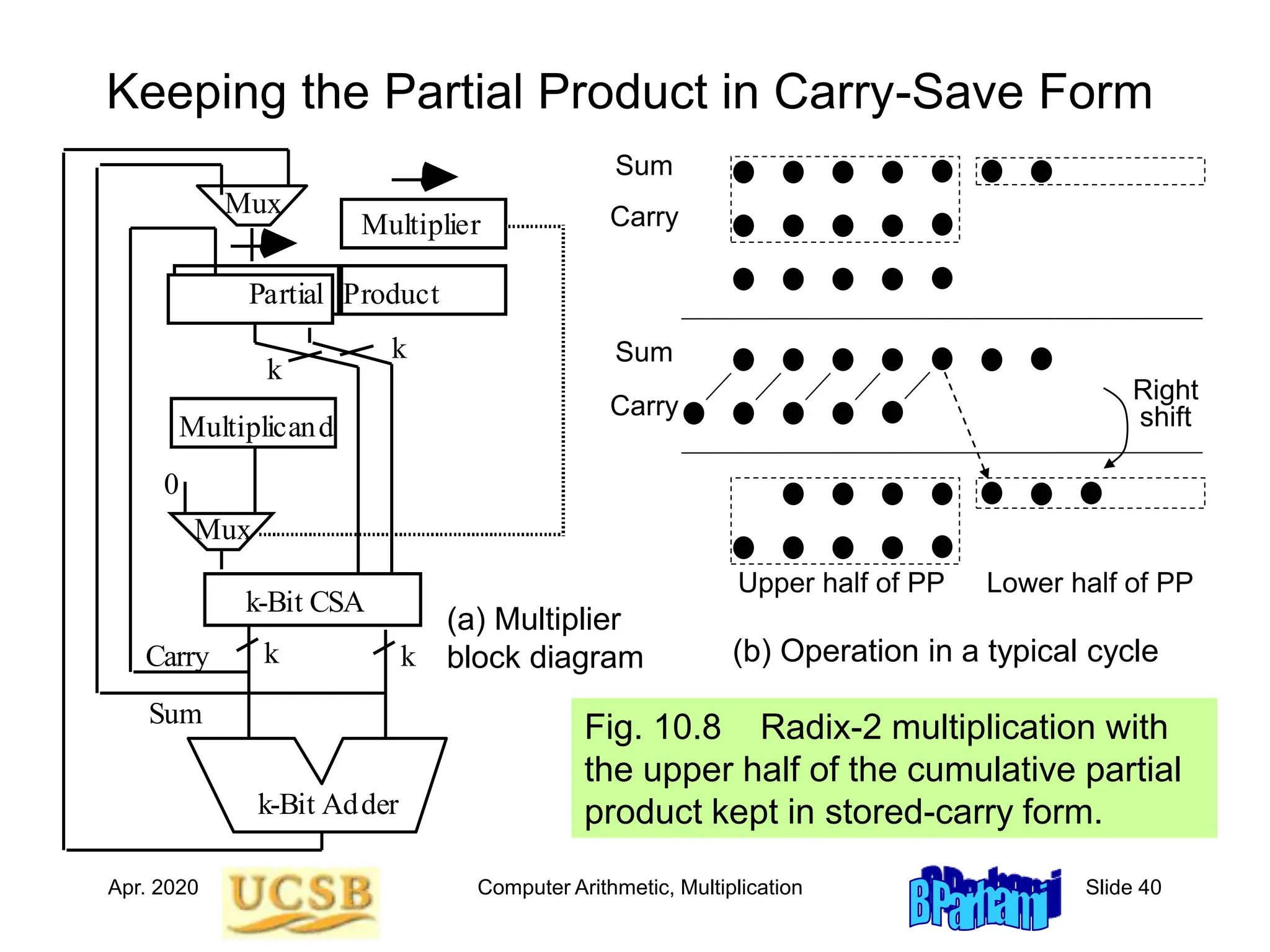
Keeping the Partial Product in Carry-Save Form
Fig. 10.8 Radix-2 multiplication with
the upper half of the cumulative partial
product kept in stored-carry form.
0
Multiplier
k
k
k-Bit CSA
k
Partial Product
k
Mux
k-Bit Adder
Mux
Multiplicand
Carry
Sum
Upper half of PP Lower half of PP
Right
shift
Sum
Carry
Sum
Carry
(a) Multiplier
block diagram (b) Operation in a typical cycle
Apr. 2020 Computer Arithmetic, Multiplication Slide 41
Carry-Save Multiplier with Radix-4 Booth’s Recoding
Fig. 10.9 Radix-4 multiplication with a CSA used to combine the
stored-carry cumulative partial product and zi/2a into two numbers.
a Multiplier
x
i+1
x
i
Adder
New cumulative
partial product
Old cumulative
partial product
FF
2-bit
Adder
To the lower half
of partial product
Booth recoder
and selector
CSA
x
i-1
z a
i/2
Extra “dot”
Apr. 2020 Computer Arithmetic, Multiplication Slide 42
Radix-4 Booth’s Recoding for Parallel Multiplication
Fig. 10.10 Booth
recoding and multiple
selection logic for
high-radix or parallel
multiplication.
x x x x
Recoding Logic
two non0
a 2a
Enable
Select
z a
neg
i
i+1 i–1
i/2
i–2
0 1
Mux
k+1
0, a, or 2a
k+2
Selective Complement
0, a, –a, 2a, or –2a
Extra "Dot"
for Column i
xi+2
Apr. 2020 Computer Arithmetic, Multiplication Slide 43
Yet Another Design for Radix-4 Multiplication
Fig. 10.11 Radix-4 multiplication,
with the cumulative partial product,
xia, and 2xi+1a combined into two
numbers by two CSAs.
Mux
0 2a
0 a
Multiplier
CSA
Mux
xi+1 xi
Adder
CSA
New Cumulative
PartialProduct
Old Cumulative
PartialProduct
FF
2-Bit
Adder
To the Lower Half
of Partial Product
(4; 2)-counter
Apr. 2020 Computer Arithmetic, Multiplication Slide 44
10.4 Radix-8 and Radix-16 Multipliers
Fig. 10.12 Radix-16
multiplication with the
upper half of the
cumulative partial
product in carry-save
form.
Multiplier
CSA CSA
CSA
CSA
PartialProduct
(Upper Half)
Mux
0 8a
Mux
0 4a
Mux
0 2a
Mux
0 a
xi+3
xi+2
xi+1
xi
Carry
Sum
4-Bit
Shift
FF
To the Lower Half
of Partial Product
3
4-Bit
Adder
4
4
4-bit
right
shift
Apr. 2020 Computer Arithmetic, Multiplication Slide 45
Other High-Radix Multipliers Multiplier
CSA CSA
CSA
CSA
PartialProduct
(Upper Half)
Mux
0 8a
Mux
0 4a
Mux
0 2a
Mux
0 a
xi+3
xi+2
xi+1
xi
Carry
Sum
4-Bit
Shift
FF
To the Lower Half
of Partial Product
3
4-Bit
Adder
4
4
Fig. 10.12
A radix-16 multiplier design
becomes a radix-256
multiplier if radix-4 Booth’s
recoding is applied first
(the muxes are replaced by
Booth recoding and multiple
selection logic)
Remove this mux & CSA and
replace the 4-bit shift (adder)
with a 3-bit shift (adder) to get
a radix-8 multiplier (cycle time
will remain the same, though)
Apr. 2020 Computer Arithmetic, Multiplication Slide 46
A Spectrum of Multiplier Design Choices
Basic
binary
Adder
Adder
Next
multiple
Partial product
...
Several
multiples
Adder
. . .
All multiples
SmallCSA
tree
FullCSA
tree
High-radix
or
partial tree
Full
tree
Speed up Economize
Partial product
Fig. 10.13 High-radix multipliers as intermediate
between sequential radix-2 and full-tree multipliers.
Apr. 2020 Computer Arithmetic, Multiplication Slide 47
10.5 Multibeat Multipliers
Observation: Half of the
clock cycle goes to waste
Fig. 10.15 Two-phase clocking for sequential logic.
Next-state
logic
State
flip-flops
Inputs
Next-state
excitation
Present
state
Next-state
logic
State
latches
Inputs
Next-state
logic
Inputs
State
latches
PH1
PH2
CLK
(a) Sequential machine with FFs (b) Sequential machine with latches and 2-phase clock
Once cycle
Begin changing FF contents
Change becomes visible at FF output
Apr. 2020 Computer Arithmetic, Multiplication Slide 48
Twin-Beat and Three-Beat Multipliers
This radix-64 multiplier
runs at the clock rate of a
radix-8 design (2X speed)
Fig. 10.14 Twin-beat multiplier
with radix-8 Booth’s recoding.
Adder
CSA
Sum
Carry
CSA
Sum
Carry
FF
To the Lower Half
of Partial Product
6-Bit
Adder
6
6
5
Pipelined
Radix-8
Booth
Recoder
& Selector
3a a 3a a
4 4
Twin Multiplier
Registers
Pipelined
Radix-8
Booth
Recoder
& Selector
Fig. 10.16 Conceptual view
of a three-beat multiplier.
Apr. 2020 Computer Arithmetic, Multiplication Slide 49
10.6 VLSI Complexity Issues
A radix-2b multiplier requires:
bk two-input AND gates to form the partial products bit-matrix
O(bk) area for the CSA tree
At least Q(k) area for the final carry-propagate adder
Total area: A = O(bk)
Latency: T = O((k/b) log b + log k)
Any VLSI circuit computing the product of two k-bit integers must
satisfy the following constraints:
AT grows at least as fast as k3/2
AT2 is at least proportional to k2
The preceding radix-2b implementations are suboptimal, because:
AT = O(k2 log b + bk log k)
AT2 = O((k3/b) log2b)
Apr. 2020 Computer Arithmetic, Multiplication Slide 50
Comparing High- and Low-Radix Multipliers
Intermediate designs do not yield better AT or AT2 values;
The multipliers remain asymptotically suboptimal for any b
Low-Cost
b = O(1)
High Speed
b = O(k)
AT- or AT2-
Optimal
AT O(k2) O(k2 log k) O(k3/2)
AT2 O(k3) O(k2 log2k) O(k2)
AT = O(k2 log b + bk log k) AT2 = O((k3/b) log2b)
By the AT measure (indicator of cost-effectiveness), slower radix-2
multipliers are better than high-radix or tree multipliers
Thus, when an application requires many independent multiplications,
it is more cost-effective to use a large number of slower multipliers
High-radix multiplier latency can be reduced from O((k/b) log b + log k)
to O(k/b + log k) through more effective pipelining (Chapter 11)
Apr. 2020 Computer Arithmetic, Multiplication Slide 51
11 Tree and Array Multipliers
Chapter Goals
Study the design of multipliers for highest
possible performance (speed, throughput)
Chapter Highlights
Tree multiplier = reduction tree
+ redundant-to-binary converter
Avoiding full sign extension in multiplying
signed numbers
Array multiplier = one-sided reduction tree
+ ripple-carry adder
Apr. 2020 Computer Arithmetic, Multiplication Slide 52
Tree and Array Multipliers: Topics
Topics in This Chapter
11.1. Full-Tree Multipliers
11.2. Alternative Reduction Trees
11.3. Tree Multipliers for Signed Numbers
11.4. Partial-Tree and Truncated Multipliers
11.5. Array Multipliers
11.6. Pipelined Tree and Array Multipliers
Apr. 2020 Computer Arithmetic, Multiplication Slide 53
11.1 Full-Tree Multipliers
Basic
binary
Adder
Adder
Next
multiple
Partial product
...
Several
multiples
Adder
. . .
All multiples
SmallCSA
tree
FullCSA
tree
High-radix
or
partial tree
Full
tree
Speed up Economize
Partial product
Fig. 10.13 High-radix multipliers
as intermediate between sequential
radix-2 and full-tree multipliers. Higher-order
product bits
Multiplier
a
a
a
a
. . .
. . .
Some lower-order
product bits are
generated directly
Redundant result
Redundant-to-Binary
Converter
Multiple-
Forming
Circuits
(Multi-Operand
Addition Tree)
Partial-Products
Reduction Tree
Fig. 11.1 General structure of a full-tree multiplier.
Multiplier
x
p Product
Multiplicand
a
(x x ) a 41
3 2 two
40
a
(x x )
1 0 two

Apr. 2020 Computer Arithmetic, Multiplication Slide 54
Full-Tree versus Partial-Tree Multiplier
Schematic diagrams for full-tree and partial-tree multipliers.
Adder
Large tree of
carry-save
adders
. . .
All partial products
Product
Adder
Small tree of
carry-save
adders
. . .
Several partial products
Product
Log-
depth
Log-
depth
Apr. 2020 Computer Arithmetic, Multiplication Slide 55
Variations in Full-Tree Multiplier Design
Designs are distinguished by
variations in three elements:
Higher-order
product bits
Multiplier
a
a
a
a
. . .
. . .
Some lower-order
product bits are
generated directly
Redundant result
Redundant-to-Binary
Converter
Multiple-
Forming
Circuits
(Multi-Operand
Addition Tree)
Partial-Products
Reduction Tree
Fig. 11.1
2. Partial products reduction tree
3. Redundant-to-binary converter
1. Multiple-forming circuits
Apr. 2020 Computer Arithmetic, Multiplication Slide 56
Product
Partial
products
bit-matrix
a
x
p
2
x a 0
0
1
x a 21
x a 22
2
23
3
x a
Multiplicand
Multiplier

Example of Variations in CSA Tree Design
1 2 3 4 3 2 1
FA FA FA HA
--------------------
1 3 2 3 2 1 1
FA HA FA HA
----------------------
2 2 2 2 1 1 1
4-Bit Adder
----------------------
1 1 1 1 1 1 1 1
Wallace Tree
(5 FAs + 3 HAs + 4-Bit Adder)
1 2 3 4 3 2 1
FA FA
--------------------
1 3 2 2 3 2 1
FA HA HA FA
----------------------
2 2 2 2 1 2 1
6-Bit Adder
----------------------
1 1 1 1 1 1 1 1
Dadda Tree
(4 FAs + 2 HAs + 6-Bit Adder)
Fig. 11.2 Two different binary 4  4 tree multipliers.
HA
3
HA
3
FA
FA HA
Corrections
shown in red
2
Apr. 2020 Computer Arithmetic, Multiplication Slide 57
Details of a CSA Tree
Fig. 11.3 Possible
CSA tree for a 7  7
tree multiplier.
CSA trees are quite
irregular, causing
some difficulties in
VLSI realization
10-bit CPA
7-bit CSA 7-bit CSA
7-bit CSA
10-bit CSA
2
Ignore
The indexpair
[i, j] means that
bit positions
fromi up to j
are involved.
7-bit CSA
[0, 6]
[1, 7]
[2, 8]
[6, 12]
[3, 11]
[1,8]
[3, 9]
[4, 10]
[5, 11]
[2, 8] [5, 11]
[6, 12]
[2,12]
[3, 12]
[4,13] [4,12]
[4, 13]
[3,9]
3
[3,12]
[2, 8]
[3,12]
[1, 6]
0
1
Thus, our motivation
to examine alternate
methods for partial
products reduction
Apr. 2020 Computer Arithmetic, Multiplication Slide 58
11.2 Alternative Reduction Trees
Fig. 11.4
A slice of a
balanced-delay
tree for 11
inputs.
FA FA FA
FA FA
FA FA
FA
FA
Inputs
Level-1
carries
Level-2
carries
Level-3
carries
Level-4
carry
Outputs
FA
FA
FA
FA
FA
FA
FA
FA
FA
11 + y1 = 2y1 + 3
Therefore, y1 = 8
carries are needed
Level
1
Level
5
Level
4
Level
3
Level
2
Apr. 2020 Computer Arithmetic, Multiplication Slide 59
Binary Tree of 4-to-2 Reduction Modules
Due to its recursive structure, a binary tree is more regular
than a 3-to-2 reduction tree when laid out in VLSI
Fig. 11.5 Tree multiplier with a more regular
structure based on 4-to-2 reduction modules.
(a) Binary tree of (4; 2)-counters
4-to-2 4-to-2 4-to-2 4-to-2
4-to-2 4-to-2
4-to-2
(b) Realization with FAs (c) A faster realization
FA
FA
c s c s
0 1
0 1
4-to-2 compressor
Apr. 2020 Computer Arithmetic, Multiplication Slide 60
Example Multiplier with 4-to-2 Reduction Tree
Fig. 11.6 Layout of a partial-products reduction tree composed of
4-to-2 reduction modules. Each solid arrow represents two numbers.
M u l t i p l i c a n d
. . .
Redundant-to-binary converter
Multiple
generation
circuits
M
u
l
t
i
p
l
e
s
e
l
e
c
t
i
o
n
s
i
g
n
a
l
s
Even if 4-to-2 reduction
is implemented using
two CSA levels, design
regularity potentially
makes up for the larger
number of logic levels
Similarly,
using Booth’s
recoding may
not yield any
advantage,
because it
introduces
irregularity
Apr. 2020 Computer Arithmetic, Multiplication Slide 61
11.3 Tree Multipliers for Signed Numbers
From Fig. 8.19a Sign extension in multioperand addition.
---------- Extended positions ---------- Sign Magnitude positions ---------
xk–1 xk–1 xk–1 xk–1 xk–1 xk–1 xk–2 xk–3 xk–4 . . .
yk–1 yk–1 yk–1 yk–1 yk–1 yk–1 yk–2 yk–3 yk–4 . . .
zk–1 zk–1 zk–1 zk–1 zk–1 zk–1 zk–2 zk–3 zk–4 . . .




x


















x
x
x
x
x
x
x
x
x
x
x
x
x
x
x
x
x
x
x
x
x
x
x
FA
FA
FA
FA
FA
FA
Five redundant copies
removed
Sign extensions
Signs
The difference in
multiplication is the
shifting sign positions
Fig. 11.7 Sharing of full adders to reduce
the CSA width in a signed tree multiplier.
Apr. 2020 Computer Arithmetic, Multiplication Slide 62
Using the Negative-Weight
Property of the Sign Bit
Fig. 11.8 Baugh-Wooley
2’s-complement multiplication.
Sign extension is a way of
converting negatively weighted bits
(negabits) to positively weighted
bits (posibits) to facilitate reduction,
but there are other methods of
accomplishing the same without
introducing a lot of extra bits
Baugh and Wooley have
contributed two such methods
4 3 2 1 0
4 3 2 1 0
4 3 2 1 0
4 3 2 1 0
a x a x a x a x a x
a a a a a
x x x x x
4 0 3 0 2 0 1 0 0 0
4 1 3 1 2 1 1 1 0 1
4 2 3 2 2 2 1 2 0 2
4 3 3 3 2 3 1 3 0 3
4 4 3 4 2 4 1 4 0 4

a a a a a
x x x x x
----------------------------
a x a x a x a x a x
a x a x a x a x a x
a x a x a x a x a x
a x a x a x a x a x
a x a x a x a x a x
--------------------------------------------------------
-
p p p p p p p p p p
a a a a a
x x x x x
----------------------------
-a x a x a x a x a x
a x -a x -a x -a x -a x
--------------------------------------------------------
-
p p p p p p p p p p
a a a a a
x x x x x
----------------------------
a x a x a x a x a x
a x a x a x a x a x
a x a x a x a x a x
a x a x a x a x a x
a x a x a x a x a x
a a
1 x x
--------------------------------------------------------
-
p p p p p p p p p p
---------------------------
a x a x a x a x a x
a x a x a x a x a x
a x a x a x a x a x
a x a x a x a x a x
--------------------------------------------------------
-
p p p p p p p p p p
1 1
4 0 3 0 2 0 1 0 0 0
4 1 3 1 2 1 1 1 0 1
4 2 3 2 2 2 1 2 0 2
4 3 3 3 2 3 1 3 0 3
4 4 3 4 2 4 1 4 0 4
4 4
4 4
4 3 2 1 0
4 3 2 1 0
4 3 2 1 0
4 3 2 1 0
4 0 3 0 2 0 1 0 0 0
4 1 3 1 2 1 1 1 0 1
4 2 3 2 2 2 1 2 0 2
4 3 3 3 2 3 1 3 0 3
4 4 3 4 2 4 1 4 0 4
4 0 3 0 2 0 1 0 0 0
4 1 3 1 2 1 1 1 0 1
4 2 3 2 2 2 1 2 0 2
4 3 3 3 2 3 1 3 0 3
4 4 3 4 2 4 1 4 0 4



9 8 7 6 5 4 3 2 1 0
9 8 7 6 5 4 3 2 1 0
9 8 7 6 5 4 3 2 1 0
9 8 7 6 5 4 3 2 1 0
a. Unsigned
b. 2's-complement
c. Baugh-Wooley
d. Modified B-W
__
__
__
__
__
__
__
__
_
_
_
_
_ _ _ _
Apr. 2020 Computer Arithmetic, Multiplication Slide 63
Fig. 11.8
4 3 2 1 0
4 3 2 1 0
a x a x a x a x a x
a a a a a
x x x x x
4 0 3 0 2 0 1 0 0 0
4 1 3 1 2 1 1 1 0 1
4 2 3 2 2 2 1 2 0 2
4 3 3 3 2 3 1 3 0 3
4 4 3 4 2 4 1 4 0 4

a x -a x -a x -a x -a x
--------------------------------------------------------
-
p p p p p p p p p p
a a a a a
x x x x x
----------------------------
a x a x a x a x a x
a x a x a x a x a x
a x a x a x a x a x
a x a x a x a x a x
a x a x a x a x a x
a a
1 x x
--------------------------------------------------------
-
p p p p p p p p p p
---------------------------
a x a x a x a x a x
a x a x a x a x a x
a x a x a x a x a x
a x a x a x a x a x
--------------------------------------------------------
-
p p p p p p p p p p
1 1
4 0 3 0 2 0 1 0 0 0
4 1 3 1 2 1 1 1 0 1
4 2 3 2 2 2 1 2 0 2
4 3 3 3 2 3 1 3 0 3
4 4 3 4 2 4 1 4 0 4
4 4
4 4
4 3 2 1 0
4 3 2 1 0
4 4 3 4 2 4 1 4 0 4

9 8 7 6 5 4 3 2 1 0
9 8 7 6 5 4 3 2 1 0
9 8 7 6 5 4 3 2 1 0
c. Baugh-Wooley
d. Modified B-W
__
__
__
__
__
__
__
__
_
_
_
_
_ _ _ _
The Baugh-Wooley Method and Its Modified Form
–a4x0 = a4(1 – x0) – a4
= a4x0 – a4
–a4 a4x0
a4
In next column
–a4x0 = (1 – a4x0) – 1
= (a4x0) – 1
–1 (a4x0)
1
In next column
Apr. 2020 Computer Arithmetic, Multiplication Slide 64
Alternate Views of the
Baugh-Wooley Methods
+ 0 0 –a4x3 –a4x2 –a4x1 –a4x0
+ 0 0 –a3x4 –a2x4 –a1x4 –a0x4
--------------------------------------------
– 0 0 a4x3 a4x2 a4x1 a4x0
– 0 0 a3x4 a2x4 a1x4 a0x4
--------------------------------------------
+ 1 1 a4x3 a4x2 a4x1 a4x0
+ 1 1 a3x4 a2x4 a1x4 a0x4
1
1
--------------------------------------------
+ a4 a4 a4x3 a4x2 a4x1 a4x0
+ x4 x4 a3x4 a2x4 a1x4 a0x4
a4
x4
--------------------------------------------
a4
1 x4
4 3 2 1 0
4 3 2 1 0
4 3 2 1 0
4 3 2 1 0
a x a x a x a x a x
a a a a a
x x x x x
4 0 3 0 2 0 1 0 0 0
4 1 3 1 2 1 1 1 0 1
4 2 3 2 2 2 1 2 0 2
4 3 3 3 2 3 1 3 0 3
4 4 3 4 2 4 1 4 0 4

a a a a a
x x x x x
----------------------------
a x a x a x a x a x
a x a x a x a x a x
a x a x a x a x a x
a x a x a x a x a x
a x a x a x a x a x
--------------------------------------------------------
-
p p p p p p p p p p
a a a a a
x x x x x
----------------------------
-a x a x a x a x a x
a x -a x -a x -a x -a x
--------------------------------------------------------
-
p p p p p p p p p p
a a a a a
x x x x x
----------------------------
a x a x a x a x a x
a x a x a x a x a x
a x a x a x a x a x
a x a x a x a x a x
a x a x a x a x a x
a a
1 x x
--------------------------------------------------------
-
p p p p p p p p p p
---------------------------
a x a x a x a x a x
a x a x a x a x a x
a x a x a x a x a x
a x a x a x a x a x
--------------------------------------------------------
-
p p p p p p p p p p
1 1
4 0 3 0 2 0 1 0 0 0
4 1 3 1 2 1 1 1 0 1
4 2 3 2 2 2 1 2 0 2
4 3 3 3 2 3 1 3 0 3
4 4 3 4 2 4 1 4 0 4
4 4
4 4
4 3 2 1 0
4 3 2 1 0
4 3 2 1 0
4 3 2 1 0
4 0 3 0 2 0 1 0 0 0
4 1 3 1 2 1 1 1 0 1
4 2 3 2 2 2 1 2 0 2
4 3 3 3 2 3 1 3 0 3
4 4 3 4 2 4 1 4 0 4
4 0 3 0 2 0 1 0 0 0
4 1 3 1 2 1 1 1 0 1
4 2 3 2 2 2 1 2 0 2
4 3 3 3 2 3 1 3 0 3
4 4 3 4 2 4 1 4 0 4



9 8 7 6 5 4 3 2 1 0
9 8 7 6 5 4 3 2 1 0
9 8 7 6 5 4 3 2 1 0
9 8 7 6 5 4 3 2 1 0
a. Unsigned
b. 2's-complement
c. Baugh-Wooley
d. Modified B-W
__
__
__
__
__
__
__
__
_
_
_
_
_ _ _ _
Apr. 2020 Computer Arithmetic, Multiplication Slide 65
11.4 Partial-Tree and Truncated Multipliers
Fig. 11.9 General structure
of a partial-tree multiplier.
. . .
CSA Tree
h inputs
Adder
Lower part of
the cumulative
partial product
FF
h-Bit
Adder
Sum
Carry
Upper part of
the cumulative
partial product
(stored-carry)
High-radix versus partial-tree
multipliers: The difference is
quantitative, not qualitative
For small h, say  8 bits,
we view the multiplier of
Fig. 11.9 as high-radix
When h is a significant
fraction of k, say k/2 or k/4,
then we tend to view it as
a partial-tree multiplier
Better design through pipelining
to be covered in Section 11.6
Apr. 2020 Computer Arithmetic, Multiplication Slide 66
Why Truncated Multipliers?
Fig. 11.10 The idea of a truncated multiplier with 8-bit fractional operands.
Nearly half of the hardware in array/tree multipliers is there to get the
last bit right (1 dot = one FPGA cell)
ulp
.         k-by-k fractional
 .         multiplication
---------------------------------
.       |
.      | 
.     |  
.    |   
.   |    
.  |     
. |      
. |       
---------------------------------
.        |       
Max error = 8/2 + 7/4
+ 6/8 + 5/16 + 4/32
+ 3/64 + 2/128
+ 1/256 = 7.004 ulp
Mean error =
1.751 ulp
Apr. 2020 Computer Arithmetic, Multiplication Slide 67
Truncated Multipliers with Error Compensation
Constant and variable error compensation for truncated multipliers.
We can introduce additional “dots” on the left-hand side to compensate
for the removal of dots from the right-hand side
Constant compensation Variable compensation
. o o o o o o o| . o o o o o o o|
. o o o o o o| . o o o o o o|
. o o o o o| . o o o o o|
. o o o o| . o o o o|
. o o o| . o o o|
. 1 o o| . o o|
. o| . x-1o|
. | . y-1 |
Max error = +4 ulp
Max error  -3 ulp
Max error = +? ulp
Max error  -? ulp
Mean error = ? ulp Mean error = ? ulp
Apr. 2020 Computer Arithmetic, Multiplication Slide 68
11.5 Array Multipliers
Fig. 11.11 A basic array
multiplier uses a one-sided CSA
tree and a ripple-carry adder.
0
x a
x a
x a
x a
x a
CSA
CSA
CSA
CSA
Ripple-Carry Adder
0
1
2
3
4
ax
p0
p1
p2
p3
p4
p6
p7
p8
a x
0 0
a x
1 0
a x
2 0
a x
3 0
a x
4 0 0 0 0 0
a x
0 1
a x
1 1
a x
2 1
a x
3 1
p9
p5
a x
4 1
a x
4 2
a x
4 3
a x
4 4
a x
0 2
a x
1 2
a x
2 2
a x
3 2
a x
0 3
a x
1 3
a x
2 3
a x
3 3
a x
0 4
a x
1 4
a x
2 4
a x
3 4
0
Fig. 11.12 Details of a 55
array multiplier using FA blocks.
Apr. 2020 Computer Arithmetic, Multiplication Slide 69
Signed (2’s-complement) Array Multiplier
Fig. 11.13
Modifications in a 55
array multiplier to deal
with 2’s-complement
inputs using the
Baugh-Wooley
method or to shorten
the critical path.
p0
p1
p2
p3
p4
p6
p7
p8
a x
0 0
a x
1 0
a x
2 0
a x
3 0
a x
4 0 0 0 0 0
a x
0 1
a x
1 1
a x
2 1
a x
3 1
p9
p5
a x
4 1
a x
4 2
a x
4 3
a x
4 4
a x
0 2
a x
1 2
a x
2 2
a x
3 2
a x
0 3
a x
1 3
a x
2 3
a x
3 3
a x
0 4
a x
1 4
a x
2 4
a x
3 4
1
x4
a4
a4
x4
_
_
_
_
_
_
_ _ _ _
Apr. 2020 Computer Arithmetic, Multiplication Slide 70
Array Multiplier Built of Modified Full-Adder Cells
Fig. 11.14 Design of
a 5  5 array multiplier
with two additive
inputs and full-adder
blocks that include
AND gates.
p p p p
p
4 3 2 1 0
a a a a a
4
3
2
1
0
x
x
x
x
x
4
3
2
1
0
p
p
p
p
p
9 8 7 6
5
FA
Apr. 2020 Computer Arithmetic, Multiplication Slide 71
Array Multiplier without a Final Carry-Propagate Adder
Fig. 11.15 Conceptual
view of a modified
array multiplier that
does not need a final
carry-propagate adder.
i+1
i
i+1
i
i i
Mux
Mux
Mux
k
[k, 2k–1] 1
i–1
i
i+1
k–1
Level i
k k
0
Mux
..
.
..
.
Bi+1
Bi
Dots in row i + 1
Bi
Bi+1
Dots in row i
i Conditional bits
i + 1 Conditional bits
of the final product
Fig. 11.16 Carry-save
addition, performed in
level i, extends the
conditionally computed
bits of the final product.
All remaining bits of the final product
produced only 2 gate levels after pk–1
Apr. 2020 Computer Arithmetic, Multiplication Slide 72
11.6 Pipelined Tree and Array Multipliers
. . .
CSA Tree
h inputs
Adder
Lower part of
the cumulative
partial product
FF
h-Bit
Adder
Sum
Carry
Upper part of
the cumulative
partial product
(stored-carry)
Fig. 11.9 General structure
of a partial-tree multiplier.
Fig. 11.17 Efficiently pipelined
partial-tree multiplier.
. . .
h inputs
Adder
Lower part of
the cumulative
partial product
FF
h-Bit
Adder
Sum
Carry
CSA
Pipelined
CSA Tree
Latches
Latches
Latches
CSA
(h + 2)-input
CSA tree
Latch
Apr. 2020 Computer Arithmetic, Multiplication Slide 73
Pipelined Array Multipliers
With latches after every
FA level, the maximum
throughput is achieved
Latches may be inserted
after every h FA levels for
an intermediate design
Fig. 11.18 Pipelined 55
array multiplier using
latched FA blocks.
The small shaded boxes
are latches.
p p p p p
4 3 2 1 0
a a a a a 4
3
2
1
0
x
x
x
x
x
4 3 2 1 0
p p p p p
9 8 7 6 5
Latched
FA with
AND gate
Latch
FA
FA
FA
FA
Example: 3-stage pipeline
Apr. 2020 Computer Arithmetic, Multiplication Slide 74
12 Variations in Multipliers
Chapter Goals
Learn additional methods for synthesizing
fast multipliers as well as other types
of multipliers (bit-serial, modular, etc.)
Chapter Highlights
Building a multiplier from smaller units
Performing multiply-add as one operation
Bit-serial and (semi)systolic multipliers
Using a multiplier for squaring is wasteful
Apr. 2020 Computer Arithmetic, Multiplication Slide 75
Variations in Multipliers: Topics
Topics in This Chapter
12.1 Divide-and-Conquer Designs
12.2 Additive Multiply Modules
12.3 Bit-Serial Multipliers
12.4 Modular Multipliers
12.5 The Special Case of Squaring
12.6 Combined Multiply-Add Units
Apr. 2020 Computer Arithmetic, Multiplication Slide 76
12.1 Divide-and-Conquer Designs
Building wide multiplier from narrower ones
Fig. 12.1 Divide-and-conquer (recursive) strategy for
synthesizing a 2b  2b multiplier from b  b multipliers.
a

p
Rearranged partialproducts
in 2b-by-2b multiplication
2b bits
3b bits
H aL
xH xL
aL xH
aL xL
aH xL
xH
aH
aH xL
aL xH
aL xL
xH
aH
b bits
Apr. 2020 Computer Arithmetic, Multiplication Slide 77
General Structure of a Recursive Multiplier
2b  2b use (3; 2)-counters
3b  3b use (5; 2)-counters
4b  4b use (7; 2)-counters
Fig. 12.2 Using b  b multipliers to synthesize
2b  2b, 3b  3b, and 4b  4b multipliers.
4b  4b
3b  3b
2b  2b
b  b
Apr. 2020 Computer Arithmetic, Multiplication Slide 78
Using b  c, rather than b  b Building Blocks
2b  2c use b  c multipliers and (3; 2)-counters
2b  4c use b  c multipliers and (5?; 2)-counters
gb  hc use b  c multipliers and (?; 2)-counters
4b  4b
3b  3b
2b  2b
b  b
Apr. 2020 Computer Arithmetic, Multiplication Slide 79
Wide Multiplier Built of Narrow Multipliers and Adders
Fig. 12.3 Using 4  4
multipliers and 4-bit
adders to synthesize
an 8  8 multiplier.
a x a x a x a x
Add
Add
Add
Add Add
p
p p p
000
8
8
12
12
H L
H H H L
L
L
[4, 7] [4, 7] [0, 3] [4, 7] [4, 7] [0, 3] [0, 3] [0, 3]
[12,15] [8,11] [8,11] [4, 7] [8,11] [4, 7] [4, 7] [0, 3]
[4, 7]
[4, 7]
[8,11]
[8,11]
[12,15]
[12,15] [8,11] [0, 3]
[4, 7]
Multiply Multiply
Multiply
Multiply
Apr. 2020 Computer Arithmetic, Multiplication Slide 80
Karatsuba Multiplication
2b  2b multiplication requires four b  b multiplications:
(2baH + aL)  (2bxH + xL) = 22baHxH + 2b (aHxL + aLxH) + aLxL
aH aL
xH xL
Karatsuba noted that one of the four multiplications can be removed
at the expense of introducing a few additions:
(2baH + aL)  (2bxH + xL) =
22baHxH + 2b [(aH + aL)  (xH + xL) – aHxH – aLxL] + aLxL
Mult 1 Mult 2
Mult 3
Benefit is quite significant for extremely wide operands
(4/3)5 = 4.2 (4/3)10 = 17.8 (4/3)20 = 315.3 (4/3)50 = 1,765,781
b bits
Apr. 2020 Computer Arithmetic, Multiplication Slide 81
Computational Complexity of Multiplication
Arnold Schonhage and Volker Strassen (via FFT); best until 2007
O(log k) time
O(k log k log log k) complexity
It is an open problem whether there exist logarithmic-delay
multipliers with linear cost
(it is widely believed that there are not)
In the absence of a linear cost multiplication circuit, multiplication
must be viewed as a more difficult problem than addition
In 2007, Martin Furer managed to replace the log log k term with
an asymptotically smaller term (for astronomically large numbers)
In 2019, David Harvey and Joris van der Hoeven developed an
O(k log k) multiplication algorithm, which is believed to be the best
possible theoretically (but not practical at present)
Apr. 2020 Computer Arithmetic, Multiplication Slide 82
12.2 Additive Multiply Modules
Fig. 12.4 Additive multiply module with 2  4 multiplier (ax)
plus 4-bit and 2-bit additive inputs (y and z).
cin
y
z
ax
p
4-bit adder
y z
x
a
p = ax + y + z
(a) Block diagram
v
(b) Dot notation
v
b-bit and c-bit multiplicative inputs
b  c AMM b-bit and c-bit additive inputs
(b + c)-bit output
(2b – 1)  (2c – 1) + (2b – 1) + (2c – 1) = 2b+c – 1
Apr. 2020 Computer Arithmetic, Multiplication Slide 83
Multiplier Built of AMMs
Fig. 12.5 An 8  8 multiplier built of 42 AMMs.
Inputs marked with an asterisk carry 0s.
[0, 1]
[2, 3]
[4, 5]
[6, 7]
[8, 9]
[10,11]
[12,15]
[0, 1]
[2, 3]
[4,5]
[6, 7]
x
x
x
x
[0, 3]
a
[0, 3]
a
[0, 3]
a
[0, 3]
a
p
p
p
p
p
p
p
[0, 1]
x
[2, 3]
[4, 5]
[6, 7]
x
x
x
[10,11]
[8, 9]
[4, 7]
a
[4, 7]
a
[4, 7]
a
[4, 7]
a
[8, 9]
[0, 1]
[2, 3]
[4, 5]
[6, 7]
[4,5]
[6, 7]
[8, 11]
[10,13]
[2, 5]
[4,7]
[6, 9]
[8, 11]
[6, 9]
*
*
* *
*
*
Legend:
2 bits
4 bits Understanding
an 8  8 multiplier
built of 4  2
AMMs using dot
notation
Apr. 2020 Computer Arithmetic, Multiplication Slide 84
Multiplier Built of AMMs: Alternate Design
Fig. 12.6 Alternate 8  8
multiplier design based on
4  2 AMMs. Inputs marked
with an asterisk carry 0s.
[8, 9]
p
* *
*
*
*
*
[0, 1]
[2, 3]
[4, 5]
[6, 7]
x
x
x
x
[10,11]
[12,15]
[0, 1]
[2, 3]
[4,5]
[6, 7]
p
p
p
p
p
p
[0,3]
[4, 7] a
a
Legend:
2 bits
4 bits
This design is more regular
than that in Fig. 12.5 and is
easily expandable to larger
configurations; its latency,
however, is greater
Apr. 2020 Computer Arithmetic, Multiplication Slide 85
12.3 Bit-Serial Multipliers
What goes inside the box to make a bit-serial multiplier?
Can the circuit be designed to support a high clock rate?
FA
FF
Bit-serial adder
(LSB first) x0
y0
s0
x1
y1
s1
x2
y2
s2
…
…
…
Bit-serial multiplier
a1
x1
p1
a0
x0
p0
a2
x2
p2
…
…
…
(Must follow the k-bit
inputs with k 0s;
alternatively, view
the product as being
only k bits wide)
?
Apr. 2020 Computer Arithmetic, Multiplication Slide 86
Semisystolic Serial-Parallel Multiplier
Multiplicand (parallelin)
Multiplier
(serialin)
LSB-first
Carry
Sum
FA
Product
(serialout)
FA FA FA
a3 a2 a1 a0
x0 x1 x2 x3
Fig. 12.7 Semi-systolic circuit for 4  4 multiplication in 8 clock cycles.
This is called “semisystolic” because it has a large signal fan-out of k
(k-way broadcasting) and a long wire spanning all k positions
Apr. 2020 Computer Arithmetic, Multiplication Slide 87
Systolic Retiming as a Design Tool
Fig. 12.8 Example of retiming by delaying the inputs to CL
and advancing the outputs from CL by d units
Cut
CL CR CL CR
e
f
g
h
e+d
f+d
g–d
h–d
+d
–d
–d
+d
Originaldelays Adjusted delays
A semisystolic circuit can be converted to a systolic circuit
via retiming, which involves advancing and retarding signals
by means of delay removal and delay insertion in such a
way that the relative timings of various parts are unaffected
Apr. 2020 Computer Arithmetic, Multiplication Slide 88
Alternate Explanation of Systolic Retiming
Transferring delay from the outputs of a subsystem to its
inputs does not change the behavior of the overall system
t
d1
d2 t+a+d1+d2
t+d1
t+a+d1
t
t
t + a d1 d2 t+a+d1+d2
Apr. 2020 Computer Arithmetic, Multiplication Slide 89
A First Attempt
at Retiming
Fig. 12.9 A retimed version
of our semi-systolic multiplier.
Multiplicand (parallelin)
Multiplier
(serialin)
LSB-first
Carry
FA
Product
(serialout)
FA FA FA
a3 a2 a1 a0
x0 x1 x2 x3
Sum
Cut 1
Cut 2
Cut 3
Multiplicand (parallelin)
Multiplier
(serialin)
LSB-first
Carry
Sum
FA
Product
(serialout)
FA FA FA
a3 a2 a1 a0
x0 x1 x2 x3
Fig. 12.7
Apr. 2020 Computer Arithmetic, Multiplication Slide 90
Deriving a Fully
Systolic Multiplier
Multiplicand (parallelin)
Multiplier
(serialin)
LSB-first
Carry
Sum
FA
Product
(serialout)
FA FA FA
a3 a2 a1 a0
x0 x1 x2 x3
Fig. 12.7
Fig. 12.10 Systolic circuit for
44 multiplication in 15 cycles.
Multiplicand (parallelin)
Multiplier
(serialin)
LSB-first
Sum
FA
Product
(serialout)
FA FA FA
a3 a2 a1 a0
x0 x1 x2 x3
Carry
Apr. 2020 Computer Arithmetic, Multiplication Slide 91
A Direct Design for a Bit-Serial Multiplier
Fig. 12.13 Bit-serial multiplier
design in dot notation.
p
x
a
Already
accumulated
into three
numbers
(i - 1)
a
x(i - 1)
i
a
xi
xi
(i - 1)
a
i
a x(i - 1)
xi
i
a
Already output
(a) Structure of the bit-matrix
(b) Reduction after each input bit
p(i - 1)
i
a x(i - 1)
xi
(i - 1)
a
xi
i
a
2p(i ) Shift right to
obtain p(i )
Mux
(5; 3)-counter
0
1
0
1
2
a x
a x
s
s
c c
t tin
out in
in out
out
p
i
i
i
i
(i–1)
a
x
s
s
c c
t tin
out in
in out
out
p
i
i
. . .
. . .
. . .
. . .
. . .
i
LSB
0
Fig. 12.11 Building block for a
latency-free bit-serial multiplier.
Fig. 12.12 The cellular structure
of the bit-serial multiplier based on
the cell in Fig. 12.11.
Apr. 2020 Computer Arithmetic, Multiplication Slide 92
12.4 Modular Multipliers
. . .
FA FA
FA
FA
FA
Mod-15 CSA
Divide by 16
4 4 4 4
Mod-15 CSA
4
Mod-15 CPA
Fig. 12.14 Modulo-(2b – 1)
carry-save adder.
Fig. 12.15 Design of a
4  4 modulo-15 multiplier.
Apr. 2020 Computer Arithmetic, Multiplication Slide 93
Other Examples of Modular Multiplication
Fig. 12.16 One way
to design of a 4  4
modulo-13 multiplier.
Fig. 12.17 A method for
modular multioperand addition.
. . .
Table
n inputs
CSA Tree
summod m
3-input
Modulo-m
Adder
.
.
.
Address
Data
Apr. 2020 Computer Arithmetic, Multiplication Slide 94
12.5 The Special Case of Squaring
x0
x1
x2
x3
x4
x0
x1
x2
x3
x4
x0
x1
x2
x3
x4 x0
x0
p0
x4
x1
x4
x0
x1
x2
x3
x4
x0
x1
x2
x3
x4
x0
Multiply x by x
x1
x2
x3
x4 x0
x1
x2
x3
x4 x0
x1
x2
x3
x4 x0
x1
x2
x3
x4 x0
x1
x2
x3
x1
x2
x3
x2
x3
x4
p1
p2
p3
p4
p5
p6
p7
p8
p9
x1
x2
x3
x4 x0
x1
x0
x2
x0
x1
x0
x2
x3
x4 x0
x3
x4
x0
x1
x2 x1
x2
x3
x3
x4
x4
p2
p3
p4
p5
p6
p7
p8
p9 0
_
Simplify
Fig. 12.18 Design of a 5-bit squarer.
x1x0 –x1x0
Apr. 2020 Computer Arithmetic, Multiplication Slide 95
Divide-and-Conquer Squarers
Building wide squarers from narrower ones
Divide-and-conquer (recursive) strategy for synthesizing a
2b  2b squarer from b  b squarers and multiplier.
a

p
Rearranged partialproducts
in 2b-by-2b multiplication
2b bits
3b bits
H aL
xH xL
aL xH
aL xL
aH xL
xH
aH
aH xL
aL xH
aL xL
xH
aH
b bits
xL
xH
xL
xL xL
xH
xL
xH
xH
xH
Apr. 2020 Computer Arithmetic, Multiplication Slide 96
12.6 Combined Multiply-Add Units
Fig. 12.19
Dot-notation
representations
of various methods
for performing
a multiply-add
operation
in hardware.
Multiply-add
versus
multiply-accumulate
Multiply-accumulate
units often have wider
additive inputs
(c)
Additive input
Dot matrix for the
4  4 multiplication
(a)
Additive input
CSA tree output
(b)
Carry-save additive input
CSA tree output
(d)
Carry-save additive input
Dot matrix for the
4  4 multiplication

Computer organization and architecture arithmetic.ppt

  • 1.
    Apr. 2020 ComputerArithmetic, Multiplication Slide 1 Part III Multiplication Number Representation Numbers and Arithmetic Representing Signed Numbers Redundant Number Systems Residue Number Systems Addition / Subtraction Basic Addition and Counting Carry-Lookahead Adders Variations in Fast Adders Multioperand Addition Multiplication Basic Multiplication Schemes High-Radix Multipliers Tree and Array Multipliers Variations in Multipliers Division Basic Division Schemes High-Radix Dividers Variations in Dividers Division by Convergence Real Arithmetic Floating-Point Reperesentations Floating-Point Operations Errors and Error Control Precise and Certifiable Arithmetic Function Evaluation Square-Rooting Methods The CORDIC Algorithms Variations in Function Evaluation Arithmetic by Table Lookup Implementation Topics High-Throughput Arithmetic Low-Power Arithmetic Fault-Tolerant Arithmetic Past, Present, and Future Parts Chapters I. II. III. IV. V. VI. VII. 1. 2. 3. 4. 5. 6. 7. 8. 9. 10. 11. 12. 25. 26. 27. 28. 21. 22. 23. 24. 17. 18. 19. 20. 13. 14. 15. 16. Elementary Operations 28. Reconfigurable Arithmetic Appendix: Past, Present, and Future
  • 2.
    Apr. 2020 ComputerArithmetic, Multiplication Slide 2 About This Presentation Edition Released Revised Revised Revised Revised First Jan. 2000 Sep. 2001 Sep. 2003 Oct. 2005 May 2007 Apr. 2008 Apr. 2009 Second Apr. 2010 Apr. 2011 Apr. 2012 Apr. 2015 Apr. 2020 This presentation is intended to support the use of the textbook Computer Arithmetic: Algorithms and Hardware Designs (Oxford U. Press, 2nd ed., 2010, ISBN 978-0-19-532848-6). It is updated regularly by the author as part of his teaching of the graduate course ECE 252B, Computer Arithmetic, at the University of California, Santa Barbara. Instructors can use these slides freely in classroom teaching and for other educational purposes. Unauthorized uses are strictly prohibited. © Behrooz Parhami
  • 3.
    Apr. 2020 ComputerArithmetic, Multiplication Slide 3 III Multiplication Topics in This Part Chapter 9 Basic Multiplication Schemes Chapter 10 High-Radix Multipliers Chapter 11 Tree and Array Multipliers Chapter 12 Variations in Multipliers Review multiplication schemes and various speedup methods • Multiplication is heavily used (in arith & array indexing) • Division = reciprocation + multiplication • Multiplication speedup: high-radix, tree, recursive • Bit-serial, modular, and array multipliers
  • 4.
    Apr. 2020 ComputerArithmetic, Multiplication Slide 4 “Well, well, for a rabbit, you’re not very good at multiplying, are you?”
  • 5.
    Apr. 2020 ComputerArithmetic, Multiplication Slide 5 9 Basic Multiplication Schemes Chapter Goals Study shift/add or bit-at-a-time multipliers and set the stage for faster methods and variations to be covered in Chapters 10-12 Chapter Highlights Multiplication = multioperand addition Hardware, firmware, software algorithms Multiplying 2’s-complement numbers The special case of one constant operand
  • 6.
    Apr. 2020 ComputerArithmetic, Multiplication Slide 6 Basic Multiplication Schemes: Topics Topics in This Chapter 9.1 Shift/Add Multiplication Algorithms 9.2 Programmed Multiplication 9.3 Basic Hardware Multipliers 9.4 Multiplication of Signed Numbers 9.5 Multiplication by Constants 9.6 Preview of Fast Multipliers
  • 7.
    Apr. 2020 ComputerArithmetic, Multiplication Slide 7 9.1 Shift/Add Multiplication Algorithms Notation for our discussion of multiplication algorithms: a Multiplicand ak–1ak–2 . . . a1a0 x Multiplier xk–1xk–2 . . . x1x0 p Product (a  x) p2k–1p2k–2 . . . p3p2p1p0 Initially, we assume unsigned operands Fig. 9.1 Multiplication of two 4-bit unsigned binary numbers in dot notation. Product Partial products bit-matrix a x p 2 x a 0 0 1 x a 21 x a 22 2 23 3 x a Multiplicand Multiplier 
  • 8.
    Apr. 2020 ComputerArithmetic, Multiplication Slide 8 Preferred Multiplication Recurrence Multiplication with right shifts: top-to-bottom accumulation p(j+1) = (p(j) + xj a 2k) 2–1 with p(0) = 0 and |–––add–––| p(k) = p = ax + p(0)2–k |––shift right––| Product Partial products bit-matrix a x p 2 x a 0 0 1 x a 21 x a 22 2 23 3 x a Multiplicand Multiplier  Multiplication with left shifts: bottom-to-top accumulation p(j+1) = 2p(j) + xk–j–1a with p(0) = 0 and |shift| p(k) = p = ax + p(0)2k |––––add––––| Fig. 9.1
  • 9.
    Apr. 2020 ComputerArithmetic, Multiplication Slide 9 Why Premultiply the Multiplicand by 2k? Addition takes place between the dashed lines in the figure below The 0th PP is eventually shifted right by k bits, the 1st by k – 1 bits, … Even though the cumulative PP widens by 1 bit at each step, the addition is always k bits wide Fig. 9.1 Multiplication of two 4-bit unsigned binary numbers in dot notation. Product Partial products bit-matrix a x p 2 x a 0 0 1 x a 21 x a 22 2 23 3 x a Multiplicand Multiplier  p(j+1) = (p(j) + xj a 2k) 2–1 with p(0) = 0 and
  • 10.
    Apr. 2020 ComputerArithmetic, Multiplication Slide 10 Examples of Basic Multiplication Fig. 9.2 Examples of sequential multipli- cation with right and left shifts. Right-shift algorithm Left-shift algorithm ======================== ======================= a 1 0 1 0 a 1 0 1 0 x 1 0 1 1 x 1 0 1 1 ======================== ======================= p(0) 0 0 0 0 p(0) 0 0 0 0 +x0a 1 0 1 0 2p(0) 0 0 0 0 0 ––––––––––––––––––––––––– +x3a 1 0 1 0 2p(1) 0 1 0 1 0 –––––––––––––––––––––––– p(1) 0 1 0 1 0 p(1) 0 1 0 1 0 +x1a 1 0 1 0 2p(1) 0 1 0 1 0 0 ––––––––––––––––––––––––– +x2a 0 0 0 0 2p(2) 0 1 1 1 1 0 –––––––––––––––––––––––– p(2) 0 1 1 1 1 0 p(2) 0 1 0 1 0 0 +x2a 0 0 0 0 2p(2) 0 1 0 1 0 0 0 ––––––––––––––––––––––––– +x1a 1 0 1 0 2p(3) 0 0 1 1 1 1 0 –––––––––––––––––––––––– p(3) 0 0 1 1 1 1 0 p(3) 0 1 1 0 0 1 0 +x3a 1 0 1 0 2p(3) 0 1 1 0 0 1 0 0 ––––––––––––––––––––––––– +x0a 1 0 1 0 2p(4) 0 1 1 0 1 1 1 0 –––––––––––––––––––––––– p(4) 0 1 1 0 1 1 1 0 p(4) 0 1 1 0 1 1 1 0 ======================== ======================= p(j+1) = (p(j) + xj a 2k) 2–1 |–––add–––| |––shift right––| 1 0 1 0 Check: 10  11 = 110 = 64 + 32 + 8 + 4 + 2
  • 11.
    Apr. 2020 ComputerArithmetic, Multiplication Slide 11 Examples of Basic Multiplication (Continued) Fig. 9.2 Examples of sequential multipli- cation with right and left shifts. Right-shift algorithm Left-shift algorithm ======================== ======================= a 1 0 1 0 a 1 0 1 0 x 1 0 1 1 x 1 0 1 1 ======================== ======================= p(0) 0 0 0 0 p(0) 0 0 0 0 +x0a 1 0 1 0 2p(0) 0 0 0 0 0 ––––––––––––––––––––––––– +x3a 1 0 1 0 2p(1) 0 1 0 1 0 –––––––––––––––––––––––– p(1) 0 1 0 1 0 p(1) 0 1 0 1 0 +x1a 1 0 1 0 2p(1) 0 1 0 1 0 0 ––––––––––––––––––––––––– +x2a 0 0 0 0 2p(2) 0 1 1 1 1 0 –––––––––––––––––––––––– p(2) 0 1 1 1 1 0 p(2) 0 1 0 1 0 0 +x2a 0 0 0 0 2p(2) 0 1 0 1 0 0 0 ––––––––––––––––––––––––– +x1a 1 0 1 0 2p(3) 0 0 1 1 1 1 0 –––––––––––––––––––––––– p(3) 0 0 1 1 1 1 0 p(3) 0 1 1 0 0 1 0 +x3a 1 0 1 0 2p(3) 0 1 1 0 0 1 0 0 ––––––––––––––––––––––––– +x0a 1 0 1 0 2p(4) 0 1 1 0 1 1 1 0 –––––––––––––––––––––––– p(4) 0 1 1 0 1 1 1 0 p(4) 0 1 1 0 1 1 1 0 ======================== ======================= p(j+1) = 2p(j) + xk–j–1a |shift| |––––add––––| Check: 10  11 = 110 = 64 + 32 + 8 + 4 + 2
  • 12.
    Apr. 2020 ComputerArithmetic, Multiplication Slide 12 9.2 Programmed Multiplication Fig. 9.3 Programmed multiplication (right-shift algorithm). {Using right shifts, multiply unsigned m_cand and m_ier, storing the resultant 2k-bit product in p_high and p_low. Registers: R0 holds 0 Rc for counter Ra for m_cand Rx for m_ier Rp for p_high Rq for p_low} {Load operands into registers Ra and Rx} mult: load Ra with m_cand load Rx with m_ier {Initialize partial product and counter} copy R0 into Rp copy R0 into Rq load k into Rc {Begin multiplication loop} m_loop: shift Rx right 1 {LSB moves to carry flag} branch no_add if carry = 0 add Ra to Rp {carry flag is set to cout} no_add: rotate Rp right 1 {carry to MSB, LSB to carry} rotate Rq right 1 {carry to MSB, LSB to carry} decr Rc {decrement counter by 1} branch m_loop if Rc  0 {Store the product} store Rp into p_high store Rq into p_low m_done: ... R0 Rc Counter 0 Ra Rx Rp Rq Multiplicand Multiplier Product, high Product, low
  • 13.
    Apr. 2020 ComputerArithmetic, Multiplication Slide 13 Time Complexity of Programmed Multiplication Assume k-bit words k iterations of the main loop 6-7 instructions per iteration, depending on the multiplier bit Thus, 6k + 3 to 7k + 3 machine instructions, ignoring operand loads and result store k = 32 implies 200+ instructions on average This is too slow for many modern applications! Microprogrammed multiply would be somewhat better
  • 14.
    Apr. 2020 ComputerArithmetic, Multiplication Slide 14 9.3 Basic Hardware Multipliers Fig. 9.4 Hardware realization of the sequential multiplication algorithm with additions and right shifts. Multiplier x Mux Adder 0 out c 0 1 Doublewidth partial product p Multiplicand a Shift Shift (j) j x x a j k k k p(j+1) = (p(j) + xj a 2k) 2–1 |–––add–––| |––shift right––|
  • 15.
    Apr. 2020 ComputerArithmetic, Multiplication Slide 15 Example of Hardware Multiplication Fig. 9.4a Hardware realization of the sequential multiplication algorithm with additions and right shifts. 1 0 1 1 1 0 1 0 0 0 0 0 1 0 1 0 1 0 1 0 1 0 1 0 1 1 1 1 0 1 0 0 1 1 1 1 0 1 0 0 1 1 1 1 0 1 1 0 1 1 1 0 0 1 1 0 1 1 1 0 (11)ten (10)ten (110)ten p(j+1) = (p(j) + xj a 2k) 2–1 |–––add–––| |––shift right––|
  • 16.
    Apr. 2020 ComputerArithmetic, Multiplication Slide 16 Performing Add and Shift in One Clock Cycle Partial product p(j) k Unused part of the multiplier x Adder’s carry-out Adder’s sum k k – 1 k – 1 To mux control To adder Fig. 9.5 Combining the loading and shifting of the double-width register holding the partial product and the partially used multiplier.
  • 17.
    Apr. 2020 ComputerArithmetic, Multiplication Slide 17 Sequential Multiplication with Left Shifts Fig. 9.4b Hardware realization of the sequential multiplication algorithm with left shifts and additions. Multiplier x Mux 2k-bit adder 0 out c 0 1 Doublewidth partial product p Multiplicand a Shift Shift (j) k-j-1 x a 2k k k-j-1 x 2k
  • 18.
    Apr. 2020 ComputerArithmetic, Multiplication Slide 18 9.4 Multiplication of Signed Numbers Fig. 9.6 Sequential multiplication of 2’s-complement numbers with right shifts (positive multiplier). ============================ a 1 0 1 1 0 x 0 1 0 1 1 ============================ p(0) 0 0 0 0 0 +x0a 1 0 1 1 0 ––––––––––––––––––––––––––––– 2p(1) 1 1 0 1 1 0 p(1) 1 1 0 1 1 0 +x1a 1 0 1 1 0 ––––––––––––––––––––––––––––– 2p(2) 1 1 0 0 0 1 0 p(2) 1 1 0 0 0 1 0 +x2a 0 0 0 0 0 ––––––––––––––––––––––––––––– 2p(3) 1 1 1 0 0 0 1 0 p(3) 1 1 1 0 0 0 1 0 +x3a 1 0 1 1 0 ––––––––––––––––––––––––––––– 2p(4) 1 1 0 0 1 0 0 1 0 p(4) 1 1 0 0 1 0 0 1 0 +x4a 0 0 0 0 0 ––––––––––––––––––––––––––––– 2p(5) 1 1 1 0 0 1 0 0 1 0 p(5) 1 1 1 0 0 1 0 0 1 0 ============================ Negative multiplicand, positive multiplier: No change, other than looking out for proper sign extension Check: –10  11 = –110 = –512 + 256 + 128 + 16 + 2
  • 19.
    Apr. 2020 ComputerArithmetic, Multiplication Slide 19 The Case of a Negative Multiplier Fig. 9.7 Sequential multiplication of 2’s-complement numbers with right shifts (negative multiplier). ============================ a 1 0 1 1 0 x 1 0 1 0 1 ============================ p(0) 0 0 0 0 0 +x0a 1 0 1 1 0 ––––––––––––––––––––––––––––– 2p(1) 1 1 0 1 1 0 p(1) 1 1 0 1 1 0 +x1a 0 0 0 0 0 ––––––––––––––––––––––––––––– 2p(2) 1 1 1 0 1 1 0 p(2) 1 1 1 0 1 1 0 +x2a 1 0 1 1 0 ––––––––––––––––––––––––––––– 2p(3) 1 1 0 0 1 1 1 0 p(3) 1 1 0 0 1 1 1 0 +x3a 0 0 0 0 0 ––––––––––––––––––––––––––––– 2p(4) 1 1 1 0 0 1 1 1 0 p(4) 1 1 1 0 0 1 1 1 0 +(-x4a) 0 1 0 1 0 ––––––––––––––––––––––––––––– 2p(5) 0 0 0 1 1 0 1 1 1 0 p(5) 0 0 0 1 1 0 1 1 1 0 ============================ Negative multiplicand, negative multiplier: In last step (the sign bit), subtract rather than add Check: –10  –11 = 110 = 64 + 32 + 8 + 4 + 2
  • 20.
    Apr. 2020 ComputerArithmetic, Multiplication Slide 20 Signed 2’s-Complement Hardware Multiplier Fig. 9.8 The 2’s-complement sequential hardware multiplier. Adder k + 1 0, except in last cycle 0 1 Mux k + 1 Enable Select Partial product Multiplier Multiplicand k + 1 cin cout
  • 21.
    Apr. 2020 ComputerArithmetic, Multiplication Slide 21 Booth’s Recoding Table 9.1 Radix-2 Booth’s recoding ––––––––––––––––––––––––––––––––––––– xi xi–1 yi Explanation ––––––––––––––––––––––––––––––––––––– 0 0 0 No string of 1s in sight 0 1 1 End of string of 1s in x 1 0 -1 Beginning of string of 1s in x 1 1 0 Continuation of string of 1s in x ––––––––––––––––––––––––––––––––––––– Example 1 0 0 1 1 1 0 1 1 0 1 0 1 1 1 0 Operand x (1) -1 0 1 0 0 -1 1 0 -1 1 -1 1 0 0 -1 0 Recoded version y Justification 2j + 2j–1 + . . . + 2i+1 + 2i = 2j+1 – 2i
  • 22.
    Apr. 2020 ComputerArithmetic, Multiplication Slide 22 Example Multiplication with Booth’s Recoding Fig. 9.9 Sequential multiplication of 2’s-complement numbers with right shifts by means of Booth’s recoding. ============================ a 1 0 1 1 0 x 1 0 1 0 1 Multiplier y -1 1 -1 1 -1 Booth-recoded ============================ p(0) 0 0 0 0 0 +y0a 0 1 0 1 0 ––––––––––––––––––––––––––––– 2p(1) 0 0 1 0 1 0 p(1) 0 0 1 0 1 0 +y1a 1 0 1 1 0 ––––––––––––––––––––––––––––– 2p(2) 1 1 1 0 1 1 0 p(2) 1 1 1 0 1 1 0 +y2a 0 1 0 1 0 ––––––––––––––––––––––––––––– 2p(3) 0 0 0 1 1 1 1 0 p(3) 0 0 0 1 1 1 1 0 +y3a 1 0 1 1 0 ––––––––––––––––––––––––––––– 2p(4) 1 1 1 0 0 1 1 1 0 p(4) 1 1 1 0 0 1 1 1 0 y4a 0 1 0 1 0 ––––––––––––––––––––––––––––– 2p(5) 0 0 0 1 1 0 1 1 1 0 p(5) 0 0 0 1 1 0 1 1 1 0 ============================ –––––––––– xi xi–1 yi –––––––––– 0 0 0 0 1 1 1 0 -1 1 1 0 –––––––––– Check: –10  –11 = 110 = 64 + 32 + 8 + 4 + 2
  • 23.
    Apr. 2020 ComputerArithmetic, Multiplication Slide 23 9.5 Multiplication by Constants Explicit, e.g. y := 12 * x + 1 Implicit, e.g. A[i, j] := A[i, j] + B[i, j] Address of A[i, j] = base + n * i + j Software aspects: Optimizing compilers replace multiplications by shifts/adds/subs Produce efficient code using as few registers as possible Find the best code by a time/space-efficient algorithm 0 1 2 . . . n – 1 0 1 2 . . . m – 1 Row i Column j Hardware aspects: Synthesize special-purpose units such as filters y[t] = a0x[t] + a1x[t – 1] + a2x[t – 2] + b1y[t – 1] + b2y[t – 2]
  • 24.
    Apr. 2020 ComputerArithmetic, Multiplication Slide 24 Multiplication Using Binary Expansion Example: Multiply R1 by the constant 113 = (1 1 1 0 0 0 1)two R2  R1 shift-left 1 R3  R2 + R1 R6  R3 shift-left 1 R7  R6 + R1 R112  R7 shift-left 4 R113  R112 + R1 Shift, add Shift Ri: Register that contains i times (R1) This notation is for clarity; only one register other than R1 is needed Shorter sequence using shift-and-add instructions R3  R1 shift-left 1 + R1 R7  R3 shift-left 1 + R1 R113  R7 shift-left 4 + R1
  • 25.
    Apr. 2020 ComputerArithmetic, Multiplication Slide 25 Multiplication via Recoding Example: Multiply R1 by 113 = (1 1 1 0 0 0 1)two = (1 0 0-1 0 0 0 1)two R8  R1 shift-left 3 R7  R8 – R1 R112  R7 shift-left 4 R113  R112 + R1 Shift, add Shift Shorter sequence using shift-and-add/subtract instructions R7  R1 shift-left 3 – R1 R113  R7 shift-left 4 + R1 Shift, subtract 6 shift or add (3 shift-and-add) instructions needed without recoding The canonic signed-digit representation of a number contains no consecutive nonzero digits: average number of shift-adds is O(k/3)
  • 26.
    Apr. 2020 ComputerArithmetic, Multiplication Slide 26 Multiplication via Factorization Example: Multiply R1 by 119 = 7  17 = (8 – 1)  (16 + 1) R8  R1 shift-left 3 R7  R8 – R1 R112  R7 shift-left 4 R119  R112 + R7 Shorter sequence using shift-and-add/subtract instructions R7  R1 shift-left 3 – R1 R119  R7 shift-left 4 + R7 119 = (1 1 1 0 1 1 1)two = (1 0 0 0-1 0 0-1)two More instructions may be needed without factorization Requires a scratch register for holding the 7 multiple CSA CPA 128x 8x x 119x 1 1
  • 27.
    Apr. 2020 ComputerArithmetic, Multiplication Slide 27 Multiplication by Multiple Constants Example: Multiplying a number by 45, 49, and 65 R9  R1 shift-left 3 + R1 R45  R9 shift-left 2 + R9 R7  R1 shift-left 3 – R1 R49  R7 shift-left 3 – R7 R65  R1 shift-left 6 + R1 A combined solution for all three constants R65  R1 shift-left 6 + R1 R49  R65 – R1 left-shift 4 R45  R49 – R1 left-shift 2 Separate solutions: 5 shift-add/subtract operations A programmable block can perform any of the three multiplications
  • 28.
    Apr. 2020 ComputerArithmetic, Multiplication Slide 28 9.6 Preview of Fast Multipliers Viewing multiplication as a multioperand addition problem, there are but two ways to speed it up a. Reducing the number of operands to be added: Handling more than one multiplier bit at a time (high-radix multipliers, Chapter 10) b. Adding the operands faster: Parallel/pipelined multioperand addition (tree and array multipliers, Chapter 11) In Chapter 12, we cover all remaining multiplication topics: Bit-serial multipliers Modular multipliers Multiply-add units Squaring as a special case
  • 29.
    Apr. 2020 ComputerArithmetic, Multiplication Slide 29 10 High-Radix Multipliers Chapter Goals Study techniques that allow us to handle more than one multiplier bit in each cycle (two bits in radix 4, three in radix 8, . . .) Chapter Highlights High radix gives rise to “difficult” multiples Recoding (change of digit-set) as remedy Carry-save addition reduces cycle time Implementation and optimization methods
  • 30.
    Apr. 2020 ComputerArithmetic, Multiplication Slide 30 High-Radix Multipliers: Topics Topics in This Chapter 10.1 Radix-4 Multiplication 10.2 Modified Booth’s Recoding 10.3 Using Carry-Save Adders 10.4 Radix-8 and Radix-16 Multipliers 10.5 Multibeat Multipliers 10.6 VLSI Complexity Issues
  • 31.
    Apr. 2020 ComputerArithmetic, Multiplication Slide 31 10.1 Radix-4 Multiplication Preferred Multiplication with right shifts in radix r: top-to-bottom accumulation p(j+1) = (p(j) + xj a rk) r–1 with p(0) = 0 and |–––add–––| p(k) = p = ax + p(0)r–k |––shift right––| Multiplication with left shifts in radix r: bottom-to-top accumulation p(j+1) = rp(j) + xk–j–1a with p(0) = 0 and |shift| p(k) = p = ax + p(0)rk |––––add––––| Fig. 9.1 (modified) Product Partial products bit-matrix a x p 2 x a 0 0 1 x a 21 x a 22 2 23 3 x a Multiplicand Multiplier  x0 a r0 x1 a r1 x2 a r2 x3 a r3
  • 32.
    Apr. 2020 ComputerArithmetic, Multiplication Slide 32 Radix-4 Multiplication in Dot Notation Number of cycles is halved, but now the “difficult” multiple 3a must be dealt with Product Partial products bit-matrix a x p 2 x a 0 0 1 x a 21 x a 22 2 23 3 x a Multiplicand Multiplier  Multiplier x p Product Multiplicand a (x x ) a 41 3 2 two 40 a (x x ) 1 0 two  Fig. 9.1 Fig. 10.1 Radix-4, or two-bit-at-a-time, multiplication in dot notation
  • 33.
    Apr. 2020 ComputerArithmetic, Multiplication Slide 33 A Possible Design for a Radix-4 Multiplier Precomputed via shift-and-add (3a = 2a + a) k/2 + 1 cycles, rather than k One extra cycle over k/2 not too bad, but we would like to avoid it if possible Solving this problem for radix 4 may also help when dealing with even higher radices 0 a 2a 3a Multiplier To the adder 2-bit shifts 00 01 10 11 Mux xi+1 xi Fig. 10.2 The multiple generation part of a radix-4 multiplier with precomputation of 3a.
  • 34.
    Apr. 2020 ComputerArithmetic, Multiplication Slide 34 Example Radix-4 Multiplication Using 3a ================================ a 0 1 1 0 3a 0 1 0 0 1 0 x 1 1 1 0 ================================ p(0) 0 0 0 0 +(x1x0)twoa 0 0 1 1 0 0 ––––––––––––––––––––––––––––––––– 4p(1) 0 0 1 1 0 0 p(1) 0 0 1 1 0 0 +(x3x2)twoa 0 1 0 0 1 0 ––––––––––––––––––––––––––––––––– 4p(2) 0 1 0 1 0 1 0 0 p(2) 0 1 0 1 0 1 0 0 ================================ Fig. 10.3 Example of radix-4 multiplication using the 3a multiple. x p a (x x ) 3 2 (x x ) 1 0 
  • 35.
    Apr. 2020 ComputerArithmetic, Multiplication Slide 35 A Second Design for a Radix-4 Multiplier xi+1 xi c Mux control Set carry ---- --- --- ---------------- ------------ 0 0 0 0 0 0 0 0 1 0 1 0 0 1 0 0 1 0 0 1 1 1 0 0 1 0 0 1 0 0 1 0 1 1 1 1 1 1 0 1 1 1 1 1 1 0 0 1 Fig. 10.4 The multiple generation part of a radix-4 multiplier based on replacing 3a with 4a (carry into next higher radix-4 multiplier digit) and –a. 0 a 2a –a Multiplier To the adder +c FF Set if = = 1 or if = c = 1 c 00 01 10 11 Mux 2-bit shifts mod 4 Carry xi+1 xi xi+1 xi+1 xi xi+1(xi  c) xi+1  xi c xi  c c
  • 36.
    Apr. 2020 ComputerArithmetic, Multiplication Slide 36 10.2 Modified Booth’s Recoding Table 10.1 Radix-4 Booth’s recoding yielding (zk/2 . . . z1z0)four ––––––––––––––––––––––––––––––––––––––––––––––––––––––––––––––––– xi+1 xi xi–1 yi+1 yi zi/2 Explanation ––––––––––––––––––––––––––––––––––––––––––––––––––––––––––––––––– 0 0 0 0 0 0 No string of 1s in sight 0 0 1 0 1 1 End of string of 1s 0 1 0 0 1 1 Isolated 1 0 1 1 1 0 2 End of string of 1s 1 0 0 -1 0 -2 Beginning of string of 1s 1 0 1 -1 1 -1 End a string, begin new one 1 1 0 0 -1 -1 Beginning of string of 1s 1 1 1 0 0 0 Continuation of string of 1s ––––––––––––––––––––––––––––––––––––––––––––––––––––––––––––––––– (1) -2 2 -1 2 -1 -1 0 -2 Radix-4 version z Context Recoded radix-2 digits Radix-4 digit Example 1 0 0 1 1 1 0 1 1 0 1 0 1 1 1 0 Operand x (1) -1 0 1 0 0 -1 1 0 -1 1 -1 1 0 0 -1 0 Recoded version y
  • 37.
    Apr. 2020 ComputerArithmetic, Multiplication Slide 37 Example Multiplication via Modified Booth’s Recoding ================================ a 0 1 1 0 x 1 0 1 0 z -1 -2 Radix-4 ================================ p(0) 0 0 0 0 0 0 +z0a 1 1 0 1 0 0 ––––––––––––––––––––––––––––––––– 4p(1) 1 1 0 1 0 0 p(1) 1 1 1 1 0 1 0 0 +z1a 1 1 1 0 1 0 ––––––––––––––––––––––––––––––––– 4p(2) 1 1 0 1 1 1 0 0 p(2) 1 1 0 1 1 1 0 0 ================================ Fig. 10.5 Example of radix-4 multiplication with modified Booth’s recoding of the 2’s- complement multiplier. x p a (x x ) 3 2 (x x ) 1 0 
  • 38.
    Apr. 2020 ComputerArithmetic, Multiplication Slide 38 Multiple Generation with Radix-4 Booth’s Recoding Fig. 10.6 The multiple generation part of a radix-4 multiplier based on Booth’s recoding. Could have named this signal one/two two non0 a 2a Enable Select z a neg i i+1 i–1 i/2 0 1 Mux k+1 0, a, or 2a To adder input Add/subtract control x Multiplier x x Recoding Logic Multiplicand 0 k 0 2-bit shift Init. 0 Sign of a ---- Encoding ---- Digit neg two non0 –2 1 1 1 –1 1 0 1 0 0 0 0 1 0 0 1 2 0 1 1
  • 39.
    Apr. 2020 ComputerArithmetic, Multiplication Slide 39 10.3 Using Carry-Save Adders Fig. 10.7 Radix-4 multiplication with a carry-save adder used to combine the cumulative partial product, xia, and 2xi+1a into two numbers. Mux 0 2a 0 a Multiplier New Cumulative PartialProduct Old Cumulative PartialProduct CSA Mux xi+1 xi Adder
  • 40.
    Apr. 2020 ComputerArithmetic, Multiplication Slide 40 Keeping the Partial Product in Carry-Save Form Fig. 10.8 Radix-2 multiplication with the upper half of the cumulative partial product kept in stored-carry form. 0 Multiplier k k k-Bit CSA k Partial Product k Mux k-Bit Adder Mux Multiplicand Carry Sum Upper half of PP Lower half of PP Right shift Sum Carry Sum Carry (a) Multiplier block diagram (b) Operation in a typical cycle
  • 41.
    Apr. 2020 ComputerArithmetic, Multiplication Slide 41 Carry-Save Multiplier with Radix-4 Booth’s Recoding Fig. 10.9 Radix-4 multiplication with a CSA used to combine the stored-carry cumulative partial product and zi/2a into two numbers. a Multiplier x i+1 x i Adder New cumulative partial product Old cumulative partial product FF 2-bit Adder To the lower half of partial product Booth recoder and selector CSA x i-1 z a i/2 Extra “dot”
  • 42.
    Apr. 2020 ComputerArithmetic, Multiplication Slide 42 Radix-4 Booth’s Recoding for Parallel Multiplication Fig. 10.10 Booth recoding and multiple selection logic for high-radix or parallel multiplication. x x x x Recoding Logic two non0 a 2a Enable Select z a neg i i+1 i–1 i/2 i–2 0 1 Mux k+1 0, a, or 2a k+2 Selective Complement 0, a, –a, 2a, or –2a Extra "Dot" for Column i xi+2
  • 43.
    Apr. 2020 ComputerArithmetic, Multiplication Slide 43 Yet Another Design for Radix-4 Multiplication Fig. 10.11 Radix-4 multiplication, with the cumulative partial product, xia, and 2xi+1a combined into two numbers by two CSAs. Mux 0 2a 0 a Multiplier CSA Mux xi+1 xi Adder CSA New Cumulative PartialProduct Old Cumulative PartialProduct FF 2-Bit Adder To the Lower Half of Partial Product (4; 2)-counter
  • 44.
    Apr. 2020 ComputerArithmetic, Multiplication Slide 44 10.4 Radix-8 and Radix-16 Multipliers Fig. 10.12 Radix-16 multiplication with the upper half of the cumulative partial product in carry-save form. Multiplier CSA CSA CSA CSA PartialProduct (Upper Half) Mux 0 8a Mux 0 4a Mux 0 2a Mux 0 a xi+3 xi+2 xi+1 xi Carry Sum 4-Bit Shift FF To the Lower Half of Partial Product 3 4-Bit Adder 4 4 4-bit right shift
  • 45.
    Apr. 2020 ComputerArithmetic, Multiplication Slide 45 Other High-Radix Multipliers Multiplier CSA CSA CSA CSA PartialProduct (Upper Half) Mux 0 8a Mux 0 4a Mux 0 2a Mux 0 a xi+3 xi+2 xi+1 xi Carry Sum 4-Bit Shift FF To the Lower Half of Partial Product 3 4-Bit Adder 4 4 Fig. 10.12 A radix-16 multiplier design becomes a radix-256 multiplier if radix-4 Booth’s recoding is applied first (the muxes are replaced by Booth recoding and multiple selection logic) Remove this mux & CSA and replace the 4-bit shift (adder) with a 3-bit shift (adder) to get a radix-8 multiplier (cycle time will remain the same, though)
  • 46.
    Apr. 2020 ComputerArithmetic, Multiplication Slide 46 A Spectrum of Multiplier Design Choices Basic binary Adder Adder Next multiple Partial product ... Several multiples Adder . . . All multiples SmallCSA tree FullCSA tree High-radix or partial tree Full tree Speed up Economize Partial product Fig. 10.13 High-radix multipliers as intermediate between sequential radix-2 and full-tree multipliers.
  • 47.
    Apr. 2020 ComputerArithmetic, Multiplication Slide 47 10.5 Multibeat Multipliers Observation: Half of the clock cycle goes to waste Fig. 10.15 Two-phase clocking for sequential logic. Next-state logic State flip-flops Inputs Next-state excitation Present state Next-state logic State latches Inputs Next-state logic Inputs State latches PH1 PH2 CLK (a) Sequential machine with FFs (b) Sequential machine with latches and 2-phase clock Once cycle Begin changing FF contents Change becomes visible at FF output
  • 48.
    Apr. 2020 ComputerArithmetic, Multiplication Slide 48 Twin-Beat and Three-Beat Multipliers This radix-64 multiplier runs at the clock rate of a radix-8 design (2X speed) Fig. 10.14 Twin-beat multiplier with radix-8 Booth’s recoding. Adder CSA Sum Carry CSA Sum Carry FF To the Lower Half of Partial Product 6-Bit Adder 6 6 5 Pipelined Radix-8 Booth Recoder & Selector 3a a 3a a 4 4 Twin Multiplier Registers Pipelined Radix-8 Booth Recoder & Selector Fig. 10.16 Conceptual view of a three-beat multiplier.
  • 49.
    Apr. 2020 ComputerArithmetic, Multiplication Slide 49 10.6 VLSI Complexity Issues A radix-2b multiplier requires: bk two-input AND gates to form the partial products bit-matrix O(bk) area for the CSA tree At least Q(k) area for the final carry-propagate adder Total area: A = O(bk) Latency: T = O((k/b) log b + log k) Any VLSI circuit computing the product of two k-bit integers must satisfy the following constraints: AT grows at least as fast as k3/2 AT2 is at least proportional to k2 The preceding radix-2b implementations are suboptimal, because: AT = O(k2 log b + bk log k) AT2 = O((k3/b) log2b)
  • 50.
    Apr. 2020 ComputerArithmetic, Multiplication Slide 50 Comparing High- and Low-Radix Multipliers Intermediate designs do not yield better AT or AT2 values; The multipliers remain asymptotically suboptimal for any b Low-Cost b = O(1) High Speed b = O(k) AT- or AT2- Optimal AT O(k2) O(k2 log k) O(k3/2) AT2 O(k3) O(k2 log2k) O(k2) AT = O(k2 log b + bk log k) AT2 = O((k3/b) log2b) By the AT measure (indicator of cost-effectiveness), slower radix-2 multipliers are better than high-radix or tree multipliers Thus, when an application requires many independent multiplications, it is more cost-effective to use a large number of slower multipliers High-radix multiplier latency can be reduced from O((k/b) log b + log k) to O(k/b + log k) through more effective pipelining (Chapter 11)
  • 51.
    Apr. 2020 ComputerArithmetic, Multiplication Slide 51 11 Tree and Array Multipliers Chapter Goals Study the design of multipliers for highest possible performance (speed, throughput) Chapter Highlights Tree multiplier = reduction tree + redundant-to-binary converter Avoiding full sign extension in multiplying signed numbers Array multiplier = one-sided reduction tree + ripple-carry adder
  • 52.
    Apr. 2020 ComputerArithmetic, Multiplication Slide 52 Tree and Array Multipliers: Topics Topics in This Chapter 11.1. Full-Tree Multipliers 11.2. Alternative Reduction Trees 11.3. Tree Multipliers for Signed Numbers 11.4. Partial-Tree and Truncated Multipliers 11.5. Array Multipliers 11.6. Pipelined Tree and Array Multipliers
  • 53.
    Apr. 2020 ComputerArithmetic, Multiplication Slide 53 11.1 Full-Tree Multipliers Basic binary Adder Adder Next multiple Partial product ... Several multiples Adder . . . All multiples SmallCSA tree FullCSA tree High-radix or partial tree Full tree Speed up Economize Partial product Fig. 10.13 High-radix multipliers as intermediate between sequential radix-2 and full-tree multipliers. Higher-order product bits Multiplier a a a a . . . . . . Some lower-order product bits are generated directly Redundant result Redundant-to-Binary Converter Multiple- Forming Circuits (Multi-Operand Addition Tree) Partial-Products Reduction Tree Fig. 11.1 General structure of a full-tree multiplier. Multiplier x p Product Multiplicand a (x x ) a 41 3 2 two 40 a (x x ) 1 0 two 
  • 54.
    Apr. 2020 ComputerArithmetic, Multiplication Slide 54 Full-Tree versus Partial-Tree Multiplier Schematic diagrams for full-tree and partial-tree multipliers. Adder Large tree of carry-save adders . . . All partial products Product Adder Small tree of carry-save adders . . . Several partial products Product Log- depth Log- depth
  • 55.
    Apr. 2020 ComputerArithmetic, Multiplication Slide 55 Variations in Full-Tree Multiplier Design Designs are distinguished by variations in three elements: Higher-order product bits Multiplier a a a a . . . . . . Some lower-order product bits are generated directly Redundant result Redundant-to-Binary Converter Multiple- Forming Circuits (Multi-Operand Addition Tree) Partial-Products Reduction Tree Fig. 11.1 2. Partial products reduction tree 3. Redundant-to-binary converter 1. Multiple-forming circuits
  • 56.
    Apr. 2020 ComputerArithmetic, Multiplication Slide 56 Product Partial products bit-matrix a x p 2 x a 0 0 1 x a 21 x a 22 2 23 3 x a Multiplicand Multiplier  Example of Variations in CSA Tree Design 1 2 3 4 3 2 1 FA FA FA HA -------------------- 1 3 2 3 2 1 1 FA HA FA HA ---------------------- 2 2 2 2 1 1 1 4-Bit Adder ---------------------- 1 1 1 1 1 1 1 1 Wallace Tree (5 FAs + 3 HAs + 4-Bit Adder) 1 2 3 4 3 2 1 FA FA -------------------- 1 3 2 2 3 2 1 FA HA HA FA ---------------------- 2 2 2 2 1 2 1 6-Bit Adder ---------------------- 1 1 1 1 1 1 1 1 Dadda Tree (4 FAs + 2 HAs + 6-Bit Adder) Fig. 11.2 Two different binary 4  4 tree multipliers. HA 3 HA 3 FA FA HA Corrections shown in red 2
  • 57.
    Apr. 2020 ComputerArithmetic, Multiplication Slide 57 Details of a CSA Tree Fig. 11.3 Possible CSA tree for a 7  7 tree multiplier. CSA trees are quite irregular, causing some difficulties in VLSI realization 10-bit CPA 7-bit CSA 7-bit CSA 7-bit CSA 10-bit CSA 2 Ignore The indexpair [i, j] means that bit positions fromi up to j are involved. 7-bit CSA [0, 6] [1, 7] [2, 8] [6, 12] [3, 11] [1,8] [3, 9] [4, 10] [5, 11] [2, 8] [5, 11] [6, 12] [2,12] [3, 12] [4,13] [4,12] [4, 13] [3,9] 3 [3,12] [2, 8] [3,12] [1, 6] 0 1 Thus, our motivation to examine alternate methods for partial products reduction
  • 58.
    Apr. 2020 ComputerArithmetic, Multiplication Slide 58 11.2 Alternative Reduction Trees Fig. 11.4 A slice of a balanced-delay tree for 11 inputs. FA FA FA FA FA FA FA FA FA Inputs Level-1 carries Level-2 carries Level-3 carries Level-4 carry Outputs FA FA FA FA FA FA FA FA FA 11 + y1 = 2y1 + 3 Therefore, y1 = 8 carries are needed Level 1 Level 5 Level 4 Level 3 Level 2
  • 59.
    Apr. 2020 ComputerArithmetic, Multiplication Slide 59 Binary Tree of 4-to-2 Reduction Modules Due to its recursive structure, a binary tree is more regular than a 3-to-2 reduction tree when laid out in VLSI Fig. 11.5 Tree multiplier with a more regular structure based on 4-to-2 reduction modules. (a) Binary tree of (4; 2)-counters 4-to-2 4-to-2 4-to-2 4-to-2 4-to-2 4-to-2 4-to-2 (b) Realization with FAs (c) A faster realization FA FA c s c s 0 1 0 1 4-to-2 compressor
  • 60.
    Apr. 2020 ComputerArithmetic, Multiplication Slide 60 Example Multiplier with 4-to-2 Reduction Tree Fig. 11.6 Layout of a partial-products reduction tree composed of 4-to-2 reduction modules. Each solid arrow represents two numbers. M u l t i p l i c a n d . . . Redundant-to-binary converter Multiple generation circuits M u l t i p l e s e l e c t i o n s i g n a l s Even if 4-to-2 reduction is implemented using two CSA levels, design regularity potentially makes up for the larger number of logic levels Similarly, using Booth’s recoding may not yield any advantage, because it introduces irregularity
  • 61.
    Apr. 2020 ComputerArithmetic, Multiplication Slide 61 11.3 Tree Multipliers for Signed Numbers From Fig. 8.19a Sign extension in multioperand addition. ---------- Extended positions ---------- Sign Magnitude positions --------- xk–1 xk–1 xk–1 xk–1 xk–1 xk–1 xk–2 xk–3 xk–4 . . . yk–1 yk–1 yk–1 yk–1 yk–1 yk–1 yk–2 yk–3 yk–4 . . . zk–1 zk–1 zk–1 zk–1 zk–1 zk–1 zk–2 zk–3 zk–4 . . .     x                   x x x x x x x x x x x x x x x x x x x x x x x FA FA FA FA FA FA Five redundant copies removed Sign extensions Signs The difference in multiplication is the shifting sign positions Fig. 11.7 Sharing of full adders to reduce the CSA width in a signed tree multiplier.
  • 62.
    Apr. 2020 ComputerArithmetic, Multiplication Slide 62 Using the Negative-Weight Property of the Sign Bit Fig. 11.8 Baugh-Wooley 2’s-complement multiplication. Sign extension is a way of converting negatively weighted bits (negabits) to positively weighted bits (posibits) to facilitate reduction, but there are other methods of accomplishing the same without introducing a lot of extra bits Baugh and Wooley have contributed two such methods 4 3 2 1 0 4 3 2 1 0 4 3 2 1 0 4 3 2 1 0 a x a x a x a x a x a a a a a x x x x x 4 0 3 0 2 0 1 0 0 0 4 1 3 1 2 1 1 1 0 1 4 2 3 2 2 2 1 2 0 2 4 3 3 3 2 3 1 3 0 3 4 4 3 4 2 4 1 4 0 4  a a a a a x x x x x ---------------------------- a x a x a x a x a x a x a x a x a x a x a x a x a x a x a x a x a x a x a x a x a x a x a x a x a x -------------------------------------------------------- - p p p p p p p p p p a a a a a x x x x x ---------------------------- -a x a x a x a x a x -a x a x a x a x a x -a x a x a x a x a x -a x a x a x a x a x a x -a x -a x -a x -a x -------------------------------------------------------- - p p p p p p p p p p a a a a a x x x x x ---------------------------- a x a x a x a x a x a x a x a x a x a x a x a x a x a x a x a x a x a x a x a x a x a x a x a x a x a a 1 x x -------------------------------------------------------- - p p p p p p p p p p --------------------------- a x a x a x a x a x a x a x a x a x a x a x a x a x a x a x a x a x a x a x a x -------------------------------------------------------- - p p p p p p p p p p 1 1 4 0 3 0 2 0 1 0 0 0 4 1 3 1 2 1 1 1 0 1 4 2 3 2 2 2 1 2 0 2 4 3 3 3 2 3 1 3 0 3 4 4 3 4 2 4 1 4 0 4 4 4 4 4 4 3 2 1 0 4 3 2 1 0 4 3 2 1 0 4 3 2 1 0 4 0 3 0 2 0 1 0 0 0 4 1 3 1 2 1 1 1 0 1 4 2 3 2 2 2 1 2 0 2 4 3 3 3 2 3 1 3 0 3 4 4 3 4 2 4 1 4 0 4 4 0 3 0 2 0 1 0 0 0 4 1 3 1 2 1 1 1 0 1 4 2 3 2 2 2 1 2 0 2 4 3 3 3 2 3 1 3 0 3 4 4 3 4 2 4 1 4 0 4    9 8 7 6 5 4 3 2 1 0 9 8 7 6 5 4 3 2 1 0 9 8 7 6 5 4 3 2 1 0 9 8 7 6 5 4 3 2 1 0 a. Unsigned b. 2's-complement c. Baugh-Wooley d. Modified B-W __ __ __ __ __ __ __ __ _ _ _ _ _ _ _ _
  • 63.
    Apr. 2020 ComputerArithmetic, Multiplication Slide 63 Fig. 11.8 4 3 2 1 0 4 3 2 1 0 a x a x a x a x a x a a a a a x x x x x 4 0 3 0 2 0 1 0 0 0 4 1 3 1 2 1 1 1 0 1 4 2 3 2 2 2 1 2 0 2 4 3 3 3 2 3 1 3 0 3 4 4 3 4 2 4 1 4 0 4  a x -a x -a x -a x -a x -------------------------------------------------------- - p p p p p p p p p p a a a a a x x x x x ---------------------------- a x a x a x a x a x a x a x a x a x a x a x a x a x a x a x a x a x a x a x a x a x a x a x a x a x a a 1 x x -------------------------------------------------------- - p p p p p p p p p p --------------------------- a x a x a x a x a x a x a x a x a x a x a x a x a x a x a x a x a x a x a x a x -------------------------------------------------------- - p p p p p p p p p p 1 1 4 0 3 0 2 0 1 0 0 0 4 1 3 1 2 1 1 1 0 1 4 2 3 2 2 2 1 2 0 2 4 3 3 3 2 3 1 3 0 3 4 4 3 4 2 4 1 4 0 4 4 4 4 4 4 3 2 1 0 4 3 2 1 0 4 4 3 4 2 4 1 4 0 4  9 8 7 6 5 4 3 2 1 0 9 8 7 6 5 4 3 2 1 0 9 8 7 6 5 4 3 2 1 0 c. Baugh-Wooley d. Modified B-W __ __ __ __ __ __ __ __ _ _ _ _ _ _ _ _ The Baugh-Wooley Method and Its Modified Form –a4x0 = a4(1 – x0) – a4 = a4x0 – a4 –a4 a4x0 a4 In next column –a4x0 = (1 – a4x0) – 1 = (a4x0) – 1 –1 (a4x0) 1 In next column
  • 64.
    Apr. 2020 ComputerArithmetic, Multiplication Slide 64 Alternate Views of the Baugh-Wooley Methods + 0 0 –a4x3 –a4x2 –a4x1 –a4x0 + 0 0 –a3x4 –a2x4 –a1x4 –a0x4 -------------------------------------------- – 0 0 a4x3 a4x2 a4x1 a4x0 – 0 0 a3x4 a2x4 a1x4 a0x4 -------------------------------------------- + 1 1 a4x3 a4x2 a4x1 a4x0 + 1 1 a3x4 a2x4 a1x4 a0x4 1 1 -------------------------------------------- + a4 a4 a4x3 a4x2 a4x1 a4x0 + x4 x4 a3x4 a2x4 a1x4 a0x4 a4 x4 -------------------------------------------- a4 1 x4 4 3 2 1 0 4 3 2 1 0 4 3 2 1 0 4 3 2 1 0 a x a x a x a x a x a a a a a x x x x x 4 0 3 0 2 0 1 0 0 0 4 1 3 1 2 1 1 1 0 1 4 2 3 2 2 2 1 2 0 2 4 3 3 3 2 3 1 3 0 3 4 4 3 4 2 4 1 4 0 4  a a a a a x x x x x ---------------------------- a x a x a x a x a x a x a x a x a x a x a x a x a x a x a x a x a x a x a x a x a x a x a x a x a x -------------------------------------------------------- - p p p p p p p p p p a a a a a x x x x x ---------------------------- -a x a x a x a x a x -a x a x a x a x a x -a x a x a x a x a x -a x a x a x a x a x a x -a x -a x -a x -a x -------------------------------------------------------- - p p p p p p p p p p a a a a a x x x x x ---------------------------- a x a x a x a x a x a x a x a x a x a x a x a x a x a x a x a x a x a x a x a x a x a x a x a x a x a a 1 x x -------------------------------------------------------- - p p p p p p p p p p --------------------------- a x a x a x a x a x a x a x a x a x a x a x a x a x a x a x a x a x a x a x a x -------------------------------------------------------- - p p p p p p p p p p 1 1 4 0 3 0 2 0 1 0 0 0 4 1 3 1 2 1 1 1 0 1 4 2 3 2 2 2 1 2 0 2 4 3 3 3 2 3 1 3 0 3 4 4 3 4 2 4 1 4 0 4 4 4 4 4 4 3 2 1 0 4 3 2 1 0 4 3 2 1 0 4 3 2 1 0 4 0 3 0 2 0 1 0 0 0 4 1 3 1 2 1 1 1 0 1 4 2 3 2 2 2 1 2 0 2 4 3 3 3 2 3 1 3 0 3 4 4 3 4 2 4 1 4 0 4 4 0 3 0 2 0 1 0 0 0 4 1 3 1 2 1 1 1 0 1 4 2 3 2 2 2 1 2 0 2 4 3 3 3 2 3 1 3 0 3 4 4 3 4 2 4 1 4 0 4    9 8 7 6 5 4 3 2 1 0 9 8 7 6 5 4 3 2 1 0 9 8 7 6 5 4 3 2 1 0 9 8 7 6 5 4 3 2 1 0 a. Unsigned b. 2's-complement c. Baugh-Wooley d. Modified B-W __ __ __ __ __ __ __ __ _ _ _ _ _ _ _ _
  • 65.
    Apr. 2020 ComputerArithmetic, Multiplication Slide 65 11.4 Partial-Tree and Truncated Multipliers Fig. 11.9 General structure of a partial-tree multiplier. . . . CSA Tree h inputs Adder Lower part of the cumulative partial product FF h-Bit Adder Sum Carry Upper part of the cumulative partial product (stored-carry) High-radix versus partial-tree multipliers: The difference is quantitative, not qualitative For small h, say  8 bits, we view the multiplier of Fig. 11.9 as high-radix When h is a significant fraction of k, say k/2 or k/4, then we tend to view it as a partial-tree multiplier Better design through pipelining to be covered in Section 11.6
  • 66.
    Apr. 2020 ComputerArithmetic, Multiplication Slide 66 Why Truncated Multipliers? Fig. 11.10 The idea of a truncated multiplier with 8-bit fractional operands. Nearly half of the hardware in array/tree multipliers is there to get the last bit right (1 dot = one FPGA cell) ulp .         k-by-k fractional  .         multiplication --------------------------------- .       | .      |  .     |   .    |    .   |     .  |      . |       . |        --------------------------------- .        |        Max error = 8/2 + 7/4 + 6/8 + 5/16 + 4/32 + 3/64 + 2/128 + 1/256 = 7.004 ulp Mean error = 1.751 ulp
  • 67.
    Apr. 2020 ComputerArithmetic, Multiplication Slide 67 Truncated Multipliers with Error Compensation Constant and variable error compensation for truncated multipliers. We can introduce additional “dots” on the left-hand side to compensate for the removal of dots from the right-hand side Constant compensation Variable compensation . o o o o o o o| . o o o o o o o| . o o o o o o| . o o o o o o| . o o o o o| . o o o o o| . o o o o| . o o o o| . o o o| . o o o| . 1 o o| . o o| . o| . x-1o| . | . y-1 | Max error = +4 ulp Max error  -3 ulp Max error = +? ulp Max error  -? ulp Mean error = ? ulp Mean error = ? ulp
  • 68.
    Apr. 2020 ComputerArithmetic, Multiplication Slide 68 11.5 Array Multipliers Fig. 11.11 A basic array multiplier uses a one-sided CSA tree and a ripple-carry adder. 0 x a x a x a x a x a CSA CSA CSA CSA Ripple-Carry Adder 0 1 2 3 4 ax p0 p1 p2 p3 p4 p6 p7 p8 a x 0 0 a x 1 0 a x 2 0 a x 3 0 a x 4 0 0 0 0 0 a x 0 1 a x 1 1 a x 2 1 a x 3 1 p9 p5 a x 4 1 a x 4 2 a x 4 3 a x 4 4 a x 0 2 a x 1 2 a x 2 2 a x 3 2 a x 0 3 a x 1 3 a x 2 3 a x 3 3 a x 0 4 a x 1 4 a x 2 4 a x 3 4 0 Fig. 11.12 Details of a 55 array multiplier using FA blocks.
  • 69.
    Apr. 2020 ComputerArithmetic, Multiplication Slide 69 Signed (2’s-complement) Array Multiplier Fig. 11.13 Modifications in a 55 array multiplier to deal with 2’s-complement inputs using the Baugh-Wooley method or to shorten the critical path. p0 p1 p2 p3 p4 p6 p7 p8 a x 0 0 a x 1 0 a x 2 0 a x 3 0 a x 4 0 0 0 0 0 a x 0 1 a x 1 1 a x 2 1 a x 3 1 p9 p5 a x 4 1 a x 4 2 a x 4 3 a x 4 4 a x 0 2 a x 1 2 a x 2 2 a x 3 2 a x 0 3 a x 1 3 a x 2 3 a x 3 3 a x 0 4 a x 1 4 a x 2 4 a x 3 4 1 x4 a4 a4 x4 _ _ _ _ _ _ _ _ _ _
  • 70.
    Apr. 2020 ComputerArithmetic, Multiplication Slide 70 Array Multiplier Built of Modified Full-Adder Cells Fig. 11.14 Design of a 5  5 array multiplier with two additive inputs and full-adder blocks that include AND gates. p p p p p 4 3 2 1 0 a a a a a 4 3 2 1 0 x x x x x 4 3 2 1 0 p p p p p 9 8 7 6 5 FA
  • 71.
    Apr. 2020 ComputerArithmetic, Multiplication Slide 71 Array Multiplier without a Final Carry-Propagate Adder Fig. 11.15 Conceptual view of a modified array multiplier that does not need a final carry-propagate adder. i+1 i i+1 i i i Mux Mux Mux k [k, 2k–1] 1 i–1 i i+1 k–1 Level i k k 0 Mux .. . .. . Bi+1 Bi Dots in row i + 1 Bi Bi+1 Dots in row i i Conditional bits i + 1 Conditional bits of the final product Fig. 11.16 Carry-save addition, performed in level i, extends the conditionally computed bits of the final product. All remaining bits of the final product produced only 2 gate levels after pk–1
  • 72.
    Apr. 2020 ComputerArithmetic, Multiplication Slide 72 11.6 Pipelined Tree and Array Multipliers . . . CSA Tree h inputs Adder Lower part of the cumulative partial product FF h-Bit Adder Sum Carry Upper part of the cumulative partial product (stored-carry) Fig. 11.9 General structure of a partial-tree multiplier. Fig. 11.17 Efficiently pipelined partial-tree multiplier. . . . h inputs Adder Lower part of the cumulative partial product FF h-Bit Adder Sum Carry CSA Pipelined CSA Tree Latches Latches Latches CSA (h + 2)-input CSA tree Latch
  • 73.
    Apr. 2020 ComputerArithmetic, Multiplication Slide 73 Pipelined Array Multipliers With latches after every FA level, the maximum throughput is achieved Latches may be inserted after every h FA levels for an intermediate design Fig. 11.18 Pipelined 55 array multiplier using latched FA blocks. The small shaded boxes are latches. p p p p p 4 3 2 1 0 a a a a a 4 3 2 1 0 x x x x x 4 3 2 1 0 p p p p p 9 8 7 6 5 Latched FA with AND gate Latch FA FA FA FA Example: 3-stage pipeline
  • 74.
    Apr. 2020 ComputerArithmetic, Multiplication Slide 74 12 Variations in Multipliers Chapter Goals Learn additional methods for synthesizing fast multipliers as well as other types of multipliers (bit-serial, modular, etc.) Chapter Highlights Building a multiplier from smaller units Performing multiply-add as one operation Bit-serial and (semi)systolic multipliers Using a multiplier for squaring is wasteful
  • 75.
    Apr. 2020 ComputerArithmetic, Multiplication Slide 75 Variations in Multipliers: Topics Topics in This Chapter 12.1 Divide-and-Conquer Designs 12.2 Additive Multiply Modules 12.3 Bit-Serial Multipliers 12.4 Modular Multipliers 12.5 The Special Case of Squaring 12.6 Combined Multiply-Add Units
  • 76.
    Apr. 2020 ComputerArithmetic, Multiplication Slide 76 12.1 Divide-and-Conquer Designs Building wide multiplier from narrower ones Fig. 12.1 Divide-and-conquer (recursive) strategy for synthesizing a 2b  2b multiplier from b  b multipliers. a  p Rearranged partialproducts in 2b-by-2b multiplication 2b bits 3b bits H aL xH xL aL xH aL xL aH xL xH aH aH xL aL xH aL xL xH aH b bits
  • 77.
    Apr. 2020 ComputerArithmetic, Multiplication Slide 77 General Structure of a Recursive Multiplier 2b  2b use (3; 2)-counters 3b  3b use (5; 2)-counters 4b  4b use (7; 2)-counters Fig. 12.2 Using b  b multipliers to synthesize 2b  2b, 3b  3b, and 4b  4b multipliers. 4b  4b 3b  3b 2b  2b b  b
  • 78.
    Apr. 2020 ComputerArithmetic, Multiplication Slide 78 Using b  c, rather than b  b Building Blocks 2b  2c use b  c multipliers and (3; 2)-counters 2b  4c use b  c multipliers and (5?; 2)-counters gb  hc use b  c multipliers and (?; 2)-counters 4b  4b 3b  3b 2b  2b b  b
  • 79.
    Apr. 2020 ComputerArithmetic, Multiplication Slide 79 Wide Multiplier Built of Narrow Multipliers and Adders Fig. 12.3 Using 4  4 multipliers and 4-bit adders to synthesize an 8  8 multiplier. a x a x a x a x Add Add Add Add Add p p p p 000 8 8 12 12 H L H H H L L L [4, 7] [4, 7] [0, 3] [4, 7] [4, 7] [0, 3] [0, 3] [0, 3] [12,15] [8,11] [8,11] [4, 7] [8,11] [4, 7] [4, 7] [0, 3] [4, 7] [4, 7] [8,11] [8,11] [12,15] [12,15] [8,11] [0, 3] [4, 7] Multiply Multiply Multiply Multiply
  • 80.
    Apr. 2020 ComputerArithmetic, Multiplication Slide 80 Karatsuba Multiplication 2b  2b multiplication requires four b  b multiplications: (2baH + aL)  (2bxH + xL) = 22baHxH + 2b (aHxL + aLxH) + aLxL aH aL xH xL Karatsuba noted that one of the four multiplications can be removed at the expense of introducing a few additions: (2baH + aL)  (2bxH + xL) = 22baHxH + 2b [(aH + aL)  (xH + xL) – aHxH – aLxL] + aLxL Mult 1 Mult 2 Mult 3 Benefit is quite significant for extremely wide operands (4/3)5 = 4.2 (4/3)10 = 17.8 (4/3)20 = 315.3 (4/3)50 = 1,765,781 b bits
  • 81.
    Apr. 2020 ComputerArithmetic, Multiplication Slide 81 Computational Complexity of Multiplication Arnold Schonhage and Volker Strassen (via FFT); best until 2007 O(log k) time O(k log k log log k) complexity It is an open problem whether there exist logarithmic-delay multipliers with linear cost (it is widely believed that there are not) In the absence of a linear cost multiplication circuit, multiplication must be viewed as a more difficult problem than addition In 2007, Martin Furer managed to replace the log log k term with an asymptotically smaller term (for astronomically large numbers) In 2019, David Harvey and Joris van der Hoeven developed an O(k log k) multiplication algorithm, which is believed to be the best possible theoretically (but not practical at present)
  • 82.
    Apr. 2020 ComputerArithmetic, Multiplication Slide 82 12.2 Additive Multiply Modules Fig. 12.4 Additive multiply module with 2  4 multiplier (ax) plus 4-bit and 2-bit additive inputs (y and z). cin y z ax p 4-bit adder y z x a p = ax + y + z (a) Block diagram v (b) Dot notation v b-bit and c-bit multiplicative inputs b  c AMM b-bit and c-bit additive inputs (b + c)-bit output (2b – 1)  (2c – 1) + (2b – 1) + (2c – 1) = 2b+c – 1
  • 83.
    Apr. 2020 ComputerArithmetic, Multiplication Slide 83 Multiplier Built of AMMs Fig. 12.5 An 8  8 multiplier built of 42 AMMs. Inputs marked with an asterisk carry 0s. [0, 1] [2, 3] [4, 5] [6, 7] [8, 9] [10,11] [12,15] [0, 1] [2, 3] [4,5] [6, 7] x x x x [0, 3] a [0, 3] a [0, 3] a [0, 3] a p p p p p p p [0, 1] x [2, 3] [4, 5] [6, 7] x x x [10,11] [8, 9] [4, 7] a [4, 7] a [4, 7] a [4, 7] a [8, 9] [0, 1] [2, 3] [4, 5] [6, 7] [4,5] [6, 7] [8, 11] [10,13] [2, 5] [4,7] [6, 9] [8, 11] [6, 9] * * * * * * Legend: 2 bits 4 bits Understanding an 8  8 multiplier built of 4  2 AMMs using dot notation
  • 84.
    Apr. 2020 ComputerArithmetic, Multiplication Slide 84 Multiplier Built of AMMs: Alternate Design Fig. 12.6 Alternate 8  8 multiplier design based on 4  2 AMMs. Inputs marked with an asterisk carry 0s. [8, 9] p * * * * * * [0, 1] [2, 3] [4, 5] [6, 7] x x x x [10,11] [12,15] [0, 1] [2, 3] [4,5] [6, 7] p p p p p p [0,3] [4, 7] a a Legend: 2 bits 4 bits This design is more regular than that in Fig. 12.5 and is easily expandable to larger configurations; its latency, however, is greater
  • 85.
    Apr. 2020 ComputerArithmetic, Multiplication Slide 85 12.3 Bit-Serial Multipliers What goes inside the box to make a bit-serial multiplier? Can the circuit be designed to support a high clock rate? FA FF Bit-serial adder (LSB first) x0 y0 s0 x1 y1 s1 x2 y2 s2 … … … Bit-serial multiplier a1 x1 p1 a0 x0 p0 a2 x2 p2 … … … (Must follow the k-bit inputs with k 0s; alternatively, view the product as being only k bits wide) ?
  • 86.
    Apr. 2020 ComputerArithmetic, Multiplication Slide 86 Semisystolic Serial-Parallel Multiplier Multiplicand (parallelin) Multiplier (serialin) LSB-first Carry Sum FA Product (serialout) FA FA FA a3 a2 a1 a0 x0 x1 x2 x3 Fig. 12.7 Semi-systolic circuit for 4  4 multiplication in 8 clock cycles. This is called “semisystolic” because it has a large signal fan-out of k (k-way broadcasting) and a long wire spanning all k positions
  • 87.
    Apr. 2020 ComputerArithmetic, Multiplication Slide 87 Systolic Retiming as a Design Tool Fig. 12.8 Example of retiming by delaying the inputs to CL and advancing the outputs from CL by d units Cut CL CR CL CR e f g h e+d f+d g–d h–d +d –d –d +d Originaldelays Adjusted delays A semisystolic circuit can be converted to a systolic circuit via retiming, which involves advancing and retarding signals by means of delay removal and delay insertion in such a way that the relative timings of various parts are unaffected
  • 88.
    Apr. 2020 ComputerArithmetic, Multiplication Slide 88 Alternate Explanation of Systolic Retiming Transferring delay from the outputs of a subsystem to its inputs does not change the behavior of the overall system t d1 d2 t+a+d1+d2 t+d1 t+a+d1 t t t + a d1 d2 t+a+d1+d2
  • 89.
    Apr. 2020 ComputerArithmetic, Multiplication Slide 89 A First Attempt at Retiming Fig. 12.9 A retimed version of our semi-systolic multiplier. Multiplicand (parallelin) Multiplier (serialin) LSB-first Carry FA Product (serialout) FA FA FA a3 a2 a1 a0 x0 x1 x2 x3 Sum Cut 1 Cut 2 Cut 3 Multiplicand (parallelin) Multiplier (serialin) LSB-first Carry Sum FA Product (serialout) FA FA FA a3 a2 a1 a0 x0 x1 x2 x3 Fig. 12.7
  • 90.
    Apr. 2020 ComputerArithmetic, Multiplication Slide 90 Deriving a Fully Systolic Multiplier Multiplicand (parallelin) Multiplier (serialin) LSB-first Carry Sum FA Product (serialout) FA FA FA a3 a2 a1 a0 x0 x1 x2 x3 Fig. 12.7 Fig. 12.10 Systolic circuit for 44 multiplication in 15 cycles. Multiplicand (parallelin) Multiplier (serialin) LSB-first Sum FA Product (serialout) FA FA FA a3 a2 a1 a0 x0 x1 x2 x3 Carry
  • 91.
    Apr. 2020 ComputerArithmetic, Multiplication Slide 91 A Direct Design for a Bit-Serial Multiplier Fig. 12.13 Bit-serial multiplier design in dot notation. p x a Already accumulated into three numbers (i - 1) a x(i - 1) i a xi xi (i - 1) a i a x(i - 1) xi i a Already output (a) Structure of the bit-matrix (b) Reduction after each input bit p(i - 1) i a x(i - 1) xi (i - 1) a xi i a 2p(i ) Shift right to obtain p(i ) Mux (5; 3)-counter 0 1 0 1 2 a x a x s s c c t tin out in in out out p i i i i (i–1) a x s s c c t tin out in in out out p i i . . . . . . . . . . . . . . . i LSB 0 Fig. 12.11 Building block for a latency-free bit-serial multiplier. Fig. 12.12 The cellular structure of the bit-serial multiplier based on the cell in Fig. 12.11.
  • 92.
    Apr. 2020 ComputerArithmetic, Multiplication Slide 92 12.4 Modular Multipliers . . . FA FA FA FA FA Mod-15 CSA Divide by 16 4 4 4 4 Mod-15 CSA 4 Mod-15 CPA Fig. 12.14 Modulo-(2b – 1) carry-save adder. Fig. 12.15 Design of a 4  4 modulo-15 multiplier.
  • 93.
    Apr. 2020 ComputerArithmetic, Multiplication Slide 93 Other Examples of Modular Multiplication Fig. 12.16 One way to design of a 4  4 modulo-13 multiplier. Fig. 12.17 A method for modular multioperand addition. . . . Table n inputs CSA Tree summod m 3-input Modulo-m Adder . . . Address Data
  • 94.
    Apr. 2020 ComputerArithmetic, Multiplication Slide 94 12.5 The Special Case of Squaring x0 x1 x2 x3 x4 x0 x1 x2 x3 x4 x0 x1 x2 x3 x4 x0 x0 p0 x4 x1 x4 x0 x1 x2 x3 x4 x0 x1 x2 x3 x4 x0 Multiply x by x x1 x2 x3 x4 x0 x1 x2 x3 x4 x0 x1 x2 x3 x4 x0 x1 x2 x3 x4 x0 x1 x2 x3 x1 x2 x3 x2 x3 x4 p1 p2 p3 p4 p5 p6 p7 p8 p9 x1 x2 x3 x4 x0 x1 x0 x2 x0 x1 x0 x2 x3 x4 x0 x3 x4 x0 x1 x2 x1 x2 x3 x3 x4 x4 p2 p3 p4 p5 p6 p7 p8 p9 0 _ Simplify Fig. 12.18 Design of a 5-bit squarer. x1x0 –x1x0
  • 95.
    Apr. 2020 ComputerArithmetic, Multiplication Slide 95 Divide-and-Conquer Squarers Building wide squarers from narrower ones Divide-and-conquer (recursive) strategy for synthesizing a 2b  2b squarer from b  b squarers and multiplier. a  p Rearranged partialproducts in 2b-by-2b multiplication 2b bits 3b bits H aL xH xL aL xH aL xL aH xL xH aH aH xL aL xH aL xL xH aH b bits xL xH xL xL xL xH xL xH xH xH
  • 96.
    Apr. 2020 ComputerArithmetic, Multiplication Slide 96 12.6 Combined Multiply-Add Units Fig. 12.19 Dot-notation representations of various methods for performing a multiply-add operation in hardware. Multiply-add versus multiply-accumulate Multiply-accumulate units often have wider additive inputs (c) Additive input Dot matrix for the 4  4 multiplication (a) Additive input CSA tree output (b) Carry-save additive input CSA tree output (d) Carry-save additive input Dot matrix for the 4  4 multiplication