Unit 3
Network Layer
• Introduction to Network layer Network Layer Services
• Packet Switching
• Network Layer performance
• IPV4 Address
• Forwarding of IP packets
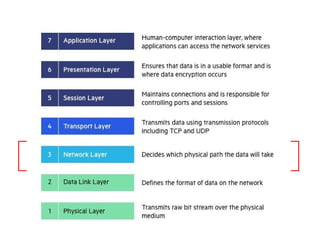
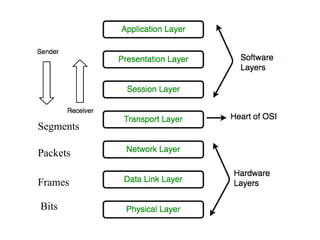
Bits
Frames
Packets
Segments
Introduction to Network Layer
• The network layer in the TCP/IP protocol suite is responsible for
the host-to-host delivery of datagrams.
• It provides services to the transport layer and receives services
from the data-link layer (receiver side).
• At the source host (Alice), the network layer accepts a packet
from a transport layer, encapsulates the packet in a datagram,
and delivers the packet to the data-link layer.
• At the destination host (Bob), the datagram is de-capsulated, and
the packet is extracted and delivered to the corresponding
transport layer.
3.1 Packetizing
• The first duty of the network layer is definitely packetizing: encapsulating
the payload (data received from upper layer) in a network-layer packet at the
source and decapsulating the payload from the network-layer packet at the
destination.
• One duty of the network layer is to carry a payload from the source to the
destination without changing it or using it.
• The network layer is doing the service of a carrier such as the postal office,
which is responsible for delivery of packages from a sender to a receiver
without changing or using the contents.
• The source host receives the payload from an upper-layer protocol, adds a
header that contains the source and destination addresses and some other
information that is required by the network-layer protocol and delivers the
packet to the data-link layer.
3.1 Packetizing…
• The destination host receives the network-layer packet from its
data-link layer, decapsulates the packet, and delivers the payload
to the corresponding upper-layer protocol.
• If the packet is fragmented at the source or at routers along the
path, the network layer is responsible for waiting until all
fragments arrive, reassembling them, and delivering them to the
upper-layer protocol.
• The routers are not allowed to change source and destination
addresses either.
3.2 Routing and Forwarding
Routing
• The network layer is responsible for routing the packet from its
source to the destination.
• A physical network is a combination of networks (LANs and
WANs) and routers that connect them.
• This means that there is more than one route from the source to
the destination. The network layer is responsible for finding the
best one among these possible routes.
• This is done by running some routing protocols to help the
routers coordinate their knowledge and deliver the packets in a
shortest and efficient way.
3.2 Routing and Forwarding
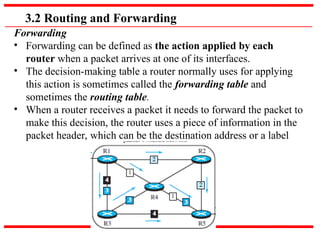
Forwarding
• Forwarding can be defined as the action applied by each
router when a packet arrives at one of its interfaces.
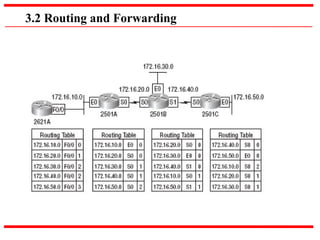
• The decision-making table a router normally uses for applying
this action is sometimes called the forwarding table and
sometimes the routing table.
• When a router receives a packet it needs to forward the packet to
make this decision, the router uses a piece of information in the
packet header, which can be the destination address or a label
3.2 Routing and Forwarding
Services of the Network Layer
1. Error Control:
2. Flow Control:
3. Congestion Control: is a situation in which too many
datagrams are present in an area of the Internet. Congestion
may occur if the number of datagrams sent by source
computers is beyond the capacity of the network or routers.
In this situation, some routers may drop some of the
datagrams.
4. Quality of Service: The quality of service (QoS) of the
communication has become more and more important. As
the Internet has allowed new applications such as multimedia
communication (audio and video)
5. Security: Today, however, security is a big concern. To
provide security for a connectionless network layer.
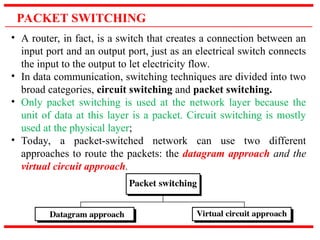
PACKET SWITCHING
• A router, in fact, is a switch that creates a connection between an
input port and an output port, just as an electrical switch connects
the input to the output to let electricity flow.
• In data communication, switching techniques are divided into two
broad categories, circuit switching and packet switching.
• Only packet switching is used at the network layer because the
unit of data at this layer is a packet. Circuit switching is mostly
used at the physical layer;
• Today, a packet-switched network can use two different
approaches to route the packets: the datagram approach and the
virtual circuit approach.
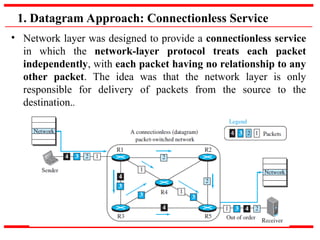
1. Datagram Approach: Connectionless Service
• Network layer was designed to provide a connectionless service
in which the network-layer protocol treats each packet
independently, with each packet having no relationship to any
other packet. The idea was that the network layer is only
responsible for delivery of packets from the source to the
destination..
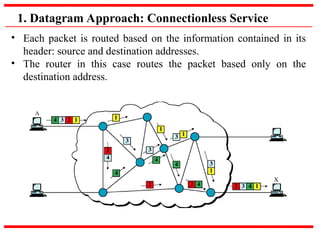
1. Datagram Approach: Connectionless Service
• Each packet is routed based on the information contained in its
header: source and destination addresses.
• The router in this case routes the packet based only on the
destination address.
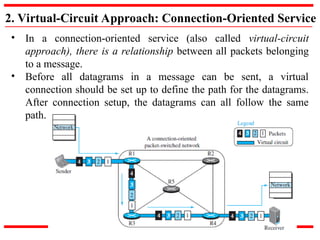
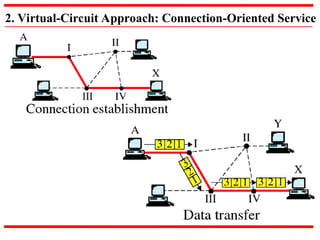
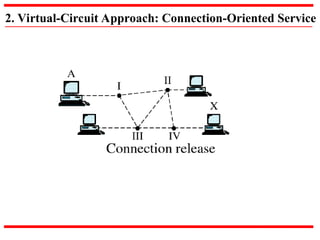
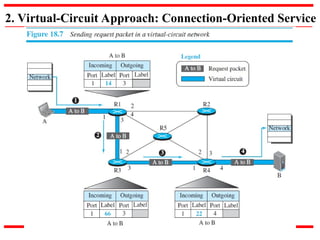
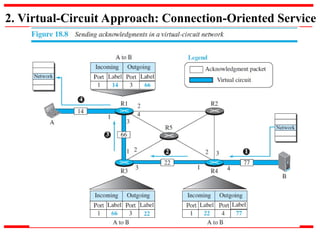
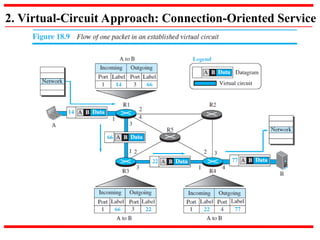
2. Virtual-Circuit Approach: Connection-Oriented Service
• In a connection-oriented service (also called virtual-circuit
approach), there is a relationship between all packets belonging
to a message.
• Before all datagrams in a message can be sent, a virtual
connection should be set up to define the path for the datagrams.
After connection setup, the datagrams can all follow the same
path.
2. Virtual-Circuit Approach: Connection-Oriented Service
NETWORK-LAYER PERFORMANCE
The performance of a network can be measured in terms of delay,
throughput, and packet loss. Congestion control is an issue that
can improve the performance.
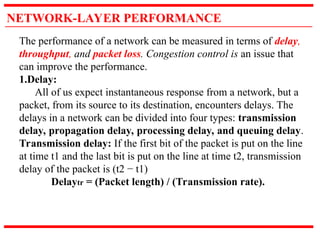
1.Delay:
All of us expect instantaneous response from a network, but a
packet, from its source to its destination, encounters delays. The
delays in a network can be divided into four types: transmission
delay, propagation delay, processing delay, and queuing delay.
Transmission delay: If the first bit of the packet is put on the line
at time t1 and the last bit is put on the line at time t2, transmission
delay of the packet is (t2 − t1)
Delaytr = (Packet length) / (Transmission rate).
NETWORK-LAYER PERFORMANCE
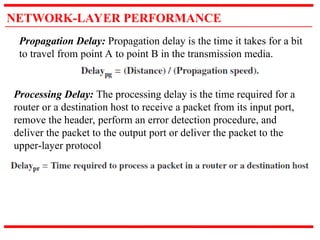
Propagation Delay: Propagation delay is the time it takes for a bit
to travel from point A to point B in the transmission media.
Processing Delay: The processing delay is the time required for a
router or a destination host to receive a packet from its input port,
remove the header, perform an error detection procedure, and
deliver the packet to the output port or deliver the packet to the
upper-layer protocol
NETWORK-LAYER PERFORMANCE
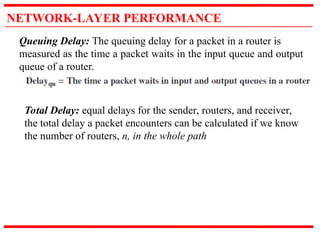
Queuing Delay: The queuing delay for a packet in a router is
measured as the time a packet waits in the input queue and output
queue of a router.
Total Delay: equal delays for the sender, routers, and receiver,
the total delay a packet encounters can be calculated if we know
the number of routers, n, in the whole path
NETWORK-LAYER PERFORMANCE
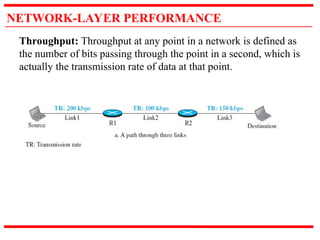
Throughput: Throughput at any point in a network is defined as
the number of bits passing through the point in a second, which is
actually the transmission rate of data at that point.
NETWORK-LAYER PERFORMANCE
Packet Loss:
•When a router receives a packet while processing another packet,
the received packet needs to be stored in the input buffer waiting
for its turn. A router, however, has an input buffer with a limited
size. A time may come when the buffer is full and the next packet
needs to be dropped.
•The effect of packet loss on the Internet network layer is that the
packet needs to be resent, which in turn may create overflow and
cause more packet loss.
NETWORK-LAYER PERFORMANCE
Congestion Control:
•Congestion control refers to techniques and mechanisms that can
either prevent congestion before it happens or remove congestion
after it has happened. In general, we can divide congestion control
mechanisms into two broad categories:
•open-loop congestion control (prevention) and
•closed-loop congestion control (removal).
NETWORK-LAYER PERFORMANCE
Open-Loop Congestion Control: (prevention)
•Retransmission Policy: If the sender feels that a sent packet is
lost or corrupted, the packet needs to be retransmitted.
Retransmission in general may increase congestion in the network
•Window Policy: The type of window at the sender may also
affect congestion. The Selective Repeat window is better than the
Go-Back-N window for congestion control.
•Acknowledgment Policy: If the receiver does not acknowledge
every packet it receives, it may slow down the sender and help
prevent congestion.
•Discarding Policy: A good discarding policy by the routers may
prevent congestion
•Admission Policy: is a quality-of-service mechanism
NETWORK-LAYER PERFORMANCE
Closed-Loop Congestion Control: (removal)
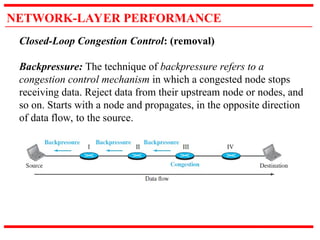
Backpressure: The technique of backpressure refers to a
congestion control mechanism in which a congested node stops
receiving data. Reject data from their upstream node or nodes, and
so on. Starts with a node and propagates, in the opposite direction
of data flow, to the source.
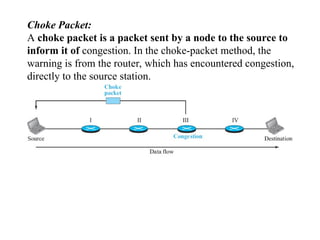
Choke Packet:
A choke packet is a packet sent by a node to the source to
inform it of congestion. In the choke-packet method, the
warning is from the router, which has encountered congestion,
directly to the source station.
• Implicit Signaling:
In implicit signaling, there is no communication between the
congested node or nodes and the source. The source guesses
that there is congestion somewhere in the network from other
symptoms.
• Explicit Signaling:
The node that experiences congestion can explicitly send a
signal to the source or destination.
computer networks fundamentals in signal processing

  • 1.
    Unit 3 Network Layer •Introduction to Network layer Network Layer Services • Packet Switching • Network Layer performance • IPV4 Address • Forwarding of IP packets
  • 2.
  • 4.
    Introduction to NetworkLayer • The network layer in the TCP/IP protocol suite is responsible for the host-to-host delivery of datagrams. • It provides services to the transport layer and receives services from the data-link layer (receiver side). • At the source host (Alice), the network layer accepts a packet from a transport layer, encapsulates the packet in a datagram, and delivers the packet to the data-link layer. • At the destination host (Bob), the datagram is de-capsulated, and the packet is extracted and delivered to the corresponding transport layer.
  • 5.
    3.1 Packetizing • Thefirst duty of the network layer is definitely packetizing: encapsulating the payload (data received from upper layer) in a network-layer packet at the source and decapsulating the payload from the network-layer packet at the destination. • One duty of the network layer is to carry a payload from the source to the destination without changing it or using it. • The network layer is doing the service of a carrier such as the postal office, which is responsible for delivery of packages from a sender to a receiver without changing or using the contents. • The source host receives the payload from an upper-layer protocol, adds a header that contains the source and destination addresses and some other information that is required by the network-layer protocol and delivers the packet to the data-link layer.
  • 6.
    3.1 Packetizing… • Thedestination host receives the network-layer packet from its data-link layer, decapsulates the packet, and delivers the payload to the corresponding upper-layer protocol. • If the packet is fragmented at the source or at routers along the path, the network layer is responsible for waiting until all fragments arrive, reassembling them, and delivering them to the upper-layer protocol. • The routers are not allowed to change source and destination addresses either.
  • 7.
    3.2 Routing andForwarding Routing • The network layer is responsible for routing the packet from its source to the destination. • A physical network is a combination of networks (LANs and WANs) and routers that connect them. • This means that there is more than one route from the source to the destination. The network layer is responsible for finding the best one among these possible routes. • This is done by running some routing protocols to help the routers coordinate their knowledge and deliver the packets in a shortest and efficient way.
  • 8.
    3.2 Routing andForwarding Forwarding • Forwarding can be defined as the action applied by each router when a packet arrives at one of its interfaces. • The decision-making table a router normally uses for applying this action is sometimes called the forwarding table and sometimes the routing table. • When a router receives a packet it needs to forward the packet to make this decision, the router uses a piece of information in the packet header, which can be the destination address or a label
  • 9.
    3.2 Routing andForwarding
  • 10.
    Services of theNetwork Layer 1. Error Control: 2. Flow Control: 3. Congestion Control: is a situation in which too many datagrams are present in an area of the Internet. Congestion may occur if the number of datagrams sent by source computers is beyond the capacity of the network or routers. In this situation, some routers may drop some of the datagrams. 4. Quality of Service: The quality of service (QoS) of the communication has become more and more important. As the Internet has allowed new applications such as multimedia communication (audio and video) 5. Security: Today, however, security is a big concern. To provide security for a connectionless network layer.
  • 11.
    PACKET SWITCHING • Arouter, in fact, is a switch that creates a connection between an input port and an output port, just as an electrical switch connects the input to the output to let electricity flow. • In data communication, switching techniques are divided into two broad categories, circuit switching and packet switching. • Only packet switching is used at the network layer because the unit of data at this layer is a packet. Circuit switching is mostly used at the physical layer; • Today, a packet-switched network can use two different approaches to route the packets: the datagram approach and the virtual circuit approach.
  • 12.
    1. Datagram Approach:Connectionless Service • Network layer was designed to provide a connectionless service in which the network-layer protocol treats each packet independently, with each packet having no relationship to any other packet. The idea was that the network layer is only responsible for delivery of packets from the source to the destination..
  • 13.
    1. Datagram Approach:Connectionless Service • Each packet is routed based on the information contained in its header: source and destination addresses. • The router in this case routes the packet based only on the destination address.
  • 14.
    2. Virtual-Circuit Approach:Connection-Oriented Service • In a connection-oriented service (also called virtual-circuit approach), there is a relationship between all packets belonging to a message. • Before all datagrams in a message can be sent, a virtual connection should be set up to define the path for the datagrams. After connection setup, the datagrams can all follow the same path.
  • 15.
    2. Virtual-Circuit Approach:Connection-Oriented Service
  • 16.
    2. Virtual-Circuit Approach:Connection-Oriented Service
  • 17.
    2. Virtual-Circuit Approach:Connection-Oriented Service
  • 18.
    2. Virtual-Circuit Approach:Connection-Oriented Service
  • 19.
    2. Virtual-Circuit Approach:Connection-Oriented Service
  • 20.
    NETWORK-LAYER PERFORMANCE The performanceof a network can be measured in terms of delay, throughput, and packet loss. Congestion control is an issue that can improve the performance. 1.Delay: All of us expect instantaneous response from a network, but a packet, from its source to its destination, encounters delays. The delays in a network can be divided into four types: transmission delay, propagation delay, processing delay, and queuing delay. Transmission delay: If the first bit of the packet is put on the line at time t1 and the last bit is put on the line at time t2, transmission delay of the packet is (t2 − t1) Delaytr = (Packet length) / (Transmission rate).
  • 21.
    NETWORK-LAYER PERFORMANCE Propagation Delay:Propagation delay is the time it takes for a bit to travel from point A to point B in the transmission media. Processing Delay: The processing delay is the time required for a router or a destination host to receive a packet from its input port, remove the header, perform an error detection procedure, and deliver the packet to the output port or deliver the packet to the upper-layer protocol
  • 22.
    NETWORK-LAYER PERFORMANCE Queuing Delay:The queuing delay for a packet in a router is measured as the time a packet waits in the input queue and output queue of a router. Total Delay: equal delays for the sender, routers, and receiver, the total delay a packet encounters can be calculated if we know the number of routers, n, in the whole path
  • 23.
    NETWORK-LAYER PERFORMANCE Throughput: Throughputat any point in a network is defined as the number of bits passing through the point in a second, which is actually the transmission rate of data at that point.
  • 24.
    NETWORK-LAYER PERFORMANCE Packet Loss: •Whena router receives a packet while processing another packet, the received packet needs to be stored in the input buffer waiting for its turn. A router, however, has an input buffer with a limited size. A time may come when the buffer is full and the next packet needs to be dropped. •The effect of packet loss on the Internet network layer is that the packet needs to be resent, which in turn may create overflow and cause more packet loss.
  • 25.
    NETWORK-LAYER PERFORMANCE Congestion Control: •Congestioncontrol refers to techniques and mechanisms that can either prevent congestion before it happens or remove congestion after it has happened. In general, we can divide congestion control mechanisms into two broad categories: •open-loop congestion control (prevention) and •closed-loop congestion control (removal).
  • 26.
    NETWORK-LAYER PERFORMANCE Open-Loop CongestionControl: (prevention) •Retransmission Policy: If the sender feels that a sent packet is lost or corrupted, the packet needs to be retransmitted. Retransmission in general may increase congestion in the network •Window Policy: The type of window at the sender may also affect congestion. The Selective Repeat window is better than the Go-Back-N window for congestion control. •Acknowledgment Policy: If the receiver does not acknowledge every packet it receives, it may slow down the sender and help prevent congestion. •Discarding Policy: A good discarding policy by the routers may prevent congestion •Admission Policy: is a quality-of-service mechanism
  • 27.
    NETWORK-LAYER PERFORMANCE Closed-Loop CongestionControl: (removal) Backpressure: The technique of backpressure refers to a congestion control mechanism in which a congested node stops receiving data. Reject data from their upstream node or nodes, and so on. Starts with a node and propagates, in the opposite direction of data flow, to the source.
  • 28.
    Choke Packet: A chokepacket is a packet sent by a node to the source to inform it of congestion. In the choke-packet method, the warning is from the router, which has encountered congestion, directly to the source station.
  • 29.
    • Implicit Signaling: Inimplicit signaling, there is no communication between the congested node or nodes and the source. The source guesses that there is congestion somewhere in the network from other symptoms. • Explicit Signaling: The node that experiences congestion can explicitly send a signal to the source or destination.