COMPUTER NETWORKS
BCA – VI SEMESTER
SUB.CODE : 16SCCCA8
UNIT-II
Error Detection and Correction
Presented By
S.Vijaya Lakshmi B.E(CSE)
Assistant Professor,
Department of Computer Science,
Sri Sarada Niketan College for Women,Karur.
Error detection and correction
• Networks must be able to transfer data
from one device to another with complete
accuracy.
• Data can be corrupted during transmission.
• For reliable communication, errors must be
detected and corrected.
• Error detection and correction are
implemented either at the data link layer
or the transport layer of the OSI model.
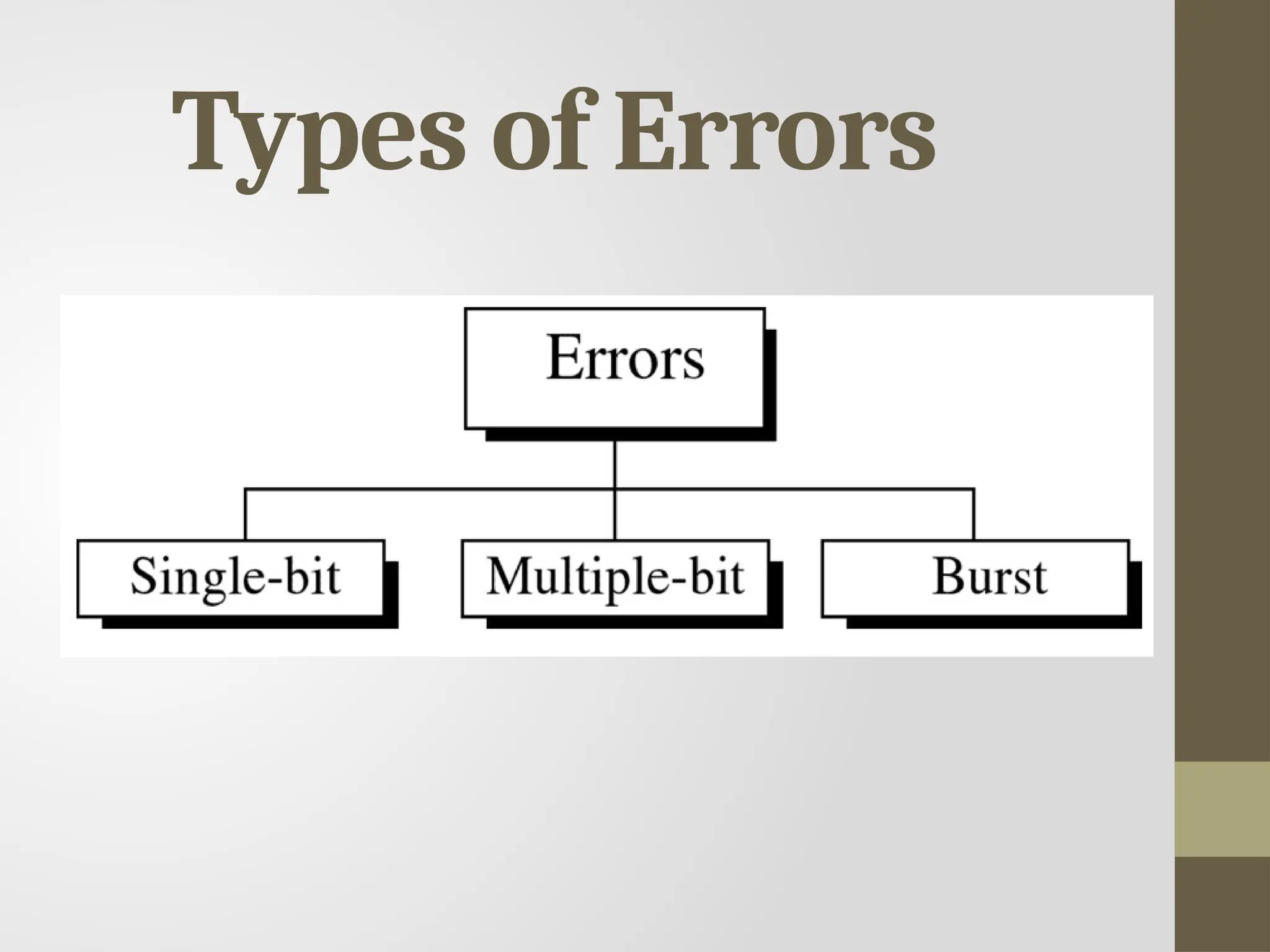
Types of Errors
Single-bit error
Cyclic Redundancy Check
 Given a k-bit frame or message, the transmitter
generates an n-bit sequence, known as a frame
check sequence (FCS), so that the resulting
frame, consisting of (k+n) bits, is exactly
divisible by some predetermined number.
 The receiver then divides the incoming frame
by the same number and, if there is no
remainder, assumes that there was no error.
Single-bit error
• Single bit errors are the least likely type of errors in
serial data transmission because the noise must have a
very short duration which is very rare.
• However this kind of errors can happen in parallel
transmission.
• Example:
• If data is sent at 1Mbps then each bit lasts only 1/1,000,000 sec.
or 1 μs.
• For a single-bit error to occur, the noise must have a duration of
only 1 μs, which is very rare.
Burst error
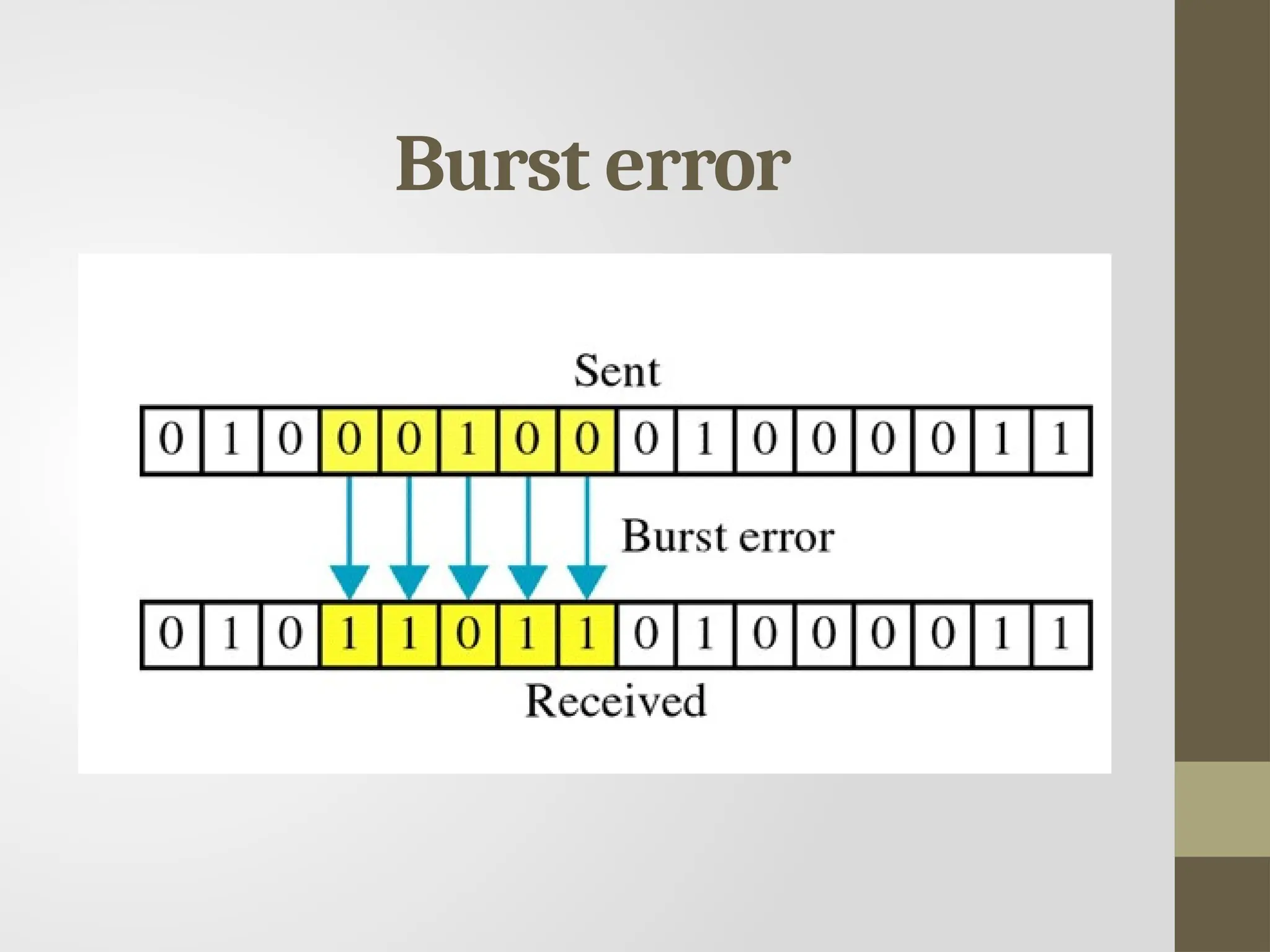
Burst error
• Burst error is most likely to happen in
serial transmission since the duration of
noise is normally longer than the duration
of a bit.
• The number of bits affected depends on
the data rate and duration of noise.
• Example:
• 🢂If data is sent at rate = 1Kbps then a
noise of 1/100 sec can affect 10 bits.
(1/100*1000)
Error detection
• Error detection means to decide whether
the received data is correct or not without
having a copy of the original message.
• Error detection uses the concept of
redundancy, which means adding extra
bits for detecting errors at the destination.
Redundancy
Error Correction
 It can be handled in two ways:
receiver can have the sender
retransmit the entire data unit.
 The receiver can use an error
correcting code, which automatically
corrects certain errors.
Error Correction
Single-bit error correction
• To correct an error, the receiver reverses
the value of the altered bit. To do so, it
must know which bit is in error.
• Number of redundancy bits needed
• Let data bits = m
• Redundancy bits = r
• Total message sent = m+r
2r ≥ m+r+1
ThankYou
14

Computer Networks - Error Detection and Correction

  • 1.
    COMPUTER NETWORKS BCA –VI SEMESTER SUB.CODE : 16SCCCA8 UNIT-II Error Detection and Correction Presented By S.Vijaya Lakshmi B.E(CSE) Assistant Professor, Department of Computer Science, Sri Sarada Niketan College for Women,Karur.
  • 2.
    Error detection andcorrection • Networks must be able to transfer data from one device to another with complete accuracy. • Data can be corrupted during transmission. • For reliable communication, errors must be detected and corrected. • Error detection and correction are implemented either at the data link layer or the transport layer of the OSI model.
  • 3.
  • 4.
  • 5.
    Cyclic Redundancy Check Given a k-bit frame or message, the transmitter generates an n-bit sequence, known as a frame check sequence (FCS), so that the resulting frame, consisting of (k+n) bits, is exactly divisible by some predetermined number.  The receiver then divides the incoming frame by the same number and, if there is no remainder, assumes that there was no error.
  • 6.
    Single-bit error • Singlebit errors are the least likely type of errors in serial data transmission because the noise must have a very short duration which is very rare. • However this kind of errors can happen in parallel transmission. • Example: • If data is sent at 1Mbps then each bit lasts only 1/1,000,000 sec. or 1 μs. • For a single-bit error to occur, the noise must have a duration of only 1 μs, which is very rare.
  • 7.
  • 8.
    Burst error • Bursterror is most likely to happen in serial transmission since the duration of noise is normally longer than the duration of a bit. • The number of bits affected depends on the data rate and duration of noise. • Example: • 🢂If data is sent at rate = 1Kbps then a noise of 1/100 sec can affect 10 bits. (1/100*1000)
  • 9.
    Error detection • Errordetection means to decide whether the received data is correct or not without having a copy of the original message. • Error detection uses the concept of redundancy, which means adding extra bits for detecting errors at the destination.
  • 10.
  • 11.
    Error Correction  Itcan be handled in two ways: receiver can have the sender retransmit the entire data unit.  The receiver can use an error correcting code, which automatically corrects certain errors.
  • 12.
  • 13.
    Single-bit error correction •To correct an error, the receiver reverses the value of the altered bit. To do so, it must know which bit is in error. • Number of redundancy bits needed • Let data bits = m • Redundancy bits = r • Total message sent = m+r 2r ≥ m+r+1
  • 14.