Advanced Operating Systems
I MCA- II SEMESTER
SUBJECT CODE : P22MCACC22
UNIT – II
Distributed OS
Presented By
S.Vijaya Lakshmi B.E(CSE)
Assistant Professor,
Department of Computer Science,
Sri Sarada Niketan College for Women,Karur.
Distributed Operating System
 A distributed operating system (DOS) is an
essential type of operating system.
Distributed systems use many central
processors to serve multiple real-time
applications and users.
 As a result, data processing jobs are
distributed between the processors.
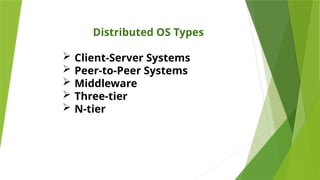
Distributed OS Types
 Client-Server Systems
 Peer-to-Peer Systems
 Middleware
 Three-tier
 N-tier
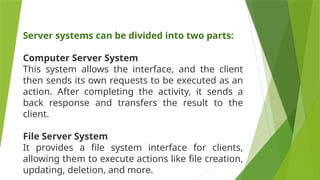
Server systems can be divided into two parts:
Computer Server System
This system allows the interface, and the client
then sends its own requests to be executed as an
action. After completing the activity, it sends a
back response and transfers the result to the
client.
File Server System
It provides a file system interface for clients,
allowing them to execute actions like file creation,
updating, deletion, and more.
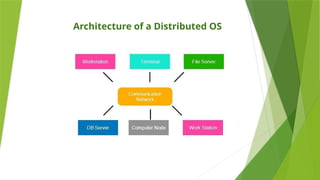
Architecture of a Distributed OS
Applications of Distributed Operating
System
 Internet Technology
 Distributed databases System
 Air Traffic Control System
 Airline reservation Control systems
 Peep-to-peer networks system
 Telecommunication networks
 Scientific Computing System
 Cluster Computing
 Grid Computing
 Data rendering
Design issues of distributed system
 Heterogeneity
 Openness
 Scalability
 Security
 Failure Handling
 Concurrency
 Transparency
Communication Model
 Communication in distributed systems
is always based on low-level message
passing as offered by the underlying
network.
 Expressing communication through
message passing is harder than using
primitives based on shared memory, as
available for non-distributed platforms.
Network Communications Models
 Point-to-point.
 Client-server.
 Publish-subscribe.
What is Distributed Deadlock?
 Distributed deadlocks can occur when distributed
transactions or concurrency control are utilized in
distributed systems.
 It may be identified via a distributed technique like edge
chasing or by creating a global wait-for graph (WFG)
from local wait-for graphs at a deadlock detector.
Approaches
 Centralized Approach
 Hierarchical Approach
 Distributed Approach
Approaches to detect deadlock in the
distributed system
Centralized Approach
 Only one resource is responsible for detecting deadlock in the
centralized method, and it is simple and easy to use.
 Still, the disadvantages include excessive workload on a single
node and single-point failure
 The entire system is dependent on one node, and if that node
fails, the entire system crashes, making the system less reliable.
Hierarchical Approach
 In a distributed system, it is the integration of
both centralized and distributed approaches to
deadlock detection.
 In this strategy, a single node handles a set of
selected nodes or clusters of nodes that are in
charge of deadlock detection.
Distributed Approach
 In the distributed technique, various nodes work to
detect deadlocks.
 There is no single point of failure as the workload is
equally spread among all nodes.
 It also helps to increase the speed of deadlock detection
Thank You

Advanced Operating Systems- Distributed OS

  • 1.
    Advanced Operating Systems IMCA- II SEMESTER SUBJECT CODE : P22MCACC22 UNIT – II Distributed OS Presented By S.Vijaya Lakshmi B.E(CSE) Assistant Professor, Department of Computer Science, Sri Sarada Niketan College for Women,Karur.
  • 2.
    Distributed Operating System A distributed operating system (DOS) is an essential type of operating system. Distributed systems use many central processors to serve multiple real-time applications and users.  As a result, data processing jobs are distributed between the processors.
  • 3.
    Distributed OS Types Client-Server Systems  Peer-to-Peer Systems  Middleware  Three-tier  N-tier
  • 4.
    Server systems canbe divided into two parts: Computer Server System This system allows the interface, and the client then sends its own requests to be executed as an action. After completing the activity, it sends a back response and transfers the result to the client. File Server System It provides a file system interface for clients, allowing them to execute actions like file creation, updating, deletion, and more.
  • 5.
    Architecture of aDistributed OS
  • 6.
    Applications of DistributedOperating System  Internet Technology  Distributed databases System  Air Traffic Control System  Airline reservation Control systems  Peep-to-peer networks system  Telecommunication networks  Scientific Computing System  Cluster Computing  Grid Computing  Data rendering
  • 7.
    Design issues ofdistributed system  Heterogeneity  Openness  Scalability  Security  Failure Handling  Concurrency  Transparency
  • 8.
    Communication Model  Communicationin distributed systems is always based on low-level message passing as offered by the underlying network.  Expressing communication through message passing is harder than using primitives based on shared memory, as available for non-distributed platforms.
  • 9.
    Network Communications Models Point-to-point.  Client-server.  Publish-subscribe.
  • 10.
    What is DistributedDeadlock?  Distributed deadlocks can occur when distributed transactions or concurrency control are utilized in distributed systems.  It may be identified via a distributed technique like edge chasing or by creating a global wait-for graph (WFG) from local wait-for graphs at a deadlock detector.
  • 11.
    Approaches  Centralized Approach Hierarchical Approach  Distributed Approach
  • 12.
    Approaches to detectdeadlock in the distributed system Centralized Approach  Only one resource is responsible for detecting deadlock in the centralized method, and it is simple and easy to use.  Still, the disadvantages include excessive workload on a single node and single-point failure  The entire system is dependent on one node, and if that node fails, the entire system crashes, making the system less reliable.
  • 13.
    Hierarchical Approach  Ina distributed system, it is the integration of both centralized and distributed approaches to deadlock detection.  In this strategy, a single node handles a set of selected nodes or clusters of nodes that are in charge of deadlock detection.
  • 14.
    Distributed Approach  Inthe distributed technique, various nodes work to detect deadlocks.  There is no single point of failure as the workload is equally spread among all nodes.  It also helps to increase the speed of deadlock detection
  • 15.