--- Po-Ning Chen ---
NCTU/CM
chap0-1
Po-Ning Chen@CM.NCTU
微算機系統 課程介紹
陳伯寧 教授
電信工程學系
國立交通大學
chap0-2
Po-Ning Chen@CM.NCTU
Introduction to Microprocessor System
1. Software Overview of the Microprocessor System
ŽMachine Language
– CPU is passive, and only “recognizes” 0-1 machine language.
– In the past, in order to tell a CPU to do some proper JOB, a
programmer needs to memorize (or look-up) the machine
language corresponding to the JOB, which is really a heavy
burden (to a programmer).
--- Po-Ning Chen ---
NCTU/CM
chap0-3
Po-Ning Chen@CM.NCTU
Introduction to Microprocessor System
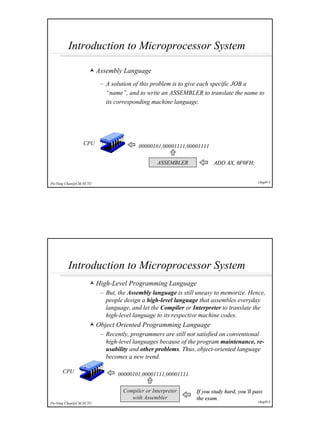
ŽAssembly Language
– A solution of this problem is to give each specific JOB a
“name”, and to write an ASSEMBLER to translate the name to
its corresponding machine language.
CPU
00000101,00001111,00001111
ADD AX, 0F0FH;
ADD AX, 0F0FH;
ASSEMBLER
chap0-4
Po-Ning Chen@CM.NCTU
Introduction to Microprocessor System
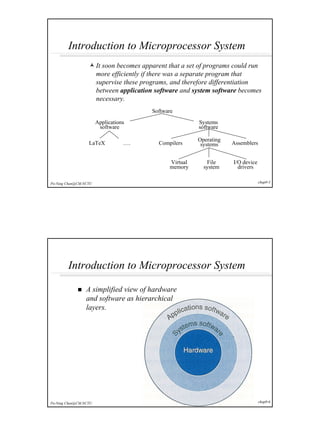
ŽHigh-Level Programming Language
– But, the Assembly language is still uneasy to memorize. Hence,
people design a high-level language that assembles everyday
language, and let the Compiler or Interpreter to translate the
high-level language to its respective machine codes.
ŽObject Oriented Programming Language
– Recently, programmers are still not satisfied on conventional
high-level languages because of the program maintenance, re-
usability and other problems. Thus, object-oriented language
becomes a new trend.
CPU
00000101,00001111,00001111
Compiler or Interpreter
with Assembler
with Assembler
If you study hard, you
If you study hard, you’
’ll pass
ll pass
the exam.
the exam.
--- Po-Ning Chen ---
NCTU/CM
chap0-5
Po-Ning Chen@CM.NCTU
Introduction to Microprocessor System
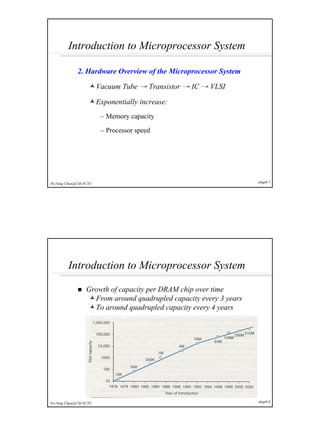
ŽIt soon becomes apparent that a set of programs could run
more efficiently if there was a separate program that
supervise these programs, and therefore differentiation
between application software and system software becomes
necessary.
Software
Applications
software
Systems
software
Compilers
Operating
systems Assemblers
LaTeX ….
Virtual
memory
File
system
I/O device
drivers
chap0-6
Po-Ning Chen@CM.NCTU
Introduction to Microprocessor System
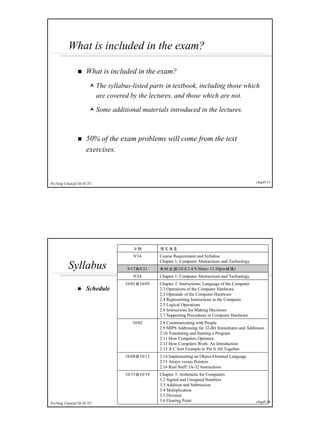
„ A simplified view of hardware
and software as hierarchical
layers.
--- Po-Ning Chen ---
NCTU/CM
chap0-7
Po-Ning Chen@CM.NCTU
Introduction to Microprocessor System
2. Hardware Overview of the Microprocessor System
ŽVacuum Tube → Transistor → IC → VLSI
ŽExponentially increase:
– Memory capacity
– Processor speed
chap0-8
Po-Ning Chen@CM.NCTU
Introduction to Microprocessor System
„ Growth of capacity per DRAM chip over time
ŽFrom around quadrupled capacity every 3 years
ŽTo around quadrupled capacity every 4 years
--- Po-Ning Chen ---
NCTU/CM
chap0-9
Po-Ning Chen@CM.NCTU
Introduction to Microprocessor System
„ Performance increment of workstations (relative to
SPECint performance of VAX-11/780)
ŽAround 1.5~1.6 times per year
chap0-10
Po-Ning Chen@CM.NCTU
Introduction to Microprocessor System
3. Things you’ll be learning in this course
ŽHow computers work, a basic foundation
ŽHow to analyze their performance
ŽIssues affecting modern processors (caches,
pipelines, etc).
--- Po-Ning Chen ---
NCTU/CM
chap0-11
Po-Ning Chen@CM.NCTU
Syllabus
„ Textbook
ŽDavid A. Patterson and John L. Hennessy, Computer
Organization & Design: The Hardware/Software Interface,
3rd edition, Morgan Kaufmann Publishers, Inc: San
Francisso, 2004.
chap0-12
Po-Ning Chen@CM.NCTU
Syllabus
„ 授課教師資訊
ŽPo-Ning Chen (陳伯寧)
ŽOffice﹕ED 831
ŽE-mail: qponing@mail.nctu.edu.tw
ŽHomepage: http://shannon.cm.nctu.edu.tw or
http://140.113.13.233
„ 上課時間
Ž週二EF 與 週五B
--- Po-Ning Chen ---
NCTU/CM
chap0-13
Po-Ning Chen@CM.NCTU
Syllabus
„ 成績計算標準
Ž期中考: 11/09舉行, 考兩小時,佔學期成績的40%。
Ž期末考: 01/11舉行,考兩小時,佔學期成績的40%。
Ž隨堂考: 10/01、10/19、11/30、12/21共四次,以1~2題為
原則,考試時間為10分鐘,每次佔學期成績的5%。
chap0-14
Po-Ning Chen@CM.NCTU
Syllabus
„ 講義網站
Žhttp://shannon.cm.nctu.edu.tw
Ž請自行下載影印 或 至系上影印室影印
--- Po-Ning Chen ---
NCTU/CM
chap0-15
Po-Ning Chen@CM.NCTU
What is included in the exam?
„ What is included in the exam?
ŽThe syllabus-listed parts in textbook, including those which
are covered by the lectures, and those which are not.
ŽSome additional materials introduced in the lectures.
„ 50% of the exam problems will come from the text
exercises.
chap0-16
Po-Ning Chen@CM.NCTU
Syllabus
„ Schedule
Chapter 3: Arithmetic for Computers
3.2 Signed and Unsigned Numbers
3.3 Addition and Subtraction
3.4 Multiplication
3.5 Division
3.6 Floating Point
10/15與10/19
2.14 Implementing an Object-Oriented Language
2.15 Arrays versus Pointers
2.16 Real Stuff: IA-32 Instructions
10/08與10/12
2.8 Communicating with People
2.9 MIPS Addressing for 32-Bit Immediates and Addresses
2.10 Translating and Starting a Program
2.11 How Compilers Optimize
2.12 How Compilers Work: An Introduction
2.13 A C Sort Example to Put It All Together
10/02
Chapter 2: Instructions: Language of the Computer
2.2 Operations of the Computer Hardware
2.3 Operands of the Computer Hardware
2.4 Representing Instructions in the Computer
2.5 Logical Operations
2.6 Instructions for Making Decisions
2.7 Supporting Procedures in Computer Hardware
10/01與10/05
Chapter 1: Computer Abstractions and Technology
9/24
教師出國(10月2日9:30am~12:30pm補課)
9/17與9/21
Course Requirement and Syllabus
Chapter 1: Computer Abstractions and Technology
9/14
預定進度
日期
chap0-16
--- Po-Ning Chen ---
NCTU/CM
chap0-17
Po-Ning Chen@CM.NCTU
Syllabus
„ Schedule
6.3 Pipelined Control
6.4 Data Hazards and Forwarding
6.5 Data Hazards and Stalls
6.6 Branch Hazards
6.7 Using a Hardware Description Language to Describe and
Model a Pipeline
6.8 Exceptions
11/30與12/03
5.6 Exceptions
5.7 Microprogramming: Simplifying Control Design
5.8 An Introduction to Digital Design Using a Hardware
Design Language
5.9 Real Stuff: The Organization of Recent Pentium
Implementations
Chapter 6: Enhancing Performance with Pipelining
6.1 An Overview of Pipelining
6.2 A Pipelined Datapath
11/23與11/26
5.4 A Simple Implementation Scheme
5.5 A Multicycle Implementation
11/16與11/19
Chapter 5: The Processor: Datapath and Control
5.2 Logic Design and Conventions
5.3 Building a Datapath
11/12
期中考 (考一 ~ 四章)
11/09
Chapter 4: Accessing and Understanding Performance
2.2 CPU Performance and Its Factors
2.3 Evaluating Performance
2.4 Real Stuff: Two SPEC Benchmarks and the Performance
of Recent Intel Processors
10/29與11/02與
11/05
3.7 Real Stuff: Floating Point in the IA-32
10/22與10/26
chap0-17
chap0-18
Po-Ning Chen@CM.NCTU
Syllabus
„ Schedule
期末考(考五 ~ 八章)
1/11
8.6 I/O Performance Measures: Examples from Disk and
File Systems
8.7 Designing an I/O System
8.8 Real Stuff: A Digital Camera
1/04與1/07
Chapter 8: Storage, Networks, and Other Peripherals
8.2 Disk Storage and Dependability
8.3 Networks
8.4 Buses and Other Connections between Processors,
Memory, and I/O Devices
8.5 Interfacing I/O Devices to the Processor, Memory, and
Operating System
12/28與12/31
7.5 A Common Framework for Memory Hierarchies
7.6 Real Stuff: The Pentium P4 and the AMD Opteron
Memory Hierarchies
12/21與12/24
Chapter 7: Large and Fast: Exploiting Memory Hierarchy
7.2 The Basics of Caches
7.3 Measuring and Improving Cache Performance
7.4 Virtual Memory
12/14與12/17
6.9 Advanced Pipelining: Extracting More Performance
6.10 Real Stuff: The Pentium 4 Pipeline
12/07與12/10
--- Po-Ning Chen ---
NCTU/CM
chap0-19
Po-Ning Chen@CM.NCTU
Syllabus
„ 助教
Ž蔣名駿 bluepig.cm88@nctu.edu.tw 工程四館823實驗
室:分機5457
Ž卓雅婷 yatingcho.cm88@nctu.edu.tw 工程四館823實驗
室:分機54570
„ 助教Q&A時間與地點
Ž時間: Wednesday GH
Ž地點:工程四館823實驗室

Computer Architecture in Microprocessor pdf document is very useful

  • 1.
    --- Po-Ning Chen--- NCTU/CM chap0-1 Po-Ning Chen@CM.NCTU 微算機系統 課程介紹 陳伯寧 教授 電信工程學系 國立交通大學 chap0-2 Po-Ning Chen@CM.NCTU Introduction to Microprocessor System 1. Software Overview of the Microprocessor System ŽMachine Language – CPU is passive, and only “recognizes” 0-1 machine language. – In the past, in order to tell a CPU to do some proper JOB, a programmer needs to memorize (or look-up) the machine language corresponding to the JOB, which is really a heavy burden (to a programmer).
  • 2.
    --- Po-Ning Chen--- NCTU/CM chap0-3 Po-Ning Chen@CM.NCTU Introduction to Microprocessor System ŽAssembly Language – A solution of this problem is to give each specific JOB a “name”, and to write an ASSEMBLER to translate the name to its corresponding machine language. CPU 00000101,00001111,00001111 ADD AX, 0F0FH; ADD AX, 0F0FH; ASSEMBLER chap0-4 Po-Ning Chen@CM.NCTU Introduction to Microprocessor System ŽHigh-Level Programming Language – But, the Assembly language is still uneasy to memorize. Hence, people design a high-level language that assembles everyday language, and let the Compiler or Interpreter to translate the high-level language to its respective machine codes. ŽObject Oriented Programming Language – Recently, programmers are still not satisfied on conventional high-level languages because of the program maintenance, re- usability and other problems. Thus, object-oriented language becomes a new trend. CPU 00000101,00001111,00001111 Compiler or Interpreter Compiler or Interpreter with Assembler with Assembler If you study hard, you If you study hard, you’ ’ll pass ll pass the exam. the exam.
  • 3.
    --- Po-Ning Chen--- NCTU/CM chap0-5 Po-Ning Chen@CM.NCTU Introduction to Microprocessor System ŽIt soon becomes apparent that a set of programs could run more efficiently if there was a separate program that supervise these programs, and therefore differentiation between application software and system software becomes necessary. Software Applications software Systems software Compilers Operating systems Assemblers LaTeX …. Virtual memory File system I/O device drivers chap0-6 Po-Ning Chen@CM.NCTU Introduction to Microprocessor System „ A simplified view of hardware and software as hierarchical layers.
  • 4.
    --- Po-Ning Chen--- NCTU/CM chap0-7 Po-Ning Chen@CM.NCTU Introduction to Microprocessor System 2. Hardware Overview of the Microprocessor System ŽVacuum Tube → Transistor → IC → VLSI ŽExponentially increase: – Memory capacity – Processor speed chap0-8 Po-Ning Chen@CM.NCTU Introduction to Microprocessor System „ Growth of capacity per DRAM chip over time ŽFrom around quadrupled capacity every 3 years ŽTo around quadrupled capacity every 4 years
  • 5.
    --- Po-Ning Chen--- NCTU/CM chap0-9 Po-Ning Chen@CM.NCTU Introduction to Microprocessor System „ Performance increment of workstations (relative to SPECint performance of VAX-11/780) ŽAround 1.5~1.6 times per year chap0-10 Po-Ning Chen@CM.NCTU Introduction to Microprocessor System 3. Things you’ll be learning in this course ŽHow computers work, a basic foundation ŽHow to analyze their performance ŽIssues affecting modern processors (caches, pipelines, etc).
  • 6.
    --- Po-Ning Chen--- NCTU/CM chap0-11 Po-Ning Chen@CM.NCTU Syllabus „ Textbook ŽDavid A. Patterson and John L. Hennessy, Computer Organization & Design: The Hardware/Software Interface, 3rd edition, Morgan Kaufmann Publishers, Inc: San Francisso, 2004. chap0-12 Po-Ning Chen@CM.NCTU Syllabus „ 授課教師資訊 ŽPo-Ning Chen (陳伯寧) ŽOffice﹕ED 831 ŽE-mail: qponing@mail.nctu.edu.tw ŽHomepage: http://shannon.cm.nctu.edu.tw or http://140.113.13.233 „ 上課時間 Ž週二EF 與 週五B
  • 7.
    --- Po-Ning Chen--- NCTU/CM chap0-13 Po-Ning Chen@CM.NCTU Syllabus „ 成績計算標準 Ž期中考: 11/09舉行, 考兩小時,佔學期成績的40%。 Ž期末考: 01/11舉行,考兩小時,佔學期成績的40%。 Ž隨堂考: 10/01、10/19、11/30、12/21共四次,以1~2題為 原則,考試時間為10分鐘,每次佔學期成績的5%。 chap0-14 Po-Ning Chen@CM.NCTU Syllabus „ 講義網站 Žhttp://shannon.cm.nctu.edu.tw Ž請自行下載影印 或 至系上影印室影印
  • 8.
    --- Po-Ning Chen--- NCTU/CM chap0-15 Po-Ning Chen@CM.NCTU What is included in the exam? „ What is included in the exam? ŽThe syllabus-listed parts in textbook, including those which are covered by the lectures, and those which are not. ŽSome additional materials introduced in the lectures. „ 50% of the exam problems will come from the text exercises. chap0-16 Po-Ning Chen@CM.NCTU Syllabus „ Schedule Chapter 3: Arithmetic for Computers 3.2 Signed and Unsigned Numbers 3.3 Addition and Subtraction 3.4 Multiplication 3.5 Division 3.6 Floating Point 10/15與10/19 2.14 Implementing an Object-Oriented Language 2.15 Arrays versus Pointers 2.16 Real Stuff: IA-32 Instructions 10/08與10/12 2.8 Communicating with People 2.9 MIPS Addressing for 32-Bit Immediates and Addresses 2.10 Translating and Starting a Program 2.11 How Compilers Optimize 2.12 How Compilers Work: An Introduction 2.13 A C Sort Example to Put It All Together 10/02 Chapter 2: Instructions: Language of the Computer 2.2 Operations of the Computer Hardware 2.3 Operands of the Computer Hardware 2.4 Representing Instructions in the Computer 2.5 Logical Operations 2.6 Instructions for Making Decisions 2.7 Supporting Procedures in Computer Hardware 10/01與10/05 Chapter 1: Computer Abstractions and Technology 9/24 教師出國(10月2日9:30am~12:30pm補課) 9/17與9/21 Course Requirement and Syllabus Chapter 1: Computer Abstractions and Technology 9/14 預定進度 日期 chap0-16
  • 9.
    --- Po-Ning Chen--- NCTU/CM chap0-17 Po-Ning Chen@CM.NCTU Syllabus „ Schedule 6.3 Pipelined Control 6.4 Data Hazards and Forwarding 6.5 Data Hazards and Stalls 6.6 Branch Hazards 6.7 Using a Hardware Description Language to Describe and Model a Pipeline 6.8 Exceptions 11/30與12/03 5.6 Exceptions 5.7 Microprogramming: Simplifying Control Design 5.8 An Introduction to Digital Design Using a Hardware Design Language 5.9 Real Stuff: The Organization of Recent Pentium Implementations Chapter 6: Enhancing Performance with Pipelining 6.1 An Overview of Pipelining 6.2 A Pipelined Datapath 11/23與11/26 5.4 A Simple Implementation Scheme 5.5 A Multicycle Implementation 11/16與11/19 Chapter 5: The Processor: Datapath and Control 5.2 Logic Design and Conventions 5.3 Building a Datapath 11/12 期中考 (考一 ~ 四章) 11/09 Chapter 4: Accessing and Understanding Performance 2.2 CPU Performance and Its Factors 2.3 Evaluating Performance 2.4 Real Stuff: Two SPEC Benchmarks and the Performance of Recent Intel Processors 10/29與11/02與 11/05 3.7 Real Stuff: Floating Point in the IA-32 10/22與10/26 chap0-17 chap0-18 Po-Ning Chen@CM.NCTU Syllabus „ Schedule 期末考(考五 ~ 八章) 1/11 8.6 I/O Performance Measures: Examples from Disk and File Systems 8.7 Designing an I/O System 8.8 Real Stuff: A Digital Camera 1/04與1/07 Chapter 8: Storage, Networks, and Other Peripherals 8.2 Disk Storage and Dependability 8.3 Networks 8.4 Buses and Other Connections between Processors, Memory, and I/O Devices 8.5 Interfacing I/O Devices to the Processor, Memory, and Operating System 12/28與12/31 7.5 A Common Framework for Memory Hierarchies 7.6 Real Stuff: The Pentium P4 and the AMD Opteron Memory Hierarchies 12/21與12/24 Chapter 7: Large and Fast: Exploiting Memory Hierarchy 7.2 The Basics of Caches 7.3 Measuring and Improving Cache Performance 7.4 Virtual Memory 12/14與12/17 6.9 Advanced Pipelining: Extracting More Performance 6.10 Real Stuff: The Pentium 4 Pipeline 12/07與12/10
  • 10.
    --- Po-Ning Chen--- NCTU/CM chap0-19 Po-Ning Chen@CM.NCTU Syllabus „ 助教 Ž蔣名駿 bluepig.cm88@nctu.edu.tw 工程四館823實驗 室:分機5457 Ž卓雅婷 yatingcho.cm88@nctu.edu.tw 工程四館823實驗 室:分機54570 „ 助教Q&A時間與地點 Ž時間: Wednesday GH Ž地點:工程四館823實驗室