A Constituent College of Yenepoya (Deemed to be University)
Naringana, Mangaluru
Proteins
Ms.Sajini
Assistant professor
Department of Pharmaceutical
chemistry
Table of content
• Definition, and classification of protein
• Definition and classification of amino acids
• Structure of proteins
• Biological role of protein and aminoacids
• Disease related to malnutrition of proteins
Introduction
Proteins are naturally occurring polymers made up of amino acids
linked together by peptide bonds (-CONH-) having high
molecular weight found in all living cells
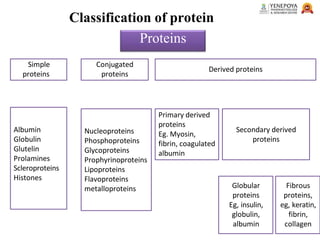
Classification of protein
Proteins
Conjugated
proteins
Derived proteins
Simple
proteins
Albumin
Globulin
Glutelin
Prolamines
Scleroproteins
Histones
Nucleoproteins
Phosphoproteins
Glycoproteins
Prophyrinoproteins
Lipoproteins
Flavoproteins
metalloproteins
Primary derived
proteins
Eg. Myosin,
fibrin, coagulated
albumin
Secondary derived
proteins
Globular
proteins
Eg, insulin,
globulin,
albumin
Fibrous
proteins,
eg, keratin,
fibrin,
collagen
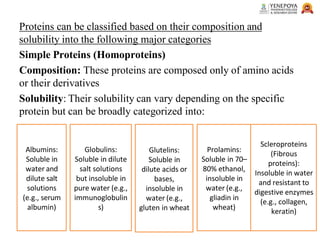
Proteins can be classified based on their composition and
solubility into the following major categories
Simple Proteins (Homoproteins)
Composition: These proteins are composed only of amino acids
or their derivatives
Solubility: Their solubility can vary depending on the specific
protein but can be broadly categorized into:
Albumins:
Soluble in
water and
dilute salt
solutions
(e.g., serum
albumin)
Globulins:
Soluble in dilute
salt solutions
but insoluble in
pure water (e.g.,
immunoglobulin
s)
Glutelins:
Soluble in
dilute acids or
bases,
insoluble in
water (e.g.,
gluten in wheat
Prolamins:
Soluble in 70–
80% ethanol,
insoluble in
water (e.g.,
gliadin in
wheat)
Scleroproteins
(Fibrous
proteins):
Insoluble in water
and resistant to
digestive enzymes
(e.g., collagen,
keratin)
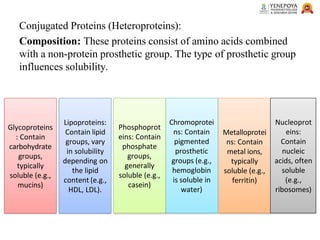
Conjugated Proteins (Heteroproteins):
Composition: These proteins consist of amino acids combined
with a non-protein prosthetic group. The type of prosthetic group
influences solubility.
Phosphoprot
eins: Contain
phosphate
groups,
generally
soluble (e.g.,
casein)
Chromoprotei
ns: Contain
pigmented
prosthetic
groups (e.g.,
hemoglobin
is soluble in
water)
Metalloprotei
ns: Contain
metal ions,
typically
soluble (e.g.,
ferritin)
Nucleoprot
eins:
Contain
nucleic
acids, often
soluble
(e.g.,
ribosomes)
Lipoproteins:
Contain lipid
groups, vary
in solubility
depending on
the lipid
content (e.g.,
HDL, LDL).
Glycoproteins
: Contain
carbohydrate
groups,
typically
soluble (e.g.,
mucins)
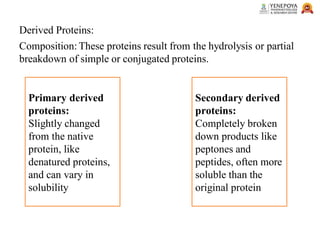
Derived Proteins:
Composition: These proteins result from the hydrolysis or partial
breakdown of simple or conjugated proteins.
Secondary derived
proteins:
Completely broken
down products like
peptones and
peptides, often more
soluble than the
original protein
Primary derived
proteins:
Slightly changed
from the native
protein, like
denatured proteins,
and can vary in
solubility
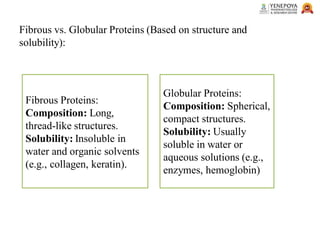
Fibrous vs. Globular Proteins (Based on structure and
solubility):
Fibrous Proteins:
Composition: Long,
thread-like structures.
Solubility: Insoluble in
water and organic solvents
(e.g., collagen, keratin).
Globular Proteins:
Composition: Spherical,
compact structures.
Solubility: Usually
soluble in water or
aqueous solutions (e.g.,
enzymes, hemoglobin)
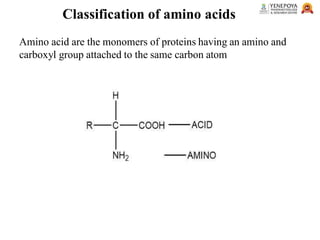
Classification of amino acids
Amino acid are the monomers of proteins having an amino and
carboxyl group attached to the same carbon atom
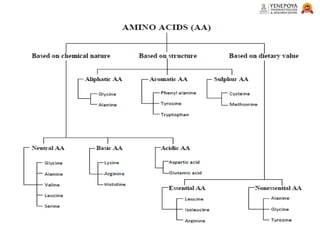
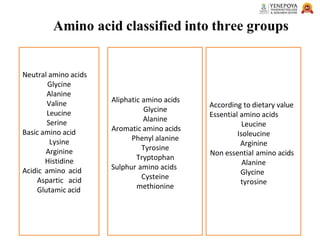
Amino acid classified into three groups
Neutral amino acids
Glycine
Alanine
Valine
Leucine
Serine
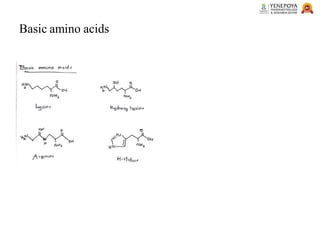
Basic amino acid
Lysine
Arginine
Histidine
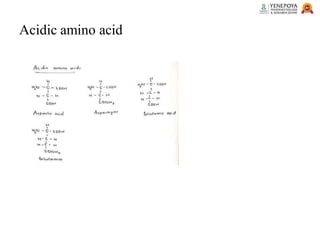
Acidic amino acid
Aspartic acid
Glutamic acid
According to dietary value
Essential amino acids
Leucine
Isoleucine
Arginine
Non essential amino acids
Alanine
Glycine
tyrosine
Aliphatic amino acids
Glycine
Alanine
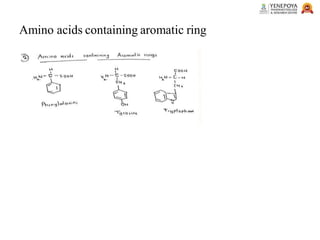
Aromatic amino acids
Phenyl alanine
Tyrosine
Tryptophan
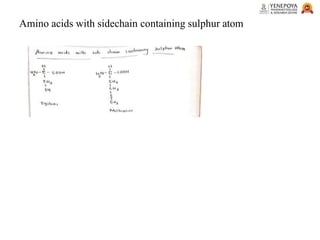
Sulphur amino acids
Cysteine
methionine
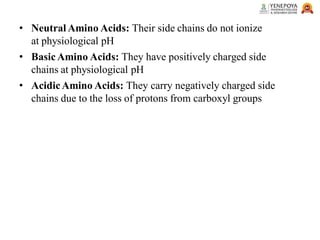
• Neutral Amino Acids: Their side chains do not ionize
at physiological pH
• BasicAmino Acids: They have positively charged side
chains at physiological pH
• AcidicAmino Acids: They carry negatively charged side
chains due to the loss of protons from carboxyl groups
• AliphaticAmino Acids: Have simple, non-polar side chains
with only carbon and hydrogen atoms.
• Aromatic Amino Acids: Contain aromatic rings in their
side chains
• Sulfur-ContainingAmino Acids: Include sulfur atoms,
playing roles in protein structure (cysteine) or serving as
important functional groups (methionine).
Essential Amino Acids:
• These cannot be synthesized by the human body and must be
obtained through the diet. They are crucial for protein
synthesis and overall health
• Leucine
• Isoleucine
• Arginine
Non-Essential Amino Acids:
• These amino acids can be synthesized by the body and do not
need to come from the diet.
• Alanine
• Glycine
• tyrosine
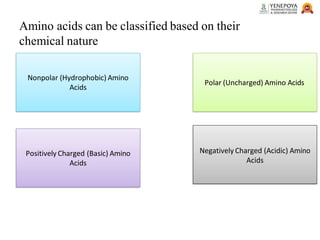
Amino acids can be classified based on their
chemical nature
Nonpolar (Hydrophobic) Amino
Acids
Polar (Uncharged) Amino Acids
Negatively Charged (Acidic) Amino
Acids
Positively Charged (Basic) Amino
Acids
Nonpolar (Hydrophobic)Amino Acid
• Characteristics: These amino acids have hydrophobic
nonpolar side chains, meaning they do not interact well with
water. They tend to be located in the interior of proteins.
Examples:
• Aliphatic: Glycine, Alanine, Valine, Leucine,
Isoleucine, Proline
• Sulfur-containing: Methionine
• Aromatic: Phenylalanine, Tryptophan
Polar (Uncharged) Amino Acids
Characteristics: These amino acids have side chains that are polar
but uncharged, making them hydrophilic. They can form hydrogen
bonds with water and other polar molecules.
Examples:
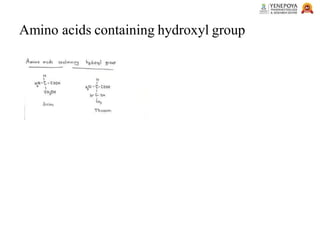
• Hydroxyl-Containing: Serine, Threonine
• Amide-Containing: Asparagine, Glutamine
• Aromatic: Tyrosine (also partially hydrophobic
Positively Charged (Basic) Amino Acids
• Characteristics: These amino acids have side chains that are
positively charged at physiological pH, making them basic.
They often participate in interactions with negatively charged
molecules.
• Examples: Lysine, Arginine, Histidine (Histidine is slightly
less basic and can be neutral at certain pH levels)
Negatively Charged (Acidic)Amino Acids
• Characteristics: These amino acids have side chains that are
negatively charged at physiological pH, making them acidic.
They often engage in ionic interactions with positively
charged molecules.
• Examples: Aspartic acid, Glutamic acid
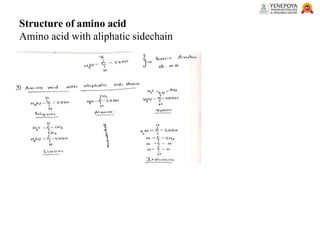
Structure of amino acid
Amino acid with aliphatic sidechain
Amino acids containing aromatic ring
Amino acids with sidechain containing sulphur atom
Amino acids containing hydroxyl group
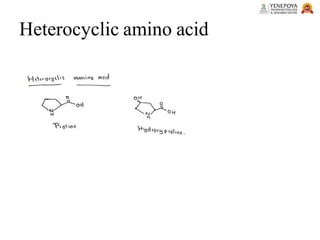
Heterocyclic amino acid
Acidic amino acid
Basic amino acids
Structure of proteins
• Primary structure
• Secondary structure
• Tertiary structure
• Quaternary structure
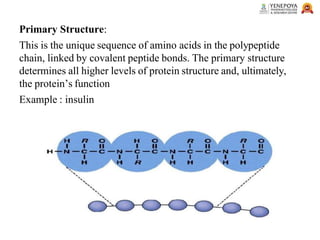
Primary Structure:
This is the unique sequence of amino acids in the polypeptide
chain, linked by covalent peptide bonds. The primary structure
determines all higher levels of protein structure and, ultimately,
the protein’s function
Example : insulin
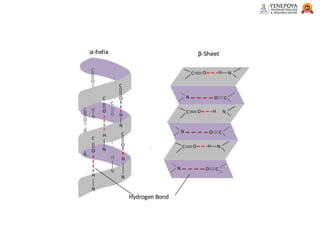
Secondary Structure: This level refers to the local folding
patterns within a polypeptide chain, primarily held together by
hydrogen bonds. The most common secondary structures are:
• Alpha Helix: A coiled structure stabilized by hydrogen bonds
between the carbonyl oxygen of one amino acid and the
amide hydrogen of another
• Beta Sheet:Formed by hydrogen bonding between strands
running parallel or anti-parallel to each other
• Example : Keratin, Fibroin
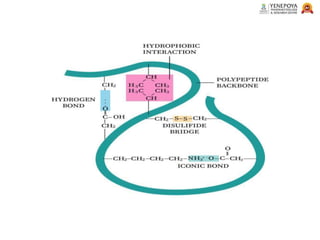
Tertiary Structure:
The tertiary structure of a protein is the three-
dimensional shape formed by the folding and
interactions of its polypeptide chain.
• Stabilized by various interactions: Hydrophobic
interactions
• Hydrogen bonds
• Ionic bonds
• Disulfide bridges
Example : Myoglobin
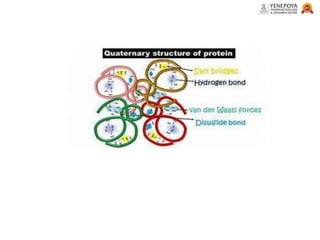
Quaternary Structure:
The quaternary structure of a protein refers to the
arrangement and interactions of multiple polypeptide chains
The arrangement of these subunits is stabilized by the same
forces as the tertiary structure
Example: Hemoglobin, which has four subunits (two α and two
β chains)
The biological role of protein
Source of energy
• Proteins can be broken down to provide energy
• ex: amino acids are converted into glucose through
gluconeogenesis
Structural Role
• Proteins provide structure and support to cells and tissue
• Ex: Collagen: Provides tensile strength to skin, tendons, and
cartilage
• Keratin: A structural component of hair, nails, and the outer
layer of skin
Enzymatic Role
• Proteins act as enzymes to catalyze biochemical
reactions
• Ex:Amylase: Breaks down starch into sugars
Transport and Storage
• Proteins transport molecules across membranes and store
essential molecules
• Ex:Hemoglobin: Transports oxygen in the blood.
• Ferritin: Stores iron in cells.
Hormonal Role
• Proteins function as hormones, acting as chemical
messengers to regulate physiological processes
• Ex:Insulin: Regulates blood glucose levels.
• Glucagon: Stimulates the release of glucose from
glycogen stores
Immune Response
• Proteins play a critical role in defending the body against
pathogen
• Ex: Antibodies: Identify and neutralize foreign
substances like bacteria and viruses
Movement and Motility
• Proteins are involved in muscle contraction and cellular
movement
• Ex: Actin and Myosin: Work together in muscle contraction
Cell Communication
• Proteins function as receptors and signaling molecules in
cellular communication
• Ex: G-protein Coupled Receptors (GPCRs): Transmit
signals across cell membranes.
• Cytokines: Mediate communication between immune cells.
Disease related to malnutrition of proteins
• Kwashiorkor disease
• Marasmus disease
• Nutritional oedema
Kwashiorkor disease
• It is a protein deficiency disease occurring commonly in
children
• It is a qualitative and quantitative deficiency of
proteins
Causes
Large family size
Poor health of the mother
Premature termination of breastfeeding Poor
environmental condition
Delayed supplementary feeding
Use of diluted cow milk to infants
Symptoms
• Retard growth
• Changes or alterations in pigmentation of skin and hair
• Enlargement of liver
• Hypoalbuminemia(low levels of albumin in the blood)
• GIT disturbance
• Psychic changes
• Hypoglycaemia
• Stools containing a much higher quantity of digested food
• Anaemia
Treatment
• Supply of diet rich in protein
• First choice milk and egg, soybean, meat, seafood
• In severe conditions blood transfusion is required
Marasmus disease
• It is a protein deficiency disease commonly found in infants
below 1 year of age
Causes
• It is caused by a deficiency of proteins and carbohydrates
with some other nutritional factors
• Protein and energy deficiency disease of such type is also known
as marasmic kwashiorkor
• Absence of maintaining a proper diet
• Early stop breastfeeding
Symptoms
• Retard growth
• Complete loss of body fat
• Changes in the texture of skin
• Alteration in pigmentation of skin and hair
• GIT disturbances
• Oedema
Treatment
Providing a diet rich in calories
Providing protein diet
Nutritional oedema
This is a disease caused by prolonged and significant protein
deficiency commonly found in adults
Symptoms
• Loss of body weight
• Reduced subcutaneous fat
• Anaemia
• Much higher susceptibility to the infection
• General lethargy
• Increase in frequency of watery stools
• Inability to carry out sustained work
• oedema
Treatments
• The diet consisting mainly of milk, milk products, eggs
and soyabean is given
• It is always better to adopt preventive action by
regulating protein content of the daily diet
Reference
V.N raje, Biochemistry and clinical pathology-3rd edition
Proteins: Classification, Structure, and Biological Roles

Proteins: Classification, Structure, and Biological Roles

  • 1.
    A Constituent Collegeof Yenepoya (Deemed to be University) Naringana, Mangaluru Proteins Ms.Sajini Assistant professor Department of Pharmaceutical chemistry
  • 2.
    Table of content •Definition, and classification of protein • Definition and classification of amino acids • Structure of proteins • Biological role of protein and aminoacids • Disease related to malnutrition of proteins
  • 3.
    Introduction Proteins are naturallyoccurring polymers made up of amino acids linked together by peptide bonds (-CONH-) having high molecular weight found in all living cells
  • 4.
    Classification of protein Proteins Conjugated proteins Derivedproteins Simple proteins Albumin Globulin Glutelin Prolamines Scleroproteins Histones Nucleoproteins Phosphoproteins Glycoproteins Prophyrinoproteins Lipoproteins Flavoproteins metalloproteins Primary derived proteins Eg. Myosin, fibrin, coagulated albumin Secondary derived proteins Globular proteins Eg, insulin, globulin, albumin Fibrous proteins, eg, keratin, fibrin, collagen
  • 5.
    Proteins can beclassified based on their composition and solubility into the following major categories Simple Proteins (Homoproteins) Composition: These proteins are composed only of amino acids or their derivatives Solubility: Their solubility can vary depending on the specific protein but can be broadly categorized into: Albumins: Soluble in water and dilute salt solutions (e.g., serum albumin) Globulins: Soluble in dilute salt solutions but insoluble in pure water (e.g., immunoglobulin s) Glutelins: Soluble in dilute acids or bases, insoluble in water (e.g., gluten in wheat Prolamins: Soluble in 70– 80% ethanol, insoluble in water (e.g., gliadin in wheat) Scleroproteins (Fibrous proteins): Insoluble in water and resistant to digestive enzymes (e.g., collagen, keratin)
  • 6.
    Conjugated Proteins (Heteroproteins): Composition:These proteins consist of amino acids combined with a non-protein prosthetic group. The type of prosthetic group influences solubility. Phosphoprot eins: Contain phosphate groups, generally soluble (e.g., casein) Chromoprotei ns: Contain pigmented prosthetic groups (e.g., hemoglobin is soluble in water) Metalloprotei ns: Contain metal ions, typically soluble (e.g., ferritin) Nucleoprot eins: Contain nucleic acids, often soluble (e.g., ribosomes) Lipoproteins: Contain lipid groups, vary in solubility depending on the lipid content (e.g., HDL, LDL). Glycoproteins : Contain carbohydrate groups, typically soluble (e.g., mucins)
  • 7.
    Derived Proteins: Composition: Theseproteins result from the hydrolysis or partial breakdown of simple or conjugated proteins. Secondary derived proteins: Completely broken down products like peptones and peptides, often more soluble than the original protein Primary derived proteins: Slightly changed from the native protein, like denatured proteins, and can vary in solubility
  • 8.
    Fibrous vs. GlobularProteins (Based on structure and solubility): Fibrous Proteins: Composition: Long, thread-like structures. Solubility: Insoluble in water and organic solvents (e.g., collagen, keratin). Globular Proteins: Composition: Spherical, compact structures. Solubility: Usually soluble in water or aqueous solutions (e.g., enzymes, hemoglobin)
  • 9.
    Classification of aminoacids Amino acid are the monomers of proteins having an amino and carboxyl group attached to the same carbon atom
  • 11.
    Amino acid classifiedinto three groups Neutral amino acids Glycine Alanine Valine Leucine Serine Basic amino acid Lysine Arginine Histidine Acidic amino acid Aspartic acid Glutamic acid According to dietary value Essential amino acids Leucine Isoleucine Arginine Non essential amino acids Alanine Glycine tyrosine Aliphatic amino acids Glycine Alanine Aromatic amino acids Phenyl alanine Tyrosine Tryptophan Sulphur amino acids Cysteine methionine
  • 12.
    • Neutral AminoAcids: Their side chains do not ionize at physiological pH • BasicAmino Acids: They have positively charged side chains at physiological pH • AcidicAmino Acids: They carry negatively charged side chains due to the loss of protons from carboxyl groups
  • 13.
    • AliphaticAmino Acids:Have simple, non-polar side chains with only carbon and hydrogen atoms. • Aromatic Amino Acids: Contain aromatic rings in their side chains • Sulfur-ContainingAmino Acids: Include sulfur atoms, playing roles in protein structure (cysteine) or serving as important functional groups (methionine).
  • 14.
    Essential Amino Acids: •These cannot be synthesized by the human body and must be obtained through the diet. They are crucial for protein synthesis and overall health • Leucine • Isoleucine • Arginine Non-Essential Amino Acids: • These amino acids can be synthesized by the body and do not need to come from the diet. • Alanine • Glycine • tyrosine
  • 15.
    Amino acids canbe classified based on their chemical nature Nonpolar (Hydrophobic) Amino Acids Polar (Uncharged) Amino Acids Negatively Charged (Acidic) Amino Acids Positively Charged (Basic) Amino Acids
  • 16.
    Nonpolar (Hydrophobic)Amino Acid •Characteristics: These amino acids have hydrophobic nonpolar side chains, meaning they do not interact well with water. They tend to be located in the interior of proteins. Examples: • Aliphatic: Glycine, Alanine, Valine, Leucine, Isoleucine, Proline • Sulfur-containing: Methionine • Aromatic: Phenylalanine, Tryptophan
  • 17.
    Polar (Uncharged) AminoAcids Characteristics: These amino acids have side chains that are polar but uncharged, making them hydrophilic. They can form hydrogen bonds with water and other polar molecules. Examples: • Hydroxyl-Containing: Serine, Threonine • Amide-Containing: Asparagine, Glutamine • Aromatic: Tyrosine (also partially hydrophobic
  • 18.
    Positively Charged (Basic)Amino Acids • Characteristics: These amino acids have side chains that are positively charged at physiological pH, making them basic. They often participate in interactions with negatively charged molecules. • Examples: Lysine, Arginine, Histidine (Histidine is slightly less basic and can be neutral at certain pH levels)
  • 19.
    Negatively Charged (Acidic)AminoAcids • Characteristics: These amino acids have side chains that are negatively charged at physiological pH, making them acidic. They often engage in ionic interactions with positively charged molecules. • Examples: Aspartic acid, Glutamic acid
  • 20.
    Structure of aminoacid Amino acid with aliphatic sidechain
  • 21.
  • 22.
    Amino acids withsidechain containing sulphur atom
  • 23.
    Amino acids containinghydroxyl group
  • 24.
  • 25.
  • 26.
  • 27.
    Structure of proteins •Primary structure • Secondary structure • Tertiary structure • Quaternary structure
  • 28.
    Primary Structure: This isthe unique sequence of amino acids in the polypeptide chain, linked by covalent peptide bonds. The primary structure determines all higher levels of protein structure and, ultimately, the protein’s function Example : insulin
  • 29.
    Secondary Structure: Thislevel refers to the local folding patterns within a polypeptide chain, primarily held together by hydrogen bonds. The most common secondary structures are: • Alpha Helix: A coiled structure stabilized by hydrogen bonds between the carbonyl oxygen of one amino acid and the amide hydrogen of another • Beta Sheet:Formed by hydrogen bonding between strands running parallel or anti-parallel to each other • Example : Keratin, Fibroin
  • 31.
    Tertiary Structure: The tertiarystructure of a protein is the three- dimensional shape formed by the folding and interactions of its polypeptide chain. • Stabilized by various interactions: Hydrophobic interactions • Hydrogen bonds • Ionic bonds • Disulfide bridges Example : Myoglobin
  • 33.
    Quaternary Structure: The quaternarystructure of a protein refers to the arrangement and interactions of multiple polypeptide chains The arrangement of these subunits is stabilized by the same forces as the tertiary structure Example: Hemoglobin, which has four subunits (two α and two β chains)
  • 35.
    The biological roleof protein Source of energy • Proteins can be broken down to provide energy • ex: amino acids are converted into glucose through gluconeogenesis Structural Role • Proteins provide structure and support to cells and tissue • Ex: Collagen: Provides tensile strength to skin, tendons, and cartilage • Keratin: A structural component of hair, nails, and the outer layer of skin
  • 36.
    Enzymatic Role • Proteinsact as enzymes to catalyze biochemical reactions • Ex:Amylase: Breaks down starch into sugars Transport and Storage • Proteins transport molecules across membranes and store essential molecules • Ex:Hemoglobin: Transports oxygen in the blood. • Ferritin: Stores iron in cells.
  • 37.
    Hormonal Role • Proteinsfunction as hormones, acting as chemical messengers to regulate physiological processes • Ex:Insulin: Regulates blood glucose levels. • Glucagon: Stimulates the release of glucose from glycogen stores Immune Response • Proteins play a critical role in defending the body against pathogen • Ex: Antibodies: Identify and neutralize foreign substances like bacteria and viruses
  • 38.
    Movement and Motility •Proteins are involved in muscle contraction and cellular movement • Ex: Actin and Myosin: Work together in muscle contraction Cell Communication • Proteins function as receptors and signaling molecules in cellular communication • Ex: G-protein Coupled Receptors (GPCRs): Transmit signals across cell membranes. • Cytokines: Mediate communication between immune cells.
  • 39.
    Disease related tomalnutrition of proteins • Kwashiorkor disease • Marasmus disease • Nutritional oedema
  • 40.
    Kwashiorkor disease • Itis a protein deficiency disease occurring commonly in children • It is a qualitative and quantitative deficiency of proteins Causes Large family size Poor health of the mother Premature termination of breastfeeding Poor environmental condition Delayed supplementary feeding Use of diluted cow milk to infants
  • 41.
    Symptoms • Retard growth •Changes or alterations in pigmentation of skin and hair • Enlargement of liver • Hypoalbuminemia(low levels of albumin in the blood) • GIT disturbance • Psychic changes • Hypoglycaemia • Stools containing a much higher quantity of digested food • Anaemia
  • 42.
    Treatment • Supply ofdiet rich in protein • First choice milk and egg, soybean, meat, seafood • In severe conditions blood transfusion is required
  • 43.
    Marasmus disease • Itis a protein deficiency disease commonly found in infants below 1 year of age Causes • It is caused by a deficiency of proteins and carbohydrates with some other nutritional factors • Protein and energy deficiency disease of such type is also known as marasmic kwashiorkor • Absence of maintaining a proper diet • Early stop breastfeeding
  • 44.
    Symptoms • Retard growth •Complete loss of body fat • Changes in the texture of skin • Alteration in pigmentation of skin and hair • GIT disturbances • Oedema Treatment Providing a diet rich in calories Providing protein diet
  • 45.
    Nutritional oedema This isa disease caused by prolonged and significant protein deficiency commonly found in adults Symptoms • Loss of body weight • Reduced subcutaneous fat • Anaemia • Much higher susceptibility to the infection • General lethargy • Increase in frequency of watery stools • Inability to carry out sustained work • oedema
  • 46.
    Treatments • The dietconsisting mainly of milk, milk products, eggs and soyabean is given • It is always better to adopt preventive action by regulating protein content of the daily diet
  • 47.
    Reference V.N raje, Biochemistryand clinical pathology-3rd edition