Comprehensive Database Assessment with a
Small Staff
Who am I?
Courtney Fuson
– Electronic & Educational Resources
Librarian
– Belmont University
@library_chic
courtney.fuson@belmont.edu
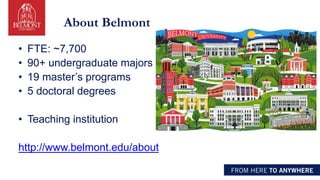
About Belmont
• FTE: ~7,700
• 90+ undergraduate majors
• 19 master’s programs
• 5 doctoral degrees
• Teaching institution
http://www.belmont.edu/about
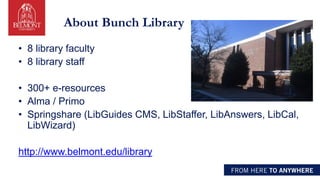
About Bunch Library
• 8 library faculty
• 8 library staff
• 300+ e-resources
• Alma / Primo
• Springshare (LibGuides CMS, LibStaffer, LibAnswers, LibCal,
LibWizard)
http://www.belmont.edu/library
Changes in the Library
• Library director stepped down December 2015
• New Chief Information Officer for campus arrived January
2016
• Went live on Alma/Primo in May 2016
• New library director appointed Summer 2016
• Maternity leave – January to May 2017
Changes in the Library
• Comprehensive serials review (P+E)– Fall 2016
• New allocations model in Fall 2016
• New strategic plan for library – May 2017
• Comprehensive deselection project – Currently in
progress
DATABASE ASSESSMENT
Timeline (Library Strategic Plan)
• “Phase 1” – Summer 2018
• Complete – Fall 2018
My Initial Timeline
1. Create assessment criteria - Summer 2017
2. Gather data needed by criteria - Fall 2017
3. Put data into useable format for assessment - Fall 2017 / Winter
Break
4. Create team to perform assessment - Spring 2018
5. Perform assessment - Spring 2018
6. Solicit faculty feedback on assessment results (databases marked
for cancellation; collection gaps identified?) - Spring 2018
7. Finalize list of core resources that will be reviewed every 3 years -
Spring 2018
8. Begin cancellation process for marked resources - Summer 2018
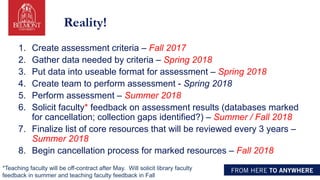
Reality!
1. Create assessment criteria – Fall 2017
2. Gather data needed by criteria – Spring 2018
3. Put data into useable format for assessment – Spring 2018
4. Create team to perform assessment - Spring 2018
5. Perform assessment – Summer 2018
6. Solicit faculty* feedback on assessment results (databases marked
for cancellation; collection gaps identified?) – Summer / Fall 2018
7. Finalize list of core resources that will be reviewed every 3 years –
Summer 2018
8. Begin cancellation process for marked resources – Fall 2018
*Teaching faculty will be off-contract after May. Will solicit library faculty
feedback in summer and teaching faculty feedback in Fall
Literature Review
• Combined projects
– Database Purchase Approval
– Database Assessment
• Criteria list
• Data desired
• Best practices
Starting References
Bordeaux, Abigail, and Alesia McManus. 2007. “A Collaborative,
Criteria-Based Approach for Electronic Resource Purchase and
Renewals.” Conference presented at the Electronic Resources &
Libraries, Atlanta, GA, February 22.
https://smartech.gatech.edu/handle/1853/13615.
Foudy, Gerri, and Alesia McManus. 2005. “Using a Decision Grid
Process to Build Consensus in Electronic Resources Cancellation
Decisions.” The Journal of Academic Librarianship 31 (6): 533–538.
Metz, Paul, 1948-, and John Cornelius Cosgriff. 2000. “Building a
Comprehensive Serials Decision Database at Virginia Tech.”
College & Research Libraries 61 (4): 324–34.
Zotero folder: http://bit.ly/2FyOGFD
Criteria
• Initial list included 7 sections with a total of 32 distinct
criteria
• Discussion of the list with the assessment team resulted
in narrowing to 7 sections with 18 distinct criteria
• Data gathering work resulted in further narrowing of
criteria
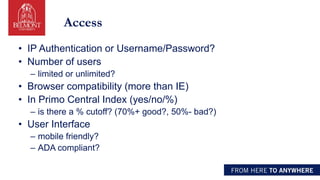
Access
• IP Authentication or Username/Password?
• Number of users
– limited or unlimited?
• Browser compatibility (more than IE)
• In Primo Central Index (yes/no/%)
– is there a % cutoff? (70%+ good?, 50%- bad?)
• User Interface
– mobile friendly?
– ADA compliant?
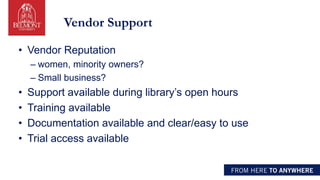
Vendor Support
• Vendor Reputation
– women, minority owners?
– Small business?
• Support available during library’s open hours
• Training available
• Documentation available and clear/easy to use
• Trial access available
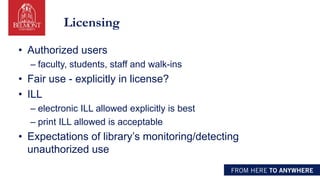
Licensing
• Authorized users
– faculty, students, staff and walk-ins
• Fair use - explicitly in license?
• ILL
– electronic ILL allowed explicitly is best
– print ILL allowed is acceptable
• Expectations of library’s monitoring/detecting
unauthorized use
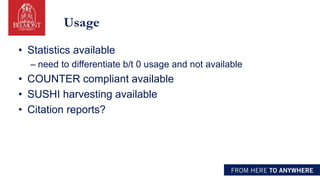
Usage
• Statistics available
– need to differentiate b/t 0 usage and not available
• COUNTER compliant available
• SUSHI harvesting available
• Citation reports?
Cost
• Cost per search
• Average inflation rate
• Current payment
Audience
• # anticipated users / # users affected
• Primary user group(s)
• # searches / year
• # turnaways / year
• Choice (or other professional literature) review?
• A to Z comparison with other Springshare libraries
Uniqueness
• Overlap with other resources
• Curriculum / Accreditation needs
• Research needs
Data Gathering
• Access?
• Excel?
• Airtable?
Data Gathering
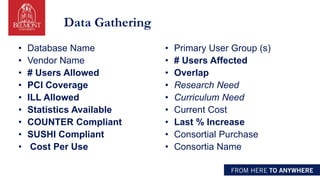
• Database Name
• Vendor Name
• # Users Allowed
• PCI Coverage
• ILL Allowed
• Statistics Available
• COUNTER Compliant
• SUSHI Compliant
• Cost Per Use
• Primary User Group (s)
• # Users Affected
• Overlap
• Research Need
• Curriculum Need
• Current Cost
• Last % Increase
• Consortial Purchase
• Consortia Name
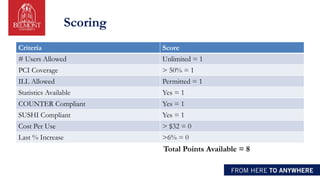
Scoring
Criteria Score
# Users Allowed Unlimited = 1
PCI Coverage > 50% = 1
ILL Allowed Permitted = 1
Statistics Available Yes = 1
COUNTER Compliant Yes = 1
SUSHI Compliant Yes = 1
Cost Per Use > $32 = 0
Last % Increase >6% = 0
Total Points Available = 8
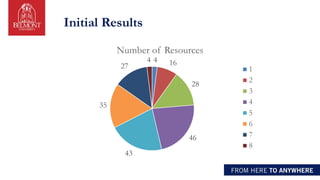
Initial Results
[CELLRANGE]
[CELLRANGE]
[CELLRANGE]
[CELLRANGE]
[CELLRANGE]
[CELLRANGE]
[CELLRANGE]
[CELLRANGE]
0
5
10
15
20
25
30
35
40
45
50
1 2 3 4 5 6 7 8
Number
of
Resources
Total Score
Initial Results
4 16
28
46
43
35
27
4
Number of Resources
1
2
3
4
5
6
7
8
What’s Next?
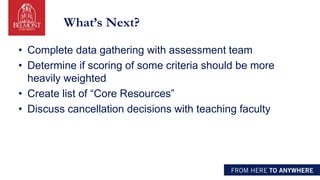
• Complete data gathering with assessment team
• Determine if scoring of some criteria should be more
heavily weighted
• Create list of “Core Resources”
• Discuss cancellation decisions with teaching faculty
Lessons Learned
• A master list of resources still doesn’t exist
• So many resources have incomplete information!
• Everything takes longer than you think it will.

Comprehensive Database Assessment with a Small Staff.pptx

  • 1.
  • 2.
    Who am I? CourtneyFuson – Electronic & Educational Resources Librarian – Belmont University @library_chic courtney.fuson@belmont.edu
  • 3.
    About Belmont • FTE:~7,700 • 90+ undergraduate majors • 19 master’s programs • 5 doctoral degrees • Teaching institution http://www.belmont.edu/about
  • 4.
    About Bunch Library •8 library faculty • 8 library staff • 300+ e-resources • Alma / Primo • Springshare (LibGuides CMS, LibStaffer, LibAnswers, LibCal, LibWizard) http://www.belmont.edu/library
  • 5.
    Changes in theLibrary • Library director stepped down December 2015 • New Chief Information Officer for campus arrived January 2016 • Went live on Alma/Primo in May 2016 • New library director appointed Summer 2016 • Maternity leave – January to May 2017
  • 6.
    Changes in theLibrary • Comprehensive serials review (P+E)– Fall 2016 • New allocations model in Fall 2016 • New strategic plan for library – May 2017 • Comprehensive deselection project – Currently in progress
  • 7.
  • 8.
    Timeline (Library StrategicPlan) • “Phase 1” – Summer 2018 • Complete – Fall 2018
  • 9.
    My Initial Timeline 1.Create assessment criteria - Summer 2017 2. Gather data needed by criteria - Fall 2017 3. Put data into useable format for assessment - Fall 2017 / Winter Break 4. Create team to perform assessment - Spring 2018 5. Perform assessment - Spring 2018 6. Solicit faculty feedback on assessment results (databases marked for cancellation; collection gaps identified?) - Spring 2018 7. Finalize list of core resources that will be reviewed every 3 years - Spring 2018 8. Begin cancellation process for marked resources - Summer 2018
  • 10.
    Reality! 1. Create assessmentcriteria – Fall 2017 2. Gather data needed by criteria – Spring 2018 3. Put data into useable format for assessment – Spring 2018 4. Create team to perform assessment - Spring 2018 5. Perform assessment – Summer 2018 6. Solicit faculty* feedback on assessment results (databases marked for cancellation; collection gaps identified?) – Summer / Fall 2018 7. Finalize list of core resources that will be reviewed every 3 years – Summer 2018 8. Begin cancellation process for marked resources – Fall 2018 *Teaching faculty will be off-contract after May. Will solicit library faculty feedback in summer and teaching faculty feedback in Fall
  • 11.
    Literature Review • Combinedprojects – Database Purchase Approval – Database Assessment • Criteria list • Data desired • Best practices
  • 12.
    Starting References Bordeaux, Abigail,and Alesia McManus. 2007. “A Collaborative, Criteria-Based Approach for Electronic Resource Purchase and Renewals.” Conference presented at the Electronic Resources & Libraries, Atlanta, GA, February 22. https://smartech.gatech.edu/handle/1853/13615. Foudy, Gerri, and Alesia McManus. 2005. “Using a Decision Grid Process to Build Consensus in Electronic Resources Cancellation Decisions.” The Journal of Academic Librarianship 31 (6): 533–538. Metz, Paul, 1948-, and John Cornelius Cosgriff. 2000. “Building a Comprehensive Serials Decision Database at Virginia Tech.” College & Research Libraries 61 (4): 324–34. Zotero folder: http://bit.ly/2FyOGFD
  • 13.
    Criteria • Initial listincluded 7 sections with a total of 32 distinct criteria • Discussion of the list with the assessment team resulted in narrowing to 7 sections with 18 distinct criteria • Data gathering work resulted in further narrowing of criteria
  • 14.
    Access • IP Authenticationor Username/Password? • Number of users – limited or unlimited? • Browser compatibility (more than IE) • In Primo Central Index (yes/no/%) – is there a % cutoff? (70%+ good?, 50%- bad?) • User Interface – mobile friendly? – ADA compliant?
  • 15.
    Vendor Support • VendorReputation – women, minority owners? – Small business? • Support available during library’s open hours • Training available • Documentation available and clear/easy to use • Trial access available
  • 16.
    Licensing • Authorized users –faculty, students, staff and walk-ins • Fair use - explicitly in license? • ILL – electronic ILL allowed explicitly is best – print ILL allowed is acceptable • Expectations of library’s monitoring/detecting unauthorized use
  • 17.
    Usage • Statistics available –need to differentiate b/t 0 usage and not available • COUNTER compliant available • SUSHI harvesting available • Citation reports?
  • 18.
    Cost • Cost persearch • Average inflation rate • Current payment
  • 19.
    Audience • # anticipatedusers / # users affected • Primary user group(s) • # searches / year • # turnaways / year • Choice (or other professional literature) review? • A to Z comparison with other Springshare libraries
  • 20.
    Uniqueness • Overlap withother resources • Curriculum / Accreditation needs • Research needs
  • 21.
    Data Gathering • Access? •Excel? • Airtable?
  • 22.
    Data Gathering • DatabaseName • Vendor Name • # Users Allowed • PCI Coverage • ILL Allowed • Statistics Available • COUNTER Compliant • SUSHI Compliant • Cost Per Use • Primary User Group (s) • # Users Affected • Overlap • Research Need • Curriculum Need • Current Cost • Last % Increase • Consortial Purchase • Consortia Name
  • 23.
    Scoring Criteria Score # UsersAllowed Unlimited = 1 PCI Coverage > 50% = 1 ILL Allowed Permitted = 1 Statistics Available Yes = 1 COUNTER Compliant Yes = 1 SUSHI Compliant Yes = 1 Cost Per Use > $32 = 0 Last % Increase >6% = 0 Total Points Available = 8
  • 24.
  • 25.
  • 26.
    What’s Next? • Completedata gathering with assessment team • Determine if scoring of some criteria should be more heavily weighted • Create list of “Core Resources” • Discuss cancellation decisions with teaching faculty
  • 27.
    Lessons Learned • Amaster list of resources still doesn’t exist • So many resources have incomplete information! • Everything takes longer than you think it will.

Editor's Notes

  • #2 This session will review the steps taken to create the assessment protocol used and will include initial results.  The goal of this process is not cancellation, but a strong rationale for why we have each resource.  This comprehensive assessment was created and performed by < 5 people.
  • #3 12 years at Belmont, in current position Job duties include managing library’s website, managing electronic resources (but not electronic journals, and sometimes not ebooks); teaching information literacy, collection management of Education collection, liaison to School of Education Best ways to reach me are via Twitter or via email
  • #4 Small, private, Christian, liberal arts institution Total headcount – 8,012 361 FT faculty; 492 PT faculty Music, Music Business & Health Sciences are the top majors for undergrads; other special interests include UG majors in Music Therapy, Entrepreneurship, Motion Pictures; joint Healthcare MBA + Pharmacy degrees; Master’s in Audio Technology Doctoral degrees include Pharmacy, Physical Therapy, Occupational Therapy, Nursing Practice, Law Focus for faculty is not on research but on teaching – growing emphasis on Scholarship of Teaching & Learning for faculty research, which focuses on the application of research to classroom teaching.
  • #5 Library faculty are degreed librarians who have non-tenure track 12 month faculty contracts. Library director is included, although her contract is different (I think) Nearly equal numbers of ebooks and physical books (~190k ea) Asset Management = 1 librarian + 2 ½ staff E-Resources = Me! (1 librarian) Systems = 1 librarian + ½ staff (+ 1 law library staff)
  • #6 Library reporting moved to the CIO from the Provost at this time; CIO has no previous library experience Previously on Voyager and Serials Solutions – migrated all ERM functions at the same time “New” director was previously the Unit Head for Systems and Collection Management (a position that was not replaced)
  • #7 New director means a change in focus (of sorts) for the library. New director was previously our Collection Management librarian and has focused on updating and improving our collections in addition to improving the patron experience in our library (and online) Criteria and review determined by small committee; results of analysis sent to all faculty for review – kept titles recommended for cancellation on their request (few requests) New allocations model moved from dividing entire library acquisitions budget between all departments to dividing budget between e-resources, subject clusters, and general funds with an emphasis on distributing funds based on demonstrated needs Strategic plan focuses on customer experience and comprehensive collections reviews – for print collection and databases especially Print collection deselection – extensive criteria list; Green Glass data, etc
  • #8 Timeline Criteria Data gathering Assessment
  • #9 Created while I was on maternity leave – very vague, and also flexible
  • #11 Assessment criteria were finalized in October 2017. Then the fall semester happened – I also conduct library instruction sessions in the general education courses and sit at the research desk 2 hours/week. Creating a team was the easy part – Assistant Collection Management Supervisor for Acquisitions; Assistant Supervisor for Electronic Resources, Library Director, and at least one library liaison/faculty librarian *Teaching faculty will be off-contract after May. Will solicit library faculty feedback in summer and teaching faculty in Fall Cancellation will begin only AFTER teaching faculty have had the opportunity to review.
  • #12 Database Purchase Approval – implementation of a new process to gather more upfront information from faculty / librarians about resources being requested in order to better prioritize use of limited funds. Implemented in Fall 2017 – will complete 2nd round of approvals in April. Database Assessment – comprehensive review of all current subscriptions to determine recommendations for cancellation. Primary objective is not cancellation – primary objective is to be able to prove that we are using funds in best possible way to meet needs of students and faculty in order to be able to make a stronger argument to increase library acquisitions budget
  • #13 Many other resources came from these – using works cited, etc to grow research Discovered a hole – nothing has really been published on this topic in the last 10 years or so, or focused on serials and not databases specifically
  • #14 Started with the same list for both projects. Lists were based on research that I had done as well as on my experience. Database Assessment and Database Approval criteria did differentiate
  • #15 IP authentication is not a deal breaker, but a preference Browser compatibility is no longer a real issue for most resources PCI – discoverability! User Interface – no good way to rate this; it is a concern, and will be considered
  • #16 Support, training, and documentation are important, but are not deal breakers, especially for existing resources. More important for new resources. Same for trial access – doesn’t matter for existing resources Vendor identity is important to university – emphasis on using minority-owned businesses for university suppliers However – we are limited in the fact that we don’t have options for many of these resources – the people offering these resources are often the only ones
  • #17 We have had questions about who is an authorized user for some of our resources, but that is not a deal-breaker – most resources allow walk-ins and campus affiliated users Fair use is generally in licenses ILL is not something we have been tracking, and we are often a net lender Detecting unauthorized use is not something that we are able to do, but expectations are not spelled out in licenses beyond “you should not allow unauthorized users”
  • #18 A surprising number of our resources do not collect usage information. Many of them are small vendors who cannot afford to do so. As a stand-in, we will be using asset clicks from LibGuides for those resources Citation reports – this is an interesting idea, but very time and labor intensive – involves finding out where our faculty are citing their sources and seeing if they could be using library resources for those sources or if they have to go outside the university
  • #19 Current payment will be available information, but will not be part of the decision making criteria. Average inflation rate and cost per search are more important.
  • #20 # anticipated users / primary user group information is based on the allocations formula and supply/demand information there # turnaways is not available for all resources Professional reviews not available for all resources Springshare A to Z comparison didn’t work the way I anticipated it would. It may be added in the future because we are interested in ensuring that we have resources comparable to those of other schools of our size/program/caliber
  • #21 Overlap analysis will be done in Alma to see how unique a particular resource truly is. Curriculum needs / accreditation needs – if item is required for accreditation or heavily integrated into curriculum, we will not cancel Integration into curriculum should be reflected in usage information as well, depending on department/classes using resource Research needs – will come from faculty feedback
  • #22 Access kept blowing up on me Excel hates me, but a new computer has helped lessen that Airtable – new, online, bends my brain much like Prezi for presentations Went with Excel – Airtable said I exceeded their free limits with my table, and I’m not as comfortable using Access
  • #23 18 columns of data for final(ish) assessment Bolded columns were used to score each resource 203 resources to score Research Need & Curriculum need will be discussed with faculty and library liaisons
  • #25 Bell curve! This doesn’t mean that we will automatically cancel the resources that scored a 1 or 2, but they will be looked at more closely to see if they simply need more data in order to score better, or if they really should have been in that tier.
  • #26 Same data, but in a pie chart for folks who prefer this kind of visualization
  • #28 Master list of resources? Records are a mess! So many licenses missing! Still incomplete data – consortia information; users affected; research & curricular needs As all good projects do, this one has spawned further projects! Next project: get comprehensive ERM information into Alma. Starting with SUSHI usage information and vendor contact info Need to have discussion with staff about what files we need to digitize and how/where to store them – Alma or elsewhere?