Library
Services
Selecting and Implementing
Library Systems
Andrew Preater
Head of Library Information Systems
@preater #citylis #DigiLibs
Slides and notes
These slides:
http://x.preater.com/citylis
Summary
• What are library systems for?
• How to buy a library system
• Imperial College London case study
Evolution of
the LMS
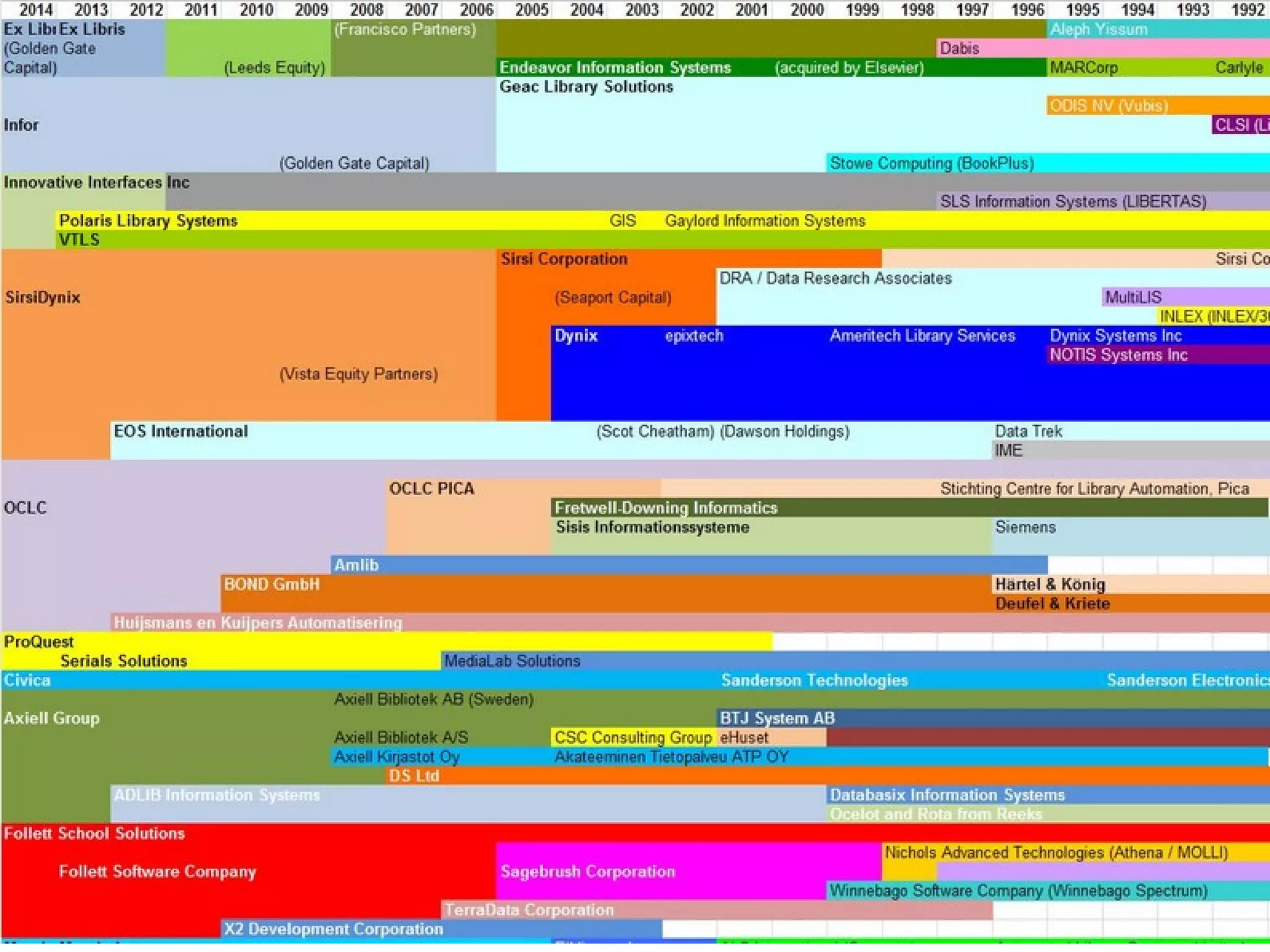
Context: library systems over time
Breeding, M. (2016) Library technology guides. Available at: http://www.librarytechnology.org/
Unified and next-generation library
systems
• Alma
• Intota
• OLE
• Sierra
• WorldShare
Grant, C. (2012) 'The future of library systems: library services
platforms', Information Standards Quarterly, 24(4), pp. 4-8.
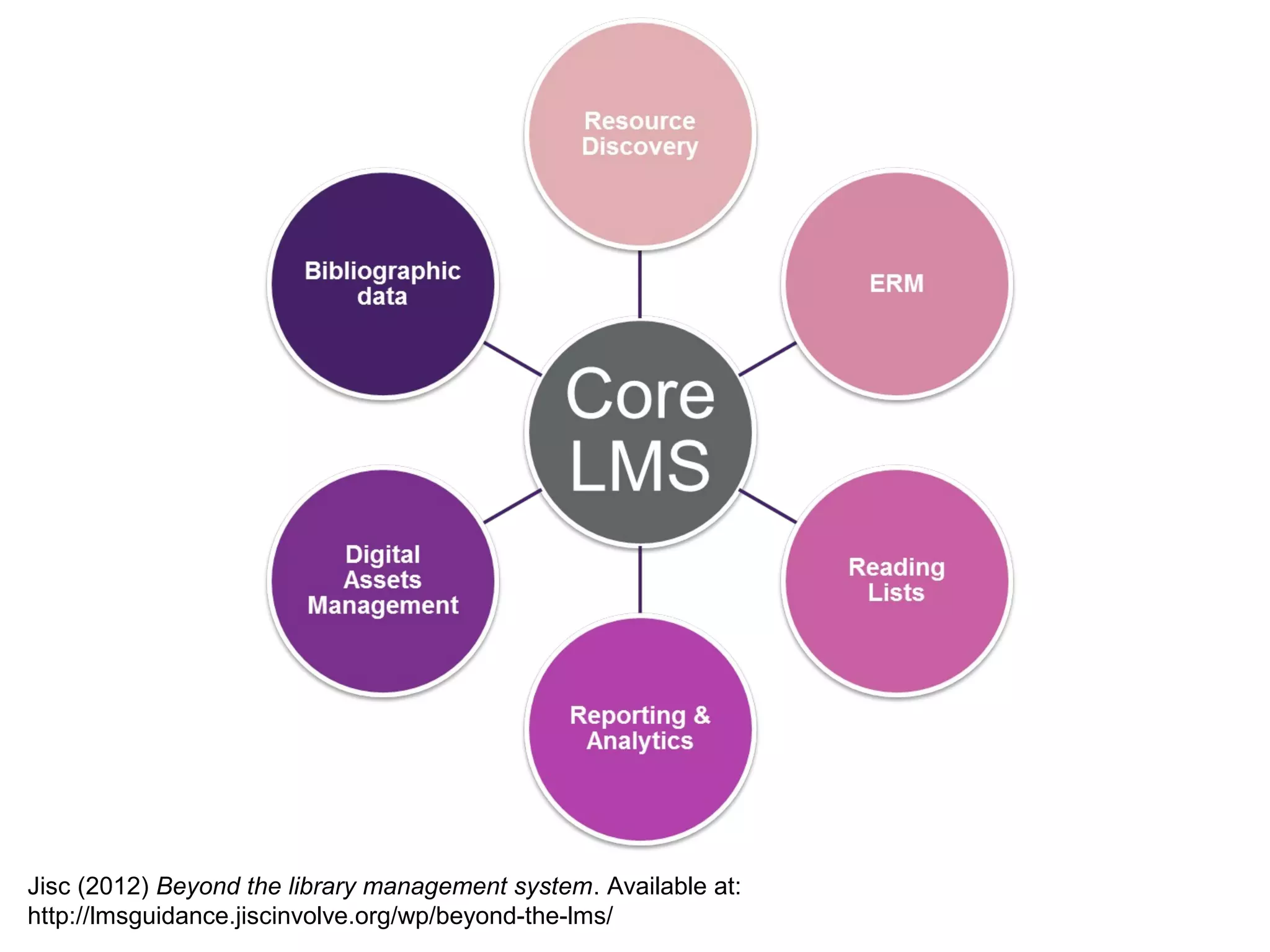
Jisc (2012) Beyond the library management system. Available at:
http://lmsguidance.jiscinvolve.org/wp/beyond-the-lms/
The modern
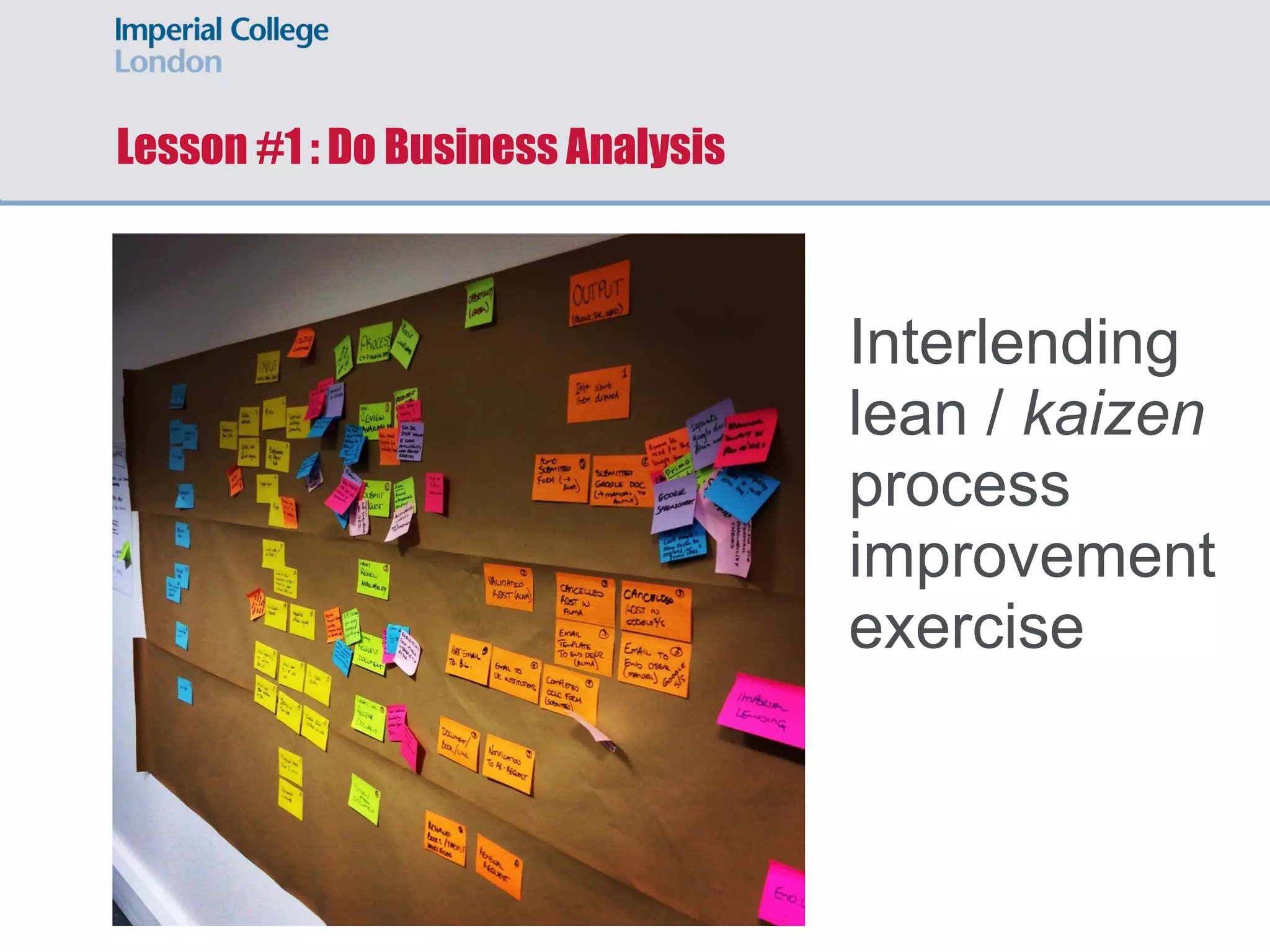
landscape
Chad, K. (2016) Next generation library systems. Available at:
http://helibtech.com/Next+Generation
Jisc (2014) Library systems support and guidance. Available at:
http://lmsguidance.jiscinvolve.org/wp/
Higher education context
Procurement
How we do things
around here
Millstream Associates (2016) Tenders direct. Available at:
http://www.tendersdirect.co.uk
Chad, K. (2015) Procurements. Available at:
http://helibtech.com/Procurements
Case study
Ex Libris Alma
at Imperial
College London
Imperial College London
Library Services context
Library Services: resources
Why did we migrate system?
Time to change from a legacy LMS
Why did we migrate system?
Time to change from legacy LMS
Timed to get value for money
Why did we migrate system?
Time to change from legacy LMS
Timed to get value for money
Wanted integration with existing
Library & College systems
Why did we migrate system?
Time to change from legacy LMS
Timed to get value for money
Wanted integration with existing
Library & College systems
“Future-flexible” system
Objective #1
“To improve user service and enhance student experience”
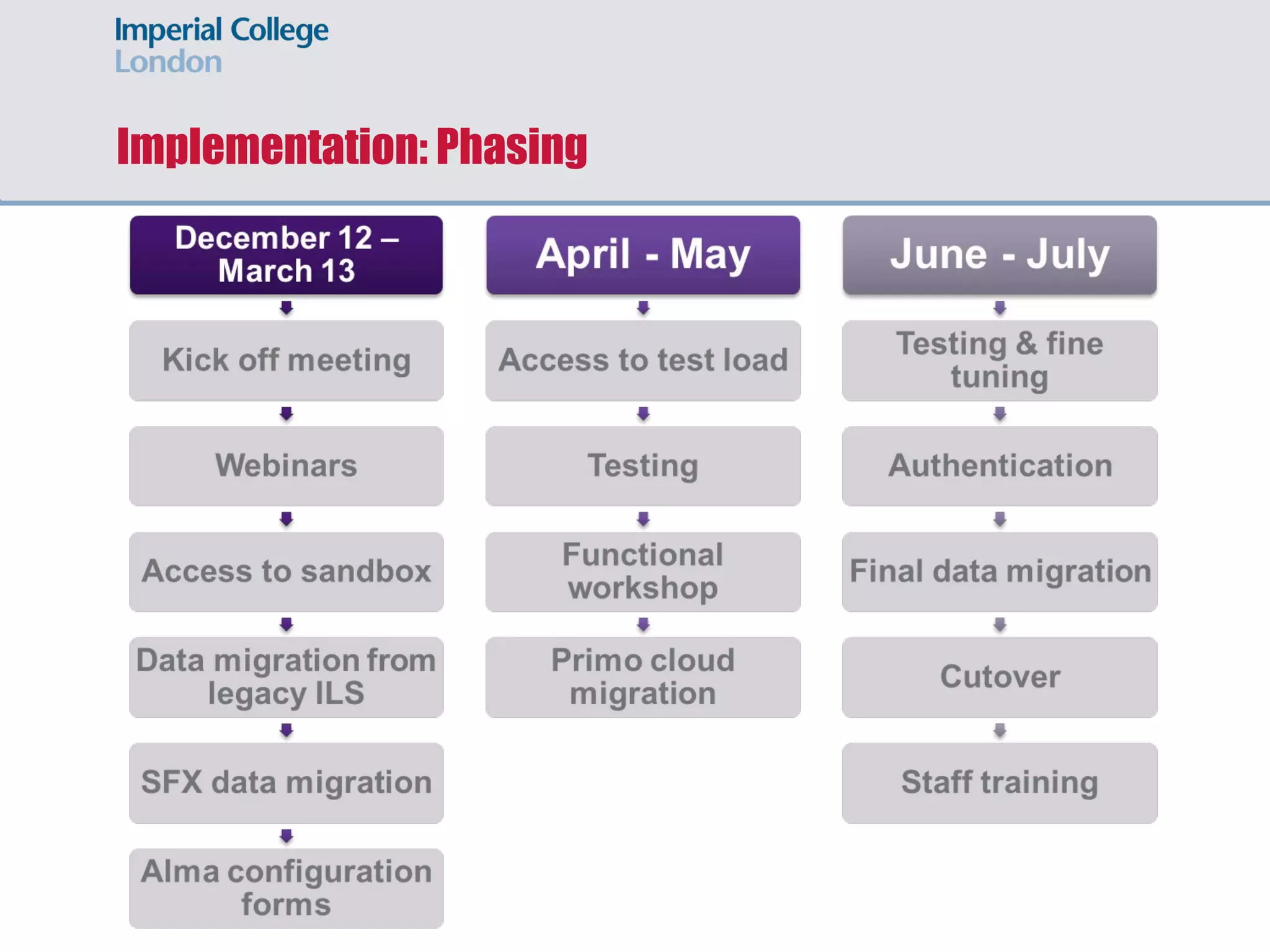
Alma project phasing
Success factors
Print and e-resource workflows
Success factors
Print and e-resource workflows
Review and improve policy and
processes
Success factors
Print and e-resource workflows
Review and improve policy and
processes
Technology platform
Success factors
Print and e-resource workflows
Review and improve policy and
processes
Technology platform
Standardized approach to analytics
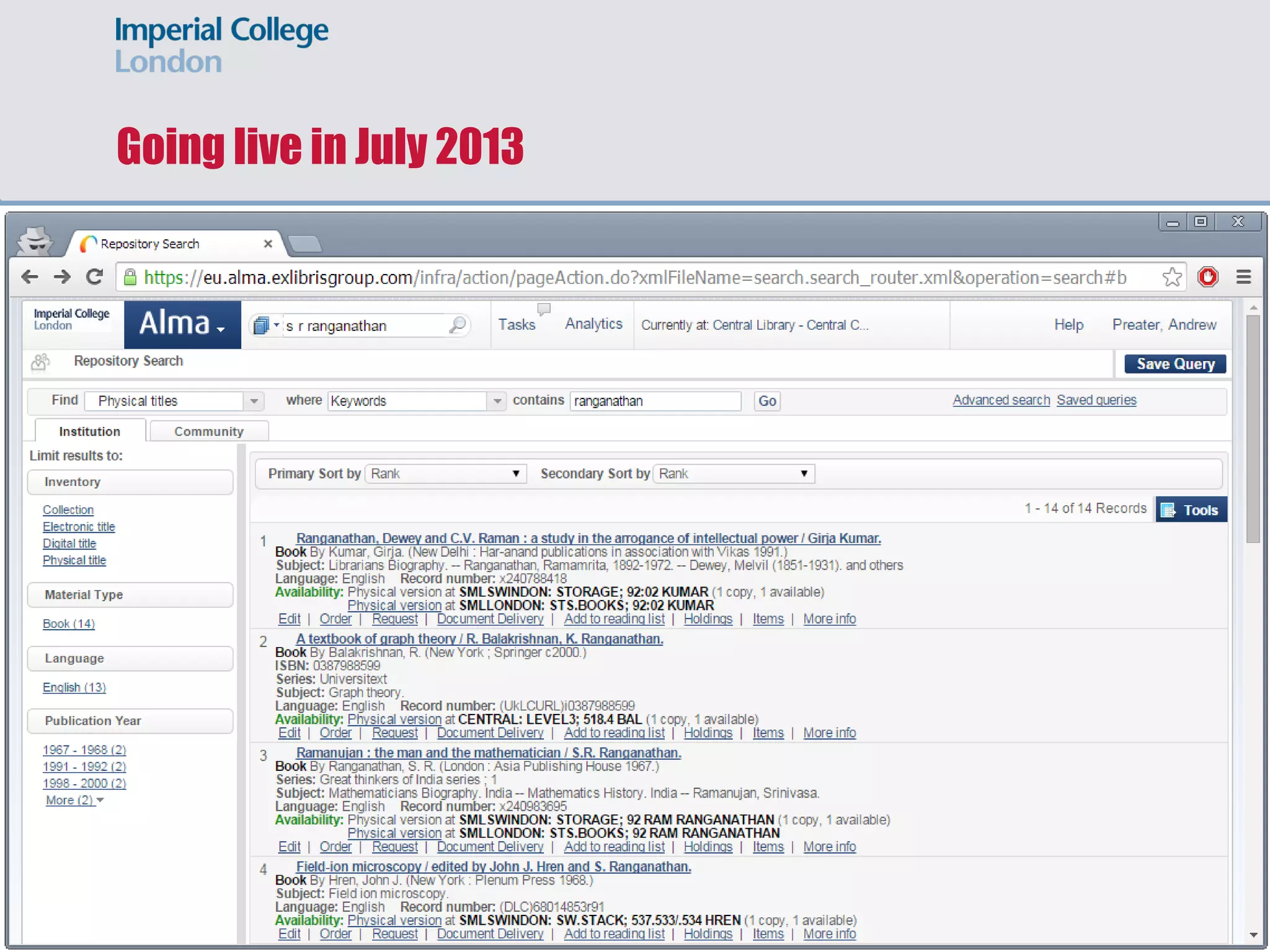
Going live in July 2013
One
•Two
• Three
» Four
 Five
@preater
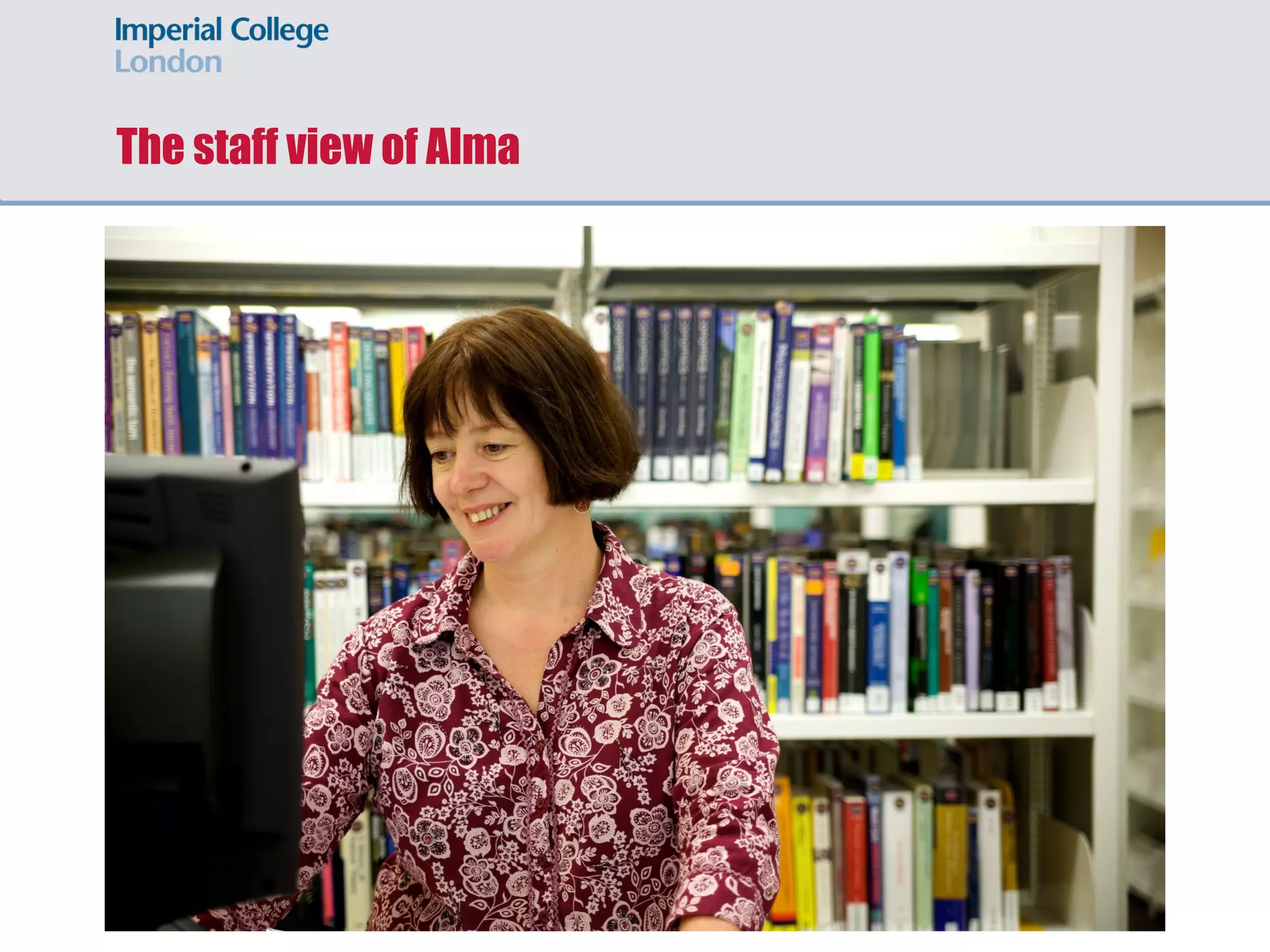
The staff view of Alma
Lessons learned
Do business analysis
Lesson #1 : Do business analysis
Interlending
lean / kaizen
process
improvement
exercise
Lesson #1 : Interlending 2014
33
Lesson #1 : Interlending 2015
“We are also reminded regularly that
even the changes the vendor agrees
to make cause the vendor
inconvenience, and that we should
change our procedures to align with
the technology […] we don't like
being told that we're not doing things
right, from the vendor’s point of view”
- anonymous Alma site
Breeding, M. (2016). ‘Perceptions 2015: An international survey of library automation’. Available at:
http://librarytechnology.org/survey-2015-comments.pl#Alma
Lessons learned
Do business analysis
Rescoping is OK
“Pick any two…”
• Time
• Scope (or quality)
• Resources (or cost)
‘Reality Triangle’ (Walsh)
Scope
TimeResources
Concept from Barry Walsh, University Information
Systems and Financial Management Services,
Indiana University
Lock, D. (2007) The essentials of project management.
3rd edn. Aldershot: Gower.
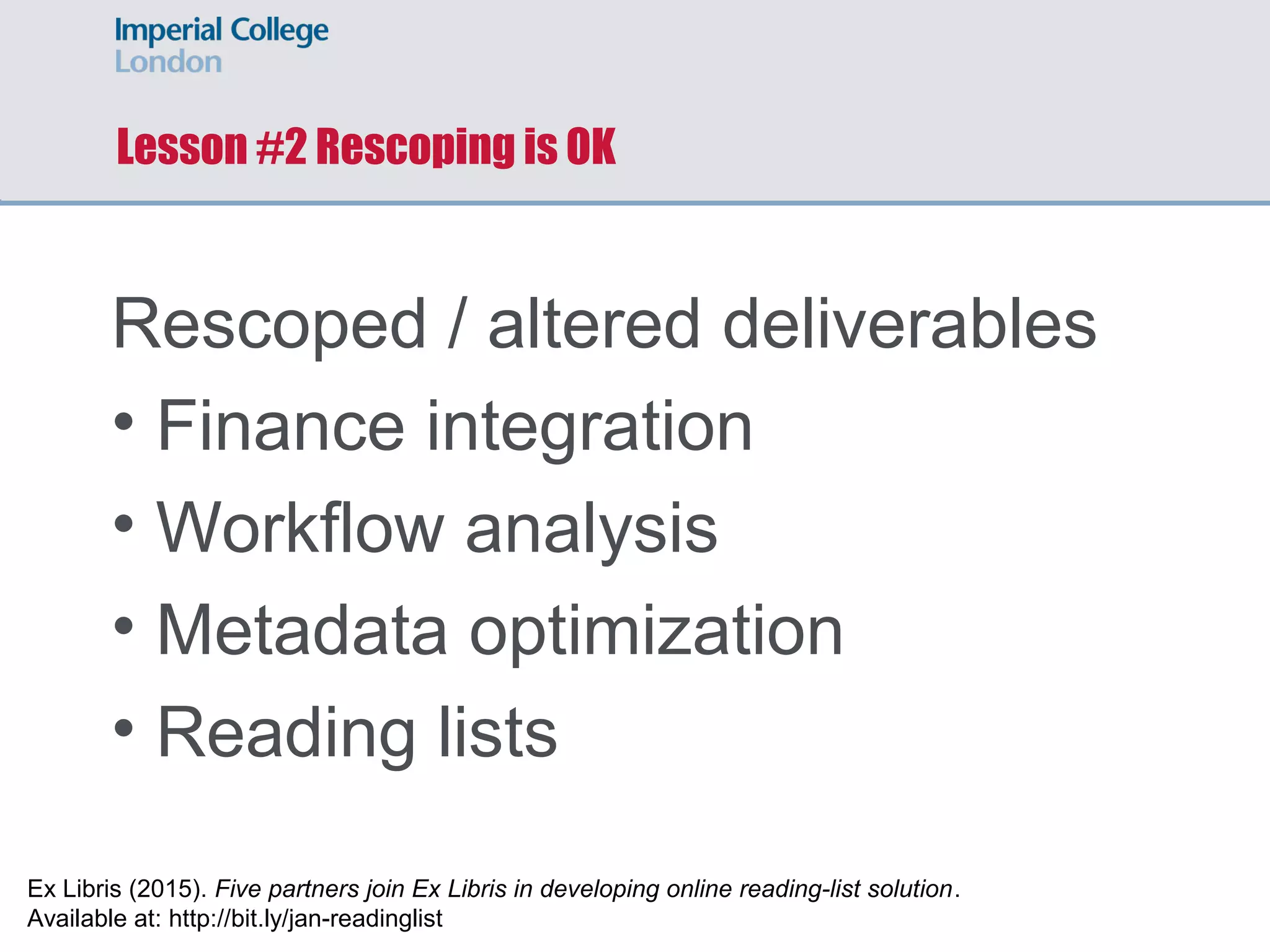
Lesson #2 Rescoped ‘deliverables’
• Finance integration
• Workflow analysis
• Metadata optimization
• Reading lists
Ex Libris (2015). Five partners join Ex Libris in developing online reading-list solution.
Available at: http://bit.ly/jan-readinglist
Lessons learned
Do business analysis
Rescoping is OK
Manage expectations
Chad, K. (2013) Unified resource management system specification. Available at:
http://libtechrfp.wikispaces.com/Unified+library+resource+management+specification
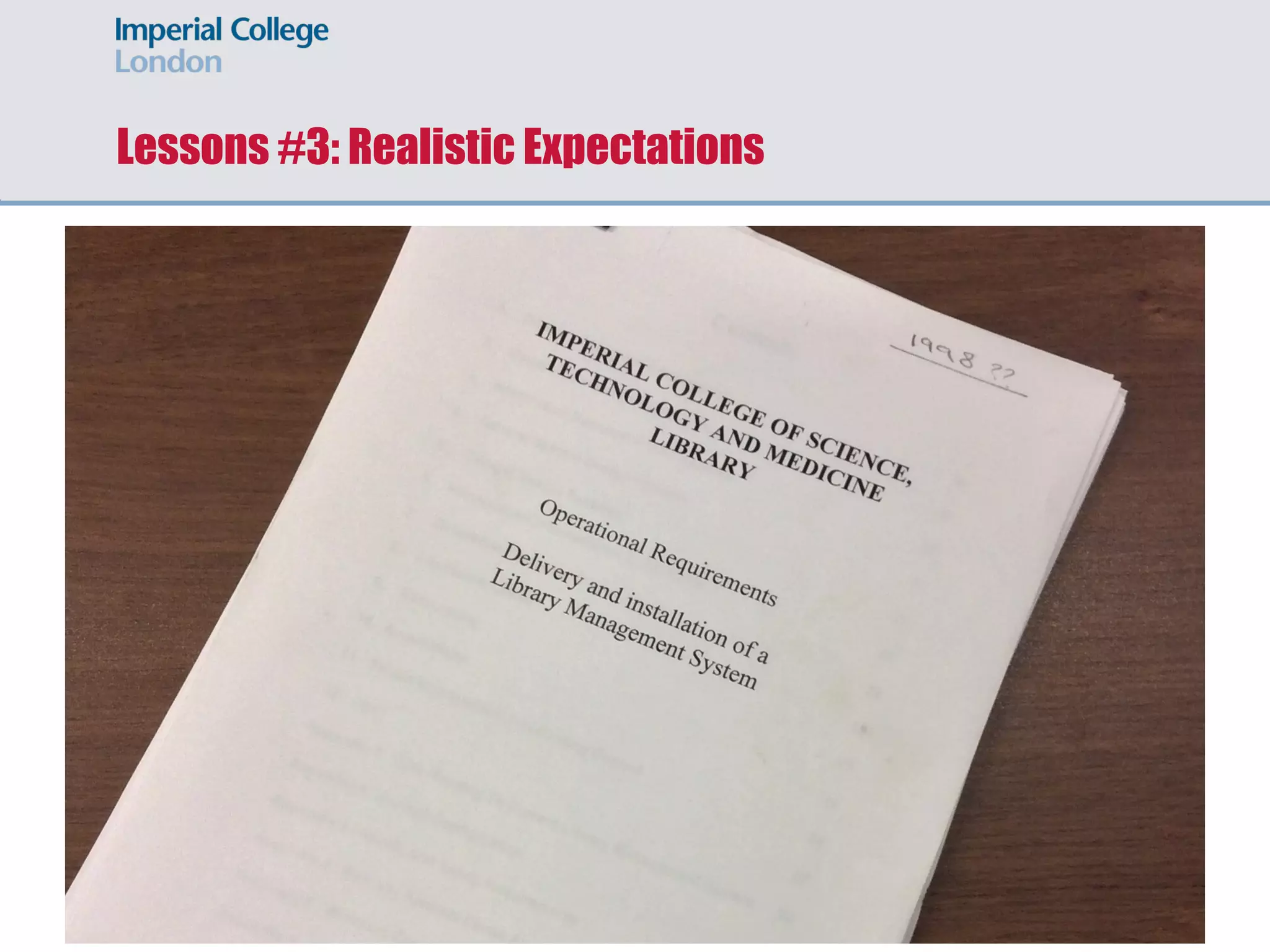
Lessons #3: Manage Expectations
“We view Alma as an immature product
with great potential. Basic functionality is
fairly solid though resource sharing of
materials across the consortium is labor
intensive and wrought with problems.
Analytics and the ability to generate custom
reports or otherwise assess data is very
poorly developed […]”
- anonymous Alma site
Breeding, M. (2016). Perceptions 2015: An international survey of library automation. Available at:
http://librarytechnology.org/survey-2015-comments.pl#Alma
Lessons learned
Do business analysis
Rescoping is OK
Manage expectations
There will be bugs & snags
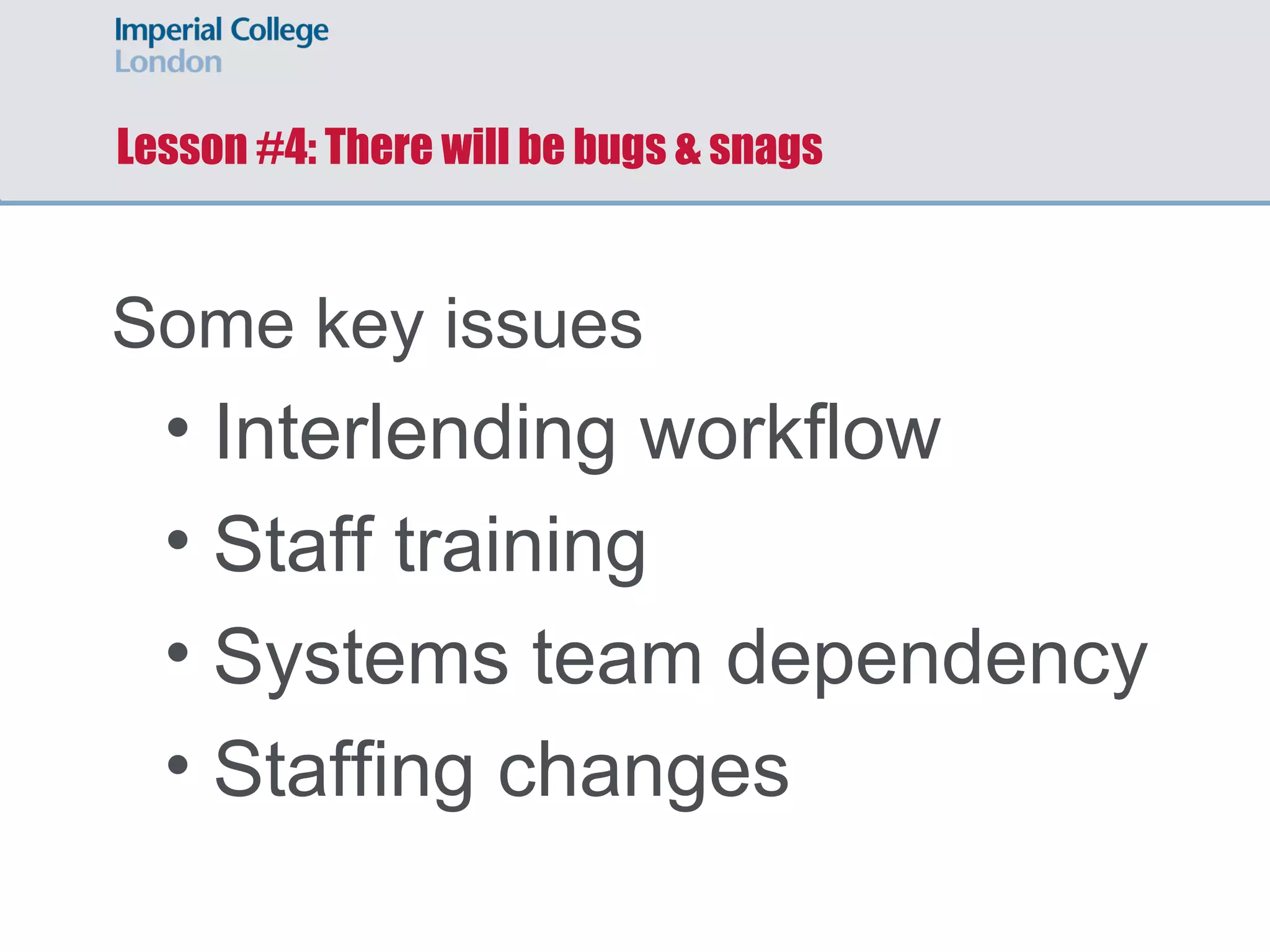
Lesson #4: There will be bugs &
snags
Some key issues
• Interlending workflow
• Staff training
• Systems team dependency
• Staffing changes
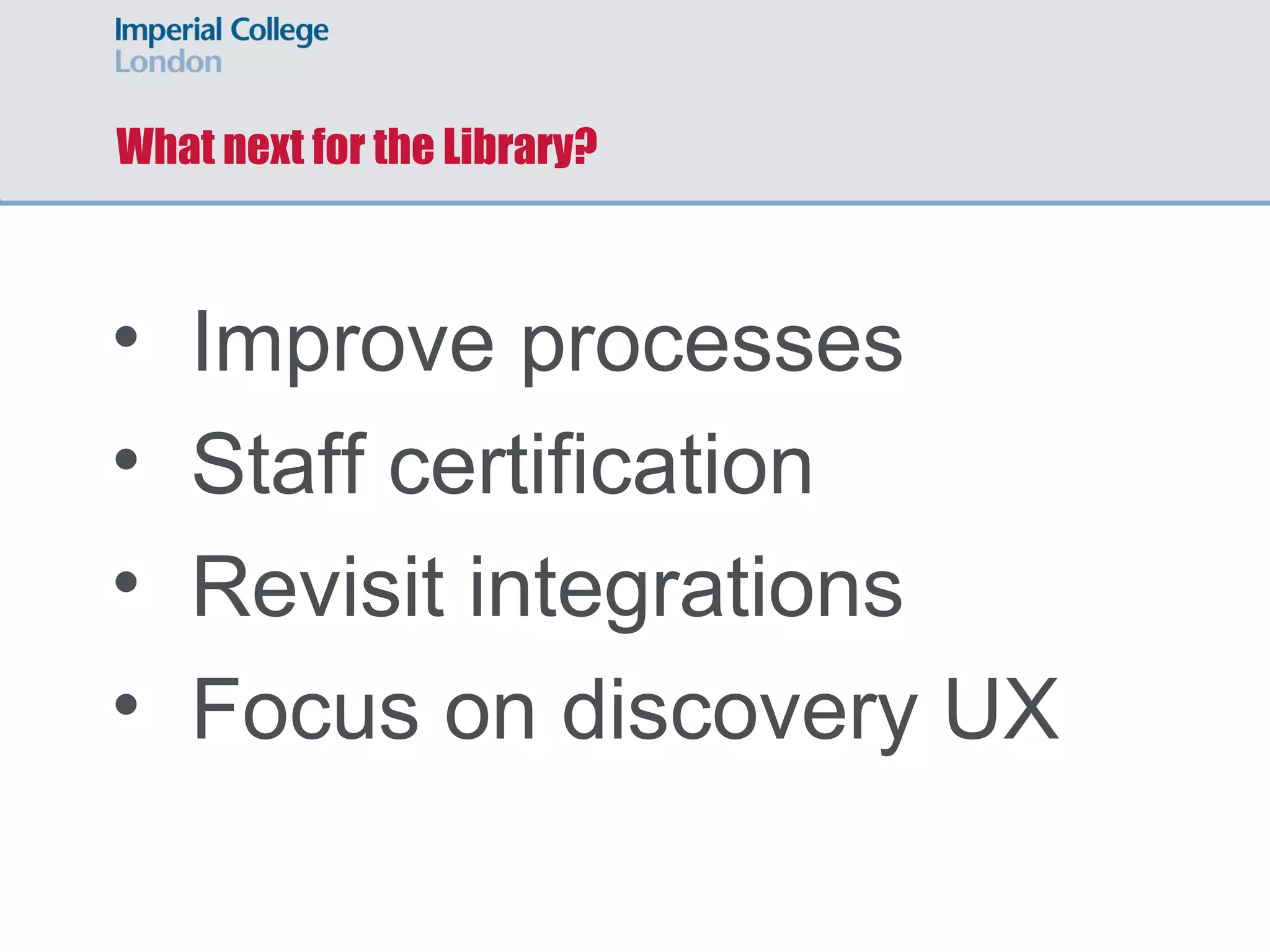
What next for the Library?
Re-evaluating and improving
processes
Staff certification
Focus on user experience
Revisit key integrations




One
•Two
• Three
» Four
 Five
@preater

Selecting and implementing library systems, for #citylis #DigiLibs

  • 1.
    Library Services Selecting and Implementing LibrarySystems Andrew Preater Head of Library Information Systems @preater #citylis #DigiLibs
  • 2.
    Slides and notes Theseslides: http://x.preater.com/citylis
  • 3.
    Summary • What arelibrary systems for? • How to buy a library system • Imperial College London case study
  • 4.
    Evolution of the LMS Context:library systems over time Breeding, M. (2016) Library technology guides. Available at: http://www.librarytechnology.org/
  • 6.
    Unified and next-generationlibrary systems • Alma • Intota • OLE • Sierra • WorldShare Grant, C. (2012) 'The future of library systems: library services platforms', Information Standards Quarterly, 24(4), pp. 4-8.
  • 7.
    Jisc (2012) Beyondthe library management system. Available at: http://lmsguidance.jiscinvolve.org/wp/beyond-the-lms/
  • 8.
    The modern landscape Chad, K.(2016) Next generation library systems. Available at: http://helibtech.com/Next+Generation Jisc (2014) Library systems support and guidance. Available at: http://lmsguidance.jiscinvolve.org/wp/ Higher education context
  • 9.
    Procurement How we dothings around here Millstream Associates (2016) Tenders direct. Available at: http://www.tendersdirect.co.uk Chad, K. (2015) Procurements. Available at: http://helibtech.com/Procurements
  • 10.
    Case study Ex LibrisAlma at Imperial College London
  • 11.
  • 12.
  • 13.
  • 14.
    Why did wemigrate system? Time to change from a legacy LMS
  • 15.
    Why did wemigrate system? Time to change from legacy LMS Timed to get value for money
  • 16.
    Why did wemigrate system? Time to change from legacy LMS Timed to get value for money Wanted integration with existing Library & College systems
  • 17.
    Why did wemigrate system? Time to change from legacy LMS Timed to get value for money Wanted integration with existing Library & College systems “Future-flexible” system
  • 18.
    Objective #1 “To improveuser service and enhance student experience”
  • 19.
  • 20.
    Success factors Print ande-resource workflows
  • 21.
    Success factors Print ande-resource workflows Review and improve policy and processes
  • 22.
    Success factors Print ande-resource workflows Review and improve policy and processes Technology platform
  • 23.
    Success factors Print ande-resource workflows Review and improve policy and processes Technology platform Standardized approach to analytics
  • 24.
    Going live inJuly 2013 One •Two • Three » Four  Five @preater
  • 25.
  • 26.
  • 27.
  • 28.
    Lesson #1 :Do business analysis Interlending lean / kaizen process improvement exercise
  • 29.
    Lesson #1 :Interlending 2014
  • 30.
    33 Lesson #1 :Interlending 2015
  • 31.
    “We are alsoreminded regularly that even the changes the vendor agrees to make cause the vendor inconvenience, and that we should change our procedures to align with the technology […] we don't like being told that we're not doing things right, from the vendor’s point of view” - anonymous Alma site Breeding, M. (2016). ‘Perceptions 2015: An international survey of library automation’. Available at: http://librarytechnology.org/survey-2015-comments.pl#Alma
  • 32.
    Lessons learned Do businessanalysis Rescoping is OK
  • 33.
    “Pick any two…” •Time • Scope (or quality) • Resources (or cost)
  • 34.
    ‘Reality Triangle’ (Walsh) Scope TimeResources Conceptfrom Barry Walsh, University Information Systems and Financial Management Services, Indiana University Lock, D. (2007) The essentials of project management. 3rd edn. Aldershot: Gower.
  • 35.
    Lesson #2 Rescoped‘deliverables’ • Finance integration • Workflow analysis • Metadata optimization • Reading lists Ex Libris (2015). Five partners join Ex Libris in developing online reading-list solution. Available at: http://bit.ly/jan-readinglist
  • 36.
    Lessons learned Do businessanalysis Rescoping is OK Manage expectations Chad, K. (2013) Unified resource management system specification. Available at: http://libtechrfp.wikispaces.com/Unified+library+resource+management+specification
  • 37.
    Lessons #3: ManageExpectations
  • 38.
    “We view Almaas an immature product with great potential. Basic functionality is fairly solid though resource sharing of materials across the consortium is labor intensive and wrought with problems. Analytics and the ability to generate custom reports or otherwise assess data is very poorly developed […]” - anonymous Alma site Breeding, M. (2016). Perceptions 2015: An international survey of library automation. Available at: http://librarytechnology.org/survey-2015-comments.pl#Alma
  • 39.
    Lessons learned Do businessanalysis Rescoping is OK Manage expectations There will be bugs & snags
  • 40.
    Lesson #4: Therewill be bugs & snags Some key issues • Interlending workflow • Staff training • Systems team dependency • Staffing changes
  • 41.
    What next forthe Library? Re-evaluating and improving processes Staff certification Focus on user experience Revisit key integrations    
  • 42.

Editor's Notes

  • #3 In summary: Briefly I’ll say something about what library systems do for us and the state of the HE market. Then a little about how we traditionally buy systems. I’ll tell you about our journey to implementing Alma. That will include lessons learned and my opinions on some best practices.
  • #4 In summary: Briefly I’ll say something about what library systems do for us and the state of the HE market. Then a little about how we traditionally buy systems. I’ll tell you about our journey to implementing Alma. That will include lessons learned and my opinions on some best practices.
  • #5 Until the mid to late 2000s we used ‘traditional’ library management systems which built upon previous generations of systems to provide complete, integrated systems to run our libraries (they’re also called integrated library systems – ILSs – in the United States). The important point about traditional LMSs are they arrived before and evolved during the arrival of mainstream electronic content, and especially the ascendance of e-journals in the late 1990s and early 2000s. Often, HE libraries have ended up ‘bolting on’ electronic provision using a separate product called an electronic resource management (ERM). In some cases this from a different vendor from their LMS, and some systems have proved more integrated than others. Innovative Millennium and the Innovative ERM offer very good integration for example. Marshall Breeding’s website presents library systems industry news, and includes this table (forward slide) …
  • #6 Marshall Breeding’s website presents library systems industry news, and includes a graph showing the history of mergers and acquisitions of library systems companies. The important point here is the trend over time from the mid-2000s: we’ve seen a shrinking number of vendors due to acquisitions by private equity companies, and a relatively stable, mature market with little differentiation between different systems – until the arrival of next-generation systems…
  • #7 This leads us to the next-generation systems, variously also called library services platforms or unified resource management systems. URM is Ex Libris’s term and generally the term I use nowadays. “Next-gen” is starting to sound corny and out of date. As well as Marshall Breeding’s commentary in this area, Carl Grant in 2012 wrote an interesting article on next-gen systems including typical features and Grant’s take on the different extant systems. Although this is quite old now it’s still well worth reading. These are systems that either exist now (in live use) or that are being developed.
  • #8 This is my take on a generic version of a ‘library services platform’ slide similar to those software suppliers show. What makes up a library services platform will include various components such as discovery, resource discovery, ERM, perhaps also digital asset management and reading lists, grouped around the vendor’s ‘core library system’ at the centre of things. These ‘vendor ecosystems’ have been critiqued by Jisc as representing the the ‘hopelessness of hegemony’ which is a quote from the Jisc LMS Guidance site there, so someone at Jisc knows their Gramsci.
  • #9 A great deal of work has been done collaborative on systems by Jisc projects – do look at their LMS Guidance site for toolkits, case studies, and lots of helpful information. Additionally Ken Chad’s HELibTech wiki is a great resource for information on next-generation systems. As distinct from what Marshall Breeding does, HELibTech has a specifically UK higher education focus. I’ll say something about how we actually buy our systems in HE, and in the public sector in general.
  • #10 Public-sector bodies follow formal tendering procedures. There are different threshold amounts for this, but normally if a university wants buy something over £100,000 then they go out to an “EU tender” via the OJEC/OJEU (Official Journal of the EU). (Formally, the threshold is actually bit higher at £111,676 = €134,000.) This procurement approach has a formal structure and processes to work through, doing things this way is intended to provide a certain minimum level of market competition and provide best value for money for the university. In practise, you’ll have guessed that not all systems are created equal and often there are only a few (or in some cases one) supplier that could actually meet a given requirement. If you’re interested in current tenders try searching the Tenders Direct site for something like ‘library management system’ or ‘library software’. I saw by looking recently there have been tenders from: London Fire and emergency planning authority Cranfield University University of Lincoln Keele University As it happens, at the moment there are not many tenders live. A lot of libraries have in the last year or two decided to switch to a unified system so have announced the outcome of the tender. A more digestible site is Ken Chad’s procurements page on the HELibTech wiki which notes recent tenders.
  • #11 Part two, a case study of our work at Imperial College London
  • #12 Imperial College specialises in science, engineering, medicine, and business. We are highly research-intensive with a strong focus on research translation and technology transfer and the applicability of research especially to health and industrial applications. 14,735 students (about 9,000 of them undergrads) and 7,023 staff. We are spread over nine campuses – the main one is at South Kensington in London. These sites include a large medical faculty which means we need to meet the needs of clinical NHS staff too. As a library service we support our mission in teaching, learning and research - what else are you there for? We have our main library – our central library at South Kensington, and our site libraries which are mostly medical libraries at our teaching hospitals. Our libraries are busy and heavily used and there is an upward trend of use of the physical space. Without rattling out too many facts and figures, I want to mention atwo things that are particularly challenging from our Alma implementation point of view.
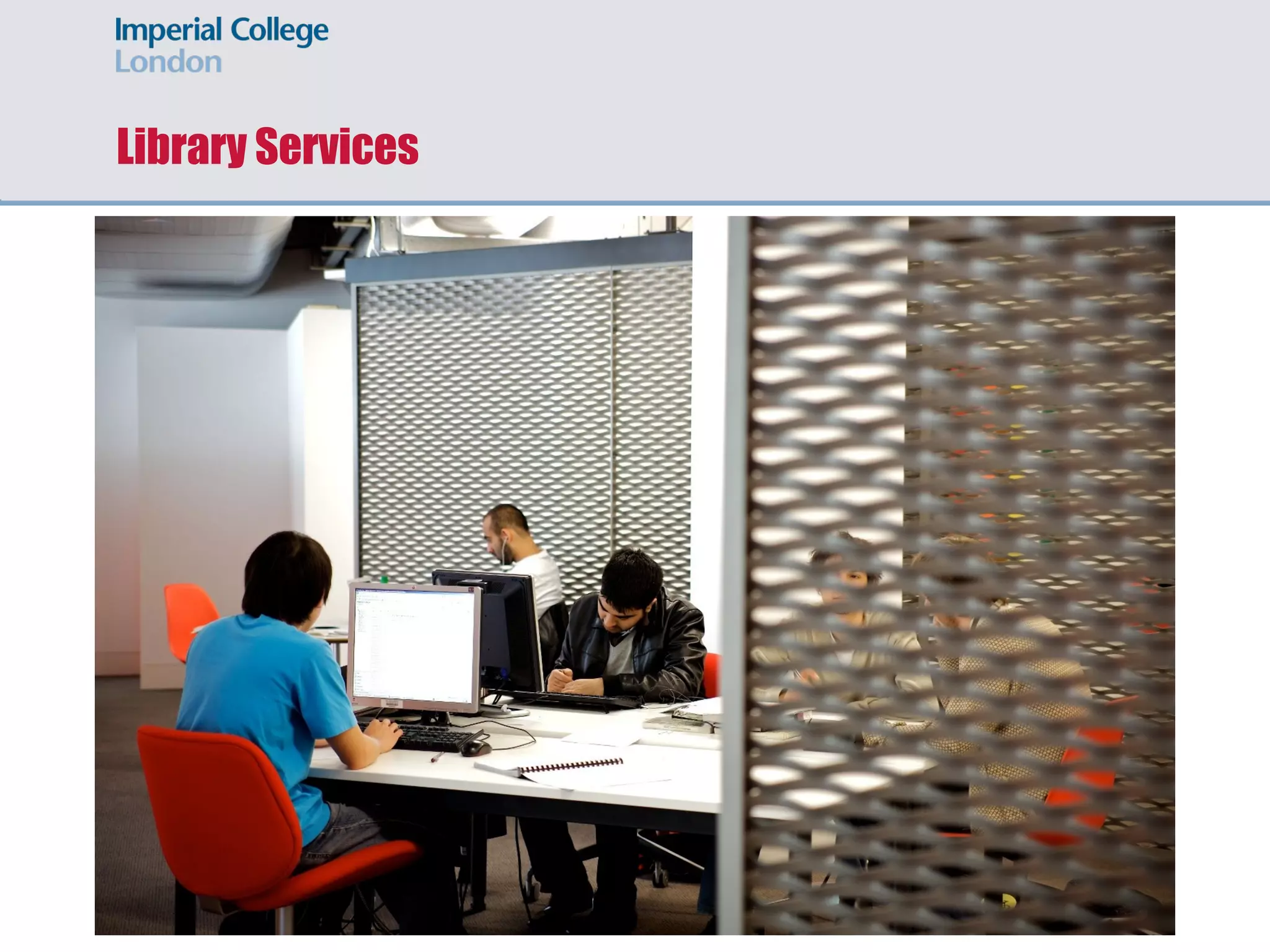
  • #13 As a library service we support our mission in teaching, learning and research - what else are you there for? We have our main library – our central library at South Kensington, and our site libraries which are mostly medical libraries at our teaching hospitals. Our libraries are busy and heavily used and there is an upward trend of use of the physical space.
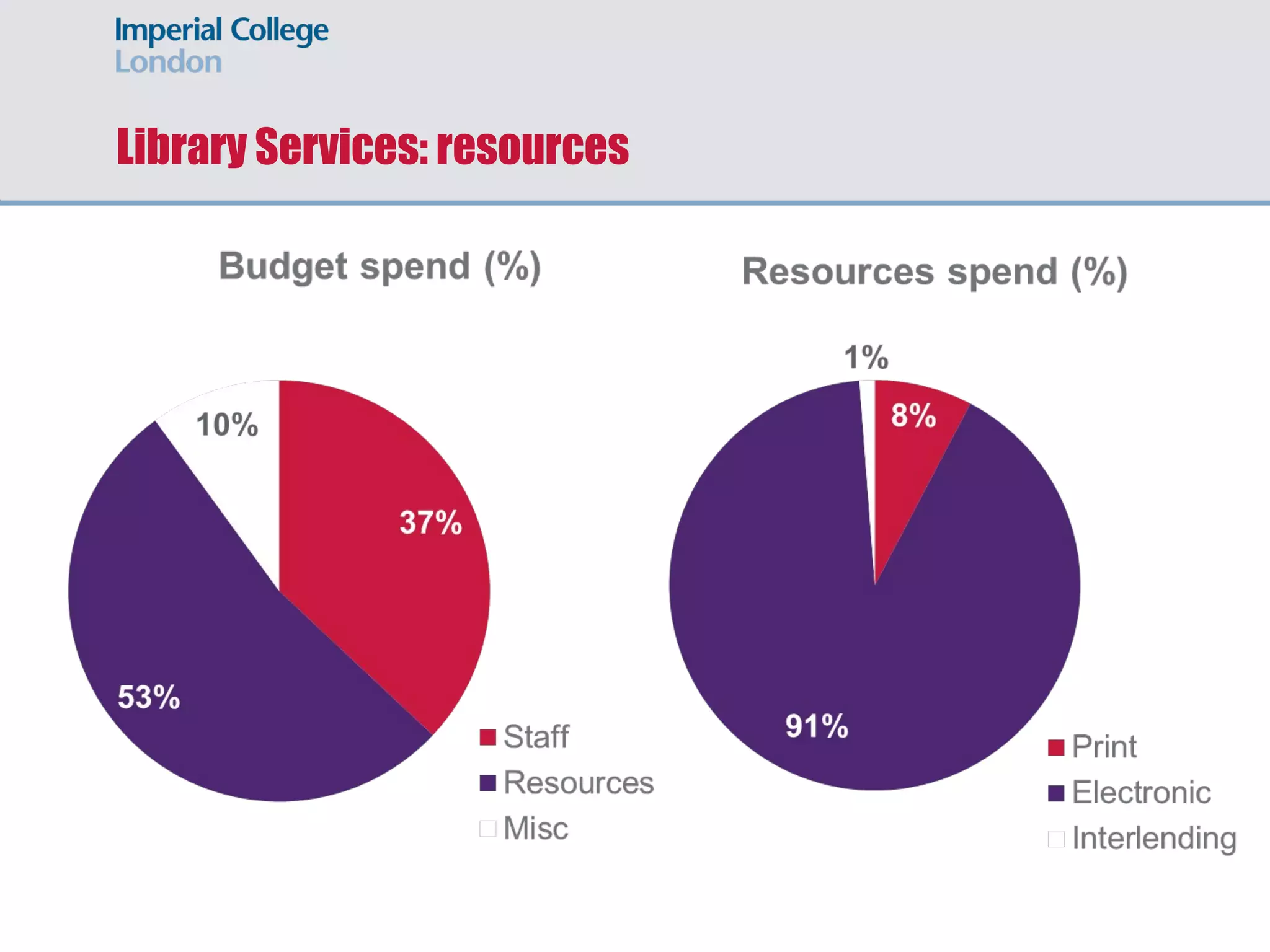
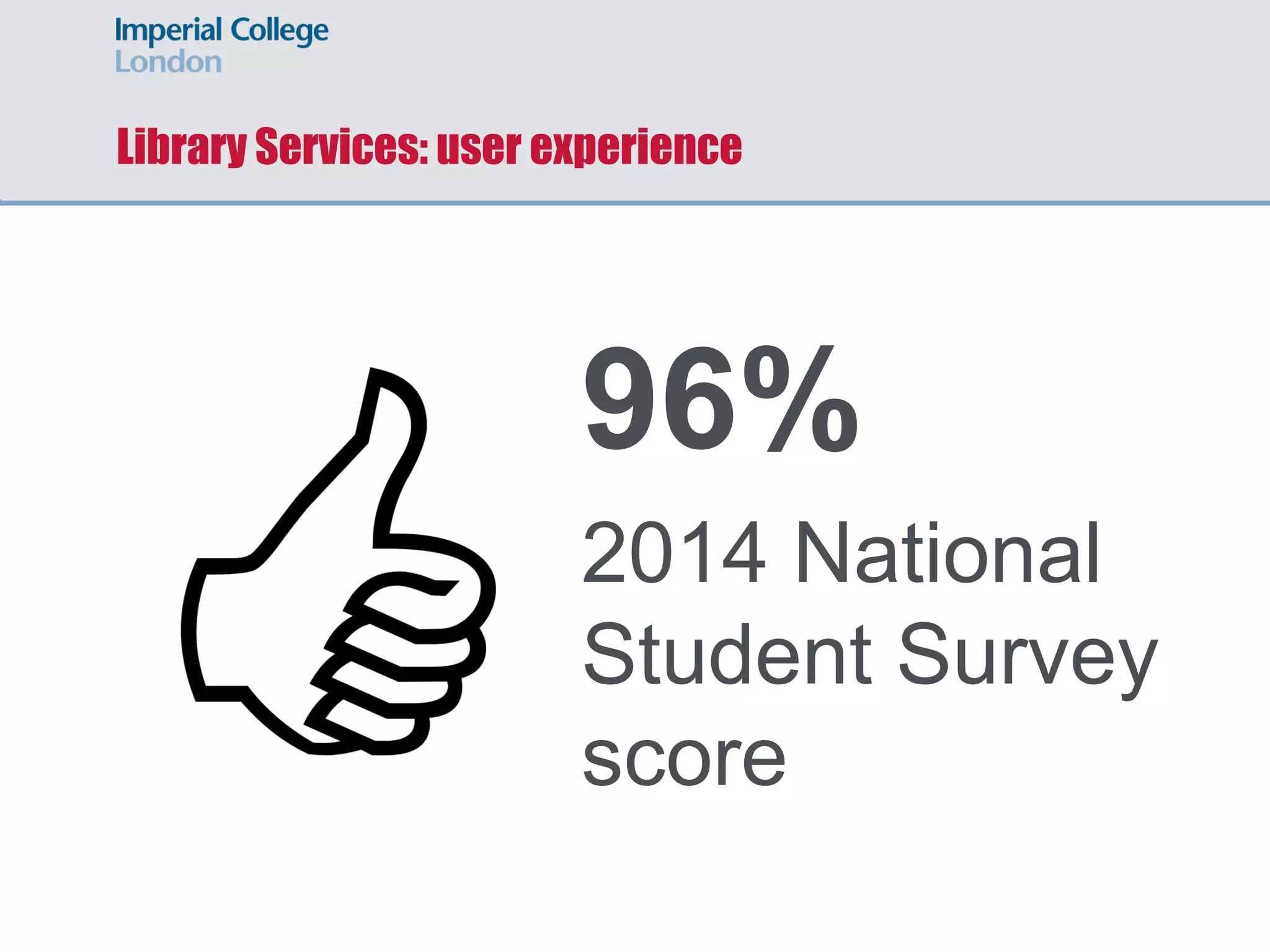
  • #14 Firstly, our spending on resources is high for our comparators (eg. Russell Group universities) and of our spending on resources each year, 91% of what we spend on resources is electronic. Of our journals spending, over 99% is electronic: we spend a lot on e-resources; not so much on print. We have 84,000 online journals. I reassure you we do still have books (!), about half a million. These numbers are important for what comes later, for our reasons for selecting Alma. Second part – we have a high rating in our yearly National Student Survey. This 96% relates to the question on the survey about the library, which is “the library resources and services are good enough for my needs”. As reductionist as it is to look at what we do in this way, the simple point is your library probably should be able to score well on such a question. And if you are focused on user service and continuous improvement, it shouldn’t drop next year. The challenge is any systems changes really have to be positive to students and researchers – and at worse, non-disruptive. We are talking about a diverse group with different needs - and sometimes have needs which are in opposition. There’s a bigger question posed here too - why change anything if we’re doing so well, anyway?
  • #15 We had our legacy system since 1999. This was very much an integrated library system from the 20th century, based around a print world with eresources “bolted on” rather than being at the core. And we were becoming increasingly focused on e-resources over time.
  • #16 Secondly we knew we could make this change to Alma without a really significant capital outlay. I am not saying Alma is free of course - just that it was attractively priced for a next-gen system, we perceived financial benefits of being an early adopter. I want to be mindful of privilege here: of course, what’s not ‘significant’ for us might be very significant for other libraries. I’m talking about our context.
  • #17 Thirdly, we wanted to be able to integrate the system with key college systems and existing library systems. We were already an Ex Libris site with various systems (Primo / Primo Central, bX, SFX) in place so obviously these systems would better integrate well. We knew we could not integrate our legacy ILS as well. Although it did things like taking records from our student records system, the skills to use these were effectively very specialist skills which we knew we would lose when our current systems manager left and that we’d have trouble re-recruiting. This idea leads me on to the last point…
  • #18 We saw Alma as a more flexible system that would continue to meet our needs for the foreseeable future in an increasingly electronic-focused world, but also for handing those future formats and material types that we currently do know will be ascendant in future. At Imperial we say “future flexible” rather than “future proof”.
  • #19 This is a quote from our project initiation document. Ultimately, from a higher education point of view you’d better be sure this is at the core of why you’d want to change systems. In terms of measuring the benefits to the end user we should note they’re not interacting with Alma - we need to be careful in measuring benefits in terms of their experience, not our internal library processes.
  • #20 A quick note on procurement… The nature of Imperial College’s finance means we did not have to go to a full tendering process with publication in OJEU, and so on. There was still a protracted negotiation involving Library Services, ICT, and our purchasing specialists. I mentioned our “early adopter” invitation reduced total cost of ownership – this doesn’t mean we just signed up, there was still a negotiation process, and especially important to us were: The nature of the service level agreement offered by Ex Libris for our systems. At the time we were procuring the system, we didn’t have a great deal of experience with cloud hosting – so that aspect was especially new and we were cautious. Obviously, there were (and are for many potential customers) concerns about data protection as well as business continuity and assurance.
  • #21 I wanted to give you a flavour of the speed of our implementation. This to me was very fast, starting from kick off in December 2012 and cutting over to a live Alma system July 2013. This included a migration of our Primo instance to cloud hosting at the same time. There was a relatively short testing process, and there are only two data migrations so we were limited in what we could do around metadata optimisation work. One point about the early adopter experience is that when we had access to webinars for training and the sandbox test system, we found things changed on Alma very very quickly – Ex Libris use agile methods for development and we were getting monthly releases, so often what was there on the training materials was dated by the time we got to looking at the latest release.
  • #22 We wanted to revise all workflows and procedures, but the main focus is on improving print and eresource workflows. This is the thing about moving to a 21st century system – you really want to ensure you are not running with your old, 20th century workflow still in place! To us a successful system is one based around a single, unified workflow. Absolutely fundamental.
  • #23 We also took the opportunity to review and improve our policies and processes. Of course, you could argue you could do this anyway, but in reality I rarely see libraries do this. The disruption of a systems migration brings a particularly helpful opportunity while everyone is focused on change processes in general.
  • #24 The technology platform provides robust cloud hosting that has substantially reduced the burden on the systems team (and our IT team) and meant we left behind a lot of sysadmin work that did not add value for our users.
  • #25 Finally, a standard approach to analytics. I do mean analytics here, rather than simple reporting. We are using the same Oracle system – Oracle Business Intelligence / OBIEE across Imperial College so there was potential for sharing knowledge and best practices there.
  • #26 So what happened in the end? We launched on July 29th in 2013 which is at the end of our financial or fiscal year. We had a longer “freeze” on circulation than this – about 10 days of not checking in our out physical items.
  • #27 The staff view of things. (This is Rita.) - With a few specific exceptions our library staff view has been very positive. - It’s important to be sensitive to expertise, as a feeling of mastery is key to professional identity for many of us. Many staff had years of experience with the legacy LMS and in some ways (not all ways, of course) they find they are back to square one learning a new system. To be fair, some people told me they loved the learning process of systems migration. - We’ve hugely simplified our policies, especially around circulation so it is much simpler for staff working front-of-house supporting users. - From a systems point of view, there is so much less that needs to be done that you actually forget the amount you used to need to do managing servers and software. There is one big issue to point out…
  • #28 This bit about print and e-resources workflow is so important and I wanted to emphasise it. A ‘unified’ system has made a big difference to the day-to-day work of staff who do serials and book acquisitions and cataloguing. They particularly appreciate the ease of working with ebooks and ejournal subscriptions. Because we are so electronic-heavy, this really plays to the strengths of our collection and our collection development approach. We’ve been able to do some things with Alma that were not impossible with our old ILS, for example: Integrating our license database into Alma, which we had held outside the old system in an access database Trialling patron-driven acquisition, which Alma allowed us to do. This is very positive stuff. What about negatives, what about lessons learned and advice that I can pass on to you?
  • #29 Business analysis is the research discipline of identifying business needs and determining solutions to business problems.
  • #30 We call our interlending section the “document delivery service”, and it supplies over 8000 items a year to Imperial College staff and students. In the UK our model includes a lot of items sourced electronically (or in print as well) from the British Library. We took a ‘lean’ approach to this to revise workflow and reduce waste, remove rework, and simplify processes. It comes from manufacturing originally but the basic idea can be applied to knowledge work and creation. There is a focus on continuous improvement which anyone from an IT background will appreciate. :-) I know other libraries are doing similar work during Alma implementation to revise workflows, for example at LSE (London School of Economics) where they started these processes about 6 months ahead of migrating to Alma. The system suppliers own vision of moving "From discrete processes to continuous workflow" with the next-gen is actually very close to our experience moving from legacy ILS, but it needs the evaluation and improvement of workflows.
  • #31 This is an example showing analysis of our interlending (document delivery) analysis and how complex the process can be. This project is running now (November-December 2014) and is making progress to eliminate waste from our interlending workflow and improve user experience.
  • #32 This is how interlending looked for digital delivered items before being improved.
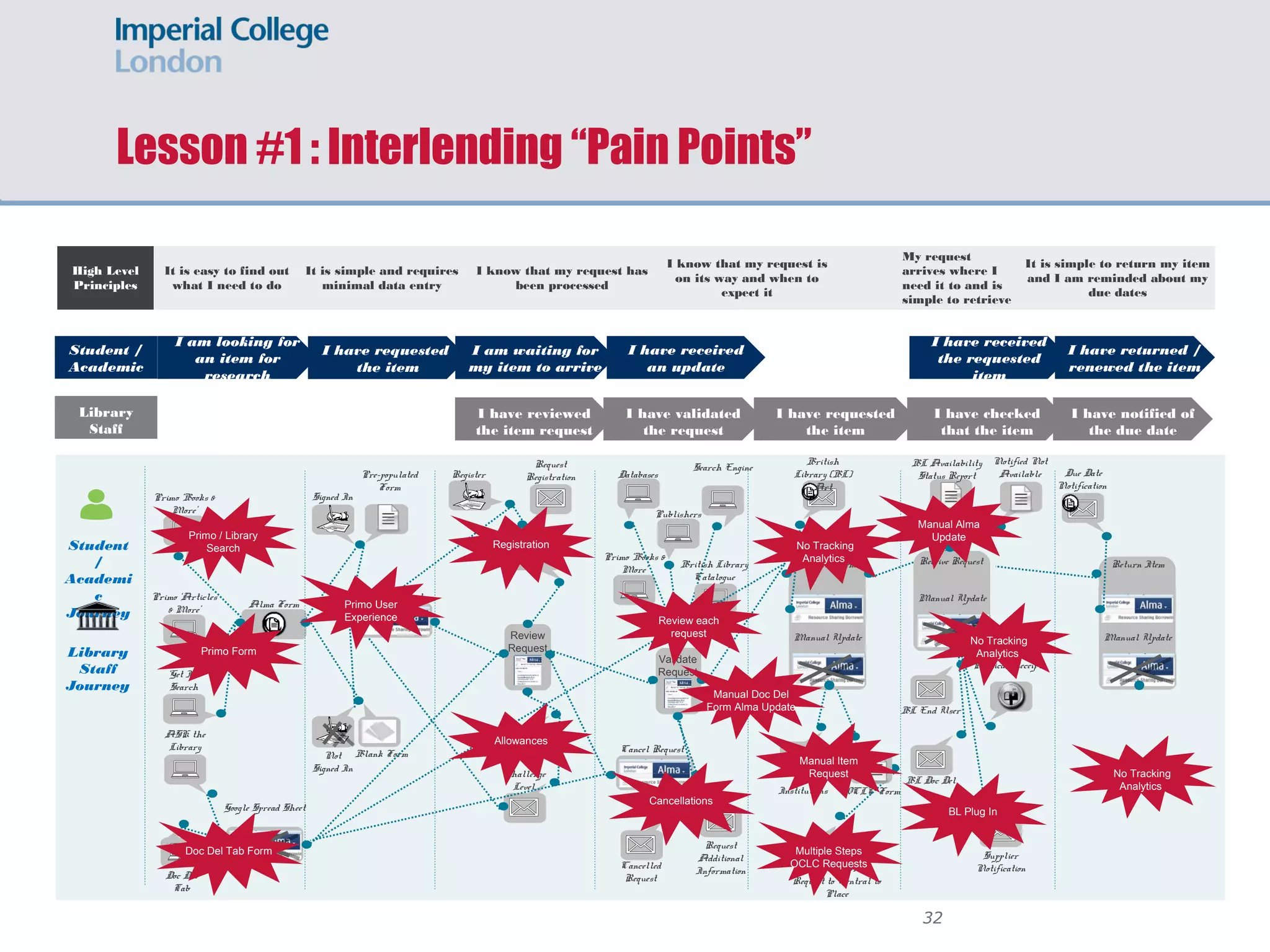
  • #33 This is just to show you the same processes with ‘pain points’ highlighted! One interesting thing is how quickly we went from looking at problems in Alma, that is outstanding things we needed fixed by Ex Libris to support our processes, to concentrating on waste, for example failed searches that lead to people submitting requests for things we already have subscribed.
  • #34 Digital shows sharper and clearer differences. In 2015 there is less of a pronounced peak at 1-2 day delivery than in 2014 and by eye delivery appears more evenly spread over 1-7 days than in was in 2014. The 2015 volumes handled are much higher: an 83.1% increase. Given volume of requests this is an overall improvement: mean delivery time dropped from 7.4 days in 2014 to 5.9 days in 2015, and the 2015 distribution more acutely ‘peaks’ around its mean than in 2014. The distributions vary from each other significantly (tested using a two-sample K-S test, p < 0.01) with delivery times in 2015 significantly lower (tested using a Mann-Whitney U test, p < 0.01)
  • #35 This is a quote from the latest yearly library systems survey run by Marshall Breeding – a US-based library technology consultant and speaker. This is from the free text fields where you can write whatever about your library systems. It shows clearly how things can work out when you do not align your process to the system and expect to maintain the old process with the new tools: friction. The vendor is Ex Libris and they are not unreasonable – but they will not do bespoke development to meet odd requirements from one site, there are vendors that can do that at a higher cost than ‘off the shelf’ systems.
  • #36 Rescoping during the life of the project, compared with the original project documentation… Project managers and leaders can produce some aspirational ideas to provide buy-in, during the life of the project you tend to find yourself becoming more realistic.
  • #37 This is classic project management theory but I highlight it because it came into sharp relief during our Alma project. The idea is that you can’t control all three of the factors represented by the sides of the triangle, only two. So if you have a fixed deadline (time) and resources (money, staff), then you may find the scope of what you deliver shrinks so you can achieve it within those constraints.
  • #38 You may have seen variants on this sort of diagram elsewhere in projects or IT, but this specific interpretation is from Barry Walsh at University of Indiana. The idea is that you can’t control all three of the factors represented by the sides of the triangle, only two. So if you have a fixed deadline (time) and resources (money, staff), then you may find the scope of what you deliver shrinks so you can achieve it within those constraints. This is a variation on the idea of the points of a triangle being resources (money), time, and quality – which is commonly found in PM textbooks, like Dennis Lock’s book. What they’re getting across to you is the idea of operating under constraints of various types which include scope (or quality), time available, and resources (or money).
  • #39 Rescoped / altered deliverables Finance integration with our oracle system Workflow analysis to provide improved and rationalised workflows. Metadata optimisation to improve findability of our content with richer / better quality metadata Reading lists or course readings was removed, too. We made a pragmatic decision not to try to use the Alma reading lists functionality as it did not meet our needs at the time. Since then we reviewed the marketplace and have entered a development partner agreement with Ex Libris to create an integrated reading lists solution for Alma.
  • #40 It’s important to have realistic expectations about what the system will do and what a modern library system looks like. It’s a mistake to focus on legacy requirements and features as “must haves” for a systems that is radically different. As a basic starting point it’s worth using something like the Alma spec from Ken Chad’s LibTechRFP site: http://libtechrfp.wikispaces.com/Unified+library+resource+management+specification rather than the legacy equivalents.
  • #42 Again, this is not Imperial – it’s a large academic library consortium. For me this speaks to a mismatch in expectations, and perhaps believing “the technology” will solve what are at base cultural issues - people issues.
  • #43 This is partly about including some contingency in your project and properly defining your tolerances, but also accepting there will be various bugs and snags with any project. These are ones I will highlight…
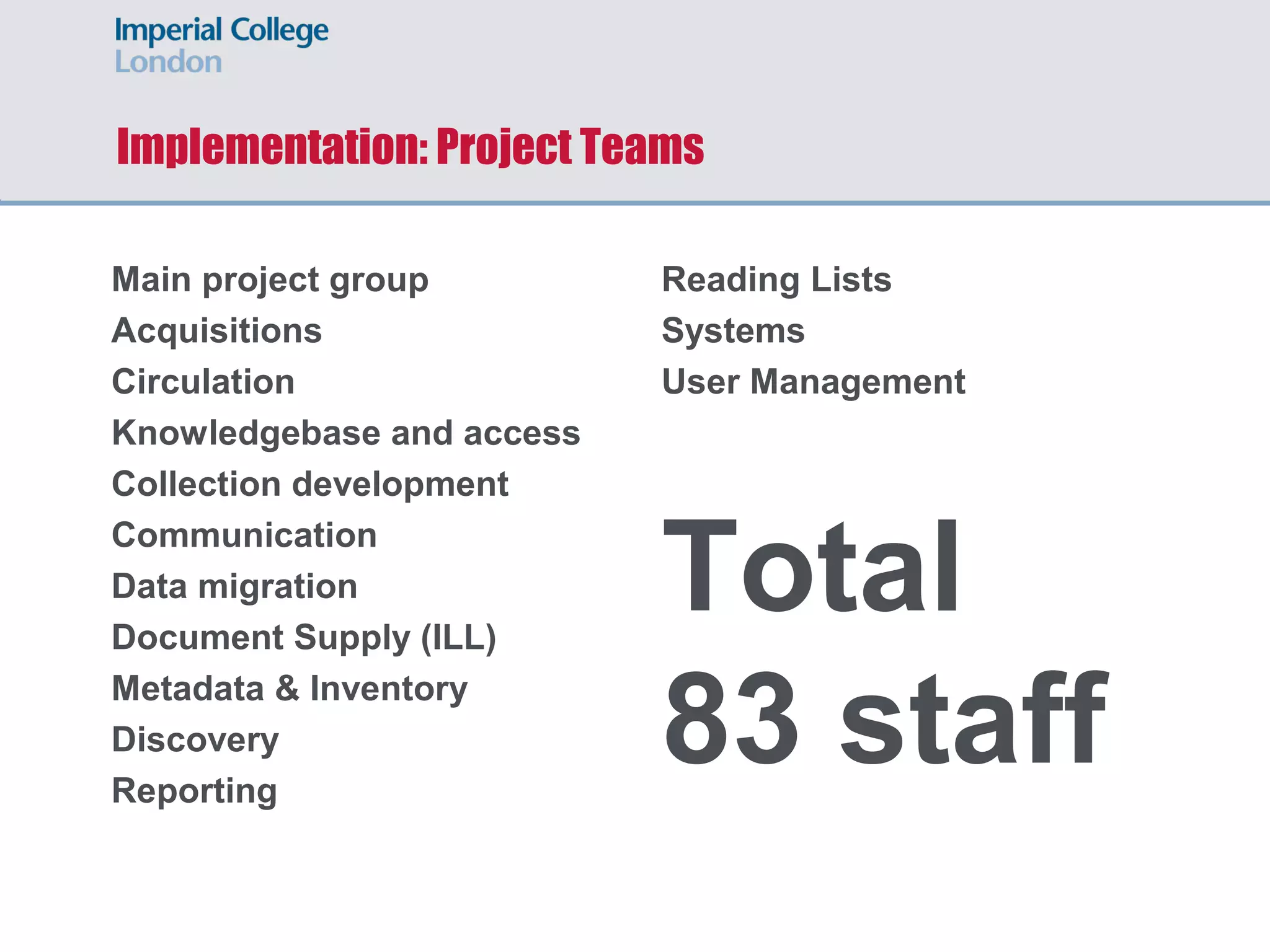
  • #44 Document Delivery issues in workflow. We were the first in the world (!) to try various things with Resource Sharing distributed across multiple campus sites, so have found all the bugs. We have taken this as a clue we are doing unusual things with interlending and we are looking into that as part of our workflow analysis and improvement. Staff training: Live webinars: 24 sessions; shared with other universities in cohort 3 Recorded sessions: Available throughout the implementation phase Access to sandbox: As soon as training starts; Contains Ex Libris test data Systems team dependencies reflect a legacy approach that no longer fits. Lots of living expertise embodied in my systems manager and a cultural expectations around what the team will do. Under staffing changes we changed director during the implementation of the system with a new director starting after our go-live date. The acting directors did a great job, but it makes a difference in terms of workload i.e. having that dedicated senior management resource available, and introduces risks changing project sponsor / executive roles mid-project.
  • #45 Originally I finished this talk by noting things we wanted to do next to improve things – basically they are a set of follow-on actions. I noted Document Delivery earlier – we need to extend that work to other functional areas such as our Subscriptions and our Reading Lists workflows. We use Oracle's eBusiness Suite for Financials and will revisit integrating Alma with that system – currently there is data held in two systems and it’s rekeyed. Want to expand staff Alma certification beyond the systems team as there is a lot of potential for non “systems” colleagues to be involved with the systems as a development opportunity for this. Other Alma sites in the UK have found this is a really great thing to do. I agree, and our heads of Subscriptions, Metadata, and Document Delivery will get Alma certification in the next year. This provides a broader base of users who understand systems aspects. Finally to refocus on user experience aspects. From a “web” point of view this means primarily the Primo front end, but we want to consider all aspects of user experience broadly, as in areas the user interacts with our systems and how Alma and our existing procesess might make that easier or harder for them. How did it work out? Everything except the integration with finance is done – that project has is just formally getting started now, and I plan to first investigate if a) it can be done and b) if it is worth doing.
  • #46 This sort of implementation is about continuous improvement, not a model of change that takes a problem, goes through and “fixes it”. We’re now starting to realise those benefits. After almost a year and half from going live, we feel we are stable and well bedded-in – but we are looking towards 2 to 3 years after implementation to fully realise benefits.