Compound Lipids
SIMS 305- Clinical Biochemistry
Lipids
Dr. Ali Raza
Centre for Human Genetics and Molecular Medicine (CHGMM),
Sindh Institute of Medical Sciences (SIMS), SIUT.
Compound lipids
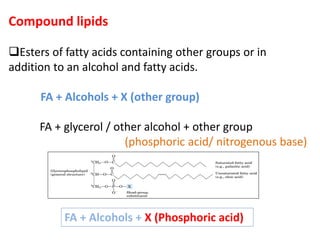
Esters of fatty acids containing other groups or in
addition to an alcohol and fatty acids.
FA + Alcohols + X (other group)
FA + glycerol / other alcohol + other group
(phosphoric acid/ nitrogenous base)
FA + Alcohols + X (Phosphoric acid)
Examples of Compound lipids:
Phospholipids
Glycolipids
Sulfolipids
Aminolipids / Proteolipids
Lipoprotein
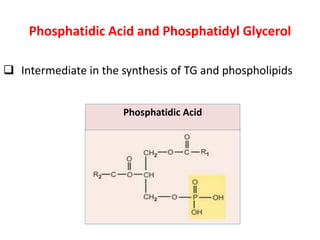
Phosphatidic Acid and Phosphatidyl Glycerol
 Intermediate in the synthesis of TG and phospholipids
Phosphatidic Acid
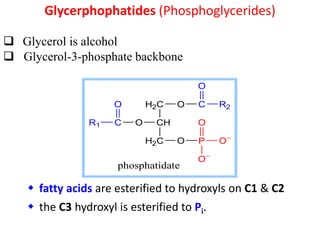
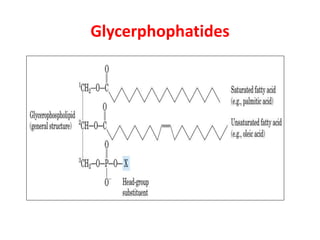
Glycerphophatides (Phosphoglycerides)
 Glycerol is alcohol
 Glycerol-3-phosphate backbone
O P O
O
O
H2C
CH
H2C
OCR1
O O C
O
R2
phosphatidate
 fatty acids are esterified to hydroxyls on C1 & C2
 the C3 hydroxyl is esterified to Pi.
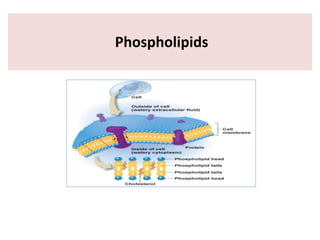
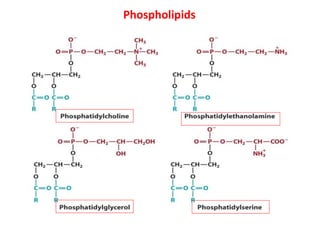
Phospholipids
Phospholipids
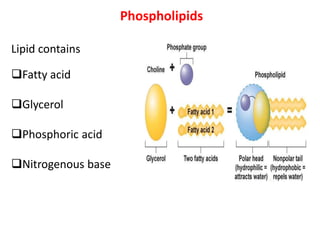
Lipid contains
Fatty acid
Glycerol
Phosphoric acid
Nitrogenous base
Example of Phospholipids
 Phosphatidyl choline (Lecithin)
 Phosphatidyl ethanolamine (Cephalin)
 Phosphatidyl inositols (Lipositols)
 Phosphatidyl serine
 Plasmalogens
 Sphingomelins
Phospholipids
Phospholipids
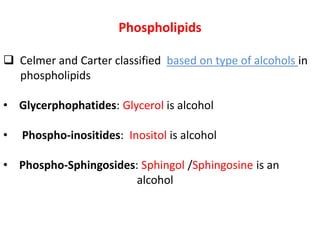
 Celmer and Carter classified based on type of alcohols in
phospholipids
• Glycerphophatides: Glycerol is alcohol
• Phospho-inositides: Inositol is alcohol
• Phospho-Sphingosides: Sphingol /Sphingosine is an
alcohol
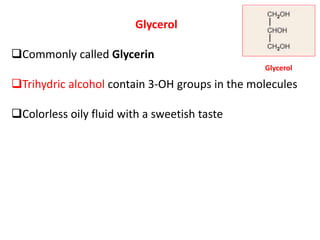
Glycerol
Commonly called Glycerin
Trihydric alcohol contain 3-OH groups in the molecules
Colorless oily fluid with a sweetish taste
Glycerol
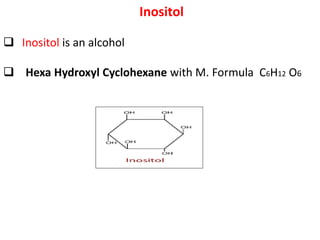
Inositol
 Inositol is an alcohol
 Hexa Hydroxyl Cyclohexane with M. Formula C6H12 O6
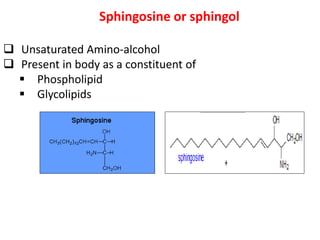
Sphingosine or sphingol
 Unsaturated Amino-alcohol
 Present in body as a constituent of
 Phospholipid
 Glycolipids
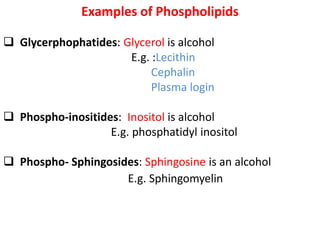
Examples of Phospholipids
 Glycerphophatides: Glycerol is alcohol
E.g. :Lecithin
Cephalin
Plasma login
 Phospho-inositides: Inositol is alcohol
E.g. phosphatidyl inositol
 Phospho- Sphingosides: Sphingosine is an alcohol
E.g. Sphingomyelin
Glycerphophatides
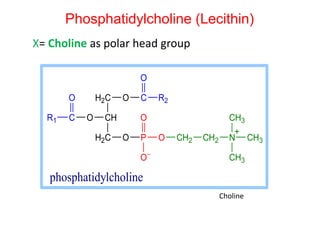
X= Choline as polar head group
O P O
O
O
H2C
CH
H2C
OCR1
O O C
O
R2
CH2 CH2 N CH3
CH3
CH3
+
phosphatidylcholine
Phosphatidylcholine (Lecithin)
Choline
Structural and Metabolic function
Common membrane lipid
Source : Seeds and sprouts
Found in animals ( liver, brain, nerve tissues, sperm, yolk)
α and β lecithin are found depending on the position of
phosphoric acid choline complex
Phosphatidylcholine (Lecithin)
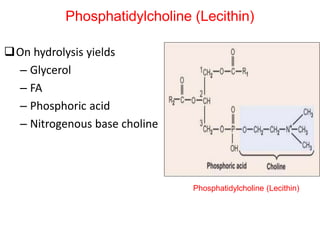
On hydrolysis yields
– Glycerol
– FA
– Phosphoric acid
– Nitrogenous base choline
Phosphatidylcholine (Lecithin)
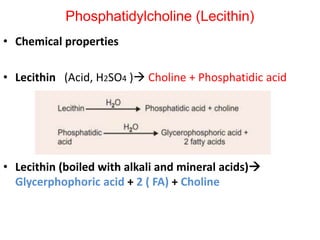
• Chemical properties
• Lecithin (Acid, H2SO4 ) Choline + Phosphatidic acid
• Lecithin (boiled with alkali and mineral acids)
Glycerphophoric acid + 2 ( FA) + Choline
Phosphatidylcholine (Lecithin)
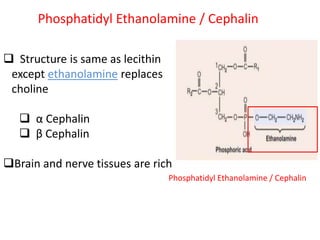
Phosphatidyl Ethanolamine / Cephalin
 Structure is same as lecithin
except ethanolamine replaces
choline
 α Cephalin
 β Cephalin
Brain and nerve tissues are rich
Phosphatidyl Ethanolamine / Cephalin
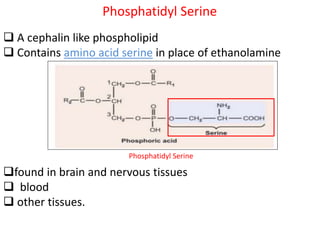
Phosphatidyl Serine
 A cephalin like phospholipid
 Contains amino acid serine in place of ethanolamine
found in brain and nervous tissues
 blood
 other tissues.
Phosphatidyl Serine
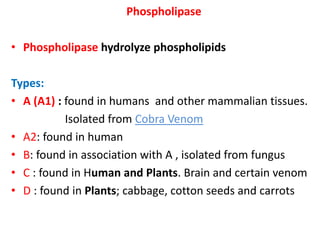
Phospholipase
• Phospholipase hydrolyze phospholipids
Types:
• A (A1) : found in humans and other mammalian tissues.
Isolated from Cobra Venom
• A2: found in human
• B: found in association with A , isolated from fungus
• C : found in Human and Plants. Brain and certain venom
• D : found in Plants; cabbage, cotton seeds and carrots
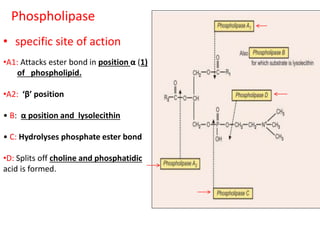
• specific site of action
Phospholipase
•A1: Attacks ester bond in position α (1)
of phospholipid.
•A2: ‘β’ position
• B: α position and lysolecithin
• C: Hydrolyses phosphate ester bond
•D: Splits off choline and phosphatidic
acid is formed.
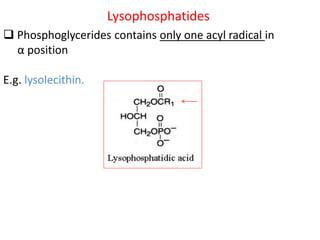
Lysophosphatides
 Phosphoglycerides contains only one acyl radical in
α position
E.g. lysolecithin.
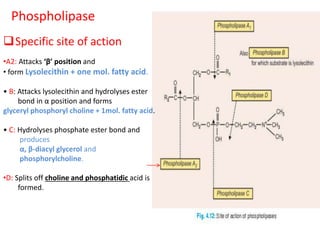
Specific site of action
Phospholipase
•A2: Attacks ‘β’ position and
• form Lysolecithin + one mol. fatty acid.
• B: Attacks lysolecithin and hydrolyses ester
bond in α position and forms
glyceryl phosphoryl choline + 1mol. fatty acid.
• C: Hydrolyses phosphate ester bond and
produces
α, β-diacyl glycerol and
phosphorylcholine.
•D: Splits off choline and phosphatidic acid is
formed.
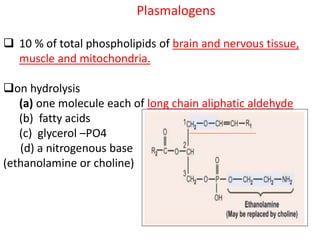
Plasmalogens
 10 % of total phospholipids of brain and nervous tissue,
muscle and mitochondria.
on hydrolysis
(a) one molecule each of long chain aliphatic aldehyde
(b) fatty acids
(c) glycerol –PO4
(d) a nitrogenous base
(ethanolamine or choline)
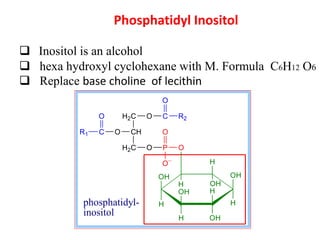
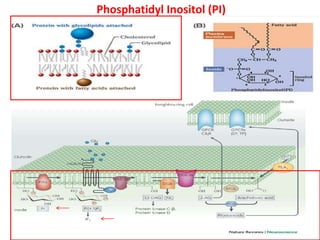
Phosphatidyl Inositol
 Inositol is an alcohol
 hexa hydroxyl cyclohexane with M. Formula C6H12 O6
 Replace base choline of lecithin
O P
O
O
H2C
CH
H2C
OCR1
O O C
O
R2
OH
H
OH
H
H
OHH
OH
H
O
H OH
phosphatidyl-
inositol
Phosphatidyl Inositol (PI)
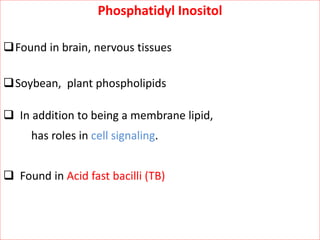
Phosphatidyl Inositol
Found in brain, nervous tissues
Soybean, plant phospholipids
 In addition to being a membrane lipid,
has roles in cell signaling.
 Found in Acid fast bacilli (TB)
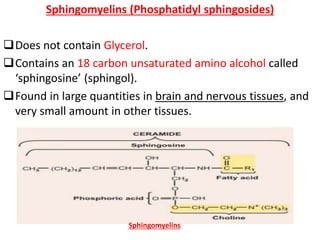
Sphingomyelins (Phosphatidyl sphingosides)
Does not contain Glycerol.
Contains an 18 carbon unsaturated amino alcohol called
‘sphingosine’ (sphingol).
Found in large quantities in brain and nervous tissues, and
very small amount in other tissues.
Sphingomyelins
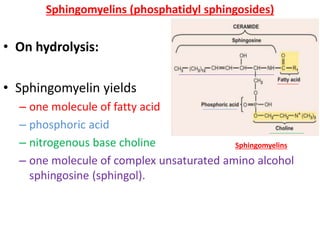
Sphingomyelins (phosphatidyl sphingosides)
• On hydrolysis:
• Sphingomyelin yields
– one molecule of fatty acid
– phosphoric acid
– nitrogenous base choline
– one molecule of complex unsaturated amino alcohol
sphingosine (sphingol).
Sphingomyelins
Sphingomyelins (phosphatidyl sphingosides)
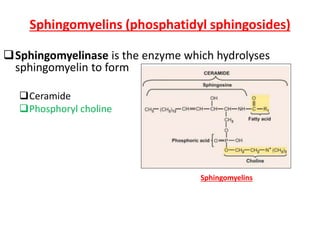
Sphingomyelinase is the enzyme which hydrolyses
sphingomyelin to form
Ceramide
Phosphoryl choline
Sphingomyelins
Sphingomyelins (Phosphatidyl sphingosides)
lipid-storage disease (lipidoses).
Niemann-Pick disease:
• inherited disorder of sphingomyelin metabolism in
which sphingomyelin is not degraded, as a result
sphingomyelin accumulates.
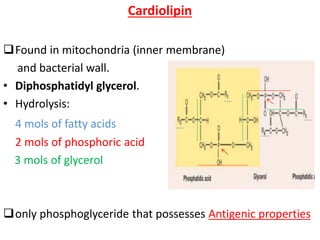
Cardiolipin
Found in mitochondria (inner membrane)
and bacterial wall.
• Diphosphatidyl glycerol.
• Hydrolysis:
4 mols of fatty acids
2 mols of phosphoric acid
3 mols of glycerol
only phosphoglyceride that possesses Antigenic properties
Functions of Phospholipids
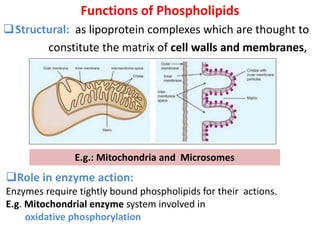
Structural: as lipoprotein complexes which are thought to
constitute the matrix of cell walls and membranes,
E.g.: Mitochondria and Microsomes
Role in enzyme action:
Enzymes require tightly bound phospholipids for their actions.
E.g. Mitochondrial enzyme system involved in
oxidative phosphorylation
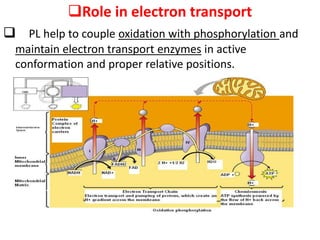
Role in electron transport
 PL help to couple oxidation with phosphorylation and
maintain electron transport enzymes in active
conformation and proper relative positions.
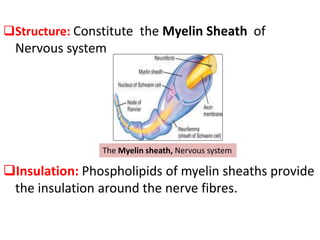
Structure: Constitute the Myelin Sheath of
Nervous system
Insulation: Phospholipids of myelin sheaths provide
the insulation around the nerve fibres.
The Myelin sheath, Nervous system
Role in lipid absorption in intestine:
• Lecithin lowers the surface tension of water and
• Aids in emulsification of lipid water mixtures
Role in transport of lipids from intestines:
• Exogenous TG is carried as lipoprotein complex,
chylomicrons, in which PL takes an active part.
Role in transport of lipids from liver:
• Endogenous TG is carried from Liver to various tissues
as lipoprotein complex Pre-β-lipoprotein (VLDL),
• PL is required for the formation of the lipoprotein
complex.
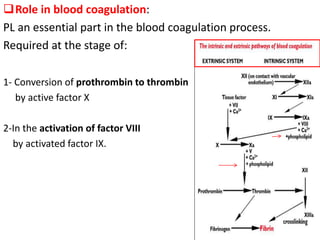
Role in blood coagulation:
PL an essential part in the blood coagulation process.
Required at the stage of:
1- Conversion of prothrombin to thrombin
by active factor X
2-In the activation of factor VIII
by activated factor IX.
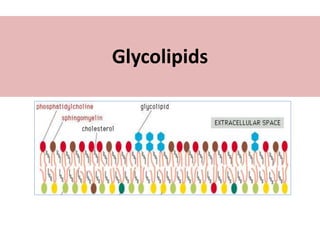
Glycolipids
Glycolipids
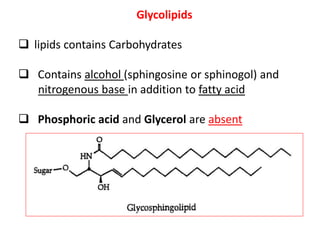
 lipids contains Carbohydrates
 Contains alcohol (sphingosine or sphinogol) and
nitrogenous base in addition to fatty acid
 Phosphoric acid and Glycerol are absent
Glycolipids
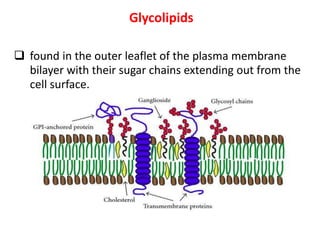
 found in the outer leaflet of the plasma membrane
bilayer with their sugar chains extending out from the
cell surface.
Glycolipids
 White and Grey matter of brain
 Myelin Sheaths of Nerve
 Membrane binding sites (receptor sites) for
hormones
Gaucher’s Disease
Glycolipids
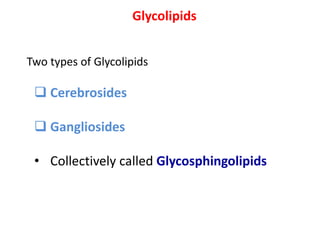
Two types of Glycolipids
 Cerebrosides
 Gangliosides
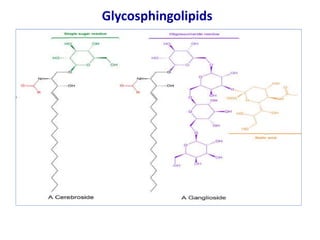
• Collectively called Glycosphingolipids
Glycosphingolipids
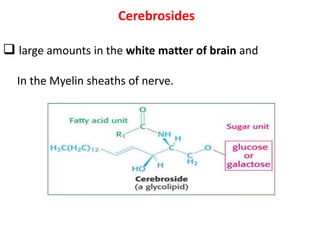
Cerebrosides
 large amounts in the white matter of brain and
In the Myelin sheaths of nerve.
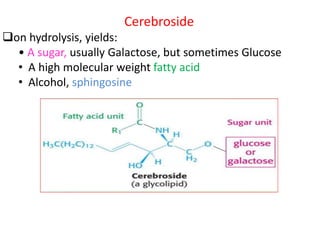
Cerebroside
on hydrolysis, yields:
• A sugar, usually Galactose, but sometimes Glucose
• A high molecular weight fatty acid
• Alcohol, sphingosine
Types of Cerebrosides
Cerebrosides are differentiated by the kinds of fatty acids in
the molecule.
Kerasin: Lignoceric acid (C23H47COOH) as FA
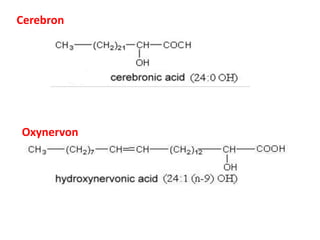
Cerebron (Phrenosin): hydroxy lignoceric acid
(Cerebronic acid)
 Nervon (Nervonic acid): Unsaturated homologue of
lignoceric acid (C23H45 COOH).
Oxynervon: hydroxy derivative of nervonic acid.
Oxynervon
Cerebron
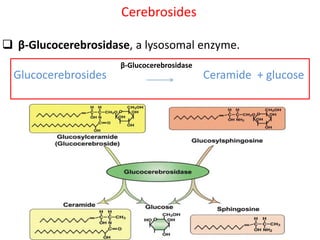
Cerebrosides
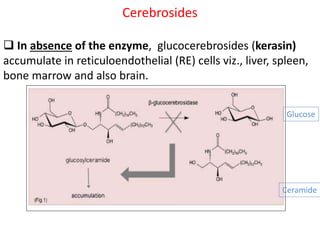
 β-Glucocerebrosidase, a lysosomal enzyme.
Glucocerebrosides Ceramide + glucose
β-Glucocerebrosidase
Cerebrosides
 In absence of the enzyme, glucocerebrosides (kerasin)
accumulate in reticuloendothelial (RE) cells viz., liver, spleen,
bone marrow and also brain.
Ceramide
Glucose
Cerebrosides
 Gaucher’s Disease:
Enzyme deficiency: β-Glucocerebrosidase
 Inherited disorder of cerebrosides metabolism (lipidosis)
 Major signs and symptoms include
enlargement of the liver and spleen(hepatosplenomegaly)
A low number of red blood cells (anemia)
GANGLIOSIDES
GANGLIOSIDES
 The highest concentrations are found in Gray matter of
brain.
 Isolated from ganglion cells, neuronal bodies and
dendrites, spleen and RBC stroma.
GANGLIOSIDES
 The most complex lipid of the glycosphingolipids.
 They are large complex lipids, their molecular weights
varies from 180,000 to 250,000
GANGLIOSIDES
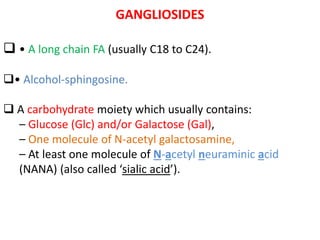
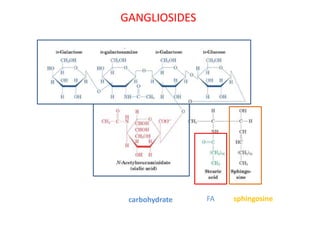
 • A long chain FA (usually C18 to C24).
• Alcohol-sphingosine.
 A carbohydrate moiety which usually contains:
– Glucose (Glc) and/or Galactose (Gal),
– One molecule of N-acetyl galactosamine,
– At least one molecule of N-acetyl neuraminic acid
(NANA) (also called ‘sialic acid’).
GANGLIOSIDES
FA sphingosinecarbohydrate
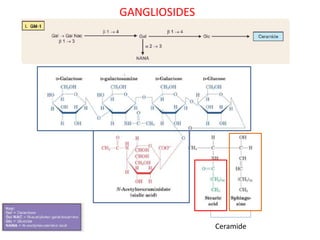
GANGLIOSIDES
Ceramide
GANGLIOSIDES
 Brain gangliosides are known to be complex
 Contain 1 to 3 sialic acid residues [mono-(M) , di-(D),
trisialogangliosides(T)]
 The letter G refers to ganglioside, and
M is for Monosialic acid (one sialic acid)
 GM (Mono sialodi hexosyl ganglioside) is a type of
ganglioside.
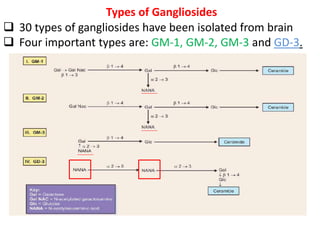
Types of Gangliosides
 30 types of gangliosides have been isolated from brain
 Four important types are: GM-1, GM-2, GM-3 and GD-3.
Types of Gangliosides
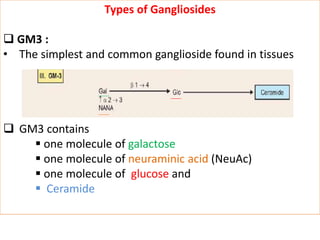
 GM3 :
• The simplest and common ganglioside found in tissues
 GM3 contains
 one molecule of galactose
 one molecule of neuraminic acid (NeuAc)
 one molecule of glucose and
 Ceramide
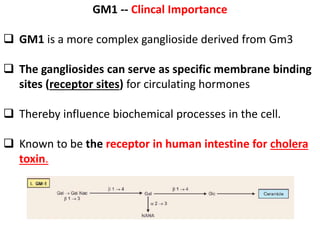
GM1 -- Clincal Importance
 GM1 is a more complex ganglioside derived from Gm3
 The gangliosides can serve as specific membrane binding
sites (receptor sites) for circulating hormones
 Thereby influence biochemical processes in the cell.
 Known to be the receptor in human intestine for cholera
toxin.
Clincal Importance
GM1 Gangliosidosis
 The inheritance pattern and symptoms are similar to
Tay-Sach’s disease.
 Due to a deficiency of the enzyme β-galactosidase,
 Results in accumulation of
 GM1 gangliosides,
 Glycoproteins and
 the mucopolysaccharide karatan sulphate.
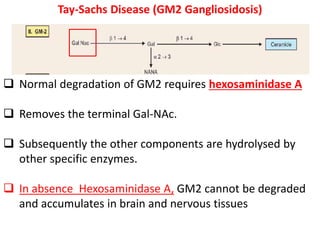
Tay-Sachs Disease (GM2 Gangliosidosis)
 Normal degradation of GM2 requires hexosaminidase A
 Removes the terminal Gal-NAc.
 Subsequently the other components are hydrolysed by
other specific enzymes.
 In absence Hexosaminidase A, GM2 cannot be degraded
and accumulates in brain and nervous tissues
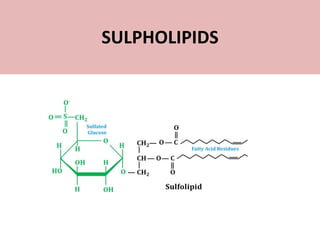
SULPHOLIPIDS
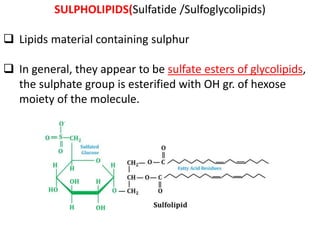
SULPHOLIPIDS(Sulfatide /Sulfoglycolipids)
 Lipids material containing sulphur
 In general, they appear to be sulfate esters of glycolipids,
the sulphate group is esterified with OH gr. of hexose
moiety of the molecule.
SULPHOLIPIDS
 found in liver, kidney, testes, brains and certain tumours.
 Most abundant in white matter of brain.
 Several types of sulfur containing lipids have been isolated
from brain and other tissues.
Sulpholipids: Clinical significance
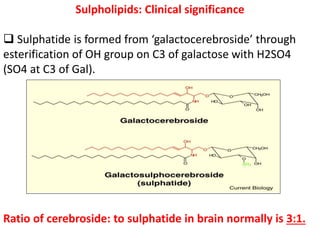
 Sulphatide is formed from ‘galactocerebroside’ through
esterification of OH group on C3 of galactose with H2SO4
(SO4 at C3 of Gal).
Ratio of cerebroside: to sulphatide in brain normally is 3:1.
Sulpholipids: Clinical significance
1-Metachromatic Leucodystrophy (MLD)
 Enzyme sulphatase called as Aryl sulfatase A
 Ratio of cerebroside: to sulphatide in brain altered to 1:4.
 Deficiency of Sulphatase causes Metachromatic
Leucodystrophy (MLD) [sulfatide accumulates in
various tissues. ]
2. Fabry’s disease
 An inherited disorder, a lipid storage disease (lipidosis).
 Enzyme deficiency: α-galactosidase.
Found in liver, spleen, kidney, brain and small intestine.
 Nature of lipid that accumulates ceramide trihexoside
(globotriosyl ceramide)
Fabry’s disease
• Clinical manifestations:
Vascular thrombosis: Lipid accumulates in the
endothelial lining of blood vessels
Renal failure– extensive deposition of lipids in
glomeruli.
Cardiac enlargement
Eye involvement: cataracts, vascular dilatation
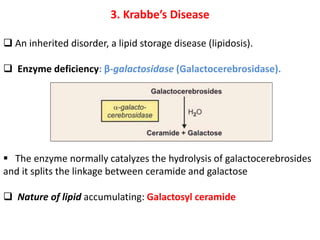
3. Krabbe’s Disease
 An inherited disorder, a lipid storage disease (lipidosis).
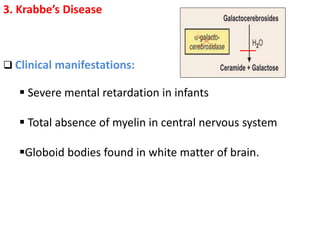
 Enzyme deficiency: β-galactosidase (Galactocerebrosidase).
 The enzyme normally catalyzes the hydrolysis of galactocerebrosides
and it splits the linkage between ceramide and galactose
 Nature of lipid accumulating: Galactosyl ceramide
3. Krabbe’s Disease
 Clinical manifestations:
 Severe mental retardation in infants
 Total absence of myelin in central nervous system
Globoid bodies found in white matter of brain.
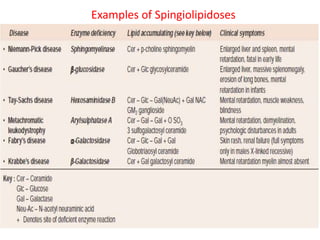
Examples of Spingiolipidoses
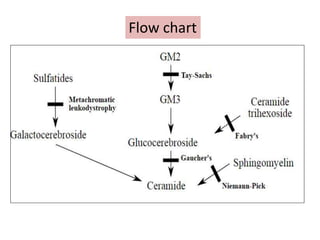
Flow chart
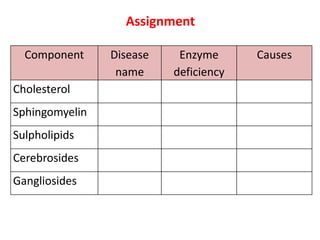
Component Disease
name
Enzyme
deficiency
Causes
Cholesterol
Sphingomyelin
Sulpholipids
Cerebrosides
Gangliosides
Assignment
79
Reference:
Textbook Medical Biochemistry by Chatterjea,
Sixth Edition, Chapter 4
https://www.amazon.com/Textbook-Medical-Biochemistry-M-D-
Chatterjea/dp/9350254840

Compound lipids

  • 1.
  • 2.
    SIMS 305- ClinicalBiochemistry Lipids Dr. Ali Raza Centre for Human Genetics and Molecular Medicine (CHGMM), Sindh Institute of Medical Sciences (SIMS), SIUT.
  • 3.
    Compound lipids Esters offatty acids containing other groups or in addition to an alcohol and fatty acids. FA + Alcohols + X (other group) FA + glycerol / other alcohol + other group (phosphoric acid/ nitrogenous base) FA + Alcohols + X (Phosphoric acid)
  • 4.
    Examples of Compoundlipids: Phospholipids Glycolipids Sulfolipids Aminolipids / Proteolipids Lipoprotein
  • 5.
    Phosphatidic Acid andPhosphatidyl Glycerol  Intermediate in the synthesis of TG and phospholipids Phosphatidic Acid
  • 6.
    Glycerphophatides (Phosphoglycerides)  Glycerolis alcohol  Glycerol-3-phosphate backbone O P O O O H2C CH H2C OCR1 O O C O R2 phosphatidate  fatty acids are esterified to hydroxyls on C1 & C2  the C3 hydroxyl is esterified to Pi.
  • 7.
  • 8.
  • 9.
    Example of Phospholipids Phosphatidyl choline (Lecithin)  Phosphatidyl ethanolamine (Cephalin)  Phosphatidyl inositols (Lipositols)  Phosphatidyl serine  Plasmalogens  Sphingomelins
  • 10.
  • 11.
    Phospholipids  Celmer andCarter classified based on type of alcohols in phospholipids • Glycerphophatides: Glycerol is alcohol • Phospho-inositides: Inositol is alcohol • Phospho-Sphingosides: Sphingol /Sphingosine is an alcohol
  • 12.
    Glycerol Commonly called Glycerin Trihydricalcohol contain 3-OH groups in the molecules Colorless oily fluid with a sweetish taste Glycerol
  • 13.
    Inositol  Inositol isan alcohol  Hexa Hydroxyl Cyclohexane with M. Formula C6H12 O6
  • 14.
    Sphingosine or sphingol Unsaturated Amino-alcohol  Present in body as a constituent of  Phospholipid  Glycolipids
  • 15.
    Examples of Phospholipids Glycerphophatides: Glycerol is alcohol E.g. :Lecithin Cephalin Plasma login  Phospho-inositides: Inositol is alcohol E.g. phosphatidyl inositol  Phospho- Sphingosides: Sphingosine is an alcohol E.g. Sphingomyelin
  • 16.
  • 17.
    X= Choline aspolar head group O P O O O H2C CH H2C OCR1 O O C O R2 CH2 CH2 N CH3 CH3 CH3 + phosphatidylcholine Phosphatidylcholine (Lecithin) Choline
  • 18.
    Structural and Metabolicfunction Common membrane lipid Source : Seeds and sprouts Found in animals ( liver, brain, nerve tissues, sperm, yolk) α and β lecithin are found depending on the position of phosphoric acid choline complex Phosphatidylcholine (Lecithin)
  • 19.
    On hydrolysis yields –Glycerol – FA – Phosphoric acid – Nitrogenous base choline Phosphatidylcholine (Lecithin) Phosphatidylcholine (Lecithin)
  • 20.
    • Chemical properties •Lecithin (Acid, H2SO4 ) Choline + Phosphatidic acid • Lecithin (boiled with alkali and mineral acids) Glycerphophoric acid + 2 ( FA) + Choline Phosphatidylcholine (Lecithin)
  • 21.
    Phosphatidyl Ethanolamine /Cephalin  Structure is same as lecithin except ethanolamine replaces choline  α Cephalin  β Cephalin Brain and nerve tissues are rich Phosphatidyl Ethanolamine / Cephalin
  • 22.
    Phosphatidyl Serine  Acephalin like phospholipid  Contains amino acid serine in place of ethanolamine found in brain and nervous tissues  blood  other tissues. Phosphatidyl Serine
  • 23.
    Phospholipase • Phospholipase hydrolyzephospholipids Types: • A (A1) : found in humans and other mammalian tissues. Isolated from Cobra Venom • A2: found in human • B: found in association with A , isolated from fungus • C : found in Human and Plants. Brain and certain venom • D : found in Plants; cabbage, cotton seeds and carrots
  • 24.
    • specific siteof action Phospholipase •A1: Attacks ester bond in position α (1) of phospholipid. •A2: ‘β’ position • B: α position and lysolecithin • C: Hydrolyses phosphate ester bond •D: Splits off choline and phosphatidic acid is formed.
  • 25.
    Lysophosphatides  Phosphoglycerides containsonly one acyl radical in α position E.g. lysolecithin.
  • 26.
    Specific site ofaction Phospholipase •A2: Attacks ‘β’ position and • form Lysolecithin + one mol. fatty acid. • B: Attacks lysolecithin and hydrolyses ester bond in α position and forms glyceryl phosphoryl choline + 1mol. fatty acid. • C: Hydrolyses phosphate ester bond and produces α, β-diacyl glycerol and phosphorylcholine. •D: Splits off choline and phosphatidic acid is formed.
  • 27.
    Plasmalogens  10 %of total phospholipids of brain and nervous tissue, muscle and mitochondria. on hydrolysis (a) one molecule each of long chain aliphatic aldehyde (b) fatty acids (c) glycerol –PO4 (d) a nitrogenous base (ethanolamine or choline)
  • 28.
    Phosphatidyl Inositol  Inositolis an alcohol  hexa hydroxyl cyclohexane with M. Formula C6H12 O6  Replace base choline of lecithin O P O O H2C CH H2C OCR1 O O C O R2 OH H OH H H OHH OH H O H OH phosphatidyl- inositol
  • 29.
  • 30.
    Phosphatidyl Inositol Found inbrain, nervous tissues Soybean, plant phospholipids  In addition to being a membrane lipid, has roles in cell signaling.  Found in Acid fast bacilli (TB)
  • 31.
    Sphingomyelins (Phosphatidyl sphingosides) Doesnot contain Glycerol. Contains an 18 carbon unsaturated amino alcohol called ‘sphingosine’ (sphingol). Found in large quantities in brain and nervous tissues, and very small amount in other tissues. Sphingomyelins
  • 32.
    Sphingomyelins (phosphatidyl sphingosides) •On hydrolysis: • Sphingomyelin yields – one molecule of fatty acid – phosphoric acid – nitrogenous base choline – one molecule of complex unsaturated amino alcohol sphingosine (sphingol). Sphingomyelins
  • 33.
    Sphingomyelins (phosphatidyl sphingosides) Sphingomyelinaseis the enzyme which hydrolyses sphingomyelin to form Ceramide Phosphoryl choline Sphingomyelins
  • 34.
    Sphingomyelins (Phosphatidyl sphingosides) lipid-storagedisease (lipidoses). Niemann-Pick disease: • inherited disorder of sphingomyelin metabolism in which sphingomyelin is not degraded, as a result sphingomyelin accumulates.
  • 35.
    Cardiolipin Found in mitochondria(inner membrane) and bacterial wall. • Diphosphatidyl glycerol. • Hydrolysis: 4 mols of fatty acids 2 mols of phosphoric acid 3 mols of glycerol only phosphoglyceride that possesses Antigenic properties
  • 36.
  • 37.
    Functions of Phospholipids Structural:as lipoprotein complexes which are thought to constitute the matrix of cell walls and membranes, E.g.: Mitochondria and Microsomes Role in enzyme action: Enzymes require tightly bound phospholipids for their actions. E.g. Mitochondrial enzyme system involved in oxidative phosphorylation
  • 38.
    Role in electrontransport  PL help to couple oxidation with phosphorylation and maintain electron transport enzymes in active conformation and proper relative positions.
  • 39.
    Structure: Constitute theMyelin Sheath of Nervous system Insulation: Phospholipids of myelin sheaths provide the insulation around the nerve fibres. The Myelin sheath, Nervous system
  • 40.
    Role in lipidabsorption in intestine: • Lecithin lowers the surface tension of water and • Aids in emulsification of lipid water mixtures Role in transport of lipids from intestines: • Exogenous TG is carried as lipoprotein complex, chylomicrons, in which PL takes an active part. Role in transport of lipids from liver: • Endogenous TG is carried from Liver to various tissues as lipoprotein complex Pre-β-lipoprotein (VLDL), • PL is required for the formation of the lipoprotein complex.
  • 41.
    Role in bloodcoagulation: PL an essential part in the blood coagulation process. Required at the stage of: 1- Conversion of prothrombin to thrombin by active factor X 2-In the activation of factor VIII by activated factor IX.
  • 42.
  • 43.
    Glycolipids  lipids containsCarbohydrates  Contains alcohol (sphingosine or sphinogol) and nitrogenous base in addition to fatty acid  Phosphoric acid and Glycerol are absent
  • 44.
    Glycolipids  found inthe outer leaflet of the plasma membrane bilayer with their sugar chains extending out from the cell surface.
  • 45.
    Glycolipids  White andGrey matter of brain  Myelin Sheaths of Nerve  Membrane binding sites (receptor sites) for hormones Gaucher’s Disease
  • 46.
    Glycolipids Two types ofGlycolipids  Cerebrosides  Gangliosides • Collectively called Glycosphingolipids
  • 47.
  • 48.
    Cerebrosides  large amountsin the white matter of brain and In the Myelin sheaths of nerve.
  • 49.
    Cerebroside on hydrolysis, yields: •A sugar, usually Galactose, but sometimes Glucose • A high molecular weight fatty acid • Alcohol, sphingosine
  • 50.
    Types of Cerebrosides Cerebrosidesare differentiated by the kinds of fatty acids in the molecule. Kerasin: Lignoceric acid (C23H47COOH) as FA Cerebron (Phrenosin): hydroxy lignoceric acid (Cerebronic acid)  Nervon (Nervonic acid): Unsaturated homologue of lignoceric acid (C23H45 COOH). Oxynervon: hydroxy derivative of nervonic acid.
  • 51.
  • 52.
    Cerebrosides  β-Glucocerebrosidase, alysosomal enzyme. Glucocerebrosides Ceramide + glucose β-Glucocerebrosidase
  • 53.
    Cerebrosides  In absenceof the enzyme, glucocerebrosides (kerasin) accumulate in reticuloendothelial (RE) cells viz., liver, spleen, bone marrow and also brain. Ceramide Glucose
  • 54.
    Cerebrosides  Gaucher’s Disease: Enzymedeficiency: β-Glucocerebrosidase  Inherited disorder of cerebrosides metabolism (lipidosis)  Major signs and symptoms include enlargement of the liver and spleen(hepatosplenomegaly) A low number of red blood cells (anemia)
  • 55.
  • 56.
    GANGLIOSIDES  The highestconcentrations are found in Gray matter of brain.  Isolated from ganglion cells, neuronal bodies and dendrites, spleen and RBC stroma.
  • 57.
    GANGLIOSIDES  The mostcomplex lipid of the glycosphingolipids.  They are large complex lipids, their molecular weights varies from 180,000 to 250,000
  • 58.
    GANGLIOSIDES  • Along chain FA (usually C18 to C24). • Alcohol-sphingosine.  A carbohydrate moiety which usually contains: – Glucose (Glc) and/or Galactose (Gal), – One molecule of N-acetyl galactosamine, – At least one molecule of N-acetyl neuraminic acid (NANA) (also called ‘sialic acid’).
  • 59.
  • 60.
  • 61.
    GANGLIOSIDES  Brain gangliosidesare known to be complex  Contain 1 to 3 sialic acid residues [mono-(M) , di-(D), trisialogangliosides(T)]  The letter G refers to ganglioside, and M is for Monosialic acid (one sialic acid)  GM (Mono sialodi hexosyl ganglioside) is a type of ganglioside.
  • 62.
    Types of Gangliosides 30 types of gangliosides have been isolated from brain  Four important types are: GM-1, GM-2, GM-3 and GD-3.
  • 63.
    Types of Gangliosides GM3 : • The simplest and common ganglioside found in tissues  GM3 contains  one molecule of galactose  one molecule of neuraminic acid (NeuAc)  one molecule of glucose and  Ceramide
  • 64.
    GM1 -- ClincalImportance  GM1 is a more complex ganglioside derived from Gm3  The gangliosides can serve as specific membrane binding sites (receptor sites) for circulating hormones  Thereby influence biochemical processes in the cell.  Known to be the receptor in human intestine for cholera toxin.
  • 65.
    Clincal Importance GM1 Gangliosidosis The inheritance pattern and symptoms are similar to Tay-Sach’s disease.  Due to a deficiency of the enzyme β-galactosidase,  Results in accumulation of  GM1 gangliosides,  Glycoproteins and  the mucopolysaccharide karatan sulphate.
  • 66.
    Tay-Sachs Disease (GM2Gangliosidosis)  Normal degradation of GM2 requires hexosaminidase A  Removes the terminal Gal-NAc.  Subsequently the other components are hydrolysed by other specific enzymes.  In absence Hexosaminidase A, GM2 cannot be degraded and accumulates in brain and nervous tissues
  • 67.
  • 68.
    SULPHOLIPIDS(Sulfatide /Sulfoglycolipids)  Lipidsmaterial containing sulphur  In general, they appear to be sulfate esters of glycolipids, the sulphate group is esterified with OH gr. of hexose moiety of the molecule.
  • 69.
    SULPHOLIPIDS  found inliver, kidney, testes, brains and certain tumours.  Most abundant in white matter of brain.  Several types of sulfur containing lipids have been isolated from brain and other tissues.
  • 70.
    Sulpholipids: Clinical significance Sulphatide is formed from ‘galactocerebroside’ through esterification of OH group on C3 of galactose with H2SO4 (SO4 at C3 of Gal). Ratio of cerebroside: to sulphatide in brain normally is 3:1.
  • 71.
    Sulpholipids: Clinical significance 1-MetachromaticLeucodystrophy (MLD)  Enzyme sulphatase called as Aryl sulfatase A  Ratio of cerebroside: to sulphatide in brain altered to 1:4.  Deficiency of Sulphatase causes Metachromatic Leucodystrophy (MLD) [sulfatide accumulates in various tissues. ]
  • 72.
    2. Fabry’s disease An inherited disorder, a lipid storage disease (lipidosis).  Enzyme deficiency: α-galactosidase. Found in liver, spleen, kidney, brain and small intestine.  Nature of lipid that accumulates ceramide trihexoside (globotriosyl ceramide)
  • 73.
    Fabry’s disease • Clinicalmanifestations: Vascular thrombosis: Lipid accumulates in the endothelial lining of blood vessels Renal failure– extensive deposition of lipids in glomeruli. Cardiac enlargement Eye involvement: cataracts, vascular dilatation
  • 74.
    3. Krabbe’s Disease An inherited disorder, a lipid storage disease (lipidosis).  Enzyme deficiency: β-galactosidase (Galactocerebrosidase).  The enzyme normally catalyzes the hydrolysis of galactocerebrosides and it splits the linkage between ceramide and galactose  Nature of lipid accumulating: Galactosyl ceramide
  • 75.
    3. Krabbe’s Disease Clinical manifestations:  Severe mental retardation in infants  Total absence of myelin in central nervous system Globoid bodies found in white matter of brain.
  • 76.
  • 77.
  • 78.
  • 79.
    79 Reference: Textbook Medical Biochemistryby Chatterjea, Sixth Edition, Chapter 4 https://www.amazon.com/Textbook-Medical-Biochemistry-M-D- Chatterjea/dp/9350254840