W
H
I
T
E
Composting
procedures and
relevant legislation
in Italy
What is compost?
• Compost is a fertilizer that improve the
quality of soil
• In EU fertilizers are regulated by Reg.
• At Italian level National Decree 75/2010
• The definition of “compost” is included in
the national decree n. 152/06
(Environmental law)
• Compost is a PRODUCT obtained by a
composting process of biowaste separately
collected, in compliance with the
properties defined by the decree on
fertilizer n. 75/2010 and amendements
The composting
process
• The composting process is the evolution of
the natural process of biodegradation of
organic matter.
• Complex substances are transformed by
microorganisms and bacteria in a more
simple substances rich of humic
compounds
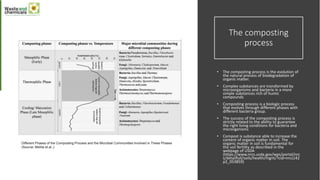
• Composting process is a biologic process
that evolves through different phases with
different bacteria group.
• The success of the composting process is
strictly related to the ability to guarantee
the right living conditions for bacteria and
microrganisms
• Compost is substance able to increase the
content of organic matter in soil. The
organic matter in soil is fundamental for
the soil fertility as described in the
webpage of USDA
(https://www.nrcs.usda.gov/wps/portal/nrc
s/detailfull/soils/health/mgnt/?cid=nrcs142
p2_053859)
Different Phases of the Composting Process and the Microbial Communities Involved in These Phases
(Source: Mehta et al.,)
The role of composting in waste management
• Composting process
represents a common
system for the
management of the
following waste fractions
• Green waste as grass and
branches
• Biowaste from separate
collection
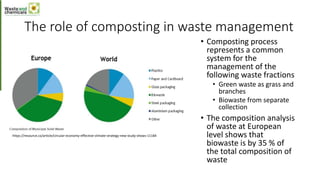
• The composition analysis
of waste at European
level shows that
biowaste is by 35 % of
the total composition of
waste
https://resource.co/article/circular-economy-effective-climate-strategy-new-study-shows-11184
The composting
regulation in Italy
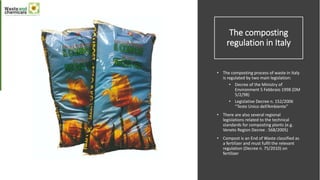
• The composting process of waste in Italy
is regulated by two main legislation:
• Decree of the Ministry of
Environment 5 Febbraio 1998 (DM
5/2/98)
• Legislative Decree n. 152/2006
“Testo Unico dell’Ambiente”
• There are also several regional
legislations related to the technical
standards for composting plants (e.g.
Veneto Region Decree . 568/2005)
• Compost is an End of Waste classified as
a fertilizer and must fulfil the relevant
regulation (Decree n. 75/2010) on
fertilizer
The composting plant regulation
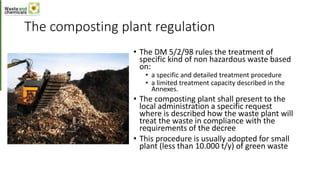
• The DM 5/2/98 rules the treatment of
specific kind of non hazardous waste based
on:
• a specific and detailed treatment procedure
• a limited treatment capacity described in the
Annexes.
• The composting plant shall present to the
local administration a specific request
where is described how the waste plant will
treat the waste in compliance with the
requirements of the decree
• This procedure is usually adopted for small
plant (less than 10.000 t/y) of green waste
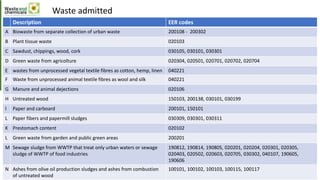
Description EER codes
A Biowaste from separate collection of urban waste 200108 - 200302
B Plant tissue waste 020103
C Sawdust, chippings, wood, cork 030105, 030101, 030301
D Green waste from agricolture 020304, 020501, 020701, 020702, 020704
E wastes from unprocessed vegetal textile fibres as cotton, hemp, linen 040221
F Waste from unprocessed animal textile fibres as wool and silk 040221
G Manure and animal dejections 020106
H Untreated wood 150103, 200138, 030101, 030199
I Paper and carboard 200101, 150101
L Paper fibers and papermill sludges 030309, 030301, 030311
K Prestomach content 020102
L Green waste from garden and public green areas 200201
M Sewage sludge from WWTP that treat only urban waters or sewage
sludge of WWTP of food industries
190812, 190814, 190805, 020201, 020204, 020301, 020305,
020403, 020502, 020603, 020705, 030302, 040107, 190605,
190606
N Ashes from olive oil production sludges and ashes from combustion
of untreated wood
100101, 100102, 100103, 100115, 100117
Waste admitted
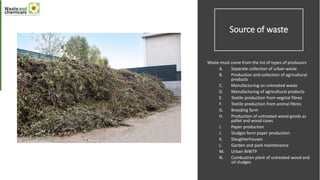
Source of waste
Waste must come from the list of types of producers
A. Separate collection of urban waste
B. Production and collection of agricultural
products
C. Manufacturing on untreated waste
D. Manufacturing of agricultural products
E. Textile production from vegetal fibres
F. Textile production from animal fibres
G. Breeding farm
H. Production of untreated wood goods as
pallet and wood cases
I. Paper production
J. Sludges form paper production
K. Slaughterhouses
L. Garden and park maintenance
M. Urban WWTP
N. Combustion plant of untreated wood and
oil sludges
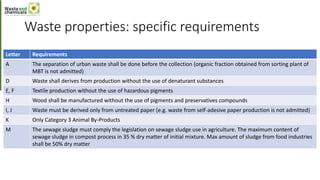
Waste properties: specific requirements
Letter Requirements
A The separation of urban waste shall be done before the collection (organic fraction obtained from sorting plant of
MBT is not admitted)
D Waste shall derives from production without the use of denaturant substances
E, F Textile production without the use of hazardous pigments
H Wood shall be manufactured without the use of pigments and preservatives compounds
I, J Waste must be derived only from untreated paper (e.g. waste from self-adesive paper production is not admitted)
K Only Category 3 Animal By-Products
M The sewage sludge must comply the legislation on sewage sludge use in agriculture. The maximum content of
sewage sludge in compost process in 35 % dry matter of initial mixture. Max amount of sludge from food industries
shall be 50% dry matter
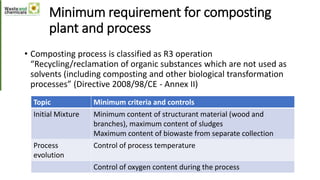
Minimum requirement for composting
plant and process
• Composting process is classified as R3 operation
“Recycling/reclamation of organic substances which are not used as
solvents (including composting and other biological transformation
processes” (Directive 2008/98/CE - Annex II)
Topic Minimum criteria and controls
Initial Mixture Minimum content of structurant material (wood and
branches), maximum content of sludges
Maximum content of biowaste from separate collection
Process
evolution
Control of process temperature
Control of oxygen content during the process
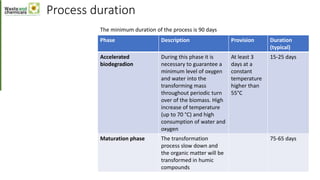
Process duration
Phase Description Provision Duration
(typical)
Accelerated
biodegradion
During this phase it is
necessary to guarantee a
minimum level of oxygen
and water into the
transforming mass
throughout periodic turn
over of the biomass. High
increase of temperature
(up to 70 °C) and high
consumption of water and
oxygen
At least 3
days at a
constant
temperature
higher than
55°C
15-25 days
Maturation phase The transformation
process slow down and
the organic matter will be
transformed in humic
compounds
75-65 days
The minimum duration of the process is 90 days
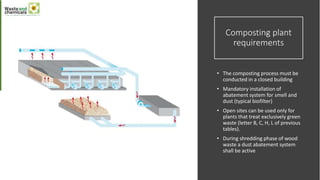
Composting plant
requirements
• The composting process must be
conducted in a closed building
• Mandatory installation of
abatement system for smell and
dust (typical biofilter)
• Open sites can be used only for
plants that treat exclusively green
waste (letter B, C, H, L of previous
tables).
• During shredding phase of wood
waste a dust abatement system
shall be active
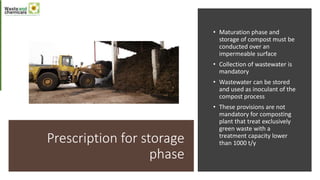
Prescription for storage
phase
• Maturation phase and
storage of compost must be
conducted over an
impermeable surface
• Collection of wastewater is
mandatory
• Wastewater can be stored
and used as inoculant of the
compost process
• These provisions are not
mandatory for composting
plant that treat exclusively
green waste with a
treatment capacity lower
than 1000 t/y
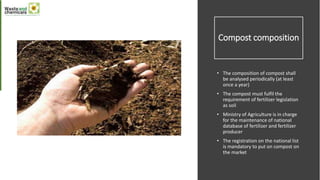
Compost composition
• The composition of compost shall
be analysed periodically (at least
once a year)
• The compost must fulfil the
requirement of fertilizer legislation
as soil
• Ministry of Agriculture is in charge
for the maintenance of national
database of fertilizer and fertilizer
producer
• The registration on the national list
is mandatory to put on compost on
the market
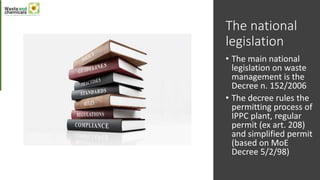
The national
legislation
• The main national
legislation on waste
management is the
Decree n. 152/2006
• The decree rules the
permitting process of
IPPC plant, regular
permit (ex art. 208)
and simplified permit
(based on MoE
Decree 5/2/98)
An example of regional regulation:
the Decree n. 568/2005 of Veneto Region
The Regional decree provides
specific provisions for waste
management, composting
mixture, quality and process
controls
The regulation include the
provisions defined by the Decree
5/2/98 and it is applied only in
Veneto Region. Other local
guideline has been developed by
other local authorities
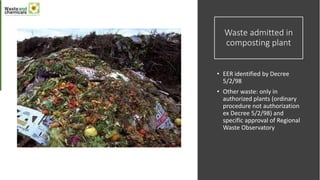
Waste admitted in
composting plant
• EER identified by Decree
5/2/98
• Other waste: only in
authorized plants (ordinary
procedure not authorization
ex Decree 5/2/98) and
specific approval of Regional
Waste Observatory
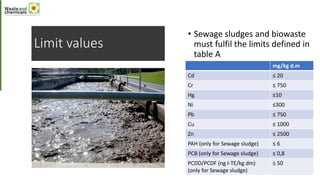
Limit values
• Sewage sludges and biowaste
must fulfil the limits defined in
table A
mg/kg d.m
Cd ≤ 20
Cr ≤ 750
Hg ≤10
Ni ≤300
Pb ≤ 750
Cu ≤ 1000
Zn ≤ 2500
PAH (only for Sewage sludge) ≤ 6
PCB (only for Sewage sludge) ≤ 0,8
PCDD/PCDF (ng I-TE/kg dm)
(only for Sewage sludge)
≤ 50
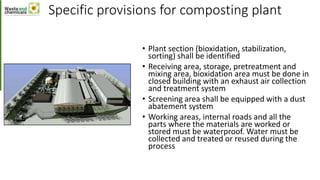
Specific provisions for composting plant
• Plant section (bioxidation, stabilization,
sorting) shall be identified
• Receiving area, storage, pretreatment and
mixing area, bioxidation area must be done in
closed building with an exhaust air collection
and treatment system
• Screening area shall be equipped with a dust
abatement system
• Working areas, internal roads and all the
parts where the materials are worked or
stored must be waterproof. Water must be
collected and treated or reused during the
process
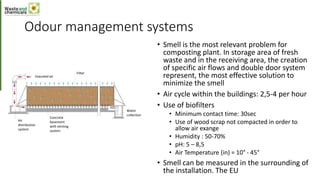
Odour management systems
• Smell is the most relevant problem for
composting plant. In storage area of fresh
waste and in the receiving area, the creation
of specific air flows and double door system
represent, the most effective solution to
minimize the smell
• Air cycle within the buildings: 2,5-4 per hour
• Use of biofilters
• Minimum contact time: 30sec
• Use of wood scrap not compacted in order to
allow air exange
• Humidity : 50-70%
• pH: 5 – 8,5
• Air Temperature (in) = 10° - 45°
• Smell can be measured in the surrounding of
the installation. The EU
Exausted air
Filter
Air
distribution
system
Concrete
basement
with venting
system
Water
collection
Process controls and provisions
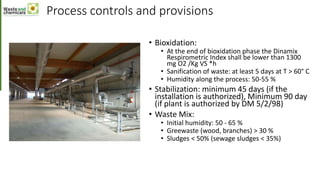
• Bioxidation:
• At the end of bioxidation phase the Dinamix
Respirometric Index shall be lower than 1300
mg O2 /Kg VS *h
• Sanification of waste: at least 5 days at T > 60° C
• Humidity along the process: 50-55 %
• Stabilization: minimum 45 days (if the
installation is authorized), Minimum 90 day
(if plant is authorized by DM 5/2/98)
• Waste Mix:
• Initial humidity: 50 - 65 %
• Greewaste (wood, branches) > 30 %
• Sludges < 50% (sewage sludges < 35%)
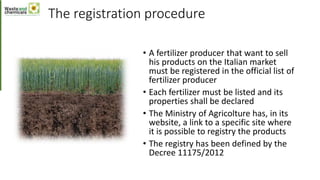
The registration procedure
• A fertilizer producer that want to sell
his products on the Italian market
must be registered in the official list of
fertilizer producer
• Each fertilizer must be listed and its
properties shall be declared
• The Ministry of Agricolture has, in its
website, a link to a specific site where
it is possible to registry the products
• The registry has been defined by the
Decree 11175/2012
The use of compost as fertilizer
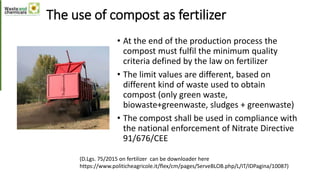
• At the end of the production process the
compost must fulfil the minimum quality
criteria defined by the law on fertilizer
• The limit values are different, based on
different kind of waste used to obtain
compost (only green waste,
biowaste+greenwaste, sludges + greenwaste)
• The compost shall be used in compliance with
the national enforcement of Nitrate Directive
91/676/CEE
(D.Lgs. 75/2015 on fertilizer can be downloader here
https://www.politicheagricole.it/flex/cm/pages/ServeBLOB.php/L/IT/IDPagina/10087)
The role of Wasteandchemicals
• Support you on finding the right
technology for your treatment phase
• Environmental permitting and
Environmental due diligence
• Support on composting process, quality controls
and process controls
• Registration procedures
Circonvallazione Gianicolense, 216E
00152 Roma, Italia
www.wasteandchemicals.eu
Mail: info@wasteandchemicals.eu
Tel. +39 06 4567 5590/1

Compost legislation in Italy

  • 1.
  • 2.
    What is compost? •Compost is a fertilizer that improve the quality of soil • In EU fertilizers are regulated by Reg. • At Italian level National Decree 75/2010 • The definition of “compost” is included in the national decree n. 152/06 (Environmental law) • Compost is a PRODUCT obtained by a composting process of biowaste separately collected, in compliance with the properties defined by the decree on fertilizer n. 75/2010 and amendements
  • 3.
    The composting process • Thecomposting process is the evolution of the natural process of biodegradation of organic matter. • Complex substances are transformed by microorganisms and bacteria in a more simple substances rich of humic compounds • Composting process is a biologic process that evolves through different phases with different bacteria group. • The success of the composting process is strictly related to the ability to guarantee the right living conditions for bacteria and microrganisms • Compost is substance able to increase the content of organic matter in soil. The organic matter in soil is fundamental for the soil fertility as described in the webpage of USDA (https://www.nrcs.usda.gov/wps/portal/nrc s/detailfull/soils/health/mgnt/?cid=nrcs142 p2_053859) Different Phases of the Composting Process and the Microbial Communities Involved in These Phases (Source: Mehta et al.,)
  • 4.
    The role ofcomposting in waste management • Composting process represents a common system for the management of the following waste fractions • Green waste as grass and branches • Biowaste from separate collection • The composition analysis of waste at European level shows that biowaste is by 35 % of the total composition of waste https://resource.co/article/circular-economy-effective-climate-strategy-new-study-shows-11184
  • 5.
    The composting regulation inItaly • The composting process of waste in Italy is regulated by two main legislation: • Decree of the Ministry of Environment 5 Febbraio 1998 (DM 5/2/98) • Legislative Decree n. 152/2006 “Testo Unico dell’Ambiente” • There are also several regional legislations related to the technical standards for composting plants (e.g. Veneto Region Decree . 568/2005) • Compost is an End of Waste classified as a fertilizer and must fulfil the relevant regulation (Decree n. 75/2010) on fertilizer
  • 6.
    The composting plantregulation • The DM 5/2/98 rules the treatment of specific kind of non hazardous waste based on: • a specific and detailed treatment procedure • a limited treatment capacity described in the Annexes. • The composting plant shall present to the local administration a specific request where is described how the waste plant will treat the waste in compliance with the requirements of the decree • This procedure is usually adopted for small plant (less than 10.000 t/y) of green waste
  • 7.
    Description EER codes ABiowaste from separate collection of urban waste 200108 - 200302 B Plant tissue waste 020103 C Sawdust, chippings, wood, cork 030105, 030101, 030301 D Green waste from agricolture 020304, 020501, 020701, 020702, 020704 E wastes from unprocessed vegetal textile fibres as cotton, hemp, linen 040221 F Waste from unprocessed animal textile fibres as wool and silk 040221 G Manure and animal dejections 020106 H Untreated wood 150103, 200138, 030101, 030199 I Paper and carboard 200101, 150101 L Paper fibers and papermill sludges 030309, 030301, 030311 K Prestomach content 020102 L Green waste from garden and public green areas 200201 M Sewage sludge from WWTP that treat only urban waters or sewage sludge of WWTP of food industries 190812, 190814, 190805, 020201, 020204, 020301, 020305, 020403, 020502, 020603, 020705, 030302, 040107, 190605, 190606 N Ashes from olive oil production sludges and ashes from combustion of untreated wood 100101, 100102, 100103, 100115, 100117 Waste admitted
  • 8.
    Source of waste Wastemust come from the list of types of producers A. Separate collection of urban waste B. Production and collection of agricultural products C. Manufacturing on untreated waste D. Manufacturing of agricultural products E. Textile production from vegetal fibres F. Textile production from animal fibres G. Breeding farm H. Production of untreated wood goods as pallet and wood cases I. Paper production J. Sludges form paper production K. Slaughterhouses L. Garden and park maintenance M. Urban WWTP N. Combustion plant of untreated wood and oil sludges
  • 9.
    Waste properties: specificrequirements Letter Requirements A The separation of urban waste shall be done before the collection (organic fraction obtained from sorting plant of MBT is not admitted) D Waste shall derives from production without the use of denaturant substances E, F Textile production without the use of hazardous pigments H Wood shall be manufactured without the use of pigments and preservatives compounds I, J Waste must be derived only from untreated paper (e.g. waste from self-adesive paper production is not admitted) K Only Category 3 Animal By-Products M The sewage sludge must comply the legislation on sewage sludge use in agriculture. The maximum content of sewage sludge in compost process in 35 % dry matter of initial mixture. Max amount of sludge from food industries shall be 50% dry matter
  • 10.
    Minimum requirement forcomposting plant and process • Composting process is classified as R3 operation “Recycling/reclamation of organic substances which are not used as solvents (including composting and other biological transformation processes” (Directive 2008/98/CE - Annex II) Topic Minimum criteria and controls Initial Mixture Minimum content of structurant material (wood and branches), maximum content of sludges Maximum content of biowaste from separate collection Process evolution Control of process temperature Control of oxygen content during the process
  • 11.
    Process duration Phase DescriptionProvision Duration (typical) Accelerated biodegradion During this phase it is necessary to guarantee a minimum level of oxygen and water into the transforming mass throughout periodic turn over of the biomass. High increase of temperature (up to 70 °C) and high consumption of water and oxygen At least 3 days at a constant temperature higher than 55°C 15-25 days Maturation phase The transformation process slow down and the organic matter will be transformed in humic compounds 75-65 days The minimum duration of the process is 90 days
  • 12.
    Composting plant requirements • Thecomposting process must be conducted in a closed building • Mandatory installation of abatement system for smell and dust (typical biofilter) • Open sites can be used only for plants that treat exclusively green waste (letter B, C, H, L of previous tables). • During shredding phase of wood waste a dust abatement system shall be active
  • 13.
    Prescription for storage phase •Maturation phase and storage of compost must be conducted over an impermeable surface • Collection of wastewater is mandatory • Wastewater can be stored and used as inoculant of the compost process • These provisions are not mandatory for composting plant that treat exclusively green waste with a treatment capacity lower than 1000 t/y
  • 14.
    Compost composition • Thecomposition of compost shall be analysed periodically (at least once a year) • The compost must fulfil the requirement of fertilizer legislation as soil • Ministry of Agriculture is in charge for the maintenance of national database of fertilizer and fertilizer producer • The registration on the national list is mandatory to put on compost on the market
  • 15.
    The national legislation • Themain national legislation on waste management is the Decree n. 152/2006 • The decree rules the permitting process of IPPC plant, regular permit (ex art. 208) and simplified permit (based on MoE Decree 5/2/98)
  • 16.
    An example ofregional regulation: the Decree n. 568/2005 of Veneto Region The Regional decree provides specific provisions for waste management, composting mixture, quality and process controls The regulation include the provisions defined by the Decree 5/2/98 and it is applied only in Veneto Region. Other local guideline has been developed by other local authorities
  • 17.
    Waste admitted in compostingplant • EER identified by Decree 5/2/98 • Other waste: only in authorized plants (ordinary procedure not authorization ex Decree 5/2/98) and specific approval of Regional Waste Observatory
  • 18.
    Limit values • Sewagesludges and biowaste must fulfil the limits defined in table A mg/kg d.m Cd ≤ 20 Cr ≤ 750 Hg ≤10 Ni ≤300 Pb ≤ 750 Cu ≤ 1000 Zn ≤ 2500 PAH (only for Sewage sludge) ≤ 6 PCB (only for Sewage sludge) ≤ 0,8 PCDD/PCDF (ng I-TE/kg dm) (only for Sewage sludge) ≤ 50
  • 19.
    Specific provisions forcomposting plant • Plant section (bioxidation, stabilization, sorting) shall be identified • Receiving area, storage, pretreatment and mixing area, bioxidation area must be done in closed building with an exhaust air collection and treatment system • Screening area shall be equipped with a dust abatement system • Working areas, internal roads and all the parts where the materials are worked or stored must be waterproof. Water must be collected and treated or reused during the process
  • 20.
    Odour management systems •Smell is the most relevant problem for composting plant. In storage area of fresh waste and in the receiving area, the creation of specific air flows and double door system represent, the most effective solution to minimize the smell • Air cycle within the buildings: 2,5-4 per hour • Use of biofilters • Minimum contact time: 30sec • Use of wood scrap not compacted in order to allow air exange • Humidity : 50-70% • pH: 5 – 8,5 • Air Temperature (in) = 10° - 45° • Smell can be measured in the surrounding of the installation. The EU Exausted air Filter Air distribution system Concrete basement with venting system Water collection
  • 21.
    Process controls andprovisions • Bioxidation: • At the end of bioxidation phase the Dinamix Respirometric Index shall be lower than 1300 mg O2 /Kg VS *h • Sanification of waste: at least 5 days at T > 60° C • Humidity along the process: 50-55 % • Stabilization: minimum 45 days (if the installation is authorized), Minimum 90 day (if plant is authorized by DM 5/2/98) • Waste Mix: • Initial humidity: 50 - 65 % • Greewaste (wood, branches) > 30 % • Sludges < 50% (sewage sludges < 35%)
  • 22.
    The registration procedure •A fertilizer producer that want to sell his products on the Italian market must be registered in the official list of fertilizer producer • Each fertilizer must be listed and its properties shall be declared • The Ministry of Agricolture has, in its website, a link to a specific site where it is possible to registry the products • The registry has been defined by the Decree 11175/2012
  • 23.
    The use ofcompost as fertilizer • At the end of the production process the compost must fulfil the minimum quality criteria defined by the law on fertilizer • The limit values are different, based on different kind of waste used to obtain compost (only green waste, biowaste+greenwaste, sludges + greenwaste) • The compost shall be used in compliance with the national enforcement of Nitrate Directive 91/676/CEE (D.Lgs. 75/2015 on fertilizer can be downloader here https://www.politicheagricole.it/flex/cm/pages/ServeBLOB.php/L/IT/IDPagina/10087)
  • 24.
    The role ofWasteandchemicals • Support you on finding the right technology for your treatment phase • Environmental permitting and Environmental due diligence • Support on composting process, quality controls and process controls • Registration procedures
  • 25.
    Circonvallazione Gianicolense, 216E 00152Roma, Italia www.wasteandchemicals.eu Mail: info@wasteandchemicals.eu Tel. +39 06 4567 5590/1