Components of
Marketing Programs
Presented by
Heena Kousar
Final year M.sc {H A}
J N Medical College
Heena .k 2
Marketing Programs
• Definitions:
The set of marketing strategies that are implemented and used at the
same time
The combination of all of an organisation's marketing plans, marketing
research
- a formal, planned approach to the collection, analysis, interpretation
and reporting of information required for marketing decision-making.
Heena .k 3
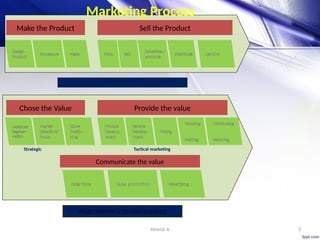
Make the Product Sell the Product
Design
Product
Procedure Make Price Sell
Advertise /
promote
Distribute Service
TRADITIONAL PHYSICAL PROCESS SEQUENCE
VALUE CREATION & DELIVERY SEQUENCE
Strategic Tactical marketing
Chose the Value Provide the value
Customer
Segmen-
-tation
Market
Selection/
Focus
Value
Positio-
ning
Product
Develop
-ment
Service
Develop
-ment
Pricing
Sales Force Sales promotion
Communicate the value
Sourcing
Making
Distributing
Servicing
Advertising
Marketing Process
Heena .k 4
Marketing Process
• The market process consists of analyzing marketing
opportunities, research & selecting target markets,
designing marketing strategies', planning marketing
programs, and organising, implementing, and
controlling the marketing effort.
Heena .k 5
Planning Marketing Programs
• To transform marketing strategy into marketing programs, marketing
managers must make basic decisions on marketing expenditures,
marketing mix, and marketing allocation.
• First, company must decide what level of marketing expenditures will
achieve
its marketing objectives.
• Companies typically establish their marketing budget at a percentage
of the sales goal.
Heena .k 6
• A particular company may spend more than the normal
percentage ratio in the hope of achieving a higher market
share.
• Second, the company has to decide how to divide the total
marketing budget among the various tools in the marketing
mix: product, price, place, and promotion.
• Finally, marketers must decide on the allocation of the
marketing budget to the various products, channels,
promotion media, and sales areas.
Heena .k 7
• To make these allocations, marketing managers use sales-response
functions that show how sales would be affected by the amount of
money spent in each application.
• The most basic marketing-mix tool is product—the firm’s tangible
offering to the market, which includes the product quality, design,
features, branding, and packaging.
• As part of its product offering, co. may provide various services, such as
leasing, delivery, repair, and training. Such support services can provide a
competitive advantage in the globally competitive marketplace.
Heena .k 8
• A critical marketing-mix tool is price co. has to decide on whole-
sale and retail prices, discounts, allowances, and credit terms.
• Its price should be commensurate with the offer’s perceived
value. Otherwise, buyers will turn to competitors’ products.
• Place includes the various activities the company undertakes to
make the product accessible and available to target customers.
• Co. must identify, recruit, and link various marketing facilitators to
supply its products and services efficiently to the target market.
Heena .k 9
• It must understand the various types of retailers, wholesalers, and
physical-distribution firms and how they make their decisions.
• Promotion includes all the activities the company undertakes to
communicate and promote its products to the target market.
• Company has to hire, train, and motivate salespeople. It has to
set up communication and promotion programs consisting of
advertising, sales promotion, public relations, and direct and on-
line marketing.
Heena .k 10
Managing the Marketing Effort
• The final step in the marketing process is organizing
the marketing resources and then implementing and
controlling the marketing plan.
• The company must build a marketing organization
that is capable of implementing the marketing plan.
Heena .k 11
Managing the Marketing Effort
• In a small company, one person might carry out all
the marketing tasks.
• Large companies will have several marketing
specialists: salespeople, sales managers, marketing
researchers, advertising personnel, product and
brand managers, market-segment managers, and
customer service personnel.
Heena .k 12
CONTENTS OF THE MARKETING PLAN
• Executive summary and table of contents: The marketing
plan should open with a brief summary of the plan’s main goals
and recommendations. The executive summary permits senior
management to grasp the plan’s major thrust. A table of
contents should follow the executive summary.
• Current marketing situation:
This section presents relevant background data on sales, costs,
profits, the market, competitors, distribution, and the macro
environment. The data are drawn from a product fact book
maintained by the product manager.
Heena .k 13
• Opportunity and issue analysis:
After summarizing the current marketing situation, the product
manager proceeds to identify the major opportunities/threats,
strengths/weaknesses, and issues facing the product line.
• Objectives:
Once the product manager has summarized the issues, he or
she must decide on the plan’s financial and marketing
objectives.
Heena .k 14
• Marketing strategy:
The product manager now outlines the broad marketing
strategy or “game plan” to accomplish the plan’s
objectives. In developing the strategy, the product
manager talks with the purchasing and manufacturing
people to confirm that they are able to buy enough
material and produce enough units to meet the target
sales volume levels. The product manager also needs to
talk to the sales manager to obtain sufficient sales force
support and to the financial officer to obtain sufficient
funds for advertising and promotion.
Heena .k 15
• Action programs:
The marketing plan must specify the broad marketing programs for
achieving the business objectives. Each marketing strategy element
must be elaborated to answer these questions: What will be done?
When will it be done? Who will do it? How much will it cost?
• Projected profit-and-loss statement:
Action plans allow the product manager to build a supporting
budget. On the revenue side, this budget shows the forecasted
sales volume in units and the average price. On the expense side, it
shows the cost of pro-
Heena .k 16
Reference
• Marketing Management
By Phillip Koetler
Heena .k 17
THANK YOU
Components of Marketing Programs
•Class Presentation By –
•Mr.Sanjeev B.Chougule
IInd Year M.Sc. (Hospital Administration)
Marketing Programs
• Definitions:
The set of marketing strategies that are implemented and used at the
same time
The combination of all of an organisation's marketing plans, marketing
research
- a formal, planned approach to the collection, analysis, interpretation
and reporting of information required for marketing decision-making.
Mr.Sanjeev B.Chougule 04-11-2009 03.00pm
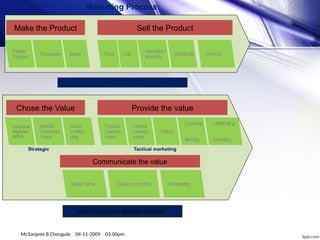
Make the Product Sell the Product
Design
Product
Procedure Make Price Sell
Advertise /
promote
Distribute Service
TRADITIONAL PHYSICAL PROCESS SEQUENCE
VALUE CREATION & DELIVERY SEQUENCE
Strategic Tactical marketing
Chose the Value Provide the value
Customer
Segmen-
-tation
Market
Selection/
Focus
Value
Positio-
ning
Product
Develop
-ment
Service
Develop
-ment
Pricing
Sales Force Sales promotion
Communicate the value
Sourcing
Making
Distributing
Servicing
Advertising
Mr.Sanjeev B.Chougule 04-11-2009 03.00pm
Marketing Process
Marketing Process
• The market process consists of analyzing
marketing opportunities, research &
selecting target markets, designing
marketing strategies', planning marketing
programs, and organising, implementing,
and controlling the marketing effort.
Mr.Sanjeev B.Chougule 04-11-2009 03.00pm
Planning Marketing Programs
• To transform marketing strategy into marketing
programs, marketing managers must make basic
decisions on marketing expenditures, marketing mix,
and marketing allocation.
• First, company must decide what level of marketing
expenditures will achieve
its marketing objectives.
• Companies typically establish their marketing budget
at a percentage of the sales goal.
Mr.Sanjeev B.Chougule 04-11-2009 03.00pm
• A particular company may spend more than
the normal percentage ratio in the hope of
achieving a higher market share.
• Second, the company has to decide how to
divide the total marketing budget among the
various tools in the marketing mix: product,
price, place, and promotion.
• Finally, marketers must decide on the
allocation of the marketing budget to the
various products, channels, promotion media,
and sales areas.
Mr.Sanjeev B.Chougule 04-11-2009 03.00pm
• To make these allocations, marketing managers use
sales-response functions that show how sales would
be affected by the amount of money spent in each
application.
• The most basic marketing-mix tool is product—the
firm’s tangible offering to the market, which includes
the product quality, design, features, branding, and
packaging.
• As part of its product offering, co. may provide
various services, such as leasing, delivery, repair, and
training. Such support services can provide a
competitive advantage in the globally competitive
marketplace.
Mr.Sanjeev B.Chougule 04-11-2009 03.00pm
• A critical marketing-mix tool is price co. has to
decide on whole- sale and retail prices,
discounts, allowances, and credit terms.
• Its price should be commensurate with the
offer’s perceived value. Otherwise, buyers will
turn to competitors’ products.
• Place includes the various activities the company
undertakes to make the product accessible and
available to target customers.
• Co. must identify, recruit, and link various
marketing facilitators to supply its products and
services efficiently to the target market.
Mr.Sanjeev B.Chougule 04-11-2009 03.00pm
• It must understand the various types of
retailers, wholesalers, and physical-distribution
firms and how they make their decisions.
• Promotion includes all the activities the
company undertakes to communicate and
promote its products to the target market.
• Company has to hire, train, and motivate
salespeople. It has to set up communication
and promotion programs consisting of
advertising, sales promotion, public relations,
and direct and on-line marketing.
Mr.Sanjeev B.Chougule 04-11-2009 03.00pm
Managing the Marketing Effort
• The final step in the marketing process is organizing
the marketing resources and then implementing and
controlling the marketing plan.
• The company must build a marketing organization
that is capable of implementing the marketing plan.
Mr.Sanjeev B.Chougule 04-11-2009 03.00pm
Managing the Marketing Effort
• In a small company, one person might carry out all
the marketing tasks.
• Large companies will have several marketing
specialists: salespeople, sales managers, marketing
researchers, advertising personnel, product and
brand managers, market-segment managers, and
customer service personnel.
Mr.Sanjeev B.Chougule 04-11-2009 03.00pm
CONTENTS OF THE MARKETING PLAN
• Executive summary and table of contents: The
marketing plan should open with a brief summary of
the plan’s main goals and recommendations. The
executive summary permits senior management to
grasp the plan’s major thrust. A table of contents
should follow the executive summary.
• Current marketing situation:
This section presents relevant background data on
sales, costs, profits, the market, competitors,
distribution, and the macro environment. The data
are drawn from a product fact book maintained by
the product manager.
Mr.Sanjeev B.Chougule 04-11-2009 03.00pm
• Opportunity and issue analysis:
After summarizing the current marketing
situation, the product manager proceeds to
identify the major opportunities/threats,
strengths/weaknesses, and issues facing the
product line.
• Objectives:
Once the product manager has summarized the
issues, he or she must decide on the plan’s
financial and marketing objectives.
Mr.Sanjeev B.Chougule 04-11-2009 03.00pm
• Marketing strategy:
The product manager now outlines the
broad marketing strategy or “game plan” to
accomplish the plan’s objectives. In developing
the strategy, the product manager talks with
the purchasing and manufacturing people to
confirm that they are able to buy enough
material and produce enough units to meet the
target sales volume levels. The product
manager also needs to talk to the sales
manager to obtain sufficient sales force
support and to the financial officer to obtain
sufficient funds for advertising and promotion.
Mr.Sanjeev B.Chougule 04-11-2009 03.00pm
• Action programs:
The marketing plan must specify the broad
marketing programs for achieving the business
objectives. Each marketing strategy element must
be elaborated to answer these questions: What
will be done? When will it be done? Who will do
it? How much will it cost?
• Projected profit-and-loss statement:
Action plans allow the product manager to build a
supporting budget. On the revenue side, this
budget shows the forecasted sales volume in units
and the average price. On the expense side, it
shows the cost of pro-
Mr.Sanjeev B.Chougule 04-11-2009 03.00pm
Reference
• Marketing Management
By Phillip Koetler
Mr.Sanjeev B.Chougule
04-11-2009 03.00pm
components of marketing programs.presentation

components of marketing programs.presentation

  • 1.
    Components of Marketing Programs Presentedby Heena Kousar Final year M.sc {H A} J N Medical College
  • 2.
    Heena .k 2 MarketingPrograms • Definitions: The set of marketing strategies that are implemented and used at the same time The combination of all of an organisation's marketing plans, marketing research - a formal, planned approach to the collection, analysis, interpretation and reporting of information required for marketing decision-making.
  • 3.
    Heena .k 3 Makethe Product Sell the Product Design Product Procedure Make Price Sell Advertise / promote Distribute Service TRADITIONAL PHYSICAL PROCESS SEQUENCE VALUE CREATION & DELIVERY SEQUENCE Strategic Tactical marketing Chose the Value Provide the value Customer Segmen- -tation Market Selection/ Focus Value Positio- ning Product Develop -ment Service Develop -ment Pricing Sales Force Sales promotion Communicate the value Sourcing Making Distributing Servicing Advertising Marketing Process
  • 4.
    Heena .k 4 MarketingProcess • The market process consists of analyzing marketing opportunities, research & selecting target markets, designing marketing strategies', planning marketing programs, and organising, implementing, and controlling the marketing effort.
  • 5.
    Heena .k 5 PlanningMarketing Programs • To transform marketing strategy into marketing programs, marketing managers must make basic decisions on marketing expenditures, marketing mix, and marketing allocation. • First, company must decide what level of marketing expenditures will achieve its marketing objectives. • Companies typically establish their marketing budget at a percentage of the sales goal.
  • 6.
    Heena .k 6 •A particular company may spend more than the normal percentage ratio in the hope of achieving a higher market share. • Second, the company has to decide how to divide the total marketing budget among the various tools in the marketing mix: product, price, place, and promotion. • Finally, marketers must decide on the allocation of the marketing budget to the various products, channels, promotion media, and sales areas.
  • 7.
    Heena .k 7 •To make these allocations, marketing managers use sales-response functions that show how sales would be affected by the amount of money spent in each application. • The most basic marketing-mix tool is product—the firm’s tangible offering to the market, which includes the product quality, design, features, branding, and packaging. • As part of its product offering, co. may provide various services, such as leasing, delivery, repair, and training. Such support services can provide a competitive advantage in the globally competitive marketplace.
  • 8.
    Heena .k 8 •A critical marketing-mix tool is price co. has to decide on whole- sale and retail prices, discounts, allowances, and credit terms. • Its price should be commensurate with the offer’s perceived value. Otherwise, buyers will turn to competitors’ products. • Place includes the various activities the company undertakes to make the product accessible and available to target customers. • Co. must identify, recruit, and link various marketing facilitators to supply its products and services efficiently to the target market.
  • 9.
    Heena .k 9 •It must understand the various types of retailers, wholesalers, and physical-distribution firms and how they make their decisions. • Promotion includes all the activities the company undertakes to communicate and promote its products to the target market. • Company has to hire, train, and motivate salespeople. It has to set up communication and promotion programs consisting of advertising, sales promotion, public relations, and direct and on- line marketing.
  • 10.
    Heena .k 10 Managingthe Marketing Effort • The final step in the marketing process is organizing the marketing resources and then implementing and controlling the marketing plan. • The company must build a marketing organization that is capable of implementing the marketing plan.
  • 11.
    Heena .k 11 Managingthe Marketing Effort • In a small company, one person might carry out all the marketing tasks. • Large companies will have several marketing specialists: salespeople, sales managers, marketing researchers, advertising personnel, product and brand managers, market-segment managers, and customer service personnel.
  • 12.
    Heena .k 12 CONTENTSOF THE MARKETING PLAN • Executive summary and table of contents: The marketing plan should open with a brief summary of the plan’s main goals and recommendations. The executive summary permits senior management to grasp the plan’s major thrust. A table of contents should follow the executive summary. • Current marketing situation: This section presents relevant background data on sales, costs, profits, the market, competitors, distribution, and the macro environment. The data are drawn from a product fact book maintained by the product manager.
  • 13.
    Heena .k 13 •Opportunity and issue analysis: After summarizing the current marketing situation, the product manager proceeds to identify the major opportunities/threats, strengths/weaknesses, and issues facing the product line. • Objectives: Once the product manager has summarized the issues, he or she must decide on the plan’s financial and marketing objectives.
  • 14.
    Heena .k 14 •Marketing strategy: The product manager now outlines the broad marketing strategy or “game plan” to accomplish the plan’s objectives. In developing the strategy, the product manager talks with the purchasing and manufacturing people to confirm that they are able to buy enough material and produce enough units to meet the target sales volume levels. The product manager also needs to talk to the sales manager to obtain sufficient sales force support and to the financial officer to obtain sufficient funds for advertising and promotion.
  • 15.
    Heena .k 15 •Action programs: The marketing plan must specify the broad marketing programs for achieving the business objectives. Each marketing strategy element must be elaborated to answer these questions: What will be done? When will it be done? Who will do it? How much will it cost? • Projected profit-and-loss statement: Action plans allow the product manager to build a supporting budget. On the revenue side, this budget shows the forecasted sales volume in units and the average price. On the expense side, it shows the cost of pro-
  • 16.
    Heena .k 16 Reference •Marketing Management By Phillip Koetler
  • 17.
  • 18.
    Components of MarketingPrograms •Class Presentation By – •Mr.Sanjeev B.Chougule IInd Year M.Sc. (Hospital Administration)
  • 19.
    Marketing Programs • Definitions: Theset of marketing strategies that are implemented and used at the same time The combination of all of an organisation's marketing plans, marketing research - a formal, planned approach to the collection, analysis, interpretation and reporting of information required for marketing decision-making. Mr.Sanjeev B.Chougule 04-11-2009 03.00pm
  • 20.
    Make the ProductSell the Product Design Product Procedure Make Price Sell Advertise / promote Distribute Service TRADITIONAL PHYSICAL PROCESS SEQUENCE VALUE CREATION & DELIVERY SEQUENCE Strategic Tactical marketing Chose the Value Provide the value Customer Segmen- -tation Market Selection/ Focus Value Positio- ning Product Develop -ment Service Develop -ment Pricing Sales Force Sales promotion Communicate the value Sourcing Making Distributing Servicing Advertising Mr.Sanjeev B.Chougule 04-11-2009 03.00pm Marketing Process
  • 21.
    Marketing Process • Themarket process consists of analyzing marketing opportunities, research & selecting target markets, designing marketing strategies', planning marketing programs, and organising, implementing, and controlling the marketing effort. Mr.Sanjeev B.Chougule 04-11-2009 03.00pm
  • 22.
    Planning Marketing Programs •To transform marketing strategy into marketing programs, marketing managers must make basic decisions on marketing expenditures, marketing mix, and marketing allocation. • First, company must decide what level of marketing expenditures will achieve its marketing objectives. • Companies typically establish their marketing budget at a percentage of the sales goal. Mr.Sanjeev B.Chougule 04-11-2009 03.00pm
  • 23.
    • A particularcompany may spend more than the normal percentage ratio in the hope of achieving a higher market share. • Second, the company has to decide how to divide the total marketing budget among the various tools in the marketing mix: product, price, place, and promotion. • Finally, marketers must decide on the allocation of the marketing budget to the various products, channels, promotion media, and sales areas. Mr.Sanjeev B.Chougule 04-11-2009 03.00pm
  • 24.
    • To makethese allocations, marketing managers use sales-response functions that show how sales would be affected by the amount of money spent in each application. • The most basic marketing-mix tool is product—the firm’s tangible offering to the market, which includes the product quality, design, features, branding, and packaging. • As part of its product offering, co. may provide various services, such as leasing, delivery, repair, and training. Such support services can provide a competitive advantage in the globally competitive marketplace. Mr.Sanjeev B.Chougule 04-11-2009 03.00pm
  • 25.
    • A criticalmarketing-mix tool is price co. has to decide on whole- sale and retail prices, discounts, allowances, and credit terms. • Its price should be commensurate with the offer’s perceived value. Otherwise, buyers will turn to competitors’ products. • Place includes the various activities the company undertakes to make the product accessible and available to target customers. • Co. must identify, recruit, and link various marketing facilitators to supply its products and services efficiently to the target market. Mr.Sanjeev B.Chougule 04-11-2009 03.00pm
  • 26.
    • It mustunderstand the various types of retailers, wholesalers, and physical-distribution firms and how they make their decisions. • Promotion includes all the activities the company undertakes to communicate and promote its products to the target market. • Company has to hire, train, and motivate salespeople. It has to set up communication and promotion programs consisting of advertising, sales promotion, public relations, and direct and on-line marketing. Mr.Sanjeev B.Chougule 04-11-2009 03.00pm
  • 27.
    Managing the MarketingEffort • The final step in the marketing process is organizing the marketing resources and then implementing and controlling the marketing plan. • The company must build a marketing organization that is capable of implementing the marketing plan. Mr.Sanjeev B.Chougule 04-11-2009 03.00pm
  • 28.
    Managing the MarketingEffort • In a small company, one person might carry out all the marketing tasks. • Large companies will have several marketing specialists: salespeople, sales managers, marketing researchers, advertising personnel, product and brand managers, market-segment managers, and customer service personnel. Mr.Sanjeev B.Chougule 04-11-2009 03.00pm
  • 29.
    CONTENTS OF THEMARKETING PLAN • Executive summary and table of contents: The marketing plan should open with a brief summary of the plan’s main goals and recommendations. The executive summary permits senior management to grasp the plan’s major thrust. A table of contents should follow the executive summary. • Current marketing situation: This section presents relevant background data on sales, costs, profits, the market, competitors, distribution, and the macro environment. The data are drawn from a product fact book maintained by the product manager. Mr.Sanjeev B.Chougule 04-11-2009 03.00pm
  • 30.
    • Opportunity andissue analysis: After summarizing the current marketing situation, the product manager proceeds to identify the major opportunities/threats, strengths/weaknesses, and issues facing the product line. • Objectives: Once the product manager has summarized the issues, he or she must decide on the plan’s financial and marketing objectives. Mr.Sanjeev B.Chougule 04-11-2009 03.00pm
  • 31.
    • Marketing strategy: Theproduct manager now outlines the broad marketing strategy or “game plan” to accomplish the plan’s objectives. In developing the strategy, the product manager talks with the purchasing and manufacturing people to confirm that they are able to buy enough material and produce enough units to meet the target sales volume levels. The product manager also needs to talk to the sales manager to obtain sufficient sales force support and to the financial officer to obtain sufficient funds for advertising and promotion. Mr.Sanjeev B.Chougule 04-11-2009 03.00pm
  • 32.
    • Action programs: Themarketing plan must specify the broad marketing programs for achieving the business objectives. Each marketing strategy element must be elaborated to answer these questions: What will be done? When will it be done? Who will do it? How much will it cost? • Projected profit-and-loss statement: Action plans allow the product manager to build a supporting budget. On the revenue side, this budget shows the forecasted sales volume in units and the average price. On the expense side, it shows the cost of pro- Mr.Sanjeev B.Chougule 04-11-2009 03.00pm
  • 33.
    Reference • Marketing Management ByPhillip Koetler Mr.Sanjeev B.Chougule 04-11-2009 03.00pm