SUBMITTED TO : SUBMITTED BY:
ASST.PROF.TINU THOMAS ABHIJITH JAYAKUMAR
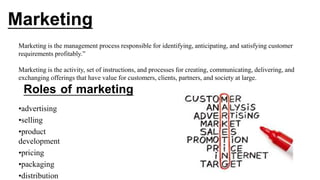
Marketing
Roles of marketing
•advertising
•selling
•product
development
•pricing
•packaging
•distribution
Marketing is the management process responsible for identifying, anticipating, and satisfying customer
requirements profitably.”
Marketing is the activity, set of instructions, and processes for creating, communicating, delivering, and
exchanging offerings that have value for customers, clients, partners, and society at large.
What do marketers do?
• Identify needs and wants
• Choose which/whose needs to focus on
• Create and manage products
• Communicate about products
• Price products
• Distribute products
• Follow up
Marketing Process
Three elements:
1. Market analysis
(Who will buy?)
2. Marketing-mix planning
(What? Where? How much?
How?)
2. Marketing control
(Have we been successful?)
A simple model of the marketing
process:
• Understand the marketplace and
customer needs and wants.
• Design a customer-driven marketing
strategy.
• Construct an integrated marketing
program that delivers superior value.
• Build profitable relationships and
create customer delight.
• Capture value from customers to
create profits and customer quality.
MARKETING – MANAGEMENT PROCESS
• Analysis/Audit - where are we now?
• Objectives- where do we want to be
• Strategies - which way is best?
• Tactics- how do we get there?
• Implementation- Getting there!
• Control- Ensuring arrival
WHAT DO WE MARKET
• Goods
• Services
• Events
• Experiences
• Personalities
• Place
• Organizations
• Properties
• Information
• Ideas and Concepts
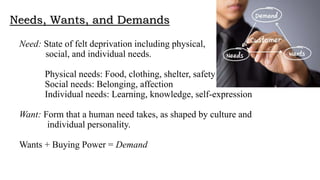
Needs, Wants, and Demands
Need: State of felt deprivation including physical,
social, and individual needs.
Physical needs: Food, clothing, shelter, safety
Social needs: Belonging, affection
Individual needs: Learning, knowledge, self-expression
Want: Form that a human need takes, as shaped by culture and
individual personality.
Wants + Buying Power = Demand
Need/ Want Fulfillment
Needs & wants are fulfilled through a Marketing Offering:
Products:
Persons, places, organizations, information, ideas.
Services:
Activity or benefit offered for sale that is essentially
intangible and does not result in ownership.
Experiences:
Consumers live the offering.
=> developing a tactics to achieve strategic aims
aim: to make customers from the target group buy
Marketing mix planning (6P)
• Product – the item or service you offer
• Place – distribution channels where a consumer can get access
• Price – enough to make a profit and not too much for the market to bear
• Promotion - how you communicate the existence of your product or
service and its benefits
• People - staff and customers
• Positioning - brand or corporate identity
•Market Research
• How is your organisation perceived, internally and by customers?
Who should you ask?
• Current and lapsed customers
• Potential customers
• How can you find out?
• Quantitative research – know the Numbers via statistics, survey results
• Qualitative research - Explores the motivations such as through focus
groups, interviews, feedback....
• Observation is also important
Setting Marketing Goals
• Short term (within 12 months)
• Long term (within 3 years)
They should come from your analysis. Keep them few and
simple, achievable now, grouped together to focus effort
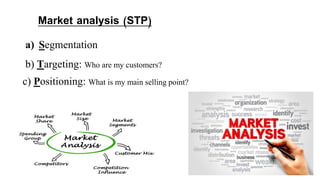
Market analysis (STP)
a) Segmentation
b) Targeting: Who are my customers?
c) Positioning: What is my main selling point?
=>looking back at the entire process to find out whether or not it was successful
Why control?
• planning is no guarantee for profit
• markets change constantly
• strategies not always effective
Tools:
a)Annual-plan control
b)Profitability control
c)Efficiency control
d)Strategic control
Evaluation and control
MARKETING STRATEGY
• 1.Systematic futuristic thinking by management
• 2.Better co-ordination of company efforts
• 3.Development of better performance standards for control
• 4.Sharpening of objectives and policies
• 5.Better prepare for sudden new developments
• 6.Managers have a vivid sense of participation

MARKRTING

  • 1.
    SUBMITTED TO :SUBMITTED BY: ASST.PROF.TINU THOMAS ABHIJITH JAYAKUMAR
  • 2.
    Marketing Roles of marketing •advertising •selling •product development •pricing •packaging •distribution Marketingis the management process responsible for identifying, anticipating, and satisfying customer requirements profitably.” Marketing is the activity, set of instructions, and processes for creating, communicating, delivering, and exchanging offerings that have value for customers, clients, partners, and society at large.
  • 3.
    What do marketersdo? • Identify needs and wants • Choose which/whose needs to focus on • Create and manage products • Communicate about products • Price products • Distribute products • Follow up
  • 4.
    Marketing Process Three elements: 1.Market analysis (Who will buy?) 2. Marketing-mix planning (What? Where? How much? How?) 2. Marketing control (Have we been successful?) A simple model of the marketing process: • Understand the marketplace and customer needs and wants. • Design a customer-driven marketing strategy. • Construct an integrated marketing program that delivers superior value. • Build profitable relationships and create customer delight. • Capture value from customers to create profits and customer quality.
  • 5.
    MARKETING – MANAGEMENTPROCESS • Analysis/Audit - where are we now? • Objectives- where do we want to be • Strategies - which way is best? • Tactics- how do we get there? • Implementation- Getting there! • Control- Ensuring arrival
  • 6.
    WHAT DO WEMARKET • Goods • Services • Events • Experiences • Personalities • Place • Organizations • Properties • Information • Ideas and Concepts
  • 7.
    Needs, Wants, andDemands Need: State of felt deprivation including physical, social, and individual needs. Physical needs: Food, clothing, shelter, safety Social needs: Belonging, affection Individual needs: Learning, knowledge, self-expression Want: Form that a human need takes, as shaped by culture and individual personality. Wants + Buying Power = Demand
  • 8.
    Need/ Want Fulfillment Needs& wants are fulfilled through a Marketing Offering: Products: Persons, places, organizations, information, ideas. Services: Activity or benefit offered for sale that is essentially intangible and does not result in ownership. Experiences: Consumers live the offering.
  • 9.
    => developing atactics to achieve strategic aims aim: to make customers from the target group buy Marketing mix planning (6P) • Product – the item or service you offer • Place – distribution channels where a consumer can get access • Price – enough to make a profit and not too much for the market to bear • Promotion - how you communicate the existence of your product or service and its benefits • People - staff and customers • Positioning - brand or corporate identity
  • 10.
    •Market Research • Howis your organisation perceived, internally and by customers? Who should you ask? • Current and lapsed customers • Potential customers • How can you find out? • Quantitative research – know the Numbers via statistics, survey results • Qualitative research - Explores the motivations such as through focus groups, interviews, feedback.... • Observation is also important
  • 11.
    Setting Marketing Goals •Short term (within 12 months) • Long term (within 3 years) They should come from your analysis. Keep them few and simple, achievable now, grouped together to focus effort
  • 12.
    Market analysis (STP) a)Segmentation b) Targeting: Who are my customers? c) Positioning: What is my main selling point?
  • 13.
    =>looking back atthe entire process to find out whether or not it was successful Why control? • planning is no guarantee for profit • markets change constantly • strategies not always effective Tools: a)Annual-plan control b)Profitability control c)Efficiency control d)Strategic control Evaluation and control
  • 14.
    MARKETING STRATEGY • 1.Systematicfuturistic thinking by management • 2.Better co-ordination of company efforts • 3.Development of better performance standards for control • 4.Sharpening of objectives and policies • 5.Better prepare for sudden new developments • 6.Managers have a vivid sense of participation