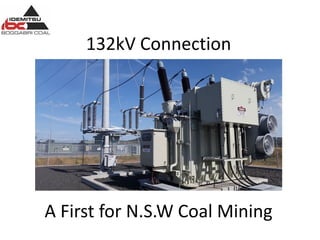
132kV Connection
A First for N.S.W Coal Mining
Introduction
• Where is Boggabri – Situated between Gunnedah and Narrabri in north west
N.S.W approx. 115km West from Tamworth.
• Boggabri Coal Operations commenced mining in 2006
• A significant expansion of site infrastructure was undertaken in 2014/2015
• The 132kV connection was a joint project by Transgrid and Boggabri Coal
Operations.
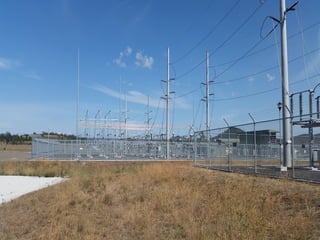
• Included was 15kM of single structure, double circuit, 132kV transmission line,
132kV switching station and the 132kv/11kV substation.
Overview
• Boggabri Coal Operations were an LV customer (HV was
managed by the utility) at inception.
• Site demand was below 2MVA
• An 11kV rural feeder from Boggabri Substation was the
only mine supply source. The service extended over 25kM
(voltage regulation was required).
• Expansion of site infrastructure required power system
demand exceeding the 11kV capability.
• Overall site demand increased to 8MVA (design capacity)
• Local services could not meet the demand – Transmission
was the only option.
Why 132kV Connection
?
A first for Mining and Transgrid
Network Layout
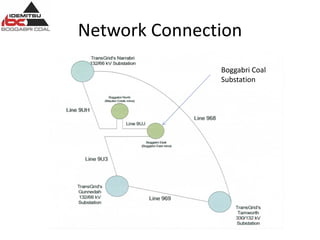
Network Connection
Boggabri Coal
Substation
Network Connection
Protection Schemes
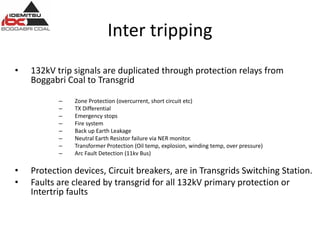
Inter tripping
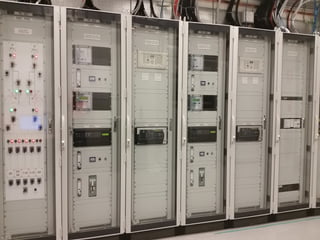
• 132kV trip signals are duplicated through protection relays from
Boggabri Coal to Transgrid
– Zone Protection (overcurrent, short circuit etc)
– TX Differential
– Emergency stops
– Fire system
– Back up Earth Leakage
– Neutral Earth Resistor failure via NER monitor.
– Transformer Protection (Oil temp, explosion, winding temp, over pressure)
– Arc Fault Detection (11kv Bus)
• Protection devices, Circuit breakers, are in Transgrids Switching Station.
• Faults are cleared by transgrid for all 132kV primary protection or
Intertrip faults
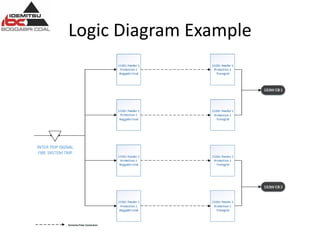
Logic Diagram Example
Load shed Arrangements
• Transmission systems demand stability
• Transgrid Load shed scheme means exactly what is
sounds like
• 4 Tiers are implemented which shed different load
blocks
• Bus voltage is monitored at the switching station for
trip signal initiations
EARTHING
• Common earthing system between Transgrid and Boggabri Coal
• Design requirements - Allowable touch and step voltages were
derived from different standards
• Transgrid – AS2067 ( Calculated)
• Boggabri Coal – AS3007 (step/touch potentials v’s clearance times)
• Transfer voltage levels required separation between
“mine infrastructure area” and the 132kV facility. A
164M exclusion zone has been established for earthed
services entering this zone.
EARTHING
Challenges
• Design was completed by Transmission orientated Engineers with a different approach to mining
“Risk management base”
• Design review was undertaken by a QLD based engineering company
• Disconnect between project team and the end user of the facility
• System operation – original design philosophy was to run 2 x 10MVA TX’s in parallel which allowed
for a 65kA fault level on the 415V system (terminals of the 3MVA TX supply)
• Fundamental protection schemes, secondary systems, required further development prior to
energistaion.
• HV and LV services crossing operational boundaries. Boggabri Coal and Transgrid share HV and LV
services originating on both sides of the installation.
• Differences in isolation procedures, including hardware between both Transgrid and Boggabri Coal
• Transgrid having a major facility “next door” to the mine substation.
• Unrestricted earth fault levels on the 132kV connection (max 15kA) – transfer voltages
• Reliance of primary protection clearing faults is by the utility – No 132kV protective devices are
owned or operated by Boggabri Coal Operations.
Advantages
• Transgrid monitoring
• Transgrid system control monitor the status of Transgrid equipment, including the 132kV circuit breakers,
24/7
• Remote operation of 132kV circuit breakers from Transgrid system control
• Stability of Supply
• The 132kV connection is part of the overall, north west area “Ring Main”. This means the system is very
stable and subject to minimal outages or faults.
• Reduced Arc Flash Categories
• Increased equipment clearances (above 3M) and protection schemes allow for arc
flash categories to be reduced
Key Outcomes
• Transgrid and Boggabri Coal Operating agreement implemented
This document identifies
– Equipment isolation instructions, each piece of equipment has an agreed isolation procedure
– Communication protocol’s
– Key contacts for events
– Use and transaction of “High Voltage Equipment Outage” permits.
• Connection Agreement
– Highlights the obligations of each party
– Deals with access and safety scenarios .
– Modifications to the agreed installation and protection settings are dealt with here
• Operational and Maintenance, hazard identification and risk analysis via
consultation with designer, supplier, installer, operator and utility (Transgrid).
– This process expedited the risk mitigation process due to designer information being supplied by key engineers
• Designer based training for operational staff
– Maintenance, Isolation and Operational documents were developed and used as training material
for electrical staff by the designer. Training was delivered onsite.
Recommendations
• Where plant and installations are being
constructed, for the purpose of mining
operations, statutory functions should be
involved in the key decisions.
• Collaboration with mining and transmission
industries requires further development.
Mindsets are differing around system
operations and protection functions.
Thank You!

Complex connections Rick Chorley

  • 1.
    132kV Connection A Firstfor N.S.W Coal Mining
  • 2.
    Introduction • Where isBoggabri – Situated between Gunnedah and Narrabri in north west N.S.W approx. 115km West from Tamworth. • Boggabri Coal Operations commenced mining in 2006 • A significant expansion of site infrastructure was undertaken in 2014/2015 • The 132kV connection was a joint project by Transgrid and Boggabri Coal Operations. • Included was 15kM of single structure, double circuit, 132kV transmission line, 132kV switching station and the 132kv/11kV substation.
  • 3.
    Overview • Boggabri CoalOperations were an LV customer (HV was managed by the utility) at inception. • Site demand was below 2MVA • An 11kV rural feeder from Boggabri Substation was the only mine supply source. The service extended over 25kM (voltage regulation was required). • Expansion of site infrastructure required power system demand exceeding the 11kV capability. • Overall site demand increased to 8MVA (design capacity) • Local services could not meet the demand – Transmission was the only option.
  • 4.
    Why 132kV Connection ? Afirst for Mining and Transgrid
  • 5.
  • 6.
  • 7.
  • 9.
  • 10.
    Inter tripping • 132kVtrip signals are duplicated through protection relays from Boggabri Coal to Transgrid – Zone Protection (overcurrent, short circuit etc) – TX Differential – Emergency stops – Fire system – Back up Earth Leakage – Neutral Earth Resistor failure via NER monitor. – Transformer Protection (Oil temp, explosion, winding temp, over pressure) – Arc Fault Detection (11kv Bus) • Protection devices, Circuit breakers, are in Transgrids Switching Station. • Faults are cleared by transgrid for all 132kV primary protection or Intertrip faults
  • 11.
  • 12.
    Load shed Arrangements •Transmission systems demand stability • Transgrid Load shed scheme means exactly what is sounds like • 4 Tiers are implemented which shed different load blocks • Bus voltage is monitored at the switching station for trip signal initiations
  • 13.
    EARTHING • Common earthingsystem between Transgrid and Boggabri Coal • Design requirements - Allowable touch and step voltages were derived from different standards • Transgrid – AS2067 ( Calculated) • Boggabri Coal – AS3007 (step/touch potentials v’s clearance times) • Transfer voltage levels required separation between “mine infrastructure area” and the 132kV facility. A 164M exclusion zone has been established for earthed services entering this zone.
  • 14.
  • 15.
    Challenges • Design wascompleted by Transmission orientated Engineers with a different approach to mining “Risk management base” • Design review was undertaken by a QLD based engineering company • Disconnect between project team and the end user of the facility • System operation – original design philosophy was to run 2 x 10MVA TX’s in parallel which allowed for a 65kA fault level on the 415V system (terminals of the 3MVA TX supply) • Fundamental protection schemes, secondary systems, required further development prior to energistaion. • HV and LV services crossing operational boundaries. Boggabri Coal and Transgrid share HV and LV services originating on both sides of the installation. • Differences in isolation procedures, including hardware between both Transgrid and Boggabri Coal • Transgrid having a major facility “next door” to the mine substation. • Unrestricted earth fault levels on the 132kV connection (max 15kA) – transfer voltages • Reliance of primary protection clearing faults is by the utility – No 132kV protective devices are owned or operated by Boggabri Coal Operations.
  • 16.
    Advantages • Transgrid monitoring •Transgrid system control monitor the status of Transgrid equipment, including the 132kV circuit breakers, 24/7 • Remote operation of 132kV circuit breakers from Transgrid system control • Stability of Supply • The 132kV connection is part of the overall, north west area “Ring Main”. This means the system is very stable and subject to minimal outages or faults. • Reduced Arc Flash Categories • Increased equipment clearances (above 3M) and protection schemes allow for arc flash categories to be reduced
  • 17.
    Key Outcomes • Transgridand Boggabri Coal Operating agreement implemented This document identifies – Equipment isolation instructions, each piece of equipment has an agreed isolation procedure – Communication protocol’s – Key contacts for events – Use and transaction of “High Voltage Equipment Outage” permits. • Connection Agreement – Highlights the obligations of each party – Deals with access and safety scenarios . – Modifications to the agreed installation and protection settings are dealt with here • Operational and Maintenance, hazard identification and risk analysis via consultation with designer, supplier, installer, operator and utility (Transgrid). – This process expedited the risk mitigation process due to designer information being supplied by key engineers • Designer based training for operational staff – Maintenance, Isolation and Operational documents were developed and used as training material for electrical staff by the designer. Training was delivered onsite.
  • 18.
    Recommendations • Where plantand installations are being constructed, for the purpose of mining operations, statutory functions should be involved in the key decisions. • Collaboration with mining and transmission industries requires further development. Mindsets are differing around system operations and protection functions.
  • 25.