Starting somewhere new
Starting off
0 Work in small groups. Match the reasons for studying in a
different country (a-d) with the photos (1-4).
a to get internationally recognised qualifications
b to learn a foreign language
c to experience living in a different culture
d to make friends with people from other countries
6 Now discuss these questions.
• Which reason for studying abroad would be the most important
for you?
• What other reasons do people have for studying abroad?
Listening Section 1
Exam information
• You hear a conversation between two people on a social or
practical topic.
• In this section only, you are given an example at the beginning.
• You write your answers on the question paper while you listen.
0 Work in pairs. You are going to hear a conversation with a
woman who wants to join an international social club. Before
you listen, look at the advert below.
I What is an international social club?
2 Would you enjoy being a member? Why? I Why not?
Inte~nal
SoC-ial Club
~
(D Unit 1
Meet people from around the world
at the International Social Club!
We organise events for people from
different countries to meet and
share ideas and experiences.
If you want to widen your horizons
by meeting people of different
nationalities in a social atmosphere,
click here to join.
6 Work in pairs. Read Questions 1-5 in this
Listening task. Decide what information you will
need for each gap; for example, which answers
might need numbers? Which might need the
name of an activity?
Questions 1-5
Complete the form below.
Write ONE WORD AND/OR A NUMBER for each
answer.
lnter
...
onal
Soci Club
'-....::../
Name:
Age:
Nationality:
Address:
Mobile phone:
Occupation:
Application form
JennyFoo
21
1 ··················
2 ................. Road, Bondi
3 ..................
4 ..................
Free-time interests: Singing and 5
€) (oi Now listen and answer Questions 1-5.
Exam advice Form completion
• While you read the questions, think what type of
information you need for each gap.
• You will often hear someone spell a name or
say a number. Make sure you know how to say
letters and numbers in English.
• Write numbers as figures, not words.
0 Read Questions 6-10. Underline the key idea in
each question.
Questions 6-10
Choose the correct letter, A, B or C.
6 According to Don, what might be a problem
for Jenny?
A her accent
B talking to her colleagues
C understanding local people
7 How many members does the club have now?
A 30
B 50
c 80
8 How often does the club meet?
A once a week
B once every two weeks
C once a month
9 What is the club's most frequent type of
activity?
A a talk
B a visit
C a meal
10 The main purpose of the club is to help
members to
A meet Australians.
B learn about life in Australia.
C enjoy themselves together.
0 ~ Now listen and answer Questions 6-10.
Exam advice Multiple choice
Before you listen, underline the key idea in each
question.
• The correct answer is often expressed using
different words from the words in the question.
@ Work in pairs. Imagine that you want to join the
International Social Club. Take turns to interview
each other to complete the form in Exercise 2.
Starting somewhere new G
Reading Section 1
Exam information
• Reading Passage 1 is usually a factual text.
• You need to find specific information.
• It is usually easier than the other parts, so it's a
good idea to do it first.
0 Work in small groups. Look at the list of things
people do when they live or study in a different
country. Which do you think are quite easy and
which are more difficult? Why?
• eating different food
• understanding people
• getting to know local people
• using public transport
• missing family and friends
• obtaining the correct papers
E) You are going to read a passage about culture
shock. Read the title of the passage and the
subheading in italics. What do you think culture
shock is?
€) Read the whole passage quickly. Which
stage of culture shock seems to be the most
uncomfortable?
@ Unit 1
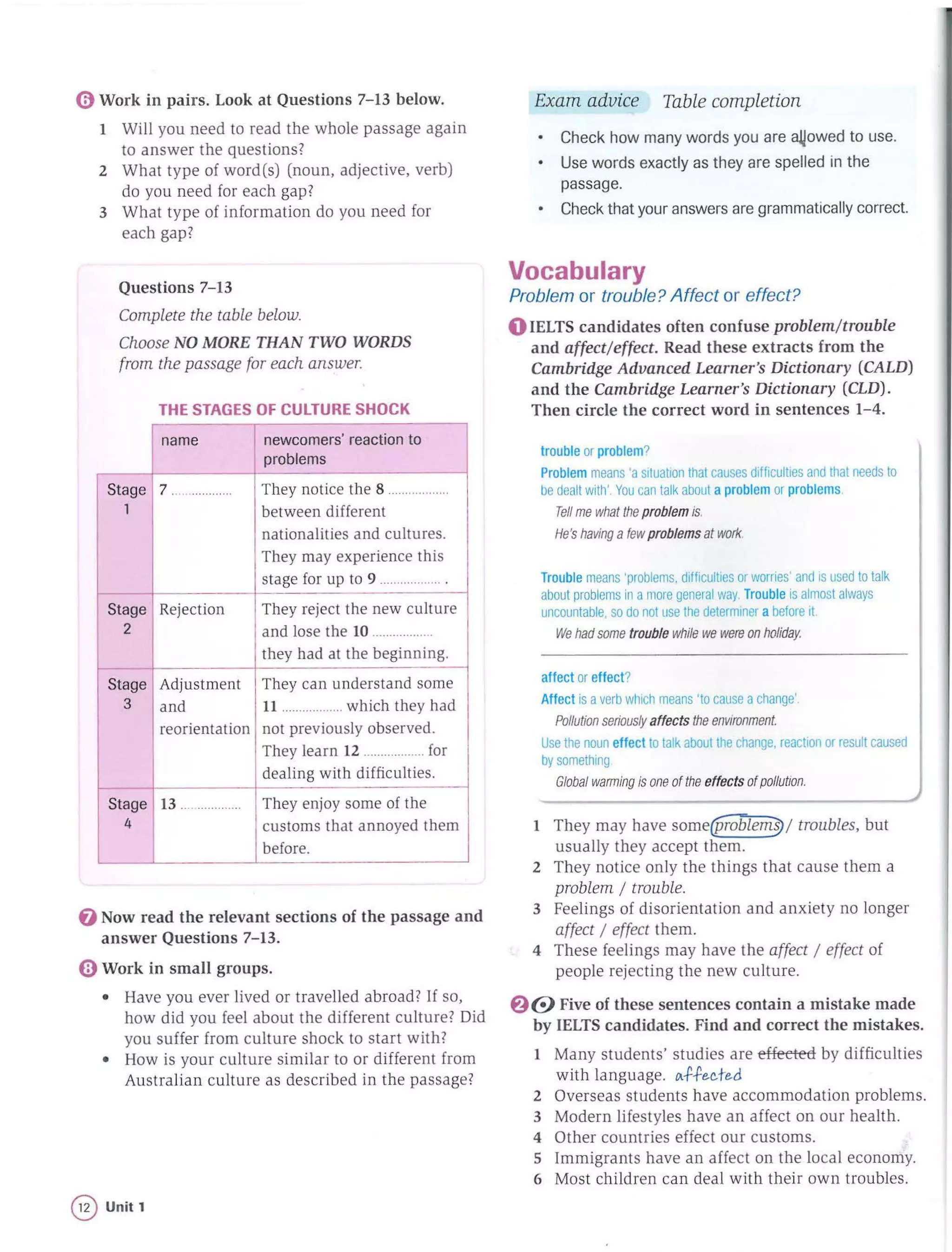
Sometimes work, study or asense ofadventure take us out
ofour familiar surroundings to go and live in a different
culture. The experience can be difficult, even shocking.
Almost everyone who studies,lives or works abroad has
problems adjusting to anew culture. Thisresponse is commonly
referred to as 'culture shock'. Culture shock canbe defined as
'the physical andemotional discomfort aperson experiences
whenentering aculture different from their own' (Weaver, 1993).
For people moving to Australia, Price (2001) has identified
certain values which may give rise to culture shock. Firstly, he
argues that Australians place a high value on independence
and personal choice. This means that ateacher or course tutor
will not tell studentswhat to do, but will give them anumber of
options and suggest they work out which one isthe best in their
circumstances.It also means that they are expected to take
action if something goes wrong and seek out resources and
support for themselves.
Australians are also prepared to accept arange of opinions
rather than believing there is one truth. This means that in an
educational setting, students will be expected to form their own
opinions and defend the reasons for that point of view and the
evidence for it.
Price also comments that Australians are uncomfortable with
differences in status and hence idealise the idea of treating
everyone equally. An illustration of this is that most adult
Australians call each other by their first names. This concern
with equality means that Australians are uncomfortable taking
anything too seriously and are even ready tojoke about
themselves.
Australians believe that life should have a balance between work
and leisure time. As aconsequence, some students may be
critical of others who they perceive as doing nothing but study.
Australian notions of privacy mean that areas such as financial
matters, appearance and relationships are only discussed with
close friends. While people may volunteer such information, they
may resent someone actually asking them unless the friendship
is firmly established. Even then, it is considered very impolite to
ask someone what they earn.With older people,it is also rude
to ask how old they are, why they are not married or why they do
not have children. It is also impolite to ask people how much they
have paid for something, unless there is a very good reason for
asking.
Kohls (1996) describes culture shock as aprocess of change
marked by four basic stages. During the first stage, the new
arrival is excited to be in anew place, so this is often referred
to as the "honeymoon" stage. Like atourist, they are intrigued
by all the new sights and sounds, new smells and tastes of their
surroundings. They may have some problems, but usually they
accept them as just part of the novelty. At this point, it is the
similarities that stand out, and it seems to the newcomer that
people everywhere and their way of life are very much alike. This
period of euphoria may last from a couple of weeks to a month,
but the letdown is inevitable.
During the second stage, known as the 'rejection' stage, the
newcomer starts to experience difficulties due to the differences
between the new culture and the way they were accustomed to
living. The initial enthusiasm turns into irritation, frustration, anger
and depression, and these feelings may have the effect of people
rejecting the new culture so that they notice only the things that
cause them trouble, which they then complain about. In addition,
they may feel homesick, bored, withdrawn and irritable during this
period as well.
Fortunately, most people gradually learn to adapt to the new
cultureand move on to the third stage, known as 'adjustment
and reorientation'. During this stage a transition occurs to anew
optimistic attitude. As the newcomer begins to understand more
of the new culture, they are able to interpret some of the subtle
cultural clues which passed by unnoticed earlier. Now things
make more sense and the culture seems more familiar. As a
result,they begin to develop problem-solving skills, and feelings
of disorientation and anxiety no longer affect them.
In Kohls's model, in the fourth stage, newcomers undergo a
process of adaptation. They have settled into the new culture, and
this results in afeeling of direction and self-confidence. They have
accepted the new food, drinks, habits and customs and may even
find themselves enjoying some of the very customs that bothered
them so much previously. In addition, they realise that the new
culture has good and bad things to offer and that no way is really
better than anothe~just different.
adaptedfrom Intercultural Communication for Students in the
Faculty of Economics and Commerce, University of Melbourne
0 Read the paragraph in blue in the passage and
say which of these statements is TRUE, which is
FALSE and which is NOT GIVEN.
1 Culture shock affects most people who spend
time living in another country.
2 Culture shock affects certain types of people
more quickly than others.
3 Culture shock only affects how people feel.
0 Use the underlined words in Questions 1-6 below
to find the relevant part of the passage. Then read
those parts of the passage carefully to answer the
questions.
Questions 1-6
Do the following statements agree with the
information given in the reading passage?
Write
TRUE
FALSE
if the statement agrees with the
information
if the statement contradicts the
information
NOT GIVEN if there is no information on this
1 Australian teachers will suggest alternatives
to students rather than offer one solution.
2 In Australia, teachers will show interest in
students' personal circumstances.
3 Australians use people's first names so that
everyone feels their status is similar.
4 Students who study all the time may receive
positive comments from their colleagues.
5 It is acceptable to discuss financial issues
with people you do not know well.
6 Younger Australians tend to be friendlier than
older Australians.
Exam advice True I False I Not Given
• If the passage expresses the same information,
write TRUE.
• If the passage expresses the opposite
information, write FALSE.
• If the passage does not include the information
expressed in the question, write NOT GIVEN.
Starting somewhere new @
@ Work in pairs. Look at Questions 7-13 below.
1 Will you need to read the whole passage again
to answer the questions?
2 What type of word(s) (noun, adjective, verb)
do you need for each gap?
3 What type of information do you need for
each gap?
Questions 7-13
Complete the table below.
Choose NO MORE THAN TWO WORDS
from the passage for each answer.
THE STAGES OF CULTURE SHOCK
name newcomers' reaction to
problems
Stage 7 ... ··········· They notice the 8 . .. .........
1 between different
nationalities and cultures.
They may experience this
stage for up to 9 ...................
Stage Rejection They reject the new culture
2 and lose the 10 ..................
they had at the beginning.
Stage Adjustment They can understand some
3 and 11 .................. which they had
reorientation not previously observed.
They learn 12 .................. for
dealing with difficulties.
Stage 13 ... ............. They enjoy some of the
4 customs that annoyed them
before.
f) Now read the relevant sections of the passage and
answer Questions 7-13.
€) Work in small groups.
• Have you ever lived or travelled abroad? If so,
how did you feel about the different culture? Did
you suffer from culture shock to start with?
• How is your culture similar to or different from
Australian culture as described in the passage?
@ Unit 1
Exam advice Table completion
• Check how many words you are aJJowed to use.
• Use words exactly as they are spelled in the
passage.
• Check that your answers are grammatically correct.
Vocabulary
Problem or trouble? Affect or effect?
0 IELTS candidates often confuse problem/trouble
and affect/effect. Read these extracts from the
Cambridge Advanced Learner's Dictionary (CALD)
and the Cambridge Learner's Dictionary (CLD).
Then circle the correct word in sentences 1-4.
trouble or problem?
Problem means 'a s1tuat1on that causes difficulties and that needs to
bedealt with' Y
ou cantalk about a problemorproblems
Tell me what the problem is.
He'shavinga few problems at work
Trouble means 'problems, difficultiesor worries and1
s used totalk
about problems in amoregeneral way Trouble isalmost always
uncountable,so do not use the determ1ner abefore1
!
We hadsome trouble while we were on holiday.
affect or effect?
Affect isaverb wh1chmeans'to cause achange'
Pollution seriously affects the environment.
Usethe noun effect to talkabout thechange,react1on or result caused
bysometh1
ng
Global warming is one ofthe effects ofpollution.
1 They may have some{jiroblem§J/ troubles, but
usually they accept them.
2 They notice only the things that cause them a
problem I trouble.
3 Feelings of disorientation and anxiety no longer
affect I effect them.
4 These feelings may have the affect I effect of
people rejecting the new culture.
6 @ Five of these sentences contain a mistake made
by IELTS candidates. Find and correct the mistakes.
1 Many students' studies are effected by difficulties
with language. et-P-Pe.cte.d
2 Overseas students have accommodation problems.
3 Modern lifestyles have an affect on our health.
4 Other countries effect our customs.
5 Immigrants have an affect on the local economy.
6 Most children can deal with their own troubles.
Speaking Part 1
Exam information
• The examiner asks you about yourself, your
home, work, studies and other topics.
• This part lasts between four and five minutes.
0 ~ Listen to four IELTS candidates- Svetlana,
Huan, Reva and Mateusz - each answering one of
the questions below. Which question does each
candidate answer?
I Can you tell me a little bit about your home
town I where you are from?
2 How long have you been living here/there?
3 What do you like about living here/there?
4 Is there anything you find difficult about
living here/there?
5 How do you get to schooljcollege;work?
6 Tell me a little bit about what you study.
7 What do you like about your studies? Is there
anything you dislike?
8 Have you travelled to another country?
(Which one?)
.
9 Do you enjoy travelling? Why? I Why not?
10 What's your favourite form of travel? Why?
@ Work in pairs. Which of these statements are
good things to do in Speaking Part 1? Tick (.f)
the boxes.
1 Answer each question as briefly as
possible in two or three words. D
2 Give reasons for your answers. D
3 Offer extra details. D
4 Sound interested in what you are saying. D
5 Repeat the exact words of the question. D
6 Speak clearly so that the examiner can
hear you easily. D
€) ~ Listen to the four candidates again. Which of
the things in Exercise 2 do they all do?
0 Pronunciation: Sentence stress 7
0 Think about how you would answer questions
1-10 in Exercise 1 and write notes.
Example: Mosc.ow1 ittr-
0e. c.itlj) we.ste.r--v. R~ssitt
0 Work in pairs. Take turns to interview each other
using the questions in Exercise 1.
Exam advice Speaking Part 1
• Give reasons for your answers.
• Offer extra details.
• Use your own words when possible.
Pronunciation
Sentence stress 1
You should put the stress on the words you think
give the most important information. When you
answer a question, you normally stress the words
which give the answer.
0 ~ Read and listen to these extracts from the
four candidates' answers in Speaking Part 1.
Underline the stressed words in each extract.
1 Well, I think the people here are very friendly
and I've made a lot of new friends.
2 Well, I'm not too keen on flying because you
spend too long at airports.
3 I find it hard being away from my family and
not seeing my friends.
4 I've been here since I came to university, so for
about two years.
@ Work in pairs. Take turns to read the candidates'
answers in Exercise 1.
Starting somewhere new @
Writing Task 1
Exam information
You write a summary of information from one or
more graphs, tables, charts or diagrams.
You must also compare some of the information
and write an overview.
You must write at least 150 words in about 20
minutes.
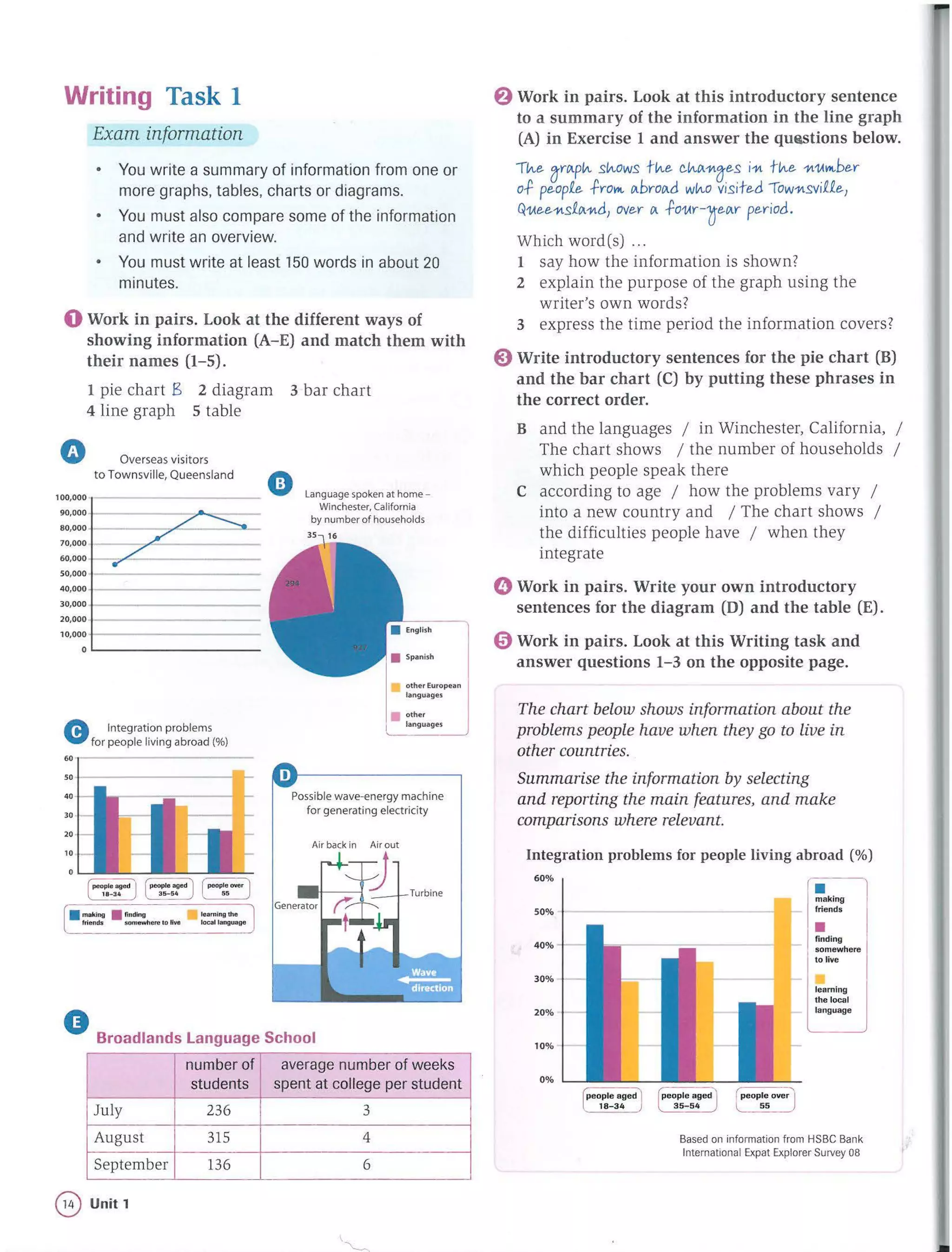
0 Work in pairs. Look at the different ways of
showing information (A-E) and match them with
their names (1-5).
1 pie chart B 2 diagram 3 bar chart
4 line graph 5 table
100,000
90,000
80,000
70,000
60,000
50,000
40,000
Overseas visitors
to Townsville, Queensland
~-
30,000 t----------
20,000
10,000 t----------
0~---------
A Integration problems
W for people living abroad (%)
60
0 Language spoken at home-
Winchester, California
by number of households
other European
languages
Possible wave-energy machine
for generating electricity
0 Broadlands Language School
number of average number of weeks
students spent at college per student
July 236 3
August 315 4
September 136 6
@ Unit 1
l
@ Work in pairs. Look at this introductory sentence
to a summary of the information in the line graph
(A) in Exercise 1 and answer the qu&Stions below.
T"'-e.
0mp"'- s"'-ows f"'-e. c."'-1A1-toe.s i1-t f"'-e. wtAj!.be.r
o-f pe.opfe. -Proj!. tAbrotAd w"'-o visite.d Tow1-tsviffe.1
Q'!Ae.e.1-tsiiA1-tO1 ove.r lA -fo'tAr-lJe.IAr pe.riod.
Which word(s) ...
1 say how the information is shown?
2 explain the purpose of the graph using the
writer's own words?
3 express the time period the information covers?
€) Write introductory sentences for the pie chart (B)
and the bar chart (C) by putting these phrases in
the correct order.
B and the languages 1 in Winchester, California, I
The chart shows I the number of households I
which people speak there
C according to age I how the problems vary I
into a new country and I The chart shows I
the difficulties people have I when they
integrate
() Work in pairs. Write your own introductory
sentences for the diagram (D) and the table (E).
0 Work in pairs. Look at this Writing task and
answer questions 1-3 on the opposite page.
The chart below shows information about the
problems people have when they go to live in
other countries.
Summarise the information by selecting
and reporting the main features, and make
comparisons where relevant.
Integration problems for people living abroad (%)
60%
50%
40%
30%
20%
10%
0%
I~akong
friends
•
~~~-
to live
learning
the local
language
Based on information from HSBC Bank
International Expat Explorer Survey 08
1 What is the greatest problem for 18-34-year-
olds? How many of them experience this
problem? How does this compare with the other
age groups?
2 What is most problematic for people in the oldest
age group? How does this compare with the
youngest age group?
3 What thing does the oldest age group have the
least difficulty with? How does this compare
with the other age groups?
0 Read the sample answer below to the Writing task.
1 Which paragraphs answer questions l-3 in
Exercise 5?
2 What is the purpose of the last paragraph?
The c.hart shows the diffc.ulties people have when
they move to a new country and how the problems vary
according to people's ages.
The greatestproblem for young people aged 15 to .34 is
forming friendships. aproblem experienced by 4b percent
ofthe people in this age group.towever. only .3b percent
of.35- to 54-year-olds find it hard to make friends. while
even fewer people over 55 (2.3 percent) have this problem.
fifty-four percent ofthe older age group find learning
to speak the loc.allanguage the most problematic.. In
comparison. the youngest age group finds this easier. and
the percentage who have problems learning the language
is muc.h lower. at 29 percent.
In contrastto their language-learning difficulties. only 22
percent ofpeople in the oldest age group have trouble
finding accommodation.towever. this is the second most
significant problem for the other two age groups with .39 to
40 percent ofthe people in eac.h group finding ithard.
In general. all age groups experience the same problems
to some extent. butthe percentage ofolder people who
find language learning difficult is muc.h higher than the
others.
0 page 16 Key grammar: Making comparisons
f) You will get higher marks in the exam if you
use your own words, not the words in the
Writing task.
1 What words does the writer use in the sample
answer for these words?
a problems di-Hic.'!Aitie.s
b go to live
c other countries
2 What other information does the writer add in
the introductory paragraph?
€) @ IELTS candidates often make mistakes when
they use percent and percentage. Look at the two
underlined sentences in the sample answer in
Exercise 6.
1 Which word - percent or percentage - is used
after a number?
2 Which word is not used with the exact number
given?
3 Do we use a before percent?
4 Which word do we use before percentage?
5 Can we make percent plural?
0 @ Each of these sentences contains a mistake
made by IELTS candidates. Find and correct
the mistakes.
1 The graph shows the increase in the percent of
people who used rail transport between 1976
and 1999. pe.rc.e.~t"-~e.
2 The graph shows the percentage of people with
a criminal record according to their age and
percentage of people in prison according to their
gender.
3 By 1995, the numbers had fallen to a two
percent.
4 In 2004, the number rose to approximately 58
percents.
5 It is surprising that percentage of people
watching television remained the same.
6 On the other hand, socialising with friends rose
sharply to 25 percentage in comparison with
1981.
Exam advice Chart summary
• Write a short introductory paragraph saying
what the chart shows.
• Compare the important information.
Include figures from the chart in your summary.
• Don't suggest reasons for the data which are
not included in the information you are given.
Starting somewhere new @
® Work in pairs. Look at the Writing task below.
1 What does the chart show?
2 What information would you put in your
introductory sentence?
3 What is the biggest problem for the middle age
group? What percentage of them experience this
problem? How does this compare with the other
age groups?
4 Which age group seems to have the most
problems related to money? How does this
compare with the other age groups?
5 Which group has the most problems finding a
school for their children? And which has the
least?
6 In general, which group has to deal with the
most problems?
The chart below shows information about the
problems people have when they go to live in
other countries.
Summarise the information by selecting and
reporting the main features, and make
comparisons where relevant.
Integration problems for people living abroad (%)
40
30
25
20
15
10
0
r-- --.
I !!!rting out I
j finances
•
sorting out
heatthcare
finding
schools for
my children
_ j
Based on information from HSBC Bank
International Expat Explorer Survey 08
(D Write a brief plan for your summary.
• How many paragraphs will you need?
• What information will you include in each
paragraph?
Write your answer to the task in at least ISO
words. Use the sample summary in Exercise 6
to help you.
@ Unit 1
Key grammar
Making comparisons
..
0 Match the rules for making comparisons (1-4)
with the examples from the sample summary
from Exercise 6 (a-d).
a easier 8]
b higher D
c the greatest D
d the most problematic D
1 Form comparatives of adjectives with one syllable
by adding -er.
2 Form superlatives of adjectives with one syllable
by adding the - est.
3 Form comparisons and superlatives of adjectives
with two syllables ending in -y by changing y to i
and adding -er and -est.
4 Form comparisons and superlatives of adjectives
with more than one syllable by adding more and
the most.
0 page 100 Makmg compansons
E) Complete these sentences by putting the adjective
in brackets into the correct form.
1 Learning the language is the ~qst i~p.ortG~.~t
(important) thing for people going to live in a
new country.
2 Many people find making friends
(hard) than finding a job.
3 Local people are often (friendly) than
you expect.
4 If the climate is .. ..... (warm) or
(cold) than at home, it affects the way people
feel about their new country.
5 (old) people are often (good) at
making friends than younger people.
€» @ IELTS candidates often make mistakes with
comparisons of adjectives and adverbs. Find and
correct the mistakes in each of these sentences.
1 I can read English easyier than before.
111.-ore ell.si£
7t
2 Living in the country is the better way to learn
the language.
3 Travelling is becoming more clean and safe.
4 The most highest percentage appeared in 1991.
5 Workers' salaries got worser in the year 2001.
6 I want to study abroad so that I can get a more
well job in the future.
It's good for you!
Starting off
0 Work in pairs. Match the photos (1-6) with the phrases in the box.
pesticide use
battery farming
outdoor farming
crop rotation
6 Work in small groups.
I What is 'organic' food?
genetic engineenng
natural fertiliser
2 Do you eat organic food? Why? I Why not?
3 Which of the photos in Exercise 1 relate to organic food?
4 How important are these points when you choose food to eat?
a price e packaging
b taste "" f country of origin
c freshness g contents
d appearance h farming methods
It's good for you! @
Reading Section 2
Exam information
• Reading Passage 2 is divided into paragraphs or
sections: A, B. C, etc.
• The paragraph headings task comes before the
passage.
0 Work in pairs. You are going to read a magazine
article about organic food. First, read the title and
the subheading, then discuss what you expect to
read about in the rest of the article.
6 Quickly read the article. Are the writers for or
against organic food?
€) Read headings i-ix below and underline the key
ideas. An example (viii) has been done for you.
Questions 1- 7
The reading passage has seven paragraphs, A- G.
Choose the correct heading for paragraphs B- G
from the list of headings below.
List of Headings
Research into whether organic food is
better for us
ii Adding up the cost of organic food
iii The factors that can affect food quality
iv The rich and poor see things differently
v A description of organic farming
vi Testing the taste of organic food
vii Fear of science has created the organic
trend
viii The main reason for the popularity of
organic food
1
2
3
4
ix The need to remove hidden dangers
from food
Paragraph A . ...viii..
Paragraph B .. 5 Paragraph E
Paragraph C ................ 6 Paragraph F
Paragraph D ................ 7 Paragraph G
.......
................
········· ·
0 Now read the article and choose the correct
heading for each paragraph.
Exam advice Matching headings
• Read the headings, underlining the key ideas.
• Read each paragraph carefully, one by one, to
choose the best heading.
@ Unit2
by Rob Lyons and Jan Bo an
T
oday, many governments are promoting
organicor natural farming methods that
avoidthe use of pesticidesand other
artifical products. The aim is to show
that they care about theenvironment
and about people'shealth. But is this
the right approach?
A Europe is now the biggest market
for organic food in the world,
expandingby 25percent ayear over the
past 10 years. So what is the attraction
of organic food for some people? The really
important thing is that organic sounds more
'natural'. Eating organic is awayof defining oneself as
natural, good, caring, different from the junk-food-scoffing
masses. As one journalist puts it: 'It feelscloser to the
source, the beginning, the start of things.' Thereal desire is
to be somehow close to the soil, to Mother Nature.
B Unlike conventional farming, the organic approach means
farming with natural, rather than man-made, fertilisers
and pesticides. Techniques such ascrop rotation improve
soil quality and helporganic farmers compensate for the
absence of man-made chemicals. Asa method offood
production, organic is, however, inefficient in its useof
labour and land; there are severelimits to how much food
can beproduced. Also, the environmental benefitsof not
using artificial fertiliser are tiny comparedwith the amount
of carbon dioxide emitted by transporting food (a great
deal of Britain's organic produce is shipped in from other
countries and transported from shop to homeby car).
C Organicfarming is often claimed tobe safer than
conventional farming - for the environment and for
consumers. Yet studies into organicfarming worldwide
continue to reject this claim. An extensive reviewby the
UK Food Standards Agency found that there was no
statistically significant difference between organic and
conventional crops. Even where results indicated there
wasevidence of a difference, thereviewersfound no sign
that these differences would haveany noticeable effect on
health.
D The simplisticclaimthat organicfood ismore nutritious
than conventional food was alwayslikely to be misleading.
Food is anatural product, and the health value of
different foods will varyfor anumber of reasons, including
freshness, the way the food iscooked, the type of soil it
is grown in, the amount of sunlight and rain cropshave
received, andso on. Likewise,the flavour of acarrot has
less to do with whether it was fertilised with manure or
something out of aplasticsack than with the variety of
carrot and how long ago it was dug up. The differences
created by these things are likely to be greater than any
differences brought about by using an organic or non-
organic system of production. Indeed, even some 'organic'
farms are quite different from one another.
E The notion that organic food is safer than 'normal' food
isalso contradicted by the fact that many of our most
common foods are full of natural toxins. Parsnips cause
blisters on the skin of agricultural workers. Toasting bread
creates carcinogens.As one research expert says: 'People
think that the more natural something is, the better it isfor
them. That is simply not the case.In fact, it is the opposite
that is true: the closer aplant isto its natural state, the
more likely it is that it will poison you. Naturally, many
plants do not want to be eaten, so we have spent 10,000
years developingagriculture and breeding out harmful traits
from crops.'
F Yet educated Europeans are more scared of eating traces
of afew, strictly regulated, man-made chemicals than
they are of eating the ones that nature created directly.
Surrounded by plentiful food,it's not nature they worry
about, but technology. Our obsessions with the ethics
and safety of whatwe eat - concerns about antibiotics
inanimals, additives in food, GM crops and so on- are
symptomaticof ahighlytechnological society that has
little faith in its abilitytouse this technology wisely. In this
context,the less something istouchedby the human hand,
the healthier people assume it must be.
G Ultimately,the organic farming movement is an expensive
luxury for shoppers in well-manicured Europe. For
developingpartsof the world, it is irrelevant. To European
environmentalists, the fact that organic methods require
morelabour and land than conventional ones to get the
same yields is a good thing; toafarmer in rural Africa, it
is adisaster.Here, land tendsto be so starvedand crop
yields so low that there simply is not enough organic
matter toput backinto the soil. Perhaps the focus should
be on helping thesecountries to gain access to themost
advanced farming techniques, rather than going back to
basics. "
adapted from articles in Spiked
0 Look at Questions 8- 13 below and underline the
key ideas in the questions and the options (A-E).
0 Now scan the passage to find where the key ideas
are mentioned. Read those parts carefully and
choose the correct options.
Questions 8-13
Choose TWO letters, A- E
Questions 8-9
Which TWO of the following points does the writer
mention in connection with organic farming?
A the occasional use of pesticides
B using the same field for different crops
C testing soil quality
0 reducing the number of farm workers
E the production of greenhouse gases
Questions 10-11
According to the writer, which TWO factors affect
the nutritional content of food?
A who prepares the food
B the weather conditions during growth
C where the food has been stored
o when the plants were removed from the earth
E the type of farm the food was grown on
Questions 12- 13
Which TWO negative aspects of organic farming
does the writer mention?
A Consumers complain about the extra cost.
B Organic food may make people ill.
C Farm workers have to be specially trained.
0 It requires too much technological expertise.
E It is not possible in some countries.
Exam advice Pick from a list
• Use the key ideas in the questions to help you
find the right place in the passage.
• Underline the answers in the passage and match
them to the options.
• The answers may come from one section of the
passage or from several paragraphs.
f) Work in pairs.
• How popular is organic food in your country?
• Do you think people should be encouraged to eat
organic food? Why? I Why not?
It's good for you! @
listening Section 2
Exam information
• You hear one speaker talking about a social topic.
0 Work in pairs. You are going to hear a supervisor
talking to a group of new nurses at a large
hospital. Ask and answer questions based on
the pictures below. Who do you think has the
healthier lifestyle - you or your partner?
• When did you last ...?
• What's your favourite ...?
• How often do you ...?
@ Unit2
6 Look at Questions 1-5 below and underline the
key ideas in the questions.
€) ~ Listen to the first part of the talk and choose
the correct answers for Questions 1-5.
Questions 1-5
Choose the correct letter, A, B or C.
1 According to Debbie, why do some people fail
to eat a balanced diet?
A They don't know how to cook.
B They don't have enough time to cook.
C They don't feel hungry enough to cook.
2 Debbie recommends that staff should keep
fit by
A using a gym.
B taking up a new sport.
C changing some daily activities.
3 Which benefit of exercise does Debbie think is
most important?
A It helps you sleep.
B It keeps your heart healthy.
C It improves mental skills.
4 What advice does Debbie give the nurses
about health and safety?
A to avoid drinking coffee
B to use the canteen at night
C to take regular breaks
5 When she talks about hygiene, Debbie asks
the nurses to
A wash their hands regularly.
B keep away from germs.
C help with the cleaning.
Exam advice Multiple choice
• Listen for the correct idea or information - don't
just match words.
• Make sure you answer all the questions.
0 Work in pairs. Look at the places A-H on the map
below. Pick a place and tell your partner how to
get there from the main building. Use the words
and expressions in the box to help you.
next to traffic lights west/east (of)
turn (east/west/right/left) behind turning
right/left (of) go straight on opposite
roundabout go past/beyond beyond corner
You go out of the front of the main
building, turn left and it's directly
opposite you.
0 ~ Now listen and choose the correct answer for
Questions 6-10.
Questions 6-10
Label the map below.
Write the correct letter, A-H, next to questions
6-10.
H TYE ROAD
F
G
E . .
A MAIN BUILDING
6 recreation centre
7 health centre
BACK EXIT
B
8 swimming pool and sauna
9 health-food store
10 Jenny's Restaurant
Exam advice Labelling a map or plan
c
• Look at the location of each option on the map.
• The ans~rs will come in the same order as the
questions.
• Listen for each place name and follow the
speaker's directions.
Vocabulary
Word formation
0 Complete each of the sentences below with a word
in the box.
fte8:l#t healthy unhealthy healthier
healthiest healthily
1 The key to good .he:~tf:th-. is eating a balanced diet.
2 Cooking at home can help people eat more
3 Hospitals can become ................. if they are not very
clean.
4 People need exercise as well as a .... diet.
5 Being generally active is much .................. than
doing lots of exercise just occasionally.
6 Employees should be the ..................people in the
hospital.
0 page 100 Word formation
@ Which of the words in the box in Exercise 1 ...
1 is a noun? !Ae.tl.lt!A
2 is an adverb?
3 are adjectives?
~ Work in pairs. Which of the suffixes or prefixes
underlined in the words below ...
1 forms a noun? -1-1e.s.s
2 forms an adverb?
3 form an adjective?
4 give a word an opposite or negative meaning?
fitness stressful reasonable i.Qact1ve [ regular
risk)' general!)' careless unusual
0 @ IELTS candidates often use the wrong form of
words or misspell words because of changes in
form. Correct the mistake in each sentence.
1 In general, people should eat more healthy and do
some exercise. !Ae.tl.ft!Aif(J
2 Pesticides may be harmy to our health.
3 Some farmers feel that using natural fertiliser is
too unconvenient.
4 The media often give usefull advice about food.
5 There has been a slightly drop in the popularity
of fast food in my country.
6 I don't think that wealth people should get the
best food.
7 Most people can easy do some exercise.
8 The number of people who live to 100 has
increased dramaticaly.
It's good for you! @
Speaking Part 2
Exam information
• You must speak alone for between one and two
minutes on a topic the examiner gives you.
• You have one minute to write some notes before
you speak.
• The examiner tells you when to stop speaking.
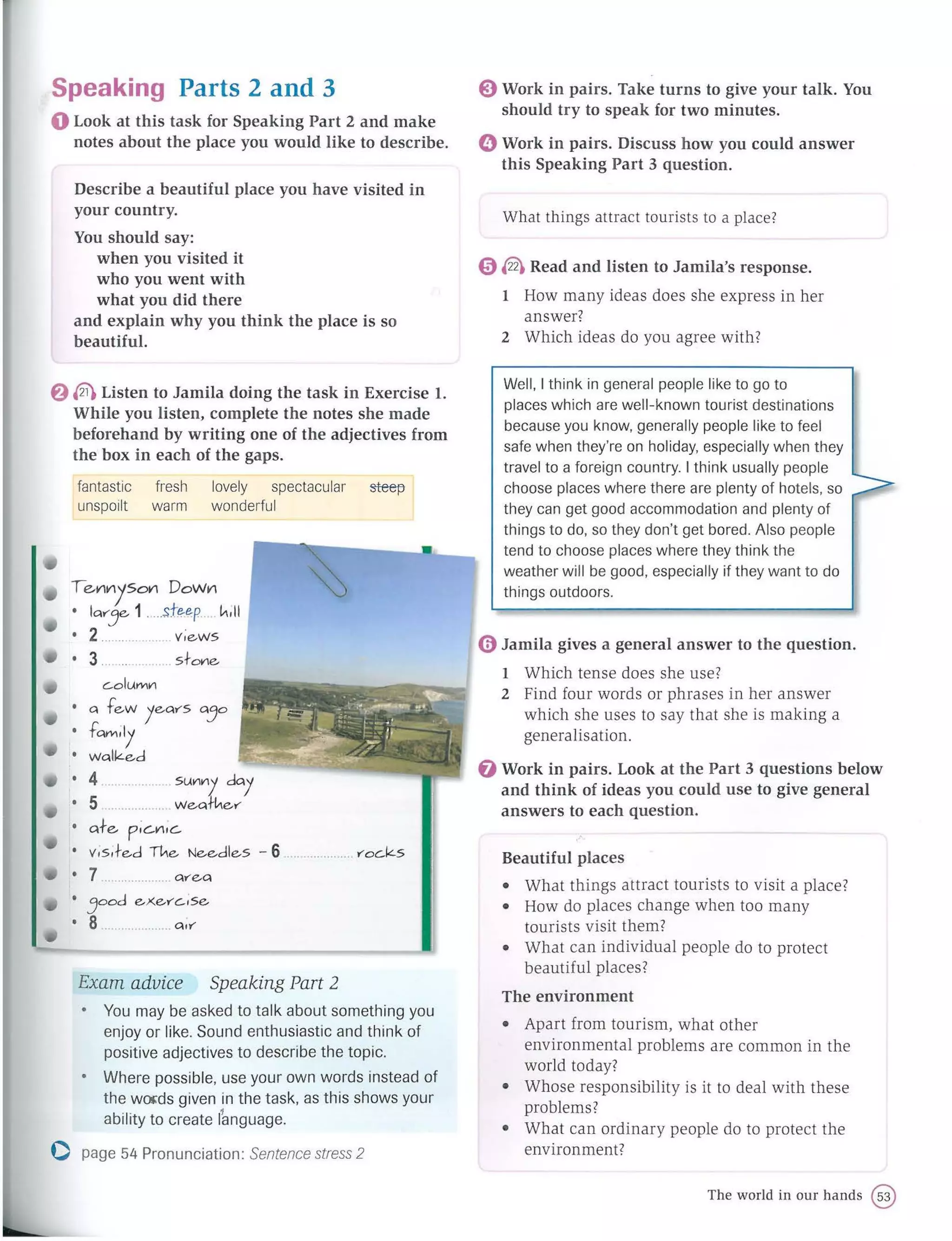
0 Work in pairs. Read this Speaking task and
discuss what you could say.
Describe somewhere you like to shop for food.
You should say:
where this place is
what this place is like
what you buy there
and explain why you like buying food at this
place.
6 ~ Listen to Eva doing the task in Exercise 1.
Which of the places in the photos does she talk
about?
€) Eva uses the points in the task to guide her talk.
Complete this chart showing her key points.
place where I shop St-vtde'1'tt.s - sltl.op
-f'-reB-vte'11H[j
L...oect£ 1 .................
1--- -
Or7tC'11iC - ver)t 2 ..................
where th1s place is NeCr 11./Y 3 ............... ..
PedestnC'111 b-vtszy
Opposite 4 .............. ...
-
what th1s place is like Crowded, b-vtszy1 pop-vt£Cr
L-ots o-f 5 ..................
- -
what I buy there Fr-vtit, ve
0, 11t-eCt1 cltl.eese1
6 ..................
FCVo-vtrite - o£d 7 .................
why I like buying food Food
0ood
at this place 8 ..................p£Me
C.o£o-vtr.f'--vt£
0 Pronunciation: Intonation 7
@ Unit2
0 ~ Listen again to Eva's talk. Complete this chart
showing the phrases she uses to start her talk,
introduce her points and end her talk.
starting a talk
introducmg points :r. reCHzy £i1<e 2 .................
So £et 11t.e 3 .................. wltl.ere it is.
ending a talk
A'1'td 4 .. ... .. ... 1
1. 'VtS-vtC££zy 5
As :r.'ve 6 ...
0 Look at this Part 2 task and make some notes in
the table below about what you want to say for
each point.
Describe a meal that you enjoyed eating in a
restaurant.
You should say:
where the restaurant was
what you ate
who ate the meal with you
and explain why you enjoyed eating the meal
so much.
meal I enjoyed
where the
restaurant was
what Iate
who ate with me
why Ienjoyed the
meal
~ Work in pairs. Listen to each other doing the task
in Exercise 5.
Exam advice Speaking Part 2
• Note down some key ideas for each bullet to
prompt you.
• Use your notes and the points on the card to
guide your talk.
• Use phrases to introduce your points and to
help yOLtkeep going.
• Use intonation to highlight key information and
help your examiner follow your talk.
Pronunciation
Intonation 1
When we speak, the tone of our voice rises and
falls. A rise helps your listener understand that you
haven't finished what you are saying or that the
information is new or exciting; a fall indicates the
end of a sentence or utterance.
0 ~ Work in pairs. Look at this extract from Eva's
talk and listen to how her voice changes on the
words with arrows. Take turns to repeat what she
says.
~ ~
Er, she weighs everything vel}' quickly ... andyou can't bargain
~
with her ... but the price is always reasonable.
@ Work in pairs. Look at some of Eva's sentences.
Discuss where her voice might rise or fall.
1 ... we're students, so we can't afford to eat in
restaurants very often.
2 I really like going to the local market ...
3 ... everything you get there's fantastic - it's
so fresh.
4 ... it's a pedestrian street ... you know, there are
no cars.
5 There's a large number of stalls that sell food -
and some shops, too.
6 I've got a favourite stall, it's run by a little old
lady ...
7 As I've mentioned, I like it because the food
tastes good, but also it's a very sociable place.
8 All in all, I like it because it's a great place to go
... it's a colourful experience.
€) (o9 Listen to the sentences and check your
answers.
0 Take turns to read the extracts to each other,
using the same intonation.
It's good for you! @
Writing Task 2
Exam information
• Task 2 is a discursive essay.
• The question may contain more than one part to
discuss.
• You must write at least 250 words in about 40
minutes.
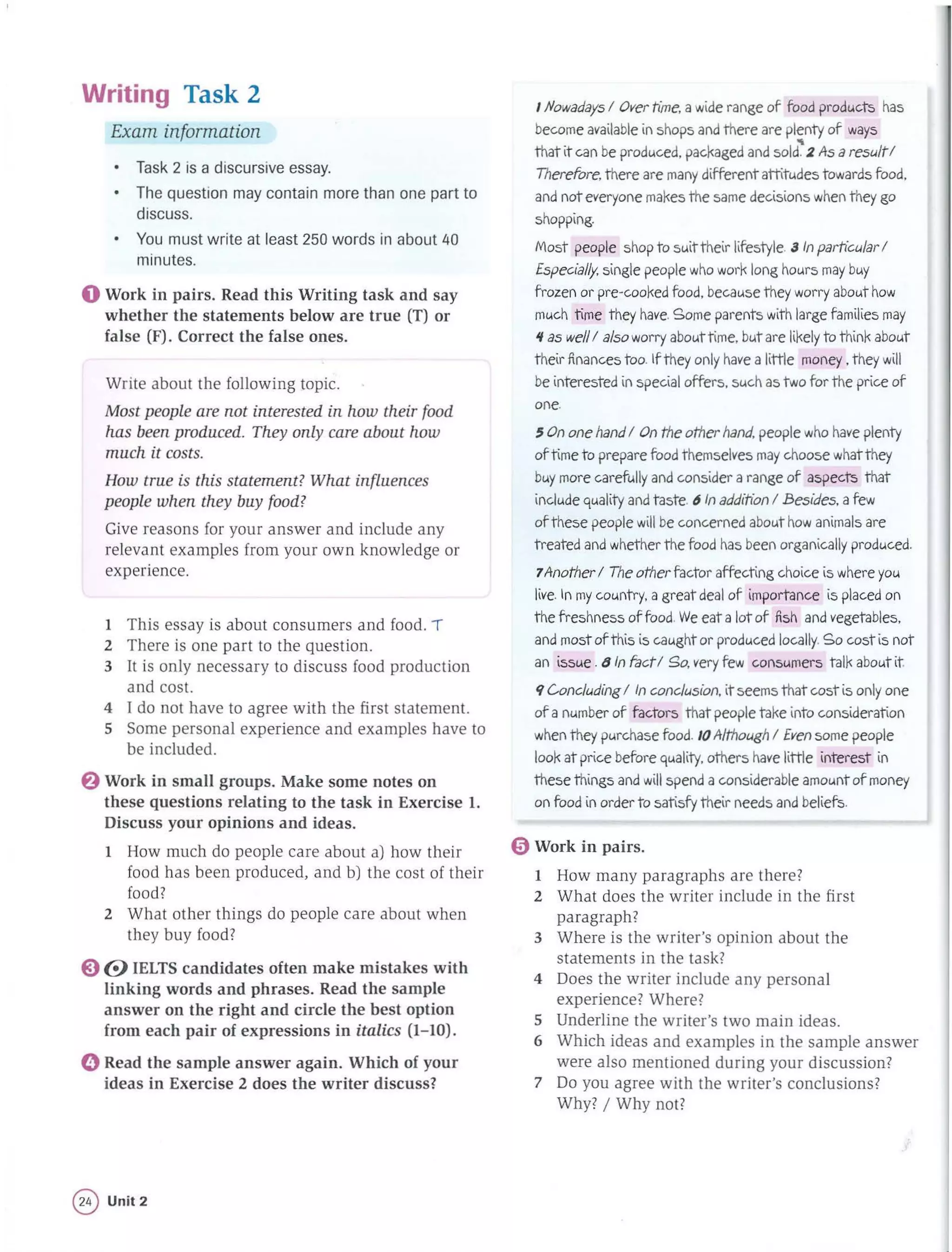
0 Work in pairs. Read this Writing task and say
whether the statements below are true (T) or
false (F). Correct the false ones.
Write about the following topic.
Most people are not interested in how their food
has been produced. They only care about how
much it costs.
How true is this statement? What influences
people when they buy food?
Give reasons for your answer and include any
relevant examples from your own knowledge or
experience.
1 This essay is about consumers and food. T
2 There is one part to the question.
3 It is only necessary to discuss food production
and cost.
4 I do not have to agree with the first statement.
5 Some personal experience and examples have to
be included.
6 Work in small groups. Make some notes on
these questions relating to the task in Exercise 1.
Discuss your opinions and ideas.
1 How much do people care about a) how their
food has been produced, and b) the cost of their
food?
2 What other things do people care about when
they buy food?
€) @ IELTS candidates often make mistakes with
linking words and phrases. Read the sample
answer on the right and circle the best option
from each pair of expressions in italics (1-10).
0 Read the sample answer again. Which of your
ideas in Exercise 2 does the writer discuss?
@ Unit2
I .Nowadays! Over time. awide range of food products has
become available in shops and there are plenty of ways
"'
thatitcan be produced. packaged and sold. 2 As a resultI
Therefore. there are many differentattitudes towards food,
and noteveryone makes the same decisions when they go
shopping.
Most people shop to suittheir lifestyle. J In particularI
Especially. single people who work long hours may buy
frozen or pre-cooked food. because they worry about how
much time they have.Some parents with large families may
'I as well! alsoworry abouttime. but are likely to think about
their finances too. lfthey only have alittle money. they will
be interested in special offers. such as two for the price of
one.
5 On one handI On the other hand. people who have plenty
oftime to prepare food themselves may choose whatthey
buy more carefully and consider arange of aspects that
include quality and taste.6 In addihon I Besides. afew
ofthese people will be concerned about how animals are
treated and whether the food has been organically produced.
7AnotherI The other factor affecting choice is where you
live. ln my country. agreat deal of importance is placed on
the freshness of food.We eata lot of nsh and vegetables.
and mostofthis is caughtor produced locally.So costis not
an issue. 8/n factI So, very few consumers talk about it.
li ConcludingI In conclusion. it seems that cost is only one
of anumber of factors that people take into consideration
when they purchase food. 10Although I Even some people
look atprice before quality. others have little interest in
these things and will spend a considerable amountof money
on food in order to satisfy their needs and beliefs.
0 Work in pairs.
1 How many paragraphs are there?
2 What does the writer include in the first
paragraph?
3 Where is the writer's opinion about the
statements in the task?
4 Does the writer include any personal
experience? Where?
5 Underline the writer's two main ideas.
6 Which ideas and examples in the sample answer
were also mentioned during your discussion?
7 Do you agree with the writer's conclusions?
Why? I Why not?
0 Use your answers to Exercise 5 to write the plan
for the sample essay on page 24.
0 Key grammar: Countable and uncountable nouns
f) Work in pairs. Say whether these statements
about the Writing task are true (T) or false (F).
1 You shouldn't copy from the question paper.
2 The answer can be in bullet points.
3 It is important to plan the answer.
4 Paragraphing is important.
5 Spelling does not have to be correct.
(I) Work in small groups. Read this Writing task and
answer the questions below.
Write about the following topic.
Many children these days have an unhealthy
lifestyle. Both schools and parents are responsible
for solving this problem.
To what extent do you agree with this statement?
Give reasons for your answer and include any
relevant examples from your own knowledge or
experience.
1 Is it true that many children have an unhealthy
lifestyle? Why?
2 Are parents responsible? Why? What should
they do?
3 Are schools responsible? Why? What should they
do?
4 Is anyone else responsible? Who?
(i) Write a plan for the task. Decide how many
paragraphs to write and which ideas will go in
each paragraph. Also plan your introduction and
conclusion.
Exam advice Writing Task 2
• Analyse the question carefully first. You will lose
marks if you don't deal with all parts of the task.
• Brainstorm your ideas and write a quick plan.
• Write your answer in paragraphs following your
plan.
® Now write your answer in about 40 minutes and
check your word count. You should write at least
250 words.
Key grammar
Countable and uncountable nouns
0 Look at this extract from the sample answer on
page 24. Which underlined noun is countable and
which one is uncountable?
... there are many different attitudes towards
food ...
0 page 102 Countable and uncountable nouns
E) Look at the highlighted words in the sample
answer. Which are countable and which are
uncountable?
@) Look at these words/phrases that are often used
with countable/uncountable nouns. Put them in
the correct column of the table below.
a (wide) range of a little (very) few plenty of
a lot of a (large) number of many a few little
most a great deal of a considerable amount of
much a/an any some
countable nouns uncountable nouns countable or
uncountable nouns
£ (wide.) Y"£1-toe. o-F
0 @ IELTS students often make mistakes with
countable and uncountable nouns. Choose the
correct expression to complete each sentence.
1 Recently, the number ;§Oilli!Jof fast food that
is eaten has increased.
2 For example, few I a few years ago there were
not many microwave ovens in our country.
3 Technology brings much I many advantages to
our lives.
4 I think many I a lot of research must be done on
organic farming.
5 You can't get many I much information about
your health these days without using the
Internet.
6 Unfortunately, I have little I a little time to cook
when I get home.
7 I think the amount I number of fast-food stores
should be reduced.
8 Some children eat much I a lot of oily and fatty
foods.
It's good for you! @
Vocabulary and grammar review Uni~ 1
Vocabulary
0 Complete these sentences with the correct form of
problem, trouble, affect or effect.
1 I hope my visit won't cause you too much
tro'JA.
ble. .
2 Studying at a foreign university will greatly
the way you see the world.
3 If you are not careful about money, you can get
into a lot of financially.
4 Investigators are carrying out research into the
of culture shock on overseas students.
5 Some students have had many adapting
to our very different lifestyle.
6 New technologies have had an enormous
on the way we interact.
6 Study the graph below and complete these
sentences with percent or percentage. Then decide
if the sentences are true (T) or false (F) according
to the graph. Correct the false ones.
1 Sixty-five .pe..rce.-xt of overseas workers in
Germany learn to speak German.
F~lse : 157.
2 The of workers from abroad who learn
to speak English is lowest in the United States.
3 Workers from other countries who learn to
speak English in the UK and the USA are 18 and
15 respectively.
4 Belgium has the third highest of
overseas workers learning to speak the
language, with the figure standing at
70 .
Grammar
€) Complete these sentences with the correct form of
the adjective or adverb in brackets.
1 People who are ready to change their views
often find it e..~s'er (easy) to adapt to a new
culture.
2 You will learn the language much
(quickly) if you share accommodation with
people from the country - in other words, it will
save you a lot of time.
3 Many students are attracted to this university
because it has the reputation of being the one
with the (good) teachers.
4 I think this is the (complicated)
language I have ever tried to study; I really don't
know if I'm making progress.
5 You'll find the film much (funny) if you
watch it in the original version.
6 Many overseas students find understanding
other students a (big) problem than
understanding their teachers.
7 The (successful) students are not always
the ones with the best brains.
8 Many people prefer travelling by train because
they think it is (safe) than travelling by
plane.
Workers from abroad who learn local languages by country (%)
80%
70%
60%
50%
40%
30%
20%
10%
0%
r-:-
ermany
L Kingdom
@ Vocabulary and grammar review Unit 1
(figures from HSBC Bank International
Expat Explorer Survey 08, Report
Three: Expat Expenence)
Vocabulary and grammar review Unit 2
Vocabulary
0 Complete these sentences using the correct
form of the word in brackets.
I It must be very hard work being a }etn'll,e.r
(farm).
2 Although pesticides protect plants, they can be
... (harm) to humans.
3 Our .. (enjoy) of the meal was spoilt by
the loud music in the restaurant.
4 I've done so much exercise at the gym that I'm
............ (total) exhausted.
5 Someone told me this soup was very .
(taste), but I don't like the flavour.
6 The vegetables in our local shop have been
.. (organic) produced.
7 My brother has a really . (health) diet -
he eats nothing but fried food!
8 Some people . .. (critic) conventional
farming methods, but they do produce high
yields.
@ Write nouns for each of these adjectives.
Three adjectives have two possible noun forms.
adjective noun
developing I d~.V~.fPpr-.~.11t
active 2
dangerous 3
fit 4
happy 5
independent 6
toxic 7
nutritious 8
reliable 9
accurate 10 ... . . . . .. . . . . .. . . . ...
Grammar
~ Circle the correct option in each of these sentences.
I Can you give me some @Vice
)! advices on how
to stay fit?
2 Children need clear information I informations
about the food they eat.
3 A balanced diet I Balanced diet consists of plenty
of fruit and vegetables.
4 Organic farming causes less pollutions I
pollution than traditional farming.
5 Some people say that a little knowledges 1
knowledge can be a dangerous thing.
6 I go to fast-food shop I fast-food shops as little as
possible.
7 A shift worker can have very stressful lifestyle I a
very stressful lifestyle.
8 More research I researches is needed to make
genetic engineering safe.
0 Complete the sentences below with the expressions
in the box. Use each expression only once. There
are two extra expressions that you do not need.
a/an
many
afew
much
amount of dealof few
number of plentyof
little
I Only a small Y.<~r-.b~r...R
:f consumers buy organic
food.
2 I can't stand cooking in . . dirty kitchen.
3 Everyone needs to spend a ........ ..... time
relaxing.
4 At the end of the week, I don't have ...... ......
money left to buy food.
5 You need to put a large . fertiliser on
young plants.
6 You need free time in order to do your
own cooking.
7 It's a pity that so . .. people are interested
in reading the labels on food.
8 Obviously someone has put a great .. . ...... work
into this meal - it's delicious!
Vocabulary and grammar review Unit 2 @
Getting the message across
Starting off
0 Work in pairs. Look at these photos. Who is ...
1 attending a lecture?
2 making a presentation?
3 writing a term paper?
4 taking part in a tutorial?
f) Now discuss these questions.
1 What links these situations?
2 Have you had experience of any of these situations?
3 Which situation do you think is the most/least enjoyable? Why?
Listening Section 3
Exam information
• You hear a conversation between two or more speakers on a
study-based topic.
• Some questions may be on the speaker's opinions.
0 Work in pairs. You are going to hear a student talking to her course tutor
about an assignment. Before you listen, match the words (1-9) with their
definitions (a-i).
1 assignment
2 self-assessment
3 weaknesses
4 peer evaluation
5 extract
6 authentic
7 feature
8 structure
9 finding
@ Unit3
a particular parts or qualities of someone
that are not good
b a judgement which you make about the quality
of something you have done
c a particular part of a book, poem, etc. that is
chosen so that it can be used in a discussion,
article, etc.
d a piece of work or job that you are given to do
e a typical quality or important part of something
a piece of information that has been
discovered as a result of an official study
g carefully considering or studying something
done by a colleague/classmate/friend and
judging how good or bad it is
h the way that parts of something are arranged
or put together
real or true
f) Work in pairs. Read Questions 1-4 and underline
the key ideas in the questions (not the options).
Questions 1-4
Choose TWO letters, A-E.
Questions 1-2
Which TWO activities will students do as part
of Amanda's assignment?
A analyse their own speech
B record other students' speech
C read something frdm a book
D repeat part of a lecture
E remember part of a lecture
Questions 3-4
Which TWO features must Amanda check when
she chooses the extract?
A the time it takes to read
B the overall organisation
C the number of words
D the number of sentences
E the inclusion of key ideas
8 ~ Now listen to the first part of the recording
and answer Questions 1-4.
Exam advice Pick from a list
• Underline the key ideas in the question(s).
• Read through the options and remember that
only two of them are correct.
• As you listen. tick the options you hear. The
correct answers may not come in the same order
in the recording as they do in the question.
0 Work in pairs. Read all the information for
Questions 5-8.
1 What are Questions 5-8?
2 Underline the key ideas in A-F. How many extra
options are there?
3 What should you write as your answer for each
question?
Exam advice Matching
• Underline key ideas in the question and options.
• You will.,.
hear the answers to the questions in
the same order as the questions appear on the
paper.
Questions 5-8
Which comments do the speakers make about
each lecture?
Choose FOUR answers from the box and write
the correct letter, A- F, next to Questions S- 8.
Lectures
5 History of English
6 Gestures and signs
7 Intonation patterns
8 Language and rhyth m
Comments
A The content is repetitive.
B It took a long time to write.
C It was shorter than the others.
D It was well structured.
E The content is relevant.
F The topic was popu lar.
0 Read Questions 9-10 and underline the key ideas
in the question.
Questions 9-10
Answer the questions below.
Write NO MORE THAN TWO WORDS for each
answer.
Which TWO pieces of equipment will the
students use in the study?
9
10 ........... ... ..... .... ........
Exam advice Short-answer questions
• Underline the key ideas in the question.
• Make sure you don't use more words than you
are allowed.
• Check that you have spelled your answers
correctly.
0 (1i Now listen to the second part of the recording
and answer Questions 5- 10.
Getting the message across @
Reading Section 3
Exam information
Reading Passage 3 usually contains arguments
and opinions as well as information.
• There are 14 questions.
0 Work in small groups. You are going to read an
article about different theories on how babies
learn to talk. Before you read, look at the speech
bubbles below.
1 How would you express each of these
utterances?
2 Why do you think babies talk like this?
3 How do you think babies learn language?
OlDaddygoout ~ Q
~
E) Work in pairs. Read the title and subheading of
the passage quickly. What do you expect to read
about in the article?
€) Now read the whole passage. When do children
start talking in longer sentences?
Why don't babies talk like adults?
Kids go from 'goo-goo' to talkative one step at a time
by Joshua Hartshorne
A recent e-trade advertisement shows a baby speaking
directly to the camera: 'Look at this,' he says, 'I'm a
free man. I go anywhere I want now.' He describes his
stock-buying activities, and then his phone rings. This
advertisement proves what comedians have known for
years: few things are as funny as a baby who talks like an
adult. But it also raises an important question: Why don't
young children express themselves clearly like adults?
Many people assume children learn to talk by copying
what they hear. In other words, they listen to the words
adults use and the situations in which they use them and
imitate accordingly. Behaviourism, the scientific approach
that dominated American cognitive science for the first
half of the 20th century, made exactly this argument.
@ Unit3
However, this 'copycat' theory can't explain why toddlers
aren't as conversational as adults. After all, you never
hear literate adults express themselves in one-word
sentences like 'bottle' or 'doggie'. In fact, it's easy for
scientists to show that a copycat theory of language
acquisition can't explain children's first words. What is
hard for them to do is to explain these first words, and
how they fit into the language acquisition pattern.
Over the past half-century, scientists have settled on
two reasonable possibilities. The first of these is called
the 'mental-developmental hypothesis'. It states that
one-year-olds speak in baby talk because their immature
brains can't handle adult speech. Children don't learn
to walk until their bodies are ready. Likewise, they don't
speak multi-word sentences or use word endings and
function words ('Mummy opened the boxes') before their
brains are ready.
The second is called the 'stages-of-language hypothesis',
which states that the stages of progress in child speech
are necessary stages in language development.
A basketball player can't perfect his or her jump shot
before learning to (1) jump and (2) shoot. Similarly,
children learn to multiply after they have learned to add.
This is the order in which children are taught - not the
reverse. There's evidence, for instance, that children
don't usually begin speaking in two-word sentences
until they've learned a certain number of single words.
In other words, until they've crossed that linguistic
threshold, the word-combination process doesn't get
going.
The difference between these theories is this: under
the mental-development hypothesis, language learning
should depend on the child's age and level of mental
development when he or she starts learning a language.
Under the stages-of-language hypothesis, however,
it shouldn't depend on such patterns, but only on the
, ompletion of previous stages.
In 2007, researchers at Harvard University, who were
studying the two theories, found a clever way to test
them. More than 20,000 internationally adopted children
enter the US each year. Many of them no longer hear
their birth language after they arrive, and they must learn
English more or less the same way infants do - that is,
by listening and by trial and error. International adoptees
don't take classes or use a dictionary when they are
learning their new tongue and most of them don't have a
well-developed first language. All of these factors make
them an ideal population in.which to test these competing
hypotheses about how language is learned.
Neuroscientists Jesse Snedeker, Joy Geren and
Carissa Shafto studied the language development of
27 children adopted from China between the ages of
two and five years. These children began learning English
at an older age than US natives and had more mature
brains with which to tackle the task. Even so, just as
with American-born infants, their first English sentences
consisted of single words and were largely bereft of
function words, word endings and verbs. The adoptees
then went through the same stages as typical American-
born children, albeit at a faster clip. The adoptees and
native children started combining words in sentences
when their vocabulary reached the same sizes, further
suggesting that what matters is not how
old you are or how mature your brain is, but the number
of words you know.
This finding - that having more mature brains did not help
the adoptees avoid the toddler-talk stage - suggests that
babies speak in babytalk not because they have baby
brains, but because they have only just started learning
and need time to gain enough vocabulary to be able to
expand their conversations. Before long, the one-word
stage will give way to the two-word stage and so on.
Learning how to chat like an adult is a gradual process.
But this potential answer also raises an even older and
more difficult question. Adult immigrants who learn a
second language rarely achieve the same proficiency in
a foreign language as the average child raised as a native
speaker. Researchers have long suspected there is a
'critical period' for language development, after which
it cannot proceed with full success to fluency. Yet we
~till do not understand this critical period or know why
1
t ends.
"
adapted from Scientific American: Mind Matters
0 Work in pairs. Look at the underlining in
Question 1 below, then read the first paragraph
of the passage. What is the answer?
Questions 1-4
Do the following statements agree with the
claims of the writer in the reading passage?
Write
YES
NO
if the statement agrees with the
claims of the writer
if the statement contradicts the
claims of the writer
NOT GIVEN if it is impossible to say what
the writer thinks about this
This is a paraphrase of few things are as
funny in the first paragraph of the passage.
I
I People are extremely amused when they
see a baby talk like an adult. - ----,
2 Behaviourists of the early 20th century
argued that children learn to speak by
copying adults.
3 Children have more conversations with
adults than with other children.
4 Scientists have found it easy to work out
why babies use one-word sentences.
These words are similar to words in the
passage, so they help find the right place.
0 Now underline the words in Questions 2- 4 that
help you find the right place in the passage. Then
answer Questions 2- 4.
Exam advice Yes I No 1Not Given
• You should use the same approach for True I
False I Not Given and Yes I No I Not Given
questions (see page 11).
• Write your answer clearly. If the examiner
is not sure what you have written, it will
be marked wrong.
Getting the message across @
A
B
c
D
0 Work in pairs. Read the title of the summary
below and use this to find the right part of the
passage. Look at Question 5. Why is 'C' correct?
Questions 5-9
Complete the summary using the list of words
and phrases, A-H, below.
Two theories about babytalk
According to the writer, there are two main
theories related to babytalk. One states that
a young child's brain needs 5 ....C
.... to master
language, in the same way that it does to
master other abilities such as 6 .......... .
The second theory states that a child's 7 .......... is
the key factor. According to this theory, some
key steps have to occur in a logical sequence
before 8 ..... occurs. Children's 9 ......
develops in the same way.
vocabulary level
physical movement
time
attention
Exam advice
E mathematical knowledge
F sentence formation
G learning
H teaching
Summary completion with
a box
• Read through the summary and decide what
type of word or phrase you need for each gap.
• Underline words and phrases around the gaps
to help you find the right place in the passage.
• Underline the words in the passage that provide
the missing information.
• Choose the option that means the same.
f) Answer Questions 6-9 on your own. Then check
your answers with your partner.
€) Look at Questions 10-14 in the next column.
I Underline the key ideas in Questions 10- 14, then
quickly find the right place in the passage.
2 Read that part of the passage carefully, then
choose the correct options.
Exam advice Multiple choice
• Use key ideas in the question to find the right
place in the passage.
• Read that part of the passage and underline the
words which answer the question.
@ Unit3
Questions 10-14
Choose the correct letter, A, B, C or D.,
10 What is the writer's main purpose in the
seventh paragraph?
A to give reasons why adopted children were
used in the study
B to reject the view that adopted children
need two languages
C to argue that culture affects the way
children learn a language
D to justify a particular approach to
language learning
11 Snedeker, Geren and Shafto based their study
on children who
A were finding it difficult to learn English.
B had come from a number of language
backgrounds.
C were learning English at a later age than
US children.
D had taken English lessons in China.
12 What aspect of the adopted children's
language development differed from that of
US-born children?
A their first words
B the way they learnt English
C the rate at which they acquired language
D the point at which they started producing
sentences
13 What did the Harvard finding show?
A Not all toddlers use babytalk.
B Language learning takes place in ordered
steps.
C Some children need more conversation
than others.
D Not all brains work in the same way.
14 When the writer says 'critical period', he
means a period when .
A studies produce useful results.
B adults need to be taught like children.
C immigrants want to learn another
language.
D language learning takes place effectively.
€) Work in small groups.
• Do you agree that there is a critical period for
learning language? When do you think this
might end?
• What do you think is the best way for an adult
to learn another language?
II
Speaking Part 2
0 Work in pairs. Read this task and match the
phrases (1-8) below with the points in the task.
Describe a situation you remember when you
had to use a foreign language to communicate.
You should say:
what you were doing
what happened
how well you communicated in the language
and explain why you remember this situation
or experience.
1 on holiday 5 summer break
2 what have I learned 6 the emergency services
3 difficult situation 7 didn't know how to say
4 took a trip 8 hired a car
6 ~ Listen to Abi doing the task in Exercise 1 and
make brief notes about the following.
1 Where was Abi?
2 What happened?
3 How well did he communicate?
4 Why does he remember the situation?
€) ~ Abi uses phrases to mark the stages in his
story. Listen again and complete the chart below
with these phrases.
A couple of :y·eaFs ago Eventually
So the next thing we did Th1
s was because
Before we went At the time The reason why
As soon as However, one morn1ng
A C..01Api.e. o-P ~e.LYS "'oo
L
giving reasons I
explanations
0 Pronunciation: Consonantsounds
0 page 34 Key grammar: Present perfect andpast simple
0 Write some brief notes that you could use in a
two-minute talk on the topic in Exercise 1.
0 Work in pairs. Take turns to give your talks.
Exam advice Speaking Part 2
• Structure your talk by using your notes and
introduc~ng your points clearly to the examiner.
• Use appropriate phrases to mark the stages in
your talk.
0 Read this Speaking task and prepare notes for
each point. Think about how you will link your
ideas.
Describe an English lesson that you really
enjoyed.
You should say:
where and when it took place
who the teacher was
what you did in the lesson
and explain why you enjoyed it so much.
6 Work in pairs. Take turns to give your talks.
After listening to your partner, give feedback.
Pronunciation
Consonant sounds
IELTS candidates often confuse consonant sounds,
and this can change a word or meaning.
0 ~ Listen to and read these examples.
similar sounds
If/ and 1c131
Ill and /r/
lvl and lwl
examples
sheep I jeep
climb I crime
vent I went
f) ~ Work in pairs. Listen again to the first part of
Abi's talk and write the missing words.
A couple of years ago, I 1 ....w~~t.... on holiday with a
friend to Windsor. Um, the 2. .... . . why we chose
Windsor is that I've got an aunt who 3 .... ..... there.
She's been living there for 20 years now. And, well,
I've always enjoyed travelling ... I've always wanted
to go to the UK. At the time, my friend and I had
4 ................ finished our exams at school and we were
5 .. ............. to go to university. It was the summer
break, and 6 . . .... ... invited us to visit her, so we
decided to go.
@) Work in pairs. Take turns to read the paragraph
to each other. Which sounds are most difficult for
you to pronounce?
(.} Work in pairs. Read the audioscript of the talk on
page 136. Mark six sounds that you find difficult.
Read the script extracts to your partner.
Getting the message across @
Vocabulary
Teach, learn or study? Find out or know?
0 IELTS candidates often confuse teach/learn/study
and find out/know. Circle the correct words in
these extracts from the Reading passage.
1 This advertisement proves what comedians have
@ wry/ found out for years.
2 Over the past half-century, scientists have
known I found out much about babytalk.
3 Children don't study 1 learn to walk until their
bodies are ready.
4 Knowing 1 Learning how to chat like an adult is
a gradual process.
5 Yet we still do not understand this critical
period or know I find out why it ends.
6 Read these extracts from CLD to check your
answers.
learn,teach or study?
To learn is to get new knowledge or skills
I want to learn how to drive.
When you teach someone, you give them new knowledge orskills.
My dad taught me how to drive. My dati learnt me hew te dfi•uv.
When you study,you go to classes. read books, etc. to try to
understand new 1
deas and facts.
He is studyingbiologyat university
know or find out?
To know something means to already have information about
something.
Kelly knows what time the train leaves.
To find out something means to learn new 1
nformat1on for the first
time.
Can you find out what time the train leaves?
~ Work in pairs. Complete these questions with
teach, learn, study, know or find out.
1 How many English words do you ....K1tPW.... ?
2 Do you prefer to ... a language by talking
to people or reading books?
3 If you worked in a school, which subject would
you prefer to ..... ?
4 How would you .... .... where the best
language schools are in your home town?
5 Did you .. ............... hard for your school exams?
0 Work in pairs. Ask and answer the questions in
Exercise 3.
@ Unit3
Key grammar
Present perfect and past simple
..
0 Match the underlined verbs in these sentences
from Abi's talk (1-3) with the tenses (a-c).
1 I've always enjoyed
travelling.
2 It was a summer break.
3 She's been living there
for 20 years now.
a past simple
b present perfect
simple
c present perfect
continuous
6 Which sentence from Exercise 1 describes:
a something in the past that is now ended?
b a situation that started in the past and is still
going on?
c a feeling from the past that is still present?
~ Underline the verb forms in these sentences from
Abi's talk and say what tense they are.
4 Before we went, we hired a car, which we
picked up when we reached the airport.
5 I didn't know the word for tyre.
6 1venty minutes later, a recovery van arrived.
7 So, what have I learned from this experience?
0 Match the sentences (1-7) in Exercises 1 and 3
with the uses of the past simple, present perfect
and present perfect continuous tenses (a-d).
a a past action or state that is clearly now over
(often with a time expression) 2..1 • • •
b a situation or state that started in the past and
continues into the present (often with a time
reference)
c a series of events that took place in the past
d an action or activity that started in the past and
is still continuing
0 page 103 Tenses
0 @ IELTS candidates often make mistakes using
tenses. Circle the correct verb form in these
sentences.
1 In the last few decades, there was ;(fj{IS--oeeTg a
rapid development in computer technology.
2 The most popular country that UK residents
have visited I visited in 1999 was France.
3 I was I have been responsible for taking care of
myself since I was eight years old.
4 Obesity became I has become a global problem.
5 Sometimes people who have been on a diet eat
even more afterwards than they have eaten 1 ate
before.
6 One day, the company has been I was shut down.
Writing Task 1
0 Work in pairs. Look at the graph below.
1 What does the graph show?
2 What is the main difference between the two
lines on the graph?
3 Are there any significant similarities or
differences between the two language trends?
4 What are the main features of each trend?
5 How could you divide the information into
paragraphs?
The graph below shows information about the
languages that 13-year-old students in one school
chose to study.
Summarise the information by selecting
and reporting the main features, and make
comparisons where relevant.
Language options selected by 13-year-old
students in a school in England
160
140
120
100
80
60
40
6 Put these sentences in the correct order.
a Overall, it can be seen that more students have
been choosing to study Mandarin, but French is
still the most popular language option. D
b Over the Mext five years, the figure fell
considerably for French, but rose dramatically
for Mandarin and reached a peak at
75 students. D
c In 2000, the number of students who took
French was 150, compared to just under 10
students who chose Mandarin. D
d French gained some popularity in 2006, but has
remained fairly stable since then at about 90
students. D
e The graph shows how many 13-year-old students
studied French and Mandarin between 2000
and the present day in a school in England. [I]
f On the other hand, the trend for French
is the opposite. D
g So there was a significant difference in numbers
at this time. D
h According to the data, Mandarin has increased
in popularity during this time. D
In contrast, the number of students taking
Mandarin dipped in 2006 and then fluctuated,
before it returned to 75. D
Since 2005, the trends have not changed
as much. D
@) Work in pairs. Look at the text in Exercise 2
again and find verb phrases which mean the
following.
1 went down (two phrases)
2 hit a high point
3 has stayed the same
4 went up a lot
5 went up and down
0 Work in pairs. Look at this table and discuss
what it shows. Which column:
I increases significantly?
2 fluctuates?
3 peaks then falls slightly?
Global statistics: Shore Hotel
Staff: 1975-2010
with language
1
speaking two or previous work
qualification ' more languages experience
% % %
1975 5 10 75
1980 10 12 70
1985 12 14 78
1990 17 23 55
1995 21 48 65
2000 22 so so
2005 21 65 45
2010 20 79 67
Getting the message across @
0 Complete the gaps in this summary with the
correct percentages.
The table provides some bac.kground information on the
staffworking in aglobal hotel c.hain. The information
goes bac.k to 1975 and c.overs languages spoken and
quallfic.atlons, as well as previous work experienc.e.
Between 1975 and 2000, there was asignilkant rise in
the perc.entage of employees who held aquallfic.atlon in
aforeign language, from 1..............to 2 .................. After
this, there was aslightfall ofa..................over the nextten
years.
'I ....... .... ofstaffwere able to speak at leasttwo
languages in 1975. Atfirst, this figure rose by 13 perc.entto
5 ... . . . in 1990. 1--owever, from 1990 to 2010. itroc.keted
to6 .......... .
finally, the perc.entage ofstaffwith experienc.e in the
hotel industry fluc.tuated between 1975 and 2010. In 1955,
there was apeak at7 .................,and this was followed by
asudden fall to 6 ................five years later. figures then
wentup and down over the next 15 years.
0 Underline the expressions that describe trends in
the summary in Exercise 5.
0 Write an overview of the information in the
summary in one or two sentences.
0 page 102 Prepositions
~ Using the rules in the Language reference,
complete these sentences with the correct
prepositions.
I Car sales rose by five percent .......!:1-1....... August.
2 The chart shows the number of people finding
jobs ......... 2003 and 2007.
3 The number of new employees fell ..................
12 percent last year.
4 Yesterday, there was a fall . .............. ten degrees
in city temperatures.
5 There will be an increase ...... taxi fares
next month.
6 Customer complaints have gone down
below 100.
7 The percentage of people needing medical
treatment peaked ..... . ... .... 35 in 2009.
@ Unit3
0 @ Find and correct the mistakes made by IELTS
students in these sentences.
I The oldest underground railway v<:"as built in
London en 1863. i-1-1.
2 In general, all the figures gradually increased
over 1911 to 2001.
3 There is no evidence that a rise of petrol prices
leads to less traffic.
4 The number of people peaked to 5,523 in 2001.
5 Spending on teachers' salaries fell on 5%.
6 The temperature decreased until a low of three
degrees in December.
7 During the period of 1986 and 1999 there was a
gradual increase.
8 The profits experienced an increase by $2m.
(ID Work in pairs. Look at the Writing task below
and decide:
• what the graph shows
• how you will organise your report - what each
paragraph will contain
• what your overview will include.
Work alone and write your summary. You should
write at least ISO words.
The graph below shows information about the
recruitment of teachers in Ontario between 2001
and 2007.
Summarise the information by selecting
and reporting the main features, and make
comparisons where relevant.
Percentage of first-year teachers with regular
teaching jobs by year of graduation
80%
70%
60%
50%
40%
30% - - - - - - - - -
20% L._.,----------...,-------
2001 2002 2003 2004 2005 2006 2007
year of graduation
[+--
~~---
-=-=-
~-...J
Exam advice Describing trends
When you have to describe trends:
look at the similarities and differences.
• use approriate language to describe them.
New media
Starting off
0 Work in pairs. Look at the photos of different media.
Which do you normally use to do the following?
• keep up to date with the news
• do research for your work or studies
• relax when you're alone
• keep up with the latest ideas and fashions
• enjoy yourself with friends
Reading Section 1
0 Work in small groups. You are going to read a passage about
the World Wide Web. Before you read, discuss these questions.
1 How is tbe World Wide Web different from the Internet?
2 How do you personally use the Web?
6 Now read the passage on page 38 quite quickly.
How many uses of the Web are mentioned?
zoo
The manyguisesof
ourmost successful theory
E.T.DEnCTOR
Ifthere arealiens
tl!is wur findthem
TURN Df'FPAIN
Is
Theswitch
lnlhe brain
New media @
'Information Management: A Proposal'. That was the bland
title of adocument written in March 1989 by athen little-
known computer scientist called Tim Berners-Lee, who was
working at CERN, Europe's particle physics laboratory, near
Geneva. His proposal, modestly called the World Wide Web,
has achieved far more than anyone expected at the time.
In fact, the Web was invented to deal with aspecific problem.
In the late 1980s, CERN was planning one of the most
ambitious scientific projects ever, the Large Hadron Collider•,
or LHC. As the first few lines of the original proposal put it,
'Many of the discussions of the future at CERN and the LHC
end with the question "Yes, but how will we ever keep track
of such a large project?" This proposal provides an answer to
such questions.'
The Web, as everyone now knows,has many more uses
than the original idea of linking electronic documents about
particle physics in laboratories around the world. But among
all the changes it has brought about, from personal social
networks to political campaigning, it has also transformed the
business of doing science itself, as the man who invented it
hoped it would.
It allows journals to be published online and links to be
made from one paper to another. It also permits professional
scientists to recruit thousands of amateurs to give them a
hand. One project of this type, called GalaxyZoo,used these
unpaid workers to classify one million images of galaxies into
various types (spiral, elliptical and irregular). This project,
which was intended to help astronomers understand how
galaxies evolve, was so successful that asuccessor has now
been launched, to classify the brightest quarter of amillion
of them in finer detail. People working for amore modest
project called Herbaria@home examine scanned images of
handwritten notes about old plants stored in British museums.
This will allow them to track the changes in the distribution of
species in response to climate change.
Another new scientific application of the Web is to use it as
an experimental laboratory. It is allowing social scientists, in
particular, to do things that were previously impossible. In
one project, scientists made observations about the sizes of
human social networks using data from Facebook.A second
investigation of these networks, produced by Bernardo
Huberman of HP Labs, Hewlett-Packard's research arm in
Palo Alto, California, looked at Twitter, asocial networking
website that allows people to post short messages to long
lists of friends.
@ Unit4
At first glance, the networks seemed enormous- the
300,000 Twitterers sampled had 80 friends each, on average
(those on Facebook had 120), but some listed up to 1,000.
Closer statistical inspection,however, revealed that the
majority of the messages were directed at afew specific
friends. This showed that an individual's active social network
is far smaller than his 'clan'. Dr Huberman has also helped
uncover several laws of web surfing, including the number
of times an average person will go from web page to web
page on agiven site before giving up, and the details of the
'winner takes all' phenomenon,whereby a few sites on a
given subject attract most of the attention, and the rest get
very little.
Scientists have been good at using the Web to carry out
research. However, they have not been so effective at
employing the latest web-based social-networking tools to
open up scientific discussion and encourage more effective
collaboration.
Journalists are now used to having their articles commented
on by dozens of readers. Indeed,many bloggers develop
and refine their essays as aresult of these comments.
Yet although people have tried to have scientific research
reviewed in the same way, most researchers only accept
reviews from a few anonymous experts. When Nature,
one of the world's most respected scientific journals,
experimented with open peer review in 2006, the results were
disappointing. Only 5% of the authors it spoke to agreed to
have their article posted for review on the Web - and their
instinct turned out to be right, because almost half of the
papers attracted no comments. Michael Nielsen, an expert
on quantumcomputers, belongsto anew wave of scientist
bloggers who want to change this. He thinks the reason
for the lack of comments is that potential reviewers lack
incentive.
adapted from The Economist
*The Large Hadron Collider (LHC) is the world's largest particle
accelerator and collides particle beams. It provides information on
fundamental questions of physics.
8 Read Questions 1-6 below, underline the key
words in the statements, then use these to find
the right place in the passage.
0 Now read those sections of the passage carefully
to decide if the statements are true, false or not
given.
Questions 1-6
Do the following statements agree with the
information given in the reading passage?
Write
TRUE
FALSE
if the statement agrees with the
information
if the statement contradicts the
information
NOT GIVEN if there is no information on this
1 Tim Berners-Lee was famous for his research
in physics before he invented the World
Wide Web.
2 The original intention of the Web was to
help manage one extremely complex project.
3 Tim Berners-Lee has also been active in
politics.
4 The Web has allowed professional and
amateur scientists to work together.
5 The second galaxy project aims to examine
more galaxies than the first.
6 Herbaria@home's work will help to reduce
the effects of climate change.
Exam advice True 1False I Not Given
• Find words in the passage that are the same as
or similar to words in the statement.
• Quickly find the part of the passage that deals
with each statement; you will be able to find
this, even when an answer is Not Given.
0 Work in pairs. Look at Questions 7-10 in the next
column.
1 Read the title of the notes and find the section of
the passage which deals with this.
2 Read Questions 7-10 and decide what type of
information you need for each gap.
3 Read th~ relevant section of the passage
carefully and answer Questions 7-10.
Questions 7-10
Complete the notes below.
Choose NO MORE THAN TWO WORDS from the
passage for each answer.
We.b use.d b)' Soc..al SGoe.V1+.s+s CV1c.IUdol'1j
Dr" llube.Y"mal'1) +o '"'ve.s+,ja+e. +t,e. 1 .. . of
Soc.,al V1e.+WoY"kS.
Mos+ 8 ......... . '"'+e.V1de.d for" l,m,+e.d V1Umbe.Y"
of people. - Vlo+ e..Ve..Y"jo"'e.. oV1 l,s+.
Dr" llube.Y"mal'1 i.-.QS also '"'ve.s+~C+e.d:
9 .. ... ... .. +o d.sc.oVe.Y" koW lo"'j people. w,ll
spe."'d ol'1 a pa,.,+.c.ular" we.bs,+e.;
wry a Small V1Umbe.Y" of s.+e.s 3e.+ muc.L-. moY"e..
10 . ...... . +L-.a"' o+ke.Y"S oV1 Same. su~e.c.+.
Exam advice Note completion
Read the title of the notes and find the section
of the passage which deals with the subject.
Read the notes and decide what type of
information you need for each gap.
Be careful to copy the answer from the passage
exactly.
(i) Look at Questions 11-13 below.
1 Underline the key idea in each question and find
the part of the passage which deals with it.
2 Read the passage and underline the words you
need to answer the questions, then copy the
answers carefully.
3 Check that your answer gives the correct
information, e.g. for Question 11 your answer
should be a name (Whose writing ... ?).
Questions 11-13
Answer the questions below.
Choose NO MORE THAN TWO WORDS from the
passage for each answer.
11 Whose writing improves as a result of
feedback received from readers?
12 What type of writing is not reviewed
extensively on the Web?
13 Which publication invited authors to publish
their articles on the World Wide Web?
New media @
Exam advice Short-answer questions
• Underline the key idea in each question and find
where it is dealt with in the passage.
• Read that part carefully and underline the
answer.
0 Work in small groups.
1 Do you use Facebook, Twitter or other social
networking sites?
2 If so, how many 'friends' do you have? How
many do you 'talk' to regularly? What sort of
things do you talk about?
3 What other ways do you have of keeping in
touch with your friends?
II Jj
"Are you f ollowing my t weet s?"
listening Section 4
Exam information
• You hear one speaker giving a talk, lecture or
presentation on an academic subject.
• The speaker will express opinions and ideas, not
just facts.
• This section does not contain a break.
0 Work in small groups. You are going to hear
a lecturer talking about journalism practised
by people who are not professional journalists.
Before you listen, discuss this question.
Where do you think amateur journalists can publish
articles and reports?
@ Unit4
f) Work in pairs. Read Questions 1-5 below.
1 What type of word (noun/ verb/adjective, etc.)
is needed in each gap? ,
2 If you need a noun, do you think it will be
singular or plural?
Questions 1- 5
Complete the sentences below.
Write ONE OR TWO WORDS for each answer.
1 Ordinary people can provide a news story,
a . . or a video when no professional
journalist is present.
2 Amateur journalists often report on subjects
which would be of little interest to a large
3 In the past, someone who wanted to express
an opinion used to write a . .. , while
now they write a blog.
4 An amateur journalist's subject is more
likely to be a .................. rather than national or
international news.
5 Amateur news websites, such as Ohmynews
in South Korea, earn money from .................. .
€) ~ Now listen and answer Questions 1-5.
0 Look at Questions 6-10 below.
I What is a flow chart?
2 What type of word (noun/verb/adjective, etc.) is
needed in each gap?
3 If you need a noun, do you think it will be
singular or plural?
Questions 6-10
Complete the flow chart below.
Write ONE WORD ONLY for each answer.
How to write an article
Put the main facts at the beginning to attract
attention.
Use a model in the shate of a 6 ... ... ... ... to build
up details.
~
Include 7. . from people involved.
~
Check the accuracy of your 8
.J,
Rewrite, making sure paragraphs are short.
~
Don't write a 9 .................. .
~
Add a picture to accompany the article.
-,!..
Finally, write an attractive 10 . ........ .... . .
0 ~ Now listen and answer Questions 6-10.
Exam advice Sentence and flow-chart
completion
• Try to use words you actually hear. If not, use
words which express the same idea.
• Check your answers when you have finished.
~ Work in small groups.
Have you ever contributed to a blog, or posted a photo
'lo.
or video on the Internet? What was it about?
Vocabulary
Cause, factor and reason
0 IELTS candidates often confuse cause, factor and
reason. Complete these sentences by writing one
of the above words in each gap.
1 Another key .................in the process has
been the mobile phone.
2 I think the main ............................ of this change has
been the Internet.
3 Newspapers only print a few of the thousands
of letters they receive each day, and the
................ for this is that they just don't have
enough space.
6 Check your answers by reading these extracts
from CALD. Which words are often used before
and after cause, factor and reason?
cause the reason why something, especially something bad,
happens:
The police are still trying to establish the cause ofthefire.
factor a fact or situation that influences the result of something:
Price wtll be a major/ ct·ucialfactor in the success ofthis
newproduct.
reason the cause of an event or situation or something which
provides an excuse or explanation:
The reasonfor the disaster was enginefailure, not
human en·ot·.
The reason why grass is green was a mystery to the
little boy.
€) @ Find and correct the mistakes made by IELTS
candidates in these sentences.
I Pollution is a teftSiffi: of global warming. C.t.'!Ase.
2 A major reason which causes this serious
problem is pressure on students.
3 The growth of big cities has its human,
economic and political reasons.
4 This chart shows the main causes why
agricultural land is losing productiveness.
s We work hard throughout our student life in
order to prepare for the future, although this is
not the only cause.
New media @
Speaking Parts 2 and 3
0 Work in pairs. Look at this task for Speaking
Part 2. Which words and phrases in the box
below would you use when you do the task?
Describe a website on the Internet that you use
regularly.
You should say:
what sort of website it is
what you use it for
what you like and dislike about it
and explain why you use it regularly.
site social network1
ng to browse to buy online
to chat to download to keep 1n touch
to keep up to date to research to v1s1t to watch
f) You are going to do the task in Exercise 1. Before
you talk, think about what you're going to say
and make some notes.
€) Work in pairs and take turns to give your talks.
You should each speak for up to two minutes.
Exam information Speaking Part 3
• In Part 3, the examiner asks you questions on a
range of topics connected with the topic of Part
2, and you discuss your opinions with him/her.
• The questions are more general and less
personal than in Part 1.
• This part takes four to five minutes.
0 Look at this Part 3 question and the three
answers below. Which answer do you think is
best? Why?
How does the Internet help
people in their everyday lives?
I use the Internet for downloading films. I enjoy
watching films in my free time. and it's cheaper than
going to the cinema.
Well. I think it helps people in quite a lot of ways. for
instance to get information, or to book air tickets, it
helps people to study and to do research for their
homework and their studies or even to get advice about
how to study.
Yes, I think it helps people a lot.
@ Unit4
0 Work in pairs. Look at these questions for
Speaking Part 3.
1 What opinion or ideas would you"express to
answer each question?
2 What reasons and examples can you give?
Internet use
• How does the Internet help people in their
everyday lives?
• Do you think that some people spend too
much time on the Internet? Why?
• In your opinion, will newspapers and books
disappear as a result of the Internet? Why? 1
Why not?
C) Read the response below given by Elena, an
IELTS candidate.
1 Which question from Speaking Part 3 in
Exercise 5 is she answering?
2 Underline the reasons and examples she gives.
3 Which four words and phrases does she use to
show she's not certain about her answer?
Well, I'm not sure. Some people do perhaps, for example
young people who should be studying instead, but a
lot of people use the Internet for their jobs or for other
things. Maybe too much time chatting to friends, not
enough time doing other things. Too much time sitting
down. But many people leave the Internet connected
all day because they use it instead of a telephone for
messages or instead of going to the library, so I think it
depends. For some things, it saves time.
0 Pronunciation: Chunking
f) Work in pairs. Take turns to ask and answer the
questions in Exercise 5.
Exam advice Speaking Part 3
• Listen carefully to the questions and make sure
you give direct and relevant answers.
• Give quite long answers to the questions, giving
an example or a reason.
• If you're not certain how to answer, say so and
suggest possible ideas you have.
(!) Work in pairs. Take turns to ask and answer
these questions.
Using the Internet
1 How can the Internet help students with their
studies?
2 What dangers do you think there are
connected with the Internet?
3 What are the advantages of using social
networking sites instead of meeting friends
face to face?
4 Do you think people should pay for music
and films they download from the Internet, or
should they be free? Why? I Why not?
onunciation
Chunking
We tend to say words in groups, almost like one
word. We call this chunking. Between groups of
words, we pause or hesitate.
0 ~ Listen to Elena's answer to the first question
from Speaking Part 3 above and mark the pauses
or hesitations I as she speaks.
Well, I think it helps people in quite a lot of
ways, for instance to get information, or to book
air tickets. It helps people to study and to do
research for their homework and their studies or
even to get advice about how to study.
6 ~ Work in pairs. Read Elena's answer to the
second question and decide where she will pause.
Then listen and check your answers.
Well, I'm not sure. Some people do perhaps, for
example young people who should be studying
instead, but a lot of people use the Internet for
their jobs or for other things. Maybe too much
time chatting to friends, not enough time doing
other things. Too much time sitting down. But
many people leave the Internet connected all day
because they use it instead of a telephone for
messages or instead of going to the library, so I
think it depends. For some things, it saves time.
@ Now take turns to read Elena's answer aloud.
Writing Task 2
0 Work in pairs. Read this Writing task and underline
the things you must deal with in your answer. Then
answer the question below.
Write about the following topic.
The media should limit how much bad news they
report because it discourages people from doing
activities which usually involve very little risk.
To what extent do you agree or disagree?
Give reasons for your answer and include any
relevant examples from your own knowledge or
experience.
Which of these things should you write about in your
answer?
a Whether the media report too much bad news
b What you enjoy watching on TV and reading in
newspapers
c If people are really affected by the news
d Which activities you think people should avoid
e If the media should limit the amount of news they
report
f How much you agree or disagree with the topic
6 Three people wrote answers to the question. Read
the first paragraph of each of their answers (1-3)
and match each with a description (a-c) on page 44.
1 Rodio, televi5ion ond the Internet repetlt 5torie5
obovt i5oloted incident5, svch tl5 tl mvrder or o
robbery, 24- hovrs tl doy. As tl resvlt, mony people
worry obovt normol things 51Jch os ollowing their
children to ploy in the pork I ~eel t hiS iS o pity ond
thtlt the medio 5hovld redvce the omovnt o~ bad news
they tell.
2 In fAe- pasf. pe-ople- use-d fo near fne news by falkin3 fo
fravellers wAo arrive-d af fneir fown or villa3e.Today. we
near news from all over fAe world eve-ry day fnroU(}n fne
maSS media, and If IS offen combtned wtfh snockin3 or
fri3hfe-nin3 ima3es whicA affed fAe- way we fnink and
behave.
3 TI-le. m':_jor';t)' of V1e.wS r'e.por'fs te.Vd to be.
Se.V1SQt;oV1QIJ sl'loc.bV13 QV1d UV1ple.QSQV1t. Howe.Ve.r'>
I be.loe.Ve. we. l'IQVe. Q ~"''3l'lt to kV1oW WhQ+ ;s
hQppe.V;V3 ;V +he. Wor'ld QVd I do Vlot be.l;e.ve.
thQ+ +he. me.d;Q should r'e.s+,..-,d WhQ+ +he.)' +ell us.
New media @
a A general description of how the world has
changed and how the situation affects us now to
show why the subject is important
b A short opening sentence introducing the
subject of the essay, followed by the writer's
opinion given clearly and directly
c An explanation of the topic giving examples,
followed by the writer's opinion
€) Work in pairs. Tick (.t) the things which all
three paragraphs in Exercise 2 have in common.
a They are quite short - just two or three
sentences each. [Z]
b The writer's opinion is clearly stated. D
c The paragraphs are a clear introduction to the
subject. D
d The writers have used their own words, not just
repeated words from the question. D
0 Read the notes Hassan made before he started
writing his answer to the Writing task in Exercise 1.
Then read his answer on the right and match each
paragraph (1-4) with the relevant note (a-d).
Conc lusion: my o;>lnlon: media.S
duty to re;>o d + lac/: o.f' ln.f'
o
Para. ll a
reduc es heedo m
Para. 2
b Introduc e s u -tjec t : newS m ainly
Para. 3
Para. 4
bad + my o;>lnlo n: our r1jht
to ln.f'o
c Main Idea: w hy re;>ortln3 s h o uld
not be limited. .f"eaSons: ln.f'
o
ma./:eS ;>eo;>le reS;>onSible,
decide themselves about rls/:s .
5 u;>;>ortln3 ;>oint: e::J- motorway
accident
d
Main Idea: w hy ;>eo;>le thin/:
bad newS Sh ould be limited:
s to;>S ;>eo;>le do ln3 thln:JS
St.<;>;>ortln3 ,Points: e-3. crime
and not vlsltln3 dan3ero u s
dis tric ts I ;>lane c rashes ,
;>eo;>le sto;> llyln3. .f"es ults:
buSineSSeS Su.f'.fer
0 Look at how the highlighted words and phrases
are used in the answer in Exercise 4. Which
words and phrases:
1 start a new sentence~
2 join two sentences~
0 page 103 However, although, even though and on the
other hand
e Unit4
Mostnews reports tend to be sensational, shocking and
unpleasant. Itowever . I believe we have arigftto know whatis
happening in the world and I do notbelieve thatthe media should
restrict whatthey tell us.
People who argue thatthe media should notreport so much
bad news have one main reason for t his opinion.They suggest
thatbad news discourages ~ from doingt hings which are
normally safe. for instance. crime rates may be amqjor factor in
discouraging people from visiting acity. Another example is when
aplane crashes and many people stop flying for awhile. even
though itis one ofthe safestways to travel. As aresult ofthese
reactions. businesses suffer because people become frightened
of doing things they previously thought were harmless.
On the other hand .there are strong reasons for arguing that
the media should notlimittheir reporting. firstly. people have to
be informed so t hatthey can then take responsible decisions.
Also. people have to be able to decide for themselves what risks
are involved in doing aparticular activity. for example. when there
has been an accidenton the motorway. I do not stop driving.
although I usually drive more carefully for afew days. especially
ifthe cause ofthe accidentwas the weather.
In short. Ithink the media have aduty to report all important
events.Ifwe do notreceive information ofthis type. we cannot
make responsible decisions aboutwhatwe do. and this reduces
our freedom to actin away whichis bestfor us.
('270 words)
0 Match items 1-6 with items a- f.
1 Although there are more and more channels, .f
2 I believe we should be informed about how
politicians behave.
3 I find the radio distracts me when I'm working.
4 I like to buy a newspaper on Sunday,
5 Online newspapers are widely read.
6 Television news programmes should show pictures
of disasters that have happened,
a even though many people find these extremely
upsetting.
b even though I can read it online for free.
c However, I don't believe they will ever completely
replace printed ones.
d However, I find it entertaining when I'm driving or
doing the housework.
e On the other hand, I don't think we should be told
details of their private lives.
f people spend less and less time watching television.
0 Key grammar: Articles
0 Read this Writing task and underline the things
you must deal with in your answer.
Write about the following topic.
The media pay too much attention to the lives
and relationships of celebrities such as actors,
singers or footballers. They should spend more
time reporting the lives of ordinary people
instead.
To what extent do you agree or disagree?
Give reasons for your answer and include any
relevant examples from your own knowledge or
experience.
(i) Work in small groups. Discuss to what extent
you agree or disagree with the statement in
the Writing task in Exercise 7. While you are
discussing, note down any ideas you might use
when you write your answer.
0 Write a plan for your answer, then write your
complete answer. You should write at least 250
words.
• For your first paragraph, use one of the
paragraphs you looked at in Exercise 2 as a
model.
• Your middle paragraphs should each have a
main idea and supporting points or examples.
• Your final paragraph should contain your
opinion and the reasons for it.
Exam advice Writing Task 2
• Your answer should include a short introductory
paragraph saying why the topic is important or
what you are going to discuss.
• Each of the middle paragraphs should express
one main idea with supporting points and/or
examples.
• Summarise your opinion in the final paragraph.
Key grammar
Articles
0 Read these rules for when to use articles (a, an,
the or no article) and complete each gap using
one of the underlined phrases from the sample
answer to the Writing task in Exercise 5. You will
have to use two words twice
Use the
• when people know what you are talking about
because you've mentioned it before or it's clear
from the context: I've been to the post office,
1 t~A-e. t:C.C.Jde.11t
• when only one of a thing exists: the sun,
2
• with a noun which refers to a group of people or
things: the police, 3
• with superlatives: the highest figure, 4
Use a or an
• with a singular countable noun the first time
you mention it: an example, 5
Don't use a or an
• with uncountable nouns or plural nouns: society,
6
Don't use the
• when you are talking in general
• with an uncountable noun or with plural nouns:
Fruit is good for you, 7
f...., page 104 Use ofarttcles
f) @ Each of these sentences contains a mistake
with articles made by IELTS candidates. Correct
the mistakes.
tke.
1 As/worl·d·is changing, society is becoming more
competitive.
2 I think computers play an important role in the
society.
3 If students are allowed to use the computers
in class, they can easily access the latest
information.
4 Internet and other media benefit us in many
ways.
5 It is necessary to keep in mind that the older the
people get, the more experienced they are.
6 People can access the information from a
computer whenever and wherever they want.
7 Some people argue that the books are the best
type of media for communicating information.
8 Their parents always plan and give them a best
school to study at.
New media @
Vocabulary and grammar review Uni~ 3
Vocabulary
0 Complete each of these sentences with the correct
form of learn, teach, study, know or find out.
1 Some people ~e.G.I:r:1:t . to speak a new language
faster than others.
2 I'll .. how much the book costs and call
you back.
3 This software is great - it's .............. me how to
pronounce some difficult English sounds.
4 Unfortunately, my brother should have
harder for his exams.
5 My tutor was annoyed because he didn't
why I was late for the lecture.
6 I prefer . in the library, where it's quiet.
7 We haven't .. about phonetics with our
course tutor yet.
8 I was going to tell Mark about the test, but he
already ..
Grammar
E) Complete these sentences with the past simple,
present perfect or present perfect continuous of
the verb in brackets. In some cases, two forms
are possible.
1 I 0,0-,ve b.ee.
1t)e.0-,r1:ti1l
0 (learn) Japanese for two
years now.
2 ... .. .. ........ ............... (you decide) which
university to apply for yet?
3 My favourite author .. . . . (write)
his first book ten years ago.
4 Not everyone in my old high school
........... .... (come from) the local area.
5 We .... ........ . (wait) here for half an
hour, but my tutor still hasn't arrived.
6 Maisie . ............. . (feel) very nervous
before the presentation, but it went well.
7 Since the heavy rains started, my sister
................ .. ......... (travel) to college by bus.
8 My neighbour recently confessed that he
. . . (never read) a newspaper in
his life!
@ Vocabulary and grammar review Unit 3
@) Study this graph and complete each sentence
below using a preposition from the box. Two of
the prepositions are used twice.
Full-time enrolment of students in education
in Ireland (1980-2010)
1980 1990 2000 2005-2006 2009-2010
_ ___.._ _ primary level
- - · - - - secondary level
at between by from 1
n of over to
The chart shows changes in Irish school enrolment
figures 1 .PYe.r ...a30-year period.
2 ......... 1980 and 2010, there were always more
students at primary level than at secondary level.
About 550,000 students were studying at primary
level 3..................1980, and this figure remained
stable 4 .......... the next ten-year period. Enrolments
fell 5.................. 100,000 afterthat, then rose gradually
6.................500,000 at the end of the first decade of
the 21st century.
Enrolments in secondary education fluctuated slightly
during this time period. 7..................1980 to 2000, there
was an increase 8..................50,000 students, and
numbers reached 350,000. The next five years showed
aslight decrease 9 ........... numbers, and since 2005,
numbers have remained stable 10 ................325,000.
Overall, while primary school numbershave fallen
slightly, secondary school enrolments have risen.
Vocabulary and grammar review Unit 4
Vocabulary
0 Complete the sentences below with words
connected with the Internet from the box in the
correct form.
browse chat download go keep visit
I I brqwse. the Web to look for the information I
need for my studies.
2 I . with my friends using a social
networking site.
3 Although there are millions of websites, most
people just . . .. a few favourites frequently.
4 Facebook is a great way to in touch with
your friends.
5 When I want to buy something, first I
online to compare products and prices.
6 I films onto my computer because I find
it more convenient than going to the cinema.
6 Complete each of these sentences with the correct
form of cause, factor or reason.
I There are several .ftAc;.tors which influence
people when deciding where to go on holiday.
2 The Internet has been the main of the
decline of conventional newspapers.
3 One why young people watch less
television is that they have less time.
4 Online advertising is successful for a number
of . One is that people can react to it
instantly.
5 You can only really deal with a problem if you
understand its
6 Advertising is influential, but price will always
be the main influencing your decision
to buy.
Grammar
8 Complete these sentences with however, although,
on the other hand or even though. In most cases,
more than one answer is correct.
I Television advertising is expensive.
2
1-lowe.ve.r I 011 t{.....e. ot"'-e:-r "'-tA11d , it reaches the
widest audience.
TV
advertisements are often amusing, I don't like
them when they interrupt films on TV.
3 Chen never uses online dictionaries
his teacher
recommends them.
4 Printed books have been around for centuries.
, I think they will
become obsolete in the next few years.
5 Printed books have been around for centuries.
, electronic books
are relatively new.
0 Complete this paragraph by writing a, an, the or
- if you think no article is needed. In some cases,
more than one answer is possible.
When you join 1 C group on 2 social
networking site, you may be revealing more than you
want to. 3 experimental website has managed
to identify 4 names of people who visit it by
gathering 5 information about 6 groups
they belong to. 7 ....... website exploits 8 . fact
that your web browser keeps a list of 9 . web
addresses you have visited. 10 owners of
websites can obtain this information by hiding
11 list of 12 web addresses in the code
for their web page. When someone accesses
13 ..... page, their browser will tell 14 . .. website
owner which of 15 ..... . hidden addresses they have
already visited.
Vocabulary and grammar review Unit 4 @
The world in our hands
Starting off
0 Work in pairs. Match the photos
(1-5) with the environmental
problems (a-e).
a climate change
b destruction of forests
c endangered species
d greenhouse gases
e rising sea levels
6 Match these sentence halves to form four ways of protecting the environment.
Which do you think is the most urgent?
1 Driving cars with zero emissions
2 Nature reserves are a way
a are essential for protecting endangered species.
b will reduce our dependence on fossil fuels.
3 Switching to renewable energy
4 Wildlife conservation programmes
c will cut the quantity of greenhouse gases which are released
into the atmosphere.
d of protecting natural habitats.
listening Section 1
0 Work in pairs. You are going to hear a man
who is interested in protecting the environment
talking to a travel agent about eco-holidays.
Before you listen, discuss these questions.
1 What do you think eco-holidays are?
2 Can you think of examples of eco-holidays?
6 Work in pairs. Look at Questions 1-6 and decide
what type of information you need to fill each
gap.
@ UnitS
Questions 1-6
Complete the notes below.
Write NO MORE THAN TWO WORDS AND/OR
A NUMBER for each answer.
C.u5fome-r' '5 V1Cime-: .J:(}CJr. Je,tr.o.v
Le-.-,_ci~ of l-lol;da;: 1 .............. ··········
w;ll PClj up fo L 2 ....... . ........
Told l-l;m a bou f 3... .. ..for' ad'ICIV1c.e. f<Ajme-V1f5
Ne-e-ds crote- fo..- 4 .. du..-;.-,j l-lol;dClj
Re-c:r;r'e-55.. .................... ..OY1 plaV1e-
MU5f c.l-le-cJ"- ;f l-Ie- .-,e-e-J5 a6..... ....... . .
€) ~ Now listen and answer Questions 1-6.
Exam advice Note and table completion
• Check how many words you are allowed to use.
• Take care to spell your answers correctly.
• Write numbers as figures, not words.
0 Read Questions 7-10 below and decide what
information you might need for each gap.
Questions 7- 10
Complete the table below.
Write ONE OR TWO WORDS for each answer.
Eco-holidays
type of holiday
Dumbarton Tablelands watching animals
Bago Nature Reserve live with a 8 .....................
San Luis Island working in a 9 .....................
0 ~ Now listen and answer Questions 7-10.
(i) Work in pairs.
1 Would you enjoy an eco-holiday?
2 Which of the eco-holidays in Exercise 4 would
interest you? Why?
Vocabulary
Nature, the environment or the countryside?
Tourist or tourism?
0 IELTS candidates often confuse nature, the
environment and the countryside, and tourist
and tourism. Match the words (1-5) with their
definitions from CALD (a-e).
accommodation
house in a 7 ...
village house
hostel
1 nature a [U) land where there are no towns or cities
advantage
close to nature
learn about way of life
holiday location without
10 .....................
2 the environment
b [U) all the things in the world which exist naturally and were not created
by people
3 countryside
4 tourism
5 tourist
c [U) the land, water and air that animals and plants live in. It is usually
used when talking about the way people use or damage the natural world.
d [C)someone who visits a place for pleasure and interest, usually while they
are on holiday
e [U) the business of providing services such as transport, places to stay
or entertainment for people who are on holiday
The world in our hands @
f) Complete these sentences from the Listening
section by writing the correct form of a
word from Exercise 1 in each gap. You will
have to use one word twice.
I phoned you earlier about an eco-holiday, you know,
one of those holidays where you don't damage
1 .tM-...
e:·:J:Wir.9.:11~&:11t at all and you get close to
2 ..
You get to stay in a quite luxurious house or cabin
built high up in a tree and surrounded by lovely
3 .. ........................... .
You go and stay with a local family in their house in
a small mountain village away from other
4 .................... ......... and the usual 5 .............................. spots.
You might like it because international
6 .. ... hasn't spoilt it yet.
€) @ Four of these sentences contain a mistake
made by IELTS candidates in the exam. Find
and correct the mistakes.
1 As far as I am concerned, the increase in the
amount of ffittrtst is inevitable. to1Aris....
2 In conclusion, the nature we live in is very
important to us and therefore we should all try
to protect it.
3 There is also a very positive side to tourists
because it brings money and business to places.
4 They live in a lovely old house surrounded by
beautiful countryside.
5 People from the city leave their rubbish in the
nature and spoil it as a result.
Reading Section 2
0 Work in pairs. You are going to read an article
about a form of renewable energy. Before you
read, look at the title and the subheading and
answer these questions.
1 What do you think the article will be about?
2 What problems do you think there might be
with producing electricity in this way?
f) Now read the article quite quickly to find three
problems with producing electricity in the
Sahara.
@ UnitS
Vivienne Walt reports on how the Sahara Desert could offera
truly green solution to Europe's energyproblems
A For years, the Sahara has been regarded by many
Europeans as a terra incognita* of little economic
value or importance. But this idea may soon change
completely. Politicians and scientists on both sides of
the Mediterranean are beginning to focus on the Sahara's
potent ial to provide power for Europe in the future. They
believe the desert's true value comes from the fact that it is
dry and empty. Some areas of the Sahara reach 45 degrees
centigrade on many afternoons. It is, in other words, a
gigantic natural storehouse of solar energy.
B A few years ago, scientists began to calculate just how
much energy the Sahara holds. They were astonished at
the answer. In theory, a 90,600 square kilometre chunk of
the Sahara- smallerthan Portugal and a little over 1%of its
total area- could yield the same amount of electricity as
all the world's power plants combined. Asmaller square of
15,500 square kilometres - about the size of Connecticut-
could provide electrrcity for Europe's 500 million people.
'I admit I was sceptical until I did the calculations myself,'
says Michael Pawlyn, director of Exploration Architecture,
one of three British environmental companies comprising
the Sahara Forest Project, which is testing solar plants
in Oman and the United Arab Emirates. Pawlyn calls the
Sahara's potential 'staggering'.
C At the moment, no one is proposing the creation of a solar
power station the size of a small country. But a relatively
well-developed technology exists, which proponents say
could turn the Sahara's heat and sunlight into a major
source of electricity- Concentrating Solar Power [CSP).
Unlike solar panels, which convert sunlight directly into
electricity, CSP utilises mirrors which focus light on water
pipes or boilers to produce very hot steam to operate the
turbines of generators. Small CSP plants have produced
power in California's Mojave Desert since the 1980s. The
Sahara Forest Project proposes building CSP plants in areas
below sea level [the Sahara has several such depressions)
so that sea water can flow into them. This water would then
be purified and used for powering turbines and washing
dust off the mirrors. Waste water would then supply
irrigation to areas around the stations, creating lush
oases - hence the 'forest' in the group's name.
0 But producing significant quantities of electricity
means building huge arrays of mirrors and pipes across
hundreds of miles of remote desert, which is expensive.
Gerry Wolff, an engineer who heads DESERTEC, an
international consortium of solar-power scientists, says
they have estimated it will cost about $59 billion to begin
transmitting power from the Sahara by 2020.
E Building plants is just part ofthe challenge. One of the
drawbacks to CSP technology is that it works at maximum
efficiency only in sunny, hot climates- and deserts tend to
be distant from population centres. To supply Europe with
20% of its electricity needs, more than 19,300 kilometres
of cables would need to be laid under the Mediterranean,
says GunnarAsplund, head of HVOC research at ABB Power
Technologies in Ludvika, Sweden. Indeed, to use renewable
sources of power, including solar, wind and tidal, Europe
will need to build completely new electrical grids. That's
because existing infrastructures, built largely for the coal-
fired plants that supply 80% of Europe's power, would not
be suitable for carrying the amount of electricity generated
by the Sahara. Germany's government-run Aerospace
Centre, which researches energy, estimates that replacing
those lines could raise the cost of building solar plants
in the Sahara and sending significant amounts of power
to Europe to about $465 billion over the next 40 years.
Generous government subsidies will be needed. 'Of course
it costs a lot of money,' says Asplund. 'It's a lot cheaper to
burn coal than to make solar power in the Sahara.'
F Meanwhile, some companies are getting started. Seville
engineering company Abengoa is building one solar-
thermal plant in Algeria and another in Morocco, while
a third is being built in Egypt by a Spanish-Japanese
joint venture. The next step will be to get cables in place.
Although the European Parliament has passed a law that
aids investors who help the continent reach its goal of
getting 20% of it~ power from renewable energy by 2020, it
could take years to create the necessary infrastructure.
G Nicholas Dunlop, secretary-general of the London-based
NGO e-Parliament, thinks companies should begin
transmitting small amounts of solar power as soon as the
North African plants begin operating, by linking a few cable
lines under the Med. 'I call it the Lego method,' he says.
'Build it piece by piece.' If it can be shown that power from
the Sahara can be produced profitably, he says, companies
and governments will soon jump in. If they do, perhaps
airplane passengers flying across the Sahara will one day
count the mirrors and patches of green instead of staring
at sand.
adapted from T1me Magazme
*terra incognito - Latin, meaning 'an unknown land'
€) Read the instructions for Questions 1-5 below and
answer these questions. Then underline the key
ideas in Questions 1-5.
1 Will you need to use all the letters, A-G, in your
answers?
2 Can you use the same letter for more than one
answer?
Questions 1-5
The reading passage has seven paragraphs, A-G.
Which paragraph contains the following
information?
Write the correct letter, A-G.
NB You may use any letter more than once.
1 a mention of systems which could not be used
2 estimates of the quantity of power the
Sahara could produce
3 a suggestion for how to convince
organisations about the Sahara's potential
4 a short description of the Sahara at present
s a comparison of the costs of two different
energy sources
0 Now read the article and answer Questions 1-5.
Exam advice Matching information
Read the instructions carefully.
You will not need all the paragraphs for your
answers.
You may be able to find two of the answers
in the same paragraph.
Read the questions carefully.
Underline the key ideas in each of them.
Quickly find the right part of the passage
and read carefully to make sure it covers the
information.
The world in our hands @
0 Look at Questions 6-9 and the list
of organisations below.
1 Read the passage very quickly and underline
where each organisation on the list is
mentioned.
2 Read the statements and underline the key
ideas.
3 Carefully read the parts of the article where
each organisation is mentioned and decide
whether a statement matches this.
Questions 6-9
Look at the following statements (Questions 6- 9)
and the list of organisations below.
Match each statement with the correct
organisation, A- G.
6 They have set a time for achieving an
objective.
7 They believe that successful small-scale
projects will demonstrate that larger projects
are possible.
8 They have a number of renewable energy
projects under construction.
9 They are already experimenting with solar-
energy installations in other parts of the
world.
List of Organisations
A Exploration Architecture
B DESERTEC
C ABB Power Technologies
D Aerospace Centre
E Abengoa
F The European Parliament
G e-Parliament
Exam advice Matching features
• Sometimes there are more options than
questions; they are listed in the order they
appear in the passage. Quickly locate them and
underline them.
• Underline the key ideas in each question.
• Read carefully what the passage says about
each option and match each question to one
option.
@ Unit5
0 Look at Questions 10-13 below.
1 What type of information do you need to
complete each gap? '
2 Which paragraph in the article deals with
Concentrating Solar Power? Read it and
complete the gaps.
Questions 10-13
Complete the summary below.
Choose NO MORE THAN TWO WORDS from the
passage for each answer.
Concentrating Solar Power (CSP)
Unlike solar panels, CSP concentrates the sun's rays
on boilers by using 10 ..................... . The resulting heat
produces high-temperature 11 ..................... , which in
turn moves the turbines which generate electricity.
CSP plants will be situated in 12 ....................to allow
sea water to run in. This, when purified, can be used
to wash the equipment. The resulting dirty water will
be used for 13 ....... .......... around the power plant,
and in this way oases will be formed.
Exam advice Summary completion
• Read the summary carefully first.
• Use the title to find the correct section of the
passage, then read it carefully.
• Check your summary when you have finished.
f) Work in small groups.
• What renewable energy is used in your country?
• Why is renewable energy better than other
sources of energy?
• What disadvantages does renewable energy
have?
Speaking Parts 2 and 3
0 Look at this task for Speaking Part 2 and make
notes about the place you would like to describe.
Describe a beautiful place you have visited in
your country.
You should say:
when you visited it
who you went with
what you did there
and explain why you think the place is so
beautiful.
f) ~ Listen to Jamila doing the task in Exercise 1.
While you listen, complete the notes she made
beforehand by writing one of the adjectives from
the box in each of the gaps.
fantastic fresh lovely spectacular steep
unspoilt warm wonderful
Te..V1V1j5oV1 DoWV1
• l<=lr'Y' 1 .....ste.e:p . '-'•11
• 2.................. v;ews
• 3.. StoV1e
c..olumV1
• Cl few JeClr'S ~o
fClmoiJ
• WCllked
• 4
• 5
ate p•C..V1•C..
• v.soted ~e Needles - 6 .................... r'oc..ks
• 7 .......... Clr'eCl
• Jood eXer'c..;se
0
8 ... ... .. ... CloY
Exam advice Speaking Part 2
• You may be asked to talk about something you
enjoy or like. Sound enthusiastic and think of
positive adjectives to describe the topic.
• Where possible, use your own words instead of
the wa.;ds given in the task, as this shows your
ability to create lk nguage.
0 page 54 Pronunciation: Sentence stress 2
€) Work in pairs. Take turns to give your talk. You
should try to speak for two minutes.
0 Work in pairs. Discuss how you could answer
this Speaking Part 3 question.
What things attract tourists to a place?
0lm Read and listen to Jamila's response.
I How many ideas does she express in her
answer?
2 Which ideas do you agree with?
Well, I think in general people like to go to
places which are well-known tourist destinations
because you know, generally people like to feel
safe when they're on holiday, especially when they
travel to a foreign country. I think usually people
choose places where there are plenty of hotels, so
they can get good accommodation and plenty of
things to do, so they don't get bored. Also people
tend to choose places where they think the
weather will be good, especially if they want to do
things outdoors.
(£) Jamila gives a general answer to the question.
I Which tense does she use?
2 Find four words or phrases in her answer
which she uses to say that she is making a
generalisation.
0 Work in pairs. Look at the Part 3 questions below
and think of ideas you could use to give general
answers to each question.
Beautiful places
• What things attract tourists to visit a place?
• How do places change when too many
tourists visit them?
• What can individual people do to protect
beautiful places?
The environment
• Apart from tourism , what other
environmental problems are common in the
world today?
• Whose responsibility is it to deal with these
problems?
• What can ordinary people do to protect the
environment?
The world in our hands @
€) Change partners and take turns to ask and
answer the questions in Exercise 7.
Exam advice Speaking Part 3
Give general answers to Part 3 questions; don't
talk about yourself.
Use words and phrases which show that you are
making general points.
Pronunciation
Sentence stress 2
You can stress words which express how you feel
about something, for example positive adjectives
to express enthusiasm or negative adjectives to
express annoyance.
0 ~ Work in pairs. Look at these extracts from
Jamila's answer. Underline the words which you
think should be stressed. Then listen and check
which words Jamila stressed.
1 ... there are these fantastic views across the sea
in all directions ...
2 At the top of the hill, there's this wonderful
stone column ...
3 It was a lovely sunny day and there weren't too
many people around.
4 ... until you reach the Needles, which are some
spectacular rocks standing out in the sea, very
spectacular .. .
5 Why is the place so beautiful? I think it's
particularly beautiful because it's such an
unspoilt area, it's protected.
6 ... it's a wonderful day out, good exercise, fresh
air, fantastic views and very, very relaxing.
6 Work in pairs.
1 What types of word does Jamila tend to stress
(nouns, adjectives, etc.)?
2 Why does she stress words like fantastic,
spectacular and wonderful?
€) Work in pairs. Take turns to read the sentences
in Exercise 1 aloud, trying to put the stress in
the same places.
@ UnitS
Writing Task 1
0 Work in pairs. Look at the diagrams in the
"
Writing task below.
1 What is the machine used for?
2 How does it work?
3 Where can it be placed?
4 What comparisons can you make about the two
locations?
The diagrams below show the design for a wave-
energy machine and its location.
Summarise the information by selecting and
reporting the main features, making comparisons
where relevant.
A wave-energy machine
large waves-
high output
high installation
costs
air flow
small waves
-low output
low installation
costs
6 Complete this answer to the Writing task using
verbs from the box. In some cases, more than
one answer may be possible.
connected
generated
COflSIStS
installed
sucked turns enters
passes produced rises
The diagrams show a machine for generating
electricity from waves and where it can be placed.
The machine 1 .~0.:11s.i.sh. of two chambers, one
above the other. The process starts when a wave
2 ......... the lower chamber. As a result, the
water level inside the chamber 3 ....... .. ...... and
air is pushed up into the chamber above. As the air
4 ........ through the upper chamber, it moves
a turbine which is 5 ... ................. to a generator.
When the wave goes down, air is 6 .. ...... in
from outside and this also 7 .................... the turbine.
The machine can be placed near the coast, and
in this case it can be 8 ..... at a lower cost.
However, waves near the coast tend to be smaller
and so less electricity is 9 ...................... Alternatively,
the machine can be placed in deeper water where
the waves are larger and more electricity can be
10 .. However, in this case, it will cost
more to install. In general, while the machine
appears to be a simple way of harnessing renewable
energy, its installation may cause a number
of problems related to its cost and its location.
8 Work in pairs. Divide the answer in Exercise 2
into paragraphs. Write// where you think there
should be a new paragraph. Then discuss the
purpose of each paragraph.
Key grammar
The passive
0 The passive is formed with the verb to be + past
participle (opened, done, eaten, etc.). Which verb
in this sentence is passive?
As a result, the water level inside the chamber rises
and air is pushed up into the chamber above.
6 Underline other examples of the passive in the
sample answer in Writing Exercise 2.
8 Which rea~ons (a-c) apply to the example
sentence in Exercise 1? You can choose more
than one.
We use the passive when:
a we don't know who or what does/did something.
b we don't need to say who or what does/did
something.
c what happens/ happened is more important than
who or what does/did it.
0 page 104 The passiVe
() Rewrite each of these sentences using a verb in
the passive and starting with the words given.
1 They generate 20 percent of the nation's energy
using renewable energy sources.
Twenty percent of the nation's energy is
~e.1-1.e.mte.d '!ASi-11.(} re.-11.e.wC1.bte. e.-11.e.r·~~ so'!Arc.e.s.
2 !hey have closed down some nuc1ear power
plants.
Some nuclear power plants ...
3 They can use the electricity for lighting homes.
The electricity ...
4 The government will subsidise new wind-
turbine installations.
New wind-turbine installations ...
5 In the first stage of the process, they heat the air
which will inflate the balloon.
In the first stage of the process, the air which
will inflate the balloon ...
6 In tropical countries, people tend to consume
more electricity in summer months.
In tropical countries, more electricity tends ...
0 @ IELTS candidates often make mistakes when
they use the passive. Correct the mistake in each
of these sentences.
1 Children are easily influence by others, by their
environment or by their parents. t1-1.-F£1Ae.1-1.c.e.d
2 I think some problems which exist in this world
can solve by money.
3 In my country, few schools teach students by
computer but not all subjects teach by computer.
4 Moreover, unnecessary restrictions should
reduce by the government.
5 The primary reason for their disapproval is the
damage to the environment which caused by
mass tourism.
6 The result of this research shows that in the UK
a great proportion of household tasks are doing
by women.
7 This diagram presents the process of brick
manufacturing which is used for the building
industry.
The world in our hands @
0 When describing a process, it is a good idea to
use words and phrases which explain the order
in which things happen. Find these phrases
in the sample answer, then write them in the
correct column of the table below.
as a result as the process starts when
when the wave goes down
introduces the explains that one explains that two
first part of the thing happens things happen
process after another simultaneously
t:S t:l res1Aft
0 Add these words and phrases to the table in
Exercise 4.
as a consequence at the same time first
following this in the first stage of the process
in the next stage meanwhile next then
® Unit S
Exam advice Diagram summary
When you have to describe a d iagra~ or diagrams:
• describe the key stages in a logical order.
• compare information and include a short,
general overview.
0 Work in pairs. Look at the Writing task below.
1 Decide what the main features of the machines
are and how they work.
2 Decide what comparisons you can make.
3 Write a plan: decide how many paragraphs you
need and what information to include in each
paragraph.
4 Work alone to write your answer. You should
write at least 150 words.
The diagrams below show the design for a wind
turbine and its location.
Summarise the information by selecting
and reporting the main features, and make
comparisons where relevant.
Starting off
Work in pairs.
1 Which of these shops would you prefer to shop
at? Why?
2 What things attract you to some shops more
than others? ......~27-""":
Reading Section 1
0 Work in small groups. You are going to read a passage about supermarkets. Before you read,
match these words and phrases (1-7) with their definitions from Cambridge dictionaries (a-g).
1 aisle -----......._ a a person, shop or business that sells goods to the public
2 bargain '------ b a long, narrow space between the rows of shelves in a large shop
3 branded product c a product with the name of the shop where you buy it, rather than the
4 own-label product name of the company that made it
5 promotion d a product made by a particular company
6 purchase e activities to advertise something
7 retailer f something on sale at a lower price than its true value
g something that you buy
6 Work in pairs. Read the title and subheading
of the pass~ge on the next page. What aspect
of supermarkets do you think the passage will
describe?
6) Read the passage quite quickly. Find three
methods supermarkets use to persuade customers
to spend more money.
Making money, spending money @
The way the brain buys
Supermarkets take greatcare over the way thegoods they sellare
arranged. This is because they know alot abouthow topersuade
people to buy things.
When you enter a supermarket, it takes some time for the
mind to get into a shopping mode. This is why the area
immediately inside the entrance of a supermarket is known
as the 'decompression zone'. People need to slow down and
take stock of the surroundings, even if they are regulars.
Supermarkets do not expect to sell much here, so it tends
to be used more for promotion. So the large items piled up
here are designed to suggest that there are bargains further
inside the store, and shoppers are not necessarily expected
to buy them. Walmart, the world's biggest retailer, famously
employs 'greeters' at the entrance to its stores. A friendly
welcome is said to cut shoplifting. It is harder to steal from
nice people.
Immediately to the left in many supermarkets is a 'chill
zone', where customers can enjoy browsing magazines, books
and DVDs. This is intended to tempt unplanned purchases
and slow customers down. But people who just want to do
their shopping quickly will keep walking ahead, and the first
thing they come to is the fresh fruit and vegetables section.
However, for shoppers, this makes no sense. Fruit and
vegetables can be easily damaged, so they should be bought at
the end, not the beginning, of a shopping trip. But psychology
is at work here: selecting these items makes people feel good,
so they feel less guilty about reaching for less healthy food
later on.
Shoppers already know that everyday items, like milk, are
invariably placed towards the back of a store to provide
more opportunity to tempt customers to buy things which
are not on their shopping list. This is why pharmacies are
also generally at the back. But supermarkets know shoppers
know this, so they use other tricks, like placing popular items
halfway along a section so that people have to walk all along
the aisle looking for them. The idea is to boost 'dwell time':
the length of time people spend in a store.
Having walked to the end of the fruit-and-vegetable aisle,
shoppers arrive at counters ofprepared food, the fishmonger,
the butcher and the deli. Then there is the in-store bakery,
which can be smelt before it is seen. Even small supermarkets
now use in-store bakeries. Mostly these bake pre-prepared
items and frozen ingredients which have been delivered to the
supermarket previously, and their numbers have increased,
even though central bakeries that deliver to a number of
stores are much more efficient. They do it for the smell of
freshly baked bread, which arouses people's appetites and thus
encourages them to purchase not just bread but also other
food, including ready meals.
@ Unit6
Retailers and producers talk a lot about the 'moment of
truth'. This is not a philosophical idea, but the point when
people standing in the aisle decide to buy something and
reach to get it. At the instant coffee section, for example,
branded products from the big producers are arranged at
eye level while cheaper ones are lower down, along with the
supermarket's own-label products.
But shelfpositioning is fiercely fought over, not just by those
trying to sell goods, but also by those arguing over how best
to manipulate shoppers. While many stores reckon eye level is
the top spot, some think a little higher is better. Others think
goods displayed at the end of aisles sell the most because they
have the greatest visibility. To be on the right-hand side of
an eye-level selection is often considered the very best place,
because most people are right-handed and most people's eyes
drift rightwards. Some supermarkets reserve that for their
most expensive own-label goods.
Scott Bearse, a retail expert with Deloitte Consulting in
Boston, Massachusetts, has led projects observing and
questioning tens of thousands of customers about how they
feel about shopping. People say they leave shops empty-
handed more often because they are 'unable to decide'
than because prices are too high, says Mr Bearse. Getting
customers to try something is one of the best ways ofgetting
them to buy, adds Mr Bearse. Deloitte found that customers
who use fitting rooms in order to try on clothes buy the
product they are considering at a rate of85% compared with
s8% for those that do not do so.
Often a customer struggling to decide which of two items is
best ends up not buying either. In order to avoid a situation
where a customer decides not to buy either product, a third
'decoy' item, which is not quite as good as the other two,
is placed beside them to make the choice easier and more
pleasurable. Happier customers are more likely to buy.
odopted from The fconomis
0 Work in pairs. Look at the diagram below.
1 What does it show?
2 What information might you need to complete
each gap (1-4)?
Questions 1-4
Label the diagram below.
Choose NO MORE THAN THREE WORDS from
the passage for each answer.
Layout of typical supermarket
pharmacy
counters selling
3.
situated opposite
entrance
'chill zone' for
2. .. , such as
-
- 4 . ...............
r.====-
..
~
~=l._- often placed
in central ·
areas of
aisles
'decompression zone'
magazines, books, DVDs
forl .................... J
not sales
0 Find the relevant paragraphs in the passage and
read these carefully, underlining the words which
give you the answers. Then label the diagram.
Exam advice Labelling a diagram
Use the title of the diagram to find the right part
of the passage.
• Check how many words you need for each gap.
• Write the answers exactly as they appear in the
passage.
0 Look at Questions 5-10 below.
1 Underline a word or phrase in each statement
which you think will help you find the right part
of the passage.
2 Read the passage quite quickly to find where
each answer is dealt with.
3 Read those parts of the passage carefully to
answer the questions, and where possible,
underline the words which give you the
answers.
Questions 5- 10
Do the following statements agree with the
information given in the reading passage?
Write
TRUE
FALSE
if the statement agrees with the
information
if the statement contradicts the
information
NOT GIVEN if there is no information on this
5 The 'greeters' at Walmart increase sales.
6 People feel better about their shopping if they
buy fruit and vegetables before they buy other
food.
7 In-store bakeries produce a wider range of
products than central bakeries.
8 Supermarkets find right-handed people easier
to persuade than left-handed people.
9 The most frequent reason for leaving shops
without buying something is price.
10 'Decoy' items are products which the store
expects customers to choose.
Exam advice True I False I Not Given
Don't read the whole passage again. Find the
sections that answer each question.
Making money, spending money @
f) Read Questions 11-13 below and describe what
the flow chart shows in your own words.
Questions 11-13
Complete the flow chart below.
Choose NO MORE THAN TWO WORDS from the
passage for each answer.
In-store bread
production process
The supermarket is sent 11 and other
items which have been prepared earlier.
- - - - --....!!!!!!!!!!!~
~
Baking bread in-store produces an aroma.
Shoppers' 12 are stimulated.
They are then keenefto buy food, including
bread and 13
Q Find the paragraph of the passage which deals
with the subject, then read it carefully and
complete the flow chart.
Exam advice Flow-chart completion
• Use the title of the flow chart to find the right
part of the passage.
• Check how many words you need to fill each
gap.
• Underline the words you need and copy them
onto the answer sheet.
@ Unit6
Listening Section 2
0 You are going to hear a worker from the Citizen's
Advice Bureau talking to people Who have arrived
recently in the country about the banking system
in Britain. Before you listen, match these words
and phrases (1- 8) with their definitions (a-h).
1 account [@ 5 in credit D
2 balance D 6 interest rate D
3 branch D 7 overdraft D
4 direct debit D 8 savings 0
a arrangement that allows an organisation to take
money from your bank account to pay for somethin
b arrangement with a bank to keep your money there
c exact amount of money you have in a bank account
d extra money that you must pay to a bank which
has lent you money
e having money in your bank account
f money which you have saved and not spent
g one of the offices of a bank
h when you have taken more money out of your
bank account than you had in it
f) Read Questions 1-4 and underline the key idea in
each.
Questions 1- 4
Which bank provides the following?
Choose FOUR answers from the box and write the
correct letter, A- F, next to questions 1-4.
1 a branch on the campus
2 a free gift for new customers
3 special interest rates for students
4 no bank charges for certain customers
A Evergreen
B Finley's
C Great Western
D International Union ~~~
E Moneysafe
F Northern Star
@) (oi Now listen and answer Questions 1-4.
Exam advice Matching
• Underline the key idea in each question.
Sometimes you will have to underline the whole
phrase.
• Write only one letter for each question - you will
not need to use all the letters.
() Work in pairs. Look at Questions 5-10 and the
diagram below. What information do you think
you need to complete the labels?
Questions 5-10 DEBIT CARD
Label the diagram below.
Write ONE OR TWO WORDS for each answer.
hologram with
moving
6 ..
name of bank
or debit-card
company
10 ................. .
expiry
9 ..
0 {o2 Now listen and answer Questions 5-10.
Exam advice Labelling a diagram
• Look at the title of the diagram to see what it is
about.
• Find the first gap you need to label: this will be
the first piece of information you hear.
• The gaps you need to label are arranged in a
logical order on the diagram. You will hear the
information in the same order.
(i)Work in small groups.
1 What things are important to you when
choosing a bank?
2 Which do you prefer to use: a credit card or
cash? Why?
Vocabulary
Verb + to do I verb + doing
0 Look at these extracts from the Reading passage
and circle the correct verb form in each one.
I ... they know a lot about how to persuade
people€0U)i)l buying things.
2 Supermarkets do not expect to sell I selling
much here, so it tends to be 1 being used more
for promotton.
3 ... a 'chill zone', where customers can enjoy
to browse 1 browsing magazines ...
5 ....
security number
and holder's
7 ..
4 ... the smell of freshly baked bread encourages
people to purchase I purchasing not just bread
but also other food ...
5 Often a customer ends up not to buy I not buying
either.
6 In order to avoid a situation where a customer
decides not to buy I not buying either product, ...
0 page 105 Verbs+ infinitive and verbs+ -ing
f) (i) Six of these sentences contain mistakes made
by IELTS candidates. Two are correct. Find and
correct the mistakes.
1 When people think in terms of shopping, they
always think of btty something pleasant. b1A'Zf1'1-a
2 I strongly recommend using small local shops.
3 I suggest to improve the situation by spending
more money to solve the problem.
4 Many people cannot afford buying expensive
clothes, so they tend to look for bargains.
5 I don't think spending money on your child will
make him become irresponsible with money as
an adult.
6 In conclusion, oil prices are forecast increasing
in the medium term.
7 Parents should give their children pocket money
to enable them buying the things they want.
8 Some people will spend all their spare time to
shop.
Making money, spending money @
€) (!)These sentences were all written by IELTS
candidates. Complete them with the correct form
of the verb in brackets.
I We enjoy b1-1~!:r...
0 (buy) many different kinds of
food.
2 Some people cannot afford ........ ... ..... (go)
shopping in such expensive stores.
3 Young people should spend Jess time .......
(watch) television.
4 Firstly, the money could help poorer nations
... (improve) their economies.
5 We enjoy . . d d (have) more money than in
the past.
6 In summary, it's a good idea to encourage
tourists ............d d . (come) to our country.
7 Some people spend a lot of money .. .. .. (buy)
high-quality clothes.
8 Improvements in people's living standards are
allowing more people . .. ·· ··· d······ (get) whatever
they want.
0 Work in pairs. Take turns to ask and answer
these questions.
1 Do you enjoy shopping at your local
supermarket? Why? 1 Why not?
2 How does your supermarket try to persuade you
to spend more money?
3 Where would you recommend visitors to your
town or city go shopping?
@ UnitS
Speaking Parts 2 and 3
0 Look at this Speaking Part 2 task and think about
"
what you could say. Make some notes.
Describe an advertisement which you found
very persuasive.
You should say:
what the advertisement was for
where you saw or read it
what the advertisement consisted of
and why you found it so persuasive.
6 ~ Listen to Irina doing the task
in Exercise 1. As you listen, take
notes on her answer for each of
the points.
0 Pronunciation: Word stress
€) Work in pairs. Take turns to do the
Speaking task in Exercise 1.
0 Work in pairs.
I How would you answer the questions below
from Part 3?
2 What reasons and examples could you give to
support each answer?
Company advertising
• How important do you think it is for companies
to advertise their products?
• How do advertisements influence people to buy
things?
• How effective is advertising as a way of
persuading people to buy things?
The wider implications of advertising
• Apart from advertising, what other factors
influence people's decisions to buy things?
• Jn what ways can advertising be bad or
harmful to society?
• Why do you think that some people say
advertising is a form of art?
0 {o4) Listen to Irina answering the first question in
Exercise 4. Note down the reasons and examples
she gives for her answer.
0 {o4) Listen again. Which of the phrases below
does Irina use:
1 to express the same idea again more clearly?
2 to correct something she has said?
3 when she's looking for the correct word?
I mean in other words how do you say
what's the word
fJ Work in pairs. Take turns to ask and answer the
questions in Exercise 4.
Exam advice Speaking Parts 2 and 3
• If you think you haven't expressed yourself
clearly, express the idea again using other
words.
• If you think you've made a mistake, correct
yourself.
Pronunciation
Word stress
With words which have more than one syllable, e.g.
actually, we stress one syllable more than the others.
Actually contains three syllables:
• • •
ac tua lly
0 ~ Listen to the first sentence of Irina's answer
again. Which syllable is stressed in actually?
6 Work in pairs. How many syllables does each of
these words have?
1 advertisements 4- 9 product
2 persuasive 10 person
3 energy 11 famous
4 activity 12 successful
5 television 13 university
6 generally 14 expensive
7 advertising 15 energetic
8 usually
€) ~ Decide which syllable in each word in
Exercise 2 has the main stress. Then listen
again to Irina's talk to check your answers.
0 Answer these questions about the words in
Exercise 2.
I What do you notice about advertisements and
advertising, and energy and energetic?
2 Look at the words again. Which syllable is not
usually the stressed syllable?
0 Work in pairs. Take turns to practise saying the
words in Exercise 2.
Making money, spending money @
Writing Task 2
0 Work in pairs. Read this Writing task and make a
list of advantages and disadvantages.
Write about the following topic.
Buying things on the Internet, such as books, air
tickets and groceries, is becoming more and more
popular.
Do the advantages of shopping in this way
outweigh the disadvantages?
Give reasons for your answer and include any
relevant examples from your own knowledge or
experience.
f) Divide this sample answer into paragraphs by
writing// where you think the writer should
start a new paragraph.
Itis becoming increasingly common for people to go online
to buy what they need rather than going to ashop or
travel agentto do so.Although there are some dangers
and disadvantages to internet shopping. Ibelieve thatthe
convenience often outweighs any drawbacks. There are
two main dangers and disadvantages to buying things on
the Internet. The one that attracts the most publicity is the
problem of internetfraud.Unless the website is secure.
hackers may be able to c.opy your credit card details and
steal your money Afurther disadvantage is thatyou
cannot examine whatyou are buying until after you have
bought it This means you may sometimes buy something
that you do notreally want On the other hand. shopping
for certain things on the Internet has several points in
its favour.The main one is its convenience. People who
wantto compare products and prices can look atall this
information on awebsite without havingto go from shop
to shop.Also. they can make their purchases at any time
of day or night and from any partofthe world.The other
advantage is that because internet companies do notneed
ashop. the products which they sell are often cheaper All
in all. Ithink thatthe advantages of using the Internetfor
buying things such as books. computers and air tickets are
greater than the disadvantages. 1-towever. someone that
wants to buy c.lothes should visitshops because they need
to see and touch thembefore buying them. and Iwould not
recommend purchasing them online.
@ UnitS
@) Read the sample answer again.
I Which of the things on your list from Exercise 1
are mentioned in the answer?
2 Would it be possible to include everything
on your list in an answer? If not, how do you
decide what things to include and what things
to leave out?
3 What is the purpose of these two sentences?
There are two main dangers and disadvantages
to buying things on the Internet.
On the other hand, shopping for certain things on
the Internet has several points in its favour.
0 Key grammar: Relative pronouns and relative clauses
0 Underline any words and phrases in the sample
answer which you think might be useful when
you do a Writing task.
Exam advice Writing Task 2
Each paragraph should cover a different aspect
of what you want to say.
• If you're not sure how to begin a paragraph,
start it with a short sentence saying what the
paragraph is about.
0 Work in pairs. Look at this Writing task
and brainstorm a list of advantages and
disadvantages.
Write about the following topic.
Some people decide to start their own business
instead of working for a company or organisation.
Do the advantages for people working for their own
business outweigh the disadvantages?
Give reasons for your answer and include any
relevant examples from your own knowledge or
experience.
(!) Work in pairs. Look at the opening sentences
below of paragraphs 2 and 3 of the Writing task.
1 Discuss how you would complete the
paragraphs.
2 Working alone, write one of the paragraphs
using phrases you underlined in the sample
answer in Exercise 2.
3 When you have finished, compare what you
have written with your partner.
TV..e.n~. etre. two 1'11-Cti-1-t etdVet1-ttet
0es to stetrti1-t7f ~o'!Ar
ow-1-t b'!Asi-1-tess i-1-tsteetd o-P be'-1-to e~'~~-p£~ed '&~
Ct-1-tOtV..er or
0et1-tiSetti01-t.
0-1-t tV..e otV..er V..et1-td1 I'II.Ct1-t7J peop£e pre-Per 1-tot to be
seR.-P-e~'~~-p£o71ed or to stetrt' tV..eir ow-1-t C.OI'II-pet1-t~1 et-1-td
tV..e~
0ive .f'wo reetS0-1-tS -for tV..JS.
fj Work in pairs. Look at the Writing task below.
1 Brainstorm a list of advantages and
disadvantages.
2 Write a plan for your answer.
• Decide how many paragraphs you will
need and what will be the subject of each
paragraph.
• Think of examples and consequences to
support your points.
• Decide what your opinion is and which
paragraph(s) you will express it in.
Write about the following topic.
Some suggest that young people should take a job
for a few years between school and university.
Discuss what the advantages and disadvantages
might be for people who do this.
Give reasons for your answer and include any
relevant examples from your own knowledge or
experience.
(l) Write your complete answer to the Writing task
in Exercise 7. You should write at least 250 words.
Key grammar
Relative pronouns and relative clauses
0 Look at the highlighted words in the sample
answer in Writing Exercise 2. Which word:
1 is used to refer to people? wV..o
2 is used to refer to things?
3 is used to refer to both people and things?
4 means the thing(s) which?
0 page 105 Relative clauses and relative pronouns
6 @ IELTS candidates often make mistakes with
relative clauses. Correct the mistake in each of
these sentences.
1 It is not difficult for young people to spend
money on whlelt they want. wV..ett
2 Internet shopping is not easy in places who do
not have good delivery services.
3 People from all walks of life generally like
shopping, so shopping is one activity where
families can enjoy doing together.
4 The Internet can also be used by people who
they are travelling.
5 There has been continuous debate on the
advantages and disadvantages of what we can
do on the Internet, especially those who are
related to buying things and using credit cards.
6 We would like to spend our money on
something what makes us happy.
@) Complete these sentences by writing who, which,
what or that in each gap. In some cases, more
than one answer is possible.
1 I like browsing in shops w~iG-h/t~.Ct sell the
latest fashions.
2 Kiri doesn't enjoy shopping because she can
never afford .......................... she likes.
3 There's an excellent boutique on Main Street
........................always seems to have .......... ... .
I'm looking for.
4 People ... ........ ....... ...pay for their purchases with
a credit card often spend more than they should.
5 .................... you can buy on this website are
things ... ... . ....... you can't find in the shops.
Making money, spending money @
Vocabulary and grammar review Uni~ 5
Vocabulary
0 Complete the sentences below with words
connected with the environment, then use the
words to complete this crossword.
1 Many animals are now protected as a result of
wildlife conservation pro
0r-c:t~~-i11-.e.s . .
2 We need to reduce the quantity of
gases we release into the atmosphere.
3 Politicians talk a lot about change,
but don't do enough to prevent it.
4 Rising sea may mean that some
islands will disappear.
5 I believe it's time to reduce our dependence on
fuels.
6 Solar power and wind power are two forms of
energy.
7 The ideal situation would be to drive cars with
zero ..
8 Tigers and pandas are species.
@ Complete each of these sentences with the correct
form of nature, the environment, the countryside,
tourist or tourism.
1 The town I live in is surrounded by beautiful
unspoilt ~O't!1tr~.side. .
2 Governments should do more to protect .... . ...
by limiting pollution, especially in big cities.
@ Vocabulary and grammar review Unit 5
3 ... ...... . is a big industry in my country, and
people come here from all over the world. On
the other hand, when our holidays come along,
we local people become ourselves and
go off to visit other parts of the world.
4 I love to go walking in the country; it makes me
feel in harmony with . and the natural
world.
Grammar
€) Rewrite the passage below putting the verbs in
the underlined phrases into the passive. Make
any other necessary changes.
Example: C.o'!Afd ~sptt..~it ~-xd co-xcre.te. e.ve.-xt'!A~£i-lJ
be. re.pf~ce.d b(J soi~r p~-xe.fs?
Could solar panels eventually replace
asphalt and concrete?
These days, we can find solar panels just about
everywhere. People have suggested that if we laid
down a gigantic number of solar panels over a wide
area, they could absorb enough sunlight to power
entire cities, effectively ending our energy crisis. The
problem isthat they would spoil the countryside if we
covered large areas of it with these things.
0nthe other hand, there is a network of roads all over
the country, and now they are even manufacturing
cars with solar panels on them. If you put the two
together, you get a unique solution: solar panels on
our highways. This could mean that we could place
the panels along roadways as sound barriers, or an
even more extreme idea -that we will make the roads
themselves out of solar panels.
adaptedfromwww sc1
ence.howstuffworkscom
Vocabulary and grammar review Unit 6
Vocabulary
0 Circle the correct option in each of these
sentences.
I The majority of people choose (fOgG]1 going
shopping in large shopping centres.
2 Many employers will avoid to employ 1
employing someone who has never had a job,
but they will consider to offer I offering work to
someone with a little work experience.
3 For people who want to buy I buying clothes,
I would recommend them not to do I not doing
so online.
4 Governments should encourage people to save 1
saving money rather than spending it.
5 I believe that every young person should
consider to work 1 working for a year before
going to university.
6 Many young people waste a lot of time to play I
playing online games instead of studying.
7 Some students fail to save I saving enough
money, so they are forced to take out I taking
out a loan from the bank.
8 The number of shoppers paying by credit card
seems to be I being rising.
f) Find seven more words and phrases in the grid
connected with banks and banking. You can find
the words horizontally, vertically and diagonally
-and in any direction (forwards and backwards).
When you have finished, you can read a hidden
message in the first three lines.
I G 0 0 D L u s c
/ /f:/ T K
N w I T H I A E
/ /c'/
/r. N T
T s T Q I v K/1.1/
;M K u T
E M T L I N/VA.//r. L L 0 p
R R M N N/Vr./Vc F D y c L
E K G
~VA/Vy L R v R c R
s s M ~~ Q w R E X A v
T v T p T w K z z D c p
R D I R E c T D E B I T
A v M R M K N M R R y T
T G 0 v E R D R A F T H
E D c L B R A N c H J w
Grammar
€) Complete these sentences with who, which, that,
whose, what, where, when or why. In some cases,
more than one answer is possible.
I I believe .tlt.~At the idea that money makes
people happy is only partly true.
2 It is important to understand motivates
people to work hard.
3 Many banks seem to make large profits and
pay low rates of interest, and this is the reason
they are often unpopular.
4 .. most people dream of is a secure, well-
paid job.
5 My parents moved from the town I was
born to live in the capital when I was nine years
old.
6 Parents should only give pocket money to
children help with the housework.
7 Students' results are better in countries
teachers are well paid.
8 Young people need the work experience
will make them attractive to employers.
e Join these pairs of sentences using who, which,
that, whose, what, where, when or why.
I Schoolleavers can find jobs. The jobs are badly
paid.
ScV..oo£ 1e.~Avexs CIA11 .ft11djobs wV..tcV.. /Are. b~Ad£{1
plAtd.
2 Some jobs take up too much time. For that
reason, students often leave them.
The. Y"e.IAS011 ...
3 Young people are often in a hurry to go to
university. Their parents are ambitious for them.
4 Students often take a part-time job. The job
helps pay their university fees.
5 Students work. Students often find this distracts
them from their studies.
6 Students often find it difficult to find a job near
their college. They study at the college.
7 I got my first job at the age of 18. I left school at
the age of 18.
8 I got my first job in a town. My cousin lives in
the town.
Vocabulary and grammar review Unit 6 @
Relationships
Starting off
Work in pairs. Look at the photos of people in different
situations and discuss these questions. You can use the
vocabulary in the box to help you express your views.
1 What does their body language suggest about how
they feel?
2 What sort of conversation do you think they are
having?
The man/woman ISlookmg ...
annoyed anx1ous bored concerned Interested
unhappy upset
The man/woman IS be1ng ...
argumentative helpful writat1ng persuasive reassunng
Listening Section 3
0 Work in small groups. You are going to hear
two students talking about a project on human
relationships. Before you listen, discuss these
questions.
1 How do you think doing projects can help
people to learn?
2 Do you enjoy doing project work?
@ Unit7
@ Underline the key ideas in Questions 1-5 (but not
options A-C).
Questions 1-5
Choose the correct letter, A, B or C.
1 What problem does Fumiko have with her
psychology project?
A She isn't interested in the topic.
B She can't find enough information.
C She doesn't know what to focus on.
2 What point does Victor make about Fumiko's
tutor?
A He explores his students' key interests.
B He is a very hard-working member of staff.
C He uses a limited range of project titles.
3 What has Fumiko already read on her topic?
A book extracts
B journal articles
C internet material
4 According to Mr Dresden, Fumiko's project
must include
A some graphic data.
B a bibliography.
C a public survey.
5 Victor and Fumiko arrange to
A get in contact in half an hour.
B meet up in the library.
C have lunch together.
0 Speakers in IELTS Listening tests often use
signals to help candidates know when the answer
to a question is coming. Match Questions 1-5
above to these signals (a-e) .
a The thing about Mr Dresden is ... D
b That's the trouble ... ITl
c He said that the important thing was ... D
d Look, tell you what, I'll text you ... D
e So what reading have you done so far? D
Exam advice Listening Sections 1-4
• Look quickly at the number of tasks and the
number of questions in each task.
• Use the signals you hear and the key ideas you
underline to help you answer the questions.
• Leave ~y questions you cannot do; try to
answer them when the recording has finished.
0 Quickly read through Questions 6-10 and think
about the type of word and type of information
that you will need.
Questions 6-10
Complete the flow chart below.
Write NO MORE THAN TWO WORDS for each
answer.
Fumiko's plan
Define 6 . using a diagram
v
Background: relationships in the
7 . ... .. .... , e.g. apes
'V
Present an overview of the 8 . for
human relationships, e.g. work, home
v
Look at six 9 . involved in a friendship
(plus survey)
v
Predict the future 10 on friendship
0 ~ Now listen and do Questions 1-10.
(i) ~ Complete the speaker's signals for each of the
answers in Questions 6-10 by writing one word
in each gap. Then listen again to check your
answers.
6 I think the very ................. thing you need to do
is ...
7 After .................. , you could do ...
8 'You mean ... ?' 'Yes, .................. the word.'
9 The .................. thing might be to ...
10 Why don't I .. ..... ... by ... , or better still, ...
f) Work in pairs. Take turns to speak for a minute
or two on this topic.
Describe someone who is a really good friend. Say
who they are, how you met them and why they are
such a good friend.
Relationships ~
Vocabulary
age(s) I agedI age group
0 IELTS candidates often confuse these words:
age(s) I aged I age group. Read these dictionary
extracts. Then circle the correct word in the
sentences below from the Listening section.
age a noun that refers to the number ofyear~ someone has
lived, or that something has existed.
Tbe sbow appeals to people ofall ages.
Sbe Lejt India at the age of 12.
Cbitdren under ten years ofage must be accompanied
by an aduLt.
aged an adjecuve that mean. ·ha'tng a parttcular age or
age range·:
Tbey have one daughter, aged three.
Tbe toys arefor children agedfour to six.
age group a noun that refers to people of a particular age
(note that the ages come first)
We shouldpromdejob training forpeople in the 16-24
age group.
1 I want to do a survey and interview some people
of different@:§/ age group.
2 Are you going to target a particular group of
age I age group?
3 Even toddlers aged 1 age 18 months or under
have relationships.
4 I could examine the 21-30 age group 1 aged
group.
5 It might be good to get some opinions from
people over age I the age of 60.
6 @ These sentences each contain a mistake made
by IELTS candidates. Correct the underlined
mistakes by reorganising, changing or adding
words.
tke.
1 I met my best friend ~age of 16.
2 People ages between 35 and 40 have a wide
range of relationships.
3 Many babies 10-20 months begin to form strong
relationships with siblings.
4 Most of the people I work with are in the 20-35
aged group.
5 Children in the age group 5 to 11 tend to change
their friends quite frequently.
6 Relationships are very important for the group
age 60 and above.
@ Unit7
Reading Section 2
0 Work in pairs. How much do you remember about
"
the Reading Test? Say whether these statements
are true (T) or false (F). If you think a statement
is false, correct it.
1 There are four sections to the Reading paper;
each section has 13 questions.
2 You need to understand the whole passage
before doing any of the questions.
3 The answers do not have to be spelled correctly.
4 The passages gradually get harder.
5 You get extra time to transfer answers onto the
answer sheet.
6 Written answers must be copied exactly from
the reading passage.
6 Work in groups. You are going to read an article
about lying. Before you read, discuss these questions.
1 What things do people generally lie about?
2 Why do people lie? What advantage do they
gain from lying?
3 How can you tell when someone is lying?
@) Now read the passage and answer Questions 1-6
below and Questions 7-13 on page 72.
Questions 1-6
The reading passage has six paragraphs, A-F.
Choose the correct heading for each paragraph
from the list of headings below.
1
2
3
List of Headings
Some of the things liars really do
ii When do we begin to lie?
iii How wrong is it to lie?
iv Exposing some false beliefs
v Which form of communication best
exposes a lie?
vi Do only humans lie?
vii Dealing with known liars
viii A public test of our ability to spot a lie
Paragraph A ............
Paragraph B
Paragraph C ..............
4
5
6
Paragraph D ..
Paragraph E ..
Paragraph F
Exam advice Reading Sections 1-3
• If there are any questions you can't do, make a note
of possible answers and come back to them later.
Make sure you leave time to do the other questions.
Over the years Richard Wiseman has tried to unravel
the truth about deception - investigating the signs that
give away a liar.
A In the 1970s, as part of a large-scale research
programme exploring the area of interspecies
communication, Dr Francine Patterson from Stanford
University attempted to teach two lowland gorillas called
Michael and Koko a simplified version of Sign Language.
According to Patterson, the great apes were capable of
holding meaningful conversations, and could even reflect
upon profound topics, such as love and death. During the
project, their trainers believe they uncovered instances
where the two gorillas' linguistic skills seemed to provide
reliable evidence of intentional deceit. In one example,
Koko broke a toy cat, and then signed to indicate that
the breakage had been caused by one of her trainers.
In another episode, Michael ripped a jacket belonging
to atrainer and, when asked who was responsible for
the incident, signed 'Koko'. When the trainer expressed
some scepticism, Michael appeared to change his mind,
and indicated that Dr Patterson was actually responsible,
before finally confessing.
B Other researchers have explored the development of
deception in children. Some of the most interesting
experiments have involved asking youngsters not to take
a peek at their favourite toys. During these studies, a child
is led into a laboratory and asked to face one of the walls.
The experimenter then explains that he is going to set up
an elaborate toy afew feet behind them. After setting up
the toy, the experimenter says that he has to leave the
laboratory, and asks the child not to turn around and peek
at the toy. The child is secretly filmed by hidden cameras
for a few minutes, and then the experimenter returns and
asks them whether they peeked. Almost all three-year-olds
do, and then half of them lie about it to the experimenter.
By the time the children have reached the age of five,
all of them peek and all of them lie. The results provide
compelling evidence that lying starts to emerge the
moment we learn to speak.
adapted from The National Newspaper
C So what are the tell-tale signs that give away a lie? In 1994,
the psychologist Richard Wiseman devised a large-scale
experiment on a TV programme called Tomorrow's World.
As part of the experiment, viewers watched two interviews
in which Wiseman asked a presenter in front of the cameras
to describe his favourite film. In one interview, th~ presenter
picked Some Like It Hot and he told the truth; in the other
interview, he picked Gone with the Wind and lied. The viewers
were then invited to make a choice- to telephone in to say
which film he was lying about. More than 30,000 calls were
received, but viewers were unable to tell the difference and the
vote was a 50/50 split. In similar experiments, the results have
been remarkably consistent- when it comes to lie detection,
people might as well simply toss a coin. It doesn't matter if you
are male or female, young or old; very few people are able to
detect deception.
D Why is this? Professor Charles Bond from the Texas Christian
University has conducted surveys into the sorts of behaviour
people associate with lying. He has interviewed thousands of
people from more than 60 countries, asking them to describe
how they set about telling whether someone is lying. People's
answers are remarkably consistent. Almost everyone thinks
liars tend to avert their gaze, nervously wave their hands
around and shift about in their seats. There is, however,
one small problem. Researchers have spent hour upon hour
carefully comparing films of liars and truth-tellers. The results
are clear. Liars do not necessarily look away from you; they
do not appear nervous and move their hands around or shift
about in their seats. People fail to detect lies because they
are basing their opinions on behaviours that are not actually
associated with deception.
E So what are we missing? It is obvious that the more information
you give away, the greater the chances of some of it coming
back to haunt you. As a result, liars tend to say less and
provide fewer details than truth-tellers. Looking back at the
transcripts of the interviews with the presenter, his lie about
Gone with the Wind contained about 40 words, whereas the
truth about Some Like It Hot was nearly twice as long. People
who lie also try psychologically to keep a distance from
their falsehoods, and so tend to include fewer references to
themselves intheir stories. In his entire interview about Gone
with the Wind, the presenter only once mentioned how the film
made him feel, compared with the several references to his
feelings when he talked about Some Like It Hot.
F The simple fact is that the real clues to deceit are in the
words that people use, not the body language. So do people
become better lie detectors when they listen to a liar, or even
just read a transcript of their comments? The interviews with
the presenter were also broadcast on radio and published in
a newspaper, and althoughthe lie-detecting abilities of the
television viewers were no better than chance, the newspaper
readers were correct 64%of the time, and the radio listeners
scored an impressive 73% accuracy rate.
Relationships @
Questions 7-10
Look at the following statements and the list of
experiments below.
Match each statement with the correct
experiment, A- C.
You may use any letter more than once.
7 Someone who was innocent was blamed for
something.
8 Those involved knew they were being
filmed.
9 Some objects were damaged.
10 Some instructions were ignored.
List of Experiments
A the gorilla experiment
B the experiment with children
c the TV experiment
Exam advice Matching features
1-
• Sometimes there are more questions than
options, so you will need to use some of the
options more than once.
• Quickly locate and underline the options.
Read what the passage says about each option
carefully and match each question to one
option.
Questions 11-13
Complete the sentences below.
Choose ONE WORD ONLY from the passage for
each answer.
11 Filming liars has shown that they do not
display ..................... behaviour.
12 Liars tend to avoid talking about their own
13 Signs of lying are exposed in people's ..............
rather than their movements.
Exam advice Sentence completion
• Copy the words you need exactly.
Don't use too many words.
• Check that the completed sentence is
grammatically correct.
@ Unit7
0 @ IELTS candidates often make mistakes when
doing completion tasks. Here are some wrong
answers to Questions 11-13. Why ~re they marked
wrong? There may be more than one reason.
Q answer reason it was marked wrong
11 body language two wor-ds I ~ -»01A-» I WY"O-»a
~1-SWe.Y"
11 nervously
12 their feelings
12 themsleves
12 feeling
13 real clues
13 use
0 Discuss these questions.
1 How do you feel when someone lies to you?
2 Are all lies equally wrong/ bad, or is lying
sometimes justified?
Speaking Part 1
0 Work in pairs. How much do you remember about
Speaking Part 1? Complete the sentences below
with a word from the box.
fam11tar five question three vocabulary word
1 It can last up to ......:fiv~ ..... minutes.
2 The questions are about .. ........... topics.
3 You should aim to answer in two or .
sentences.
4 It is important to use some topic-related
5 The examiner can explain a ..................... that you
don't understand.
6 Each . . ...... .. is based on a theme, e.g.
shopping.
6 ~ Work in pairs. It can be useful to begin a
Part 1 answer with an opening phrase, or
'opener'. Listen to two people talking about the
same topic and answer these questions.
1 How do the speakers begin their answers?
2 Which speaker produces a better answer? Why?
3 How does the opener help the better speaker?
@) Work in pairs. Match each of these 'openers' (1-5)
with their function (a-e).
1 That's an interesting question. d
2 Let me see ... it's hard to remember ...
3 I'm sorry, could you repeat the question?
4 It depends on what you mean by ... If you mean
...,then ...
5 Generally speaking, I ...
a needs some thinking time
b can interpret the question in different ways
c wants to talk about what usually happens or
what he/she usually does/feels
d likes the question or is amused by it
e hasn't fully understood the question
() Look at these Part 1 questions. Which one(s) can
you answer quickly without needing an opener?
Which 'openers' from Exercise 3 could you use
with the other questions?
1 Do you come from a large or small family?
2 When did you last visit relatives?
3 What don't you like about visiting relatives?
4 Who in your family has been most successful?
5 Do you think you're similar to this person?
0 page 74 Pronunciation: Sentence stress 3
0 ~ Listen to Dominic answering the questions in
Exercise 4. Which 'openers' does he use?
0 Work in pairs. Take turns to ask and answer
these questions on friendship using openers.
1 Are friends important to you? Why? I Why
not?
2 How often do you go out with friends?
3 How do you communicate with friends?
4 What makes someone a special friend?
5 Did you have a lot of friends when you were
a child?
0 ~ Listen again to Dominic.
1 Which of these words does Dominic not know?
a park c suburbs
b underground d countryside
2 Dominic uses other language to express the
~
word that he doesn't know (X). Which two of
these paraphrasing strategies does he use?
a state what X is not
b explain what X is made of
c describe what X looks like
d use words that have a similar meaning to X
e explain how X makes you feel
f describe what X is used for or does
g give a definition of X
~ (1i Listen to some students paraphrasing words
they have forgotten or do not know and answer
these questions.
1 Which picture shows what each student is
paraphrasing?
2 Which strategy/strategies from Exercise 7 does
each student use to paraphrase?
0 Work in pairs. Take turns to interview each other
using the questions in Exercise 4.
Exam advice Speaking Part 1
• Use openers to avoid hesitation and repetition.
• Paraphrase when you can't think of the word (s).
• Use stress to emphasise points or make a
contrast.
• If you don't understand a question, ask the
examiner to repeat it.
Relationships @
P o unciation
Sentence stress 3
Speakers use stress to emphasise a point they are
making and show that it is important or that they
feel strongly about it. They also use stress to make
a contrast and show how points differ.
0 ~ Listen to these two sentences from Dominic's
interview and underline the stressed words in
each.
1 When I was younger, I hated going to see them -
yeah - I thought it was so boring.
2 My sister's very hard-working. She knows what
she wants, whereas I'm still trying to make some
decisions about that.
In which sentence (I or 2) does Dominic use
stress to emphasise how strongly he felt? In which
sentence does he use stress to make a contrast?
6 ~ Look at these extracts from another student's
interview. Underline the words you would stress
for emphasis and the words you would express for
contrast. Then listen and check your answers.
1 Being an only child has its advantages - I mean,
I get all my parents' attention.
2 Before I left home and came here to study, I used
to visit my grandparents about twice a week, but
now it's much more difficult.
3 My gran, who lives on her own, is always so
pleased to see me.
4 Both my parents are architects, but my mum
gets more work than my dad!
€) Think about how you could answer these
questions. Write down some ideas you could
emphasise and some you could contrast.
Example: I We.li1 :r: re.~t~£.~kr ~}t £et~&(5'.s bwtkdc~.:(1.s1
!Yut o-fte.1'l -for-
0e.t ~lJ £rie.1't.d.s' birtMetlj.s·
1 How good are you at remembering other people's
birthdays?
2 Do you arrive on time when you arrange to meet
someone? Why? I Why not?
3 How do you feel if someone is late meeting you?
4 When was the last time you forgot something
important?
5 What do you do if you need to remember
something?
0 Work in small groups and take turns to ask and
answer the questions in Exercise 3.
@ Unit7
Writing Task 1
0 Work in pairs. How much do you remember
about Writing Task I? Choose the cb rrect option
to complete each of these sentences.
1 You should allow 20 I 25 minutes to write your
answer.
2 There will always 1 not always be a chart to
summarise.
3 You should I should not copy the headings.
4 You should I should not include data in your
answer.
5 You should I should not give your opinion on the
diagrams.
6 You should use your own words I words from the
question paper as far as possible.
7 If you have a diagram question, you need I do
not need to write an overview.
6 Work in pairs. Look at the task below.
1 How are the graph and the chart linked? What
features do they have in common?
2 What trends does the graph show?
3 What trends does the chart show?
4 What overall conclusions can you draw from
each one?
5 Which would you describe first?
The graph below and the chart on the next page
show the answers people gave about the extent to
which they are satisfied with their lives and what
they think would make them happiest.
Summarise the information by selecting
5.7
5.6
5.5
5.4
5.3
5.2
5.1
5.0
and reporting the main features, and make
comparisons where relevant.
How satisfied are you with your life?
score on a 1- 7 scale
4.9 1..----------:-
,---r---------
~ ( 21-30 ) ( 31-40 ) ( 41-50 ) ~ ( 61-70 )
Age
- - - - male fem~ Source: British
~-----------
=-
-) Household Panel Survey
60%
50%
40%
30%
20%
10%
0%
What would make you happiest?
( 15-24 ) ( 25- 34 ) ( 35-44 ) ( 45 - 54 ) ( 55- 64 ) ( 65- 74 ) ~
age
~~~~~~=J~~~~~~) Source: British
~ health money Household Panel Survey
€) Read these three introductory paragraphs and
answer the questions below.
a ~ _gra.ph a.nd. cho..rt proVici.e ,nformo..tion a.bou.t
_genera.! feeliY!9S of ho..pp·,n€ss in life. The _gra.ph
compa.res people's levels of life sa.tisfa.dion a.t
different a._ges. ~ cho..rt looks a.t fa.ctors tho..t
people t hink m!ght mo..ke them ho..ppy a.nd. compa.res
t hese a.cross a._ge _grou.ps.
b lhel"e c:we t·vvo gl"cphs abo ut people 's
cVel"cge .-9e satis-9cction and what rY~ight
rY~cke therY~ happiest. lhey ceal"y s h o tJ
that rY~en and WOrY~en al"e the ScrY~e.
1-o tJeVel", di-9-9el"ent things rY~cke therY~
h appy.
c The graph is about satisfaction wit h life. It shows
t he data across different age groups. The chart
is about people and happiness. It shows t he data
in percent ages.
Which introduction(s):
1 begin with a general introductory statement?
2 provide a brief description of the content of each
chart/graph?
3 are written as far as possible in the student's
own words?
0 Work in pairs. Read the second paragraph of a
student's answer to the task in Exercise 2 (ignore
the underlined words for now). Is the student
summarising the chart or graph? Circle the parts
of the cha~t/graph which the sentences describe.
The trend in life satisfaction is similar for men and women.
1-towever. 1it differs slight ly during theteenage years.
when men's score is 5.5, while women's is 5..3. So between
the ages of 15 and 20, women are less satisfied with 2 their
lives. After 3 this period. scores fall gradually to q their
lowestpoint of5 .0 for everyone aged 41- 50. 5They then
rise significantly to apeak of around s.o for those in the
101-70 age group.
0 Read the paragraph in Exercise 4 again and say
what each of the underlined words (1-5) refers
back to.
0 page 106 Reference devices
0 page 76 Keygrammar: Zero, first and second conditionals
0 Complete the third and final paragraphs below
with the words in the box. You will need to use
some of them more than once. Then say what
each pronoun refers back to.
it one their them these they this
Although 55% of t heyoungest age group say t hat money
would make I ... ..th.~~- ... happiest. 2 .............. .. figure falls
as people getolder. andbythe age of 75 . 3 .. ...... ...... is
relatively low.On the other hand, only 12% ofthe 15-24 age
group worry aboutq. .. health. but it becomes a
key concern as 5 getolder.S ot hetrends for
6 ..........two features cross in middle age and
7 . .. .. is t he opposite ofthe other.
Overall. it seems t hat people are most satisfied atthe start
and end of 8 ................ lives.for young people, happiness
comes from money. while for older people q ... lS
linked to health.
Exam advice Chart/graph summary
If you have more than one chart or graph, look
at the similarities and differences between them
and pick out the key features.
Introduce both charts/graphs, then compare the
information within them.
Use some referencing to avoid repetition.
Relationships @
0 Work in pairs. Look at this task and discuss the
questions in Exercise 2.
The charts below show the results of a survey on
happiness ratings for married and unmarried
people in the US, and the effect of children on the
overall ratings of married couples.
Summarise the information by selecting
and reporting the main features, and make
comparisons where relevant.
Happiness ratings: married and unmarried people
100%
90%
80%
70%
60%
SO%
40%
34
30%
21
20%
10%
0%
( - 18-29 - 30-4 9 65~
Happiness ratings: married couples
100%
90%
80% ---------------~ -
70%
60%
SO%
44 43
40%
30%
20%
10%
0%
- childrenunder18 - childrenlB+only no children
€) Write your answer to the task in Exercise 7. You
should write at least ISO words.
@ Unit7
Key grammar
Zero, first and second conditionals
0 Work in pairs. Look at these extr:cts (1-3) from
Dominic's answers to Speaking Exercise 5. Which
answer refers to something that:
a always happens?
b will probably happen?
c is not likely to happen?
1 I'd do well if I worked harder.
2 If I don't go out this evening, for example, I'll eat
dinner and chat with her.
3 We meet up in the city if there's a birthday or
something ...
6 What tenses are used in each sentence in Exercise I?
0 page 106 Zero, first andsecond conditionals
@) Complete these sentences by writing the correct form
of the verb in brackets.
1 My father's very decisive - if he says he's going to d
something, he .~e.!J.1ti.,S (mean) it.
2 lf Jayne told the truth more often, people
(like) her better.
3 If l (be) rich, I'd give a lot of money to
charity.
4 You'll find it hard to write a good essay if you
. (not plan) it first.
5 If I take 50 driving lessons, I still . ..... .... (not
pass) my test.
6 If politicians .. ..... (stop) talking, they might
learn something!
7 Where would you live if you (have) the
choice?
8 If I keep quiet about the mistake, no one
(find out).
() @ IELTS candidates often make mistakes using
conditional sentences. Correct the underlined errors
in these sentences.
1 Globalisation can only happen if people will all
think the same way. ~u t~A.i1tl.)(
2 If people would agree with each other all the time,
the world would be a boring place.
3 Some youngsters think that if they leave home, the
would be unhappy.
4 Some people will not smile if they did not want to.
5 People have more friends if they were rich.
6 If you only think about yourself, you never
understood other people.
Fashion and design
Starting off
0 Work in pairs. Look at these photos of people
wearing different clothes and briefly describe
what they are wearing.
• How are their clothes suitable for what they are
doing?
• Where do you think these photographs were
taken?
6 Now discuss these questions.
1 What dress is traditional in your country? When
do people wear it?
2 Do you think it is important for a country to
have traditional clothes? Why?
Reading Section 3
0 Work in pairs. You are going to read an article
about a project to restore a dress. Before you read,
look at the painting in the article on page 78.
I How old do you think the painting is?
2 What do you think the person in the painting is
doing?
3 Why might some old clothes become valuable
items?
6 Read the subheading to find out what the article
is about. Then read the article quickly to find
three reasobs why the dress is being restored.
Fashion and design @
An astonishingly intricate
project is being undertaken
to restore a legendary
theatrical dress, Angela
Wintle explains.
On December 28th, 1888, the
curtain rose on a daring new
stage revival of Shakespeare's
Macbeth at the Lyceum Theatre
in London. Topping the bill,
playing Lady Macbeth, a main
character in the play, was Ellen
Terry. She was the greatest and
most adored English actress of
the age. But she didn't achieve
this devotion through her acting
ability alone. She knew the power
of presentation and carefully
cultivated her image. That first
night was no exception. When
she walked on stage for the
famous banqueting scene, her
appearance drew acollective
gasp from the audience.
She was dressed in the most extraordinary clothes ever to
have graced a British stage: along, emerald and sea-green
gown with tapering sleeves, surmounted by avelvet cloak,
which glistened and sparkled eerily inthe limelight. Yet this
was no mere stage trickery. The effect had been achieved
using hundreds of wings from beetles. The gown - later named
the 'Beetlewing dress' - became one of the most iconic and
celebrated costumes of the age.
Terry was every bit as remarkable as her costumes. At
31, she became a leading lady at the L
yceum Theatre and for
two decades, she set about bringing culture to the masses.
The productions she worked on were extravagant and daring.
Shakespeare's plays were staged alongside blood-and-thunder
melodramas and their texts were ruthlessly cut. Some people
were critical, but they missed the point. The innovations sold
tickets and brought new audiences to see masterpieces that
they would never otherwise have seen.
However, it was a painter who immortalised her. John Singer
Sargent had been so struck by Terry's appearance at that
first performance that he asked her to model for him, and his
famous portrait of 1889, now at the Tate Gallery in London,
showed her with aglint in her eye, holding a crown over her
flame-red hair. But while the painting remains almost as fresh
as the day it was painted, the years have not been so kind to
the dress. Its delicate structure, combined with the cumulative
effects of time, has meant it is now in an extremely fragile
@ UnitS
condition. Thus, two years ago, afundraising project was
launched by Britain's National Trust1
to pay for its conservation.
It turned to textile conservator Zenzie Tinker to do the job.
Zenzie loves historical dress because of the link with the past.
'Working on costumes like the Beetlewing dress gives you
a real sense of the people who wore them; you can see the
sweat stains and wear marks. But it's quite unusual to know
who actually wore a garment. That's the thing that makes the
Beetlewing project so special.'
Before any of Zenzie's conservation work can begin, she
and her team will conduct athorough investigation to help
determine what changes have been made to the dress and
when. This will involve close examination of the dress for signs
of damage and wear, and will be aided by comparing it with
John Singer Sargent's painting and contemporary photographs.
Then Zenzie and the National Trust will decide how far back to
take the reconstruction, as some members feel that even the
most recent changes are now part of the history of the dress.
The first stages in the actual restoration will involve
delicate surface cleaning, using a small vacuum suction device.
Once the level of reconstruction has been determined, the
original crocheted zoverdress will be stitched onto a dyed net
support before repairs begin. 'It's going to be extraordinarily
difficult, because the original cloth is quite stretchy, so we've
deliberately chosen net because that has a certain amount of
flexibility in it too,' says Zenzie. When the dress is displayed,
none of our work will be noticeable, but we'll retain all the
evidence on the reverse so that future experts will be able
to see exactly what we've done - and I'll produce adetailed
report.'
Zenzie has estimated that the project, costing about
£30,000, will require more than 700 hours' work. 'It will be a
huge undertaking and I don't think the Trust has ever spent
quite as much on acostume before,' she says. 'But this dress
isunique. It's very unusual to see this level of workmanship
on atheatrical costume, and it must have looked spectacular
on stage.' If Terry was alive today, there's no doubt she would
be delighted. Unlike many other actresses, she valued her
costumes because she kept and reused them time and time
again. 'I'd like to think she'd see our contribution as part of the
ongoing history of the dress,' says Zenzie.
1 Aconservation organisation whose work includes the funding of projects
designed to protect and preserve Britain's cultural heritage
2 Produced using wool and a spec1al
needle with ahook at the end
adapted from Sussex Life magazme
€) Answer Questions 1-10 below.
Questions 1-6
Choose the correct letter, A, B, C or D.
1 What do you learn about Ellen Terry in the first
paragraph?
A Lady Macbeth was her first leading role.
B The Lyceum was her favourite theatre.
C She tried hard to look good on stage.
D She wanted to look young for her audience.
2 What is the writer's purpose in paragraph 2?
A to describe different responses to the
Beetlewing dress
B to explain why the Beetlewing dress had
such a big impact
C to consider the suitability of the Beetlewing
dress for the play
D to compare the look of the Beetlewing dress
on and off the stage
3 According to the writer, the main effect of the
Lyceum productions was to
A expose more people to Shakespeare's plays.
B reduce the interest in other types of
production.
C raise the cost of going to the theatre.
D encourage writers to produce more plays.
4 In the fourth paragraph, what comparison does
the writer make between Sargent's portrait and
the Beetlewing dress?
A The dress has attracted more attention than
the painting.
B The dress is worth more money than the
painting.
C The painting took longer to produce.
D The painting looks newer.
5 Zenzie says the Beetlewing project is
particularly special because
A the dress is very old.
B people know who wore the dress.
C the dress was designed by someone famous.
D there is evidence that the dress has been
used.
6 Which of the following is the most suitable title
for the passage?
A A lesson from the past
B A ch~llenging task
C An unusual fashion show
D An unexpected discovery
Exam advice Multiple choice
Find the option which expresses the same idea;
don't just match words.
If you have a question on the title of the passage,
read the subheading again, then skim each
paragraph quickly to check the overall theme.
Questions 7-10
Do the following statements agree with the
views of the writer in the reading passage?
Write
YES if the statement agrees with the
views of the writer
NO if the statement contradicts the
views of the writer
NOT GIVEN if it is impossible to say what the
writer thinks about this
7 The National Trust conducted useful research
to assist Zenzie's plans for the dress.
8 There will be some discussion over the
changes that Zenzie's team should make to the
dress.
9 Zenzie's estimate for the timing of the project
is realistic.
10 Ellen Terry's attitude towards her dresses was
typical of her time.
Exam advice Yes I No I Not Given
Remember that the ideas in the passage may be
worded differently in the questions.
• Once you have found the right place in the
passage, read it carefully before you decide on
the answer.
• Make sure your choice reflects the writer's
opinion or claim.
0 Look at Questions 11-14 on page 80. Underline the
key ideas in the questions and the box of endings.
0 Use key words in Questions 11-14 to find the
relevant sentences in the passage. Read these
carefully and match each question to the correct
ending.
Fashion and design @
Questions 11-14
Complete each sentence with the correct ending,
A-F, below.
11 Pictures will be used
12 A special machine will be used
13 A net material has been selected
14 Work will be visible on one side
A to show how the team did the repairs on the
dress.
B to reduce the time taken to repair the dress.
C to remove the dirt from the top layer of the
dress.
D to demonstrate the quality of the team's work
on the dress.
E to match a quality of the original fabric used
in the dress.
F to help show where the dress needs repair
work.
Exam advice Matching sentence endings
Underline the key words in the questions and
use these to find the right place in the passage.
(You will find them in the same order.)
Read the completed sentences to check they
make sense.
Vocabulary
dress (uncountable) I dress(es) (countable) I
clothes I cloth
0 IELTS candidates often confuse these words:
dress I dresses I clothes I cloth. Circle the correct
word in each of these two sentences from the
Reading passage. Then check your answers by
reading the definitions below.
1 She was dressed in the most extraordinary cloth I
clothes ever to have graced a British stage.
2 Zenzie loves historical dress I dresses because of
the link with the past.
Cloth (n) [U] material that can be u~ed to make clothes and
furnishings:
The cloth used to make this dress was very expensive.
@ UnitS
clothes (n) [plural] Items that are worn, such as skirt,
trousers, socks, etc. Clothes is always plural:
I packed my clothes in the suitcase.
I need some new clothes.
dress (n) [C] an item of clothing worn by women
dress (n) [UJ a style of clothing, e.g.formal dress. traditional
dress, etc.
f) @ Four of these sentences contain mistakes
made by IELTS candidates; one is correct. Find
and correct the mistakes.
1 Young men and women tend to wear similar
dresses. dotiAe.s
2 People need shelter, cloth to wear and food to
eat.
3 Famous people attract thousands of fans, who
imitate their style of dresses.
4 People who travel may adopt the culture,
dresses and customs of another country.
5 Indian saris are usually made using very
colourful cloth.
€) Work in pairs. Take turns to ask and answer
these questions.
1 How important is fashion to you?
2 When did you last buy some new clothes?
3 Have you ever had your clothes made for you?
4 What's the oldest item of clothing that you own?
listening Section 4
0 Work in pairs. How much do you remember
about the Listening Test? Complete the sentences
below with the words in the box.
answers break correct tmee one
questions ten ten
1 You hear the script 011c.e.
2 You have time to read the
start of each section.
. before the
3 There is no . .. in Section 4.
4 There are . .. .. questions in every section.
5 There is . ... mark per question.
6 You will hear the . . ....... in the same order as
the questions.
7 Spellings must be . .. .. . .
8 At the end of the test, you get
to complete the answer sheet.
... minutes
f) Work in pairs. You are going to hear someone
giving a lecture on a traditional Japanese form of
stitching called sashiko. Before you listen, work
in pairs and take turns to describe the items
below.
I What are they? What features do they have in
common?
2 Who do you think made them and why?
3 Where would you expect to see them?
Exam information
The words ~sed in Listening questions are often
synonyms or paraphrases of words used in the
script.
€) Work in pairs. Underline the words or phrases in
Questions 1-10 below that have a similar area of
meaning to these words from the script.
1 translates as 6 dressed (in)
2 origins 7 skill
3 material/cloth 8 no longer necessary
4 stitch together 9 nowadays
5 patterns 10 ancient garments
0 ~ Listen and answer Questions 1-10.
Questions 1-10
Complete the sentences below.
Write NO MORE THAN TWO WORDS for each
answer.
1 The word sashiko means '..................'.
2 In the beginning, sashiko was .................. rather
than decorative.
3 In the past, warm fabrics such as .................. were
not available in some parts of Japan.
4 Warm clothes were produced by using sashiko
to join ..... of material.
5 Traditional sashiko designs included one called
6 In the towns of ancient Japan, workers such as
wore sashiko garments.
7 It used to be essential for someone married to a
... to know how to do sashiko.
8 Sashiko was not needed when .................. began
in northern Japan.
9 Modern sashiko patterns include stripes and
shapes.
10 Unfortunately, .................. are not as interested in
old clothes as in other ancient craft objects.
Exam advice Sentence completion
• The words in the questions will not always be
exactly the same as what you hear; listen for the
same meaning.
• You will hear the exact word (s) you need to
complete the sentences.
• Read the completed sentences to check they
make sense.
0 Work in small groups.
1 Why is it important to preserve old things from
the past?
2 What ancient things are kept in museums in
your culture?
Fashion and design @
Speaking Parts 2 and 3
0 Work in pairs. How much do you remember
about Speaking Parts 2 and 3? Say whether these
statements are true (T) or false (F). If you think a
statement is false, correct it.
Part 2
1 I can use my notes and the topic card during
my talk. T
2 There is a choice of topics.
3 I need to talk about the points in order.
4 It is a good idea to prepare a talk beforehand.
5 1 can talk about myself.
6 I don't need to speak for the full two minutes.
Part 3
7 The questions are similar to Part l.
8 Part 3 is longer than Part 1.
9 The questions gradually get more challenging.
10 I can ask the examiner to rephrase the question.
6 Work in pairs. Look at this topic and discuss
what you could say, making notes as you speak.
Then change partners and take turns to give
your talks.
Describe a museum or exhibition that you
particularly enjoyed visiting.
You should say:
where the museum or exhibition is/was
who you went with
what you saw there
and explain why you enjoyed visiting this
museum or exhibition.
@) Work in pairs. Read the questions below and
decide which one(s) invite you to:
a make comparisons.
b provide a number of advantages.
c support an opinion with reasons.
Then discuss how you could answer each of them.
Museums and education
1 What benefits can schoolchildren gain from
visiting museums?
2 How do you think most children feel about
visiting a museum?
3 Are museums more educational now than they
were when your parents were young?
@ UnitS
0 (15 ~ ~ Listen to David and Lin answering the
questions from Exercise 3 and put a tick (I') or
cross (.X) beside the appropriate ROints for each
question below.
Who:
question 1 a presents benefits?
b explains benefits?
c keeps strictly to the
question?
d structures their answer
clearly?
question 2 a presents a view?
b gives reasons?
c uses general, not
personal, arguments?
d structures their answer
clearly?
question 3 a makes comparisons?
b supports points?
c covers past and present?
d structures their answer
clearly?
David Lin
./
.X
0 Who do you think gives the best answer to each
question: David or Lin? Why?
0 Pronunciation: Linking andpausing
(i) Work in pairs. Take turns to ask and answer the
questions from Exercise 3 yourselves. Give your
partner feedback using the checklist in Exercise 4.
f) Work in pairs. Take turns to ask and answer
these questions.
Fashion and history
• Why do many people like to wear fashionable
clothes?
• How do fashions vary for different age groups?
• What factors cause adult fashions to change?
Exam advice Speaking Part 3
• Listen carefully to the question: you may have
to compare I explain I list points I give an
argument, etc.
• Make sure your answer is clear, relevant and
well developed.
• Try to use a range of vocabulary and sentence
types.
ronunciation
Linking and pausing
Speakers tend to link certain words together and
pause between others. This gives their speech
a characteristic rhythm and flow, and helps the
listener follow what they say.
~ Listen to this extract from one of David's
answers in Speaking Exercise 4 and answer the
question below.
Museums are sometimes a bit expensive, but if the
school pays, it's OK and there's such a lot to see.
Where does he tend to link words?
a Between words which end with a vowel and
begin with a consonant
b Between words which end with a consonant and
begin with a vowel
6 Work in pairs. Look at part of Lin's answer to
Questions I and 3 in Speaking Exercise 3.
I Which words would you link when speaking?
Underline them.
2 Where would you pause when speaking?
Put I between the words.
First of all, they can experience things directly ...
you know, they're not in the classroom any more,
they're in a different environment.
I don't think there's any doubt that museums are
much better at educating children now ... In the
past, I think museums had a different function,
um they were just places to keep ancient objects
like coins or pots, but now they're .. . well, there
are many interactive displays.
@) ~ Listen and check your answers to Exercise 2.
When you have finished, take turns to read Lin's
answers aloud.
Writing Task 2
0 Work in pairs. How much do you remember
about Writing Task 2? Choose the correct options
in each of these sentences.
1 You should allow 30 I 40 minutes to write your
answer.
2 You get twice as many marks as I the same
marks as Task 1 for this answer.
3 If you write fewer than 250 words, you will lose
marks 1 it doesn't matter.
4 You must I needn't give your own opinion.
5 You should try to I needn't express opinions the
examiner will agree with.
6 Paragraphing is I is not important.
7 It is better to keep your language simple but
correct I try to use complex language and risk
making mistakes.
6 Work in pairs. Underline the two opinions you
have to deal with in this task.
Write about the following topic.
Some people argue that fashion items cost too
much money. Others say that this is acceptable
because fashion is an important part of life.
Discuss both these views and give your own
opinion.
Give reasons for your answer and include any
relevant examples from your own knowledge or
experience.
8 Work in small groups. Discuss how these people
might feel about the opinions in Exercise 2.
I a celebrity
2 a teenager
3 a young adult
4 a parent
5 a fashion designer
6 an elderly person
Fashion and design @
(') Read the sample answer below and find two
sentences that introduce the opinions expressed
in the task. Then underline the sentences that
express the writer's own opinion.
Throughout history. people have always been interested in
fashion.When you read rnagazines these days. you see rnany
advertisements for the latestfashions. and sorne ofthese are
very expensive.So, is this agood thing?
Sorne people say thatprices should be lower in shops, and l
can understand their pointof view.Before youngsters start
work. they dependon their parents for rnoney. Although rnany
parents are notwealthy. they are often pressurised into buying
things like designerjeans for their children.After they have
started earning rnoney. young adults can still find ithard to afford
fashionable clothes because they are saving up for other iterns.
1-towever, t here are other people who say they are happy to pay
for designer clothes.Teenagers look forward to doing this when
they have their own incorne.C...elebrities have plenty of rnoney.
so they rnightsay thatthey do notworry about how rnuch clothes
cost. They know they need to look after their irnage while they
are farnous. Surely fashion designers would also argue thatthe
cost is fine. According to people in the fashion business. you
cannotcriticise until you have seen how hard itis to be original
and set new trends.
Personally. l think the question depends on how irnportant
fashion is to you.lfyou are notinterested in fashion, you needn't
spend alotofrnoney because these days there are rnany clothes
shops around.On the other hand. ifyou like to look good, you
hav
e to buy fewer clothes and pay rnore rnoney for thern.
0 Work in pairs. Write these phrases introducing
opinions in the correct column of the table below.
Other people d1sagree. Xmay argue that
According to X, ... In X's opinion, .
Personally, Iagree.
A suggesting B giving c introducing D giving
what might a clear an opposing someone
be someone opinion of argument else's view
else's view your own
i-1-1. 'f-.'s.
opi1-1.i01-1.
@ UnitS
0 Find six other phrases in the sample answer
in Exercise 4 which introduce opinions, and
write them in the correct column 4n the table
in Exercise 5.
f) The sample answer in Exercise 4 is missing a
concluding paragraph. Which of these items
would be appropriate for this part of the essay?
1 a statement expressing your personal opinion
2 a repetition of the argument in paragraph 2
3 a reference to the views of people not mentioned
previously in the essay
4 a summary of the views discussed in the essay
5 a quote
6 a new argument about the subject
7 a logical link to the previous paragraph
G) Which items 1-7 from Exercise 7 can you find in
this concluding paragraph?
A£tko1A(jk dotke.s. kP-ve. be.co..._e. B1Aite. e.Xpe.1-1.s.ive.1
:L tki1-1-Kt ke.re. is e.1-1.01A(jk ckoice. tke.s.e. dP.~S .for
e.ve.YJr01-te.. PP.re.1-1.fs.jus.t kP-ve. to be. s.hict witk
ckiidre.-1-1. P.bo1At wkP.t tke.Jt CP-1-1. P.-Hord, P-1-1-d people.
kMe. t o b1A(j witki-1-1. tke.ir b 1Ad(je.t.
0 Key grammar: Time conjunctions: until/before/when/after
0 Work in small groups. Look at this Writing task.
Write a list of people or organisations who would
have opinions on each side of the issue, then write
a plan for your answer.
Write about the following topic.
Some organisations believe that their employees
should dress smartly. Others value quality of work
above appearance.
Discuss both these views and give your own
opinion.
Give reasons for your answer and include any
relevant examples from your own knowledge or
experience.
® Write an answer to the task in Exercise 9. You
should write at least 250 words.
Exam advice Writing Task 2
• Check how many opinions you should write
about.
• Consider who might have the opinions and
express them using your own words.
• Make your own opinion clear, too.
• Summarise your points and draw a conclusion.
Key grammar
Time conjunctions: until/before/when/after
0 Complete these sentences by writing a
conjunction (until, before, when or after) in each
gap. Then check your answers by referring to the
sample answer on page 84.
1 W.lrc~:11 . you read magazines these days, you see
many advertisements for the latest fashions.
2 youngsters start work, they depend on
their parents for money.
3 they have started earning money, young
adults can still find it hard to afford fashionable
clothes.
4 Teenagers look forward to doing this
they have their own income.
5 You cannot criticise . ... you have seen how
hard it is to be original.
0 page 1Ol"..Time con;unct10ns
6 Join each pair of sentences using the conjunction
in brackets and starting with the words given.
You may need to reorganise the sentence and add,
change or remove some words.
1 New fashions reach the shops. Prices often go
up. (when)
When new fashions re.MIA tiAe. .s1Aops1 prices
o-He.11L
0o 1Ap.
2 Staff must leave the building first. Then they can
smoke. (until)
Staff cannot ...
3 You wear casual clothes to work. Then it is hard
to wear a suit. (after)
After you ...
4 The sales start. Then some people go shopping.
(until)
Some people ...
5 Employees put on a uniform. They all look the
same. (when)
Employees all ...
6 Customers spent less money on clothes. Designer
brands were introduced. (before)
Before designer brands ...
7 I spend all my money. I go home. (when)
When I ...
E) IELTS candidates often make mistakes with
tenses following time conjunctions. Circle the
correct verb form in each of these sentences.
1 I go shopping when I was ; @@upset by
somebody.
2 The customer was aware of the price before she
buy I bought the dress.
3 After graduate I we graduate, we need to
compete for a good job.
4 We must set goals and not stop until achieved I
we achieve them.
5 When children will grow up I grow up, they face
many problems.
6 Some parents don't want their children to work
before they reach I will reach adulthood.
Fashion and design @
Vocabulary and grammar review Uni~ 7
Vocabulary
0 Complete each conversation below with a word
from the box.
bored concerned 1rr1tating
persuas1ve reassuring upsetting
A: I cried when I watched the programme about
the baby gorilla that died.
B: I know, it was so 1 ~ps.~t:h1-1
0.
A: I've been worrying about Gina's new job.
B: Me too - but it's 2 to know that she's
getting on well with her colleagues.
A: Whenever I get to the bus stop, one's just left!
B: That must be really 3
A: Telling people that they will save money if they
buy a more expensive phone makes no sense.
B: Mmm, but it's a very 4 . argument.
A: He's yawning again.
B: I guess he's 5 .
A: I'd like to give more money to charity.
B: Yes, but you can't be 6 about everyone.
6 Complete the sentences below about US Facebook
users using the expressions in the box. You will
need to use some expressions more than once.
age age group aged ages the age(s)
1 Facebook is used by people of all v.
0e.s .. .
2 Just over 50 percent of users are under .
of 26.
3 The 18 to 25 is the largest single group
of users.
4 People between of 26 and 34 make
up the second largest group of users.
5 More youngsters . 13 to 17
use Facebook than people over 44.
6 Twelve percent of Facebook users
are under 17 years of . .. ........ .
7 Ninety-seven percent of users are
under of55.
8 The 55 to 65 represents
the smallest category of users.
@ Vocabulary and grammar review Unit 7
18- 25
43%
Grammar
8 Circle the correct option in each of these
sentences.
1 Petra said she'd join us for lunch if she
(/fiUs~l would finish her work in time.
2 If you asked people, most of them will said I
would say that lying is wrong.
3 The old woman won't get across the road if
someone didn't I doesn't help her.
4 Harim's changed so much that if I met I will
meet him now, I wouldn't recognise him.
5 Research shows that children will disobey an
instruction if they think I thought no one is
watching them.
6 In England, people say 'Pardon' if they
cannot 1 could not hear someone clearly.
7 If you get on with your colleagues, work is I
was more enjoyable.
8 I'll tell you what I think, but you might I
would not agree with me.
9 You shouldn't give up the course unless you
find I you'll find it too hard.
0 Find five other referencing mistakes in this
paragraph and correct them using the words
in the box.
It ItS etftef they thiS thiS
In every society, people need to build
relationships with another otke.r people. These
relationships can take place at work, school or
home. Wherever it occur, it is important that
people understand each other. An organisation
will not function well if their members are
unhappy. Good managers understand the point
35-44
14%
and make sure they reward employees
for good work. In fact, when you take
time to understand what people
want and why they want them,
it is usually possible to solve
most problems. These results
in a happy environment where
people progress well.
US Facebook users by age
group (insideFacebook.com)
Vocabulary and grammar review Unit 8
Vocabulary
0 Match the words from the Reading passage on
page 78 (I-8) with a synonym (a-h).
I ability a well known
2 famous b garments
3 clothes c new
4 extraordinary d connection
5 seen e skill
6 fresh f state
7 condition g observed
8 link h unusual
f) Complete these sentences with words connected
with fashion and design, then use the words to
complete the crossword below.
1 You should wear s.~~r-t clothes to the
graduation ceremony.
2 I've bought some beautiful silk
a shirt.
. to make
3 . . often set the trends for young people.
4 More and more businesswomen are wearing a
to work.
5 The school was very expensive.
yet? It's time to go out.
6 Are you ...
7 The .. is a traditional Indian garment for
women.
8 Jeans have been . ... for many years.
€) Complete these sentences with dress, dresses, cloth
or clothes.
I If Marc had more money, he could afford some
new q.fof!Ae.s .
2 It's formal ... at the party tonight, so I'm
going to wear my suit.
3 Different textiles are woven into ............. using a
machine called a loom.
4 There are many different styles of .... for
women, to suit a range of different occasions.
5 Fortunately, the that was used to make
these curtains is fire-resistant.
6 The shop sells a variety of hand-made ..... .......
for men and women.
7 Some women prefer to wear skirts and tops to
8 People can sometimes find it hard to throw away
their old .
Grammar
() Circle the correct verb in each sentence. Then
underline the time conjunctions.
I When you don't have much money, it @ 1 will be
hard to afford new clothes.
2 I'm not leaving this shop until I will buy I have
bought something.
3 Sashiko had a functional purpose before it has
become 1 became a decorative art form.
4 The textiles are spun into cloth after they have
been I were dyed.
5 Woollen fabrics sometimes shrink when you
wash I washed them.
6 It's important to check the quality of a garment
before you will buy I buy it.
7 Until I went to India, I have had I had no idea
how colourful the traditional clothes were.
8 When I go 1 have been to the fashion museum,
I'll go shopping.
9 I promise we I we'll go out after the show has
finished.
Vocabulary and grammar review Unit 8 @
Speaking reference
What to expect in the exam
The Speaking Test is normally held on the same day as the
other tests. It is the last part of the exam.
• The Speaking Test lasts 11-14 minutes and has three
parts.
• You do the test on your own.
• There is one examiner in the room who gives you the
instructions, asks the questions and assesses your
performance.
• It is recorded for administrative purposes.
Part 1: Introduction and interview
Part 1 lasts between four and five minutes. It consists of:
• a short introduction in which the examiner asks you
your name and where you come from, and checks your
identification;
• some initial questions about what you do or where you
live;
• some questions on topics such as your hobbies and
activities. places you know, family celebrations, holidays,
etc.
You studied and practised Part 1 in Units 1 and 7.
How to do Part 1
1 Listen carefully to each question the examiner asks you.
Think about the topic and the tenses that you need to
use.
2 Give relevant replies and try to provide some reasons for
your answer.
3 Aim to answer each question in about two or three
sentences.
4 Don't memorise answers. but make sure you know the
sort of topics that are often used in Part 1 and learn
some vocabulary related to these.
5 Speak clearly so that the examiner can hear and
understand you.
6 Try to look confident and relaxed; look at the examiner
when you are speaking.
7 If you don't understand a question ask the examiner to
repeat it: I'm sorry, could you repeat the question, please?
@ Complete IELTS Bands 5-6.5
Topics and questions
Match each of these questions (1-12) to a topic (a-1
).
1 Do you prefer to study by yourself or in a class? Why? [ill
2 Which form of transport did you use last?
3 When did you last celebrate something in your home?
4 How often do you watch a play or film?
5 Are there any sports you want to play in the future?
6 Do you do the same activities every day?
7 What special types of dish are there in your culture?
8 How did you find out about the news last week?
9 Have you ever lived in a different place?
10 What influences the way you dress?
11 Do you plan to go on holiday in the future?
12 Have the weather patterns changed recently in your
country?
Typical Part 1 topics
a Forms of entertainment
b Fashion
c Daily routines
g Health and fitness
h Family occasions
Cooking
0
0
0
0
0
0
0
0
0
0
0
d Education and learniflg
e The media
j Your home town or city
k Daily travel
f Tourism The seasons
Exercise
Work in pairs. Discuss which of these tenses you would be
likely to use to answer each question 1-12 above.
Tense Question
a Present simple
b Present continuous
c Past simple
d Present perfect
1, .. .
Then take turns to ask and answer the questions.
Part 2: long turn
Part 2 lasts between three and four minutes. The examiner
gives you a topic to talk about. The topic is written down
and includes some bullet points to guide you. The examiner
also gives you some paper and a pencil. You have one
minute to prepare for the talk and two minutes to give the
talk. When you have finished, the examiner may ask you a
short yes/no question about the talk.
You studied and practised Part 2 in Units 2, 3, 4, 5, 6 and 8.
How to do Part 2
1 Listen carefully to the instructions. The examiner will
tell you how long you have to prepare and to talk. He/
She will also read the first line of the topic to you, before
giving you the written instructions.
2 Read the topic carefully, including all the bullet points,
which help give you ideas and a structure for your talk.
3 Make full use of the minute's preparation time and write
down some key points.
4 Introduce your talk at the start. Link your points together
and use an appropriate ending.
5 Don't memorise a talk; the examiner will know if you do.
6 Aim to speak for two minutes. You don't need to stop
until the examiner says 'Thank you'.
7 If the examiner asks you a short question at the end, you
only need to give a very brief answer.
Useful language
Introducing your talk
I'm going to talk about ...
The X I'm going to talk about is ...
Giving a reason/detail/explanation
The reason (why) .. .
In other words, .
What I mean is ...
What else can I tell you about ...
Introducing a new point
So let me tell you
The next thing .. .
Describing the stages in a story
At that time, ..
Then ...
Before/After ...
When ...
Eventually, ...
Referring back to something you said earlier in the talk
As I mentioned before, ...
As I said before, ...
Ending the talk
So, all in all, .. .
In the end, .. .
So I guess that's ...
'!.
Why did/do I ...?
Exercise
In pairs, read the instructions and the sample topic below
and discuss your ideas. Afterwards, spend a minute making
some notes on your own and then take turns to give your
talk. Try to talk for about two minutes.
Examiner's instructions
Now I'm going to give you a topic and I'd like you to talk
about it for one to two minutes. Before you talk, you'll have
one minute to think about whatyou're going to say: You can
make some notes ifyou wish. Do you understand?
Here's a paper and pencil for making notes and here's your
topic.
I'd like you to describe a new country or town you have
visited.
Describe a new country or town you have visited.
You should say:
where this country/ town is
why you visited this country/town
what you did there
and explain how you felt about visiting this country
or town.
Part 3: Two-way discussion
Part 3 lasts between four and five minutes. The examiner
leads a discussion that is based on the Part 2 topic. You
have to give your opinions on general, abstract topics, not
personal topics as in Part 1. This is your opportunity to show
the examiner the full range of your language.
You studied and practised Part 3 in Units 4, 5, 6 and 8.
How to do Part 3
1 Listen carefully to the instructions and questions.
Consider what the examiner is expecting you to do, e.g.
give reasons, explain something, compare two things,
agree or disagree, etc.
2 Make sure your replies are relevant and try to extend
your answers (more than you did in Part 1).
3 Don't use memorised answers, but make sure you
know the sort of topics that come up in Part 3 (e.g.
environmental issues, language and communications,
human relationships, education and learning, etc.) and
learn some vocabulary and phrases related to them.
4 Speak clearly so that the examiner can understand you;
try to answer the questions as you would in a discussion.
5 Remember that there are no right or wrong answers. The
examiner is interested in hearing whether you can talk
fluently about abstract topics and organise your points in
a logical way.
Speaking reference @
Useful language
Starting your response
I think that ...
Well, in my view/opinion,
Giving reasons
This is because ...
This is why ...
The main reason is ...
Comparing and contrasting
In the past, .. but nowadays .. .
Many years ago, ... but now .. .
However, ...
On the other hand, ...
While ...
Agreeing/Disagreeing
I agree that ...
I'm not sure I agree that .. I I don't think/believe that ...
Exercise
In pairs, read these instructions and discuss the sample
questions. Think about what sort of reply you need to give
and write down some useful vocabulary.
Examiner's instructions
We've been talking about a new country/town you have
visited and I'd like to ask you one or two more general
questions related to this. Let's consider first ofall moving to
a new place.
• Can you tell me some reasons why someone might have
to go to a new city or country?
• What sort ofthings would you organise before going
somewhere new?
• Is it easier to go somewhere new now than it used to be
in the past? Why?
Let's move on to talk about living in a new place.
• What sort ofchanges mightyou have to deal with when
you move to a new place?
• How can these changes affect people?
• What is the best way to get used to circumstances that
are different?
Ask each other the questions. Try to give extended answers.
@ Complete IELTS Bands 5-6.5
How are you rated?
The examiner listens very carefully to your speech and gives
you a Band Score from 1 to 9 for the whof.r test. This means
that the three parts are not rated separately. However, there
are levels of performance that you need to reach in order to
achieve a certain band.
As the examiner is talking to you, he/she considers these
questions:
1 How long are your answers? How well can you link your
ideas and structure your points?
2 How much vocabulary can you use, and how accurate
is it?
3 How many grammatical structures can you use, and how
accurate are they?
4 How well can you use standard features of
pronunciation?
Exercise
Here are some things you should try to do in the Speaking
Test. Match each of them (a-j) to one the questions above
(1-4).
a be understood, even though you make grammatical
mistakes
b give quite long answers in Part 3
c be understood, even though some words are
mispronounced
d use a range of different words and phrases
e use a range of linkers
f use some accurate intonation and stress
g be understood, even though you sometimes use the
wrong word
h paraphrase when you cannot find the right word
use a mix of simple and complex sentences
pause naturally as you speak
Preparing for the Speaking Test
Part 1
• Build up a list of vocabulary that will help you to talk
about the topics that are often used in this part of the
test. Start by looking back at page 88 and underlining
the topic vocabulary in the questions. You can also go
back to Units 1 and 7 and note down some vocabulary
from the exercises.
• Practise making statements about yourself in relation
to Part 1 topics, e.g. talk about your likes, dislikes and
preferences; your activities and when you do them; what
you are studying and why; your favourite shop I animal I
type of clothing; things you did as a child; where you
would like to live/travel in the future, etc.
,. Keep a list of topics and useful words and phrases in a
Speaking notebook or file, and add to this list whenever
you can.
Part2
• Practise talking on your own on a topic for two minutes.
There are plenty of examples of topics in IELTS practice
materials. You can also use the topics in Units 2, 3, 4, 5, 6
and 8 of this book, but think of a different idea from the
one you used in the classroom.
• Make a collection of topics for your IELTS preparation.
Brainstorm some ideas and vocabulary, and keep a
record of this under a topic heading in your notebook.
• Study the model talks in the units. They will show you
how to structure a Part 2 talk and how to link ideas.
Make a note of any useful vocabulary and linkers.
• Record yourself and practise using some of the Useful
language in this section. Also try to include some of
the grammatical structures that you have learned on
this course, such as conditionals, relative clauses, time
conjunctions, etc. When you first practise, allow yourself
the time you need.
• As the test date approaches, use Practice Tests and try
to spend only a minute preparing for your talk. When the
test date is near, make sure you have a fairly good idea
of how much you need to say to fill two minutes.
Part 3
• Build up a list of abstract Speaking topics in your
notebook and record some vocabulary that you can use
to talk about them. Start by re-reading the articles in
this book and checking the relevant Vocabulary reviews.
Topics like language, the media, the environment, health
and nutrition, etc. are common Part 3 topics.
• Develop your ideas by reading some articles on
international topics such as city life, pollution, nature, the
rich and poor, etc.
• Practise expressing views on topical issues, using some
of the structures on page 90. Write a list of questions,
with a friend or classmate if possible, and then practise
answering them, e.g.:
1 Should parents pay for their children's education?
I think it depends on how rich the parents are. If they
have a lot ofmoney, they can afford to pay, but if they
don't, it isn't fair to expect them to pay.
2 Should air travel be more expensive than it is?
3 What are the benefits of knowing more than one
language?
For all parts, record yourself speaking and ask a teacher 1
native speaker to point out:
• how clearly you speak;
• any individual sounds or words that you don't pronounce
clearly;
• how effectively you group words and phrases;
• how well you use stress to emphasise words;
• whether you need to use more or less intonation.
On the test day
Remember these important points because they may affect
your mark.
• listen carefully to the examiner's questions and
instructions
Each answer you give should be relevant. If you cannot
understand the examiner, ask him/her to repeat the
question.
• Smile at the examiner and look interested
Communication works better for everyone if people are
interested in what they are saying.
• Make sure the examiner can hear you
If you speak too softly, too quickly or not clearly enough,
the examiner may mark you down for pronunciation and
may be unable to judge your true language level.
• Provide enough language for the examiner to
assess
Examiners can only rate what they hear. Even if you know
a lot of English, you won't get a high mark if you don't
say enough to demonstrate your true language ability.
• Use your imagination
There are no right or wrong answers to the questions. If
you don't have any experience of the Part 2 topic, think
about something you have read or seen on television, or
make something up. Similarly, if you don't have a view on
a Part 3 question, imagine one that someone else might
have.
• Be prepared and be confident
The Speaking Test materials are designed to help
you talk as much as possible. During the test, the
examiner will cover a number of different topics and will
encourage you to speak. If you are well prepared, you
should feel confident enough to do your best.
Speaking reference @
Writing reference
What to expect in the exam
The Writing Test is the third paper in the exam and it takes
place after the Reading Test.
You do two tasks in one hour:
• Task 1 is a summary of one or more charts or diagrams
on the same subject.
• Task 2 is a discursive essay. There is only one topic.
Task 1
In this task, you must summarise and compare information
from a graph, chart, table or diagram, or a combination of
these.
Your summary must be at least 150 words long. You may
write more than this, but if you write less, you will lose some
marks. You need to spend about 20 minutes on this task.
You should try to:
• include all the key points;
• include some details or data to support the key points;
• compare relevant features of the information;
• include an overview;
• organise your answer in a logical way;
• use relevant vocabulary;
• use your own words where possible, rather than copying
from the question;
• write grammatically correct sentences;
• use accurate spelling and punctuation;
• write in a formal academic style (not bullet points or
note form).
You studied and practised Writing Task 1 in Units 1, 3, 5
and 7.
How to do Task 1
1 Read the instructions and study the headings and
information carefully. Find at least three key points and
decide which features you should compare. (Allow
between two and three minutes.)
2 Decide how many paragraphs to write and what to put
in each one. Decide what will go in your overview. (Allow
between two and three minutes.)
3 Write your answer, allowing a couple of minutes to check
it through afterwards. (15 minutes)
@ Complete IELTS Bands 5-6.5
Graphs, charts and diagrams
There are different types of visual information that you will
have to deal with.
1 Graphs: showing trends over time
Look at the Writing task below and answer these questions.
1 What do the figures on the vertical axis represent?
2 What period of time does the graph cover?
3 What overall trends does the graph show?
4 Find three key points that you can compare on the
graph.
The graph below shows population figures for India and
China since the year 2000 and predicted population growth
up until 2050.
Summarise the information by selecting and reporting the
main features, and make comparisons where relevant.
Population growth in India and China
1.7
1.6
vert:al~
'U1
c
~ 1.5
:s
g
c 1.4
"
·~
=
c. 1.3
"
c.
:s
£ 1.2
1.1
1.0
2000 2010 2020 2030 2040 2050
• India
• China l
5 Read the sample answer on page 93. Underline the
writer's key points and the comparisons the writer
makes.
6 Are the data that support the key points accurate?
I
li
L..
Sample answer
The graph shows how the populations of India and China have
changed since 2000 and how they will change in the future.
Start with a sentence
that introduces the
summary. Use your own
words as far as possible.
In 2000, there were more people living in China than in India. The
number of Chinese was 1.25 billion, while India's population was about
1 billion. Between 2000 and the present, there has been a 0.2 billion
rise in the number of Indian citizens. Over the same period, China's
population has increased by 0.1 billion to reach over 1.35 billion.
According to the graph, the population in India will increase more
quickly than in China, and experts say that by 2030, both countries will
have the same population of 1.45 billion. After this, China's population
The paragraphs cover
different time periods on
the graph. In this answer,
the second paragraph
goes up to the present day
and the third paragraph
deals with the future.
Note the
change in tense to
summarise points
about the future.
is likely to fall slightly to 1.4 billion in 2050, while India's population will
probably increase and reach 1.6 billion.
The overview is at
the end and forms the
final paragraph. It gives
an overall picture of the
Thus, over the 50-year period, India is going to experience steady
growth in its population and it will overtake China. On the other hand,
China's population will peak in 2030 and then begin to fall. ---------
7 Read the sample answer again. Underline any verbs, nouns and phrases that the writer uses to
describe trends. (Include the prepositions.)
2 Pie charts: showing how 100% of something is
divided up into smaller percentages
Look at the Writing task below and answer these questions.
1 Say what the pie chart shows (tell a partner in your own
words). What does the bar on the right represent?
2 What are the key points in the charts?
3 How could you organise the information into
paragraphs?
The chart below shows the world's energy use in 2070.
Summarise the information by selecting and reporting the
main features, and make comparisons where relevant.
Global breakdown of energy consumption 2010
natural gas
23%
hydroelectric
36%
straw, etc.)
Sample answer
The chart illustrates the world's use of
different forms of energy in 2010 and
provides a breakdown of the use of
renewable energy.
By far the biggest source of power is
petroleum. Thirty-nine per cent of the
world's energy comes from this source.
Also, natural gas and coal together
contribute 45 per cent of our energy
sources. Clearly, we are very dependent
on these three main energy supplies.
Similar but much smaller amounts of
energy are consumed from nuclear
power (8 per cent) and renewable
sources (7 per cent). Within the
renewable sector, there are a number of
different energy sources. Wood-based
sources and hydroelectric power are
the largest of these and account for 53
and 36 per cent respectively, while solar
energy is the smallest, at one per cent.
In addition, very small percentages of
wind and geothermal energy are used.
Although we use some renewable
trends.
Notice how
the writer avoids
repeating the
same words and
phrases.
It is fine to
use words from
the task if you put
them in your own
sentence.
4 Read the sample answer on the right. Which sentence
sums up the first key point?
energy, our reliance on these forms is
still minimal compared to the significant Include relevant
consumption of fossil fuels --------l vocabulary to
5 Find the overview.
6 Read the sa~ple answer again. Underline the phrases
the writer uses to make comparisons.
7 Underline the linkers.
improve your score.
Writing reference @
3 Tables and bar charts: showing items and related
values in columns
Look at the Writing task below and answer these questions.
1 How are the table and chart related? (Which would you
summarise first?)
2 What comparisons could you make?
3 What should you put in your overview?
The table and chart give the results ofsurveys in
Australia about the use ofthe Internet. The table provides
information on the reasons for use. The chart shows use in
relation to age.
Summarise the information by selecting and reporting the
main features, and make comparisons where relevant.
Internet use
Internet uses (in o/o)
Trends - all Australians Total
2008 people
over14
Bon~2%
Phone calls 22%
Blogs 10%
Ordering goods
and services S?o/o
0% 20% 40% 60% 80% 100%
Sample answer
The table and chart provide details
about who uses the Internet in '
Australia and what it is used for.
First, the chart indicates that an
average of 89 per cent of Australians
use the Internet. However, all
14-17-year-olds go online, and 99
per cent of the 20-29 age group.
This figure is a few percent lower
between these two age groups and
then decreases to 91 per cent up
to the age of 64. After that age, the
percentage of people who use the
Internet dips to 56.
According to the table, people use
the Internet most for paying bills
and banking, at 63 and 62 per cent
respectively. The next most popular
reason why the Internet is used is
to purchase products and services.
In contrast, only 22 per cent of use
is for making phone calls, and even
less for writing blogs.
Overall, internet use is very high
among most age groups, but it is
less popular among older people.
Among adults, its highest level of
use is related to financial activities.
Note how
the writer has
changed the
words in the
task to his/her
own vocabulary.
4 Read the sample answer on the right. How
has the writer organised the information?
5 Which figures are included, and why?
4 Diagrams: showing a process and/or
The diagram below shows how household waste is turned into energy
Summarise the information by selecting and reporting the main features,
and make comparisons where relevant.
how something works
Look at the Writing task on the right and
answer these questions.
1 What are the key stages in the process?
(Explain them to a partner.)
2 What verbs and verb forms will you use?
3 What comparisons could you make?
4 Read the sample answer on page 95.
Has the writer included all the key stages?
In which paragraph(s) are they? Where is
the overview?
5 Underline the words/phrases used to
mark the stages in the process.
6 Read the answer again and underline the
verb forms the writer uses to describe
the process.
@ Complete IElTS Bands 5- 6.5
Waste-to-energy plant diagram
Pollution control systems
E) nitrogen oxide removal system
e mercury and dioxin removal systems
G acid gas removal system
stages
Note the use of the passive
because what happens to the waste is 1--
the important information.
Sample answer
The diagram illustrates how rubbish from homes is used
to create energy. The process is quite straightforward,
but there are several important stages to complete and a
number of safety controls.
When the waste truck arrives at the plant, the waste is -
tipped into a bunker where it can be stored until it is
needed. Eventually, the waste is collected and burned in
a furnace, and this produces steam, flue gases and ash.
Unlike the steam, the ash is not useful, so it is sent by a
conveyor belt to another truck and taken to a landfill site.
Before the steam is used, it must be treated by removing
any nitrogen oxide. Then the steam is separated from
the flue gases and used to drive a turbine and generate
electricity.
The flue gases are also cleaned by removing pollutants
such as mercury and acid gas. Finally, clean gases and
any remaining water vapour are released into the air.
Useful language
Use other forms of key
words if you know them.
Starting your answer I Introducing a key point
The graph/chart/table/diagram shows ...
The graph/chart/table/diagram gives/provides
information about/on ...
The graph/chart/table/diagram indicates ...
The diagram illustrates ...
According to the graph/chart/table/diagram,
Linking ideas and sentences
In addition I Also, ...
However, ...
Comparing and contrasting
While .. .
On the other hand, ..
However, ...
Although ...
Similarly, ...
In contrast/comparison, .
Unlike .. .
Summarising the stages in a diagram
First/Before/When
Next I Then I After that, ...
Finally/Lastly/Eventually, ..
Describing trends
a(n) ... increase/decrease/rise/fall/drop in
to increase/decrease/rise/fall/drop by
to fluctuate
to remain stable/steady
to dip
to peak
Introducing the overview
Overall, ...
Thus, ..
Clearly, ...
Task2
This task is in the form of a statement and question(s).
There may be more than one part to discuss, and you need
to give your own opinion.
Your answer must be at least 250 words long. You can write
more than this, but if you write less, you will lose some
marks. You need to spend about 40 minutes on this task.
There are twice as many marks for Part 2 as for Part 1.
You should try to:
• discuss all the questions or issues in the task;
• present main ideas and provide some supporting ideas
or examples;
• include relevant examples from your own experience;
• draw a logical conclusion;
• organise your answer, using paragraphs;
• link your ideas together in a logical way;
• use your own words where possible and avoid copying
from the question;
• write grammatically correct sentences;
• use accurate spelling and punctuation;
• write in a formal academic style.
You studied and practised Writing Task 2 in Units 2, 4, 6 and 8.
Writing reference @
How to do Task 2
1 Read the instructions carefully. Decide how many parts
there are to the question and underline them. Decide
what your view is on the topic. (Allow between two and
three minutes.)
2 Quickly brainstorm some ideas and write a plan. Make
sure you know how many paragraphs to write and
what to put in each one. Decide what will go in your
conclusion. (Allow between three and four minutes.)
3 Write your answer, allowing up to five minutes to check
it through afterwards. (34 minutes)
Task 2 questions
In addition to writing about a single question or statement,
there are other types of task you may have to deal with.
Two questions
Read the Writing task below and answer these questions.
1 What does these changes refer back to?
2 What are the issues you must write about? Describe
them in your own words.
In today's world, many people use mobile phones and
the Internet to communicate with others. This has
resulted in the use ofnew words and different forms of
speffing and grammar
Bot.h Why do you think these changes have happened?
questions f.-
must be Are they a positive or negative development?
covered. Give reasons for your answer and include any relevant
examples from your own knowledge or experience.
3 Read the sample answer on the right and complete this
plan for the essay. Has the writer dealt with all parts of
the task? In which paragraph (s) is each part dealt with?
para. 1 Introduction 1 C.ol"k-l"k-1k~tticP.tio11 tt..P.s
ctt..P.11ae.d - ttt..is p..f.fe.cts
r-·
fP.11~1A().~e.
para. 2 Main idea+ 2 .........
supporting idea + examples
--
para. 3 Main idea+ 3
supporting idea + examples
para. 4 Main idea + 4
supporting idea + reasons
para. 5 Conclusion 5 Cannot stop change but
still need to be accurate
4 Read the sample answer again and underline
the linkers the writer uses.
5 What idea links paragraphs 2 and 3?
@ Complete IELTS Bands 5-6.5
-
Sample answer
es in the way
Write a short
introduction t
t 20 years, 111nd /
There have been many chang
we communicate over the las
it is understandable that thes
affected the way we speak a
good thing or a bad thing?
the essay.
e changes have
nd write. Is this a
cated by writing
In the past, people communi
letters and speaking on the p
technology has changed this
texts and the Internet are the
communication tools, especi
people. These methods of co
are much faster than the old
means that people write mor
communicate more frequent
hone. However,
, and now emails,
most common
ally for young
mmunication
ones, and this
e guickly and
ly.
odern ~
reduced the
Unfortunately, the speed of m
communication systems has
accuracy of our messages. T
people make up their own w
abbreviations, and some of t
quite popular. In my country,
means 'laugh out loud', and
and say it. What is more, pun
missing, and people worry le
his is because
ords and
hese can become
for example, LOL
children write this
ctuation may be
ss about how
they spell words.
ecessarily a
Yet language change is not n
bad thing. Informal texts and
just messages between frien
matter too much how they a
important thing is that peopl
more accurate language whe
However, if they lose this abi
communication becomes too
there will be problems.
emails are
ds. It does not
re written. The
e can switch to
n they need to.
lity, and formal
careless, then
ou can stop ~
ent new ways of
All in all, I do not think that y
change and you cannot prev
communicating. On the othe
necessary to make sure that
appreciate and use correct g
r hand, it is still
everyone can
rammar and
vocabulary.
A question
often works
well at the
start
Link new
paragraphs
to previous
paragraphusing
topic vocabulan
or linkers
Sum up your
points - don't
add anything
new.
Two opposing views
Read the Writing task below and answer these questions.
1 Express the two opposing views in your own words.
Some people find history a fascinating subject. Others say it
is dull and has no place in modern life.
Discuss both these views and give vour own opinion.
Give reasons for your answer and include any relevant
examples from your own knowledge or experience.
2 Read the sample answer below. How many different
views are presented? Whose are they?
3 In which paragraph(s) is each part of the task dealt with?
How are the views used to support each argument?
4 Read the sample answer again and say what the
underlined words refer to.
Sample answer
People do not all feel the same about history. For some
people, it is very interesting and they like seeing old
things and talking about how different life once was.
boring subject. Personally, I
For others it is just a
think the past is very
can learn from ]1 2
•
interesting and there is a lot we
about how people lived long ago
Historians often talk
because it shows us
For example, wherea
week to make a pair
can now make hundr
of time. They 3
believe
human progress.
that society has moved forward.
s one person may have taken a
of trousers in the 18th century, we
eds of pairs over the same period
this is important evidence of
Many tourists really enjoy going to museums when
they visit other countries. There, they see objects from
centuries ago. For example, my country is well known
for its beautiful arts and crafts, and we see these 4
as
cultural treasures. Other people like reading about
inventors or travellers. All these types of people would
say that history is a wonderful subject.
On the other hand, not everyone agrees with their
views. Youngsters in particular feel that the past is too
far away to think about. They are more interested in
the future and in how things will change. For them 5
,
going to a museum can be very boring because they
feel no connection with the exhibits, while reading
about history seems meaningless.
In my view, this is a pity. Everyone should have an
interest in the past because it has made us what we
are now. However, sometimes we just have to accept
that people like and dislike different things, and one 6
example is history.
""
State your view
clearly and stick
to it.
Note how the wnter
uses reference words
to avoid repetition.
You need to cover
both arguments but
you do not have to
write exactly the same
number of words on
each one.
To what extent do you agree?
Read the Writing task below and
answer these questions.
1 What does the statement in the task
mean?
a Learning about the environment
is more important than learning
to read and write.
b Learning to read and write is
more important than learning
about the environment.
c Teaching children to protect the
environment and teaching them
to read and write are equally
important.
2 How many questions are there to
discuss?
r
It is as important to teach children
to protect the environment as it is to
teach them to read and write.
To what extent do you agree with this
statement?
Give reasons for your answer and
include any relevant examples from
your own knowledge or experience.
To what extent means 'how
much?'. You can agree completely
or disagree completely, or you can
present both sides of the argument.
Writing reference @
3 Read the sample answer below and replace each of the highlighted words
with one of the words in the box. What improvement do they make?
children
SkillS
coAceFA deeply food
subjects top1cs totally
Sample answer
matter
world
There is no doubt that the environment has become
a significant thing 1
over the past few years. However,
I am not sure we can compare looking after it with
learning to read and write. In my opinion, the two areas
seem to be so 2
different, but, generally, I think reading
and writing are more important.
Caring about the environment is really a social thing 3•
In my country, many parents encourage their children
to pick up litter and not waste stuff4
• These are good
habits, and it is important to develop them early. When
Write in an
academic
style and use
precise words.
youngsters go to school, they study thmgs 5 like science. __.---------..
During these lessons, I think it is very important for
teachers to discuss things6
like pollution and global
warming and help youngsters understand how they can
Try to use words
that explain exactly
what you mean.
reduce their effects. '-------- ---'
Reading and writing, on the other hand, are things7
that everyone needs. Most pupils start to learn to read
and write before they can think much 8
about life. They
improve as they get older and by the time they leave
school, they can understand complex issues and express
their thoughts and feelings about them. As everyone
knows, this is very important if they want to go to
university or get a good job.
I believe that learning to take care of the environment
should be part of our education, but it is not as important
as literacy. Today, people 9
need to learn many things at
school, but if they cannot read and write, they will be
unprepared for the future and the place 10
around them.
4 Read the sample answer again. Which of a, b or c in Question 1 on page 97
is the writer's view? Where is it stated?
5 Underline the two main ideas. What are the supporting arguments?
@ Complete IELTS Bands 5-6.5
Useful language
Giving your opinions
In my view/opinion,'..
(Personally,) I think/ believe ...
From my point of view, ...
I am not sure I I do not believe ...
Introducing other people's opinions
Experts/Scientists etc. argue/say/
suggest/believe/think (that) .. .
People sometimes say/argue ...
For some people, ...; for others, ...
Introducing general arguments
The main argument in favour of I
against ...
It is (certainly) true that ...
It is (generally) believed/felt that ...
In the past, ...; nowadays, ...
Presenting reasons/examples
The main reason why ...
There are a number of reasons ...
This is because .. .
For this reason, ...
For example/instance, ...
Adding support
Also ...
What is more, .. .
In addition, ...
Giving personal experience
In my country/town/home/family/
experience, ...
Where I grew up, ...
Drawing a conclusion
Overall, .. .
All in all, ...
In conclusion, .. .
To conclude, .. .
-
How are you rated?
The two tasks are rated separately, but Task 2 is worth
twice as many marks as Task 1. The marks are combined to
produce one Band Score from 1 to 9 for the whole test.
There are levels of performance that you need to reach in
order to achieve a certain band.
The examiner considers the following questions:
Task 1
• Have you understood the task and the data/diagram?
• Have you included all the key points?
• Have you included some relevant data?
• Is there an overview?
Task2
• Have you understood the task?
• Have you covered all the parts/questions in the task?
• Is your opinion clear?
• Have you presented relevant ideas?
Both tasks
• How well have you organised the answer? Is there a
range of linkers? Can you use referencing?
• How adequate is your vocabulary, and how accurate
is it?
• How many different grammatical structures can you use,
and how accurate are they?
Preparing for the Writing Test
For Task 1, practise summarising the information in a range
of different charts and diagrams. For Task 2, practise writing
arguments on a range of different topics.
Before you write, brainstorm some ideas and then organise
them into paragraphs. The sample answers in the units and
in this Writing reference have been written to show you how
to structure an answer and how to link ideas.
Try to use some of the grammatical structures that you have
learned on this course. Don't be over-ambitious, but include
some complex sentences, e.g. conditionals, relative clauses,
time clauses. etc.
On the test day
Remember these important points because they affect your
mark.
Task 1
• Make sure you fully understand the data
Study the task first and make sure you understand it.
- If it is a graph or chart. look carefully at the axes,
labels and any keys.
- If it is a table, look at all the headings.
- If it is a diagram, look at all the steps or stages and
get a mental image of the process or structure.
• Include the key points
Decide on at least three key points and make sure you
highlight these in your answer.
• Include data and make sure they are accurate
Make sure that the figures or details that you include to
illustrate your key points are accurate.
• Include an overview of the information
The overview is like a conclusion and it gives your reader
a simple picture of what the graphic shows overall. It is
not the same as the introduction, which states what the
information is about. The overview usually goes at the
end of the answer, but it doesn't have to. As long as it is
there, you will get credit for it. If it is not there, you will
lose marks.
Task2
• Make sure you understand the question
Take time to read the question very carefully. Underline
the parts you have to write about and ask yourself:
- What is the main topic?
- How many parts are there?
- Do I need to present arguments for and against?
- What is my opinion?
• Introduce your essay
The introduction sets the scene for your reader. It tells
them what you are going to discuss, what the issues are,
and often what your opinion is.
• Make your opinion on the topic clear to the reader
Decide on your view and state this, either in the
introduction or during the course of your essay. Keep
your position clear and don't change it.
• Include some main ideas
Decide on at least three main ideas and some supporting
points. Build your paragraphs around your main ideas.
Ideas can come from other people's opinions, your own
opinions, facts, etc.
• Include some personal experience
Make sure this is relevant to the question. You only need
to write a sentence on this, and if you have no personal
experience. you do not need to worry. Just say Although I
have no personal experience of this, I think .. .'.
• Draw a conclusion
At the end of your essay, you need to write one or two
sentences that summarise your arguments and your
point of view.
Writing reference @
Language reference
Unit 1
Making comparisons
To compare information, you can use comparative and
superlative forms of adjectives and adverbs.
• Use comparative adjectives (+ than) to compare people,
things, places or events:
People in their 50s find learning a language more
difficult than young people.
• Use comparative adverbs (+ than) to compare actions:
People in their 50s make friends more quickly than
young people.
• Use the+ a superlative adjective or adverb to compare
one person or thing with everyone or everything else in
the group:
The most difficult thing is learning the local language.
Forming comparative and superlative adjectives
and adverbs
• Add -er and -estto:
- one-syllable adjectives:
slower (than), the highest
- two-syllable adjectives ending in -y:
easier (than), the happiest (changing -yto I)
- one-syllable adverbs:
faster (than). the hardest
• Add more and mostto:
- adjectives with two or more syllables (except two-
syllable adjectives ending in -y):
more important (than). the most complicated
- adverbs with two or more syllables:
more easily (than). the most successfully
• Some adjectives have irregular comparative and
superlative forms:
good, better, best
bad, worse, worst
far, farther/further, farthest/furthest
many. more, most
much, more, most
little, less, least
• Some adverbs have irregular comparative and
superlative forms:
badly, worse. worst
well, better, best
• To say one thing is less than another, use less and least:
Children find learning to read less complicated than
mathematics.
@ Complete IELTS Bands 5-6.5
Spelling
• When there is only one vowel (a, e, i, o or u) before the
final consonant (b. c. d, etc.), the final consonant is
doubled:
big - bigger, thin - thinner (BUT safe - safer, clean -
cleaner)
Note: when the final consonant is w. it does not double:
low -lower
• Final y becomes i:
friendly - friendlier
Unit 2
Word formation
Adding prefixes
Some words can be given the opposite meaning by adding
a prefix (e.g. dis-+ appear= disappear) to the beginning
of a word. Here are some common prefixes which give the
opposite meaning:
un- unusual
dis- disappear
in- inefficient mis- misleading
Adding suffixes
Verbs, nouns. adjectives and adverbs can be formed from
other related words by adding a suffix (e.g. appear + -ance
= appearance) to the end of a word.
There are no clear rules - each word and the words which
can be formed from it must be learned individually. Some of
the most common are listed below.
verb ..... noun
suffix verb
-ment move
-ation/-tion/-sion rotate
inform
obsess
-erj-or consume
supervise
-ance appear
adjective ..... noun
suffix adjective
-ancej-ence important
absent
- ness fresh
- ity popular
noun
movement
rotation
information
obsession
consumer
supervisor
appearance
noun
importance
absence
freshness
popularity
-
noun -+ adjective
suffix noun adjective
-y wealth wealthy
-ful harm harmful
-ous nutrition nutritious
-less care careless
-al nature natural
noun-+ verb
suffix noun verb
-ify class classify
- isej- ize critic criticise/criticize
adjective -+ verb
suffix adjective verb
- ify simple simplify
verb -+ adjective
suffix verb adjective
-ed educate educated
- ing care caring
- ablej-ible notice noticeable
li
respond responsible
II adjective -+ adverb
II Adverbs are almost always formed by adding -ly. If
the adjective ends in -ic, you change it to an adverb by
II adding -ally
II
suffix adjective adverb
- lyj- ally simple simply
organic organically
I! Spelling rules for adding prefixes and suffixes
Adding prefixes
II When a prefix is added, the spelling does not change, e.g.
I' appoint- disappoint, satisfied- dissatisfied, like - unlike,
[1
necessary - unnecessary.
Notes:
The prefix in- is not used in front of certain letters:
• Before words beginning with r-, use ir-:
irrelevant
• Before words beginning with m- or p-, use im-:
immature, impatient
• Before words beginning with 1- use i/-:
illogical, illiterate
"'
ll
l__
Adding suffixes
Doubling consonants
• Double the final consonant:
- when you add -ed, - ing, -er or -est to a one-syllable
word which ends in a consonant-vowel-consonant:
shop - shopper, big - bigger
- in verbs of two or more syllables which end in
consonant-vowel-consonant and the final syllable
is stressed:
oc'cur - occurrence, for'get- forgetting, ad'mit-
admitted (but 'happened, de'veloping)
- in words which end in I after one vowel in British
English (in American English they may not double):
travel- traveller, cancel - cancellation
• Final -w. -x and -yare never doubled:
slower, relaxed, buyer
• Don't double the final consonant when:
- there are two final consonants:
depend - depending
- there are two vowels before the final consonant:
disappear - disappearance
- the verb ends in a vowel:
share - shared
- the stress is not on the final syllable:
open - opening
y-+ iand i-+ y
• For words ending in -y after a consonant, they becomes
i when a suffix is added (except -ing - see below):
happy - happiness, try- tries, family - familiar,
rely - reliance
• Note this exception:
day- daily
• -ing: i becomes y with - ing; y does not change:
lie - lying, study- studying, try - trying
When to drop the final -e
• The final -e is dropped if there is a consonant before it
and the suffix begins with a vowel (- er, -ed, - ing, -ance,
-ation, etc.):
amaze - amazing, fame - famous
• The final -e is not dropped when the suffix begins with
a consonant:
safe - safety, arrange - arrangement
(exception: argue- argument)
Adding -ly to form adverbs
Adjectives ending in - I end in -lly when the adverb is
formed:
beautiful - beautifully, magical - magically
Language reference @
Countable and uncountable nouns
Nouns are either countable [C], uncountable [U] or both countable and uncountable.
If they are both countable and uncountable, there is a difference in meaning:
It will take time [U] (=months, years) to change people's opinions on the subject.
I visited Sydney several times [C] (= on several occasions) during my stay in Australia.
Countable and uncountable nouns have different grammar rules:
Countable nouns:
• use a or an when they are singular:
a job, an opinion
Uncountable nouns:
• do not use a or an:
work, research
• have a plural form:
jobs, opinions
• do not have a plural form (and so the verb is always singular):
• can use some and any in the plural:
some ideas, any students
• can use few and many in the plural:
few teachers, many suggestions
Their experience is very useful.
• can use some and any:
some information, any food
• can use little and much:
little help, much discussion
• may use other countable nouns to refer to a quantity:
a piece of research, a large amount of money.
Some common uncountable nouns which IELTS candidates
often make mistakes with are:
advice food
aid furniture
attention garbage
behaviour help
countryside homework
damage information
dirt knowledge
equipment pollution
Phrases to express quantity
countable nouns
• a (large/small) number of:
A large number ofpeople came to
the meeting.
• a wide range of:
The students expressed a wide
range of points of view.
@ Complete IELTS Bands 5-6.5
research
shopping
software
spending
stuff
transport
work
uncountable nouns
• a (large/small/considerable)
amount of:
The storm produced a considerable
amount of damage.
• a great deal of:
A great deal of research is being
done.
both countable and uncountable
nouns
• a Jot of:
They ate a lot of food.
• plenty of:
He has plenty of qualifications, but
little experience.
She has plenty of experience, but
few qualifications.
Unit 3
Prepositions
In time expressions
• For months and years, use in: in August, in 2077
• For periods of time, use:
- between ... and: between August and October
- from ... to: from 2005 to 2070 (=between 2005
and 2070)
- over+ a number of months or years +period:
over a 20-year period
- during +a word or phrase that represents a period of
time*: During the summer holidays I the lesson I the
period between March and May I the five-year period,
* Note that during means 'for part of the time mentioned'. Over
means 'for the whole time mentioned': Faisa/ stayed at the hotel
for two weeks during the summer. The graph shows information
about hotel staff over a ten-year period.
In phrases expressing trends
• To say what has changed, use a noun + in (a change in,
a rise in, a decrease in, etc.): There has been a rise in the
number ofstudents studying Mandarin.
• To say how much something changed, use:
- a noun + of: There has been an increase of3 percent.
- a verb + by: The number fell by 3,000.
- a verb or noun + from .. . to:
The average rose from 0.7 to 7
.3.
• To express a level, use a verb+ at:
Unemployment peaked at 77percent.
• To say the level something reached, use a verb + to:
The number rose to 27
,000.
Tenses: past simple, present perfect simple
and continuous
form
past simple verb + -ed
did not + verb
present perfect have/has + verb + -ed
simple have not + verb + -ed
present perfect havejhas been + verb + -ing
continuous havejhas not been + verb + -ing
Use the past simple for:
• actions or events in the past where the time you refer to
is clear:
A couple ofyears ago, I went on holiday with a friend.
• a series of past actions or events which happened one
after the other:
We hired a car, which we picked up when we reached
the airport.
• things which were clearly finished in the past:
I went to a different primary school from my brothers.
Use the present perfect simple for:
• situations or states (not actions or activities) which
started in the past and are still continuing now:
I've always enjoyed travelling.
• things which happened in the past, but no time is given
and they have a result in the present:
Great news! I've passed the exam!
Use the present perfect continuous for:
• actions and situations which started in the past and are
still continuing now:
He has been working on the project for three months.
Unit 4
However, although, even though and on the
other hand
However, although, even though and on the other hand are
used to contrast ideas or information.
Although and even though
• Use although and even though to contrast ideas in the
same sentence:
Although television is not as popular as in the past, it is
still the most influential form ofmedia.
Many people still buy newspapers even though they have
little time to read them.
• Use a comma when although or even though are placed
at the beginning of the sentence:
Although the website was expensive to design, very few
people visit it.
• Don't use a comma when although or even though are
placed in the middle of the sentence:
Many people are afraid offlying even though it is very
safe.
• Even though is stronger than although.
Language reference @
~-
However and on the other hand
• Use however and on the other hand to contrast ideas or
information in separate sentences. However and on the
other hand start the second sentence:
Air travel is the fastest form oftravel. However, you can
waste a lot oftime at airports.
• On the other hand is often used to start a new paragraph
which expresses the opposite point of view:
On the other hand, there are strong arguments against
reporting details ofcrimes on television.
• However and on the other hand are both followed by
commas:
However, I believe stronger measures are necessary.
Use of articles
The
Use the:
• when people know what you are talking about because
you've mentioned the thing before or it's clear from the
context:
He had an excellent idea. The idea was to post the list on
the web.
• when only one of a thing exists:
the world, the Internet
• with a singular noun which refers to a group of people or
things:
the police, the government
• with superlatives (see Making comparisons on page
100):
the highest figure, the best solution
• with the first, the second, etc.:
the first difficulty
• with adjectives which refer to groups:
the rich
• with nationalities:
the Chinese
Don't use the:
• when you are talking in general with an uncountable
noun or with plural nouns:
Life was more difficult for our grandparents.
People are often afraid oftaking risks
• in these common expressions: at home, in/to hospital,
in/to prison, at/to school, at/to university, at/to work:
I'm hoping to go to university in Australia.
He's at work at the moment.
@ Complete IELTS Bands 5-6.5
A and an
• Use a or an with a singular countable noun the first time
you mention it: ,.
A teacher who influenced me when I was at school was ...
• Don't use a or an with uncountable nouns or plural
nouns:
freedom, arguments
• Use an before words beginning with:
- a, e, i, o and u:
an impression
- h when his not pronounced :
an hour
• Use a, not an, before words beginning with e- and u-
when they are pronounced y:
a university, a European bank
Unit 5
The passive
The passive is formed by to be + past participle (done/
changed/spoken).
With verbs like can, should, must, etc., the passive is formed
by can/should/must+ be+ past participle:
The equipment must be placed in the right environment.
Look at these sentences in the active and the passive:
active passive
r---------------------r-
The wind moves the The turbine is moved by
turbine. the wind.
They raised the price of The price of cigarettes was
cigarettes last year. raised last year.
The government has The tax on petrol has been
reduced the tax on petrol. reduced.
People can argue that It can be argued that
travel is an essential part travel is an essential part
of education. of education.
~--------------------~
The passive is used:
• when we don't know who or what does/did something:
The price of cigarettes was raised last year.
• when it's not necessary to say who/what did something
(because it's obvious):
The tax on petrol has been reduced.
(obviously by the government)
• when what happens/happened is more important than
who/what does it:
The turbine is moved by the wind.
• in formal styles of writing:
It can be argued that travel is an essential part of
education.
Unit 6
Verbs+ infinitive and verbs+ -ing
• verb+ infinitive
(They agreed to install a wind turbine.)
agree appear bother choose decide demand
fail hope learn manage offer plan refuse seem
• verb + infinitive OR verb + somebody/something +
infinitive
(She asked to see the plans. She asked them to show
her the plans.)
ask choose expect help intend want
• verb+ somebody/something+ infinitive
(They have advised the government to invest in
renewable energy)
advise allow enable encourage forbid force 1nv1te
order permit persuade recommend remind teach
tell
• verb+ -ing
(She admitted breaking the window.)
admit appreciate avoid celebrate consider delay
deny dislike enjoy finish imagine keep
mind miss postpone practise risk suggest
• The verb + -ing is also used after these expressions:
spend/waste time, it's no good, it's not worth, it's no use:
He spends his free time shopping for clothes.
• Some verbs are followed by either an infinitive or a verb
+ -ing with the same meaning:
love* begin continue hate* prefer* like* start
/love playing tennis.
/love to play tennis.
* When these verbs are used with would, they are always
followed by the infinitive:
I wouldn't like to work in a factory
I'd prefer to buy it online than go to a shop.
• Some verbs followed by either an infinitive or a verb +
-ing with a difference in meaning:
Relative clauses and relative pronouns
There are two types of relative clause:
1 Defining relative clauses
These say which person or thing is being talked about.
They give essential information:
The school which I went to had more than 7,000 pupils.
The relative clause says which school is being talked
about.
2 Non-defining relative clauses
These give extra information, but do not say which
person or thing is being talked about because we
already know:
Leeds University, which was founded in 1904, has an
excellent reputation.
We know which university is being talked about. The
relative clause just adds extra information.
Differences between defining and non-defining relative
clauses:
Defining relative clauses: Non-defining relative
• do not use commas: clauses
The village where I live • use commas:
only has one shop. wa Mohamed, who
Nag
• can use that instead of spoke at the meeting,
who or which: is the new head of the
The school that I went department.
to had more than 1,000 • cannot use that instead
pupils. of who or which.
• can omit who, which or • cannot omit the relative
that when they are the pronoun (who or
object of the verb: which).
The school I went to had
more than 1,000 pupils.
verb + infinitive verb+ -ing
remember You must remember to write your name
at the top of the page. (an action you
have to do)
stop He stopped to answer the phone. (He
stopped something he was doing in order
to answer the phone.)
try Sire's trying to improve her vocabulary,
so she's reading a lot. (Her objective is to
improve her vocabulary.)
I remember going to school for the first
time. (a memory of something in the
past)
He stopped speaking. (He stopped the
activity he was doing.)
She has tried learning word lists as
a way of improving her vocabulary.
(Learning word lists is a method to reach
her objective.)
Language reference @
The following are relative pronouns:
• Who refers to people:
The customers who come to this shop are generally
young and well-off.
• Which refers to things:
I prefergoing to shops which give you individual
attention.
• Whose refers to either people or things and adds
information by mentioning something belonging to a
person or thing:
Children whose parents both work are often lonelier.
/live in a city whose districts are separated by canals.
• What means 'the thing which' and is often used after a
verb:
She couldn't find what she wanted in the shop.
• Where can:
- refer to something which happens/happened in a
place:
In my holidays, I go back to the village where I was
born.
- add information about a place:
I come from Suzhou, where there is a big computer
industry.
• When can be used to add information about a time:
We came to Abu Dhabi in 2005, when I was 74.
• Why is used in the phrase the reason why:
Greenhouse gases are causing global warming, and this is
one ofthe reasons why we have to find forms of energy
which do not pollute the atmosphere.
Unit 7
Reference devices
Reference devices are used to avoid repeating the same
vocabulary too often:
Twenty-five per cent of the people in the survey said they
(the pe(Jf:Jie) would repeat the experience.
These are some common reference devices and their uses:
• it/its refers to the thing which was mentioned last:
My country gives grants for its students to study abroad.
It can also refer back to an idea or an argument:
There has been a 20% fall in the number oftourists. It has
led to a fall in income for hotels.
• they/them/their refer to people or things:
There are now 20% more cars than ten years ago, but
they only consume 70% more fuel.
• this can also be used to refer to the thing which was
mentioned last:
Larger cities need more water. This has meant that there
is less water available for agriculture.
@ Complete IELTS Bands 5-6.5
• this/these/that can be used as adjectives:
Children from rural areas find it more difficult to go to
university. Governments have tried various measures to
deal with this problem.
• one refers to a singular countable noun from a group:
There are several reasons why people are happier than
in the past. One (or One reason) is that they have more
free time.
• he/him/his refers to the boy or man who was
mentioned last:
Sergei sent his passport to the consulate because he
wanted to apply for a visa.
• she/her refers to the girl or woman who was mentioned
last.
• that can be used to the thing which was last mentioned
and is often used when giving a reason:
The number of tourists fell, and that is why hotels' income
also fell.
• another refers to the second or third singular countable
noun in a group:
There are several reasons why people are happier than in
the past. One is that they have more free time. Another is
that they have more money.
• ones refers to a plural noun:
Children from rural areas find it more difficult to go to
university than children from urban ones.
• other is an adjective used before uncountable nouns or
plural countable nouns:
Some furniture is exported to Europe. Other furniture is
produced for the home market.
Zero, first and second conditionals
Conditional sentences express a condition (If ...) and the
consequence of the condition. To draw attention to the
condition, put it at the beginning of the sentence:
IfI want to discuss something important with my friends, I
usually phone them and arrange to meet.
To draw attention to the consequence, put the condition
after:
I'll callyou tonight if I have time.
Note: in writing, if the condition comes first, a comma is
used. If the consequence comes first, no comma is used.
Zero conditional
If/Unless+ present tense, present tense:
IfI don't have a lot ofhomework to do, I go out with my
friends.
It is used to express something which is always or generally
true.
First conditional
If/Unless+ present tense, future tense I modal verb
(can, should, must, etc.):
We can go to the park tomorrow if it doesn't rain.
IfI get high enough marks in my exams, /'II study biology
at university
It expresses a future condition which the speaker thinks
is possible or likely.
Second conditional
If/Unless+ past tense, would/could/might+ infinitive:
Ifmy parents weren't so busy, I'd spend more time with
them.
It expresses an imaginary, impossible or improbable present
or future condition:
If!lived in California, I'd eat ice cream every day. (imaginary -
she doesn't live in California)
If they offered me fifty thousand dollars a year; I'd accept the
job. (improbable that they'll offer fifty thousand dollars)
Unit 8
Time conjunctions
You can use time conjunctions (when, after; before, until,
etc.) to join phrases which say the time something happens
with the main part of the sentence:
I'm going to do a postgraduate course after I've graduated.
(after I've graduated says when I will do a postgraduate
course).
Depending on the context and the tenses of the verbs (see
below), when can mean:
• after:
Few people continue to dress like students when they
have graduated.
• at about the same time:
When students graduate, often the hardest thing is to find
ajob which meets their expectations.
• at the same time:
Workers should be forbidden to smoke when they are
working.
Until means 'up to the time that':
Many young people live with their parents untH they get
married.
Tenses with time conjunctions
• When talking about something which finishes before
something in the main part of the sentence, use either a
simple or a perfect form (underlined):
Most people hope to find a well-paidjob when thev
graduate from universitv (at about the same time as they
graduate).
Most people hope to find a well-paidjob after thev have
graduated from universitv (after they graduate).
• When talking about actions which happen at the same
time, use a simple tense:
He wears very smart clothes when he goes to work!
(Not: when he's goiff[J to work)
• If you are talking about two actions which happen at the
same time but one takes longer than the other. use a
continuous tense for the action which takes longer:
I hope to pass my driving test when I'm studving in New
Zealand.
(Not: when f st:uefy in NewZeBftmff)
• When talking about the future, use a present tense with
when, after, before, until, etc.:
I won't travel to Canada until/ pass mv fELTS test.
(Not: tffltH f ~~ill pt!ss my I£LTS test)
/'II visit Russia when I've saved enough monev.
(Not: when f will st~~·e enough money)
Language reference @
Word list
Abbreviations: nlnp = noun 1noun phrase; vlvp = verb I verb phrase; adjl adjp = adjective
1 adjective phrase; advladvp = adverb 1adverb phrase; TII = transitive I intransitive; CIU =
countable I uncountable
The numbers indicate the page in the unit on which the word of phrase first appears. RS indicates
that the word or phrase appears in the recording script.
Unit 1
a'broad adv (8) in or to a foreign country
a'ccustomed to adj (11) If you are accustomed to
something, you have experienced it often enough for it to
seem normal to you.
ad'just v [I] (10) to change the way you behave or think
in order to suit a new situation
con'cern n [CIU] (10) something that involves or affects
you or is important to you
'customs plural n (11) things that have been done for
a long time in a society and are part of that society's
culture
de'fine (as) v [T] (10) to say exactly what something
means
'evidence n [U] (10) something that makes you believe
that something is true or exists
ex'perience v [T] (8) If you experience something, it
happens to you or you are involved in it.
fi'nancial 'matters plural n (10) subjects connected with
money
give rise to vp (10) to cause
go wrong vp (10) to develop problems
'immigrant n [C] (12} someone who comes to live in a
different country
inter'nationally 'recognised qualifi'cations plural n (8)
qualifications (= what you get when you pass exams)
that are accepted in many different countries
'lifestyle n [C] (12) the way that you live
make sense up (11) to have a meaning or reason that
you can understand
'notice v [IIT] (11) to see something and be aware of it
point of view n [C] (10) an opinion
@ Complete IELTS Bands 5-6.5
'problem-solving skills plural n (11} the ability to find
solutions to problems
'process n [C] (11) a series of changes that happen and
have a particular result
re'source n [C] (10) something that a country, person or
oranisation has which they can use
seek out vp [T] (10) to look for something you want to
have
stage n [C] (10) a period of development or a particular
time in a process
stand out vp (11) to be very easy to see or notice
su'rroundings plural n (11) the place where someone or
something is and the things that are in that place
take 'action vp (10) to do something to solve a problem
take 'something 'seriously up (10) to believe that
something is important and that you should pay
attention to it
re'fer to sth/sb (as) up (11) to call someone or
something a particular name
'values plural n (10) beliefs about what is morally right
and wrong and what is most important in life
work sth out vp (10) to understand something or decide
something after thinking very carefully
Unit 2
a'pproach n [C] (18) a way of doing something
arti'ficial adj (18) not natural, but made by people
'attitudes (towards) plural n (24) how people think or
feel about something and how this makes them behave
a'void v [T] (20) to choose not to use something or have
something
con'ventional adj (27) Conventional objects or ways of
doing things are the usual ones which have been used for
a long time.
cre'ate v [T] (18) to make something happen or exist
crop yields plural n (19) the amount of a plant such as
grain, fruit or vegetable that is grown
e'mit v [T] (18) to send out gas, heat, light, etc. into the
air
'farming tech'niques plural n (19) methods used for
working on farms
food stall n [C] (23) a small shop with an open front or a
table from which food is sold
for one thing phrase (RS) used to give a reason for
something
'frozen food n [U] (24) food that has been frozen (made
very cold and hard) in order to store it
gain 'access to vp (19) to get the opportunity to have or
use something
'greenhouse 'gases plural n (18) gases which cause the
Earth to become warmer
'hygiene n [U] (20) the process of keeping things clean,
especially to prevent disease
'influence v [T] (24) to affect or change how someone
behaves or thinks
'likely to phrase (24) If something is more likely to be or
do something, it will probably be or do that thing.
'locally adv (24) in the area that is near to where you live
or near to the place you are talking about
'luxury n [C] (19) something expensive that you enjoy
but do not need
'man-made adj (19) not natural, but made by people
nu'trition n [llJ (19) the food that you eat and the way
that it affects your health
point (sth) out vp (RS) to tell someone a fact
re'ject v [T] (19) to refuse to accept or agree with
something
sound v (17) to seem to have a particular quality
trend n [C] (18) a general development or change in a
situation
'ultimately adv (19) used to emphasise the most
important fact in a situation
'value n [U] (18) how useful or important something is
'weather con'ditions plural n (19) the type of weather
that a place has
Word list @
Unit 3
a'chieve v [T] (31) to succeed in doing something good,
usually by working hard
base sth on sth vp (32) to use something as the main
part of something you are developing
com'pletion (of) n [U] (31) when something that you are
doing or making is finished
'critical adj (31) very important for the way things will
happen in the future
ex'press v [T] (30) to tell someone about an opinion, a
feeling or an idea by speaking or writing
'figure n [C] (35) a number
find something 'easy vp (31) to have no difficulty doing
something
'fluency n [U] (31) the ability to speak a language well
'gestures plural n (29) movements that you make with
your hand, arm or head to express what you are thinking
or feeling or what you want someone to do
get 'going vp (30) to start to happen
'handle v [T] (30) to deal with something
hy'pothesis n [C] (30) a suggested explanation for
something which has not yet been proved to be true
i'deal adj (31) perfect or the best possible
'imitate v [1/T] (30) to copy the way someone or
something looks, sounds or behaves
in'clusion (of) n [U] (29) when you have something as a
part of something else
'language acqui'sition n [U] (30) the process of learning
to speak a language
'level (of) n [C] (31) the amount or standard of
something
'literate adj (30) able to read and write
(im)ma'ture adj (30) (not) completely grown or
developed
'matter v [I] (31) to be important or to affect what
happens
more or less phrase (31) almost
'native 'speaker n [C] (31) someone who speaks a
language as their first language
no 'longer phrase (31) in the past but not now
@ Complete IELTS Bands 5-6.5
o'besity n (34) the state of being extremely fat
'
on a 'diet phrase (34) If someone is on a diet, they eat
less food in order to become thinner.
'options plural n (29) the things that you can choose
between in a particular situation
po'tential adj (31) possible, but not yet proved
raise a 'question vp [T] (31) to cause people to think
about something
reach v [T] (31) to get to a particular level
re'cruitment n [U] (36) the process of trying to find
someone to work for an organisation
the re'verse n (30) the opposite of what has just been
said
sus'pect v [T] (31) to think that something is probably
true
tongue n [C] (31) a language
(by) 'trial and 'error phrase (31) a way of learning the
best way to do something by trying different methods
Unit 4
'accuracy n [U] (41) how correct or exact something is
'amateur n [C] (38) someone who does something as a
hobby and not as their job
'amateur adj (RS) doing something as a hobby and not
as your job
am'bitious 'project n [C] (38) a planned piece of work
which will need a lot of effort and will be difficult to
achieve
a'nonymous adj (38) If someone is anonymous, their
name is not given.
a'ttract a'ttention vp (41) to cause people to notice
something and be interested in it
'carry out re'search vp (38) to study something in order
to discover information about it
collabo'ration n [C/ U] (38) when two or more people
work together to create or achieve something
disa'ppointing results plural n (38) results are not as
good as you had hoped or expected
dis'courage sb from doing sth vp (43) to try to persuade
someone not to do something
do re'search vp (43) to study something in order to
discover information about it
e'volve v [I/T] (38) to develop or make something
develop, usually gradually
ex'periment (with) v [I] (38) to try something new in
order to see what happens and how succesful it is
'feedback n [U] (40) comments about something that
you have done or made, given to help you improve it if
necessary
in res'ponse to phrase (38) as a reaction to something
that has happened or been done
keep in touch (with) vp (42) to continue to communicate
with someone, for example by telephoning them or
writing to them
keep up (with) vp (42) to be able to understand and deal
with something that is happening or changing fast
lack in'centive vp (38) to have nothing to encourage you
to do something
'latest 'faslt,ions plural n (37) things that have recently
become fashionable
launch v [T] (38) to begin an activity
law n [C] (38) something that is always true
po'tential adj (38) A potential problem, employer, partner,
etc. may become one in the future, although they are not
one now.
pro'posal n [C] (38) a suggestion for a plan
publi'cation n [C] (40) a book, newspaper or magazine
'publish v [T] (40) to prepare and print a book,
newspaper, magazine, article, etc. so that people can
buy it
'publish v [T] (40) to write something that is then printed
in a book, newspaper, magazine, etc.
re'strict v [T] (43) to limit something
re'view n [C] an examination of what has been written
about a particular subject
re'veal v [T] (47) to give someone information that was
not known before
'social 'networking n [U] (47) using websites to
communicate with friends and to meet other people
trans'form v [T] (38) to change something completely,
usually to improve it
turn out vp (38) to happen in a particular way, or to have
a particular result
Word list @
Unit 5
ad'vance 'payment n [C] (49) a sum of money that is
paid some time before you get the thing you want to buy
'calculate v [T] (SO) to discover an amount or number
using mathematics
'challenge n [C/U] (51) something that is difficult and
that tests someone's ability or determination
'climate change n [U] (48) the way the Earth's weather
is changing
de'pendence (on) n (U] (48) when you need someone or
something in order to exist or continue as before
de'struction n [U] (48) when something is destroyed
'drawback n [C] (51) a problem or disadvantage
en'dangered 'species n [C] (48) a type of animal or
plant that soon may not exist because there are very few
now alive
'estimate the cost vp (51) to use any information that
you have to guess how much something will cost
'focus on vp [T] (SO) to give a lot of attention to one
particular subject or thing
'fossil 'fuels plural n (48) fuels such as coal or oil that
are obtained from under the ground
fresh air n [U] (54) air outside buildings that is clean
and cool
'harness 'energy vp (55) to control energy so that you
can use it
'infrastructure n [C] (51) the basic systems, such
as transport and communication, that a country or
organisation uses in order to work effectively
a 'major source of elec'tricity np (SO) something that
produces a lot of electricity
'natural 'habitat np [C] (48) the place where animals
live or plants grow naturally
'nature re'serve np [C] (48) a place where animals and
plants live and are protected
the next step np (51) the next in a series of actions
'power 'station I 'power plant np [C] (SO) a large
building or group of buildings where electricity is
produced by machines
pro'duce 'profitably vp (51) to produce something in
such a way that it makes profit
@ Complete IELTS Bands 5-6.5
re'lease into the 'atmosphere vp (48) to allow
substance to get into the air around the 'tarth
re'newable 'energy np [U] (48) energy from sources that
continue to exist, for example wind or the sun
'rising sea 'levels plural np (48) the increased height of
the level of seas and oceans
'sceptical adj (SO) doubting that something is true or
useful
'scenery n [U] (53) attractive, natural things that you
see in the countryside
switch (to) v [I] (48) to change from using one thing to
using another
'unspoilt 'countryside n [U] (66) areas of land that have
not been changed or damaged by people
yield v [T] (SO) to produce or provide something
'wildlife conservation 'programme np [C] (66) a plan
whose aim is to protect wild animals and plants
'zero e'missions plural np (48) If something such as a
machine or an industry has zero emissions, it does not
release any harmful substances into the atmosphere.
Unit 6
a'fford v [T] (60) to have enough money to buy
something
a'ttract pub'licity up (64) to get attention in newspapers,
on the TV, on the Internet, etc.
'bargain n [C] (60) something that is sold for less than
its usual price or its real value
become 'common vp (64) to start to happen more often
boost sales vp (58) to increase the number of things that
are sold
'branded 'product n [C] (57) a product that is made by
a well-known company and has that company's name or
symbol on it
e'fficient adj (58) working well and not wasting time or
energy
end up up (58) to finish by doing something because of a
particular situation
'forecast u [T] (60) to say what you expect to happen in
the future
go from shop to shop up (64) to go to several different
shops
'highly 'profitable phrase (59) making a large profit
'living 'standards plural np (61) how pleasant and
comfortable someone's life is and how much money they
have
in the 'medium term phrase (60) during a period of time
that starts now and continues for a length of time that is
not particularly short or long
out'weigh v [T] (64) to be greater or more important than
something else
'own-label 'product np [C] (57) a product that a
particular shop makes itself and which has the name of
that shop on it
pro'motion n [C/U] (57) activities to advertise something
'purchase v [C/U] (57) to buy something
at a rate of phrase (58) used to show the number of
times that something happens or how often something
happens in a particular period of time
'reckon u [T] (58) to think that something is probably
true
'retailer n [C] (58) a person, shop or business that sells
goods to the public
take time vp (58) to need a long time
tempt v [T] (58) to make someone want to have
something
think in terms of up (60) to consider something from a
particular point of view
Word list @
Unit 7
blame (for) v [T] (72) to say or think that someone or
something is responsible for someth ing bad which has
happened
'broadcast v [I/T] (71) to send out a programme on
television or radio
clue n [C] (71) a sign or a piece of information that helps
you to solve a problem or answer a question
con'fess v [I/T] (71) to admit that you have done
something wrong
con'sistent adj (71) always happening in a similar way
deal with vp [T] (70) to do what needs to be done with a
particular type of person
de'ception n [U] (71) the act of making someone believe
something that is not true
de'tect v [T] (71) to discover or notice something,
especially something that is difficult to see, hear, smell,
etc.
dis'play v [T] (72) If a person or animal displays a
particular kind of behaviour, they behave in that way.
'episode n [C] (71) a single event
globali'sation n [U] (76) the process by which
businesses operate in many different countries and the
culture of different countries becomes more sim ilar
go'rilla n [C] (86) a big, black, hairy animal like a large
monkey
'incident n [C] (71) an event, especially one that is bad
or unusual
in'tentional ad} (71) planned or intended
in the wild phrase (RS) in a natural environment
in'volve v [T] (69) If someone is involved in an activity,
they are taking part in it.
in'volve v [T] (71) If an activity involves doing
something, that thing is a necessary part of it.
'journal n [C] (69) a magazine containing articles about
a particular subject
la'boratory n [C] (71) a room used for scientific work
lin'guistic 'skills plural np (71) the ability to use
language
'liar n [C] (71) someone who tells lies
e Complete IELTS Bands 5-6.5
'overview n [T] (69) a short description of the most
important facts about something "
'practical work n [U] (RS) study that involves doing
something or studying real situations rather than just
reading and writing
pre'dict v [T] (69) to say what you think will happen in
the future
psycho'logically adv (71) in a way that relates to the
human mind and feelings
re'search 'programme n [C] (71) a plan for studying
something in order to find out information about it
set up vp [T] (71) to get all the necessary equipment
ready for an activity
'survey n [C] (71) an examination of people's opinions or
behaviour made by asking people questions
tell the 'difference vp (71) to notice that two things are
different from one another
a 'version of np (71) a form of something that is slightly
different from other forms of the same th ing
Unit 8
'ancient adj (81) from a long time ago
'casual clothes plural np (85) clothes that are
comfortable and suitable for informal occasions
ce'lebrity n [C] (83) a famous person
conser'vation n [U] (78) the act of repairing something
or protecting it from damage
con'temporary adj (78) existing or happening at the
same time as something
'decorative adj (81) making something or someone look
more attractive
'delicate 'structure np [C] (78) If something has a
delicate structure, the parts it is made of are easy to
damage or break.
de'signer clothes I brands plural np (84) clothes;
products made by fashionable designers
'fabric n [C/U] (81) cloth
flexi'bility n [U] (78) the ability to bend or stretch
'fragile adj (78) easily broken, damaged or destroyed
'functional ad} (87) designed to be practical or useful
and not only attractive
'garment n [C] (87) a piece of clothing
give a sense of vp (78) to give someone a particular
impression or feeling about something
inno'vations plural n (77) new ideas or methods
miss the point vp (77) to not understand what someone
means
o'riginal adj (78) existing since the beginning or being
the earliest form of something
'origins plural n (81) the place where something started
to exist
per'formance n [C] (88) the act of acting, singing,
dancing or playing music to entertain people
'pastime n [C] (RS) an activity that you enjoy doing
when you are not working
pre'serve v [T] (81) to keep something the same or
prevent it from being damaged or destroyed
'portrait n [C] (78) a painting, drawing or photograph of
someone "'
pro'duced by hand phrase (RS} made by a person instead
of a machine
re'pair v [T] (78) to fix something that is broken or
damaged
re'tire v [I] (78) to leave your job and stop working,
usually because you are old
'social 'events plural np (78) events such as parties that
are organised for people to enjoy themselves with other
people
'textile(s) n [C] (78) any type of cloth that is made by
weaving crossing threads under and over each other
u'nique ad} (78) different from everyone and everything
else
Word list @
IELTS practice test
LISTENING
~ SECTION 1 Questions 1-5
Complete the form below.
Write NO MORE THAN THREE WORDS AND/OR A NUMBER for each answer.
Customer details
Example
Caller's name
Company name:
Address:
Contact number:
Delivery option:
Answer
KT Furniture
Customer Order Form
$:tA.e:..f.,r.()·~,t:V..:............
1 .
2 . ............... Trading Estate
210 New Hampton Road
South Down
3 ...... ............ ............................ (mobile)
1D 2 [Z] (no 4 ........................................... )
Method of payment: credit card Type: 5 ............................................
Questions 6-10
Complete the table below.
Write NO MORE THAN TWO WORDS AND/OR A NUMBER for each answer.
item code colour quantity
Office chairs ASP 23 6 .................. 5
7 ·················· 8 .................. 2
Leather sofa DFD 44 9 .................. 1
10 ·········•······ TX 22 silver 1
@ Complete IELTS Bands 5-6.5
(2i} SECTION 2 Questions 11-17
Complete the sentences below.
Write NO MORE THAN TWO WORDS for each answer.
Marathon - tips for spectators
11 To enjoy the day, make sure you .......... ....... it first.
12 Travel .................. within the city centre.
13 Wear .................. on the day.
14 Check the .................. the night before the marathon.
15 Let the .................. give drinks to runners.
16 Stay on one side of the road to avoid .................. .
17 Don't arrange to meet runners near the .................. .
Questions 18-20
What does the speaker say about the following forms of transport?
Write the correct letter, A, B, C, D orE, next to questions 18-20.
A will take more passengers than usual
B will suit people who want to see the start of the race
C waiting times will be longer than usual
D will have fewer staff than usual
E some work schedules will change
18 taxis •··· ··············
19 trams ..................
20 buse"s •··· ··············
Listening
IELTS practice test @
Practice test
4'm SECTION 3 Questions 21-26
Choose the correct letter, A, B or C.
21 What does Ahmed say about last week's seminar?
A He wasn't able to get there on time.
B He didn't know all the students.
C He couldn't understand everything.
22 What does the tutor say about Ahmed's preparation for the seminar?
A He was better prepared than some students.
B He completed some useful work.
C He read some useful articles.
23 What does Ahmed say about his participation in the seminar?
A He tended to speak to his neighbour only.
B He spoke when other students were talking.
C He felt embarrassed when students looked at him.
24 What does Ahmed worry about most in seminars?
A speaking at the right time
B taking enough notes
C staying focused
25 What does Ahmed say about his role in the group?
A He hasn't thought about it.
B He'd like to change it.
C He feels he is acting a part.
26 At the next seminar, Ahmed's tutor suggests that he should
A give other students more help with their work.
B observe the behaviour of other students.
C ask other students for their views.
@ Complete IELTS Bands 5-6.5
Listening
Questions 27 and 28 Questions 29 and 30
Choose TWO letters, A- E. Choose TWO letters, A-E.
Which TWO strategies does the tutor suggest for the
next seminar?
Which TWO suggestions does the tutor make about
taking notes?
A speak more frequently A plan them before the seminar
B behave in a confident manner
C sit next to someone helpful
B note down key words that people say
C note points to say later
D listen to what other people say
E think of questions to ask
{23 SECTION 4 Questions 31-40
Complete the notes below.
Write NO MORE THAN TWO WORDS for each answer.
D include self-analysis
E rewrite them after the seminar
DESERT PLANTS
Background
Deserts found in what is known as a 31 .......... (or dry area).
Annual rainfall, if any, amounts to a 32 .................. .
Soil contains a lot of salt and 33 ................. .
General adaptations of desert plants
They can 34 .................and store water.
They have features that reduce water loss.
Examples of adaptations
Saguaro Cactus: stores water in its 35 ......
Barrel Cactus: can 36 ..................or shrink according to weather
Old Man Cactus: has 37 .................. that reflect the sun
Prickly Pear Cactus: has 38 ................. to keep away animals
Desert Spoon: leaves are 39 .................. to reduce water loss
Aloe Plant: leaf surface acts like a 40 ................. covering and keeps water inside
IELTS practice test @
Practice test
READING
READING PASSAGE 1
You should spend about 20 minutes on Questions 1- 13, which are based on Reading Passage 1 below.
Domestic robots
Machines that look after your home are getting
cleverer, but they still need care and attention if
they are to perform as intended
Floor-cleaning machines capable of responding
to their environment were among the first
commercially available domestic products worthy
of being called robots. The best known is the
Roomba, made by iRobot, an American company
which has sold more than three million of the disc-
shaped, frisbee-sized vacuuming robots. The latest
model, the fifth version of the Roomba, has more
sensors and cleverer software than its predecessors.
Press the 'Clean' button and the robot glides out of
its docking station and sets off across the floor.
Domestic robots are supposed to free up time so that you can do other things, but watching how the
Roomba deals with obstacles is strangely compelling. It is capable of sensing its surroundings, and does
not simply try to adhere to a pre-planned route, so it is not upset if furniture is moved, or if it is picked
up and taken to clean another room. Its infra-red sensors enable it to slow down before reaching an
obstacle - such as a dozy cat- changing direction and setting off again.
It steadily works its way around the room, figuring out how to get out from under the television stand or
untangle itself from a stray Game Boy recharging lead. Watch it for long enough, and you can sometimes
predict its next move. The machine has a 'dirt sensor' and flashes a blue light when it finds things to
clean up. Only when it detects no more dirt does it stop going over the same area and, eventually,
conclude that the whole room is clean. It then trundles back to dock at its recharging station.
So the first observation of life with a domestic robot is that you will keep watching it before you trust it
completely. Perhaps that is not surprising: after all, when automatic washing machines first appeared,
people used to draw up a chair and sit and watch them complete their wash, rinse and spin cycles. Now
they just load them, switch them on and leave them to it.
The second observation is that, despite their current level of intelligence, certain allowances must be
made to get the best out of a domestic robot. The Roomba can be set up to clean at particular times,
and to clean more than one room (small infra-red 'lighthouses' can be positioned in doorways, creating
an invisible barrier between one room and the next that is only removed when the first room has been
cleaned). A 'drop-off' sensor underneath the robot prevents it from falling down stairs. All very clever,
but what the Roomba will not do is pick up toys, shoes and other items left lying around. Rooms cared
for by robots must be kept tidy. To start with, children will happily put things away in order to watch the
robot set off, but unfortunately the novelty soon wears off.
@ Complete IELTS Bands 5-6.5
Reading
Similar allowances must be made for other domestic robots. Sweden's Husqvarna recently launched a
new version of its Automower lawn mowing robot. Before it can be used, a wire must be placed around
the perimeter of the lawn to define the part to be cut. If toys and other obstacles are not cleared from
the lawn before it starts work, the robot will steer around them, leaving uncut areas. However, the latest
version can top up its batteries with solar power, or send its owner a text message if it gets into trouble
trying to climb a mole-hill.
But there is still only a limited range of domestic robots. Machines that mop the floor, clean a swimming
pool and clear muck from guttering are made by iRobot. Several surveillance robots are also on offer.
The Rovio, made by WowWee of Hong Kong, is a wi-fi-enabled webcam, mounted on an extending
arm, which rides along smoothly on a nimble set of three wheels. Its movement can be remotely
operated over the Internet via a laptop or mobile phone. The idea is that Rovio can patrol the home
when its owner is away, either automatically or under manual control: in the latter case, two-way
communication allows the operator to see and talk via the machine. So you could, for instance, shout at
the cat if it is sleeping on your best sofa.
Some machines are called robots even though they cannot move around. There is an ironing robot,
for instance, that resembles an inflatable dummy: put a damp shirt on it, and it puffs up to remove the
creases. Similarly, there are elaborate trouser presses that aspire to be robots. But do these devices really
count as robots? If so, then surely dishwashers and washing machines do, too.
Yet whatever shape or size robots come in, many will be adored. Another important observation from
living with a robot is that it tends to become part of the family. 'People give them names, and if they
have to be sent back for repair, they carefully add a mark to them to ensure they get the same machine
back,' says Nancy Dussault Smith of iRobot.
IELTS practice test @
Practice test
Questions 1-6
Do the following statements agree with the information given in Reading Passage 1?
Write
TRUE
FALSE
NOT GIVEN
if the statement agrees with the information
if the statement contradicts the information
if there is no information on this
1 Improvements have been made to Roomba over time.
2 Obstacles have to be removed from Roomba's path.
3 Roomba keeps cleaning in one place until it thinks it is dirt free.
4 People once found washing machines as fascinating as robots.
5 Comparative studies are available on the intelligence of domestic robots.
6 Roomba tidies up a room as well as cleaning it.
Questions 7-10
Answer the questions below.
Use NO MORE THAN THREE WORDS from the passage for each answer.
7 What is used to mark out the mowing area for the Automower?
8 What form of renewable energy can some Automowers use?
9 What does the ironing robot look like?
10 What do people often put on a robot when it is going to be repaired?
Questions 11-13
Label the diagram below.
Choose NO MORE THAN THREE WORDS from the passage for each answer.
The Rovio
.................. holding webcam
@ Complete IELTS Bands 5-6.5
Manual controls give home-owner
13 ....... with robot
READING PASSAGE 2
You should spend about 20 minutes on Questions 14-26, which are based on Reading Passage 2 below.
Deforestation in the 21st century
When it comes to cutting down trees, satellite data reveals a shift from the patterns of the past
A Globally, roughly 13 million hectares of forest are
destroyed each year. Such deforestation has long been
driven by farmers desperate to earn a living or by loggers
building new roads into pristine forest. But now new data
appears to show that big, block clearings that reflect
industrial deforestation have come to dominate, rather
than these smaller-scale efforts that leave behind long,
narrow swaths of cleared land. Geographer Ruth DeFries
of Columbia University and her colleagues used satellite
images to analyse tree-clearing in countries ringing the
tropics, representing 98 per cent of all remaining tropical
forest. Instead of the usual 'fish bone' signature of
deforestation from small-scale operations, large, chunky
blocks of cleared land reveal a new motive for cutting
down woods.
B In fact, a statistical analysis of 41 countries showed that
forest loss rates were most closely linked with urban
population growth and agricultural exports in the early
part of the 21st century - even overall population growth
was not as strong an influence. 'In previous decades,
deforestation was associated with planned colonisation,
resettlement schemes in local areas and farmers clearing
land to grow food for subsistence,' DeFries says. 'What
we're seeing now is a shift from small-scale farmers
driving deforestation to distant demands from urban
growth, agricultural trade and exports being more
important drivers.'
C In other words, the increasing urbanisation of the developing world, as populations leave
rural areas to concentrate in booming cities, is driving deforestation, rather than containing
it. Coupled with this there is an ongoing increase in consumption in the developed world of
products that have an impact on forests, whether furniture, shoe leather or chicken feed. 'One
of the really striking characteristics of this century is urbanisation and rapid urban growth in
Reading
the developing world,' DeFries says. 'People in cities need to eat.' 'There's no surprise there,'
observes Scott Poynton, executive director of the Tropical Forest Trust, a Switzerland-based
organisation that helps businesses implement and manage sustainable forestry in countries such
as Brazil, Congo and Indonesia. 'It's not about people chopping down trees. It's all the people in
New York, Europe and elsewhere who want cheap products, primarily food.'
D De~ies argues that in order to help sustain this increasing urban and global demand,
agricultural productivity will need to be increased on lands that have already been cleared.
This means that better crop varieties or better management techniques will need to be used
IELTS practice test @
Practice test
"'I
on the many degraded and abandoned lands in the tropics. And the Tropical Forest Trust is
building management systems to keep illegally harvested wood from ending up in, for example,
deck chairs, as well as expanding its efforts to look at how to reduce the 'forest footprint'
of agricultural products such as palm oil. Poynton says, 'The point is to give forests value as
forests, to keep them as forests and give them a use as forests. They're not going to be locked
away as national parks. That's not going to happen.'
E But it is not all bad news. Halts in tropical deforestation have resulted in forest regrowth in
some areas where tropical lands were previously cleared. And forest clearing in the Amazon,
the world's largest tropical forest, dropped from roughly 1.9 million hectares a year in the 1990s
to 1.6 million hectares a year over the last decade, according to the Brazilian government. 'We
know that deforestation has slowed down in at least the Brazilian Amazon,' DeFries says. 'Every
place is different. Every country has its own particular situation, circumstances and driving
forces.'
F Regardless of this, deforestation continues, and cutting down forests is one of the largest
sources of greenhouse gas emissions from human activity - a double blow that both eliminates
a biological system to suck up C02
and creates a new source of greenhouse gases in the form
of decaying plants. The United Nations Environment Programme estimates that slowing such
deforestation could reduce some so billion metric tons of C02
, or more than a year of global
emissions. Indeed, international climate negotiations continue to attempt to set up a system to
encourage this, known as the UN Development Programme's fund for reducing emissions from
deforestation and forest degradation in developing countries (REDO). If policies [like REDO] are
to be effective, we need to understand what the driving forces are behind deforestation, DeFries
argues. This is particularly important in the light of new pressures that are on the horizon: the
need to reduce our dependence on fossil fuels and find alternative power sources, particularly
for private cars, is forcing governments to make products such as biofuels more readily
accessible. This will only exacerbate the pressures on tropical forests.
G But millions of hectares of pristine forest remain to protect, according to this new analysis from
Columbia University. Approximately 6o percent of the remaining tropical forests are in countries
or areas that currently have little agricultural trade or urban growth. The amount of forest area
in places like central Africa, Guyana and Suriname, DeFries notes, is huge. 'There's a lot of
forest that has not yet faced these pressures.'
Questions 14- 19
Reading Passage 2 has seven paragraphs, A-G.
Which paragraph contains the following information?
You may use any letter more than once.
14 two ways that farming activity might be improved in the future
15 reference to a fall in the rate of deforestation in one area
16 the amount of forest cut down annually
17 how future transport requirements may increase deforestation levels
18 a reference to the typical shape of early deforested areas
19 key reasons why forests in some areas have not been cut down
@ Complete IELTS Bands 5-6.5
Questions 20-21
Choose TWO letters, A-E.
Which TWO of these reasons do experts give for current patterns of deforestation?
A to provide jobs
B to create transport routes
C to feed city dwellers
D to manufacture low-budget consumer items
E to meet government targets
Questions 22-23
Choose TWO letters, A- E.
The list below gives some of the impacts of tropical deforestation.
Which TWO of these results are mentioned by the writer of the text?
A local food supplies fall
B soil becomes less fertile
C some areas have new forest growth
D some regions become uninhabitable
E local economies suffer
Questions 24-26
Complete the sentences below.
Choose NO MORE THAN TWO WORDS and/ or A NUMBER from the passage for each answer.
24 The expression 'a ... ...........' is used to assess the amount of wood used in certain types of
production.
25 Greenhouse gases result from the .. .... that remain after trees have been cut down.
26 About .................. of the world's tropical forests have not experienced deforestation yet.
Reading
IELTS practice test @
Practice test
READING PASSAGE 3
You should spend about 20 minutes on Questions 27-40, which are based on Reading Passage 3 below.
So you think humans are unique
There was atime when we thought humans were
special in so many ways. Now we know better. We are
not the only species that feels emotions, empathises
with others or abides by a moral code. Neither are
we the only ones with personalities, cultures and the
ability to design and use tools. Yet we have steadfastly
clung to the notion that one attribute, at least, makes
us unique: we alone have the capacityfor language.
Alas, it turns out we are not so special inthis respect
either. Key to the revolutionary reassessment of our
talent for communication is the way we think about
language itself. Where once it was seen as a monolith,
adiscrete and singular entity, today scientists find it
is more productive to thinkof language as a suite of
abilities. Viewed this way, it becomes apparent that
the component parts of language are not as unique as
the whole.
Take gesture, arguably the starting point for language.
Until recently, it was considered uniquely human- but not any more. Mike Tomasello of the Max Planck
Institute for Evolutionary Anthropology in Leipzig, Germany, and others have compiled a list of gestures
observed in monkeys, gibbons, gorillas, chimpanzees, bonobos and orang-utans,which reveals that
gesticulation plays a large role in their communication. Ape gestures can involve touch, vocalising or eye
movement, and individuals wait until they have another ape's attention before making visual or auditory
gestures. If their gestures go unacknowledged, they will often repeat them or touch the recipient.
In an experiment carried out in 2006 by Erica Cartmill and Richard Byrne from the University of St Andrews
in the UK, they got a person to sit on a chair with some highly desirable food such as banana to one side
of them and some bland food such as celery to the other. The orang-utans,who could see the person and
the food from their enclosures, gestured at their human partners to encourage them to push the desirable
food their way. If the person feigned incomprehension and offered the bland food, the animals would change
their gestures -just as humans would in a similar situation. If the human seemed to understand while being
somewhat confused, giving only half the preferred food, the apes would repeat and exaggerate their gestures
-again in exactly the same way a human would. Such findings highlight the fact that the gestures of non-
human primates are not merely innate reflexes but are learned, flexible and undervoluntary control - all
characteristics that are considered prerequisites for human-like communication.
As well as gesturing, pre-linguistic infants babble. At about five months, babies start to make their first
speech sounds,which some researchers believe containa random selection of all the phonemes humans
@ Complete IELTS Bands 5-6.5
Reading
can produce. But as children learn the language of their parents, they narrowtheir sound repertoire to fit the
model to which they are exposed, producing just the sounds of their native language as well as its classic
intonation patterns. Indeed, they lose their polymath talents so effectively that they are ultimately unable to
produce some sounds- think about the difficulty some speakers have producing the English th.
Dolphin calves also pass through a babbling phase. Laurance Doyle from the SET! institute in Mountain
View, California, Brenda McCowan from the University of California at Davis and their colleagues analysed
the complexity of baby dolphin sounds and found it looked remarkably like that of babbling infants, in that
the young dolphins had amuch wider repertoire of sound than adults.This suggests that they practise
the sounds of their species, much as human babies do, before they begin to put them together in the way
characteristic of mature dolphins of their species.
Of course, language is more than mere sound -it also has meaning. While the traditional, cartoonish version
of animal communication renders it unclear, unpredictable and involuntary, it has become clear that various
species are able to give meaning to particular sounds by connecting them with specific ideas. Dolphins
use 'signature whistles', so called because it appears that they name themselves. Each develops a unique
moniker within the first year of life and uses it whenever it meets another dolphin.
One of the clearest examples of animals making connections between specific sounds and meanings was
demonstrated by Klaus Zuberbuhler and Katie Slocombe of the University of St Andrews in the UK. They
noticed that chimps at Edinburgh Zoo appeared to make rudimentary references to objects by using distinct
cries when they came across different kinds of food. Highly valued foods such as bread would elicit high-
pitched grunts, less appealing ones, such as an apple, got low-pitched grunts. Zuberbuhler and Slocombe
showed not only that chimps could make distinctions in the way they vocalised about food, but that other
chimps understood what they meant. When played recordings of grunts that were produced for a specific
food, the chimps looked in the place where that food was usually found. They also searched longer if the cry
had signalled a prized type of food.
Clearly animals do have greater talents for communication than we realised. Humans are still special, but it is
afar more graded, qualified kind of special than it used to be.
IELTS practice test @
Practice test
Questions 27-31
Choose the correct letter, A, B, Cor D.
27 What point does the writer make in the first paragraph?
A We know more about language now than we used to.
B We recognise the importance of talking about emotions.
C We like to believe that language is a strictly human skill.
D We have used tools for longer than some other species.
28 According to the writer, what has changed our view of communication?
A analysing different world languages
B understanding that language involves a range of skills
C studying the different purposes of language
D realising that we can communicate without language
29 The writer quotes the Cartmill and Byrne experiment because it shows
A the similarities in the way humans and apes use gesture.
B the abilities of apes to use gesture in different environments.
C how food can be used to encourage ape gestures.
D how hard humans find it to interpret ape gestures.
30 In paragraph 7, the writer says that one type of dolphin sound is
A used only when dolphins are in danger.
B heard only at a particular time of day.
C heard at a range of pitch levels.
D used as a form of personal identification.
31 Experiments at Edinburgh Zoo showed that chimps were able to
A use grunts to ask humans for food.
B use pitch changes to express meaning.
C recognise human voices on a recording.
D tell the difference between a false grunt and a real one.
@ Complete IELTS Bands 5-6.5
Questions 32-36
Do the following statements agree with the claims of the writer in Reading Passage 3?
Write
YES if the statement agrees with the claims of the writer
NO if the statement contradicts the claims of the writer
NOT GIVEN if it is impossible to say what the writer thinks about this
32 It could be said that language begins with gesture.
33 Ape gestures always consist of head or limb movements.
34 Apes ensure that other apes are aware of their gesturing.
35 Primate and human gestures share some key features.
36 Cartoons present an amusing picture of animal communication.
Questions 37-40
Complete the summary using the list of words, A-H, below.
Babbling
It seems that humans are not the only species that babble. Before young infants speak,
some experts think that they produce the 37 . .. .... mixture of human sounds. Over
time, however, they copy the language of their parents, and this affects their ability to
pronounce 38 ..... sounds from other languages.
A 39 . . .. . . . . pattern has been found among dolphins. They produce a range of
Reading
individual sounds when they are babies, and then combine some of these to produce the
sounds of 40 .. ....... dolphins later on.
A adult B rare
c similar 0 full
E restricted F sociable
G different H random
IELTS practice test @
Practice test
WRITING
WRITING TASK 1
You should spend about 20 minutes on this task.
The chart and table below show customer satisfaction levels in the US
with airlines and aspects of air travel in 1999, 2000 and 2007.
Summarise the information by selecting and reporting the main
features, and make comparisons where relevant.
Write at least 150 words.
Satisfaction with the job the nation's major
airlines are doing
Satisfaction with specific aspects of the flying
experience, Gullup Polls
65%
32%
.....___
1999
WRITING
69%
r---'1
• satisfied
TASK2
29%
....___
2000
• dissatisfied
72%
24%
2007
You should spend about 40 minutes on this task.
Write about the following topic.
%satisfied
Courtesy of flight attendants
Courtesy of check-in/gate agents
Price of tickets
Schedules
Comfort of seats
To learn effectively, children need to eat a healthy meal at school.
How true is this statement?
Whose responsibility is it to provide food for school children?
~
%
88
87
45
75
Give reasons for your answer and include any relevant examples from your own knowledge or
experience.
Write at least 250 words.
@ Complete IELTS Bands 5-6-5
~ ~
% %
90 92
89 88
59 65
79 79
47
SPEAKING
PART 1
4-5 minutes
Examiner
Now, in this first part, I'd like to ask some questions about yourself What do you do?
Do you work or are you a student?
• What are you studying?
• Who do you study with?
• When did you start your course?
• Is there anything you particularly like
about your studies?
• What would you like to study in the
future?
Let's talk about restaurants now.
• What job do you do?
• Who do you work with?
• When did you start your job?
• Is there anything you particularly like
about your job?
• What other job would you like to do in
the future?
• How often do you eat in a restaurant? Why? 1 Why not?
• Where is your favourite restaurant?
• Do you prefer restaurant food or home-cooked food? Why?
• Have you ever complained about the food in a restaurant? Why?
• What do you think makes a restaurant successful?
I'd like to talk about the news now.
• How do you usually find out about the world news?
• When did you last listen to the news on the radio?
• Which types of news article do not interest you? Why?
• Do you think web-based news sites will become more popular than newspapers in the
future? Why? 1 Why not?
• Would you like to be a journalist? Why? I Why not?
Speaking
IELTS practice test @
Practice test
PART 2
2- 3 minutes
Examiner
Now I'm going to give you a topic and I'd like you to talk about it for one to two minutes. Before
you talk, you'll have one minute to think about what you're going to say, you can make some notes
if you wish. Do you understand? Here is some paper and a pencil for making notes and here is
your topic. I'd like you to describe someone who you think can or could communicate well with
others.
Describe someone who you think can or could communicate well with others.
You should say:
who this person is/was
how you know about this person
what this person does/did
and explain why you think this person is/was a good communicator.
All right? Remember you have one to two minutes for this, so don't worry if I stop you. I will tell
you when the time is up. Can you start speaking now, please?
• Do your friends think this person isjwas a good communicator?
• Do you think it's easy to be a good communicator?
PART 3
4-5 minutes
Examiner
We've been talking about good communication, and I'd like to ask you some more general
questions about this.
Let's consider different forms of communication.
• What forms of communication (e.g. letters, faxes) do people use these days?
• What forms of communication were popular in the past?
• How are text messages different from letters?
Let's move on to talk about communicating with people.
• Should parents or schools teach children how to communicate?
• How important are speaking and writing skills in communication?
• Do children communicate in a different way from adults?
Thank you. That is the end of the Speaking Test.
@ Complete JELlS Bands 5-6.5

Complete ielts band 5 6-18-142

  • 1.
    Starting somewhere new Startingoff 0 Work in small groups. Match the reasons for studying in a different country (a-d) with the photos (1-4). a to get internationally recognised qualifications b to learn a foreign language c to experience living in a different culture d to make friends with people from other countries 6 Now discuss these questions. • Which reason for studying abroad would be the most important for you? • What other reasons do people have for studying abroad? Listening Section 1 Exam information • You hear a conversation between two people on a social or practical topic. • In this section only, you are given an example at the beginning. • You write your answers on the question paper while you listen. 0 Work in pairs. You are going to hear a conversation with a woman who wants to join an international social club. Before you listen, look at the advert below. I What is an international social club? 2 Would you enjoy being a member? Why? I Why not? Inte~nal SoC-ial Club ~ (D Unit 1 Meet people from around the world at the International Social Club! We organise events for people from different countries to meet and share ideas and experiences. If you want to widen your horizons by meeting people of different nationalities in a social atmosphere, click here to join.
  • 2.
    6 Work inpairs. Read Questions 1-5 in this Listening task. Decide what information you will need for each gap; for example, which answers might need numbers? Which might need the name of an activity? Questions 1-5 Complete the form below. Write ONE WORD AND/OR A NUMBER for each answer. lnter ... onal Soci Club '-....::../ Name: Age: Nationality: Address: Mobile phone: Occupation: Application form JennyFoo 21 1 ·················· 2 ................. Road, Bondi 3 .................. 4 .................. Free-time interests: Singing and 5 €) (oi Now listen and answer Questions 1-5. Exam advice Form completion • While you read the questions, think what type of information you need for each gap. • You will often hear someone spell a name or say a number. Make sure you know how to say letters and numbers in English. • Write numbers as figures, not words. 0 Read Questions 6-10. Underline the key idea in each question. Questions 6-10 Choose the correct letter, A, B or C. 6 According to Don, what might be a problem for Jenny? A her accent B talking to her colleagues C understanding local people 7 How many members does the club have now? A 30 B 50 c 80 8 How often does the club meet? A once a week B once every two weeks C once a month 9 What is the club's most frequent type of activity? A a talk B a visit C a meal 10 The main purpose of the club is to help members to A meet Australians. B learn about life in Australia. C enjoy themselves together. 0 ~ Now listen and answer Questions 6-10. Exam advice Multiple choice Before you listen, underline the key idea in each question. • The correct answer is often expressed using different words from the words in the question. @ Work in pairs. Imagine that you want to join the International Social Club. Take turns to interview each other to complete the form in Exercise 2. Starting somewhere new G
  • 3.
    Reading Section 1 Examinformation • Reading Passage 1 is usually a factual text. • You need to find specific information. • It is usually easier than the other parts, so it's a good idea to do it first. 0 Work in small groups. Look at the list of things people do when they live or study in a different country. Which do you think are quite easy and which are more difficult? Why? • eating different food • understanding people • getting to know local people • using public transport • missing family and friends • obtaining the correct papers E) You are going to read a passage about culture shock. Read the title of the passage and the subheading in italics. What do you think culture shock is? €) Read the whole passage quickly. Which stage of culture shock seems to be the most uncomfortable? @ Unit 1 Sometimes work, study or asense ofadventure take us out ofour familiar surroundings to go and live in a different culture. The experience can be difficult, even shocking. Almost everyone who studies,lives or works abroad has problems adjusting to anew culture. Thisresponse is commonly referred to as 'culture shock'. Culture shock canbe defined as 'the physical andemotional discomfort aperson experiences whenentering aculture different from their own' (Weaver, 1993). For people moving to Australia, Price (2001) has identified certain values which may give rise to culture shock. Firstly, he argues that Australians place a high value on independence and personal choice. This means that ateacher or course tutor will not tell studentswhat to do, but will give them anumber of options and suggest they work out which one isthe best in their circumstances.It also means that they are expected to take action if something goes wrong and seek out resources and support for themselves. Australians are also prepared to accept arange of opinions rather than believing there is one truth. This means that in an educational setting, students will be expected to form their own opinions and defend the reasons for that point of view and the evidence for it. Price also comments that Australians are uncomfortable with differences in status and hence idealise the idea of treating everyone equally. An illustration of this is that most adult Australians call each other by their first names. This concern with equality means that Australians are uncomfortable taking anything too seriously and are even ready tojoke about themselves. Australians believe that life should have a balance between work and leisure time. As aconsequence, some students may be critical of others who they perceive as doing nothing but study. Australian notions of privacy mean that areas such as financial matters, appearance and relationships are only discussed with close friends. While people may volunteer such information, they may resent someone actually asking them unless the friendship is firmly established. Even then, it is considered very impolite to ask someone what they earn.With older people,it is also rude
  • 4.
    to ask howold they are, why they are not married or why they do not have children. It is also impolite to ask people how much they have paid for something, unless there is a very good reason for asking. Kohls (1996) describes culture shock as aprocess of change marked by four basic stages. During the first stage, the new arrival is excited to be in anew place, so this is often referred to as the "honeymoon" stage. Like atourist, they are intrigued by all the new sights and sounds, new smells and tastes of their surroundings. They may have some problems, but usually they accept them as just part of the novelty. At this point, it is the similarities that stand out, and it seems to the newcomer that people everywhere and their way of life are very much alike. This period of euphoria may last from a couple of weeks to a month, but the letdown is inevitable. During the second stage, known as the 'rejection' stage, the newcomer starts to experience difficulties due to the differences between the new culture and the way they were accustomed to living. The initial enthusiasm turns into irritation, frustration, anger and depression, and these feelings may have the effect of people rejecting the new culture so that they notice only the things that cause them trouble, which they then complain about. In addition, they may feel homesick, bored, withdrawn and irritable during this period as well. Fortunately, most people gradually learn to adapt to the new cultureand move on to the third stage, known as 'adjustment and reorientation'. During this stage a transition occurs to anew optimistic attitude. As the newcomer begins to understand more of the new culture, they are able to interpret some of the subtle cultural clues which passed by unnoticed earlier. Now things make more sense and the culture seems more familiar. As a result,they begin to develop problem-solving skills, and feelings of disorientation and anxiety no longer affect them. In Kohls's model, in the fourth stage, newcomers undergo a process of adaptation. They have settled into the new culture, and this results in afeeling of direction and self-confidence. They have accepted the new food, drinks, habits and customs and may even find themselves enjoying some of the very customs that bothered them so much previously. In addition, they realise that the new culture has good and bad things to offer and that no way is really better than anothe~just different. adaptedfrom Intercultural Communication for Students in the Faculty of Economics and Commerce, University of Melbourne 0 Read the paragraph in blue in the passage and say which of these statements is TRUE, which is FALSE and which is NOT GIVEN. 1 Culture shock affects most people who spend time living in another country. 2 Culture shock affects certain types of people more quickly than others. 3 Culture shock only affects how people feel. 0 Use the underlined words in Questions 1-6 below to find the relevant part of the passage. Then read those parts of the passage carefully to answer the questions. Questions 1-6 Do the following statements agree with the information given in the reading passage? Write TRUE FALSE if the statement agrees with the information if the statement contradicts the information NOT GIVEN if there is no information on this 1 Australian teachers will suggest alternatives to students rather than offer one solution. 2 In Australia, teachers will show interest in students' personal circumstances. 3 Australians use people's first names so that everyone feels their status is similar. 4 Students who study all the time may receive positive comments from their colleagues. 5 It is acceptable to discuss financial issues with people you do not know well. 6 Younger Australians tend to be friendlier than older Australians. Exam advice True I False I Not Given • If the passage expresses the same information, write TRUE. • If the passage expresses the opposite information, write FALSE. • If the passage does not include the information expressed in the question, write NOT GIVEN. Starting somewhere new @
  • 5.
    @ Work inpairs. Look at Questions 7-13 below. 1 Will you need to read the whole passage again to answer the questions? 2 What type of word(s) (noun, adjective, verb) do you need for each gap? 3 What type of information do you need for each gap? Questions 7-13 Complete the table below. Choose NO MORE THAN TWO WORDS from the passage for each answer. THE STAGES OF CULTURE SHOCK name newcomers' reaction to problems Stage 7 ... ··········· They notice the 8 . .. ......... 1 between different nationalities and cultures. They may experience this stage for up to 9 ................... Stage Rejection They reject the new culture 2 and lose the 10 .................. they had at the beginning. Stage Adjustment They can understand some 3 and 11 .................. which they had reorientation not previously observed. They learn 12 .................. for dealing with difficulties. Stage 13 ... ............. They enjoy some of the 4 customs that annoyed them before. f) Now read the relevant sections of the passage and answer Questions 7-13. €) Work in small groups. • Have you ever lived or travelled abroad? If so, how did you feel about the different culture? Did you suffer from culture shock to start with? • How is your culture similar to or different from Australian culture as described in the passage? @ Unit 1 Exam advice Table completion • Check how many words you are aJJowed to use. • Use words exactly as they are spelled in the passage. • Check that your answers are grammatically correct. Vocabulary Problem or trouble? Affect or effect? 0 IELTS candidates often confuse problem/trouble and affect/effect. Read these extracts from the Cambridge Advanced Learner's Dictionary (CALD) and the Cambridge Learner's Dictionary (CLD). Then circle the correct word in sentences 1-4. trouble or problem? Problem means 'a s1tuat1on that causes difficulties and that needs to bedealt with' Y ou cantalk about a problemorproblems Tell me what the problem is. He'shavinga few problems at work Trouble means 'problems, difficultiesor worries and1 s used totalk about problems in amoregeneral way Trouble isalmost always uncountable,so do not use the determ1ner abefore1 ! We hadsome trouble while we were on holiday. affect or effect? Affect isaverb wh1chmeans'to cause achange' Pollution seriously affects the environment. Usethe noun effect to talkabout thechange,react1on or result caused bysometh1 ng Global warming is one ofthe effects ofpollution. 1 They may have some{jiroblem§J/ troubles, but usually they accept them. 2 They notice only the things that cause them a problem I trouble. 3 Feelings of disorientation and anxiety no longer affect I effect them. 4 These feelings may have the affect I effect of people rejecting the new culture. 6 @ Five of these sentences contain a mistake made by IELTS candidates. Find and correct the mistakes. 1 Many students' studies are effected by difficulties with language. et-P-Pe.cte.d 2 Overseas students have accommodation problems. 3 Modern lifestyles have an affect on our health. 4 Other countries effect our customs. 5 Immigrants have an affect on the local economy. 6 Most children can deal with their own troubles.
  • 6.
    Speaking Part 1 Examinformation • The examiner asks you about yourself, your home, work, studies and other topics. • This part lasts between four and five minutes. 0 ~ Listen to four IELTS candidates- Svetlana, Huan, Reva and Mateusz - each answering one of the questions below. Which question does each candidate answer? I Can you tell me a little bit about your home town I where you are from? 2 How long have you been living here/there? 3 What do you like about living here/there? 4 Is there anything you find difficult about living here/there? 5 How do you get to schooljcollege;work? 6 Tell me a little bit about what you study. 7 What do you like about your studies? Is there anything you dislike? 8 Have you travelled to another country? (Which one?) . 9 Do you enjoy travelling? Why? I Why not? 10 What's your favourite form of travel? Why? @ Work in pairs. Which of these statements are good things to do in Speaking Part 1? Tick (.f) the boxes. 1 Answer each question as briefly as possible in two or three words. D 2 Give reasons for your answers. D 3 Offer extra details. D 4 Sound interested in what you are saying. D 5 Repeat the exact words of the question. D 6 Speak clearly so that the examiner can hear you easily. D €) ~ Listen to the four candidates again. Which of the things in Exercise 2 do they all do? 0 Pronunciation: Sentence stress 7 0 Think about how you would answer questions 1-10 in Exercise 1 and write notes. Example: Mosc.ow1 ittr- 0e. c.itlj) we.ste.r--v. R~ssitt 0 Work in pairs. Take turns to interview each other using the questions in Exercise 1. Exam advice Speaking Part 1 • Give reasons for your answers. • Offer extra details. • Use your own words when possible. Pronunciation Sentence stress 1 You should put the stress on the words you think give the most important information. When you answer a question, you normally stress the words which give the answer. 0 ~ Read and listen to these extracts from the four candidates' answers in Speaking Part 1. Underline the stressed words in each extract. 1 Well, I think the people here are very friendly and I've made a lot of new friends. 2 Well, I'm not too keen on flying because you spend too long at airports. 3 I find it hard being away from my family and not seeing my friends. 4 I've been here since I came to university, so for about two years. @ Work in pairs. Take turns to read the candidates' answers in Exercise 1. Starting somewhere new @
  • 7.
    Writing Task 1 Examinformation You write a summary of information from one or more graphs, tables, charts or diagrams. You must also compare some of the information and write an overview. You must write at least 150 words in about 20 minutes. 0 Work in pairs. Look at the different ways of showing information (A-E) and match them with their names (1-5). 1 pie chart B 2 diagram 3 bar chart 4 line graph 5 table 100,000 90,000 80,000 70,000 60,000 50,000 40,000 Overseas visitors to Townsville, Queensland ~- 30,000 t---------- 20,000 10,000 t---------- 0~--------- A Integration problems W for people living abroad (%) 60 0 Language spoken at home- Winchester, California by number of households other European languages Possible wave-energy machine for generating electricity 0 Broadlands Language School number of average number of weeks students spent at college per student July 236 3 August 315 4 September 136 6 @ Unit 1 l @ Work in pairs. Look at this introductory sentence to a summary of the information in the line graph (A) in Exercise 1 and answer the qu&Stions below. T"'-e. 0mp"'- s"'-ows f"'-e. c."'-1A1-toe.s i1-t f"'-e. wtAj!.be.r o-f pe.opfe. -Proj!. tAbrotAd w"'-o visite.d Tow1-tsviffe.1 Q'!Ae.e.1-tsiiA1-tO1 ove.r lA -fo'tAr-lJe.IAr pe.riod. Which word(s) ... 1 say how the information is shown? 2 explain the purpose of the graph using the writer's own words? 3 express the time period the information covers? €) Write introductory sentences for the pie chart (B) and the bar chart (C) by putting these phrases in the correct order. B and the languages 1 in Winchester, California, I The chart shows I the number of households I which people speak there C according to age I how the problems vary I into a new country and I The chart shows I the difficulties people have I when they integrate () Work in pairs. Write your own introductory sentences for the diagram (D) and the table (E). 0 Work in pairs. Look at this Writing task and answer questions 1-3 on the opposite page. The chart below shows information about the problems people have when they go to live in other countries. Summarise the information by selecting and reporting the main features, and make comparisons where relevant. Integration problems for people living abroad (%) 60% 50% 40% 30% 20% 10% 0% I~akong friends • ~~~- to live learning the local language Based on information from HSBC Bank International Expat Explorer Survey 08
  • 8.
    1 What isthe greatest problem for 18-34-year- olds? How many of them experience this problem? How does this compare with the other age groups? 2 What is most problematic for people in the oldest age group? How does this compare with the youngest age group? 3 What thing does the oldest age group have the least difficulty with? How does this compare with the other age groups? 0 Read the sample answer below to the Writing task. 1 Which paragraphs answer questions l-3 in Exercise 5? 2 What is the purpose of the last paragraph? The c.hart shows the diffc.ulties people have when they move to a new country and how the problems vary according to people's ages. The greatestproblem for young people aged 15 to .34 is forming friendships. aproblem experienced by 4b percent ofthe people in this age group.towever. only .3b percent of.35- to 54-year-olds find it hard to make friends. while even fewer people over 55 (2.3 percent) have this problem. fifty-four percent ofthe older age group find learning to speak the loc.allanguage the most problematic.. In comparison. the youngest age group finds this easier. and the percentage who have problems learning the language is muc.h lower. at 29 percent. In contrastto their language-learning difficulties. only 22 percent ofpeople in the oldest age group have trouble finding accommodation.towever. this is the second most significant problem for the other two age groups with .39 to 40 percent ofthe people in eac.h group finding ithard. In general. all age groups experience the same problems to some extent. butthe percentage ofolder people who find language learning difficult is muc.h higher than the others. 0 page 16 Key grammar: Making comparisons f) You will get higher marks in the exam if you use your own words, not the words in the Writing task. 1 What words does the writer use in the sample answer for these words? a problems di-Hic.'!Aitie.s b go to live c other countries 2 What other information does the writer add in the introductory paragraph? €) @ IELTS candidates often make mistakes when they use percent and percentage. Look at the two underlined sentences in the sample answer in Exercise 6. 1 Which word - percent or percentage - is used after a number? 2 Which word is not used with the exact number given? 3 Do we use a before percent? 4 Which word do we use before percentage? 5 Can we make percent plural? 0 @ Each of these sentences contains a mistake made by IELTS candidates. Find and correct the mistakes. 1 The graph shows the increase in the percent of people who used rail transport between 1976 and 1999. pe.rc.e.~t"-~e. 2 The graph shows the percentage of people with a criminal record according to their age and percentage of people in prison according to their gender. 3 By 1995, the numbers had fallen to a two percent. 4 In 2004, the number rose to approximately 58 percents. 5 It is surprising that percentage of people watching television remained the same. 6 On the other hand, socialising with friends rose sharply to 25 percentage in comparison with 1981. Exam advice Chart summary • Write a short introductory paragraph saying what the chart shows. • Compare the important information. Include figures from the chart in your summary. • Don't suggest reasons for the data which are not included in the information you are given. Starting somewhere new @
  • 9.
    ® Work inpairs. Look at the Writing task below. 1 What does the chart show? 2 What information would you put in your introductory sentence? 3 What is the biggest problem for the middle age group? What percentage of them experience this problem? How does this compare with the other age groups? 4 Which age group seems to have the most problems related to money? How does this compare with the other age groups? 5 Which group has the most problems finding a school for their children? And which has the least? 6 In general, which group has to deal with the most problems? The chart below shows information about the problems people have when they go to live in other countries. Summarise the information by selecting and reporting the main features, and make comparisons where relevant. Integration problems for people living abroad (%) 40 30 25 20 15 10 0 r-- --. I !!!rting out I j finances • sorting out heatthcare finding schools for my children _ j Based on information from HSBC Bank International Expat Explorer Survey 08 (D Write a brief plan for your summary. • How many paragraphs will you need? • What information will you include in each paragraph? Write your answer to the task in at least ISO words. Use the sample summary in Exercise 6 to help you. @ Unit 1 Key grammar Making comparisons .. 0 Match the rules for making comparisons (1-4) with the examples from the sample summary from Exercise 6 (a-d). a easier 8] b higher D c the greatest D d the most problematic D 1 Form comparatives of adjectives with one syllable by adding -er. 2 Form superlatives of adjectives with one syllable by adding the - est. 3 Form comparisons and superlatives of adjectives with two syllables ending in -y by changing y to i and adding -er and -est. 4 Form comparisons and superlatives of adjectives with more than one syllable by adding more and the most. 0 page 100 Makmg compansons E) Complete these sentences by putting the adjective in brackets into the correct form. 1 Learning the language is the ~qst i~p.ortG~.~t (important) thing for people going to live in a new country. 2 Many people find making friends (hard) than finding a job. 3 Local people are often (friendly) than you expect. 4 If the climate is .. ..... (warm) or (cold) than at home, it affects the way people feel about their new country. 5 (old) people are often (good) at making friends than younger people. €» @ IELTS candidates often make mistakes with comparisons of adjectives and adverbs. Find and correct the mistakes in each of these sentences. 1 I can read English easyier than before. 111.-ore ell.si£ 7t 2 Living in the country is the better way to learn the language. 3 Travelling is becoming more clean and safe. 4 The most highest percentage appeared in 1991. 5 Workers' salaries got worser in the year 2001. 6 I want to study abroad so that I can get a more well job in the future.
  • 10.
    It's good foryou! Starting off 0 Work in pairs. Match the photos (1-6) with the phrases in the box. pesticide use battery farming outdoor farming crop rotation 6 Work in small groups. I What is 'organic' food? genetic engineenng natural fertiliser 2 Do you eat organic food? Why? I Why not? 3 Which of the photos in Exercise 1 relate to organic food? 4 How important are these points when you choose food to eat? a price e packaging b taste "" f country of origin c freshness g contents d appearance h farming methods It's good for you! @
  • 11.
    Reading Section 2 Examinformation • Reading Passage 2 is divided into paragraphs or sections: A, B. C, etc. • The paragraph headings task comes before the passage. 0 Work in pairs. You are going to read a magazine article about organic food. First, read the title and the subheading, then discuss what you expect to read about in the rest of the article. 6 Quickly read the article. Are the writers for or against organic food? €) Read headings i-ix below and underline the key ideas. An example (viii) has been done for you. Questions 1- 7 The reading passage has seven paragraphs, A- G. Choose the correct heading for paragraphs B- G from the list of headings below. List of Headings Research into whether organic food is better for us ii Adding up the cost of organic food iii The factors that can affect food quality iv The rich and poor see things differently v A description of organic farming vi Testing the taste of organic food vii Fear of science has created the organic trend viii The main reason for the popularity of organic food 1 2 3 4 ix The need to remove hidden dangers from food Paragraph A . ...viii.. Paragraph B .. 5 Paragraph E Paragraph C ................ 6 Paragraph F Paragraph D ................ 7 Paragraph G ....... ................ ········· · 0 Now read the article and choose the correct heading for each paragraph. Exam advice Matching headings • Read the headings, underlining the key ideas. • Read each paragraph carefully, one by one, to choose the best heading. @ Unit2 by Rob Lyons and Jan Bo an T oday, many governments are promoting organicor natural farming methods that avoidthe use of pesticidesand other artifical products. The aim is to show that they care about theenvironment and about people'shealth. But is this the right approach? A Europe is now the biggest market for organic food in the world, expandingby 25percent ayear over the past 10 years. So what is the attraction of organic food for some people? The really important thing is that organic sounds more 'natural'. Eating organic is awayof defining oneself as natural, good, caring, different from the junk-food-scoffing masses. As one journalist puts it: 'It feelscloser to the source, the beginning, the start of things.' Thereal desire is to be somehow close to the soil, to Mother Nature. B Unlike conventional farming, the organic approach means farming with natural, rather than man-made, fertilisers and pesticides. Techniques such ascrop rotation improve soil quality and helporganic farmers compensate for the absence of man-made chemicals. Asa method offood production, organic is, however, inefficient in its useof labour and land; there are severelimits to how much food can beproduced. Also, the environmental benefitsof not using artificial fertiliser are tiny comparedwith the amount of carbon dioxide emitted by transporting food (a great deal of Britain's organic produce is shipped in from other countries and transported from shop to homeby car). C Organicfarming is often claimed tobe safer than conventional farming - for the environment and for consumers. Yet studies into organicfarming worldwide continue to reject this claim. An extensive reviewby the UK Food Standards Agency found that there was no statistically significant difference between organic and conventional crops. Even where results indicated there wasevidence of a difference, thereviewersfound no sign that these differences would haveany noticeable effect on health. D The simplisticclaimthat organicfood ismore nutritious than conventional food was alwayslikely to be misleading. Food is anatural product, and the health value of different foods will varyfor anumber of reasons, including freshness, the way the food iscooked, the type of soil it
  • 12.
    is grown in,the amount of sunlight and rain cropshave received, andso on. Likewise,the flavour of acarrot has less to do with whether it was fertilised with manure or something out of aplasticsack than with the variety of carrot and how long ago it was dug up. The differences created by these things are likely to be greater than any differences brought about by using an organic or non- organic system of production. Indeed, even some 'organic' farms are quite different from one another. E The notion that organic food is safer than 'normal' food isalso contradicted by the fact that many of our most common foods are full of natural toxins. Parsnips cause blisters on the skin of agricultural workers. Toasting bread creates carcinogens.As one research expert says: 'People think that the more natural something is, the better it isfor them. That is simply not the case.In fact, it is the opposite that is true: the closer aplant isto its natural state, the more likely it is that it will poison you. Naturally, many plants do not want to be eaten, so we have spent 10,000 years developingagriculture and breeding out harmful traits from crops.' F Yet educated Europeans are more scared of eating traces of afew, strictly regulated, man-made chemicals than they are of eating the ones that nature created directly. Surrounded by plentiful food,it's not nature they worry about, but technology. Our obsessions with the ethics and safety of whatwe eat - concerns about antibiotics inanimals, additives in food, GM crops and so on- are symptomaticof ahighlytechnological society that has little faith in its abilitytouse this technology wisely. In this context,the less something istouchedby the human hand, the healthier people assume it must be. G Ultimately,the organic farming movement is an expensive luxury for shoppers in well-manicured Europe. For developingpartsof the world, it is irrelevant. To European environmentalists, the fact that organic methods require morelabour and land than conventional ones to get the same yields is a good thing; toafarmer in rural Africa, it is adisaster.Here, land tendsto be so starvedand crop yields so low that there simply is not enough organic matter toput backinto the soil. Perhaps the focus should be on helping thesecountries to gain access to themost advanced farming techniques, rather than going back to basics. " adapted from articles in Spiked 0 Look at Questions 8- 13 below and underline the key ideas in the questions and the options (A-E). 0 Now scan the passage to find where the key ideas are mentioned. Read those parts carefully and choose the correct options. Questions 8-13 Choose TWO letters, A- E Questions 8-9 Which TWO of the following points does the writer mention in connection with organic farming? A the occasional use of pesticides B using the same field for different crops C testing soil quality 0 reducing the number of farm workers E the production of greenhouse gases Questions 10-11 According to the writer, which TWO factors affect the nutritional content of food? A who prepares the food B the weather conditions during growth C where the food has been stored o when the plants were removed from the earth E the type of farm the food was grown on Questions 12- 13 Which TWO negative aspects of organic farming does the writer mention? A Consumers complain about the extra cost. B Organic food may make people ill. C Farm workers have to be specially trained. 0 It requires too much technological expertise. E It is not possible in some countries. Exam advice Pick from a list • Use the key ideas in the questions to help you find the right place in the passage. • Underline the answers in the passage and match them to the options. • The answers may come from one section of the passage or from several paragraphs. f) Work in pairs. • How popular is organic food in your country? • Do you think people should be encouraged to eat organic food? Why? I Why not? It's good for you! @
  • 13.
    listening Section 2 Examinformation • You hear one speaker talking about a social topic. 0 Work in pairs. You are going to hear a supervisor talking to a group of new nurses at a large hospital. Ask and answer questions based on the pictures below. Who do you think has the healthier lifestyle - you or your partner? • When did you last ...? • What's your favourite ...? • How often do you ...? @ Unit2 6 Look at Questions 1-5 below and underline the key ideas in the questions. €) ~ Listen to the first part of the talk and choose the correct answers for Questions 1-5. Questions 1-5 Choose the correct letter, A, B or C. 1 According to Debbie, why do some people fail to eat a balanced diet? A They don't know how to cook. B They don't have enough time to cook. C They don't feel hungry enough to cook. 2 Debbie recommends that staff should keep fit by A using a gym. B taking up a new sport. C changing some daily activities. 3 Which benefit of exercise does Debbie think is most important? A It helps you sleep. B It keeps your heart healthy. C It improves mental skills. 4 What advice does Debbie give the nurses about health and safety? A to avoid drinking coffee B to use the canteen at night C to take regular breaks 5 When she talks about hygiene, Debbie asks the nurses to A wash their hands regularly. B keep away from germs. C help with the cleaning. Exam advice Multiple choice • Listen for the correct idea or information - don't just match words. • Make sure you answer all the questions.
  • 14.
    0 Work inpairs. Look at the places A-H on the map below. Pick a place and tell your partner how to get there from the main building. Use the words and expressions in the box to help you. next to traffic lights west/east (of) turn (east/west/right/left) behind turning right/left (of) go straight on opposite roundabout go past/beyond beyond corner You go out of the front of the main building, turn left and it's directly opposite you. 0 ~ Now listen and choose the correct answer for Questions 6-10. Questions 6-10 Label the map below. Write the correct letter, A-H, next to questions 6-10. H TYE ROAD F G E . . A MAIN BUILDING 6 recreation centre 7 health centre BACK EXIT B 8 swimming pool and sauna 9 health-food store 10 Jenny's Restaurant Exam advice Labelling a map or plan c • Look at the location of each option on the map. • The ans~rs will come in the same order as the questions. • Listen for each place name and follow the speaker's directions. Vocabulary Word formation 0 Complete each of the sentences below with a word in the box. fte8:l#t healthy unhealthy healthier healthiest healthily 1 The key to good .he:~tf:th-. is eating a balanced diet. 2 Cooking at home can help people eat more 3 Hospitals can become ................. if they are not very clean. 4 People need exercise as well as a .... diet. 5 Being generally active is much .................. than doing lots of exercise just occasionally. 6 Employees should be the ..................people in the hospital. 0 page 100 Word formation @ Which of the words in the box in Exercise 1 ... 1 is a noun? !Ae.tl.lt!A 2 is an adverb? 3 are adjectives? ~ Work in pairs. Which of the suffixes or prefixes underlined in the words below ... 1 forms a noun? -1-1e.s.s 2 forms an adverb? 3 form an adjective? 4 give a word an opposite or negative meaning? fitness stressful reasonable i.Qact1ve [ regular risk)' general!)' careless unusual 0 @ IELTS candidates often use the wrong form of words or misspell words because of changes in form. Correct the mistake in each sentence. 1 In general, people should eat more healthy and do some exercise. !Ae.tl.ft!Aif(J 2 Pesticides may be harmy to our health. 3 Some farmers feel that using natural fertiliser is too unconvenient. 4 The media often give usefull advice about food. 5 There has been a slightly drop in the popularity of fast food in my country. 6 I don't think that wealth people should get the best food. 7 Most people can easy do some exercise. 8 The number of people who live to 100 has increased dramaticaly. It's good for you! @
  • 15.
    Speaking Part 2 Examinformation • You must speak alone for between one and two minutes on a topic the examiner gives you. • You have one minute to write some notes before you speak. • The examiner tells you when to stop speaking. 0 Work in pairs. Read this Speaking task and discuss what you could say. Describe somewhere you like to shop for food. You should say: where this place is what this place is like what you buy there and explain why you like buying food at this place. 6 ~ Listen to Eva doing the task in Exercise 1. Which of the places in the photos does she talk about? €) Eva uses the points in the task to guide her talk. Complete this chart showing her key points. place where I shop St-vtde'1'tt.s - sltl.op -f'-reB-vte'11H[j L...oect£ 1 ................. 1--- - Or7tC'11iC - ver)t 2 .................. where th1s place is NeCr 11./Y 3 ............... .. PedestnC'111 b-vtszy Opposite 4 .............. ... - what th1s place is like Crowded, b-vtszy1 pop-vt£Cr L-ots o-f 5 .................. - - what I buy there Fr-vtit, ve 0, 11t-eCt1 cltl.eese1 6 .................. FCVo-vtrite - o£d 7 ................. why I like buying food Food 0ood at this place 8 ..................p£Me C.o£o-vtr.f'--vt£ 0 Pronunciation: Intonation 7 @ Unit2 0 ~ Listen again to Eva's talk. Complete this chart showing the phrases she uses to start her talk, introduce her points and end her talk. starting a talk introducmg points :r. reCHzy £i1<e 2 ................. So £et 11t.e 3 .................. wltl.ere it is. ending a talk A'1'td 4 .. ... .. ... 1 1. 'VtS-vtC££zy 5 As :r.'ve 6 ...
  • 16.
    0 Look atthis Part 2 task and make some notes in the table below about what you want to say for each point. Describe a meal that you enjoyed eating in a restaurant. You should say: where the restaurant was what you ate who ate the meal with you and explain why you enjoyed eating the meal so much. meal I enjoyed where the restaurant was what Iate who ate with me why Ienjoyed the meal ~ Work in pairs. Listen to each other doing the task in Exercise 5. Exam advice Speaking Part 2 • Note down some key ideas for each bullet to prompt you. • Use your notes and the points on the card to guide your talk. • Use phrases to introduce your points and to help yOLtkeep going. • Use intonation to highlight key information and help your examiner follow your talk. Pronunciation Intonation 1 When we speak, the tone of our voice rises and falls. A rise helps your listener understand that you haven't finished what you are saying or that the information is new or exciting; a fall indicates the end of a sentence or utterance. 0 ~ Work in pairs. Look at this extract from Eva's talk and listen to how her voice changes on the words with arrows. Take turns to repeat what she says. ~ ~ Er, she weighs everything vel}' quickly ... andyou can't bargain ~ with her ... but the price is always reasonable. @ Work in pairs. Look at some of Eva's sentences. Discuss where her voice might rise or fall. 1 ... we're students, so we can't afford to eat in restaurants very often. 2 I really like going to the local market ... 3 ... everything you get there's fantastic - it's so fresh. 4 ... it's a pedestrian street ... you know, there are no cars. 5 There's a large number of stalls that sell food - and some shops, too. 6 I've got a favourite stall, it's run by a little old lady ... 7 As I've mentioned, I like it because the food tastes good, but also it's a very sociable place. 8 All in all, I like it because it's a great place to go ... it's a colourful experience. €) (o9 Listen to the sentences and check your answers. 0 Take turns to read the extracts to each other, using the same intonation. It's good for you! @
  • 17.
    Writing Task 2 Examinformation • Task 2 is a discursive essay. • The question may contain more than one part to discuss. • You must write at least 250 words in about 40 minutes. 0 Work in pairs. Read this Writing task and say whether the statements below are true (T) or false (F). Correct the false ones. Write about the following topic. Most people are not interested in how their food has been produced. They only care about how much it costs. How true is this statement? What influences people when they buy food? Give reasons for your answer and include any relevant examples from your own knowledge or experience. 1 This essay is about consumers and food. T 2 There is one part to the question. 3 It is only necessary to discuss food production and cost. 4 I do not have to agree with the first statement. 5 Some personal experience and examples have to be included. 6 Work in small groups. Make some notes on these questions relating to the task in Exercise 1. Discuss your opinions and ideas. 1 How much do people care about a) how their food has been produced, and b) the cost of their food? 2 What other things do people care about when they buy food? €) @ IELTS candidates often make mistakes with linking words and phrases. Read the sample answer on the right and circle the best option from each pair of expressions in italics (1-10). 0 Read the sample answer again. Which of your ideas in Exercise 2 does the writer discuss? @ Unit2 I .Nowadays! Over time. awide range of food products has become available in shops and there are plenty of ways "' thatitcan be produced. packaged and sold. 2 As a resultI Therefore. there are many differentattitudes towards food, and noteveryone makes the same decisions when they go shopping. Most people shop to suittheir lifestyle. J In particularI Especially. single people who work long hours may buy frozen or pre-cooked food. because they worry about how much time they have.Some parents with large families may 'I as well! alsoworry abouttime. but are likely to think about their finances too. lfthey only have alittle money. they will be interested in special offers. such as two for the price of one. 5 On one handI On the other hand. people who have plenty oftime to prepare food themselves may choose whatthey buy more carefully and consider arange of aspects that include quality and taste.6 In addihon I Besides. afew ofthese people will be concerned about how animals are treated and whether the food has been organically produced. 7AnotherI The other factor affecting choice is where you live. ln my country. agreat deal of importance is placed on the freshness of food.We eata lot of nsh and vegetables. and mostofthis is caughtor produced locally.So costis not an issue. 8/n factI So, very few consumers talk about it. li ConcludingI In conclusion. it seems that cost is only one of anumber of factors that people take into consideration when they purchase food. 10Although I Even some people look atprice before quality. others have little interest in these things and will spend a considerable amountof money on food in order to satisfy their needs and beliefs. 0 Work in pairs. 1 How many paragraphs are there? 2 What does the writer include in the first paragraph? 3 Where is the writer's opinion about the statements in the task? 4 Does the writer include any personal experience? Where? 5 Underline the writer's two main ideas. 6 Which ideas and examples in the sample answer were also mentioned during your discussion? 7 Do you agree with the writer's conclusions? Why? I Why not?
  • 18.
    0 Use youranswers to Exercise 5 to write the plan for the sample essay on page 24. 0 Key grammar: Countable and uncountable nouns f) Work in pairs. Say whether these statements about the Writing task are true (T) or false (F). 1 You shouldn't copy from the question paper. 2 The answer can be in bullet points. 3 It is important to plan the answer. 4 Paragraphing is important. 5 Spelling does not have to be correct. (I) Work in small groups. Read this Writing task and answer the questions below. Write about the following topic. Many children these days have an unhealthy lifestyle. Both schools and parents are responsible for solving this problem. To what extent do you agree with this statement? Give reasons for your answer and include any relevant examples from your own knowledge or experience. 1 Is it true that many children have an unhealthy lifestyle? Why? 2 Are parents responsible? Why? What should they do? 3 Are schools responsible? Why? What should they do? 4 Is anyone else responsible? Who? (i) Write a plan for the task. Decide how many paragraphs to write and which ideas will go in each paragraph. Also plan your introduction and conclusion. Exam advice Writing Task 2 • Analyse the question carefully first. You will lose marks if you don't deal with all parts of the task. • Brainstorm your ideas and write a quick plan. • Write your answer in paragraphs following your plan. ® Now write your answer in about 40 minutes and check your word count. You should write at least 250 words. Key grammar Countable and uncountable nouns 0 Look at this extract from the sample answer on page 24. Which underlined noun is countable and which one is uncountable? ... there are many different attitudes towards food ... 0 page 102 Countable and uncountable nouns E) Look at the highlighted words in the sample answer. Which are countable and which are uncountable? @) Look at these words/phrases that are often used with countable/uncountable nouns. Put them in the correct column of the table below. a (wide) range of a little (very) few plenty of a lot of a (large) number of many a few little most a great deal of a considerable amount of much a/an any some countable nouns uncountable nouns countable or uncountable nouns £ (wide.) Y"£1-toe. o-F 0 @ IELTS students often make mistakes with countable and uncountable nouns. Choose the correct expression to complete each sentence. 1 Recently, the number ;§Oilli!Jof fast food that is eaten has increased. 2 For example, few I a few years ago there were not many microwave ovens in our country. 3 Technology brings much I many advantages to our lives. 4 I think many I a lot of research must be done on organic farming. 5 You can't get many I much information about your health these days without using the Internet. 6 Unfortunately, I have little I a little time to cook when I get home. 7 I think the amount I number of fast-food stores should be reduced. 8 Some children eat much I a lot of oily and fatty foods. It's good for you! @
  • 19.
    Vocabulary and grammarreview Uni~ 1 Vocabulary 0 Complete these sentences with the correct form of problem, trouble, affect or effect. 1 I hope my visit won't cause you too much tro'JA. ble. . 2 Studying at a foreign university will greatly the way you see the world. 3 If you are not careful about money, you can get into a lot of financially. 4 Investigators are carrying out research into the of culture shock on overseas students. 5 Some students have had many adapting to our very different lifestyle. 6 New technologies have had an enormous on the way we interact. 6 Study the graph below and complete these sentences with percent or percentage. Then decide if the sentences are true (T) or false (F) according to the graph. Correct the false ones. 1 Sixty-five .pe..rce.-xt of overseas workers in Germany learn to speak German. F~lse : 157. 2 The of workers from abroad who learn to speak English is lowest in the United States. 3 Workers from other countries who learn to speak English in the UK and the USA are 18 and 15 respectively. 4 Belgium has the third highest of overseas workers learning to speak the language, with the figure standing at 70 . Grammar €) Complete these sentences with the correct form of the adjective or adverb in brackets. 1 People who are ready to change their views often find it e..~s'er (easy) to adapt to a new culture. 2 You will learn the language much (quickly) if you share accommodation with people from the country - in other words, it will save you a lot of time. 3 Many students are attracted to this university because it has the reputation of being the one with the (good) teachers. 4 I think this is the (complicated) language I have ever tried to study; I really don't know if I'm making progress. 5 You'll find the film much (funny) if you watch it in the original version. 6 Many overseas students find understanding other students a (big) problem than understanding their teachers. 7 The (successful) students are not always the ones with the best brains. 8 Many people prefer travelling by train because they think it is (safe) than travelling by plane. Workers from abroad who learn local languages by country (%) 80% 70% 60% 50% 40% 30% 20% 10% 0% r-:- ermany L Kingdom @ Vocabulary and grammar review Unit 1 (figures from HSBC Bank International Expat Explorer Survey 08, Report Three: Expat Expenence)
  • 20.
    Vocabulary and grammarreview Unit 2 Vocabulary 0 Complete these sentences using the correct form of the word in brackets. I It must be very hard work being a }etn'll,e.r (farm). 2 Although pesticides protect plants, they can be ... (harm) to humans. 3 Our .. (enjoy) of the meal was spoilt by the loud music in the restaurant. 4 I've done so much exercise at the gym that I'm ............ (total) exhausted. 5 Someone told me this soup was very . (taste), but I don't like the flavour. 6 The vegetables in our local shop have been .. (organic) produced. 7 My brother has a really . (health) diet - he eats nothing but fried food! 8 Some people . .. (critic) conventional farming methods, but they do produce high yields. @ Write nouns for each of these adjectives. Three adjectives have two possible noun forms. adjective noun developing I d~.V~.fPpr-.~.11t active 2 dangerous 3 fit 4 happy 5 independent 6 toxic 7 nutritious 8 reliable 9 accurate 10 ... . . . . .. . . . . .. . . . ... Grammar ~ Circle the correct option in each of these sentences. I Can you give me some @Vice )! advices on how to stay fit? 2 Children need clear information I informations about the food they eat. 3 A balanced diet I Balanced diet consists of plenty of fruit and vegetables. 4 Organic farming causes less pollutions I pollution than traditional farming. 5 Some people say that a little knowledges 1 knowledge can be a dangerous thing. 6 I go to fast-food shop I fast-food shops as little as possible. 7 A shift worker can have very stressful lifestyle I a very stressful lifestyle. 8 More research I researches is needed to make genetic engineering safe. 0 Complete the sentences below with the expressions in the box. Use each expression only once. There are two extra expressions that you do not need. a/an many afew much amount of dealof few number of plentyof little I Only a small Y.<~r-.b~r...R :f consumers buy organic food. 2 I can't stand cooking in . . dirty kitchen. 3 Everyone needs to spend a ........ ..... time relaxing. 4 At the end of the week, I don't have ...... ...... money left to buy food. 5 You need to put a large . fertiliser on young plants. 6 You need free time in order to do your own cooking. 7 It's a pity that so . .. people are interested in reading the labels on food. 8 Obviously someone has put a great .. . ...... work into this meal - it's delicious! Vocabulary and grammar review Unit 2 @
  • 21.
    Getting the messageacross Starting off 0 Work in pairs. Look at these photos. Who is ... 1 attending a lecture? 2 making a presentation? 3 writing a term paper? 4 taking part in a tutorial? f) Now discuss these questions. 1 What links these situations? 2 Have you had experience of any of these situations? 3 Which situation do you think is the most/least enjoyable? Why? Listening Section 3 Exam information • You hear a conversation between two or more speakers on a study-based topic. • Some questions may be on the speaker's opinions. 0 Work in pairs. You are going to hear a student talking to her course tutor about an assignment. Before you listen, match the words (1-9) with their definitions (a-i). 1 assignment 2 self-assessment 3 weaknesses 4 peer evaluation 5 extract 6 authentic 7 feature 8 structure 9 finding @ Unit3 a particular parts or qualities of someone that are not good b a judgement which you make about the quality of something you have done c a particular part of a book, poem, etc. that is chosen so that it can be used in a discussion, article, etc. d a piece of work or job that you are given to do e a typical quality or important part of something a piece of information that has been discovered as a result of an official study g carefully considering or studying something done by a colleague/classmate/friend and judging how good or bad it is h the way that parts of something are arranged or put together real or true
  • 22.
    f) Work inpairs. Read Questions 1-4 and underline the key ideas in the questions (not the options). Questions 1-4 Choose TWO letters, A-E. Questions 1-2 Which TWO activities will students do as part of Amanda's assignment? A analyse their own speech B record other students' speech C read something frdm a book D repeat part of a lecture E remember part of a lecture Questions 3-4 Which TWO features must Amanda check when she chooses the extract? A the time it takes to read B the overall organisation C the number of words D the number of sentences E the inclusion of key ideas 8 ~ Now listen to the first part of the recording and answer Questions 1-4. Exam advice Pick from a list • Underline the key ideas in the question(s). • Read through the options and remember that only two of them are correct. • As you listen. tick the options you hear. The correct answers may not come in the same order in the recording as they do in the question. 0 Work in pairs. Read all the information for Questions 5-8. 1 What are Questions 5-8? 2 Underline the key ideas in A-F. How many extra options are there? 3 What should you write as your answer for each question? Exam advice Matching • Underline key ideas in the question and options. • You will.,. hear the answers to the questions in the same order as the questions appear on the paper. Questions 5-8 Which comments do the speakers make about each lecture? Choose FOUR answers from the box and write the correct letter, A- F, next to Questions S- 8. Lectures 5 History of English 6 Gestures and signs 7 Intonation patterns 8 Language and rhyth m Comments A The content is repetitive. B It took a long time to write. C It was shorter than the others. D It was well structured. E The content is relevant. F The topic was popu lar. 0 Read Questions 9-10 and underline the key ideas in the question. Questions 9-10 Answer the questions below. Write NO MORE THAN TWO WORDS for each answer. Which TWO pieces of equipment will the students use in the study? 9 10 ........... ... ..... .... ........ Exam advice Short-answer questions • Underline the key ideas in the question. • Make sure you don't use more words than you are allowed. • Check that you have spelled your answers correctly. 0 (1i Now listen to the second part of the recording and answer Questions 5- 10. Getting the message across @
  • 23.
    Reading Section 3 Examinformation Reading Passage 3 usually contains arguments and opinions as well as information. • There are 14 questions. 0 Work in small groups. You are going to read an article about different theories on how babies learn to talk. Before you read, look at the speech bubbles below. 1 How would you express each of these utterances? 2 Why do you think babies talk like this? 3 How do you think babies learn language? OlDaddygoout ~ Q ~ E) Work in pairs. Read the title and subheading of the passage quickly. What do you expect to read about in the article? €) Now read the whole passage. When do children start talking in longer sentences? Why don't babies talk like adults? Kids go from 'goo-goo' to talkative one step at a time by Joshua Hartshorne A recent e-trade advertisement shows a baby speaking directly to the camera: 'Look at this,' he says, 'I'm a free man. I go anywhere I want now.' He describes his stock-buying activities, and then his phone rings. This advertisement proves what comedians have known for years: few things are as funny as a baby who talks like an adult. But it also raises an important question: Why don't young children express themselves clearly like adults? Many people assume children learn to talk by copying what they hear. In other words, they listen to the words adults use and the situations in which they use them and imitate accordingly. Behaviourism, the scientific approach that dominated American cognitive science for the first half of the 20th century, made exactly this argument. @ Unit3 However, this 'copycat' theory can't explain why toddlers aren't as conversational as adults. After all, you never hear literate adults express themselves in one-word sentences like 'bottle' or 'doggie'. In fact, it's easy for scientists to show that a copycat theory of language acquisition can't explain children's first words. What is hard for them to do is to explain these first words, and how they fit into the language acquisition pattern. Over the past half-century, scientists have settled on two reasonable possibilities. The first of these is called the 'mental-developmental hypothesis'. It states that one-year-olds speak in baby talk because their immature brains can't handle adult speech. Children don't learn to walk until their bodies are ready. Likewise, they don't speak multi-word sentences or use word endings and function words ('Mummy opened the boxes') before their brains are ready. The second is called the 'stages-of-language hypothesis', which states that the stages of progress in child speech are necessary stages in language development. A basketball player can't perfect his or her jump shot before learning to (1) jump and (2) shoot. Similarly, children learn to multiply after they have learned to add. This is the order in which children are taught - not the reverse. There's evidence, for instance, that children don't usually begin speaking in two-word sentences until they've learned a certain number of single words. In other words, until they've crossed that linguistic threshold, the word-combination process doesn't get going. The difference between these theories is this: under the mental-development hypothesis, language learning should depend on the child's age and level of mental development when he or she starts learning a language. Under the stages-of-language hypothesis, however,
  • 24.
    it shouldn't dependon such patterns, but only on the , ompletion of previous stages. In 2007, researchers at Harvard University, who were studying the two theories, found a clever way to test them. More than 20,000 internationally adopted children enter the US each year. Many of them no longer hear their birth language after they arrive, and they must learn English more or less the same way infants do - that is, by listening and by trial and error. International adoptees don't take classes or use a dictionary when they are learning their new tongue and most of them don't have a well-developed first language. All of these factors make them an ideal population in.which to test these competing hypotheses about how language is learned. Neuroscientists Jesse Snedeker, Joy Geren and Carissa Shafto studied the language development of 27 children adopted from China between the ages of two and five years. These children began learning English at an older age than US natives and had more mature brains with which to tackle the task. Even so, just as with American-born infants, their first English sentences consisted of single words and were largely bereft of function words, word endings and verbs. The adoptees then went through the same stages as typical American- born children, albeit at a faster clip. The adoptees and native children started combining words in sentences when their vocabulary reached the same sizes, further suggesting that what matters is not how old you are or how mature your brain is, but the number of words you know. This finding - that having more mature brains did not help the adoptees avoid the toddler-talk stage - suggests that babies speak in babytalk not because they have baby brains, but because they have only just started learning and need time to gain enough vocabulary to be able to expand their conversations. Before long, the one-word stage will give way to the two-word stage and so on. Learning how to chat like an adult is a gradual process. But this potential answer also raises an even older and more difficult question. Adult immigrants who learn a second language rarely achieve the same proficiency in a foreign language as the average child raised as a native speaker. Researchers have long suspected there is a 'critical period' for language development, after which it cannot proceed with full success to fluency. Yet we ~till do not understand this critical period or know why 1 t ends. " adapted from Scientific American: Mind Matters 0 Work in pairs. Look at the underlining in Question 1 below, then read the first paragraph of the passage. What is the answer? Questions 1-4 Do the following statements agree with the claims of the writer in the reading passage? Write YES NO if the statement agrees with the claims of the writer if the statement contradicts the claims of the writer NOT GIVEN if it is impossible to say what the writer thinks about this This is a paraphrase of few things are as funny in the first paragraph of the passage. I I People are extremely amused when they see a baby talk like an adult. - ----, 2 Behaviourists of the early 20th century argued that children learn to speak by copying adults. 3 Children have more conversations with adults than with other children. 4 Scientists have found it easy to work out why babies use one-word sentences. These words are similar to words in the passage, so they help find the right place. 0 Now underline the words in Questions 2- 4 that help you find the right place in the passage. Then answer Questions 2- 4. Exam advice Yes I No 1Not Given • You should use the same approach for True I False I Not Given and Yes I No I Not Given questions (see page 11). • Write your answer clearly. If the examiner is not sure what you have written, it will be marked wrong. Getting the message across @
  • 25.
    A B c D 0 Work inpairs. Read the title of the summary below and use this to find the right part of the passage. Look at Question 5. Why is 'C' correct? Questions 5-9 Complete the summary using the list of words and phrases, A-H, below. Two theories about babytalk According to the writer, there are two main theories related to babytalk. One states that a young child's brain needs 5 ....C .... to master language, in the same way that it does to master other abilities such as 6 .......... . The second theory states that a child's 7 .......... is the key factor. According to this theory, some key steps have to occur in a logical sequence before 8 ..... occurs. Children's 9 ...... develops in the same way. vocabulary level physical movement time attention Exam advice E mathematical knowledge F sentence formation G learning H teaching Summary completion with a box • Read through the summary and decide what type of word or phrase you need for each gap. • Underline words and phrases around the gaps to help you find the right place in the passage. • Underline the words in the passage that provide the missing information. • Choose the option that means the same. f) Answer Questions 6-9 on your own. Then check your answers with your partner. €) Look at Questions 10-14 in the next column. I Underline the key ideas in Questions 10- 14, then quickly find the right place in the passage. 2 Read that part of the passage carefully, then choose the correct options. Exam advice Multiple choice • Use key ideas in the question to find the right place in the passage. • Read that part of the passage and underline the words which answer the question. @ Unit3 Questions 10-14 Choose the correct letter, A, B, C or D., 10 What is the writer's main purpose in the seventh paragraph? A to give reasons why adopted children were used in the study B to reject the view that adopted children need two languages C to argue that culture affects the way children learn a language D to justify a particular approach to language learning 11 Snedeker, Geren and Shafto based their study on children who A were finding it difficult to learn English. B had come from a number of language backgrounds. C were learning English at a later age than US children. D had taken English lessons in China. 12 What aspect of the adopted children's language development differed from that of US-born children? A their first words B the way they learnt English C the rate at which they acquired language D the point at which they started producing sentences 13 What did the Harvard finding show? A Not all toddlers use babytalk. B Language learning takes place in ordered steps. C Some children need more conversation than others. D Not all brains work in the same way. 14 When the writer says 'critical period', he means a period when . A studies produce useful results. B adults need to be taught like children. C immigrants want to learn another language. D language learning takes place effectively. €) Work in small groups. • Do you agree that there is a critical period for learning language? When do you think this might end? • What do you think is the best way for an adult to learn another language?
  • 26.
    II Speaking Part 2 0Work in pairs. Read this task and match the phrases (1-8) below with the points in the task. Describe a situation you remember when you had to use a foreign language to communicate. You should say: what you were doing what happened how well you communicated in the language and explain why you remember this situation or experience. 1 on holiday 5 summer break 2 what have I learned 6 the emergency services 3 difficult situation 7 didn't know how to say 4 took a trip 8 hired a car 6 ~ Listen to Abi doing the task in Exercise 1 and make brief notes about the following. 1 Where was Abi? 2 What happened? 3 How well did he communicate? 4 Why does he remember the situation? €) ~ Abi uses phrases to mark the stages in his story. Listen again and complete the chart below with these phrases. A couple of :y·eaFs ago Eventually So the next thing we did Th1 s was because Before we went At the time The reason why As soon as However, one morn1ng A C..01Api.e. o-P ~e.LYS "'oo L giving reasons I explanations 0 Pronunciation: Consonantsounds 0 page 34 Key grammar: Present perfect andpast simple 0 Write some brief notes that you could use in a two-minute talk on the topic in Exercise 1. 0 Work in pairs. Take turns to give your talks. Exam advice Speaking Part 2 • Structure your talk by using your notes and introduc~ng your points clearly to the examiner. • Use appropriate phrases to mark the stages in your talk. 0 Read this Speaking task and prepare notes for each point. Think about how you will link your ideas. Describe an English lesson that you really enjoyed. You should say: where and when it took place who the teacher was what you did in the lesson and explain why you enjoyed it so much. 6 Work in pairs. Take turns to give your talks. After listening to your partner, give feedback. Pronunciation Consonant sounds IELTS candidates often confuse consonant sounds, and this can change a word or meaning. 0 ~ Listen to and read these examples. similar sounds If/ and 1c131 Ill and /r/ lvl and lwl examples sheep I jeep climb I crime vent I went f) ~ Work in pairs. Listen again to the first part of Abi's talk and write the missing words. A couple of years ago, I 1 ....w~~t.... on holiday with a friend to Windsor. Um, the 2. .... . . why we chose Windsor is that I've got an aunt who 3 .... ..... there. She's been living there for 20 years now. And, well, I've always enjoyed travelling ... I've always wanted to go to the UK. At the time, my friend and I had 4 ................ finished our exams at school and we were 5 .. ............. to go to university. It was the summer break, and 6 . . .... ... invited us to visit her, so we decided to go. @) Work in pairs. Take turns to read the paragraph to each other. Which sounds are most difficult for you to pronounce? (.} Work in pairs. Read the audioscript of the talk on page 136. Mark six sounds that you find difficult. Read the script extracts to your partner. Getting the message across @
  • 27.
    Vocabulary Teach, learn orstudy? Find out or know? 0 IELTS candidates often confuse teach/learn/study and find out/know. Circle the correct words in these extracts from the Reading passage. 1 This advertisement proves what comedians have @ wry/ found out for years. 2 Over the past half-century, scientists have known I found out much about babytalk. 3 Children don't study 1 learn to walk until their bodies are ready. 4 Knowing 1 Learning how to chat like an adult is a gradual process. 5 Yet we still do not understand this critical period or know I find out why it ends. 6 Read these extracts from CLD to check your answers. learn,teach or study? To learn is to get new knowledge or skills I want to learn how to drive. When you teach someone, you give them new knowledge orskills. My dad taught me how to drive. My dati learnt me hew te dfi•uv. When you study,you go to classes. read books, etc. to try to understand new 1 deas and facts. He is studyingbiologyat university know or find out? To know something means to already have information about something. Kelly knows what time the train leaves. To find out something means to learn new 1 nformat1on for the first time. Can you find out what time the train leaves? ~ Work in pairs. Complete these questions with teach, learn, study, know or find out. 1 How many English words do you ....K1tPW.... ? 2 Do you prefer to ... a language by talking to people or reading books? 3 If you worked in a school, which subject would you prefer to ..... ? 4 How would you .... .... where the best language schools are in your home town? 5 Did you .. ............... hard for your school exams? 0 Work in pairs. Ask and answer the questions in Exercise 3. @ Unit3 Key grammar Present perfect and past simple .. 0 Match the underlined verbs in these sentences from Abi's talk (1-3) with the tenses (a-c). 1 I've always enjoyed travelling. 2 It was a summer break. 3 She's been living there for 20 years now. a past simple b present perfect simple c present perfect continuous 6 Which sentence from Exercise 1 describes: a something in the past that is now ended? b a situation that started in the past and is still going on? c a feeling from the past that is still present? ~ Underline the verb forms in these sentences from Abi's talk and say what tense they are. 4 Before we went, we hired a car, which we picked up when we reached the airport. 5 I didn't know the word for tyre. 6 1venty minutes later, a recovery van arrived. 7 So, what have I learned from this experience? 0 Match the sentences (1-7) in Exercises 1 and 3 with the uses of the past simple, present perfect and present perfect continuous tenses (a-d). a a past action or state that is clearly now over (often with a time expression) 2..1 • • • b a situation or state that started in the past and continues into the present (often with a time reference) c a series of events that took place in the past d an action or activity that started in the past and is still continuing 0 page 103 Tenses 0 @ IELTS candidates often make mistakes using tenses. Circle the correct verb form in these sentences. 1 In the last few decades, there was ;(fj{IS--oeeTg a rapid development in computer technology. 2 The most popular country that UK residents have visited I visited in 1999 was France. 3 I was I have been responsible for taking care of myself since I was eight years old. 4 Obesity became I has become a global problem. 5 Sometimes people who have been on a diet eat even more afterwards than they have eaten 1 ate before. 6 One day, the company has been I was shut down.
  • 28.
    Writing Task 1 0Work in pairs. Look at the graph below. 1 What does the graph show? 2 What is the main difference between the two lines on the graph? 3 Are there any significant similarities or differences between the two language trends? 4 What are the main features of each trend? 5 How could you divide the information into paragraphs? The graph below shows information about the languages that 13-year-old students in one school chose to study. Summarise the information by selecting and reporting the main features, and make comparisons where relevant. Language options selected by 13-year-old students in a school in England 160 140 120 100 80 60 40 6 Put these sentences in the correct order. a Overall, it can be seen that more students have been choosing to study Mandarin, but French is still the most popular language option. D b Over the Mext five years, the figure fell considerably for French, but rose dramatically for Mandarin and reached a peak at 75 students. D c In 2000, the number of students who took French was 150, compared to just under 10 students who chose Mandarin. D d French gained some popularity in 2006, but has remained fairly stable since then at about 90 students. D e The graph shows how many 13-year-old students studied French and Mandarin between 2000 and the present day in a school in England. [I] f On the other hand, the trend for French is the opposite. D g So there was a significant difference in numbers at this time. D h According to the data, Mandarin has increased in popularity during this time. D In contrast, the number of students taking Mandarin dipped in 2006 and then fluctuated, before it returned to 75. D Since 2005, the trends have not changed as much. D @) Work in pairs. Look at the text in Exercise 2 again and find verb phrases which mean the following. 1 went down (two phrases) 2 hit a high point 3 has stayed the same 4 went up a lot 5 went up and down 0 Work in pairs. Look at this table and discuss what it shows. Which column: I increases significantly? 2 fluctuates? 3 peaks then falls slightly? Global statistics: Shore Hotel Staff: 1975-2010 with language 1 speaking two or previous work qualification ' more languages experience % % % 1975 5 10 75 1980 10 12 70 1985 12 14 78 1990 17 23 55 1995 21 48 65 2000 22 so so 2005 21 65 45 2010 20 79 67 Getting the message across @
  • 29.
    0 Complete thegaps in this summary with the correct percentages. The table provides some bac.kground information on the staffworking in aglobal hotel c.hain. The information goes bac.k to 1975 and c.overs languages spoken and quallfic.atlons, as well as previous work experienc.e. Between 1975 and 2000, there was asignilkant rise in the perc.entage of employees who held aquallfic.atlon in aforeign language, from 1..............to 2 .................. After this, there was aslightfall ofa..................over the nextten years. 'I ....... .... ofstaffwere able to speak at leasttwo languages in 1975. Atfirst, this figure rose by 13 perc.entto 5 ... . . . in 1990. 1--owever, from 1990 to 2010. itroc.keted to6 .......... . finally, the perc.entage ofstaffwith experienc.e in the hotel industry fluc.tuated between 1975 and 2010. In 1955, there was apeak at7 .................,and this was followed by asudden fall to 6 ................five years later. figures then wentup and down over the next 15 years. 0 Underline the expressions that describe trends in the summary in Exercise 5. 0 Write an overview of the information in the summary in one or two sentences. 0 page 102 Prepositions ~ Using the rules in the Language reference, complete these sentences with the correct prepositions. I Car sales rose by five percent .......!:1-1....... August. 2 The chart shows the number of people finding jobs ......... 2003 and 2007. 3 The number of new employees fell .................. 12 percent last year. 4 Yesterday, there was a fall . .............. ten degrees in city temperatures. 5 There will be an increase ...... taxi fares next month. 6 Customer complaints have gone down below 100. 7 The percentage of people needing medical treatment peaked ..... . ... .... 35 in 2009. @ Unit3 0 @ Find and correct the mistakes made by IELTS students in these sentences. I The oldest underground railway v<:"as built in London en 1863. i-1-1. 2 In general, all the figures gradually increased over 1911 to 2001. 3 There is no evidence that a rise of petrol prices leads to less traffic. 4 The number of people peaked to 5,523 in 2001. 5 Spending on teachers' salaries fell on 5%. 6 The temperature decreased until a low of three degrees in December. 7 During the period of 1986 and 1999 there was a gradual increase. 8 The profits experienced an increase by $2m. (ID Work in pairs. Look at the Writing task below and decide: • what the graph shows • how you will organise your report - what each paragraph will contain • what your overview will include. Work alone and write your summary. You should write at least ISO words. The graph below shows information about the recruitment of teachers in Ontario between 2001 and 2007. Summarise the information by selecting and reporting the main features, and make comparisons where relevant. Percentage of first-year teachers with regular teaching jobs by year of graduation 80% 70% 60% 50% 40% 30% - - - - - - - - - 20% L._.,----------...,------- 2001 2002 2003 2004 2005 2006 2007 year of graduation [+-- ~~--- -=-=- ~-...J Exam advice Describing trends When you have to describe trends: look at the similarities and differences. • use approriate language to describe them.
  • 30.
    New media Starting off 0Work in pairs. Look at the photos of different media. Which do you normally use to do the following? • keep up to date with the news • do research for your work or studies • relax when you're alone • keep up with the latest ideas and fashions • enjoy yourself with friends Reading Section 1 0 Work in small groups. You are going to read a passage about the World Wide Web. Before you read, discuss these questions. 1 How is tbe World Wide Web different from the Internet? 2 How do you personally use the Web? 6 Now read the passage on page 38 quite quickly. How many uses of the Web are mentioned? zoo The manyguisesof ourmost successful theory E.T.DEnCTOR Ifthere arealiens tl!is wur findthem TURN Df'FPAIN Is Theswitch lnlhe brain New media @
  • 31.
    'Information Management: AProposal'. That was the bland title of adocument written in March 1989 by athen little- known computer scientist called Tim Berners-Lee, who was working at CERN, Europe's particle physics laboratory, near Geneva. His proposal, modestly called the World Wide Web, has achieved far more than anyone expected at the time. In fact, the Web was invented to deal with aspecific problem. In the late 1980s, CERN was planning one of the most ambitious scientific projects ever, the Large Hadron Collider•, or LHC. As the first few lines of the original proposal put it, 'Many of the discussions of the future at CERN and the LHC end with the question "Yes, but how will we ever keep track of such a large project?" This proposal provides an answer to such questions.' The Web, as everyone now knows,has many more uses than the original idea of linking electronic documents about particle physics in laboratories around the world. But among all the changes it has brought about, from personal social networks to political campaigning, it has also transformed the business of doing science itself, as the man who invented it hoped it would. It allows journals to be published online and links to be made from one paper to another. It also permits professional scientists to recruit thousands of amateurs to give them a hand. One project of this type, called GalaxyZoo,used these unpaid workers to classify one million images of galaxies into various types (spiral, elliptical and irregular). This project, which was intended to help astronomers understand how galaxies evolve, was so successful that asuccessor has now been launched, to classify the brightest quarter of amillion of them in finer detail. People working for amore modest project called Herbaria@home examine scanned images of handwritten notes about old plants stored in British museums. This will allow them to track the changes in the distribution of species in response to climate change. Another new scientific application of the Web is to use it as an experimental laboratory. It is allowing social scientists, in particular, to do things that were previously impossible. In one project, scientists made observations about the sizes of human social networks using data from Facebook.A second investigation of these networks, produced by Bernardo Huberman of HP Labs, Hewlett-Packard's research arm in Palo Alto, California, looked at Twitter, asocial networking website that allows people to post short messages to long lists of friends. @ Unit4 At first glance, the networks seemed enormous- the 300,000 Twitterers sampled had 80 friends each, on average (those on Facebook had 120), but some listed up to 1,000. Closer statistical inspection,however, revealed that the majority of the messages were directed at afew specific friends. This showed that an individual's active social network is far smaller than his 'clan'. Dr Huberman has also helped uncover several laws of web surfing, including the number of times an average person will go from web page to web page on agiven site before giving up, and the details of the 'winner takes all' phenomenon,whereby a few sites on a given subject attract most of the attention, and the rest get very little. Scientists have been good at using the Web to carry out research. However, they have not been so effective at employing the latest web-based social-networking tools to open up scientific discussion and encourage more effective collaboration. Journalists are now used to having their articles commented on by dozens of readers. Indeed,many bloggers develop and refine their essays as aresult of these comments. Yet although people have tried to have scientific research reviewed in the same way, most researchers only accept reviews from a few anonymous experts. When Nature, one of the world's most respected scientific journals, experimented with open peer review in 2006, the results were disappointing. Only 5% of the authors it spoke to agreed to have their article posted for review on the Web - and their instinct turned out to be right, because almost half of the papers attracted no comments. Michael Nielsen, an expert on quantumcomputers, belongsto anew wave of scientist bloggers who want to change this. He thinks the reason for the lack of comments is that potential reviewers lack incentive. adapted from The Economist *The Large Hadron Collider (LHC) is the world's largest particle accelerator and collides particle beams. It provides information on fundamental questions of physics.
  • 32.
    8 Read Questions1-6 below, underline the key words in the statements, then use these to find the right place in the passage. 0 Now read those sections of the passage carefully to decide if the statements are true, false or not given. Questions 1-6 Do the following statements agree with the information given in the reading passage? Write TRUE FALSE if the statement agrees with the information if the statement contradicts the information NOT GIVEN if there is no information on this 1 Tim Berners-Lee was famous for his research in physics before he invented the World Wide Web. 2 The original intention of the Web was to help manage one extremely complex project. 3 Tim Berners-Lee has also been active in politics. 4 The Web has allowed professional and amateur scientists to work together. 5 The second galaxy project aims to examine more galaxies than the first. 6 Herbaria@home's work will help to reduce the effects of climate change. Exam advice True 1False I Not Given • Find words in the passage that are the same as or similar to words in the statement. • Quickly find the part of the passage that deals with each statement; you will be able to find this, even when an answer is Not Given. 0 Work in pairs. Look at Questions 7-10 in the next column. 1 Read the title of the notes and find the section of the passage which deals with this. 2 Read Questions 7-10 and decide what type of information you need for each gap. 3 Read th~ relevant section of the passage carefully and answer Questions 7-10. Questions 7-10 Complete the notes below. Choose NO MORE THAN TWO WORDS from the passage for each answer. We.b use.d b)' Soc..al SGoe.V1+.s+s CV1c.IUdol'1j Dr" llube.Y"mal'1) +o '"'ve.s+,ja+e. +t,e. 1 .. . of Soc.,al V1e.+WoY"kS. Mos+ 8 ......... . '"'+e.V1de.d for" l,m,+e.d V1Umbe.Y" of people. - Vlo+ e..Ve..Y"jo"'e.. oV1 l,s+. Dr" llube.Y"mal'1 i.-.QS also '"'ve.s+~C+e.d: 9 .. ... ... .. +o d.sc.oVe.Y" koW lo"'j people. w,ll spe."'d ol'1 a pa,.,+.c.ular" we.bs,+e.; wry a Small V1Umbe.Y" of s.+e.s 3e.+ muc.L-. moY"e.. 10 . ...... . +L-.a"' o+ke.Y"S oV1 Same. su~e.c.+. Exam advice Note completion Read the title of the notes and find the section of the passage which deals with the subject. Read the notes and decide what type of information you need for each gap. Be careful to copy the answer from the passage exactly. (i) Look at Questions 11-13 below. 1 Underline the key idea in each question and find the part of the passage which deals with it. 2 Read the passage and underline the words you need to answer the questions, then copy the answers carefully. 3 Check that your answer gives the correct information, e.g. for Question 11 your answer should be a name (Whose writing ... ?). Questions 11-13 Answer the questions below. Choose NO MORE THAN TWO WORDS from the passage for each answer. 11 Whose writing improves as a result of feedback received from readers? 12 What type of writing is not reviewed extensively on the Web? 13 Which publication invited authors to publish their articles on the World Wide Web? New media @
  • 33.
    Exam advice Short-answerquestions • Underline the key idea in each question and find where it is dealt with in the passage. • Read that part carefully and underline the answer. 0 Work in small groups. 1 Do you use Facebook, Twitter or other social networking sites? 2 If so, how many 'friends' do you have? How many do you 'talk' to regularly? What sort of things do you talk about? 3 What other ways do you have of keeping in touch with your friends? II Jj "Are you f ollowing my t weet s?" listening Section 4 Exam information • You hear one speaker giving a talk, lecture or presentation on an academic subject. • The speaker will express opinions and ideas, not just facts. • This section does not contain a break. 0 Work in small groups. You are going to hear a lecturer talking about journalism practised by people who are not professional journalists. Before you listen, discuss this question. Where do you think amateur journalists can publish articles and reports? @ Unit4 f) Work in pairs. Read Questions 1-5 below. 1 What type of word (noun/ verb/adjective, etc.) is needed in each gap? , 2 If you need a noun, do you think it will be singular or plural? Questions 1- 5 Complete the sentences below. Write ONE OR TWO WORDS for each answer. 1 Ordinary people can provide a news story, a . . or a video when no professional journalist is present. 2 Amateur journalists often report on subjects which would be of little interest to a large 3 In the past, someone who wanted to express an opinion used to write a . .. , while now they write a blog. 4 An amateur journalist's subject is more likely to be a .................. rather than national or international news. 5 Amateur news websites, such as Ohmynews in South Korea, earn money from .................. . €) ~ Now listen and answer Questions 1-5.
  • 34.
    0 Look atQuestions 6-10 below. I What is a flow chart? 2 What type of word (noun/verb/adjective, etc.) is needed in each gap? 3 If you need a noun, do you think it will be singular or plural? Questions 6-10 Complete the flow chart below. Write ONE WORD ONLY for each answer. How to write an article Put the main facts at the beginning to attract attention. Use a model in the shate of a 6 ... ... ... ... to build up details. ~ Include 7. . from people involved. ~ Check the accuracy of your 8 .J, Rewrite, making sure paragraphs are short. ~ Don't write a 9 .................. . ~ Add a picture to accompany the article. -,!.. Finally, write an attractive 10 . ........ .... . . 0 ~ Now listen and answer Questions 6-10. Exam advice Sentence and flow-chart completion • Try to use words you actually hear. If not, use words which express the same idea. • Check your answers when you have finished. ~ Work in small groups. Have you ever contributed to a blog, or posted a photo 'lo. or video on the Internet? What was it about? Vocabulary Cause, factor and reason 0 IELTS candidates often confuse cause, factor and reason. Complete these sentences by writing one of the above words in each gap. 1 Another key .................in the process has been the mobile phone. 2 I think the main ............................ of this change has been the Internet. 3 Newspapers only print a few of the thousands of letters they receive each day, and the ................ for this is that they just don't have enough space. 6 Check your answers by reading these extracts from CALD. Which words are often used before and after cause, factor and reason? cause the reason why something, especially something bad, happens: The police are still trying to establish the cause ofthefire. factor a fact or situation that influences the result of something: Price wtll be a major/ ct·ucialfactor in the success ofthis newproduct. reason the cause of an event or situation or something which provides an excuse or explanation: The reasonfor the disaster was enginefailure, not human en·ot·. The reason why grass is green was a mystery to the little boy. €) @ Find and correct the mistakes made by IELTS candidates in these sentences. I Pollution is a teftSiffi: of global warming. C.t.'!Ase. 2 A major reason which causes this serious problem is pressure on students. 3 The growth of big cities has its human, economic and political reasons. 4 This chart shows the main causes why agricultural land is losing productiveness. s We work hard throughout our student life in order to prepare for the future, although this is not the only cause. New media @
  • 35.
    Speaking Parts 2and 3 0 Work in pairs. Look at this task for Speaking Part 2. Which words and phrases in the box below would you use when you do the task? Describe a website on the Internet that you use regularly. You should say: what sort of website it is what you use it for what you like and dislike about it and explain why you use it regularly. site social network1 ng to browse to buy online to chat to download to keep 1n touch to keep up to date to research to v1s1t to watch f) You are going to do the task in Exercise 1. Before you talk, think about what you're going to say and make some notes. €) Work in pairs and take turns to give your talks. You should each speak for up to two minutes. Exam information Speaking Part 3 • In Part 3, the examiner asks you questions on a range of topics connected with the topic of Part 2, and you discuss your opinions with him/her. • The questions are more general and less personal than in Part 1. • This part takes four to five minutes. 0 Look at this Part 3 question and the three answers below. Which answer do you think is best? Why? How does the Internet help people in their everyday lives? I use the Internet for downloading films. I enjoy watching films in my free time. and it's cheaper than going to the cinema. Well. I think it helps people in quite a lot of ways. for instance to get information, or to book air tickets, it helps people to study and to do research for their homework and their studies or even to get advice about how to study. Yes, I think it helps people a lot. @ Unit4 0 Work in pairs. Look at these questions for Speaking Part 3. 1 What opinion or ideas would you"express to answer each question? 2 What reasons and examples can you give? Internet use • How does the Internet help people in their everyday lives? • Do you think that some people spend too much time on the Internet? Why? • In your opinion, will newspapers and books disappear as a result of the Internet? Why? 1 Why not? C) Read the response below given by Elena, an IELTS candidate. 1 Which question from Speaking Part 3 in Exercise 5 is she answering? 2 Underline the reasons and examples she gives. 3 Which four words and phrases does she use to show she's not certain about her answer? Well, I'm not sure. Some people do perhaps, for example young people who should be studying instead, but a lot of people use the Internet for their jobs or for other things. Maybe too much time chatting to friends, not enough time doing other things. Too much time sitting down. But many people leave the Internet connected all day because they use it instead of a telephone for messages or instead of going to the library, so I think it depends. For some things, it saves time. 0 Pronunciation: Chunking f) Work in pairs. Take turns to ask and answer the questions in Exercise 5. Exam advice Speaking Part 3 • Listen carefully to the questions and make sure you give direct and relevant answers. • Give quite long answers to the questions, giving an example or a reason. • If you're not certain how to answer, say so and suggest possible ideas you have.
  • 36.
    (!) Work inpairs. Take turns to ask and answer these questions. Using the Internet 1 How can the Internet help students with their studies? 2 What dangers do you think there are connected with the Internet? 3 What are the advantages of using social networking sites instead of meeting friends face to face? 4 Do you think people should pay for music and films they download from the Internet, or should they be free? Why? I Why not? onunciation Chunking We tend to say words in groups, almost like one word. We call this chunking. Between groups of words, we pause or hesitate. 0 ~ Listen to Elena's answer to the first question from Speaking Part 3 above and mark the pauses or hesitations I as she speaks. Well, I think it helps people in quite a lot of ways, for instance to get information, or to book air tickets. It helps people to study and to do research for their homework and their studies or even to get advice about how to study. 6 ~ Work in pairs. Read Elena's answer to the second question and decide where she will pause. Then listen and check your answers. Well, I'm not sure. Some people do perhaps, for example young people who should be studying instead, but a lot of people use the Internet for their jobs or for other things. Maybe too much time chatting to friends, not enough time doing other things. Too much time sitting down. But many people leave the Internet connected all day because they use it instead of a telephone for messages or instead of going to the library, so I think it depends. For some things, it saves time. @ Now take turns to read Elena's answer aloud. Writing Task 2 0 Work in pairs. Read this Writing task and underline the things you must deal with in your answer. Then answer the question below. Write about the following topic. The media should limit how much bad news they report because it discourages people from doing activities which usually involve very little risk. To what extent do you agree or disagree? Give reasons for your answer and include any relevant examples from your own knowledge or experience. Which of these things should you write about in your answer? a Whether the media report too much bad news b What you enjoy watching on TV and reading in newspapers c If people are really affected by the news d Which activities you think people should avoid e If the media should limit the amount of news they report f How much you agree or disagree with the topic 6 Three people wrote answers to the question. Read the first paragraph of each of their answers (1-3) and match each with a description (a-c) on page 44. 1 Rodio, televi5ion ond the Internet repetlt 5torie5 obovt i5oloted incident5, svch tl5 tl mvrder or o robbery, 24- hovrs tl doy. As tl resvlt, mony people worry obovt normol things 51Jch os ollowing their children to ploy in the pork I ~eel t hiS iS o pity ond thtlt the medio 5hovld redvce the omovnt o~ bad news they tell. 2 In fAe- pasf. pe-ople- use-d fo near fne news by falkin3 fo fravellers wAo arrive-d af fneir fown or villa3e.Today. we near news from all over fAe world eve-ry day fnroU(}n fne maSS media, and If IS offen combtned wtfh snockin3 or fri3hfe-nin3 ima3es whicA affed fAe- way we fnink and behave. 3 TI-le. m':_jor';t)' of V1e.wS r'e.por'fs te.Vd to be. Se.V1SQt;oV1QIJ sl'loc.bV13 QV1d UV1ple.QSQV1t. Howe.Ve.r'> I be.loe.Ve. we. l'IQVe. Q ~"''3l'lt to kV1oW WhQ+ ;s hQppe.V;V3 ;V +he. Wor'ld QVd I do Vlot be.l;e.ve. thQ+ +he. me.d;Q should r'e.s+,..-,d WhQ+ +he.)' +ell us. New media @
  • 37.
    a A generaldescription of how the world has changed and how the situation affects us now to show why the subject is important b A short opening sentence introducing the subject of the essay, followed by the writer's opinion given clearly and directly c An explanation of the topic giving examples, followed by the writer's opinion €) Work in pairs. Tick (.t) the things which all three paragraphs in Exercise 2 have in common. a They are quite short - just two or three sentences each. [Z] b The writer's opinion is clearly stated. D c The paragraphs are a clear introduction to the subject. D d The writers have used their own words, not just repeated words from the question. D 0 Read the notes Hassan made before he started writing his answer to the Writing task in Exercise 1. Then read his answer on the right and match each paragraph (1-4) with the relevant note (a-d). Conc lusion: my o;>lnlon: media.S duty to re;>o d + lac/: o.f' ln.f' o Para. ll a reduc es heedo m Para. 2 b Introduc e s u -tjec t : newS m ainly Para. 3 Para. 4 bad + my o;>lnlo n: our r1jht to ln.f'o c Main Idea: w hy re;>ortln3 s h o uld not be limited. .f"eaSons: ln.f' o ma./:eS ;>eo;>le reS;>onSible, decide themselves about rls/:s . 5 u;>;>ortln3 ;>oint: e::J- motorway accident d Main Idea: w hy ;>eo;>le thin/: bad newS Sh ould be limited: s to;>S ;>eo;>le do ln3 thln:JS St.<;>;>ortln3 ,Points: e-3. crime and not vlsltln3 dan3ero u s dis tric ts I ;>lane c rashes , ;>eo;>le sto;> llyln3. .f"es ults: buSineSSeS Su.f'.fer 0 Look at how the highlighted words and phrases are used in the answer in Exercise 4. Which words and phrases: 1 start a new sentence~ 2 join two sentences~ 0 page 103 However, although, even though and on the other hand e Unit4 Mostnews reports tend to be sensational, shocking and unpleasant. Itowever . I believe we have arigftto know whatis happening in the world and I do notbelieve thatthe media should restrict whatthey tell us. People who argue thatthe media should notreport so much bad news have one main reason for t his opinion.They suggest thatbad news discourages ~ from doingt hings which are normally safe. for instance. crime rates may be amqjor factor in discouraging people from visiting acity. Another example is when aplane crashes and many people stop flying for awhile. even though itis one ofthe safestways to travel. As aresult ofthese reactions. businesses suffer because people become frightened of doing things they previously thought were harmless. On the other hand .there are strong reasons for arguing that the media should notlimittheir reporting. firstly. people have to be informed so t hatthey can then take responsible decisions. Also. people have to be able to decide for themselves what risks are involved in doing aparticular activity. for example. when there has been an accidenton the motorway. I do not stop driving. although I usually drive more carefully for afew days. especially ifthe cause ofthe accidentwas the weather. In short. Ithink the media have aduty to report all important events.Ifwe do notreceive information ofthis type. we cannot make responsible decisions aboutwhatwe do. and this reduces our freedom to actin away whichis bestfor us. ('270 words) 0 Match items 1-6 with items a- f. 1 Although there are more and more channels, .f 2 I believe we should be informed about how politicians behave. 3 I find the radio distracts me when I'm working. 4 I like to buy a newspaper on Sunday, 5 Online newspapers are widely read. 6 Television news programmes should show pictures of disasters that have happened, a even though many people find these extremely upsetting. b even though I can read it online for free. c However, I don't believe they will ever completely replace printed ones. d However, I find it entertaining when I'm driving or doing the housework. e On the other hand, I don't think we should be told details of their private lives. f people spend less and less time watching television. 0 Key grammar: Articles
  • 38.
    0 Read thisWriting task and underline the things you must deal with in your answer. Write about the following topic. The media pay too much attention to the lives and relationships of celebrities such as actors, singers or footballers. They should spend more time reporting the lives of ordinary people instead. To what extent do you agree or disagree? Give reasons for your answer and include any relevant examples from your own knowledge or experience. (i) Work in small groups. Discuss to what extent you agree or disagree with the statement in the Writing task in Exercise 7. While you are discussing, note down any ideas you might use when you write your answer. 0 Write a plan for your answer, then write your complete answer. You should write at least 250 words. • For your first paragraph, use one of the paragraphs you looked at in Exercise 2 as a model. • Your middle paragraphs should each have a main idea and supporting points or examples. • Your final paragraph should contain your opinion and the reasons for it. Exam advice Writing Task 2 • Your answer should include a short introductory paragraph saying why the topic is important or what you are going to discuss. • Each of the middle paragraphs should express one main idea with supporting points and/or examples. • Summarise your opinion in the final paragraph. Key grammar Articles 0 Read these rules for when to use articles (a, an, the or no article) and complete each gap using one of the underlined phrases from the sample answer to the Writing task in Exercise 5. You will have to use two words twice Use the • when people know what you are talking about because you've mentioned it before or it's clear from the context: I've been to the post office, 1 t~A-e. t:C.C.Jde.11t • when only one of a thing exists: the sun, 2 • with a noun which refers to a group of people or things: the police, 3 • with superlatives: the highest figure, 4 Use a or an • with a singular countable noun the first time you mention it: an example, 5 Don't use a or an • with uncountable nouns or plural nouns: society, 6 Don't use the • when you are talking in general • with an uncountable noun or with plural nouns: Fruit is good for you, 7 f...., page 104 Use ofarttcles f) @ Each of these sentences contains a mistake with articles made by IELTS candidates. Correct the mistakes. tke. 1 As/worl·d·is changing, society is becoming more competitive. 2 I think computers play an important role in the society. 3 If students are allowed to use the computers in class, they can easily access the latest information. 4 Internet and other media benefit us in many ways. 5 It is necessary to keep in mind that the older the people get, the more experienced they are. 6 People can access the information from a computer whenever and wherever they want. 7 Some people argue that the books are the best type of media for communicating information. 8 Their parents always plan and give them a best school to study at. New media @
  • 39.
    Vocabulary and grammarreview Uni~ 3 Vocabulary 0 Complete each of these sentences with the correct form of learn, teach, study, know or find out. 1 Some people ~e.G.I:r:1:t . to speak a new language faster than others. 2 I'll .. how much the book costs and call you back. 3 This software is great - it's .............. me how to pronounce some difficult English sounds. 4 Unfortunately, my brother should have harder for his exams. 5 My tutor was annoyed because he didn't why I was late for the lecture. 6 I prefer . in the library, where it's quiet. 7 We haven't .. about phonetics with our course tutor yet. 8 I was going to tell Mark about the test, but he already .. Grammar E) Complete these sentences with the past simple, present perfect or present perfect continuous of the verb in brackets. In some cases, two forms are possible. 1 I 0,0-,ve b.ee. 1t)e.0-,r1:ti1l 0 (learn) Japanese for two years now. 2 ... .. .. ........ ............... (you decide) which university to apply for yet? 3 My favourite author .. . . . (write) his first book ten years ago. 4 Not everyone in my old high school ........... .... (come from) the local area. 5 We .... ........ . (wait) here for half an hour, but my tutor still hasn't arrived. 6 Maisie . ............. . (feel) very nervous before the presentation, but it went well. 7 Since the heavy rains started, my sister ................ .. ......... (travel) to college by bus. 8 My neighbour recently confessed that he . . . (never read) a newspaper in his life! @ Vocabulary and grammar review Unit 3 @) Study this graph and complete each sentence below using a preposition from the box. Two of the prepositions are used twice. Full-time enrolment of students in education in Ireland (1980-2010) 1980 1990 2000 2005-2006 2009-2010 _ ___.._ _ primary level - - · - - - secondary level at between by from 1 n of over to The chart shows changes in Irish school enrolment figures 1 .PYe.r ...a30-year period. 2 ......... 1980 and 2010, there were always more students at primary level than at secondary level. About 550,000 students were studying at primary level 3..................1980, and this figure remained stable 4 .......... the next ten-year period. Enrolments fell 5.................. 100,000 afterthat, then rose gradually 6.................500,000 at the end of the first decade of the 21st century. Enrolments in secondary education fluctuated slightly during this time period. 7..................1980 to 2000, there was an increase 8..................50,000 students, and numbers reached 350,000. The next five years showed aslight decrease 9 ........... numbers, and since 2005, numbers have remained stable 10 ................325,000. Overall, while primary school numbershave fallen slightly, secondary school enrolments have risen.
  • 40.
    Vocabulary and grammarreview Unit 4 Vocabulary 0 Complete the sentences below with words connected with the Internet from the box in the correct form. browse chat download go keep visit I I brqwse. the Web to look for the information I need for my studies. 2 I . with my friends using a social networking site. 3 Although there are millions of websites, most people just . . .. a few favourites frequently. 4 Facebook is a great way to in touch with your friends. 5 When I want to buy something, first I online to compare products and prices. 6 I films onto my computer because I find it more convenient than going to the cinema. 6 Complete each of these sentences with the correct form of cause, factor or reason. I There are several .ftAc;.tors which influence people when deciding where to go on holiday. 2 The Internet has been the main of the decline of conventional newspapers. 3 One why young people watch less television is that they have less time. 4 Online advertising is successful for a number of . One is that people can react to it instantly. 5 You can only really deal with a problem if you understand its 6 Advertising is influential, but price will always be the main influencing your decision to buy. Grammar 8 Complete these sentences with however, although, on the other hand or even though. In most cases, more than one answer is correct. I Television advertising is expensive. 2 1-lowe.ve.r I 011 t{.....e. ot"'-e:-r "'-tA11d , it reaches the widest audience. TV advertisements are often amusing, I don't like them when they interrupt films on TV. 3 Chen never uses online dictionaries his teacher recommends them. 4 Printed books have been around for centuries. , I think they will become obsolete in the next few years. 5 Printed books have been around for centuries. , electronic books are relatively new. 0 Complete this paragraph by writing a, an, the or - if you think no article is needed. In some cases, more than one answer is possible. When you join 1 C group on 2 social networking site, you may be revealing more than you want to. 3 experimental website has managed to identify 4 names of people who visit it by gathering 5 information about 6 groups they belong to. 7 ....... website exploits 8 . fact that your web browser keeps a list of 9 . web addresses you have visited. 10 owners of websites can obtain this information by hiding 11 list of 12 web addresses in the code for their web page. When someone accesses 13 ..... page, their browser will tell 14 . .. website owner which of 15 ..... . hidden addresses they have already visited. Vocabulary and grammar review Unit 4 @
  • 41.
    The world inour hands Starting off 0 Work in pairs. Match the photos (1-5) with the environmental problems (a-e). a climate change b destruction of forests c endangered species d greenhouse gases e rising sea levels 6 Match these sentence halves to form four ways of protecting the environment. Which do you think is the most urgent? 1 Driving cars with zero emissions 2 Nature reserves are a way a are essential for protecting endangered species. b will reduce our dependence on fossil fuels. 3 Switching to renewable energy 4 Wildlife conservation programmes c will cut the quantity of greenhouse gases which are released into the atmosphere. d of protecting natural habitats. listening Section 1 0 Work in pairs. You are going to hear a man who is interested in protecting the environment talking to a travel agent about eco-holidays. Before you listen, discuss these questions. 1 What do you think eco-holidays are? 2 Can you think of examples of eco-holidays? 6 Work in pairs. Look at Questions 1-6 and decide what type of information you need to fill each gap. @ UnitS Questions 1-6 Complete the notes below. Write NO MORE THAN TWO WORDS AND/OR A NUMBER for each answer. C.u5fome-r' '5 V1Cime-: .J:(}CJr. Je,tr.o.v Le-.-,_ci~ of l-lol;da;: 1 .............. ·········· w;ll PClj up fo L 2 ....... . ........ Told l-l;m a bou f 3... .. ..for' ad'ICIV1c.e. f<Ajme-V1f5 Ne-e-ds crote- fo..- 4 .. du..-;.-,j l-lol;dClj Re-c:r;r'e-55.. .................... ..OY1 plaV1e- MU5f c.l-le-cJ"- ;f l-Ie- .-,e-e-J5 a6..... ....... . .
  • 42.
    €) ~ Nowlisten and answer Questions 1-6. Exam advice Note and table completion • Check how many words you are allowed to use. • Take care to spell your answers correctly. • Write numbers as figures, not words. 0 Read Questions 7-10 below and decide what information you might need for each gap. Questions 7- 10 Complete the table below. Write ONE OR TWO WORDS for each answer. Eco-holidays type of holiday Dumbarton Tablelands watching animals Bago Nature Reserve live with a 8 ..................... San Luis Island working in a 9 ..................... 0 ~ Now listen and answer Questions 7-10. (i) Work in pairs. 1 Would you enjoy an eco-holiday? 2 Which of the eco-holidays in Exercise 4 would interest you? Why? Vocabulary Nature, the environment or the countryside? Tourist or tourism? 0 IELTS candidates often confuse nature, the environment and the countryside, and tourist and tourism. Match the words (1-5) with their definitions from CALD (a-e). accommodation house in a 7 ... village house hostel 1 nature a [U) land where there are no towns or cities advantage close to nature learn about way of life holiday location without 10 ..................... 2 the environment b [U) all the things in the world which exist naturally and were not created by people 3 countryside 4 tourism 5 tourist c [U) the land, water and air that animals and plants live in. It is usually used when talking about the way people use or damage the natural world. d [C)someone who visits a place for pleasure and interest, usually while they are on holiday e [U) the business of providing services such as transport, places to stay or entertainment for people who are on holiday The world in our hands @
  • 43.
    f) Complete thesesentences from the Listening section by writing the correct form of a word from Exercise 1 in each gap. You will have to use one word twice. I phoned you earlier about an eco-holiday, you know, one of those holidays where you don't damage 1 .tM-... e:·:J:Wir.9.:11~&:11t at all and you get close to 2 .. You get to stay in a quite luxurious house or cabin built high up in a tree and surrounded by lovely 3 .. ........................... . You go and stay with a local family in their house in a small mountain village away from other 4 .................... ......... and the usual 5 .............................. spots. You might like it because international 6 .. ... hasn't spoilt it yet. €) @ Four of these sentences contain a mistake made by IELTS candidates in the exam. Find and correct the mistakes. 1 As far as I am concerned, the increase in the amount of ffittrtst is inevitable. to1Aris.... 2 In conclusion, the nature we live in is very important to us and therefore we should all try to protect it. 3 There is also a very positive side to tourists because it brings money and business to places. 4 They live in a lovely old house surrounded by beautiful countryside. 5 People from the city leave their rubbish in the nature and spoil it as a result. Reading Section 2 0 Work in pairs. You are going to read an article about a form of renewable energy. Before you read, look at the title and the subheading and answer these questions. 1 What do you think the article will be about? 2 What problems do you think there might be with producing electricity in this way? f) Now read the article quite quickly to find three problems with producing electricity in the Sahara. @ UnitS Vivienne Walt reports on how the Sahara Desert could offera truly green solution to Europe's energyproblems A For years, the Sahara has been regarded by many Europeans as a terra incognita* of little economic value or importance. But this idea may soon change completely. Politicians and scientists on both sides of the Mediterranean are beginning to focus on the Sahara's potent ial to provide power for Europe in the future. They believe the desert's true value comes from the fact that it is dry and empty. Some areas of the Sahara reach 45 degrees centigrade on many afternoons. It is, in other words, a gigantic natural storehouse of solar energy. B A few years ago, scientists began to calculate just how much energy the Sahara holds. They were astonished at the answer. In theory, a 90,600 square kilometre chunk of the Sahara- smallerthan Portugal and a little over 1%of its total area- could yield the same amount of electricity as all the world's power plants combined. Asmaller square of 15,500 square kilometres - about the size of Connecticut- could provide electrrcity for Europe's 500 million people. 'I admit I was sceptical until I did the calculations myself,' says Michael Pawlyn, director of Exploration Architecture, one of three British environmental companies comprising the Sahara Forest Project, which is testing solar plants in Oman and the United Arab Emirates. Pawlyn calls the Sahara's potential 'staggering'. C At the moment, no one is proposing the creation of a solar power station the size of a small country. But a relatively well-developed technology exists, which proponents say could turn the Sahara's heat and sunlight into a major source of electricity- Concentrating Solar Power [CSP). Unlike solar panels, which convert sunlight directly into electricity, CSP utilises mirrors which focus light on water pipes or boilers to produce very hot steam to operate the turbines of generators. Small CSP plants have produced power in California's Mojave Desert since the 1980s. The Sahara Forest Project proposes building CSP plants in areas below sea level [the Sahara has several such depressions) so that sea water can flow into them. This water would then be purified and used for powering turbines and washing dust off the mirrors. Waste water would then supply irrigation to areas around the stations, creating lush oases - hence the 'forest' in the group's name.
  • 44.
    0 But producingsignificant quantities of electricity means building huge arrays of mirrors and pipes across hundreds of miles of remote desert, which is expensive. Gerry Wolff, an engineer who heads DESERTEC, an international consortium of solar-power scientists, says they have estimated it will cost about $59 billion to begin transmitting power from the Sahara by 2020. E Building plants is just part ofthe challenge. One of the drawbacks to CSP technology is that it works at maximum efficiency only in sunny, hot climates- and deserts tend to be distant from population centres. To supply Europe with 20% of its electricity needs, more than 19,300 kilometres of cables would need to be laid under the Mediterranean, says GunnarAsplund, head of HVOC research at ABB Power Technologies in Ludvika, Sweden. Indeed, to use renewable sources of power, including solar, wind and tidal, Europe will need to build completely new electrical grids. That's because existing infrastructures, built largely for the coal- fired plants that supply 80% of Europe's power, would not be suitable for carrying the amount of electricity generated by the Sahara. Germany's government-run Aerospace Centre, which researches energy, estimates that replacing those lines could raise the cost of building solar plants in the Sahara and sending significant amounts of power to Europe to about $465 billion over the next 40 years. Generous government subsidies will be needed. 'Of course it costs a lot of money,' says Asplund. 'It's a lot cheaper to burn coal than to make solar power in the Sahara.' F Meanwhile, some companies are getting started. Seville engineering company Abengoa is building one solar- thermal plant in Algeria and another in Morocco, while a third is being built in Egypt by a Spanish-Japanese joint venture. The next step will be to get cables in place. Although the European Parliament has passed a law that aids investors who help the continent reach its goal of getting 20% of it~ power from renewable energy by 2020, it could take years to create the necessary infrastructure. G Nicholas Dunlop, secretary-general of the London-based NGO e-Parliament, thinks companies should begin transmitting small amounts of solar power as soon as the North African plants begin operating, by linking a few cable lines under the Med. 'I call it the Lego method,' he says. 'Build it piece by piece.' If it can be shown that power from the Sahara can be produced profitably, he says, companies and governments will soon jump in. If they do, perhaps airplane passengers flying across the Sahara will one day count the mirrors and patches of green instead of staring at sand. adapted from T1me Magazme *terra incognito - Latin, meaning 'an unknown land' €) Read the instructions for Questions 1-5 below and answer these questions. Then underline the key ideas in Questions 1-5. 1 Will you need to use all the letters, A-G, in your answers? 2 Can you use the same letter for more than one answer? Questions 1-5 The reading passage has seven paragraphs, A-G. Which paragraph contains the following information? Write the correct letter, A-G. NB You may use any letter more than once. 1 a mention of systems which could not be used 2 estimates of the quantity of power the Sahara could produce 3 a suggestion for how to convince organisations about the Sahara's potential 4 a short description of the Sahara at present s a comparison of the costs of two different energy sources 0 Now read the article and answer Questions 1-5. Exam advice Matching information Read the instructions carefully. You will not need all the paragraphs for your answers. You may be able to find two of the answers in the same paragraph. Read the questions carefully. Underline the key ideas in each of them. Quickly find the right part of the passage and read carefully to make sure it covers the information. The world in our hands @
  • 45.
    0 Look atQuestions 6-9 and the list of organisations below. 1 Read the passage very quickly and underline where each organisation on the list is mentioned. 2 Read the statements and underline the key ideas. 3 Carefully read the parts of the article where each organisation is mentioned and decide whether a statement matches this. Questions 6-9 Look at the following statements (Questions 6- 9) and the list of organisations below. Match each statement with the correct organisation, A- G. 6 They have set a time for achieving an objective. 7 They believe that successful small-scale projects will demonstrate that larger projects are possible. 8 They have a number of renewable energy projects under construction. 9 They are already experimenting with solar- energy installations in other parts of the world. List of Organisations A Exploration Architecture B DESERTEC C ABB Power Technologies D Aerospace Centre E Abengoa F The European Parliament G e-Parliament Exam advice Matching features • Sometimes there are more options than questions; they are listed in the order they appear in the passage. Quickly locate them and underline them. • Underline the key ideas in each question. • Read carefully what the passage says about each option and match each question to one option. @ Unit5 0 Look at Questions 10-13 below. 1 What type of information do you need to complete each gap? ' 2 Which paragraph in the article deals with Concentrating Solar Power? Read it and complete the gaps. Questions 10-13 Complete the summary below. Choose NO MORE THAN TWO WORDS from the passage for each answer. Concentrating Solar Power (CSP) Unlike solar panels, CSP concentrates the sun's rays on boilers by using 10 ..................... . The resulting heat produces high-temperature 11 ..................... , which in turn moves the turbines which generate electricity. CSP plants will be situated in 12 ....................to allow sea water to run in. This, when purified, can be used to wash the equipment. The resulting dirty water will be used for 13 ....... .......... around the power plant, and in this way oases will be formed. Exam advice Summary completion • Read the summary carefully first. • Use the title to find the correct section of the passage, then read it carefully. • Check your summary when you have finished. f) Work in small groups. • What renewable energy is used in your country? • Why is renewable energy better than other sources of energy? • What disadvantages does renewable energy have?
  • 46.
    Speaking Parts 2and 3 0 Look at this task for Speaking Part 2 and make notes about the place you would like to describe. Describe a beautiful place you have visited in your country. You should say: when you visited it who you went with what you did there and explain why you think the place is so beautiful. f) ~ Listen to Jamila doing the task in Exercise 1. While you listen, complete the notes she made beforehand by writing one of the adjectives from the box in each of the gaps. fantastic fresh lovely spectacular steep unspoilt warm wonderful Te..V1V1j5oV1 DoWV1 • l<=lr'Y' 1 .....ste.e:p . '-'•11 • 2.................. v;ews • 3.. StoV1e c..olumV1 • Cl few JeClr'S ~o fClmoiJ • WCllked • 4 • 5 ate p•C..V1•C.. • v.soted ~e Needles - 6 .................... r'oc..ks • 7 .......... Clr'eCl • Jood eXer'c..;se 0 8 ... ... .. ... CloY Exam advice Speaking Part 2 • You may be asked to talk about something you enjoy or like. Sound enthusiastic and think of positive adjectives to describe the topic. • Where possible, use your own words instead of the wa.;ds given in the task, as this shows your ability to create lk nguage. 0 page 54 Pronunciation: Sentence stress 2 €) Work in pairs. Take turns to give your talk. You should try to speak for two minutes. 0 Work in pairs. Discuss how you could answer this Speaking Part 3 question. What things attract tourists to a place? 0lm Read and listen to Jamila's response. I How many ideas does she express in her answer? 2 Which ideas do you agree with? Well, I think in general people like to go to places which are well-known tourist destinations because you know, generally people like to feel safe when they're on holiday, especially when they travel to a foreign country. I think usually people choose places where there are plenty of hotels, so they can get good accommodation and plenty of things to do, so they don't get bored. Also people tend to choose places where they think the weather will be good, especially if they want to do things outdoors. (£) Jamila gives a general answer to the question. I Which tense does she use? 2 Find four words or phrases in her answer which she uses to say that she is making a generalisation. 0 Work in pairs. Look at the Part 3 questions below and think of ideas you could use to give general answers to each question. Beautiful places • What things attract tourists to visit a place? • How do places change when too many tourists visit them? • What can individual people do to protect beautiful places? The environment • Apart from tourism , what other environmental problems are common in the world today? • Whose responsibility is it to deal with these problems? • What can ordinary people do to protect the environment? The world in our hands @
  • 47.
    €) Change partnersand take turns to ask and answer the questions in Exercise 7. Exam advice Speaking Part 3 Give general answers to Part 3 questions; don't talk about yourself. Use words and phrases which show that you are making general points. Pronunciation Sentence stress 2 You can stress words which express how you feel about something, for example positive adjectives to express enthusiasm or negative adjectives to express annoyance. 0 ~ Work in pairs. Look at these extracts from Jamila's answer. Underline the words which you think should be stressed. Then listen and check which words Jamila stressed. 1 ... there are these fantastic views across the sea in all directions ... 2 At the top of the hill, there's this wonderful stone column ... 3 It was a lovely sunny day and there weren't too many people around. 4 ... until you reach the Needles, which are some spectacular rocks standing out in the sea, very spectacular .. . 5 Why is the place so beautiful? I think it's particularly beautiful because it's such an unspoilt area, it's protected. 6 ... it's a wonderful day out, good exercise, fresh air, fantastic views and very, very relaxing. 6 Work in pairs. 1 What types of word does Jamila tend to stress (nouns, adjectives, etc.)? 2 Why does she stress words like fantastic, spectacular and wonderful? €) Work in pairs. Take turns to read the sentences in Exercise 1 aloud, trying to put the stress in the same places. @ UnitS Writing Task 1 0 Work in pairs. Look at the diagrams in the " Writing task below. 1 What is the machine used for? 2 How does it work? 3 Where can it be placed? 4 What comparisons can you make about the two locations? The diagrams below show the design for a wave- energy machine and its location. Summarise the information by selecting and reporting the main features, making comparisons where relevant. A wave-energy machine large waves- high output high installation costs air flow small waves -low output low installation costs
  • 48.
    6 Complete thisanswer to the Writing task using verbs from the box. In some cases, more than one answer may be possible. connected generated COflSIStS installed sucked turns enters passes produced rises The diagrams show a machine for generating electricity from waves and where it can be placed. The machine 1 .~0.:11s.i.sh. of two chambers, one above the other. The process starts when a wave 2 ......... the lower chamber. As a result, the water level inside the chamber 3 ....... .. ...... and air is pushed up into the chamber above. As the air 4 ........ through the upper chamber, it moves a turbine which is 5 ... ................. to a generator. When the wave goes down, air is 6 .. ...... in from outside and this also 7 .................... the turbine. The machine can be placed near the coast, and in this case it can be 8 ..... at a lower cost. However, waves near the coast tend to be smaller and so less electricity is 9 ...................... Alternatively, the machine can be placed in deeper water where the waves are larger and more electricity can be 10 .. However, in this case, it will cost more to install. In general, while the machine appears to be a simple way of harnessing renewable energy, its installation may cause a number of problems related to its cost and its location. 8 Work in pairs. Divide the answer in Exercise 2 into paragraphs. Write// where you think there should be a new paragraph. Then discuss the purpose of each paragraph. Key grammar The passive 0 The passive is formed with the verb to be + past participle (opened, done, eaten, etc.). Which verb in this sentence is passive? As a result, the water level inside the chamber rises and air is pushed up into the chamber above. 6 Underline other examples of the passive in the sample answer in Writing Exercise 2. 8 Which rea~ons (a-c) apply to the example sentence in Exercise 1? You can choose more than one. We use the passive when: a we don't know who or what does/did something. b we don't need to say who or what does/did something. c what happens/ happened is more important than who or what does/did it. 0 page 104 The passiVe () Rewrite each of these sentences using a verb in the passive and starting with the words given. 1 They generate 20 percent of the nation's energy using renewable energy sources. Twenty percent of the nation's energy is ~e.1-1.e.mte.d '!ASi-11.(} re.-11.e.wC1.bte. e.-11.e.r·~~ so'!Arc.e.s. 2 !hey have closed down some nuc1ear power plants. Some nuclear power plants ... 3 They can use the electricity for lighting homes. The electricity ... 4 The government will subsidise new wind- turbine installations. New wind-turbine installations ... 5 In the first stage of the process, they heat the air which will inflate the balloon. In the first stage of the process, the air which will inflate the balloon ... 6 In tropical countries, people tend to consume more electricity in summer months. In tropical countries, more electricity tends ... 0 @ IELTS candidates often make mistakes when they use the passive. Correct the mistake in each of these sentences. 1 Children are easily influence by others, by their environment or by their parents. t1-1.-F£1Ae.1-1.c.e.d 2 I think some problems which exist in this world can solve by money. 3 In my country, few schools teach students by computer but not all subjects teach by computer. 4 Moreover, unnecessary restrictions should reduce by the government. 5 The primary reason for their disapproval is the damage to the environment which caused by mass tourism. 6 The result of this research shows that in the UK a great proportion of household tasks are doing by women. 7 This diagram presents the process of brick manufacturing which is used for the building industry. The world in our hands @
  • 49.
    0 When describinga process, it is a good idea to use words and phrases which explain the order in which things happen. Find these phrases in the sample answer, then write them in the correct column of the table below. as a result as the process starts when when the wave goes down introduces the explains that one explains that two first part of the thing happens things happen process after another simultaneously t:S t:l res1Aft 0 Add these words and phrases to the table in Exercise 4. as a consequence at the same time first following this in the first stage of the process in the next stage meanwhile next then ® Unit S Exam advice Diagram summary When you have to describe a d iagra~ or diagrams: • describe the key stages in a logical order. • compare information and include a short, general overview. 0 Work in pairs. Look at the Writing task below. 1 Decide what the main features of the machines are and how they work. 2 Decide what comparisons you can make. 3 Write a plan: decide how many paragraphs you need and what information to include in each paragraph. 4 Work alone to write your answer. You should write at least 150 words. The diagrams below show the design for a wind turbine and its location. Summarise the information by selecting and reporting the main features, and make comparisons where relevant.
  • 50.
    Starting off Work inpairs. 1 Which of these shops would you prefer to shop at? Why? 2 What things attract you to some shops more than others? ......~27-""": Reading Section 1 0 Work in small groups. You are going to read a passage about supermarkets. Before you read, match these words and phrases (1-7) with their definitions from Cambridge dictionaries (a-g). 1 aisle -----......._ a a person, shop or business that sells goods to the public 2 bargain '------ b a long, narrow space between the rows of shelves in a large shop 3 branded product c a product with the name of the shop where you buy it, rather than the 4 own-label product name of the company that made it 5 promotion d a product made by a particular company 6 purchase e activities to advertise something 7 retailer f something on sale at a lower price than its true value g something that you buy 6 Work in pairs. Read the title and subheading of the pass~ge on the next page. What aspect of supermarkets do you think the passage will describe? 6) Read the passage quite quickly. Find three methods supermarkets use to persuade customers to spend more money. Making money, spending money @
  • 51.
    The way thebrain buys Supermarkets take greatcare over the way thegoods they sellare arranged. This is because they know alot abouthow topersuade people to buy things. When you enter a supermarket, it takes some time for the mind to get into a shopping mode. This is why the area immediately inside the entrance of a supermarket is known as the 'decompression zone'. People need to slow down and take stock of the surroundings, even if they are regulars. Supermarkets do not expect to sell much here, so it tends to be used more for promotion. So the large items piled up here are designed to suggest that there are bargains further inside the store, and shoppers are not necessarily expected to buy them. Walmart, the world's biggest retailer, famously employs 'greeters' at the entrance to its stores. A friendly welcome is said to cut shoplifting. It is harder to steal from nice people. Immediately to the left in many supermarkets is a 'chill zone', where customers can enjoy browsing magazines, books and DVDs. This is intended to tempt unplanned purchases and slow customers down. But people who just want to do their shopping quickly will keep walking ahead, and the first thing they come to is the fresh fruit and vegetables section. However, for shoppers, this makes no sense. Fruit and vegetables can be easily damaged, so they should be bought at the end, not the beginning, of a shopping trip. But psychology is at work here: selecting these items makes people feel good, so they feel less guilty about reaching for less healthy food later on. Shoppers already know that everyday items, like milk, are invariably placed towards the back of a store to provide more opportunity to tempt customers to buy things which are not on their shopping list. This is why pharmacies are also generally at the back. But supermarkets know shoppers know this, so they use other tricks, like placing popular items halfway along a section so that people have to walk all along the aisle looking for them. The idea is to boost 'dwell time': the length of time people spend in a store. Having walked to the end of the fruit-and-vegetable aisle, shoppers arrive at counters ofprepared food, the fishmonger, the butcher and the deli. Then there is the in-store bakery, which can be smelt before it is seen. Even small supermarkets now use in-store bakeries. Mostly these bake pre-prepared items and frozen ingredients which have been delivered to the supermarket previously, and their numbers have increased, even though central bakeries that deliver to a number of stores are much more efficient. They do it for the smell of freshly baked bread, which arouses people's appetites and thus encourages them to purchase not just bread but also other food, including ready meals. @ Unit6 Retailers and producers talk a lot about the 'moment of truth'. This is not a philosophical idea, but the point when people standing in the aisle decide to buy something and reach to get it. At the instant coffee section, for example, branded products from the big producers are arranged at eye level while cheaper ones are lower down, along with the supermarket's own-label products. But shelfpositioning is fiercely fought over, not just by those trying to sell goods, but also by those arguing over how best to manipulate shoppers. While many stores reckon eye level is the top spot, some think a little higher is better. Others think goods displayed at the end of aisles sell the most because they have the greatest visibility. To be on the right-hand side of an eye-level selection is often considered the very best place, because most people are right-handed and most people's eyes drift rightwards. Some supermarkets reserve that for their most expensive own-label goods. Scott Bearse, a retail expert with Deloitte Consulting in Boston, Massachusetts, has led projects observing and questioning tens of thousands of customers about how they feel about shopping. People say they leave shops empty- handed more often because they are 'unable to decide' than because prices are too high, says Mr Bearse. Getting customers to try something is one of the best ways ofgetting them to buy, adds Mr Bearse. Deloitte found that customers who use fitting rooms in order to try on clothes buy the product they are considering at a rate of85% compared with s8% for those that do not do so. Often a customer struggling to decide which of two items is best ends up not buying either. In order to avoid a situation where a customer decides not to buy either product, a third 'decoy' item, which is not quite as good as the other two, is placed beside them to make the choice easier and more pleasurable. Happier customers are more likely to buy. odopted from The fconomis
  • 52.
    0 Work inpairs. Look at the diagram below. 1 What does it show? 2 What information might you need to complete each gap (1-4)? Questions 1-4 Label the diagram below. Choose NO MORE THAN THREE WORDS from the passage for each answer. Layout of typical supermarket pharmacy counters selling 3. situated opposite entrance 'chill zone' for 2. .. , such as - - 4 . ............... r.====- .. ~ ~=l._- often placed in central · areas of aisles 'decompression zone' magazines, books, DVDs forl .................... J not sales 0 Find the relevant paragraphs in the passage and read these carefully, underlining the words which give you the answers. Then label the diagram. Exam advice Labelling a diagram Use the title of the diagram to find the right part of the passage. • Check how many words you need for each gap. • Write the answers exactly as they appear in the passage. 0 Look at Questions 5-10 below. 1 Underline a word or phrase in each statement which you think will help you find the right part of the passage. 2 Read the passage quite quickly to find where each answer is dealt with. 3 Read those parts of the passage carefully to answer the questions, and where possible, underline the words which give you the answers. Questions 5- 10 Do the following statements agree with the information given in the reading passage? Write TRUE FALSE if the statement agrees with the information if the statement contradicts the information NOT GIVEN if there is no information on this 5 The 'greeters' at Walmart increase sales. 6 People feel better about their shopping if they buy fruit and vegetables before they buy other food. 7 In-store bakeries produce a wider range of products than central bakeries. 8 Supermarkets find right-handed people easier to persuade than left-handed people. 9 The most frequent reason for leaving shops without buying something is price. 10 'Decoy' items are products which the store expects customers to choose. Exam advice True I False I Not Given Don't read the whole passage again. Find the sections that answer each question. Making money, spending money @
  • 53.
    f) Read Questions11-13 below and describe what the flow chart shows in your own words. Questions 11-13 Complete the flow chart below. Choose NO MORE THAN TWO WORDS from the passage for each answer. In-store bread production process The supermarket is sent 11 and other items which have been prepared earlier. - - - - --....!!!!!!!!!!!~ ~ Baking bread in-store produces an aroma. Shoppers' 12 are stimulated. They are then keenefto buy food, including bread and 13 Q Find the paragraph of the passage which deals with the subject, then read it carefully and complete the flow chart. Exam advice Flow-chart completion • Use the title of the flow chart to find the right part of the passage. • Check how many words you need to fill each gap. • Underline the words you need and copy them onto the answer sheet. @ Unit6 Listening Section 2 0 You are going to hear a worker from the Citizen's Advice Bureau talking to people Who have arrived recently in the country about the banking system in Britain. Before you listen, match these words and phrases (1- 8) with their definitions (a-h). 1 account [@ 5 in credit D 2 balance D 6 interest rate D 3 branch D 7 overdraft D 4 direct debit D 8 savings 0 a arrangement that allows an organisation to take money from your bank account to pay for somethin b arrangement with a bank to keep your money there c exact amount of money you have in a bank account d extra money that you must pay to a bank which has lent you money e having money in your bank account f money which you have saved and not spent g one of the offices of a bank h when you have taken more money out of your bank account than you had in it f) Read Questions 1-4 and underline the key idea in each. Questions 1- 4 Which bank provides the following? Choose FOUR answers from the box and write the correct letter, A- F, next to questions 1-4. 1 a branch on the campus 2 a free gift for new customers 3 special interest rates for students 4 no bank charges for certain customers A Evergreen B Finley's C Great Western D International Union ~~~ E Moneysafe F Northern Star @) (oi Now listen and answer Questions 1-4. Exam advice Matching • Underline the key idea in each question. Sometimes you will have to underline the whole phrase. • Write only one letter for each question - you will not need to use all the letters.
  • 54.
    () Work inpairs. Look at Questions 5-10 and the diagram below. What information do you think you need to complete the labels? Questions 5-10 DEBIT CARD Label the diagram below. Write ONE OR TWO WORDS for each answer. hologram with moving 6 .. name of bank or debit-card company 10 ................. . expiry 9 .. 0 {o2 Now listen and answer Questions 5-10. Exam advice Labelling a diagram • Look at the title of the diagram to see what it is about. • Find the first gap you need to label: this will be the first piece of information you hear. • The gaps you need to label are arranged in a logical order on the diagram. You will hear the information in the same order. (i)Work in small groups. 1 What things are important to you when choosing a bank? 2 Which do you prefer to use: a credit card or cash? Why? Vocabulary Verb + to do I verb + doing 0 Look at these extracts from the Reading passage and circle the correct verb form in each one. I ... they know a lot about how to persuade people€0U)i)l buying things. 2 Supermarkets do not expect to sell I selling much here, so it tends to be 1 being used more for promotton. 3 ... a 'chill zone', where customers can enjoy to browse 1 browsing magazines ... 5 .... security number and holder's 7 .. 4 ... the smell of freshly baked bread encourages people to purchase I purchasing not just bread but also other food ... 5 Often a customer ends up not to buy I not buying either. 6 In order to avoid a situation where a customer decides not to buy I not buying either product, ... 0 page 105 Verbs+ infinitive and verbs+ -ing f) (i) Six of these sentences contain mistakes made by IELTS candidates. Two are correct. Find and correct the mistakes. 1 When people think in terms of shopping, they always think of btty something pleasant. b1A'Zf1'1-a 2 I strongly recommend using small local shops. 3 I suggest to improve the situation by spending more money to solve the problem. 4 Many people cannot afford buying expensive clothes, so they tend to look for bargains. 5 I don't think spending money on your child will make him become irresponsible with money as an adult. 6 In conclusion, oil prices are forecast increasing in the medium term. 7 Parents should give their children pocket money to enable them buying the things they want. 8 Some people will spend all their spare time to shop. Making money, spending money @
  • 55.
    €) (!)These sentenceswere all written by IELTS candidates. Complete them with the correct form of the verb in brackets. I We enjoy b1-1~!:r... 0 (buy) many different kinds of food. 2 Some people cannot afford ........ ... ..... (go) shopping in such expensive stores. 3 Young people should spend Jess time ....... (watch) television. 4 Firstly, the money could help poorer nations ... (improve) their economies. 5 We enjoy . . d d (have) more money than in the past. 6 In summary, it's a good idea to encourage tourists ............d d . (come) to our country. 7 Some people spend a lot of money .. .. .. (buy) high-quality clothes. 8 Improvements in people's living standards are allowing more people . .. ·· ··· d······ (get) whatever they want. 0 Work in pairs. Take turns to ask and answer these questions. 1 Do you enjoy shopping at your local supermarket? Why? 1 Why not? 2 How does your supermarket try to persuade you to spend more money? 3 Where would you recommend visitors to your town or city go shopping? @ UnitS Speaking Parts 2 and 3 0 Look at this Speaking Part 2 task and think about " what you could say. Make some notes. Describe an advertisement which you found very persuasive. You should say: what the advertisement was for where you saw or read it what the advertisement consisted of and why you found it so persuasive. 6 ~ Listen to Irina doing the task in Exercise 1. As you listen, take notes on her answer for each of the points. 0 Pronunciation: Word stress €) Work in pairs. Take turns to do the Speaking task in Exercise 1.
  • 56.
    0 Work inpairs. I How would you answer the questions below from Part 3? 2 What reasons and examples could you give to support each answer? Company advertising • How important do you think it is for companies to advertise their products? • How do advertisements influence people to buy things? • How effective is advertising as a way of persuading people to buy things? The wider implications of advertising • Apart from advertising, what other factors influence people's decisions to buy things? • Jn what ways can advertising be bad or harmful to society? • Why do you think that some people say advertising is a form of art? 0 {o4) Listen to Irina answering the first question in Exercise 4. Note down the reasons and examples she gives for her answer. 0 {o4) Listen again. Which of the phrases below does Irina use: 1 to express the same idea again more clearly? 2 to correct something she has said? 3 when she's looking for the correct word? I mean in other words how do you say what's the word fJ Work in pairs. Take turns to ask and answer the questions in Exercise 4. Exam advice Speaking Parts 2 and 3 • If you think you haven't expressed yourself clearly, express the idea again using other words. • If you think you've made a mistake, correct yourself. Pronunciation Word stress With words which have more than one syllable, e.g. actually, we stress one syllable more than the others. Actually contains three syllables: • • • ac tua lly 0 ~ Listen to the first sentence of Irina's answer again. Which syllable is stressed in actually? 6 Work in pairs. How many syllables does each of these words have? 1 advertisements 4- 9 product 2 persuasive 10 person 3 energy 11 famous 4 activity 12 successful 5 television 13 university 6 generally 14 expensive 7 advertising 15 energetic 8 usually €) ~ Decide which syllable in each word in Exercise 2 has the main stress. Then listen again to Irina's talk to check your answers. 0 Answer these questions about the words in Exercise 2. I What do you notice about advertisements and advertising, and energy and energetic? 2 Look at the words again. Which syllable is not usually the stressed syllable? 0 Work in pairs. Take turns to practise saying the words in Exercise 2. Making money, spending money @
  • 57.
    Writing Task 2 0Work in pairs. Read this Writing task and make a list of advantages and disadvantages. Write about the following topic. Buying things on the Internet, such as books, air tickets and groceries, is becoming more and more popular. Do the advantages of shopping in this way outweigh the disadvantages? Give reasons for your answer and include any relevant examples from your own knowledge or experience. f) Divide this sample answer into paragraphs by writing// where you think the writer should start a new paragraph. Itis becoming increasingly common for people to go online to buy what they need rather than going to ashop or travel agentto do so.Although there are some dangers and disadvantages to internet shopping. Ibelieve thatthe convenience often outweighs any drawbacks. There are two main dangers and disadvantages to buying things on the Internet. The one that attracts the most publicity is the problem of internetfraud.Unless the website is secure. hackers may be able to c.opy your credit card details and steal your money Afurther disadvantage is thatyou cannot examine whatyou are buying until after you have bought it This means you may sometimes buy something that you do notreally want On the other hand. shopping for certain things on the Internet has several points in its favour.The main one is its convenience. People who wantto compare products and prices can look atall this information on awebsite without havingto go from shop to shop.Also. they can make their purchases at any time of day or night and from any partofthe world.The other advantage is that because internet companies do notneed ashop. the products which they sell are often cheaper All in all. Ithink thatthe advantages of using the Internetfor buying things such as books. computers and air tickets are greater than the disadvantages. 1-towever. someone that wants to buy c.lothes should visitshops because they need to see and touch thembefore buying them. and Iwould not recommend purchasing them online. @ UnitS @) Read the sample answer again. I Which of the things on your list from Exercise 1 are mentioned in the answer? 2 Would it be possible to include everything on your list in an answer? If not, how do you decide what things to include and what things to leave out? 3 What is the purpose of these two sentences? There are two main dangers and disadvantages to buying things on the Internet. On the other hand, shopping for certain things on the Internet has several points in its favour. 0 Key grammar: Relative pronouns and relative clauses 0 Underline any words and phrases in the sample answer which you think might be useful when you do a Writing task. Exam advice Writing Task 2 Each paragraph should cover a different aspect of what you want to say. • If you're not sure how to begin a paragraph, start it with a short sentence saying what the paragraph is about. 0 Work in pairs. Look at this Writing task and brainstorm a list of advantages and disadvantages. Write about the following topic. Some people decide to start their own business instead of working for a company or organisation. Do the advantages for people working for their own business outweigh the disadvantages? Give reasons for your answer and include any relevant examples from your own knowledge or experience.
  • 58.
    (!) Work inpairs. Look at the opening sentences below of paragraphs 2 and 3 of the Writing task. 1 Discuss how you would complete the paragraphs. 2 Working alone, write one of the paragraphs using phrases you underlined in the sample answer in Exercise 2. 3 When you have finished, compare what you have written with your partner. TV..e.n~. etre. two 1'11-Cti-1-t etdVet1-ttet 0es to stetrti1-t7f ~o'!Ar ow-1-t b'!Asi-1-tess i-1-tsteetd o-P be'-1-to e~'~~-p£~ed '&~ Ct-1-tOtV..er or 0et1-tiSetti01-t. 0-1-t tV..e otV..er V..et1-td1 I'II.Ct1-t7J peop£e pre-Per 1-tot to be seR.-P-e~'~~-p£o71ed or to stetrt' tV..eir ow-1-t C.OI'II-pet1-t~1 et-1-td tV..e~ 0ive .f'wo reetS0-1-tS -for tV..JS. fj Work in pairs. Look at the Writing task below. 1 Brainstorm a list of advantages and disadvantages. 2 Write a plan for your answer. • Decide how many paragraphs you will need and what will be the subject of each paragraph. • Think of examples and consequences to support your points. • Decide what your opinion is and which paragraph(s) you will express it in. Write about the following topic. Some suggest that young people should take a job for a few years between school and university. Discuss what the advantages and disadvantages might be for people who do this. Give reasons for your answer and include any relevant examples from your own knowledge or experience. (l) Write your complete answer to the Writing task in Exercise 7. You should write at least 250 words. Key grammar Relative pronouns and relative clauses 0 Look at the highlighted words in the sample answer in Writing Exercise 2. Which word: 1 is used to refer to people? wV..o 2 is used to refer to things? 3 is used to refer to both people and things? 4 means the thing(s) which? 0 page 105 Relative clauses and relative pronouns 6 @ IELTS candidates often make mistakes with relative clauses. Correct the mistake in each of these sentences. 1 It is not difficult for young people to spend money on whlelt they want. wV..ett 2 Internet shopping is not easy in places who do not have good delivery services. 3 People from all walks of life generally like shopping, so shopping is one activity where families can enjoy doing together. 4 The Internet can also be used by people who they are travelling. 5 There has been continuous debate on the advantages and disadvantages of what we can do on the Internet, especially those who are related to buying things and using credit cards. 6 We would like to spend our money on something what makes us happy. @) Complete these sentences by writing who, which, what or that in each gap. In some cases, more than one answer is possible. 1 I like browsing in shops w~iG-h/t~.Ct sell the latest fashions. 2 Kiri doesn't enjoy shopping because she can never afford .......................... she likes. 3 There's an excellent boutique on Main Street ........................always seems to have .......... ... . I'm looking for. 4 People ... ........ ....... ...pay for their purchases with a credit card often spend more than they should. 5 .................... you can buy on this website are things ... ... . ....... you can't find in the shops. Making money, spending money @
  • 59.
    Vocabulary and grammarreview Uni~ 5 Vocabulary 0 Complete the sentences below with words connected with the environment, then use the words to complete this crossword. 1 Many animals are now protected as a result of wildlife conservation pro 0r-c:t~~-i11-.e.s . . 2 We need to reduce the quantity of gases we release into the atmosphere. 3 Politicians talk a lot about change, but don't do enough to prevent it. 4 Rising sea may mean that some islands will disappear. 5 I believe it's time to reduce our dependence on fuels. 6 Solar power and wind power are two forms of energy. 7 The ideal situation would be to drive cars with zero .. 8 Tigers and pandas are species. @ Complete each of these sentences with the correct form of nature, the environment, the countryside, tourist or tourism. 1 The town I live in is surrounded by beautiful unspoilt ~O't!1tr~.side. . 2 Governments should do more to protect .... . ... by limiting pollution, especially in big cities. @ Vocabulary and grammar review Unit 5 3 ... ...... . is a big industry in my country, and people come here from all over the world. On the other hand, when our holidays come along, we local people become ourselves and go off to visit other parts of the world. 4 I love to go walking in the country; it makes me feel in harmony with . and the natural world. Grammar €) Rewrite the passage below putting the verbs in the underlined phrases into the passive. Make any other necessary changes. Example: C.o'!Afd ~sptt..~it ~-xd co-xcre.te. e.ve.-xt'!A~£i-lJ be. re.pf~ce.d b(J soi~r p~-xe.fs? Could solar panels eventually replace asphalt and concrete? These days, we can find solar panels just about everywhere. People have suggested that if we laid down a gigantic number of solar panels over a wide area, they could absorb enough sunlight to power entire cities, effectively ending our energy crisis. The problem isthat they would spoil the countryside if we covered large areas of it with these things. 0nthe other hand, there is a network of roads all over the country, and now they are even manufacturing cars with solar panels on them. If you put the two together, you get a unique solution: solar panels on our highways. This could mean that we could place the panels along roadways as sound barriers, or an even more extreme idea -that we will make the roads themselves out of solar panels. adaptedfromwww sc1 ence.howstuffworkscom
  • 60.
    Vocabulary and grammarreview Unit 6 Vocabulary 0 Circle the correct option in each of these sentences. I The majority of people choose (fOgG]1 going shopping in large shopping centres. 2 Many employers will avoid to employ 1 employing someone who has never had a job, but they will consider to offer I offering work to someone with a little work experience. 3 For people who want to buy I buying clothes, I would recommend them not to do I not doing so online. 4 Governments should encourage people to save 1 saving money rather than spending it. 5 I believe that every young person should consider to work 1 working for a year before going to university. 6 Many young people waste a lot of time to play I playing online games instead of studying. 7 Some students fail to save I saving enough money, so they are forced to take out I taking out a loan from the bank. 8 The number of shoppers paying by credit card seems to be I being rising. f) Find seven more words and phrases in the grid connected with banks and banking. You can find the words horizontally, vertically and diagonally -and in any direction (forwards and backwards). When you have finished, you can read a hidden message in the first three lines. I G 0 0 D L u s c / /f:/ T K N w I T H I A E / /c'/ /r. N T T s T Q I v K/1.1/ ;M K u T E M T L I N/VA.//r. L L 0 p R R M N N/Vr./Vc F D y c L E K G ~VA/Vy L R v R c R s s M ~~ Q w R E X A v T v T p T w K z z D c p R D I R E c T D E B I T A v M R M K N M R R y T T G 0 v E R D R A F T H E D c L B R A N c H J w Grammar €) Complete these sentences with who, which, that, whose, what, where, when or why. In some cases, more than one answer is possible. I I believe .tlt.~At the idea that money makes people happy is only partly true. 2 It is important to understand motivates people to work hard. 3 Many banks seem to make large profits and pay low rates of interest, and this is the reason they are often unpopular. 4 .. most people dream of is a secure, well- paid job. 5 My parents moved from the town I was born to live in the capital when I was nine years old. 6 Parents should only give pocket money to children help with the housework. 7 Students' results are better in countries teachers are well paid. 8 Young people need the work experience will make them attractive to employers. e Join these pairs of sentences using who, which, that, whose, what, where, when or why. I Schoolleavers can find jobs. The jobs are badly paid. ScV..oo£ 1e.~Avexs CIA11 .ft11djobs wV..tcV.. /Are. b~Ad£{1 plAtd. 2 Some jobs take up too much time. For that reason, students often leave them. The. Y"e.IAS011 ... 3 Young people are often in a hurry to go to university. Their parents are ambitious for them. 4 Students often take a part-time job. The job helps pay their university fees. 5 Students work. Students often find this distracts them from their studies. 6 Students often find it difficult to find a job near their college. They study at the college. 7 I got my first job at the age of 18. I left school at the age of 18. 8 I got my first job in a town. My cousin lives in the town. Vocabulary and grammar review Unit 6 @
  • 61.
    Relationships Starting off Work inpairs. Look at the photos of people in different situations and discuss these questions. You can use the vocabulary in the box to help you express your views. 1 What does their body language suggest about how they feel? 2 What sort of conversation do you think they are having? The man/woman ISlookmg ... annoyed anx1ous bored concerned Interested unhappy upset The man/woman IS be1ng ... argumentative helpful writat1ng persuasive reassunng Listening Section 3 0 Work in small groups. You are going to hear two students talking about a project on human relationships. Before you listen, discuss these questions. 1 How do you think doing projects can help people to learn? 2 Do you enjoy doing project work? @ Unit7
  • 62.
    @ Underline thekey ideas in Questions 1-5 (but not options A-C). Questions 1-5 Choose the correct letter, A, B or C. 1 What problem does Fumiko have with her psychology project? A She isn't interested in the topic. B She can't find enough information. C She doesn't know what to focus on. 2 What point does Victor make about Fumiko's tutor? A He explores his students' key interests. B He is a very hard-working member of staff. C He uses a limited range of project titles. 3 What has Fumiko already read on her topic? A book extracts B journal articles C internet material 4 According to Mr Dresden, Fumiko's project must include A some graphic data. B a bibliography. C a public survey. 5 Victor and Fumiko arrange to A get in contact in half an hour. B meet up in the library. C have lunch together. 0 Speakers in IELTS Listening tests often use signals to help candidates know when the answer to a question is coming. Match Questions 1-5 above to these signals (a-e) . a The thing about Mr Dresden is ... D b That's the trouble ... ITl c He said that the important thing was ... D d Look, tell you what, I'll text you ... D e So what reading have you done so far? D Exam advice Listening Sections 1-4 • Look quickly at the number of tasks and the number of questions in each task. • Use the signals you hear and the key ideas you underline to help you answer the questions. • Leave ~y questions you cannot do; try to answer them when the recording has finished. 0 Quickly read through Questions 6-10 and think about the type of word and type of information that you will need. Questions 6-10 Complete the flow chart below. Write NO MORE THAN TWO WORDS for each answer. Fumiko's plan Define 6 . using a diagram v Background: relationships in the 7 . ... .. .... , e.g. apes 'V Present an overview of the 8 . for human relationships, e.g. work, home v Look at six 9 . involved in a friendship (plus survey) v Predict the future 10 on friendship 0 ~ Now listen and do Questions 1-10. (i) ~ Complete the speaker's signals for each of the answers in Questions 6-10 by writing one word in each gap. Then listen again to check your answers. 6 I think the very ................. thing you need to do is ... 7 After .................. , you could do ... 8 'You mean ... ?' 'Yes, .................. the word.' 9 The .................. thing might be to ... 10 Why don't I .. ..... ... by ... , or better still, ... f) Work in pairs. Take turns to speak for a minute or two on this topic. Describe someone who is a really good friend. Say who they are, how you met them and why they are such a good friend. Relationships ~
  • 63.
    Vocabulary age(s) I agedIage group 0 IELTS candidates often confuse these words: age(s) I aged I age group. Read these dictionary extracts. Then circle the correct word in the sentences below from the Listening section. age a noun that refers to the number ofyear~ someone has lived, or that something has existed. Tbe sbow appeals to people ofall ages. Sbe Lejt India at the age of 12. Cbitdren under ten years ofage must be accompanied by an aduLt. aged an adjecuve that mean. ·ha'tng a parttcular age or age range·: Tbey have one daughter, aged three. Tbe toys arefor children agedfour to six. age group a noun that refers to people of a particular age (note that the ages come first) We shouldpromdejob training forpeople in the 16-24 age group. 1 I want to do a survey and interview some people of different@:§/ age group. 2 Are you going to target a particular group of age I age group? 3 Even toddlers aged 1 age 18 months or under have relationships. 4 I could examine the 21-30 age group 1 aged group. 5 It might be good to get some opinions from people over age I the age of 60. 6 @ These sentences each contain a mistake made by IELTS candidates. Correct the underlined mistakes by reorganising, changing or adding words. tke. 1 I met my best friend ~age of 16. 2 People ages between 35 and 40 have a wide range of relationships. 3 Many babies 10-20 months begin to form strong relationships with siblings. 4 Most of the people I work with are in the 20-35 aged group. 5 Children in the age group 5 to 11 tend to change their friends quite frequently. 6 Relationships are very important for the group age 60 and above. @ Unit7 Reading Section 2 0 Work in pairs. How much do you remember about " the Reading Test? Say whether these statements are true (T) or false (F). If you think a statement is false, correct it. 1 There are four sections to the Reading paper; each section has 13 questions. 2 You need to understand the whole passage before doing any of the questions. 3 The answers do not have to be spelled correctly. 4 The passages gradually get harder. 5 You get extra time to transfer answers onto the answer sheet. 6 Written answers must be copied exactly from the reading passage. 6 Work in groups. You are going to read an article about lying. Before you read, discuss these questions. 1 What things do people generally lie about? 2 Why do people lie? What advantage do they gain from lying? 3 How can you tell when someone is lying? @) Now read the passage and answer Questions 1-6 below and Questions 7-13 on page 72. Questions 1-6 The reading passage has six paragraphs, A-F. Choose the correct heading for each paragraph from the list of headings below. 1 2 3 List of Headings Some of the things liars really do ii When do we begin to lie? iii How wrong is it to lie? iv Exposing some false beliefs v Which form of communication best exposes a lie? vi Do only humans lie? vii Dealing with known liars viii A public test of our ability to spot a lie Paragraph A ............ Paragraph B Paragraph C .............. 4 5 6 Paragraph D .. Paragraph E .. Paragraph F Exam advice Reading Sections 1-3 • If there are any questions you can't do, make a note of possible answers and come back to them later. Make sure you leave time to do the other questions.
  • 64.
    Over the yearsRichard Wiseman has tried to unravel the truth about deception - investigating the signs that give away a liar. A In the 1970s, as part of a large-scale research programme exploring the area of interspecies communication, Dr Francine Patterson from Stanford University attempted to teach two lowland gorillas called Michael and Koko a simplified version of Sign Language. According to Patterson, the great apes were capable of holding meaningful conversations, and could even reflect upon profound topics, such as love and death. During the project, their trainers believe they uncovered instances where the two gorillas' linguistic skills seemed to provide reliable evidence of intentional deceit. In one example, Koko broke a toy cat, and then signed to indicate that the breakage had been caused by one of her trainers. In another episode, Michael ripped a jacket belonging to atrainer and, when asked who was responsible for the incident, signed 'Koko'. When the trainer expressed some scepticism, Michael appeared to change his mind, and indicated that Dr Patterson was actually responsible, before finally confessing. B Other researchers have explored the development of deception in children. Some of the most interesting experiments have involved asking youngsters not to take a peek at their favourite toys. During these studies, a child is led into a laboratory and asked to face one of the walls. The experimenter then explains that he is going to set up an elaborate toy afew feet behind them. After setting up the toy, the experimenter says that he has to leave the laboratory, and asks the child not to turn around and peek at the toy. The child is secretly filmed by hidden cameras for a few minutes, and then the experimenter returns and asks them whether they peeked. Almost all three-year-olds do, and then half of them lie about it to the experimenter. By the time the children have reached the age of five, all of them peek and all of them lie. The results provide compelling evidence that lying starts to emerge the moment we learn to speak. adapted from The National Newspaper C So what are the tell-tale signs that give away a lie? In 1994, the psychologist Richard Wiseman devised a large-scale experiment on a TV programme called Tomorrow's World. As part of the experiment, viewers watched two interviews in which Wiseman asked a presenter in front of the cameras to describe his favourite film. In one interview, th~ presenter picked Some Like It Hot and he told the truth; in the other interview, he picked Gone with the Wind and lied. The viewers were then invited to make a choice- to telephone in to say which film he was lying about. More than 30,000 calls were received, but viewers were unable to tell the difference and the vote was a 50/50 split. In similar experiments, the results have been remarkably consistent- when it comes to lie detection, people might as well simply toss a coin. It doesn't matter if you are male or female, young or old; very few people are able to detect deception. D Why is this? Professor Charles Bond from the Texas Christian University has conducted surveys into the sorts of behaviour people associate with lying. He has interviewed thousands of people from more than 60 countries, asking them to describe how they set about telling whether someone is lying. People's answers are remarkably consistent. Almost everyone thinks liars tend to avert their gaze, nervously wave their hands around and shift about in their seats. There is, however, one small problem. Researchers have spent hour upon hour carefully comparing films of liars and truth-tellers. The results are clear. Liars do not necessarily look away from you; they do not appear nervous and move their hands around or shift about in their seats. People fail to detect lies because they are basing their opinions on behaviours that are not actually associated with deception. E So what are we missing? It is obvious that the more information you give away, the greater the chances of some of it coming back to haunt you. As a result, liars tend to say less and provide fewer details than truth-tellers. Looking back at the transcripts of the interviews with the presenter, his lie about Gone with the Wind contained about 40 words, whereas the truth about Some Like It Hot was nearly twice as long. People who lie also try psychologically to keep a distance from their falsehoods, and so tend to include fewer references to themselves intheir stories. In his entire interview about Gone with the Wind, the presenter only once mentioned how the film made him feel, compared with the several references to his feelings when he talked about Some Like It Hot. F The simple fact is that the real clues to deceit are in the words that people use, not the body language. So do people become better lie detectors when they listen to a liar, or even just read a transcript of their comments? The interviews with the presenter were also broadcast on radio and published in a newspaper, and althoughthe lie-detecting abilities of the television viewers were no better than chance, the newspaper readers were correct 64%of the time, and the radio listeners scored an impressive 73% accuracy rate. Relationships @
  • 65.
    Questions 7-10 Look atthe following statements and the list of experiments below. Match each statement with the correct experiment, A- C. You may use any letter more than once. 7 Someone who was innocent was blamed for something. 8 Those involved knew they were being filmed. 9 Some objects were damaged. 10 Some instructions were ignored. List of Experiments A the gorilla experiment B the experiment with children c the TV experiment Exam advice Matching features 1- • Sometimes there are more questions than options, so you will need to use some of the options more than once. • Quickly locate and underline the options. Read what the passage says about each option carefully and match each question to one option. Questions 11-13 Complete the sentences below. Choose ONE WORD ONLY from the passage for each answer. 11 Filming liars has shown that they do not display ..................... behaviour. 12 Liars tend to avoid talking about their own 13 Signs of lying are exposed in people's .............. rather than their movements. Exam advice Sentence completion • Copy the words you need exactly. Don't use too many words. • Check that the completed sentence is grammatically correct. @ Unit7 0 @ IELTS candidates often make mistakes when doing completion tasks. Here are some wrong answers to Questions 11-13. Why ~re they marked wrong? There may be more than one reason. Q answer reason it was marked wrong 11 body language two wor-ds I ~ -»01A-» I WY"O-»a ~1-SWe.Y" 11 nervously 12 their feelings 12 themsleves 12 feeling 13 real clues 13 use 0 Discuss these questions. 1 How do you feel when someone lies to you? 2 Are all lies equally wrong/ bad, or is lying sometimes justified? Speaking Part 1 0 Work in pairs. How much do you remember about Speaking Part 1? Complete the sentences below with a word from the box. fam11tar five question three vocabulary word 1 It can last up to ......:fiv~ ..... minutes. 2 The questions are about .. ........... topics. 3 You should aim to answer in two or . sentences. 4 It is important to use some topic-related 5 The examiner can explain a ..................... that you don't understand. 6 Each . . ...... .. is based on a theme, e.g. shopping. 6 ~ Work in pairs. It can be useful to begin a Part 1 answer with an opening phrase, or 'opener'. Listen to two people talking about the same topic and answer these questions. 1 How do the speakers begin their answers? 2 Which speaker produces a better answer? Why? 3 How does the opener help the better speaker?
  • 66.
    @) Work inpairs. Match each of these 'openers' (1-5) with their function (a-e). 1 That's an interesting question. d 2 Let me see ... it's hard to remember ... 3 I'm sorry, could you repeat the question? 4 It depends on what you mean by ... If you mean ...,then ... 5 Generally speaking, I ... a needs some thinking time b can interpret the question in different ways c wants to talk about what usually happens or what he/she usually does/feels d likes the question or is amused by it e hasn't fully understood the question () Look at these Part 1 questions. Which one(s) can you answer quickly without needing an opener? Which 'openers' from Exercise 3 could you use with the other questions? 1 Do you come from a large or small family? 2 When did you last visit relatives? 3 What don't you like about visiting relatives? 4 Who in your family has been most successful? 5 Do you think you're similar to this person? 0 page 74 Pronunciation: Sentence stress 3 0 ~ Listen to Dominic answering the questions in Exercise 4. Which 'openers' does he use? 0 Work in pairs. Take turns to ask and answer these questions on friendship using openers. 1 Are friends important to you? Why? I Why not? 2 How often do you go out with friends? 3 How do you communicate with friends? 4 What makes someone a special friend? 5 Did you have a lot of friends when you were a child? 0 ~ Listen again to Dominic. 1 Which of these words does Dominic not know? a park c suburbs b underground d countryside 2 Dominic uses other language to express the ~ word that he doesn't know (X). Which two of these paraphrasing strategies does he use? a state what X is not b explain what X is made of c describe what X looks like d use words that have a similar meaning to X e explain how X makes you feel f describe what X is used for or does g give a definition of X ~ (1i Listen to some students paraphrasing words they have forgotten or do not know and answer these questions. 1 Which picture shows what each student is paraphrasing? 2 Which strategy/strategies from Exercise 7 does each student use to paraphrase? 0 Work in pairs. Take turns to interview each other using the questions in Exercise 4. Exam advice Speaking Part 1 • Use openers to avoid hesitation and repetition. • Paraphrase when you can't think of the word (s). • Use stress to emphasise points or make a contrast. • If you don't understand a question, ask the examiner to repeat it. Relationships @
  • 67.
    P o unciation Sentencestress 3 Speakers use stress to emphasise a point they are making and show that it is important or that they feel strongly about it. They also use stress to make a contrast and show how points differ. 0 ~ Listen to these two sentences from Dominic's interview and underline the stressed words in each. 1 When I was younger, I hated going to see them - yeah - I thought it was so boring. 2 My sister's very hard-working. She knows what she wants, whereas I'm still trying to make some decisions about that. In which sentence (I or 2) does Dominic use stress to emphasise how strongly he felt? In which sentence does he use stress to make a contrast? 6 ~ Look at these extracts from another student's interview. Underline the words you would stress for emphasis and the words you would express for contrast. Then listen and check your answers. 1 Being an only child has its advantages - I mean, I get all my parents' attention. 2 Before I left home and came here to study, I used to visit my grandparents about twice a week, but now it's much more difficult. 3 My gran, who lives on her own, is always so pleased to see me. 4 Both my parents are architects, but my mum gets more work than my dad! €) Think about how you could answer these questions. Write down some ideas you could emphasise and some you could contrast. Example: I We.li1 :r: re.~t~£.~kr ~}t £et~&(5'.s bwtkdc~.:(1.s1 !Yut o-fte.1'l -for- 0e.t ~lJ £rie.1't.d.s' birtMetlj.s· 1 How good are you at remembering other people's birthdays? 2 Do you arrive on time when you arrange to meet someone? Why? I Why not? 3 How do you feel if someone is late meeting you? 4 When was the last time you forgot something important? 5 What do you do if you need to remember something? 0 Work in small groups and take turns to ask and answer the questions in Exercise 3. @ Unit7 Writing Task 1 0 Work in pairs. How much do you remember about Writing Task I? Choose the cb rrect option to complete each of these sentences. 1 You should allow 20 I 25 minutes to write your answer. 2 There will always 1 not always be a chart to summarise. 3 You should I should not copy the headings. 4 You should I should not include data in your answer. 5 You should I should not give your opinion on the diagrams. 6 You should use your own words I words from the question paper as far as possible. 7 If you have a diagram question, you need I do not need to write an overview. 6 Work in pairs. Look at the task below. 1 How are the graph and the chart linked? What features do they have in common? 2 What trends does the graph show? 3 What trends does the chart show? 4 What overall conclusions can you draw from each one? 5 Which would you describe first? The graph below and the chart on the next page show the answers people gave about the extent to which they are satisfied with their lives and what they think would make them happiest. Summarise the information by selecting 5.7 5.6 5.5 5.4 5.3 5.2 5.1 5.0 and reporting the main features, and make comparisons where relevant. How satisfied are you with your life? score on a 1- 7 scale 4.9 1..----------:- ,---r--------- ~ ( 21-30 ) ( 31-40 ) ( 41-50 ) ~ ( 61-70 ) Age - - - - male fem~ Source: British ~----------- =- -) Household Panel Survey
  • 68.
    60% 50% 40% 30% 20% 10% 0% What would makeyou happiest? ( 15-24 ) ( 25- 34 ) ( 35-44 ) ( 45 - 54 ) ( 55- 64 ) ( 65- 74 ) ~ age ~~~~~~=J~~~~~~) Source: British ~ health money Household Panel Survey €) Read these three introductory paragraphs and answer the questions below. a ~ _gra.ph a.nd. cho..rt proVici.e ,nformo..tion a.bou.t _genera.! feeliY!9S of ho..pp·,n€ss in life. The _gra.ph compa.res people's levels of life sa.tisfa.dion a.t different a._ges. ~ cho..rt looks a.t fa.ctors tho..t people t hink m!ght mo..ke them ho..ppy a.nd. compa.res t hese a.cross a._ge _grou.ps. b lhel"e c:we t·vvo gl"cphs abo ut people 's cVel"cge .-9e satis-9cction and what rY~ight rY~cke therY~ happiest. lhey ceal"y s h o tJ that rY~en and WOrY~en al"e the ScrY~e. 1-o tJeVel", di-9-9el"ent things rY~cke therY~ h appy. c The graph is about satisfaction wit h life. It shows t he data across different age groups. The chart is about people and happiness. It shows t he data in percent ages. Which introduction(s): 1 begin with a general introductory statement? 2 provide a brief description of the content of each chart/graph? 3 are written as far as possible in the student's own words? 0 Work in pairs. Read the second paragraph of a student's answer to the task in Exercise 2 (ignore the underlined words for now). Is the student summarising the chart or graph? Circle the parts of the cha~t/graph which the sentences describe. The trend in life satisfaction is similar for men and women. 1-towever. 1it differs slight ly during theteenage years. when men's score is 5.5, while women's is 5..3. So between the ages of 15 and 20, women are less satisfied with 2 their lives. After 3 this period. scores fall gradually to q their lowestpoint of5 .0 for everyone aged 41- 50. 5They then rise significantly to apeak of around s.o for those in the 101-70 age group. 0 Read the paragraph in Exercise 4 again and say what each of the underlined words (1-5) refers back to. 0 page 106 Reference devices 0 page 76 Keygrammar: Zero, first and second conditionals 0 Complete the third and final paragraphs below with the words in the box. You will need to use some of them more than once. Then say what each pronoun refers back to. it one their them these they this Although 55% of t heyoungest age group say t hat money would make I ... ..th.~~- ... happiest. 2 .............. .. figure falls as people getolder. andbythe age of 75 . 3 .. ...... ...... is relatively low.On the other hand, only 12% ofthe 15-24 age group worry aboutq. .. health. but it becomes a key concern as 5 getolder.S ot hetrends for 6 ..........two features cross in middle age and 7 . .. .. is t he opposite ofthe other. Overall. it seems t hat people are most satisfied atthe start and end of 8 ................ lives.for young people, happiness comes from money. while for older people q ... lS linked to health. Exam advice Chart/graph summary If you have more than one chart or graph, look at the similarities and differences between them and pick out the key features. Introduce both charts/graphs, then compare the information within them. Use some referencing to avoid repetition. Relationships @
  • 69.
    0 Work inpairs. Look at this task and discuss the questions in Exercise 2. The charts below show the results of a survey on happiness ratings for married and unmarried people in the US, and the effect of children on the overall ratings of married couples. Summarise the information by selecting and reporting the main features, and make comparisons where relevant. Happiness ratings: married and unmarried people 100% 90% 80% 70% 60% SO% 40% 34 30% 21 20% 10% 0% ( - 18-29 - 30-4 9 65~ Happiness ratings: married couples 100% 90% 80% ---------------~ - 70% 60% SO% 44 43 40% 30% 20% 10% 0% - childrenunder18 - childrenlB+only no children €) Write your answer to the task in Exercise 7. You should write at least ISO words. @ Unit7 Key grammar Zero, first and second conditionals 0 Work in pairs. Look at these extr:cts (1-3) from Dominic's answers to Speaking Exercise 5. Which answer refers to something that: a always happens? b will probably happen? c is not likely to happen? 1 I'd do well if I worked harder. 2 If I don't go out this evening, for example, I'll eat dinner and chat with her. 3 We meet up in the city if there's a birthday or something ... 6 What tenses are used in each sentence in Exercise I? 0 page 106 Zero, first andsecond conditionals @) Complete these sentences by writing the correct form of the verb in brackets. 1 My father's very decisive - if he says he's going to d something, he .~e.!J.1ti.,S (mean) it. 2 lf Jayne told the truth more often, people (like) her better. 3 If l (be) rich, I'd give a lot of money to charity. 4 You'll find it hard to write a good essay if you . (not plan) it first. 5 If I take 50 driving lessons, I still . ..... .... (not pass) my test. 6 If politicians .. ..... (stop) talking, they might learn something! 7 Where would you live if you (have) the choice? 8 If I keep quiet about the mistake, no one (find out). () @ IELTS candidates often make mistakes using conditional sentences. Correct the underlined errors in these sentences. 1 Globalisation can only happen if people will all think the same way. ~u t~A.i1tl.)( 2 If people would agree with each other all the time, the world would be a boring place. 3 Some youngsters think that if they leave home, the would be unhappy. 4 Some people will not smile if they did not want to. 5 People have more friends if they were rich. 6 If you only think about yourself, you never understood other people.
  • 70.
    Fashion and design Startingoff 0 Work in pairs. Look at these photos of people wearing different clothes and briefly describe what they are wearing. • How are their clothes suitable for what they are doing? • Where do you think these photographs were taken? 6 Now discuss these questions. 1 What dress is traditional in your country? When do people wear it? 2 Do you think it is important for a country to have traditional clothes? Why? Reading Section 3 0 Work in pairs. You are going to read an article about a project to restore a dress. Before you read, look at the painting in the article on page 78. I How old do you think the painting is? 2 What do you think the person in the painting is doing? 3 Why might some old clothes become valuable items? 6 Read the subheading to find out what the article is about. Then read the article quickly to find three reasobs why the dress is being restored. Fashion and design @
  • 71.
    An astonishingly intricate projectis being undertaken to restore a legendary theatrical dress, Angela Wintle explains. On December 28th, 1888, the curtain rose on a daring new stage revival of Shakespeare's Macbeth at the Lyceum Theatre in London. Topping the bill, playing Lady Macbeth, a main character in the play, was Ellen Terry. She was the greatest and most adored English actress of the age. But she didn't achieve this devotion through her acting ability alone. She knew the power of presentation and carefully cultivated her image. That first night was no exception. When she walked on stage for the famous banqueting scene, her appearance drew acollective gasp from the audience. She was dressed in the most extraordinary clothes ever to have graced a British stage: along, emerald and sea-green gown with tapering sleeves, surmounted by avelvet cloak, which glistened and sparkled eerily inthe limelight. Yet this was no mere stage trickery. The effect had been achieved using hundreds of wings from beetles. The gown - later named the 'Beetlewing dress' - became one of the most iconic and celebrated costumes of the age. Terry was every bit as remarkable as her costumes. At 31, she became a leading lady at the L yceum Theatre and for two decades, she set about bringing culture to the masses. The productions she worked on were extravagant and daring. Shakespeare's plays were staged alongside blood-and-thunder melodramas and their texts were ruthlessly cut. Some people were critical, but they missed the point. The innovations sold tickets and brought new audiences to see masterpieces that they would never otherwise have seen. However, it was a painter who immortalised her. John Singer Sargent had been so struck by Terry's appearance at that first performance that he asked her to model for him, and his famous portrait of 1889, now at the Tate Gallery in London, showed her with aglint in her eye, holding a crown over her flame-red hair. But while the painting remains almost as fresh as the day it was painted, the years have not been so kind to the dress. Its delicate structure, combined with the cumulative effects of time, has meant it is now in an extremely fragile @ UnitS condition. Thus, two years ago, afundraising project was launched by Britain's National Trust1 to pay for its conservation. It turned to textile conservator Zenzie Tinker to do the job. Zenzie loves historical dress because of the link with the past. 'Working on costumes like the Beetlewing dress gives you a real sense of the people who wore them; you can see the sweat stains and wear marks. But it's quite unusual to know who actually wore a garment. That's the thing that makes the Beetlewing project so special.' Before any of Zenzie's conservation work can begin, she and her team will conduct athorough investigation to help determine what changes have been made to the dress and when. This will involve close examination of the dress for signs of damage and wear, and will be aided by comparing it with John Singer Sargent's painting and contemporary photographs. Then Zenzie and the National Trust will decide how far back to take the reconstruction, as some members feel that even the most recent changes are now part of the history of the dress. The first stages in the actual restoration will involve delicate surface cleaning, using a small vacuum suction device. Once the level of reconstruction has been determined, the original crocheted zoverdress will be stitched onto a dyed net support before repairs begin. 'It's going to be extraordinarily difficult, because the original cloth is quite stretchy, so we've deliberately chosen net because that has a certain amount of flexibility in it too,' says Zenzie. When the dress is displayed, none of our work will be noticeable, but we'll retain all the evidence on the reverse so that future experts will be able to see exactly what we've done - and I'll produce adetailed report.' Zenzie has estimated that the project, costing about £30,000, will require more than 700 hours' work. 'It will be a huge undertaking and I don't think the Trust has ever spent quite as much on acostume before,' she says. 'But this dress isunique. It's very unusual to see this level of workmanship on atheatrical costume, and it must have looked spectacular on stage.' If Terry was alive today, there's no doubt she would be delighted. Unlike many other actresses, she valued her costumes because she kept and reused them time and time again. 'I'd like to think she'd see our contribution as part of the ongoing history of the dress,' says Zenzie. 1 Aconservation organisation whose work includes the funding of projects designed to protect and preserve Britain's cultural heritage 2 Produced using wool and a spec1al needle with ahook at the end adapted from Sussex Life magazme
  • 72.
    €) Answer Questions1-10 below. Questions 1-6 Choose the correct letter, A, B, C or D. 1 What do you learn about Ellen Terry in the first paragraph? A Lady Macbeth was her first leading role. B The Lyceum was her favourite theatre. C She tried hard to look good on stage. D She wanted to look young for her audience. 2 What is the writer's purpose in paragraph 2? A to describe different responses to the Beetlewing dress B to explain why the Beetlewing dress had such a big impact C to consider the suitability of the Beetlewing dress for the play D to compare the look of the Beetlewing dress on and off the stage 3 According to the writer, the main effect of the Lyceum productions was to A expose more people to Shakespeare's plays. B reduce the interest in other types of production. C raise the cost of going to the theatre. D encourage writers to produce more plays. 4 In the fourth paragraph, what comparison does the writer make between Sargent's portrait and the Beetlewing dress? A The dress has attracted more attention than the painting. B The dress is worth more money than the painting. C The painting took longer to produce. D The painting looks newer. 5 Zenzie says the Beetlewing project is particularly special because A the dress is very old. B people know who wore the dress. C the dress was designed by someone famous. D there is evidence that the dress has been used. 6 Which of the following is the most suitable title for the passage? A A lesson from the past B A ch~llenging task C An unusual fashion show D An unexpected discovery Exam advice Multiple choice Find the option which expresses the same idea; don't just match words. If you have a question on the title of the passage, read the subheading again, then skim each paragraph quickly to check the overall theme. Questions 7-10 Do the following statements agree with the views of the writer in the reading passage? Write YES if the statement agrees with the views of the writer NO if the statement contradicts the views of the writer NOT GIVEN if it is impossible to say what the writer thinks about this 7 The National Trust conducted useful research to assist Zenzie's plans for the dress. 8 There will be some discussion over the changes that Zenzie's team should make to the dress. 9 Zenzie's estimate for the timing of the project is realistic. 10 Ellen Terry's attitude towards her dresses was typical of her time. Exam advice Yes I No I Not Given Remember that the ideas in the passage may be worded differently in the questions. • Once you have found the right place in the passage, read it carefully before you decide on the answer. • Make sure your choice reflects the writer's opinion or claim. 0 Look at Questions 11-14 on page 80. Underline the key ideas in the questions and the box of endings. 0 Use key words in Questions 11-14 to find the relevant sentences in the passage. Read these carefully and match each question to the correct ending. Fashion and design @
  • 73.
    Questions 11-14 Complete eachsentence with the correct ending, A-F, below. 11 Pictures will be used 12 A special machine will be used 13 A net material has been selected 14 Work will be visible on one side A to show how the team did the repairs on the dress. B to reduce the time taken to repair the dress. C to remove the dirt from the top layer of the dress. D to demonstrate the quality of the team's work on the dress. E to match a quality of the original fabric used in the dress. F to help show where the dress needs repair work. Exam advice Matching sentence endings Underline the key words in the questions and use these to find the right place in the passage. (You will find them in the same order.) Read the completed sentences to check they make sense. Vocabulary dress (uncountable) I dress(es) (countable) I clothes I cloth 0 IELTS candidates often confuse these words: dress I dresses I clothes I cloth. Circle the correct word in each of these two sentences from the Reading passage. Then check your answers by reading the definitions below. 1 She was dressed in the most extraordinary cloth I clothes ever to have graced a British stage. 2 Zenzie loves historical dress I dresses because of the link with the past. Cloth (n) [U] material that can be u~ed to make clothes and furnishings: The cloth used to make this dress was very expensive. @ UnitS clothes (n) [plural] Items that are worn, such as skirt, trousers, socks, etc. Clothes is always plural: I packed my clothes in the suitcase. I need some new clothes. dress (n) [C] an item of clothing worn by women dress (n) [UJ a style of clothing, e.g.formal dress. traditional dress, etc. f) @ Four of these sentences contain mistakes made by IELTS candidates; one is correct. Find and correct the mistakes. 1 Young men and women tend to wear similar dresses. dotiAe.s 2 People need shelter, cloth to wear and food to eat. 3 Famous people attract thousands of fans, who imitate their style of dresses. 4 People who travel may adopt the culture, dresses and customs of another country. 5 Indian saris are usually made using very colourful cloth. €) Work in pairs. Take turns to ask and answer these questions. 1 How important is fashion to you? 2 When did you last buy some new clothes? 3 Have you ever had your clothes made for you? 4 What's the oldest item of clothing that you own? listening Section 4 0 Work in pairs. How much do you remember about the Listening Test? Complete the sentences below with the words in the box. answers break correct tmee one questions ten ten 1 You hear the script 011c.e. 2 You have time to read the start of each section. . before the 3 There is no . .. in Section 4. 4 There are . .. .. questions in every section. 5 There is . ... mark per question. 6 You will hear the . . ....... in the same order as the questions. 7 Spellings must be . .. .. . . 8 At the end of the test, you get to complete the answer sheet. ... minutes
  • 74.
    f) Work inpairs. You are going to hear someone giving a lecture on a traditional Japanese form of stitching called sashiko. Before you listen, work in pairs and take turns to describe the items below. I What are they? What features do they have in common? 2 Who do you think made them and why? 3 Where would you expect to see them? Exam information The words ~sed in Listening questions are often synonyms or paraphrases of words used in the script. €) Work in pairs. Underline the words or phrases in Questions 1-10 below that have a similar area of meaning to these words from the script. 1 translates as 6 dressed (in) 2 origins 7 skill 3 material/cloth 8 no longer necessary 4 stitch together 9 nowadays 5 patterns 10 ancient garments 0 ~ Listen and answer Questions 1-10. Questions 1-10 Complete the sentences below. Write NO MORE THAN TWO WORDS for each answer. 1 The word sashiko means '..................'. 2 In the beginning, sashiko was .................. rather than decorative. 3 In the past, warm fabrics such as .................. were not available in some parts of Japan. 4 Warm clothes were produced by using sashiko to join ..... of material. 5 Traditional sashiko designs included one called 6 In the towns of ancient Japan, workers such as wore sashiko garments. 7 It used to be essential for someone married to a ... to know how to do sashiko. 8 Sashiko was not needed when .................. began in northern Japan. 9 Modern sashiko patterns include stripes and shapes. 10 Unfortunately, .................. are not as interested in old clothes as in other ancient craft objects. Exam advice Sentence completion • The words in the questions will not always be exactly the same as what you hear; listen for the same meaning. • You will hear the exact word (s) you need to complete the sentences. • Read the completed sentences to check they make sense. 0 Work in small groups. 1 Why is it important to preserve old things from the past? 2 What ancient things are kept in museums in your culture? Fashion and design @
  • 75.
    Speaking Parts 2and 3 0 Work in pairs. How much do you remember about Speaking Parts 2 and 3? Say whether these statements are true (T) or false (F). If you think a statement is false, correct it. Part 2 1 I can use my notes and the topic card during my talk. T 2 There is a choice of topics. 3 I need to talk about the points in order. 4 It is a good idea to prepare a talk beforehand. 5 1 can talk about myself. 6 I don't need to speak for the full two minutes. Part 3 7 The questions are similar to Part l. 8 Part 3 is longer than Part 1. 9 The questions gradually get more challenging. 10 I can ask the examiner to rephrase the question. 6 Work in pairs. Look at this topic and discuss what you could say, making notes as you speak. Then change partners and take turns to give your talks. Describe a museum or exhibition that you particularly enjoyed visiting. You should say: where the museum or exhibition is/was who you went with what you saw there and explain why you enjoyed visiting this museum or exhibition. @) Work in pairs. Read the questions below and decide which one(s) invite you to: a make comparisons. b provide a number of advantages. c support an opinion with reasons. Then discuss how you could answer each of them. Museums and education 1 What benefits can schoolchildren gain from visiting museums? 2 How do you think most children feel about visiting a museum? 3 Are museums more educational now than they were when your parents were young? @ UnitS 0 (15 ~ ~ Listen to David and Lin answering the questions from Exercise 3 and put a tick (I') or cross (.X) beside the appropriate ROints for each question below. Who: question 1 a presents benefits? b explains benefits? c keeps strictly to the question? d structures their answer clearly? question 2 a presents a view? b gives reasons? c uses general, not personal, arguments? d structures their answer clearly? question 3 a makes comparisons? b supports points? c covers past and present? d structures their answer clearly? David Lin ./ .X 0 Who do you think gives the best answer to each question: David or Lin? Why? 0 Pronunciation: Linking andpausing (i) Work in pairs. Take turns to ask and answer the questions from Exercise 3 yourselves. Give your partner feedback using the checklist in Exercise 4. f) Work in pairs. Take turns to ask and answer these questions. Fashion and history • Why do many people like to wear fashionable clothes? • How do fashions vary for different age groups? • What factors cause adult fashions to change? Exam advice Speaking Part 3 • Listen carefully to the question: you may have to compare I explain I list points I give an argument, etc. • Make sure your answer is clear, relevant and well developed. • Try to use a range of vocabulary and sentence types.
  • 76.
    ronunciation Linking and pausing Speakerstend to link certain words together and pause between others. This gives their speech a characteristic rhythm and flow, and helps the listener follow what they say. ~ Listen to this extract from one of David's answers in Speaking Exercise 4 and answer the question below. Museums are sometimes a bit expensive, but if the school pays, it's OK and there's such a lot to see. Where does he tend to link words? a Between words which end with a vowel and begin with a consonant b Between words which end with a consonant and begin with a vowel 6 Work in pairs. Look at part of Lin's answer to Questions I and 3 in Speaking Exercise 3. I Which words would you link when speaking? Underline them. 2 Where would you pause when speaking? Put I between the words. First of all, they can experience things directly ... you know, they're not in the classroom any more, they're in a different environment. I don't think there's any doubt that museums are much better at educating children now ... In the past, I think museums had a different function, um they were just places to keep ancient objects like coins or pots, but now they're .. . well, there are many interactive displays. @) ~ Listen and check your answers to Exercise 2. When you have finished, take turns to read Lin's answers aloud. Writing Task 2 0 Work in pairs. How much do you remember about Writing Task 2? Choose the correct options in each of these sentences. 1 You should allow 30 I 40 minutes to write your answer. 2 You get twice as many marks as I the same marks as Task 1 for this answer. 3 If you write fewer than 250 words, you will lose marks 1 it doesn't matter. 4 You must I needn't give your own opinion. 5 You should try to I needn't express opinions the examiner will agree with. 6 Paragraphing is I is not important. 7 It is better to keep your language simple but correct I try to use complex language and risk making mistakes. 6 Work in pairs. Underline the two opinions you have to deal with in this task. Write about the following topic. Some people argue that fashion items cost too much money. Others say that this is acceptable because fashion is an important part of life. Discuss both these views and give your own opinion. Give reasons for your answer and include any relevant examples from your own knowledge or experience. 8 Work in small groups. Discuss how these people might feel about the opinions in Exercise 2. I a celebrity 2 a teenager 3 a young adult 4 a parent 5 a fashion designer 6 an elderly person Fashion and design @
  • 77.
    (') Read thesample answer below and find two sentences that introduce the opinions expressed in the task. Then underline the sentences that express the writer's own opinion. Throughout history. people have always been interested in fashion.When you read rnagazines these days. you see rnany advertisements for the latestfashions. and sorne ofthese are very expensive.So, is this agood thing? Sorne people say thatprices should be lower in shops, and l can understand their pointof view.Before youngsters start work. they dependon their parents for rnoney. Although rnany parents are notwealthy. they are often pressurised into buying things like designerjeans for their children.After they have started earning rnoney. young adults can still find ithard to afford fashionable clothes because they are saving up for other iterns. 1-towever, t here are other people who say they are happy to pay for designer clothes.Teenagers look forward to doing this when they have their own incorne.C...elebrities have plenty of rnoney. so they rnightsay thatthey do notworry about how rnuch clothes cost. They know they need to look after their irnage while they are farnous. Surely fashion designers would also argue thatthe cost is fine. According to people in the fashion business. you cannotcriticise until you have seen how hard itis to be original and set new trends. Personally. l think the question depends on how irnportant fashion is to you.lfyou are notinterested in fashion, you needn't spend alotofrnoney because these days there are rnany clothes shops around.On the other hand. ifyou like to look good, you hav e to buy fewer clothes and pay rnore rnoney for thern. 0 Work in pairs. Write these phrases introducing opinions in the correct column of the table below. Other people d1sagree. Xmay argue that According to X, ... In X's opinion, . Personally, Iagree. A suggesting B giving c introducing D giving what might a clear an opposing someone be someone opinion of argument else's view else's view your own i-1-1. 'f-.'s. opi1-1.i01-1. @ UnitS 0 Find six other phrases in the sample answer in Exercise 4 which introduce opinions, and write them in the correct column 4n the table in Exercise 5. f) The sample answer in Exercise 4 is missing a concluding paragraph. Which of these items would be appropriate for this part of the essay? 1 a statement expressing your personal opinion 2 a repetition of the argument in paragraph 2 3 a reference to the views of people not mentioned previously in the essay 4 a summary of the views discussed in the essay 5 a quote 6 a new argument about the subject 7 a logical link to the previous paragraph G) Which items 1-7 from Exercise 7 can you find in this concluding paragraph? A£tko1A(jk dotke.s. kP-ve. be.co..._e. B1Aite. e.Xpe.1-1.s.ive.1 :L tki1-1-Kt ke.re. is e.1-1.01A(jk ckoice. tke.s.e. dP.~S .for e.ve.YJr01-te.. PP.re.1-1.fs.jus.t kP-ve. to be. s.hict witk ckiidre.-1-1. P.bo1At wkP.t tke.Jt CP-1-1. P.-Hord, P-1-1-d people. kMe. t o b1A(j witki-1-1. tke.ir b 1Ad(je.t. 0 Key grammar: Time conjunctions: until/before/when/after 0 Work in small groups. Look at this Writing task. Write a list of people or organisations who would have opinions on each side of the issue, then write a plan for your answer. Write about the following topic. Some organisations believe that their employees should dress smartly. Others value quality of work above appearance. Discuss both these views and give your own opinion. Give reasons for your answer and include any relevant examples from your own knowledge or experience.
  • 78.
    ® Write ananswer to the task in Exercise 9. You should write at least 250 words. Exam advice Writing Task 2 • Check how many opinions you should write about. • Consider who might have the opinions and express them using your own words. • Make your own opinion clear, too. • Summarise your points and draw a conclusion. Key grammar Time conjunctions: until/before/when/after 0 Complete these sentences by writing a conjunction (until, before, when or after) in each gap. Then check your answers by referring to the sample answer on page 84. 1 W.lrc~:11 . you read magazines these days, you see many advertisements for the latest fashions. 2 youngsters start work, they depend on their parents for money. 3 they have started earning money, young adults can still find it hard to afford fashionable clothes. 4 Teenagers look forward to doing this they have their own income. 5 You cannot criticise . ... you have seen how hard it is to be original. 0 page 1Ol"..Time con;unct10ns 6 Join each pair of sentences using the conjunction in brackets and starting with the words given. You may need to reorganise the sentence and add, change or remove some words. 1 New fashions reach the shops. Prices often go up. (when) When new fashions re.MIA tiAe. .s1Aops1 prices o-He.11L 0o 1Ap. 2 Staff must leave the building first. Then they can smoke. (until) Staff cannot ... 3 You wear casual clothes to work. Then it is hard to wear a suit. (after) After you ... 4 The sales start. Then some people go shopping. (until) Some people ... 5 Employees put on a uniform. They all look the same. (when) Employees all ... 6 Customers spent less money on clothes. Designer brands were introduced. (before) Before designer brands ... 7 I spend all my money. I go home. (when) When I ... E) IELTS candidates often make mistakes with tenses following time conjunctions. Circle the correct verb form in each of these sentences. 1 I go shopping when I was ; @@upset by somebody. 2 The customer was aware of the price before she buy I bought the dress. 3 After graduate I we graduate, we need to compete for a good job. 4 We must set goals and not stop until achieved I we achieve them. 5 When children will grow up I grow up, they face many problems. 6 Some parents don't want their children to work before they reach I will reach adulthood. Fashion and design @
  • 79.
    Vocabulary and grammarreview Uni~ 7 Vocabulary 0 Complete each conversation below with a word from the box. bored concerned 1rr1tating persuas1ve reassuring upsetting A: I cried when I watched the programme about the baby gorilla that died. B: I know, it was so 1 ~ps.~t:h1-1 0. A: I've been worrying about Gina's new job. B: Me too - but it's 2 to know that she's getting on well with her colleagues. A: Whenever I get to the bus stop, one's just left! B: That must be really 3 A: Telling people that they will save money if they buy a more expensive phone makes no sense. B: Mmm, but it's a very 4 . argument. A: He's yawning again. B: I guess he's 5 . A: I'd like to give more money to charity. B: Yes, but you can't be 6 about everyone. 6 Complete the sentences below about US Facebook users using the expressions in the box. You will need to use some expressions more than once. age age group aged ages the age(s) 1 Facebook is used by people of all v. 0e.s .. . 2 Just over 50 percent of users are under . of 26. 3 The 18 to 25 is the largest single group of users. 4 People between of 26 and 34 make up the second largest group of users. 5 More youngsters . 13 to 17 use Facebook than people over 44. 6 Twelve percent of Facebook users are under 17 years of . .. ........ . 7 Ninety-seven percent of users are under of55. 8 The 55 to 65 represents the smallest category of users. @ Vocabulary and grammar review Unit 7 18- 25 43% Grammar 8 Circle the correct option in each of these sentences. 1 Petra said she'd join us for lunch if she (/fiUs~l would finish her work in time. 2 If you asked people, most of them will said I would say that lying is wrong. 3 The old woman won't get across the road if someone didn't I doesn't help her. 4 Harim's changed so much that if I met I will meet him now, I wouldn't recognise him. 5 Research shows that children will disobey an instruction if they think I thought no one is watching them. 6 In England, people say 'Pardon' if they cannot 1 could not hear someone clearly. 7 If you get on with your colleagues, work is I was more enjoyable. 8 I'll tell you what I think, but you might I would not agree with me. 9 You shouldn't give up the course unless you find I you'll find it too hard. 0 Find five other referencing mistakes in this paragraph and correct them using the words in the box. It ItS etftef they thiS thiS In every society, people need to build relationships with another otke.r people. These relationships can take place at work, school or home. Wherever it occur, it is important that people understand each other. An organisation will not function well if their members are unhappy. Good managers understand the point 35-44 14% and make sure they reward employees for good work. In fact, when you take time to understand what people want and why they want them, it is usually possible to solve most problems. These results in a happy environment where people progress well. US Facebook users by age group (insideFacebook.com)
  • 80.
    Vocabulary and grammarreview Unit 8 Vocabulary 0 Match the words from the Reading passage on page 78 (I-8) with a synonym (a-h). I ability a well known 2 famous b garments 3 clothes c new 4 extraordinary d connection 5 seen e skill 6 fresh f state 7 condition g observed 8 link h unusual f) Complete these sentences with words connected with fashion and design, then use the words to complete the crossword below. 1 You should wear s.~~r-t clothes to the graduation ceremony. 2 I've bought some beautiful silk a shirt. . to make 3 . . often set the trends for young people. 4 More and more businesswomen are wearing a to work. 5 The school was very expensive. yet? It's time to go out. 6 Are you ... 7 The .. is a traditional Indian garment for women. 8 Jeans have been . ... for many years. €) Complete these sentences with dress, dresses, cloth or clothes. I If Marc had more money, he could afford some new q.fof!Ae.s . 2 It's formal ... at the party tonight, so I'm going to wear my suit. 3 Different textiles are woven into ............. using a machine called a loom. 4 There are many different styles of .... for women, to suit a range of different occasions. 5 Fortunately, the that was used to make these curtains is fire-resistant. 6 The shop sells a variety of hand-made ..... ....... for men and women. 7 Some women prefer to wear skirts and tops to 8 People can sometimes find it hard to throw away their old . Grammar () Circle the correct verb in each sentence. Then underline the time conjunctions. I When you don't have much money, it @ 1 will be hard to afford new clothes. 2 I'm not leaving this shop until I will buy I have bought something. 3 Sashiko had a functional purpose before it has become 1 became a decorative art form. 4 The textiles are spun into cloth after they have been I were dyed. 5 Woollen fabrics sometimes shrink when you wash I washed them. 6 It's important to check the quality of a garment before you will buy I buy it. 7 Until I went to India, I have had I had no idea how colourful the traditional clothes were. 8 When I go 1 have been to the fashion museum, I'll go shopping. 9 I promise we I we'll go out after the show has finished. Vocabulary and grammar review Unit 8 @
  • 81.
    Speaking reference What toexpect in the exam The Speaking Test is normally held on the same day as the other tests. It is the last part of the exam. • The Speaking Test lasts 11-14 minutes and has three parts. • You do the test on your own. • There is one examiner in the room who gives you the instructions, asks the questions and assesses your performance. • It is recorded for administrative purposes. Part 1: Introduction and interview Part 1 lasts between four and five minutes. It consists of: • a short introduction in which the examiner asks you your name and where you come from, and checks your identification; • some initial questions about what you do or where you live; • some questions on topics such as your hobbies and activities. places you know, family celebrations, holidays, etc. You studied and practised Part 1 in Units 1 and 7. How to do Part 1 1 Listen carefully to each question the examiner asks you. Think about the topic and the tenses that you need to use. 2 Give relevant replies and try to provide some reasons for your answer. 3 Aim to answer each question in about two or three sentences. 4 Don't memorise answers. but make sure you know the sort of topics that are often used in Part 1 and learn some vocabulary related to these. 5 Speak clearly so that the examiner can hear and understand you. 6 Try to look confident and relaxed; look at the examiner when you are speaking. 7 If you don't understand a question ask the examiner to repeat it: I'm sorry, could you repeat the question, please? @ Complete IELTS Bands 5-6.5 Topics and questions Match each of these questions (1-12) to a topic (a-1 ). 1 Do you prefer to study by yourself or in a class? Why? [ill 2 Which form of transport did you use last? 3 When did you last celebrate something in your home? 4 How often do you watch a play or film? 5 Are there any sports you want to play in the future? 6 Do you do the same activities every day? 7 What special types of dish are there in your culture? 8 How did you find out about the news last week? 9 Have you ever lived in a different place? 10 What influences the way you dress? 11 Do you plan to go on holiday in the future? 12 Have the weather patterns changed recently in your country? Typical Part 1 topics a Forms of entertainment b Fashion c Daily routines g Health and fitness h Family occasions Cooking 0 0 0 0 0 0 0 0 0 0 0 d Education and learniflg e The media j Your home town or city k Daily travel f Tourism The seasons Exercise Work in pairs. Discuss which of these tenses you would be likely to use to answer each question 1-12 above. Tense Question a Present simple b Present continuous c Past simple d Present perfect 1, .. . Then take turns to ask and answer the questions. Part 2: long turn Part 2 lasts between three and four minutes. The examiner gives you a topic to talk about. The topic is written down and includes some bullet points to guide you. The examiner also gives you some paper and a pencil. You have one minute to prepare for the talk and two minutes to give the talk. When you have finished, the examiner may ask you a short yes/no question about the talk. You studied and practised Part 2 in Units 2, 3, 4, 5, 6 and 8.
  • 82.
    How to doPart 2 1 Listen carefully to the instructions. The examiner will tell you how long you have to prepare and to talk. He/ She will also read the first line of the topic to you, before giving you the written instructions. 2 Read the topic carefully, including all the bullet points, which help give you ideas and a structure for your talk. 3 Make full use of the minute's preparation time and write down some key points. 4 Introduce your talk at the start. Link your points together and use an appropriate ending. 5 Don't memorise a talk; the examiner will know if you do. 6 Aim to speak for two minutes. You don't need to stop until the examiner says 'Thank you'. 7 If the examiner asks you a short question at the end, you only need to give a very brief answer. Useful language Introducing your talk I'm going to talk about ... The X I'm going to talk about is ... Giving a reason/detail/explanation The reason (why) .. . In other words, . What I mean is ... What else can I tell you about ... Introducing a new point So let me tell you The next thing .. . Describing the stages in a story At that time, .. Then ... Before/After ... When ... Eventually, ... Referring back to something you said earlier in the talk As I mentioned before, ... As I said before, ... Ending the talk So, all in all, .. . In the end, .. . So I guess that's ... '!. Why did/do I ...? Exercise In pairs, read the instructions and the sample topic below and discuss your ideas. Afterwards, spend a minute making some notes on your own and then take turns to give your talk. Try to talk for about two minutes. Examiner's instructions Now I'm going to give you a topic and I'd like you to talk about it for one to two minutes. Before you talk, you'll have one minute to think about whatyou're going to say: You can make some notes ifyou wish. Do you understand? Here's a paper and pencil for making notes and here's your topic. I'd like you to describe a new country or town you have visited. Describe a new country or town you have visited. You should say: where this country/ town is why you visited this country/town what you did there and explain how you felt about visiting this country or town. Part 3: Two-way discussion Part 3 lasts between four and five minutes. The examiner leads a discussion that is based on the Part 2 topic. You have to give your opinions on general, abstract topics, not personal topics as in Part 1. This is your opportunity to show the examiner the full range of your language. You studied and practised Part 3 in Units 4, 5, 6 and 8. How to do Part 3 1 Listen carefully to the instructions and questions. Consider what the examiner is expecting you to do, e.g. give reasons, explain something, compare two things, agree or disagree, etc. 2 Make sure your replies are relevant and try to extend your answers (more than you did in Part 1). 3 Don't use memorised answers, but make sure you know the sort of topics that come up in Part 3 (e.g. environmental issues, language and communications, human relationships, education and learning, etc.) and learn some vocabulary and phrases related to them. 4 Speak clearly so that the examiner can understand you; try to answer the questions as you would in a discussion. 5 Remember that there are no right or wrong answers. The examiner is interested in hearing whether you can talk fluently about abstract topics and organise your points in a logical way. Speaking reference @
  • 83.
    Useful language Starting yourresponse I think that ... Well, in my view/opinion, Giving reasons This is because ... This is why ... The main reason is ... Comparing and contrasting In the past, .. but nowadays .. . Many years ago, ... but now .. . However, ... On the other hand, ... While ... Agreeing/Disagreeing I agree that ... I'm not sure I agree that .. I I don't think/believe that ... Exercise In pairs, read these instructions and discuss the sample questions. Think about what sort of reply you need to give and write down some useful vocabulary. Examiner's instructions We've been talking about a new country/town you have visited and I'd like to ask you one or two more general questions related to this. Let's consider first ofall moving to a new place. • Can you tell me some reasons why someone might have to go to a new city or country? • What sort ofthings would you organise before going somewhere new? • Is it easier to go somewhere new now than it used to be in the past? Why? Let's move on to talk about living in a new place. • What sort ofchanges mightyou have to deal with when you move to a new place? • How can these changes affect people? • What is the best way to get used to circumstances that are different? Ask each other the questions. Try to give extended answers. @ Complete IELTS Bands 5-6.5 How are you rated? The examiner listens very carefully to your speech and gives you a Band Score from 1 to 9 for the whof.r test. This means that the three parts are not rated separately. However, there are levels of performance that you need to reach in order to achieve a certain band. As the examiner is talking to you, he/she considers these questions: 1 How long are your answers? How well can you link your ideas and structure your points? 2 How much vocabulary can you use, and how accurate is it? 3 How many grammatical structures can you use, and how accurate are they? 4 How well can you use standard features of pronunciation? Exercise Here are some things you should try to do in the Speaking Test. Match each of them (a-j) to one the questions above (1-4). a be understood, even though you make grammatical mistakes b give quite long answers in Part 3 c be understood, even though some words are mispronounced d use a range of different words and phrases e use a range of linkers f use some accurate intonation and stress g be understood, even though you sometimes use the wrong word h paraphrase when you cannot find the right word use a mix of simple and complex sentences pause naturally as you speak Preparing for the Speaking Test Part 1 • Build up a list of vocabulary that will help you to talk about the topics that are often used in this part of the test. Start by looking back at page 88 and underlining the topic vocabulary in the questions. You can also go back to Units 1 and 7 and note down some vocabulary from the exercises. • Practise making statements about yourself in relation to Part 1 topics, e.g. talk about your likes, dislikes and preferences; your activities and when you do them; what you are studying and why; your favourite shop I animal I type of clothing; things you did as a child; where you would like to live/travel in the future, etc.
  • 84.
    ,. Keep alist of topics and useful words and phrases in a Speaking notebook or file, and add to this list whenever you can. Part2 • Practise talking on your own on a topic for two minutes. There are plenty of examples of topics in IELTS practice materials. You can also use the topics in Units 2, 3, 4, 5, 6 and 8 of this book, but think of a different idea from the one you used in the classroom. • Make a collection of topics for your IELTS preparation. Brainstorm some ideas and vocabulary, and keep a record of this under a topic heading in your notebook. • Study the model talks in the units. They will show you how to structure a Part 2 talk and how to link ideas. Make a note of any useful vocabulary and linkers. • Record yourself and practise using some of the Useful language in this section. Also try to include some of the grammatical structures that you have learned on this course, such as conditionals, relative clauses, time conjunctions, etc. When you first practise, allow yourself the time you need. • As the test date approaches, use Practice Tests and try to spend only a minute preparing for your talk. When the test date is near, make sure you have a fairly good idea of how much you need to say to fill two minutes. Part 3 • Build up a list of abstract Speaking topics in your notebook and record some vocabulary that you can use to talk about them. Start by re-reading the articles in this book and checking the relevant Vocabulary reviews. Topics like language, the media, the environment, health and nutrition, etc. are common Part 3 topics. • Develop your ideas by reading some articles on international topics such as city life, pollution, nature, the rich and poor, etc. • Practise expressing views on topical issues, using some of the structures on page 90. Write a list of questions, with a friend or classmate if possible, and then practise answering them, e.g.: 1 Should parents pay for their children's education? I think it depends on how rich the parents are. If they have a lot ofmoney, they can afford to pay, but if they don't, it isn't fair to expect them to pay. 2 Should air travel be more expensive than it is? 3 What are the benefits of knowing more than one language? For all parts, record yourself speaking and ask a teacher 1 native speaker to point out: • how clearly you speak; • any individual sounds or words that you don't pronounce clearly; • how effectively you group words and phrases; • how well you use stress to emphasise words; • whether you need to use more or less intonation. On the test day Remember these important points because they may affect your mark. • listen carefully to the examiner's questions and instructions Each answer you give should be relevant. If you cannot understand the examiner, ask him/her to repeat the question. • Smile at the examiner and look interested Communication works better for everyone if people are interested in what they are saying. • Make sure the examiner can hear you If you speak too softly, too quickly or not clearly enough, the examiner may mark you down for pronunciation and may be unable to judge your true language level. • Provide enough language for the examiner to assess Examiners can only rate what they hear. Even if you know a lot of English, you won't get a high mark if you don't say enough to demonstrate your true language ability. • Use your imagination There are no right or wrong answers to the questions. If you don't have any experience of the Part 2 topic, think about something you have read or seen on television, or make something up. Similarly, if you don't have a view on a Part 3 question, imagine one that someone else might have. • Be prepared and be confident The Speaking Test materials are designed to help you talk as much as possible. During the test, the examiner will cover a number of different topics and will encourage you to speak. If you are well prepared, you should feel confident enough to do your best. Speaking reference @
  • 85.
    Writing reference What toexpect in the exam The Writing Test is the third paper in the exam and it takes place after the Reading Test. You do two tasks in one hour: • Task 1 is a summary of one or more charts or diagrams on the same subject. • Task 2 is a discursive essay. There is only one topic. Task 1 In this task, you must summarise and compare information from a graph, chart, table or diagram, or a combination of these. Your summary must be at least 150 words long. You may write more than this, but if you write less, you will lose some marks. You need to spend about 20 minutes on this task. You should try to: • include all the key points; • include some details or data to support the key points; • compare relevant features of the information; • include an overview; • organise your answer in a logical way; • use relevant vocabulary; • use your own words where possible, rather than copying from the question; • write grammatically correct sentences; • use accurate spelling and punctuation; • write in a formal academic style (not bullet points or note form). You studied and practised Writing Task 1 in Units 1, 3, 5 and 7. How to do Task 1 1 Read the instructions and study the headings and information carefully. Find at least three key points and decide which features you should compare. (Allow between two and three minutes.) 2 Decide how many paragraphs to write and what to put in each one. Decide what will go in your overview. (Allow between two and three minutes.) 3 Write your answer, allowing a couple of minutes to check it through afterwards. (15 minutes) @ Complete IELTS Bands 5-6.5 Graphs, charts and diagrams There are different types of visual information that you will have to deal with. 1 Graphs: showing trends over time Look at the Writing task below and answer these questions. 1 What do the figures on the vertical axis represent? 2 What period of time does the graph cover? 3 What overall trends does the graph show? 4 Find three key points that you can compare on the graph. The graph below shows population figures for India and China since the year 2000 and predicted population growth up until 2050. Summarise the information by selecting and reporting the main features, and make comparisons where relevant. Population growth in India and China 1.7 1.6 vert:al~ 'U1 c ~ 1.5 :s g c 1.4 " ·~ = c. 1.3 " c. :s £ 1.2 1.1 1.0 2000 2010 2020 2030 2040 2050 • India • China l 5 Read the sample answer on page 93. Underline the writer's key points and the comparisons the writer makes. 6 Are the data that support the key points accurate?
  • 86.
    I li L.. Sample answer The graphshows how the populations of India and China have changed since 2000 and how they will change in the future. Start with a sentence that introduces the summary. Use your own words as far as possible. In 2000, there were more people living in China than in India. The number of Chinese was 1.25 billion, while India's population was about 1 billion. Between 2000 and the present, there has been a 0.2 billion rise in the number of Indian citizens. Over the same period, China's population has increased by 0.1 billion to reach over 1.35 billion. According to the graph, the population in India will increase more quickly than in China, and experts say that by 2030, both countries will have the same population of 1.45 billion. After this, China's population The paragraphs cover different time periods on the graph. In this answer, the second paragraph goes up to the present day and the third paragraph deals with the future. Note the change in tense to summarise points about the future. is likely to fall slightly to 1.4 billion in 2050, while India's population will probably increase and reach 1.6 billion. The overview is at the end and forms the final paragraph. It gives an overall picture of the Thus, over the 50-year period, India is going to experience steady growth in its population and it will overtake China. On the other hand, China's population will peak in 2030 and then begin to fall. --------- 7 Read the sample answer again. Underline any verbs, nouns and phrases that the writer uses to describe trends. (Include the prepositions.) 2 Pie charts: showing how 100% of something is divided up into smaller percentages Look at the Writing task below and answer these questions. 1 Say what the pie chart shows (tell a partner in your own words). What does the bar on the right represent? 2 What are the key points in the charts? 3 How could you organise the information into paragraphs? The chart below shows the world's energy use in 2070. Summarise the information by selecting and reporting the main features, and make comparisons where relevant. Global breakdown of energy consumption 2010 natural gas 23% hydroelectric 36% straw, etc.) Sample answer The chart illustrates the world's use of different forms of energy in 2010 and provides a breakdown of the use of renewable energy. By far the biggest source of power is petroleum. Thirty-nine per cent of the world's energy comes from this source. Also, natural gas and coal together contribute 45 per cent of our energy sources. Clearly, we are very dependent on these three main energy supplies. Similar but much smaller amounts of energy are consumed from nuclear power (8 per cent) and renewable sources (7 per cent). Within the renewable sector, there are a number of different energy sources. Wood-based sources and hydroelectric power are the largest of these and account for 53 and 36 per cent respectively, while solar energy is the smallest, at one per cent. In addition, very small percentages of wind and geothermal energy are used. Although we use some renewable trends. Notice how the writer avoids repeating the same words and phrases. It is fine to use words from the task if you put them in your own sentence. 4 Read the sample answer on the right. Which sentence sums up the first key point? energy, our reliance on these forms is still minimal compared to the significant Include relevant consumption of fossil fuels --------l vocabulary to 5 Find the overview. 6 Read the sa~ple answer again. Underline the phrases the writer uses to make comparisons. 7 Underline the linkers. improve your score. Writing reference @
  • 87.
    3 Tables andbar charts: showing items and related values in columns Look at the Writing task below and answer these questions. 1 How are the table and chart related? (Which would you summarise first?) 2 What comparisons could you make? 3 What should you put in your overview? The table and chart give the results ofsurveys in Australia about the use ofthe Internet. The table provides information on the reasons for use. The chart shows use in relation to age. Summarise the information by selecting and reporting the main features, and make comparisons where relevant. Internet use Internet uses (in o/o) Trends - all Australians Total 2008 people over14 Bon~2% Phone calls 22% Blogs 10% Ordering goods and services S?o/o 0% 20% 40% 60% 80% 100% Sample answer The table and chart provide details about who uses the Internet in ' Australia and what it is used for. First, the chart indicates that an average of 89 per cent of Australians use the Internet. However, all 14-17-year-olds go online, and 99 per cent of the 20-29 age group. This figure is a few percent lower between these two age groups and then decreases to 91 per cent up to the age of 64. After that age, the percentage of people who use the Internet dips to 56. According to the table, people use the Internet most for paying bills and banking, at 63 and 62 per cent respectively. The next most popular reason why the Internet is used is to purchase products and services. In contrast, only 22 per cent of use is for making phone calls, and even less for writing blogs. Overall, internet use is very high among most age groups, but it is less popular among older people. Among adults, its highest level of use is related to financial activities. Note how the writer has changed the words in the task to his/her own vocabulary. 4 Read the sample answer on the right. How has the writer organised the information? 5 Which figures are included, and why? 4 Diagrams: showing a process and/or The diagram below shows how household waste is turned into energy Summarise the information by selecting and reporting the main features, and make comparisons where relevant. how something works Look at the Writing task on the right and answer these questions. 1 What are the key stages in the process? (Explain them to a partner.) 2 What verbs and verb forms will you use? 3 What comparisons could you make? 4 Read the sample answer on page 95. Has the writer included all the key stages? In which paragraph(s) are they? Where is the overview? 5 Underline the words/phrases used to mark the stages in the process. 6 Read the answer again and underline the verb forms the writer uses to describe the process. @ Complete IElTS Bands 5- 6.5 Waste-to-energy plant diagram Pollution control systems E) nitrogen oxide removal system e mercury and dioxin removal systems G acid gas removal system stages
  • 88.
    Note the useof the passive because what happens to the waste is 1-- the important information. Sample answer The diagram illustrates how rubbish from homes is used to create energy. The process is quite straightforward, but there are several important stages to complete and a number of safety controls. When the waste truck arrives at the plant, the waste is - tipped into a bunker where it can be stored until it is needed. Eventually, the waste is collected and burned in a furnace, and this produces steam, flue gases and ash. Unlike the steam, the ash is not useful, so it is sent by a conveyor belt to another truck and taken to a landfill site. Before the steam is used, it must be treated by removing any nitrogen oxide. Then the steam is separated from the flue gases and used to drive a turbine and generate electricity. The flue gases are also cleaned by removing pollutants such as mercury and acid gas. Finally, clean gases and any remaining water vapour are released into the air. Useful language Use other forms of key words if you know them. Starting your answer I Introducing a key point The graph/chart/table/diagram shows ... The graph/chart/table/diagram gives/provides information about/on ... The graph/chart/table/diagram indicates ... The diagram illustrates ... According to the graph/chart/table/diagram, Linking ideas and sentences In addition I Also, ... However, ... Comparing and contrasting While .. . On the other hand, .. However, ... Although ... Similarly, ... In contrast/comparison, . Unlike .. . Summarising the stages in a diagram First/Before/When Next I Then I After that, ... Finally/Lastly/Eventually, .. Describing trends a(n) ... increase/decrease/rise/fall/drop in to increase/decrease/rise/fall/drop by to fluctuate to remain stable/steady to dip to peak Introducing the overview Overall, ... Thus, .. Clearly, ... Task2 This task is in the form of a statement and question(s). There may be more than one part to discuss, and you need to give your own opinion. Your answer must be at least 250 words long. You can write more than this, but if you write less, you will lose some marks. You need to spend about 40 minutes on this task. There are twice as many marks for Part 2 as for Part 1. You should try to: • discuss all the questions or issues in the task; • present main ideas and provide some supporting ideas or examples; • include relevant examples from your own experience; • draw a logical conclusion; • organise your answer, using paragraphs; • link your ideas together in a logical way; • use your own words where possible and avoid copying from the question; • write grammatically correct sentences; • use accurate spelling and punctuation; • write in a formal academic style. You studied and practised Writing Task 2 in Units 2, 4, 6 and 8. Writing reference @
  • 89.
    How to doTask 2 1 Read the instructions carefully. Decide how many parts there are to the question and underline them. Decide what your view is on the topic. (Allow between two and three minutes.) 2 Quickly brainstorm some ideas and write a plan. Make sure you know how many paragraphs to write and what to put in each one. Decide what will go in your conclusion. (Allow between three and four minutes.) 3 Write your answer, allowing up to five minutes to check it through afterwards. (34 minutes) Task 2 questions In addition to writing about a single question or statement, there are other types of task you may have to deal with. Two questions Read the Writing task below and answer these questions. 1 What does these changes refer back to? 2 What are the issues you must write about? Describe them in your own words. In today's world, many people use mobile phones and the Internet to communicate with others. This has resulted in the use ofnew words and different forms of speffing and grammar Bot.h Why do you think these changes have happened? questions f.- must be Are they a positive or negative development? covered. Give reasons for your answer and include any relevant examples from your own knowledge or experience. 3 Read the sample answer on the right and complete this plan for the essay. Has the writer dealt with all parts of the task? In which paragraph (s) is each part dealt with? para. 1 Introduction 1 C.ol"k-l"k-1k~tticP.tio11 tt..P.s ctt..P.11ae.d - ttt..is p..f.fe.cts r-· fP.11~1A().~e. para. 2 Main idea+ 2 ......... supporting idea + examples -- para. 3 Main idea+ 3 supporting idea + examples para. 4 Main idea + 4 supporting idea + reasons para. 5 Conclusion 5 Cannot stop change but still need to be accurate 4 Read the sample answer again and underline the linkers the writer uses. 5 What idea links paragraphs 2 and 3? @ Complete IELTS Bands 5-6.5 - Sample answer es in the way Write a short introduction t t 20 years, 111nd / There have been many chang we communicate over the las it is understandable that thes affected the way we speak a good thing or a bad thing? the essay. e changes have nd write. Is this a cated by writing In the past, people communi letters and speaking on the p technology has changed this texts and the Internet are the communication tools, especi people. These methods of co are much faster than the old means that people write mor communicate more frequent hone. However, , and now emails, most common ally for young mmunication ones, and this e guickly and ly. odern ~ reduced the Unfortunately, the speed of m communication systems has accuracy of our messages. T people make up their own w abbreviations, and some of t quite popular. In my country, means 'laugh out loud', and and say it. What is more, pun missing, and people worry le his is because ords and hese can become for example, LOL children write this ctuation may be ss about how they spell words. ecessarily a Yet language change is not n bad thing. Informal texts and just messages between frien matter too much how they a important thing is that peopl more accurate language whe However, if they lose this abi communication becomes too there will be problems. emails are ds. It does not re written. The e can switch to n they need to. lity, and formal careless, then ou can stop ~ ent new ways of All in all, I do not think that y change and you cannot prev communicating. On the othe necessary to make sure that appreciate and use correct g r hand, it is still everyone can rammar and vocabulary. A question often works well at the start Link new paragraphs to previous paragraphusing topic vocabulan or linkers Sum up your points - don't add anything new.
  • 90.
    Two opposing views Readthe Writing task below and answer these questions. 1 Express the two opposing views in your own words. Some people find history a fascinating subject. Others say it is dull and has no place in modern life. Discuss both these views and give vour own opinion. Give reasons for your answer and include any relevant examples from your own knowledge or experience. 2 Read the sample answer below. How many different views are presented? Whose are they? 3 In which paragraph(s) is each part of the task dealt with? How are the views used to support each argument? 4 Read the sample answer again and say what the underlined words refer to. Sample answer People do not all feel the same about history. For some people, it is very interesting and they like seeing old things and talking about how different life once was. boring subject. Personally, I For others it is just a think the past is very can learn from ]1 2 • interesting and there is a lot we about how people lived long ago Historians often talk because it shows us For example, wherea week to make a pair can now make hundr of time. They 3 believe human progress. that society has moved forward. s one person may have taken a of trousers in the 18th century, we eds of pairs over the same period this is important evidence of Many tourists really enjoy going to museums when they visit other countries. There, they see objects from centuries ago. For example, my country is well known for its beautiful arts and crafts, and we see these 4 as cultural treasures. Other people like reading about inventors or travellers. All these types of people would say that history is a wonderful subject. On the other hand, not everyone agrees with their views. Youngsters in particular feel that the past is too far away to think about. They are more interested in the future and in how things will change. For them 5 , going to a museum can be very boring because they feel no connection with the exhibits, while reading about history seems meaningless. In my view, this is a pity. Everyone should have an interest in the past because it has made us what we are now. However, sometimes we just have to accept that people like and dislike different things, and one 6 example is history. "" State your view clearly and stick to it. Note how the wnter uses reference words to avoid repetition. You need to cover both arguments but you do not have to write exactly the same number of words on each one. To what extent do you agree? Read the Writing task below and answer these questions. 1 What does the statement in the task mean? a Learning about the environment is more important than learning to read and write. b Learning to read and write is more important than learning about the environment. c Teaching children to protect the environment and teaching them to read and write are equally important. 2 How many questions are there to discuss? r It is as important to teach children to protect the environment as it is to teach them to read and write. To what extent do you agree with this statement? Give reasons for your answer and include any relevant examples from your own knowledge or experience. To what extent means 'how much?'. You can agree completely or disagree completely, or you can present both sides of the argument. Writing reference @
  • 91.
    3 Read thesample answer below and replace each of the highlighted words with one of the words in the box. What improvement do they make? children SkillS coAceFA deeply food subjects top1cs totally Sample answer matter world There is no doubt that the environment has become a significant thing 1 over the past few years. However, I am not sure we can compare looking after it with learning to read and write. In my opinion, the two areas seem to be so 2 different, but, generally, I think reading and writing are more important. Caring about the environment is really a social thing 3• In my country, many parents encourage their children to pick up litter and not waste stuff4 • These are good habits, and it is important to develop them early. When Write in an academic style and use precise words. youngsters go to school, they study thmgs 5 like science. __.---------.. During these lessons, I think it is very important for teachers to discuss things6 like pollution and global warming and help youngsters understand how they can Try to use words that explain exactly what you mean. reduce their effects. '-------- ---' Reading and writing, on the other hand, are things7 that everyone needs. Most pupils start to learn to read and write before they can think much 8 about life. They improve as they get older and by the time they leave school, they can understand complex issues and express their thoughts and feelings about them. As everyone knows, this is very important if they want to go to university or get a good job. I believe that learning to take care of the environment should be part of our education, but it is not as important as literacy. Today, people 9 need to learn many things at school, but if they cannot read and write, they will be unprepared for the future and the place 10 around them. 4 Read the sample answer again. Which of a, b or c in Question 1 on page 97 is the writer's view? Where is it stated? 5 Underline the two main ideas. What are the supporting arguments? @ Complete IELTS Bands 5-6.5 Useful language Giving your opinions In my view/opinion,'.. (Personally,) I think/ believe ... From my point of view, ... I am not sure I I do not believe ... Introducing other people's opinions Experts/Scientists etc. argue/say/ suggest/believe/think (that) .. . People sometimes say/argue ... For some people, ...; for others, ... Introducing general arguments The main argument in favour of I against ... It is (certainly) true that ... It is (generally) believed/felt that ... In the past, ...; nowadays, ... Presenting reasons/examples The main reason why ... There are a number of reasons ... This is because .. . For this reason, ... For example/instance, ... Adding support Also ... What is more, .. . In addition, ... Giving personal experience In my country/town/home/family/ experience, ... Where I grew up, ... Drawing a conclusion Overall, .. . All in all, ... In conclusion, .. . To conclude, .. . -
  • 92.
    How are yourated? The two tasks are rated separately, but Task 2 is worth twice as many marks as Task 1. The marks are combined to produce one Band Score from 1 to 9 for the whole test. There are levels of performance that you need to reach in order to achieve a certain band. The examiner considers the following questions: Task 1 • Have you understood the task and the data/diagram? • Have you included all the key points? • Have you included some relevant data? • Is there an overview? Task2 • Have you understood the task? • Have you covered all the parts/questions in the task? • Is your opinion clear? • Have you presented relevant ideas? Both tasks • How well have you organised the answer? Is there a range of linkers? Can you use referencing? • How adequate is your vocabulary, and how accurate is it? • How many different grammatical structures can you use, and how accurate are they? Preparing for the Writing Test For Task 1, practise summarising the information in a range of different charts and diagrams. For Task 2, practise writing arguments on a range of different topics. Before you write, brainstorm some ideas and then organise them into paragraphs. The sample answers in the units and in this Writing reference have been written to show you how to structure an answer and how to link ideas. Try to use some of the grammatical structures that you have learned on this course. Don't be over-ambitious, but include some complex sentences, e.g. conditionals, relative clauses, time clauses. etc. On the test day Remember these important points because they affect your mark. Task 1 • Make sure you fully understand the data Study the task first and make sure you understand it. - If it is a graph or chart. look carefully at the axes, labels and any keys. - If it is a table, look at all the headings. - If it is a diagram, look at all the steps or stages and get a mental image of the process or structure. • Include the key points Decide on at least three key points and make sure you highlight these in your answer. • Include data and make sure they are accurate Make sure that the figures or details that you include to illustrate your key points are accurate. • Include an overview of the information The overview is like a conclusion and it gives your reader a simple picture of what the graphic shows overall. It is not the same as the introduction, which states what the information is about. The overview usually goes at the end of the answer, but it doesn't have to. As long as it is there, you will get credit for it. If it is not there, you will lose marks. Task2 • Make sure you understand the question Take time to read the question very carefully. Underline the parts you have to write about and ask yourself: - What is the main topic? - How many parts are there? - Do I need to present arguments for and against? - What is my opinion? • Introduce your essay The introduction sets the scene for your reader. It tells them what you are going to discuss, what the issues are, and often what your opinion is. • Make your opinion on the topic clear to the reader Decide on your view and state this, either in the introduction or during the course of your essay. Keep your position clear and don't change it. • Include some main ideas Decide on at least three main ideas and some supporting points. Build your paragraphs around your main ideas. Ideas can come from other people's opinions, your own opinions, facts, etc. • Include some personal experience Make sure this is relevant to the question. You only need to write a sentence on this, and if you have no personal experience. you do not need to worry. Just say Although I have no personal experience of this, I think .. .'. • Draw a conclusion At the end of your essay, you need to write one or two sentences that summarise your arguments and your point of view. Writing reference @
  • 93.
    Language reference Unit 1 Makingcomparisons To compare information, you can use comparative and superlative forms of adjectives and adverbs. • Use comparative adjectives (+ than) to compare people, things, places or events: People in their 50s find learning a language more difficult than young people. • Use comparative adverbs (+ than) to compare actions: People in their 50s make friends more quickly than young people. • Use the+ a superlative adjective or adverb to compare one person or thing with everyone or everything else in the group: The most difficult thing is learning the local language. Forming comparative and superlative adjectives and adverbs • Add -er and -estto: - one-syllable adjectives: slower (than), the highest - two-syllable adjectives ending in -y: easier (than), the happiest (changing -yto I) - one-syllable adverbs: faster (than). the hardest • Add more and mostto: - adjectives with two or more syllables (except two- syllable adjectives ending in -y): more important (than). the most complicated - adverbs with two or more syllables: more easily (than). the most successfully • Some adjectives have irregular comparative and superlative forms: good, better, best bad, worse, worst far, farther/further, farthest/furthest many. more, most much, more, most little, less, least • Some adverbs have irregular comparative and superlative forms: badly, worse. worst well, better, best • To say one thing is less than another, use less and least: Children find learning to read less complicated than mathematics. @ Complete IELTS Bands 5-6.5 Spelling • When there is only one vowel (a, e, i, o or u) before the final consonant (b. c. d, etc.), the final consonant is doubled: big - bigger, thin - thinner (BUT safe - safer, clean - cleaner) Note: when the final consonant is w. it does not double: low -lower • Final y becomes i: friendly - friendlier Unit 2 Word formation Adding prefixes Some words can be given the opposite meaning by adding a prefix (e.g. dis-+ appear= disappear) to the beginning of a word. Here are some common prefixes which give the opposite meaning: un- unusual dis- disappear in- inefficient mis- misleading Adding suffixes Verbs, nouns. adjectives and adverbs can be formed from other related words by adding a suffix (e.g. appear + -ance = appearance) to the end of a word. There are no clear rules - each word and the words which can be formed from it must be learned individually. Some of the most common are listed below. verb ..... noun suffix verb -ment move -ation/-tion/-sion rotate inform obsess -erj-or consume supervise -ance appear adjective ..... noun suffix adjective -ancej-ence important absent - ness fresh - ity popular noun movement rotation information obsession consumer supervisor appearance noun importance absence freshness popularity -
  • 94.
    noun -+ adjective suffixnoun adjective -y wealth wealthy -ful harm harmful -ous nutrition nutritious -less care careless -al nature natural noun-+ verb suffix noun verb -ify class classify - isej- ize critic criticise/criticize adjective -+ verb suffix adjective verb - ify simple simplify verb -+ adjective suffix verb adjective -ed educate educated - ing care caring - ablej-ible notice noticeable li respond responsible II adjective -+ adverb II Adverbs are almost always formed by adding -ly. If the adjective ends in -ic, you change it to an adverb by II adding -ally II suffix adjective adverb - lyj- ally simple simply organic organically I! Spelling rules for adding prefixes and suffixes Adding prefixes II When a prefix is added, the spelling does not change, e.g. I' appoint- disappoint, satisfied- dissatisfied, like - unlike, [1 necessary - unnecessary. Notes: The prefix in- is not used in front of certain letters: • Before words beginning with r-, use ir-: irrelevant • Before words beginning with m- or p-, use im-: immature, impatient • Before words beginning with 1- use i/-: illogical, illiterate "' ll l__ Adding suffixes Doubling consonants • Double the final consonant: - when you add -ed, - ing, -er or -est to a one-syllable word which ends in a consonant-vowel-consonant: shop - shopper, big - bigger - in verbs of two or more syllables which end in consonant-vowel-consonant and the final syllable is stressed: oc'cur - occurrence, for'get- forgetting, ad'mit- admitted (but 'happened, de'veloping) - in words which end in I after one vowel in British English (in American English they may not double): travel- traveller, cancel - cancellation • Final -w. -x and -yare never doubled: slower, relaxed, buyer • Don't double the final consonant when: - there are two final consonants: depend - depending - there are two vowels before the final consonant: disappear - disappearance - the verb ends in a vowel: share - shared - the stress is not on the final syllable: open - opening y-+ iand i-+ y • For words ending in -y after a consonant, they becomes i when a suffix is added (except -ing - see below): happy - happiness, try- tries, family - familiar, rely - reliance • Note this exception: day- daily • -ing: i becomes y with - ing; y does not change: lie - lying, study- studying, try - trying When to drop the final -e • The final -e is dropped if there is a consonant before it and the suffix begins with a vowel (- er, -ed, - ing, -ance, -ation, etc.): amaze - amazing, fame - famous • The final -e is not dropped when the suffix begins with a consonant: safe - safety, arrange - arrangement (exception: argue- argument) Adding -ly to form adverbs Adjectives ending in - I end in -lly when the adverb is formed: beautiful - beautifully, magical - magically Language reference @
  • 95.
    Countable and uncountablenouns Nouns are either countable [C], uncountable [U] or both countable and uncountable. If they are both countable and uncountable, there is a difference in meaning: It will take time [U] (=months, years) to change people's opinions on the subject. I visited Sydney several times [C] (= on several occasions) during my stay in Australia. Countable and uncountable nouns have different grammar rules: Countable nouns: • use a or an when they are singular: a job, an opinion Uncountable nouns: • do not use a or an: work, research • have a plural form: jobs, opinions • do not have a plural form (and so the verb is always singular): • can use some and any in the plural: some ideas, any students • can use few and many in the plural: few teachers, many suggestions Their experience is very useful. • can use some and any: some information, any food • can use little and much: little help, much discussion • may use other countable nouns to refer to a quantity: a piece of research, a large amount of money. Some common uncountable nouns which IELTS candidates often make mistakes with are: advice food aid furniture attention garbage behaviour help countryside homework damage information dirt knowledge equipment pollution Phrases to express quantity countable nouns • a (large/small) number of: A large number ofpeople came to the meeting. • a wide range of: The students expressed a wide range of points of view. @ Complete IELTS Bands 5-6.5 research shopping software spending stuff transport work uncountable nouns • a (large/small/considerable) amount of: The storm produced a considerable amount of damage. • a great deal of: A great deal of research is being done. both countable and uncountable nouns • a Jot of: They ate a lot of food. • plenty of: He has plenty of qualifications, but little experience. She has plenty of experience, but few qualifications.
  • 96.
    Unit 3 Prepositions In timeexpressions • For months and years, use in: in August, in 2077 • For periods of time, use: - between ... and: between August and October - from ... to: from 2005 to 2070 (=between 2005 and 2070) - over+ a number of months or years +period: over a 20-year period - during +a word or phrase that represents a period of time*: During the summer holidays I the lesson I the period between March and May I the five-year period, * Note that during means 'for part of the time mentioned'. Over means 'for the whole time mentioned': Faisa/ stayed at the hotel for two weeks during the summer. The graph shows information about hotel staff over a ten-year period. In phrases expressing trends • To say what has changed, use a noun + in (a change in, a rise in, a decrease in, etc.): There has been a rise in the number ofstudents studying Mandarin. • To say how much something changed, use: - a noun + of: There has been an increase of3 percent. - a verb + by: The number fell by 3,000. - a verb or noun + from .. . to: The average rose from 0.7 to 7 .3. • To express a level, use a verb+ at: Unemployment peaked at 77percent. • To say the level something reached, use a verb + to: The number rose to 27 ,000. Tenses: past simple, present perfect simple and continuous form past simple verb + -ed did not + verb present perfect have/has + verb + -ed simple have not + verb + -ed present perfect havejhas been + verb + -ing continuous havejhas not been + verb + -ing Use the past simple for: • actions or events in the past where the time you refer to is clear: A couple ofyears ago, I went on holiday with a friend. • a series of past actions or events which happened one after the other: We hired a car, which we picked up when we reached the airport. • things which were clearly finished in the past: I went to a different primary school from my brothers. Use the present perfect simple for: • situations or states (not actions or activities) which started in the past and are still continuing now: I've always enjoyed travelling. • things which happened in the past, but no time is given and they have a result in the present: Great news! I've passed the exam! Use the present perfect continuous for: • actions and situations which started in the past and are still continuing now: He has been working on the project for three months. Unit 4 However, although, even though and on the other hand However, although, even though and on the other hand are used to contrast ideas or information. Although and even though • Use although and even though to contrast ideas in the same sentence: Although television is not as popular as in the past, it is still the most influential form ofmedia. Many people still buy newspapers even though they have little time to read them. • Use a comma when although or even though are placed at the beginning of the sentence: Although the website was expensive to design, very few people visit it. • Don't use a comma when although or even though are placed in the middle of the sentence: Many people are afraid offlying even though it is very safe. • Even though is stronger than although. Language reference @
  • 97.
    ~- However and onthe other hand • Use however and on the other hand to contrast ideas or information in separate sentences. However and on the other hand start the second sentence: Air travel is the fastest form oftravel. However, you can waste a lot oftime at airports. • On the other hand is often used to start a new paragraph which expresses the opposite point of view: On the other hand, there are strong arguments against reporting details ofcrimes on television. • However and on the other hand are both followed by commas: However, I believe stronger measures are necessary. Use of articles The Use the: • when people know what you are talking about because you've mentioned the thing before or it's clear from the context: He had an excellent idea. The idea was to post the list on the web. • when only one of a thing exists: the world, the Internet • with a singular noun which refers to a group of people or things: the police, the government • with superlatives (see Making comparisons on page 100): the highest figure, the best solution • with the first, the second, etc.: the first difficulty • with adjectives which refer to groups: the rich • with nationalities: the Chinese Don't use the: • when you are talking in general with an uncountable noun or with plural nouns: Life was more difficult for our grandparents. People are often afraid oftaking risks • in these common expressions: at home, in/to hospital, in/to prison, at/to school, at/to university, at/to work: I'm hoping to go to university in Australia. He's at work at the moment. @ Complete IELTS Bands 5-6.5 A and an • Use a or an with a singular countable noun the first time you mention it: ,. A teacher who influenced me when I was at school was ... • Don't use a or an with uncountable nouns or plural nouns: freedom, arguments • Use an before words beginning with: - a, e, i, o and u: an impression - h when his not pronounced : an hour • Use a, not an, before words beginning with e- and u- when they are pronounced y: a university, a European bank Unit 5 The passive The passive is formed by to be + past participle (done/ changed/spoken). With verbs like can, should, must, etc., the passive is formed by can/should/must+ be+ past participle: The equipment must be placed in the right environment. Look at these sentences in the active and the passive: active passive r---------------------r- The wind moves the The turbine is moved by turbine. the wind. They raised the price of The price of cigarettes was cigarettes last year. raised last year. The government has The tax on petrol has been reduced the tax on petrol. reduced. People can argue that It can be argued that travel is an essential part travel is an essential part of education. of education. ~--------------------~ The passive is used: • when we don't know who or what does/did something: The price of cigarettes was raised last year. • when it's not necessary to say who/what did something (because it's obvious): The tax on petrol has been reduced. (obviously by the government) • when what happens/happened is more important than who/what does it: The turbine is moved by the wind. • in formal styles of writing: It can be argued that travel is an essential part of education.
  • 98.
    Unit 6 Verbs+ infinitiveand verbs+ -ing • verb+ infinitive (They agreed to install a wind turbine.) agree appear bother choose decide demand fail hope learn manage offer plan refuse seem • verb + infinitive OR verb + somebody/something + infinitive (She asked to see the plans. She asked them to show her the plans.) ask choose expect help intend want • verb+ somebody/something+ infinitive (They have advised the government to invest in renewable energy) advise allow enable encourage forbid force 1nv1te order permit persuade recommend remind teach tell • verb+ -ing (She admitted breaking the window.) admit appreciate avoid celebrate consider delay deny dislike enjoy finish imagine keep mind miss postpone practise risk suggest • The verb + -ing is also used after these expressions: spend/waste time, it's no good, it's not worth, it's no use: He spends his free time shopping for clothes. • Some verbs are followed by either an infinitive or a verb + -ing with the same meaning: love* begin continue hate* prefer* like* start /love playing tennis. /love to play tennis. * When these verbs are used with would, they are always followed by the infinitive: I wouldn't like to work in a factory I'd prefer to buy it online than go to a shop. • Some verbs followed by either an infinitive or a verb + -ing with a difference in meaning: Relative clauses and relative pronouns There are two types of relative clause: 1 Defining relative clauses These say which person or thing is being talked about. They give essential information: The school which I went to had more than 7,000 pupils. The relative clause says which school is being talked about. 2 Non-defining relative clauses These give extra information, but do not say which person or thing is being talked about because we already know: Leeds University, which was founded in 1904, has an excellent reputation. We know which university is being talked about. The relative clause just adds extra information. Differences between defining and non-defining relative clauses: Defining relative clauses: Non-defining relative • do not use commas: clauses The village where I live • use commas: only has one shop. wa Mohamed, who Nag • can use that instead of spoke at the meeting, who or which: is the new head of the The school that I went department. to had more than 1,000 • cannot use that instead pupils. of who or which. • can omit who, which or • cannot omit the relative that when they are the pronoun (who or object of the verb: which). The school I went to had more than 1,000 pupils. verb + infinitive verb+ -ing remember You must remember to write your name at the top of the page. (an action you have to do) stop He stopped to answer the phone. (He stopped something he was doing in order to answer the phone.) try Sire's trying to improve her vocabulary, so she's reading a lot. (Her objective is to improve her vocabulary.) I remember going to school for the first time. (a memory of something in the past) He stopped speaking. (He stopped the activity he was doing.) She has tried learning word lists as a way of improving her vocabulary. (Learning word lists is a method to reach her objective.) Language reference @
  • 99.
    The following arerelative pronouns: • Who refers to people: The customers who come to this shop are generally young and well-off. • Which refers to things: I prefergoing to shops which give you individual attention. • Whose refers to either people or things and adds information by mentioning something belonging to a person or thing: Children whose parents both work are often lonelier. /live in a city whose districts are separated by canals. • What means 'the thing which' and is often used after a verb: She couldn't find what she wanted in the shop. • Where can: - refer to something which happens/happened in a place: In my holidays, I go back to the village where I was born. - add information about a place: I come from Suzhou, where there is a big computer industry. • When can be used to add information about a time: We came to Abu Dhabi in 2005, when I was 74. • Why is used in the phrase the reason why: Greenhouse gases are causing global warming, and this is one ofthe reasons why we have to find forms of energy which do not pollute the atmosphere. Unit 7 Reference devices Reference devices are used to avoid repeating the same vocabulary too often: Twenty-five per cent of the people in the survey said they (the pe(Jf:Jie) would repeat the experience. These are some common reference devices and their uses: • it/its refers to the thing which was mentioned last: My country gives grants for its students to study abroad. It can also refer back to an idea or an argument: There has been a 20% fall in the number oftourists. It has led to a fall in income for hotels. • they/them/their refer to people or things: There are now 20% more cars than ten years ago, but they only consume 70% more fuel. • this can also be used to refer to the thing which was mentioned last: Larger cities need more water. This has meant that there is less water available for agriculture. @ Complete IELTS Bands 5-6.5 • this/these/that can be used as adjectives: Children from rural areas find it more difficult to go to university. Governments have tried various measures to deal with this problem. • one refers to a singular countable noun from a group: There are several reasons why people are happier than in the past. One (or One reason) is that they have more free time. • he/him/his refers to the boy or man who was mentioned last: Sergei sent his passport to the consulate because he wanted to apply for a visa. • she/her refers to the girl or woman who was mentioned last. • that can be used to the thing which was last mentioned and is often used when giving a reason: The number of tourists fell, and that is why hotels' income also fell. • another refers to the second or third singular countable noun in a group: There are several reasons why people are happier than in the past. One is that they have more free time. Another is that they have more money. • ones refers to a plural noun: Children from rural areas find it more difficult to go to university than children from urban ones. • other is an adjective used before uncountable nouns or plural countable nouns: Some furniture is exported to Europe. Other furniture is produced for the home market. Zero, first and second conditionals Conditional sentences express a condition (If ...) and the consequence of the condition. To draw attention to the condition, put it at the beginning of the sentence: IfI want to discuss something important with my friends, I usually phone them and arrange to meet. To draw attention to the consequence, put the condition after: I'll callyou tonight if I have time. Note: in writing, if the condition comes first, a comma is used. If the consequence comes first, no comma is used. Zero conditional If/Unless+ present tense, present tense: IfI don't have a lot ofhomework to do, I go out with my friends. It is used to express something which is always or generally true.
  • 100.
    First conditional If/Unless+ presenttense, future tense I modal verb (can, should, must, etc.): We can go to the park tomorrow if it doesn't rain. IfI get high enough marks in my exams, /'II study biology at university It expresses a future condition which the speaker thinks is possible or likely. Second conditional If/Unless+ past tense, would/could/might+ infinitive: Ifmy parents weren't so busy, I'd spend more time with them. It expresses an imaginary, impossible or improbable present or future condition: If!lived in California, I'd eat ice cream every day. (imaginary - she doesn't live in California) If they offered me fifty thousand dollars a year; I'd accept the job. (improbable that they'll offer fifty thousand dollars) Unit 8 Time conjunctions You can use time conjunctions (when, after; before, until, etc.) to join phrases which say the time something happens with the main part of the sentence: I'm going to do a postgraduate course after I've graduated. (after I've graduated says when I will do a postgraduate course). Depending on the context and the tenses of the verbs (see below), when can mean: • after: Few people continue to dress like students when they have graduated. • at about the same time: When students graduate, often the hardest thing is to find ajob which meets their expectations. • at the same time: Workers should be forbidden to smoke when they are working. Until means 'up to the time that': Many young people live with their parents untH they get married. Tenses with time conjunctions • When talking about something which finishes before something in the main part of the sentence, use either a simple or a perfect form (underlined): Most people hope to find a well-paidjob when thev graduate from universitv (at about the same time as they graduate). Most people hope to find a well-paidjob after thev have graduated from universitv (after they graduate). • When talking about actions which happen at the same time, use a simple tense: He wears very smart clothes when he goes to work! (Not: when he's goiff[J to work) • If you are talking about two actions which happen at the same time but one takes longer than the other. use a continuous tense for the action which takes longer: I hope to pass my driving test when I'm studving in New Zealand. (Not: when f st:uefy in NewZeBftmff) • When talking about the future, use a present tense with when, after, before, until, etc.: I won't travel to Canada until/ pass mv fELTS test. (Not: tffltH f ~~ill pt!ss my I£LTS test) /'II visit Russia when I've saved enough monev. (Not: when f will st~~·e enough money) Language reference @
  • 101.
    Word list Abbreviations: nlnp= noun 1noun phrase; vlvp = verb I verb phrase; adjl adjp = adjective 1 adjective phrase; advladvp = adverb 1adverb phrase; TII = transitive I intransitive; CIU = countable I uncountable The numbers indicate the page in the unit on which the word of phrase first appears. RS indicates that the word or phrase appears in the recording script. Unit 1 a'broad adv (8) in or to a foreign country a'ccustomed to adj (11) If you are accustomed to something, you have experienced it often enough for it to seem normal to you. ad'just v [I] (10) to change the way you behave or think in order to suit a new situation con'cern n [CIU] (10) something that involves or affects you or is important to you 'customs plural n (11) things that have been done for a long time in a society and are part of that society's culture de'fine (as) v [T] (10) to say exactly what something means 'evidence n [U] (10) something that makes you believe that something is true or exists ex'perience v [T] (8) If you experience something, it happens to you or you are involved in it. fi'nancial 'matters plural n (10) subjects connected with money give rise to vp (10) to cause go wrong vp (10) to develop problems 'immigrant n [C] (12} someone who comes to live in a different country inter'nationally 'recognised qualifi'cations plural n (8) qualifications (= what you get when you pass exams) that are accepted in many different countries 'lifestyle n [C] (12) the way that you live make sense up (11) to have a meaning or reason that you can understand 'notice v [IIT] (11) to see something and be aware of it point of view n [C] (10) an opinion @ Complete IELTS Bands 5-6.5 'problem-solving skills plural n (11} the ability to find solutions to problems 'process n [C] (11) a series of changes that happen and have a particular result re'source n [C] (10) something that a country, person or oranisation has which they can use seek out vp [T] (10) to look for something you want to have stage n [C] (10) a period of development or a particular time in a process stand out vp (11) to be very easy to see or notice su'rroundings plural n (11) the place where someone or something is and the things that are in that place take 'action vp (10) to do something to solve a problem take 'something 'seriously up (10) to believe that something is important and that you should pay attention to it re'fer to sth/sb (as) up (11) to call someone or something a particular name 'values plural n (10) beliefs about what is morally right and wrong and what is most important in life work sth out vp (10) to understand something or decide something after thinking very carefully
  • 102.
    Unit 2 a'pproach n[C] (18) a way of doing something arti'ficial adj (18) not natural, but made by people 'attitudes (towards) plural n (24) how people think or feel about something and how this makes them behave a'void v [T] (20) to choose not to use something or have something con'ventional adj (27) Conventional objects or ways of doing things are the usual ones which have been used for a long time. cre'ate v [T] (18) to make something happen or exist crop yields plural n (19) the amount of a plant such as grain, fruit or vegetable that is grown e'mit v [T] (18) to send out gas, heat, light, etc. into the air 'farming tech'niques plural n (19) methods used for working on farms food stall n [C] (23) a small shop with an open front or a table from which food is sold for one thing phrase (RS) used to give a reason for something 'frozen food n [U] (24) food that has been frozen (made very cold and hard) in order to store it gain 'access to vp (19) to get the opportunity to have or use something 'greenhouse 'gases plural n (18) gases which cause the Earth to become warmer 'hygiene n [U] (20) the process of keeping things clean, especially to prevent disease 'influence v [T] (24) to affect or change how someone behaves or thinks 'likely to phrase (24) If something is more likely to be or do something, it will probably be or do that thing. 'locally adv (24) in the area that is near to where you live or near to the place you are talking about 'luxury n [C] (19) something expensive that you enjoy but do not need 'man-made adj (19) not natural, but made by people nu'trition n [llJ (19) the food that you eat and the way that it affects your health point (sth) out vp (RS) to tell someone a fact re'ject v [T] (19) to refuse to accept or agree with something sound v (17) to seem to have a particular quality trend n [C] (18) a general development or change in a situation 'ultimately adv (19) used to emphasise the most important fact in a situation 'value n [U] (18) how useful or important something is 'weather con'ditions plural n (19) the type of weather that a place has Word list @
  • 103.
    Unit 3 a'chieve v[T] (31) to succeed in doing something good, usually by working hard base sth on sth vp (32) to use something as the main part of something you are developing com'pletion (of) n [U] (31) when something that you are doing or making is finished 'critical adj (31) very important for the way things will happen in the future ex'press v [T] (30) to tell someone about an opinion, a feeling or an idea by speaking or writing 'figure n [C] (35) a number find something 'easy vp (31) to have no difficulty doing something 'fluency n [U] (31) the ability to speak a language well 'gestures plural n (29) movements that you make with your hand, arm or head to express what you are thinking or feeling or what you want someone to do get 'going vp (30) to start to happen 'handle v [T] (30) to deal with something hy'pothesis n [C] (30) a suggested explanation for something which has not yet been proved to be true i'deal adj (31) perfect or the best possible 'imitate v [1/T] (30) to copy the way someone or something looks, sounds or behaves in'clusion (of) n [U] (29) when you have something as a part of something else 'language acqui'sition n [U] (30) the process of learning to speak a language 'level (of) n [C] (31) the amount or standard of something 'literate adj (30) able to read and write (im)ma'ture adj (30) (not) completely grown or developed 'matter v [I] (31) to be important or to affect what happens more or less phrase (31) almost 'native 'speaker n [C] (31) someone who speaks a language as their first language no 'longer phrase (31) in the past but not now @ Complete IELTS Bands 5-6.5 o'besity n (34) the state of being extremely fat ' on a 'diet phrase (34) If someone is on a diet, they eat less food in order to become thinner. 'options plural n (29) the things that you can choose between in a particular situation po'tential adj (31) possible, but not yet proved raise a 'question vp [T] (31) to cause people to think about something reach v [T] (31) to get to a particular level re'cruitment n [U] (36) the process of trying to find someone to work for an organisation the re'verse n (30) the opposite of what has just been said sus'pect v [T] (31) to think that something is probably true tongue n [C] (31) a language (by) 'trial and 'error phrase (31) a way of learning the best way to do something by trying different methods
  • 104.
    Unit 4 'accuracy n[U] (41) how correct or exact something is 'amateur n [C] (38) someone who does something as a hobby and not as their job 'amateur adj (RS) doing something as a hobby and not as your job am'bitious 'project n [C] (38) a planned piece of work which will need a lot of effort and will be difficult to achieve a'nonymous adj (38) If someone is anonymous, their name is not given. a'ttract a'ttention vp (41) to cause people to notice something and be interested in it 'carry out re'search vp (38) to study something in order to discover information about it collabo'ration n [C/ U] (38) when two or more people work together to create or achieve something disa'ppointing results plural n (38) results are not as good as you had hoped or expected dis'courage sb from doing sth vp (43) to try to persuade someone not to do something do re'search vp (43) to study something in order to discover information about it e'volve v [I/T] (38) to develop or make something develop, usually gradually ex'periment (with) v [I] (38) to try something new in order to see what happens and how succesful it is 'feedback n [U] (40) comments about something that you have done or made, given to help you improve it if necessary in res'ponse to phrase (38) as a reaction to something that has happened or been done keep in touch (with) vp (42) to continue to communicate with someone, for example by telephoning them or writing to them keep up (with) vp (42) to be able to understand and deal with something that is happening or changing fast lack in'centive vp (38) to have nothing to encourage you to do something 'latest 'faslt,ions plural n (37) things that have recently become fashionable launch v [T] (38) to begin an activity law n [C] (38) something that is always true po'tential adj (38) A potential problem, employer, partner, etc. may become one in the future, although they are not one now. pro'posal n [C] (38) a suggestion for a plan publi'cation n [C] (40) a book, newspaper or magazine 'publish v [T] (40) to prepare and print a book, newspaper, magazine, article, etc. so that people can buy it 'publish v [T] (40) to write something that is then printed in a book, newspaper, magazine, etc. re'strict v [T] (43) to limit something re'view n [C] an examination of what has been written about a particular subject re'veal v [T] (47) to give someone information that was not known before 'social 'networking n [U] (47) using websites to communicate with friends and to meet other people trans'form v [T] (38) to change something completely, usually to improve it turn out vp (38) to happen in a particular way, or to have a particular result Word list @
  • 105.
    Unit 5 ad'vance 'paymentn [C] (49) a sum of money that is paid some time before you get the thing you want to buy 'calculate v [T] (SO) to discover an amount or number using mathematics 'challenge n [C/U] (51) something that is difficult and that tests someone's ability or determination 'climate change n [U] (48) the way the Earth's weather is changing de'pendence (on) n (U] (48) when you need someone or something in order to exist or continue as before de'struction n [U] (48) when something is destroyed 'drawback n [C] (51) a problem or disadvantage en'dangered 'species n [C] (48) a type of animal or plant that soon may not exist because there are very few now alive 'estimate the cost vp (51) to use any information that you have to guess how much something will cost 'focus on vp [T] (SO) to give a lot of attention to one particular subject or thing 'fossil 'fuels plural n (48) fuels such as coal or oil that are obtained from under the ground fresh air n [U] (54) air outside buildings that is clean and cool 'harness 'energy vp (55) to control energy so that you can use it 'infrastructure n [C] (51) the basic systems, such as transport and communication, that a country or organisation uses in order to work effectively a 'major source of elec'tricity np (SO) something that produces a lot of electricity 'natural 'habitat np [C] (48) the place where animals live or plants grow naturally 'nature re'serve np [C] (48) a place where animals and plants live and are protected the next step np (51) the next in a series of actions 'power 'station I 'power plant np [C] (SO) a large building or group of buildings where electricity is produced by machines pro'duce 'profitably vp (51) to produce something in such a way that it makes profit @ Complete IELTS Bands 5-6.5 re'lease into the 'atmosphere vp (48) to allow substance to get into the air around the 'tarth re'newable 'energy np [U] (48) energy from sources that continue to exist, for example wind or the sun 'rising sea 'levels plural np (48) the increased height of the level of seas and oceans 'sceptical adj (SO) doubting that something is true or useful 'scenery n [U] (53) attractive, natural things that you see in the countryside switch (to) v [I] (48) to change from using one thing to using another 'unspoilt 'countryside n [U] (66) areas of land that have not been changed or damaged by people yield v [T] (SO) to produce or provide something 'wildlife conservation 'programme np [C] (66) a plan whose aim is to protect wild animals and plants 'zero e'missions plural np (48) If something such as a machine or an industry has zero emissions, it does not release any harmful substances into the atmosphere.
  • 106.
    Unit 6 a'fford v[T] (60) to have enough money to buy something a'ttract pub'licity up (64) to get attention in newspapers, on the TV, on the Internet, etc. 'bargain n [C] (60) something that is sold for less than its usual price or its real value become 'common vp (64) to start to happen more often boost sales vp (58) to increase the number of things that are sold 'branded 'product n [C] (57) a product that is made by a well-known company and has that company's name or symbol on it e'fficient adj (58) working well and not wasting time or energy end up up (58) to finish by doing something because of a particular situation 'forecast u [T] (60) to say what you expect to happen in the future go from shop to shop up (64) to go to several different shops 'highly 'profitable phrase (59) making a large profit 'living 'standards plural np (61) how pleasant and comfortable someone's life is and how much money they have in the 'medium term phrase (60) during a period of time that starts now and continues for a length of time that is not particularly short or long out'weigh v [T] (64) to be greater or more important than something else 'own-label 'product np [C] (57) a product that a particular shop makes itself and which has the name of that shop on it pro'motion n [C/U] (57) activities to advertise something 'purchase v [C/U] (57) to buy something at a rate of phrase (58) used to show the number of times that something happens or how often something happens in a particular period of time 'reckon u [T] (58) to think that something is probably true 'retailer n [C] (58) a person, shop or business that sells goods to the public take time vp (58) to need a long time tempt v [T] (58) to make someone want to have something think in terms of up (60) to consider something from a particular point of view Word list @
  • 107.
    Unit 7 blame (for)v [T] (72) to say or think that someone or something is responsible for someth ing bad which has happened 'broadcast v [I/T] (71) to send out a programme on television or radio clue n [C] (71) a sign or a piece of information that helps you to solve a problem or answer a question con'fess v [I/T] (71) to admit that you have done something wrong con'sistent adj (71) always happening in a similar way deal with vp [T] (70) to do what needs to be done with a particular type of person de'ception n [U] (71) the act of making someone believe something that is not true de'tect v [T] (71) to discover or notice something, especially something that is difficult to see, hear, smell, etc. dis'play v [T] (72) If a person or animal displays a particular kind of behaviour, they behave in that way. 'episode n [C] (71) a single event globali'sation n [U] (76) the process by which businesses operate in many different countries and the culture of different countries becomes more sim ilar go'rilla n [C] (86) a big, black, hairy animal like a large monkey 'incident n [C] (71) an event, especially one that is bad or unusual in'tentional ad} (71) planned or intended in the wild phrase (RS) in a natural environment in'volve v [T] (69) If someone is involved in an activity, they are taking part in it. in'volve v [T] (71) If an activity involves doing something, that thing is a necessary part of it. 'journal n [C] (69) a magazine containing articles about a particular subject la'boratory n [C] (71) a room used for scientific work lin'guistic 'skills plural np (71) the ability to use language 'liar n [C] (71) someone who tells lies e Complete IELTS Bands 5-6.5 'overview n [T] (69) a short description of the most important facts about something " 'practical work n [U] (RS) study that involves doing something or studying real situations rather than just reading and writing pre'dict v [T] (69) to say what you think will happen in the future psycho'logically adv (71) in a way that relates to the human mind and feelings re'search 'programme n [C] (71) a plan for studying something in order to find out information about it set up vp [T] (71) to get all the necessary equipment ready for an activity 'survey n [C] (71) an examination of people's opinions or behaviour made by asking people questions tell the 'difference vp (71) to notice that two things are different from one another a 'version of np (71) a form of something that is slightly different from other forms of the same th ing
  • 108.
    Unit 8 'ancient adj(81) from a long time ago 'casual clothes plural np (85) clothes that are comfortable and suitable for informal occasions ce'lebrity n [C] (83) a famous person conser'vation n [U] (78) the act of repairing something or protecting it from damage con'temporary adj (78) existing or happening at the same time as something 'decorative adj (81) making something or someone look more attractive 'delicate 'structure np [C] (78) If something has a delicate structure, the parts it is made of are easy to damage or break. de'signer clothes I brands plural np (84) clothes; products made by fashionable designers 'fabric n [C/U] (81) cloth flexi'bility n [U] (78) the ability to bend or stretch 'fragile adj (78) easily broken, damaged or destroyed 'functional ad} (87) designed to be practical or useful and not only attractive 'garment n [C] (87) a piece of clothing give a sense of vp (78) to give someone a particular impression or feeling about something inno'vations plural n (77) new ideas or methods miss the point vp (77) to not understand what someone means o'riginal adj (78) existing since the beginning or being the earliest form of something 'origins plural n (81) the place where something started to exist per'formance n [C] (88) the act of acting, singing, dancing or playing music to entertain people 'pastime n [C] (RS) an activity that you enjoy doing when you are not working pre'serve v [T] (81) to keep something the same or prevent it from being damaged or destroyed 'portrait n [C] (78) a painting, drawing or photograph of someone "' pro'duced by hand phrase (RS} made by a person instead of a machine re'pair v [T] (78) to fix something that is broken or damaged re'tire v [I] (78) to leave your job and stop working, usually because you are old 'social 'events plural np (78) events such as parties that are organised for people to enjoy themselves with other people 'textile(s) n [C] (78) any type of cloth that is made by weaving crossing threads under and over each other u'nique ad} (78) different from everyone and everything else Word list @
  • 109.
    IELTS practice test LISTENING ~SECTION 1 Questions 1-5 Complete the form below. Write NO MORE THAN THREE WORDS AND/OR A NUMBER for each answer. Customer details Example Caller's name Company name: Address: Contact number: Delivery option: Answer KT Furniture Customer Order Form $:tA.e:..f.,r.()·~,t:V..:............ 1 . 2 . ............... Trading Estate 210 New Hampton Road South Down 3 ...... ............ ............................ (mobile) 1D 2 [Z] (no 4 ........................................... ) Method of payment: credit card Type: 5 ............................................ Questions 6-10 Complete the table below. Write NO MORE THAN TWO WORDS AND/OR A NUMBER for each answer. item code colour quantity Office chairs ASP 23 6 .................. 5 7 ·················· 8 .................. 2 Leather sofa DFD 44 9 .................. 1 10 ·········•······ TX 22 silver 1 @ Complete IELTS Bands 5-6.5
  • 110.
    (2i} SECTION 2Questions 11-17 Complete the sentences below. Write NO MORE THAN TWO WORDS for each answer. Marathon - tips for spectators 11 To enjoy the day, make sure you .......... ....... it first. 12 Travel .................. within the city centre. 13 Wear .................. on the day. 14 Check the .................. the night before the marathon. 15 Let the .................. give drinks to runners. 16 Stay on one side of the road to avoid .................. . 17 Don't arrange to meet runners near the .................. . Questions 18-20 What does the speaker say about the following forms of transport? Write the correct letter, A, B, C, D orE, next to questions 18-20. A will take more passengers than usual B will suit people who want to see the start of the race C waiting times will be longer than usual D will have fewer staff than usual E some work schedules will change 18 taxis •··· ·············· 19 trams .................. 20 buse"s •··· ·············· Listening IELTS practice test @
  • 111.
    Practice test 4'm SECTION3 Questions 21-26 Choose the correct letter, A, B or C. 21 What does Ahmed say about last week's seminar? A He wasn't able to get there on time. B He didn't know all the students. C He couldn't understand everything. 22 What does the tutor say about Ahmed's preparation for the seminar? A He was better prepared than some students. B He completed some useful work. C He read some useful articles. 23 What does Ahmed say about his participation in the seminar? A He tended to speak to his neighbour only. B He spoke when other students were talking. C He felt embarrassed when students looked at him. 24 What does Ahmed worry about most in seminars? A speaking at the right time B taking enough notes C staying focused 25 What does Ahmed say about his role in the group? A He hasn't thought about it. B He'd like to change it. C He feels he is acting a part. 26 At the next seminar, Ahmed's tutor suggests that he should A give other students more help with their work. B observe the behaviour of other students. C ask other students for their views. @ Complete IELTS Bands 5-6.5
  • 112.
    Listening Questions 27 and28 Questions 29 and 30 Choose TWO letters, A- E. Choose TWO letters, A-E. Which TWO strategies does the tutor suggest for the next seminar? Which TWO suggestions does the tutor make about taking notes? A speak more frequently A plan them before the seminar B behave in a confident manner C sit next to someone helpful B note down key words that people say C note points to say later D listen to what other people say E think of questions to ask {23 SECTION 4 Questions 31-40 Complete the notes below. Write NO MORE THAN TWO WORDS for each answer. D include self-analysis E rewrite them after the seminar DESERT PLANTS Background Deserts found in what is known as a 31 .......... (or dry area). Annual rainfall, if any, amounts to a 32 .................. . Soil contains a lot of salt and 33 ................. . General adaptations of desert plants They can 34 .................and store water. They have features that reduce water loss. Examples of adaptations Saguaro Cactus: stores water in its 35 ...... Barrel Cactus: can 36 ..................or shrink according to weather Old Man Cactus: has 37 .................. that reflect the sun Prickly Pear Cactus: has 38 ................. to keep away animals Desert Spoon: leaves are 39 .................. to reduce water loss Aloe Plant: leaf surface acts like a 40 ................. covering and keeps water inside IELTS practice test @
  • 113.
    Practice test READING READING PASSAGE1 You should spend about 20 minutes on Questions 1- 13, which are based on Reading Passage 1 below. Domestic robots Machines that look after your home are getting cleverer, but they still need care and attention if they are to perform as intended Floor-cleaning machines capable of responding to their environment were among the first commercially available domestic products worthy of being called robots. The best known is the Roomba, made by iRobot, an American company which has sold more than three million of the disc- shaped, frisbee-sized vacuuming robots. The latest model, the fifth version of the Roomba, has more sensors and cleverer software than its predecessors. Press the 'Clean' button and the robot glides out of its docking station and sets off across the floor. Domestic robots are supposed to free up time so that you can do other things, but watching how the Roomba deals with obstacles is strangely compelling. It is capable of sensing its surroundings, and does not simply try to adhere to a pre-planned route, so it is not upset if furniture is moved, or if it is picked up and taken to clean another room. Its infra-red sensors enable it to slow down before reaching an obstacle - such as a dozy cat- changing direction and setting off again. It steadily works its way around the room, figuring out how to get out from under the television stand or untangle itself from a stray Game Boy recharging lead. Watch it for long enough, and you can sometimes predict its next move. The machine has a 'dirt sensor' and flashes a blue light when it finds things to clean up. Only when it detects no more dirt does it stop going over the same area and, eventually, conclude that the whole room is clean. It then trundles back to dock at its recharging station. So the first observation of life with a domestic robot is that you will keep watching it before you trust it completely. Perhaps that is not surprising: after all, when automatic washing machines first appeared, people used to draw up a chair and sit and watch them complete their wash, rinse and spin cycles. Now they just load them, switch them on and leave them to it. The second observation is that, despite their current level of intelligence, certain allowances must be made to get the best out of a domestic robot. The Roomba can be set up to clean at particular times, and to clean more than one room (small infra-red 'lighthouses' can be positioned in doorways, creating an invisible barrier between one room and the next that is only removed when the first room has been cleaned). A 'drop-off' sensor underneath the robot prevents it from falling down stairs. All very clever, but what the Roomba will not do is pick up toys, shoes and other items left lying around. Rooms cared for by robots must be kept tidy. To start with, children will happily put things away in order to watch the robot set off, but unfortunately the novelty soon wears off. @ Complete IELTS Bands 5-6.5
  • 114.
    Reading Similar allowances mustbe made for other domestic robots. Sweden's Husqvarna recently launched a new version of its Automower lawn mowing robot. Before it can be used, a wire must be placed around the perimeter of the lawn to define the part to be cut. If toys and other obstacles are not cleared from the lawn before it starts work, the robot will steer around them, leaving uncut areas. However, the latest version can top up its batteries with solar power, or send its owner a text message if it gets into trouble trying to climb a mole-hill. But there is still only a limited range of domestic robots. Machines that mop the floor, clean a swimming pool and clear muck from guttering are made by iRobot. Several surveillance robots are also on offer. The Rovio, made by WowWee of Hong Kong, is a wi-fi-enabled webcam, mounted on an extending arm, which rides along smoothly on a nimble set of three wheels. Its movement can be remotely operated over the Internet via a laptop or mobile phone. The idea is that Rovio can patrol the home when its owner is away, either automatically or under manual control: in the latter case, two-way communication allows the operator to see and talk via the machine. So you could, for instance, shout at the cat if it is sleeping on your best sofa. Some machines are called robots even though they cannot move around. There is an ironing robot, for instance, that resembles an inflatable dummy: put a damp shirt on it, and it puffs up to remove the creases. Similarly, there are elaborate trouser presses that aspire to be robots. But do these devices really count as robots? If so, then surely dishwashers and washing machines do, too. Yet whatever shape or size robots come in, many will be adored. Another important observation from living with a robot is that it tends to become part of the family. 'People give them names, and if they have to be sent back for repair, they carefully add a mark to them to ensure they get the same machine back,' says Nancy Dussault Smith of iRobot. IELTS practice test @
  • 115.
    Practice test Questions 1-6 Dothe following statements agree with the information given in Reading Passage 1? Write TRUE FALSE NOT GIVEN if the statement agrees with the information if the statement contradicts the information if there is no information on this 1 Improvements have been made to Roomba over time. 2 Obstacles have to be removed from Roomba's path. 3 Roomba keeps cleaning in one place until it thinks it is dirt free. 4 People once found washing machines as fascinating as robots. 5 Comparative studies are available on the intelligence of domestic robots. 6 Roomba tidies up a room as well as cleaning it. Questions 7-10 Answer the questions below. Use NO MORE THAN THREE WORDS from the passage for each answer. 7 What is used to mark out the mowing area for the Automower? 8 What form of renewable energy can some Automowers use? 9 What does the ironing robot look like? 10 What do people often put on a robot when it is going to be repaired? Questions 11-13 Label the diagram below. Choose NO MORE THAN THREE WORDS from the passage for each answer. The Rovio .................. holding webcam @ Complete IELTS Bands 5-6.5 Manual controls give home-owner 13 ....... with robot
  • 116.
    READING PASSAGE 2 Youshould spend about 20 minutes on Questions 14-26, which are based on Reading Passage 2 below. Deforestation in the 21st century When it comes to cutting down trees, satellite data reveals a shift from the patterns of the past A Globally, roughly 13 million hectares of forest are destroyed each year. Such deforestation has long been driven by farmers desperate to earn a living or by loggers building new roads into pristine forest. But now new data appears to show that big, block clearings that reflect industrial deforestation have come to dominate, rather than these smaller-scale efforts that leave behind long, narrow swaths of cleared land. Geographer Ruth DeFries of Columbia University and her colleagues used satellite images to analyse tree-clearing in countries ringing the tropics, representing 98 per cent of all remaining tropical forest. Instead of the usual 'fish bone' signature of deforestation from small-scale operations, large, chunky blocks of cleared land reveal a new motive for cutting down woods. B In fact, a statistical analysis of 41 countries showed that forest loss rates were most closely linked with urban population growth and agricultural exports in the early part of the 21st century - even overall population growth was not as strong an influence. 'In previous decades, deforestation was associated with planned colonisation, resettlement schemes in local areas and farmers clearing land to grow food for subsistence,' DeFries says. 'What we're seeing now is a shift from small-scale farmers driving deforestation to distant demands from urban growth, agricultural trade and exports being more important drivers.' C In other words, the increasing urbanisation of the developing world, as populations leave rural areas to concentrate in booming cities, is driving deforestation, rather than containing it. Coupled with this there is an ongoing increase in consumption in the developed world of products that have an impact on forests, whether furniture, shoe leather or chicken feed. 'One of the really striking characteristics of this century is urbanisation and rapid urban growth in Reading the developing world,' DeFries says. 'People in cities need to eat.' 'There's no surprise there,' observes Scott Poynton, executive director of the Tropical Forest Trust, a Switzerland-based organisation that helps businesses implement and manage sustainable forestry in countries such as Brazil, Congo and Indonesia. 'It's not about people chopping down trees. It's all the people in New York, Europe and elsewhere who want cheap products, primarily food.' D De~ies argues that in order to help sustain this increasing urban and global demand, agricultural productivity will need to be increased on lands that have already been cleared. This means that better crop varieties or better management techniques will need to be used IELTS practice test @
  • 117.
    Practice test "'I on themany degraded and abandoned lands in the tropics. And the Tropical Forest Trust is building management systems to keep illegally harvested wood from ending up in, for example, deck chairs, as well as expanding its efforts to look at how to reduce the 'forest footprint' of agricultural products such as palm oil. Poynton says, 'The point is to give forests value as forests, to keep them as forests and give them a use as forests. They're not going to be locked away as national parks. That's not going to happen.' E But it is not all bad news. Halts in tropical deforestation have resulted in forest regrowth in some areas where tropical lands were previously cleared. And forest clearing in the Amazon, the world's largest tropical forest, dropped from roughly 1.9 million hectares a year in the 1990s to 1.6 million hectares a year over the last decade, according to the Brazilian government. 'We know that deforestation has slowed down in at least the Brazilian Amazon,' DeFries says. 'Every place is different. Every country has its own particular situation, circumstances and driving forces.' F Regardless of this, deforestation continues, and cutting down forests is one of the largest sources of greenhouse gas emissions from human activity - a double blow that both eliminates a biological system to suck up C02 and creates a new source of greenhouse gases in the form of decaying plants. The United Nations Environment Programme estimates that slowing such deforestation could reduce some so billion metric tons of C02 , or more than a year of global emissions. Indeed, international climate negotiations continue to attempt to set up a system to encourage this, known as the UN Development Programme's fund for reducing emissions from deforestation and forest degradation in developing countries (REDO). If policies [like REDO] are to be effective, we need to understand what the driving forces are behind deforestation, DeFries argues. This is particularly important in the light of new pressures that are on the horizon: the need to reduce our dependence on fossil fuels and find alternative power sources, particularly for private cars, is forcing governments to make products such as biofuels more readily accessible. This will only exacerbate the pressures on tropical forests. G But millions of hectares of pristine forest remain to protect, according to this new analysis from Columbia University. Approximately 6o percent of the remaining tropical forests are in countries or areas that currently have little agricultural trade or urban growth. The amount of forest area in places like central Africa, Guyana and Suriname, DeFries notes, is huge. 'There's a lot of forest that has not yet faced these pressures.' Questions 14- 19 Reading Passage 2 has seven paragraphs, A-G. Which paragraph contains the following information? You may use any letter more than once. 14 two ways that farming activity might be improved in the future 15 reference to a fall in the rate of deforestation in one area 16 the amount of forest cut down annually 17 how future transport requirements may increase deforestation levels 18 a reference to the typical shape of early deforested areas 19 key reasons why forests in some areas have not been cut down @ Complete IELTS Bands 5-6.5
  • 118.
    Questions 20-21 Choose TWOletters, A-E. Which TWO of these reasons do experts give for current patterns of deforestation? A to provide jobs B to create transport routes C to feed city dwellers D to manufacture low-budget consumer items E to meet government targets Questions 22-23 Choose TWO letters, A- E. The list below gives some of the impacts of tropical deforestation. Which TWO of these results are mentioned by the writer of the text? A local food supplies fall B soil becomes less fertile C some areas have new forest growth D some regions become uninhabitable E local economies suffer Questions 24-26 Complete the sentences below. Choose NO MORE THAN TWO WORDS and/ or A NUMBER from the passage for each answer. 24 The expression 'a ... ...........' is used to assess the amount of wood used in certain types of production. 25 Greenhouse gases result from the .. .... that remain after trees have been cut down. 26 About .................. of the world's tropical forests have not experienced deforestation yet. Reading IELTS practice test @
  • 119.
    Practice test READING PASSAGE3 You should spend about 20 minutes on Questions 27-40, which are based on Reading Passage 3 below. So you think humans are unique There was atime when we thought humans were special in so many ways. Now we know better. We are not the only species that feels emotions, empathises with others or abides by a moral code. Neither are we the only ones with personalities, cultures and the ability to design and use tools. Yet we have steadfastly clung to the notion that one attribute, at least, makes us unique: we alone have the capacityfor language. Alas, it turns out we are not so special inthis respect either. Key to the revolutionary reassessment of our talent for communication is the way we think about language itself. Where once it was seen as a monolith, adiscrete and singular entity, today scientists find it is more productive to thinkof language as a suite of abilities. Viewed this way, it becomes apparent that the component parts of language are not as unique as the whole. Take gesture, arguably the starting point for language. Until recently, it was considered uniquely human- but not any more. Mike Tomasello of the Max Planck Institute for Evolutionary Anthropology in Leipzig, Germany, and others have compiled a list of gestures observed in monkeys, gibbons, gorillas, chimpanzees, bonobos and orang-utans,which reveals that gesticulation plays a large role in their communication. Ape gestures can involve touch, vocalising or eye movement, and individuals wait until they have another ape's attention before making visual or auditory gestures. If their gestures go unacknowledged, they will often repeat them or touch the recipient. In an experiment carried out in 2006 by Erica Cartmill and Richard Byrne from the University of St Andrews in the UK, they got a person to sit on a chair with some highly desirable food such as banana to one side of them and some bland food such as celery to the other. The orang-utans,who could see the person and the food from their enclosures, gestured at their human partners to encourage them to push the desirable food their way. If the person feigned incomprehension and offered the bland food, the animals would change their gestures -just as humans would in a similar situation. If the human seemed to understand while being somewhat confused, giving only half the preferred food, the apes would repeat and exaggerate their gestures -again in exactly the same way a human would. Such findings highlight the fact that the gestures of non- human primates are not merely innate reflexes but are learned, flexible and undervoluntary control - all characteristics that are considered prerequisites for human-like communication. As well as gesturing, pre-linguistic infants babble. At about five months, babies start to make their first speech sounds,which some researchers believe containa random selection of all the phonemes humans @ Complete IELTS Bands 5-6.5
  • 120.
    Reading can produce. Butas children learn the language of their parents, they narrowtheir sound repertoire to fit the model to which they are exposed, producing just the sounds of their native language as well as its classic intonation patterns. Indeed, they lose their polymath talents so effectively that they are ultimately unable to produce some sounds- think about the difficulty some speakers have producing the English th. Dolphin calves also pass through a babbling phase. Laurance Doyle from the SET! institute in Mountain View, California, Brenda McCowan from the University of California at Davis and their colleagues analysed the complexity of baby dolphin sounds and found it looked remarkably like that of babbling infants, in that the young dolphins had amuch wider repertoire of sound than adults.This suggests that they practise the sounds of their species, much as human babies do, before they begin to put them together in the way characteristic of mature dolphins of their species. Of course, language is more than mere sound -it also has meaning. While the traditional, cartoonish version of animal communication renders it unclear, unpredictable and involuntary, it has become clear that various species are able to give meaning to particular sounds by connecting them with specific ideas. Dolphins use 'signature whistles', so called because it appears that they name themselves. Each develops a unique moniker within the first year of life and uses it whenever it meets another dolphin. One of the clearest examples of animals making connections between specific sounds and meanings was demonstrated by Klaus Zuberbuhler and Katie Slocombe of the University of St Andrews in the UK. They noticed that chimps at Edinburgh Zoo appeared to make rudimentary references to objects by using distinct cries when they came across different kinds of food. Highly valued foods such as bread would elicit high- pitched grunts, less appealing ones, such as an apple, got low-pitched grunts. Zuberbuhler and Slocombe showed not only that chimps could make distinctions in the way they vocalised about food, but that other chimps understood what they meant. When played recordings of grunts that were produced for a specific food, the chimps looked in the place where that food was usually found. They also searched longer if the cry had signalled a prized type of food. Clearly animals do have greater talents for communication than we realised. Humans are still special, but it is afar more graded, qualified kind of special than it used to be. IELTS practice test @
  • 121.
    Practice test Questions 27-31 Choosethe correct letter, A, B, Cor D. 27 What point does the writer make in the first paragraph? A We know more about language now than we used to. B We recognise the importance of talking about emotions. C We like to believe that language is a strictly human skill. D We have used tools for longer than some other species. 28 According to the writer, what has changed our view of communication? A analysing different world languages B understanding that language involves a range of skills C studying the different purposes of language D realising that we can communicate without language 29 The writer quotes the Cartmill and Byrne experiment because it shows A the similarities in the way humans and apes use gesture. B the abilities of apes to use gesture in different environments. C how food can be used to encourage ape gestures. D how hard humans find it to interpret ape gestures. 30 In paragraph 7, the writer says that one type of dolphin sound is A used only when dolphins are in danger. B heard only at a particular time of day. C heard at a range of pitch levels. D used as a form of personal identification. 31 Experiments at Edinburgh Zoo showed that chimps were able to A use grunts to ask humans for food. B use pitch changes to express meaning. C recognise human voices on a recording. D tell the difference between a false grunt and a real one. @ Complete IELTS Bands 5-6.5
  • 122.
    Questions 32-36 Do thefollowing statements agree with the claims of the writer in Reading Passage 3? Write YES if the statement agrees with the claims of the writer NO if the statement contradicts the claims of the writer NOT GIVEN if it is impossible to say what the writer thinks about this 32 It could be said that language begins with gesture. 33 Ape gestures always consist of head or limb movements. 34 Apes ensure that other apes are aware of their gesturing. 35 Primate and human gestures share some key features. 36 Cartoons present an amusing picture of animal communication. Questions 37-40 Complete the summary using the list of words, A-H, below. Babbling It seems that humans are not the only species that babble. Before young infants speak, some experts think that they produce the 37 . .. .... mixture of human sounds. Over time, however, they copy the language of their parents, and this affects their ability to pronounce 38 ..... sounds from other languages. A 39 . . .. . . . . pattern has been found among dolphins. They produce a range of Reading individual sounds when they are babies, and then combine some of these to produce the sounds of 40 .. ....... dolphins later on. A adult B rare c similar 0 full E restricted F sociable G different H random IELTS practice test @
  • 123.
    Practice test WRITING WRITING TASK1 You should spend about 20 minutes on this task. The chart and table below show customer satisfaction levels in the US with airlines and aspects of air travel in 1999, 2000 and 2007. Summarise the information by selecting and reporting the main features, and make comparisons where relevant. Write at least 150 words. Satisfaction with the job the nation's major airlines are doing Satisfaction with specific aspects of the flying experience, Gullup Polls 65% 32% .....___ 1999 WRITING 69% r---'1 • satisfied TASK2 29% ....___ 2000 • dissatisfied 72% 24% 2007 You should spend about 40 minutes on this task. Write about the following topic. %satisfied Courtesy of flight attendants Courtesy of check-in/gate agents Price of tickets Schedules Comfort of seats To learn effectively, children need to eat a healthy meal at school. How true is this statement? Whose responsibility is it to provide food for school children? ~ % 88 87 45 75 Give reasons for your answer and include any relevant examples from your own knowledge or experience. Write at least 250 words. @ Complete IELTS Bands 5-6-5 ~ ~ % % 90 92 89 88 59 65 79 79 47
  • 124.
    SPEAKING PART 1 4-5 minutes Examiner Now,in this first part, I'd like to ask some questions about yourself What do you do? Do you work or are you a student? • What are you studying? • Who do you study with? • When did you start your course? • Is there anything you particularly like about your studies? • What would you like to study in the future? Let's talk about restaurants now. • What job do you do? • Who do you work with? • When did you start your job? • Is there anything you particularly like about your job? • What other job would you like to do in the future? • How often do you eat in a restaurant? Why? 1 Why not? • Where is your favourite restaurant? • Do you prefer restaurant food or home-cooked food? Why? • Have you ever complained about the food in a restaurant? Why? • What do you think makes a restaurant successful? I'd like to talk about the news now. • How do you usually find out about the world news? • When did you last listen to the news on the radio? • Which types of news article do not interest you? Why? • Do you think web-based news sites will become more popular than newspapers in the future? Why? 1 Why not? • Would you like to be a journalist? Why? I Why not? Speaking IELTS practice test @
  • 125.
    Practice test PART 2 2-3 minutes Examiner Now I'm going to give you a topic and I'd like you to talk about it for one to two minutes. Before you talk, you'll have one minute to think about what you're going to say, you can make some notes if you wish. Do you understand? Here is some paper and a pencil for making notes and here is your topic. I'd like you to describe someone who you think can or could communicate well with others. Describe someone who you think can or could communicate well with others. You should say: who this person is/was how you know about this person what this person does/did and explain why you think this person is/was a good communicator. All right? Remember you have one to two minutes for this, so don't worry if I stop you. I will tell you when the time is up. Can you start speaking now, please? • Do your friends think this person isjwas a good communicator? • Do you think it's easy to be a good communicator? PART 3 4-5 minutes Examiner We've been talking about good communication, and I'd like to ask you some more general questions about this. Let's consider different forms of communication. • What forms of communication (e.g. letters, faxes) do people use these days? • What forms of communication were popular in the past? • How are text messages different from letters? Let's move on to talk about communicating with people. • Should parents or schools teach children how to communicate? • How important are speaking and writing skills in communication? • Do children communicate in a different way from adults? Thank you. That is the end of the Speaking Test. @ Complete JELlS Bands 5-6.5