IELTS Speaking Test
PART - 3
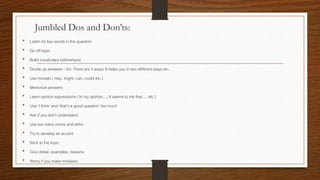
Jumbled Dos and Don’ts:
• Listen for key words in the question
• Go off topic
• Build vocabulary beforehand
• Divide up answers – Ex- There are 3 ways/ It helps you in two different ways etc.
• Use modals ( may, might, can, could etc.)
• Memorize answers
• Learn opinion expressions ( In my opinion…, It seems to me that…. etc.)
• Use ‘I think’ and ‘that’s a good question’ too much
• Ask if you don’t understand
• Use too many umms and ahhs
• Try to develop an accent
• Stick to the topic
• Give detail, examples, reasons
• Worry if you make mistakes
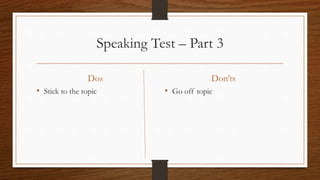
Speaking Test – Part 3
Dos
• Stick to the topic
Don’ts
• Go off topic
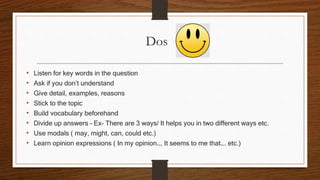
Dos
• Listen for key words in the question
• Ask if you don’t understand
• Give detail, examples, reasons
• Stick to the topic
• Build vocabulary beforehand
• Divide up answers – Ex- There are 3 ways/ It helps you in two different ways etc.
• Use modals ( may, might, can, could etc.)
• Learn opinion expressions ( In my opinion…, It seems to me that…. etc.)
Don’ts
• Go off topic
• Memorize answers
• Use too many umms and ahhs
• Use ‘I think’ and ‘that’s a good question’ too much
• Try to develop an accent
• Worry if you make mistakes
Sample video:
https://www.youtube.com/watch?v=ldbQQo8XzCo
Quiz:
1. Part 3 of the Speaking test takes about ten mins. T/F
2. In part 3 you may have to compare the past and the present. T/F
3. Should you make eye-contact with your examiner:
a. Yes
b. No, it’s not respectful to do so
4. You are marked for your English and not your opinions. T/F
5. Fluency means speaking quickly. T/F
6- Having a British/American accent can get you a better score.
T/F
Role-play:
• Candidate
• Examiner
• Observer
Criteria:
Fluency & Cohesion
Vocabulary
Grammar
Pronunciation

Ielts speaking test ppt

  • 1.
  • 2.
    Jumbled Dos andDon’ts: • Listen for key words in the question • Go off topic • Build vocabulary beforehand • Divide up answers – Ex- There are 3 ways/ It helps you in two different ways etc. • Use modals ( may, might, can, could etc.) • Memorize answers • Learn opinion expressions ( In my opinion…, It seems to me that…. etc.) • Use ‘I think’ and ‘that’s a good question’ too much • Ask if you don’t understand • Use too many umms and ahhs • Try to develop an accent • Stick to the topic • Give detail, examples, reasons • Worry if you make mistakes
  • 3.
    Speaking Test –Part 3 Dos • Stick to the topic Don’ts • Go off topic
  • 4.
    Dos • Listen forkey words in the question • Ask if you don’t understand • Give detail, examples, reasons • Stick to the topic • Build vocabulary beforehand • Divide up answers – Ex- There are 3 ways/ It helps you in two different ways etc. • Use modals ( may, might, can, could etc.) • Learn opinion expressions ( In my opinion…, It seems to me that…. etc.)
  • 5.
    Don’ts • Go offtopic • Memorize answers • Use too many umms and ahhs • Use ‘I think’ and ‘that’s a good question’ too much • Try to develop an accent • Worry if you make mistakes
  • 6.
  • 7.
    Quiz: 1. Part 3of the Speaking test takes about ten mins. T/F 2. In part 3 you may have to compare the past and the present. T/F 3. Should you make eye-contact with your examiner: a. Yes b. No, it’s not respectful to do so 4. You are marked for your English and not your opinions. T/F 5. Fluency means speaking quickly. T/F 6- Having a British/American accent can get you a better score. T/F
  • 8.
    Role-play: • Candidate • Examiner •Observer Criteria: Fluency & Cohesion Vocabulary Grammar Pronunciation