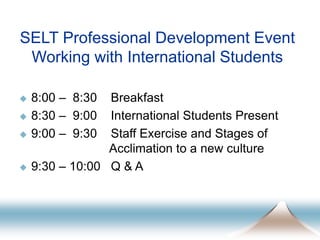
SELT Professional Development Event
Working with International Students
 8:00 – 8:30 Breakfast
 8:30 – 9:00 International Students Present
 9:00 – 9:30 Staff Exercise and Stages of
Acclimation to a new culture
 9:30 – 10:00 Q & A
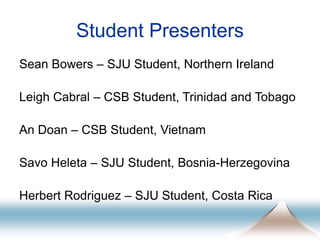
Student Presenters
Sean Bowers – SJU Student, Northern Ireland
Leigh Cabral – CSB Student, Trinidad and Tobago
An Doan – CSB Student, Vietnam
Savo Heleta – SJU Student, Bosnia-Herzegovina
Herbert Rodriguez – SJU Student, Costa Rica
Complete the form you have
been given and follow these
instructions:
1. Write from right to left
2. Write very clearly. Sloppy
writing will be discarded
3. Fill in every blank
4. For #2, use the Moslem
calendar, which begins
July 16, A.D. 622.
5. Do not answer #7 unless you
have a green and-white-card.
6. Complete this task within
three minutes
7. Ask no questions
The Five Stages of Culture
Shock
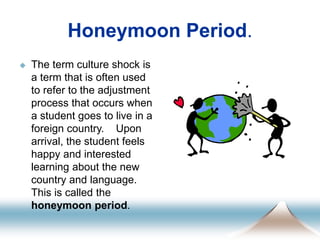
Honeymoon Period.
 The term culture shock is
a term that is often used
to refer to the adjustment
process that occurs when
a student goes to live in a
foreign country. Upon
arrival, the student feels
happy and interested
learning about the new
country and language.
This is called the
honeymoon period.
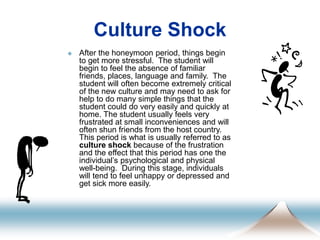
Culture Shock
 After the honeymoon period, things begin
to get more stressful. The student will
begin to feel the absence of familiar
friends, places, language and family. The
student will often become extremely critical
of the new culture and may need to ask for
help to do many simple things that the
student could do very easily and quickly at
home. The student usually feels very
frustrated at small inconveniences and will
often shun friends from the host country.
This period is what is usually referred to as
culture shock because of the frustration
and the effect that this period has one the
individual’s psychological and physical
well-being. During this stage, individuals
will tend to feel unhappy or depressed and
get sick more easily.
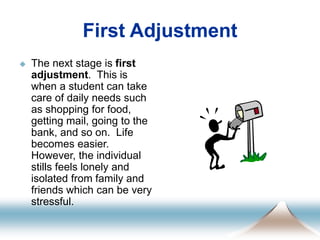
First Adjustment
 The next stage is first
adjustment. This is
when a student can take
care of daily needs such
as shopping for food,
getting mail, going to the
bank, and so on. Life
becomes easier.
However, the individual
stills feels lonely and
isolated from family and
friends which can be very
stressful.
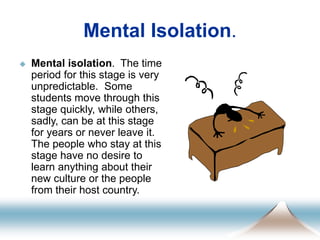
Mental Isolation.
 Mental isolation. The time
period for this stage is very
unpredictable. Some
students move through this
stage quickly, while others,
sadly, can be at this stage
for years or never leave it.
The people who stay at this
stage have no desire to
learn anything about their
new culture or the people
from their host country.
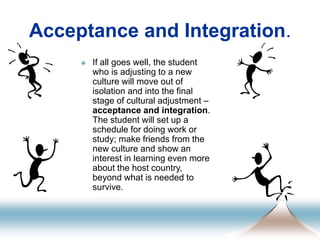
Acceptance and Integration.
 If all goes well, the student
who is adjusting to a new
culture will move out of
isolation and into the final
stage of cultural adjustment –
acceptance and integration.
The student will set up a
schedule for doing work or
study; make friends from the
new culture and show an
interest in learning even more
about the host country,
beyond what is needed to
survive.
Culture Bumps
"A culture bump occurs when a person has expectations of a
particular behavior and gets something different when interacting
with individuals from another culture." Expectations, as used in the
definition, refer to the expectations of “normal” behavior as learned
in one’s own culture.
While living in another culture, we find some things that are the same
as in our own country. In these instances, the two cultures fit
together. However, there are other things that are different. The
points at which the two cultures differ or "bump into each other" are
usually the areas that interfere in the development of successful
cross-cultural relationships. If the specific points of difference, or
culture bumps, are analyzed, they can lead to a deeper
understanding. If they are not analyzed, they can lead to
stereotypes of people in the other culture.
Keys to Good Communication in
Working with International Students
 Strive to pronounce students’ names correctly
 Learn about the students background/country and culture
 Respect personal space
 Learn the cultural rules about touching
 Establish rapport
 Ask Questions
 Listen to the Answers
 Appreciate and use silence “pause time”
 Notice eye contact
 Pay attention to body movements
 Note responses
 Don’t be afraid to say “No”, “Could you please repeat that”, or “Could
you talk slower, I am having a hard time understanding your accent”
Handouts
 Country/Culture information
 Culture Bumps definition
 Intercultural Communication conclusions
 Common Adjustment Issues for
International Students
Thank you for your time!
 Lynda Fish, Academic Advisor,
International Students
 Addy Spitzer, Interim International Student
Program Director

seltpresentation.ppt

  • 1.
    SELT Professional DevelopmentEvent Working with International Students  8:00 – 8:30 Breakfast  8:30 – 9:00 International Students Present  9:00 – 9:30 Staff Exercise and Stages of Acclimation to a new culture  9:30 – 10:00 Q & A
  • 2.
    Student Presenters Sean Bowers– SJU Student, Northern Ireland Leigh Cabral – CSB Student, Trinidad and Tobago An Doan – CSB Student, Vietnam Savo Heleta – SJU Student, Bosnia-Herzegovina Herbert Rodriguez – SJU Student, Costa Rica
  • 3.
    Complete the formyou have been given and follow these instructions: 1. Write from right to left 2. Write very clearly. Sloppy writing will be discarded 3. Fill in every blank 4. For #2, use the Moslem calendar, which begins July 16, A.D. 622. 5. Do not answer #7 unless you have a green and-white-card. 6. Complete this task within three minutes 7. Ask no questions
  • 4.
    The Five Stagesof Culture Shock
  • 5.
    Honeymoon Period.  Theterm culture shock is a term that is often used to refer to the adjustment process that occurs when a student goes to live in a foreign country. Upon arrival, the student feels happy and interested learning about the new country and language. This is called the honeymoon period.
  • 6.
    Culture Shock  Afterthe honeymoon period, things begin to get more stressful. The student will begin to feel the absence of familiar friends, places, language and family. The student will often become extremely critical of the new culture and may need to ask for help to do many simple things that the student could do very easily and quickly at home. The student usually feels very frustrated at small inconveniences and will often shun friends from the host country. This period is what is usually referred to as culture shock because of the frustration and the effect that this period has one the individual’s psychological and physical well-being. During this stage, individuals will tend to feel unhappy or depressed and get sick more easily.
  • 7.
    First Adjustment  Thenext stage is first adjustment. This is when a student can take care of daily needs such as shopping for food, getting mail, going to the bank, and so on. Life becomes easier. However, the individual stills feels lonely and isolated from family and friends which can be very stressful.
  • 8.
    Mental Isolation.  Mentalisolation. The time period for this stage is very unpredictable. Some students move through this stage quickly, while others, sadly, can be at this stage for years or never leave it. The people who stay at this stage have no desire to learn anything about their new culture or the people from their host country.
  • 9.
    Acceptance and Integration. If all goes well, the student who is adjusting to a new culture will move out of isolation and into the final stage of cultural adjustment – acceptance and integration. The student will set up a schedule for doing work or study; make friends from the new culture and show an interest in learning even more about the host country, beyond what is needed to survive.
  • 10.
    Culture Bumps "A culturebump occurs when a person has expectations of a particular behavior and gets something different when interacting with individuals from another culture." Expectations, as used in the definition, refer to the expectations of “normal” behavior as learned in one’s own culture. While living in another culture, we find some things that are the same as in our own country. In these instances, the two cultures fit together. However, there are other things that are different. The points at which the two cultures differ or "bump into each other" are usually the areas that interfere in the development of successful cross-cultural relationships. If the specific points of difference, or culture bumps, are analyzed, they can lead to a deeper understanding. If they are not analyzed, they can lead to stereotypes of people in the other culture.
  • 11.
    Keys to GoodCommunication in Working with International Students  Strive to pronounce students’ names correctly  Learn about the students background/country and culture  Respect personal space  Learn the cultural rules about touching  Establish rapport  Ask Questions  Listen to the Answers  Appreciate and use silence “pause time”  Notice eye contact  Pay attention to body movements  Note responses  Don’t be afraid to say “No”, “Could you please repeat that”, or “Could you talk slower, I am having a hard time understanding your accent”
  • 12.
    Handouts  Country/Culture information Culture Bumps definition  Intercultural Communication conclusions  Common Adjustment Issues for International Students
  • 13.
    Thank you foryour time!  Lynda Fish, Academic Advisor, International Students  Addy Spitzer, Interim International Student Program Director