Math, Banking, and
Credit Unit
Marketing I
Banking Terms to Know
 Endorse – To sign the back of a check
 Three types of Endorsements
Blank – Signature only
Restrictive – “For Deposit Only”, then
Signature
Full or Special – “Pay to the order of
……”, then Signature
 Signature Card – Card filled out when
opening an account so the bank can
identify your signature
 Deposit – To put money into an account
 Withdrawal – To take money out of an
account (check, debit card, etc)
 Debit Card – works same as writing a
check. Different from a credit card b/c
the money comes right out of your
checking acct. instead of being charged
 Check Register – a booklet, stub or
carbon copy of a check. Used to keep
track of all transactions in an account.
VERY IMPORTANT to be kept accurate
and up to date.
 Bank Statement – Monthly report of your
checking account from the bank. May
contain images of cancelled checks.
 Reconcile – Comparing your bank
statement to your check register
 Cancelled check – a check that you
have written that has cleared the bank (it
has been paid by the bank)
 Overdraft (Bounced check) – writing a
check for more money than is in the
account.
 Overdraft protection – Arrangement for
the overdraft amount to come out of
another account (Like savings) or be
charged to your credit card.
 Outstanding Check – A check you have
written but has not yet been paid by the
bank (Doesn’t appear on your statement)
 Outstanding Deposit – Deposit you have
made but doesn’t appear on your
statement
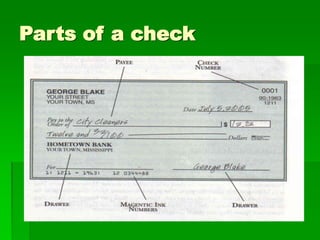
Parts of a check
Reconciling a
Bank Statement
 Getting the balance in the check register and the
balance on the bank statement to agree.
 Process
 Compare C.R. and B.S., make note of any outstanding
checks or deposits on the worksheet on the back of the
bank statement.
 Subtract any service charges, etc that may have been
taken out of your account from your check register.
 Complete worksheet on back of your statement
 Statement Balance + Outstanding Deposits – Outstanding Checks
= Balance in Check Register
Credit – Buy Now Pay Later
 Commercial Credit – Credit for
businesses
 Personal Credit (Consumer Credit)
– Credit for personal spending
Laws Dealing with Credit
 Equal Credit Opportunity Act
(ECOA) 1975,1977 – Protects against
credit discrimination
 Truth in Lending 1968 –Requires
creditors to disclose the finance
charges and APR to applicants
 Fair Credit Reporting Act 1970 –
Gives consumers specific rights in
dealing with credit reporting agencies.
 State Laws – vary by state
Types of Credit
1. Revolving Credit Accounts –
Consumers pay what they want
toward the balance. Interest may be
charged to the balance at the end of
the month
2. Installment Credit Accounts – The
total amount of the loan is broken
down into payments including interest.
Monthly installments are made until
the loan is paid
3. Regular Credit Accounts – (Open
Accounts) – Allow customers to buy
any time during a set period and pay
the entire amount due.
4. Budget Credit Accounts – short term
credit – ex. 90 days same as cash
5. Bank Credit Cards – May be used at
a variety of businesses, retailer sends
the bank the charge slip for payment.
The bank charges the business a fee
for the service. Bank bills the
customer. Ex. Mastercard, Visa
6. Travel and Entertainment Cards –
used at restaurants, clubs, hotels,
etc. For travelers who don’t want to
carry large amt. of cash. These
charge an annual fee. The balance
must be paid at the end of the month.
Ex. American Express, Diners Club
8. Secured Loans – The borrower
pledges some valuable possession
as collateral. If the loan isn’t repaid
the item belongs to the lender
9. Unsecured Loans – Signature
Loan – higher risk loan so interest
rate could be higher, offered to
those with excellent credit ratings.
No collateral
Sources of Credit
 Commercial Banks
 Savings and Loan Associations
 Credit Unions
 Sales Finance Companies
 Other businesses (Manufacturers,
wholesalers, retailers, etc)
Costs of Credit
1. Annual Fees – a fee just to have the
card
2. Finance Charges – interest charged on
unpaid balance
3. Higher Prices – businesses must cover
the expense of offering credit and protect
itself against those who do not repay.
4. Interest Rates – Fee the lender charges
for the use of the money.
Benefits to Businesses
who offer Credit
 Competitive
 Gain new customers
 Encourage customers to buy
 Foster customer loyalty
 Marketing information tool
Benefits of Obtaining
Credit
 Purchase expensive items
 Convenience
 Emergency items
 Maintain stock levels
 Buy time until there is available cash
 Credit rating
 Save money (in some instances)
Credit Reports
 National Credit Bureaus
 Experian
 Equifax
 Trans Union
 A credit report is now free, but to get your
credit score there is a charge.
 Credit report can be checked by anyone
with whom you are trying to obtain credit,
prospective employers, landlords,
insurance agents
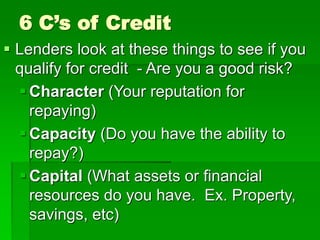
6 C’s of Credit
 Lenders look at these things to see if you
qualify for credit - Are you a good risk?
 Character (Your reputation for
repaying)
 Capacity (Do you have the ability to
repay?)
 Capital (What assets or financial
resources do you have. Ex. Property,
savings, etc)
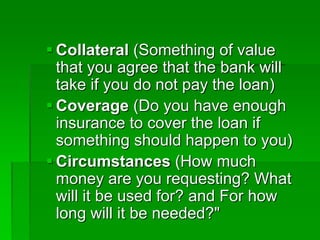
 Collateral (Something of value
that you agree that the bank will
take if you do not pay the loan)
 Coverage (Do you have enough
insurance to cover the loan if
something should happen to you)
 Circumstances (How much
money are you requesting? What
will it be used for? and For how
long will it be needed?"
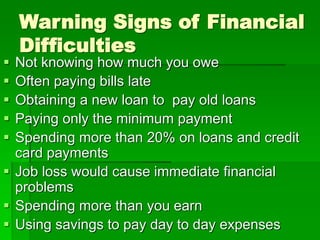
Warning Signs of Financial
Difficulties
 Not knowing how much you owe
 Often paying bills late
 Obtaining a new loan to pay old loans
 Paying only the minimum payment
 Spending more than 20% on loans and credit
card payments
 Job loss would cause immediate financial
problems
 Spending more than you earn
 Using savings to pay day to day expenses

Math, Banking, and Credit Unit.ppt

  • 1.
    Math, Banking, and CreditUnit Marketing I
  • 2.
    Banking Terms toKnow  Endorse – To sign the back of a check  Three types of Endorsements Blank – Signature only Restrictive – “For Deposit Only”, then Signature Full or Special – “Pay to the order of ……”, then Signature
  • 3.
     Signature Card– Card filled out when opening an account so the bank can identify your signature  Deposit – To put money into an account  Withdrawal – To take money out of an account (check, debit card, etc)  Debit Card – works same as writing a check. Different from a credit card b/c the money comes right out of your checking acct. instead of being charged
  • 4.
     Check Register– a booklet, stub or carbon copy of a check. Used to keep track of all transactions in an account. VERY IMPORTANT to be kept accurate and up to date.  Bank Statement – Monthly report of your checking account from the bank. May contain images of cancelled checks.  Reconcile – Comparing your bank statement to your check register
  • 5.
     Cancelled check– a check that you have written that has cleared the bank (it has been paid by the bank)  Overdraft (Bounced check) – writing a check for more money than is in the account.  Overdraft protection – Arrangement for the overdraft amount to come out of another account (Like savings) or be charged to your credit card.
  • 6.
     Outstanding Check– A check you have written but has not yet been paid by the bank (Doesn’t appear on your statement)  Outstanding Deposit – Deposit you have made but doesn’t appear on your statement
  • 7.
  • 8.
    Reconciling a Bank Statement Getting the balance in the check register and the balance on the bank statement to agree.  Process  Compare C.R. and B.S., make note of any outstanding checks or deposits on the worksheet on the back of the bank statement.  Subtract any service charges, etc that may have been taken out of your account from your check register.  Complete worksheet on back of your statement  Statement Balance + Outstanding Deposits – Outstanding Checks = Balance in Check Register
  • 9.
    Credit – BuyNow Pay Later  Commercial Credit – Credit for businesses  Personal Credit (Consumer Credit) – Credit for personal spending
  • 10.
    Laws Dealing withCredit  Equal Credit Opportunity Act (ECOA) 1975,1977 – Protects against credit discrimination  Truth in Lending 1968 –Requires creditors to disclose the finance charges and APR to applicants  Fair Credit Reporting Act 1970 – Gives consumers specific rights in dealing with credit reporting agencies.  State Laws – vary by state
  • 11.
    Types of Credit 1.Revolving Credit Accounts – Consumers pay what they want toward the balance. Interest may be charged to the balance at the end of the month 2. Installment Credit Accounts – The total amount of the loan is broken down into payments including interest. Monthly installments are made until the loan is paid
  • 12.
    3. Regular CreditAccounts – (Open Accounts) – Allow customers to buy any time during a set period and pay the entire amount due. 4. Budget Credit Accounts – short term credit – ex. 90 days same as cash 5. Bank Credit Cards – May be used at a variety of businesses, retailer sends the bank the charge slip for payment. The bank charges the business a fee for the service. Bank bills the customer. Ex. Mastercard, Visa
  • 13.
    6. Travel andEntertainment Cards – used at restaurants, clubs, hotels, etc. For travelers who don’t want to carry large amt. of cash. These charge an annual fee. The balance must be paid at the end of the month. Ex. American Express, Diners Club
  • 14.
    8. Secured Loans– The borrower pledges some valuable possession as collateral. If the loan isn’t repaid the item belongs to the lender 9. Unsecured Loans – Signature Loan – higher risk loan so interest rate could be higher, offered to those with excellent credit ratings. No collateral
  • 15.
    Sources of Credit Commercial Banks  Savings and Loan Associations  Credit Unions  Sales Finance Companies  Other businesses (Manufacturers, wholesalers, retailers, etc)
  • 16.
    Costs of Credit 1.Annual Fees – a fee just to have the card 2. Finance Charges – interest charged on unpaid balance 3. Higher Prices – businesses must cover the expense of offering credit and protect itself against those who do not repay. 4. Interest Rates – Fee the lender charges for the use of the money.
  • 17.
    Benefits to Businesses whooffer Credit  Competitive  Gain new customers  Encourage customers to buy  Foster customer loyalty  Marketing information tool
  • 18.
    Benefits of Obtaining Credit Purchase expensive items  Convenience  Emergency items  Maintain stock levels  Buy time until there is available cash  Credit rating  Save money (in some instances)
  • 19.
    Credit Reports  NationalCredit Bureaus  Experian  Equifax  Trans Union  A credit report is now free, but to get your credit score there is a charge.  Credit report can be checked by anyone with whom you are trying to obtain credit, prospective employers, landlords, insurance agents
  • 20.
    6 C’s ofCredit  Lenders look at these things to see if you qualify for credit - Are you a good risk?  Character (Your reputation for repaying)  Capacity (Do you have the ability to repay?)  Capital (What assets or financial resources do you have. Ex. Property, savings, etc)
  • 21.
     Collateral (Somethingof value that you agree that the bank will take if you do not pay the loan)  Coverage (Do you have enough insurance to cover the loan if something should happen to you)  Circumstances (How much money are you requesting? What will it be used for? and For how long will it be needed?"
  • 23.
    Warning Signs ofFinancial Difficulties  Not knowing how much you owe  Often paying bills late  Obtaining a new loan to pay old loans  Paying only the minimum payment  Spending more than 20% on loans and credit card payments  Job loss would cause immediate financial problems  Spending more than you earn  Using savings to pay day to day expenses