DEPARTMENT OF CSG
YEAR: IV BTECH I SEM
SUBJECT : COMPILER DESIGN
Seminar Presentation On
TOPIC : STACK ALLOCATION OF SPACE (UNIT IV )
FACULTY:
MRS.A.NANDHINI SREE
PRESENTED BY:
K. NIKHIL ( 22R91A7427)
N. KARTHIK ( 23R95A7404)
2.
INTRODUCTION
Before learning about“Stack Allocation of Space “ there is a need to know about
Run Time Environment .
What is Run Time Environment ?
The CPU can only execute a program that is in the main memory.
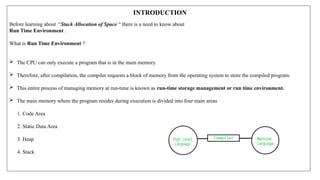
Therefore, after compilation, the compiler requests a block of memory from the operating system to store the compiled program.
This entire process of managing memory at run-time is known as run-time storage management or run time environment.
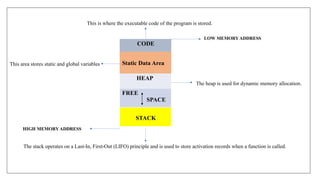
The main memory where the program resides during execution is divided into four main areas
1. Code Area
2. Static Data Area
3. Heap
4. Stack
3.
CODE
Static Data Area
HEAP
FREE
SPACE
STACK
Thisis where the executable code of the program is stored.
This area stores static and global variables
The heap is used for dynamic memory allocation.
The stack operates on a Last-In, First-Out (LIFO) principle and is used to store activation records when a function is called.
LOW MEMORYADDRESS
HIGH MEMORY ADDRESS
4.
Stack Allocation ofSpace
The stack is the component of run-time management dedicated to handling the sequence of function calls.
What it does?
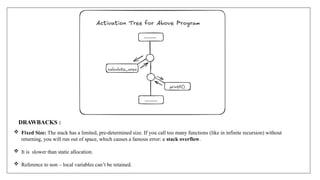
Every time a function is called, a new block of memory, called an activation record or stack frame, is pushed onto the top of the stack.
How it works?
It follows a strict Last-In, First-Out (LIFO) principle. When a function finishes, its stack frame is popped off the top, automatically
freeing the memory.
Key Characteristics
Automatic: The compiler handles all the work of adding and removing from the stack. The programmer doesn't have to manually
manage this memory.
Fast: Allocating and deallocating memory on the stack is extremely fast. It's as simple as moving a single pointer to a new address.
Temporary Storage: The data stored on the stack is temporary and exists only for the lifetime of the function call.
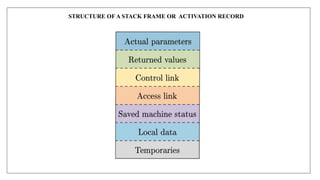
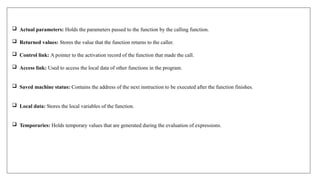
Actual parameters:Holds the parameters passed to the function by the calling function.
Returned values: Stores the value that the function returns to the caller.
Control link: A pointer to the activation record of the function that made the call.
Access link: Used to access the local data of other functions in the program.
Saved machine status: Contains the address of the next instruction to be executed after the function finishes.
Local data: Stores the local variables of the function.
Temporaries: Holds temporary values that are generated during the evaluation of expressions.
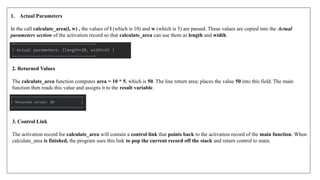
1. Actual Parameters
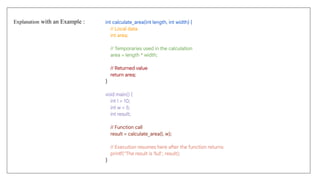
Inthe call calculate_area(l, w) , the values of l (which is 10) and w (which is 5) are passed. These values are copied into the Actual
parameters section of the activation record so that calculate_area can use them as length and width.
2. Returned Values
The calculate_area function computes area = 10 * 5, which is 50. The line return area; places the value 50 into this field. The main
function then reads this value and assigns it to the result variable.
3. Control Link
The activation record for calculate_area will contain a control link that points back to the activation record of the main function. When
calculate_area is finished, the program uses this link to pop the current record off the stack and return control to main.
9.
4. Saved MachineStatus
The system saves the address of the printf statement inside the main function. Once calculate_area returns its value, the program uses this
saved address to know that it should continue executing from that printf line.
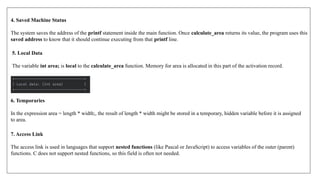
5. Local Data
The variable int area; is local to the calculate_area function. Memory for area is allocated in this part of the activation record.
6. Temporaries
In the expression area = length * width;, the result of length * width might be stored in a temporary, hidden variable before it is assigned
to area.
7. Access Link
The access link is used in languages that support nested functions (like Pascal or JavaScript) to access variables of the outer (parent)
functions. C does not support nested functions, so this field is often not needed.
10.
DRAWBACKS :
FixedSize: The stack has a limited, pre-determined size. If you call too many functions (like in infinite recursion) without
returning, you will run out of space, which causes a famous error: a stack overflow.
It is slower than static allocation.
Reference to non – local variables can’t be retained.