1
#CompetitiveCities
2
• Will tell a story based on evidence of
‘what works’:
– Data on 750 cities worldwide;
– 6 structured case studies of high-
growing cities;
– Secondary literature;
– Firm-level econometrics;
– Lots of conversations.
‘Market systems’ in a city context
2
3
How have other cities created jobs and
growth?
What should be the top priorities for my
city?
How do I get it done?
4
So we decided to find a way to answer these questions
In-depth lit review
and consultations Database of
750 Cities
6 in-depth
case studies
Econometric analysis
in two countries
5
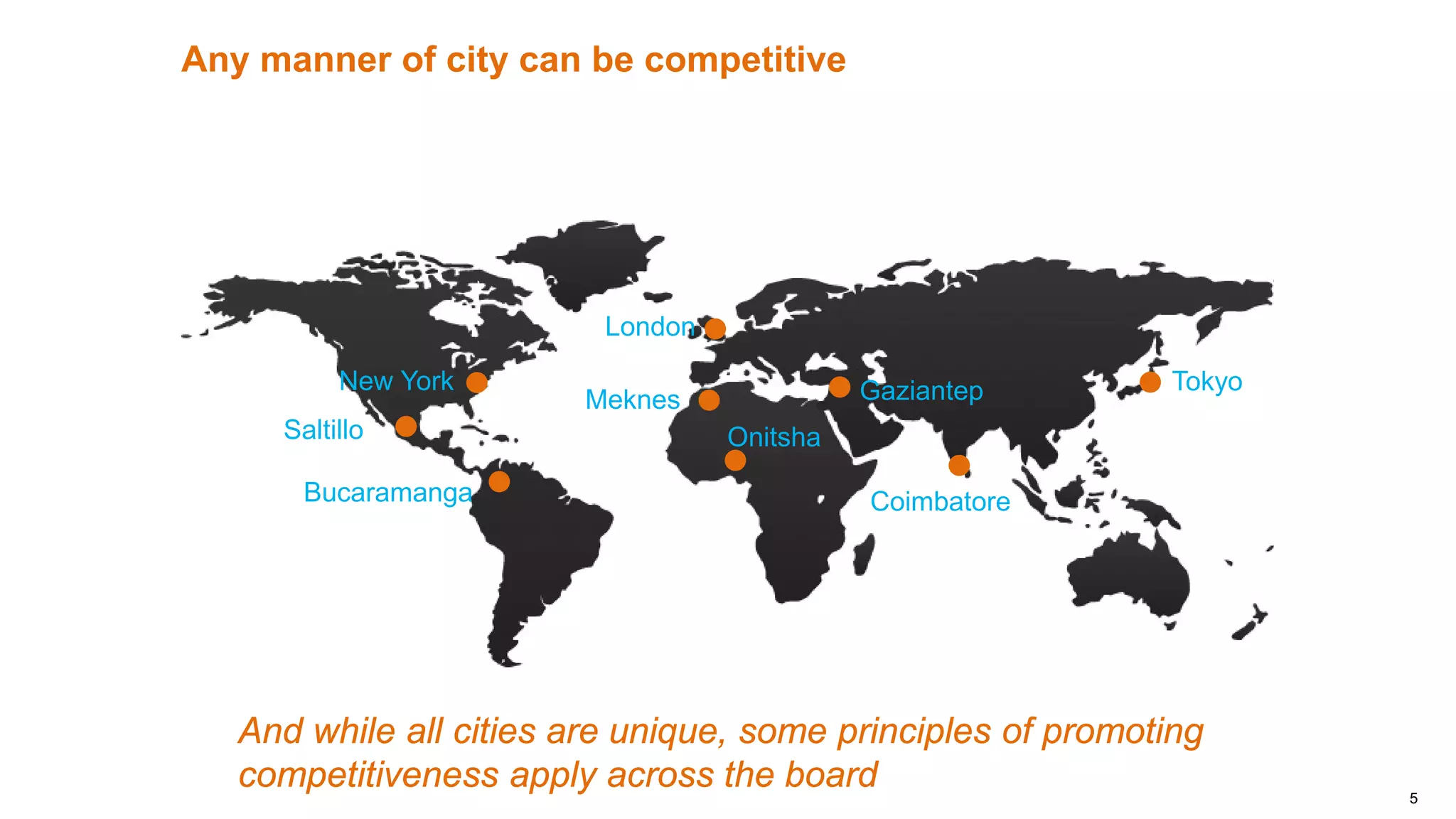
Any manner of city can be competitive
Meknes
Bucaramanga Coimbatore
Gaziantep
OnitshaSaltillo
New York Tokyo
London
And while all cities are unique, some principles of promoting
competitiveness apply across the board
6
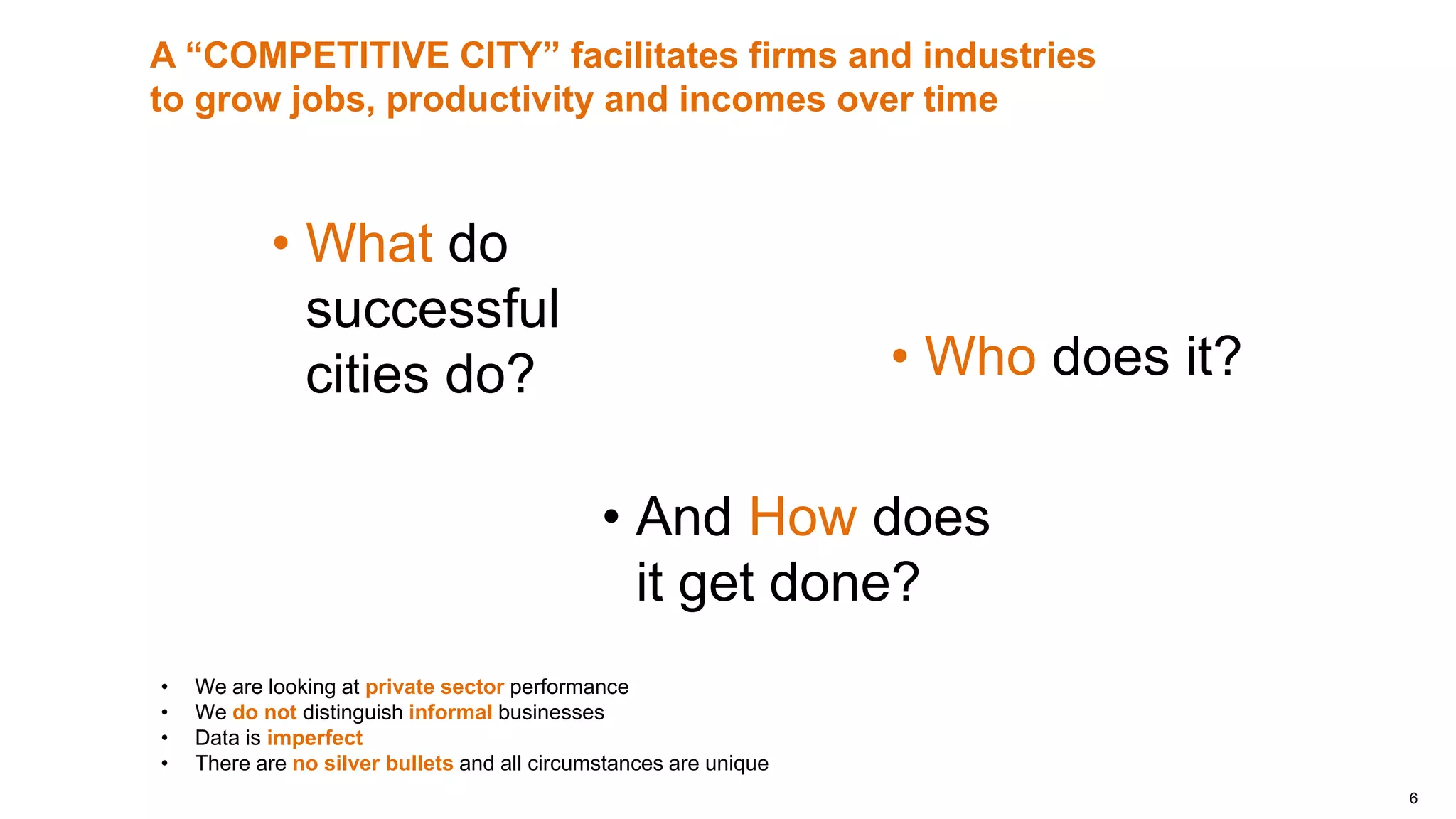
• And How does
it get done?
A “COMPETITIVE CITY” facilitates firms and industries
to grow jobs, productivity and incomes over time
• What do
successful
cities do? • Who does it?
• We are looking at private sector performance
• We do not distinguish informal businesses
• Data is imperfect
• There are no silver bullets and all circumstances are unique
7
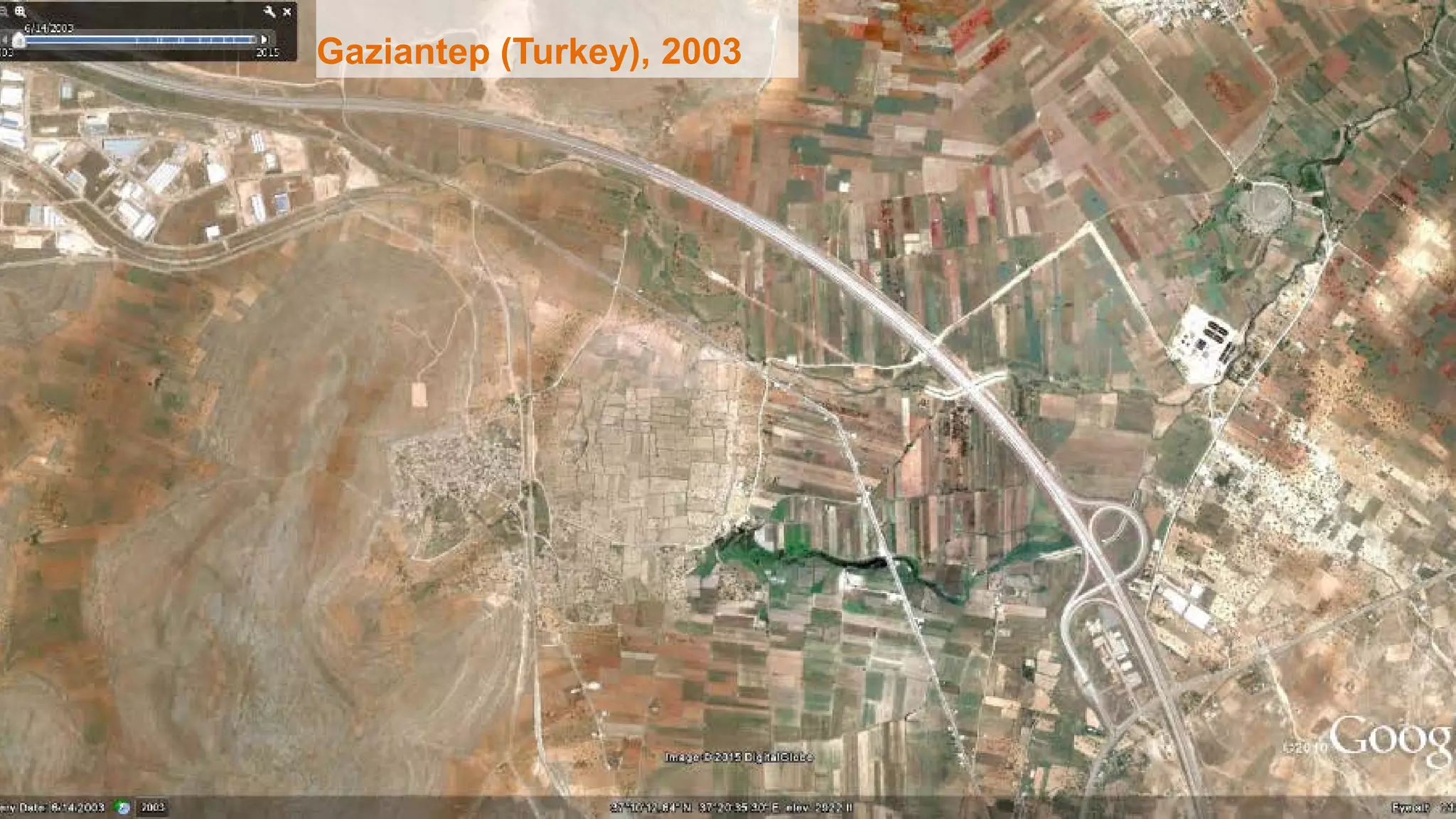
An unexpected story of ONE city
WHAT WOULD YOU DO…..?
• Land is dry and ill-suited for agriculture.
• Not a port city; 210km from a port.
• Low skilled population.
• No high-tech clusters.
Gaziantep (Turkey), 2003
Gaziantep (Turkey), 2014
• Light-manufacturing firms export to 175
countries around the globe.
• Exports increased tenfold from $620 million
in 2002 to $6.2 billion in 2013.
• Ranked #9 globally for economic growth in
the decade 1999 to 2009.
• Recorded an average of 6.3 percent in
annual GDP growth from 2005-2012.
• 3.6 percent in annual employment growth.
12
1. WHAT CAN BE DONE
13
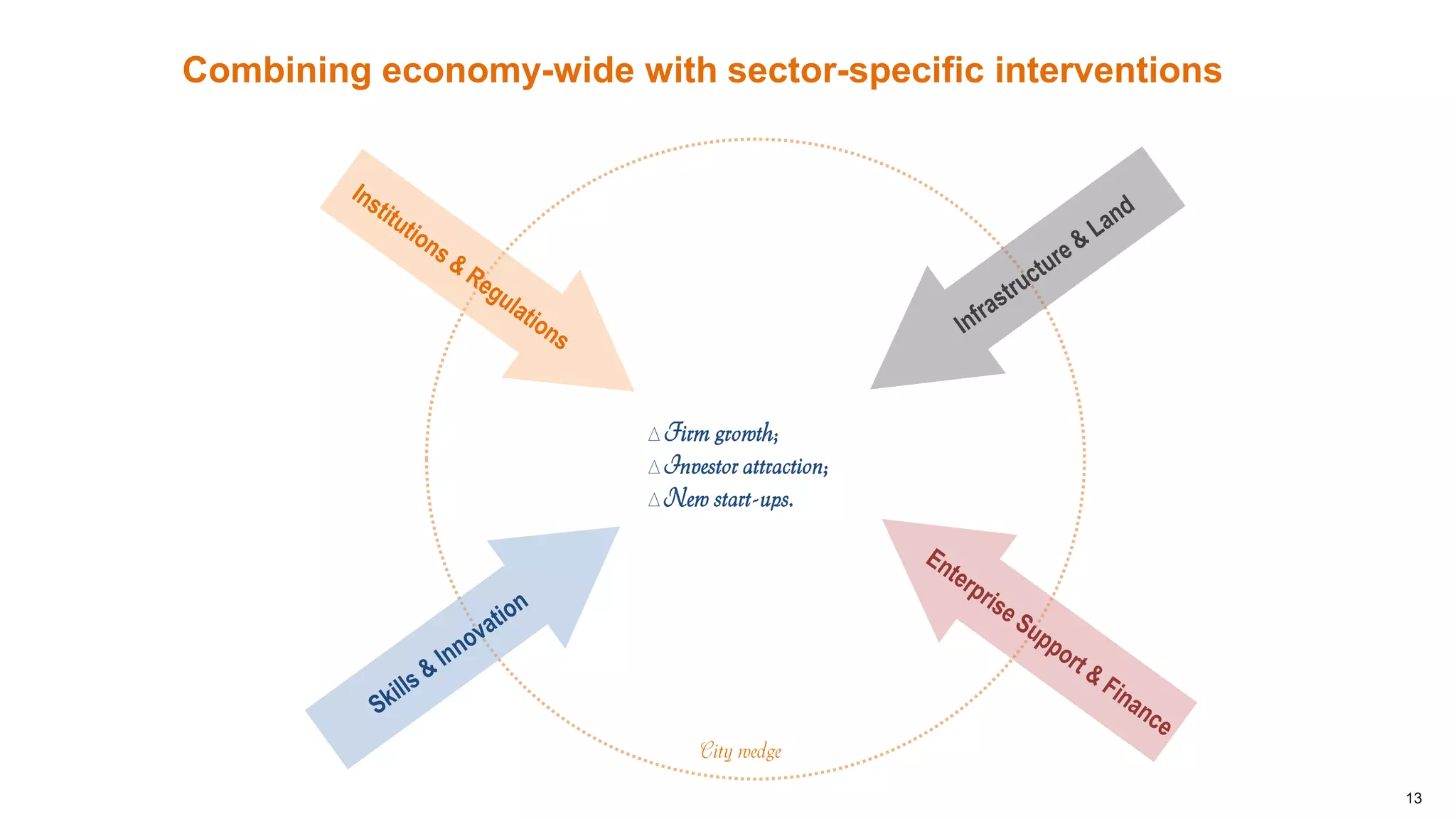
Combining economy-wide with sector-specific interventions
∆ Firm growth;
∆ Investor attraction;
∆ New start-ups.
City wedge
14
Successful cities combined:
a) industry-specific (sector/value
chain) interventions, with
b) economy-wide interventions.
This was not an either/or choice…
14
Source: Analysis using Oxford Economics city-level data for 750 cities worldwide, 2005-2012
Tradable goods & services drive growth in competitive cities
0
1
2
3
4
5
6
7
Top 10 percent of cities Other 90 percent of cities
Tradable goods & services
Non-tradable goods & services
The reasons:
• Expand the local economic
pie;
• Help increase productivity
through competition.
Annualemploymentgrowth,2005-2012
16
2. WHO DOES IT
17
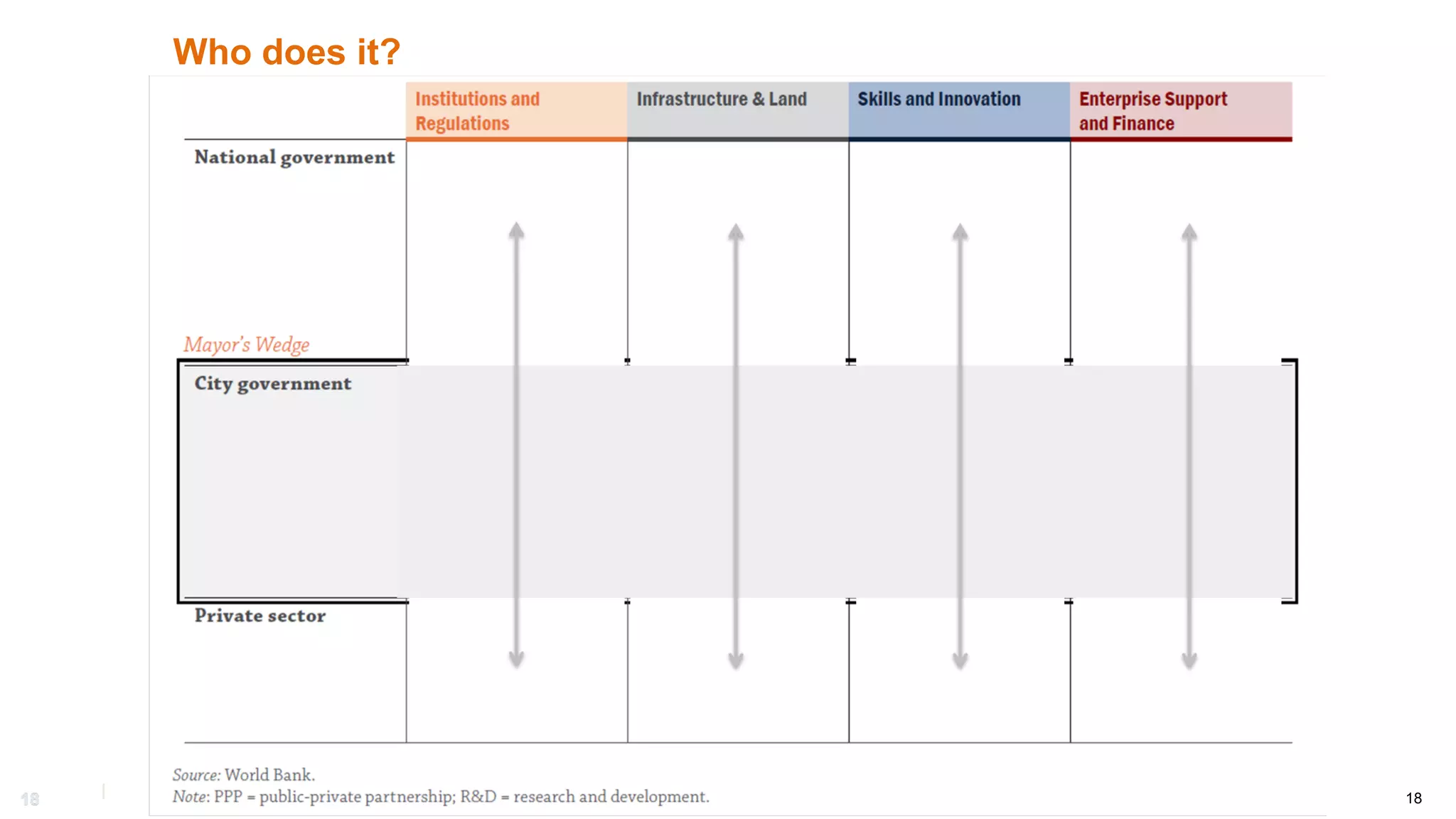
Who: The city wedge
i. Growth Coalitions:
collaboration with
stakeholders;
ii. Mayor’s Wedge: internal
scope and capacity;
iii. Intergovernmental
relations: external leverage.
18
Who does it?
19
3. HOW WILL IT BE DONE
City economic development strategies in practice
“There is a strategy on paper, but it’s not evident to us. What is evident is
the various directorates with their own key focus areas– but that’s not a
combined strategy.”
-- Executive Director
of city Chamber of Commerce, South Africa
“In the Metro growth strategy there are two and a half pages of
priority projects. We need 2-3 focused areas, rather than a wish
list.”
-- LED professional,
South Africa
“If you ask people what is their number one priority, they will not
say it’s housing; they will not say it’s electricity; they will say give
me dignity by giving me a job. Job creation should be our number
one driver. If I get a job then everything else falls into place.”
— CFO of eThekwini, South Africa
“We thought we had a problem with our industrial development strategy,
and instead we realized the biggest issues were with our management
system.”
--Minister of Planning, Central American city
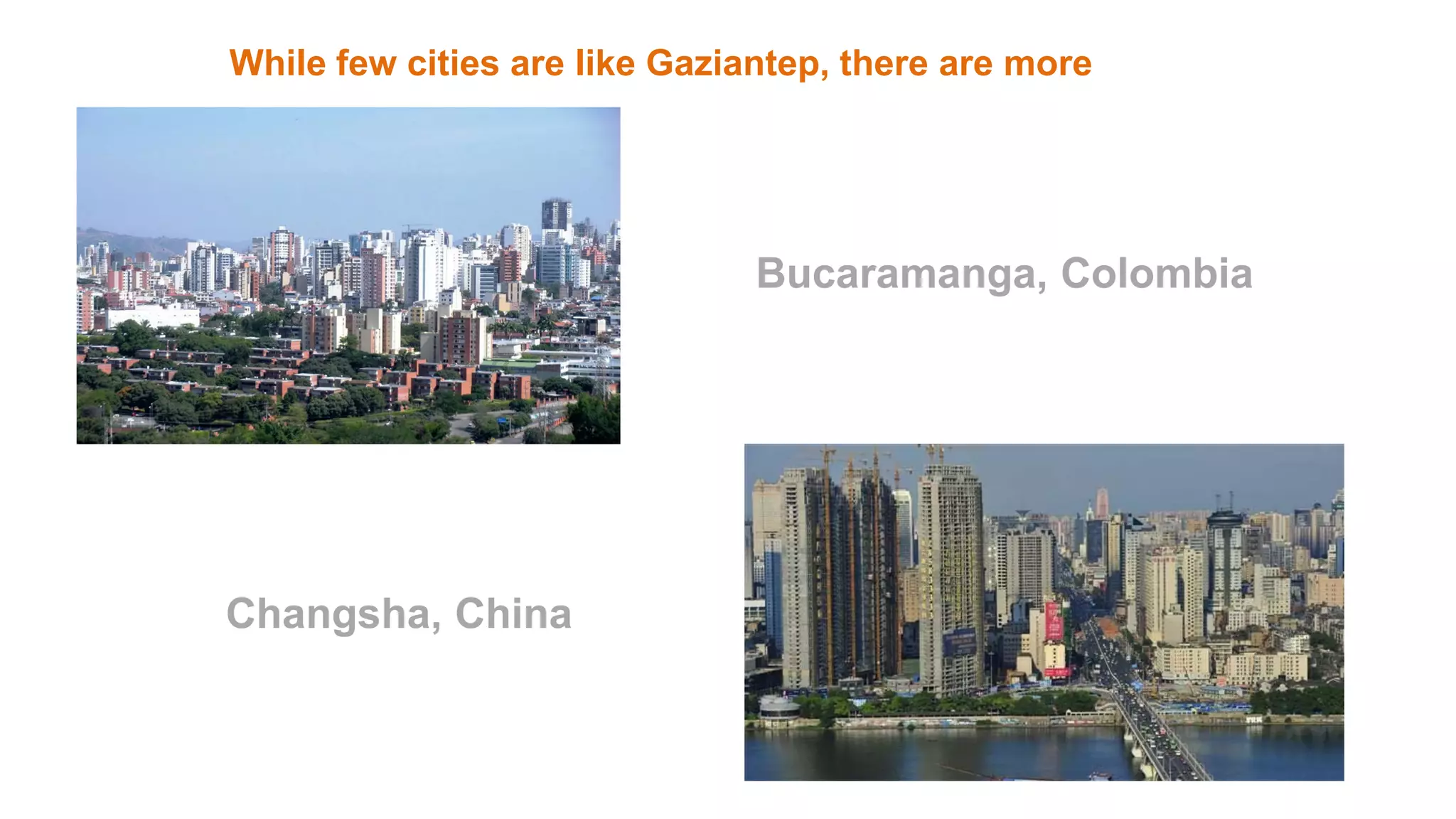
While few cities are like Gaziantep, there are more
Bucaramanga, Colombia
Changsha, China
These findings apply to all sorts of cities
What
How
Who
NEW YORK
PITTSBURGH MANCHESTER
LONDON
BALTIMORE MEXICO CITY
23
“We tend to keep people busy,
rather than to change people’s
lives”—
LED professional, South Africa
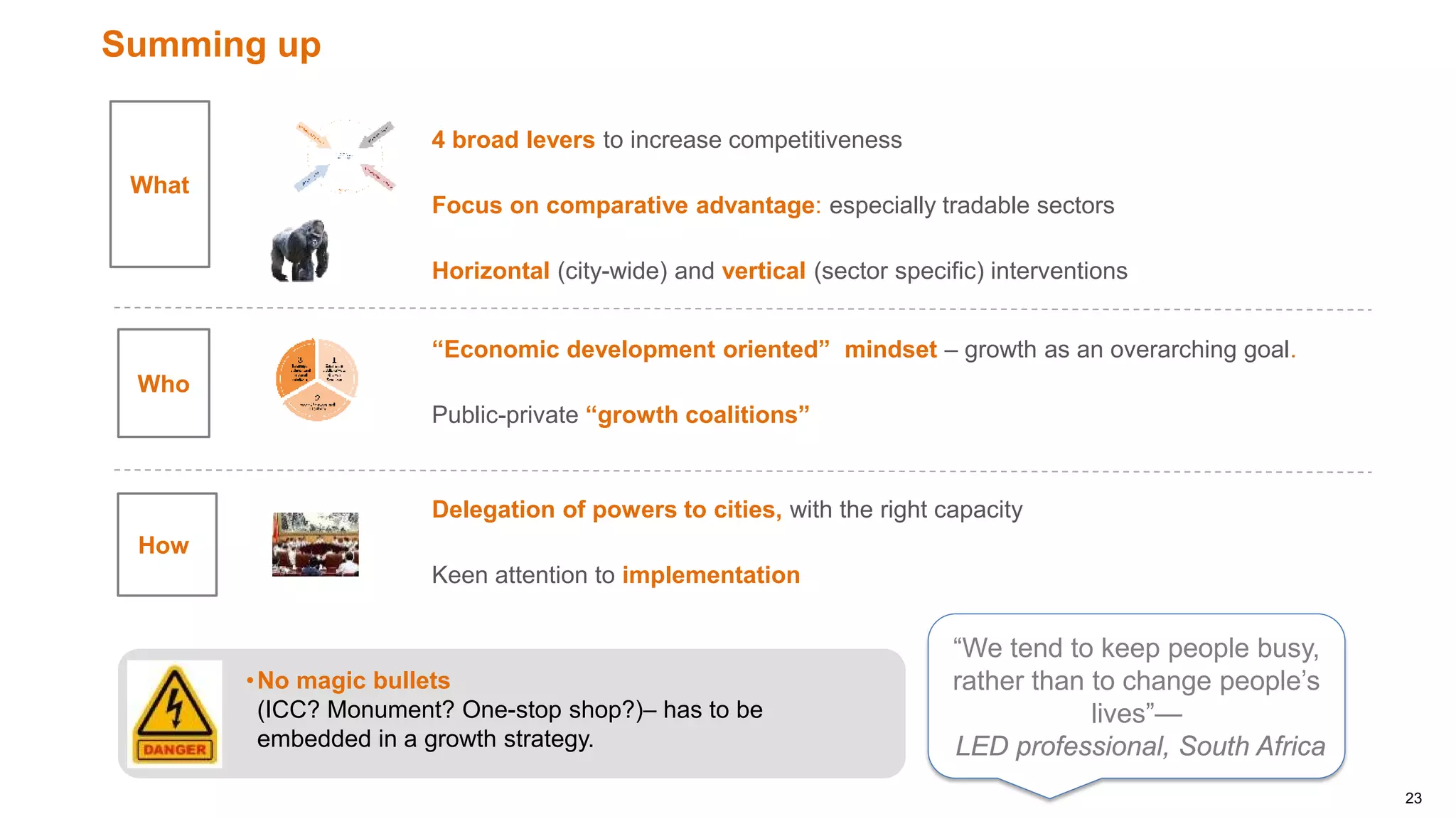
•No magic bullets
(ICC? Monument? One-stop shop?)– has to be
embedded in a growth strategy.
Summing up
4 broad levers to increase competitiveness
Focus on comparative advantage: especially tradable sectors
Horizontal (city-wide) and vertical (sector specific) interventions
What
“Economic development oriented” mindset – growth as an overarching goal.
Public-private “growth coalitions”
Delegation of powers to cities, with the right capacity
Keen attention to implementation
How
Who
24
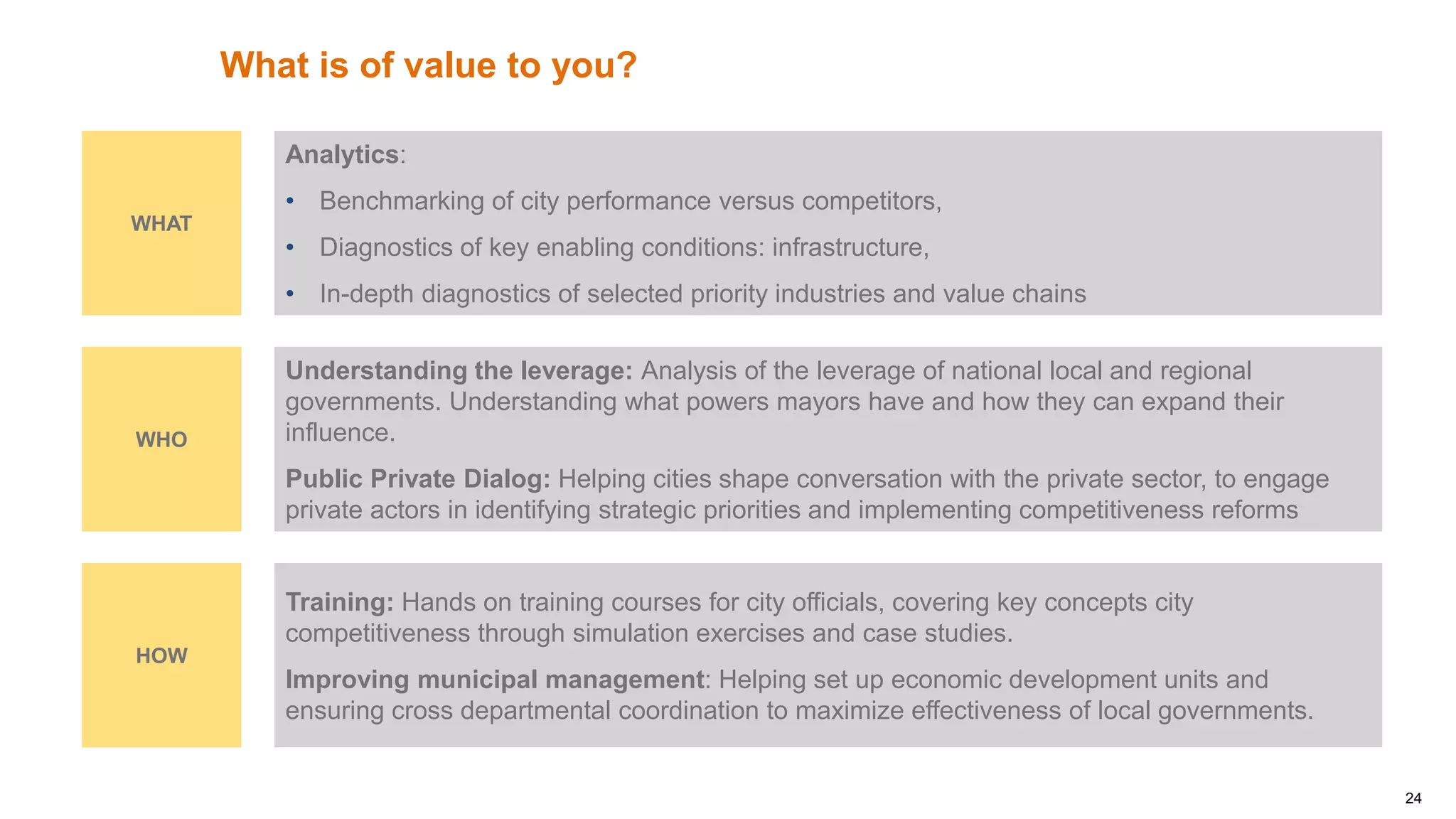
What is of value to you?
WHAT
WHO
HOW
Analytics:
• Benchmarking of city performance versus competitors,
• Diagnostics of key enabling conditions: infrastructure,
• In-depth diagnostics of selected priority industries and value chains
Understanding the leverage: Analysis of the leverage of national local and regional
governments. Understanding what powers mayors have and how they can expand their
influence.
Public Private Dialog: Helping cities shape conversation with the private sector, to engage
private actors in identifying strategic priorities and implementing competitiveness reforms
Training: Hands on training courses for city officials, covering key concepts city
competitiveness through simulation exercises and case studies.
Improving municipal management: Helping set up economic development units and
ensuring cross departmental coordination to maximize effectiveness of local governments.
25
Austin Kilroy & Dmitry Sivaev
Competitive Cities
World Bank Group
akilroy@worldbank.org & dsivaev@worldbank.org
26
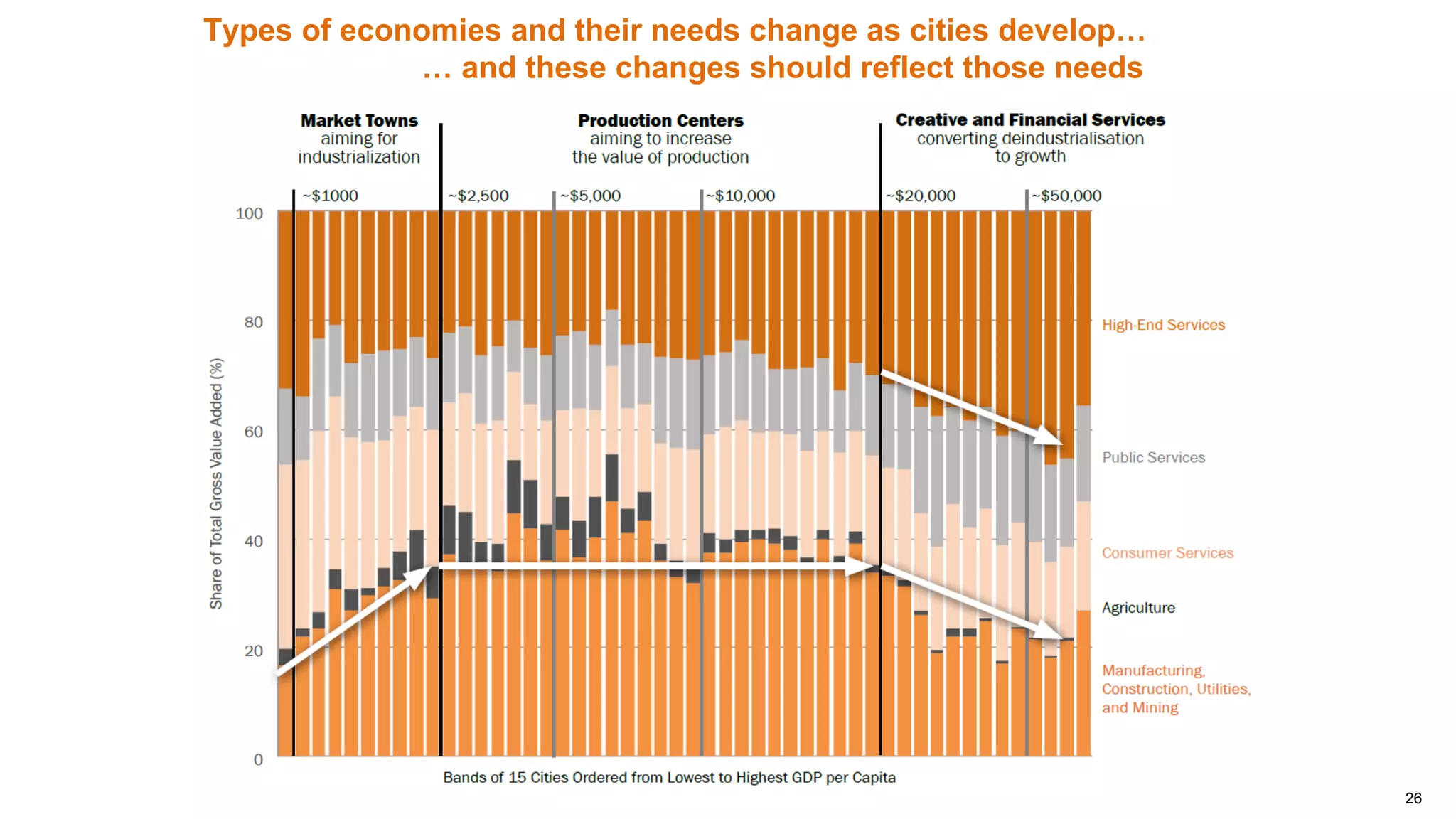
Types of economies and their needs change as cities develop…
… and these changes should reflect those needs

Competitive cities for jobs and growth. What, who and how.

  • 1.
  • 2.
    2 • Will tella story based on evidence of ‘what works’: – Data on 750 cities worldwide; – 6 structured case studies of high- growing cities; – Secondary literature; – Firm-level econometrics; – Lots of conversations. ‘Market systems’ in a city context 2
  • 3.
    3 How have othercities created jobs and growth? What should be the top priorities for my city? How do I get it done?
  • 4.
    4 So we decidedto find a way to answer these questions In-depth lit review and consultations Database of 750 Cities 6 in-depth case studies Econometric analysis in two countries
  • 5.
    5 Any manner ofcity can be competitive Meknes Bucaramanga Coimbatore Gaziantep OnitshaSaltillo New York Tokyo London And while all cities are unique, some principles of promoting competitiveness apply across the board
  • 6.
    6 • And Howdoes it get done? A “COMPETITIVE CITY” facilitates firms and industries to grow jobs, productivity and incomes over time • What do successful cities do? • Who does it? • We are looking at private sector performance • We do not distinguish informal businesses • Data is imperfect • There are no silver bullets and all circumstances are unique
  • 7.
  • 9.
    WHAT WOULD YOUDO…..? • Land is dry and ill-suited for agriculture. • Not a port city; 210km from a port. • Low skilled population. • No high-tech clusters.
  • 10.
  • 11.
    Gaziantep (Turkey), 2014 •Light-manufacturing firms export to 175 countries around the globe. • Exports increased tenfold from $620 million in 2002 to $6.2 billion in 2013. • Ranked #9 globally for economic growth in the decade 1999 to 2009. • Recorded an average of 6.3 percent in annual GDP growth from 2005-2012. • 3.6 percent in annual employment growth.
  • 12.
  • 13.
    13 Combining economy-wide withsector-specific interventions ∆ Firm growth; ∆ Investor attraction; ∆ New start-ups. City wedge
  • 14.
    14 Successful cities combined: a)industry-specific (sector/value chain) interventions, with b) economy-wide interventions. This was not an either/or choice… 14
  • 15.
    Source: Analysis usingOxford Economics city-level data for 750 cities worldwide, 2005-2012 Tradable goods & services drive growth in competitive cities 0 1 2 3 4 5 6 7 Top 10 percent of cities Other 90 percent of cities Tradable goods & services Non-tradable goods & services The reasons: • Expand the local economic pie; • Help increase productivity through competition. Annualemploymentgrowth,2005-2012
  • 16.
  • 17.
    17 Who: The citywedge i. Growth Coalitions: collaboration with stakeholders; ii. Mayor’s Wedge: internal scope and capacity; iii. Intergovernmental relations: external leverage.
  • 18.
  • 19.
    19 3. HOW WILLIT BE DONE
  • 20.
    City economic developmentstrategies in practice “There is a strategy on paper, but it’s not evident to us. What is evident is the various directorates with their own key focus areas– but that’s not a combined strategy.” -- Executive Director of city Chamber of Commerce, South Africa “In the Metro growth strategy there are two and a half pages of priority projects. We need 2-3 focused areas, rather than a wish list.” -- LED professional, South Africa “If you ask people what is their number one priority, they will not say it’s housing; they will not say it’s electricity; they will say give me dignity by giving me a job. Job creation should be our number one driver. If I get a job then everything else falls into place.” — CFO of eThekwini, South Africa “We thought we had a problem with our industrial development strategy, and instead we realized the biggest issues were with our management system.” --Minister of Planning, Central American city
  • 21.
    While few citiesare like Gaziantep, there are more Bucaramanga, Colombia Changsha, China
  • 22.
    These findings applyto all sorts of cities What How Who NEW YORK PITTSBURGH MANCHESTER LONDON BALTIMORE MEXICO CITY
  • 23.
    23 “We tend tokeep people busy, rather than to change people’s lives”— LED professional, South Africa •No magic bullets (ICC? Monument? One-stop shop?)– has to be embedded in a growth strategy. Summing up 4 broad levers to increase competitiveness Focus on comparative advantage: especially tradable sectors Horizontal (city-wide) and vertical (sector specific) interventions What “Economic development oriented” mindset – growth as an overarching goal. Public-private “growth coalitions” Delegation of powers to cities, with the right capacity Keen attention to implementation How Who
  • 24.
    24 What is ofvalue to you? WHAT WHO HOW Analytics: • Benchmarking of city performance versus competitors, • Diagnostics of key enabling conditions: infrastructure, • In-depth diagnostics of selected priority industries and value chains Understanding the leverage: Analysis of the leverage of national local and regional governments. Understanding what powers mayors have and how they can expand their influence. Public Private Dialog: Helping cities shape conversation with the private sector, to engage private actors in identifying strategic priorities and implementing competitiveness reforms Training: Hands on training courses for city officials, covering key concepts city competitiveness through simulation exercises and case studies. Improving municipal management: Helping set up economic development units and ensuring cross departmental coordination to maximize effectiveness of local governments.
  • 25.
    25 Austin Kilroy &Dmitry Sivaev Competitive Cities World Bank Group akilroy@worldbank.org & dsivaev@worldbank.org
  • 26.
    26 Types of economiesand their needs change as cities develop… … and these changes should reflect those needs