TOPIC - KINDS OF STATUTE
SUBMITTED TO- SUBMITTED BY-
PROF. NEERAJ TRIVEDI KHYATI TONGIA
BBA. LLB, VI SEM
GOVERNMENT NEW LAW COLLEGE, INDORE
INTERPRETATION OF STATUTES
ASSIGNMENT I
INTRODUCTION –
WHAT IS A STATUTE?
According to Black's law dictionary, "A Statute is a formal written enactment of
Legislative authority that governs a country, state, city or county. The word is
often used to distinguish law made by legislative bodies from the judicial
decisions of the common law and the regulations used by government
agencies".
The Indian Constitution does not use the term "Statute" but it uses the term
"law“ which includes any Ordinance, order, bye-law, rule, regulation,
notification, custom or usage having in the territory of India the force of law.
[Article 13(3)(a)of the Constitution of India]
It may have the following Particulars - Short title, Long Title, Preamble,
Marginal notes, Headings of a group of sections or individual sections,
Definition of interpretation clauses, Provisions, Illustrations, Exceptions and
saving clauses, Explanations, Schedules, Punctuation.
KINDS OF STATUTES
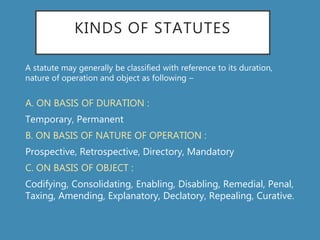
A statute may generally be classified with reference to its duration,
nature of operation and object as following –
A. ON BASIS OF DURATION :
Temporary, Permanent
B. ON BASIS OF NATURE OF OPERATION :
Prospective, Retrospective, Directory, Mandatory
C. ON BASIS OF OBJECT :
Codifying, Consolidating, Enabling, Disabling, Remedial, Penal,
Taxing, Amending, Explanatory, Declatory, Repealing, Curative.
A. ON BASIS OF DURATION
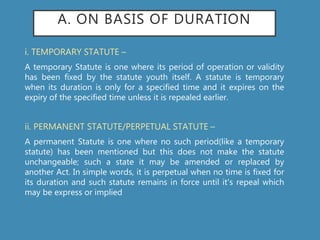
i. TEMPORARY STATUTE –
A temporary Statute is one where its period of operation or validity
has been fixed by the statute youth itself. A statute is temporary
when its duration is only for a specified time and it expires on the
expiry of the specified time unless it is repealed earlier.
ii. PERMANENT STATUTE/PERPETUAL STATUTE –
A permanent Statute is one where no such period(like a temporary
statute) has been mentioned but this does not make the statute
unchangeable; such a state it may be amended or replaced by
another Act. In simple words, it is perpetual when no time is fixed for
its duration and such statute remains in force until it's repeal which
may be express or implied
B. ON BASIS OF NATURE OF
OPERATION
i. PROSPECTIVE STATUTES –
A Statute which operates upon act and transactions which will take place after
statute takes effect. Not applicable on acts that occurred before statute coming
in effect.
ii. RETROSPECTIVE STATUTES –
Every Statute takes away or impairs vested rights acquired under the existing
laws or creates new obligations into a new duty or attaches new disability in
respect of transactions or considerations already passed are deemed
retrospective or retroactive statutes.
iii. DIRECTORY STATUTES –
Directory statutes merely direct or permits anything to be done without
compelling its performance. It is generally affirmative in its terms recommends a
certain act or omissions, but it does not impose the penalty on non-observance
of its provisions.
iv. MANDATORY STATUTES –
Mandatory Statutes is one which compels performance of certain things or
compels that a certain thing must be done in a certain manner or form.
C. ON BASIS OF OBJECT
i. CODIFYING STATUTE –
A Codifying Statute is one which Codifies the law. The purpose is to present
an orderly and authoritative Statement of the leading rule of law on a given
subject whether those rules are to be found in statute law or common law.
ii. CONSOLIDATING STATUTE –
Consolidating statute is one which consolidates the law on a particular
subject at one place; it collects all statutory enactments on a specific
subject and gives them the shape of one statute with minor amendments if
necessary.
iii. DECLARATORY STATUTE –
This kind of statute does an act of removing doubts, clarifying and
improving the law based on the interpretation given by the court, which
might not be suitable from the point of view of the parliament. For
example- the definition of house property has been amended under the
Income Tax (Amendment) Act, 1985 through the judgement of the supreme
court.
iv. REMEDIAL STATUTES –
Granting of new remedies for enforcing one’s rights can be done through
the remedial statutes. The purpose is to promote the general welfare for
bringing social reforms through the system. These statutes have liberal
interpretation and not strict. For example- The Maternity Benefits Act, 1961,
The Workmen’s Compensation Act, 1923 etc.
v. ENABLING STATUTES-
The purpose of this statute is to enlarge a particular common law. For
example- Land Acquisition Act enables the government to acquire the
public property for the purpose of the public, which is otherwise not
permissible.
vi. DISABLING STATUTES-
It is the opposite of what is provided under the enabling statute. Here the
rights conferred by common law are being cut down and are being
restrained.
vii. TAXING STATUTES –
Tax is a form of revenue which is to be paid to the government. It can
either be on income that an individual earns or on any other transaction.
A taxing statute thus, levies taxes on all such transactions. There can be
income tax, wealth tax, sales tax, gift tax, etc. Therefore, a tax can be
levied only when it has been specifically expressed and provided by any
statute
viii. PENAL STATUTES -
The offences for various types of offences are provided through these
statutes, and these provisions have to be imposed strictly. For example-
Indian Penal Code, 1860.
ix. EXPLANATORY STATUTES –
The term explanatory itself indicates that this type of statute explains the
law and rectifies any omission left earlier in the enactment of the statutes.
Further, ambiguities in the text are also clarified and checked upon the
previous statutes.
x. AMENDING STATUTES –
The statutes which operate to make changes in the provisions of the
enactment to change the original law for making an improvement
therein and for carrying out the provisions effectively for which the
original law was passed are referred to as amending statutes. For
example- Code of Criminal Procedure 1973, amended the code of 1898.
xi. REPEALING STATUTES –
A repealing statute is one which terminates an earlier statute and may
be done in the express or explicit language of the statute. For example-
Competition Act, 2002 repealed the MRTP Act.
xii. CURATIVE STATUTES –
Through these statutes, certain acts which would otherwise be illegal are
validated by curing the illegality and enables a particular line of action.
THANK YOU!
- KHYATI TONGIA