IS IT FUTURE OF TRAINING AND DEVELOPMENT Competency framework
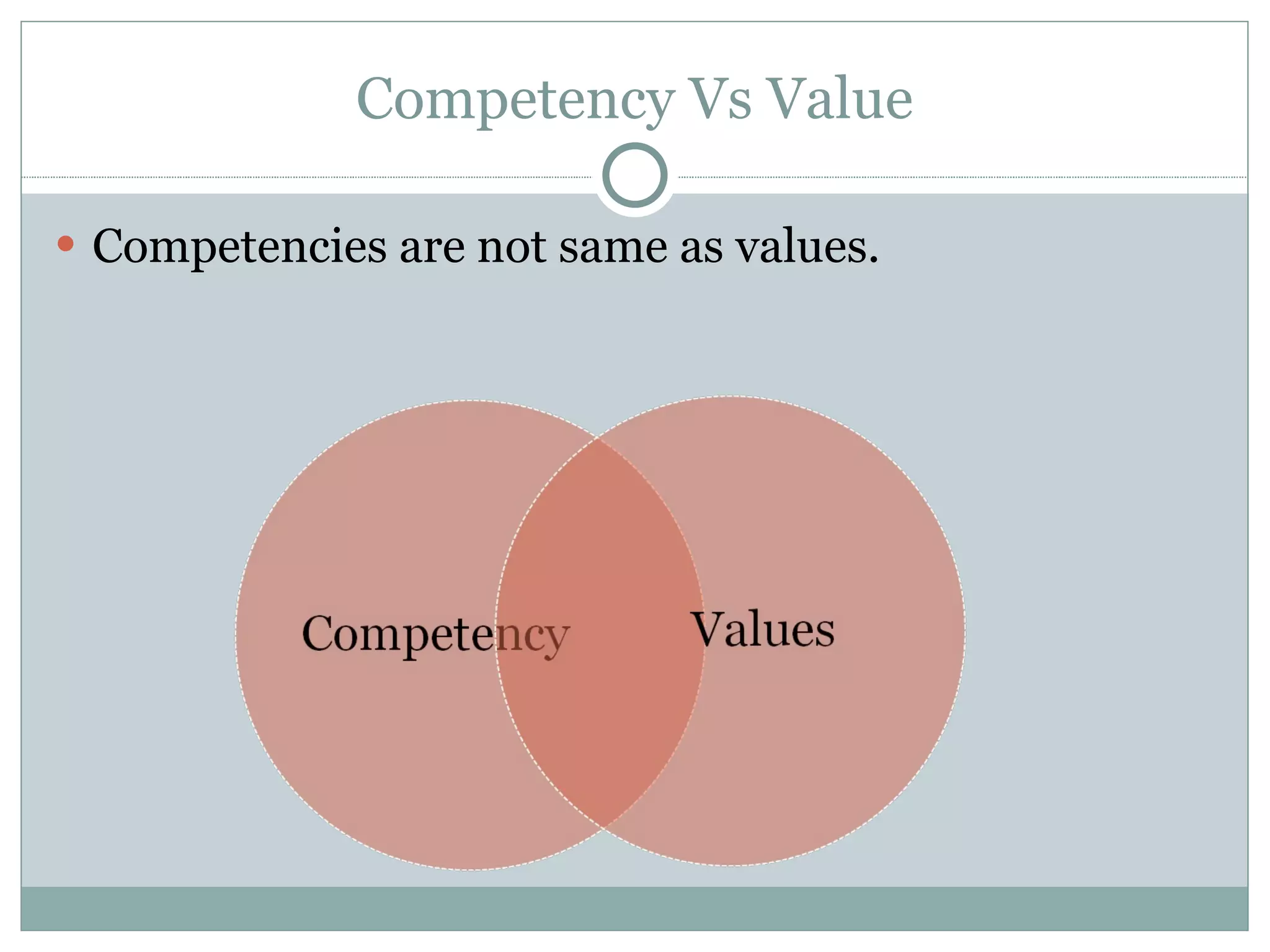
Competency Vs Value Competencies are not same as values.
Organisational Values “ Values” are enduring convictions that shape are action and influence our choices  Organisational values represent collective sense of what is good for the organization.
Values classified
Competency-defined
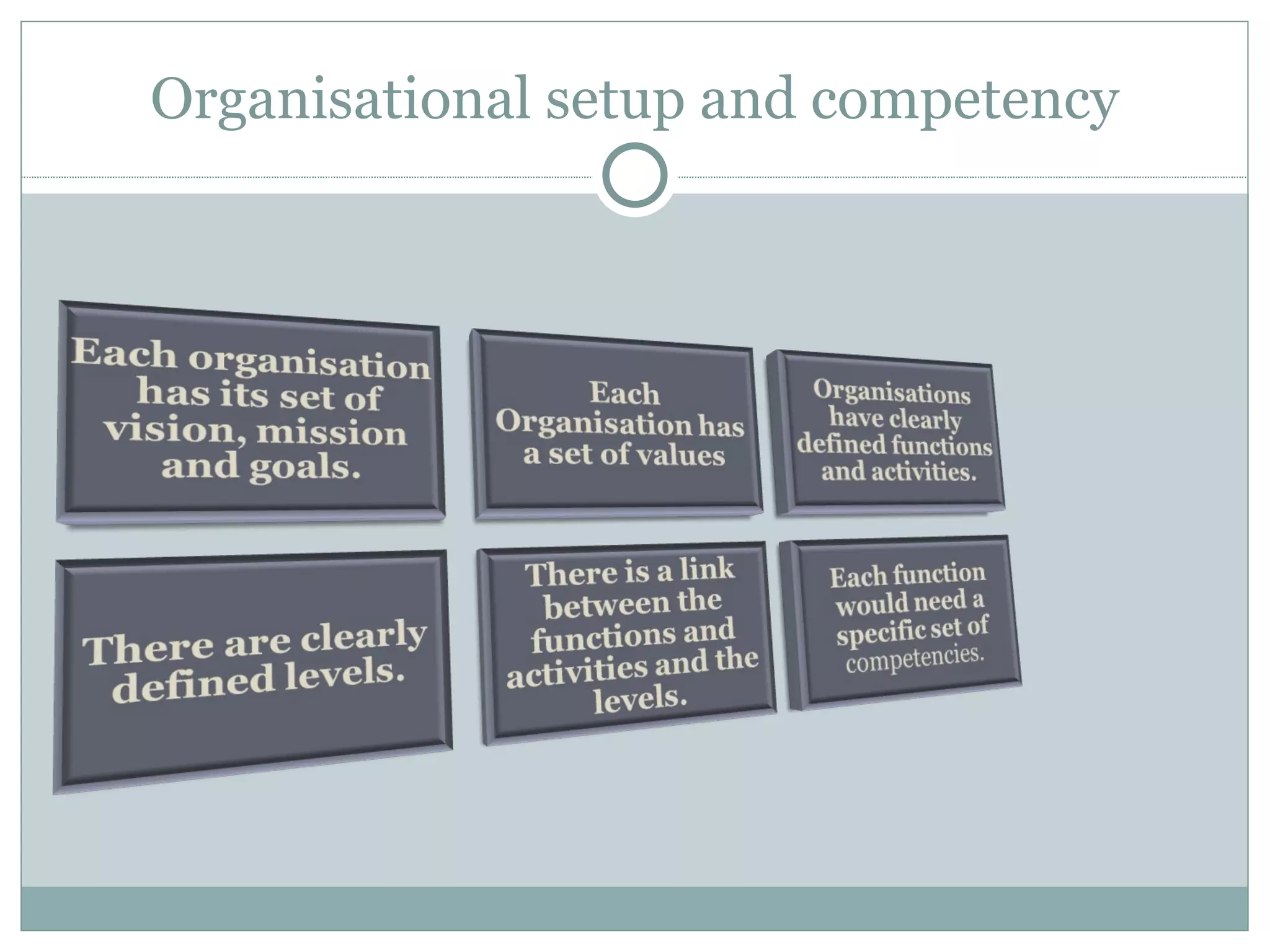
Organisational setup and competency
Thrust of competency based model The salient features of competency based model:- every job should be held by a person competent to hold that job and all employees should have an opportunity to upgrade their competency to the level expected for a given job.
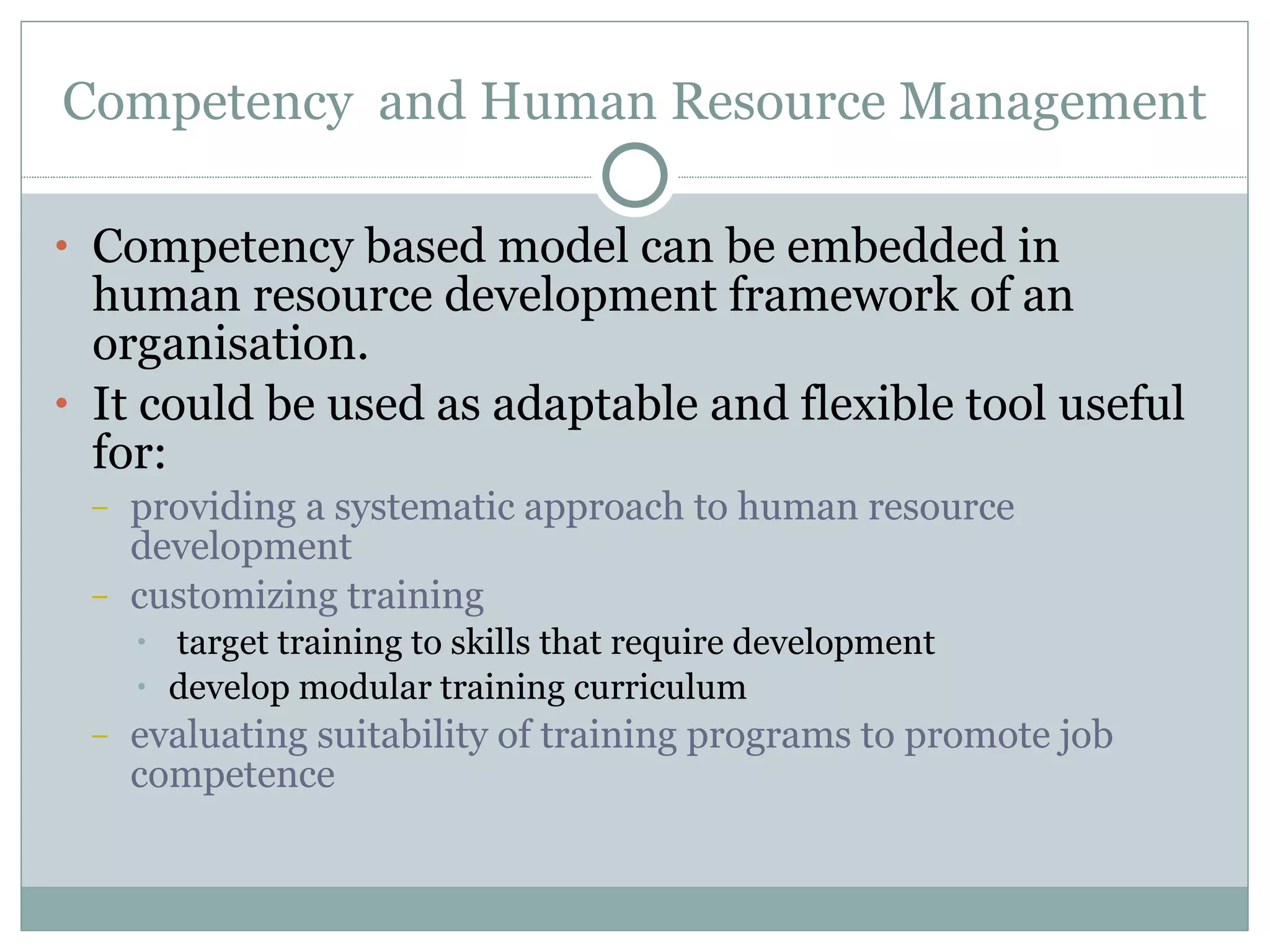
Competency  and Human Resource Management Competency based model can be embedded in human resource development framework of an organisation. It could be used as adaptable and flexible tool useful for: providing a systematic approach to human resource development  customizing training target training to skills that require development  develop modular training curriculum evaluating suitability of training programs to promote job competence
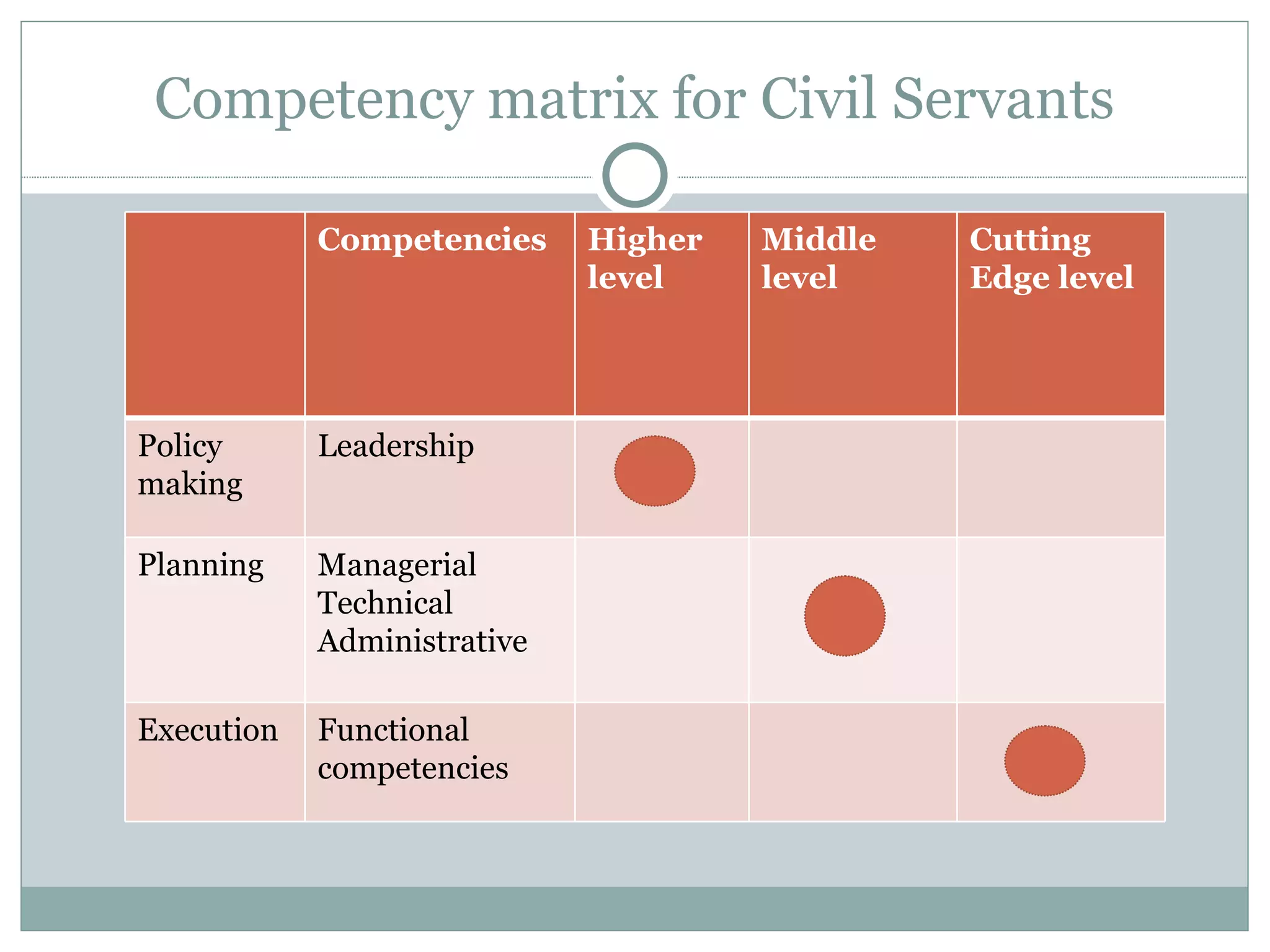
Competency matrix for Civil Servants Competencies  Higher level Middle level Cutting Edge level Policy making Leadership Planning  Managerial Technical Administrative Execution Functional competencies
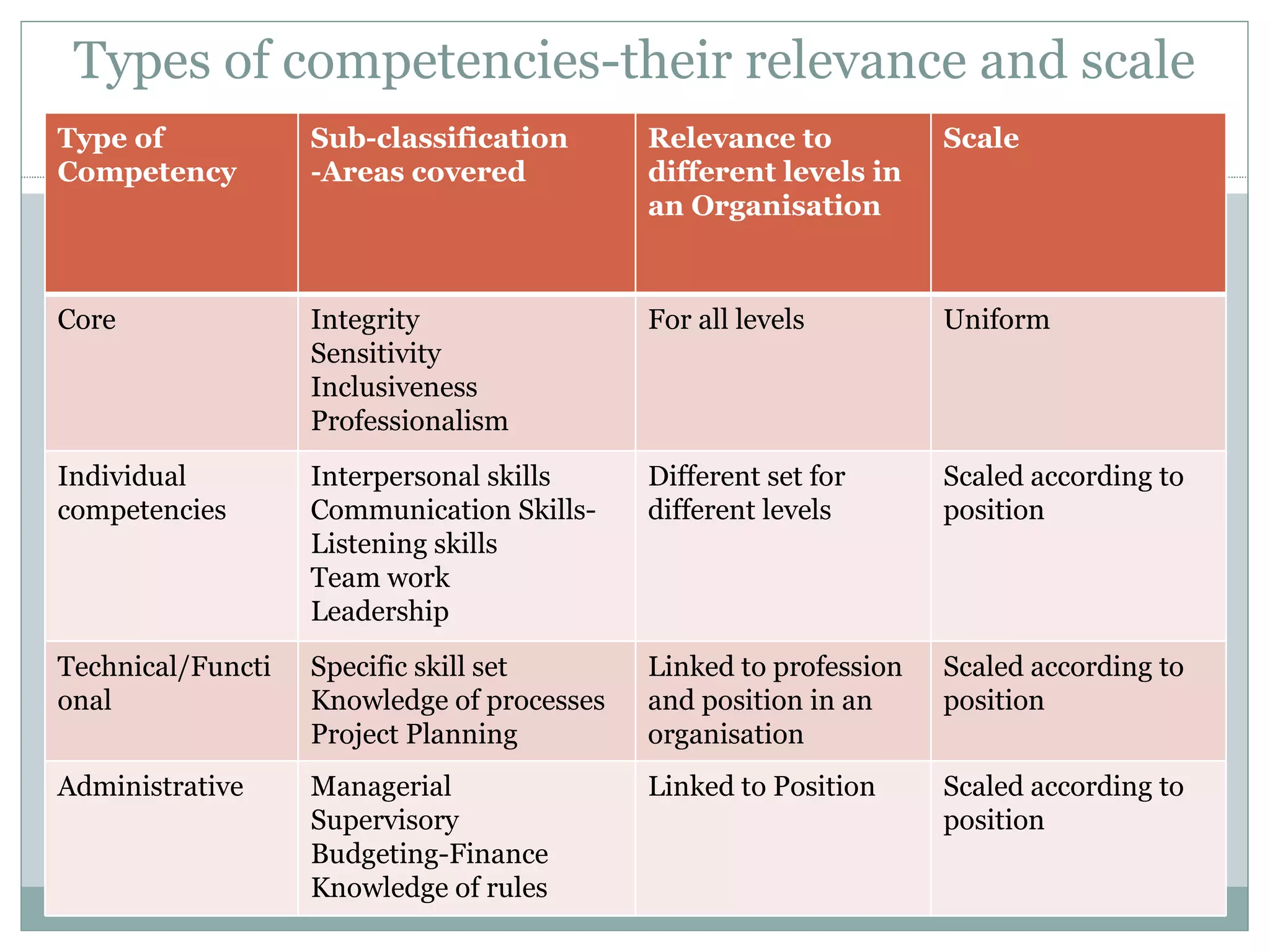
Types of competencies-their relevance and scale Type of Competency Sub-classification -Areas covered Relevance to different levels in an Organisation Scale Core Integrity Sensitivity Inclusiveness Professionalism For all levels Uniform Individual competencies Interpersonal skills Communication Skills-Listening skills Team work Leadership Different set for different levels Scaled according to position  Technical/Functional Specific skill set Knowledge of processes Project Planning Linked to profession and position in an organisation Scaled according to position  Administrative Managerial Supervisory  Budgeting-Finance Knowledge of rules Linked to Position Scaled according to position
Constructive tooling Competency framework should be used more in a constructive rather than a restrictive way.  It should be seen more as an enabling provision rather than a qualifying benchmark. It should be flexible and scalable tool useful for providing a systematic approach for human resource development.
Competency Framework in Government:Challenges Unlike private sector which is more homogenous and less stratified, government systems are more  complex,  heterogeneous  and stratified with many horizontal divisions and multiple vertical layers  Government systems entail variety of expertise, competencies and responsibilities. Further, movement across horizontal divisions is quite fast with uncertain timeframes. This calls for customized techniques of competency framework.
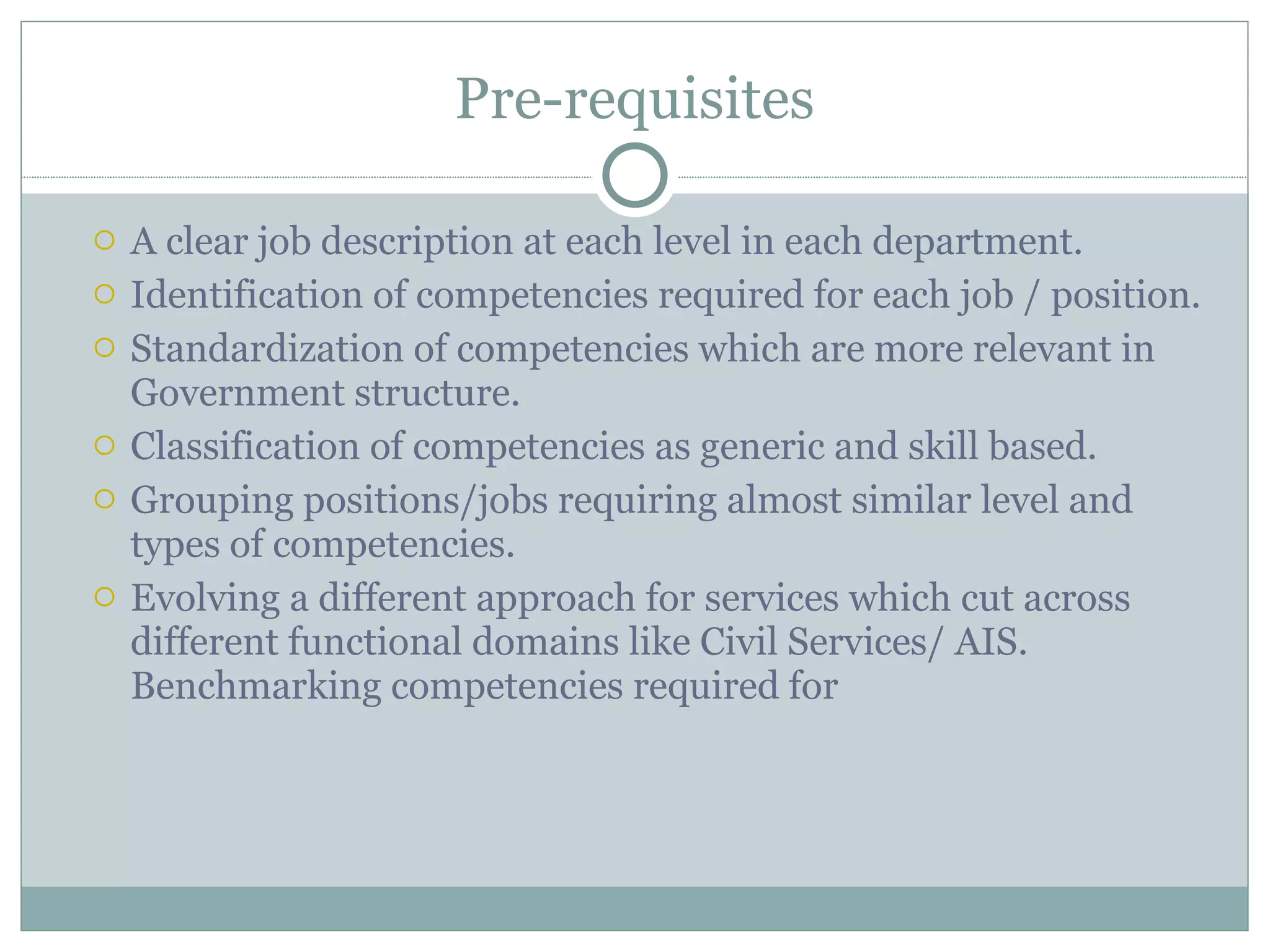
Pre-requisites A clear job description at each level in each department. Identification of competencies required for each job / position. Standardization of competencies which are more relevant in Government structure. Classification of competencies as generic and skill based. Grouping positions/jobs requiring almost similar level and types of competencies. Evolving a different approach for services which cut across different functional domains like Civil Services/ AIS. Benchmarking competencies required for
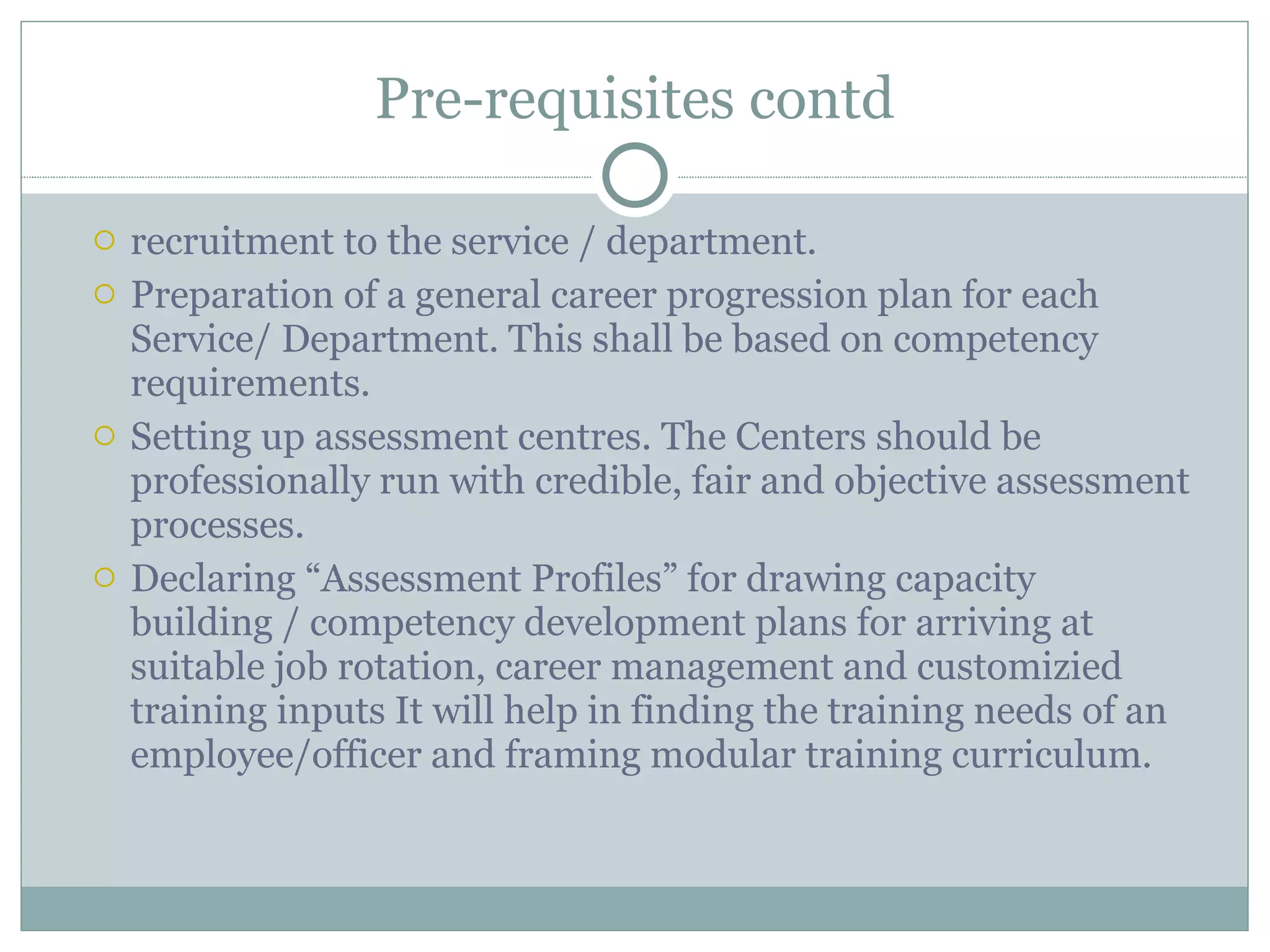
Pre-requisites contd recruitment to the service / department. Preparation of a general career progression plan for each Service/ Department. This shall be based on competency requirements. Setting up assessment centres. The Centers should be professionally run with credible, fair and objective assessment processes. Declaring “Assessment Profiles” for drawing capacity building / competency development plans for arriving at suitable job rotation, career management and customizied training inputs It will help in finding the training needs of an employee/officer and framing modular training curriculum.
Essentials Mutual understanding between the employee and the employer.  Requires a high degree of dialogue and trust between the employer and employee  Greater understanding of job expectations.
Benefits Promotes objectivity and Transparency and common understanding of job expectations. Identifies skill gaps and training needs. Greater employer and employee satisfaction. Better service delivery and higher citizen satisfaction.
Bottlenecks Difficulties in clear job description with specific functions. Absence of standards/benchmarks Absence of measurement tools for finding competency gaps. Credibility of assessment Centres. Large numbers  Interdepartmental postings. Training not available on demand
Sample Competency framework
  Range of competency required   Within acceptable range   Outside acceptable range   JOB-1 Parameter Scale Integrity/work ethics  1 2 3 4 5 6 7 8 9 10 Development of Others 1 2 3 4 5 6 7 8 9 10 Output 1 2 3 4 5 6 7 8 9 10 Commitment 1 2 3 4 5 6 7 8 9 10 Office Management 1 2 3 4 5 6 7 8 9 10 Leadership 1 2 3 4 5 6 7 8 9 10 Adaptability 1 2 3 4 5 6 7 8 9 10 Team spirit 1 2 3 4 5 6 7 8 9 10 Relationship 1 2 3 4 5 6 7 8 9 10 Sensitivity 1 2 3 4 5 6 7 8 9 10 JOB-2 Parameter Scale Integrity/work ethics  1 2 3 4 5 6 7 8 9 10 Development of Others 1 2 3 4 5 6 7 8 9 10 Output 1 2 3 4 5 6 7 8 9 10 Commitment 1 2 3 4 5 6 7 8 9 10 Office Management 1 2 3 4 5 6 7 8 9 10 Leadership 1 2 3 4 5 6 7 8 9 10 Adaptability 1 2 3 4 5 6 7 8 9 10 Team spirit 1 2 3 4 5 6 7 8 9 10 Relationship 1 2 3 4 5 6 7 8 9 10 Sensitivity 1 2 3 4 5 6 7 8 9 10
Bottlenecks Thanks

Competency based approach in Human Resources

  • 1.
    IS IT FUTUREOF TRAINING AND DEVELOPMENT Competency framework
  • 2.
    Competency Vs ValueCompetencies are not same as values.
  • 3.
    Organisational Values “Values” are enduring convictions that shape are action and influence our choices Organisational values represent collective sense of what is good for the organization.
  • 4.
  • 5.
  • 6.
  • 7.
    Thrust of competencybased model The salient features of competency based model:- every job should be held by a person competent to hold that job and all employees should have an opportunity to upgrade their competency to the level expected for a given job.
  • 8.
    Competency andHuman Resource Management Competency based model can be embedded in human resource development framework of an organisation. It could be used as adaptable and flexible tool useful for: providing a systematic approach to human resource development customizing training target training to skills that require development develop modular training curriculum evaluating suitability of training programs to promote job competence
  • 9.
    Competency matrix forCivil Servants Competencies Higher level Middle level Cutting Edge level Policy making Leadership Planning Managerial Technical Administrative Execution Functional competencies
  • 10.
    Types of competencies-theirrelevance and scale Type of Competency Sub-classification -Areas covered Relevance to different levels in an Organisation Scale Core Integrity Sensitivity Inclusiveness Professionalism For all levels Uniform Individual competencies Interpersonal skills Communication Skills-Listening skills Team work Leadership Different set for different levels Scaled according to position Technical/Functional Specific skill set Knowledge of processes Project Planning Linked to profession and position in an organisation Scaled according to position Administrative Managerial Supervisory Budgeting-Finance Knowledge of rules Linked to Position Scaled according to position
  • 11.
    Constructive tooling Competencyframework should be used more in a constructive rather than a restrictive way. It should be seen more as an enabling provision rather than a qualifying benchmark. It should be flexible and scalable tool useful for providing a systematic approach for human resource development.
  • 12.
    Competency Framework inGovernment:Challenges Unlike private sector which is more homogenous and less stratified, government systems are more complex, heterogeneous and stratified with many horizontal divisions and multiple vertical layers Government systems entail variety of expertise, competencies and responsibilities. Further, movement across horizontal divisions is quite fast with uncertain timeframes. This calls for customized techniques of competency framework.
  • 13.
    Pre-requisites A clearjob description at each level in each department. Identification of competencies required for each job / position. Standardization of competencies which are more relevant in Government structure. Classification of competencies as generic and skill based. Grouping positions/jobs requiring almost similar level and types of competencies. Evolving a different approach for services which cut across different functional domains like Civil Services/ AIS. Benchmarking competencies required for
  • 14.
    Pre-requisites contd recruitmentto the service / department. Preparation of a general career progression plan for each Service/ Department. This shall be based on competency requirements. Setting up assessment centres. The Centers should be professionally run with credible, fair and objective assessment processes. Declaring “Assessment Profiles” for drawing capacity building / competency development plans for arriving at suitable job rotation, career management and customizied training inputs It will help in finding the training needs of an employee/officer and framing modular training curriculum.
  • 15.
    Essentials Mutual understandingbetween the employee and the employer. Requires a high degree of dialogue and trust between the employer and employee Greater understanding of job expectations.
  • 16.
    Benefits Promotes objectivityand Transparency and common understanding of job expectations. Identifies skill gaps and training needs. Greater employer and employee satisfaction. Better service delivery and higher citizen satisfaction.
  • 17.
    Bottlenecks Difficulties inclear job description with specific functions. Absence of standards/benchmarks Absence of measurement tools for finding competency gaps. Credibility of assessment Centres. Large numbers Interdepartmental postings. Training not available on demand
  • 18.
  • 19.
      Range ofcompetency required   Within acceptable range   Outside acceptable range   JOB-1 Parameter Scale Integrity/work ethics 1 2 3 4 5 6 7 8 9 10 Development of Others 1 2 3 4 5 6 7 8 9 10 Output 1 2 3 4 5 6 7 8 9 10 Commitment 1 2 3 4 5 6 7 8 9 10 Office Management 1 2 3 4 5 6 7 8 9 10 Leadership 1 2 3 4 5 6 7 8 9 10 Adaptability 1 2 3 4 5 6 7 8 9 10 Team spirit 1 2 3 4 5 6 7 8 9 10 Relationship 1 2 3 4 5 6 7 8 9 10 Sensitivity 1 2 3 4 5 6 7 8 9 10 JOB-2 Parameter Scale Integrity/work ethics 1 2 3 4 5 6 7 8 9 10 Development of Others 1 2 3 4 5 6 7 8 9 10 Output 1 2 3 4 5 6 7 8 9 10 Commitment 1 2 3 4 5 6 7 8 9 10 Office Management 1 2 3 4 5 6 7 8 9 10 Leadership 1 2 3 4 5 6 7 8 9 10 Adaptability 1 2 3 4 5 6 7 8 9 10 Team spirit 1 2 3 4 5 6 7 8 9 10 Relationship 1 2 3 4 5 6 7 8 9 10 Sensitivity 1 2 3 4 5 6 7 8 9 10
  • 20.