Competency and the Learning
Organization
(Donald Shandler)
By Muhammad Kashif Din
Book Review
Book Background
 Objective : This Book is written with the objective of guiding the
readers through the process of identifying the core competencies
of any organizations and learning programs that will achieve set
business objectives. Competency Based Learning (CBL) is used by
many companies to drive organizational performance.
 About the Author : Donald Shandler is president of Shandler
Associates, a consulting firm specializing in the development of
managers, leaders, and professionals. He also is an adjunct
professor at the University of Maryland University College where
he teaches the MBA course Managing People and Groups in a
Global Workplace.
 Publisher : Viva Books Private Ltd. New Delhi India
Structure of Book
 This Book is designed in such a way that you not only learn the process of
implementing the process of CBL but also the basics of the CBL. Also there are
case studies in all the parts of this book.
 Introduction to CBL
 Core Competency; Competency Based Learning (CBL)
 Difference between Competency Based Learning (CBL) and Competency Based
Training (CBT)
 How CBL leads to Competency Based Performance
 Process of implementing CBL is based in four parts in this book that includes:
 Build Foundation for CBL in an Organization
 Design a CBL Program
 Implement Competency based Program
 Evaluate and measure competency based Programs
Competency Based Learning Importance
 Competency Based Learning (CBL) model is important as it
influence various aspects of any organization including:
 Training and development of Employees;
 Recruiting and staffing;
 Compensation and benefits;
 Leadership and executive development
 Human resources; and
 Organizational development
Introduction
 Competency A Cluster of related knowledge, skills, and attributes that affects
a major part of one’s job (a role or responsibility), that correlates with
performance on the job. Performance is also measurable against well accepted
standards. Competencies can be improved through training and development.
 Core Competency for an Individual – One Competency that is essential for an
individual’s success for a given job at a specific level within organization
 Core Competency for an Organization – the activities that define the
organization's competitive advantage in the economy
 Difference between CBL and CBT – Long term versus Short Term, For Future
requirement vs. Current requirement, Learning to Learn vs. skills acquisition
Introduction….
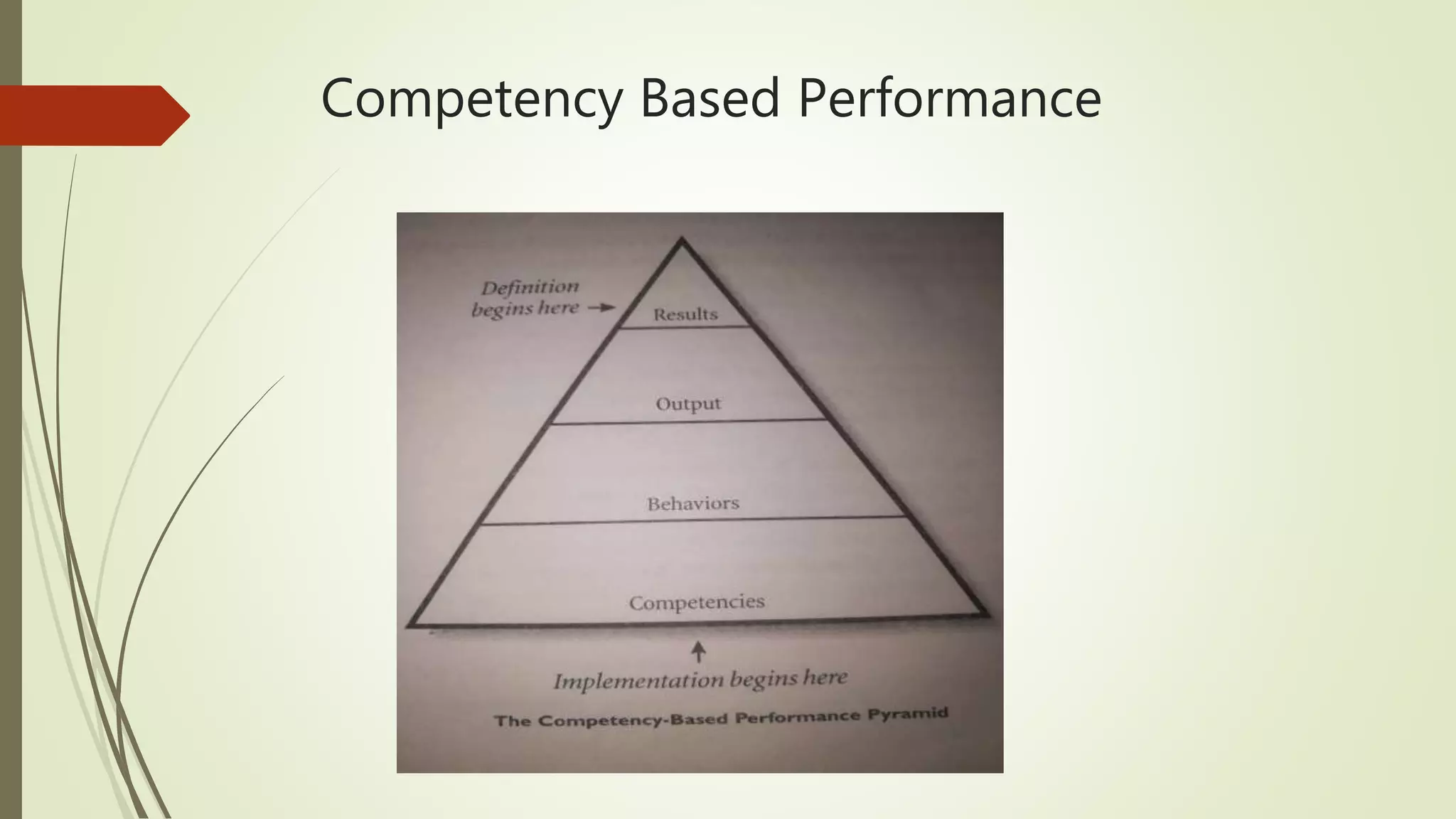
 How it works: CBL results in competency based performance
through the simple and practical application of four steps:
1. Individual and organizations posses and acquire competencies;
2. They apply these competencies in form of behaviors;
3. Their behaviors produce output;
4. How this is done yield results;
 Development of CBL Program begins at step four and
reversely leads to step one.
Competency Based Performance
Success Stories (Examples)
EASTMAN KODAK
HON COMPANY
NATIONAL RETAIL FEDERATION
SEARS UNIVERSITYMYER GRACE BROS.
Benefits of implementing CBL Programs
 Organization becomes Learning Organization and reaps benefits both in short
and long run.
 Threefold Benefits include:
 Organizations benefits by linking strategies with competencies.
 Adult Learners Profits by integrated opportunity to learn as part of work.
 Society as a whole learns as organization does and that ultimately leads to vision of
nation for Continuous Learning.
 Hence, All three Foundations of any Nation can benefit from CBL:
 Individual
 Organization
 Society
PROCESS OF IMPLEMENTING CBL
 Process of implementing Competency Based Learning (CBL) consists of four
steps:
 Building foundation for CBL in your organization
 Design a CBL Program
 Implement CBL Program
 Evaluate and measure CBL Program
Now we shall move one by one in this Process
BUILD FOUNDATION FOR
CBL PROGRAM
Systematic Approach to Organization
Learning (Building Foundation)
 A Systematic Process to Organizational Learning Provides the cornerstone
for building foundation for CBL Program. It Consists of two Steps:
1. Analyze needs of your Organization –
i. How Critical is the need to align performance improvement with strategy of the
Organization
ii. Identify Return on Investment and alternatives to organizationally sponsored
performance improvement opportunities
2. Build a Competency Model – (Models can be made on your own or they can
be Customized Models Designed by Others)
i. Identify / Define Core Competencies for Each Employee Level
ii. Construct one or two models based on those core competencies
Design a CBL Plan
Before Designing a CBL Program
(Assumptions)
Every CBL Model is based on following four
Assumptions:
1. Adults have a need to know why they should learn
something
2. Adults have a deep need to be self directing
3. Adults have a greater volume and different quality of
experience than youth
4. Adults only become interest in learning when they find a
situation that demands new knowledge
Meeting the Needs of Adult Learners
 Adults bring into learning a rich set of experiences, the design of CBL must
acknowledge this rich experience. Thus CBL Strategies must meet
following criteria:
 Strategies must emphasize competencies, their relation to job goals, and
ultimately relationship of competencies and job goals to organizational goals
 Strategies must involve learners and make learners responsible for
achievements
 Strategies must stimulate work conditions
 Strategies must enable employees to see how learning applies to job
Integrated Competency Based Learning
(CBL) Program
 Integrated CBL Programs settle down adult learners and create relationship
between Theory and practice of the process. Further Integrated CBL Programs
can direct learners to acquire appropriate competencies for development in
organization (Vertical Competency Development) or understand other Job
functions on same Job Level (Horizontal Competency Development)
 Horizontal Competency Development – Focuses on class of jobs on same Level of
organization
 Vertical Competency Development – Focuses on Jobs that bridge two or more levels of
jobs
Recommendations for Integrated CBL
Program
 Integrated CBL ensures that training is linked to the strategic needs of
the business. Following four recommendations can help organization
increase chances of an integrated CBL:
 Integrate and develop Critical Job Competencies;
 Select appropriate level of subject matter;
 Emphasize a cross-organization performance improvement effort;
 Enhance learner achievement of the job output with high quality level.
 Such a CBL Program can become center piece of an Organization
business strategy
Assessing the Scope of Integrated CBL
Program
 Scope of the curriculum development project is an important element to consider
when determining whether to design your own program or use other partner.
Defining scope of the project requires important areas to be identified. These
include:
 Specified Jobs for inclusion in program and the relationship among different jobs;
 Availability of delivery system and their appropriateness;
 Current performance opportunities and their relation to current Plan;
 Number and Location of targeted Employees;
 Available Resources including staffing, equipment, facilities, training technologies;
 Budget and staff available
Continue…..
 Targeted Competencies strategies adopted;
 CBL Program to be customized internally, Contracted or Purchased;
 Level of Competency required;
 Pre-intervention Assessment Profiles availability;
 Pre-required competencies from employees;
 Sequence of CBL Program available;
 CBL Program Scope will help achieve objectives of Integrated CBL
development. It will answer question whether to use inhouse CBL
Program, Partner with outsider or Use off the shelf CBL Program.
Implementing Successful
Competency Based Learning
Program
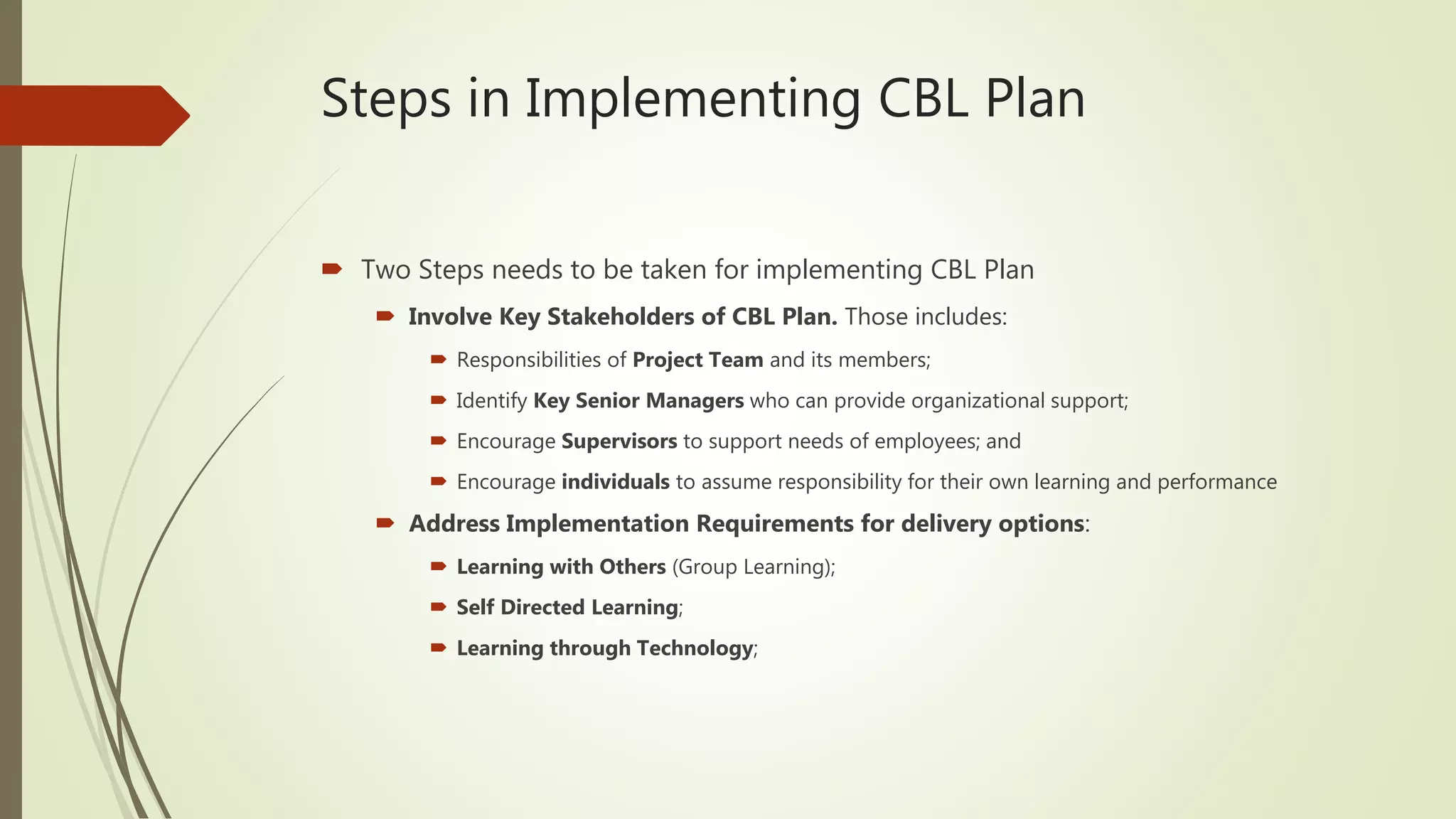
Steps in Implementing CBL Plan
 Two Steps needs to be taken for implementing CBL Plan
 Involve Key Stakeholders of CBL Plan. Those includes:
 Responsibilities of Project Team and its members;
 Identify Key Senior Managers who can provide organizational support;
 Encourage Supervisors to support needs of employees; and
 Encourage individuals to assume responsibility for their own learning and performance
 Address Implementation Requirements for delivery options:
 Learning with Others (Group Learning);
 Self Directed Learning;
 Learning through Technology;
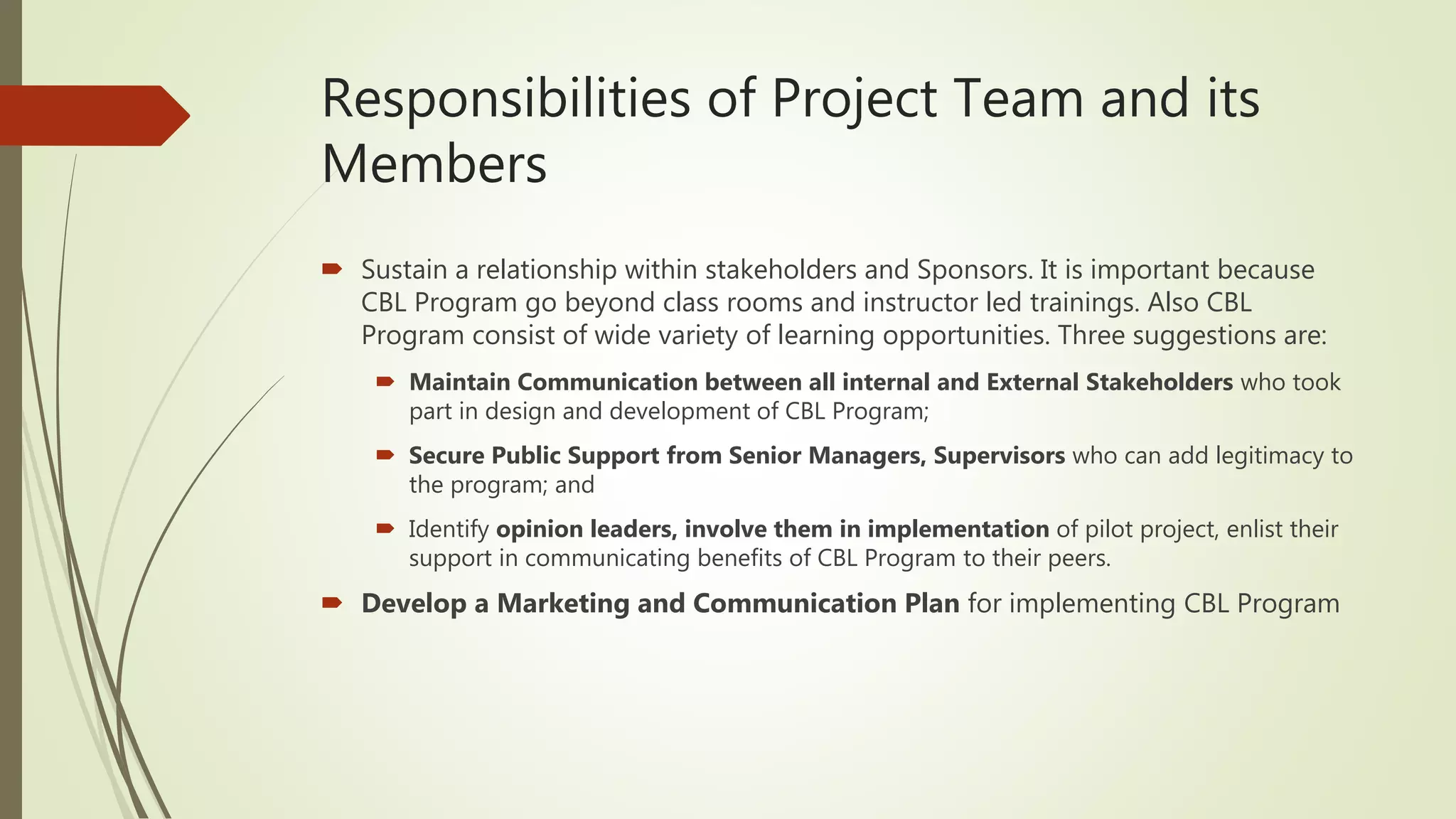
Responsibilities of Project Team and its
Members
 Sustain a relationship within stakeholders and Sponsors. It is important because
CBL Program go beyond class rooms and instructor led trainings. Also CBL
Program consist of wide variety of learning opportunities. Three suggestions are:
 Maintain Communication between all internal and External Stakeholders who took
part in design and development of CBL Program;
 Secure Public Support from Senior Managers, Supervisors who can add legitimacy to
the program; and
 Identify opinion leaders, involve them in implementation of pilot project, enlist their
support in communicating benefits of CBL Program to their peers.
 Develop a Marketing and Communication Plan for implementing CBL Program
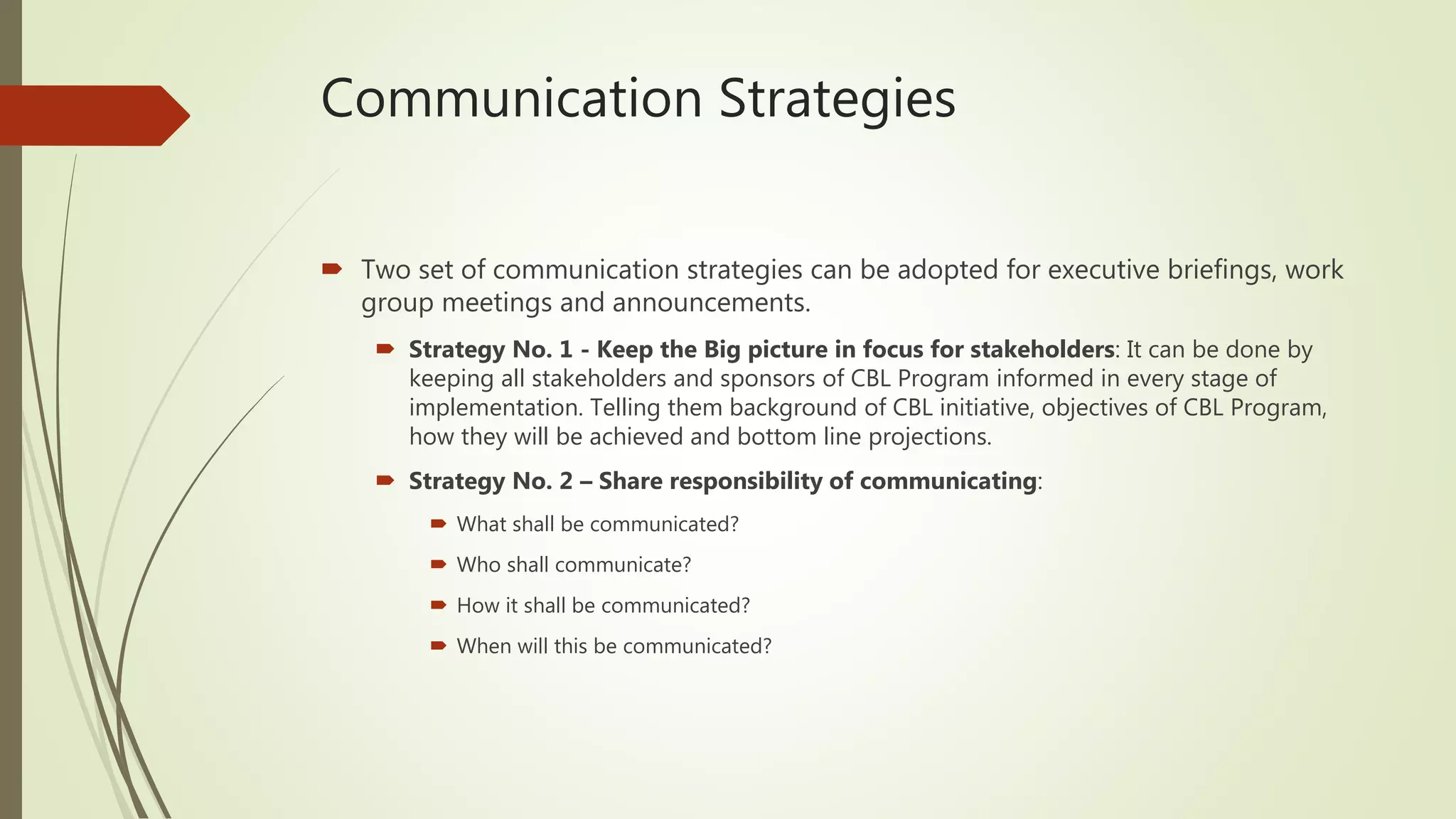
Communication Strategies
 Two set of communication strategies can be adopted for executive briefings, work
group meetings and announcements.
 Strategy No. 1 - Keep the Big picture in focus for stakeholders: It can be done by
keeping all stakeholders and sponsors of CBL Program informed in every stage of
implementation. Telling them background of CBL initiative, objectives of CBL Program,
how they will be achieved and bottom line projections.
 Strategy No. 2 – Share responsibility of communicating:
 What shall be communicated?
 Who shall communicate?
 How it shall be communicated?
 When will this be communicated?
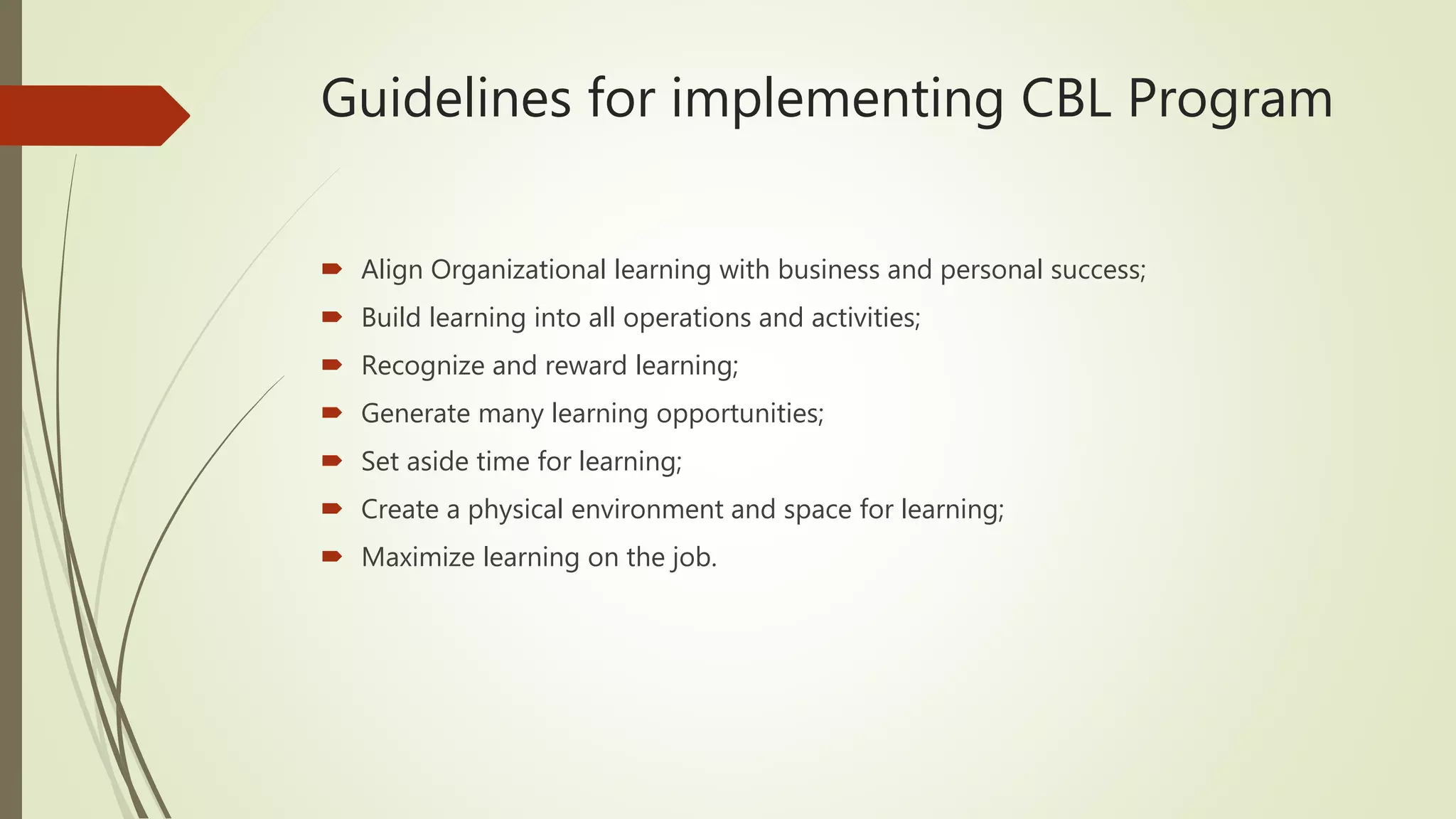
Guidelines for implementing CBL Program
 Align Organizational learning with business and personal success;
 Build learning into all operations and activities;
 Recognize and reward learning;
 Generate many learning opportunities;
 Set aside time for learning;
 Create a physical environment and space for learning;
 Maximize learning on the job.
Critical Role of Supervisor
 CBL Program implementation is a team effort. Starting from Top management to
Project Team and other stakeholders for designing and developing CBL Program.
Unless the supervisor supports the initiative of CBL Program implementation,
the results will be disappointing. Five key contributions of supervisors are:
 Help align individuals goals of learning and performance with business goals;
 Discuss learning and performance expectations before, during and after CBL event;
 Provide learners ample time (within day working time) to complete their self-directed
and group learning goals;
 Use structured methods of learning and performance enhancement for mentoring and
coaching; and
 Assist employees in integrating their learning with workplace, performance driven
application.
Delivery Options for CBL Program
 Three Types of delivery options are:
 Self Directed Learning (SDL)
 Learning in Groups (GL)
 Technology Driven Learning (TDL)
 Needs for Each delivery option can be categorized as:
 Manager’s Needs (SDL,TDL or Group Learning)
 Supervisor’s Needs (-do-)
 Individual’s Needs (-do-)
Launching Methods for CBL Program
 Methods of launching CBL Program are:
 Complete Launch
 Pilot Launch
 Sequential Launch
 Pilot Launch has proven to be most successful. It has following steps:
 Identify what to test
 Select the right pilot group
 Conduct and respond to pilot offering
 Modify the program according to results
Launching Final CBL Program
 CBL program becomes successful if it is aligned with business strategy and has
the backing of CBL Stakeholders. Launching a CBL Program can be easy by
following these steps during execution:
 Establish and sustain momentum;
 Build on the CBL Process;
 Position the Product;
 Self-market through strategic channels;
 Keep the administration simple.
Evaluating and Measuring
CBL Programs
Evaluate, Measure and Start Again
 Markets are not static, and any organization wishing to
maintain or improve its market position needs to reinvent
itself continually. Core competencies must be measured and
evaluated if they fulfill requirements of updated strategies. So
need of the hour is to continually improve competency
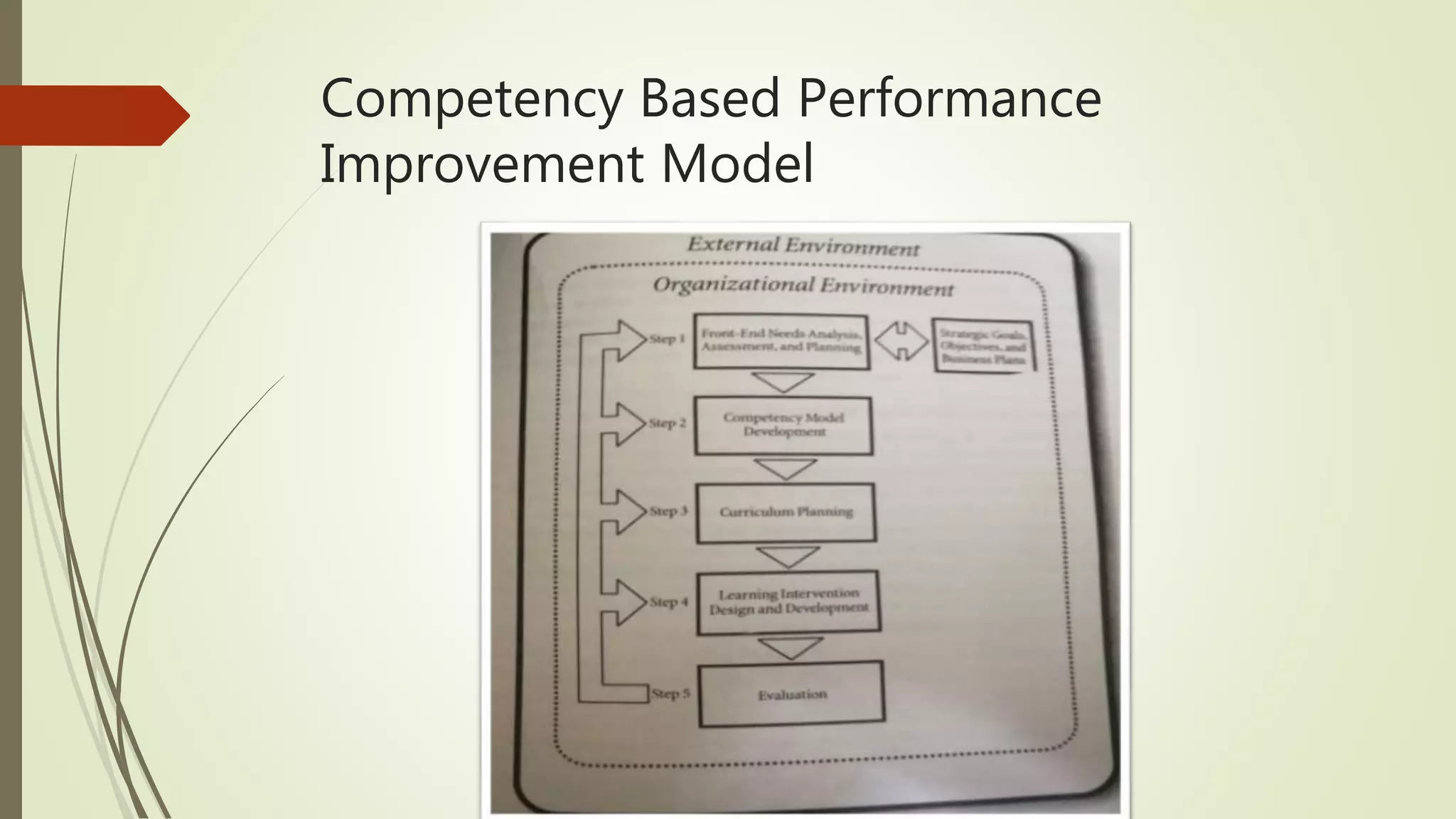
development process. This Learning Process Model is shown
in next page.
 It also shows that Competency based improvement process
corresponds with changing requirements of external and
organizational environment.
Competency Based Performance
Improvement Model
Evaluating Result Oriented CBL Program
 Competency Based Learning is a self marketing tool and a win-win process
improvement that help individuals and organizations improve their performance. A
successful implemented CBL Program will have following outputs:
 Identified Employees Competencies that most directly contributes to achieving job
outputs.
 Assured that employees have acquired theses competencies through designed and
developed learning opportunities
 Seen Improved Job performance as a result of CBL Programs and interventions
 Achieved Organizational goals through linking competency development to business
plans
 Responded to workplace constraints in designing and implementing CBL Program
Models for CBL Evaluation
 There are two models described in the book for evaluating CBL Model:
 Four Levels of Evaluation
 The Dubois Model
 FOUR LEVELS OF EVALUATION: This model states that evaluation should be made on
four levels. These levels are:
 Reaction
 Learning
 Behavior
 Results
 Assess your organization as to CBL Program penetration and then continually invest to
improve CBL program according to lacking competencies.
Models for CBL Evaluation
 The Dubois Model – This model suggest the systematic approach on evaluating
the CBL Program based on employee’s job needs and organizational strategic
needs.
 Evaluating Intangibles – Impact of technology in learning and complexity of evaluating
training
 Valuing Intangibles – identify practical guidelines for tracking operational returns by
calculating both costs and benefits of training. Secondly, appreciate the intangibles and
admitting that not all intangibles can be accounted for.
Complimentary strategies for CBL
Programs
Benchmarking – Process of comparing one’s
organization practice with another. It helps in
identifying strengths and weaknesses of one’s
organization and can help in improving performance.
Metrics – It focuses on measurement of
performance. Metrics provide organization with tools
to measure performance based on efficiency and
effectiveness.
My Final opinion
 One Line Opinion- This book presents a brief but comprehensive overview of
competency-based programs and how they can be used to improve the
performance of any size organization.
 Detailed Opinion –
 It is a very beneficial book considering the modern view that “Employees are an
important Asset of the business”.
 This is written in very simple structure and very easy language that becomes technical
only a few times.
 This Book is very much a practical book, in fact this book was written to be used
practically to implement the CBL Programs in business organizations of any size.
Shortcomings of the Book
 All in all a good book but there are some flaws in theoretical
setting up in some places. These shortcomings are:
 Fails to make reader understand linkage between designing the
program and adopting approaches for designing (Page 38)
 Disoriented organization of Topics (Page 42). It fails to disseminate
stepwise process of developing in house curriculum development
program and that of customizing a bought CBL Program.
 There is a gap of understanding linking designing and implementing
the CBL Based Program Part II.
Thank You All

Competency and the learning organization

  • 1.
    Competency and theLearning Organization (Donald Shandler) By Muhammad Kashif Din Book Review
  • 2.
    Book Background  Objective: This Book is written with the objective of guiding the readers through the process of identifying the core competencies of any organizations and learning programs that will achieve set business objectives. Competency Based Learning (CBL) is used by many companies to drive organizational performance.  About the Author : Donald Shandler is president of Shandler Associates, a consulting firm specializing in the development of managers, leaders, and professionals. He also is an adjunct professor at the University of Maryland University College where he teaches the MBA course Managing People and Groups in a Global Workplace.  Publisher : Viva Books Private Ltd. New Delhi India
  • 3.
    Structure of Book This Book is designed in such a way that you not only learn the process of implementing the process of CBL but also the basics of the CBL. Also there are case studies in all the parts of this book.  Introduction to CBL  Core Competency; Competency Based Learning (CBL)  Difference between Competency Based Learning (CBL) and Competency Based Training (CBT)  How CBL leads to Competency Based Performance  Process of implementing CBL is based in four parts in this book that includes:  Build Foundation for CBL in an Organization  Design a CBL Program  Implement Competency based Program  Evaluate and measure competency based Programs
  • 4.
    Competency Based LearningImportance  Competency Based Learning (CBL) model is important as it influence various aspects of any organization including:  Training and development of Employees;  Recruiting and staffing;  Compensation and benefits;  Leadership and executive development  Human resources; and  Organizational development
  • 5.
    Introduction  Competency ACluster of related knowledge, skills, and attributes that affects a major part of one’s job (a role or responsibility), that correlates with performance on the job. Performance is also measurable against well accepted standards. Competencies can be improved through training and development.  Core Competency for an Individual – One Competency that is essential for an individual’s success for a given job at a specific level within organization  Core Competency for an Organization – the activities that define the organization's competitive advantage in the economy  Difference between CBL and CBT – Long term versus Short Term, For Future requirement vs. Current requirement, Learning to Learn vs. skills acquisition

  • 6.
    Introduction….  How itworks: CBL results in competency based performance through the simple and practical application of four steps: 1. Individual and organizations posses and acquire competencies; 2. They apply these competencies in form of behaviors; 3. Their behaviors produce output; 4. How this is done yield results;  Development of CBL Program begins at step four and reversely leads to step one.
  • 7.
  • 8.
    Success Stories (Examples) EASTMANKODAK HON COMPANY NATIONAL RETAIL FEDERATION SEARS UNIVERSITYMYER GRACE BROS.
  • 9.
    Benefits of implementingCBL Programs  Organization becomes Learning Organization and reaps benefits both in short and long run.  Threefold Benefits include:  Organizations benefits by linking strategies with competencies.  Adult Learners Profits by integrated opportunity to learn as part of work.  Society as a whole learns as organization does and that ultimately leads to vision of nation for Continuous Learning.  Hence, All three Foundations of any Nation can benefit from CBL:  Individual  Organization  Society
  • 10.
    PROCESS OF IMPLEMENTINGCBL  Process of implementing Competency Based Learning (CBL) consists of four steps:  Building foundation for CBL in your organization  Design a CBL Program  Implement CBL Program  Evaluate and measure CBL Program Now we shall move one by one in this Process
  • 11.
  • 12.
    Systematic Approach toOrganization Learning (Building Foundation)  A Systematic Process to Organizational Learning Provides the cornerstone for building foundation for CBL Program. It Consists of two Steps: 1. Analyze needs of your Organization – i. How Critical is the need to align performance improvement with strategy of the Organization ii. Identify Return on Investment and alternatives to organizationally sponsored performance improvement opportunities 2. Build a Competency Model – (Models can be made on your own or they can be Customized Models Designed by Others) i. Identify / Define Core Competencies for Each Employee Level ii. Construct one or two models based on those core competencies
  • 13.
  • 14.
    Before Designing aCBL Program (Assumptions) Every CBL Model is based on following four Assumptions: 1. Adults have a need to know why they should learn something 2. Adults have a deep need to be self directing 3. Adults have a greater volume and different quality of experience than youth 4. Adults only become interest in learning when they find a situation that demands new knowledge
  • 15.
    Meeting the Needsof Adult Learners  Adults bring into learning a rich set of experiences, the design of CBL must acknowledge this rich experience. Thus CBL Strategies must meet following criteria:  Strategies must emphasize competencies, their relation to job goals, and ultimately relationship of competencies and job goals to organizational goals  Strategies must involve learners and make learners responsible for achievements  Strategies must stimulate work conditions  Strategies must enable employees to see how learning applies to job
  • 16.
    Integrated Competency BasedLearning (CBL) Program  Integrated CBL Programs settle down adult learners and create relationship between Theory and practice of the process. Further Integrated CBL Programs can direct learners to acquire appropriate competencies for development in organization (Vertical Competency Development) or understand other Job functions on same Job Level (Horizontal Competency Development)  Horizontal Competency Development – Focuses on class of jobs on same Level of organization  Vertical Competency Development – Focuses on Jobs that bridge two or more levels of jobs
  • 17.
    Recommendations for IntegratedCBL Program  Integrated CBL ensures that training is linked to the strategic needs of the business. Following four recommendations can help organization increase chances of an integrated CBL:  Integrate and develop Critical Job Competencies;  Select appropriate level of subject matter;  Emphasize a cross-organization performance improvement effort;  Enhance learner achievement of the job output with high quality level.  Such a CBL Program can become center piece of an Organization business strategy
  • 18.
    Assessing the Scopeof Integrated CBL Program  Scope of the curriculum development project is an important element to consider when determining whether to design your own program or use other partner. Defining scope of the project requires important areas to be identified. These include:  Specified Jobs for inclusion in program and the relationship among different jobs;  Availability of delivery system and their appropriateness;  Current performance opportunities and their relation to current Plan;  Number and Location of targeted Employees;  Available Resources including staffing, equipment, facilities, training technologies;  Budget and staff available
  • 19.
    Continue…..  Targeted Competenciesstrategies adopted;  CBL Program to be customized internally, Contracted or Purchased;  Level of Competency required;  Pre-intervention Assessment Profiles availability;  Pre-required competencies from employees;  Sequence of CBL Program available;  CBL Program Scope will help achieve objectives of Integrated CBL development. It will answer question whether to use inhouse CBL Program, Partner with outsider or Use off the shelf CBL Program.
  • 20.
  • 21.
    Steps in ImplementingCBL Plan  Two Steps needs to be taken for implementing CBL Plan  Involve Key Stakeholders of CBL Plan. Those includes:  Responsibilities of Project Team and its members;  Identify Key Senior Managers who can provide organizational support;  Encourage Supervisors to support needs of employees; and  Encourage individuals to assume responsibility for their own learning and performance  Address Implementation Requirements for delivery options:  Learning with Others (Group Learning);  Self Directed Learning;  Learning through Technology;
  • 22.
    Responsibilities of ProjectTeam and its Members  Sustain a relationship within stakeholders and Sponsors. It is important because CBL Program go beyond class rooms and instructor led trainings. Also CBL Program consist of wide variety of learning opportunities. Three suggestions are:  Maintain Communication between all internal and External Stakeholders who took part in design and development of CBL Program;  Secure Public Support from Senior Managers, Supervisors who can add legitimacy to the program; and  Identify opinion leaders, involve them in implementation of pilot project, enlist their support in communicating benefits of CBL Program to their peers.  Develop a Marketing and Communication Plan for implementing CBL Program
  • 23.
    Communication Strategies  Twoset of communication strategies can be adopted for executive briefings, work group meetings and announcements.  Strategy No. 1 - Keep the Big picture in focus for stakeholders: It can be done by keeping all stakeholders and sponsors of CBL Program informed in every stage of implementation. Telling them background of CBL initiative, objectives of CBL Program, how they will be achieved and bottom line projections.  Strategy No. 2 – Share responsibility of communicating:  What shall be communicated?  Who shall communicate?  How it shall be communicated?  When will this be communicated?
  • 24.
    Guidelines for implementingCBL Program  Align Organizational learning with business and personal success;  Build learning into all operations and activities;  Recognize and reward learning;  Generate many learning opportunities;  Set aside time for learning;  Create a physical environment and space for learning;  Maximize learning on the job.
  • 25.
    Critical Role ofSupervisor  CBL Program implementation is a team effort. Starting from Top management to Project Team and other stakeholders for designing and developing CBL Program. Unless the supervisor supports the initiative of CBL Program implementation, the results will be disappointing. Five key contributions of supervisors are:  Help align individuals goals of learning and performance with business goals;  Discuss learning and performance expectations before, during and after CBL event;  Provide learners ample time (within day working time) to complete their self-directed and group learning goals;  Use structured methods of learning and performance enhancement for mentoring and coaching; and  Assist employees in integrating their learning with workplace, performance driven application.
  • 26.
    Delivery Options forCBL Program  Three Types of delivery options are:  Self Directed Learning (SDL)  Learning in Groups (GL)  Technology Driven Learning (TDL)  Needs for Each delivery option can be categorized as:  Manager’s Needs (SDL,TDL or Group Learning)  Supervisor’s Needs (-do-)  Individual’s Needs (-do-)
  • 27.
    Launching Methods forCBL Program  Methods of launching CBL Program are:  Complete Launch  Pilot Launch  Sequential Launch  Pilot Launch has proven to be most successful. It has following steps:  Identify what to test  Select the right pilot group  Conduct and respond to pilot offering  Modify the program according to results
  • 28.
    Launching Final CBLProgram  CBL program becomes successful if it is aligned with business strategy and has the backing of CBL Stakeholders. Launching a CBL Program can be easy by following these steps during execution:  Establish and sustain momentum;  Build on the CBL Process;  Position the Product;  Self-market through strategic channels;  Keep the administration simple.
  • 29.
  • 30.
    Evaluate, Measure andStart Again  Markets are not static, and any organization wishing to maintain or improve its market position needs to reinvent itself continually. Core competencies must be measured and evaluated if they fulfill requirements of updated strategies. So need of the hour is to continually improve competency development process. This Learning Process Model is shown in next page.  It also shows that Competency based improvement process corresponds with changing requirements of external and organizational environment.
  • 31.
  • 32.
    Evaluating Result OrientedCBL Program  Competency Based Learning is a self marketing tool and a win-win process improvement that help individuals and organizations improve their performance. A successful implemented CBL Program will have following outputs:  Identified Employees Competencies that most directly contributes to achieving job outputs.  Assured that employees have acquired theses competencies through designed and developed learning opportunities  Seen Improved Job performance as a result of CBL Programs and interventions  Achieved Organizational goals through linking competency development to business plans  Responded to workplace constraints in designing and implementing CBL Program
  • 33.
    Models for CBLEvaluation  There are two models described in the book for evaluating CBL Model:  Four Levels of Evaluation  The Dubois Model  FOUR LEVELS OF EVALUATION: This model states that evaluation should be made on four levels. These levels are:  Reaction  Learning  Behavior  Results  Assess your organization as to CBL Program penetration and then continually invest to improve CBL program according to lacking competencies.
  • 34.
    Models for CBLEvaluation  The Dubois Model – This model suggest the systematic approach on evaluating the CBL Program based on employee’s job needs and organizational strategic needs.  Evaluating Intangibles – Impact of technology in learning and complexity of evaluating training  Valuing Intangibles – identify practical guidelines for tracking operational returns by calculating both costs and benefits of training. Secondly, appreciate the intangibles and admitting that not all intangibles can be accounted for.
  • 35.
    Complimentary strategies forCBL Programs Benchmarking – Process of comparing one’s organization practice with another. It helps in identifying strengths and weaknesses of one’s organization and can help in improving performance. Metrics – It focuses on measurement of performance. Metrics provide organization with tools to measure performance based on efficiency and effectiveness.
  • 36.
    My Final opinion One Line Opinion- This book presents a brief but comprehensive overview of competency-based programs and how they can be used to improve the performance of any size organization.  Detailed Opinion –  It is a very beneficial book considering the modern view that “Employees are an important Asset of the business”.  This is written in very simple structure and very easy language that becomes technical only a few times.  This Book is very much a practical book, in fact this book was written to be used practically to implement the CBL Programs in business organizations of any size.
  • 37.
    Shortcomings of theBook  All in all a good book but there are some flaws in theoretical setting up in some places. These shortcomings are:  Fails to make reader understand linkage between designing the program and adopting approaches for designing (Page 38)  Disoriented organization of Topics (Page 42). It fails to disseminate stepwise process of developing in house curriculum development program and that of customizing a bought CBL Program.  There is a gap of understanding linking designing and implementing the CBL Based Program Part II.
  • 38.