•Comparisons
•Maria Minina
COMPARISONS
As/Like
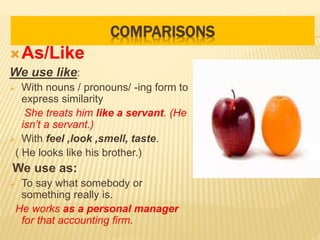
We use like:
 With nouns / pronouns/ -ing form to
express similarity
She treats him like a servant. (He
isn’t a servant.)
 With feel ,look ,smell, taste.
( He looks like his brother.)
We use as:
 To say what somebody or
something really is.
He works as a personal manager
for that accounting firm.
COMPARATIVES & SUPERLATIVES
We use the comparative to compare one
person or thing with another. We use the
superlatives to compare one person or
thing with more than one person or thing of
the same group.
We often use than after a comparative and
the before a superlative.
( He is older than me. He’s the oldest person
in the room.)
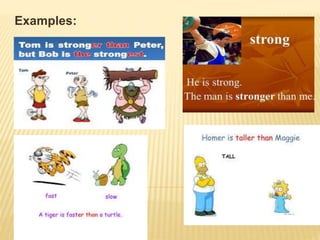
Examples:
Formation of comparatives and superlatives from
adjectives and adverbs
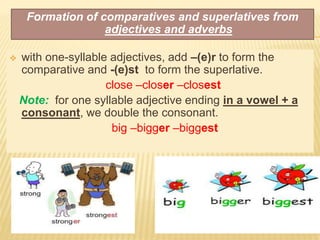
 with one-syllable adjectives, add –(e)r to form the
comparative and -(e)st to form the superlative.
close –closer –closest
Note: for one syllable adjective ending in a vowel + a
consonant, we double the consonant.
big –bigger –biggest
 with two-syllable adjectives ending in –ly/ -y/ -w,
also add –er/ -est
narrow- narrower- narrowest
Note: for adjectives ending in a consonant + y
we replace the –y with –i
tiny –tinier –tiniest
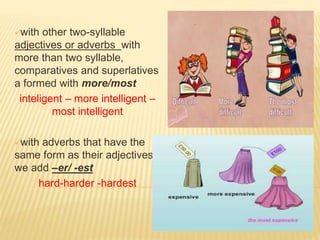
with other two-syllable
adjectives or adverbs with
more than two syllable,
comparatives and superlatives
a formed with more/most
inteligent – more intelligent –
most intelligent
with adverbs that have the
same form as their adjectives
we add –er/ -est
hard-harder -hardest
 two-syllable or compound adverbs take more/most
slowly –more slowly –most slowly
Note: clever, common, cruel, friendly, gentle,
pleasant, polite, simple, stupid, quite can form their
comparatives and superlatives either with –er / -est
with more/most.
IRREGULAR FORMS
TYPES OF COMPARISONS
 as+adjectives+as
(to show that two people or thing are similar in some way)
In negative sentences we use not as/ so…as
The blue bag is as expensive as the red one.
 less+adjectives+than
( express the difference between two people or things)
The opposite is more…than.
Paul is less successful than his brother.
 the least+adjective+of/in
(compares one persons or thing to two or more people or things in
the same group)
The opposite is most…of/in
She is the least ambitious person in the company.
 much/ a lot/ far / a little / a bit / slightly +
comparative
( express the degree of difference between two people or
things)
Brian is slightly older than Maria.
 the+comparative…
(shows that two things change together or that one thing
depends on another thing)
The longer the day went on, the more tired she
became.
 by far+ the+ superlative
( emphasises the difference between one things or person and
two or more people or things in the same group)
Last year was by far the best the company has
ever had.
Comparisons

Comparisons

  • 1.
  • 3.
    COMPARISONS As/Like We use like: With nouns / pronouns/ -ing form to express similarity She treats him like a servant. (He isn’t a servant.)  With feel ,look ,smell, taste. ( He looks like his brother.) We use as:  To say what somebody or something really is. He works as a personal manager for that accounting firm.
  • 4.
    COMPARATIVES & SUPERLATIVES Weuse the comparative to compare one person or thing with another. We use the superlatives to compare one person or thing with more than one person or thing of the same group. We often use than after a comparative and the before a superlative. ( He is older than me. He’s the oldest person in the room.)
  • 5.
  • 6.
    Formation of comparativesand superlatives from adjectives and adverbs  with one-syllable adjectives, add –(e)r to form the comparative and -(e)st to form the superlative. close –closer –closest Note: for one syllable adjective ending in a vowel + a consonant, we double the consonant. big –bigger –biggest
  • 7.
     with two-syllableadjectives ending in –ly/ -y/ -w, also add –er/ -est narrow- narrower- narrowest Note: for adjectives ending in a consonant + y we replace the –y with –i tiny –tinier –tiniest
  • 8.
    with other two-syllable adjectivesor adverbs with more than two syllable, comparatives and superlatives a formed with more/most inteligent – more intelligent – most intelligent with adverbs that have the same form as their adjectives we add –er/ -est hard-harder -hardest
  • 9.
     two-syllable orcompound adverbs take more/most slowly –more slowly –most slowly Note: clever, common, cruel, friendly, gentle, pleasant, polite, simple, stupid, quite can form their comparatives and superlatives either with –er / -est with more/most.
  • 10.
  • 11.
    TYPES OF COMPARISONS as+adjectives+as (to show that two people or thing are similar in some way) In negative sentences we use not as/ so…as The blue bag is as expensive as the red one.  less+adjectives+than ( express the difference between two people or things) The opposite is more…than. Paul is less successful than his brother.  the least+adjective+of/in (compares one persons or thing to two or more people or things in the same group) The opposite is most…of/in She is the least ambitious person in the company.
  • 13.
     much/ alot/ far / a little / a bit / slightly + comparative ( express the degree of difference between two people or things) Brian is slightly older than Maria.  the+comparative… (shows that two things change together or that one thing depends on another thing) The longer the day went on, the more tired she became.  by far+ the+ superlative ( emphasises the difference between one things or person and two or more people or things in the same group) Last year was by far the best the company has ever had.