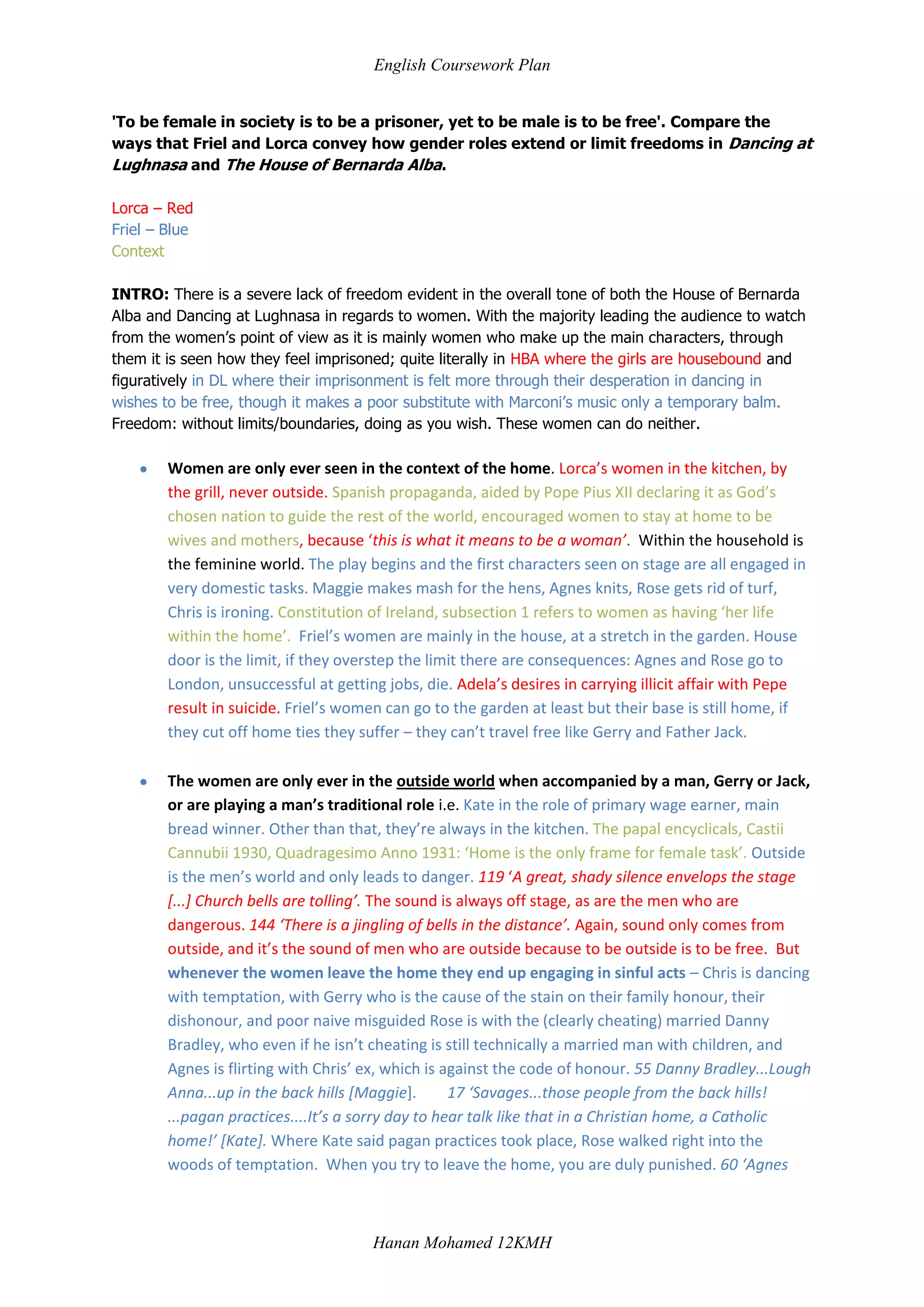
'To be female in society is to be a prisoner, yet to be male is to be free'. Compare the ways that Friel and Lorca convey how gender roles extend or limit freedoms in Dancing at Lughnasa and The House of Bernarda Alba.<br />Lorca – Red   <br />Friel – Blue<br />Context<br />INTRO: There is a severe lack of freedom evident in the overall tone of both the House of Bernarda Alba and Dancing at Lughnasa in regards to women. With the majority leading the audience to watch from the women’s point of view as it is mainly women who make up the main characters, through them it is seen how they feel imprisoned; quite literally in HBA where the girls are housebound and figuratively in DL where their imprisonment is felt more through their desperation in dancing in wishes to be free, though it makes a poor substitute with Marconi’s music only a temporary balm.<br />Freedom: without limits/boundaries, doing as you wish. These women can do neither.<br />Women are only ever seen in the context of the home. Lorca’s women in the kitchen, by the grill, never outside. Spanish propaganda, aided by Pope Pius XII declaring it as God’s chosen nation to guide the rest of the world, encouraged women to stay at home to be wives and mothers, because ‘this is what it means to be a woman’.  Within the household is the feminine world. The play begins and the first characters seen on stage are all engaged in very domestic tasks. Maggie makes mash for the hens, Agnes knits, Rose gets rid of turf, Chris is ironing. Constitution of Ireland, subsection 1 refers to women as having ‘her life within the home’.  Friel’s women are mainly in the house, at a stretch in the garden. House door is the limit, if they overstep the limit there are consequences: Agnes and Rose go to London, unsuccessful at getting jobs, die. Adela’s desires in carrying illicit affair with Pepe result in suicide. Friel’s women can go to the garden at least but their base is still home, if they cut off home ties they suffer – they can’t travel free like Gerry and Father Jack.
The women are only ever in the outside world when accompanied by a man, Gerry or Jack, or are playing a man’s traditional role i.e. Kate in the role of primary wage earner, main bread winner. Other than that, they’re always in the kitchen. The papal encyclicals, Castii Cannubii 1930, Quadragesimo Anno 1931: ‘Home is the only frame for female task’. Outside is the men’s world and only leads to danger. 119 ‘A great, shady silence envelops the stage [...] Church bells are tolling’. The sound is always off stage, as are the men who are dangerous. 144 ‘There is a jingling of bells in the distance’. Again, sound only comes from outside, and it’s the sound of men who are outside because to be outside is to be free.  But whenever the women leave the home they end up engaging in sinful acts – Chris is dancing with temptation, with Gerry who is the cause of the stain on their family honour, their dishonour, and poor naive misguided Rose is with the (clearly cheating) married Danny Bradley, who even if he isn’t cheating is still technically a married man with children, and Agnes is flirting with Chris’ ex, which is against the code of honour. 55 Danny Bradley...Lough Anna...up in the back hills [Maggie]. 17 ‘Savages...those people from the back hills! ...pagan practices....It’s a sorry day to hear talk like that in a Christian home, a Catholic home!’ [Kate]. Where Kate said pagan practices took place, Rose walked right into the woods of temptation.  When you try to leave the home, you are duly punished. 60 ‘Agnes was dead and Rose was dying in a hospice for the destitute in Southwark’. – ‘[jack] never said Mass again’.   31 Gerry is going ‘to Spain –as a matter of interest. Just for a short while’. He is free as a man to go wherever he wishes, but women are not they must stay at home.  33 ‘But you’d walk out on me again.....that’s your nature and you can’t help yourself’ because that’s what men do, they always leave, with the women left stuck at home. Parallel to Poncia’s words of newly-wed men leaving within a few weeks of marriage. They do because they can, because they are free. Home represents the boundaries. What goes on outside it must be pagan, sinful, wrong. It’s a man’s world out there. Outside = men = danger/pagan/sin/sex. Men = conflict, trouble. 6 ‘Who are you to talk, Christina Mundy, don’t you dare lecture me! [Agnes] ...Bastard [Chris]’. The first sense of conflict there is, is over a man – men only bring trouble, only trouble can come from men.
130 ‘Because men cover up for each other, on this kind of thing, and no one dares to make accusations’. But women cannot cover up for each other like this – or will not? Men have a different code of morality that is acceptable. 122 ‘Never again will you lift up my skirts behind the back corral!’ A suggestion of rape? An adulterous affair is implied, and the maid cannot say no to her master.  166 ‘I will put on a crown of thorns, like any mistress of a married man!’ [Adela]. Mistresses are a social norm, and are a part of the accepted double standards given to women by society.  (about the murder/affair) for example, the double standards of sexuality where men are allowed to be promiscuous and express their desires but women cannot. 144 ‘I myself gave money to my oldest son so he could go. Men need these things’. As in sex, and experience. Insinuates what, that women don’t? That they don’t have needs, that they don’t have sexual needs or fulfilment? 61 ‘ a curt note from a young man of my own age and also called Michael Evans’. So although Gerry proposed to Chris, he was also sleeping with another woman at the same time, being consistent with his track record of being dishonourable. Parallel – keeping a mistress, male promiscuity.
 But male promiscuity is accepted, encouraged and even endorsed as Poncia pays for her son to take part. 154 ‘Any woman who tramples on decency should pay for it! [...] Kill her! Kill her!’ Male ideology being verbally regurgitated again and impressed upon the minds of the young women.  Double standards. 61 ‘ a curt note from a young man of my own age and also called Michael Evans’. So although Gerry proposed to Chris, he was also sleeping with another woman at the same time, being consistent with his track record of being dishonourable. Parallel – keeping a mistress, male promiscuity. 128 ‘[They] lick their fingers over what goes on’. In reference to the men’s gossip at the funeral about Paca la Roseta, whose husband was tied up ina stall and she herself was thrown over the back of a horse and carried off to te top of the olive grove where prostitution popularly takes place. – So men’s wrong for a woman to have sex out of marriage and to express her sexual desires, but men are allowed to express their sexual desires, talk and lick their fingers over things like this.  65 ‘You should be a professional dancer’ [Gerry to Agnes]. He said the same thing to Chris just a little earlier, the same lines, playing them. One sister against another for the same man, parallel, to Pepe carrying on with both Adela and Angustias.
144 ‘To be born a woman is the worst punishment’ [Amelia].  Because men, ‘they are forgiven everything! [Adela]’ whereas women are upheld on a white virginal pedestal of chastity which must not have the slightest blemish on it or else she shall be jeered at, a mob wishing her and most likely bringing her death, social outcast and looked down on by society for having sex outside of marriage even once, let alone more – this is seen in the stories of the outsider women, the woman who had an illegitimate baby and killed it so that no one would find out, and the woman Paca who is judged doubly for being kidnapped to have sex with many men and then for also apparently ‘liking’ it.  144 [...] not even our eyes belong to us [Magdalena]’. A parallel to page 124, where Bernarda chastises the women not to look at men at all.

Comparative plays friel lorca plan

  • 1.
    'To be femalein society is to be a prisoner, yet to be male is to be free'. Compare the ways that Friel and Lorca convey how gender roles extend or limit freedoms in Dancing at Lughnasa and The House of Bernarda Alba.<br />Lorca – Red <br />Friel – Blue<br />Context<br />INTRO: There is a severe lack of freedom evident in the overall tone of both the House of Bernarda Alba and Dancing at Lughnasa in regards to women. With the majority leading the audience to watch from the women’s point of view as it is mainly women who make up the main characters, through them it is seen how they feel imprisoned; quite literally in HBA where the girls are housebound and figuratively in DL where their imprisonment is felt more through their desperation in dancing in wishes to be free, though it makes a poor substitute with Marconi’s music only a temporary balm.<br />Freedom: without limits/boundaries, doing as you wish. These women can do neither.<br />Women are only ever seen in the context of the home. Lorca’s women in the kitchen, by the grill, never outside. Spanish propaganda, aided by Pope Pius XII declaring it as God’s chosen nation to guide the rest of the world, encouraged women to stay at home to be wives and mothers, because ‘this is what it means to be a woman’. Within the household is the feminine world. The play begins and the first characters seen on stage are all engaged in very domestic tasks. Maggie makes mash for the hens, Agnes knits, Rose gets rid of turf, Chris is ironing. Constitution of Ireland, subsection 1 refers to women as having ‘her life within the home’. Friel’s women are mainly in the house, at a stretch in the garden. House door is the limit, if they overstep the limit there are consequences: Agnes and Rose go to London, unsuccessful at getting jobs, die. Adela’s desires in carrying illicit affair with Pepe result in suicide. Friel’s women can go to the garden at least but their base is still home, if they cut off home ties they suffer – they can’t travel free like Gerry and Father Jack.
  • 2.
    The women areonly ever in the outside world when accompanied by a man, Gerry or Jack, or are playing a man’s traditional role i.e. Kate in the role of primary wage earner, main bread winner. Other than that, they’re always in the kitchen. The papal encyclicals, Castii Cannubii 1930, Quadragesimo Anno 1931: ‘Home is the only frame for female task’. Outside is the men’s world and only leads to danger. 119 ‘A great, shady silence envelops the stage [...] Church bells are tolling’. The sound is always off stage, as are the men who are dangerous. 144 ‘There is a jingling of bells in the distance’. Again, sound only comes from outside, and it’s the sound of men who are outside because to be outside is to be free. But whenever the women leave the home they end up engaging in sinful acts – Chris is dancing with temptation, with Gerry who is the cause of the stain on their family honour, their dishonour, and poor naive misguided Rose is with the (clearly cheating) married Danny Bradley, who even if he isn’t cheating is still technically a married man with children, and Agnes is flirting with Chris’ ex, which is against the code of honour. 55 Danny Bradley...Lough Anna...up in the back hills [Maggie]. 17 ‘Savages...those people from the back hills! ...pagan practices....It’s a sorry day to hear talk like that in a Christian home, a Catholic home!’ [Kate]. Where Kate said pagan practices took place, Rose walked right into the woods of temptation. When you try to leave the home, you are duly punished. 60 ‘Agnes was dead and Rose was dying in a hospice for the destitute in Southwark’. – ‘[jack] never said Mass again’. 31 Gerry is going ‘to Spain –as a matter of interest. Just for a short while’. He is free as a man to go wherever he wishes, but women are not they must stay at home. 33 ‘But you’d walk out on me again.....that’s your nature and you can’t help yourself’ because that’s what men do, they always leave, with the women left stuck at home. Parallel to Poncia’s words of newly-wed men leaving within a few weeks of marriage. They do because they can, because they are free. Home represents the boundaries. What goes on outside it must be pagan, sinful, wrong. It’s a man’s world out there. Outside = men = danger/pagan/sin/sex. Men = conflict, trouble. 6 ‘Who are you to talk, Christina Mundy, don’t you dare lecture me! [Agnes] ...Bastard [Chris]’. The first sense of conflict there is, is over a man – men only bring trouble, only trouble can come from men.
  • 3.
    130 ‘Because mencover up for each other, on this kind of thing, and no one dares to make accusations’. But women cannot cover up for each other like this – or will not? Men have a different code of morality that is acceptable. 122 ‘Never again will you lift up my skirts behind the back corral!’ A suggestion of rape? An adulterous affair is implied, and the maid cannot say no to her master. 166 ‘I will put on a crown of thorns, like any mistress of a married man!’ [Adela]. Mistresses are a social norm, and are a part of the accepted double standards given to women by society. (about the murder/affair) for example, the double standards of sexuality where men are allowed to be promiscuous and express their desires but women cannot. 144 ‘I myself gave money to my oldest son so he could go. Men need these things’. As in sex, and experience. Insinuates what, that women don’t? That they don’t have needs, that they don’t have sexual needs or fulfilment? 61 ‘ a curt note from a young man of my own age and also called Michael Evans’. So although Gerry proposed to Chris, he was also sleeping with another woman at the same time, being consistent with his track record of being dishonourable. Parallel – keeping a mistress, male promiscuity.
  • 4.
    But malepromiscuity is accepted, encouraged and even endorsed as Poncia pays for her son to take part. 154 ‘Any woman who tramples on decency should pay for it! [...] Kill her! Kill her!’ Male ideology being verbally regurgitated again and impressed upon the minds of the young women. Double standards. 61 ‘ a curt note from a young man of my own age and also called Michael Evans’. So although Gerry proposed to Chris, he was also sleeping with another woman at the same time, being consistent with his track record of being dishonourable. Parallel – keeping a mistress, male promiscuity. 128 ‘[They] lick their fingers over what goes on’. In reference to the men’s gossip at the funeral about Paca la Roseta, whose husband was tied up ina stall and she herself was thrown over the back of a horse and carried off to te top of the olive grove where prostitution popularly takes place. – So men’s wrong for a woman to have sex out of marriage and to express her sexual desires, but men are allowed to express their sexual desires, talk and lick their fingers over things like this. 65 ‘You should be a professional dancer’ [Gerry to Agnes]. He said the same thing to Chris just a little earlier, the same lines, playing them. One sister against another for the same man, parallel, to Pepe carrying on with both Adela and Angustias.
  • 5.
    144 ‘To beborn a woman is the worst punishment’ [Amelia]. Because men, ‘they are forgiven everything! [Adela]’ whereas women are upheld on a white virginal pedestal of chastity which must not have the slightest blemish on it or else she shall be jeered at, a mob wishing her and most likely bringing her death, social outcast and looked down on by society for having sex outside of marriage even once, let alone more – this is seen in the stories of the outsider women, the woman who had an illegitimate baby and killed it so that no one would find out, and the woman Paca who is judged doubly for being kidnapped to have sex with many men and then for also apparently ‘liking’ it. 144 [...] not even our eyes belong to us [Magdalena]’. A parallel to page 124, where Bernarda chastises the women not to look at men at all.