Bachelor of Science (HONOURS) In Architecture
THEORIES OF ARCHITECTURE AND URBANISM
(ARC61303 / ARC2224)
Project: Part 2
“LIFE BETWEEN BUIDLING: USING PUBLIC SPACE”
Tutor Name: Dr. Nor Hayati
Name: Hern-Hymn Devinchi Ng
Student ID: 0320526
Due Date: Nov 28th 2016
Basic on the two site, Petaling Street, China town in Kuala Lumpur and Maiden
Lane, Union Square in San Francisco. There are many type of similarities and
dissimilarities regrading their “Life between Building” by Jan Gehl, and he stated that
functionality doesn’t meant it is just the street, and building, it meant more than that, it has
to be more like how activities of a human lifestyle happening in between of the building,
it’s about how the pedestrian uses the land in the city. How and what they use to go to
work, and they spend their time during their lunch and break time. It basically meant that
what type of integral system they used. That is why in a street it plays a very important
role as being part of he cities, it helps to connect people together as well as the spaces
found in urban forms. The movement of the pedestrian in a public street can also have
interaction with work, play and live. Jan Gehl had also stated that would a city’s street
look more interesting if not the social activities formed by spaces from the various contact
points of the public spaces? “The importance of a street as a public realm in the cities”.
(Saikia 2015)
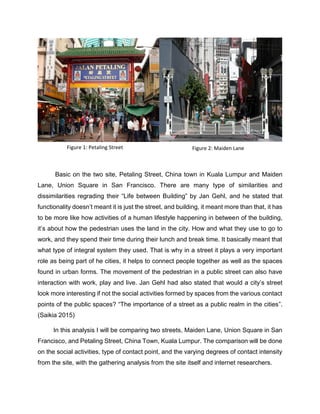
In this analysis I will be comparing two streets, Maiden Lane, Union Square in San
Francisco, and Petaling Street, China Town, Kuala Lumpur. The comparison will be done
on the social activities, type of contact point, and the varying degrees of contact intensity
from the site, with the gathering analysis from the site itself and internet researchers.
Figure 1: Petaling Street Figure 2: Maiden Lane
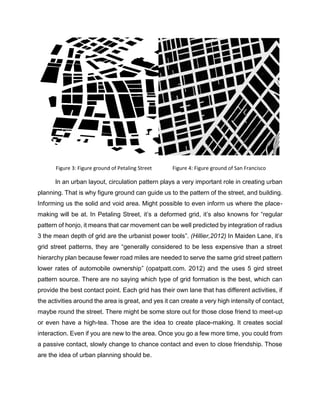
In an urban layout, circulation pattern plays a very important role in creating urban
planning. That is why figure ground can guide us to the pattern of the street, and building.
Informing us the solid and void area. Might possible to even inform us where the place-
making will be at. In Petaling Street, it’s a deformed grid, it’s also knowns for “regular
pattern of honjo, it means that car movement can be well predicted by integration of radius
3 the mean depth of grid are the urbanist power tools”. (Hillier,2012) In Maiden Lane, it’s
grid street patterns, they are “generally considered to be less expensive than a street
hierarchy plan because fewer road miles are needed to serve the same grid street pattern
lower rates of automobile ownership” (opatpatt.com. 2012) and the uses 5 gird street
pattern source. There are no saying which type of grid formation is the best, which can
provide the best contact point. Each grid has their own lane that has different activities, if
the activities around the area is great, and yes it can create a very high intensity of contact,
maybe round the street. There might be some store out for those close friend to meet-up
or even have a high-tea. Those are the idea to create place-making. It creates social
interaction. Even if you are new to the area. Once you go a few more time, you could from
a passive contact, slowly change to chance contact and even to close friendship. Those
are the idea of urban planning should be.
Figure 3: Figure ground of Petaling Street Figure 4: Figure ground of San Francisco
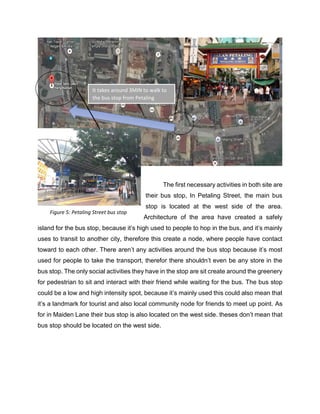
The first necessary activities in both site are
their bus stop, In Petaling Street, the main bus
stop is located at the west side of the area.
Architecture of the area have created a safely
island for the bus stop, because it’s high used to people to hop in the bus, and it’s mainly
uses to transit to another city, therefore this create a node, where people have contact
toward to each other. There aren’t any activities around the bus stop because it’s most
used for people to take the transport, therefor there shouldn’t even be any store in the
bus stop. The only social activities they have in the stop are sit create around the greenery
for pedestrian to sit and interact with their friend while waiting for the bus. The bus stop
could be a low and high intensity spot, because it’s mainly used this could also mean that
it’s a landmark for tourist and also local community node for friends to meet up point. As
for in Maiden Lane their bus stop is also located on the west side. theses don’t mean that
bus stop should be located on the west side.
It takes around 3MIN to walk to
the bus stop from Petaling
street.
Figure 5: Petaling Street bus stop
In Maiden Lane they also have island for drop-off, pick-up for the safely of the pedestrian.
In their grid formed this created a limited space for people to board and off cable car and
buses. There are no social activities in the area because it’s mainly only uses for bus to
drop-off and pick-up. They didn’t include any sitting area as a place-making for the
pedestrians because the bus come every five to ten minute (Muni bus name). Therefore,
they didn’t really think it’s necessary for them to include so many sitting areas for the
pedestrians. The contact point of the area is Union Square which located just right beside
the bus stop, and due to that it’s an activity as attraction where a landmark full of varieties
of activities, as what Jan Gehl stated “the value of the many large and small possibilities
that are attached to the opportunity of being in the same space as and seeing and hearing
other people is underlined by a series of observations investigating people’s reaction to
the presence of other people in public spaces.”(Gehl, 1987) Therefor it’s an people attract
people to come to the Union Square. The intensity is considering as low intensity because
the main attraction is located just right beside the bus stop, that is why human meet in
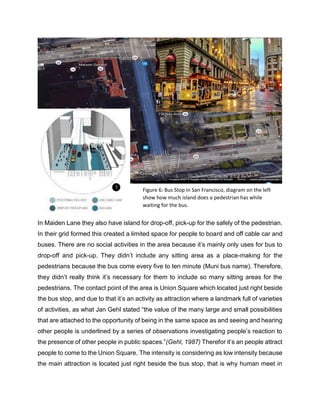
Figure 6: Bus Stop in San Francisco, diagram on the left
show how much island does a pedestrian has while
waiting for the bus.
Union Square rather than meeting in a bus stop. In term of bus stop, I think that Petaling
Street prove safer because it’s in a deform grid, are prove to be able to slow vehicular
down (Carmona, 2007). And in the grid system, “during 1920s, the rapid adoption od the
automobile caused a panic among urban planners who, based on observation, claimed
that speeding cars would eventually have killed tens of thousands of small children per
year. Planners, therefore, called for an inwardly focused ‘superblock’ arrangement, that
minimized through automobile traffic and discourage cars from traveling on anything but
arterial roads. (Facchinetti 2015). By that it also meant that it become slowly like deformed
grid. But deformed grid is mainly well known for improperly planning which they didn’t
know what is happening next. That is why in term of safely issue comparing the Petaling
Street and Maiden Lane, I think that Petaling Street are set to be safer, at least that people
wouldn’t have been drop-off and pick-off from the middle of the street, even if they have
created an island for human to stand on.
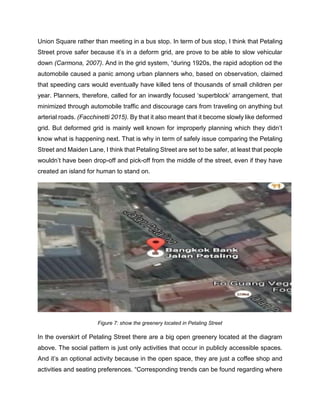
Figure 7: show the greenery located in Petaling Street
In the overskirt of Petaling Street there are a big open greenery located at the diagram
above. The social pattern is just only activities that occur in publicly accessible spaces.
And it’s an optional activity because in the open space, they are just a coffee shop and
activities and seating preferences. “Corresponding trends can be found regarding where
people choose to sit in public spaces. Benches hat provide a good view of surrounding
activities are used more than benches with less or no view o others.” (Gehl,1987) tourist
community would had uses coffee shop as a landmark because surround the site, it is
just all high rise, and the only most open and greenery spaces is there. Normally close
friend will hangout in the coffee shop, creating high intensity, and pedestrian walk passing
creating low intensity. The contact intensity would be like when two or more friend know
each other they would meet each other in that spaces, to have a social gathering. In the
spaces, it’s highly to be meeting up with co-workers often in connection with daily comings
and goings implies a valuable opportunity to establish and later maintain acquaintances
in a relaxed and undemanding way. It’s also a place where a place where it’s easy to drop
by, or to agree on what is to take place tomorrow if the participants pass by one another’s
front doors often and especially.
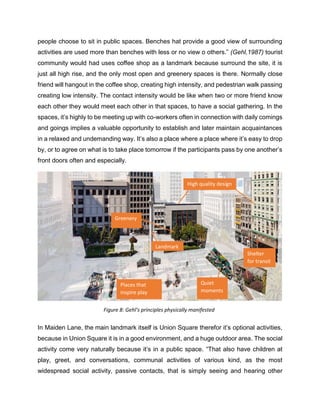
In Maiden Lane, the main landmark itself is Union Square therefor it’s optional activities,
because in Union Square it is in a good environment, and a huge outdoor area. The social
activity come very naturally because it’s in a public space. “That also have children at
play, greet, and conversations, communal activities of various kind, as the most
widespread social activity, passive contacts, that is simply seeing and hearing other
High quality design
Shelter
for transit
Landmark
Greenery
Places that
inspire play
Quiet
moments
Figure 8: Gehl’s principles physically manifested
people.” (Gehl, 1987). In Union Square it’s being known as contacting with others,
pedestrian play, and enjoy their break, relaxing, public realm. Most of the activities are
occurring or in places where there is the greatest chance of something happening. There
is even some store being on the Square, each of the small store has it own different
activities. The contact intensity will be from low to high because it’s a main spot where
people would gather, to do all kind of different activity. The change of it being from hearing
and seeing to even ingathering to have new friend. I would think that in term of having
activities in outdoor spaces, I think that Union Square will be a proper way of an urban
planning should be, because in the huge space, Union Square provide many seating
place, which can help to interact with others, even place-making can be held in this
spaces. Yet in Petaling Street, their outdoor spaces are few of the seating places,
because mainly all of it is in the coffee shop. Place-making held an important role in urban
infill, because it’s an interaction system, by providing them a proper activity into it.
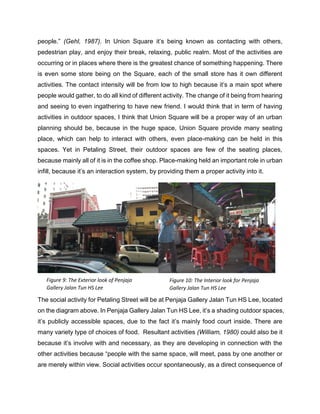
The social activity for Petaling Street will be at Penjaja Gallery Jalan Tun HS Lee, located
on the diagram above. In Penjaja Gallery Jalan Tun HS Lee, it’s a shading outdoor spaces,
it’s publicly accessible spaces, due to the fact it’s mainly food court inside. There are
many variety type of choices of food. Resultant activities (William, 1980) could also be it
because it’s involve with and necessary, as they are developing in connection with the
other activities because “people with the same space, will meet, pass by one another or
are merely within view. Social activities occur spontaneously, as a direct consequence of
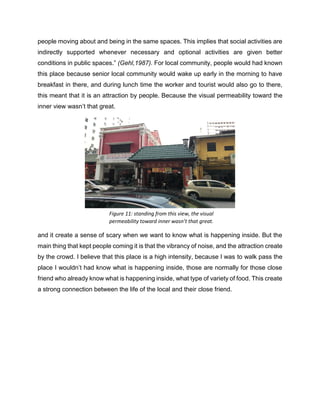
Figure 9: The Exterior look of Penjaja
Gallery Jalan Tun HS Lee
Figure 10: The Interior look for Penjaja
Gallery Jalan Tun HS Lee
people moving about and being in the same spaces. This implies that social activities are
indirectly supported whenever necessary and optional activities are given better
conditions in public spaces.” (Gehl,1987). For local community, people would had known
this place because senior local community would wake up early in the morning to have
breakfast in there, and during lunch time the worker and tourist would also go to there,
this meant that it is an attraction by people. Because the visual permeability toward the
inner view wasn’t that great.
and it create a sense of scary when we want to know what is happening inside. But the
main thing that kept people coming it is that the vibrancy of noise, and the attraction create
by the crowd. I believe that this place is a high intensity, because I was to walk pass the
place I wouldn’t had know what is happening inside, those are normally for those close
friend who already know what is happening inside, what type of variety of food. This create
a strong connection between the life of the local and their close friend.
Figure 11: standing from this view, the visual
permeability toward inner wasn’t that great.
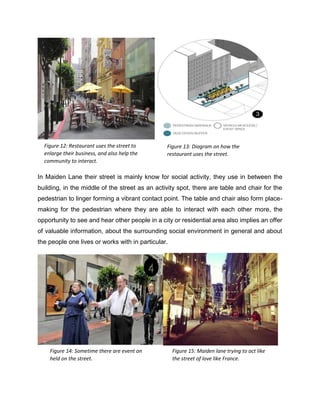
In Maiden Lane their street is mainly know for social activity, they use in between the
building, in the middle of the street as an activity spot, there are table and chair for the
pedestrian to linger forming a vibrant contact point. The table and chair also form place-
making for the pedestrian where they are able to interact with each other more, the
opportunity to see and hear other people in a city or residential area also implies an offer
of valuable information, about the surrounding social environment in general and about
the people one lives or works with in particular.
Figure 12: Restaurant uses the street to
enlarge their business, and also help the
community to interact.
Figure 13: Diagram on how the
restaurant uses the street.
Figure 14: Sometime there are event on
held on the street.
Figure 15: Maiden lane trying to act like
the street of love like France.
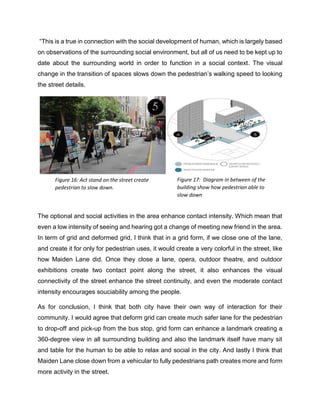
“This is a true in connection with the social development of human, which is largely based
on observations of the surrounding social environment, but all of us need to be kept up to
date about the surrounding world in order to function in a social context. The visual
change in the transition of spaces slows down the pedestrian’s walking speed to looking
the street details.
The optional and social activities in the area enhance contact intensity. Which mean that
even a low intensity of seeing and hearing got a change of meeting new friend in the area.
In term of grid and deformed grid, I think that in a grid form, if we close one of the lane,
and create it for only for pedestrian uses, it would create a very colorful in the street, like
how Maiden Lane did. Once they close a lane, opera, outdoor theatre, and outdoor
exhibitions create two contact point along the street, it also enhances the visual
connectivity of the street enhance the street continuity, and even the moderate contact
intensity encourages souciability among the people.
As for conclusion, I think that both city have their own way of interaction for their
community. I would agree that deform grid can create much safer lane for the pedestrian
to drop-off and pick-up from the bus stop, grid form can enhance a landmark creating a
360-degree view in all surrounding building and also the landmark itself have many sit
and table for the human to be able to relax and social in the city. And lastly I think that
Maiden Lane close down from a vehicular to fully pedestrians path creates more and form
more activity in the street.
Figure 16: Act stand on the street create
pedestrian to slow down.
Figure 17: Diagram in between of the
building show how pedestrian able to
slow down
References
 Alexander, C. (1977). A Pattern Langauge. New York: Oxford University Press.
 Carmona, M., & Tiesdell, S. (Eds.). (2007). Urban Design Reader. Retrieved
November 28, 2016, from
https://books.google.com.my/books?id=UvorBgAAQBAJ&pg=PA259&lpg=PA259
&dq=deformed grid slow people
down&source=bl&ots=2PkpPIVdm3&sig=nb4LjoM-
nLORtlPVv7ZZWTtu0r4&hl=en&sa=X&redir_esc=y#v=onepage&q&f=false
 Caspani, P. (2012). Shaping of Urban Design Through a Humanistic and
Pedestrian Perspective. Retrieved November 28,2016, from
https://issuu.com/pamelacaspani/docs/final_report
 Facchinetti,M (2015). Urban Planning 098425. Retrieved November 28,2016,
from
https://static1.squarespace.com/static/53777d8ce4b0a7ee8e9f9d06/t/5678179cd
f40f37eb36666d9/1450710940563/MF_urbanplanstudio_2015_XII_122115_light.
pdf
 Gehl, Jan, and Jo Koch. Life between Buildings: Using Public Space.
Washington, DC: Island, 2011. Print.
 Hillier,B (1998). The Hidden Geometry of deformed grids: or, why space syntax
works, when it looks as though it shouldn’t. Retrieved November 28,2016 from
http://discovery.ucl.ac.uk/1402/1/hillier1999-hiddengeometry.pdf
 Mel, M. Traditional Street Activities in Kuala Lumpur City. Retrieved November
28,2016, from
https://www.academia.edu/2004427/Traditional_Street_Activities_in_Kuala_Lum
pur_City
 Opatpatt.com. (n.d.). GRID STREET PATTERNS. Retrieved November 27, 2016,
from http://opatpatt.com/grid-street-patterns/
 Saikia, A. (2015, September 28). Urban Design Dimensions: 1.Functional
Dimension. Retrieved November 27, 2016, from
http://www.vasturaag.com/urban-design-dimensions-5-functional-dimension/
 Saikia, A. (2015, September 28). Urban Design Dimensions: 3.Social Dimension
- Vasturaag Design Group. Retrieved November 27, 2016, from
http://www.vasturaag.com/urban-design-dimensions-3-social/
 Saikia, A. (2015,September 28). Urban Design Dimension: 5. Functional
Dimension. Retrieved November 28, 2016, from
http://www.vasturaag.com/urban-design-dimensions-5-functional-dimension/
 Whyte, W.H. (1980). The Social Life of Small Urban Spaces. Washington D.C,:
Conservation Foundation

Theores final project

  • 1.
    Bachelor of Science(HONOURS) In Architecture THEORIES OF ARCHITECTURE AND URBANISM (ARC61303 / ARC2224) Project: Part 2 “LIFE BETWEEN BUIDLING: USING PUBLIC SPACE” Tutor Name: Dr. Nor Hayati Name: Hern-Hymn Devinchi Ng Student ID: 0320526 Due Date: Nov 28th 2016
  • 2.
    Basic on thetwo site, Petaling Street, China town in Kuala Lumpur and Maiden Lane, Union Square in San Francisco. There are many type of similarities and dissimilarities regrading their “Life between Building” by Jan Gehl, and he stated that functionality doesn’t meant it is just the street, and building, it meant more than that, it has to be more like how activities of a human lifestyle happening in between of the building, it’s about how the pedestrian uses the land in the city. How and what they use to go to work, and they spend their time during their lunch and break time. It basically meant that what type of integral system they used. That is why in a street it plays a very important role as being part of he cities, it helps to connect people together as well as the spaces found in urban forms. The movement of the pedestrian in a public street can also have interaction with work, play and live. Jan Gehl had also stated that would a city’s street look more interesting if not the social activities formed by spaces from the various contact points of the public spaces? “The importance of a street as a public realm in the cities”. (Saikia 2015) In this analysis I will be comparing two streets, Maiden Lane, Union Square in San Francisco, and Petaling Street, China Town, Kuala Lumpur. The comparison will be done on the social activities, type of contact point, and the varying degrees of contact intensity from the site, with the gathering analysis from the site itself and internet researchers. Figure 1: Petaling Street Figure 2: Maiden Lane
  • 3.
    In an urbanlayout, circulation pattern plays a very important role in creating urban planning. That is why figure ground can guide us to the pattern of the street, and building. Informing us the solid and void area. Might possible to even inform us where the place- making will be at. In Petaling Street, it’s a deformed grid, it’s also knowns for “regular pattern of honjo, it means that car movement can be well predicted by integration of radius 3 the mean depth of grid are the urbanist power tools”. (Hillier,2012) In Maiden Lane, it’s grid street patterns, they are “generally considered to be less expensive than a street hierarchy plan because fewer road miles are needed to serve the same grid street pattern lower rates of automobile ownership” (opatpatt.com. 2012) and the uses 5 gird street pattern source. There are no saying which type of grid formation is the best, which can provide the best contact point. Each grid has their own lane that has different activities, if the activities around the area is great, and yes it can create a very high intensity of contact, maybe round the street. There might be some store out for those close friend to meet-up or even have a high-tea. Those are the idea to create place-making. It creates social interaction. Even if you are new to the area. Once you go a few more time, you could from a passive contact, slowly change to chance contact and even to close friendship. Those are the idea of urban planning should be. Figure 3: Figure ground of Petaling Street Figure 4: Figure ground of San Francisco
  • 4.
    The first necessaryactivities in both site are their bus stop, In Petaling Street, the main bus stop is located at the west side of the area. Architecture of the area have created a safely island for the bus stop, because it’s high used to people to hop in the bus, and it’s mainly uses to transit to another city, therefore this create a node, where people have contact toward to each other. There aren’t any activities around the bus stop because it’s most used for people to take the transport, therefor there shouldn’t even be any store in the bus stop. The only social activities they have in the stop are sit create around the greenery for pedestrian to sit and interact with their friend while waiting for the bus. The bus stop could be a low and high intensity spot, because it’s mainly used this could also mean that it’s a landmark for tourist and also local community node for friends to meet up point. As for in Maiden Lane their bus stop is also located on the west side. theses don’t mean that bus stop should be located on the west side. It takes around 3MIN to walk to the bus stop from Petaling street. Figure 5: Petaling Street bus stop
  • 5.
    In Maiden Lanethey also have island for drop-off, pick-up for the safely of the pedestrian. In their grid formed this created a limited space for people to board and off cable car and buses. There are no social activities in the area because it’s mainly only uses for bus to drop-off and pick-up. They didn’t include any sitting area as a place-making for the pedestrians because the bus come every five to ten minute (Muni bus name). Therefore, they didn’t really think it’s necessary for them to include so many sitting areas for the pedestrians. The contact point of the area is Union Square which located just right beside the bus stop, and due to that it’s an activity as attraction where a landmark full of varieties of activities, as what Jan Gehl stated “the value of the many large and small possibilities that are attached to the opportunity of being in the same space as and seeing and hearing other people is underlined by a series of observations investigating people’s reaction to the presence of other people in public spaces.”(Gehl, 1987) Therefor it’s an people attract people to come to the Union Square. The intensity is considering as low intensity because the main attraction is located just right beside the bus stop, that is why human meet in Figure 6: Bus Stop in San Francisco, diagram on the left show how much island does a pedestrian has while waiting for the bus.
  • 6.
    Union Square ratherthan meeting in a bus stop. In term of bus stop, I think that Petaling Street prove safer because it’s in a deform grid, are prove to be able to slow vehicular down (Carmona, 2007). And in the grid system, “during 1920s, the rapid adoption od the automobile caused a panic among urban planners who, based on observation, claimed that speeding cars would eventually have killed tens of thousands of small children per year. Planners, therefore, called for an inwardly focused ‘superblock’ arrangement, that minimized through automobile traffic and discourage cars from traveling on anything but arterial roads. (Facchinetti 2015). By that it also meant that it become slowly like deformed grid. But deformed grid is mainly well known for improperly planning which they didn’t know what is happening next. That is why in term of safely issue comparing the Petaling Street and Maiden Lane, I think that Petaling Street are set to be safer, at least that people wouldn’t have been drop-off and pick-off from the middle of the street, even if they have created an island for human to stand on. Figure 7: show the greenery located in Petaling Street In the overskirt of Petaling Street there are a big open greenery located at the diagram above. The social pattern is just only activities that occur in publicly accessible spaces. And it’s an optional activity because in the open space, they are just a coffee shop and activities and seating preferences. “Corresponding trends can be found regarding where
  • 7.
    people choose tosit in public spaces. Benches hat provide a good view of surrounding activities are used more than benches with less or no view o others.” (Gehl,1987) tourist community would had uses coffee shop as a landmark because surround the site, it is just all high rise, and the only most open and greenery spaces is there. Normally close friend will hangout in the coffee shop, creating high intensity, and pedestrian walk passing creating low intensity. The contact intensity would be like when two or more friend know each other they would meet each other in that spaces, to have a social gathering. In the spaces, it’s highly to be meeting up with co-workers often in connection with daily comings and goings implies a valuable opportunity to establish and later maintain acquaintances in a relaxed and undemanding way. It’s also a place where a place where it’s easy to drop by, or to agree on what is to take place tomorrow if the participants pass by one another’s front doors often and especially. In Maiden Lane, the main landmark itself is Union Square therefor it’s optional activities, because in Union Square it is in a good environment, and a huge outdoor area. The social activity come very naturally because it’s in a public space. “That also have children at play, greet, and conversations, communal activities of various kind, as the most widespread social activity, passive contacts, that is simply seeing and hearing other High quality design Shelter for transit Landmark Greenery Places that inspire play Quiet moments Figure 8: Gehl’s principles physically manifested
  • 8.
    people.” (Gehl, 1987).In Union Square it’s being known as contacting with others, pedestrian play, and enjoy their break, relaxing, public realm. Most of the activities are occurring or in places where there is the greatest chance of something happening. There is even some store being on the Square, each of the small store has it own different activities. The contact intensity will be from low to high because it’s a main spot where people would gather, to do all kind of different activity. The change of it being from hearing and seeing to even ingathering to have new friend. I would think that in term of having activities in outdoor spaces, I think that Union Square will be a proper way of an urban planning should be, because in the huge space, Union Square provide many seating place, which can help to interact with others, even place-making can be held in this spaces. Yet in Petaling Street, their outdoor spaces are few of the seating places, because mainly all of it is in the coffee shop. Place-making held an important role in urban infill, because it’s an interaction system, by providing them a proper activity into it. The social activity for Petaling Street will be at Penjaja Gallery Jalan Tun HS Lee, located on the diagram above. In Penjaja Gallery Jalan Tun HS Lee, it’s a shading outdoor spaces, it’s publicly accessible spaces, due to the fact it’s mainly food court inside. There are many variety type of choices of food. Resultant activities (William, 1980) could also be it because it’s involve with and necessary, as they are developing in connection with the other activities because “people with the same space, will meet, pass by one another or are merely within view. Social activities occur spontaneously, as a direct consequence of Figure 9: The Exterior look of Penjaja Gallery Jalan Tun HS Lee Figure 10: The Interior look for Penjaja Gallery Jalan Tun HS Lee
  • 9.
    people moving aboutand being in the same spaces. This implies that social activities are indirectly supported whenever necessary and optional activities are given better conditions in public spaces.” (Gehl,1987). For local community, people would had known this place because senior local community would wake up early in the morning to have breakfast in there, and during lunch time the worker and tourist would also go to there, this meant that it is an attraction by people. Because the visual permeability toward the inner view wasn’t that great. and it create a sense of scary when we want to know what is happening inside. But the main thing that kept people coming it is that the vibrancy of noise, and the attraction create by the crowd. I believe that this place is a high intensity, because I was to walk pass the place I wouldn’t had know what is happening inside, those are normally for those close friend who already know what is happening inside, what type of variety of food. This create a strong connection between the life of the local and their close friend. Figure 11: standing from this view, the visual permeability toward inner wasn’t that great.
  • 10.
    In Maiden Lanetheir street is mainly know for social activity, they use in between the building, in the middle of the street as an activity spot, there are table and chair for the pedestrian to linger forming a vibrant contact point. The table and chair also form place- making for the pedestrian where they are able to interact with each other more, the opportunity to see and hear other people in a city or residential area also implies an offer of valuable information, about the surrounding social environment in general and about the people one lives or works with in particular. Figure 12: Restaurant uses the street to enlarge their business, and also help the community to interact. Figure 13: Diagram on how the restaurant uses the street. Figure 14: Sometime there are event on held on the street. Figure 15: Maiden lane trying to act like the street of love like France.
  • 11.
    “This is atrue in connection with the social development of human, which is largely based on observations of the surrounding social environment, but all of us need to be kept up to date about the surrounding world in order to function in a social context. The visual change in the transition of spaces slows down the pedestrian’s walking speed to looking the street details. The optional and social activities in the area enhance contact intensity. Which mean that even a low intensity of seeing and hearing got a change of meeting new friend in the area. In term of grid and deformed grid, I think that in a grid form, if we close one of the lane, and create it for only for pedestrian uses, it would create a very colorful in the street, like how Maiden Lane did. Once they close a lane, opera, outdoor theatre, and outdoor exhibitions create two contact point along the street, it also enhances the visual connectivity of the street enhance the street continuity, and even the moderate contact intensity encourages souciability among the people. As for conclusion, I think that both city have their own way of interaction for their community. I would agree that deform grid can create much safer lane for the pedestrian to drop-off and pick-up from the bus stop, grid form can enhance a landmark creating a 360-degree view in all surrounding building and also the landmark itself have many sit and table for the human to be able to relax and social in the city. And lastly I think that Maiden Lane close down from a vehicular to fully pedestrians path creates more and form more activity in the street. Figure 16: Act stand on the street create pedestrian to slow down. Figure 17: Diagram in between of the building show how pedestrian able to slow down
  • 12.
    References  Alexander, C.(1977). A Pattern Langauge. New York: Oxford University Press.  Carmona, M., & Tiesdell, S. (Eds.). (2007). Urban Design Reader. Retrieved November 28, 2016, from https://books.google.com.my/books?id=UvorBgAAQBAJ&pg=PA259&lpg=PA259 &dq=deformed grid slow people down&source=bl&ots=2PkpPIVdm3&sig=nb4LjoM- nLORtlPVv7ZZWTtu0r4&hl=en&sa=X&redir_esc=y#v=onepage&q&f=false  Caspani, P. (2012). Shaping of Urban Design Through a Humanistic and Pedestrian Perspective. Retrieved November 28,2016, from https://issuu.com/pamelacaspani/docs/final_report  Facchinetti,M (2015). Urban Planning 098425. Retrieved November 28,2016, from https://static1.squarespace.com/static/53777d8ce4b0a7ee8e9f9d06/t/5678179cd f40f37eb36666d9/1450710940563/MF_urbanplanstudio_2015_XII_122115_light. pdf  Gehl, Jan, and Jo Koch. Life between Buildings: Using Public Space. Washington, DC: Island, 2011. Print.  Hillier,B (1998). The Hidden Geometry of deformed grids: or, why space syntax works, when it looks as though it shouldn’t. Retrieved November 28,2016 from http://discovery.ucl.ac.uk/1402/1/hillier1999-hiddengeometry.pdf  Mel, M. Traditional Street Activities in Kuala Lumpur City. Retrieved November 28,2016, from https://www.academia.edu/2004427/Traditional_Street_Activities_in_Kuala_Lum pur_City  Opatpatt.com. (n.d.). GRID STREET PATTERNS. Retrieved November 27, 2016, from http://opatpatt.com/grid-street-patterns/  Saikia, A. (2015, September 28). Urban Design Dimensions: 1.Functional Dimension. Retrieved November 27, 2016, from http://www.vasturaag.com/urban-design-dimensions-5-functional-dimension/  Saikia, A. (2015, September 28). Urban Design Dimensions: 3.Social Dimension - Vasturaag Design Group. Retrieved November 27, 2016, from http://www.vasturaag.com/urban-design-dimensions-3-social/  Saikia, A. (2015,September 28). Urban Design Dimension: 5. Functional Dimension. Retrieved November 28, 2016, from http://www.vasturaag.com/urban-design-dimensions-5-functional-dimension/  Whyte, W.H. (1980). The Social Life of Small Urban Spaces. Washington D.C,: Conservation Foundation