Legal nature of company shares
   The capital of a profit company
    is distributed into units titled
    shares.
   The legal nature of company
    shares is as follows:
   A share that is issued by a
    company is transferable
    property, which can be
    transferred in any way as
    provided for or recognized in
    the Act or any other
    legislation.
   Shares do not have a nominal
    value/par value.
 Shares may not be authorize and issue at a
  new par value after the effective date of
  the 2008 Act.
 Current par value shares on the effective
  date may however remain in existence and
  need not be converted. Companies with
  existing par value shares may continue to
  issue, authorized but unissued, par value
  shares up to the authorized share capital
  amount, if there are shares already in issue
  at the effective date.
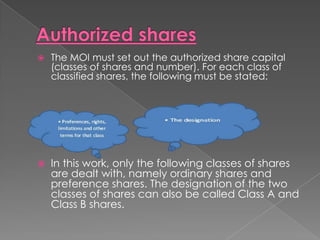
   The MOI must set out the authorized share capital
    (classes of shares and number). For each class of
    classified shares, the following must be stated:


   In this work, only the following classes of shares
    are dealt with, namely ordinary shares and
    preference shares. The designation of the two
    classes of shares can also be called Class A and
    Class B shares.
Share proportionally in the
                                       distribution of the excess assets
                                     over liabilities, after the distribution
                                     to preference shareholders, in the
                                        case of the liquidation of the
                                                    company.


Share proportionally in a dividend
  distribution by the company
 vote proportionally, but only in
 respect of an issue that affects the
 rights of the 6%
  Share proportionally in a dividend
  distribution of 6% by the company,
  before a dividend distribution is made to
  the ordinary shareholders; and
 Share proportionally in the distribution of
  the excess assets over liabilities, but
  limited to the amount of the issued 6%
  preference share capital, in the case of
  the liquidation of the company.
    The authorized share capital (class, number
    and rights) may be changed by:
    amending the MOI by special resolution (any
    amendment); or
    The board (except if the MOI provides
    otherwise) regarding increasing or decreasing
    the number of authorized shares of any class;
    or
    a notice of amendment (“NOA”) of the
    memorandum, which sets out the changes
    effected by the board and which must be filed
    with the Commission.
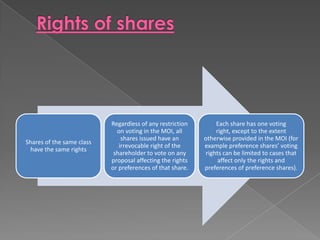
Regardless of any restriction        Each share has one voting
                             on voting in the MOI, all          right, except to the extent
                               shares issued have an       otherwise provided in the MOI (for
Shares of the same class
                              irrevocable right of the     example preference shares’ voting
 have the same rights
                            shareholder to vote on any      rights can be limited to cases that
                           proposal affecting the rights         affect only the rights and
                           or preferences of that share.   preferences of preference shares).
• Restricted voting rights for instance in
respect of preference shares;
• Preference shares enjoy preference above
any other class in respect of distributions; and
• Only a specific class of shares may share
proportionally in the distribution of the excess
of assets over liabilities in the case of the
liquidation of the company.
An authorised share of a company has no
rights associated with it until it has been
issued.
Issuing of shares in a private company
 private company initially obtains share capital by issuing its shares to
    specific individuals.
 The board of directors makes an offer to the specific individual to
    subscribe to a specific
 number of shares, at the payment of an amount as determined by the
    board of directors. After
 the amounts involved have been paid over to the company, the board
    of directors allots the
 shares to the individuals involved. (Section 39) A share certificate is
    issued to the
 shareholders and a share register is maintained.
 If a private company proposes a subsequent issue of shares, each
    shareholder of that private
 company has a right, before any other person who is not a shareholder
    of that company, to
 be offered and, within a reasonable time to subscribe, for a percentage
    of the shares to be
 issued, which is equal to the voting power of that shareholder’s general
    voting rights
 immediately before the offer was made. (Section 39).
A public company obtains share capital by “selling” its shares to the
public. The contract, in respect of which a company offers shares
for subscription, is known as a subscription contract and not as a
purchase- and sales contract. The reason for the designation
subscription contract is that the shares are incorporeal and
comprise of rights against the company, which only arise after the
shares were issued.
A public company may only make a primary offer to the public if
the offer was made by means of a prospectus. The contents of the
prospectus are regulated by the Act and its purpose is to enable
prospective shareholders to evaluate the amount of the issue price.
The prospective shareholders apply on the application form, which
must be part of the prospectus, and the relevant amount is paid
over to the company. When the application date has elapsed, the
board of directors allots the shares. A share certificate for shares in a
public company is usually not issued, since the share register is
maintained electronically. (Section 39)
Besides an issue price, a share also has a net asset value, which will
increase as the company is operated in a profitable manner during
the year, as well as a market value. Net asset value per share =
Equity (assets less liabilities) ÷ the number of issued shares. A public
company’s shares trade on the secondary market (on the JSE in the
case of a listed public company) or “over the counter” (in the case
of an unlisted public company). “Over the counter” is a facility that
is created by the relevant public company for the trading of shares
in the public company. The market value of a public company is
determined by demand and supply (market forces). The trading of
a share in the secondary market affects only the share register of
the relevant company.
 Companies Act (71 of 2008)
 Marx, Van der Watt and Bourne (2012)
  Dynamic Auditing, Chapter 2, Tenth
  Edition (Durban
 LexisNexis)
 Delport P (2011) The new Companies Act
  Manual Including Close Corporations
  and Partnerships,
 Second Edition (Durban LexisNexis).

Capitalization of a profit company

  • 2.
    Legal nature ofcompany shares  The capital of a profit company is distributed into units titled shares.  The legal nature of company shares is as follows:  A share that is issued by a company is transferable property, which can be transferred in any way as provided for or recognized in the Act or any other legislation.  Shares do not have a nominal value/par value.
  • 3.
     Shares maynot be authorize and issue at a new par value after the effective date of the 2008 Act.  Current par value shares on the effective date may however remain in existence and need not be converted. Companies with existing par value shares may continue to issue, authorized but unissued, par value shares up to the authorized share capital amount, if there are shares already in issue at the effective date.
  • 4.
    The MOI must set out the authorized share capital (classes of shares and number). For each class of classified shares, the following must be stated:  In this work, only the following classes of shares are dealt with, namely ordinary shares and preference shares. The designation of the two classes of shares can also be called Class A and Class B shares.
  • 5.
    Share proportionally inthe distribution of the excess assets over liabilities, after the distribution to preference shareholders, in the case of the liquidation of the company. Share proportionally in a dividend distribution by the company
  • 6.
     vote proportionally,but only in respect of an issue that affects the rights of the 6%
  • 7.
     Shareproportionally in a dividend distribution of 6% by the company, before a dividend distribution is made to the ordinary shareholders; and  Share proportionally in the distribution of the excess assets over liabilities, but limited to the amount of the issued 6% preference share capital, in the case of the liquidation of the company.
  • 8.
    The authorized share capital (class, number and rights) may be changed by:  amending the MOI by special resolution (any amendment); or  The board (except if the MOI provides otherwise) regarding increasing or decreasing the number of authorized shares of any class; or  a notice of amendment (“NOA”) of the memorandum, which sets out the changes effected by the board and which must be filed with the Commission.
  • 9.
    Regardless of anyrestriction Each share has one voting on voting in the MOI, all right, except to the extent shares issued have an otherwise provided in the MOI (for Shares of the same class irrevocable right of the example preference shares’ voting have the same rights shareholder to vote on any rights can be limited to cases that proposal affecting the rights affect only the rights and or preferences of that share. preferences of preference shares).
  • 10.
    • Restricted votingrights for instance in respect of preference shares; • Preference shares enjoy preference above any other class in respect of distributions; and • Only a specific class of shares may share proportionally in the distribution of the excess of assets over liabilities in the case of the liquidation of the company. An authorised share of a company has no rights associated with it until it has been issued.
  • 11.
    Issuing of sharesin a private company  private company initially obtains share capital by issuing its shares to specific individuals.  The board of directors makes an offer to the specific individual to subscribe to a specific  number of shares, at the payment of an amount as determined by the board of directors. After  the amounts involved have been paid over to the company, the board of directors allots the  shares to the individuals involved. (Section 39) A share certificate is issued to the  shareholders and a share register is maintained.  If a private company proposes a subsequent issue of shares, each shareholder of that private  company has a right, before any other person who is not a shareholder of that company, to  be offered and, within a reasonable time to subscribe, for a percentage of the shares to be  issued, which is equal to the voting power of that shareholder’s general voting rights  immediately before the offer was made. (Section 39).
  • 12.
    A public companyobtains share capital by “selling” its shares to the public. The contract, in respect of which a company offers shares for subscription, is known as a subscription contract and not as a purchase- and sales contract. The reason for the designation subscription contract is that the shares are incorporeal and comprise of rights against the company, which only arise after the shares were issued. A public company may only make a primary offer to the public if the offer was made by means of a prospectus. The contents of the prospectus are regulated by the Act and its purpose is to enable prospective shareholders to evaluate the amount of the issue price. The prospective shareholders apply on the application form, which must be part of the prospectus, and the relevant amount is paid over to the company. When the application date has elapsed, the board of directors allots the shares. A share certificate for shares in a public company is usually not issued, since the share register is maintained electronically. (Section 39)
  • 13.
    Besides an issueprice, a share also has a net asset value, which will increase as the company is operated in a profitable manner during the year, as well as a market value. Net asset value per share = Equity (assets less liabilities) ÷ the number of issued shares. A public company’s shares trade on the secondary market (on the JSE in the case of a listed public company) or “over the counter” (in the case of an unlisted public company). “Over the counter” is a facility that is created by the relevant public company for the trading of shares in the public company. The market value of a public company is determined by demand and supply (market forces). The trading of a share in the secondary market affects only the share register of the relevant company.
  • 14.
     Companies Act(71 of 2008)  Marx, Van der Watt and Bourne (2012) Dynamic Auditing, Chapter 2, Tenth Edition (Durban  LexisNexis)  Delport P (2011) The new Companies Act Manual Including Close Corporations and Partnerships,  Second Edition (Durban LexisNexis).