Community Enterprise 
start-ups 
Sophie Michelena 
Development Manager
The context…
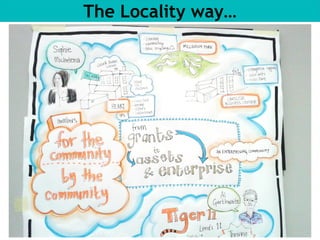
The Locality way…
Introductions
Poll 1: 
Who do you represent today? 
1. A community organisation 
2. A company/social enterprise 
3. A local authority 
4. A support organisation 
5. A consultancy firm
CONTENTS 
1. What is a community enterprise? 
Legal Matters 
2. Income generation 
Income mix 
3. Markets & Business planning 
4. Finance & Keys for success
What is a community enterprise? 
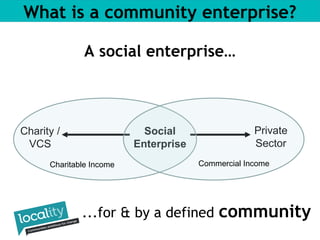
A social enterprise… 
Social 
Enterprise 
...for & by a defined community 
Charity / 
VCS 
Private 
Sector 
Charitable Income Commercial Income
What is a community enterprise? 
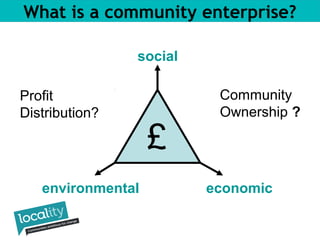
social 
£ 
Community 
Ownership ? 
Profit 
Distribution? 
environmental economic
What is a community enterprise? 
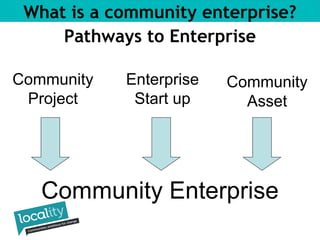
Pathways to Enterprise 
Community 
Project 
Community 
Asset 
Enterprise 
Start up 
Community Enterprise
Poll 2: 
What is your legal structure? 
1.We are unincorporated 
2.We are incorporated 
3.I don’t know
Legal Matters 
1. Social enterprise is it for me? 
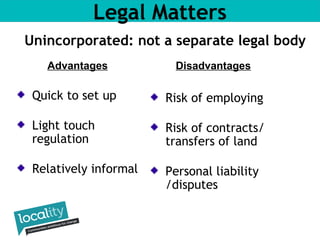
Unincorporated: not a separate legal body 
Advantages 
Quick to set up 
Light touch 
regulation 
Relatively informal 
Disadvantages 
Risk of employing 
Risk of contracts/ 
transfers of land 
Personal liability 
/disputes
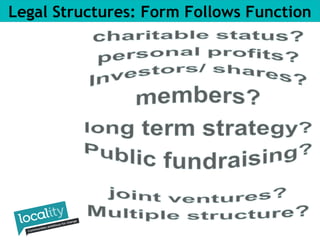
Lega1l .S Stroucciatul reenst:e Frporrimse F iosl liot wfosr Fmuen?ction
2. LLeeggaall MStartutec trusres 
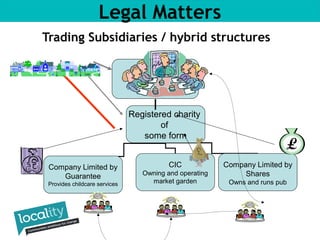
Trading Subsidiaries / hybrid structures 
Registered charity 
of 
some form 
Company Limited by 
Guarantee 
Provides childcare services 
CIC 
Owning and operating 
market garden 
Company Limited by 
Shares 
Owns and runs pub
Q & A session 1:
Income Generation 
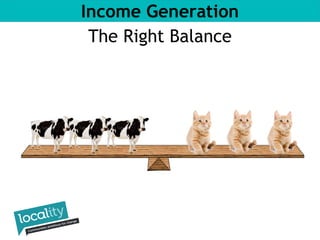
The Right Balance
Income Generation 
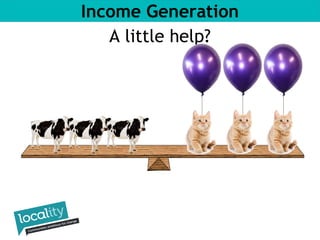
A little help?
Income Generation 
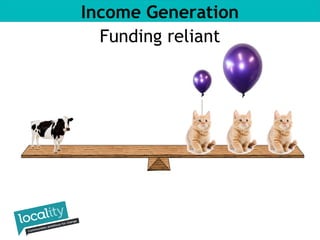
Funding reliant
Income Generation 
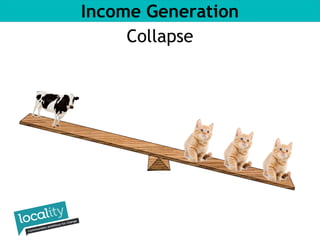
Collapse
Income Generation - TIPS 
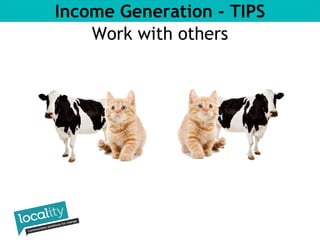
Work with others
Income Generation - TIPS 
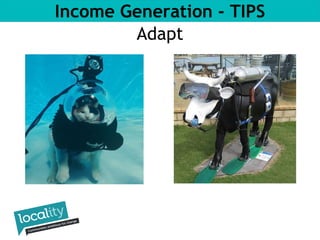
Adapt
Income Generation - TIPS 
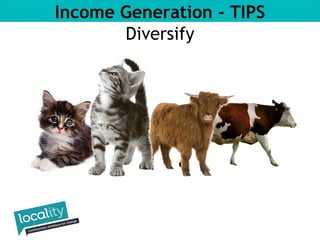
Diversify
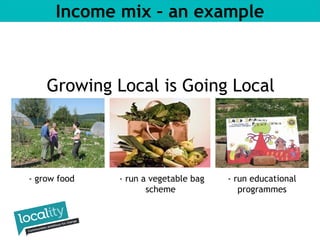
Income mix – an example 
Growing Local is Going Local 
- grow food - run educational 
programmes 
- run a vegetable bag 
scheme
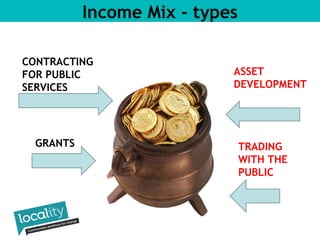
GRANTS TRADING 
WITH THE 
PUBLIC 
Income Mix - types 
CONTRACTING 
FOR PUBLIC 
SERVICES 
ASSET 
DEVELOPMENT
Q & A session 2:
Markets 
WHAT is needed in YOUR area???
Poll 3: 
How much information have you got from listening to 
your community’s needs and doing market 
research/competitor analysis? 
-Not much at all 
-Some, could do better 
-Enough, happy with it 
-We have lots of useful data
Business Planning 
Why write a business plan? 
• understand your organisation and where it’s 
going 
• raise awareness & obtain approval/funding 
from others 
• from a concept to the detail 
• help you track progress
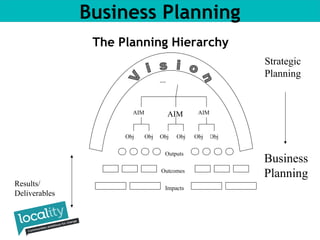
The Planning Hierarchy 
MISSION 
AIM AIM AIM 
Obj Obj Obj Obj Obj Obj 
Outputs 
Outcomes 
Impacts Results/ 
Deliverables 
Strategic 
Planning 
Business 
Planning 
Business Planning
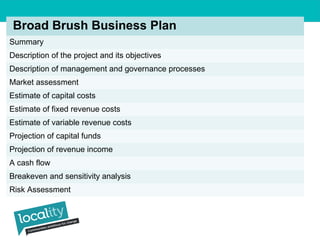
Broad Brush Business Plan 
Summary 
Description of the project and its objectives 
Description of management and governance processes 
Market assessment 
Estimate of capital costs 
Estimate of fixed revenue costs 
Estimate of variable revenue costs 
Projection of capital funds 
Projection of revenue income 
A cash flow 
Breakeven and sensitivity analysis 
Risk Assessment
Q & A session 3:
Finance Needs 
What Do You Want It For? 
–Development Finance – grow change or die - 
(for R&D, new project development, investment readiness, 
future planning) 
–Capital development – acquiring assets - for 
refurb, new build, equipment 
–Working Capital – 
–Early trading 
–Monthly turnover
Financial & Social Capital 
– http://locality.org.uk/projects/power-change/investment-• Local or National Grants 
• Big Lottery 
• Community Foundations 
• Social investors 
• Key Fund 
• Charity Bank, Triodos Bank, Unity Bank 
• Community investors 
• Share issue 
• Donations/crowdfunding
Keys for success 
1. Know your USP 
2. Be ‘business like’ – negotiate 
3. Be outward looking and opportunistic 
4. Have the confidence to invest in an idea 
5. Take Business Planning seriously 
6. Strong risk management (but being willing to take risks) 
7. Think about customers (not just beneficiaries) 
8. Sell your service and organisation 
9. Skills, knowledge, experience in your field 
10.ENTERPRISING ATTITUDE 
?
Poll 4: 
What score did you get out of 10? 
•1-3 
•4-6 
•7-9 
•10
Q & A session 4:
Sources of support 
Power to change 
http://locality.org.uk/projects/power-change/ 
Guides and support tools 
http://locality.org.uk/projects/power-change/ 
resources-tools/resources-community-enterprises/ 
Contracts/Services pre-feasibility 
http://mycommunityrights.org.uk/community-right- 
to-challenge/grants/
Thank you! 
If you want to network with others 
Locality convention 
17 & 18 Nov, Cardiff 
Sophie.michelena@locality.org.uk
Join our next webinar on 
community enterprise 
Dates TBC 
locality.org.uk/subscribe/

Community enterprise start-ups

  • 1.
    Community Enterprise start-ups Sophie Michelena Development Manager
  • 2.
  • 3.
  • 4.
  • 5.
    Poll 1: Whodo you represent today? 1. A community organisation 2. A company/social enterprise 3. A local authority 4. A support organisation 5. A consultancy firm
  • 6.
    CONTENTS 1. Whatis a community enterprise? Legal Matters 2. Income generation Income mix 3. Markets & Business planning 4. Finance & Keys for success
  • 7.
    What is acommunity enterprise? A social enterprise… Social Enterprise ...for & by a defined community Charity / VCS Private Sector Charitable Income Commercial Income
  • 8.
    What is acommunity enterprise? social £ Community Ownership ? Profit Distribution? environmental economic
  • 9.
    What is acommunity enterprise? Pathways to Enterprise Community Project Community Asset Enterprise Start up Community Enterprise
  • 10.
    Poll 2: Whatis your legal structure? 1.We are unincorporated 2.We are incorporated 3.I don’t know
  • 11.
    Legal Matters 1.Social enterprise is it for me? Unincorporated: not a separate legal body Advantages Quick to set up Light touch regulation Relatively informal Disadvantages Risk of employing Risk of contracts/ transfers of land Personal liability /disputes
  • 12.
    Lega1l .S Stroucciatulreenst:e Frporrimse F iosl liot wfosr Fmuen?ction
  • 13.
    2. LLeeggaall MStartutectrusres Trading Subsidiaries / hybrid structures Registered charity of some form Company Limited by Guarantee Provides childcare services CIC Owning and operating market garden Company Limited by Shares Owns and runs pub
  • 14.
    Q & Asession 1:
  • 15.
    Income Generation TheRight Balance
  • 16.
    Income Generation Alittle help?
  • 17.
  • 18.
  • 19.
    Income Generation -TIPS Work with others
  • 20.
  • 21.
    Income Generation -TIPS Diversify
  • 22.
    Income mix –an example Growing Local is Going Local - grow food - run educational programmes - run a vegetable bag scheme
  • 23.
    GRANTS TRADING WITHTHE PUBLIC Income Mix - types CONTRACTING FOR PUBLIC SERVICES ASSET DEVELOPMENT
  • 24.
    Q & Asession 2:
  • 25.
    Markets WHAT isneeded in YOUR area???
  • 26.
    Poll 3: Howmuch information have you got from listening to your community’s needs and doing market research/competitor analysis? -Not much at all -Some, could do better -Enough, happy with it -We have lots of useful data
  • 27.
    Business Planning Whywrite a business plan? • understand your organisation and where it’s going • raise awareness & obtain approval/funding from others • from a concept to the detail • help you track progress
  • 28.
    The Planning Hierarchy MISSION AIM AIM AIM Obj Obj Obj Obj Obj Obj Outputs Outcomes Impacts Results/ Deliverables Strategic Planning Business Planning Business Planning
  • 29.
    Broad Brush BusinessPlan Summary Description of the project and its objectives Description of management and governance processes Market assessment Estimate of capital costs Estimate of fixed revenue costs Estimate of variable revenue costs Projection of capital funds Projection of revenue income A cash flow Breakeven and sensitivity analysis Risk Assessment
  • 30.
    Q & Asession 3:
  • 31.
    Finance Needs WhatDo You Want It For? –Development Finance – grow change or die - (for R&D, new project development, investment readiness, future planning) –Capital development – acquiring assets - for refurb, new build, equipment –Working Capital – –Early trading –Monthly turnover
  • 32.
    Financial & SocialCapital – http://locality.org.uk/projects/power-change/investment-• Local or National Grants • Big Lottery • Community Foundations • Social investors • Key Fund • Charity Bank, Triodos Bank, Unity Bank • Community investors • Share issue • Donations/crowdfunding
  • 33.
    Keys for success 1. Know your USP 2. Be ‘business like’ – negotiate 3. Be outward looking and opportunistic 4. Have the confidence to invest in an idea 5. Take Business Planning seriously 6. Strong risk management (but being willing to take risks) 7. Think about customers (not just beneficiaries) 8. Sell your service and organisation 9. Skills, knowledge, experience in your field 10.ENTERPRISING ATTITUDE ?
  • 34.
    Poll 4: Whatscore did you get out of 10? •1-3 •4-6 •7-9 •10
  • 35.
    Q & Asession 4:
  • 36.
    Sources of support Power to change http://locality.org.uk/projects/power-change/ Guides and support tools http://locality.org.uk/projects/power-change/ resources-tools/resources-community-enterprises/ Contracts/Services pre-feasibility http://mycommunityrights.org.uk/community-right- to-challenge/grants/
  • 37.
    Thank you! Ifyou want to network with others Locality convention 17 & 18 Nov, Cardiff Sophie.michelena@locality.org.uk
  • 38.
    Join our nextwebinar on community enterprise Dates TBC locality.org.uk/subscribe/

Editor's Notes

  • #3 Visual representation of the coalition, Squeeze on the public purse and he credit crunch
  • #7 All participants encouraged to ask questions throughout
  • #8 Social enterprise often seen as being slap bang in the middle of the private sector and the charitable sector
  • #9 Here’s another diagram that represents social enterprise – all these points are outcomes – the reasons why we do things - So benefits can be one of these three the big £ sign in the middle makes the world go round – so with a strong financially sound business model it all collapses and we have nothing Money bit turns into a cow – that’s the cash cow Underpinned by a business model that has to make money
  • #14 Different funders / funding requirements/ markets may require different legal structures
  • #15 Back ups: What are the benefits of being a charity as well as a company? What is the most common legal form for a social enterprise?
  • #16 Secret is getting balance right You can think about this as enterprise on one side and social on the other Most often the concern is about keeping the cats and being able to afford to keep those cats and chasing money towards this end However many organisations have actually experienced significant mission drift – they have become concerned with ‘keeping the organisation going’ above and therefore have ended up being financially successful but have lost the plot in relation to what they we established for.
  • #17 Nic – COWS = event hire + consultancy, CATS = community events, digital lounge Sometimes in order to get the see saw to balance an extra injection is needed to get the business model to stack up Let’s think about the most cliched social enterprise in the world – the community café More often than not these are selling healthy food (with a high cost base) to customers which don’t have a lot of money. So in this case the cats are the people benefitting from healthy food, local people being trained and employed The cows is the money they’re handing over the counter to buy it In order to keep it cheap enough for people with little disposable income to buy that healthy food an element of subsidy is needed So what do you think the ballons are? Balloons could be grant Balloons could be cross subsidy from another enterprise from a bigger organisation Balloons could be basing the café within a bigger building (i.e. an asset owned by the enterprise) and not charging rent or expecting to contribute towards services Balloons could be a contract for delivering training Not all social enterprises need the balloons
  • #18 One the cow side our activities become less fruitful in terms of income generation And we lose a grant, or it shrinks, or it stops being a grant and they turn it into a contract that is too big for the organisation to benefit from
  • #20 Nic: income from job centre for the job club Increasing being pushed forward as a solution is partnership work. Despite their view on the localism the government has the view that the way in which the VCS or CSS competes is through increasing scale So consortia working around contract delivery – which even with consortia is still very challenging and procurement processes need to be designed to be far more accepting of consortia – (i.e. I’ve known tenders to be marked down cos consortia was seen as a too complicated delivery model and even when they say consortia it’s actually a lead contractor and several subcontractors (with that lead having to accept the financial risk) We’re currently exploring how collaboration can support the sector – so joint purchases power on insurance for example, organisations joining up to lobby power holders – so a sense of collective unionism on changing policy and funding regimes to be more sympathetic to the sector, even a consideration of merger
  • #21 Excellent book out by tim harford – undercover economist – google it and get you tube introduction Organisations that have been around 100 years do something completely different than they used to do An organisation I’ve forgotten the name of had bike recycling scheme – they never made any money at first But the thing that’s changed is the scrap metal market (the price of scrap metal shot up) – can get rid of stuff they don’t want and now there’s a margin that didn’t used to be there Most successful members – are the ones that have tried things a ditched things All saints action network used to do furniture recycling – at a time when there were new VCS organisations setting up it worked really well but more recently cos of a slow down in start up activity they’ve been stuck with a big storage problem Still do small scale stuff on line but largely dropped it and used the storage for a new architectural salvage project instead But when market went down they didn’t hesitate If you don’t try new things and expect to fail now and again yo could be putting the organisation as a whole at risk
  • #22 Consider a strong diversity of income streams Nothing wrong with grant But mix it with contract and direct selling of products or services, money from asset ownership and sweating etc But the other aspect of considering diversity is diversification of activities – so we do something else – we have multiple business or activity streams and then we end up with the following dilema
  • #23 Mix Sell bags money from contracts Don’t grow enough produce to make it viable without Allotment is part of the farm – good relationship with farmer
  • #24 Nic’s experience: Grants Trading Contracting Asset development
  • #25 Back up: It is very hard for a new enterprise to get access to public contracts… what do you suggest? (consortium, right to challenge…)
  • #28 Nic to say the truth about how useful a business plan is
  • #30 Whatever is filled into this template at the very outset can then be used to identify what areas need ftuerh work. By asking how do you know in answer to every question you can then address issues such as the quality of the evidence base.
  • #31 Backup: How long should a business plan be, and do I have to write more than one?
  • #32 Investment Readiness Long term business planning – third sector organisations often need to develop their business plans over a much longer term than is usual in the business sector. This will often involve assessing more rigorously their existing business and understanding in more detail the strength of their balance sheet and the ability of different service delivery activities to cover costs and contribute to surplus. Leadership and appropriate Board skills need to be assessed. Development business planning – taking on an asset is a major addition for most third sector organisations and a comprehensive business plan covering development, capital build, and trading start up is required. The cash flow consequences need thinking through. Tricky issues such as planning permission, VAT and State Aid need consideration. Project management and the ongoing management requirements of maintaining existing service delivery also need consideration. Governance and legal status need to be fit for purpose. Practitioner based learning networks - benchmarking and market research – third sector organisations can learn a great deal through visiting and studying what other organisations have got right and wrong. Capital Development Capital Post Investment (Early Trading and Working Capital).
  • #33 Nic: Not being a grant junkie, but building relationship with funders
  • #34 If you have lower than 5, find other people to join you who have these skills Above than 5, go on and start one!
  • #36 Backup: Where can I meet others trying to set up a similar enterprise?