THE IDEA 1
 1.1
 GENERATING IDEAS:
 NEED AND OPPORTUNITY

. Generating Ideas - Deciding What To Do!

. Understanding Project Development

. Working With Groups - The Development Role

. Development Notes

. Shiverton Exercise Notes - Setting The Agenda
  For The Role Play Exercise

. Shiverton Town Council Population Statistics


                                                  P 05
GENERATING IDEAS: NEED AND OPPORTUNITY 1.1
 GENERATING IDEAS -
 DECIDING WHAT TO DO!
 Once a group has been formed and information collected, it
 meets to adopt a priority list of 'good ideas' to pursue. Selecting
 ideas, testing them, planning and gathering funds and other
 resources to get off the ground can be lengthy. Take your time
 and plan thoroughly.


Finding Business Ideas                       It is usually easier and cheaper to set up a
                                             service business than a manufacturing one,
 There are 3 main ways of finding ideas:     especially as the market for the services is
                                             more likely to be local, less equipment is
 1 : What can local people do? What          needed and less money required starting
 skills do they have?                        up. There’s usually less risk because market
 It is much easier to build a business       research is easier and there are less likely
 idea around real people who have            to be established competitors. You could get
 particular skills.                          ideas from asking local people, advertising
                                             in the local paper or radio, asking local
 2 : Is someone else running a social
                                             businesses or even running a competition
 enterprise that you could copy or
                                             with local school children.
 apply locally?
 Particularly if you’re not competing, the
                                             At a brainstorming session many ideas will
 social enterprise may be willing to share
                                             emerge, the more the merrier. But at some
 their experience with you or even help
                                             stage you will need to prioritise certain ideas
 you set up.
                                             and this has to be something the whole
 3 : What goods and services are needed      group agrees with and is committed to.
 in your locality?
 There are many goods and services
 the private sector doesn’t think it
 profitable to supply to some (your?)
 communities. Make a list of things
 your social enterprise might provide.


                                                                                     P 06
GENERATING IDEAS: NEED AND OPPORTUNITY 1.1
Testing The Idea                                Skills and Resources
In many deprived areas, the local economy       Are there enough of the right people with
doesn’t have enough money circulating to        the right sort of skills locally? Or are you
support new businesses: there’s not enough      going to have to recruit?
return on investment for the private sector.
But for a social enterprise interested in        The people running a social enterprise
breaking-even while employing local people       must have:
there may be enough business to make it
worthwhile. Alternatively, you could target      . The technical skills to provide the
more affluent areas and customers who              service or make a product
might provide sufficient income to make          . The ability to organise themselves
profit, and then return that profit to your
                                                   and the business, managing people
home community through donations or
                                                   and resources
supporting community initiatives or projects.
                                                 . The ability to co-operate effectively
 The main task is to answer
                                                 . The skill and knowledge
 these questions:
                                                   to manage finance
 . Is the idea viable?

 . Do people have the necessary                 Business can be complex and highly
                                                competitive. It’s important that you assess
   skills and abilities?
                                                what skills and knowledge you have, analyse
 . Will it sell?                                the gaps and come up with strategies for
                                                filling them, whether by training, access to
 . Will it pay?
                                                expert advice or recruitment. Many skills can
 . Can it be resourced?                         be learnt ’on the job’ but if you have to be
                                                successful from the start, you may need to
                                                think about appointing a business manager
Usually, it is fairly obvious whether or not
                                                to ensure the business is set up right and is
the business can be done and is technically
                                                managed properly.
possible. However, a new product or idea
may need testing in the market and to see
if it will work. You may need to create a
prototype, perhaps with the help of
workshops in local colleges.


                                                                                         P 07
GENERATING IDEAS: NEED AND OPPORTUNITY 1.1
Will It Sell?                                   Will It Be Funded?
A common mistake is for a group to              Some brilliant ideas just can’t or won’t be
decide that because they want something,        funded. It is possible to change people’s
everyone does. Or that because a service        thinking and to persuade them to fund a
is needed, there are enough people able         project they initially oppose or don’t see
to afford it. Or that a service is needed       the value of. But you’d be wise to check out
and it will be able to capture 100% of the      the likelihood of getting funding or support
market from existing competitors. These         for each of your ideas before going too far
assumptions must be tested. Inevitably, this    down the planning stage.
means market research, and not just ’desk
research’ in libraries, business centres or
via the net but actually talking to people,     Does It Deliver A Real Benefit?
investigating potential competitors, digging
                                                Things that do are likely to last longer and
deeply into why people buy things, how
                                                be supported politically and financially and
much they are willing to spend, how much
                                                by the community when it counts. You may
it costs to provide a service or make and
                                                need that support and sometimes its better
sell particular goods and so on. Remember,
                                                to, say, plan to create more employment
you are not the customer and may not
                                                and less social profit (because that’s what
know what the customer will buy.
                                                people value) rather than employing fewer
                                                people but making more money. It's not
                                                just what you would like to do, but also
Will It Pay?                                    what works out there.
You may be able to sell your product or
service but will you make any money doing
it? What will people pay compared to all the
costs involved in making the product: do
you know? How many products will you
need to produce a year or how often will
the service be bought? What income will
that generate? You need to work out how
much it will cost to do a thing and then find
out if the price you plan to charge (or that
people are willing to pay) will cover your
costs. Don’t be put off if the sums don’t
add up at first. You may need to change
your product or who you are selling it to
or how and where you market it. Planning
a business is a kind of back-and-forth
discussion between the business (you)
and the market/your customers.


                                                                                      P 08
GENERATING IDEAS: NEED AND OPPORTUNITY 1.1
  UNDERSTANDING
  PROJECT DEVELOPMENT
Why Plan Projects?                             The Project Planning Process
Any project which is properly planned and      The first stage in project planning
managed has a greater chance of success.       is to set goals
And success is important if you are trying
                                               The second stage of project planning is to
to create self-sustaining processes of
                                               consider the external factors that will affect
regeneration, development or meeting
                                               the project (like ’the market’ or ’funding
changing social and community needs.
                                               opportunities’)

 Project planning involves certain basic       The third stage is to discuss and adopt
 and common activities:                        appropriate strategies based both on your
                                               goals and the external environment.
 . Allocating resources

 . Setting timetables                          Project planning requires both a clear
                                               focus, and appreciation of other people’s
 . Identifying targets for achievement         goals and agendas and flexibility to
                                               accommodate both. Any group managing
Project planning will also usually depend      a project planning process needs to be
on the co-operation and support of other       pragmatic, open-minded and willing
people. You usually have to co-operate with    to adapt.
others to get a project going or sustain it.
People will need to be persuaded the project
is a good idea. And those with political or
financial support will also need to be
engaged with.


                                                                                       P 09
GENERATING IDEAS: NEED AND OPPORTUNITY 1.1
Phases Of Project Development                    Reviewing And Agreeing The Action Plan

Winning Support For The Project - the            Your plan must:
project needs to be well thought out and         . Be broadly compatible with the needs
have a match with the goals of key players         and goals of those involved
and stakeholders
                                                 . Have a fit with the goals of funders
Clarifying Goals - to work you first have          and stakeholders
to identify all the people with a stake in the   . Be broadly supported both internally
project or who might be affected by it and
                                                   (within the group and community)
get them on board through a series of
                                                   and externally (with key players and
meetings or interviews
                                                   interest groups)
Researching Possible Solutions - once goals      . Be robust and defensible
have been identified its easier to identify      . Have identified counter-arguments and
potential solutions which will need to be
                                                   potential (worse) alternatives
looked into and tested. Are they practical?
Will they work locally? What factors for         Undertaking The Project - once you get
success must be present? Has the idea            approval, start early in order to ward off
worked well elsewhere, and why?                  criticism, damp down scepticism and
                                                 prevent competing groups ’recalling’
Making Proposals - these must be
                                                 the decision to go ahead.
detailed statements of the aims, means
and requirements of the project in terms
of money and other resources. The aim             Make sure you have achievable
of the proposal is to win or retain the           milestones in place and measurable
support of the individuals and stakeholders       progress indicators.
involved. At this stage it’s always a good
                                                  Make sure decisions can be made
idea to have an alternative proposal to
                                                  quickly, especially decisions about
hand in case the first is rejected or needs
                                                  putting things right when they're
extensive modifying.
                                                  going wrong.

                                                  Ensure allies are kept informed about
                                                  the project's progress.

                                                  Ensure that there is sufficient time
                                                  for the project to succeed; don't let
                                                  people with other agendas impose
                                                  early evaluation on the project.


                                                                                          P 10
GENERATING IDEAS: NEED AND OPPORTUNITY 1.1
  WORKING WITH GROUPS -
  THE DEVELOPMENT ROLE
  An individual working in the community may have to take on
  a development role. They may be asked to lead or work as part
  of a team developing a new local service. They may be assisting
  an organisation draw up plans. They may be helping put plans
  into practice.


One mistake that is often made is that        d) Does decision-making leave
’development’ and ’training’ become           members empowered or do they feel
confused. One is seen as a substitute for     left out/disempowered?
another or a precondition for progress.
                                              Different levels of participation affect how
                                              people engage with and contribute to the
Training is any learning situation with an
                                              project or group aim and therefore how a
underlying purpose and an ongoing process.
                                              project develops. Those leading the process
Development is about putting ’lessons’ into
                                              will need to make decisions about the kinds
practice, actually making use of acquired
                                              of information that can be given to all or
skills, assisting a group to maximise the
                                              part of the group and monitor and balance
benefits from learning. Keeping training
                                              out ’inequalities’ that may arise because
and development properly focused and
                                              of different levels of participation in the
balanced can be very hard to do. Planning
                                              development and/or learning process.
group development and having a clear
timetable for development, properly
                                              2 : How Do You Combine Training And
monitored, can help.
                                              Development Work?
                                              a) How will you measure learning success?
Some Development Issues                       What access to training will people in the
                                              group have?
1 : Developing Ideas Together
                                              b) How will you apply what is learnt?
a) How will the group share information
and ideas? Are there problems in how it       c) How will you deal with different levels
plans to use information?                     of competence/confidence/skills?

b) How do the interactions between group      The development process will go better
members affect the development process?       if all people involved engage and interact
c) Is the right information coming to the     positively, share tasks and fairly delegate,
group in a way that is understood and         get and use feedback, encourage discussion
can be used?                                  and questioning and develop an agreed
                                              decision-making process.


                                                                                      P 11
GENERATING IDEAS: NEED AND OPPORTUNITY 1.1
3 : Managing Development Work                    4 : Planning Group Work
The first rule is to be flexible. There are no   Planning involves:
hard and fast rules about the development
                                                 a) Resource analysis
process. Decisions will need to be made
about time and resources (especially). There     b) Assessing and choosing appropriate
will need to be some structure. But this may     development techniques
well be different each time. Making the right    c) Analysis of group needs
decisions about who to involve and what
                                                 d) Assessment of skills and experiences
needs to be done and how is crucial.
                                                 Planning the development process
The group will also need to correctly assess
                                                 can either be worker-led, group-led or
its ability to carry a workload, deal with
                                                 a joint/collective decision between all
unexpected developments, delegate and
                                                 parties. Whichever applies, someone
co-ordinate work and so on. Some groups
                                                 must be in control.
accept work willingly, others do not. Some
groups depend on outside assistance, others      Group involvement in planning the
may resist external help or involvement.         development process can be very
                                                 important in validating it.
Difficulties may arise from:
a) Outsiders playing a leadership rather         Someone in the group must schedule and
than a support role. In the reverse case,        manage regular reviews of progress and
some groups expect ’experts’ to lead and         how development is going. Changes to the
the process stalls when this isn’t offered.      process may need to be negotiated and
                                                 agreed within the group. Sometimes
b) Incorrect decisions about task allocation
                                                 reviewing and making decisions may take
and individual levels of involvement.
                                                 place in a formal process, sometimes
c) Bad resource allocation, misdirected          informal. Both have equal validity but one
effort or misunderstanding the symbolic          may be more appropriate than the other.
significance of situations or decisions.


                                                                                           P 12
GENERATING IDEAS: NEED AND OPPORTUNITY 1.1
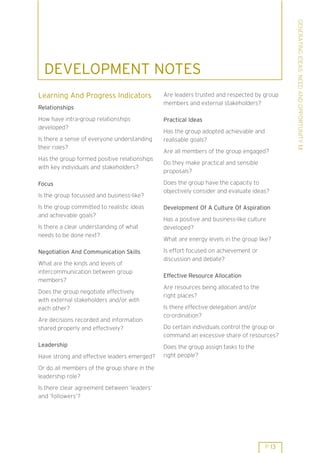
  DEVELOPMENT NOTES
Learning And Progress Indicators              Are leaders trusted and respected by group
                                              members and external stakeholders?
Relationships
How have intra-group relationships            Practical Ideas
developed?
                                              Has the group adopted achievable and
Is there a sense of everyone understanding    realisable goals?
their roles?
                                              Are all members of the group engaged?
Has the group formed positive relationships
                                              Do they make practical and sensible
with key individuals and stakeholders?
                                              proposals?

Focus                                         Does the group have the capacity to
                                              objectively consider and evaluate ideas?
Is the group focussed and business-like?
Is the group committed to realistic ideas     Development Of A Culture Of Aspiration
and achievable goals?
                                              Has a positive and business-like culture
Is there a clear understanding of what        developed?
needs to be done next?
                                              What are energy levels in the group like?

Negotiation And Communication Skills          Is effort focused on achievement or
                                              discussion and debate?
What are the kinds and levels of
intercommunication between group
                                              Effective Resource Allocation
members?
                                              Are resources being allocated to the
Does the group negotiate effectively
                                              right places?
with external stakeholders and/or with
each other?                                   Is there effective delegation and/or
                                              co-ordination?
Are decisions recorded and information
shared properly and effectively?              Do certain individuals control the group or
                                              command an excessive share of resources?
Leadership                                    Does the group assign tasks to the
Have strong and effective leaders emerged?    right people?

Or do all members of the group share in the
leadership role?
Is there clear agreement between ’leaders’
and ’followers’?


                                                                                     P 13
GENERATING IDEAS: NEED AND OPPORTUNITY 1.1
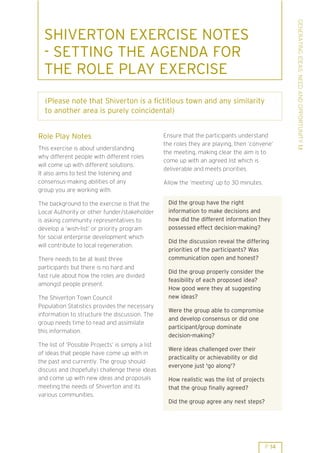
  SHIVERTON EXERCISE NOTES
  - SETTING THE AGENDA FOR
  THE ROLE PLAY EXERCISE
  (Please note that Shiverton is a fictitious town and any similarity
  to another area is purely coincidental)


Role Play Notes                                    Ensure that the participants understand
                                                   the roles they are playing, then ’convene’
This exercise is about understanding
                                                   the meeting, making clear the aim is to
why different people with different roles
                                                   come up with an agreed list which is
will come up with different solutions.
                                                   deliverable and meets priorities.
It also aims to test the listening and
consensus-making abilities of any                  Allow the ’meeting’ up to 30 minutes.
group you are working with.

The background to the exercise is that the          Did the group have the right
Local Authority or other funder/stakeholder         information to make decisions and
is asking community representatives to              how did the different information they
develop a ’wish-list’ or priority program           possessed effect decision-making?
for social enterprise development which
                                                    Did the discussion reveal the differing
will contribute to local regeneration.
                                                    priorities of the participants? Was
There needs to be at least three                    communication open and honest?
participants but there is no hard and
                                                    Did the group properly consider the
fast rule about how the roles are divided
                                                    feasibility of each proposed idea?
amongst people present.
                                                    How good were they at suggesting
The Shiverton Town Council                          new ideas?
Population Statistics provides the necessary
                                                    Were the group able to compromise
information to structure the discussion. The
                                                    and develop consensus or did one
group needs time to read and assimilate
                                                    participant/group dominate
this information.
                                                    decision-making?
The list of ’Possible Projects’ is simply a list
                                                    Were ideas challenged over their
of ideas that people have come up with in
                                                    practicality or achievability or did
the past and currently. The group should
                                                    everyone just 'go along'?
discuss and (hopefully) challenge these ideas
and come up with new ideas and proposals            How realistic was the list of projects
meeting the needs of Shiverton and its              that the group finally agreed?
various communities.
                                                    Did the group agree any next steps?


                                                                                             P 14
GENERATING IDEAS: NEED AND OPPORTUNITY 1.1
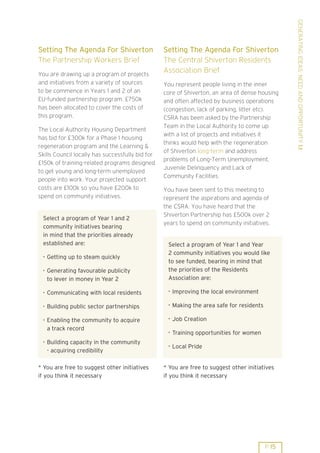
Setting The Agenda For Shiverton                  Setting The Agenda For Shiverton
The Partnership Workers Brief                     The Central Shiverton Residents
You are drawing up a program of projects
                                                  Association Brief
and initiatives from a variety of sources         You represent people living in the inner
to be commence in Years 1 and 2 of an             core of Shiverton, an area of dense housing
EU-funded partnership program. £750k              and often affected by business operations
has been allocated to cover the costs of          (congestion, lack of parking, litter etc).
this program.                                     CSRA has been asked by the Partnership
                                                  Team in the Local Authority to come up
The Local Authority Housing Department
                                                  with a list of projects and initiatives it
has bid for £300k for a Phase 1 housing
                                                  thinks would help with the regeneration
regeneration program and the Learning &
                                                  of Shiverton long-term and address
Skills Council locally has successfully bid for
                                                  problems of Long-Term Unemployment,
£150k of training-related programs designed
                                                  Juvenile Delinquency and Lack of
to get young and long-term unemployed
                                                  Community Facilities.
people into work. Your projected support
costs are £100k so you have £200k to              You have been sent to this meeting to
spend on community initiatives.                   represent the aspirations and agenda of
                                                  the CSRA. You have heard that the
                                                  Shiverton Partnership has £500k over 2
 Select a program of Year 1 and 2
                                                  years to spend on community initiatives.
 community initiatives bearing
 in mind that the priorities already
 established are:                                  Select a program of Year 1 and Year
 . Getting up to steam quickly                     2 community initiatives you would like
                                                   to see funded, bearing in mind that
 . Generating favourable publicity                 the priorities of the Residents
   to lever in money in Year 2                     Association are:

 . Communicating with local residents              . Improving the local environment

 . Building public sector partnerships             . Making the area safe for residents

 . Enabling the community to acquire               . Job Creation
   a track record                                  . Training opportunities for women
 . Building capacity in the community
                                                   . Local Pride
   - acquiring credibility

* You are free to suggest other initiatives       * You are free to suggest other initiatives
if you think it necessary                         if you think it necessary


                                                                                          P 15
GENERATING IDEAS: NEED AND OPPORTUNITY 1.1
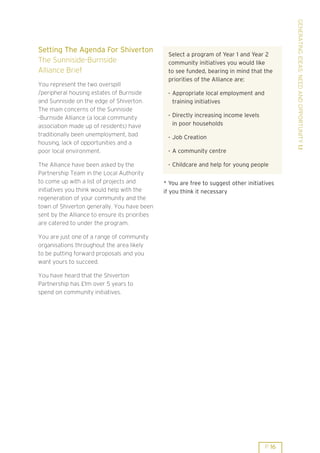
Setting The Agenda For Shiverton
                                                 Select a program of Year 1 and Year 2
The Sunniside-Burnside                           community initiatives you would like
Alliance Brief                                   to see funded, bearing in mind that the
                                                 priorities of the Alliance are:
You represent the two overspill
/peripheral housing estates of Burnside          . Appropriate local employment and
and Sunniside on the edge of Shiverton.            training initiatives
The main concerns of the Sunniside
                                                 . Directly increasing income levels
-Burnside Alliance (a local community
association made up of residents) have             in poor households
traditionally been unemployment, bad             . Job Creation
housing, lack of opportunities and a
poor local environment.                          . A community centre

The Alliance have been asked by the              . Childcare and help for young people
Partnership Team in the Local Authority
to come up with a list of projects and          * You are free to suggest other initiatives
initiatives you think would help with the       if you think it necessary
regeneration of your community and the
town of Shiverton generally. You have been
sent by the Alliance to ensure its priorities
are catered to under the program.

You are just one of a range of community
organisations throughout the area likely
to be putting forward proposals and you
want yours to succeed.

You have heard that the Shiverton
Partnership has £1m over 5 years to
spend on community initiatives.


                                                                                       P 16
GENERATING IDEAS: NEED AND OPPORTUNITY 1.1
  SHIVERTON TOWN COUNCIL
  POPULATION STATISTICS
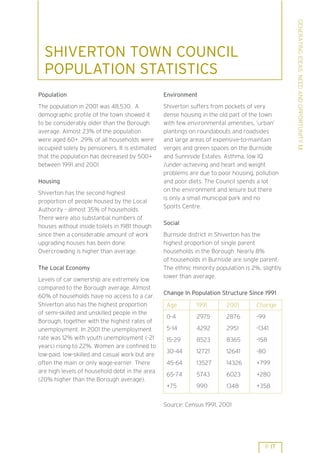
Population                                       Environment
The population in 2001 was 48,530. A             Shiverton suffers from pockets of very
demographic profile of the town showed it        dense housing in the old part of the town
to be considerably older than the Borough        with few environmental amenities, ’urban’
average. Almost 23% of the population            plantings on roundabouts and roadsides
were aged 60+. 29% of all households were        and large areas of expensive-to-maintain
occupied solely by pensioners. It is estimated   verges and green spaces on the Burnside
that the population has decreased by 500+        and Sunniside Estates. Asthma, low IQ
between 1991 and 2001.                           /under-achieving and heart and weight
                                                 problems are due to poor housing, pollution
Housing                                          and poor diets. The Council spends a lot
                                                 on the environment and leisure but there
Shiverton has the second highest
                                                 is only a small municipal park and no
proportion of people housed by the Local
                                                 Sports Centre.
Authority - almost 35% of households.
There were also substantial numbers of
                                                 Social
houses without inside toilets in 1981 though
since then a considerable amount of work         Burnside district in Shiverton has the
upgrading houses has been done.                  highest proportion of single parent
Overcrowding is higher than average.             households in the Borough. Nearly 8%
                                                 of households in Burnside are single parent.
The Local Economy                                The ethnic minority population is 2%, slightly
                                                 lower than average.
Levels of car ownership are extremely low
compared to the Borough average. Almost
                                                 Change In Population Structure Since 1991
60% of households have no access to a car.
Shiverton also has the highest proportion         Age        1991        2001        Change
of semi-skilled and unskilled people in the
                                                  0-4        2975        2876        -99
Borough, together with the highest rates of
unemployment. In 2001 the unemployment            5-14       4292        2951        -1341
rate was 12% with youth unemployment (-21         15-29      8523        8365        -158
years) rising to 22%. Women are confined to
                                                  30-44      12721       12641       -80
low-paid, low-skilled and casual work but are
often the main or only wage-earner. There         45-64      13527       14326       +799
are high levels of household debt in the area
                                                  65-74      5743        6023        +280
(20% higher than the Borough average).
                                                  +75        990         1348        +358


                                                 Source: Census 1991, 2001


                                                                                        P 17
GENERATING IDEAS: NEED AND OPPORTUNITY 1.1
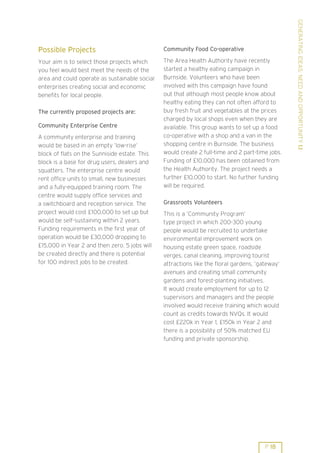
Possible Projects                              Community Food Co-operative

Your aim is to select those projects which     The Area Health Authority have recently
you feel would best meet the needs of the      started a healthy eating campaign in
area and could operate as sustainable social   Burnside. Volunteers who have been
enterprises creating social and economic       involved with this campaign have found
benefits for local people.                     out that although most people know about
                                               healthy eating they can not often afford to
The currently proposed projects are:           buy fresh fruit and vegetables at the prices
                                               charged by local shops even when they are
Community Enterprise Centre                    available. This group wants to set up a food
A community enterprise and training            co-operative with a shop and a van in the
would be based in an empty ’low-rise’          shopping centre in Burnside. The business
block of flats on the Sunniside estate. This   would create 2 full-time and 2 part-time jobs.
block is a base for drug users, dealers and    Funding of £10,000 has been obtained from
squatters. The enterprise centre would         the Health Authority. The project needs a
rent office units to small, new businesses     further £10,000 to start. No further funding
and a fully-equipped training room. The        will be required.
centre would supply office services and
a switchboard and reception service. The       Grassroots Volunteers
project would cost £100,000 to set up but      This is a ’Community Program’
would be self-sustaining within 2 years.       type project in which 200-300 young
Funding requirements in the first year of      people would be recruited to undertake
operation would be £30,000 dropping to         environmental improvement work on
£15,000 in Year 2 and then zero. 5 jobs will   housing estate green space, roadside
be created directly and there is potential     verges, canal cleaning, improving tourist
for 100 indirect jobs to be created.           attractions like the floral gardens, ’gateway’
                                               avenues and creating small community
                                               gardens and forest-planting initiatives.
                                               It would create employment for up to 12
                                               supervisors and managers and the people
                                               involved would receive training which would
                                               count as credits towards NVQs. It would
                                               cost £220k in Year 1, £150k in Year 2 and
                                               there is a possibility of 50% matched EU
                                               funding and private sponsorship.


                                                                                       P 18
GENERATING IDEAS: NEED AND OPPORTUNITY 1.1
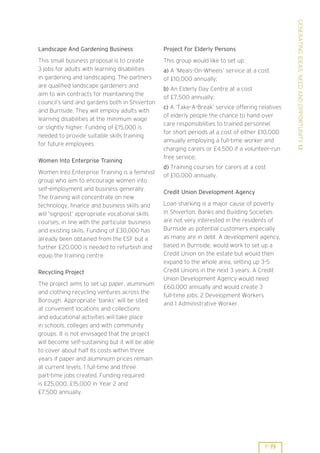
Landscape And Gardening Business                  Project For Elderly Persons
This small business proposal is to create         This group would like to set up:
3 jobs for adults with learning disabilities      a) A ’Meals-On-Wheels’ service at a cost
in gardening and landscaping. The partners        of £10,000 annually;
are qualified landscape gardeners and
                                                  b) An Elderly Day Centre at a cost
aim to win contracts for maintaining the
                                                  of £7,500 annually;
council’s land and gardens both in Shiverton
                                                  c) A ’Take-A-Break’ service offering relatives
and Burnside. They will employ adults with
                                                  of elderly people the chance to hand over
learning disabilities at the minimum wage
                                                  care responsibilities to trained personnel
or slightly higher. Funding of £15,000 is
                                                  for short periods at a cost of either £10,000
needed to provide suitable skills training
                                                  annually employing a full-time worker and
for future employees.
                                                  charging carers or £4,500 if a volunteer-run
                                                  free service;
Women Into Enterprise Training
                                                  d) Training courses for carers at a cost
Women Into Enterprise Training is a feminist
                                                  of £10,000 annually.
group who aim to encourage women into
self-employment and business generally.
                                                  Credit Union Development Agency
The training will concentrate on new
technology, finance and business skills and       Loan sharking is a major cause of poverty
will ’signpost’ appropriate vocational skills     in Shiverton. Banks and Building Societies
courses, in line with the particular business     are not very interested in the residents of
and existing skills. Funding of £30,000 has       Burnside as potential customers especially
already been obtained from the ESF but a          as many are in debt. A development agency,
further £20,000 is needed to refurbish and        based in Burnside, would work to set up a
equip the training centre.                        Credit Union on the estate but would then
                                                  expand to the whole area, setting up 3-5
Recycling Project                                 Credit Unions in the next 3 years. A Credit
                                                  Union Development Agency would need
The project aims to set up paper, aluminium
                                                  £60,000 annually and would create 3
and clothing recycling ventures across the
                                                  full-time jobs: 2 Development Workers
Borough. Appropriate ’banks’ will be sited
                                                  and 1 Administrative Worker.
at convenient locations and collections
and educational activities will take place
in schools, colleges and with community
groups. It is not envisaged that the project
will become self-sustaining but it will be able
to cover about half its costs within three
years if paper and aluminium prices remain
at current levels. 1 full-time and three
part-time jobs created. Funding required
is £25,000, £15,000 in Year 2 and
£7,500 annually.


                                                                                         P 19
GENERATING IDEAS: NEED AND OPPORTUNITY 1.1
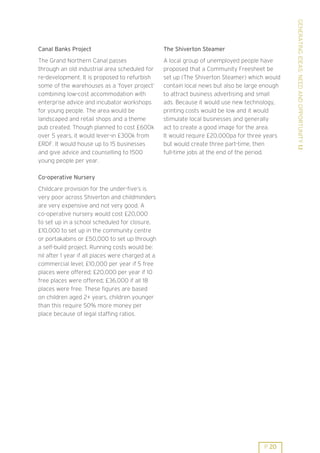
Canal Banks Project                                The Shiverton Steamer
The Grand Northern Canal passes                    A local group of unemployed people have
through an old industrial area scheduled for       proposed that a Community Freesheet be
re-development. It is proposed to refurbish        set up (The Shiverton Steamer) which would
some of the warehouses as a ’foyer project’        contain local news but also be large enough
combining low-cost accommodation with              to attract business advertising and small
enterprise advice and incubator workshops          ads. Because it would use new technology,
for young people. The area would be                printing costs would be low and it would
landscaped and retail shops and a theme            stimulate local businesses and generally
pub created. Though planned to cost £600k          act to create a good image for the area.
over 5 years, it would lever-in £300k from         It would require £20,000pa for three years
ERDF. It would house up to 15 businesses           but would create three part-time, then
and give advice and counselling to 1500            full-time jobs at the end of the period.
young people per year.

Co-operative Nursery
Childcare provision for the under-five’s is
very poor across Shiverton and childminders
are very expensive and not very good. A
co-operative nursery would cost £20,000
to set up in a school scheduled for closure,
£10,000 to set up in the community centre
or portakabins or £50,000 to set up through
a self-build project. Running costs would be:
nil after 1 year if all places were charged at a
commercial level; £10,000 per year if 5 free
places were offered; £20,000 per year if 10
free places were offered; £36,000 if all 18
places were free. These figures are based
on children aged 2+ years, children younger
than this require 50% more money per
place because of legal staffing ratios.


                                                                                        P 20

11 Generating Ideas

  • 1.
    THE IDEA 1 1.1 GENERATING IDEAS: NEED AND OPPORTUNITY . Generating Ideas - Deciding What To Do! . Understanding Project Development . Working With Groups - The Development Role . Development Notes . Shiverton Exercise Notes - Setting The Agenda For The Role Play Exercise . Shiverton Town Council Population Statistics P 05
  • 2.
    GENERATING IDEAS: NEEDAND OPPORTUNITY 1.1 GENERATING IDEAS - DECIDING WHAT TO DO! Once a group has been formed and information collected, it meets to adopt a priority list of 'good ideas' to pursue. Selecting ideas, testing them, planning and gathering funds and other resources to get off the ground can be lengthy. Take your time and plan thoroughly. Finding Business Ideas It is usually easier and cheaper to set up a service business than a manufacturing one, There are 3 main ways of finding ideas: especially as the market for the services is more likely to be local, less equipment is 1 : What can local people do? What needed and less money required starting skills do they have? up. There’s usually less risk because market It is much easier to build a business research is easier and there are less likely idea around real people who have to be established competitors. You could get particular skills. ideas from asking local people, advertising in the local paper or radio, asking local 2 : Is someone else running a social businesses or even running a competition enterprise that you could copy or with local school children. apply locally? Particularly if you’re not competing, the At a brainstorming session many ideas will social enterprise may be willing to share emerge, the more the merrier. But at some their experience with you or even help stage you will need to prioritise certain ideas you set up. and this has to be something the whole 3 : What goods and services are needed group agrees with and is committed to. in your locality? There are many goods and services the private sector doesn’t think it profitable to supply to some (your?) communities. Make a list of things your social enterprise might provide. P 06
  • 3.
    GENERATING IDEAS: NEEDAND OPPORTUNITY 1.1 Testing The Idea Skills and Resources In many deprived areas, the local economy Are there enough of the right people with doesn’t have enough money circulating to the right sort of skills locally? Or are you support new businesses: there’s not enough going to have to recruit? return on investment for the private sector. But for a social enterprise interested in The people running a social enterprise breaking-even while employing local people must have: there may be enough business to make it worthwhile. Alternatively, you could target . The technical skills to provide the more affluent areas and customers who service or make a product might provide sufficient income to make . The ability to organise themselves profit, and then return that profit to your and the business, managing people home community through donations or and resources supporting community initiatives or projects. . The ability to co-operate effectively The main task is to answer . The skill and knowledge these questions: to manage finance . Is the idea viable? . Do people have the necessary Business can be complex and highly competitive. It’s important that you assess skills and abilities? what skills and knowledge you have, analyse . Will it sell? the gaps and come up with strategies for filling them, whether by training, access to . Will it pay? expert advice or recruitment. Many skills can . Can it be resourced? be learnt ’on the job’ but if you have to be successful from the start, you may need to think about appointing a business manager Usually, it is fairly obvious whether or not to ensure the business is set up right and is the business can be done and is technically managed properly. possible. However, a new product or idea may need testing in the market and to see if it will work. You may need to create a prototype, perhaps with the help of workshops in local colleges. P 07
  • 4.
    GENERATING IDEAS: NEEDAND OPPORTUNITY 1.1 Will It Sell? Will It Be Funded? A common mistake is for a group to Some brilliant ideas just can’t or won’t be decide that because they want something, funded. It is possible to change people’s everyone does. Or that because a service thinking and to persuade them to fund a is needed, there are enough people able project they initially oppose or don’t see to afford it. Or that a service is needed the value of. But you’d be wise to check out and it will be able to capture 100% of the the likelihood of getting funding or support market from existing competitors. These for each of your ideas before going too far assumptions must be tested. Inevitably, this down the planning stage. means market research, and not just ’desk research’ in libraries, business centres or via the net but actually talking to people, Does It Deliver A Real Benefit? investigating potential competitors, digging Things that do are likely to last longer and deeply into why people buy things, how be supported politically and financially and much they are willing to spend, how much by the community when it counts. You may it costs to provide a service or make and need that support and sometimes its better sell particular goods and so on. Remember, to, say, plan to create more employment you are not the customer and may not and less social profit (because that’s what know what the customer will buy. people value) rather than employing fewer people but making more money. It's not just what you would like to do, but also Will It Pay? what works out there. You may be able to sell your product or service but will you make any money doing it? What will people pay compared to all the costs involved in making the product: do you know? How many products will you need to produce a year or how often will the service be bought? What income will that generate? You need to work out how much it will cost to do a thing and then find out if the price you plan to charge (or that people are willing to pay) will cover your costs. Don’t be put off if the sums don’t add up at first. You may need to change your product or who you are selling it to or how and where you market it. Planning a business is a kind of back-and-forth discussion between the business (you) and the market/your customers. P 08
  • 5.
    GENERATING IDEAS: NEEDAND OPPORTUNITY 1.1 UNDERSTANDING PROJECT DEVELOPMENT Why Plan Projects? The Project Planning Process Any project which is properly planned and The first stage in project planning managed has a greater chance of success. is to set goals And success is important if you are trying The second stage of project planning is to to create self-sustaining processes of consider the external factors that will affect regeneration, development or meeting the project (like ’the market’ or ’funding changing social and community needs. opportunities’) Project planning involves certain basic The third stage is to discuss and adopt and common activities: appropriate strategies based both on your goals and the external environment. . Allocating resources . Setting timetables Project planning requires both a clear focus, and appreciation of other people’s . Identifying targets for achievement goals and agendas and flexibility to accommodate both. Any group managing Project planning will also usually depend a project planning process needs to be on the co-operation and support of other pragmatic, open-minded and willing people. You usually have to co-operate with to adapt. others to get a project going or sustain it. People will need to be persuaded the project is a good idea. And those with political or financial support will also need to be engaged with. P 09
  • 6.
    GENERATING IDEAS: NEEDAND OPPORTUNITY 1.1 Phases Of Project Development Reviewing And Agreeing The Action Plan Winning Support For The Project - the Your plan must: project needs to be well thought out and . Be broadly compatible with the needs have a match with the goals of key players and goals of those involved and stakeholders . Have a fit with the goals of funders Clarifying Goals - to work you first have and stakeholders to identify all the people with a stake in the . Be broadly supported both internally project or who might be affected by it and (within the group and community) get them on board through a series of and externally (with key players and meetings or interviews interest groups) Researching Possible Solutions - once goals . Be robust and defensible have been identified its easier to identify . Have identified counter-arguments and potential solutions which will need to be potential (worse) alternatives looked into and tested. Are they practical? Will they work locally? What factors for Undertaking The Project - once you get success must be present? Has the idea approval, start early in order to ward off worked well elsewhere, and why? criticism, damp down scepticism and prevent competing groups ’recalling’ Making Proposals - these must be the decision to go ahead. detailed statements of the aims, means and requirements of the project in terms of money and other resources. The aim Make sure you have achievable of the proposal is to win or retain the milestones in place and measurable support of the individuals and stakeholders progress indicators. involved. At this stage it’s always a good Make sure decisions can be made idea to have an alternative proposal to quickly, especially decisions about hand in case the first is rejected or needs putting things right when they're extensive modifying. going wrong. Ensure allies are kept informed about the project's progress. Ensure that there is sufficient time for the project to succeed; don't let people with other agendas impose early evaluation on the project. P 10
  • 7.
    GENERATING IDEAS: NEEDAND OPPORTUNITY 1.1 WORKING WITH GROUPS - THE DEVELOPMENT ROLE An individual working in the community may have to take on a development role. They may be asked to lead or work as part of a team developing a new local service. They may be assisting an organisation draw up plans. They may be helping put plans into practice. One mistake that is often made is that d) Does decision-making leave ’development’ and ’training’ become members empowered or do they feel confused. One is seen as a substitute for left out/disempowered? another or a precondition for progress. Different levels of participation affect how people engage with and contribute to the Training is any learning situation with an project or group aim and therefore how a underlying purpose and an ongoing process. project develops. Those leading the process Development is about putting ’lessons’ into will need to make decisions about the kinds practice, actually making use of acquired of information that can be given to all or skills, assisting a group to maximise the part of the group and monitor and balance benefits from learning. Keeping training out ’inequalities’ that may arise because and development properly focused and of different levels of participation in the balanced can be very hard to do. Planning development and/or learning process. group development and having a clear timetable for development, properly 2 : How Do You Combine Training And monitored, can help. Development Work? a) How will you measure learning success? Some Development Issues What access to training will people in the group have? 1 : Developing Ideas Together b) How will you apply what is learnt? a) How will the group share information and ideas? Are there problems in how it c) How will you deal with different levels plans to use information? of competence/confidence/skills? b) How do the interactions between group The development process will go better members affect the development process? if all people involved engage and interact c) Is the right information coming to the positively, share tasks and fairly delegate, group in a way that is understood and get and use feedback, encourage discussion can be used? and questioning and develop an agreed decision-making process. P 11
  • 8.
    GENERATING IDEAS: NEEDAND OPPORTUNITY 1.1 3 : Managing Development Work 4 : Planning Group Work The first rule is to be flexible. There are no Planning involves: hard and fast rules about the development a) Resource analysis process. Decisions will need to be made about time and resources (especially). There b) Assessing and choosing appropriate will need to be some structure. But this may development techniques well be different each time. Making the right c) Analysis of group needs decisions about who to involve and what d) Assessment of skills and experiences needs to be done and how is crucial. Planning the development process The group will also need to correctly assess can either be worker-led, group-led or its ability to carry a workload, deal with a joint/collective decision between all unexpected developments, delegate and parties. Whichever applies, someone co-ordinate work and so on. Some groups must be in control. accept work willingly, others do not. Some groups depend on outside assistance, others Group involvement in planning the may resist external help or involvement. development process can be very important in validating it. Difficulties may arise from: a) Outsiders playing a leadership rather Someone in the group must schedule and than a support role. In the reverse case, manage regular reviews of progress and some groups expect ’experts’ to lead and how development is going. Changes to the the process stalls when this isn’t offered. process may need to be negotiated and agreed within the group. Sometimes b) Incorrect decisions about task allocation reviewing and making decisions may take and individual levels of involvement. place in a formal process, sometimes c) Bad resource allocation, misdirected informal. Both have equal validity but one effort or misunderstanding the symbolic may be more appropriate than the other. significance of situations or decisions. P 12
  • 9.
    GENERATING IDEAS: NEEDAND OPPORTUNITY 1.1 DEVELOPMENT NOTES Learning And Progress Indicators Are leaders trusted and respected by group members and external stakeholders? Relationships How have intra-group relationships Practical Ideas developed? Has the group adopted achievable and Is there a sense of everyone understanding realisable goals? their roles? Are all members of the group engaged? Has the group formed positive relationships Do they make practical and sensible with key individuals and stakeholders? proposals? Focus Does the group have the capacity to objectively consider and evaluate ideas? Is the group focussed and business-like? Is the group committed to realistic ideas Development Of A Culture Of Aspiration and achievable goals? Has a positive and business-like culture Is there a clear understanding of what developed? needs to be done next? What are energy levels in the group like? Negotiation And Communication Skills Is effort focused on achievement or discussion and debate? What are the kinds and levels of intercommunication between group Effective Resource Allocation members? Are resources being allocated to the Does the group negotiate effectively right places? with external stakeholders and/or with each other? Is there effective delegation and/or co-ordination? Are decisions recorded and information shared properly and effectively? Do certain individuals control the group or command an excessive share of resources? Leadership Does the group assign tasks to the Have strong and effective leaders emerged? right people? Or do all members of the group share in the leadership role? Is there clear agreement between ’leaders’ and ’followers’? P 13
  • 10.
    GENERATING IDEAS: NEEDAND OPPORTUNITY 1.1 SHIVERTON EXERCISE NOTES - SETTING THE AGENDA FOR THE ROLE PLAY EXERCISE (Please note that Shiverton is a fictitious town and any similarity to another area is purely coincidental) Role Play Notes Ensure that the participants understand the roles they are playing, then ’convene’ This exercise is about understanding the meeting, making clear the aim is to why different people with different roles come up with an agreed list which is will come up with different solutions. deliverable and meets priorities. It also aims to test the listening and consensus-making abilities of any Allow the ’meeting’ up to 30 minutes. group you are working with. The background to the exercise is that the Did the group have the right Local Authority or other funder/stakeholder information to make decisions and is asking community representatives to how did the different information they develop a ’wish-list’ or priority program possessed effect decision-making? for social enterprise development which Did the discussion reveal the differing will contribute to local regeneration. priorities of the participants? Was There needs to be at least three communication open and honest? participants but there is no hard and Did the group properly consider the fast rule about how the roles are divided feasibility of each proposed idea? amongst people present. How good were they at suggesting The Shiverton Town Council new ideas? Population Statistics provides the necessary Were the group able to compromise information to structure the discussion. The and develop consensus or did one group needs time to read and assimilate participant/group dominate this information. decision-making? The list of ’Possible Projects’ is simply a list Were ideas challenged over their of ideas that people have come up with in practicality or achievability or did the past and currently. The group should everyone just 'go along'? discuss and (hopefully) challenge these ideas and come up with new ideas and proposals How realistic was the list of projects meeting the needs of Shiverton and its that the group finally agreed? various communities. Did the group agree any next steps? P 14
  • 11.
    GENERATING IDEAS: NEEDAND OPPORTUNITY 1.1 Setting The Agenda For Shiverton Setting The Agenda For Shiverton The Partnership Workers Brief The Central Shiverton Residents You are drawing up a program of projects Association Brief and initiatives from a variety of sources You represent people living in the inner to be commence in Years 1 and 2 of an core of Shiverton, an area of dense housing EU-funded partnership program. £750k and often affected by business operations has been allocated to cover the costs of (congestion, lack of parking, litter etc). this program. CSRA has been asked by the Partnership Team in the Local Authority to come up The Local Authority Housing Department with a list of projects and initiatives it has bid for £300k for a Phase 1 housing thinks would help with the regeneration regeneration program and the Learning & of Shiverton long-term and address Skills Council locally has successfully bid for problems of Long-Term Unemployment, £150k of training-related programs designed Juvenile Delinquency and Lack of to get young and long-term unemployed Community Facilities. people into work. Your projected support costs are £100k so you have £200k to You have been sent to this meeting to spend on community initiatives. represent the aspirations and agenda of the CSRA. You have heard that the Shiverton Partnership has £500k over 2 Select a program of Year 1 and 2 years to spend on community initiatives. community initiatives bearing in mind that the priorities already established are: Select a program of Year 1 and Year . Getting up to steam quickly 2 community initiatives you would like to see funded, bearing in mind that . Generating favourable publicity the priorities of the Residents to lever in money in Year 2 Association are: . Communicating with local residents . Improving the local environment . Building public sector partnerships . Making the area safe for residents . Enabling the community to acquire . Job Creation a track record . Training opportunities for women . Building capacity in the community . Local Pride - acquiring credibility * You are free to suggest other initiatives * You are free to suggest other initiatives if you think it necessary if you think it necessary P 15
  • 12.
    GENERATING IDEAS: NEEDAND OPPORTUNITY 1.1 Setting The Agenda For Shiverton Select a program of Year 1 and Year 2 The Sunniside-Burnside community initiatives you would like Alliance Brief to see funded, bearing in mind that the priorities of the Alliance are: You represent the two overspill /peripheral housing estates of Burnside . Appropriate local employment and and Sunniside on the edge of Shiverton. training initiatives The main concerns of the Sunniside . Directly increasing income levels -Burnside Alliance (a local community association made up of residents) have in poor households traditionally been unemployment, bad . Job Creation housing, lack of opportunities and a poor local environment. . A community centre The Alliance have been asked by the . Childcare and help for young people Partnership Team in the Local Authority to come up with a list of projects and * You are free to suggest other initiatives initiatives you think would help with the if you think it necessary regeneration of your community and the town of Shiverton generally. You have been sent by the Alliance to ensure its priorities are catered to under the program. You are just one of a range of community organisations throughout the area likely to be putting forward proposals and you want yours to succeed. You have heard that the Shiverton Partnership has £1m over 5 years to spend on community initiatives. P 16
  • 13.
    GENERATING IDEAS: NEEDAND OPPORTUNITY 1.1 SHIVERTON TOWN COUNCIL POPULATION STATISTICS Population Environment The population in 2001 was 48,530. A Shiverton suffers from pockets of very demographic profile of the town showed it dense housing in the old part of the town to be considerably older than the Borough with few environmental amenities, ’urban’ average. Almost 23% of the population plantings on roundabouts and roadsides were aged 60+. 29% of all households were and large areas of expensive-to-maintain occupied solely by pensioners. It is estimated verges and green spaces on the Burnside that the population has decreased by 500+ and Sunniside Estates. Asthma, low IQ between 1991 and 2001. /under-achieving and heart and weight problems are due to poor housing, pollution Housing and poor diets. The Council spends a lot on the environment and leisure but there Shiverton has the second highest is only a small municipal park and no proportion of people housed by the Local Sports Centre. Authority - almost 35% of households. There were also substantial numbers of Social houses without inside toilets in 1981 though since then a considerable amount of work Burnside district in Shiverton has the upgrading houses has been done. highest proportion of single parent Overcrowding is higher than average. households in the Borough. Nearly 8% of households in Burnside are single parent. The Local Economy The ethnic minority population is 2%, slightly lower than average. Levels of car ownership are extremely low compared to the Borough average. Almost Change In Population Structure Since 1991 60% of households have no access to a car. Shiverton also has the highest proportion Age 1991 2001 Change of semi-skilled and unskilled people in the 0-4 2975 2876 -99 Borough, together with the highest rates of unemployment. In 2001 the unemployment 5-14 4292 2951 -1341 rate was 12% with youth unemployment (-21 15-29 8523 8365 -158 years) rising to 22%. Women are confined to 30-44 12721 12641 -80 low-paid, low-skilled and casual work but are often the main or only wage-earner. There 45-64 13527 14326 +799 are high levels of household debt in the area 65-74 5743 6023 +280 (20% higher than the Borough average). +75 990 1348 +358 Source: Census 1991, 2001 P 17
  • 14.
    GENERATING IDEAS: NEEDAND OPPORTUNITY 1.1 Possible Projects Community Food Co-operative Your aim is to select those projects which The Area Health Authority have recently you feel would best meet the needs of the started a healthy eating campaign in area and could operate as sustainable social Burnside. Volunteers who have been enterprises creating social and economic involved with this campaign have found benefits for local people. out that although most people know about healthy eating they can not often afford to The currently proposed projects are: buy fresh fruit and vegetables at the prices charged by local shops even when they are Community Enterprise Centre available. This group wants to set up a food A community enterprise and training co-operative with a shop and a van in the would be based in an empty ’low-rise’ shopping centre in Burnside. The business block of flats on the Sunniside estate. This would create 2 full-time and 2 part-time jobs. block is a base for drug users, dealers and Funding of £10,000 has been obtained from squatters. The enterprise centre would the Health Authority. The project needs a rent office units to small, new businesses further £10,000 to start. No further funding and a fully-equipped training room. The will be required. centre would supply office services and a switchboard and reception service. The Grassroots Volunteers project would cost £100,000 to set up but This is a ’Community Program’ would be self-sustaining within 2 years. type project in which 200-300 young Funding requirements in the first year of people would be recruited to undertake operation would be £30,000 dropping to environmental improvement work on £15,000 in Year 2 and then zero. 5 jobs will housing estate green space, roadside be created directly and there is potential verges, canal cleaning, improving tourist for 100 indirect jobs to be created. attractions like the floral gardens, ’gateway’ avenues and creating small community gardens and forest-planting initiatives. It would create employment for up to 12 supervisors and managers and the people involved would receive training which would count as credits towards NVQs. It would cost £220k in Year 1, £150k in Year 2 and there is a possibility of 50% matched EU funding and private sponsorship. P 18
  • 15.
    GENERATING IDEAS: NEEDAND OPPORTUNITY 1.1 Landscape And Gardening Business Project For Elderly Persons This small business proposal is to create This group would like to set up: 3 jobs for adults with learning disabilities a) A ’Meals-On-Wheels’ service at a cost in gardening and landscaping. The partners of £10,000 annually; are qualified landscape gardeners and b) An Elderly Day Centre at a cost aim to win contracts for maintaining the of £7,500 annually; council’s land and gardens both in Shiverton c) A ’Take-A-Break’ service offering relatives and Burnside. They will employ adults with of elderly people the chance to hand over learning disabilities at the minimum wage care responsibilities to trained personnel or slightly higher. Funding of £15,000 is for short periods at a cost of either £10,000 needed to provide suitable skills training annually employing a full-time worker and for future employees. charging carers or £4,500 if a volunteer-run free service; Women Into Enterprise Training d) Training courses for carers at a cost Women Into Enterprise Training is a feminist of £10,000 annually. group who aim to encourage women into self-employment and business generally. Credit Union Development Agency The training will concentrate on new technology, finance and business skills and Loan sharking is a major cause of poverty will ’signpost’ appropriate vocational skills in Shiverton. Banks and Building Societies courses, in line with the particular business are not very interested in the residents of and existing skills. Funding of £30,000 has Burnside as potential customers especially already been obtained from the ESF but a as many are in debt. A development agency, further £20,000 is needed to refurbish and based in Burnside, would work to set up a equip the training centre. Credit Union on the estate but would then expand to the whole area, setting up 3-5 Recycling Project Credit Unions in the next 3 years. A Credit Union Development Agency would need The project aims to set up paper, aluminium £60,000 annually and would create 3 and clothing recycling ventures across the full-time jobs: 2 Development Workers Borough. Appropriate ’banks’ will be sited and 1 Administrative Worker. at convenient locations and collections and educational activities will take place in schools, colleges and with community groups. It is not envisaged that the project will become self-sustaining but it will be able to cover about half its costs within three years if paper and aluminium prices remain at current levels. 1 full-time and three part-time jobs created. Funding required is £25,000, £15,000 in Year 2 and £7,500 annually. P 19
  • 16.
    GENERATING IDEAS: NEEDAND OPPORTUNITY 1.1 Canal Banks Project The Shiverton Steamer The Grand Northern Canal passes A local group of unemployed people have through an old industrial area scheduled for proposed that a Community Freesheet be re-development. It is proposed to refurbish set up (The Shiverton Steamer) which would some of the warehouses as a ’foyer project’ contain local news but also be large enough combining low-cost accommodation with to attract business advertising and small enterprise advice and incubator workshops ads. Because it would use new technology, for young people. The area would be printing costs would be low and it would landscaped and retail shops and a theme stimulate local businesses and generally pub created. Though planned to cost £600k act to create a good image for the area. over 5 years, it would lever-in £300k from It would require £20,000pa for three years ERDF. It would house up to 15 businesses but would create three part-time, then and give advice and counselling to 1500 full-time jobs at the end of the period. young people per year. Co-operative Nursery Childcare provision for the under-five’s is very poor across Shiverton and childminders are very expensive and not very good. A co-operative nursery would cost £20,000 to set up in a school scheduled for closure, £10,000 to set up in the community centre or portakabins or £50,000 to set up through a self-build project. Running costs would be: nil after 1 year if all places were charged at a commercial level; £10,000 per year if 5 free places were offered; £20,000 per year if 10 free places were offered; £36,000 if all 18 places were free. These figures are based on children aged 2+ years, children younger than this require 50% more money per place because of legal staffing ratios. P 20