Welcome toCommunicators Training
We need effectivecommunicators today2 Timothy 4:1-51 In the presence of God and of Christ Jesus, who will judge the living and the dead, and in view of his appearing and his kingdom, I give you this charge: 2 Preach the Word; be prepared in season and out of season; correct, rebuke and encourage -- with great patience and careful instruction.
We need effectivecommunicators today2 Timothy 4:1-53 For the time will come when men will not put up with sound doctrine. Instead, to suit their own desires, they will gather around them a great number of teachers to say what their itching ears want to hear.
We need effectivecommunicators today2 Timothy 4:1-54 They will turn their ears away from the truth and turn aside to myths. 5 But you, keep your head in all situations, endure hardship, do the work of an evangelist, discharge all the duties of your ministry.
How to effectively communicate the word of GodExegesis1Exposition2Exhortation3TextTheme
Topic
Truth
ThrustTarget audienceTrue need
Thesis
Turning point
TaglineTalkTake-off
Transitions
Take home
TouchdownThree QuestionsAre you born again?Can you think logically, clearly and critically?Do you have faith to be trained?
How to exegete?The goal of exegesis:TO UNDERSTAND…What the original author was talking about (Theme)What the original author wanted to focus on (Topic)What the original author wanted to say to his original audience about what he was talking about (Truth)Why the original author wanted to say this (Thrust)
How to exegete?The Theme is…A broad category or subject matter that pertains to man’s real need regardless of the situation or culture.A broad category or subject matter that God wants to talk about because it is important for us to know and understand.Examples: Salvation, Prayer, Discipleship
How to exegete?The Topic is…A narrow concern within the theme or subject matterA question that dominates the text (above all other topics that may be in the text)Examples: How to be saved, Why prayer is important, How people should follow Christ
How to exegete?The Truth is…A revelation from GodAn indicative statement that reveals what is really true at all times (i.e. a universal truth)Examples: People can only be saved by grace through faith, Prayer is important because it is the Christian’s connection with God, People should follow Christ as true disciples because He is Lord
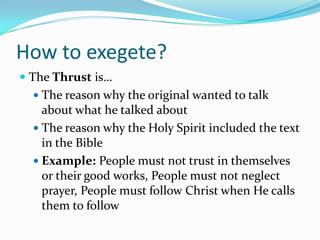
How to exegete?The Thrust is…The reason why the original author wanted to talk about what he talked about in the textThe reason why the Holy Spirit included the text in the Bible in the first placeExamples: People must not trust in themselves or their good works, People must not neglect prayer, People should follow Christ as true disciples and not just to meet their personal needs
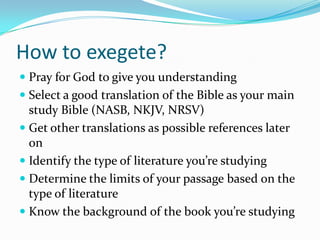
How to exegete? (The Basics)Pray for God to give you understandingSelect a good translation of the Bible as your main study Bible (NASB, NKJV, NRSV)Get other translations as possible referencesIdentify the type of literature you’re studying (Narrative, Poetry, etc.)Determine the limits of your passage based on the type of literature (where does it begin & end)Know the background of the book you’re studying
How to exegete? (DIG process)Read the text several times, then…Discover the details of the textObserve the SALT of the text: Structure, Atmosphere, Literary features of the text, and the Terms (or words used)Interpret the details of the textAsk pertinent questions regarding your observations (e.g. Why did the author include this? What does he mean?)Look for answers within the text, around the text, in other texts by the same author, in other texts by different authors (Note: In this sequence)
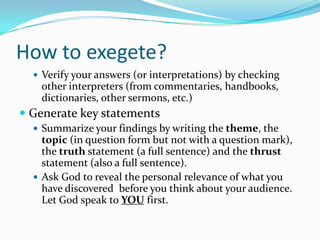
How to exegete?Verify your answers (i.e. your interpretations) by checking with other interpreters (i.e. commentaries, handbooks, dictionaries, other sermons, etc.)Generate key statementsSummarize your findings by stating the theme, topic (in question form but not with a question mark), truth statement (a full sentence) and the thrust statement (also a full sentence). Use the original context.Ask God to reveal the personal relevance of what you have discovered  before you think about your audience. Let God speak to YOU first.
Sample ExegesisText:Ephesians 1:3-14Theme:Gratitude for SalvationTopic:Why the believers in Ephesus must be grateful to God for their salvationTruth:The believers in Ephesus must be grateful to God for their salvation because by grace they have received every spiritual blessing in Christ.Thrust:Paul wanted the believers to be grateful to God for their salvation because he wanted them to appreciate the grace of God in their lives.
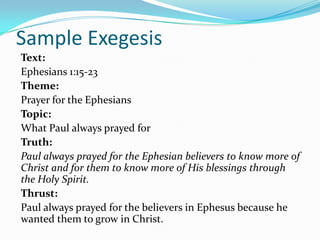
Sample ExegesisText:Ephesians 1:15-23Theme:Prayer for the EphesiansTopic:What Paul always prayed forTruth:Paul always prayed for the Ephesian believers to know more of Christ and for them to know more of His blessings through the Holy Spirit.Thrust:Paul always prayed for the believers in Ephesus because he wanted them to grow in Christ.
Sample ExegesisText:Ephesians 2:1-10Theme:SalvationTopic:How and why the Ephesian believers were savedTruth:The Ephesian believers were saved by grace through faith, not by their good works, but so that they would do good works for the glory of God.Thrust:Paul wanted the believers in Ephesus to know how and why they were saved so that they would appreciate God’s grace in their lives.
How to exegete in a simple waySilence your worldInvite the Holy SpiritMeditate on the His wordPray according to His wordListen for the practical applicationEnd with thanksgivingLife Journaling
The Goal must be the same!To communicate the word, you must still generate key statements:ThemeTopicTruthThrust
Sample of Life JournalDate: Aug 22, 2009Title: Being Grateful to GodText:Ephesians 1:3 “Praise be to the God and Father of our Lord Jesus Christ, who has blessed us in the heavenly realms with every spiritual blessing in Christ.”God’s message to me:I must always be grateful to God for all that He has given me in Christ Jesus, because He has given me every spiritual blessing I would ever need. Praise God!My prayer:Lord, thank you for all that you have given me in Christ Jesus. Help me to be always grateful to you and to never forget what you have done for me. In Jesus’ name. Amen.My application:I will practice saying ‘thank you’ to the Lord for saving me every time I wake up and before I sleep for at least seven days or until it becomes a habit for me.
Sample Exegesis based on Life JournalText: Ephesians 1:3 “Praise be to the God and Father of our Lord Jesus Christ, who has blessed us in the heavenly realms with every spiritual blessing in Christ.”God’s message to me:I must always be grateful to God for all that He has given me in Christ Jesus, because He has given me every spiritual blessing I would ever need. Praise God!Theme: GratitudeTopic: Why Christians must be grateful to GodTruth: Christians must be grateful to God because He has given them every spiritual blessing in Christ.Thrust: Christians must always remember what God has done for them in Christ so that they will always be grateful to Him.
Doing expositionThe goal of exposition is also…TO UNDERSTAND…The real needs of your audience in light of the theme and topic of the text (True Need)What God wanted to say to your present audience in light of the theme and topic of the text (Thesis)How you would to say the main point to your audience in a way that would meet their real needs and fulfill God’s intended purpose for them (Turning Point)How you can make the main point stick to your audience’s mind (Tagline)
Doing expositionTo know the True Need of your Target Audience…Know your audience (adults, youth, etc.) and the circumstance when you will be speaking to them (SWC, FNH, etc.).Examine their beliefs and behavior in relation to the theme and topic of the text: What do they really believe about this? How do they speak or act in light of these beliefs? Try to examine the thinking behind their words and actions.Think of specifics as much as possible. Come up with examples, etc. Then write down your thoughts.
Example of True NeedLet’s say the theme is Gratitudeand the topic is Why Christians must be grateful to God…You can express the True Need like this:Audience: Young people during FNHBeliefs and Behavior:A lot of young people feel defeated when they fall into sin. They assume that they have failed God again. They look down at themselves and they give up on their faith. They return to their old ways because they feel that they cannot really change.Examples: Young people going back to smoking and drinking after being saved

Communicators Training Ses 1

  • 1.
  • 2.
    We need effectivecommunicatorstoday2 Timothy 4:1-51 In the presence of God and of Christ Jesus, who will judge the living and the dead, and in view of his appearing and his kingdom, I give you this charge: 2 Preach the Word; be prepared in season and out of season; correct, rebuke and encourage -- with great patience and careful instruction.
  • 3.
    We need effectivecommunicatorstoday2 Timothy 4:1-53 For the time will come when men will not put up with sound doctrine. Instead, to suit their own desires, they will gather around them a great number of teachers to say what their itching ears want to hear.
  • 4.
    We need effectivecommunicatorstoday2 Timothy 4:1-54 They will turn their ears away from the truth and turn aside to myths. 5 But you, keep your head in all situations, endure hardship, do the work of an evangelist, discharge all the duties of your ministry.
  • 5.
    How to effectivelycommunicate the word of GodExegesis1Exposition2Exhortation3TextTheme
  • 6.
  • 7.
  • 8.
  • 9.
  • 10.
  • 11.
  • 12.
  • 13.
  • 14.
    TouchdownThree QuestionsAre youborn again?Can you think logically, clearly and critically?Do you have faith to be trained?
  • 15.
    How to exegete?Thegoal of exegesis:TO UNDERSTAND…What the original author was talking about (Theme)What the original author wanted to focus on (Topic)What the original author wanted to say to his original audience about what he was talking about (Truth)Why the original author wanted to say this (Thrust)
  • 16.
    How to exegete?TheTheme is…A broad category or subject matter that pertains to man’s real need regardless of the situation or culture.A broad category or subject matter that God wants to talk about because it is important for us to know and understand.Examples: Salvation, Prayer, Discipleship
  • 17.
    How to exegete?TheTopic is…A narrow concern within the theme or subject matterA question that dominates the text (above all other topics that may be in the text)Examples: How to be saved, Why prayer is important, How people should follow Christ
  • 18.
    How to exegete?TheTruth is…A revelation from GodAn indicative statement that reveals what is really true at all times (i.e. a universal truth)Examples: People can only be saved by grace through faith, Prayer is important because it is the Christian’s connection with God, People should follow Christ as true disciples because He is Lord
  • 19.
    How to exegete?TheThrust is…The reason why the original author wanted to talk about what he talked about in the textThe reason why the Holy Spirit included the text in the Bible in the first placeExamples: People must not trust in themselves or their good works, People must not neglect prayer, People should follow Christ as true disciples and not just to meet their personal needs
  • 20.
    How to exegete?(The Basics)Pray for God to give you understandingSelect a good translation of the Bible as your main study Bible (NASB, NKJV, NRSV)Get other translations as possible referencesIdentify the type of literature you’re studying (Narrative, Poetry, etc.)Determine the limits of your passage based on the type of literature (where does it begin & end)Know the background of the book you’re studying
  • 21.
    How to exegete?(DIG process)Read the text several times, then…Discover the details of the textObserve the SALT of the text: Structure, Atmosphere, Literary features of the text, and the Terms (or words used)Interpret the details of the textAsk pertinent questions regarding your observations (e.g. Why did the author include this? What does he mean?)Look for answers within the text, around the text, in other texts by the same author, in other texts by different authors (Note: In this sequence)
  • 22.
    How to exegete?Verifyyour answers (i.e. your interpretations) by checking with other interpreters (i.e. commentaries, handbooks, dictionaries, other sermons, etc.)Generate key statementsSummarize your findings by stating the theme, topic (in question form but not with a question mark), truth statement (a full sentence) and the thrust statement (also a full sentence). Use the original context.Ask God to reveal the personal relevance of what you have discovered before you think about your audience. Let God speak to YOU first.
  • 23.
    Sample ExegesisText:Ephesians 1:3-14Theme:Gratitudefor SalvationTopic:Why the believers in Ephesus must be grateful to God for their salvationTruth:The believers in Ephesus must be grateful to God for their salvation because by grace they have received every spiritual blessing in Christ.Thrust:Paul wanted the believers to be grateful to God for their salvation because he wanted them to appreciate the grace of God in their lives.
  • 24.
    Sample ExegesisText:Ephesians 1:15-23Theme:Prayerfor the EphesiansTopic:What Paul always prayed forTruth:Paul always prayed for the Ephesian believers to know more of Christ and for them to know more of His blessings through the Holy Spirit.Thrust:Paul always prayed for the believers in Ephesus because he wanted them to grow in Christ.
  • 25.
    Sample ExegesisText:Ephesians 2:1-10Theme:SalvationTopic:Howand why the Ephesian believers were savedTruth:The Ephesian believers were saved by grace through faith, not by their good works, but so that they would do good works for the glory of God.Thrust:Paul wanted the believers in Ephesus to know how and why they were saved so that they would appreciate God’s grace in their lives.
  • 26.
    How to exegetein a simple waySilence your worldInvite the Holy SpiritMeditate on the His wordPray according to His wordListen for the practical applicationEnd with thanksgivingLife Journaling
  • 27.
    The Goal mustbe the same!To communicate the word, you must still generate key statements:ThemeTopicTruthThrust
  • 28.
    Sample of LifeJournalDate: Aug 22, 2009Title: Being Grateful to GodText:Ephesians 1:3 “Praise be to the God and Father of our Lord Jesus Christ, who has blessed us in the heavenly realms with every spiritual blessing in Christ.”God’s message to me:I must always be grateful to God for all that He has given me in Christ Jesus, because He has given me every spiritual blessing I would ever need. Praise God!My prayer:Lord, thank you for all that you have given me in Christ Jesus. Help me to be always grateful to you and to never forget what you have done for me. In Jesus’ name. Amen.My application:I will practice saying ‘thank you’ to the Lord for saving me every time I wake up and before I sleep for at least seven days or until it becomes a habit for me.
  • 29.
    Sample Exegesis basedon Life JournalText: Ephesians 1:3 “Praise be to the God and Father of our Lord Jesus Christ, who has blessed us in the heavenly realms with every spiritual blessing in Christ.”God’s message to me:I must always be grateful to God for all that He has given me in Christ Jesus, because He has given me every spiritual blessing I would ever need. Praise God!Theme: GratitudeTopic: Why Christians must be grateful to GodTruth: Christians must be grateful to God because He has given them every spiritual blessing in Christ.Thrust: Christians must always remember what God has done for them in Christ so that they will always be grateful to Him.
  • 30.
    Doing expositionThe goalof exposition is also…TO UNDERSTAND…The real needs of your audience in light of the theme and topic of the text (True Need)What God wanted to say to your present audience in light of the theme and topic of the text (Thesis)How you would to say the main point to your audience in a way that would meet their real needs and fulfill God’s intended purpose for them (Turning Point)How you can make the main point stick to your audience’s mind (Tagline)
  • 31.
    Doing expositionTo knowthe True Need of your Target Audience…Know your audience (adults, youth, etc.) and the circumstance when you will be speaking to them (SWC, FNH, etc.).Examine their beliefs and behavior in relation to the theme and topic of the text: What do they really believe about this? How do they speak or act in light of these beliefs? Try to examine the thinking behind their words and actions.Think of specifics as much as possible. Come up with examples, etc. Then write down your thoughts.
  • 32.
    Example of TrueNeedLet’s say the theme is Gratitudeand the topic is Why Christians must be grateful to God…You can express the True Need like this:Audience: Young people during FNHBeliefs and Behavior:A lot of young people feel defeated when they fall into sin. They assume that they have failed God again. They look down at themselves and they give up on their faith. They return to their old ways because they feel that they cannot really change.Examples: Young people going back to smoking and drinking after being saved