






Part 1


Part 2
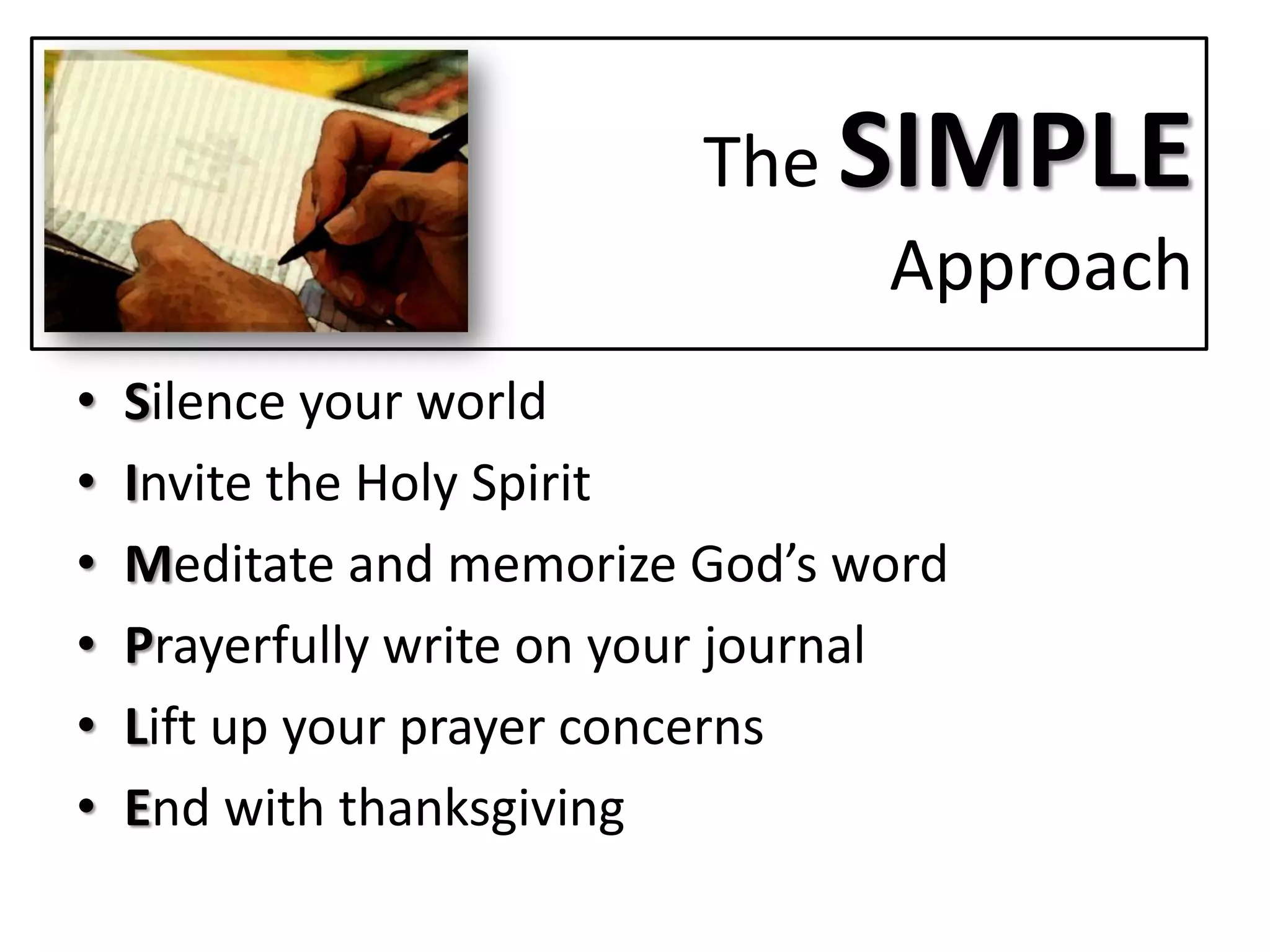
The SIMPLE
                                Approach
•   Silence your world
•   Invite the Holy Spirit
•   Meditate and memorize God’s word
•   Prayerfully write on your journal
•   Lift up your prayer concerns
•   End with thanksgiving
Matthew 28:19-20
         19 Therefore go and make
           disciples of all nations,
        baptizing them in the name
          of the Father and of the
         Son and of the Holy Spirit,
          20 and teaching them to
           obey everything I have
           commanded you. And
            surely I am with you
         always, to the very end of
                  the age."

The Great Commission
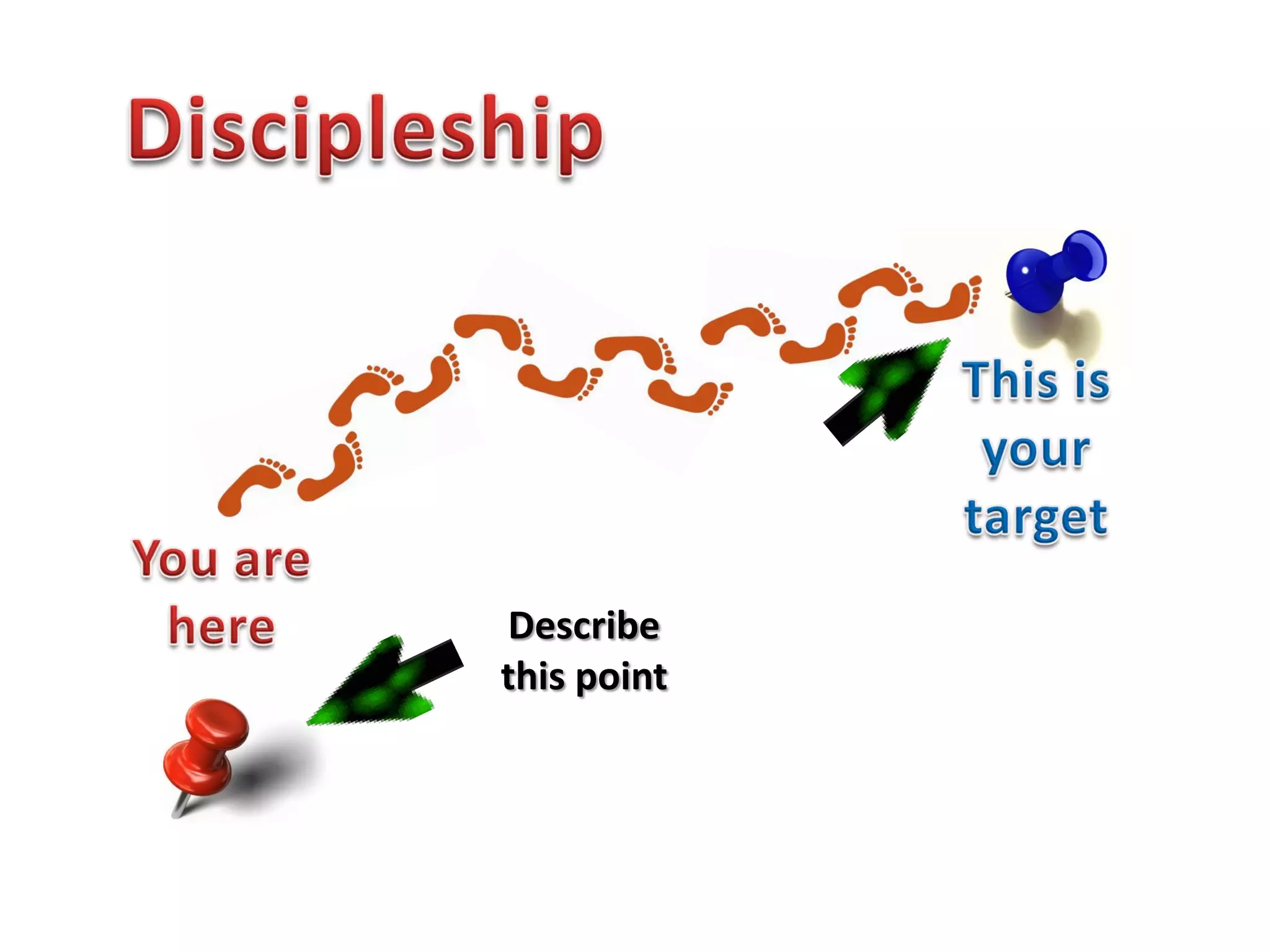
Describe
this point
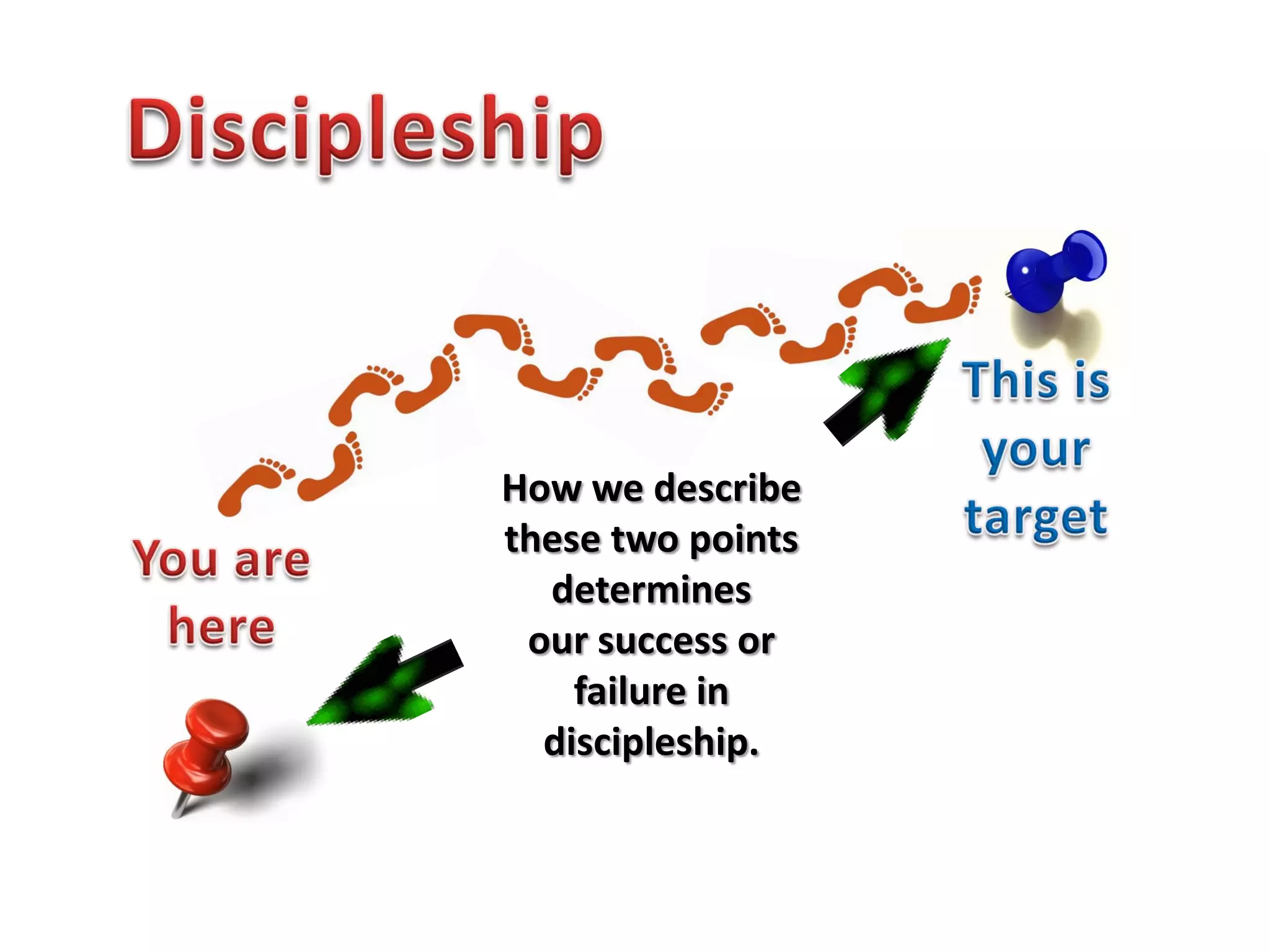
How we describe
these two points
  determines
 our success or
    failure in
  discipleship.
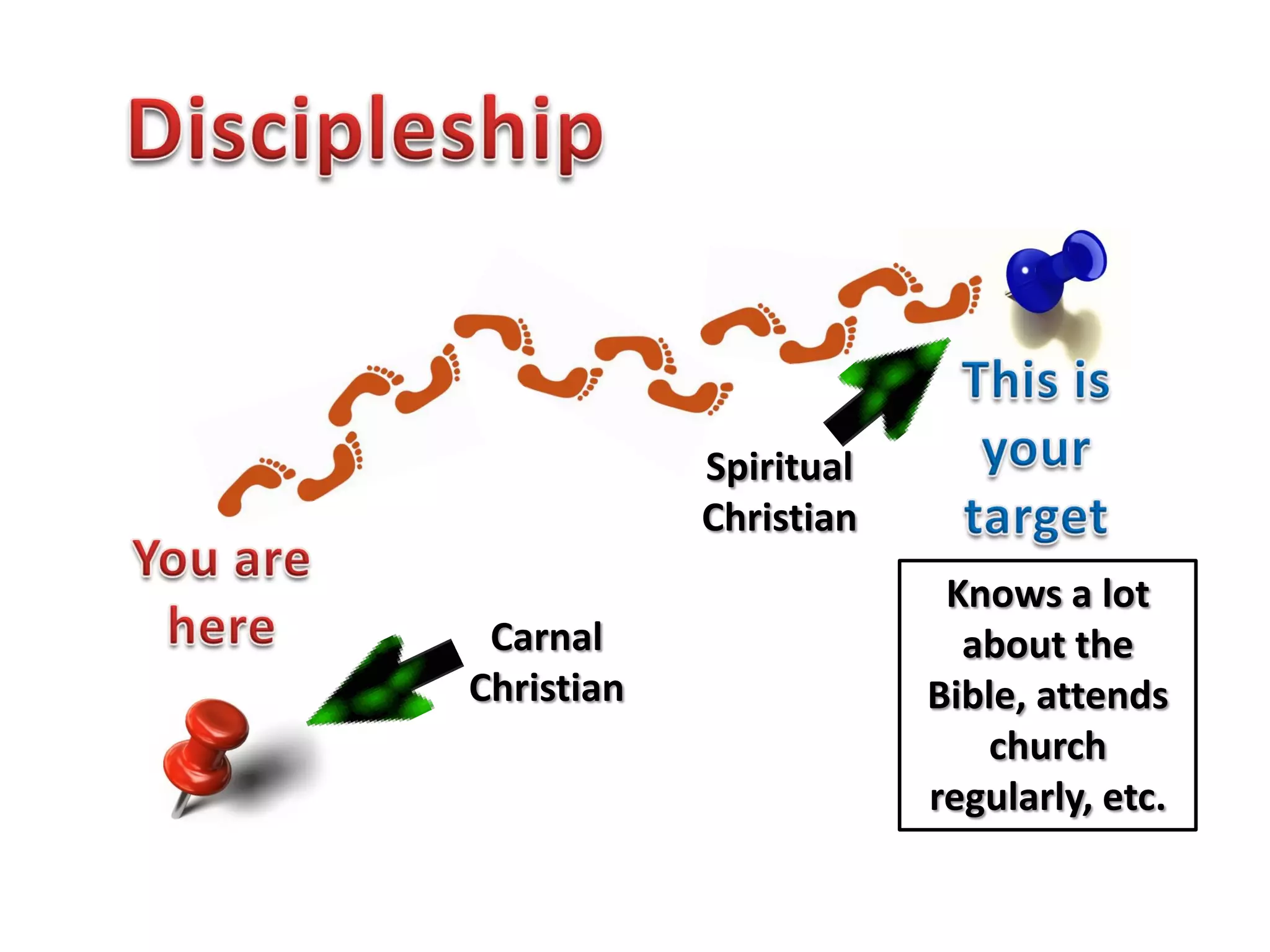
Spiritual
            Christian
                         Knows a lot
 Carnal                   about the
Christian               Bible, attends
                           church
                        regularly, etc.
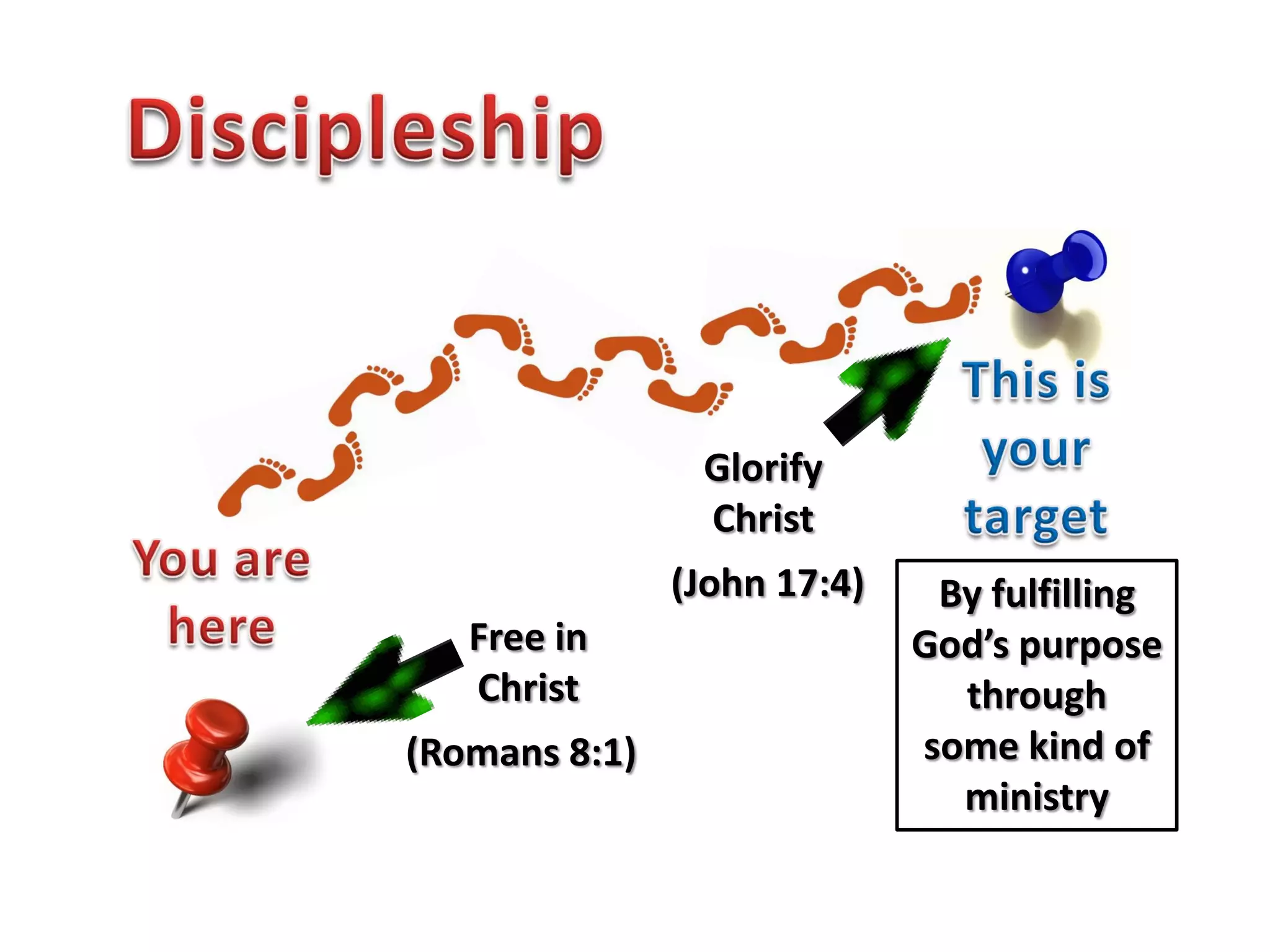
Glorify
                Christ
               (John 17:4)    By fulfilling
   Free in                   God’s purpose
   Christ                      through
(Romans 8:1)                 some kind of
                               ministry
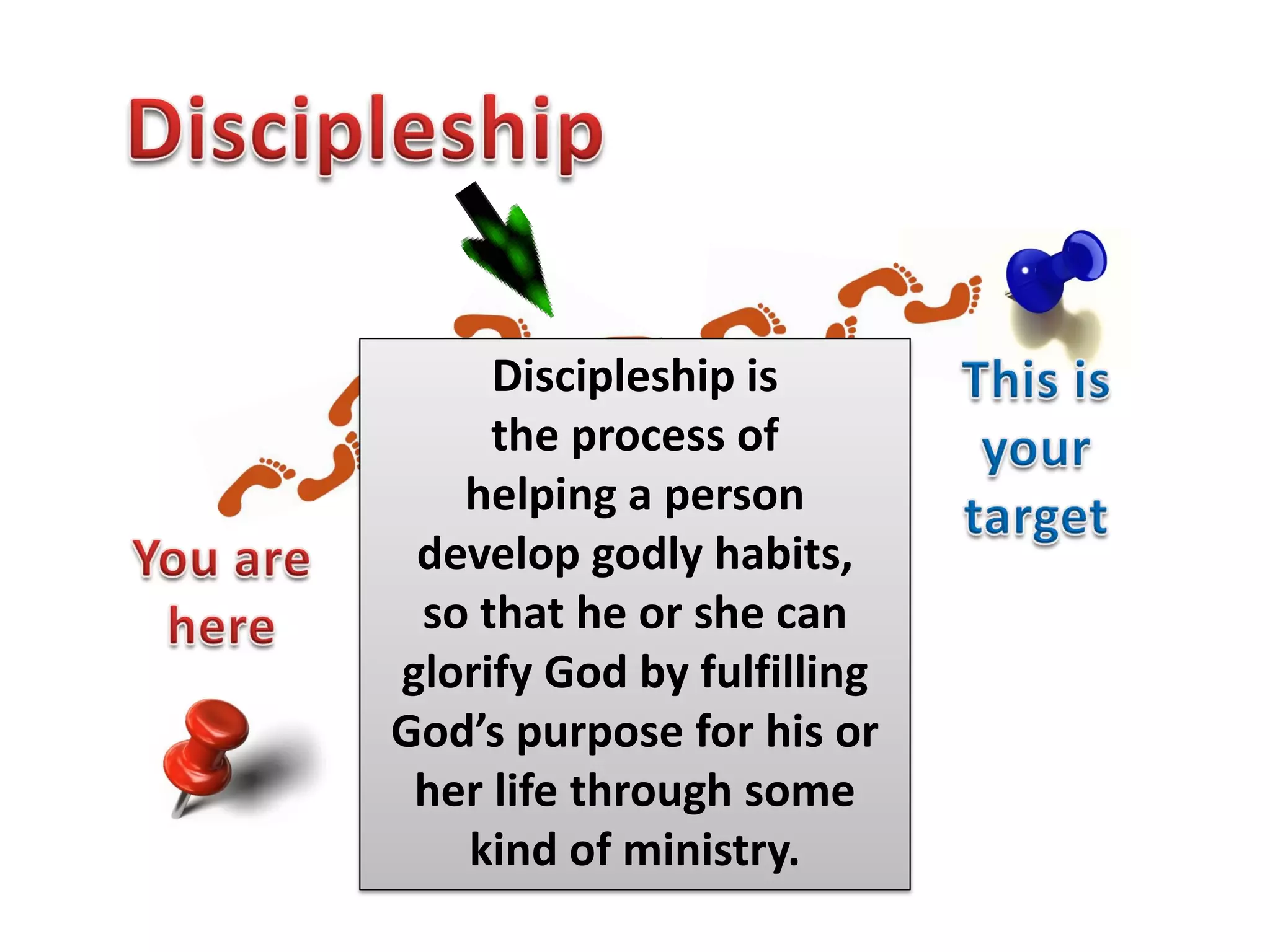
Discipleship is
     the process of
   helping a person
 develop godly habits,
 so that he or she can
glorify God by fulfilling
God’s purpose for his or
 her life through some
   kind of ministry.
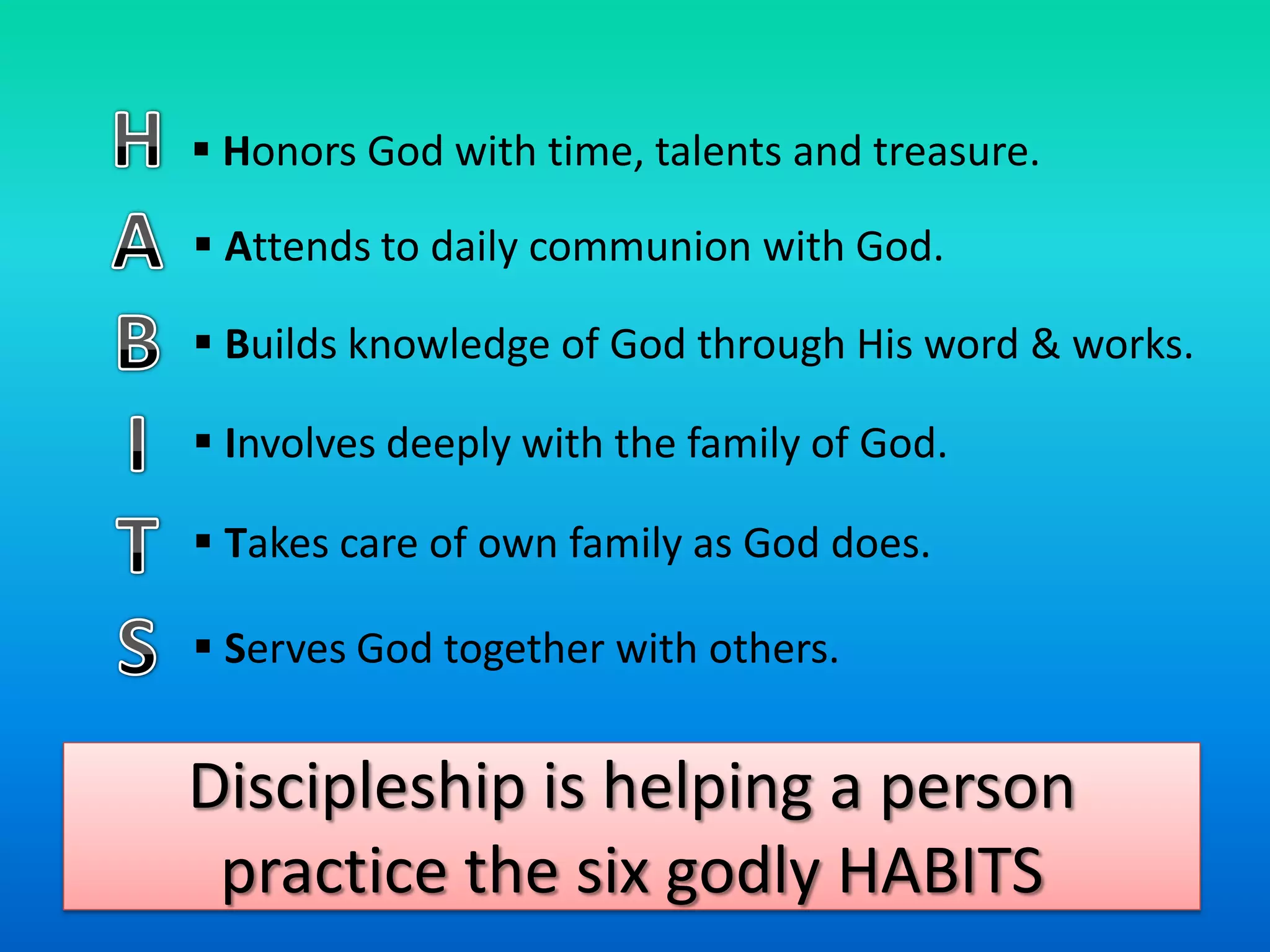
 Honors God with time, talents and treasure.

 Attends to daily communion with God.

 Builds knowledge of God through His word & works.

 Involves deeply with the family of God.

 Takes care of own family as God does.

 Serves God together with others.


Discipleship is helping a person
 practice the six godly HABITS
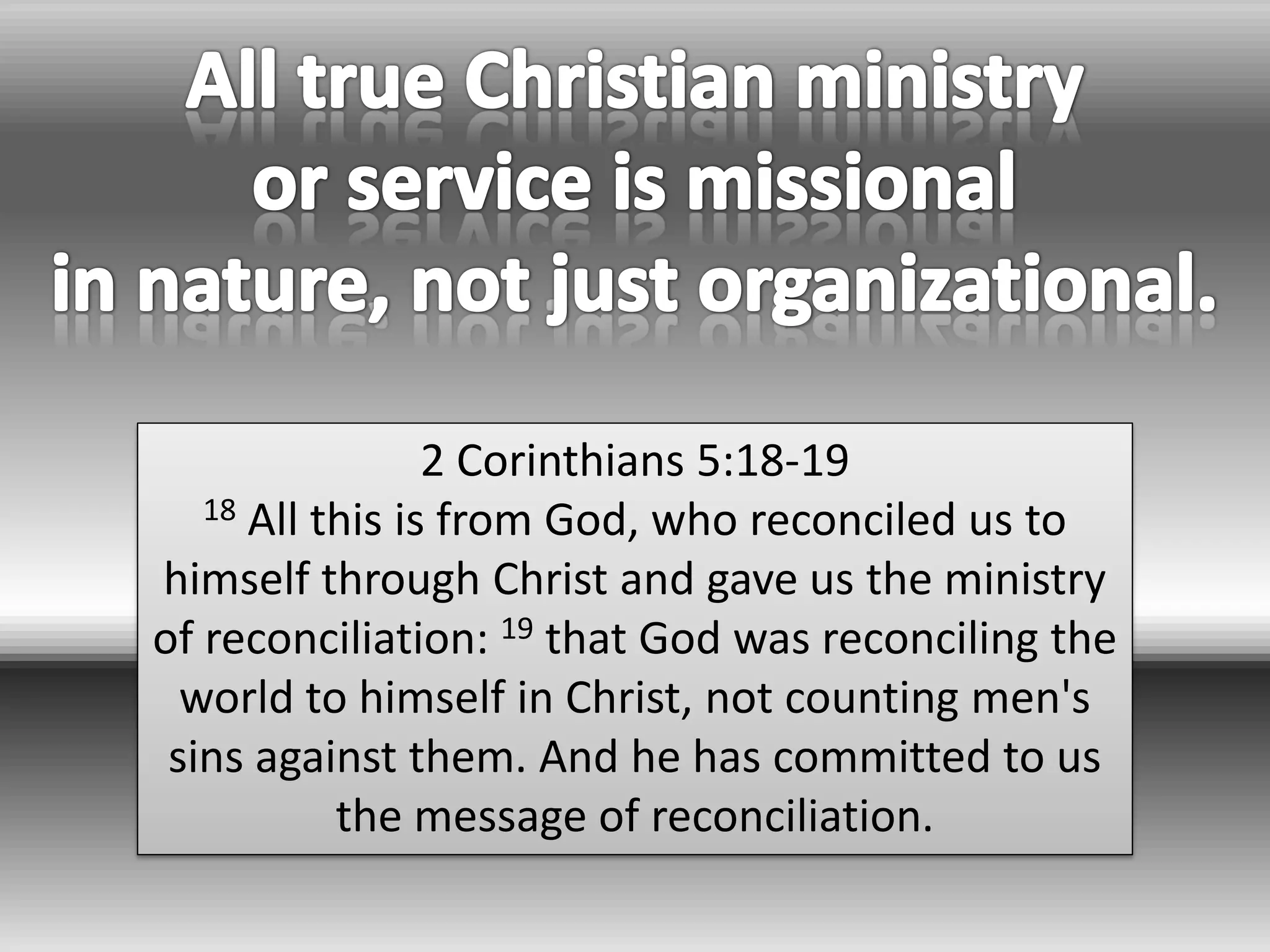
2 Corinthians 5:18-19
   18 All this is from God, who reconciled us to

himself through Christ and gave us the ministry
of reconciliation: 19 that God was reconciling the
  world to himself in Christ, not counting men's
 sins against them. And he has committed to us
           the message of reconciliation.
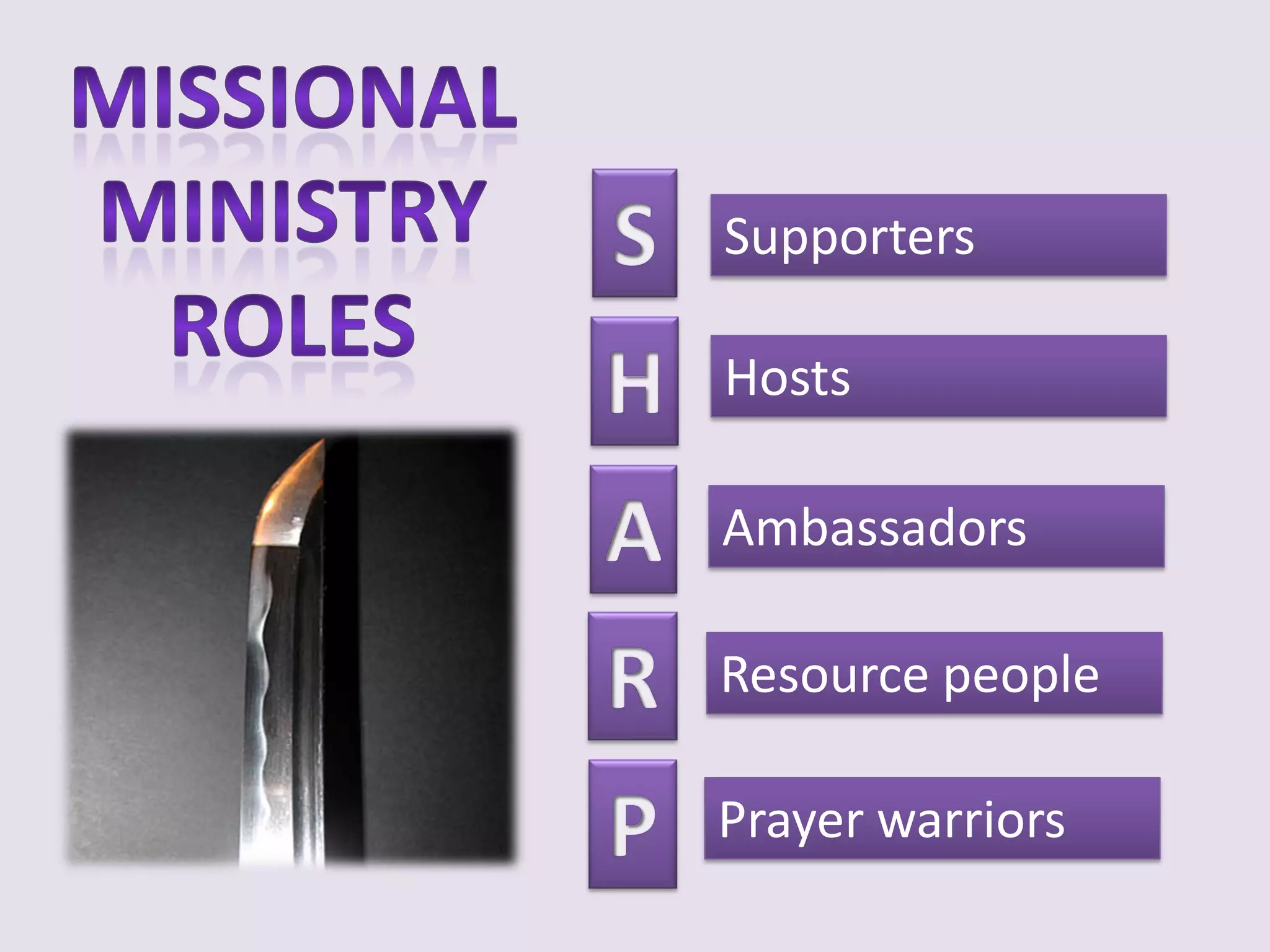
Supporters

Hosts

Ambassadors

Resource people

Prayer warriors
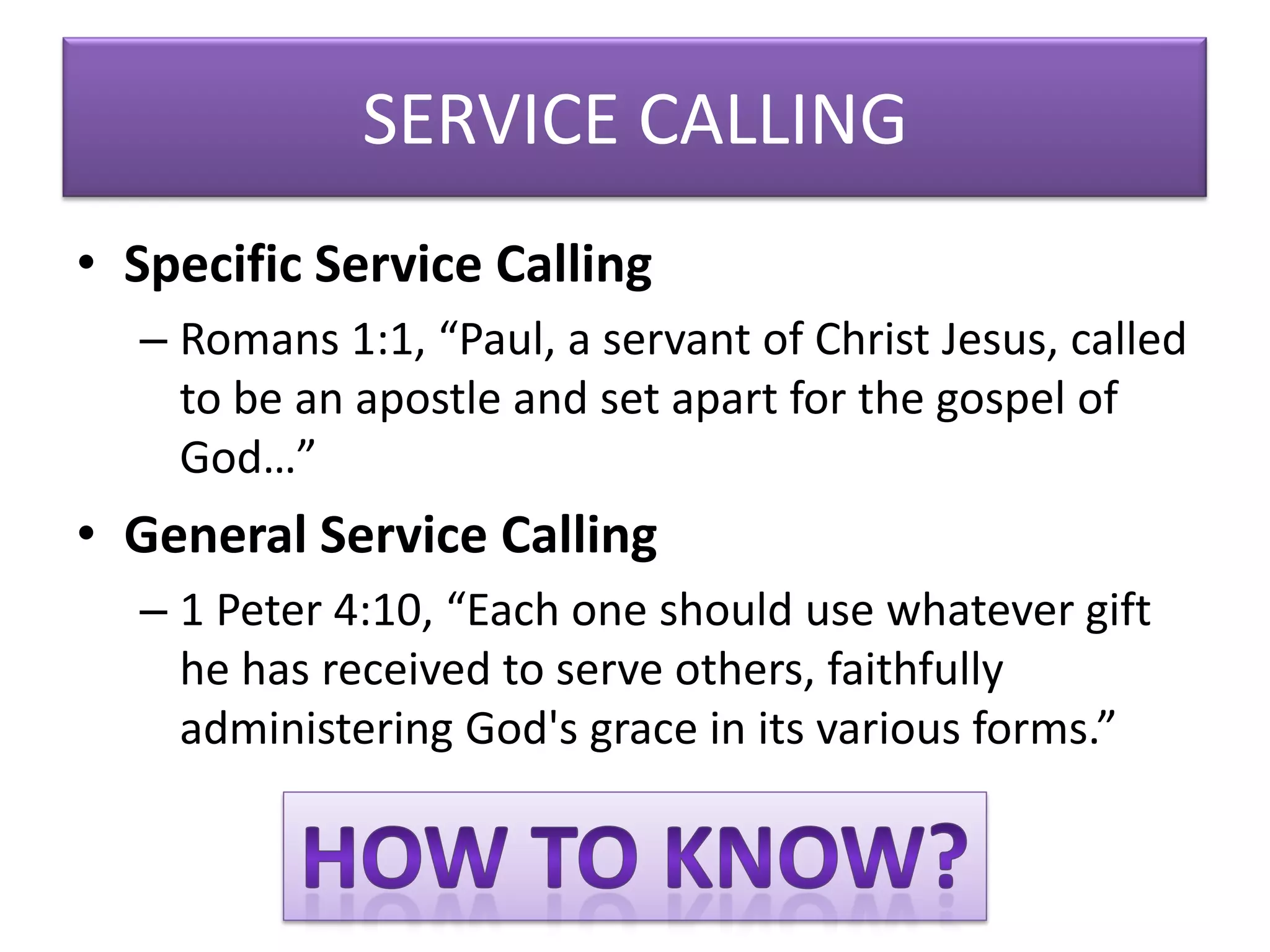
SERVICE CALLING
• Specific Service Calling
  – Romans 1:1, “Paul, a servant of Christ Jesus, called
    to be an apostle and set apart for the gospel of
    God…”
• General Service Calling
  – 1 Peter 4:10, “Each one should use whatever gift
    he has received to serve others, faithfully
    administering God's grace in its various forms.”
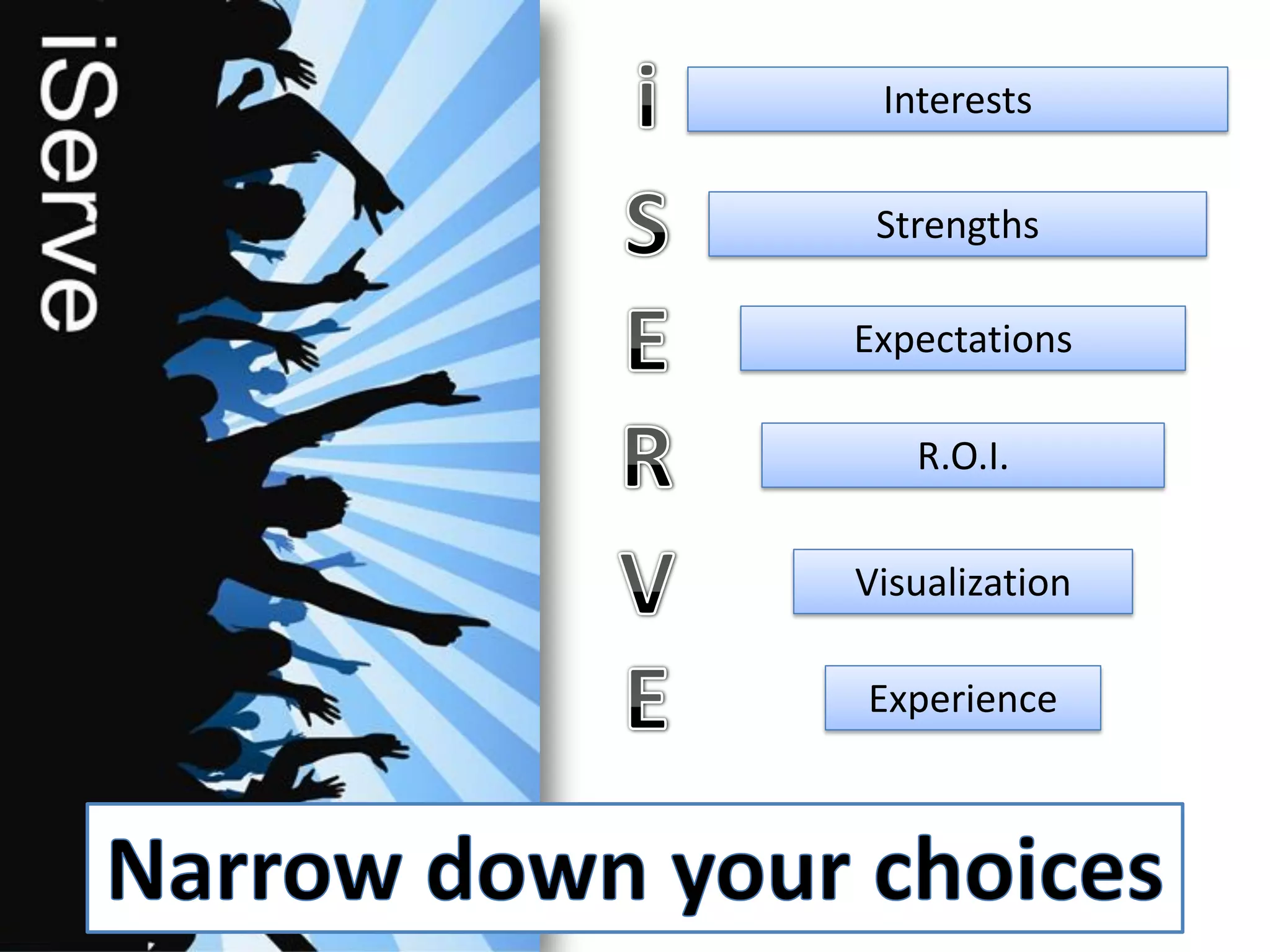
Interests

 Strengths

Expectations

   R.O.I.

Visualization

Experience
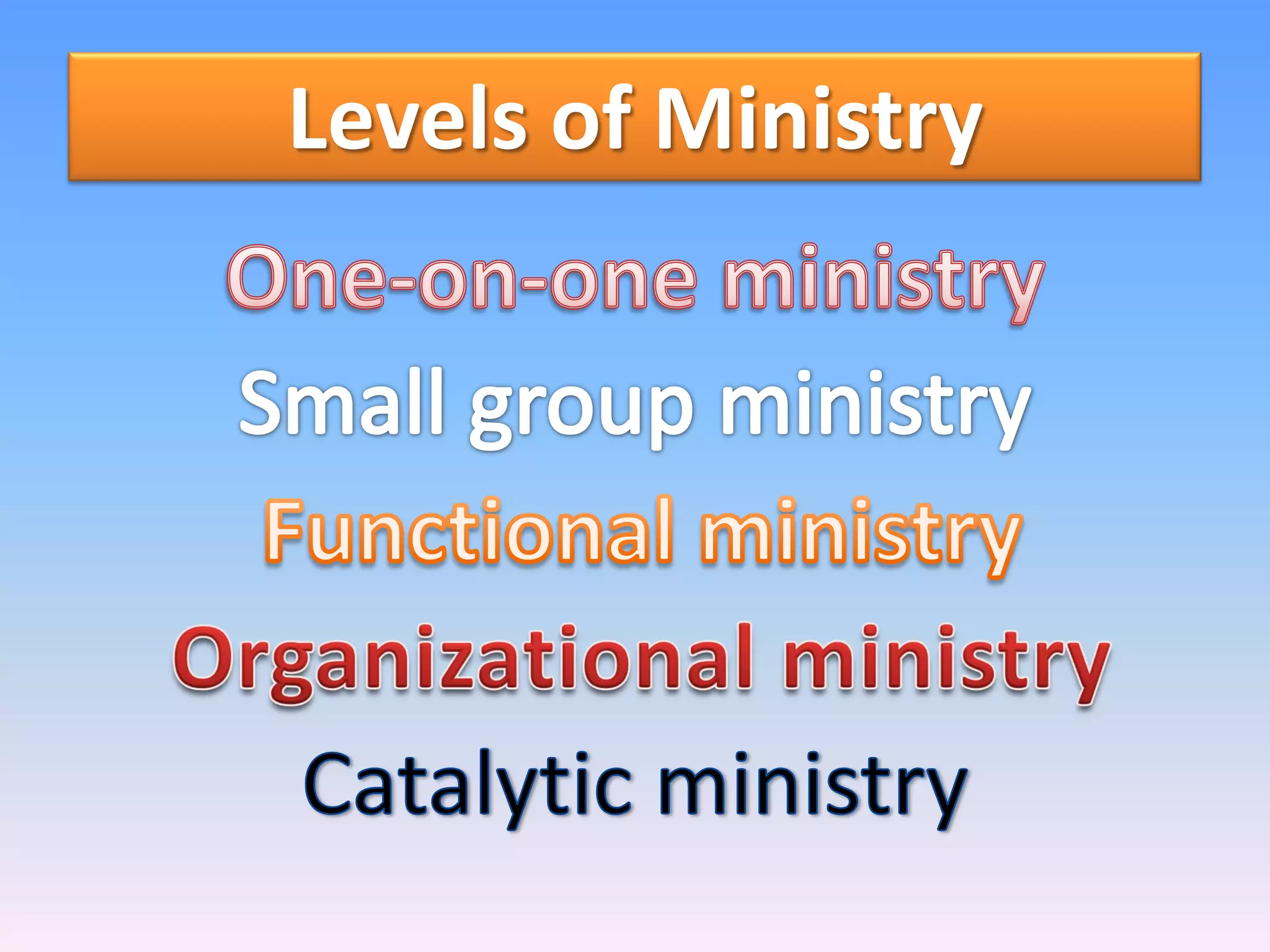
Levels of Ministry
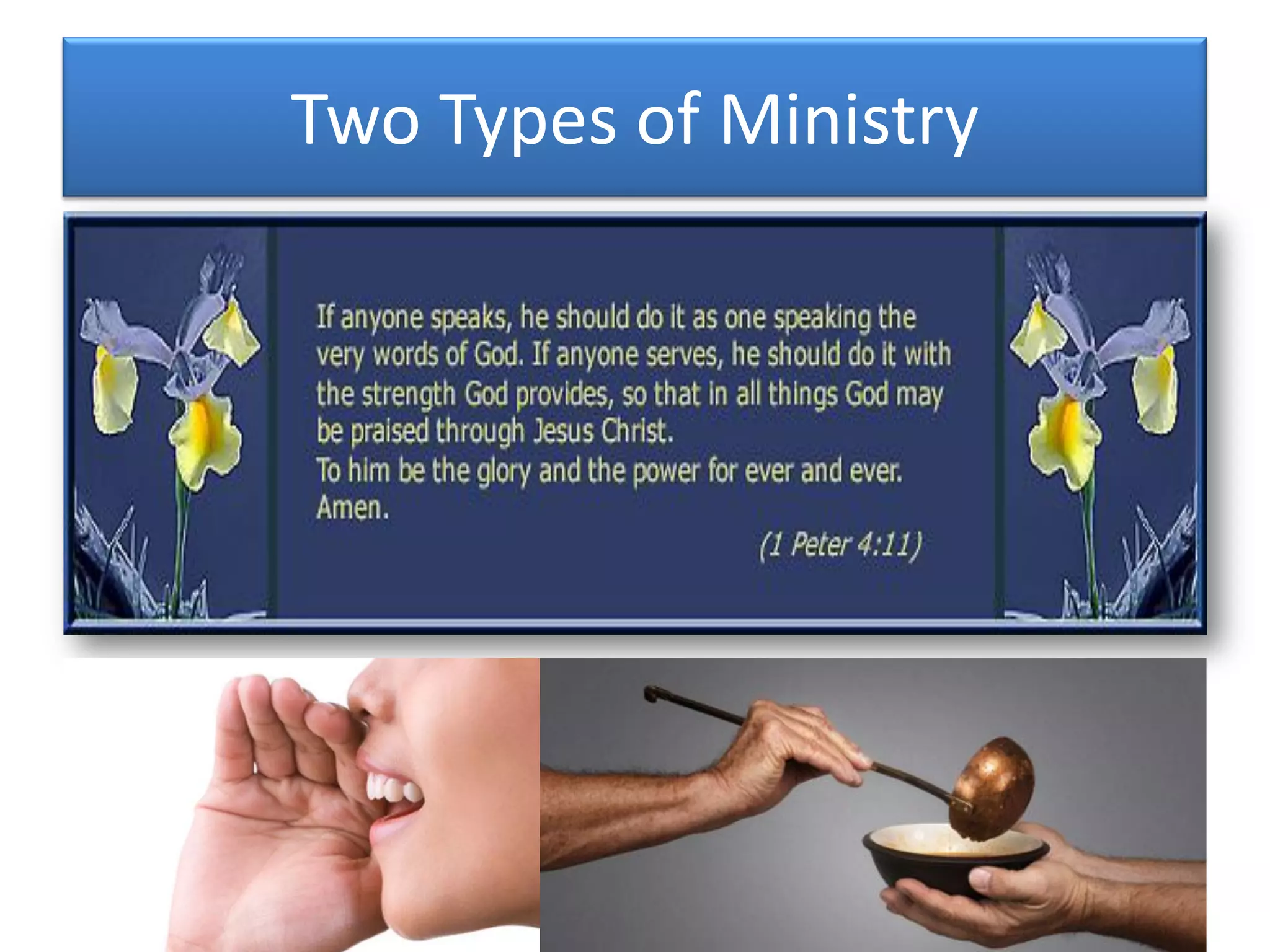
Two Types of Ministry
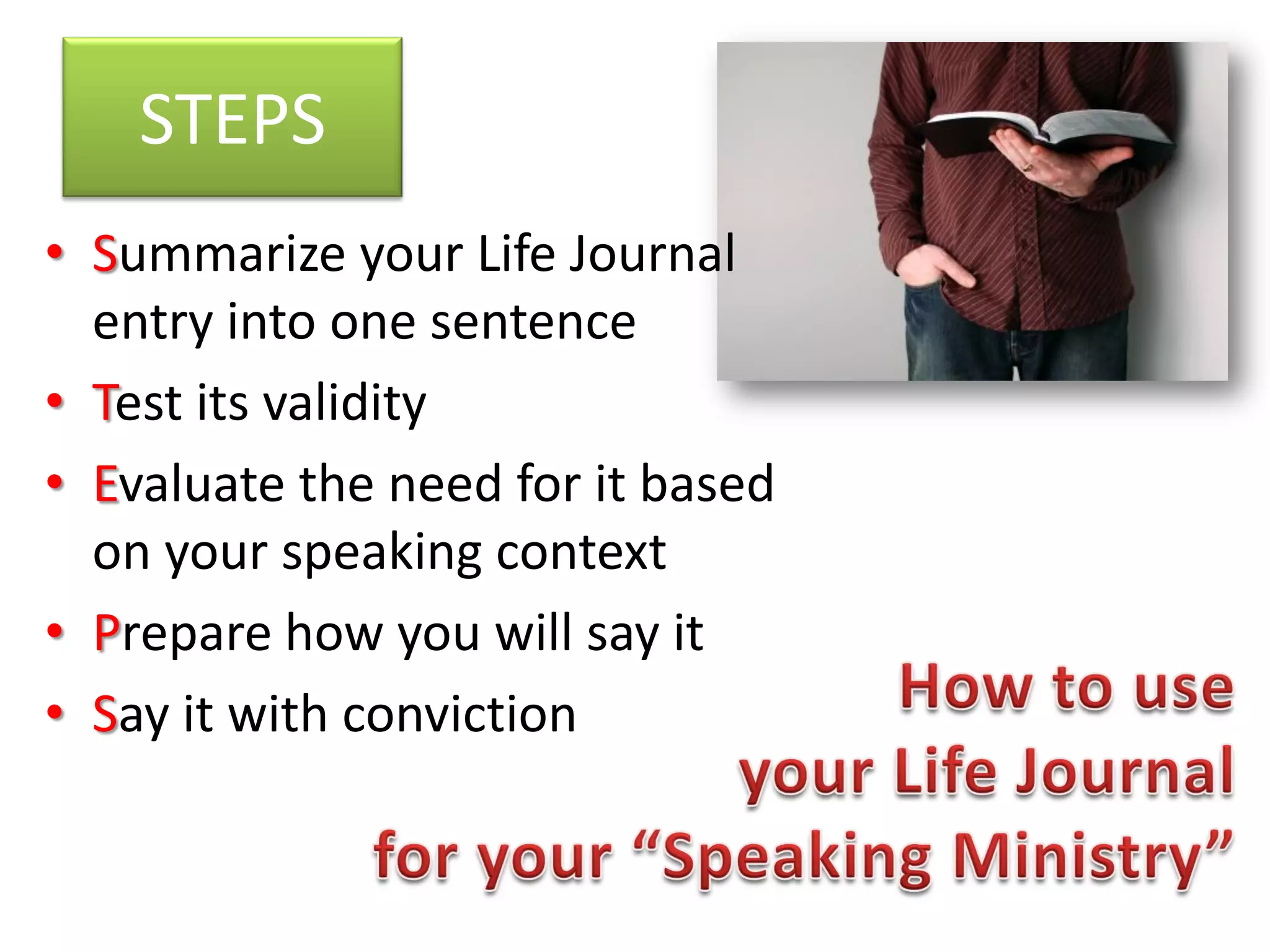
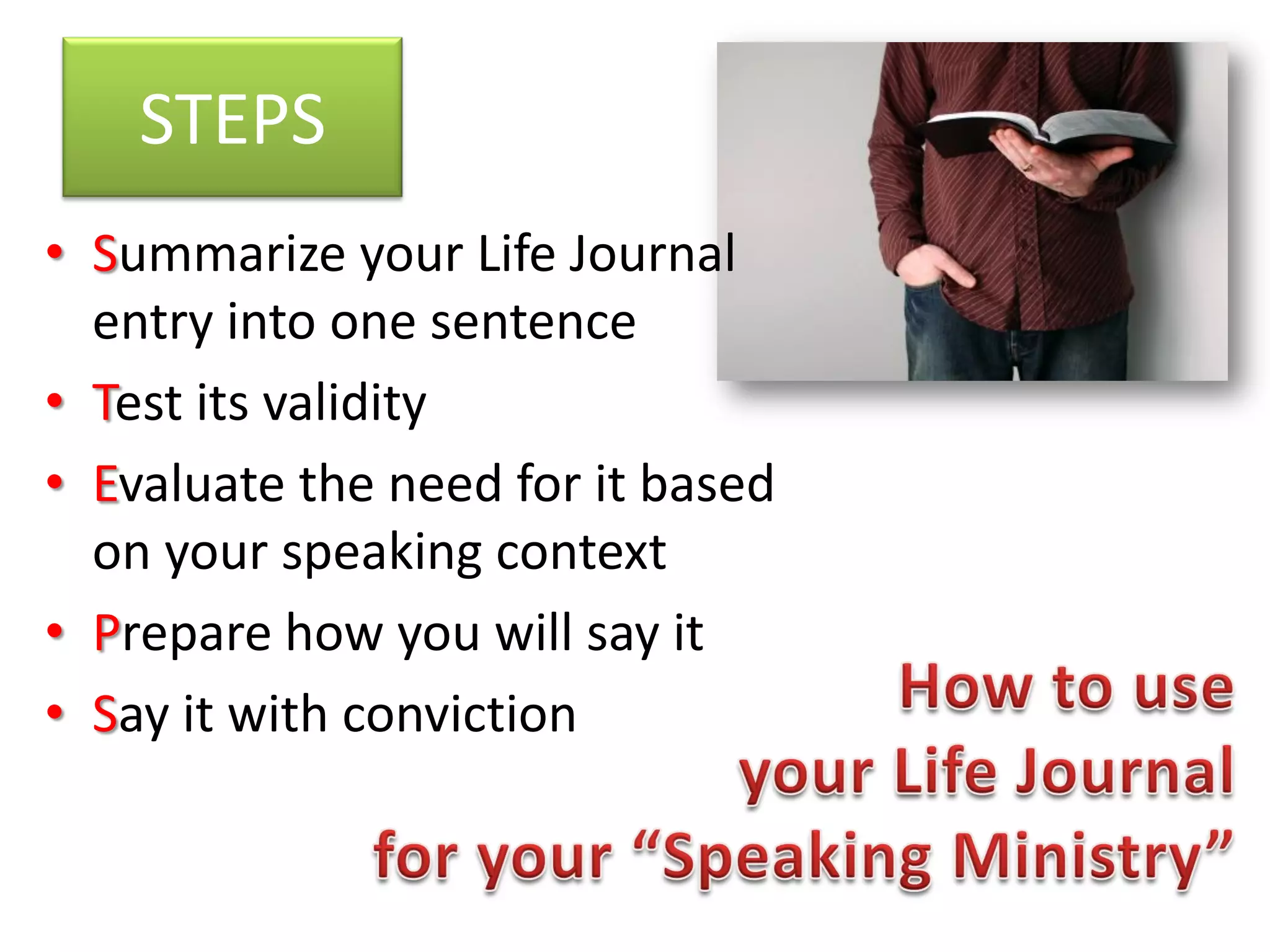
STEPS
• Summarize your Life Journal
  entry into one sentence
• Test its validity
• Evaluate the need for it based
  on your speaking context
• Prepare how you will say it
• Say it with conviction
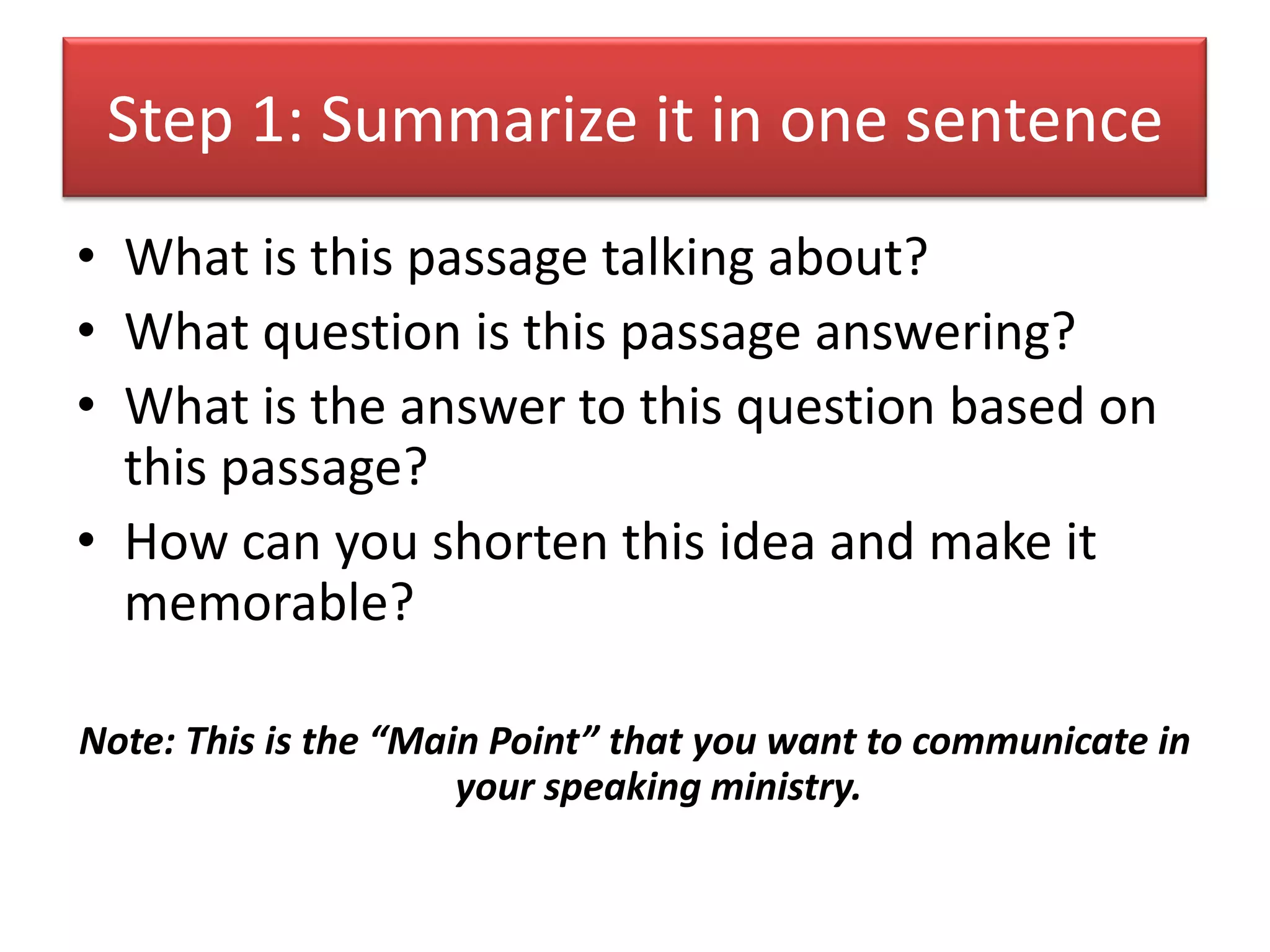
Step 1: Summarize it in one sentence
• What is this passage talking about?
• What question is this passage answering?
• What is the answer to this question based on
  this passage?
• How can you shorten this idea and make it
  memorable?

Note: This is the “Main Point” that you want to communicate in
                      your speaking ministry.
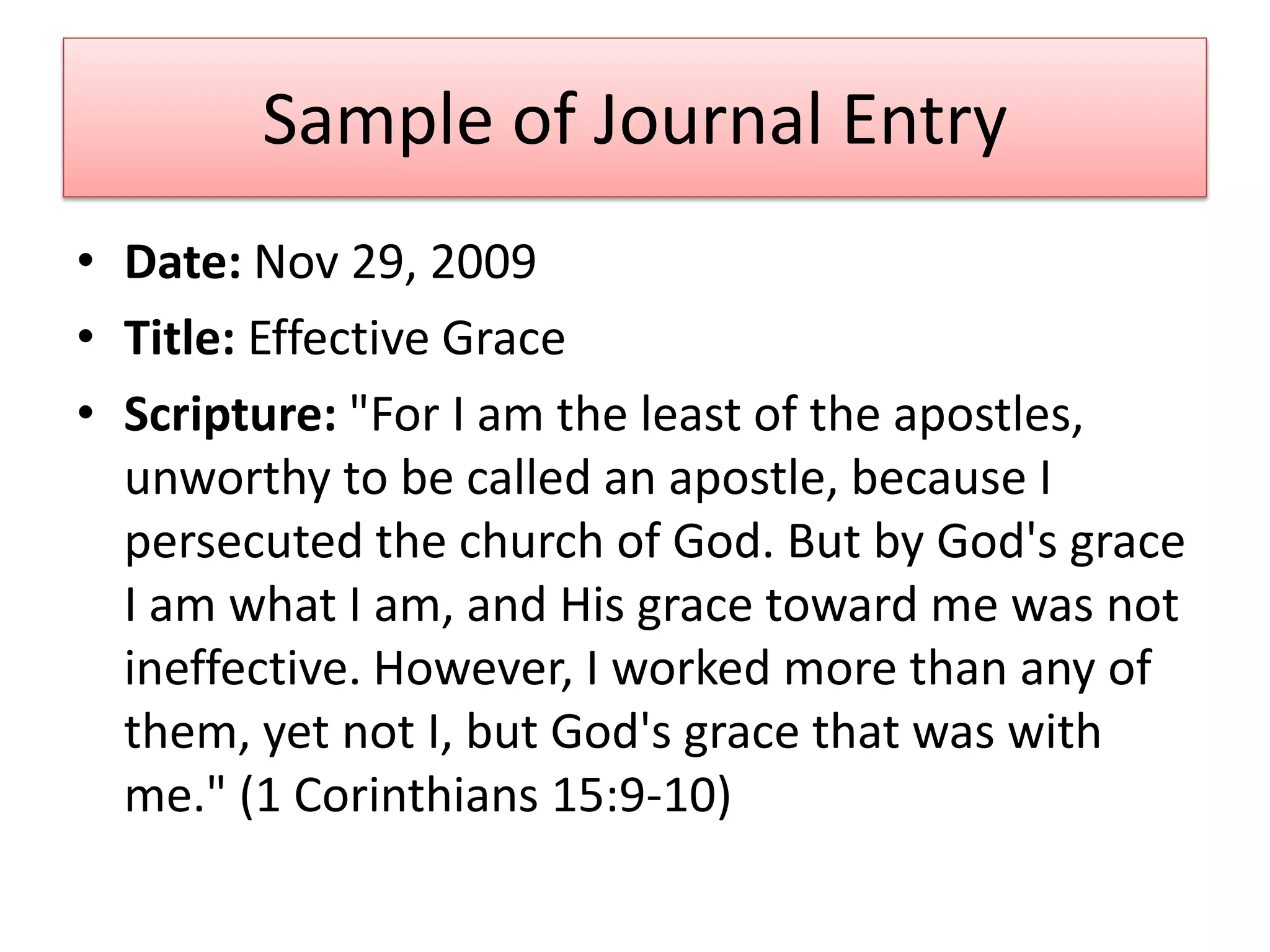
Sample of Journal Entry
• Date: Nov 29, 2009
• Title: Effective Grace
• Scripture: "For I am the least of the apostles,
  unworthy to be called an apostle, because I
  persecuted the church of God. But by God's grace
  I am what I am, and His grace toward me was not
  ineffective. However, I worked more than any of
  them, yet not I, but God's grace that was with
  me." (1 Corinthians 15:9-10)
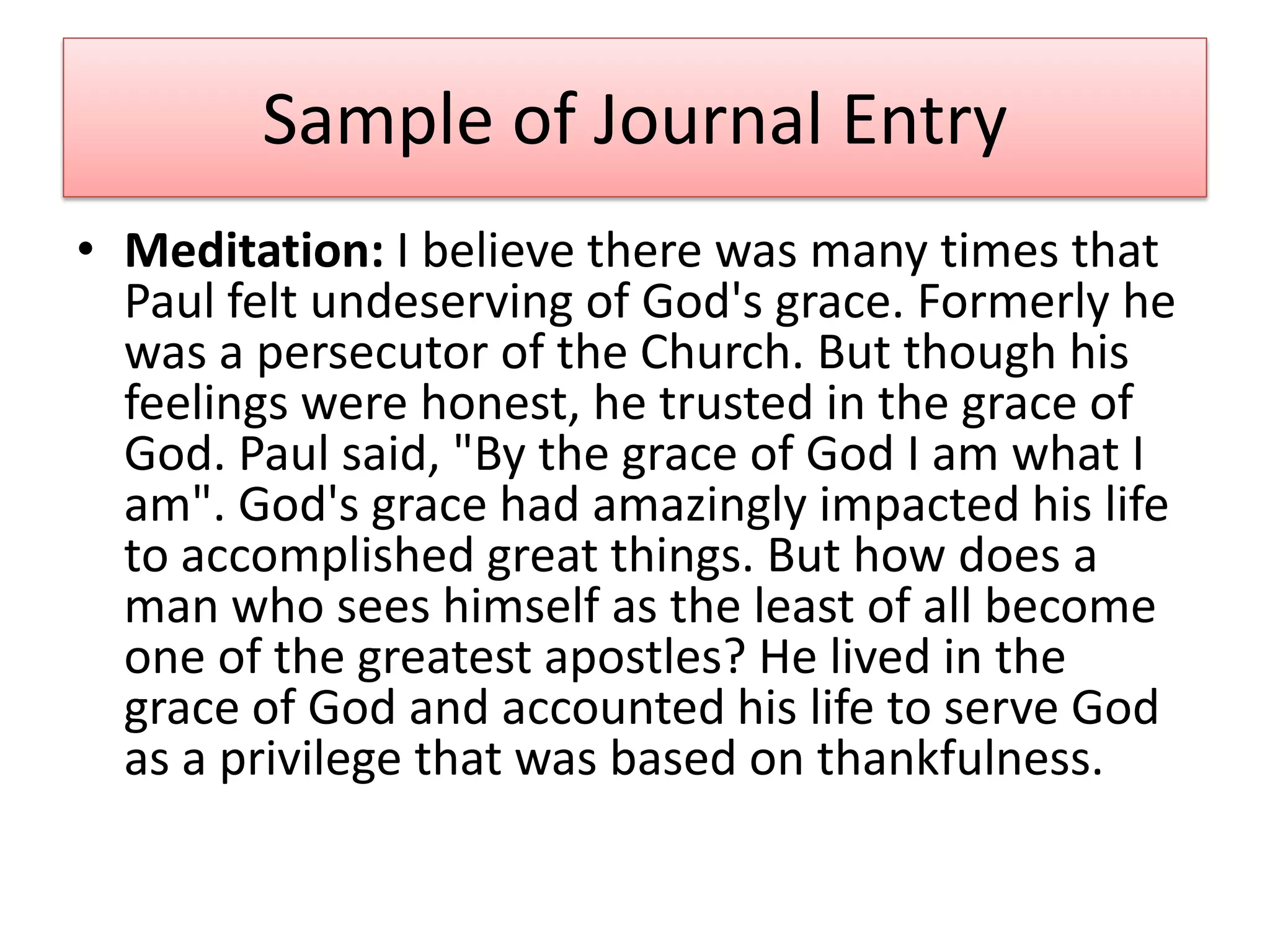
Sample of Journal Entry
• Meditation: I believe there was many times that
  Paul felt undeserving of God's grace. Formerly he
  was a persecutor of the Church. But though his
  feelings were honest, he trusted in the grace of
  God. Paul said, "By the grace of God I am what I
  am". God's grace had amazingly impacted his life
  to accomplished great things. But how does a
  man who sees himself as the least of all become
  one of the greatest apostles? He lived in the
  grace of God and accounted his life to serve God
  as a privilege that was based on thankfulness.
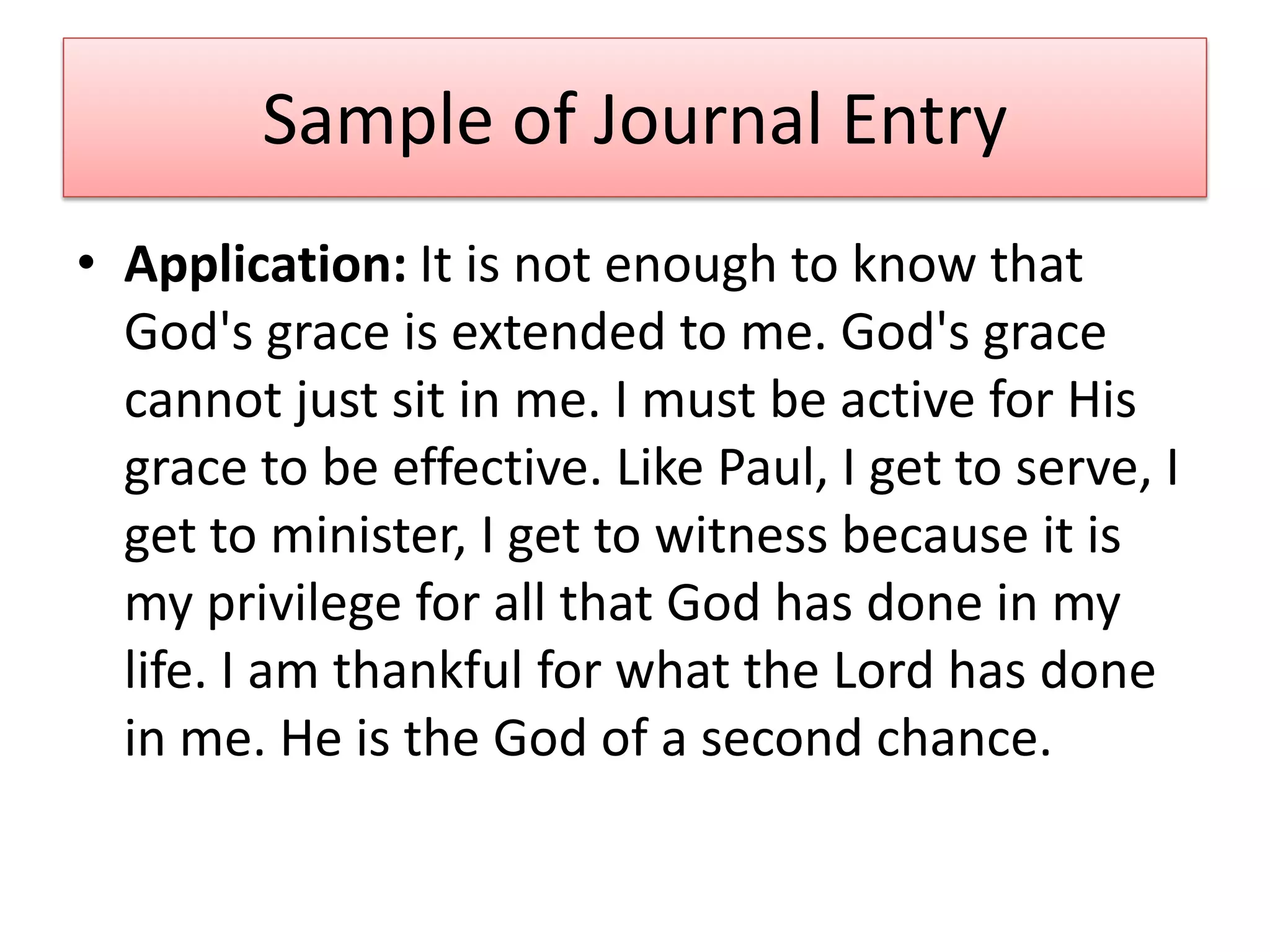
Sample of Journal Entry
• Application: It is not enough to know that
  God's grace is extended to me. God's grace
  cannot just sit in me. I must be active for His
  grace to be effective. Like Paul, I get to serve, I
  get to minister, I get to witness because it is
  my privilege for all that God has done in my
  life. I am thankful for what the Lord has done
  in me. He is the God of a second chance.
Sample of Journal Entry
• Prayer: Father, I am forever grateful to the
  cross for it is the power of God unto salvation.
  It is by grace that you save me and by grace
  you enable me to accomplish great things for
  Your Kingdom. Thank you for Your grace that
  works in me. I am forever grateful to You.
Let’s try it
 “For I am the least of the    • What is this passage
 apostles, unworthy to be        talking about?
called an apostle, because I
 persecuted the church of      • What question is this
 God. But by God's grace I       passage answering?
am what I am, and His grace    • What is the answer to
     toward me was not
   ineffective. However, I       this question based on
 worked more than any of         this passage?
 them, yet not I, but God's    • How can you shorten
 grace that was with me.”
                                 this idea and make it
       (1 Cor 15:9-10)
                                 memorable?
Step 2: Test its validity
• How does the passage validate or prove this
  idea?
• What does this idea really mean? Explain it.
• Is this idea true to life? Think of examples or
  illustrations where this idea rings true.
• Can this idea be applied in real-life situations?
  Think of some examples or illustrations where
  this idea can be applied.
Let’s try it
 “For I am the least of the    • How does the passage
 apostles, unworthy to be        validate or prove this
called an apostle, because I
 persecuted the church of        idea?
 God. But by God's grace I     • What does this idea
am what I am, and His grace      really mean?
     toward me was not
   ineffective. However, I     • Is this idea true to life?
 worked more than any of       • Can this idea be applied
 them, yet not I, but God's      in real-life situations?
 grace that was with me.”
       (1 Cor 15:9-10)
Step 3: Evaluate the need for it
• What problems do people have that this idea
  solves?
• What situations do people go through that
  this idea helps?
• What questions do people ask that this idea
  answers?
• What misunderstandings do people believe
  that this idea corrects?
Let’s try it
 “For I am the least of the    • Problems that people
 apostles, unworthy to be        have
called an apostle, because I
 persecuted the church of      • Situations that people
 God. But by God's grace I       go through
am what I am, and His grace    • Questions that people
     toward me was not
   ineffective. However, I       ask
 worked more than any of       • Misunderstandings that
 them, yet not I, but God's      people believe
 grace that was with me.”
       (1 Cor 15:9-10)
Step 4: Prepare how you will say it
• Determine the context or situation where you
  will speak (e.g. personal, group, large setting).
• Determine the approach (i.e. the “how”) that
  is best suited for this context.
• Draw up an outline if necessary then
  internalize the outline.
• Prepare “tools” (e.g. PowerPoint) IF it would
  be helpful.
If you’re speaking informally…
• Introduce the passage where you learned
  something (i.e. your main point).
• Read the passage and explain details that can
  help your audience understand how you got
  to your main point.
• Summarize everything by stating your main
  point and explaining it.
• Apply the main point to yourself (i.e. don’t
  preach).
If you’re listening informally…
• Ask “open ended” questions (e.g. why did you
  say that?)
• Clarify by repeating what you’ve heard (e.g. if I
  hear you correctly, you’re saying…)
• Affirm whenever appropriate (e.g. I appreciate
  your honesty in saying…)
• Correct gently, if necessary, and only when
  you have a relationship with the person (e.g. I
  think another way of looking at it is…)
If you’re speaking formally…
• Introduce the theme (e.g. grace, discipleship).
• Introduce the problem based on your personal
  experience (e.g. feeling condemned after
  sinning).
• Help the audience “feel” the problem, too.
• Introduce the passage and explain why it’s the
  best passage to help solve the problem.
• Go through the passage and explain relevant
  details that can help the audience understand.
If you’re speaking formally…
• Introduce your main point as the “turning
  point” in your talk, and explain it.
• Apply the main point to specific situations
  that are applicable to the audience.
• Motivate the audience to apply the main
  point (e.g. inspire them).
• Ask the audience to take an initial step toward
  applying the main point (optional).
• Bring your talk to an effective closure.
Step 5: Say it with conviction
• Believe that what you’re saying is from God.
  – 1 Peter 4:11, “If anyone speaks, he should do it as
    one speaking the very words of God.”
Step 5: Say it with conviction
• Believe that what you’re saying is from God.
• Be consistent with the atmosphere of the
  passage.
• Vary your voice and emphasize what needs to
  be emphasized.
• Listen to the Holy Spirit even as you speak.
• Be conversational, not preachy. Look at the
  people, not at your notes.
Step 5: Say it with conviction
• Illustrate only when necessary. Avoid too
  much talk.
• Always come back to the concept of grace as
  much as possible.
• Use your whole body, not just your mouth.
• If and when appropriate, end with a simple
  presentation of the Gospel.
STEPS
STEPS
• Summarize your Life Journal
  entry into one sentence
• Test its validity
• Evaluate the need for it based
  on your speaking context
• Prepare how you will say it
• Say it with conviction
Group Discussion
• What is the most significant thing that you’ve
  learned today?
• What skill or skills would you like to develop in
  the coming days?
• How do you envision yourself using these skills
  in ministry now or in the future?

              Pray for one another

Life Journaling Seminar Part 2 (Sg)

  • 2.
  • 3.
    The SIMPLE Approach • Silence your world • Invite the Holy Spirit • Meditate and memorize God’s word • Prayerfully write on your journal • Lift up your prayer concerns • End with thanksgiving
  • 5.
    Matthew 28:19-20 19 Therefore go and make disciples of all nations, baptizing them in the name of the Father and of the Son and of the Holy Spirit, 20 and teaching them to obey everything I have commanded you. And surely I am with you always, to the very end of the age." The Great Commission
  • 12.
  • 13.
    How we describe thesetwo points determines our success or failure in discipleship.
  • 14.
    Spiritual Christian Knows a lot Carnal about the Christian Bible, attends church regularly, etc.
  • 15.
    Glorify Christ (John 17:4) By fulfilling Free in God’s purpose Christ through (Romans 8:1) some kind of ministry
  • 16.
    Discipleship is the process of helping a person develop godly habits, so that he or she can glorify God by fulfilling God’s purpose for his or her life through some kind of ministry.
  • 17.
     Honors Godwith time, talents and treasure.  Attends to daily communion with God.  Builds knowledge of God through His word & works.  Involves deeply with the family of God.  Takes care of own family as God does.  Serves God together with others. Discipleship is helping a person practice the six godly HABITS
  • 19.
    2 Corinthians 5:18-19 18 All this is from God, who reconciled us to himself through Christ and gave us the ministry of reconciliation: 19 that God was reconciling the world to himself in Christ, not counting men's sins against them. And he has committed to us the message of reconciliation.
  • 20.
  • 22.
    SERVICE CALLING • SpecificService Calling – Romans 1:1, “Paul, a servant of Christ Jesus, called to be an apostle and set apart for the gospel of God…” • General Service Calling – 1 Peter 4:10, “Each one should use whatever gift he has received to serve others, faithfully administering God's grace in its various forms.”
  • 23.
    Interests Strengths Expectations R.O.I. Visualization Experience
  • 25.
  • 26.
    Two Types ofMinistry
  • 28.
    STEPS • Summarize yourLife Journal entry into one sentence • Test its validity • Evaluate the need for it based on your speaking context • Prepare how you will say it • Say it with conviction
  • 29.
    Step 1: Summarizeit in one sentence • What is this passage talking about? • What question is this passage answering? • What is the answer to this question based on this passage? • How can you shorten this idea and make it memorable? Note: This is the “Main Point” that you want to communicate in your speaking ministry.
  • 30.
    Sample of JournalEntry • Date: Nov 29, 2009 • Title: Effective Grace • Scripture: "For I am the least of the apostles, unworthy to be called an apostle, because I persecuted the church of God. But by God's grace I am what I am, and His grace toward me was not ineffective. However, I worked more than any of them, yet not I, but God's grace that was with me." (1 Corinthians 15:9-10)
  • 31.
    Sample of JournalEntry • Meditation: I believe there was many times that Paul felt undeserving of God's grace. Formerly he was a persecutor of the Church. But though his feelings were honest, he trusted in the grace of God. Paul said, "By the grace of God I am what I am". God's grace had amazingly impacted his life to accomplished great things. But how does a man who sees himself as the least of all become one of the greatest apostles? He lived in the grace of God and accounted his life to serve God as a privilege that was based on thankfulness.
  • 32.
    Sample of JournalEntry • Application: It is not enough to know that God's grace is extended to me. God's grace cannot just sit in me. I must be active for His grace to be effective. Like Paul, I get to serve, I get to minister, I get to witness because it is my privilege for all that God has done in my life. I am thankful for what the Lord has done in me. He is the God of a second chance.
  • 33.
    Sample of JournalEntry • Prayer: Father, I am forever grateful to the cross for it is the power of God unto salvation. It is by grace that you save me and by grace you enable me to accomplish great things for Your Kingdom. Thank you for Your grace that works in me. I am forever grateful to You.
  • 34.
    Let’s try it “For I am the least of the • What is this passage apostles, unworthy to be talking about? called an apostle, because I persecuted the church of • What question is this God. But by God's grace I passage answering? am what I am, and His grace • What is the answer to toward me was not ineffective. However, I this question based on worked more than any of this passage? them, yet not I, but God's • How can you shorten grace that was with me.” this idea and make it (1 Cor 15:9-10) memorable?
  • 35.
    Step 2: Testits validity • How does the passage validate or prove this idea? • What does this idea really mean? Explain it. • Is this idea true to life? Think of examples or illustrations where this idea rings true. • Can this idea be applied in real-life situations? Think of some examples or illustrations where this idea can be applied.
  • 36.
    Let’s try it “For I am the least of the • How does the passage apostles, unworthy to be validate or prove this called an apostle, because I persecuted the church of idea? God. But by God's grace I • What does this idea am what I am, and His grace really mean? toward me was not ineffective. However, I • Is this idea true to life? worked more than any of • Can this idea be applied them, yet not I, but God's in real-life situations? grace that was with me.” (1 Cor 15:9-10)
  • 37.
    Step 3: Evaluatethe need for it • What problems do people have that this idea solves? • What situations do people go through that this idea helps? • What questions do people ask that this idea answers? • What misunderstandings do people believe that this idea corrects?
  • 38.
    Let’s try it “For I am the least of the • Problems that people apostles, unworthy to be have called an apostle, because I persecuted the church of • Situations that people God. But by God's grace I go through am what I am, and His grace • Questions that people toward me was not ineffective. However, I ask worked more than any of • Misunderstandings that them, yet not I, but God's people believe grace that was with me.” (1 Cor 15:9-10)
  • 39.
    Step 4: Preparehow you will say it • Determine the context or situation where you will speak (e.g. personal, group, large setting). • Determine the approach (i.e. the “how”) that is best suited for this context. • Draw up an outline if necessary then internalize the outline. • Prepare “tools” (e.g. PowerPoint) IF it would be helpful.
  • 40.
    If you’re speakinginformally… • Introduce the passage where you learned something (i.e. your main point). • Read the passage and explain details that can help your audience understand how you got to your main point. • Summarize everything by stating your main point and explaining it. • Apply the main point to yourself (i.e. don’t preach).
  • 41.
    If you’re listeninginformally… • Ask “open ended” questions (e.g. why did you say that?) • Clarify by repeating what you’ve heard (e.g. if I hear you correctly, you’re saying…) • Affirm whenever appropriate (e.g. I appreciate your honesty in saying…) • Correct gently, if necessary, and only when you have a relationship with the person (e.g. I think another way of looking at it is…)
  • 43.
    If you’re speakingformally… • Introduce the theme (e.g. grace, discipleship). • Introduce the problem based on your personal experience (e.g. feeling condemned after sinning). • Help the audience “feel” the problem, too. • Introduce the passage and explain why it’s the best passage to help solve the problem. • Go through the passage and explain relevant details that can help the audience understand.
  • 44.
    If you’re speakingformally… • Introduce your main point as the “turning point” in your talk, and explain it. • Apply the main point to specific situations that are applicable to the audience. • Motivate the audience to apply the main point (e.g. inspire them). • Ask the audience to take an initial step toward applying the main point (optional). • Bring your talk to an effective closure.
  • 45.
    Step 5: Sayit with conviction • Believe that what you’re saying is from God. – 1 Peter 4:11, “If anyone speaks, he should do it as one speaking the very words of God.”
  • 46.
    Step 5: Sayit with conviction • Believe that what you’re saying is from God. • Be consistent with the atmosphere of the passage. • Vary your voice and emphasize what needs to be emphasized. • Listen to the Holy Spirit even as you speak. • Be conversational, not preachy. Look at the people, not at your notes.
  • 47.
    Step 5: Sayit with conviction • Illustrate only when necessary. Avoid too much talk. • Always come back to the concept of grace as much as possible. • Use your whole body, not just your mouth. • If and when appropriate, end with a simple presentation of the Gospel.
  • 49.
  • 50.
    STEPS • Summarize yourLife Journal entry into one sentence • Test its validity • Evaluate the need for it based on your speaking context • Prepare how you will say it • Say it with conviction
  • 51.
    Group Discussion • Whatis the most significant thing that you’ve learned today? • What skill or skills would you like to develop in the coming days? • How do you envision yourself using these skills in ministry now or in the future? Pray for one another