A Rhema Christian Fellowship Bible Study Lesson Session Two
Session 1 - Self Test Quiz
What do I believe about my faith?  How can I know what the will of God is?
 
God’s way of speaking to us and blessing us. We learn what the Christian life is about. We are reading the words and messages of God Himself. We are being obedient. We become equipped to deal with others.
We hear and interact with God through His words. We get everything we seek and need from God. We gain a greater in-depth knowledge of biblical accounts. We can fully understand the Good News. There are hundreds of promises from God.
What do I believe about my faith?  How can I know what the will of God is?
God’s written revelation of His will to men Central theme - salvation through Jesus Christ Explains why Jesus is the Savior for the World Contains 66 books 40 different authors Covers approximately 1600 years Old Testament mostly in Hebrew (some  Aramaic ) New Testament translated into Greek
Language of the Bible Aramaic Semitic Amharic Translations Bible - “biblos” in Greek Word - “logos”  Testament – covenant – promise, pledge, contract
Old Testament 39 books Law 5 History 12  Poetry  5 Major Prophets 5 Minor Prophets 12 New Testament 27 books Gospels  4 History  1 Epistles of Paul 13  General Letters  7 Revelation  1
Study Bible Bible Concordance Bible Commentary Dictionary and Thesaurus Bible Handbook Notebook (Writing supplies) Computer or Handheld Assistant
Reading Thorough the Bible in a Year Deductive Study Method Inductive Study Method Devotional Study Method Character, Event, and Place Studies Keyword Study
Today’s Lesson
Introduction Grasping God’s Word  is for people who want to understand the Bible at a deeper level.  Why do we have to  interpret  the Bible? The process of interpreting and applying the Bible may be compared to taking a  journey . There is a  river of differences  separating us from the biblical audience—culture, language, time, situation, and covenant.
The process of interpreting and applying the Bible may be compared to taking a  journey .
 
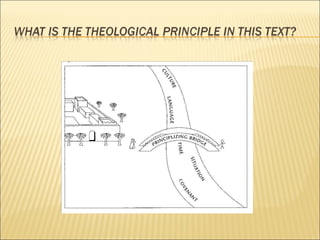
There is a  river of differences  separating us from the biblical audience Culture Language Time Situation Covenant
 
Crossing the Principlizing Bridge is the most challenging and critical step The theological principle is part of the meaning that you are discovering in the text. The principle should: be reflected in the text be timeless and tied to specific situation not be culturally bound corresponds to the rest of the Scripture be relevant to contemporary and biblical audiences
 
 
By learning an accurate and consistent approach.
The Bible is God’s communication of himself and his will to us. We  do not create  meaning; rather,  we seek  to discover the meaning that is already in the Bible. Theological principles revealed in specific passages of the Bible are applicable to both the  biblical  audience and to  Christians  today.  We can use the  principlizing bridge  to cross the river of differences.
Four Journey Steps 1 – Grasping the Text in Their Time What did the text mean to the biblical audience? 2 – Measuring the Width of the River What are the differences between the biblical  audience and us?
Four Journey Steps 3 – Crossing the Principlizing Bridge What is the theological principle in this text? 4 – Grasping the Text in Our Time  How should individual Christians today apply the  theological principle in their lives?
Read Joshua 1:1-9
Step 1  What did the text mean? The Lord commanded Joshua, the new leader of Israel, to draw strength and courage from God’s empowering presence, to be obedient to the law of Moses, and to meditate on the law so that he would be successful in the conquest of the Promised Land.
Step 2  What are the differences?   We are not leaders of the nation Israel. We are not embarking on the conquest of the Promised Land. We are not under the old covenant of law.
Step 3  What is the theological principle? To be effective in serving God and successful in the task to which he has called us, we must draw strength and courage from his presence. We must also be obedient to God’s Word, meditating on it constantly.  Note: in order to be obedient to God’s Word to meditate you must understand what the word “meditate” meant in the author’s day.
Step 4  How should we apply this principle?   Spend more time in the meditation of God’s Word Obey God when he calls you to a new and demanding ministry, trusting in his presence to empower you. Focus on God’s presence to bring you new courage and strength in your present ministry situation.
Involves three skills: Observation Interpretation Application
See precisely what the passage says Basis for accurate interpretation and correct application Answers the question: What does the passage say?
Takes into account context Requires ‘dissecting’ the passage Careful word studies Interpret Scripture literally Answers the question: What does the passage mean?
Embracing the truth The “doing” of God’s word Apply in light of 2 Tim 3:16-17 Doctrine,  Reproof,  Correction,  Instruction in righteousness Answers the question: How does the passage work?
 
Serious reading means looking at the big picture and looking at the  details .  At first, refrain from  interpretation  or  application . Start with  observation   and try to see as much as possible. Look carefully at the details of the text. Practice  Observation  with Joshua 1:1-9
Repeating words and phrases (“world”) Contrasts (“gentle answer” vs. “harsh word”) Comparisons (“soar on wings like eagles”) Lists (fruit of Spirit) Causes and effects (“wages of sin is death”) Figures of speech (“The Lord is my rock”) Conjunctions (“therefore” in Romans 12:1) Verbs (where the action is) Pronouns (“ our  Father in heaven”) Time (“immediately”, “then”)
Using Handout – Assignment 2-1 Find a minimum of 30 observations in Acts 1:8. List them on your handout. Avoid making interpretations and applications. Limit your observations to details and not interpretations of those details. Dig deep!  Work hard!  Read and reread the passage.  Happy hunting!
Acts 1:8 (NKJV)  8 But you shall receive power when the Holy Spirit has come upon you; and you shall be witnesses to Me in Jerusalem, and in all Judea and Samaria, and to the end of the earth.  Acts 1:8 ( KJV )  8 But ye shall receive power, after that the Holy Ghost is come upon you: and ye shall be witnesses unto me both in Jerusalem, and in all Judaea, and in Samaria, and unto the uttermost part of the earth. 
Conclusion  Observe first, interpret and apply later. Write down your observations. “ A pen is a mental crowbar.” - Howard Hendricks The Bible is God’s love letter to you.  Read it carefully!
 

Understanding the Bible Session 2

  • 1.
    A Rhema ChristianFellowship Bible Study Lesson Session Two
  • 2.
    Session 1 -Self Test Quiz
  • 3.
    What do Ibelieve about my faith? How can I know what the will of God is?
  • 4.
  • 5.
    God’s way ofspeaking to us and blessing us. We learn what the Christian life is about. We are reading the words and messages of God Himself. We are being obedient. We become equipped to deal with others.
  • 6.
    We hear andinteract with God through His words. We get everything we seek and need from God. We gain a greater in-depth knowledge of biblical accounts. We can fully understand the Good News. There are hundreds of promises from God.
  • 7.
    What do Ibelieve about my faith? How can I know what the will of God is?
  • 8.
    God’s written revelationof His will to men Central theme - salvation through Jesus Christ Explains why Jesus is the Savior for the World Contains 66 books 40 different authors Covers approximately 1600 years Old Testament mostly in Hebrew (some Aramaic ) New Testament translated into Greek
  • 9.
    Language of theBible Aramaic Semitic Amharic Translations Bible - “biblos” in Greek Word - “logos” Testament – covenant – promise, pledge, contract
  • 10.
    Old Testament 39books Law 5 History 12 Poetry 5 Major Prophets 5 Minor Prophets 12 New Testament 27 books Gospels 4 History 1 Epistles of Paul 13 General Letters 7 Revelation 1
  • 11.
    Study Bible BibleConcordance Bible Commentary Dictionary and Thesaurus Bible Handbook Notebook (Writing supplies) Computer or Handheld Assistant
  • 12.
    Reading Thorough theBible in a Year Deductive Study Method Inductive Study Method Devotional Study Method Character, Event, and Place Studies Keyword Study
  • 13.
  • 14.
    Introduction Grasping God’sWord is for people who want to understand the Bible at a deeper level. Why do we have to interpret the Bible? The process of interpreting and applying the Bible may be compared to taking a journey . There is a river of differences separating us from the biblical audience—culture, language, time, situation, and covenant.
  • 15.
    The process ofinterpreting and applying the Bible may be compared to taking a journey .
  • 16.
  • 17.
    There is a river of differences separating us from the biblical audience Culture Language Time Situation Covenant
  • 18.
  • 19.
    Crossing the PrinciplizingBridge is the most challenging and critical step The theological principle is part of the meaning that you are discovering in the text. The principle should: be reflected in the text be timeless and tied to specific situation not be culturally bound corresponds to the rest of the Scripture be relevant to contemporary and biblical audiences
  • 20.
  • 21.
  • 22.
    By learning anaccurate and consistent approach.
  • 23.
    The Bible isGod’s communication of himself and his will to us. We do not create meaning; rather, we seek to discover the meaning that is already in the Bible. Theological principles revealed in specific passages of the Bible are applicable to both the biblical audience and to Christians today. We can use the principlizing bridge to cross the river of differences.
  • 24.
    Four Journey Steps1 – Grasping the Text in Their Time What did the text mean to the biblical audience? 2 – Measuring the Width of the River What are the differences between the biblical audience and us?
  • 25.
    Four Journey Steps3 – Crossing the Principlizing Bridge What is the theological principle in this text? 4 – Grasping the Text in Our Time How should individual Christians today apply the theological principle in their lives?
  • 26.
  • 27.
    Step 1 What did the text mean? The Lord commanded Joshua, the new leader of Israel, to draw strength and courage from God’s empowering presence, to be obedient to the law of Moses, and to meditate on the law so that he would be successful in the conquest of the Promised Land.
  • 28.
    Step 2 What are the differences? We are not leaders of the nation Israel. We are not embarking on the conquest of the Promised Land. We are not under the old covenant of law.
  • 29.
    Step 3 What is the theological principle? To be effective in serving God and successful in the task to which he has called us, we must draw strength and courage from his presence. We must also be obedient to God’s Word, meditating on it constantly. Note: in order to be obedient to God’s Word to meditate you must understand what the word “meditate” meant in the author’s day.
  • 30.
    Step 4 How should we apply this principle? Spend more time in the meditation of God’s Word Obey God when he calls you to a new and demanding ministry, trusting in his presence to empower you. Focus on God’s presence to bring you new courage and strength in your present ministry situation.
  • 31.
    Involves three skills:Observation Interpretation Application
  • 32.
    See precisely whatthe passage says Basis for accurate interpretation and correct application Answers the question: What does the passage say?
  • 33.
    Takes into accountcontext Requires ‘dissecting’ the passage Careful word studies Interpret Scripture literally Answers the question: What does the passage mean?
  • 34.
    Embracing the truthThe “doing” of God’s word Apply in light of 2 Tim 3:16-17 Doctrine, Reproof, Correction, Instruction in righteousness Answers the question: How does the passage work?
  • 35.
  • 36.
    Serious reading meanslooking at the big picture and looking at the details . At first, refrain from interpretation or application . Start with observation and try to see as much as possible. Look carefully at the details of the text. Practice Observation with Joshua 1:1-9
  • 37.
    Repeating words andphrases (“world”) Contrasts (“gentle answer” vs. “harsh word”) Comparisons (“soar on wings like eagles”) Lists (fruit of Spirit) Causes and effects (“wages of sin is death”) Figures of speech (“The Lord is my rock”) Conjunctions (“therefore” in Romans 12:1) Verbs (where the action is) Pronouns (“ our Father in heaven”) Time (“immediately”, “then”)
  • 38.
    Using Handout –Assignment 2-1 Find a minimum of 30 observations in Acts 1:8. List them on your handout. Avoid making interpretations and applications. Limit your observations to details and not interpretations of those details. Dig deep! Work hard! Read and reread the passage. Happy hunting!
  • 39.
    Acts 1:8 (NKJV) 8 But you shall receive power when the Holy Spirit has come upon you; and you shall be witnesses to Me in Jerusalem, and in all Judea and Samaria, and to the end of the earth. Acts 1:8 ( KJV ) 8 But ye shall receive power, after that the Holy Ghost is come upon you: and ye shall be witnesses unto me both in Jerusalem, and in all Judaea, and in Samaria, and unto the uttermost part of the earth. 
  • 40.
    Conclusion Observefirst, interpret and apply later. Write down your observations. “ A pen is a mental crowbar.” - Howard Hendricks The Bible is God’s love letter to you. Read it carefully!
  • 41.

Editor's Notes

  • #2 Instructor Notes
  • #6 Instructor Notes
  • #35  16   u  All Scripture is given by inspiration of God,  v  and is profitable for doctrine, for reproof, for correction, for  3  instruction in righteousness,  17   w  that the man of God may be complete,  x  thoroughly equipped for every good work. Instructor Notes