Pablo A. Jiménez
www.drpablojimenez.net
The structure of the basic sermon
is:
 Introduction
 Body
 Conclusion
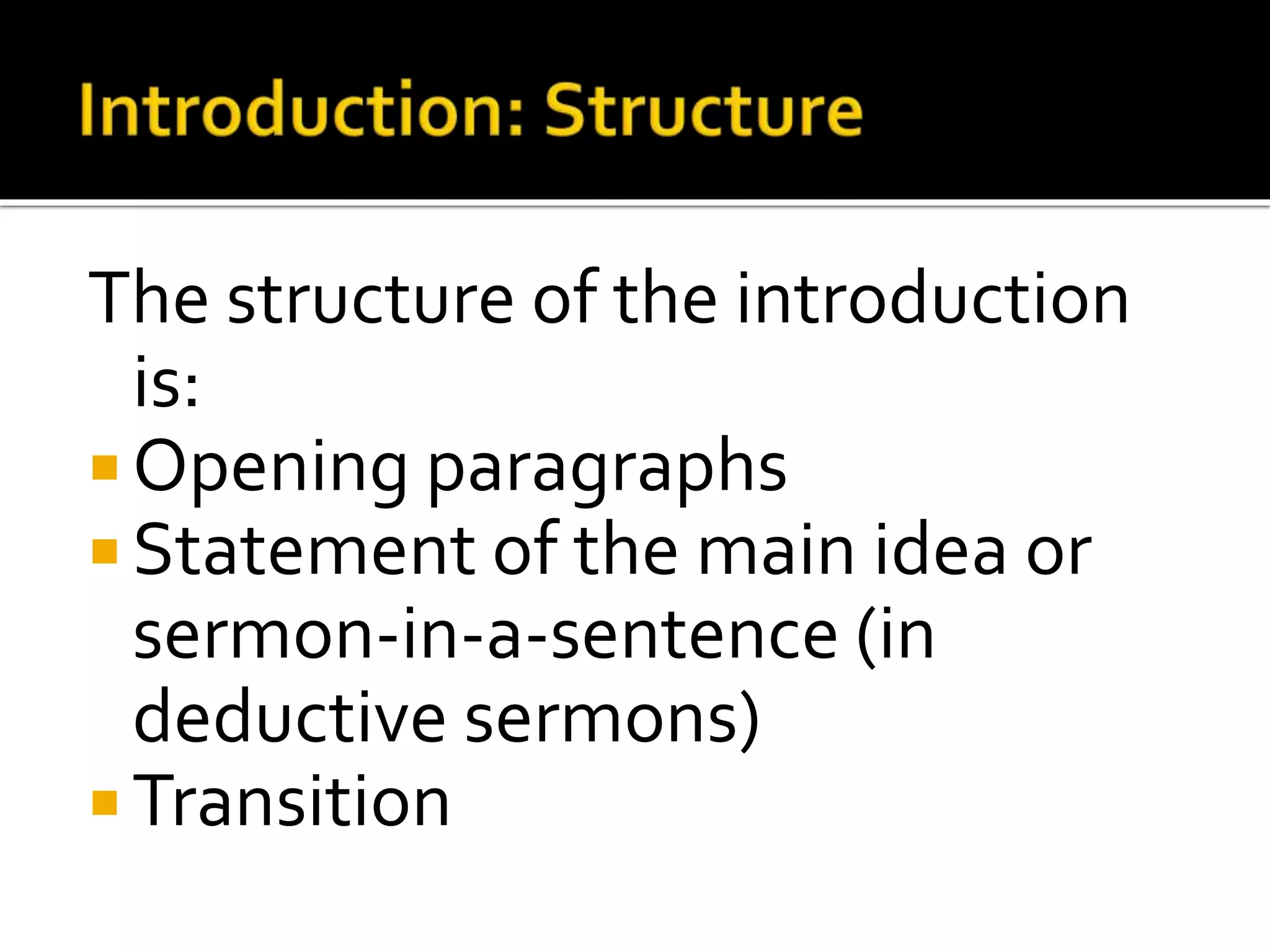
The structure of the introduction
is:
 Opening paragraphs
 Statement of the main idea or
sermon-in-a-sentence (in
deductive sermons)
 Transition
Maintain the attention of the
listeners, motivating them to
pay attention to the sermon.
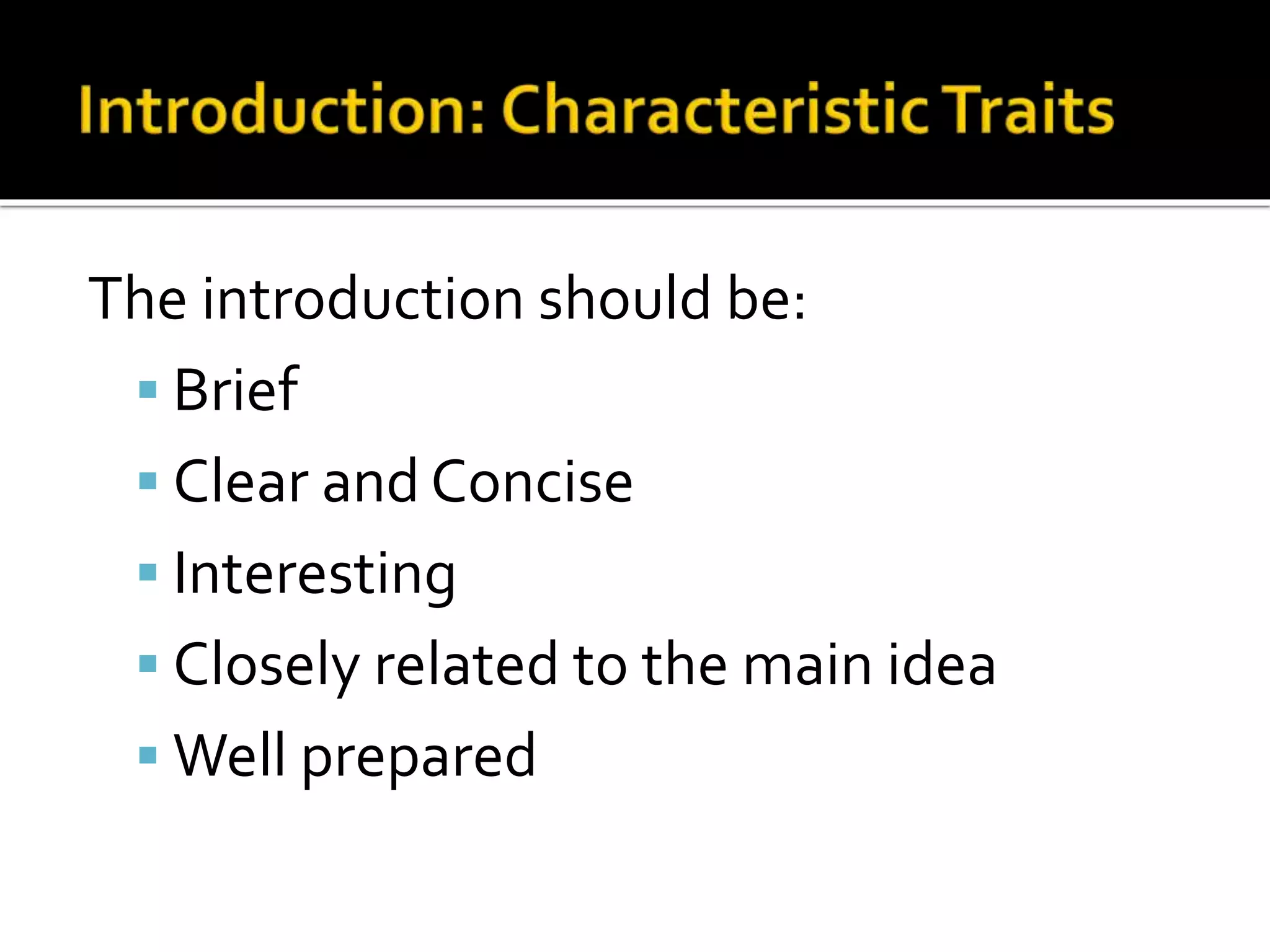
The introduction should be:
 Brief
 Clear and Concise
 Interesting
 Closely related to the main idea
 Well prepared
You may use one of the following
elements in the introduction:
An engaging question
An illustration
A true story
An allusion to a relevant historical
event of the past
A reference to a current issue
A challenge to the congregation
A dilemma or a choice
A hyperbole
A quotation from a literary work
A reference to a play, a movie or
TV program
A theological statement
A reference to the historical and
social setting of the biblical text
 Do not introduce all your sermons in the
same fashion; avoid falling into a
routine.
 Avoid generalities and banal
statements.
 Do not flatter your congregation.
 Avoid unnecessary excuses.
 Shun technical language.
You may use one of the following
elements in the transition:
 A question.
 A summary statement.
 A dilemma or choice.
 An invitation to explore further the
main idea.
 The body of the sermon is where the
main idea is discussed and developed.
 Usually, the main idea is divided in
several points that explore its
different aspects.
 A sermon should not have less than 2
or more than 5 points.
 The time allotted to the exposition
of a point should be proportional to
the time dedicated to the rest of the
sermon.
 The more points you have, the
shorter should be the discussion of
each point.
The points of the sermon should follow:
 The form or literary structure of the
biblical text, in expository sermons.
 The division of the story, in narrative
and storytelling sermons.
 A clear line of thought, in topical and
thematic sermons.
The main points of the sermon may
employ some of the following rhetorical
processes:
 Narration
 Interrogation
 Illustration
 Application
 Argumentation
 Exhortation
 Definition
 Interpretation
 Exemplification
 Comparison
 The aim of the conclusion is to
restate the “sermon-in-a-sentence”
and to stress the aim of the sermon.
 It is an exploration of the practical
implications of a main idea for the
congregation.
 The conclusion should be positive,
conveying the“good news” of the
Gospel.
 Given that it is the last section that
the congregation will listen to, the
conclusion should be properly
prepared.
A conclusion may have one of the
following aims:
Application
Exhortation
Affirmation
You may use one of the following
elements in the conclusion:
A summary of the main ideas of
the sermon
An invitation
Questions
An illustration.
A real-life story
A lesson from general history or
from the history of the church
A quotation from a literary work
A reference to a play, a movie or a
TV program
Issue a challenge to the
congregation
Develop a hypothetical scenario
that may exemplify your ideas and
challenge the congregation
Raise an issue
Visit www.drpablojimenez.net

Basic Sermon Design: The Sermon Outline

  • 1.
  • 2.
    The structure ofthe basic sermon is:  Introduction  Body  Conclusion
  • 3.
    The structure ofthe introduction is:  Opening paragraphs  Statement of the main idea or sermon-in-a-sentence (in deductive sermons)  Transition
  • 4.
    Maintain the attentionof the listeners, motivating them to pay attention to the sermon.
  • 5.
    The introduction shouldbe:  Brief  Clear and Concise  Interesting  Closely related to the main idea  Well prepared
  • 6.
    You may useone of the following elements in the introduction: An engaging question An illustration A true story
  • 7.
    An allusion toa relevant historical event of the past A reference to a current issue A challenge to the congregation A dilemma or a choice A hyperbole
  • 8.
    A quotation froma literary work A reference to a play, a movie or TV program A theological statement A reference to the historical and social setting of the biblical text
  • 9.
     Do notintroduce all your sermons in the same fashion; avoid falling into a routine.  Avoid generalities and banal statements.  Do not flatter your congregation.  Avoid unnecessary excuses.  Shun technical language.
  • 10.
    You may useone of the following elements in the transition:  A question.  A summary statement.  A dilemma or choice.  An invitation to explore further the main idea.
  • 11.
     The bodyof the sermon is where the main idea is discussed and developed.  Usually, the main idea is divided in several points that explore its different aspects.  A sermon should not have less than 2 or more than 5 points.
  • 12.
     The timeallotted to the exposition of a point should be proportional to the time dedicated to the rest of the sermon.  The more points you have, the shorter should be the discussion of each point.
  • 13.
    The points ofthe sermon should follow:  The form or literary structure of the biblical text, in expository sermons.  The division of the story, in narrative and storytelling sermons.  A clear line of thought, in topical and thematic sermons.
  • 14.
    The main pointsof the sermon may employ some of the following rhetorical processes:  Narration  Interrogation  Illustration  Application
  • 15.
     Argumentation  Exhortation Definition  Interpretation  Exemplification  Comparison
  • 16.
     The aimof the conclusion is to restate the “sermon-in-a-sentence” and to stress the aim of the sermon.  It is an exploration of the practical implications of a main idea for the congregation.
  • 17.
     The conclusionshould be positive, conveying the“good news” of the Gospel.  Given that it is the last section that the congregation will listen to, the conclusion should be properly prepared.
  • 18.
    A conclusion mayhave one of the following aims: Application Exhortation Affirmation
  • 19.
    You may useone of the following elements in the conclusion: A summary of the main ideas of the sermon An invitation Questions
  • 20.
    An illustration. A real-lifestory A lesson from general history or from the history of the church
  • 21.
    A quotation froma literary work A reference to a play, a movie or a TV program Issue a challenge to the congregation
  • 22.
    Develop a hypotheticalscenario that may exemplify your ideas and challenge the congregation Raise an issue
  • 23.