COMMUNICATIVE SKILL TRAINING
PROGRAMME
2023 - 2024
READING - RAVANA
 Ravana was a devout follower of
Lord Shiva. After attaining the
education, Ravana underwent an
intense penance to please Lord
Shiva. To appease Lord Shiva,
Ravana even chopped off his head,
it grew back, thereby enabling him
to continue his penance. This
austerity of Ravana pleased Shiva,
and he granted him ten heads.
And thus, he became one of the
most powerful beings on the
earth. The ten heads of Ravana
indicate the four Vedas and six
Shashtras that Ravana mastered.
INTERROGATIVE SENTENCE
It asks a
question.
It ends with a
question mark (?)
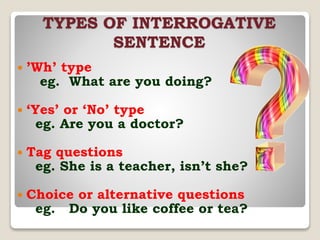
TYPES OF INTERROGATIVE
SENTENCE
 ’Wh’ type
eg. What are you doing?
 ‘Yes’ or ‘No’ type
eg. Are you a doctor?
 Tag questions
eg. She is a teacher, isn’t she?
 Choice or alternative questions
eg. Do you like coffee or tea?
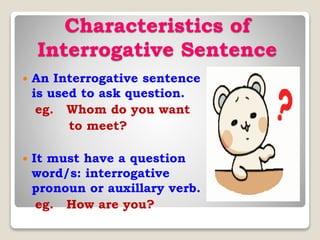
Characteristics of
Interrogative Sentence
 An Interrogative sentence
is used to ask question.
eg. Whom do you want
to meet?
 It must have a question
word/s: interrogative
pronoun or auxillary verb.
eg. How are you?
3) An interrogative sentence
ends with a question mark.
eg. Who is Sherlock Holmes?
4) Interrogative sentence can be
Affirmative or Negative.
eg. Why do you meet your
teacher?
Why do you not meet your
teacher?
5) Interrogative sentence can be in
any tense.
eg.
When do you go to school office
everyday?
When did you go to school yesterday?
When will you go to school to
tomorrow?
 6) Structurally, interrogative sentences
are formed from their
Assertive/Delarative counter part.
eg.
He wins the game. - Does he win the game?
They win the game. - Do they win the game?
He won the game. - Did he win the game?
He will win the game.- Will he win the game?
‘Wh’ type questions
‘Wh’ question starts
with What, Where,
When, Who, Whose,
Whom, Which, Why
and How.
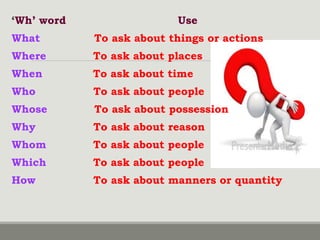
‘Wh’ word Use
What To ask about things or actions
Where To ask about places
When To ask about time
Who To ask about people
Whose To ask about possession
Why To ask about reason
Whom To ask about people
Which To ask about people
How To ask about manners or quantity
‘YES’ OR ‘NO’ QUESTIONS
‘Yes’ or ‘No’ type question
starts with
Am, Is, Are, Was, Were, Do,
Does, Did, Has, Have, Had,
Can, Could, Will, Would,
Shall, Should, May, and
Might.
POSITIVE QUESTIONS NEGATIVE QUESTIONS
 Is this your bike? Isn’t this your bike?
 Are you fine now? Aren’t you fine now?
 Do you like tea? Don’t you like tea?
 Did they meet you? Didn’t they meet you?
 Can I do that? Can’t I do that?
ACTIVITY
FRAME QUESTIONS USING
ALL THE ‘Wh’ words.
FRAME QUESTIONS USING
ALL THE helping verbs.
PREPARED BY

communicative skill training programme 23-24

  • 1.
  • 3.
    READING - RAVANA Ravana was a devout follower of Lord Shiva. After attaining the education, Ravana underwent an intense penance to please Lord Shiva. To appease Lord Shiva, Ravana even chopped off his head, it grew back, thereby enabling him to continue his penance. This austerity of Ravana pleased Shiva, and he granted him ten heads. And thus, he became one of the most powerful beings on the earth. The ten heads of Ravana indicate the four Vedas and six Shashtras that Ravana mastered.
  • 4.
    INTERROGATIVE SENTENCE It asksa question. It ends with a question mark (?)
  • 5.
    TYPES OF INTERROGATIVE SENTENCE ’Wh’ type eg. What are you doing?  ‘Yes’ or ‘No’ type eg. Are you a doctor?  Tag questions eg. She is a teacher, isn’t she?  Choice or alternative questions eg. Do you like coffee or tea?
  • 6.
    Characteristics of Interrogative Sentence An Interrogative sentence is used to ask question. eg. Whom do you want to meet?  It must have a question word/s: interrogative pronoun or auxillary verb. eg. How are you?
  • 7.
    3) An interrogativesentence ends with a question mark. eg. Who is Sherlock Holmes? 4) Interrogative sentence can be Affirmative or Negative. eg. Why do you meet your teacher? Why do you not meet your teacher?
  • 8.
    5) Interrogative sentencecan be in any tense. eg. When do you go to school office everyday? When did you go to school yesterday? When will you go to school to tomorrow?
  • 9.
     6) Structurally,interrogative sentences are formed from their Assertive/Delarative counter part. eg. He wins the game. - Does he win the game? They win the game. - Do they win the game? He won the game. - Did he win the game? He will win the game.- Will he win the game?
  • 10.
    ‘Wh’ type questions ‘Wh’question starts with What, Where, When, Who, Whose, Whom, Which, Why and How.
  • 11.
    ‘Wh’ word Use WhatTo ask about things or actions Where To ask about places When To ask about time Who To ask about people Whose To ask about possession Why To ask about reason Whom To ask about people Which To ask about people How To ask about manners or quantity
  • 12.
    ‘YES’ OR ‘NO’QUESTIONS ‘Yes’ or ‘No’ type question starts with Am, Is, Are, Was, Were, Do, Does, Did, Has, Have, Had, Can, Could, Will, Would, Shall, Should, May, and Might.
  • 13.
    POSITIVE QUESTIONS NEGATIVEQUESTIONS  Is this your bike? Isn’t this your bike?  Are you fine now? Aren’t you fine now?  Do you like tea? Don’t you like tea?  Did they meet you? Didn’t they meet you?  Can I do that? Can’t I do that?
  • 14.
    ACTIVITY FRAME QUESTIONS USING ALLTHE ‘Wh’ words. FRAME QUESTIONS USING ALL THE helping verbs.
  • 15.