©2014
by
Danielle
Reed,
M.S.,
CCC-SLP:
Sbim
Spch
http://www.teacherspayteachers.com/Store/Sublime-Speech
Communication
Checklists
Children
Age
and
Grade-Based
Speech
and
Language
checklists
from
birth
through
grade
12
for
use
by
SLPs,
T
eachers,
and
Parents.
This
reference
material
was
made
by
a
licensed
SLP
with
the
assistance
of
the
referenced
materials
below.
It
was
designed
to
assist
SLPs,
Teachers,
and
Parents
in
understanding
typical
speech
and
language
development
in
children.
It
is
not
meant
as
a
diagnostic
tool.
Teachers
and
Parents
should
utilize
this
tool
as
an
informational
material
only
and
utilize
the
information
within
for
referring
children
to
an
SLP
when
concerns
arise.
Please
reference
the
materials
below
for
additional
information
and
details
if
necessary/interested.
Thank
you.
References:
American
Speech-Language
Hearing
Association.
“Your
Child’s
Communication
Development:
Kindergarten
Through
Fifth
Grade.
”
Your
Chil
d
’s
Communication
Devel
o
pment.
American
Speech-Language
Hearing
Association,
n.
d
.
Web.
20
Feb.
2014
Sander,
Eric
K.
“When
Are
Speech
Sounds
Learned?”
Journal
of
Speech
and
Hearing
Disorders
37
(1972);
55-63.
Web.
20
Feb.
2014.
http://
jshd.
p
ubs.
a
sha.
o
rg/article/aspx?articleid=1747192.
Look
Who’s
Talking!
All
About
Child
Language
Development.
(n.
d
.
)
.
Retrieved
August
15,
2014,
from
http://childdevelopmentinfo.
c
om/child-
development/language_development/
English
Language
Arts
Standards.
(2014).
Retrieved
August
15,
2014,
from
http://www.
c
orestandards.
o
rg/ELA-Literacy/
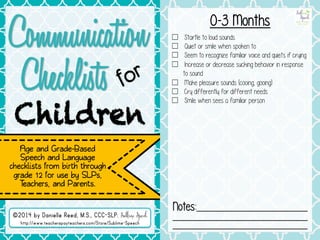
☐ Startle to loud sounds
☐ Quiet or smile when spoken to
☐ Seem to recognize familiar voice and quiets if crying
☐ Increase or decrease sucking behavior in response
to sound
☐ Make pleasure sounds (cooing, gooing)
☐ Cry differently for different needs
☐ Smile when sees a familiar person
0-3 Months
Notes:____________________________
__________________________________
__________________________________
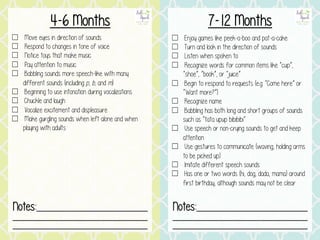
☐ Move eyes in direction of sounds
☐ Respond to changes in tone of voice
☐ Notice toys that make music
☐ Pay attention to music
☐ Babbling sounds more speech-like with many
different sounds (including p, b, and m)
☐ Beginning to use intonation during vocalizations
☐ Chuckle and laugh
☐ Vocalize excitement and displeasure
☐ Make gurgling sounds when left alone and when
playing with adults
4-6 Months
☐ Enjoy games like peek-a-boo and pat-a-cake
☐ Turn and look in the direction of sounds
☐ Listen when spoken to
☐ Recognize words for common items like “cup”,
“shoe”, “book”, or “juice”
☐ Begin to respond to requests (e.g. “Come here” or
“Want more?”)
☐ Recognize name
☐ Babbling has both long and short groups of sounds
such as “tata upup bibibibi”
☐ Use speech or non-crying sounds to get and keep
attention
☐ Use gestures to communicate (waving, holding arms
to be picked up)
☐ Imitate different speech sounds
☐ Has one or two words (hi, dog, dada, mama) around
first birthday, although sounds may not be clear
7-12 Months
Notes:____________________________
__________________________________
__________________________________
Notes:____________________________
__________________________________
__________________________________

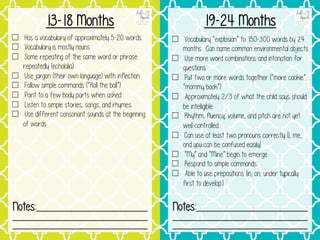
☐ Has a vocabulary of approximately 5-20 words.
☐ Vocabulary is mostly nouns
☐ Some repeating of the same word or phrase
repeatedly (echolalia)
☐ Use jargon (their own language) with inflection
☐ Follow simple commands (“Roll the ball”)
☐ Point to a few body parts when asked
☐ Listen to simple stories, songs, and rhymes
☐ Use different consonant sounds at the beginning
of words
13-18 Months
☐ Vocabulary “explosion” to 150-300 words by 24
months. Can name common environmental objects
☐ Use more word combinations and intonation for
questions
☐ Put two or more words together (“more cookie”,
“mommy book”)
☐ Approximately 2/3 of what the child says should
be intelligible
☐ Rhythm, fluency, volume, and pitch are not yet
well-controlled
☐ Can use at least two pronouns correctly (I, me,
and you can be confused easily)
☐ “My” and “Mine” begin to emerge
☐ Respond to simple commands
☐ Able to use prepositions (in, on, under typically
first to develop.)
19-24 Months
Notes:____________________________
__________________________________
__________________________________
Notes:____________________________
__________________________________
__________________________________
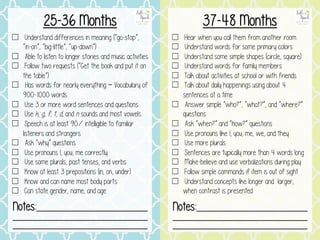
☐ Understand differences in meaning (“go-stop”,
“in-on”, “big-little”, “up-down”)
☐ Able to listen to longer stories and music activities
☐ Follow two requests (“Get the book and put it on
the table”)
☐ .Has words for nearly everything – Vocabulary of
900-1000 words
☐ Use 3 or more word sentences and questions
☐ Use k, g, f, t, d, and n sounds and most vowels
☐ Speech is at least 90% intelligible to familiar
listeners and strangers
☐ Ask “why” questions
☐ Use pronouns I, you, me correctly
☐ Use some plurals, past tenses, and verbs
☐ Know at least 3 prepositions (in, on, under)
☐ Know and can name most body parts
☐ Can state gender, name, and age
25-36 Months
☐ Hear when you call them from another room
☐ Understand words for some primary colors
☐ Understand some simple shapes (circle, square)
☐ Understand words for family members
☐ Talk about activities at school or with friends
☐ Talk about daily happenings using about 4
sentences at a time
☐ Answer simple “who?”, “what?”, and “where?”
questions
☐ Ask “when?” and “how?” questions
☐ Use pronouns like I, you, me, we, and they
☐ Use more plurals
☐ Sentences are typically more than 4 words long
☐ Make-believe and use verbalizations during play
☐ Follow simple commands if item is out of sight
☐ Understand concepts like longer and larger,
when contrast is presented
37-48 Months
Notes:____________________________
__________________________________
__________________________________
Notes:____________________________
__________________________________
__________________________________
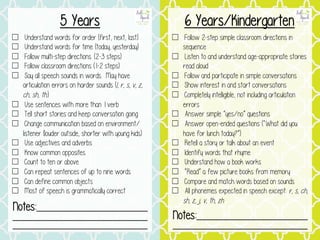
☐ Understand words for order (first, next, last)
☐ Understand words for time (today, yesterday)
☐ Follow multi-step directions. (2-3 steps)
☐ Follow classroom directions (1-2 steps)
☐ Say all speech sounds in words. May have
articulation errors on harder sounds (l, r, s, v, z,
ch, sh, th.)
☐ Use sentences with more than 1 verb
☐ Tell short stories and keep conversation going
☐ Change communication based on environment/
listener (louder outside, shorter with young kids)
☐ Use adjectives and adverbs
☐ Know common opposites
☐ Count to ten or above
☐ Can repeat sentences of up to nine words
☐ Can define common objects
☐ Most of speech is grammatically correct
5 Years
☐ Follow 2-step simple classroom directions in
sequence
☐ Listen to and understand age-appropriate stories
read aloud
☐ Follow and participate in simple conversations
☐ Show interest in and start conversations
☐ Completely intelligible, not including articulation
errors
☐ Answer simple “yes/no” questions
☐ Answer open-ended questions (“What did you
have for lunch today?”)
☐ Retell a story or talk about an event
☐ Identify words that rhyme
☐ Understand how a book works
☐ “Read” a few picture books from memory
☐ Compare and match words based on sounds
☐ All phonemes expected in speech except: r, s, ch,
sh, z, j, v, th, zh
6 Years/Kindergarten
Notes:____________________________
__________________________________
__________________________________
Notes:____________________________
__________________________________
☐ Follow 3-4 oral directions in a sequence
☐ Understand direction words (e.g.. location, space, time)
☐ Correctly answer questions about grade-level story
☐ Answer more complex “yes/no” questions
☐ Ask and answer “wh” questions
☐ Increasingly complex sentence structures
☐ Clarify and explain words and ideas
☐ Give directions with 3-4 steps
☐ Use language to inform, persuade, and entertain
☐ Start, maintain topic, use eye contact, and close
conversations
☐ Fully mastered phonics/sound awareness
☐ Explain key elements of a story
☐ Use a variety of sentence types in writing
☐ Associate speech sounds, syllables/words/phrases
with written forms
☐ Locate information to answer questions
☐ All phonemes expected in speech except: r, th (both
should be stimulable and present in some positions)
8 Years/2nd Grade
Notes:____________________________
__________________________________
__________________________________
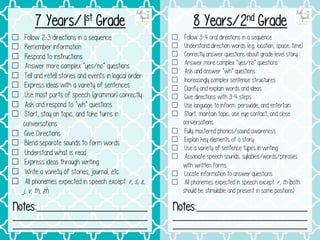
☐ Follow 2-3 directions in a sequence
☐ Remember information
☐ Respond to instructions
☐ Answer more complex “yes/no” questions
☐ Tell and retell stories and events in logical order
☐ Express ideas with a variety of sentences
☐ Use most parts of speech (grammar) correctly
☐ Ask and respond to “wh” questions
☐ Start, stay on topic, and take turns in
conversations
☐ Give Directions
☐ Blend separate sounds to form words
☐ Understand what is read
☐ Express ideas through writing
☐ Write a variety of stories, journal, etc.
☐ All phonemes expected in speech except: r, s, z,
j, v, th, zh
7 Years/1st Grade
Notes:____________________________
__________________________________
__________________________________
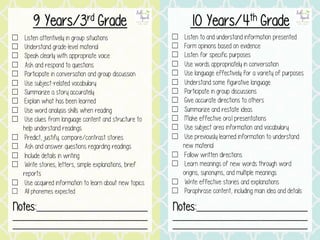
☐ Listen attentively in group situations
☐ Understand grade-level material
☐ Speak clearly with appropriate voice
☐ Ask and respond to questions
☐ Participate in conversation and group discussion
☐ Use subject-related vocabulary
☐ Summarize a story accurately
☐ Explain what has been learned
☐ Use word analysis skills when reading
☐ Use clues from language content and structure to
help understand readings
☐ Predict, justify, compare/contrast stories
☐ Ask and answer questions regarding readings
☐ Include details in writing
☐ Write stories, letters, simple explanations, brief
reports
☐ Use acquired information to learn about new topics
☐ All phonemes expected
9 Years/3rd Grade
☐ Listen to and understand information presented
☐ Form opinions based on evidence
☐ Listen for specific purposes
☐ Use words appropriately in conversation
☐ Use language effectively for a variety of purposes
☐ Understand some figurative language
☐ Participate in group discussions
☐ Give accurate directions to others
☐ Summarize and restate ideas
☐ Make effective oral presentations
☐ Use subject area information and vocabulary
☐ Use previously learned information to understand
new material
☐ Follow written directions
☐ Learn meanings of new words through word
origins, synonyms, and multiple meanings
☐ Write effective stories and explanations
☐ Paraphrase content, including main idea and details
10 Years/4th Grade
Notes:____________________________
__________________________________
__________________________________
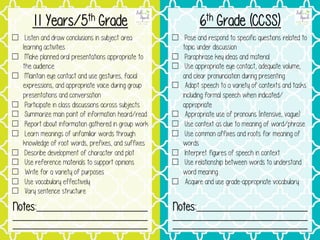
Notes:____________________________
__________________________________
__________________________________
☐ Listen and draw conclusions in subject area
learning activities
☐ Make planned oral presentations appropriate to
the audience
☐ Maintain eye contact and use gestures, facial
expressions, and appropriate voice during group
presentations and conversation
☐ Participate in class discussions across subjects
☐ Summarize main point of information heard/read
☐ Report about information gathered in group work
☐ Learn meanings of unfamiliar words through
knowledge of root words, prefixes, and suffixes
☐ Describe development of character and plot
☐ Use reference materials to support opinions
☐ Write for a variety of purposes
☐ Use vocabulary effectively
☐ Vary sentence structure
11 Years/5th Grade
☐ Pose and respond to specific questions related to
topic under discussion
☐ Paraphrase key ideas and material
☐ Use appropriate eye contact, adequate volume,
and clear pronunciation during presenting
☐ Adapt speech to a variety of contexts and tasks
including formal speech when indicated/
appropriate
☐ Appropriate use of pronouns (intensive, vague)
☐ Use context as clue to meaning of word/phrase
☐ Use common affixes and roots for meaning of
words
☐ Interpret figures of speech in context
☐ Use relationship between words to understand
word meaning
☐ Acquire and use grade-appropriate vocabulary.
6th Grade (CCSS)
Notes:____________________________
__________________________________
__________________________________
Notes:____________________________
__________________________________
__________________________________
☐ Engage effectively in a range of collaborative
discussions
☐ Pose questions that elicit elaboration
☐ Respond to others’ questions and comments
☐ Use appropriate eye contact, adequate volume,
and clear pronunciation during presenting
☐ Adapt speech to variety of contexts and tasks
including formal speech when appropriate
☐ Choose and use appropriate simple, compound,
and complex sentences depending on situation
☐ Recognize and correct misplaced and dangling
modifiers
☐ Use language that expresses ideas precisely
☐ Use context as a clue to word meaning
☐ Use affixes and roots as clues to word meaning
☐ Interpret figures of speech in context
☐ Use word relationships to understand meaning
☐ Acquire and use grade-appropriate vocabulary
7th Grade (CCSS)
☐ Pose questions to connect ideas of several
speakers
☐ Respond to others’ questions and comments with
relevant evidence, observations, and ideas
☐ Use appropriate eye contact, adequate volume,
and clear pronunciation when presenting
☐ Present claims/findings in focused/coherent
manner with relevant evidence and details
☐ Adapt speech to variety of contexts and tasks
including formal speech when appropriate
☐ Form and use verbs in active and passive voice,
and indicative/imperative/interrogative/
conditional/subjunctive moods
☐ Use context as clue to word meaning
☐ Use affixes and roots as clues to word meaning
☐ Interpret figures of speech in context
☐ Use word relationship to determine meaning
☐ Acquire and use grade-appropriate vocabulary
8th Grade (CCSS)
Notes:____________________________
__________________________________
Notes:____________________________
__________________________________
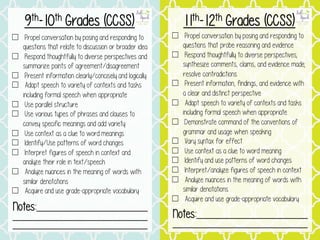
☐ Propel conversation by posing and responding to
questions that relate to discussion or broader idea
☐ Respond thoughtfully to diverse perspectives and
summarize points of agreement/disagreement
☐ Present information clearly/concisely and logically
☐ Adapt speech to variety of contexts and tasks
including formal speech when appropriate
☐ Use parallel structure
☐ Use various types of phrases and clauses to
convey specific meanings and add variety
☐ Use context as a clue to word meanings
☐ Identify/Use patterns of word changes
☐ Interpret figures of speech in context and
analyze their role in text/speech
☐ Analyze nuances in the meaning of words with
similar denotations
☐ Acquire and use grade-appropriate vocabulary
9th-10th Grades (CCSS)
☐ Propel conversation by posing and responding to
questions that probe reasoning and evidence
☐ Respond thoughtfully to diverse perspectives;
synthesize comments, claims, and evidence made;
resolve contradictions
☐ Present information, findings, and evidence with
a clear and distinct perspective
☐ Adapt speech to variety of contexts and tasks
including formal speech when appropriate
☐ Demonstrate command of the conventions of
grammar and usage when speaking
☐ Vary syntax for effect
☐ Use context as a clue to word meaning
☐ Identify and use patterns of word changes
☐ Interpret/analyze figures of speech in context
☐ Analyze nuances in the meaning of words with
similar denotations
☐ Acquire and use grade-appropriate vocabulary
11th-12th Grades (CCSS)
Notes:____________________________
__________________________________
__________________________________
Notes:____________________________
__________________________________
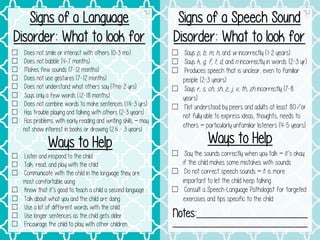
☐ Does not smile or interact with others (0-3 mo.)
☐ Does not babble (4-7 months)
☐ Makes few sounds (7-12 months)
☐ Does not use gestures (7-12 months)
☐ Does not understand what others say (7mo-2 yrs)
☐ Says only a few words (12-18 months)
☐ Does not combine words to make sentences (1½-3 yrs)
☐ Has trouble playing and talking with others (2-3 years)
☐ Has problems with early reading and writing skills – may
not show interest in books or drawing (2½ - 3 years)
Signs of a Language
Disorder: What to look for
☐ Listen and respond to the child
☐ Talk, read, and play with the child
☐ Communicate with the child in the language they are
most comfortable using
☐ Know that it’s good to teach a child a second language
☐ Talk about what you and the child are doing
☐ Use a lot of different words with the child
☐ Use longer sentences as the child gets older
☐ Encourage the child to play with other children
Ways to Help
☐ Says p, b, m, h, and w incorrectly (1-2 years)
☐ Says k, g, f, t, d, and n incorrectly in words (2-3 yr)
☐ Produces speech that is unclear, even to familiar
people (2-3 years)
☐ Says r, s, ch, sh, z, j, v, th, zh incorrectly (7-8
years)
☐ Not understood by peers and adults at least 80%or
not fully able to express ideas, thoughts, needs to
others – particularly unfamiliar listeners (4-5 years)
Signs of a Speech Sound
Disorder: What to look for
☐ Say the sounds correctly when you talk – it’s okay
if the child makes some mistakes with sounds
☐ Do not correct speech sounds – it is more
important to let the child keep talking
☐ Consult a Speech-Language Pathologist for targeted
exercises and tips specific to the child
Ways to Help
Notes:____________________________
__________________________________
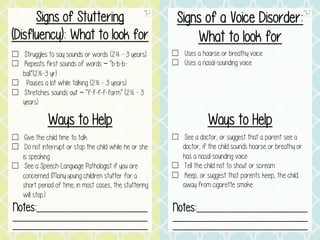
☐ Struggles to say sounds or words (2½ - 3 years)
☐ Repeats first sounds of words – “b-b-b-
ball”(2½-3 yr)
☐ Pauses a lot while talking (2½ - 3 years)
☐ Stretches sounds out – “f-f-f-f-farm” (2½ - 3
years)
Signs of Stuttering
(Disfluency): What to look for
☐ Give the child time to talk
☐ Do not interrupt or stop the child while he or she
is speaking
☐ See a Speech-Language Pathologist if you are
concerned (Many young children stutter for a
short period of time; in most cases, the stuttering
will stop.)
Ways to Help
☐ Uses a hoarse or breathy voice
☐ Uses a nasal-sounding voice
Signs of a Voice Disorder:
What to look for
☐ See a doctor, or suggest that a parent see a
doctor, if the child sounds hoarse or breathy or
has a nasal-sounding voice
☐ Tell the child not to shout or scream
☐ Keep, or suggest that parents keep, the child
away from cigarette smoke
Ways to Help
Notes:____________________________
__________________________________
__________________________________
Notes:____________________________
__________________________________
__________________________________
This reference material was made by a licensed SLP with the
assistance of the referenced materials below. It was
designed to assist SLPs, Teachers, and Parents in
understanding typical speech and language development in
children. It is not meant as a diagnostic tool. Teachers and
Parents should utilize this tool as an informational material
only and utilize the information within for referring children
to an SLP when concerns arise. Please reference the
materials below for additional information and details if
necessary/interested. Thank you.
References:
American Speech-Language Hearing Association. “Your Child’s
Communication Development: Kindergarten Through Fifth Grade.”
Your Child’s Communication Development. American Speech-Language
Hearing Association, n.d. Web. 20 Feb. 2014
Sander, Eric K. “When Are Speech Sounds Learned?” Journal of Speech
and Hearing Disorders 37 (1972); 55-63. Web. 20 Feb. 2014.
http://jshd.pubs.asha.org/article/aspx?articleid=1747192.
Look Who’s Talking! All About Child Language Development. (n.d.).
Retrieved August 15, 2014, from http://childdevelopmentinfo.com/
child-development/language_development/
English Language Arts Standards. (2014). Retrieved August 15, 2014,
from http://www.corestandards.org/ELA-Literacy/
	
  
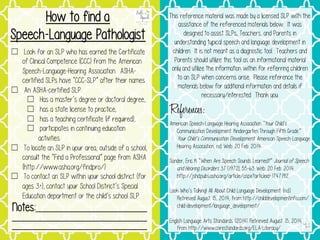
☐ Look for an SLP who has earned the Certificate
of Clinical Competence (CCC) from the American
Speech-Language-Hearing Association. ASHA-
certified SLPs have “CCC-SLP” after their names.
☐ An ASHA-certified SLP:
☐ Has a master’s degree or doctoral degree,
☐ has a state license to practice,
☐ has a teaching certificate (if required),
☐ participates in continuing education
activities.
☐ To locate an SLP in your area, outside of a school,
consult the “Find a Professional” page from ASHA
(http://www.asha.org/findpro/)
☐ To contact an SLP within your school district (for
ages 3+), contact your School District’s Special
Education department or the child’s school SLP.
How to find a
Speech-Language Pathologist
Notes:____________________________
__________________________________
__________________________________
CommunicationChecklistsforChildren-1 (1).pdf

CommunicationChecklistsforChildren-1 (1).pdf

  • 1.
  • 2.
    This reference material was made by a licensed SLP with the assistance of the referenced materials below. It was designed to assist SLPs, Teachers, and Parents in understanding typical speech and language development in children. It is not meant as a diagnostic tool. Teachers and Parents should utilize this tool as an informational material only and utilize the information within for referring children to an SLP when concerns arise. Please reference the materials below for additional information and details if necessary/interested. Thank you. References: American Speech-Language Hearing Association. “Your Child’s Communication Development: Kindergarten Through Fifth Grade. ” Your Chil d ’s Communication Devel o pment. American Speech-Language Hearing Association, n. d . Web. 20 Feb. 2014 Sander, Eric K. “When Are Speech Sounds Learned?” Journal of Speech and Hearing Disorders 37 (1972); 55-63. Web. 20 Feb. 2014. http:// jshd. p ubs. a sha. o rg/article/aspx?articleid=1747192. Look Who’s Talking! All About Child Language Development. (n. d . ) . Retrieved August 15, 2014, from http://childdevelopmentinfo. c om/child- development/language_development/ English Language Arts Standards. (2014). Retrieved August 15, 2014, from http://www. c orestandards. o rg/ELA-Literacy/
  • 3.
    ☐ Startle toloud sounds ☐ Quiet or smile when spoken to ☐ Seem to recognize familiar voice and quiets if crying ☐ Increase or decrease sucking behavior in response to sound ☐ Make pleasure sounds (cooing, gooing) ☐ Cry differently for different needs ☐ Smile when sees a familiar person 0-3 Months Notes:____________________________ __________________________________ __________________________________
  • 4.
    ☐ Move eyesin direction of sounds ☐ Respond to changes in tone of voice ☐ Notice toys that make music ☐ Pay attention to music ☐ Babbling sounds more speech-like with many different sounds (including p, b, and m) ☐ Beginning to use intonation during vocalizations ☐ Chuckle and laugh ☐ Vocalize excitement and displeasure ☐ Make gurgling sounds when left alone and when playing with adults 4-6 Months ☐ Enjoy games like peek-a-boo and pat-a-cake ☐ Turn and look in the direction of sounds ☐ Listen when spoken to ☐ Recognize words for common items like “cup”, “shoe”, “book”, or “juice” ☐ Begin to respond to requests (e.g. “Come here” or “Want more?”) ☐ Recognize name ☐ Babbling has both long and short groups of sounds such as “tata upup bibibibi” ☐ Use speech or non-crying sounds to get and keep attention ☐ Use gestures to communicate (waving, holding arms to be picked up) ☐ Imitate different speech sounds ☐ Has one or two words (hi, dog, dada, mama) around first birthday, although sounds may not be clear 7-12 Months Notes:____________________________ __________________________________ __________________________________ Notes:____________________________ __________________________________ __________________________________
  • 5.
    ☐ Has avocabulary of approximately 5-20 words. ☐ Vocabulary is mostly nouns ☐ Some repeating of the same word or phrase repeatedly (echolalia) ☐ Use jargon (their own language) with inflection ☐ Follow simple commands (“Roll the ball”) ☐ Point to a few body parts when asked ☐ Listen to simple stories, songs, and rhymes ☐ Use different consonant sounds at the beginning of words 13-18 Months ☐ Vocabulary “explosion” to 150-300 words by 24 months. Can name common environmental objects ☐ Use more word combinations and intonation for questions ☐ Put two or more words together (“more cookie”, “mommy book”) ☐ Approximately 2/3 of what the child says should be intelligible ☐ Rhythm, fluency, volume, and pitch are not yet well-controlled ☐ Can use at least two pronouns correctly (I, me, and you can be confused easily) ☐ “My” and “Mine” begin to emerge ☐ Respond to simple commands ☐ Able to use prepositions (in, on, under typically first to develop.) 19-24 Months Notes:____________________________ __________________________________ __________________________________ Notes:____________________________ __________________________________ __________________________________
  • 6.
    ☐ Understand differencesin meaning (“go-stop”, “in-on”, “big-little”, “up-down”) ☐ Able to listen to longer stories and music activities ☐ Follow two requests (“Get the book and put it on the table”) ☐ .Has words for nearly everything – Vocabulary of 900-1000 words ☐ Use 3 or more word sentences and questions ☐ Use k, g, f, t, d, and n sounds and most vowels ☐ Speech is at least 90% intelligible to familiar listeners and strangers ☐ Ask “why” questions ☐ Use pronouns I, you, me correctly ☐ Use some plurals, past tenses, and verbs ☐ Know at least 3 prepositions (in, on, under) ☐ Know and can name most body parts ☐ Can state gender, name, and age 25-36 Months ☐ Hear when you call them from another room ☐ Understand words for some primary colors ☐ Understand some simple shapes (circle, square) ☐ Understand words for family members ☐ Talk about activities at school or with friends ☐ Talk about daily happenings using about 4 sentences at a time ☐ Answer simple “who?”, “what?”, and “where?” questions ☐ Ask “when?” and “how?” questions ☐ Use pronouns like I, you, me, we, and they ☐ Use more plurals ☐ Sentences are typically more than 4 words long ☐ Make-believe and use verbalizations during play ☐ Follow simple commands if item is out of sight ☐ Understand concepts like longer and larger, when contrast is presented 37-48 Months Notes:____________________________ __________________________________ __________________________________ Notes:____________________________ __________________________________ __________________________________
  • 7.
    ☐ Understand wordsfor order (first, next, last) ☐ Understand words for time (today, yesterday) ☐ Follow multi-step directions. (2-3 steps) ☐ Follow classroom directions (1-2 steps) ☐ Say all speech sounds in words. May have articulation errors on harder sounds (l, r, s, v, z, ch, sh, th.) ☐ Use sentences with more than 1 verb ☐ Tell short stories and keep conversation going ☐ Change communication based on environment/ listener (louder outside, shorter with young kids) ☐ Use adjectives and adverbs ☐ Know common opposites ☐ Count to ten or above ☐ Can repeat sentences of up to nine words ☐ Can define common objects ☐ Most of speech is grammatically correct 5 Years ☐ Follow 2-step simple classroom directions in sequence ☐ Listen to and understand age-appropriate stories read aloud ☐ Follow and participate in simple conversations ☐ Show interest in and start conversations ☐ Completely intelligible, not including articulation errors ☐ Answer simple “yes/no” questions ☐ Answer open-ended questions (“What did you have for lunch today?”) ☐ Retell a story or talk about an event ☐ Identify words that rhyme ☐ Understand how a book works ☐ “Read” a few picture books from memory ☐ Compare and match words based on sounds ☐ All phonemes expected in speech except: r, s, ch, sh, z, j, v, th, zh 6 Years/Kindergarten Notes:____________________________ __________________________________ __________________________________ Notes:____________________________ __________________________________
  • 8.
    ☐ Follow 3-4oral directions in a sequence ☐ Understand direction words (e.g.. location, space, time) ☐ Correctly answer questions about grade-level story ☐ Answer more complex “yes/no” questions ☐ Ask and answer “wh” questions ☐ Increasingly complex sentence structures ☐ Clarify and explain words and ideas ☐ Give directions with 3-4 steps ☐ Use language to inform, persuade, and entertain ☐ Start, maintain topic, use eye contact, and close conversations ☐ Fully mastered phonics/sound awareness ☐ Explain key elements of a story ☐ Use a variety of sentence types in writing ☐ Associate speech sounds, syllables/words/phrases with written forms ☐ Locate information to answer questions ☐ All phonemes expected in speech except: r, th (both should be stimulable and present in some positions) 8 Years/2nd Grade Notes:____________________________ __________________________________ __________________________________ ☐ Follow 2-3 directions in a sequence ☐ Remember information ☐ Respond to instructions ☐ Answer more complex “yes/no” questions ☐ Tell and retell stories and events in logical order ☐ Express ideas with a variety of sentences ☐ Use most parts of speech (grammar) correctly ☐ Ask and respond to “wh” questions ☐ Start, stay on topic, and take turns in conversations ☐ Give Directions ☐ Blend separate sounds to form words ☐ Understand what is read ☐ Express ideas through writing ☐ Write a variety of stories, journal, etc. ☐ All phonemes expected in speech except: r, s, z, j, v, th, zh 7 Years/1st Grade Notes:____________________________ __________________________________ __________________________________
  • 9.
    ☐ Listen attentivelyin group situations ☐ Understand grade-level material ☐ Speak clearly with appropriate voice ☐ Ask and respond to questions ☐ Participate in conversation and group discussion ☐ Use subject-related vocabulary ☐ Summarize a story accurately ☐ Explain what has been learned ☐ Use word analysis skills when reading ☐ Use clues from language content and structure to help understand readings ☐ Predict, justify, compare/contrast stories ☐ Ask and answer questions regarding readings ☐ Include details in writing ☐ Write stories, letters, simple explanations, brief reports ☐ Use acquired information to learn about new topics ☐ All phonemes expected 9 Years/3rd Grade ☐ Listen to and understand information presented ☐ Form opinions based on evidence ☐ Listen for specific purposes ☐ Use words appropriately in conversation ☐ Use language effectively for a variety of purposes ☐ Understand some figurative language ☐ Participate in group discussions ☐ Give accurate directions to others ☐ Summarize and restate ideas ☐ Make effective oral presentations ☐ Use subject area information and vocabulary ☐ Use previously learned information to understand new material ☐ Follow written directions ☐ Learn meanings of new words through word origins, synonyms, and multiple meanings ☐ Write effective stories and explanations ☐ Paraphrase content, including main idea and details 10 Years/4th Grade Notes:____________________________ __________________________________ __________________________________ Notes:____________________________ __________________________________ __________________________________
  • 10.
    ☐ Listen anddraw conclusions in subject area learning activities ☐ Make planned oral presentations appropriate to the audience ☐ Maintain eye contact and use gestures, facial expressions, and appropriate voice during group presentations and conversation ☐ Participate in class discussions across subjects ☐ Summarize main point of information heard/read ☐ Report about information gathered in group work ☐ Learn meanings of unfamiliar words through knowledge of root words, prefixes, and suffixes ☐ Describe development of character and plot ☐ Use reference materials to support opinions ☐ Write for a variety of purposes ☐ Use vocabulary effectively ☐ Vary sentence structure 11 Years/5th Grade ☐ Pose and respond to specific questions related to topic under discussion ☐ Paraphrase key ideas and material ☐ Use appropriate eye contact, adequate volume, and clear pronunciation during presenting ☐ Adapt speech to a variety of contexts and tasks including formal speech when indicated/ appropriate ☐ Appropriate use of pronouns (intensive, vague) ☐ Use context as clue to meaning of word/phrase ☐ Use common affixes and roots for meaning of words ☐ Interpret figures of speech in context ☐ Use relationship between words to understand word meaning ☐ Acquire and use grade-appropriate vocabulary. 6th Grade (CCSS) Notes:____________________________ __________________________________ __________________________________ Notes:____________________________ __________________________________ __________________________________
  • 11.
    ☐ Engage effectivelyin a range of collaborative discussions ☐ Pose questions that elicit elaboration ☐ Respond to others’ questions and comments ☐ Use appropriate eye contact, adequate volume, and clear pronunciation during presenting ☐ Adapt speech to variety of contexts and tasks including formal speech when appropriate ☐ Choose and use appropriate simple, compound, and complex sentences depending on situation ☐ Recognize and correct misplaced and dangling modifiers ☐ Use language that expresses ideas precisely ☐ Use context as a clue to word meaning ☐ Use affixes and roots as clues to word meaning ☐ Interpret figures of speech in context ☐ Use word relationships to understand meaning ☐ Acquire and use grade-appropriate vocabulary 7th Grade (CCSS) ☐ Pose questions to connect ideas of several speakers ☐ Respond to others’ questions and comments with relevant evidence, observations, and ideas ☐ Use appropriate eye contact, adequate volume, and clear pronunciation when presenting ☐ Present claims/findings in focused/coherent manner with relevant evidence and details ☐ Adapt speech to variety of contexts and tasks including formal speech when appropriate ☐ Form and use verbs in active and passive voice, and indicative/imperative/interrogative/ conditional/subjunctive moods ☐ Use context as clue to word meaning ☐ Use affixes and roots as clues to word meaning ☐ Interpret figures of speech in context ☐ Use word relationship to determine meaning ☐ Acquire and use grade-appropriate vocabulary 8th Grade (CCSS) Notes:____________________________ __________________________________ Notes:____________________________ __________________________________
  • 12.
    ☐ Propel conversationby posing and responding to questions that relate to discussion or broader idea ☐ Respond thoughtfully to diverse perspectives and summarize points of agreement/disagreement ☐ Present information clearly/concisely and logically ☐ Adapt speech to variety of contexts and tasks including formal speech when appropriate ☐ Use parallel structure ☐ Use various types of phrases and clauses to convey specific meanings and add variety ☐ Use context as a clue to word meanings ☐ Identify/Use patterns of word changes ☐ Interpret figures of speech in context and analyze their role in text/speech ☐ Analyze nuances in the meaning of words with similar denotations ☐ Acquire and use grade-appropriate vocabulary 9th-10th Grades (CCSS) ☐ Propel conversation by posing and responding to questions that probe reasoning and evidence ☐ Respond thoughtfully to diverse perspectives; synthesize comments, claims, and evidence made; resolve contradictions ☐ Present information, findings, and evidence with a clear and distinct perspective ☐ Adapt speech to variety of contexts and tasks including formal speech when appropriate ☐ Demonstrate command of the conventions of grammar and usage when speaking ☐ Vary syntax for effect ☐ Use context as a clue to word meaning ☐ Identify and use patterns of word changes ☐ Interpret/analyze figures of speech in context ☐ Analyze nuances in the meaning of words with similar denotations ☐ Acquire and use grade-appropriate vocabulary 11th-12th Grades (CCSS) Notes:____________________________ __________________________________ __________________________________ Notes:____________________________ __________________________________
  • 13.
    ☐ Does notsmile or interact with others (0-3 mo.) ☐ Does not babble (4-7 months) ☐ Makes few sounds (7-12 months) ☐ Does not use gestures (7-12 months) ☐ Does not understand what others say (7mo-2 yrs) ☐ Says only a few words (12-18 months) ☐ Does not combine words to make sentences (1½-3 yrs) ☐ Has trouble playing and talking with others (2-3 years) ☐ Has problems with early reading and writing skills – may not show interest in books or drawing (2½ - 3 years) Signs of a Language Disorder: What to look for ☐ Listen and respond to the child ☐ Talk, read, and play with the child ☐ Communicate with the child in the language they are most comfortable using ☐ Know that it’s good to teach a child a second language ☐ Talk about what you and the child are doing ☐ Use a lot of different words with the child ☐ Use longer sentences as the child gets older ☐ Encourage the child to play with other children Ways to Help ☐ Says p, b, m, h, and w incorrectly (1-2 years) ☐ Says k, g, f, t, d, and n incorrectly in words (2-3 yr) ☐ Produces speech that is unclear, even to familiar people (2-3 years) ☐ Says r, s, ch, sh, z, j, v, th, zh incorrectly (7-8 years) ☐ Not understood by peers and adults at least 80%or not fully able to express ideas, thoughts, needs to others – particularly unfamiliar listeners (4-5 years) Signs of a Speech Sound Disorder: What to look for ☐ Say the sounds correctly when you talk – it’s okay if the child makes some mistakes with sounds ☐ Do not correct speech sounds – it is more important to let the child keep talking ☐ Consult a Speech-Language Pathologist for targeted exercises and tips specific to the child Ways to Help Notes:____________________________ __________________________________
  • 14.
    ☐ Struggles tosay sounds or words (2½ - 3 years) ☐ Repeats first sounds of words – “b-b-b- ball”(2½-3 yr) ☐ Pauses a lot while talking (2½ - 3 years) ☐ Stretches sounds out – “f-f-f-f-farm” (2½ - 3 years) Signs of Stuttering (Disfluency): What to look for ☐ Give the child time to talk ☐ Do not interrupt or stop the child while he or she is speaking ☐ See a Speech-Language Pathologist if you are concerned (Many young children stutter for a short period of time; in most cases, the stuttering will stop.) Ways to Help ☐ Uses a hoarse or breathy voice ☐ Uses a nasal-sounding voice Signs of a Voice Disorder: What to look for ☐ See a doctor, or suggest that a parent see a doctor, if the child sounds hoarse or breathy or has a nasal-sounding voice ☐ Tell the child not to shout or scream ☐ Keep, or suggest that parents keep, the child away from cigarette smoke Ways to Help Notes:____________________________ __________________________________ __________________________________ Notes:____________________________ __________________________________ __________________________________
  • 15.
    This reference materialwas made by a licensed SLP with the assistance of the referenced materials below. It was designed to assist SLPs, Teachers, and Parents in understanding typical speech and language development in children. It is not meant as a diagnostic tool. Teachers and Parents should utilize this tool as an informational material only and utilize the information within for referring children to an SLP when concerns arise. Please reference the materials below for additional information and details if necessary/interested. Thank you. References: American Speech-Language Hearing Association. “Your Child’s Communication Development: Kindergarten Through Fifth Grade.” Your Child’s Communication Development. American Speech-Language Hearing Association, n.d. Web. 20 Feb. 2014 Sander, Eric K. “When Are Speech Sounds Learned?” Journal of Speech and Hearing Disorders 37 (1972); 55-63. Web. 20 Feb. 2014. http://jshd.pubs.asha.org/article/aspx?articleid=1747192. Look Who’s Talking! All About Child Language Development. (n.d.). Retrieved August 15, 2014, from http://childdevelopmentinfo.com/ child-development/language_development/ English Language Arts Standards. (2014). Retrieved August 15, 2014, from http://www.corestandards.org/ELA-Literacy/   ☐ Look for an SLP who has earned the Certificate of Clinical Competence (CCC) from the American Speech-Language-Hearing Association. ASHA- certified SLPs have “CCC-SLP” after their names. ☐ An ASHA-certified SLP: ☐ Has a master’s degree or doctoral degree, ☐ has a state license to practice, ☐ has a teaching certificate (if required), ☐ participates in continuing education activities. ☐ To locate an SLP in your area, outside of a school, consult the “Find a Professional” page from ASHA (http://www.asha.org/findpro/) ☐ To contact an SLP within your school district (for ages 3+), contact your School District’s Special Education department or the child’s school SLP. How to find a Speech-Language Pathologist Notes:____________________________ __________________________________ __________________________________