Justice Scenarios 
borrowed from Michael Sandel’s discussion guide
Rationale: We study Justice in 
order to understand why 
people believe what they 
believe. 
borrowed from Michael Sandel’s discussion guide
True or false? 
1) Torture, as a matter of principle, is always 
morally wrong. 
borrowed from Michael Sandel’s discussion guide
! 
True or false? 
Question 2: The morality of an action is 
determined by whether, compared to the 
other available options, it maximises the sum 
total of happiness of all the people affected 
by it. 
! 
! 
borrowed from Michael Sandel’s discussion guide
! 
True or false? 
Question 3: It is always, and everywhere, 
wrong to cause another person's death - 
assuming they wish to stay alive - if this 
outcome is avoidable. 
! 
! 
borrowed from Michael Sandel’s discussion guide
! 
! 
True or false? 
Question 4: If you can save the lives of 
innocent people without reducing the sum 
total of human happiness, and without 
putting your own life at risk, you are morally 
obliged to do so. 
! 
! 
! 
borrowed from Michael Sandel’s discussion guide
Suppose you are driving through a narrow 
tunnel and a worker falls onto the road in 
front of you. There is not enough time for 
you to stop. If you keep straight, you will 
hit the worker and kill him, but if you 
swerve left into oncoming traffic, you will 
collide with a school bus and kill at least 
five children. What’s the right thing to do? 
Does utilitarianism get the right answer?
Suppose ten thousand innocent civilians 
live next to a munitions factory in a 
country at war. If you bomb the factory, 
all of them will die. If you don’t bomb the 
factory, it will be used to produce bombs 
that will be dropped on fifty thousand 
innocent civilians in another country. 
What’s the right thing to do? Does 
utilitarianism get the right answer?
Suppose a man has planted a bomb in 
New York City, and it will explode in 
twenty-four hours unless the police are 
able to find it. Should it be legal for the 
police to use torture to extract information 
from the suspected bomber? Does 
utilitarianism get the right answer?
Now suppose the man who has planted 
the bomb will not reveal the location 
unless an innocent member of his family is 
tortured. Should it be legal for the police 
to torture innocent people, if that is truly 
the only way to discover the location of a 
large bomb? Does utilitarianism have the 
right answer?
When is utilitarianism correct and when is 
it not? Why? Can something be for the 
“greater good” and still be wrong?
Libertarian co`ncepts of Justice
Can you increase equality without 
decreasing liberty? 
` 
! 
Imagine a equal world of distributed 
resources. Everyone has the same stuff. 
Unfortunately, you are LeBron James. 
People want to pay you 5$ a game to play 
for them. Do you have to give it back? 
Why would you ever play basketball at all?
Is taxation for redistribution forced labor? 
! 
Imagine you are Bill Gates and you are 
taxed for two hours and the money is 
given to a poor person. ` 
Are you now being 
forced--against your will--to work for that 
person? Does this make you a temporary 
slave?
Does taxation for redistribution violate 
historical definitions of justice? 
! 
Imagine you worked very hard becoming 
a heart surgeon. Now, ` 
you make a lot of 
money saving lives. Should the 
government have the right to take your 
money and give it to someone else?
Under what conditions does a 
government have the right to take 
money from you and give it to someone 
else? What situations don’t qualify. 
• If you got the money ` 
illegally 
• If you broke the law 
• If the other person needed it to survive 
• If enough people voted to take it from you. 
• If the government were going to war and 
needed it to buy weapons
Immanuel Kant 
Kantian con`cepts of Justice
Imagine a storekeeper who 
could cheat a young child who 
comes to her shop but decides 
not to because ` 
she’s worried 
her customers find out. 
! 
Is she acting morally?
Imagine a teacher who loves 
helping children because it 
makes ` 
him feel good. 
Is he acting morally?
Suppose someone rescues a 
child from drowning because 
he wants ` 
a reward. 
Is he acting morally?
What should we consider as a law 
` 
of morality? 
The Categorical Imperative-- 
"Act only according to that maxim 
whereby you can, at the same time, 
will that it should become a 
universal law.
What about freedom and it’s 
connection to justice? 
` 
! 
•Is a person who is addicted to 
cigarettes free? 
•Is a person who eats a boatload of 
pistachio ice cream free ? 
•If the government tries to stop 
people from buying large sodas are 
they restricting freedom?
Liberal co` ncepts of Justice
` Imagine the veil of 
ignorance 
John Rawls
1st principle: 
` 
! 
Everyone should have the 
same rights and liberties.
2nd principle: 
` 
! 
There should be equality 
of opportunity.
Should the children of rich parents 
be allowed to get very expensive, 
private math lessons, or singing 
lessons, or basketball lessons? What if 
such lessons give ` 
them a huge, 
unearned advantage in the race for 
jobs, careers, and wealth? Is it just for 
poor children to have much lower 
prospects as a result?
3rd principle: 
` 
! 
There should be no differences 
in income and wealth, except 
those differences that make even 
the least advantaged members 
of society better off.
! 
1. Is it true that you can’t really claim 
credit for your upbringing? Surely, your 
habits and temperaments today are partly 
the result of your upbringing. Does this 
mean that you don’t really deserve what 
you get from making ` 
an effort? 
! 
2. Think of some of the advantages that 
you have in your life. Do you deserve them 
more than other people who lack them? If 
so, why? If not, should these advantages be 
provided to everyone?
! 
3. Do you think it’s unjust if some 
people do not get to vote in 
elections merely because they are a 
woman or merely because of the 
color of their skin? 
4. Do you think it’s ` 
unjust if some 
people earn much less money and 
are much worse off than others 
merely because they are a woman 
or a member of a racial or ethnic 
minority? 
!
! 
5. If you answered “ yes” to the last 
two questions, do you think it’s also 
unjust if some people are much 
worse off than others merely 
because they were born with fewer 
talents or with a debilitating ` 
disease 
and the need for expensive 
medicines? Why should people be 
worse off merely because of the way 
they were born? 
! 
!
Conservative co` ncepts of Justice
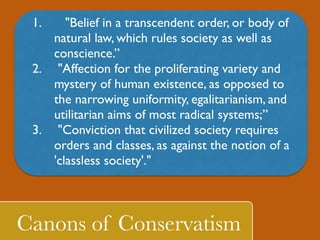
1. "Belief in a transcendent order, or body of 
natural law, which rules society as well as 
conscience.” 
2. "Affection for the proliferating variety and 
mystery of human existence, as opposed to 
the narrowing uniformity, egalitarianism, and 
utilitarian aims of most radical systems;” 
` 
3. "Conviction that civilized society requires 
orders and classes, as against the notion of a 
'classless society'." 
Canons of Conservatism
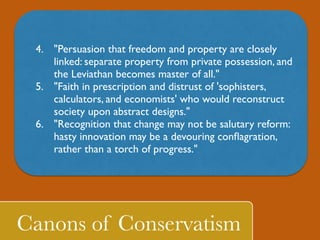
4. "Persuasion that freedom and property are closely 
linked: separate property from private possession, and 
the Leviathan becomes master of all." 
5. "Faith in prescription and distrust of 'sophisters, 
calculators, and economists' who would reconstruct 
society upon abstract designs." 
` 
6. "Recognition that change may not be salutary reform: 
hasty innovation may be a devouring conflagration, 
rather than a torch of progress." 
Canons of Conservatism
FREEDOM 
TRADITION 
LAW 
GOD 
` 
…or
Sandel intro

Sandel intro

  • 1.
    Justice Scenarios borrowedfrom Michael Sandel’s discussion guide
  • 2.
    Rationale: We studyJustice in order to understand why people believe what they believe. borrowed from Michael Sandel’s discussion guide
  • 3.
    True or false? 1) Torture, as a matter of principle, is always morally wrong. borrowed from Michael Sandel’s discussion guide
  • 4.
    ! True orfalse? Question 2: The morality of an action is determined by whether, compared to the other available options, it maximises the sum total of happiness of all the people affected by it. ! ! borrowed from Michael Sandel’s discussion guide
  • 5.
    ! True orfalse? Question 3: It is always, and everywhere, wrong to cause another person's death - assuming they wish to stay alive - if this outcome is avoidable. ! ! borrowed from Michael Sandel’s discussion guide
  • 6.
    ! ! Trueor false? Question 4: If you can save the lives of innocent people without reducing the sum total of human happiness, and without putting your own life at risk, you are morally obliged to do so. ! ! ! borrowed from Michael Sandel’s discussion guide
  • 7.
    Suppose you aredriving through a narrow tunnel and a worker falls onto the road in front of you. There is not enough time for you to stop. If you keep straight, you will hit the worker and kill him, but if you swerve left into oncoming traffic, you will collide with a school bus and kill at least five children. What’s the right thing to do? Does utilitarianism get the right answer?
  • 8.
    Suppose ten thousandinnocent civilians live next to a munitions factory in a country at war. If you bomb the factory, all of them will die. If you don’t bomb the factory, it will be used to produce bombs that will be dropped on fifty thousand innocent civilians in another country. What’s the right thing to do? Does utilitarianism get the right answer?
  • 9.
    Suppose a manhas planted a bomb in New York City, and it will explode in twenty-four hours unless the police are able to find it. Should it be legal for the police to use torture to extract information from the suspected bomber? Does utilitarianism get the right answer?
  • 10.
    Now suppose theman who has planted the bomb will not reveal the location unless an innocent member of his family is tortured. Should it be legal for the police to torture innocent people, if that is truly the only way to discover the location of a large bomb? Does utilitarianism have the right answer?
  • 11.
    When is utilitarianismcorrect and when is it not? Why? Can something be for the “greater good” and still be wrong?
  • 12.
  • 13.
    Can you increaseequality without decreasing liberty? ` ! Imagine a equal world of distributed resources. Everyone has the same stuff. Unfortunately, you are LeBron James. People want to pay you 5$ a game to play for them. Do you have to give it back? Why would you ever play basketball at all?
  • 14.
    Is taxation forredistribution forced labor? ! Imagine you are Bill Gates and you are taxed for two hours and the money is given to a poor person. ` Are you now being forced--against your will--to work for that person? Does this make you a temporary slave?
  • 15.
    Does taxation forredistribution violate historical definitions of justice? ! Imagine you worked very hard becoming a heart surgeon. Now, ` you make a lot of money saving lives. Should the government have the right to take your money and give it to someone else?
  • 16.
    Under what conditionsdoes a government have the right to take money from you and give it to someone else? What situations don’t qualify. • If you got the money ` illegally • If you broke the law • If the other person needed it to survive • If enough people voted to take it from you. • If the government were going to war and needed it to buy weapons
  • 17.
    Immanuel Kant Kantiancon`cepts of Justice
  • 18.
    Imagine a storekeeperwho could cheat a young child who comes to her shop but decides not to because ` she’s worried her customers find out. ! Is she acting morally?
  • 19.
    Imagine a teacherwho loves helping children because it makes ` him feel good. Is he acting morally?
  • 20.
    Suppose someone rescuesa child from drowning because he wants ` a reward. Is he acting morally?
  • 21.
    What should weconsider as a law ` of morality? The Categorical Imperative-- "Act only according to that maxim whereby you can, at the same time, will that it should become a universal law.
  • 22.
    What about freedomand it’s connection to justice? ` ! •Is a person who is addicted to cigarettes free? •Is a person who eats a boatload of pistachio ice cream free ? •If the government tries to stop people from buying large sodas are they restricting freedom?
  • 23.
  • 24.
    ` Imagine theveil of ignorance John Rawls
  • 25.
    1st principle: ` ! Everyone should have the same rights and liberties.
  • 26.
    2nd principle: ` ! There should be equality of opportunity.
  • 27.
    Should the childrenof rich parents be allowed to get very expensive, private math lessons, or singing lessons, or basketball lessons? What if such lessons give ` them a huge, unearned advantage in the race for jobs, careers, and wealth? Is it just for poor children to have much lower prospects as a result?
  • 28.
    3rd principle: ` ! There should be no differences in income and wealth, except those differences that make even the least advantaged members of society better off.
  • 29.
    ! 1. Isit true that you can’t really claim credit for your upbringing? Surely, your habits and temperaments today are partly the result of your upbringing. Does this mean that you don’t really deserve what you get from making ` an effort? ! 2. Think of some of the advantages that you have in your life. Do you deserve them more than other people who lack them? If so, why? If not, should these advantages be provided to everyone?
  • 30.
    ! 3. Doyou think it’s unjust if some people do not get to vote in elections merely because they are a woman or merely because of the color of their skin? 4. Do you think it’s ` unjust if some people earn much less money and are much worse off than others merely because they are a woman or a member of a racial or ethnic minority? !
  • 31.
    ! 5. Ifyou answered “ yes” to the last two questions, do you think it’s also unjust if some people are much worse off than others merely because they were born with fewer talents or with a debilitating ` disease and the need for expensive medicines? Why should people be worse off merely because of the way they were born? ! !
  • 32.
  • 33.
    1. "Belief ina transcendent order, or body of natural law, which rules society as well as conscience.” 2. "Affection for the proliferating variety and mystery of human existence, as opposed to the narrowing uniformity, egalitarianism, and utilitarian aims of most radical systems;” ` 3. "Conviction that civilized society requires orders and classes, as against the notion of a 'classless society'." Canons of Conservatism
  • 34.
    4. "Persuasion thatfreedom and property are closely linked: separate property from private possession, and the Leviathan becomes master of all." 5. "Faith in prescription and distrust of 'sophisters, calculators, and economists' who would reconstruct society upon abstract designs." ` 6. "Recognition that change may not be salutary reform: hasty innovation may be a devouring conflagration, rather than a torch of progress." Canons of Conservatism
  • 35.