Table of Contents
Introduction................................................................................................................................1
SECTION A: NETWORK SIMULATION MODELS/SIMULATIONS.................................2
CHANNEL UTILIZATION ..................................................................................................2
WAN CLOUDS FRAME DELAY BY VC...........................................................................3
WAN CLOUDS FRAME COUNTS BY VC ........................................................................4
WAN CLOUDS ACCESS LINK STATS .............................................................................6
MESSAGE + RESPONSE SOURCES MESSAGE DELAY................................................7
MESSAGE + RESPONSE SOURCES MESSAGE DELIVERED.......................................9
Simulation of p2p model..........................................................................................................11
With Edinburgh-London ......................................................................................................11
Without Edinburgh-London.................................................................................................12
Summary:.................................................................................................................................12
SECTION B: TECHNICAL REPORT....................................................................................13
Conclusion: ..............................................................................................................................18
REFERENCES ........................................................................................................................19
Appendix..................................................................................................................................20
List of Figure:
Figure 1: Channel Utilization.....................................................................................................2
Figure 2 WAN Cloud Frame Delay BY VC..............................................................................3
Figure 3: WAN CLOUD Frame Count by VC..........................................................................5
Figure 4: WAN CLOUD Access Link Stats..............................................................................6
Figure 5: MESSAGE + RESPONSE SOURCES MESSAGE DELAY....................................8
Figure 6: MESSAGE + RESPONSE SOURCES MESSAGE DELIVERED.........................10
Figure 7: Comparison of P2P Model with & with E-L Link...................................................17
1
Introduction
This report reflects the result of the given scenario of both the WAN and p2p model
based on the COMNET III software. Based on the result generated by the software the graphs
are created with the of Microsoft Excel software. Normally the graphs are created to compare
the different result generated by the COMNET software for the each WAN and p2p model.
The main objectives of this report are listed below:
• To design the WAN & p2p model using COMNET III.
• To list out the difference between result of two model.
• To study the result of WAN & p2p model.
• To present the technical report of CBS bank model.
• Comparing the result and find the better one.
2
SECTION A: NETWORK SIMULATION MODELS/SIMULATIONS
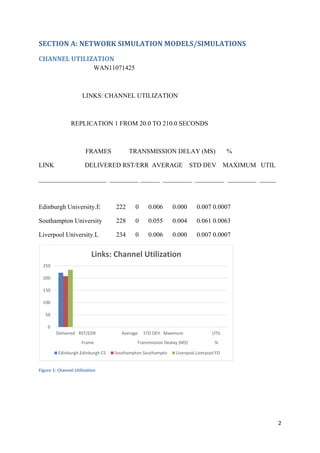
CHANNEL UTILIZATION
WAN11071425
LINKS: CHANNEL UTILIZATION
REPLICATION 1 FROM 20.0 TO 210.0 SECONDS
FRAMES TRANSMISSION DELAY (MS) %
LINK DELIVERED RST/ERR AVERAGE STD DEV MAXIMUM UTIL
_____________________ _________ ______ _________ _________ _________ _____
Edinburgh University.E 222 0 0.006 0.000 0.007 0.0007
Southampton University 228 0 0.055 0.004 0.061 0.0063
Liverpool University.L 234 0 0.006 0.000 0.007 0.0007
Figure 1: Channel Utilization
0
50
100
150
200
250
Delivered RST/EDR Average STD DEV Maximum UTIL
Frame Transmission Dealay (MS) %
Links: Channel Utilization
Edinburgh.Edinburgh CS Southampton.Southampto Liverpool.Liverpool FD
3
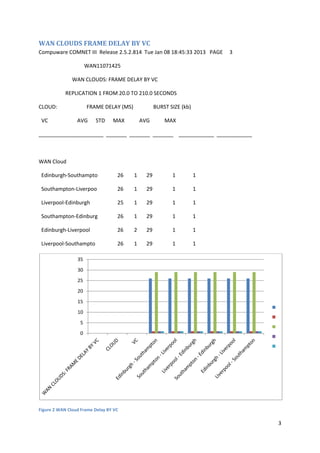
WAN CLOUDS FRAME DELAY BY VC
Compuware COMNET III Release 2.5.2.814 Tue Jan 08 18:45:33 2013 PAGE 3
WAN11071425
WAN CLOUDS: FRAME DELAY BY VC
REPLICATION 1 FROM 20.0 TO 210.0 SECONDS
CLOUD: FRAME DELAY (MS) BURST SIZE (kb)
VC AVG STD MAX AVG MAX
______________________ _______ _______ _______ ____________ ____________
WAN Cloud
Edinburgh-Southampto 26 1 29 1 1
Southampton-Liverpoo 26 1 29 1 1
Liverpool-Edinburgh 25 1 29 1 1
Southampton-Edinburg 26 1 29 1 1
Edinburgh-Liverpool 26 2 29 1 1
Liverpool-Southampto 26 1 29 1 1
Figure 2 WAN Cloud Frame Delay BY VC
0
5
10
15
20
25
30
35
4
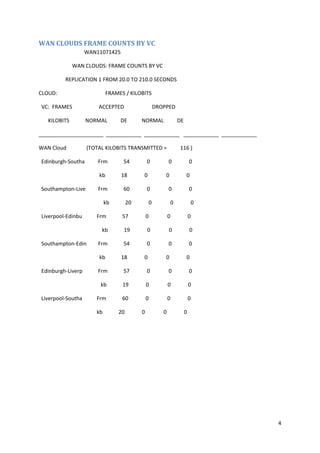
WAN CLOUDS FRAME COUNTS BY VC
WAN11071425
WAN CLOUDS: FRAME COUNTS BY VC
REPLICATION 1 FROM 20.0 TO 210.0 SECONDS
CLOUD: FRAMES / KILOBITS
VC: FRAMES ACCEPTED DROPPED
KILOBITS NORMAL DE NORMAL DE
______________________ ____________ ____________ ____________ ____________
WAN Cloud (TOTAL KILOBITS TRANSMITTED = 116 )
Edinburgh-Southa Frm 54 0 0 0
kb 18 0 0 0
Southampton-Live Frm 60 0 0 0
kb 20 0 0 0
Liverpool-Edinbu Frm 57 0 0 0
kb 19 0 0 0
Southampton-Edin Frm 54 0 0 0
kb 18 0 0 0
Edinburgh-Liverp Frm 57 0 0 0
kb 19 0 0 0
Liverpool-Southa Frm 60 0 0 0
kb 20 0 0 0
5
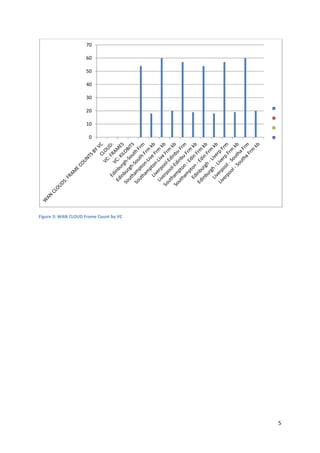
Figure 3: WAN CLOUD Frame Count by VC
0
10
20
30
40
50
60
70
6
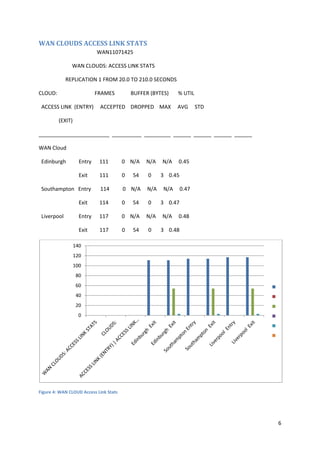
WAN CLOUDS ACCESS LINK STATS
WAN11071425
WAN CLOUDS: ACCESS LINK STATS
REPLICATION 1 FROM 20.0 TO 210.0 SECONDS
CLOUD: FRAMES BUFFER (BYTES) % UTIL
ACCESS LINK (ENTRY) ACCEPTED DROPPED MAX AVG STD
(EXIT)
________________________ __________ _________ ______ ______ ______ ______
WAN Cloud
Edinburgh Entry 111 0 N/A N/A N/A 0.45
Exit 111 0 54 0 3 0.45
Southampton Entry 114 0 N/A N/A N/A 0.47
Exit 114 0 54 0 3 0.47
Liverpool Entry 117 0 N/A N/A N/A 0.48
Exit 117 0 54 0 3 0.48
Figure 4: WAN CLOUD Access Link Stats
0
20
40
60
80
100
120
140
7
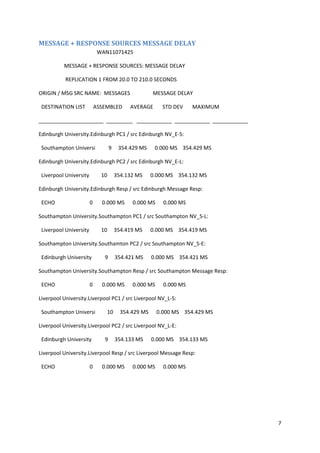
MESSAGE + RESPONSE SOURCES MESSAGE DELAY
WAN11071425
MESSAGE + RESPONSE SOURCES: MESSAGE DELAY
REPLICATION 1 FROM 20.0 TO 210.0 SECONDS
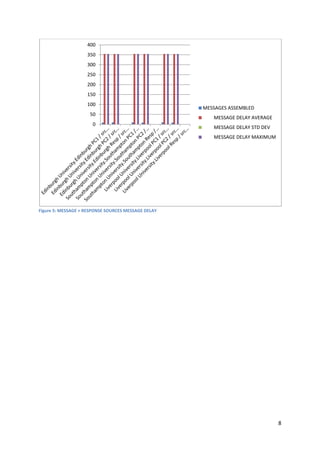
ORIGIN / MSG SRC NAME: MESSAGES MESSAGE DELAY
DESTINATION LIST ASSEMBLED AVERAGE STD DEV MAXIMUM
______________________ _________ ____________ ____________ ____________
Edinburgh University.Edinburgh PC1 / src Edinburgh NV_E-S:
Southampton Universi 9 354.429 MS 0.000 MS 354.429 MS
Edinburgh University.Edinburgh PC2 / src Edinburgh NV_E-L:
Liverpool University 10 354.132 MS 0.000 MS 354.132 MS
Edinburgh University.Edinburgh Resp / src Edinburgh Message Resp:
ECHO 0 0.000 MS 0.000 MS 0.000 MS
Southampton University.Southampton PC1 / src Southampton NV_S-L:
Liverpool University 10 354.419 MS 0.000 MS 354.419 MS
Southampton University.Southamton PC2 / src Southampton NV_S-E:
Edinburgh University 9 354.421 MS 0.000 MS 354.421 MS
Southampton University.Southampton Resp / src Southampton Message Resp:
ECHO 0 0.000 MS 0.000 MS 0.000 MS
Liverpool University.Liverpool PC1 / src Liverpool NV_L-S:
Southampton Universi 10 354.429 MS 0.000 MS 354.429 MS
Liverpool University.Liverpool PC2 / src Liverpool NV_L-E:
Edinburgh University 9 354.133 MS 0.000 MS 354.133 MS
Liverpool University.Liverpool Resp / src Liverpool Message Resp:
ECHO 0 0.000 MS 0.000 MS 0.000 MS
8
Figure 5: MESSAGE + RESPONSE SOURCES MESSAGE DELAY
0
50
100
150
200
250
300
350
400
MESSAGES ASSEMBLED
MESSAGE DELAY AVERAGE
MESSAGE DELAY STD DEV
MESSAGE DELAY MAXIMUM
9
MESSAGE + RESPONSE SOURCES MESSAGE DELIVERED
WAN11071425
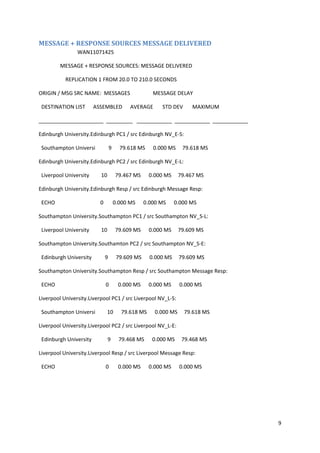
MESSAGE + RESPONSE SOURCES: MESSAGE DELIVERED
REPLICATION 1 FROM 20.0 TO 210.0 SECONDS
ORIGIN / MSG SRC NAME: MESSAGES MESSAGE DELAY
DESTINATION LIST ASSEMBLED AVERAGE STD DEV MAXIMUM
______________________ _________ ____________ ____________ ____________
Edinburgh University.Edinburgh PC1 / src Edinburgh NV_E-S:
Southampton Universi 9 79.618 MS 0.000 MS 79.618 MS
Edinburgh University.Edinburgh PC2 / src Edinburgh NV_E-L:
Liverpool University 10 79.467 MS 0.000 MS 79.467 MS
Edinburgh University.Edinburgh Resp / src Edinburgh Message Resp:
ECHO 0 0.000 MS 0.000 MS 0.000 MS
Southampton University.Southampton PC1 / src Southampton NV_S-L:
Liverpool University 10 79.609 MS 0.000 MS 79.609 MS
Southampton University.Southamton PC2 / src Southampton NV_S-E:
Edinburgh University 9 79.609 MS 0.000 MS 79.609 MS
Southampton University.Southampton Resp / src Southampton Message Resp:
ECHO 0 0.000 MS 0.000 MS 0.000 MS
Liverpool University.Liverpool PC1 / src Liverpool NV_L-S:
Southampton Universi 10 79.618 MS 0.000 MS 79.618 MS
Liverpool University.Liverpool PC2 / src Liverpool NV_L-E:
Edinburgh University 9 79.468 MS 0.000 MS 79.468 MS
Liverpool University.Liverpool Resp / src Liverpool Message Resp:
ECHO 0 0.000 MS 0.000 MS 0.000 MS
10
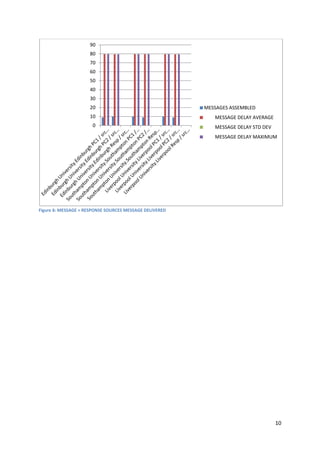
Figure 6: MESSAGE + RESPONSE SOURCES MESSAGE DELIVERED
0
10
20
30
40
50
60
70
80
90
MESSAGES ASSEMBLED
MESSAGE DELAY AVERAGE
MESSAGE DELAY STD DEV
MESSAGE DELAY MAXIMUM
11
Simulation of p2p model
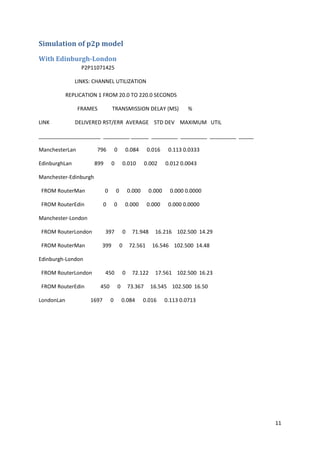
With Edinburgh-London
P2P11071425
LINKS: CHANNEL UTILIZATION
REPLICATION 1 FROM 20.0 TO 220.0 SECONDS
FRAMES TRANSMISSION DELAY (MS) %
LINK DELIVERED RST/ERR AVERAGE STD DEV MAXIMUM UTIL
_____________________ _________ ______ _________ _________ _________ _____
ManchesterLan 796 0 0.084 0.016 0.113 0.0333
EdinburghLan 899 0 0.010 0.002 0.012 0.0043
Manchester-Edinburgh
FROM RouterMan 0 0 0.000 0.000 0.000 0.0000
FROM RouterEdin 0 0 0.000 0.000 0.000 0.0000
Manchester-London
FROM RouterLondon 397 0 71.948 16.216 102.500 14.29
FROM RouterMan 399 0 72.561 16.546 102.500 14.48
Edinburgh-London
FROM RouterLondon 450 0 72.122 17.561 102.500 16.23
FROM RouterEdin 450 0 73.367 16.545 102.500 16.50
LondonLan 1697 0 0.084 0.016 0.113 0.0713
12
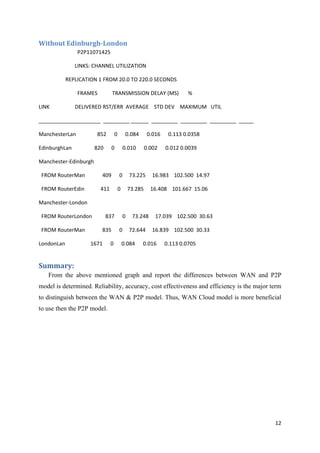
Without Edinburgh-London
P2P11071425
LINKS: CHANNEL UTILIZATION
REPLICATION 1 FROM 20.0 TO 220.0 SECONDS
FRAMES TRANSMISSION DELAY (MS) %
LINK DELIVERED RST/ERR AVERAGE STD DEV MAXIMUM UTIL
_____________________ _________ ______ _________ _________ _________ _____
ManchesterLan 852 0 0.084 0.016 0.113 0.0358
EdinburghLan 820 0 0.010 0.002 0.012 0.0039
Manchester-Edinburgh
FROM RouterMan 409 0 73.225 16.983 102.500 14.97
FROM RouterEdin 411 0 73.285 16.408 101.667 15.06
Manchester-London
FROM RouterLondon 837 0 73.248 17.039 102.500 30.63
FROM RouterMan 835 0 72.644 16.839 102.500 30.33
LondonLan 1671 0 0.084 0.016 0.113 0.0705
Summary:
From the above mentioned graph and report the differences between WAN and P2P
model is determined. Reliability, accuracy, cost effectiveness and efficiency is the major term
to distinguish between the WAN & P2P model. Thus, WAN Cloud model is more beneficial
to use then the P2P model.
13
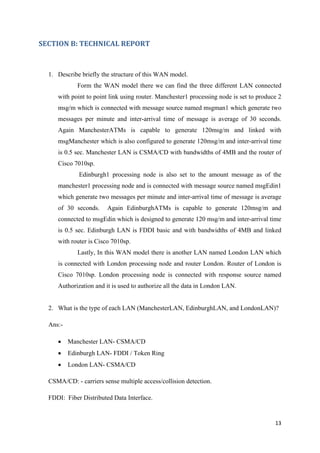
SECTION B: TECHNICAL REPORT
1. Describe briefly the structure of this WAN model.
Form the WAN model there we can find the three different LAN connected
with point to point link using router. Manchester1 processing node is set to produce 2
msg/m which is connected with message source named msgman1 which generate two
messages per minute and inter-arrival time of message is average of 30 seconds.
Again ManchesterATMs is capable to generate 120msg/m and linked with
msgManchester which is also configured to generate 120msg/m and inter-arrival time
is 0.5 sec. Manchester LAN is CSMA/CD with bandwidths of 4MB and the router of
Cisco 7010sp.
Edinburgh1 processing node is also set to the amount message as of the
manchester1 processing node and is connected with message source named msgEdin1
which generate two messages per minute and inter-arrival time of message is average
of 30 seconds. Again EdinburghATMs is capable to generate 120msg/m and
connected to msgEdin which is designed to generate 120 msg/m and inter-arrival time
is 0.5 sec. Edinburgh LAN is FDDI basic and with bandwidths of 4MB and linked
with router is Cisco 7010sp.
Lastly, In this WAN model there is another LAN named London LAN which
is connected with London processing node and router London. Router of London is
Cisco 7010sp. London processing node is connected with response source named
Authorization and it is used to authorize all the data in London LAN.
2. What is the type of each LAN (ManchesterLAN, EdinburghLAN, and LondonLAN)?
Ans:-
• Manchester LAN- CSMA/CD
• Edinburgh LAN- FDDI / Token Ring
• London LAN- CSMA/CD
CSMA/CD: - carriers sense multiple access/collision detection.
FDDI: Fiber Distributed Data Interface.
14
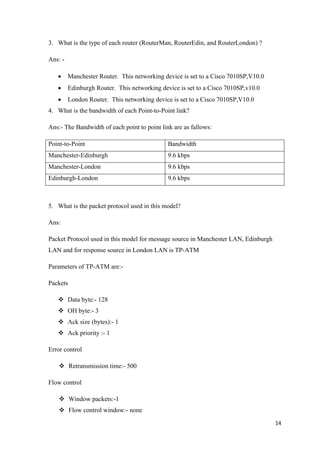
3. What is the type of each router (RouterMan, RouterEdin, and RouterLondon) ?
Ans: -
• Manchester Router. This networking device is set to a Cisco 7010SP,V10.0
• Edinburgh Router. This networking device is set to a Cisco 7010SP,v10.0
• London Router. This networking device is set to a Cisco 7010SP,V10.0
4. What is the bandwidth of each Point-to-Point link?
Ans:- The Bandwidth of each point to point link are as fallows:
Point-to-Point Bandwidth
Manchester-Edinburgh 9.6 kbps
Manchester-London 9.6 kbps
Edinburgh-London 9.6 kbps
5. What is the packet protocol used in this model?
Ans:
Packet Protocol used in this model for message source in Manchester LAN, Edinburgh
LAN and for response source in London LAN is TP-ATM
Parameters of TP-ATM are:-
Packets
 Data byte:- 128
 OH byte:- 3
 Ack size (bytes):- 1
 Ack priority :- 1
Error control
 Retransmission time:- 500
Flow control
 Window packets:-1
 Flow control window:- none
15
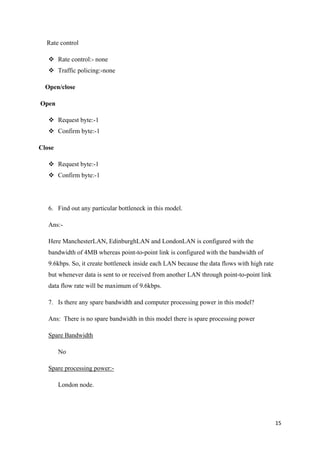
Rate control
 Rate control:- none
 Traffic policing:-none
Open/close
Open
 Request byte:-1
 Confirm byte:-1
Close
 Request byte:-1
 Confirm byte:-1
6. Find out any particular bottleneck in this model.
Ans:-
Here ManchesterLAN, EdinburghLAN and LondonLAN is configured with the
bandwidth of 4MB whereas point-to-point link is configured with the bandwidth of
9.6kbps. So, it create bottleneck inside each LAN because the data flows with high rate
but whenever data is sent to or received from another LAN through point-to-point link
data flow rate will be maximum of 9.6kbps.
7. Is there any spare bandwidth and computer processing power in this model?
Ans: There is no spare bandwidth in this model there is spare processing power
Spare Bandwidth
No
Spare processing power:-
London node.
16
8. What are the most heavily loaded devices in this model?
Ans:
The heavily loaded devices in this WAN model are mentioned below:-
• Processing node of London:- it receive all the incoming message from other
LANs.
• EdinburghLAN
• ManchesterLAN
9. Based on your experiments and/or observations, discuss the consequences if there is a
backbone link outage, such as the backbone link “Manchester-London” or
“Edinburgh-London” down.
Ans:
When the point-to-point link of Edinburgh-London is down then following results are
obtained:
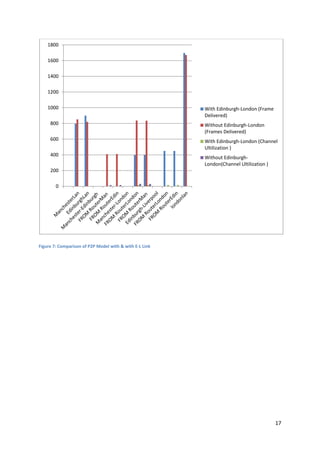
Frame Delivered: during the presence of the Edinburgh-London link the frame delivered by
the Manchester is 796, Edinburgh is 899, from routerLondon & routerMan is 397 & 399 for
the Manchester-London link likewise by the Londonlan is 1697 and from routerLondon &
routerEdin is 450 for Edinburg-Liverpool link but during the absence of the Edinburgh-
London link the frame delivered is the Manchester is 852, Edinburgh is 820, from
routerLondon & routerMan is increased by 837 & 835 for the Manchester-London link
likewise by the Londonlan is 1671 and from routerMan & routerEdin is 409 & 411
respectively. This is because there is no flow of packets from Edinburgh-London link but the
packets variation is litter for the London-Manchester path and the utilization of the channel is
more. Due to this message will delivered more in the Manchester link than the Edinburgh.
Graph mentioned below show the channel utilization and frame delivered during the presence
and absence of the Edinburgh-London point-to-point link.
17
Figure 7: Comparison of P2P Model with & with E-L Link
0
200
400
600
800
1000
1200
1400
1600
1800
With Edinburgh-London (Frame
Delivered)
Without Edinburgh-London
(Frames Delivered)
With Edinburgh-London (Channel
Ultilization )
Without Edinburgh-
London(Channel Ultilization )
18
Conclusion:
From the above mention result of both wan and p2p model it is proved that wan
model is far better than p2p in real life senario.The reports that are generated clearly shows
the overall function of the WAN and P2P models that were created from comnet software.
Here, we configured a network using CSMA/CD and FDDI basic with the net video sources
and different processing nodes including the internal and external router. Hence the result
generate the advantages of the WAN model over the p2p model.
19
REFERENCES
LAN - Local Area Network (LAN). 2013. LAN - Local Area Network (LAN). [ONLINE]
Available at:http://compnetworking.about.com/cs/lanvlanwan/g/bldef_lan.htm. [Accessed 4
January 2013].
COMNET III. 2013. COMNET III. [ONLINE] Available
at:http://feamane.org/comms/testtools/comnet3/comnet3.html. [Accessed 4 January 2013].
CSMA/CD. 2013. CSMA/CD. [ONLINE] Available
at:http://www.erg.abdn.ac.uk/~gorry/eg3561/lan-pages/csma-cd.html. [Accessed 6 January
2013].
20
Appendix

Communication Network Comnet Report

  • 1.
    Table of Contents Introduction................................................................................................................................1 SECTIONA: NETWORK SIMULATION MODELS/SIMULATIONS.................................2 CHANNEL UTILIZATION ..................................................................................................2 WAN CLOUDS FRAME DELAY BY VC...........................................................................3 WAN CLOUDS FRAME COUNTS BY VC ........................................................................4 WAN CLOUDS ACCESS LINK STATS .............................................................................6 MESSAGE + RESPONSE SOURCES MESSAGE DELAY................................................7 MESSAGE + RESPONSE SOURCES MESSAGE DELIVERED.......................................9 Simulation of p2p model..........................................................................................................11 With Edinburgh-London ......................................................................................................11 Without Edinburgh-London.................................................................................................12 Summary:.................................................................................................................................12 SECTION B: TECHNICAL REPORT....................................................................................13 Conclusion: ..............................................................................................................................18 REFERENCES ........................................................................................................................19 Appendix..................................................................................................................................20 List of Figure: Figure 1: Channel Utilization.....................................................................................................2 Figure 2 WAN Cloud Frame Delay BY VC..............................................................................3 Figure 3: WAN CLOUD Frame Count by VC..........................................................................5 Figure 4: WAN CLOUD Access Link Stats..............................................................................6 Figure 5: MESSAGE + RESPONSE SOURCES MESSAGE DELAY....................................8 Figure 6: MESSAGE + RESPONSE SOURCES MESSAGE DELIVERED.........................10 Figure 7: Comparison of P2P Model with & with E-L Link...................................................17
  • 2.
    1 Introduction This report reflectsthe result of the given scenario of both the WAN and p2p model based on the COMNET III software. Based on the result generated by the software the graphs are created with the of Microsoft Excel software. Normally the graphs are created to compare the different result generated by the COMNET software for the each WAN and p2p model. The main objectives of this report are listed below: • To design the WAN & p2p model using COMNET III. • To list out the difference between result of two model. • To study the result of WAN & p2p model. • To present the technical report of CBS bank model. • Comparing the result and find the better one.
  • 3.
    2 SECTION A: NETWORKSIMULATION MODELS/SIMULATIONS CHANNEL UTILIZATION WAN11071425 LINKS: CHANNEL UTILIZATION REPLICATION 1 FROM 20.0 TO 210.0 SECONDS FRAMES TRANSMISSION DELAY (MS) % LINK DELIVERED RST/ERR AVERAGE STD DEV MAXIMUM UTIL _____________________ _________ ______ _________ _________ _________ _____ Edinburgh University.E 222 0 0.006 0.000 0.007 0.0007 Southampton University 228 0 0.055 0.004 0.061 0.0063 Liverpool University.L 234 0 0.006 0.000 0.007 0.0007 Figure 1: Channel Utilization 0 50 100 150 200 250 Delivered RST/EDR Average STD DEV Maximum UTIL Frame Transmission Dealay (MS) % Links: Channel Utilization Edinburgh.Edinburgh CS Southampton.Southampto Liverpool.Liverpool FD
  • 4.
    3 WAN CLOUDS FRAMEDELAY BY VC Compuware COMNET III Release 2.5.2.814 Tue Jan 08 18:45:33 2013 PAGE 3 WAN11071425 WAN CLOUDS: FRAME DELAY BY VC REPLICATION 1 FROM 20.0 TO 210.0 SECONDS CLOUD: FRAME DELAY (MS) BURST SIZE (kb) VC AVG STD MAX AVG MAX ______________________ _______ _______ _______ ____________ ____________ WAN Cloud Edinburgh-Southampto 26 1 29 1 1 Southampton-Liverpoo 26 1 29 1 1 Liverpool-Edinburgh 25 1 29 1 1 Southampton-Edinburg 26 1 29 1 1 Edinburgh-Liverpool 26 2 29 1 1 Liverpool-Southampto 26 1 29 1 1 Figure 2 WAN Cloud Frame Delay BY VC 0 5 10 15 20 25 30 35
  • 5.
    4 WAN CLOUDS FRAMECOUNTS BY VC WAN11071425 WAN CLOUDS: FRAME COUNTS BY VC REPLICATION 1 FROM 20.0 TO 210.0 SECONDS CLOUD: FRAMES / KILOBITS VC: FRAMES ACCEPTED DROPPED KILOBITS NORMAL DE NORMAL DE ______________________ ____________ ____________ ____________ ____________ WAN Cloud (TOTAL KILOBITS TRANSMITTED = 116 ) Edinburgh-Southa Frm 54 0 0 0 kb 18 0 0 0 Southampton-Live Frm 60 0 0 0 kb 20 0 0 0 Liverpool-Edinbu Frm 57 0 0 0 kb 19 0 0 0 Southampton-Edin Frm 54 0 0 0 kb 18 0 0 0 Edinburgh-Liverp Frm 57 0 0 0 kb 19 0 0 0 Liverpool-Southa Frm 60 0 0 0 kb 20 0 0 0
  • 6.
    5 Figure 3: WANCLOUD Frame Count by VC 0 10 20 30 40 50 60 70
  • 7.
    6 WAN CLOUDS ACCESSLINK STATS WAN11071425 WAN CLOUDS: ACCESS LINK STATS REPLICATION 1 FROM 20.0 TO 210.0 SECONDS CLOUD: FRAMES BUFFER (BYTES) % UTIL ACCESS LINK (ENTRY) ACCEPTED DROPPED MAX AVG STD (EXIT) ________________________ __________ _________ ______ ______ ______ ______ WAN Cloud Edinburgh Entry 111 0 N/A N/A N/A 0.45 Exit 111 0 54 0 3 0.45 Southampton Entry 114 0 N/A N/A N/A 0.47 Exit 114 0 54 0 3 0.47 Liverpool Entry 117 0 N/A N/A N/A 0.48 Exit 117 0 54 0 3 0.48 Figure 4: WAN CLOUD Access Link Stats 0 20 40 60 80 100 120 140
  • 8.
    7 MESSAGE + RESPONSESOURCES MESSAGE DELAY WAN11071425 MESSAGE + RESPONSE SOURCES: MESSAGE DELAY REPLICATION 1 FROM 20.0 TO 210.0 SECONDS ORIGIN / MSG SRC NAME: MESSAGES MESSAGE DELAY DESTINATION LIST ASSEMBLED AVERAGE STD DEV MAXIMUM ______________________ _________ ____________ ____________ ____________ Edinburgh University.Edinburgh PC1 / src Edinburgh NV_E-S: Southampton Universi 9 354.429 MS 0.000 MS 354.429 MS Edinburgh University.Edinburgh PC2 / src Edinburgh NV_E-L: Liverpool University 10 354.132 MS 0.000 MS 354.132 MS Edinburgh University.Edinburgh Resp / src Edinburgh Message Resp: ECHO 0 0.000 MS 0.000 MS 0.000 MS Southampton University.Southampton PC1 / src Southampton NV_S-L: Liverpool University 10 354.419 MS 0.000 MS 354.419 MS Southampton University.Southamton PC2 / src Southampton NV_S-E: Edinburgh University 9 354.421 MS 0.000 MS 354.421 MS Southampton University.Southampton Resp / src Southampton Message Resp: ECHO 0 0.000 MS 0.000 MS 0.000 MS Liverpool University.Liverpool PC1 / src Liverpool NV_L-S: Southampton Universi 10 354.429 MS 0.000 MS 354.429 MS Liverpool University.Liverpool PC2 / src Liverpool NV_L-E: Edinburgh University 9 354.133 MS 0.000 MS 354.133 MS Liverpool University.Liverpool Resp / src Liverpool Message Resp: ECHO 0 0.000 MS 0.000 MS 0.000 MS
  • 9.
    8 Figure 5: MESSAGE+ RESPONSE SOURCES MESSAGE DELAY 0 50 100 150 200 250 300 350 400 MESSAGES ASSEMBLED MESSAGE DELAY AVERAGE MESSAGE DELAY STD DEV MESSAGE DELAY MAXIMUM
  • 10.
    9 MESSAGE + RESPONSESOURCES MESSAGE DELIVERED WAN11071425 MESSAGE + RESPONSE SOURCES: MESSAGE DELIVERED REPLICATION 1 FROM 20.0 TO 210.0 SECONDS ORIGIN / MSG SRC NAME: MESSAGES MESSAGE DELAY DESTINATION LIST ASSEMBLED AVERAGE STD DEV MAXIMUM ______________________ _________ ____________ ____________ ____________ Edinburgh University.Edinburgh PC1 / src Edinburgh NV_E-S: Southampton Universi 9 79.618 MS 0.000 MS 79.618 MS Edinburgh University.Edinburgh PC2 / src Edinburgh NV_E-L: Liverpool University 10 79.467 MS 0.000 MS 79.467 MS Edinburgh University.Edinburgh Resp / src Edinburgh Message Resp: ECHO 0 0.000 MS 0.000 MS 0.000 MS Southampton University.Southampton PC1 / src Southampton NV_S-L: Liverpool University 10 79.609 MS 0.000 MS 79.609 MS Southampton University.Southamton PC2 / src Southampton NV_S-E: Edinburgh University 9 79.609 MS 0.000 MS 79.609 MS Southampton University.Southampton Resp / src Southampton Message Resp: ECHO 0 0.000 MS 0.000 MS 0.000 MS Liverpool University.Liverpool PC1 / src Liverpool NV_L-S: Southampton Universi 10 79.618 MS 0.000 MS 79.618 MS Liverpool University.Liverpool PC2 / src Liverpool NV_L-E: Edinburgh University 9 79.468 MS 0.000 MS 79.468 MS Liverpool University.Liverpool Resp / src Liverpool Message Resp: ECHO 0 0.000 MS 0.000 MS 0.000 MS
  • 11.
    10 Figure 6: MESSAGE+ RESPONSE SOURCES MESSAGE DELIVERED 0 10 20 30 40 50 60 70 80 90 MESSAGES ASSEMBLED MESSAGE DELAY AVERAGE MESSAGE DELAY STD DEV MESSAGE DELAY MAXIMUM
  • 12.
    11 Simulation of p2pmodel With Edinburgh-London P2P11071425 LINKS: CHANNEL UTILIZATION REPLICATION 1 FROM 20.0 TO 220.0 SECONDS FRAMES TRANSMISSION DELAY (MS) % LINK DELIVERED RST/ERR AVERAGE STD DEV MAXIMUM UTIL _____________________ _________ ______ _________ _________ _________ _____ ManchesterLan 796 0 0.084 0.016 0.113 0.0333 EdinburghLan 899 0 0.010 0.002 0.012 0.0043 Manchester-Edinburgh FROM RouterMan 0 0 0.000 0.000 0.000 0.0000 FROM RouterEdin 0 0 0.000 0.000 0.000 0.0000 Manchester-London FROM RouterLondon 397 0 71.948 16.216 102.500 14.29 FROM RouterMan 399 0 72.561 16.546 102.500 14.48 Edinburgh-London FROM RouterLondon 450 0 72.122 17.561 102.500 16.23 FROM RouterEdin 450 0 73.367 16.545 102.500 16.50 LondonLan 1697 0 0.084 0.016 0.113 0.0713
  • 13.
    12 Without Edinburgh-London P2P11071425 LINKS: CHANNELUTILIZATION REPLICATION 1 FROM 20.0 TO 220.0 SECONDS FRAMES TRANSMISSION DELAY (MS) % LINK DELIVERED RST/ERR AVERAGE STD DEV MAXIMUM UTIL _____________________ _________ ______ _________ _________ _________ _____ ManchesterLan 852 0 0.084 0.016 0.113 0.0358 EdinburghLan 820 0 0.010 0.002 0.012 0.0039 Manchester-Edinburgh FROM RouterMan 409 0 73.225 16.983 102.500 14.97 FROM RouterEdin 411 0 73.285 16.408 101.667 15.06 Manchester-London FROM RouterLondon 837 0 73.248 17.039 102.500 30.63 FROM RouterMan 835 0 72.644 16.839 102.500 30.33 LondonLan 1671 0 0.084 0.016 0.113 0.0705 Summary: From the above mentioned graph and report the differences between WAN and P2P model is determined. Reliability, accuracy, cost effectiveness and efficiency is the major term to distinguish between the WAN & P2P model. Thus, WAN Cloud model is more beneficial to use then the P2P model.
  • 14.
    13 SECTION B: TECHNICALREPORT 1. Describe briefly the structure of this WAN model. Form the WAN model there we can find the three different LAN connected with point to point link using router. Manchester1 processing node is set to produce 2 msg/m which is connected with message source named msgman1 which generate two messages per minute and inter-arrival time of message is average of 30 seconds. Again ManchesterATMs is capable to generate 120msg/m and linked with msgManchester which is also configured to generate 120msg/m and inter-arrival time is 0.5 sec. Manchester LAN is CSMA/CD with bandwidths of 4MB and the router of Cisco 7010sp. Edinburgh1 processing node is also set to the amount message as of the manchester1 processing node and is connected with message source named msgEdin1 which generate two messages per minute and inter-arrival time of message is average of 30 seconds. Again EdinburghATMs is capable to generate 120msg/m and connected to msgEdin which is designed to generate 120 msg/m and inter-arrival time is 0.5 sec. Edinburgh LAN is FDDI basic and with bandwidths of 4MB and linked with router is Cisco 7010sp. Lastly, In this WAN model there is another LAN named London LAN which is connected with London processing node and router London. Router of London is Cisco 7010sp. London processing node is connected with response source named Authorization and it is used to authorize all the data in London LAN. 2. What is the type of each LAN (ManchesterLAN, EdinburghLAN, and LondonLAN)? Ans:- • Manchester LAN- CSMA/CD • Edinburgh LAN- FDDI / Token Ring • London LAN- CSMA/CD CSMA/CD: - carriers sense multiple access/collision detection. FDDI: Fiber Distributed Data Interface.
  • 15.
    14 3. What isthe type of each router (RouterMan, RouterEdin, and RouterLondon) ? Ans: - • Manchester Router. This networking device is set to a Cisco 7010SP,V10.0 • Edinburgh Router. This networking device is set to a Cisco 7010SP,v10.0 • London Router. This networking device is set to a Cisco 7010SP,V10.0 4. What is the bandwidth of each Point-to-Point link? Ans:- The Bandwidth of each point to point link are as fallows: Point-to-Point Bandwidth Manchester-Edinburgh 9.6 kbps Manchester-London 9.6 kbps Edinburgh-London 9.6 kbps 5. What is the packet protocol used in this model? Ans: Packet Protocol used in this model for message source in Manchester LAN, Edinburgh LAN and for response source in London LAN is TP-ATM Parameters of TP-ATM are:- Packets  Data byte:- 128  OH byte:- 3  Ack size (bytes):- 1  Ack priority :- 1 Error control  Retransmission time:- 500 Flow control  Window packets:-1  Flow control window:- none
  • 16.
    15 Rate control  Ratecontrol:- none  Traffic policing:-none Open/close Open  Request byte:-1  Confirm byte:-1 Close  Request byte:-1  Confirm byte:-1 6. Find out any particular bottleneck in this model. Ans:- Here ManchesterLAN, EdinburghLAN and LondonLAN is configured with the bandwidth of 4MB whereas point-to-point link is configured with the bandwidth of 9.6kbps. So, it create bottleneck inside each LAN because the data flows with high rate but whenever data is sent to or received from another LAN through point-to-point link data flow rate will be maximum of 9.6kbps. 7. Is there any spare bandwidth and computer processing power in this model? Ans: There is no spare bandwidth in this model there is spare processing power Spare Bandwidth No Spare processing power:- London node.
  • 17.
    16 8. What arethe most heavily loaded devices in this model? Ans: The heavily loaded devices in this WAN model are mentioned below:- • Processing node of London:- it receive all the incoming message from other LANs. • EdinburghLAN • ManchesterLAN 9. Based on your experiments and/or observations, discuss the consequences if there is a backbone link outage, such as the backbone link “Manchester-London” or “Edinburgh-London” down. Ans: When the point-to-point link of Edinburgh-London is down then following results are obtained: Frame Delivered: during the presence of the Edinburgh-London link the frame delivered by the Manchester is 796, Edinburgh is 899, from routerLondon & routerMan is 397 & 399 for the Manchester-London link likewise by the Londonlan is 1697 and from routerLondon & routerEdin is 450 for Edinburg-Liverpool link but during the absence of the Edinburgh- London link the frame delivered is the Manchester is 852, Edinburgh is 820, from routerLondon & routerMan is increased by 837 & 835 for the Manchester-London link likewise by the Londonlan is 1671 and from routerMan & routerEdin is 409 & 411 respectively. This is because there is no flow of packets from Edinburgh-London link but the packets variation is litter for the London-Manchester path and the utilization of the channel is more. Due to this message will delivered more in the Manchester link than the Edinburgh. Graph mentioned below show the channel utilization and frame delivered during the presence and absence of the Edinburgh-London point-to-point link.
  • 18.
    17 Figure 7: Comparisonof P2P Model with & with E-L Link 0 200 400 600 800 1000 1200 1400 1600 1800 With Edinburgh-London (Frame Delivered) Without Edinburgh-London (Frames Delivered) With Edinburgh-London (Channel Ultilization ) Without Edinburgh- London(Channel Ultilization )
  • 19.
    18 Conclusion: From the abovemention result of both wan and p2p model it is proved that wan model is far better than p2p in real life senario.The reports that are generated clearly shows the overall function of the WAN and P2P models that were created from comnet software. Here, we configured a network using CSMA/CD and FDDI basic with the net video sources and different processing nodes including the internal and external router. Hence the result generate the advantages of the WAN model over the p2p model.
  • 20.
    19 REFERENCES LAN - LocalArea Network (LAN). 2013. LAN - Local Area Network (LAN). [ONLINE] Available at:http://compnetworking.about.com/cs/lanvlanwan/g/bldef_lan.htm. [Accessed 4 January 2013]. COMNET III. 2013. COMNET III. [ONLINE] Available at:http://feamane.org/comms/testtools/comnet3/comnet3.html. [Accessed 4 January 2013]. CSMA/CD. 2013. CSMA/CD. [ONLINE] Available at:http://www.erg.abdn.ac.uk/~gorry/eg3561/lan-pages/csma-cd.html. [Accessed 6 January 2013].
  • 21.